Is the USA now considering withdrawal from AUKUS?

A little bird sent me this:
“I have just had it from a strong source in America that if Australia fails to reach an article 14 arrangement with IAEA within the next three months then irrespective of the presidential result America will give notice of withdrawal from AUKUS
However it may negotiate with Australia to use Garden Island as a base for its Indian Ocean fleet
Apparently major contractors involved with the first phase of AUKUS are lobbying the USA government to continue irrespective of what occurs with AUKUS but so far with little success”
Answers to the Questions on Notice are published in due course on the Australian Parliament House website.
AUKUS 2.0: Albanese Drives It Like He Stole It, and Then Gives It Away to the US

by Paul Gregoire, 15 Aug 2024, Fact Checked, https://www.sydneycriminallawyers.com.au/blog/aukus-2-0-albanese-drives-it-like-he-stole-it-and-then-gives-it-away-to-the-us/

On his jaunt to the US last week, not only did defence minister Richard Marles glorify the US presence across the entire Australian military domain at the AUSMIN, but he also signed an updated version of the AUKUS Exchange of Naval Nuclear Propulsion Information Agreement (ENNPIA).
Then in announcing the updated AUKUS agreement had been tabled on Monday, Marles explained that it “will be central to Australia’s acquisition of a sovereign nuclear-powered submarine (SSN) capability from the 2030s”, including US-made SSN and UK-assisted Australian-made SSN.
“It will also enable Australia to prepare for Submarine Rotational Force-West (SRF-West) at HMAS Stirling from 2027, supporting the rotational presence of up to four Virginia class submarines from the US and one Astute class submarine from the UK,” the deputy PM added in his press release.
Yet, while Marle’s first proposition, that Australia will ever acquire any of the eight proposed SSN of its own, has been shown to be full of holes, a recent paper by the US congress’ thinktank reveals that the mainly US submarine force stationed in WA is a given and it recommends no Australian SSN.
And despite these questions, the Albanese government did table the updated EENPIA, which, if all parties provide a note assuring that domestic requirements are completed, will replace the 2022 original agreement, and this rather lopsided treaty will continue to be in force until the end of 2075.
A lack of sovereignty
The AUKUS ENNPIA establishes a legally-binding framework to facilitate the communication and exchange of naval nuclear propulsion information and nuclear material and equipment from the UK and the US to Australia – the AUKUS powers – in regard to our own coming “sovereign” SSN.
The reason it’s questionable that any boats we may acquire will be sovereign is that the deal adheres to the Treaty on the Non-Proliferation of Nuclear Weapons (NPT), which guards against new states acquiring the ability to produce such weapons, so therefore, the reactors in the subs are off-limits.
The plan is to purchase three to five second-hand Virginia class SSN from the states, starting in the early 1930s, with sealed nuclear reactors in them, and in terms of the five Australian-made AUKUS subs, the UK will provide welded naval nuclear propulsion plants to be inserted into the AUKUS SSN.
And author of Nuked, investigative journalist Andrew Fowler told the ABC last month in reference to the Virginia class SSN that if Australia buys these boats, it’s questionable that they can every really be referred to as owned solely by the nation, as treaty obligations guard against that final step.
Non-proliferation requirements
The updated ENNPIA further requires Australia to establish an Article 14 Arrangement under the Agreement between Australia and the International Atomic Energy Agency (IAEA) for the Application of Safeguards in Connection with the Treaty on the Non-Proliferation of Nuclear Weapons.
This 1974 agreement permits Australia to use nuclear material in relation to “peaceful” activities, which is safeguarded under its provisions, and this further entails ensuring that the “material is not diverted to nuclear weapons or other nuclear explosive devices”.
Article 14 of the agreement requires that if Australia plans to use nuclear material in a “non-proscribed military activity”, that our nation and the IAEA must come to an arrangement, so that Australia is permitted to use it in this non-safeguarded manner.
And if Australia is found to be in breach of the NPT, it’s agreement with the IAEA or the Article 14 agreement, the US and the UK have the right to cease the AUKUS agreement and will require the return of all nuclear material and equipment transferred to it, which again raises sovereignty.
Pulling the plug
Australians have been told that the nation is committing at least $368 billion to this AUKUS sub deal, which certainly signals a nation sliding towards a war economy with less social services. And the ENNPIA notes that no public consultation has been undertaken because the process is classified.
But as Greens Senator David Shoebridge told Sydney Criminal Lawyers in April, our nation has already committed AU$4.6 billion to the US for its nuclear submarine industrial base, and another AU$4.6 billion for the UK’s nuclear submarine industrial base.
The updated ENNPIA further provides that “any party may, by giving at least one year’s written notice to the other parties, terminate this agreement”. Yet, there is nothing within it stipulating that Australia will be receiving any refunds on these already progressing investments.
And on such termination or if one party has breached the deal “each other party has the right to require the return or destruction of any naval nuclear propulsion information, nuclear material and equipment that it communicated, exchanged, or transferred pursuant to the agreement”.
So, while this last clause does technically apply to all AUKUS powers, it doesn’t really have any bearing on our nation, as we are to pay for the transference of information, nuclear material and related equipment, and we’re not supposed to provide any in the other direction.
So, Australia is left in a precarious situation where everything can be taken away.
A dumping ground for nuclear waste
In terms of nuclear waste, the AUKUS ENNPIA only “obligates Australia” to store and dispose of “any spent nuclear fuel and radioactive waste resulting from naval nuclear propulsion plants that are transferred”.
However, this document only relates to the exchange of naval nuclear propulsion information coming from the US and the UK. And it does not, for instance, dictate what will happen to the nuclear waste generated by SRF-West: the US and UK SSN force that will operating out of WA from 2027 onwards.
Indeed, the Australian Radiation Protection and Nuclear Safety Agency last month, signed off on storing the nuclear waste produced by SRF-West on Garden Island, off the coast of Perth, and this will be both low-grade and intermediate-grade waste. And such arrangements could be expanded.
And the Australian Naval Nuclear Power Safety Bill 2023 continues to sit in the lower house, after it went through the parliamentary committee process, which, amongst other measures, facilitates the establishment of a high level nuclear waste dump/s on First Nations land.
There’s a new sheriff in town
So, while the new AUKUS ENNPIA doesn’t facilitate our nation taking on high grade radioactive waste that the US and the UK hasn’t been able to store themselves, the updated document neither rules out that this will be facilitated via other means in the future.
And nor does it spell out what was clear at last week’s AUSMIN meet, which was that increasing interoperability between the US and Australian defence forces is coming, with Washington being the senior partner, and it will have a much greater military presence and in turn, control on the ground.
“If you look at the force posture of the United States on the Australian continent, we’ve seen a growth in marine rotation in Darwin,” our deputy PM said during the AUSMIN, and added that “in fact, that force posture lay down of the United States in Australia is across all domains”.
Gareth Evans: AUKUS is terrible for Australian national interests – but we’re probably stuck with it

as Paul Keating continues to put it so articulately, that we need to find our security in Asia, not from Asia.
The Conversation, Gareth Evans, Distinguished Honorary Professor, Australian National University, August 16, 2024
This is an edited extract of a presentation by Gareth Evans, Distinguished Honorary Professor at ANU and former Australian foreign minister, to the Academy of the Social Sciences in Australia Conference.
Politics played a significant part in the birth of AUKUS in Australia, and politics both here and in the United States will play a crucial role in determining whether it lives or dies. That is so at least for its core submarine component. The second pillar of the agreement, relating to technical cooperation on multiple new fronts, is both much less clear in its scope and less obviously politically fraught.
On the Australian side, partisan political opportunism was a factor in the initiation of the submarine deal, bipartisan political support was a condition of US agreement to it, and maintenance of that bipartisan support into the future presumably will be a precondition of its continuance, at least when it comes to highly sensitive elements like the handover of three Virginia class submarines.
On the American side, it was perception of US strategic advantage that drove Washington’s agreement to the deal, rather than any domestic political considerations. But strong cross-party support in Congress will remain necessary for its complete delivery. And, at the even more critical executive level, it cannot be assumed the deal is now Trump-proof.
It is only in the United Kingdom that we can reasonably regard domestic politics to be irrelevant to AUKUS’s future. The deal is so obviously a gift to the national Treasury, and has so little impact on national defence and security interests, that no one on any side of politics is ever likely to find it unpalatable.
In Australia, domestic politics have been a factor from the outset. While for the Morrison government the primary driver of the AUKUS decision was, no doubt, the ideological passion of senior Coalition ministers for all things American, it is hard to deny political opportunism came a close second.
Morrison was deeply conscious of the opportunity the deal presented to wedge the Labor opposition in the defence and security space, where the Labor Party has long been perceived, rightly or wrongly, as electorally vulnerable. That the nuclear dimension of the deal was bound to ruffle some feathers in Labor ranks was an added political attraction…………………………………………..
What I am now critical of, is that when Labor did come into office in May 2022, it is clear no such serious review of the whole AUKUS deal ever took place. Crucial questions were never seriously addressed; clearly articulated answers to them have never been given by the prime minister, defence minister or anyone else. The answers that are in fact emerging as further time passes are deeply troubling…………………………………..
……..there is zero certainty of the timely delivery of the eight AUKUS boats. We now know that both the US and UK have explicit opt-out rights. And even in the wholly unlikely event that everything falls smoothly into place in the whole vastly complex enterprise, we will be waiting 40 years for the last boat to arrive, posing real capability gap issues.
………………, the final fleet size – if its purpose really is the defence of Australia – appears hardly fit for that purpose. ………………..
…….the eye-watering cost of the AUKUS submarine program, up to $368 billion, will make it very difficult, short of a dramatic increase in the defence share of GDP, to acquire the other capabilities we will need if we are to have any kind of self-reliant capacity in meeting an invasion threat. Those capabilities include, in particular, state-of-the-art missiles, aircraft and drones, that are arguably even more critical than submarines for our defence in the event of such a crisis.
..the price now being demanded by the US for giving us access to its nuclear propulsion technology is extraordinarily high.
……… The notion that we will retain any kind of sovereign agency in determining how all these assets are used, should serious tensions erupt, is a joke in bad taste.
…….the purchase price we are now paying, for all its exorbitance, will never be enough to guarantee the absolute protective insurance that supporters of AUKUS think they are buying. ANZUS, it cannot be said too often, does not bind the US to defend us, even in the event of existential attack. And extended nuclear deterrence is as illusory for us as for ever other ally or partner believing itself to be sheltering under a US nuclear umbrella. The notion that the US would ever be prepared to run the risk of sacrificing Los Angeles for Tokyo or Seoul, let alone Perth, is and always has been nonsense.
We can rely on military support if the US sees it in its own national interest to offer it, but not otherwise.
…………………………………………………………………………………………………..as Paul Keating continues to put it so articulately, that we need to find our security in Asia, not from Asia.
Australia’s no-holds-barred embrace of AUKUS is more likely than not to prove one of the worst defence and foreign policy decisions our country has made, not only putting at profound risk our sovereign independence, but generating more risk than reward for the very national security it promises to protect. I cannot imagine this decision being made by any of the Hawke-Keating governments of which I was part. Times have changed. https://theconversation.com/gareth-evans-aukus-is-terrible-for-australian-national-interests-but-were-probably-stuck-with-it-236938
Forced Posture: has Australia already ceded military control to the US?
by Michelle Fahy Aug 13, 2024, https://michaelwest.com.au/forced-posture-has-australia-already-ceded-military-control-to-the-us/?utm_source=newsletter&utm_medium=email&utm_term=2024-08-15&utm_campaign=Michael+West+Media+Weekly+Update
The war of words between Defence Minister Richard Marles and Paul Keating belies how the US bid for military control of Australia has been underway for over a decade, supported by both the Coalition and Labor. Michelle Fahy and Elizabeth Minter explain the Force Posture Agreement.
The Albanese government has not explained the full picture in its rejection of Paul Keating’s concerns about Australia’s defence policy. The former Labor prime minister said on ABC’s 7:30 last Thursday that AUKUS was likely to turn Australia into the 51st state of the United States: “AUKUS is really about, in American terms, the military control of Australia.”
The next morning deputy prime minister Richard Marles claimed Keating’s remarks were “not a fair characterisation” and that Keating’s remarks were not news.
Unmentioned by either Keating or Marles was that America’s bid for military control of Australia has been under way for more than a decade, with the enthusiastic support of both Coalition and Labor governments. As we write this, the US is spending $630 million as part of an extensive militarisation of the Australian Top End to suit its purposes.
Furthermore, five days ago, after the annual Ausmin (Australia-US Ministerial Consultations) talks, it was announced that the US was planning more frequent deployments to Australia of long-range B-52 bombers, which can carry nuclear weapons.

When asked last year whether Australia would allow US aircraft operating out of Tindal air base in the Northern Territory to carry nuclear weapons, the response of Foreign Minister Penny Wong was simply: “We understand and respect the longstanding US policy of neither confirming or denying.”
Compare that stance with that of Malcolm Fraser’s government. As John Menadue explained in a recent podcast “The Americanisation of our public policy, media and national interest”, then prime minister Fraser stood up in Parliament and insisted that no US aircraft or ships carrying nuclear weapons could access Australian ports or operate over Australia without the permission of the Australian government.
As Menadue said: “This is our territory, this is our sovereignty, [yet today] we won’t even ask the Americans operating out of Tindal whether they’re carrying nuclear weapons.”
Unimpeded access for the US
A critical piece of evidence regarding Australia’s sellout is the little-known Force Posture Agreement (FPA) with the United States, which the Abbott Coalition government signed in 2014, building on agreements made with the US by the Gillard Labor government. Her government allowed up to 2,500 US marines to be stationed on a permanent rotation in Darwin, and increased the number of military aircraft that could fly in and out of the Top End and use Australia’s outback bombing ranges.
The FPA provides the legal basis for the extensive militarisation of Australia by the US. In short, it permits the US to prepare for, launch and control its own military operations from Australian territory: “United States Forces and United States Contractors shall have unimpeded access to and use of Agreed Facilities and Areas for activities undertaken in connection with this Agreement.”
Defence Minister Marles has been effusive in his support for the force posture agreement and the control the US has been given over Australian soil.
Just last week, he announced that: “American force posture now in Australia involves every domain: land, sea, air, cyber and space.” Yet the longstanding Outer Space Treaty, which each AUKUS ally has ratified, reserves outer space for purely peaceful purposes.
Two months after Labor won office in May 2022, Marles was in Washington DC announcing that Labor would “continue the ambitious trajectory of its force posture cooperation” with the US.
He added that Australia’s military engagement with the US military would “move beyond interoperability to interchangeability” and Australia would “ensure we have all the enablers in place to operate seamlessly together, at speed”.
While the FPA strongly supports America’s ability to wage war against China, politicians have not explained its significance to the Australian public. Moreover, public consultation on the FPA was virtually non-existent. The Northern Territory government was consulted, while other state and territory governments merely received advice about it.
Defence Minister Marles speaks of the “appreciation for the contribution that America is making to the stability and the peace of the Indo-Pacific region by its presence in Australia”, but numerous critics, including Sam Roggeveen, the director of the Lowy Institute’s international security program and a former Australian intelligence analyst, warn of the risks of bringing “US combat forces, and its military strategy to fight China, on to our shores”.
The FPA allows the following and much more:
- unimpeded access to our airfields and airport facilities for US combat aircraft and bombers;
- unimpeded access to our seaports for US naval vessels, including US nuclear submarines at HMAS Stirling in Western Australia;
- the construction of a US Air Force mission planning, intelligence and operations centre in Darwin as part of $630 million in American spending across the Top End over the next two years;
- the establishment, under US military control, of several storage facilities for aircraft fuel, spare parts and munitions, including 11 giant jet fuel storage tanks near Darwin’s main port, which “will allow the US to run large-scale exercises and operations from Northern Australia”.
AUKUS, in conjunction with the FPA, ensures that Australia’s navy, in particular, will be tightly integrated with the US navy for the purpose of fighting China, and that the two navies can operate as one from Australian ports and waters.
Handcuffed to the US
Australia’s high-tech major weapons systems also make us more reliant than ever on the United States. As respected veteran journalist Brian Toohey reported in 2020, “The US … denies Australia access to the computer source code essential to operate key electronic components in its ships, planes, missiles, sensors and so on.”
This includes the F-35 fighter jets, which both Foreign Minister Penny Wong and Defence Minister Marles have noted this year form the largest proportion of the Australian Air Force’s fast jet capacity.
The significant erosion of Australian sovereignty did not start with AUKUS. Australians were warned as far back as 2001 of the high costs of our dependence on the US by a Parliamentary Library research paper that stated: “It is almost literally true that Australia cannot go to war without the consent and support of the US.”
The paper also noted that the Australian Defence Force is critically dependent on US supply and support for the conduct of all its operations except those at the lowest level and of the shortest duration.
It is more than dependency though? Deputy Prime Minister Richard Marles boasts that “American force posture now in Australia involves every domain: land, sea, air, cyber and space” yet the Albanese government denies that Australia is turning into the 51st state of America.
Wake up Australia! We need what Britain’s got – a NUCLEAR FREE LOCAL AUTHORITIES!

Read the article below, if you can dredge through it all. It’s about the complexities of placing a nuclear waste dump.
Note the words used – the willingness of the community to accept it – a public referendum.

Australia cannot afford to leave our future in the hands of incompetent twits like these AUSMIN fools.
People like Defence Minister Richard Marles have the nerve to sign up to “undisclosed political commitments” , that involve us getting nuclear fuel wastes from submarines. No public information, discussion, consent……….
Now the unfortunate Brits have already got their burden of this toxic stuff. We don’t. This absurd plan to buy obsolete nuclear submarines looks like a cover for introducing foreign radioactive trash to Australia .
NFLA 13th Aug 2024
NFLAs welcome developments to move forward to an early poll in Theddlethorpe
The NFLAs have welcomed recent developments to move towards an early Test of Public Support of the proposal to bring a Geological Disposal Facility to Theddlethorpe in East Lincolnshire.
Nuclear Waste Services, a division of the taxpayer-funded Nuclear Decommissioning Authority, is seeking to identify a potential site for the GDF in West Cumbria or in Lincolnshire. The GDF would be the final repository for Britain’s legacy and future high-level radioactive waste. Most of this is currently in storage at Sellafield. Any final decision on the location of the nuclear waste dump would be based on two key factors – the suitability of the geology and the willingness of the community to accept it.
In Theddlethorpe, the shock revelation that the former Conoco gas terminal was being considered as a surface site generated an immediate public response. An opposition group, the Guardians of the East Coast, was soon formed and members now work with supportive elected Councillors to oppose the plan.
Amongst the Labour, Green and independent members elected in May 2023 on a platform of opposing the GDF, Theddlethorpe Councillor Travis Hesketh and Sutton on Sea Councillor Robert Watson have been active in championing the need for an early ballot to determine public support for the plan. The two Leaders of East Lindsey District Council and Lincolnshire County Council have already agreed to hold a poll in 2025, but at the last meeting of East Lindsey District Council, the two Councillors brought a further motion to commit the authority to back a local ballot within twelve months or otherwise withdraw from the process.
Under the government’s established procedures for determining public support for a GDF, Lincolnshire County Council and East Lindsey District Council are deemed to be ‘Relevant Principal Local Authorities’ with the right to decide when a ‘Test of Public Support’ should be held. However, the Community Partnership, which provides limited oversight to the process, determines the boundaries of the ‘Potential Host Community’, the geographic area within which the residents are eligible to participate in any test, and determines the nature of the ‘Test of Public Support’, which does not have to be a public referendum.
At the East Lindsey District Council meeting, the motion was carried, but with an amendment proposed by the Council Leader. Councillor Colin Leyland said he had now come round to supporting an earlier poll in principle, but with certain caveats; namely that the boundary of the ‘Potential Host Community’ be first defined and subject to Nuclear Waste Services being given an additional twelve months to provide more information to residents impacted by the proposal. Councillor Leyland indicated that, if after a year, no poll had been held and NWS engagement efforts remained unsatisfactory, he would recommend to his Executive that Council withdraw from the process. This would be subject to a review by the Council’s Overview Board.
After this amended motion was carried, the NFLA Secretary wrote to David Fannin, the newly elected Chair of the Theddlethorpe GDF Community Partnership, urging him to consider as his ‘urgent workstreams’ defining the Potential Host Community and preparing to hold a local referendum as a Test of Public Support.
The NFLAs have now received Mr Fannin’s response; in it the Community Partnership Chair said: ‘The Community Partnership will continue to press NWS (Nuclear Waste Services) to make this (open and transparent dialogue) a priority and produce information for the local community and supports the local authorities’ ambition for an early Test of Public Support. I can assure you that activities that lead to determining the Potential Host Community and preparing for the Test of Public Support are the top priority for the Community Partnership.’
In a second interesting development, newly elected Louth and Horncastle MP, Victoria Atkins, has invited her constituents to complete an online survey in which they are asked whether and when they would like to see a referendum on the GDF and who they would like to see invited to participate in such a ballot. Ms Atkins circulated a letter just before the General Election in which she made a welcome affirmation that she had ‘always argued for a swift conclusion to this and will support local residents in their quest for a prompt referendum’. In the preamble to her survey, Ms Atkins stated that ‘I will back the call for a public vote within the next 12 months if this is the will of the majority of constituents in Theddlethorpe’.
The NFLAs hope that as many Theddlethorpe residents will participate in the survey. We look forward to hearing the result and hope that it will reflect a local desire to hold a referendum within twelve months and limit participation to those local residents who are directly affected.
A letter was sent by the NFLA Secretary to Ms Atkins the day after the general election is which the MP was asked ‘to use (her) influence as the local MP to speak with your Conservative colleagues, the Leaders of East Lindsey District Council and Lincolnshire County Council, to urge the Leader of East Lindsey District Council to throw his support, and that of his Conservative Group, behind (the recent) motion and for the Leader of Lincolnshire County Council to indicate his support for its aspirations, either to hold a poll by 2025 or withdraw from the process’. The letter remains unanswered.
Ends://… For more information, contact NFLA Secretary Richard Outram by email at richard.outram@manchester.gov.uk or by telephone on 07583 097793
AUKUS revamped: Australia to indemnify US and UK against ‘any liability’ from nuclear risks
Documents tabled in parliament on Monday have also revealed the United States or United Kingdom could walk away from the AUKUS deal with Australia with a year’s notice.
SBS News, 12 August 2024
Key Points
- The US, UK and Australia signed a new AUKUS agreement in Washington last week.
- Documents tabled in parliament on Monday revealed several key elements of the revamped agreement.
- Australia will indemnify the US and UK from any ‘liability’ arising from nuclear risks related to the program.
The United States or the United Kingdom could exit the AUKUS agreement to provide nuclear-powered submarines with Australia with a year’s notice under a new arrangement.
The revamped agreement also requires Australia to legally protect both allies against costs or injuries arising from nuclear risks.
The arrangement was signed by all three partner countries in Washington in the US last week.
Advertisement
Documents tabled in parliament on Monday set out the agreed legal framework for transferring nuclear materials and equipment to Australia for the $368 billion acquisition of atomic-powered submarines announced in 2021.
The plan will bring eight nuclear-powered subs into service by the 2050s.
US and UK could walk away with a year’s notice
The agreement, which “shall remain in force until 31 December 2075”, says the AUKUS deal shouldn’t adversely affect the ability of the US and UK to “meet their respective military requirements and to not degrade their respective naval nuclear propulsion programs”.
“Any party may terminate the agreement … by giving at least one year’s written notice to the other parties,” it reads.
Australia responsible for storage and disposal of waste
Nuclear material for the future submarines’ propulsion would be transferred from the US or UK in “complete, welded power units”, the agreement says.
But Australia would be responsible for the storage and disposal of spent nuclear fuel and radioactive waste from the nuclear power units that are transferred under the deal.
Australia to cover other members for nuclear risks
The updated agreement also means Australia will indemnify the US and UK from any “liability, loss, costs, damage, or injury (including third party claims)” arising from nuclear risks related to the program.
But the legal protection won’t apply in relation to a conventionally armed, nuclear-powered submarine that has been in service with the US Navy “until such time as it is transferred to Australia”…………………..
Greens attack revamped agreement
Greens defence spokesman David Shoebridge criticised the new agreement for its “multiple escape hatches” which risked Australia being left high and dry.
“This is a $368 billion gamble with taxpayers’ money from the Albanese government,” he said…………………..more https://www.sbs.com.au/news/article/aukus-revamped-australia-to-indemnify-us-and-uk-against-any-liability-from-nuclear-risks/rudp9zf10
Resisting AUKUS: The Paul Keating Formula
The venomous icing on the cake – at least for AUKUS critics – comes in the form of an undisclosed “Understanding” that involves “additional related political commitments.”
The contents of Biden’s letter irked Keating less than the spectacular show of servility shown by Australia’s Defence Minister Richard Marles, and Foreign Minister Penny Wong on their visit to Annapolis for the latest AUSMIN talks. In what has become a pattern of increasing subordination of Australian interests to the US Imperium, US Secretary of Defense Lloyd J. Austin III and US Secretary of State Antony Blinken played happy hosts and must have been delighted by what they heard.
August 13, 2024, : Dr Binoy Kampmark, https://theaimn.com/resisting-aukus-the-paul-keating-formula/
From his own redoubt of critical inquiry, the former Australian Prime Minister Paul Keating has made fighting the imperialising leprosy of the AUKUS security pact between Australia, the UK and the United States a matter of solemn duty.
In March 15, 2023, he excoriated a Canberra press gallery seduced and tantalised by the prospect of nuclear-powered submarines, calling the Albanese government’s complicit arrangements with the US and UK to acquire such a capability “the worst international decision by an Australian Labor government since the former Labor leader, Billy Hughes, sought to introduce conscription to augment Australian forces in World War one.
His latest spray was launched in the aftermath of a touched-up AUKUS, much of it discussed in a letter by US President Joe Biden to the US House Speaker and President of the Senate. The revised agreement between the three powers for Cooperation Related to Naval Nuclear Propulsion is intended to supersede the November 22, 2021 agreement between the three powers on the Exchange of Naval Nuclear Propulsion Information (ENNPIA)
The new agreement permits “the continued communication and exchange of NNPI, including certain RD, and would also expand the cooperation between the governments by enabling the transfer of naval nuclear propulsion plants of conventionally armed, nuclear-powered submarines, including component parts and spare parts thereof, and other related equipment.” The new arrangements will also permit the sale of special nuclear material in the welded power units, along with other relevant “material as needed for such naval propulsion plants.”
The contents of Biden’s letter irked Keating less than the spectacular show of servility shown by Australia’s Defence Minister Richard Marles, and Foreign Minister Penny Wong on their visit to Annapolis for the latest AUSMIN talks. In what has become a pattern of increasing subordination of Australian interests to the US Imperium, US Secretary of Defense Lloyd J. Austin III and US Secretary of State Antony Blinken played happy hosts and must have been delighted by what they heard.
The details that emerged from the conversations held between the four – details which rendered Keating passionately apoplectic – can only make those wishing for an independent Australian defence policy weep. Words such as “Enhanced Force Posture Cooperation” were used to describe the intrusion of the US armed forces into every sphere of Australian defence:the domains of land, maritime, air, and space.
Ongoing infrastructure investments at such Royal Australian Air Force Bases as Darwin and Tindal continue to take place, not to bolster Australian defence but fortify the country as a US forward defensive position. To these can be added, as the Pentagonfact sheet reveals, “site surveys for potential upgrades at RAAF Bases Curtin, Learmonth, and Scherger.”
The degree of subservience Canberra affords is guaranteed by increased numbers of US personnel to take place in rotational deployments. These will include “frequent rotations of bombers, fighter aircraft, and Maritime Patrol and Reconnaissance Aircraft.” Secret arrangements have also been made involving the disposal of nuclear propulsion plants that will feature in Australia’s nuclear powered submarine fleet, though it is unclear how broad that commitment is.
The venomous icing on the cake – at least for AUKUS critics – comes in the form of an undisclosed “Understanding” that involves “additional related political commitments.” The Australian Greens spokesperson on Defence, Senator David Shoebridge, rightly wonders “what has to be kept secret from the Australian public? There are real concerns the secret understanding includes commitments binding us to the US in the event they go to war with China in return for getting nuclear submarines.”
Marles has been stumblingly unforthcoming in that regard. When asked what such “additional political commitments” were, he coldly replied that the agreement was “as we’ve done it.” The rest was “misinformation” being spread by detractors of the alliance.
It is precisely the nature of these undertakings, and what was made public at Annapolis, that paved the way for Keating’s hefty salvo on ABC’s 7.30. The slavishness of the whole affair had made Keating “cringe”. “This government has sold out to the United States. They’ve fallen for the dinner on the White House lawn.”
He proved unsparing about Washington’s intentions. “What AUKUS is about in the American mind is turning [Australia into suckers], locking us up for 40 years with American bases all around … not Australian bases.” It meant, quite simply, “in American terms, the military control of Australia. I mean, what’s happened … is likely to turn Australia into the 51st state of the United States.”
Having the US as an ally was itself problematic, largely because of its belligerent intentions. “If we didn’t have an aggressive ally like the United States – aggressive to others in the region – there’d be nobody attacking Australia. We are better left alone than we are being ‘protected’ by an aggressive power like the United States.”
As for what Australian obligations to the US entailed, the former PM was in little doubt. “What this is all about is the Chinese laying claim to Taiwan, and the Americans are going to say ‘no, no, we’re going to keep these Taiwanese people protected’, even though they’re sitting on Chinese real estate.” Were Australia to intervene, the picture would rapidly change: an initial confrontation between Beijing and Washington over the island would eventually lead to the realisation that catastrophic loss would simply not be worth it, leaving Australia “the ones who have done all the offence.”
As for Australia’s own means of self-defence against any adversary or enemy, Keating uttered the fundamental heresy long stomped on by the country’s political and intelligence establishment: Canberra could, if needed, go it alone. “Australia is capable of defending itself. There’s no way another state can invade a country like Australia with an armada of ships without it all failing.” Australia did not “need to be basically a pair of shoes hanging out of Americans’ backside.” With Keating’s savage rhetoric, and the possibility that AUKUS may collapse before the implosions of US domestic politics, improbable peace may break out.
Revamped AUKUS document reveals how US and UK can walk away from nuclear submarine deal

ABC News, By defence correspondent Andrew Greene 14 Aug 24
In short:
A revamped AUKUS agreement has been tabled in federal parliament revealing the submarine project can be cancelled with a year’s notice.
Under the deal, Australia has also agreed to indemnify the US and UK against any loss or injury connected to nuclear materials transferred here.
What’s next?
The deal will last until December 2075, provided the ANZUS alliance continues and the US and UK remain in NATO.
Australia would foot the bill for any loss or injury caused by sensitive technology and radioactive materials transferred by the United States and United Kingdom for nuclear submarines, under a revamped version of the AUKUS agreement.
An updated document for the trilateral partnership reveals Australia would indemnify the United States and the United Kingdom against such an outcome.
It also reveals the US or the UK could pull out of the submarine deal with just a year’s notice if either nation decides the deal weakens their own nuclear submarine programs
Details of the “understanding” signed by all three AUKUS partners last week in Washington have now been tabled in federal parliament with the agreement to “remain in force until 31 December 2075”.
Article I specifies that the US and UK can transfer “material and equipment relating to conventionally armed, nuclear-powered submarines to Australia” providing this does not constitute an “unreasonable risk” to their own defence and security.
“This is a $368 billion gamble with taxpayers’ money from the Albanese government,” Greens senator David Shoebridge said following the tabling of the document on Monday.
“Article I of the new AUKUS agreement says that if at any point the United States thinks supplying material under the AUKUS agreement to Australia prejudices their defence, they can effectively terminate the agreement and pull out.
“What this agreement makes clear in black and white: If the United States at any point thinks they don’t have enough submarines for themselves, they can pull out of AUKUS 2.0 — why isn’t the Albanese government being honest about the size of the gamble?”
According to the document, “Australia shall be responsible for the management, disposition, storage, and disposal of any spent nuclear fuel and radioactive waste resulting from the operation of Naval Nuclear Propulsion Plants”.
The Albanese government has also agreed to indemnify the US and UK against “any liability, loss, costs, damage or injury (including third-party claims) arising out of, related to, or resulting from Nuclear Risks” connected with the project……………….
The head of the AUKUS submarine program has refused to say whether an almost $5 billion government payment to the United States would be refunded if no nuclear-powered boats were delivered to Australia.
The agreement for “cooperation for naval nuclear propulsion” is also contingent on Australia and the US remaining in the ANZUS alliance, along with the US and UK staying as NATO members.
Defence Minister Richard Marles said the agreement “expressly rules out enriching uranium or reprocessing spent nuclear fuel in Australia” and prevents AUKUS partners from any activity that would contravene international non-proliferation obligations.
“The Albanese government, alongside AUKUS partners, continues to re-affirm that Australia’s acquisition of conventionally-armed, nuclear-powered submarines will set the highest non-proliferation standards through the AUKUS partnership.
“The agreement is unequivocal that, as a non-nuclear weapons state, Australia does not seek to acquire nuclear weapons,” Mr Marles stressed.
Last week, President Joe Biden revealed the existence of a new agreement in a letter to Congress in which he said the non-legally binding “understanding” had provided “additional related political commitments”. https://www.abc.net.au/news/2024-08-12/revamped-aukus-document-reveals-how-us-and-uk-can-walk-away/104214398
The AUKUS operations are stalled because Australia cannot meet the nuclear waste disposal requirements of the non-proliferation treaty regime

13 Aug 24
Despite the somewhat difficult or convoluted language in the Agreement it gives the power and agreed authority to the International Atomic Energy Agency (IAEA) to demand a proper and safe means for the storage and disposal in accordance with the prescriptions of IAEA of all nuclear material including waste generated in or acquired by Australia by whatever means and for the continuing inspection and audit of that material by IAEA
This applies specifically to the nuclear waste generated by the rotational visits of the nuclear powered submarines of the United States and the United Kingdom with Australia being solely responsible for the management and disposal of that waste
Irrespective of the strength of AUKUS by the involvement of the United States and the United Kingdom the requirements of IAEA under the Agreement will be strongly demanded by the member states who are
signatories to the non-proliferation treaty regime
The international demands on this issue will be readily adopted since they go to the most basic principles of nuclear safety and both the United States and the United Kingdom are known to have serious problems with the management of their own nuclear waste
COMPREHENSIVE SAFEGUARDS AGREEMENT
From the latest available information the Comprehensive Safeguards
Agreement as described below has still not been varied which means
that the AUKUS arrangements cannot be fully implemented for the
purposes of the non-proliferation treaty regime
The reason is that Australia cannot meet all the safety requirements of
IAEA by not having the proper means for the management and disposal
of all the nuclear waste generated by the AUKUS activities in
accordance with its prescriptions as outlined in the publication by IAEA
as to Disposal of Radioactive Waste No. SSR-5 and other
prescriptions.
There is the problem of the disposal of all the
nuclear waste generated initially by the rotational visits of nuclear submarines of the United States and the United Kingdom to Stirling in Western Australia.
Australia by its foreign minister has advised IAEA that it is seeking
appropriate sites on Defence land for a facility for the AUKUS
generated nuclear waste but this has been insufficient for the variation
of the Comprehensive Safeguards Agreement and hence is delaying
the implementation of AUKUS
*********************************************
COMPREHENSIVE SAFEGUARDS AGREEMENT
The problem for Australia is that without a variation with the
International Atomic Energy Agency (IAEA) of the
Comprehensive Safeguards Agreement as it is commonly
called it will be difficult for Australia to implement the AUKUS
arrangements yet at the same time remain within the non –
proliferation treaty regime.
In order to achieve the variation Australia must show that it
has or is in the latter stages of planning a nuclear waste
facility for the permanent disposal of the nuclear waste to be
generated by the AUKUS operations.
COMPREHENSIVE SAFEGUARDS AGREEMENT
PROVISIONS
AGREEMENT BETWEEN AUSTRALIA AND THE INTERNATIONAL ATOMIC
ENERGY AGENCY FOR THE APPLICATION OF SAFEGUARDS IN
CONNECTION WITH THE TREATY ON THE NON-PROLIFERATION OF
NUCLEAR WEAPONS
Opened for signature at London, Moscow and Washington on 1 July 1968
and which entered into force on 5 March 1970
NON-APPLICATION OF SAFEGUARDS TO NUCLEAR MATERIAL TO BE
USED IN NON-PEACEFUL ACTIVITIES
Article 14
If Australia intends to exercise its discretion to use nuclear material which is
required to be safeguarded under this Agreement in a nuclear activity which
does not require the application of safeguards under this Agreement, the
following procedures shall apply:
(a) Australia shall inform the Agency of the activity, making it clear:
(i) That the use of the nuclear material in a non-proscribed military
activity will not be in conflict with an undertaking Australia may
have given and in respect of which Agency safeguards apply, that the nuclear material will be used only in a peaceful nuclear activity;
and
(ii) That during the period of non-application of safeguards the
nuclear material will not be used for the production of nuclear
weapons or other nuclear explosive devices;
(b) Australia and the Agency shall make an arrangement so that, only while
the nuclear material is in such an activity, the safeguards provided for in this
Agreement will not be applied. The arrangement shall identify, to the extent
possible, the period or circumstances during which safeguards will not be
applied. In any event, the safeguards provided for in this Agreement shall
apply again as soon as the nuclear material is reintroduced into a peaceful
nuclear activity. The Agency shall be kept informed of the total quantity and
composition of such unsafeguarded nuclear material in Australia and of any
export of such nuclear material; and
(c) Each arrangement shall be made in agreement with the Agency. Such
agreement shall be given as promptly as possible and shall relate only to
such matters as, inter alia, temporal and procedural provisions and reporting arrangements, and shall not involve any approval or classified knowledge of
the military activity or relate to the use of the nuclear material therein.
APPLICATION OF SAFEGUARDS
Article 2
The Agency shall have the right and the obligation to ensure that safeguards
will be applied, in accordance with the terms of this Agreement, on all source
or special fissionable material in all peaceful nuclear activities within the
territory of Australia, under its jurisdiction or carried out under its control
anywhere, for the exclusive purpose of verifying that such material is not
diverted to nuclear weapons or other nuclear explosive devices.
±±The relevant provision of INFCIRC/153 is paragraph 14
Paragraph 14 provides for the “non- application” of “the safeguards
provided for in the Agreement”, but only while the nuclear material is in
the non-proscribed military use. 15 Feb 2022
Australia indemnifies US and UK ‘against any liability’ from nuclear submarine risks
Guardian, Daniel Hurst Foreign affairs and defence correspondent, 12 Aug 24
New text reveals any party can terminate their collaboration on nuclear-powered boats with just one year’s notice
The United States, the United Kingdom or Australia could terminate their collaboration on nuclear-powered submarines with just one year’s notice, according to the terms of a new treaty designed to make the Aukus security pact a reality.
The Australian government published the text of the new agreement on Monday as it sought to dispel claims it was failing to tell the public about potentially significant political commitments to the US and the UK.
But opponents of the Aukus arrangement said the treaty contained “multiple get-out-of-jail-free cards for the US”, adding to pre-existing concerns a future president could back away from selling Virginia class submarines to Australia in the 2030s.
The concerns are based on US shipyard bottlenecks that are causing delays in the US meeting its own submarine production needs.
Under the Aukus plan announced in San Diego in 2023, Australia plans to buy at least three Virginia class submarines from the US in the 2030s.
Australia and the UK will then build a new class of nuclear-powered submarine to be known as SSN-Aukus.
The new agreement will allow for the transfer of nuclear material to Australia and it replaces a pre-existing treaty that allowed “for the exchange of naval nuclear propulsion information”.
……………………………………….. The document reveals Australia has agreed to take responsibility for any nuclear safety risks.
Australia will indemnify the US and the UK “against any liability, loss, costs, damage or injury” arising from nuclear risks “connected with the design, manufacture, assembly, transfer, or utilisation” of any of the material and equipment………………………………….
The Australian Greens’ spokesperson for defence, David Shoebridge, said he had “never seen such an irresponsible one-sided international agreement signed by an Australian government”.
“Every aspect of this agreement is a blow to Australian sovereignty,” Shoebridge said.
“This is the deal of the century for the US and UK who must be chuckling all the way to the bank having found the Albanese government and their billions in public dollars.”
Shoebridge and other critics of Aukus raised alarm last week when the US president, Joe Biden, revealed that the new treaty was accompanied by “a non-legally binding understanding” including “additional related political commitments”…………………..
The Australian defence minister, Richard Marles, said the treaty was “another significant Aukus milestone”………………….https://www.theguardian.com/world/article/2024/aug/12/aukus-deal-submarines-nuclear-termination-clause
Australia, US, UK sign nuclear transfer deal for AUKUS subs – AUSTRALIA RESPONSIBLE FOR THE SPENT FUEL WASTES
Australia would be responsible for the storage and disposal of spent nuclear fuel and radioactive waste from the nuclear power units that are transferred under the deal.
SYDNEY: Australia said on Monday (Aug 12) it had signed a deal to allow the exchange of nuclear secrets and material with the United States and Britain, a key step toward equipping its navy with nuclear-powered submarines.
It binds the three countries to security arrangements for the transfer of sensitive US and UK nuclear material and know-how as part of the tripartite 2021 AUKUS security accord.
AUKUS, which envisages building an Australian nuclear-powered submarine fleet and jointly developing advanced warfighting capabilities, is seen as a strategic answer to Chinese military ambitions in the Pacific region.
“This agreement is an important step towards Australia’s acquisition of conventionally armed nuclear-powered submarines for the Royal Australian Navy,” said Richard Marles, Australia’s defence minister and deputy prime minister.
Australia’s acquisition of a nuclear-powered submarine fleet would set the “highest non-proliferation standards”, he said, stressing that the country did not seek nuclear weapons.
The latest deal – signed in Washington last week and tabled in the Australian parliament on Monday – includes a provision for Australia to indemnify its partners against any liability for nuclear risks from material sent to the country.
Nuclear material for the future submarines’ propulsion would be transferred from the US or Britain in “complete, welded power units”, it says.
But Australia would be responsible for the storage and disposal of spent nuclear fuel and radioactive waste from the nuclear power units that are transferred under the deal.
“Submarines are an essential part of Australia’s naval capability, providing a strategic advantage in terms of surveillance and protection of our maritime approaches,” the transfer deal says.
China’s foreign minister Wang Yi warned in a visit to Australia in April that AUKUS raised “serious nuclear proliferation risks”, claiming it ran counter to a South Pacific treaty banning nuclear weapons in the region.
Peter Dutton’s nuclear lies.
Ian Lowe, The Saturday Paper, August 10–16, 2024, No. 512
https://www.thesaturdaypaper.com.au/2024/08/10/the-opposition-leaders-nuclear-lies#mtr
On June 19, Peter Dutton announced that a future Coalition government would introduce nuclear energy to Australia. A fact-check of the media release he sent out that day, and subsequent claims made by the leader of the opposition, reveals a whole series of factual errors, half-truths and barefaced lies. The media release urged an open discussion about nuclear power, but its tsunami of misinformation could have been designed to avoid serious evaluation of the proposal.
Before dealing with the explicit baseless claims, I remind you that the whole scheme is totally illegal. The Howard government legislated to prohibit nuclear power 25 years ago. Three states – New South Wales, Victoria and Queensland – have their own laws that would prevent building nuclear power stations. Since the initial media release, the Coalition found a lawyer who says the laws could be changed but didn’t admit that would require a majority in both houses of parliament.
There has been only one brief period in the past 30 years when the government had control of the Senate. Since the ban was actually proposed to the Howard government by the Greens, it beggars belief to think they would support its removal. The premiers of all the states proposed for nuclear power have come out against the scheme. Even Dutton’s Liberal National Party colleagues in Queensland, facing a state election in October, have hastened to distance themselves from the proposal. So there is a formidable legal barrier to the proposal to build nuclear power stations.
The media release claims “90 per cent of baseload electricity, predominantly coal fired power stations, is coming to the end of life over the next decade”. The clear implication is that the proposed nuclear power rollout would replace those plants. In fact, we now have about 21 gigawatts of coal-fired electricity. Three of the 15 power stations – Eraring and Vales Point B in New South Wales and Callide B in Queensland – are certainly scheduled to close by 2034 and take with them about five gigawatts of generating capacity. If a future Coalition government were to build its proposed seven nuclear power stations, that would roughly replace the three units that are certain to close. If 90 per cent of the capacity does actually retire, as the media release said, the proposed nuclear program would replace only about 30 per cent of the removed generation. What would then keep the lights on?
A second claim is that “zero-emissions nuclear energy … has proven to get electricity prices and emissions down all over the world”. This is one of nine places in the Coalition media release where the dishonest claim is made that nuclear energy is “zero-emissions”. Building a nuclear power station requires huge amounts of fossil fuel energy, about what would be produced by four years of nonstop operation. It has, like solar or wind, low emissions compared with burning coal or gas but nowhere near zero.
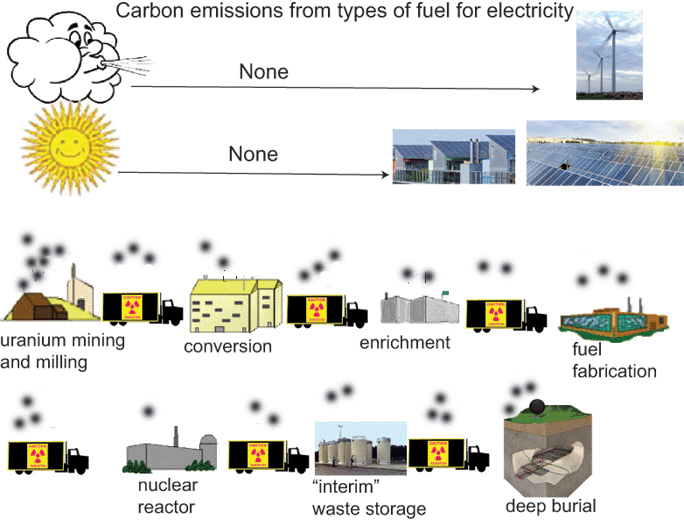
The dishonest claim of zero emissions implies we could use unlimited amounts and still meet our climate change obligations. In fact, building seven nuclear power stations would increase our greenhouse gas emissions and irresponsibly accelerate climate change.
Another falsehood is there in the very same sentence: nuclear energy is not used “all over the world”. Some 30 countries operate nuclear power stations, including four with just one reactor and six with two. About 160 countries don’t have any. Far from bringing prices down, the average price of nuclear power is much higher than solar, wind, hydro, gas or coal. Old power stations are being closed down because the costs of operation and maintenance mean they can’t compete with new solar farms and wind turbines. The world pattern of investment is telling. This year, about 500 gigawatts of new renewables will come on line. Hardly any nuclear power stations will start up. The electricity industry has voted with its chequebooks.
A third dishonest claim is that “Of the world’s 20 largest economies, Australia is the only one not using nuclear energy, or moving towards using it.” In fact, six of the 20 largest economies – Germany, Italy, Australia, Indonesia, Türkiye and Saudi Arabia – don’t operate nuclear power stations. Türkiye is the only one of those countries “moving towards using it”, with one nuclear power station being constructed.
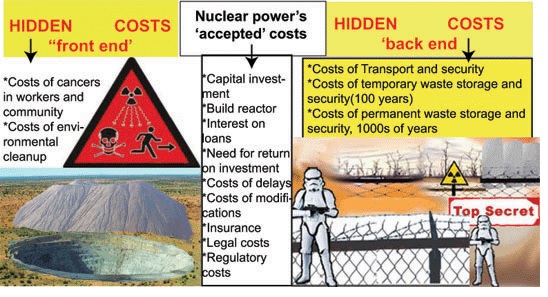
A fourth dishonest claim is that “A zero-emissions nuclear power plant will be a national asset delivering cheaper, cleaner and consistent energy for 80 years.” Again, the “zero-emissions” claim is false. Both current world average prices and regular CSIRO GenCost studies show nuclear power is far more expensive than renewables with storage. Historically, nuclear power stations have typically lasted 30 to 40 years, not 80. That is longer than the whole industry has existed.
The media release identifies “seven locations, located at a power station that has closed or is scheduled to close, where we propose to build zero-emissions nuclear power plants”. The list includes “Loy Yang Power Stations” and “Callide Power Station”. Loy Yang A is due to close in 2035, but Loy Yang B is scheduled to keep running until 2047. Callide B will close soon, but Callide C was commissioned in only 2001 and no closing date had been set. It is not true that all the power stations named will have closed within a decade.
Perhaps the most jaw-dropping of all the claims, however, is this one: “A Federal Coalition Government will initially develop two establishment projects using either small modular reactors or modern larger plants … They will start producing electricity by 2035 (with small modular reactors) or 2037 (if modern larger plants are found to be the best option)”. In fact, a report just released by the Australian Academy of Technological Sciences and Engineering shows it is unlikely we could buy small modular reactors before 2040. They do not yet exist anywhere in the OECD. Several different designs have been proposed, but they are all at the early stage of development. The idea they could be operating here by 2035 is pure fantasy.
The “modern larger plants” being built in Western Europe are years behind schedule, even though these are in countries with an established nuclear power industry, a working regulatory system and the skilled workforce needed to build these very complicated systems. The pro-nuclear Switkowski report, provided to the Howard government, concluded it would take at least 10 years and possibly 15 to build even one nuclear power station in Australia. It is just not credible to claim, even if the laws could be changed, that we could build seven by 2037, starting from scratch with no local experience and no regulatory system to assure the public of safety.
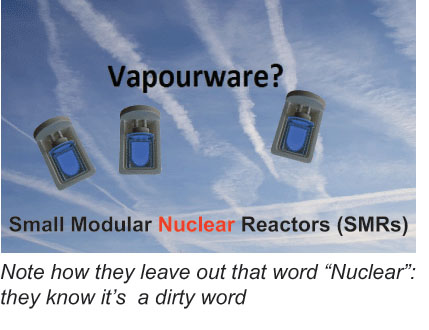
The label “small modular reactors” is misleading, too, giving the impression of a cute little device that would fit in your garage or a shipping container. The designs being proposed vary in size, but a typical so-called “small” reactor would require a site about the size of two football fields and would weigh several hundred tonnes. It would be “small” only when compared with most of the nuclear power stations that have been built. They have typically been much larger because there are economies of scale. For that reason, while there are no reliable figures at this stage, the CSIRO evaluation has consistently concluded that “small” reactors are likely to produce even more costly electricity than large ones.
A final piece of studied dishonesty is the statement that the current government’s approach of using renewables to provide our electricity would require 58 million solar panels and 3500 new wind turbines, giving a scary total investment figure. The clear implication is that seven nuclear reactors, for which no cost figures are given, wouldn’t cost as much. The recent track record for the building of nuclear power stations in Western Europe doesn’t provide much confidence. Hinkley Point C in the UK was meant to cost about $20 billion, but the total cost is likely to end up close to $100 billion. More seriously, the comparison is totally invalid. It compares an inflated estimate of the cost of providing enough renewables to meet all our needs with the unknown figure of the price of seven reactors. If they were ever to be built, they would provide about six gigawatts of generating capacity. Our installed capacity now is about nine times that much. A serious emissions reduction program will mean replacing petroleum transport fuels and gas heating with electricity. That will require doubling our capacity over the next decade. The Coalition is comparing apples with watermelons. They contrast the still-unrevealed cost of nuclear reactors to meet about 5 per cent of our needs with an inflated estimate of the cost of building enough renewables to supply our total demand.
The whole proposal is really a smokescreen. It is designed to hide the reality that a Coalition government would keep burning coal and gas for decades. There is also no plan to deal with the radioactive waste that nuclear reactors would produce, needing to be stored for geological time. The 2015 Nuclear Fuel Cycle Royal Commission, held in South Australia, estimated a storage facility would cost an eye-watering $41 billion. Peter Dutton’s nuclear plan is a farce. No part of it is real, plausible or sincere. As a proposal, it is probably the most dishonest ever put before the Australian electorate.
This article was first published in the print edition of The Saturday Paper on August 10, 2024 as “Dutton’s nuclear lies”.
Australian government would like the lucrative import of UK and USA nuclear waste ? But there’s a hitch.

Peter Remta. 12 August 24
From the information I have there is no question that Australia should like to import nuclear waste for permanent disposal principally from the United Kingdom but also from the United States if appropriate
The basic reason is that the payment for the disposal is considerable and will be some offset part of the substantial contributions – some would say astronomical – by Australia to the AUKUS arrangements
The United Kingdom has a reported legacy of 200,000 m³ of intermediate level waste with no means to dispose of it and has approached other countries for its disposal
The UK is hoping that Australia would take 40,000 m³ of this waste at obviously a negotiated fee but the applicable present cost internationally is $1.5 million a cubic metre of intermediate level waste
The British government had previously asked Australia to take this volume of waste for disposal but it could only be for long term storage at the proposed Kimba facility in South Australia which of course in timing and other reasons was not possible
An approach had also been made to Spain for disposal of that waste at the highly regarded El Cabril facility but the charges demanded by Spain were prohibitive despite being royal cousins
I understand it is affectively agreed that Australia will take 40,000 m³ of intermediate level waste as defined by the International Atomic Energy Agency from Britain as part of significantly assisting with the development and construction locally of the SSN AUKUS submarine fleet
However there can be no nuclear waste sent to Australia under the AUKUS arrangements until Australia achieves a variation of the Comprehensive Safeguards Agreement as explained in questions in the Senate, by Senator Jacqui Lambie .
Australia is still finding out what it doesn’t know about its secretive AUKUS deal
7.30 / By Laura Tingle, Sat 10 Aug 2024
When US President Joe Biden announced he would not be standing for another term, Australia’s political leaders expressed their gratitude for his contribution to public life. But this week, Australian voters had something else for which to be grateful to Biden.
For it was only as a result of a letter the US president wrote to the US Congress, that we found that there had been an update to the AUKUS agreement which will allow naval nuclear propulsion plants, rather than just nuclear propulsion “information”, to be transferred to Australia.
But it is not this part of the letter that has raised eyebrows and hackles even if, as usual, we find out about such deals from the Americans before we find out about them from our own government. The formal part of the deal will be exposed when it is submitted to the Treaties committee of our own parliament.
It is a side agreement, between the US, the UK and Australia that is of considerable concern: a non-legally binding “understanding” that includes “additional related political commitments”.
What are these? Well, they are secret.
The AUKUS saga moves on without much scrutiny
Critics argue that the “understanding” and “additional related political commitments” could include how and where these vessels are used. That is, what conflicts Australia would be expected to show up for, and how.
Some speculate on the possibility that it involves Australia agreeing to accept nuclear waste from the US and the UK, something the government has denied.
The idea that any of these such undertakings may have been made, but we aren’t allowed to know, is simply outrageous.
A quick recap of the AUKUS deal reveals that we are still expecting to receive two second-hand US Virginia class submarines, before embarking on building an entirely new, and so far unseen, British submarine in Adelaide.
Of course, we get a bit of a say in the design and plans for that new sub, don’t we?
Well the UK announced in October 2023 that it had selected BAE Systems for the SSN-AUKUS submarine. That month, Greens senator David Shoebridge asked officials about what involvement Australia had in the selection of the company that would build both the UK and Australian submarines.
The Australian Submarine Agency’s Alexandra Kelton told the Senate that “we had, through our high commission, some notification that an announcement would be made and some context around that but not of the content in great detail”.
The AUKUS submarine saga moves on with not much scrutiny in Australia, let alone apparently much input from Australia, given its cost and its huge strategic investment in one particular idea.
The second-hand Virginia class subs and later the AUKUS-class subs to be built in Adelaide are supposedly “sovereign Australian assets operating under the complete control of the Australian government”.
The Greens’ Shoebridge is one critic who warns the secret undertakings could include commitments on how the subs are used.
And this is a position which seems to be backed in by the authoritative papers written for the US Congressional Research Service.
Voters likely to be the last to know
In its latest update on the Virginia-class submarines, dated August 5, the Service’s analysts once again outline the relative benefits costs and risks of an “alternative division-of-labor approach”.
That’s technical talk for an alternative plan in which “up to eight additional Virginia-class SSNs would be procured and retained in US Navy service and operated out of Australia along with the US and UK SSNs that are already planned to be operated out of Australia … while Australia invested in military capabilities (such as, for example, long-range anti-ship missiles, drones, loitering munitions, B-21 long-range bombers, or other long-range strike aircraft)”.
That is, we don’t get any submarines, the Americans (and Brits) just run theirs out of here. Along with an expansion of bomber visits, personnel and troop rotations.
The “deterrence and warfighting cost-effectiveness” arguments for doing this “include [the fact that] Australian Defence Minister Richard Marles in March 2023 reportedly confirmed that in exchange for the Virginia-class boats, Australia’s government made no promises to the United States that Australia would support the United States in a future conflict over Taiwan.”
“Selling three to five Virginia-class SSNs to Australia would thus convert those SSNs from boats that would be available for use in a US-China crisis or conflict into boats that might not be available for use in a US-China crisis or conflict. This could weaken rather than strengthen deterrence and warfighting capability in connection with a US-China crisis or conflict.”
There’s a lot more like that.
Riled on Friday by the prime minister’s dismissal of his observations on AUKUS, Albanese’s predecessor Paul Keating warned that “the strength and scale of the United States’s basing in Australia will eclipse Australia’s own military capability such that Australia will be viewed in the United States as a continental extension of American power akin to that which it enjoys in Hawaii, Alaska and more limitedly in places like Guam”.
“Such an outcome is likely to turn the Australian government, in defence and security terms, into simply the national administrator of what would be broadly viewed in Asia as a US protectorate,” he said.
If that happens, voters are likely to be the last to know about it.
Laura Tingle is 7.30’s chief political correspondent
AUKUS Revamped: The Complete Militarisation of Australia
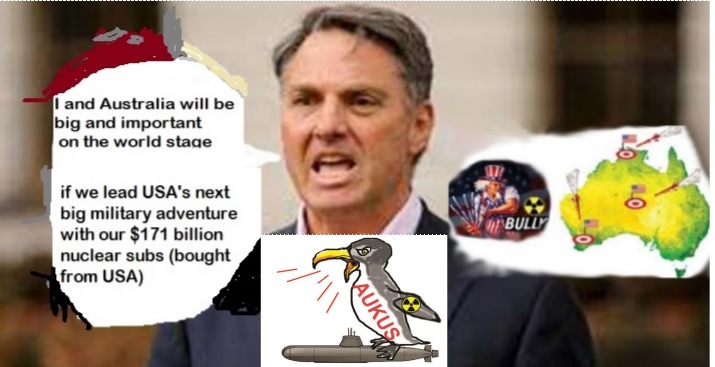
Marles, the persistently reliable spokesman for Australia’s wholesale capitulation to the US war machine, calls the document “the legal underpinning of our commitment to our international obligations so it’s a very significant step down the AUKUS path and again it’s another demonstration that we are making this happen.”
US military forces, in short, are to occupy every domain of Australia’s defence.
August 10, 2024, by: Dr Binoy Kampmark https://theaimn.com/aukus-revamped-the-complete-militarisation-of-australia/
There is much to loathe about the AUKUS security agreement between Canberra, Washington and London. Of the three conspirators against stability in the Indo and Asia Pacific, one stands out as the shouldering platform, the sustaining force, the political and military stuffing. But Australian propagandists and proselytisers of the US credo of power prefer to see it differently, repeatedly telling the good citizens down under that they are onto something truly special in being a military extension, the gargantuan annexe of another’s interests. Give them nuclear powered submarines, let them feel special, and a false sense of security will follow.
The August 2024 AUSMIN talks in Annapolis, Maryland, held between US Secretary of Defense Lloyd J. Austin III, US Secretary of State Antony Blinken, and their Australian counterparts, Richard Marles (Minister of Defence) and Penny Wong (Foreign Minister)provided yet another occasion for this grim pantomime. No one could be in doubt who the servitors were.
The factsheet from the US Department of Defense on the meeting is worth noting for Washington’s military capture – no other word describes it – and Australia’s sycophantic accommodation. As part of the “Enhanced Force Posture Cooperation,” the US and Australia are to advance “key priorities across an ambitious range of force posture cooperation efforts.” This is merely a clumsy way of describing the deeper incorporation of Australia’s own military requirements into the US military complex “across land, maritime, air, and space domains, as well as the Combined Logistics, Sustainment, and Maintenance Enterprise.” US military forces, in short, are to occupy every domain of Australia’s defence.
The greedy and speedy US garrisoning of Australia is evident through ongoing “infrastructure investments at key Australian bases in the norther, including RAAF Bases Darwin and Tindal” and “site surveys for potential upgrades at RAAF Bases Curtin, Learmonth, and Scherger.” Rotational deployments of US forces to Australia, “including frequent rotations of bombers, fighter aircraft, and Maritime Patrol and Reconnaissance Aircraft” are to increase in number. As any student of US-Australian relations knows, rotation is the disingenuous term used to mask the presence of a permanently stationed force – occupation by another name.
The public relations office has obviously been busy spiking the language with a sense of false equality: the finalising, for instance, by December 2024 of a Memorandum of Understanding on Co-Assembly for Guided Multiple Rocket Systems (GLMRS) – a “co-production”; finalising, by the same date, an MOU “on cooperative Production, Sustainment, and Follow-on Development of the Precision Strike Missile (PrSM)”; and institutionalising of “US cooperation with Australia’s Guided Weapons and Explosive Ordnance (GWEO) Enterprise.” Everywhere we look, a sense of artificial cooperation under the cover of Washington’s heavy-handed dominance, be it cooperative activities for Integrated Air and Missile Defence, or the hypersonic weapons program, can be found.
In this even more spectacular surrender of sovereignty and submission than previous undertakings, Canberra is promised second hand nuclear-powered toys in the form of Virginia Class submarines, something forever contingent on the wishes and whimsy of the US Congress. But even this contingent state of affairs is sufficient for Australia to bury itself deeper in what has been announced as a revised AUKUS agreement. More accurately, it constitutes a touch-up of the November 22, 2021 agreement between the three powers on the Exchange of Naval Nuclear Propulsion Information (ENNPIA).
The ENNPIA allows the AUKUS parties the means to communicate and exchange relevant Naval Nuclear Propulsion Information (NNPI), including officially Restricted Data (RD) as part of what is described as the “Optimal Pathway” for Australia’s needless acquisition of nuclear powered vessels.
In his letter to the US House Speaker and President of the Senate, President Joe Biden explains the nature of the revision. Less cumbersomely named than its predecessor, the new arrangements feature an Agreement between the three powers for Cooperation Related to Naval Nuclear Propulsion. In superseding the ENNPIA, it “would permit the continued communication and exchange of NNPI, including certain RD, and would also expand the cooperation between the governments by enabling the transfer of naval nuclear propulsion plants of conventionally armed, nuclear-powered submarines, including component parts and spare parts thereof, and other related equipment.”
The Agreement further permits the sale of special nuclear material in the welded power units, and other relevant “material as needed for such naval propulsion plants.” Transferrable equipment would include that necessary for research, development, or design of naval propulsion plants. The logistics of manufacture, development, design, manufacture, operation, maintenance, regulation and disposal of the plants is also covered.
Tokenistic remarks about non-proliferation are then made in Biden’s letter. The powers, for instance, commit themselves to “setting the highest nonproliferation standard” while protecting US classified information and intellectual property. This standard is actually pitifully low: Australia has committed itself to proliferation not only by seeking to acquire submarine nuclear propulsion, but by subsidising the building of such submarines in US and UK shipyards.
Marles, the persistently reliable spokesman for Australia’s wholesale capitulation to the US war machine, calls the document “the legal underpinning of our commitment to our international obligations so it’s a very significant step down the AUKUS path and again it’s another demonstration that we are making this happen.”
Obligations is the operative word here, given that Australia is burdened by any number of undertakings, be it as a US military asset placed in harm’s way or becoming a radioactive storage dump for all the AUKUS submarine fleets. Marles insists that the only nuclear waste that will end up on Australian soil will be that generated by Australia. “That is the agreement that we reached with the UK and the US back in March of last year, and so all this is doing is providing for the legal underpinning of that.”
Given that Australia has no standalone, permanent site to store high-level nuclear waste, even that undertaking is spurious. Nor does the understanding prevent Australia from accepting the waste accruing from the fleets of all the navies. Given the cringing servitude of Canberra, and the admission by the Australian government that they have made undisclosed “political commitments”, such an outcome cannot be ruled out.
Always reliably waspish, former Australian Labor Prime Minister Paul Keating gavehis assessment about the latest revelations of the AUSMIN talks. “There’ll be an American force posture now in Australia, involving every domain.” The Albanese government had “fallen for the dinner on the White House lawn.” That, and much more besides.
1 This month
17 October, Free Public Talk on Nuclear Issues in South Australia
David Noonan will speak on public interest concerns over the new Roxby Downs Indenture Act 2026 on BHP copper-uranium mining and ore processing in SA, and on how AUKUS may face SA with a High-Level nuclear waste agenda.
Dr Jim Green will discuss international developments in the field of nuclear power including ‘small modular reactors’ and Generation 4 ‘advanced’ nuclear reactor concepts.


Help Aunty Sue Protect Her Land and Sacred Sites From Destructive Rocket Testing.
.

Australians deserve the truth
about
AUKUS – https://aukuspublicinquiry.com/

PETITION – To: Prime Minister Anthony Albanese and the Australian Labor Government

of the week – Australians for War Powers Reform (AWPR)
To see nuclear-related stories in greater depth and intensity

