Nuke policy quietly nuked: Australia to fund US nuclear weapon delivery program

Greens Defence Spokesperson Senator David Shoebridge said, “When will the Albanese government start telling the whole truth about AUKUS and how Australians will be paying to help build the next class of US ballistic missile submarines?”
by Rex Patrick and Philip Dorling | Jan 2, 2024, https://michaelwest.com.au/australia-to-fund-nuclear-missiles-aukus/
A newly released Congressional Research Service report confirms that Australian funds will be used to support the United States Navy’s nuclear ballistic missile submarine program. The Government has sunk Labor’s nuclear disarmament and non-proliferation pledges. Rex Patrick and Philip Dorling explain.
The Columbia class submarines will carry 16 thirteen metre long Trident II D5 missiles. Each of those missiles can carry up to eight (they can carry 12 but, by treaty, the number has been limited to eight) multiple independently targeted re-entry vehicles. Each re-entry vehicle can deliver a thermonuclear warhead to an individual target.
Fully loaded, each submarine will be able deliver thermonuclear weapons to 128 cities or hardened military targets.
When on patrol, the submarines are virtually undetectable, and there are no known, near-term credible threats to the survivability of the SSBN force. The ballistic missile submarines are the most survivable leg of the triad.
The US Navy for more than a decade consistently identified the Columbia Class program as its top priority program.
Enter AUKUS
There has been a lot of focus on how the US will meet its own production requirements for the conventionally armed Virginia class nuclear attack submarines with the AUKUS agreements providing for two existing submarines to be transferred to Australia and at least another new vessel acquired off the production line.
No-one in Australia has paid much attention to the Columbia Program. That’s been an oversight.
The Columbia class ballistic missile submarines will be built at General Dynamics’ Electric Boat in Groton, Connecticut, and Huntington Ingalls Industries’ Newport News Shipbuilding (HII/NNS), in Newport News, Virginia. That’s exactly the same shipyards the Virginia class attack submarines will be built.
And this will all be happening at the same time. The first Columbia submarine is to be delivered in October 2027, the second in April 2030, the third in August 2032, the fourth in September 2032, and the fifth in August 2033. At the same time those same shipyards will be pumping out Virginia Class submarine for the US Navy, and Australia. As the fifth Columbia is being delivered, Australia will get its first second hand Virginia Class submarine.
Both shipyards are currently collectively punching out 1.4 Virginia class boats per annum. By 2028 it is expected that the yards will be collectively be producing 2 per annum. That will meet US Navy requirements, but AUKUS takes the required production rate to 2.33 per annum. When the Columbia submarines are added to the mix, the US submarine industrial base needs to be producing 1+2.33 submarines per annum.
AUKUS funding to be used
In the meantime, Australia has agreed to contribute US$3B (AUD$4.7B) to “the US industrial base to support increased production and maintenance capacity to ensure there is no capability gap for Australia in acquiring Nuclear Powered Submarines.”
The latest Congressional Research Service report on the Columbia class program makes to clear that the Australian commitment is to generic US submarine industrial base funding; covering construction for both the Virginia and Columbia submarine programs.
“Building up the industrial base’s capacity to a 1+2.33 capacity will require investing several billion dollars for capital plant expansion and improvements and workforce development at both the two submarine-construction shipyards and submarine supplier firms.
Some of this funding has been provided in FY2023 and prior years, some of it is requested for FY2024, some of it would be requested in FY2025 and subsequent years, and some of it would be provided, under the AUKUS proposed Pillar 1 pathway, by Australia.”
Parliament in the dark on nuclear funding
To be perfectly clear, Australian AUKUS funding will support construction of a key delivery component of the US nuclear strike force, keeping that program on track while overall submarine production accelerates.
This fact has not been shared with the Australian public or Parliament.
Greens Defence Spokesperson Senator David Shoebridge said, “When will the Albanese government start telling the whole truth about AUKUS and how Australians will be paying to help build the next class of US ballistic missile submarines?”
Of course, the Government hasn’t exactly been upfront about a number of things in the AUKUS program, with Michael West Media being left to reveal (in contrast to statements made by Defence Minister Richard Marles) that Australia will be taking nuclear waste from the US and UK under the program.
A Merry AUKUS Surprise, Western Australia!

December 20, 2023, by: Dr Binoy Kampmark, https://theaimn.com/a-merry-aukus-surprise-western-australia/
The secretive Australian government just cannot help itself. Clamouring and hectoring of other countries and their secret arrangements (who can forget the criticism of the Solomon Islands over its security pact with China for that reason?) the Albanese government is a bit too keen on keeping a lid on things regarding the withering away of Australian independence before a powerful and spoiling friend.
A degree of this may be put down to basic lack of sensibility or competence. But there may also be an inadvertent confession in the works here: Australians may not be too keen on such arrangements once the proof gets out of the dense, floury pudding.
It took, as usual, those terrier-like efforts from Rex Patrick, Australia’s foremost transparency knight, forever tilting at the windmill of government secrecy, to discover that Western Australians are in for a real treat. The US imperium, it transpires from material produced by the Australian Department of Defence, will be deploying some 700 personnel, with their families, to the state. And to make matters more interesting, Western Australia will also host a site for low-level radioactive waste produced by US and UK submarines doing their rotational rounds under the AUKUS arrangements.
The briefing notes from the recently created Australian Submarine Agency reveal that the Submarine Rotational Force-West (SRF-West) will host as many as four US nuclear submarines of the US Navy Virginia-class at HMAS Stirling and one UK nuclear-powered boat from 2027. As part of what is designated the first phase of AUKUS, an Australian workforce of some 500-700 maintenance and support personnel is projected to grow in response to the program before Australia owns and operates its own US-made nuclear-powered boats. Once established and blooded by experience, “This workforce will then move to support our enduring nuclear-powered submarine program and will be a key enabler for SRF-West.”
The ASA documents go on to project that “over 700 United States Personnel could be living and working in Western Australia to support SRF-West, with some also bringing families.” The UK will not be getting the same treatment, largely because the contingent from the Royal Navy will be moving through on shorter rotations.
The stationing of the personnel in question finally puts to rest those contemptible apologetics that Australia is not a garrison for the US armed forces. At long last Australians can be reassured, if rather grimly, that these are not fleeting visits from great defenders, but the constant, and lingering presence of an imperial power jealously guarding its interests.
The issue of storing waste will have piqued some interest, given Australia’s current and reliably consistent failure to establish any long-term storage facility for any sort of nuclear waste, be it low, medium or high grade. But never fear, the doltish poseurs of the Defence Department are always willing to please and, as the department documents show, learn in their servile role.
As Patrick reveals, the documents released under FOI tell us that “operational waste” arising from the Submarine Rotational Force operation at HMAS Stirling will include the storage of low to intermediate level radioactive waste on Australian defence sites. One document notes that, “The rotational presence of United Kingdom and United States SSNs in Western Australia as part of the Submarine Rotational Force – West (SRF-West) will provide an opportunity to learn how these vessels operate, including the management of low-level radioactive waste from routine sustainment.”
The ASA also confirms with bold foolhardiness that, “All low and intermediate radioactive waste will be safely stored at Defence sites in Australia.” The storage facility in question is “being planned as part of the infrastructure works proposed for HMAS Stirling to support SRF-West.”
The Australian Defence Minister Richard Marles has retained a consultant, Steve Grzeskowiak, to the remunerative value of AU$396,000 from February to December this year to identify a suitable site on land owned by the Commonwealth. Absurdly, the same consultant, when Deputy Secretary of Defence Estates, conducted an analysis of over 200 Defence sites in terms of suitability for low-level waste management, finding none to pass muster.
In a troubling development, Patrick also notes that the Australian Naval Nuclear Power Safety Bill 2023, in its current form, would permit the managing, storing or disposing of radioactive waste from an AUKUS submarine, which would include UK or US submarines. Importantly, that waste could well be of a high-level nature. “While the Albanese Government has made a commitment that it will not do so, the Bill leaves the legal door open for possible future agreement from the Australian Government to store high-level nuclear waste generated from US or UK nuclear-powered submarines.”
To round matters off, Australia’s citizenry was enlightened to the fact that they will be adding some $US3 billion (AU$4.45 billion) to the US submarine industrial base. In the words of the ASA, “Australia’s commitment to invest in the US submarine industrial base recognises the lift the United States is making to supporting Australia’s acquisition of nuclear-powered submarines.” This will entail the pre-purchase of “submarine components and materials, so they are on hand at the start of the maintenance period” thereby “saving time” and “outsourcing less complex sustainment and expanding planning efforts for private sector overhauls, to reduce backlog.”
Decoding such naval, middle-management gibberish is a painful task, but nothing as painful as the implications for a country that has not only surrendered itself wholly and without qualification to Washington but is all too happy to subsidise it.
Indonesia ratifies nuclear weapons ban treaty. Australia should too.
MARIANNE HANSON, https://www.lowyinstitute.org/the-interpreter/indonesia-ratifies-nuclear-weapons-ban-treaty-australia-should-too
Why does the government remain at odds with the vast majority of its neighbours?
Indonesia’s parliament last month agreed to ratify the United Nations Treaty on the Prohibition of Nuclear Weapons (TPNW). This is an important political development, and it deserves attention – across the region and in Australia. The approval of ratification was done very symbolically, just ahead of the second meeting of States Parties of the TPNW at the United Nations, held last week. The meeting at UN headquarters in New York was attended by most of the TPNW’s 69 parties, as well as by representatives from 35 non-parties, including Australia as well as NATO members Belgium, Norway and Germany.
Indonesia will soon deposit its instrument of ratification at the UN, formally becoming a state party. By ratifying the TPNW, Indonesia is making it clear that it rejects the most destructive of all weapons of mass destruction, nuclear weapons. That is good news. It’s a recognition that there are still around 12,500 nuclear weapons in existence, many of them vastly more destructive than the Hiroshima bomb, and a reminder that the world still lives under the very real – indeed growing – threat of complete annihilation.
Indonesia is a leading member of the Association of Southeast Asian Nations, a grouping which, decades ago, made its stance against nuclear weapons clear by creating the Southeast Asian Nuclear Weapon Free Zone (SEANWFZ). Nine of the ten ASEAN members have signed or ratified the TPNW (as has ASEAN observer Timor-Leste), but Indonesia’s ratification is especially important because it signals a clear commitment by one of the world’s largest states to work towards the global elimination of these inhumane weapons.
Indonesia is also a founding member of the 120 nation Non-Aligned Movement, a grouping which marshals considerable collective diplomatic clout on the international stage. For the great majority of non-aligned states, nuclear weapons are seen not just as weapons of horrific destruction, but also as instruments of continuing domination and exploitation. Many formerly colonised states are asking the large and powerful countries to listen to them and to consider their security preferences. They have a point: nuclear weapon states effectively hold the entire world to ransom.
Indonesia’s ratification should make Australians ask why its government remains at odds with the vast majority of its neighbours. Most of the South Pacific states, Southeast Asia, and New Zealand clearly oppose the threat of nuclear weapons. The TPNW makes these inhumane weapons illegal, as other treaties do for biological and chemical weapons, landmines, and cluster munitions.
Prime Minister Anthony Albanese has supported the TPNW, stating that “nuclear weapons are the most destructive, inhumane, and indiscriminate weapons ever created”, and that “the struggle for nuclear disarmament is the most important struggle for the human race”. Labor’s national policy platform, repeated in August this year, commits Australia to signing and ratifying the TPNW. But the government is yet to do so, leaving Australia now out of step with its largest neighbour and the region more broadly.
The AUKUS arrangement with the US and the UK signals a faith in the old-fashioned militarism of the Anglosphere more than the promising dynamics and peaceful potential of the region. Indonesia, Malaysia, and other states expressed concern about Australia’s plan to acquire nuclear-powered submarines. Proceeding with AUKUS makes it even more important that Australia credibly reassure the world it has no intention of acquiring nuclear weapons. Signing the TPNW would make that commitment concrete.
Clearly there has been pressure from the United States on Canberra not to sign. But fears of endangering the ANZUS alliance are overblown; Washington will be displeased when Australia signs the TPNW, but Canberra can remain an invaluable (conventional weapons) partner for the United States in the Asia-Pacific region. Signing the TPNW does not void the ANZUS alliance, nor does it mean Australia cannot proceed with AUKUS, although this pact would have to be managed carefully.
Several US allies have already signed the TPNW and even some NATO states have explored the option of joining. Australia can take a principled stand. Nuclear weapons are immoral and threaten the existence of everyone, the environment and life on Earth.
And a closer alignment by Canberra with the views of Australia’s region will be important.
Indonesia has a population of around 280 million people and is a secular democratic country with a Muslim-majority population, the largest in the world. Its economic growth is strong, with predictions that it will be among the top five world economies within a few decades. It has a growing middle-class, with an overwhelmingly young population (a quarter are aged under 14). Indonesia is a vibrant and vital part of Australia’s local geography and will become an increasingly important trading partner. All this suggests that Canberra should be paying more attention to the security wishes of its near neighbours. By signing the TPNW, Australia will be on the right side of history and be more in sync with its region.
Indonesia and other Asia-Pacific neighbours are showing the way. It’s time to work towards a common future with them, not a future blighted by the danger of nuclear annihilation.
Independents pressure Australia on nuclear ban treaty ahead of UN meeting
November 24th, 2023
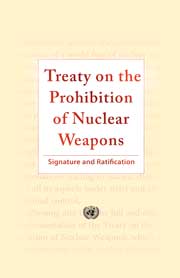
11 independent parliamentarians have issued a public call on the Prime Minister to keep Labor’s promise to sign and ratify the UN Treaty on the Prohibition of Nuclear Weapons, ahead of the treaty’s Second Meeting of States Parties on 27 November – 1 December in New York.
The letter, which is signed by Kate Chaney MP, Zoe Daniel MP, Dr. Helen Haines MP, Senator David Pocock, Dr. Monique Ryan MP, Dr. Sophie Scamps MP, Allegra Spender MP, Zali Steggall OAM MP, Senator Lidia Thorpe, Kylea Tink MP, and Andrew Wilkie MP, states that “nuclear weapons do not promote security, they undermine it. We don’t accept the everlasting presence of these weapons.” They “urge the Government to advance its signature and ratification of the Ban Treaty without delay, to bring Australia in line with our South-East Asian and Pacific island neighbours.”
In regards to the letter, Federal Member for Goldstein, Zoe Daniel MP, said: “Voters supported Labor at the election, believing in good faith that they would implement their platform.
“Signing and ratifying was Labor Party policy before the election and has been reaffirmed since.
“In the most perilous times since the height of the Cold War this treaty is needed more than ever; voters want it and so do the vulnerable nations of the Pacific whose backyards were used for nuclear testing without their permission.
“Look at what Labor does, not what it says.”
Australia will attend the Second Meeting of States Parties as an observer, with a parliamentary head of delegation, after attending the first Meeting of States Parties in June 2022. It is expected that several states, including Indonesia, will ratify the treaty during the meeting, bolstering universalisation efforts. Around 100 countries will attend, along with over 400 civil society delegates.
Gem Romuld, ICAN Australia Director, welcomed the independents’ statement and Australia’s attendance at the meeting, but said the Albanese Government must do more, in line with their policy platform to sign and ratify the treaty.
“We welcome the Australian government’s engagement with the Treaty on the Prohibition of Nuclear Weapons, but observing meetings isn’t enough. There is clearly broad support for signing on to this treaty in the Australian Parliament, as indicated by the independents’ statement to the PM.
“Labor needs to make good on their promise to join the majority of our South East Asian and Pacific neighbours and sign and ratify the TPNW. We hope that Australia’s attendance at this meeting will spur efforts towards this urgent goal.”
Romuld is joining the international ICAN delegation at the meeting, including Yankunytjatjara-Anangu woman and second-generation nuclear test survivor Karina Lester, and current ICAN Executive Director, former Labor MP Melissa Parke.
A four-decade-old Pacific treaty was meant to preserve the ‘peaceful region’. Now experts say it’s being exploited
“We regret that the Aukus agreement … is escalating geopolitical tensions in our region and undermining Pacific-led nuclear-free regionalism,” says the Pacific Elders’ Voice,
the US and the UK will increase rotations of nuclear-powered submarines to Australia,
Pacific countries rushed to join the TPNW six years ago, reflecting their longstanding concerns about nuclear testing legacies. It’s the same regional sentiment that spurred the earlier Treaty of Rarotonga.
Daniel Hurst in Rarotonga
Nearly 40 years after the Treaty of Rarotonga came into force, the region is on edge about another rise in geopolitical tension
…………………………………………………………………………….heightened concerns permeated the region in the months leading up to the crucial meeting in the Cook Islands in August 1985 where leaders endorsed a nuclear-free zone.
Hawke, the Australian prime minister at the time, hailed the negotiations as a “dramatic success” that would send “a clear and unequivocal message to the world”, with the treaty leaving major powers in no doubt about the region’s desire to preserve “the South Pacific as the peaceful region which its name implies”.
But nearly 40 years after the Treaty of Rarotonga came into force, the region is on edge about another rise in geopolitical tensions – and critics say gaps in the treaty’s coverage are now being exploited.
“The treaty was really important to a lot of people, especially for grassroots activists,” says Talei Mangioni, a Fijian-Australian board member of the International Campaign to Abolish Nuclear Weapons Australia.
But it was quite watered down. And so even though we celebrate it today, what activists were saying in the 1980s and what progressive states like Papua New Guinea, Solomon Islands and Vanuatu were saying was that it wasn’t comprehensive enough.”
Mangioni, who researches the legacy of the Nuclear Free and Independent Pacific Movement, adds: “That’s what’s left us now with things like Aukus exploiting certain loopholes that have remained in the treaty.”
A hotbed of great-power competition?
When leaders met last week in the Cook Islands for the annual meeting of the Pacific Islands Forum (Pif), the Treaty of Rarotonga was once again on everyone’s lips.
The host of the summit, prime minister Mark Brown of the Cook Islands, argued the region “should rediscover and revisit our Rarotonga treaty to ensure that it reflects the concerns of Pacific countries today, and not just what occurred back in 1985”.
The treaty – signed on the 40th anniversary of the US atomic bombing of the Japanese city of Hiroshima – reflected “the deep concern of all forum members at the continuing nuclear arms race and the risk of nuclear war”.
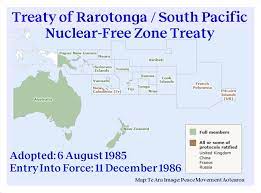
Also known as the South Pacific Nuclear Free Zone Treaty, it designated a vast area from the west coast of Australia to Latin America where its parties must prevent the “stationing” (critics say this was always a deliberately ambiguous word) of nuclear weapons.
“The treaty prohibits the use, testing or stationing of nuclear explosive devices in the South Pacific,” the Cook Islands News explained on 7 August 1985.
“It does not prohibit countries from transporting nuclear devices through the zone nor does it prohibit nuclear-powered or equipped ships from calling in ports within the area.”
Today the parties to this treaty are Australia, Cook Islands, Fiji, Kiribati, Nauru, New Zealand, Niue, Papua New Guinea, Samoa, Solomon Islands, Tonga, Tuvalu and Vanuatu.
Once again, many of these nations are worried about the Pacific becoming a hotbed of great-power competition and the risk of that spiralling into conflict. Aukus feeds into some of those fears.
“We regret that the Aukus agreement … is escalating geopolitical tensions in our region and undermining Pacific-led nuclear-free regionalism,” says the Pacific Elders’ Voice, a group of former leaders whose members include Anote Tong, the ex-president of Kiribati.
The legality of a treaty – and the spirit of it
Under the Aukus plan, Australia will buy at least three Virginia class nuclear-powered submarines from the US in the 2030s, before Australian-built boats enter into service from the 2040s.
In the meantime, the US and the UK will increase rotations of nuclear-powered submarines to Australia, all aimed at deterring China from unilateral action against Taiwan or destabilising activities in the increasingly contested South China Sea.
One point of sensitivity is that it will be the first time a provision of the Nuclear Non-Proliferation Treaty regime has been used to transfer naval nuclear propulsion technology from a nuclear weapons state to a non-weapons state.
The Australian government has worked assiduously behind the scenes to reassure Pacific leaders on a key point about Aukus.
“Certainly when I was talking to people about it I would explain how it was consistent with the Treaty of Rarotonga,” says the Australian minister for the Pacific, Pat Conroy.
Donald Rothwell, a professor of international law at the Australian National University, concurs. The treaty, he notes, does not deal with nuclear-propelled submarines.
“My view is that Aukus is consistent with Australia’s Treaty of Rarotonga obligations,” Rothwell says.
“Pacific states may have concerns about the potential stationing of US and UK nuclear-armed warships in Australian ports under Aukus. The stationing of such vessels, as opposed to port visits, would be contrary to the treaty.”
The Australian prime minister, Anthony Albanese, sought to allay any Aukus-related concerns when he briefed Pacific leaders during the Pif meetings last week and appears to have held off any open rebellion.
Albanese insists the treaty remains “a good document” and “all of the arrangements that we’ve put in place have been consistent with that”.
But anti-nuclear campaigners point to the planned new aircraft parking apron at the Tindal base in the Northern Territory that will be able to accommodate up to six US B-52 bombers.
The US refuses to confirm or deny whether the aircraft on rotation would be nuclear-armed, in line with longstanding policy.
“We should delineate between a legalistic interpretation of the Treaty of Rarotonga and the spirit of it,” says Marco de Jong, a Pacific historian based in Aotearoa New Zealand.
“Pacific nations are growing increasingly frustrated at Australia’s reliance on loopholes and technicalities.”
Australia: the regional outlier
The Nobel prize-winning International Campaign to Abolish Nuclear Weapons says a good way for Australia to reassure the region about its long-term intentions would be to sign the newer Treaty on the Prohibition of Nuclear Weapons (TPNW).
This is an idea Albanese previously supported enthusiastically but which appears stalled.
One potential problem is that the US has warned that the TPNW – which includes a blanket ban on helping others to use or threaten to use nuclear weapons – wouldn’t allow for close allies like Australia to enjoy the protection of the American “nuclear umbrella”.
Documents obtained by the Guardian under freedom of information laws show the Australian defence department has warned the Labor government that the TPNW is “internationally divisive” because the nuclear weapons states “are all opposed”.
But Mangioni, a member of the Youngsolwara Pacific movement of activists, counters that Pacific countries rushed to join the TPNW six years ago, reflecting their longstanding concerns about nuclear testing legacies. It’s the same regional sentiment that spurred the earlier Treaty of Rarotonga.
“I would say that Australia is indeed the outlier compared to the rest of the Pacific states,” Mangioni says.
“Australia depends on nuclear deterrence as its policy but the rest of the Pacific states are nuclear abolitionists.” https://www.theguardian.com/world/2023/nov/19/a-40-year-old-pacific-treaty-was-meant-to-maintain-the-peaceful-region-now-experts-say-its-being-exploited
Republicans and Democrats Unite to Push for Assange’s Freedom

Sixteen members of Congress signed a letter to President Biden urging him to drop the case against the WikiLeaks founder.
By Dave DeCamp / Antiwar.com https://scheerpost.com/2023/11/12/republicans-and-democrats-unite-to-push-for-assanges-freedom
Abipartisan group of 16 members of Congress has called on President Biden to drop the case against WikiLeaks founder Julian Assange, warning of the grave threats to press freedom if he is convicted.
The lawmakers made the call in a letter sent to President Biden on Wednesday. The effort was led by Reps. Thomas Massie (R-KY) and James McGovern (D-MA), who began circulating the letter to their colleagues for signatures last month.
“It is the duty of journalists to seek out sources, including documentary evidence, in order to report to the public on the activities of government,” the letter reads, according to a press release from Assange Defense.
“The United States must not pursue an unnecessary prosecution that risks criminalizing common journalistic practices and thus chilling the work of the free press. We urge you to ensure that this case be brought to a close in as timely a manner as possible,” the letter states.
The letter was also signed by Reps. Alexandria Ocasio-Cortez (D-NY), Jamaal Bowman (D-NY), Ayanna Pressley (D-MA), Greg Casar (D-TX), Ilhan Omar (D-MN), Cori Bush (D-MO), Rashida Tlaib (D-MI), Eric Burlison (R-MO), Marjorie Taylor Greene (R-GA), Paul Gosar (R-AZ), Jesús García (D-IL), Pramila Jayapal (D-WA), Matthew Rosendale (R-MT), and Sen. Rand Paul (R-KY).
The letter comes as the Biden administration has been under pressure from the Australian government to free Assange, who is an Australian citizen. In September, a delegation of Australian members of parliament from across the political spectrum visited Washington and met with US officials to lobby for Assange. Australian Prime Minister Anthony Albanese brought up the case with President Biden when he visited the White House in October.
Assange faces up to 175 years in prison if extradited to the US and convicted for exposing US war crimes. The charges stem from documents published by WikiLeaks that Assange obtained from his source, former Army Private Chelsea Manning, a standard journalistic practice. Assange has been held in London’s Belmarsh Prison since April 2019 as his legal team is fighting against US efforts to extradite him.
Pacific Islands Forum – time to reinvigorate the Treaty of Rarotonga, the nuclear weapons-free pact ?
Pacific backs Australian climate policy: Albanese.
St George and Sutherland Shire Leader, Australian Associated Press 9 Nov 23
“…………………………………………………………………………………………………. Joining climate as one of the top issues at the gathering are nuclear concerns, with Pacific leaders showing their resolve to keep the region nuclear-free.
The Pacific is stridently nuclear-free, a legacy of the region’s painful history with testing of nuclear weapons by the United States, United Kingdom and France.
Australia’s AUKUS deal to obtain nuclear-powered submarines raises concern among many, given the sensitivity of nuclear issues.
Leaders in Kiribati, Tuvalu, Solomon Islands and Fiji have previously expressed reservations on different fronts, including the extravagant cost, which exceeds the entire annual GDP of PIF members excepting Australia and New Zealand.
PIF chair and Cook Islands Prime Minister Mark Brown has suggested the time could have come to “reinvigorate” the Treaty of Rarotonga, the nuclear weapons-free pact signed during the Cold War.
Mr Albanese was less forthcoming on whether reform was needed, declining to respond to questions on whether he supported Mr Brown’s calls.
“We support the Treaty of Rarotonga. It is a good document. It has stood the test of time, all of the arrangements that have been in place, we’ve been consistent with that, and it retains our support,” he said.
The legacy of another nuclear incident – the 2011 Fukushima power plant disaster – also hangs over the Pacific.
Japan is releasing treated wastewater from the power plant, insisting it is safe to do so, with an International Atomic Energy Agency report as proof.
Australia and New Zealand accept those guarantees, but a growing number of Pacific nations hold concerns, including Polynesian and Melanesian blocs.
At the PIF summit, Fiji Prime Minister Sitiveni Rabuka is championing another initiative: declaring the Pacific an “ocean of peace”.
That proposal, the nuclear concerns and the Suva Agreement regional unity pact are late inclusions onto the agenda of the leaders retreat. https://www.theleader.com.au/story/8417306/pacific-backs-australian-climate-policy-albanese/
Small modular nuclear reactor that was hailed by Coalition as future cancelled due to rising costs

Opposition climate and energy spokesperson had pointed to SMRs as a solution to Australia’s energy needs, but experts raise questions over price tag.
Adam Morton, Guardian, 9 Nov 23
The only small modular nuclear power plant approved in the US – cited by the Australian opposition as evidence of a “burgeoning” global nuclear industry – has been cancelled due to rising costs.
NuScale Power announced on Wednesday that it had dropped plans to build a long-promised “carbon free power project” in Idaho. It blamed the decision on a lack of subscribers for the plant’s electricity.
The Coalition’s energy and climate spokesperson, Ted O’Brien, has cited NuScale’s technology as part of the opposition’s contentious argument that Australia should lift a national ban on nuclear energy and that small modular reactors (SMRs) could be an affordable replacement for its ageing coal-fired power plant
In an opinion piece in the Australian earlier this year, O’Brien said the company’s integrated reactors, starting with the Idaho plant in 2029, offered “exceptional flexibility” and were an example “of a burgeoning nuclear industry for next-generation technology” in the US.
The climate change minister, Chris Bowen, said SMRs were “the opposition’s only energy policy”.
“The most advanced prototype in the US has been cancelled. The LNP’s plan for energy security is just more hot air from Peter Dutton,” he said………………………………………………………………………………
Industry experts say SMRs are not commercially available, that nuclear energy is more expensive than alternatives and in a best-case scenario could not play a role in Australia for more than a decade, and probably not before 2040. The Australian Energy Market Operator found renewable energy could be providing 96% of the country’s electricity by that time.
The Coalition opposes Labor’s goal of reaching 82% renewable electricity by 2030. It has argued for a slower response to the climate crisis and amplified local concerns about new clean energy and electricity transmission connections.
The projected cost of the NuScale project had blown out from US$3.6bn for 720 megawatts in 2020 to US$9.3bn for 462MW last year. It failed after securing subscriptions for only 20% of the required capital from a Utah-based consortium of electricity companies.
Simon Holmes à Court, a clean energy advocate and commentator and convener of political fundraising body Climate 200, said the estimated capital cost of the Idaho project before it was cancelled was 70% higher than CSIRO projections of what nuclear power plants could cost to build in 2030.
He said this undermined arguments by the Coalition and other nuclear advocates, who had accused the CSIRO of exaggerating the likely cost of nuclear energy.
Holmes à Court said Australia needed a rapid rollout of solar, wind and energy storage. He recently toured nuclear power projects in the US.
“The simple fact is that commercial SMRs don’t exist. There are zero in operation or even contracted for construction outside Russia and China. The cancellation of one of the three leading proposals underscores the speculative nature of this far-off technology,” he said.
“More than two thirds of our coal generators will retire in the next decade due to age. By pushing a unicorn technology the Coalition is posing a threat to the cost and security of Australia’s electricity grid.” https://www.theguardian.com/australia-news/2023/nov/09/small-modular-nuclear-reactor-that-was-hailed-by-coalition-as-future-cancelled-due-to-rising-costs
—
Showboating for War: Johnson and Morrison in Israel
November 7, 2023, Dr Binoy Kampmark, https://theaimn.com/showboating-for-war-johnson-and-morrison-in-israel/
Banished Prime Ministers are an irritation. They clog the airwaves of punditry with their views about how things were and how things should be. But even there, degrees of severity and competence should be observed. The more noble sorts would pursue the goals of peace, even as they bag large wads of cash in stating the obvious. With former Australian Prime Minister Scott Morrison, and his disgraced counterpart from the UK, Boris Johnson, the cash is being forked out for war.
That Israeli authorities thought it suitable to invite these two men to bolster their war against Hamas shows a degree of deep desperation. Johnson, a serial rule breaker when it came to his own government’s pandemic regulations, was forced to resign as PM by his own Conservative party in June this year. He proved to be persistently and pathologically mendacious, a ragtag mix of contemptuousness and buffoonery.
Only Australia’s own Morrison could have possibly kept up, secretly commandeering, without knowledge of his own Cabinet, up to five different ministries in addition to his own. Despite losing the May 2022 election to Labor’s Anthony Albanese, he remains a sitting federal member, when not avidly think-tanking for anti-China causes and the US imperium.
As Gaza City is being systematically liquidated, pulverised, demolished and destroyed by Israeli firepower, these two men have decided to cheer matters on with their equivalent of pompoms and drums. The Israeli Defence Force needs all the help it can get in destroying any vestige of Palestinian political power in the small settlement, and history lessons are not what interests them. While Johnson is infinitely more informed about history than Morrison, both were united in their cheap showboating exercise.
Their Israeli hosts, assured that they would never be questioned, took the men to Kibbutz Kfar Aza, the place where 100 residents met their fate at the hands of the al-Qassam Brigade, the military wing of Hamas, on October 7. Here was a chance to compress and cleanse history, to give it that ethical clarity Morrison and Johnson always resisted as prime ministers. It was Johnson’s wish that the world would be able to see what had taken place “so people could be under no illusion about the savagery, the sadism, the lack of humanity of Hamas terrorists.”
That word, again: humanity. The humanity exorcised from any assessment of Palestinian worth, sovereignty, liberty. A humanity reserved for a certain type of privileged victimhood, one rarified in the cool atmosphere of exceptionalism known as God’s chosen people drawn from a document part fiction, part history. It follows that the retaliatory steps taken in prosecuting any response will be justified. “Of course,” Johnson emphasises, “it is right for Israel to take the necessary steps… to stop that happening again.”
On Channel 12 news, Johnson stressed the need to keep the moral compass steady and free of any regard for the Palestinians or their cause: “[S]ince that appalling massacre of October 7, you’re seeing a kind of fog descend, a moral fog, and I just want to remind people of the absolute barbarism of what took place and to make it clear that Israel has the right to defend itself.” With emphasis, he stated that, “There can be no moral equivalence between the terrorism of Hamas and the actions of the Israeli Defence Forces.”
When given the chance to talk about pursuing a ceasefire in the name of ecumenical grace, Johnson was curt. Think of those 240 hostages held by Hamas. “[W]hen you have a crime of this scale, and when there’s the possibility of it happening again, I don’t think it’s the business of the world to tell Israel to stop.” Forget international law, humanitarian restraint on the use of force, proportionate response, and conduct might just find itself within the margins of the tolerable.
Morrison, for his part, saw the trip as “an opportunity to understand firsthand what is occurring on the ground, honour those who have been lost, show support for those who have suffered and are now engaged in this terrible conflict and discuss how to move forward.” He also argued against a ceasefire, as this would only “advantage Hamas to be able to strengthen their positions and make this war go on for even longer”.
As for the matter of making sure the attacks of October 7 are never repeated, the point is all too obvious. It will keep happening again with dreary, bloody predictability. If not next year, then the next decade. Or generation. Eliminating Hamas will simply be a bloody pruning exercise verging on genocide, allowing fresh vegetation to thrive. The forest of vengeance will continue to grow; the thousands of children who survive will never forgive the IDF for what they have done and continue to do. Each dead family brings with it a family of converts for the Palestinian cause. Israel’s publicity relations wonks would be best advised to pay Johnson and Morrison and wish them on their merry way.
Australian leadership in Indo‑Pacific nuclear diplomacy
JOHN TILEMANN, The Interpreter, 3 Nov 23
With growing state capabilities in the region, “guardrails”
are more important than ever. Canberra can help.
Australia should again take a leadership role in nuclear diplomacy, working with regional neighbours, to reduce nuclear threats in the Indo-Pacific through confidence building and preventive diplomacy measures.
This was the call in an open letter to Prime Minister Anthony Albanese published this week by a cross-party and expert group of prominent Australians in the fields of public policy and nuclear security, urging the government to act to stem the rising tide of global nuclear threats – threats mostly generated today in the Indo-Pacific.
The seriousness of the danger has been acknowledged by regional leaders, including Australia’s prime minister. But it has yet to receive the high-level political attention it demands.
Eight of the world’s nine nuclear-armed states have strategic stakes in our region. Tensions among these nuclear players continue to rise, and the price of nuclear mistakes, or worse, intentional use of nuclear weapons, could be existential.
The numbers illustrate the danger…………………………………………………………………………………………………….
Long gone are the days of the relative simplicity of the bipolar world of two opposing blocs with a degree of stability arising from the doctrine of Mutually Assured Destruction. The multi-polar nuclear world of the Indo-Pacific is an even more dangerous place.
And additional nuclear complexity arises from the expectations of states benefiting from “ironclad treaty alliances” that the United States extends to Australia, Japan, South Korea, the Philippines and Thailand.
Both South Korea and Japan have expressed concern about the reliability of US strategic assurances, and both could build nuclear weapons quickly should they take that decision. Australia’s nuclear diplomacy must also address those proliferation pressures…………………………………………….
Global instruments to stop the spread of nuclear weapons and to cap nuclear weapon testing have been very successful – but there are big gaps in these regimes in the Indo-Pacific.
Three of the four countries to reject the Nuclear Non-Proliferation Treaty, designed to prevent the further spread of nuclear weapons, are in this region: India, Pakistan and North Korea. The formal entry into force of the global ban on nuclear weapon testing is blocked by eight countries in two areas of regional tension – the Middle East and the Indo-Pacific.
Widely supported proposals for a global ban on the production of materials used to make nuclear weapons – highly enriched uranium and plutonium – are also resisted by those in our region still growing their nuclear arsenals.
While remaining hugely important, global mechanisms must be supplemented by regional mechanisms. Even basic tools for crisis management such as hotlines are either unevenly maintained or non-existent.
The ASEAN Regional Forum brings together all relevant Indo-Pacific players but has had limited success in moving beyond information exchange to confidence building measures – and preventive diplomacy remains a distant ambition.
The East Asia Summit also engages all key Indo-Pacific strategic nuclear parties, but it has yet to become a mechanism for addressing security challenges, let alone reducing nuclear threats.
Nevertheless, Australia has a solid record of institution building from APEC through to its strong engagement with the ASEAN-led arrangements that have done much to establish the habits of regional dialogue. ……………………………………………………… more https://www.lowyinstitute.org/the-interpreter/australian-leadership-indo-pacific-nuclear-diplomacy
Australia must lobby US for ‘no first use’ of nuclear weapons, says ex-minister Gareth Evans
Former foreign minister says it is ‘sheer dumb luck’ that arms have not been used in the past 78 years and urges leadership on control measures
Daniel Hurst, Guardian, 1 Nov 23
Labor luminary and former foreign minister, Gareth Evans has urged Australia to lobby the US to promise “no first use” of nuclear weapons, warning that global arms control agreements “are now either dead or on life support”.
Evans says that in the wake of sealing the Aukus nuclear-powered submarine deal, the Albanese government should give “some comfort to ALP members and voters that we are really serious about nuclear arms control”.
Evans told Guardian Australia it was “sheer dumb luck” that the world had avoided a nuclear attack in the 78 years since the bombing of Hiroshima and Nagasaki, and “it is utterly wishful thinking to believe that this luck can continue in perpetuity”.
Evans joined arms control experts and former senior diplomats in urging the prime minister, Anthony Albanese, to take “a leadership role in addressing the rising nuclear threats in our region”.
Australia should appoint “a high-level envoy to engage our regional partners on an agenda of nuclear confidence building and preventive diplomacy measures”, according to a letter from the Asia-Pacific Leadership Network for Nuclear Non-Proliferation and Disarmament (APLN).
While the group’s letter to Albanese is not specific about policy measures, Evans offered his own view that Australia’s status as a close US ally “gives us a particularly significant potential role” in pushing to reduce nuclear risks.
“The most immediately useful step we could take would be to support the growing international movement for the universal adoption of No First Use doctrine by the nuclear-armed states,” Evans told Guardian Australia…………………………………….
In a stark warning about the security environment, Evans said the risk of nuclear weapons being used through human error, miscalculation or system error was “greater than ever, not least given new developments in AI and cyber-offence capability”.
“Nearly 13,000 nuclear warheads are still in existence, with a combined destructive capability of close to 100,000 Hiroshima- or Nagasaki-sized bombs, and stockpiles, especially in our own Indo-Pacific region … are now growing again,” he said.
“The taboo against their deliberate use is weakening, with Russia’s president, Vladimir Putin, talking up this prospect in language not heard since the height of the cold war.”
In addition to seeking universal support for “no first use”, Evans said other potential risk-reduction measures include cutting the number of weapons ready for immediate use……………………………………………….
The APLN letter gained support from high-powered experts including John Carlson, the former head of the Australian Safeguards and Non-Proliferation Office, and Ramesh Thakur, a former UN assistant secretary general.
Other signatories included John Tilemann, a former diplomat and international civil servant with the International Atomic Energy Agency, and Gary Quinlan, a former Australian ambassador to the UN.
The leader of the Greens in the Senate, Larissa Waters, backed the letter with the former Australian Democrats leader Natasha Stott Despoja and the former Labor minister for international development Melissa Parke. https://www.theguardian.com/australia-news/2023/nov/01/australia-must-lobby-us-for-no-first-use-of-nuclear-weapons-says-ex-minister-gareth-evans #nuclear #antinuclear #nuclearfree #NoNukes
Albanese’s nuclear submarine plans in disarray as he visits USA in the midst of a Republican Congressmen’s brawl
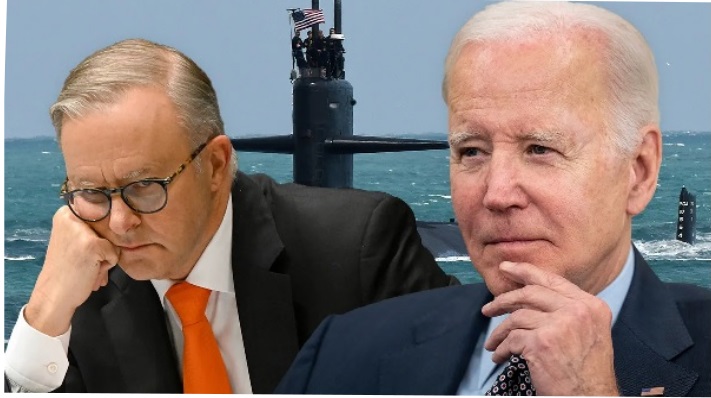
Congressional brawl threatens to overshadow Anthony Albanese’s US trip
The Age David Crowe. October 20, 2023
A political brawl in the United States is hurting Australian plans to persuade legislators to support the AUKUS pact on nuclear-powered submarines by casting doubt over whether Prime Minister Anthony Albanese will be able to meet senior Congressional leaders next week.
Albanese is due to fly to Washington DC on Sunday to hold talks with US President Joe Biden on the alliance and broader security issues as well as attending a state dinner at the White House on Wednesday night, the first for an Australian leader in four years.
The agenda for the state visit includes stronger cooperation on climate change, critical mineral supplies as well as the sharing of nuclear secrets for the AUKUS plan, which needs Congress to approve changes to the International Traffic in Arms Regulations, or ITAR, to allow the export of US knowledge and technology.
But the upheaval in the US capital, with the Republicans in disarray over whether Jim Jordan of Ohio should become Speaker of the House of Representatives, means there is no authority to approve an address to Congress and limited time for Albanese to meet top leaders…………..
Albanese is seeking meetings with Congressional leaders and the Australian ambassador to the US, Kevin Rudd, is planning a formal opening of the new embassy on Scott Circle, with guests including political and corporate leaders, and a business delegation from Australia.
While former prime minister John Howard addressed a joint sitting of Congress in 2005 and Julia Gillard did the same in 2011, a similar event appears unlikely for Albanese given the challenges with the Republican leadership…………………………………………………………………………..
Albanese is also due to meet Biden in the Oval Office and join the president in a meeting with cabinet secretaries at the White House, as well as meeting Secretary of State Antony Blinken at the State Department. https://www.theage.com.au/politics/federal/congressional-brawl-threatens-to-overshadow-anthony-albanese-s-us-trip-20231020-p5eds1.html
—
Antipodean Nuclear Free Zones: Testing Times for Antarctica and the South Pacific
October 19, 2023 https://nonproliferation.org/antipodean-nuclear-free-zones-testing-times-for-antarctica-and-the-south-pacific/
Australia and New Zealand have historically promoted strong anti-nuclear policies at both a global, regional, and sub-regional level. They joined with the United States and the other original parties to the 1959 Antarctic Treaty to make Antarctica nuclear free.
Both countries also took France to the International Court of Justice in 1973 in order to bring about a halt to France’s nuclear testing program in the South Pacific, and actively promoted the South Pacific Nuclear Free Zone in the 1985 Treaty of Rarotonga.
However, in 2021 Australia along with the UK and US announced the AUKUS initiative, which in March 2023 was finalized in San Diego. Australia will eventually acquire AUKUS nuclear-powered submarines during the 2030s.
This has placed a spotlight on Australia’s anti-nuclear credentials and its international law commitments and has attracted criticism from within the Asia Pacific, including from New Zealand, Pacific island states, and China. This seminar considers these issues through the lens of international law.
VIDEO – on original
Chapters:
00:00:00 Moderator: Avner Cohen, Professor, Nonproliferation and Terrorism Studies, Middlebury Institute of International Studies
00:01:44 Speaker: Donald R. Rothwell, Professor of International Law, ANU College of Law, Australian National University
00:57:07 Q&A
France attempts to pressure Australia to stop engaging with UN nuclear weapons ban treaty
https://www.icanw.org/france_pressures_australia_to_stop_engaging_with_un_nuclear_weapons_ban_treaty 2 Oct 23 #nuclear #anti-nuclear #Nuclear-Free #NoNukes
Recent statements by a French diplomat to “the Australian” newspaper criticizing Australia’s decision to observe the UN Treaty on the Prohibition of Nuclear Weapons (TPNW) reveal the panicked efforts by nuclear-armed states to undermine the treaty as support for the ban continues to grow. It also shows a European state with a dark colonial legacy continuing to exert pressure on the Pacific – an area heavily impacted by French nuclear testing – instead of respecting national sovereignty.
On 2 October an article in “the Australian” newspaper cited an unnamed French diplomat claiming that Australia’s support for the Treaty on the Prohibition of Nuclear Weapons “undermines the primacy of the Nuclear Non-Proliferation Treaty (NPT)” and “is contradictory with Australia’s ambition to reinforce its partnership with NATO.”
Both of these statements are not only hamfisted attempts at pressuring the Australian government away from the TPNW, they are also factually incorrect: The TPNW was carefully crafted to reinforce, complement, and build on the NPT, which obligates its parties – including France – to negotiate further legal measures to achieve nuclear disarmament under Article VI, and NATO members face no legal barrier to joining the treaty, so long as they commit not to engage in or support any nuclear-weapon-related activities. Moreover, several NATO partners are already TPNW parties (Austria, Ireland, Kazakhstan, Malta, Mongolia, New Zealand) or signatories (Algeria, Colombia).
These declarations show France’s mounting concern over the growing support for the TPNW. The statements themselves are no surprise, as France has stridently protested the TPNW ever since it was adopted at the UN in 2017 with the backing of 122 states. France insists it has a legitimate right under the NPT to possess nuclear weapons, while ignoring its commitments to pursue negotiations in good faith for nuclear disarmament under the same treaty. What is new is the fact that this pressure is being exerted publicly, and on a state that is largely seen as an ally on security issues. Previously, France has limited this kind of pressure for formerly colonised states, particularly in Africa.
Australia’s growing support for the TPNW
The Australian Labor Party, which has been in power since May 2022, adopted a resolution in 2018 committing it to sign and ratify the TPNW in government. This was moved by Anthony Albanese, who now serves as prime minister and has been a vocal supporter of the TPNW. He said at the time: “Our commitment to sign and ratify the nuclear weapon ban treaty in government is Labor at its best.” Labor reaffirmed this position in 2021 and most recently on 18 August 2023. The government also has confirmed its intention to observe the treaty’s upcoming meeting of states parties in New York (2MSP) and is evaluating whether to sign and ratify the treaty.
This is an encouraging step, but ICAN’s Executive Director, former Labor MP Melissa Parke, has criticised the government’s delay in ratifying the treaty: “It’s not enough to keep promising to sign the treaty without acting. We want to see the Prime Minister put pen to paper, without delay. Labor’s commitment on nuclear disarmament and non-proliferation will be hollow if Australia fails to do so.”
Speaking to the revelation that French diplomats are exerting pressure on Australia to consider, she said: “Our two countries have never seen eye to eye on nuclear weapons. France shouldn’t be lecturing Australia on nuclear policy. We can make our own decisions, in our own interests – and for the global common good.”
France’s unresolved nuclear legacy in the Pacific
From 1966 to 1996, France tested 193 nuclear weapons in Maohi Nui/French Polynesia, a Self Governing Territory of France in the Pacific. In 1974, Australia famously took France to the International Court of Justice in a bid to force an end to its atmospheric nuclear testing in the Pacific, as the impacts of nuclear weapons are not contained by national borders. Yet France only ended its Pacific nuclear test explosions once it was confident it had developed non-explosive testing methods sufficiently for new weapons development, and it refuses to acknowledge and address the catastrophic legacy of its nuclear tests to this day.This legacy is also a subject of hot debate at the national level in France. On 28 September, only days before France’s criticisms of Australia, the assembly of French Polynesia unanimously adopted a resolution supporting the TPNW, highlighting the region’s history as the site of numerous French nuclear tests. The resolution underscores the TPNW as a humanitarian disarmament treaty and emphasises the deep concerns of the French Polynesian population regarding this issue. While French Polynesia cannot currently access the assistance and rehabilitation outlined in Articles 6 and 7 of the TPNW due to France’s non-ratification, it sends a resounding message in favour of the treaty to Paris.
Pacific island States support the Treaty on Prohibition of Nuclear Weapons – a problem for Australia in joining AUKUS nuclear military alliance

French criticism of nuclear ban treaty highlights Canberra’s dilemma #nuclear #anti-nuclear #nuclear-free #NoNukes
The Interpreter, NIC MACLELLAN, 2 Oct 23
Can Australia rebuild a strategic military partnership with France at
the same time as independence movements claim Pacific support?
On 28 September, the Assembly of French Polynesia unanimously passed a resolution endorsing the Treaty on the Prohibition of Nuclear Weapons (TPNW), the nuclear ban treaty that entered into force in 2021. Even though France refuses to sign the treaty, and still controls the defence and foreign policy of French Polynesia, the local legislature in Tahiti with its new pro-independence government sees TPNW as setting a new norm in international law. The resolution encourages “the participation of France as an observer state at the next TPNW Meeting of the States Parties”, to be held in New York in late November. It also calls on the French government to “work towards France’s adherence to this new international norm.”
A key reason for this pointed message to Paris are the TPNW provisions that call for assistance to nuclear survivors and clean-up of contaminated nuclear test sites. The Ma’ohi people are still seeking compensation for the health and environmental effects of 193 French nuclear tests at Moruroa and Fangataufa.
Beyond this, French Polynesia’s critique of nuclear weapons echoes the views of the majority of members of the Pacific Islands Forum. Unlike Australia, nine independent Pacific Island countries and Aotearoa-New Zealand have already signed and ratified the TPNW.
At the recent Australian Labor Party (ALP) National Conference in Brisbane, the party re-confirmed its support for signing the TPNW – under restrictive conditions – and agreed to send an observer to the next Meeting of State Parties. However key ALP leaders are opposed to signing, and nuclear weapons states such as the United States and France, having long derided the treaty, are now ramping up their opposition to it.
A front-page story in The Australian on 2 October cited an unnamed French diplomat who criticised Australia over its tentative moves towards signing TPNW, though the story fails to mention last week’s resolution from the Assembly of French Polynesia…………………………………………….
the Australian government has held a series of meetings with key French ministers to rebuild relations disrupted by AUKUS, including a summit between Defence Minister Richard Marles and French counterpart Sebastien Lecornu in September 2022, and a 2+2 meeting of defence and foreign ministers in January. Marles and Lecornu are organising the South Pacific Defence Ministers meeting in Noumea in December, to the dismay of the FLNKS independence movement, which is in the midst of talks with the French state over a new political status for New Caledonia.
Last year, Marles congratulated Emmanuel Macron on his re-election to the French presidency, proclaiming “France is our neighbour. France is a Pacific country. And as such, France deeply matters to Australia.”
But France is a European colonial power, not a Pacific country. It is recognised by the United Nations as the administering power of non-self-governing territories. It has responsibilities for decolonisation under international law. Australian governments may be reluctant to talk publicly about this, but the issue of self-determination is firmly on the regional agenda, posing difficult choices for all Forum member countries (as shown by recent debates over West Papua, Bougainville, Guam, etc).
Another problem is that, in both Australia and France, the perspectives of leaders from Francophone island communities are usually missing from the public debate about France’s role in Indo-Pacific security. It’s rare to see the media or think tanks cite President Louis Mapou of New Caledonia or newly elected President Moetai Brotherson of French Polynesia. Both will be attending the next Pacific Islands Forum summit in Rarotonga as it discusses regional security – for the first time, leaders from both French territories in the Forum are supporters of independence and sharp anti-nuclear critics.
So, can Australia rebuild a strategic military partnership with France at the same time as its Pacific neighbours are seeking an independent and sovereign state?
As Penny Wong travelled to Noumea last April, becoming the first Australian Foreign Minister to address the Congress of New Caledonia, Mapou was eager to strengthen ties with Canberra around trade, investment and people-to-people engagement. He also diplomatically highlighted key differences around Australia’s close alignment with the United States under the AUKUS partnership:
The independence movement of New Caledonia – of which I’m a member – is in favour of non-alignment. We regularly attend the summits of the Non-Aligned Movement. From the earliest days, we have supported a nuclear free Pacific – that’s even set out in the preamble of the draft Constitution of Kanaky that we submitted to the United Nations in 1986. When Australia decides to align itself with the United States in the framework of AUKUS to acquire nuclear submarines, it raises the question: if it starts here, where will it end? How does this impact the Treaty of Rarotonga and the Boe Declaration on security?
The Albanese government has proclaimed its support for a world without nuclear weapons. But talk is easy. It’s getting harder for the ALP government to balance tensions between its role as an AUKUS partner, a strategic partner with France and the “security partner of choice” for the island nations of the Pacific, which are deeply opposed to nuclear weapons. Why should Australia side with a European colonial power against its closest neighbours? https://www.lowyinstitute.org/the-interpreter/french-criticism-nuclear-ban-treaty-highlights-canberra-s-dilemma
1 This month
17 October, Free Public Talk on Nuclear Issues in South Australia
David Noonan will speak on public interest concerns over the new Roxby Downs Indenture Act 2026 on BHP copper-uranium mining and ore processing in SA, and on how AUKUS may face SA with a High-Level nuclear waste agenda.
Dr Jim Green will discuss international developments in the field of nuclear power including ‘small modular reactors’ and Generation 4 ‘advanced’ nuclear reactor concepts.


Help Aunty Sue Protect Her Land and Sacred Sites From Destructive Rocket Testing.
.

Australians deserve the truth
about
AUKUS – https://aukuspublicinquiry.com/

PETITION – To: Prime Minister Anthony Albanese and the Australian Labor Government

of the week – Australians for War Powers Reform (AWPR)
To see nuclear-related stories in greater depth and intensity

