Mission to Free Assange: Australian Parliamentarians in Washington
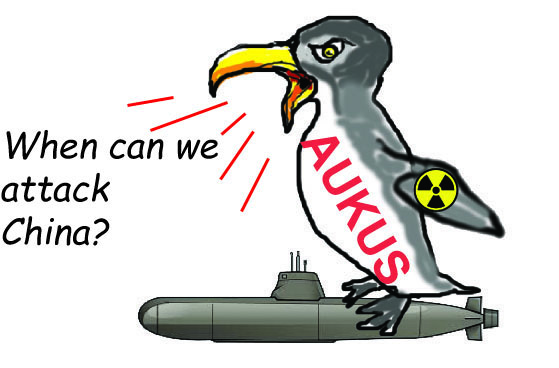
Australia remains the prized forward base of US ambitions in the Indo-Pacific, the spear pointed against China and any other rival who dares challenge its stubborn hegemony. The AUKUS pact, featuring the futile, decorative nuclear submarines …………also makes that point all too clear.
September 24, 2023, Dr Binoy Kampmark, https://theaimn.com/mission-to-free-assange-australian-parliamentarians-in-washington/
It was a short stint, involving a six-member delegation of Australian parliamentarians lobbying members of the US Congress and various relevant officials on one issue: the release of Julian Assange. If extradited to the US from the United Kingdom to face 18 charges, 17 framed with reference to the oppressive, extinguishing Espionage Act of 1917, the Australian founder of WikiLeaks risks a 175-year prison term.
Nationals MP Barnaby Joyce, Labor MP Tony Zappia, Greens Senators David Shoebridge and Peter Whish-Wilson, Liberal Senator Alex Antic and the independent member for Kooyong, Dr. Monique Ryan, are to be viewed with respect, their pluckiness admired. They came cresting on the wave of a letter published on page 9 of the Washington Post, expressing the views of over 60 Australian parliamentarians. “As Australian Parliamentarians, we are resolutely of the view that the prosecution and incarceration of the Australian citizen Julian Assange must end.”
This is a good if presumptuous start. Australia remains the prized forward base of US ambitions in the Indo-Pacific, the spear pointed against China and any other rival who dares challenge its stubborn hegemony. The AUKUS pact, featuring the futile, decorative nuclear submarines that will be rich scrapping for the Royal Australian Navy whenever they arrive, also makes that point all too clear. For the US strategist, Australia is fiefdom, property, real estate, terrain, its citizenry best treated as docile subjects represented by even more docile governments. Assange, and his publishing agenda, act as savage critiques of such assumptions.
The following views in Washington DC have been expressed by the delegates in what might be described as a mission to educate. From Senator Shoebridge, the continued detention of Assange proved to be “an ongoing irritant in the bilateral relationship” between Canberra and Washington. “If this matter is not resolved and Julian is not brought home, it will be damaging to the bilateral relationship.”
Senator Whish-Wilson focused on the activities of Assange himself. “The extradition of Julian Assange as a foreign journalist conducting activities on foreign soil is unprecedented.” To create such a “dangerous precedent” laid “a very slippery slope for any democracy to go down.”
Liberal Senator Alex Antic emphasised the spike in concern in the Australian population about wishing for Assange’s return to Australia (some nine out of 10 wishing for such an outcome). “We’ve seen 67 members of the Australian parliament share that message in a joint letter, which we’ve delivered across the spectrum.” An impressed Antic remarked that this had “never happened before. I think we’re seeing an incredible groundswell, and we want to see Julian at home as soon as possible.”
On September 20, in front of the Department of Justice, Zappia told reporters that, “we’ve had several meetings and we’re not going to go into details of those meetings. But I can say that they’ve all been useful meetings.” Not much to go on, though the Labor MP went on to state that the delegation, as representatives of the Australian people had “put our case very clearly about the fact that Julian Assange pursuit and detention and charges should be dropped and should come to an end.”
A point where the delegates feel that a rich quarry can be mined and trundled away for political consumption is the value of the US-Australian alliance. As Ryan reasoned, “This side of the AUKUS partnership feels really strongly about this and so what we expect the prime minister [Anthony Albanese] to do is that he will carry the same message to President Biden when he comes to Washington.”
The publisher’s brother, Gabriel Shipton, also suggests that the indictment is “a wedge in the Australia-US relationship, which is a very important relationship at the moment, particularly with everything that’s going on with the US and China and the sort of strategic pivot that is happening.” Assange, for his part, is bound to find this excruciatingly ironic, given his lengthy battles against the US imperium and the numbing servility of its client states.
Various members of Congress have granted an audience to the six parliamentarians. Enthusiasm was in abundance from two Kentucky Congressmen: Republican Senator Rand Paul and Republican House Representative Thomas Massie. After meeting the Australian delegation, Massie declared that it was his “strong belief [Assange] should be free to return home.”
Georgian Republican House member Marjorie Taylor Greene expressed her sense of honour at having met the delegates “to discuss the inhumane detention” of Assange “for the crime of committing journalism,” insisting that the charges be dropped and a pardon granted. “America should be a beacon of free speech and shouldn’t be following in an authoritarian regime’s footsteps.” Greene has shown herself to be a conspiracy devotee of the most pungent type, but there was little to fault her regarding these sentiments.
Minnesota Democrat Congresswoman Ilhan Omar also met the parliamentarians, discussing, according to a press release from her office, “the Assange prosecution and its significance as an issue in the bilateral relationship between the United States and Australia, as well as the implications for freedom of the press both at home and abroad.” She also reiterated her view, one expressed in an April 2023 letter to the Department of Justice co-signed with six other members of Congress, that the charges against Assange be dropped.
These opinions, consistent and venerably solid, have rarely swayed the mad hatters at the Justice Department who continue to operate within the same church consensus regarding Assange as an aberration and threat to US security. And they can rely, ultimately, on the calculus of attrition that assumes allies of Washington will eventually belt up, even if they grumble. There will always be those who pretend to question, such as the passive, meek Australian Foreign Minister, Penny Wong. “We have raised this many times,” Wong responded to a query while in New York to attend the United Nations General Assembly. “Secretary [of State Antony] Blinken and I both spoke about the fact that we had a discussion about the views that the United States has and the views that Australia has.”
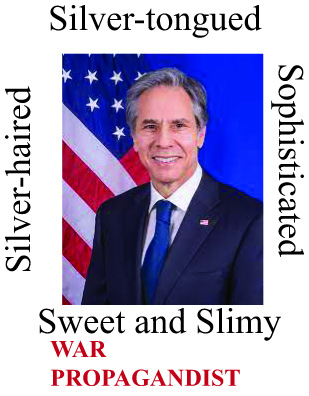
Not that this mattered a jot. In July, Blinken stomped on Wong’s views in a disingenuous, libellous assessment about Assange, reminding his counterpart that the publisher had been “charged with very serious criminal conduct in the United States in connection with his alleged role in one of the largest compromises of classified information in the history of our country.” The libel duly followed, with the claim that Assange “risked very serious harm to our national security, to the benefit of our adversaries, and put named sources at grave risk – grave risk – of physical harm, and grave risk of detention.” That gross falsification of history went unaddressed by Wong.
Thus far, Blinken has waived away the concerns of the Albanese government on Assange’s fate as passing irritants at a spring garden party. However small their purchase, six Australian parliamentarians have chosen to press the issue further. At the very least, they have gone to the centre of the imperium to add a bit of ballast to the effort.
Chris Hedges: Craig Murray on the ‘Slow Motion Execution’ of Assange
And I saw, 100% for certain, that the judge came into court with her ruling already typed out before she heard the arguments, and she sat there almost pretending to listen to what the defense was saying for now and what the prosecution was saying for now. Then she simply read out the ruling.
Chris Hedges: She’s like the Queen of Hearts in Alice in Wonderland giving the verdict before she hears the sentence.
SCHEERPOST, September 17, 2023
Julian Assange continues to fight extradition to the United States to face prosecution under the Espionage Act, a growing chorus of voices is rising to demand an end to his persecution. Hounded by US law enforcement and its allies for more than a decade, Assange has been stripped of all personal and civil liberties for the crime of exposing the extent of US atrocities during the War on Terror. In the intervening years, it’s become nakedly apparent that the intent of the US government is not only to silence Assange in particular, but to send a message to whistleblowers and journalists everywhere on the consequences of speaking truth to power. Former British ambassador to Uzbekistan, Craig Murray, who was fired for exposing the CIA’s use of torture in the country, joins The Chris Hedges Report to discuss what Julian Assange’s fight means for all of us.
TRANSCRIPT
Chris Hedges: Craig Murray, the former British ambassador to Uzbekistan, was removed from his post after he made public the widespread use of torture by the Uzbek government and the CIA. He has since become one of Britain’s most important human rights campaigners and a fierce advocate for Julian Assange as well as a supporter of Scottish independence. His coverage of the trial of former Scottish first minister Alex Salman, who was acquitted of sexual assault charges, saw him charged with contempt of court and sentenced to eight months in prison. The very dubious sentence, half of which Craig served, upended most legal norms. He was sentenced, supporters argued, to prevent him from testifying as a witness in the Spanish criminal case against UC global director, David Morales, being prosecuted for installing a surveillance system in the Ecuador embassy when Julian Assange found refuge that was used to record the privileged communications between Julian and his lawyers.
Morales is alleged to have carried out this surveillance on behalf of the CIA. Murray has published some of the most prescient and eloquent reports from Julian’s extradition hearings and was one of a half dozen guests, including myself, invited to Julian and Stella’s wedding in Belmarsh Prison in March 2022. Prison authorities denied entry to Craig, based on what the UK Ministry of Justice said were security concerns, as well as myself from attending the ceremony.
Joining me to discuss what is happening to Julian Assange and the rapid erosion of our most basic democratic rights is Craig Murray.
And to begin, Craig, I read all of your reports from the trial which are at once eloquent and brilliant. It’s the best coverage that we’ve had of the hearings. But I want you to bring us up to date with where we are with the case at this moment.
Craig Murray: Yeah. The legal procedures have been extraordinarily convoluted after the first hearings for the magistrate ruled that Julian couldn’t be extradited, on essentially, health grounds. Due to the conditions in American prisons, the US then appealed against that verdict. The high court accepted the US appeal on extraordinarily dubious grounds based on a diplomatic note giving certain assurances which were conditional and based on Julian’s future behavior. And of course, the US government has a record of breaking such assurances, and also, those assurances could have been given at the time of the initial hearing and weren’t.
Chris Hedges: I don’t think those assurances have any… It was a diplomatic note. It has no legal validity.
Craig Murray: It has no legal validity. It’s not binding in any sense. And as I say, it is in itself conditional. It states that they may change this in the future. It actually says that –
Chris Hedges: Well, based on his behavior.
Craig Murray: – Based on his behavior, which they will be the sole judges of.
Chris Hedges: Of course.
Craig Murray: And which won’t involve any further legal process. They will decide he’s going into a supermax because they don’t like the way he looks at guards or something. It’s utterly meaningless. And so the US, having won that appeal so Julian could be extradited, it was then Julian’s turn to appeal on all the points he had lost at the original extradition. Those include the First Amendment, they include freedom of speech, obviously, and they include the fact that the very extradition treaty under which he’s being extradited states that there shall be no political extradition and this is plainly a very political case and several other important grounds. That appeal was lodged. Nothing then happened for a year. And that appeal is an extraordinary document. You can actually find it on my website, CraigMurray.org.uk.
I’ve published the entire appeal document and it is an amazing document. It’s an incredible piece of legal argument. And some of the things it sets out like the fact that the US key witness for the charges was an Icelandic guy who they paid for his evidence. They paid him for his evidence and he is a convicted pedophile and convicted fraudster. And since he has said he lied in his evidence and he just did it for the money. That’s one example of the things you find. The documentation is not dry legal documentation at all. It’s well worth going and looking through Julian’s appeal. That appeal ran to 150 pages plus supporting documents.
For a year, nothing happened. Then two or three months ago it was dismissed in three pages of double-spaced A4, in which the judge, Judge Swift, said that there were no legal arguments, no coherent legal arguments in this 150 pages and it followed no known form of pleading and it was dismissed completely. And the thing is that the appeal was written by some of the greatest lawyers in the world. It’s supervised and written by Gareth Pierce, who I would say is the greatest living human rights lawyer. Those people have seen the film In the Name of the Father, starring Daniel Day-Lewis…………………………………….
She’s won numerous high-profile cases. She has enormous respect all around the world and this judge, who is nobody, is saying that there’s no validity to her pleadings which follow no known form of pleading. This is quite extraordinary.
Chris Hedges: Am I correct in that he was a barrister, essentially, for the defense ministry? He was served the interests of the UK government and that’s essentially got him his position. Is that correct?
Craig Murray: Exactly. He was the lead barrister for the security services. Well, he was a banister who specialized in working for the security services.
……………………………………………………And I saw, 100% for certain, that the judge came into court with her ruling already typed out before she heard the arguments, and she sat there almost pretending to listen to what the defense was saying for now and what the prosecution was saying for now. Then she simply read out the ruling.
Chris Hedges: She’s like the Queen of Hearts in Alice in Wonderland giving the verdict before she hears the sentence.
……………………………..On the most basic level, the evisceration of attorney-client privilege because UC Global recorded the meetings between Julian and his lawyers, that in a UK court, as in a US court alone, should get the trial invalidated
Craig Murray: In any democracy in the world, if your intelligence services have been recording the client’s attorney consultations, that would get the case thrown out. ………………………….
……………………………………………………………………………………………………………….at times it seemed as though they were deliberately doing things as slowly as possible.
Chris Hedges: Well, this is what Neils Melzer, the special repertoire on torture for the UN, said that he called it, a slow motion execution, were his words.
………………………………..Craig Murray: It was because of my advocacy for and friendship with Julian. That’s why they put me in jail. I was in the cell, my cell was 12 feet by eight feet which is slightly larger than Julian’s cell, and I was kept in solitary confinement for 23 hours a day, sometimes 23.5 hours a day for four months. And that’s extremely difficult. It’s extremely difficult. But I knew when I was leaving, I had an end date. To be in those conditions as Julian has been for years and years and no idea if it will ever stop, no idea if you’ll ever be let out alive, let alone not having an end date, I can’t imagine how psychologically crushing that would be……………………………………………………………………………….
Craig Murray: The immediate thing that will happen is that Julian’s lawyers will try to go to the European Court in Strasbourg –
Chris Hedges: To the European Court of Human Rights.
Craig Murray: – The European Court of Human Rights to submit an appeal and get the extradition stopped, pending an appeal. The worry is that Julian would instantly be extradited and that the government wouldn’t wait to hear from a European Court.
Chris Hedges: Explain to Americans what it is and what jurisdiction it has in the UK, the European Court.
Craig Murray: Yeah, the European Court of Human Rights is not a European Union body. It’s a body of the Council of Europe. It has jurisdiction over the European Convention on Human Rights which guarantees basic human rights and therefore it has legally binding jurisdiction over human rights violations in any member state of the treaty. So it does have a legally binding jurisdiction and is acknowledged as such, normally, by the UK government. They’re very powerful voices within the current conservative government in the UK which wants to exit the convention on human rights. But at present, that’s not the case. The UK is still part of this system. And so the European Court of Human Rights has legally binding authority over the government of the United Kingdom purely on matters that contravene human rights.
Chris Hedges: And if they do extradite him, they’ve essentially nullified that process, the fear is that, of course, the security services would know about the ruling in advance. He’d be on the tarmac and shuttled in, sedated, and put in a diaper and hooded or something and put on a CIA flight to Washington. I want to talk about if that happens. It’s certainly very possible. What we need to do here, and I know part of the reason you’re in the US, is to prepare for that should it take place. You will try and cover the hearings and trial here as you did in the UK but let’s talk about where we go if that event occurs.
Craig Murray: Yeah. The first thing to say is that if that happens, on the day it happens, it will be the biggest news story in the world; It would be a massive news story. So we have to be prepared. We have to know who, from the Assange movement or who from his defense team, who’s going to be the spokesman, who are going to be the spokespeople, who are going to be offered up to all the major news agencies? We have to affect the story on day one. Because if you get behind the story – And we know what their line will be. They’ll put out all these lies about people being killed because of WikiLeaks, about the American insecurity being endangered, we know all the propaganda that they will try to flood the airwaves with – So we need to be ready and ahead of the game to know who our people are, who are going to be offered up to interview, who are going to proactively get onto the media, and not just the alternative media like this media, but onto the so-called mainstream as well, and get out the story…………………………………………………………………………………………………………………………………………………………………
Chris Hedges. ………………….my reading of it is that they don’t care how they look. And part of it is to send a message. It doesn’t matter what nationality you are, it doesn’t matter where you are. WikiLeaks is not a US-based publication, it doesn’t matter where you are. If you expose the information that Julian and WikiLeaks exposed, we’re going to come for you. Isn’t that the message?
Craig Murray: That’s absolutely right. And this, again, it’s amazing they don’t see the dangers in this claim of universal jurisdiction. …………………….
This claim of universal jurisdiction is extraordinary. And what’s even more extraordinary is they’re claiming universal jurisdiction but Julian is under their jurisdiction because he published American Secrets even though he’s not an American and he wasn’t in America. And at the same time, while they claim jurisdiction over him, they’re claiming he has no First Amendment rights because he’s an Australian.
The combination of we have jurisdiction over you, you have all the liabilities that come with that but you have none of the rights that come with that because you’re not one of our citizens, that’s pernicious. It’s so illogical and so vicious. …………………………………………
Chris Hedges: I want to close because there’s been noise out of Australia. The ambassador, Carolyn Kennedy, said that they might consider a plea deal. I have put no credence in it. It’s all smoke but I wondered what you thought.
Craig Murray: Yeah. It’s an attempt to placate Australian public opinion. Public opinion in Australia is extremely strong. Over 80% of Australians want Julian released and allowed to go home to Australia. Blinken came there and made some very hostile and un-diplomatic remarks at a time when Australia was allowing the US to base nuclear weapons on its side. Caroline Kennedy came out… It’s a lie, frankly. There has been no approach from a justice department or from the State Department to doing any plea deal. It’s purely smoke and mirrors to try to distract the Australian public. Caroline Kennedy was lying to the Australian public. That’s pure and simple.…………..
Eating the three-eyed fish: where is Australia on nuclear wastewater in the Pacific?

As is usual in this framing, the peoples of the Pacific – the people impacted most by the decisions of rich, developed nations sitting on the edge of the vast ocean home of the Pacific Islands – have been ignored.
Our “Pacific family” is no doubt, once again, deeply disappointed by Australian inaction and acquiescence. A government “committed” to the Pacific is apparently not entirely on board with supporting the aspirations of its peoples – at least not when it comes to their aspirations to not live in a radioactive ocean.
by Emma Shortis https://australiainstitute.org.au/post/eating-the-three-eyed-fish-where-is-australia-on-nuclear-wastewater-in-the-pacific/00
The Australian government’s muted response to Japan’s release of Fukushima wastewater into the Pacific raises serious questions about its commitment to the region and Australia’s history of standing against nuclear testing.
In August, Japan began what will be a decades-long process of releasing more than one million tons of treated wastewater from the Fukushima nuclear meltdown into the Pacific Ocean.
Though deemed in compliance with international safety standards by the International Atomic Energy Agency (IAEA), the release of water containing tritium – a form of radioactive hydrogen – has been met with significant opposition.
Most of that opposition has come, unsurprisingly, from China. In June, a Chinese foreign ministry spokesperson said that the “ocean is humanity’s common good, not Japan’s private sewer.”
Opposition from Japan’s other neighbours and allies, meanwhile, has been muted. After expressing significant concerns, the governments of nearby nations like Korea have apparently been assuaged by promises of regulatory compliance – notwithstanding the continued opposition of local environmental and industry groups.
What appears to have happened is that the release of irradiated water into the world’s biggest ocean has been drawn all too quickly into either side of the now well-worn battle lines of “strategic competition” in the Indo-Pacific. Opposition and acquiescence fell easily, and predictably, into the binary framing of US President Biden’s world of democracies versus autocracies. So the focus of dissent has been on China.
As is usual in this framing, the peoples of the Pacific – the people impacted most by the decisions of rich, developed nations sitting on the edge of the vast ocean home of the Pacific Islands – have been ignored.
Pacific Islander peoples have been expressing their significant, historically grounded concerns about the Fukushima release since the plan was announced. In June, a member of the Pacific Islands Forum independent panel of experts, appointed to support the Pacific Islands in consultations with Japan over the release, questioned the IAEA sign-off, arguing that “the critical, foundational data upon which a sound decision could be made was either absent or, when we started getting more data…extremely concerning.”
The “unanimous conclusion” of the expert panel was that “this is a bad idea that is not defended properly at this point, and that there are alternatives that Japan should really be looking at.”
So where is Australia, an apparently critical player in the stability and prosperity of the Indo-Pacific, in all this?
This country, we have long been told, is “committed to our Pacific family, and to working together to realise our shared vision for a stable, secure and prosperous region, and to support the aspirations of Pacific island countries.”
But in a short statement released by the Department of Foreign Affairs and Trade just before the wastewater release began, the Australian government expressed “confidence in the process that has led to the decision by Japan to release the treated water.” In February, Foreign Minister Penny Wong acknowledged the concerns of Pacific Islanders, but was assured that “transparency and trust” were in place. In a move redolent of an iconic Simpsons episode, diplomatic staff at the Australian Embassy in Tokyo even went so far as to enjoy a meal of “Fukushima fish and chips”.
Our “Pacific family” is no doubt, once again, deeply disappointed by Australian inaction and acquiescence. A government “committed” to the Pacific is apparently not entirely on board with supporting the aspirations of its peoples – at least not when it comes to their aspirations to not live in a radioactive ocean.
This muted reaction is doubly disappointing from a country, and a party, that has a long and proud history of both contesting nuclear activity in the Pacific and standing up to Japanese efforts to trample environmental consensus.
For decades, and particularly in the 1990s, Australian labor governments stood alongside Pacific Island nations in furiously contesting French nuclear testing. Stretching into the 2000s, Australian governments remained staunch in their opposition to Japanese “scientific” whaling. In both cases, Australia successfully expressed significant opposition to the damaging actions of an important strategic ally. In both cases, that opposition was mostly contained to the specific issue at hand, and did not impinge on broader security relationships – which, even if they became tense, never broke down completely and have now fully recovered.
In the same Department that joyously expressed its “confidence” in Japan and effectively ignored its “family” in the Pacific, there is – or at least there should be – deep institutional knowledge of how to manage strong disagreements and successfully cordon them off from deeper security ties. Our history should make us confident that we can – and should – share and support the legitimate, evidence-based anger of our Pacific family.
So why isn’t the Australian government condemning, loudly, the release of nuclear wastewater into the world’s largest ocean?
As is becoming increasingly clear, the Labor Party’s decision to support the Morrison government’s pursuit of nuclear-powered submarines has far-reaching consequences. That decision, made within a matter of hours, has unthinkingly shattered many labor traditions – the most relevant of which here is that long, proud history of labor governments unapologetically standing against rich and powerful nuclear powers treating the Pacific as a dumping ground.
The insistence that Australia “needs” AUKUS has apparently created a reluctance to engage in that discussion in good faith, most likely to avoid the topic of nuclear waste as much as possible – now, because of Labor’s doubling down on AUKUS, a sensitive topic domestically.
AUKUS also points to another factor – this government’s extreme insecurity over issues of foreign and security policy. As was made clear at Labor’s recent national conference, party leadership is determined not to be wedged on issues of national security. Despite all the talk of being able to have “adult conversations”, the government is not willing to allow even the slightest appearance of concession to China, around which every aspect of foreign and security policy now revolves. While on paper, wastewater dumping looks like it should fall into Wong’s category of “cooperate where we can”, in reality, we cannot be opposed to something China opposes, because we are not, and can never be, on the same side about anything – even if that thing is the dumping of radioactive wastewater into the Pacific.
This framing of a world divided into enemies and allies now extends into all of Australia’s relationships. The Australian government’s reaction to the Fukushima release, and its broader relationship with Japan, make that abundantly clear. As a member of the Quad, alongside India and the United States, Japan is regarded as critical to “stability” in the Indo-Pacific and to countering or containing China. That now means, apparently, that Japan can effectively dictate Australian policy – it can be assured of our “confidence” that dumping radioactive water in the Pacific Ocean is fine, actually, and that also, we’d better not even consider phasing out the export of fossil gas to a critical ally, lest we undermine our own security and the stability of our region.
Taken together, all of this – bad faith engagement with the Pacific, AUKUS, and the ongoing insistence that our own use and export of fossil fuels is necessary to regional stability – reveal a deeply uncomfortable truth about this labor government.
Despite all assurances to the contrary, it does not take climate change seriously. Nor does it take nuclear hygiene seriously. And questions have to be asked about its long-term commitment to nuclear disarmament.
Like its predecessors, this government is hiding behind security in order to avoid doing the hard work on climate. That weakness, which extends across all areas of domestic and international policy, is why the Australian government is not “committed” to “our Pacific family”, not really.
In failing to support Pacific Islanders’ aspirations for a nuclear-free Pacific, and in failing to rapidly decarbonise, the Australian government shows “our family” who we are, every day. And they see it.
This, in the words of the Prime Minister, is how Australia deals with “the world as it is.” Our Pacific family could be forgiven for thinking that our vision of a “bright future” for the world is one in which nuclear-powered submarines prowl silently through a rising, irradiated Pacific.
Two years after AUKUS announcement, American politicians are divided on delivery of submarines to Australia
ABC By North America bureau chief Jade Macmillan in Washington DC, 16 Sept 23
A Republican senator has renewed calls for the US to step up its production of nuclear-powered submarines before selling them as part of AUKUS, arguing America is as “unprepared” as it was ahead of the Pearl Harbor attack.
The US is set to transfer at least three Virginia-class submarines to Australia from the early 2030s under the AUKUS agreement.
However, the top Republican on the Senate Armed Services committee, Roger Wicker, told a hearing in Washington this week that the US was failing to meet its own shipbuilding targets.
“We should be producing somewhere between 2.3 and 2.5 attack submarines a year to fulfil our own requirements as we implement AUKUS,” he said………….
Senator Wicker insists he supports the AUKUS agreement but has refused to back legislation in congress authorising the transfer of the submarines, arguing substantial new investments are needed in America’s shipbuilding capacity first.
In a letter to the president last month, he and 24 other Republicans argued selling submarines to Australia without a clear plan to replace them would “unacceptably weaken” the US fleet at the same time that China expands its military power.
Push for speed amid prospect of another Trump term
The AUKUS agreement will see Australia obtain up to five Virginia-class submarines from the US before eventually building its own nuclear-powered boats.
But two years after the deal was first announced, the US Congress still needs to sign off on several legislative proposals to progress it.
They include legislation to approve the sale of the subs, to allow Australia to make a promised $3 billion contribution to US shipyards, and to facilitate the sharing of sensitive technology………………………………………………………………………………………………
The political debate in the United States comes amid ongoing questions in Australia about the merits and the cost of AUKUS, which could have a price tag of up to $386 billion…………………………
Tensions within the Labor Party were exposed at its recent national conference, while former prime minister Paul Keating has described the agreement as the “worst deal in all history”.

Australian Defence Minister Richard Marles also previously expressed confidence in the level of bipartisan support for the agreement in the US………………………………
63 Members of Parliament call on US to free Assange
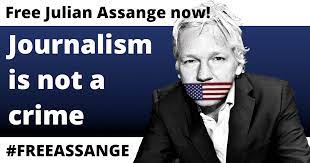
Sixty-three MPs and senators have written a strong letter calling on the US to stop persecuting WikiLeaks founder Julian Assange and warning of ‘a sharp and sustained outcry in Australia’ if he is extradited from the UK
ENOUGH IS ENOUGH’
Sixty-three Australian MPs and senators have signed a letter demanding that “the prosecution and incarceration of the Australian citizen Julian Assange must end”, Guardian Australia reports, warning it is eroding our respect for the US justice system.
The WikiLeaks founder, who is languishing in the UK’s Belmarsh prison, has suffered for a decade in various states of incarceration — it’s “wrong”, “serves no purpose” and is “unjust” for him to be further persecuted, they wrote. The US wants him on charges under the Espionage Act because of the publication of hundreds of thousands of documents on the Iraq and Afghanistan wars. But if he is extradited, “there will be a sharp and sustained outcry in Australia”.
The latest supporters included Labor’s Shayne Neumann and Louise Pratt, and the Coalition’s Melissa Price, and Opposition leader Peter Dutton has also called for Assange’s return. A bipartisan Assange delegation leaves for Washington next week. https://www.crikey.com.au/2023/09/14/63-mps-letter-us-free-assange/
Educating the US Imperium: Australia’s Mission for Assange
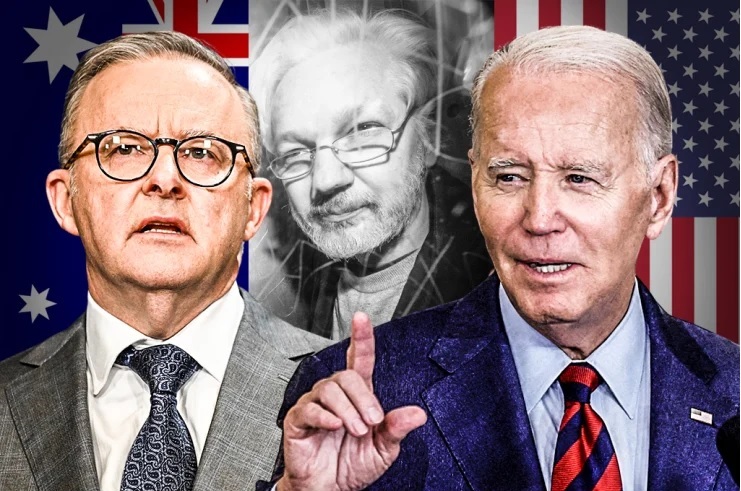
Then there is the issue of whether the delegation’s urgings will have any purchase beyond being a performing flea act. US State Department officials remain glacial in their dismissal of Canberra’s “enough is enough” concerns and defer matters to the US Department of Justice. The unimpressive ambassador Kennedy has been the perfect barometer of this sentiment: host Australian MPs for lunch, keep up appearances, listen politely and ignore their views. Such is the relationship between lord and vassal.
September 6, 2023 Dr Binoy Kampmark https://theaimn.com/educating-the-us-imperium-australias-mission-for-assange/
An odder political bunch you could not find, at least when it comes to pursuing a single goal. Given that the goal is the release of WikiLeaks publisher Julian Assange makes it all the more striking. Six Australian parliamentarians of various stripes will be heading to Washington ahead of Prime Minister Anthony Albanese’s October visit to test the ground of empire, maybe even plant a few seeds of doubt, about why the indictment against their countryman should be dropped.
That indictment, an outrageous, piffling shambles of a document comprising 18 charges, 17 based on that nasty, brutish statute, the Espionage Act of 1917, risks earning Assange a prison sentence in the order of 175 years. But in any instrumental sense, his incarceration remains ongoing, with the United Kingdom currently acting as prison warden and custodian.
In the politics of his homeland, the icy polarisation that came with Assange’s initial publishing exploits (former Australian Prime Minister Julia Gillard was convinced Cablegate was a crime) has shifted to something almost amounting to a consensus. The cynic will say that votes are in the offing, if not at risk if nothing is done; the principled will argue that enlightenment has finally dawned.
The Australian Prime Minister Anthony Albanese and the Opposition leader, Peter Dutton, agree on almost nothing else but the fact that Assange has suffered enough. In Parliament, the tireless work of the independent MP from Tasmania, Andrew Wilkie, has bloomed into the garrulous Bring Julian Assange Home Parliamentary Group.
The Washington mission, which will arrive in the US on September 20, comprises former deputy prime minister Barnaby Joyce, the scattergun former Nationals leader, Labor MP Tony Zappia, Greens Senators David Shoebridge and Peter Whish-Wilson, Liberal Senator Alex Antic and the competent independent member for Kooyong, Dr. Monique Ryan.
What will be said will hardly be pleasing to the ears of the Washington establishment. Senator Shoebridge, for instance, promises to make the case that Assange was merely telling the truth about US war crimes, hardly music for guardians from Freedom’s Land. Sounding like an impassioned pastor, he will tell his unsuspecting flock “the truth about this prosecution.”
Joyce, however, tried to pour some oil over troubled waters by insisting on ABC News that the delegates were not there “to pick a fight”. He did not necessarily want to give the impression that his views aligned with WikiLeaks. The principles, soundly, were that Assange had not committed any of the alleged offences as a US national, let alone in the United States itself. The material Assange had published had not been appropriated by himself. He had received it from Chelsea Manning, a US military source, “who is now walking the streets as a free person.”
To pursue the indictment to its logical conclusion would mean that Assange, or any journalist for that matter, could be extradited to the US from, say, Australia, for the activities in question. This extraterritorial eccentricity set a “very, very bad precedent”, and it was a “duty” to defend his status as an Australian citizen.
The Nationals MP also noted, rather saliently, that Beijing was currently interested in pursuing four Chinese nationals on Australian soil for a number of alleged offences that did not, necessarily, have a nexus to Chinese territory. Should Australia now extradite them as a matter of course? (The same observation has been made by an adviser to the Assange campaign, Greg Barns SC: “You’ve got China using the Assange case as a sort of moral equivalence argument.”)
Broadly speaking, the delegation is hoping to draw attention to the nature of publishing itself and the risks posed to free speech and the journalistic craft by the indictment. But there is another catch. In Shoebridge’s words, the delegates will also remind US lawmakers “that one of their closest allies sees the treatment of Julian Assange as a key indicator on the health of the bilateral relationship.”
Ryan expressed much the same view. “Australia is an excellent friend of the US and it’s not unreasonable to request to ask the US to cease this extradition attempt on Mr Assange.” The WikiLeaks founder was “a “journalist; he should not be prosecuted for crimes against journalism.”
While these efforts are laudable, they are also revealing. The first is that the clout of the Albanese government in Washington, on this point, has been minimal. Meekly, the government awaits the legal process in the UK to exhaust itself, possibly leading to a plea deal with all its attendant dangers to Assange. (The recent floating of that idea, based on remarks made by US ambassador to Australia Caroline Kennedy, was scotched by former British diplomat and Assange confidante Craig Murray in an interview with WBAI radio last week.) Best, then, to leave it to a diverse set of politicians representative of the “Australian voice” to convey the message across the pond.
Then there is the issue of whether the delegation’s urgings will have any purchase beyond being a performing flea act. US State Department officials remain glacial in their dismissal of Canberra’s “enough is enough” concerns and defer matters to the US Department of Justice. The unimpressive ambassador Kennedy has been the perfect barometer of this sentiment: host Australian MPs for lunch, keep up appearances, listen politely and ignore their views. Such is the relationship between lord and vassal.
In Washington, the perspective remains ossified, retributive and wrongheaded. Assange is myth and monster, the hacker who pilfered state secrets and compromised US national security; the man who revealed confidential sources and endangered informants; a propagandist who harmed the sweet sombre warriors of freedom by encouraging a new army of whistleblowers and transparency advocates.
Whatever the outcome from this trip, some stirring of hope is at least possible. The recent political movement down under shows that Assange is increasingly being seen less in the narrow context of personality than high principle. Forget whether you know the man, his habits, his inclinations. Remember him as the principle, or even a set of principles: the publisher who, with audacity, exposed the crimes and misdeeds of power; that, in doing so, he is now being hounded and persecuted in a way that will chill global efforts to do something similar.
What’s Behind Talk of a Possible Plea Deal for Assange?
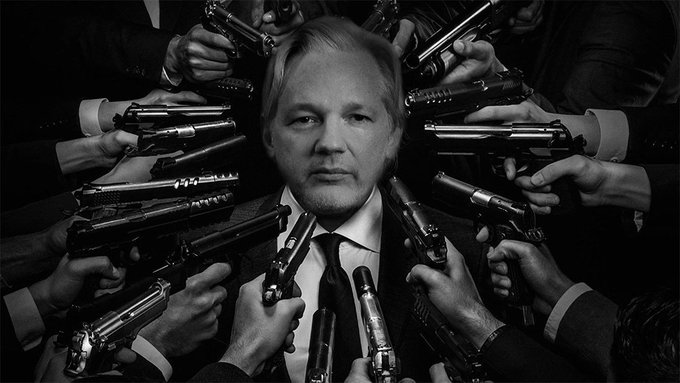
Were Assange to give up his legal battle and voluntarily go to the U.S. it would achieve two things for Washington:
1). remove the chance of a European Court of Human Rights injunction stopping his extradition should the High Court in London reject his last appeal; and
2). it would give the U.S. an opportunity to “change its mind” once Assange was in its clutches inside the Virginia federal courthouse.
Top U.S. officials are speaking at cross purposes when it comes to Julian Assange. What is really going on? asks Joe Lauria.
By Joe Lauria, Consortium News https://consortiumnews.com/2023/09/03/whats-behind-talk-of-a-possible-plea-deal-for-assange/
It was a little more than perplexing. U.S. Secretary of State Antony Blinken, on Australian soil, left no doubt about how his government feels about one of Australia’s most prominent citizens.
“I understand the concerns and views of Australians,” Blinken said in Brisbane on July 31 with the Australian foreign minister at his side. “I think it’s very important that our friends here understand our concerns about this matter.” He went on:
“What our Department of Justice has already said repeatedly, publicly, is this: Mr. Assange was charged with very serious criminal conduct in the United States in connection with his alleged role in one of the largest compromises of classified information in the history of our country. So I say that only because just as we understand sensitivities here, it’s important that our friends understand sensitivities in the United States.”
In other words, when it comes to Julian Assange, the U.S. elite cares little for what Australians have to say. There are more impolite ways to describe Blinken’s response. Upwards of 88 percent of Australians and both parties in the Australian government have told Washington to free the man. And Blinken essentially told them to stuff it. The U.S. won’t drop the case.
A few days before Blinken spoke, Caroline Kennedy, the U.S. ambassador to Australia and daughter of slain President John F. Kennedy, was also dismissive of Australians’ concerns, telling Australian Broadcasting Corporation Radio:
“I met with Parliamentary supporters of Julian Assange and I’ve listened to their concerns and I understand that this has been raised at the highest levels of our government, but it is an ongoing legal case, so the Department of Justice is really in charge but I’m sure that for Julian Assange it means a lot that he has this kind of support but we’re just going to have to wait to see what happens.”
Asked why she met with the parliamentarians at all, she said: “Well, it’s an important issue, it has, as I’ve said, been raised at the highest levels and I wanted to hear directly from them about their concerns to make sure that we all understood where each other was coming from and I thought it was a very useful conversation.”
Asked whether her meeting with the MPs had shifted her thinking on the Assange case, Kennedy said bluntly: “Not really.” She added that her “personal thinking isn’t really relevant here.”
Blowback
Australia has too often behaved as a doormat to the United States, to the point where Australia is threatening its own security by going along with an aggressive U.S. policy towards China, which poses no threat to Australia.
But this time, Blinken got an earful. Prime Minister Anthony Albanese reiterated that he wanted the Assange case to be dropped. Certain members of Parliament brusquely gave it back to Blinken.
Assange was “not the villain … and if the US wasn’t obsessed with revenge it would drop the extradition charge as soon as possible,” Independent MP Andrew Wilkie told The Guardian‘s Australian edition.
“Antony Blinken’s allegation that Julian Assange risked very serious harm to US national security is patent nonsense,” said Wilkie said.
“Mr Blinken would be well aware of the inquiries in both the US and Australia which found that the relevant WikiLeaks disclosures did not result in harm to anyone,” the MP said. “The only deadly behaviour was by US forces … exposed by WikiLeaks, like the Apache crew who gunned down Iraqi civilians and Reuters journalists” in the infamous Collateral Murder video.
As was shown conclusively by defense witnesses in his September 2020 extradition hearing in London, Assange worked assiduously to redact names of U.S. informants before WikiLeaks publications on Iraq and Afghanistan in 2010. U.S. Gen. Robert Carr testified at the court martial of WikiLeaks‘ source, Chelsea Manning, that no one was harmed by the material’s publication.
Instead, Assange faces 175 years in a U.S. dungeon on charges of violating the Espionage Act, not for stealing U.S. classified material, but for the First Amendment-protected publication of it.
Labor MP Julian Hill, also part of the Bring Julian Assange Home Parliamentary Group, told The Guardian he had “a fundamentally different view of the substance of the matter than secretary Blinken expressed. But I appreciate that at least his remarks are candid and direct.”
“In the same vein, I would say back to the United States: at the very least, take Julian Assange’s health issues seriously and go into court in the United Kingdom and get him the hell out of a maximum security prison where he’s at risk of dying without medical care if he has another stroke,” Hill said.
Damage Control
The fierce Australian reaction to both Blinken and Kennedy’s remarks appears to have taken Washington by surprise, given how accustomed to Canberra’s supine behavior the U.S. has become. Just two weeks after Blinken’s remarks, Kennedy tried to soften the blow by muddying Blinken’s clear waters.
She told The Sydney Morning Herald in a front-page interview published on Aug. 14 that the United States was now, despite Blinken’s unequivocal words, suddenly open to a plea agreement that could free Assange, allowing him to serve a shortened sentence for a lesser crime in his home country.
The newspaper said there could be a “David Hicks-style plea bargain,” a so-called Alford Plea, in which Assange would continue to state his innocence while accepting a lesser charge that would allow him to serve additional time in Australia. The four years Assange has already served on remand at London’s maximum security Belmarsh Prison could perhaps be taken into account.
Kennedy said a decision on such a plea deal was up to the U.S. Justice Department. “So it’s not really a diplomatic issue, but I think that there absolutely could be a resolution,” she told the newspaper.
Kennedy acknowledged Blinken’s harsh comments. “But there is a way to resolve it,” she said. “You can read the [newspapers] just like I can.” It is not quite clear what in the newspapers she was reading.
Blinken is Kennedy’s boss. There is little chance she had spoken out of turn. Blinken allowed her to put out the story that the U.S. is interested in a plea bargain with Assange. But why?
First, the harsh reaction in Australia to Blinken’s words probably had something to do with it. If it was up to the U.S. Justice Department alone to handle the prosecution of Assange, as Kennedy says, why was the Secretary of State saying anything about it at all? Blinken appears to have spoken out of turn himself and sent Kennedy out to reel it back in.
Given the growing opposition to the AUKUS alliance in Australia, including within the ruling Labor Party, perhaps Blinken and the rest of the U.S. security establishment is not taking Australia’s support for granted anymore. Blinken stepped in it and had Kennedy try to clean up the mess.
Second, as suspected by many Assange supporters on social media, Kennedy’s words may have been intended as a kind of ploy, perhaps to lure Assange to the United States to give up his fight against extradition in exchange for leniency.
In its article based on Kennedy’s interview, The Sydney Morning Herald spoke to only one international law expert, a Don Rothwell, of Australian National University in Canberra, who said Assange would have to go to the United States to negotiate a plea. In a second interview on Australian television, Rothwell said Assange would also have to drop his extradition fight.
Of course, neither is true. “Usually American courts don’t act unless a defendant is inside that district and shows up to the court,” U.S. constitutional lawyer Bruce Afran told Consortium News. “However, there’s nothing strictly prohibiting it either. And in a given instance, a plea could be taken internationally. I don’t think there’s anything wrong with that. It’s not barred by any laws. If all parties consent to it, then the court has jurisdiction.” But would the U.S. consent to it?
Were Assange to give up his legal battle and voluntarily go to the U.S. it would achieve two things for Washington: 1). remove the chance of a European Court of Human Rights injunction stopping his extradition should the High Court in London reject his last appeal; and 2). it would give the U.S. an opportunity to “change its mind” once Assange was in its clutches inside the Virginia federal courthouse.
“The U.S. sometimes finds ways to get around these agreements,” Afran said. “The better approach would be that he pleads while in the U.K., we resolve the sentence by either an additional sentence of seven months, such as David Hicks had or a year to be served in the U.K. or in Australia or time served.”
Assange’s brother, Gabriel Shipton, told the Herald his brother going to the U.S. was a “non-starter.” He said: “Julian cannot go to the US under any circumstances.” Assange’s father, John Shipton, told the same to Glenn Greenwald last week.
So the U.S. won’t be getting Assange on its soil voluntarily, and perhaps not very soon either. And maybe it wants it that way. Gabriel Shipton added: “Caroline Kennedy wouldn’t be saying these things if they didn’t want a way out. The Americans want this off their plate.”
Third, the U.S. may be trying to prolong Assange’s ordeal for at least another 14 months past the November 2024 U.S. presidential election. As Greenwald told John Shipton, the last thing President Joe Biden would want in the thick of his reelection campaign next year would be a high-profile criminal trial in which he was seen trying to put a publisher away for life for printing embarrassing U.S. state secrets.
But rather than a way out, as Gabriel Shipton called it, the U.S. may have in mind something more like a Great Postponement.
The postponement could come with the High Court of England and Wales continuing to take its time to give Assange his last hearing — for all of 30 minutes — before it rendered its final judgement, months after that, on his extradition. This could be stretched over 14 months. As Assange is a U.S. campaign issue, the High Court could justify its inaction by saying it wanted to avoid interference in the election.
According to Craig Murray, a former British diplomat and close Assange associate, the United States has not, despite Kennedy’s words last month, so far offered any sort of plea deal to Assange’s legal team. Murray told WBAI radio in New York:
“There have been noises made by the U.S. ambassador to Australia saying that a plea deal is possible. And that’s what the Australian Government have been pushing for as a way to solve it. What I can tell you is that there have been no official approaches from the American government indicating any willingness to soften or ameliorate their posihttps://www.youtube.com/watch?v=fnNjwQNV4Gction. The position of the Biden administration still seems to be that they wish to persecute and destroy Julian and lock him up for life for publishing the truth about war crimes …
So there’s no evidence of any sincerity on behalf of the U.S. government in these noises we’ve been hearing. It seems to be to placate public opinion in Australia, which is over 80% in favor of dropping the charges and allowing Julian to go home to his native country…
The American ambassador has made comments about, oh well, a plea deal might be possible, but this is just rubbish. This is just talk in the air. There’s been no kind of approach or indication from the Justice Department or anything like that at all. It’s just not true. It’s a false statement, in order to placate public opinion in Australia.”
Afran said a plea deal can be initiated by the Assange side as well. Assange lawyer Jennifer Robinson said in May for the first time on behalf of his legal team that they were open to discussion of a plea deal, though she said she knew of no crime Assange had committed to plead guilty to.
The U.S. would have many ways to keep prolonging talks on an Assange initiative, if one came, beyond the U.S. election. After the vote, the Justice Department could then receive Assange in Virginia courtesy of the British courts, if this the strategy the U.S. is pursuing.
Only Idiots Believe The US Is Protecting Australia From China
CAITLIN JOHNSTONE, AUG 29, 2023 https://www.caitlinjohnst.one/p/only-idiots-believe-the-us-is-protecting?utm_source=substack&utm_medium=email
The Economist has taken a keen interest in Australia lately, which if you know anything about The Economist is something you never want to see happen to your country. Two articles published in the last few days by the notorious propaganda outlet have celebrated the fact that Australia appears to be the most likely nation to follow the United States into a hot war with China as it enmeshes itself further and further with the US war machine.
In “How Joe Biden is transforming America’s Asian alliances,” The Economist writes the following:
Meanwhile, the ‘unbreakable’ defence relationship with Australia is deepening, following the AUKUS agreement struck in March, amid a flurry of equipment deals and military exercises. Should war break out with China, the Aussies seem the most willing to fight at America’s side. Australian land, sea and air bases are expanding to receive more American forces. Under the AUKUS deal, Australia is gaining its own long-range weapons, such as nuclear-powered (but not nuclear-armed) submarines to be developed jointly with America and Britain. The three partners want to work on other military technologies, from hypersonic missiles to underwater drones.
“Taken together the ‘latticework’ of security agreements, shows how America’s long-heralded pivot to Asia is accelerating.”
In “Australia is becoming America’s military launch-pad into Asia,” The Economist elaborates upon this war partnership with tumescent enthusiasm, calling it a “mateship” and likening it to a “marriage”, and calling for a rollback of US restrictions on sharing military technology with Australia.
“If America ever goes to war with China, American officials say the Aussies would be the likeliest allies to be fighting with them,” The Economist gushes, adding, “Australia’s geographical advantage is that it lies in what strategists call a Goldilocks zone: well-placed to help America to project power into Asia, but beyond the range of most of China’s weapons. It is also large, which helps America scatter its forces to avoid giving China easy targets.”
The Economist cites White House “Asia Tsar” Kurt Campbell reportedly saying of Australia, “We have them locked in now for the next 40 years.”
“Equally, though, Australia may have America locked in for the same duration,” The Economist hastens to add.
Well gosh, that’s a relief.
“How the world sees us,” tweeted former Australian foreign minister Bob Carr when sharing the Economist article.
“Historians will be absolutely baffled by what’s happening in Australia right now: normally countries never voluntarily relinquish their sovereignty and worsen their own security position out of their own accord. They normally have to lose a war and be forced to do so,” commentator Arnaud Bertrand added to Carr’s quip.
As much as it pains me to admit it, The Economist is absolutely correct. The Australian government has been showing every indication that it is fully willing to charge into a hot war with its top trading partner to please its masters in Washington, both before and after the US puppet regime in Canberra changed hands last year.
This sycophantic war-readiness was humorously mocked on Chinese state media back in 2021 by Impact Asia Capital co-founder Charles Liu, who said he didn’t think the US will actually fight a war with China over Taiwan, but the Australians might be stupid enough to fight it for them.
“US is not going to fight over Taiwan,” Liu said. “It’s not going to conduct a war over Taiwan. They may try to get Japanese to do it, but Japanese won’t be so stupid to do it. The only stupid ones who might get involved are the Australians, sorry.”
He had nothing to be sorry about; he was right. Australians are being very, very stupid, and not just our government. A recent Lowy Institute poll found that eight in ten Australians believe the nation’s alliance with the United States is important for Australia’s security, despite three-quarters also saying they believe the alliance makes Australia more likely to be drawn into a war in Asia.
That’s just plain stupid. A war with China is the absolute worst case security scenario for Australia; anything that makes war with China more likely is making us less secure. Making bad decisions which hurt your own interests is what stupid people do.
That’s not to say Australians are naturally dimwitted; we’re actually pretty clever as far as populations go. What’s making us stupid in this case is the fact that our nation has the most concentrated media ownership in the western world, a massive chunk of which is owned by longtime US empire asset Rupert Murdoch. This propaganda-conducive information environment has been distorting Australia’s understanding of the world so pervasively in recent years that on more than one occasion I’ve had total strangers start babbling at me about the dangers of China completely out of nowhere within minutes of striking up conversation with them.
This artificially manipulated information ecosystem has made Australians so pants-on-head idiotic that they think the US empire is filling their country up with war machinery because it loves them and wants to protect them from the Chinese. That’s as stupid as it gets.
The single biggest lie being circulated in Australia right now is that our government is militarising against China as a defensive measure. China has literally zero history of invading and occupying countries on the other side of the planet. You know who does have a very extensive history of doing that? The United States. The military superpower that Australia’s military is becoming increasingly intertwined with. The belief that we’re intertwining ourselves with the world’s most aggressive, destructive and war-horny military force as a defensive measure to protect ourselves against that military force’s top rival (who hasn’t dropped a bomb in decades) is transparently false, and only a complete idiot would believe it.
We’re not militarising to defend ourselves against a future attack by China, we’re militarising in preparation for a future US-led attack on the Chinese military. We’re militarising in preparation to involve ourselves in an unresolved civil war between Chinese people that has nothing to do with us. China has been sorting out its own affairs for millennia and has managed to do so just fine without the help of white people running in firing military explosives at them, and Taiwan is no exception.
The imperial media talk nonstop about how the People’s Republic of China is preparing to seize control of Taiwan using military force, without ever mentioning the fact that that’s exactly what the US empire is doing. The US empire is preparing to wrest Taiwan away from China to facilitate its long-term agenda to balkanize, weaken and subjugate its top rival.
Only a complete blithering imbecile would believe any part of this is being done defensively. It’s being done to secure unipolar planetary domination for the world’s most powerful and destructive government, and only an absolute moron would agree to risk their own country’s security and economic interests to help facilitate it.
Assange Be Weary: The Dangers of a US Plea Deal
August 18, 2023
By Binoy Kampmark / CounterPunch, https://scheerpost.com/2023/08/18/assange-be-weary-the-dangers-of-a-us-plea-deal/
At every stage of its proceedings against Julian Assange, the US Imperium has shown little by way of tempering its vengeful impulses. The WikiLeaks publisher, in uncovering the sordid, operational details of a global military power, would always have to pay. Given the 18 charges he faces, 17 fashioned from that most repressive of instruments, the US Espionage Act of 1917, any sentence is bound to be hefty. Were he to be extradited from the United Kingdom to the US, Assange will disappear into a carceral, life-ending dystopia.
In this saga of relentless mugging and persecution, the country that has featured regularly in commentary, yet done the least, is Australia. Assange may well be an Australian national, but this has generally counted for naught. Successive governments have tended to cower before the bullying disposition of Washington’s power. With the signing of the AUKUS pact and the inexorable surrender of Canberra’s military and diplomatic functions to Washington, any exertion of independent counsel and fair advice will be treated with sneering qualification.
The Albanese government has claimed, at various stages, to be pursuing the matter with its US counterparts with firm insistence. Prime Minister Anthony Albanese has even publicly expressed his frustration at the lack of progress in finding a “diplomatic solution” to Assange’s plight. But such frustrations have been tempered by an acceptance that legal processes must first run their course.
The substance of any such diplomatic solution remains vague. But on August 14, the Sydney Morning Herald, citing US Ambassador to Australia Caroline Kennedy as its chief source, reported that a “resolution” to Assange’s plight might be in the offing. “There is a way to resolve it,” the ambassador told the paper. This could involve a reduction of any charges in favour of a guilty plea, with the details sketched out by the US Department of Justice. In making her remarks, Kennedy clarified that this was more a matter for the DOJ than the State Department or any other department. “So it’s not really a diplomatic issue, but I think there absolutely could be a resolution.”
In May, Kennedy met members of the Parliamentary Friends of Julian Assange Group to hear their concerns. The previous month, 48 Australian MPs and Senators, including 13 from the governing Labor Party, wrote an open letter to the US Attorney General, Merrick Garland, warning that the prosecution “would set a dangerous precedent for all global citizens, journalists, publishers, media organizations and the freedom of the press. It would also be needlessly damaging for the US as a world leader on freedom of expression and the rule of law.”
In a discussion with The Intercept, Gabriel Shipton, Assange’s brother, had his own analysis of the latest developments. “The [Biden] administration appears to be searching for an off-ramp ahead of [Albanese’s] first state visit to DC in October.” In the event one wasn’t found, “we could see a repeat of a very public rebuff delivered by [US Secretary of State] Tony Blinken to the Australian Foreign Minister two weeks ago in Brisbane.”
That rebuff was particularly brutal, taking place on the occasion of the AUSMIN talks between the foreign and defence ministers of both Australia and the United States. On that occasion, Foreign Minister Penny Wong remarked that Australia had made its position clear to their US counterparts “that Mr Assange’s case has dragged for too long, and our desire it be brought to a conclusion, and we’ve said that publicly and you would anticipate that that reflects also the positive we articulate in private.”
In his response, Secretary of State Blinken claimed to “understand” such views and admitted that the matter had been raised with himself and various offices of the US. With such polite formalities acknowledged, Blinken proceeded to tell “our friends” what, exactly, Washington wished to do.
Assange had been “charged with very serious criminal conduct in the United States in connection with his alleged role in one of the largest compromises of classified information in the history of our country. The actions that he has alleged to have committed risked very serious harm to our national security, to the benefit of our adversaries, and put named sources at grave risk – grave risk – of physical harm, and grave risk of detention.”
Such an assessment, lazily assumed, repeatedly rebutted, and persistently disproved, went unchallenged by all the parties present, including the Australian ministers. Nor did any members of the press deem it appropriate to challenge the account. The unstated assumption here is that Assange is already guilty for absurd charges, a man condemned.
At this stage, such deals are the stuff of manipulation and fantasy. The espionage charges have been drafted to inflate, rather than diminish any sentence. Suggestions that the DOJ will somehow go soft must be treated with abundant scepticism. The pursuit of Assange is laced by sentiments of revenge, intended to both inflict harm upon the publisher while deterring those wishing to publish US national security information. As the Australian international law academic Don Rothwell observes, the plea deal may well take into account the four years spent in UK captivity, but is unlikely to either feature a complete scrapping of the charges, or exempt Assange from travelling to the US to admit his guilt. “It’s not possible to strike a plea deal outside the relevant jurisdiction except in the most exceptional circumstances.”
Should any plea deal be successfully reached and implemented, thereby making Assange admit guilt, the terms of his return to Australia, assuming he survives any stint on US soil, will be onerous. In effect, the US would merely be changing the prison warden while adjusting the terms of observation. In place of British prison wardens will be Australian overseers unlikely to ever take kindly to the publication of national security information.
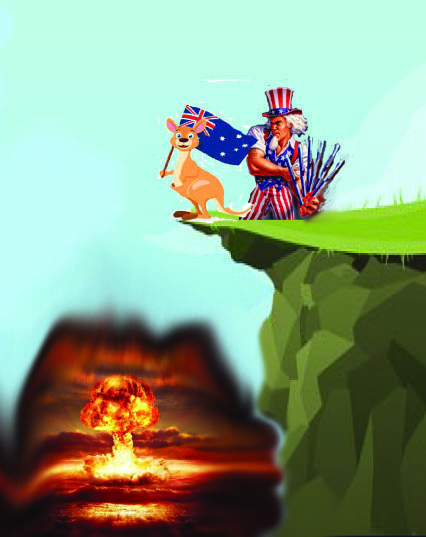
The US grip on Australia keeps tightening. Can we break free and avoid war?
By Bevan RamsdenAug 9, 2023 https://johnmenadue.com/for-independence-and-peace-the-us-grip-on-australia-must-be-broken/—
AUSMIN 2023 has further surrendered sovereignty and tightened the US military grip on Australia. The integration of the ADF with the US military, insertion of US intelligence staff in our defence intelligence organisation and the increased military presence of the US including command facilities in Australia has locked us into any war plans of the United States and made us a launching pad for their wars. The US grip on Australia must be broken to give us independence and a peaceful future.
The AUSMIN 2023 talks between the Australian Defence and Foreign Affairs ministers, Richard Marles and Penny Wong and their US counterparts Secretary of State Antony Blinken and Defence Secretary Lloyd Austin, have further tightened the US military grip on Australia.
Australia has become the US southern Indo-Pacific base from which it will launch military operations. Under the US Force Posture Agreement the US has established, or is in the process of establishing, huge fuel, munitions, spare parts, maintenance and equipment storage facilities on our continent. It has also been given unimpeded access to our airports, seaports, RAAF, RAN and Army bases for its military aircraft, warships and nuclear submarines. Sovereignty has been cravenly sacrificed on the altar of the US-Australia military alliance.
These Australian facilities are being massively upgraded largely at Australian taxpayers expense to support these US military operations.
The ADF trains extensively with, and is under the command of, the US military in war exercises such as Talisman Sabre. The ADF is now so integrated with the US military and our foreign policy so tied to that of the US that Australia will be swept into the next US war without a whimper from our political leaders and indeed with their enthusiastic support. That the next US war will be against China, Australia’s major trading partner and that such a war will have a catastrophic impact on every aspect of the Australian people’s lives and those of the people in our region and the world, with the dreadful possibility of a nuclear exchange, apparently has not registered with our leaders.
By agreeing to the outcomes of the AUSMIN 2023 talks, Richard Marles and Penny Wong have shown that they are no more than flunkeys, willing to place the interests of the US above those of the Australian people. Some might even regard them as traitors whose actions border on treason. Either way they have accepted measures which effectively increase the US grip on Australia and infringe our national sovereignty in a most fundamental way, by denying us the ability to decide if, when and against whom we go to war.
Let’s review the decisions reached at AUSMIN 2023.
AUSMIN 2023 re-affirmed a joint commitment to operationalise the Alliance including through enhanced Force Posture Cooperation across land, maritime and air domains as well as through the Combined Logistics, Sustainment and Maritime Enterprise. They declared Enhanced Space Cooperation as a new Force Posture Initiative to enable closer cooperation on this critical operational domain.
There will be a fresh expansion of the deployment of U.S. forces to Australia including amphibious troops and maritime reconnaissance planes.
American intelligence analysts will be embedded within the Defence’s spy agency in Canberra establishing a Combined Intelligence Centre- Australia within Australia’s Defence Intelligence Organisation by 2024.
In addition to upgrading RAAF Tindal and Darwin there will be expansion and “hardening” against attacks of two other RAAF bases in the north, RAAF Scherger near Weipa in Qld and RAAF Curtin near Derby in WA.
Lightning, Super Hornet fighters and C-17 cargo planes. On November 1st 2022 the ABC ‘Four Corners’ program revealed that RAAF Tindal will be upgraded to accommodate up to six nuclear-capable B52 bombers, and on August 4th 2023 it disclosed that a search of US budget filings had revealed plans to build a US Air Force Mission Planning and Operations Centre in Darwin, plans which have never been fully disclosed by the Australian Government. Through Enhanced Maritime Cooperation there will be more and longer visits of US nuclear submarines to HMAS Stirling in WA from 2023. These visits are in preparation for Submarine Rotational Force-West involving UK and US nuclear submarines being berthed and serviced under the AUKUS Agreement.
The Americans will now conduct a “regular rotation” of U.S. army watercraft as well as deploying a US Navy spy plane to conduct surveillance flights.
The US announced its intention to pre-position US Army stores and materiel at Bandiana Army base near Wodonga in Victoria as a precursor for longer term establishment of an enduring Logistics Support Area in Queensland designed to enhance interoperability and accelerate the ability to respond to alleged ‘regional crises’ which are in reality US-perceived threats to its hegemony.
The US will collaborate with Australia in the local production of multiple- launch guided missiles, planned to commence by 2025.
We are in the grip of the US military, which is ever-tightening and underpins US control of our economy. We are indebted to the historian Clinton Fernandes for his analysis showing that of Australia’s twenty largest corporations, 15 are majority US owned. This includes BHP Billiton, once called the “Big Australian” but now 73% US owned and therefore beholden to US shareholders. The four major banks, NAB, ANZ, Westpac and the CBA, once the government- owned peoples’ bank, are all majority owned by US shareholders, a form of ‘foreign influence’ that the Government doesn’t seem to have a problem with.
The huge public expenditure on “defence”, such as the $368 billion for nuclear-powered submarines, $10 billion for Hercules cargo aircraft, $10 billion for armoured vehicles, billions for runway extensions and port upgrades – the list goes on and is at the expense of addressing urgent social needs such as urgent measures to deal with climate change and address the serious crisis in public housing, health care and public education. There is no military threat to Australia. The real beneficiary is the US military-industrial complex which has its presence in Australia through Lockheed Martin, Boeing and other corporations.
If we are to have an independent and hope of a peaceful future, the US grip on our country must be broken. There can be no social or economic justice, no real solution to the ever-worsening crises in housing, public health care, public education, care of children and the aged, and no effective measures to address climate change and no peaceful future until we free ourselves from the grip of the US militarily, politically and economically.
In order to free ourselves we must unite and we can, because increasing numbers of Australians from different walks of life and political persuasions are becoming alarmed at the suicidal direction the present Australian political leadership is taking us. We are many and are powerful when we are united, while the US collaborators and those who profit from US domination are few. We need political leaders who will serve the interests of the Australian people rather than those of the US or any other foreign power. We need a new constitution, one which will respect the people who first walked this land, will forbid the presence of ALL foreign bases and foreign troops on our soil and will give emphasis to the promotion of peace and mutually beneficial relations with all countries.
Only independence can give us back our sovereignty and self-respect and the possibility of a peaceful future.
Building for War: The US Imperium’s Top End Spend

August 5, 2023, Dr Binoy Kampmark, https://theaimn.com/building-for-war-the-us-imperiums-top-end-spend/
The AUSMIN 2023 talks held between the US Secretaries of State and Defense and their Australian counterparts, confirmed the increasing, unaccountable militarisation of the Australian north and its preparation for a future conflict with Beijing. Details were skimpy, the rhetoric aspirational. But the Australian performance from Defence Minister Richard Marles, and Foreign Minister Penny Wong, was crawling, lamentable, even outrageous. State Secretary Antony Blinken and Defense Secretary Lloyd Austin III could only look on with sheer wonder at their prostrate hosts.
Money, much of it from the US military budget, is being poured into upgrading, expanding and redeveloping Royal Australian Air Force (RAAF) bases in the Northern Territory city of Darwin, and Tindal, situated 320km south-east of Darwin, the intended to “address functional deficiencies and capacity constraints in existing facilities and infrastructure.” Two new locations are also being proposed at RAAF Bases Scherger and RAAF Curtin, aided by site surveys.
The AUSMIN joint statement, while revealing nothing in terms of operational details or costs, proved heavy with talk about “the ambitious trajectory of Enhanced Force Posture Cooperation across land, maritime, and air domains, as well as Combined Logistics, Sustainment and Maintenance Enterprise (CoLSME).” Additionally, there would be “Enhanced Air Cooperation” with a rotating “US Navy Maritime Patrol and Reconnaissance Aircraft in Australia to enhance regional maritime domain awareness, with an ambition of inviting likeminded partners to participate in the future.”
Further details have come to light about the money being spent by the Pentagon on facilities in Darwin. The unromantically titled FY22 MCAF Project PAF160700 Squadron Operations Facility at the RAAF Darwin base “includes the construction (design-bid-build) of a United States Air Force squadron facility at the … (RAAF) in Darwin, Australia.” The project is deemed necessary to add space “for aircrew flight equipment, maintenance and care, mission planning, intelligence, crew briefings, crew readiness, and incidental related work.” Some of the systems are mundane but deemed important for an expanded facility, including ventilating and air conditioning, water heating, plumbing, utility energy meters and sub-meters and a building automation system (HVAC Control system).
Correspondents from the Australian Broadcasting have gone further into the squadron operations facility, consulting US budget filings and tender documents to reveal cost assessments of $26 million (A$40 million). A further parking apron at RAAF Darwin is also featured in the planning, estimated to cost somewhere in the order of $258 billion. This will further supplement plans to establish the East Arm fuel storage facility for the US Air Force located 15 kilometres from Darwin that should be able to, on completion by September this year, store 300 million litres of military jet fuel intended to support US military activity in the Northern Territory and Indo-Pacific region.
According to the tender documents, the squadron operations facility also had a broader, more strategic significance: “to support strategic operations and to run multiple 15-day training exercises during the NT dry season for deployed B-52 squadrons.” The RAAF Tindal facility’s redevelopment, slated to conclude in 2026, is also intended to accommodate six B-52 bombers. Given their nuclear capability, residents in the NT should feel a suitable degree of terror.
Michael Shoebridge, founder and director of Strategic Analysis Australia, is none too pleased by this state of affairs. He is unhappy by Canberra’s reticence on US-Australian military arrangements, and none too keen on a debate that is only being informed by US-based sources. “A public debate needs to be enabled by information and you can’t have a complete picture without knowing where the money is being spent.”
While it is hard to disagree with that tack, Shoebridge’s outfit, in line with such think tanks as the Australian Strategic Policy Institute, is not against turning Australia into a frontline fortress state ready for war. What he, and his colleagues take issue with, is the overwhelmingly dominant role the US is playing in the venture. Those in Washington, Shoebridge argues, seem to “understand the urgency we don’t seem to.” Rather than questioning Australia’s need for a larger, more threatening military capability to fight phantoms and confected foreign adversaries, he accepts the premise, wholeheartedly. Canberra, in short, should muck in more, pull its weight, and drum up Australian personnel for the killing.
Anthony Bergin, a senior fellow of Strategic Analysis Australia, teases out the idea of such mucking in, suggesting a familiar formula. He insists that, in order to improve “our national security, we should be looking at options short of conscription which wouldn’t be as hard to sell to the Australian people.” He thought the timing perfect for such a move. “There’s now a latent appetite for our political leaders to introduce measures to bolster national resilience.”
This silly reading only makes sense on the assumption that the Australian public has been softened sufficiently by such hysterical affronts to sensibility as the Red Alert campaign waged in the Fairfax Press.
Options to add padding to Australia’s military preparedness include doubling or tripling school cadets and cadet programs of the “outdoor bound” type based in the regions. But more important would be the creation of a “national militia training scheme”. Bergin is, however, displeased by the difficulty of finding “volunteers of any kind”, a strange comment given the huge, unpaid volunteer army that governs the delivery of numerous services in Australia, from charities to firefighting.
Alison Broinowski, herself formerly of the Australian diplomatic corps, safely concludes that the current moves constitute “another step in the same direction – a step that the government has been taking a series of for years; accepting whatever the United States government wants to place on Australian soil.” More’s the pity that most details are to come from Washington sources, indicating, with irrefutable finality, Canberra’s abject subordination to the US imperium and its refusal to admit that fact.
USA flexes its belligerent muscles in Western Australia, showing off its nuclear submarines

US military shows off nuclear capable submarine in Western Australia By 9News Staff Aug 4, 2023 https://www.9news.com.au/national/us-military-shows-off-nuclear-capable-submarine-in-western-australia/9b152141-2e3f-4a2a-a73f-37b7a02738cb
The United States military is flexing its nuclear fleet of submarines in Western Australia.
The arrival of the USS North Carolina is the first visit since a landmark defence deal was signed earlier this year.
Australia is buying eight of the nuclear-powered Virginia class submarines in a deal costing $368 billion.
Australia’s Ambassador to the US Kevin Rudd was on Garden Island touring the 110-metre vessel which can go three months underwater.
WA will permanently house nuclear subs from next decade.
HMAS Stirling is set for an upgrade as thousands more submariners file through Perth.
The public is not allowed to know how long the North Carolina will be docked in Perth – that information is classified even from Australia’s defence minister.
However, there have been reassurances the AUKUS deal is watertight regardless of who is in the White House.
Advisor to the US secretary of defence Abe Denmark said there has been broad bipartisan support.
Rudd described the move as an opportunity to step up the capabilities of the Royal Australian Navy and the sovereign capabilities of Australia “in a highly uncertain period strategically”.
Opposition to Aukus – especially from New Zealand, but also from Australia and the Pacific, and across the political spectrum

Military Initiative by Australia, the United Kingdom and the United States (AUKUS) is Another Major Step in Prospective War on China
Covert Action Magazine, By Murray Horton, June 29, 2023
“………………………………………………“We Are Not at War, But Neither Are We at Peace”
New Zealanders may not have appreciated the degree of militarization in Australia, much more so than here. AUKUS should jolt us out of any complacency about what is going on with our nearest neighbor—it is preparing for war. Australian media commentary at the time of the AUKUS launch made that clear. “The monumental price tag of the AUKUS pact has made it clear. We are not at war, but neither are we at peace…”
“Almost $A400b, even over three decades, is not peacetime spending in anyone’s book—a fact Government ministers concede privately. Rather, we are navigating a dangerous and unpredictable new grey zone of superpower rivalry between China and the United States. It’s a contest in which we are poised to be a central player despite our geographical isolation and relatively small population.”
“Accepting such a role will require tough spending decisions the nation as a whole is not yet ready to confront. Already, Opposition Leader Peter Dutton is flagging his willingness to support reduced spending on the National Disability Insurance Scheme to pay for the submarine programme. Other unsettling trade-offs will need to be discussed. Even in the short term, before the big bills start arriving, difficult calls will have to be made….This is because…it will cut $A3b from existing defence programmes…This is likely to anger other branches of the military, such as the Army, while the Navy is lavished with money.”[2]
Albanese tried to put a positive spin on it,……………………………………..
Criticism from Inside the Political Elite
Pleasingly, AUKUS was not unopposed among Australia’s political elite (or, at least, former leading members of it). Paul Keating, who was Labor Prime Minister from 1991 to 1996, really put the boot into the good submarine AUKUS and all who sail in her. He did so in a March 2023 speech, the day after the AUKUS announcement. “Former prime minister Paul Keating has launched an extraordinary attack on the Albanese government over its adoption of the AUKUS pact, accusing it of making the worst foreign policy decision by a Labor government since the attempted introduction of conscription in World War I.”
“He said signing up to AUKUS had broken Labor’s long ‘winning streak’ on foreign policy over the past century and was a ‘deeply pathetic’ moment in the Party’s history. ‘Falling into a major mistake, Anthony Albanese, befuddled by his own small-target election strategy, emerges as prime minister with an American sword to rattle at the neighbourhood to impress upon it the United States’ esteemed view of its untrammelled destiny…’”
“‘Naturally, I should prefer to be singing the praises of the government in all matters, but these issues carry deadly consequences for Australia and I believe it is incumbent on any former prime minister, particularly now, a Labor one, to alert the country to the dangerous and unnecessary journey on which the Government is now embarking.’”
“‘This week, Anthony Albanese screwed into place the last shackle in the long chain the United States has laid out to contain China…I don’t think I suffer from relevance deprivation, but I do suffer concern for Australia as it most unwisely proceeds down this singular and dangerous path,’ he said.”
“Keating presented a largely benign view of China’s rise, saying it was ‘not the old Soviet Union’ and was ‘not seeking to propagate some competing international ideology’ to the United States. The fact is China is not an outrider,’ he said. ‘China is a world trading state—it is not about upending the international system,’”
“Keating said: ‘Every Labor Party branch member will wince when they realise that the party we all fight for is returning to our former colonial master, Britain, to find our security in Asia—236 years after Europeans first grabbed the continent from its Indigenous people. That of all things, a contemporary Labor government is shunning security in Asia for security in and within the Anglosphere’”[3]
Nor was Keating alone in his criticism from within the elite. “The Australian National University’s Hugh White, an emeritus professor of strategic studies, unleashed a quite extraordinary criticism of Australia’s nuclear submarine plan…Professor White, a former deputy secretary of the Defence Department, said Australia was not only going to ‘hand over some serious dollars’ to the US but also pay with ‘a promise’ to enter any future conflict with China.’”
“‘This is a very serious transformation of the nature of our alliance with the United States,’ White said in an interview recorded for the ANU’s politics podcast Democracy Sausage. ‘The US don’t really care about our submarine capability—they care deeply about tying Australia into their containment strategy against China.’”
“White said he couldn’t see why the US would sell its own submarines—of which they have fewer than they need—unless it was absolutely sure Australia’s submarines would be available to it in the event of a major conflict in Asia. He said a war between America and China over Taiwan would be ‘World War III’ and have a ‘very good chance’ of being a nuclear conflict.”
“‘Australia’s experience of war [is] shaped by the fact that we’ve tended to be on the winning side, but there is no reason to expect America to win in a war with China over Taiwan,’ he warned. He suggested there was also a high chance the AUKUS deal could fall over under [sic] a future American administration and a worsening strategic environment.”
“White said there were cheaper, quicker, less risky and less demanding ways for Australia to get the submarines it needed, labelling the AUKUS plan a waste of money that ‘doesn’t make sense. There’s going to be no actual net increase in the number of submarines available until well into the 2040s, even if it goes to plan—which it probably won’t,’ he said.”[4]……………………………………………………………………………………………………………………………………………………………………..
Former New Zealand Prime Ministers from Rival Parties Dissent
When AUKUS was first announced in 2021, New Zealand, which was not invited to join, simply confined itself to saying that nuclear-powered submarines would not be allowed into New Zealand territorial waters, or ports, because of our nuclear-free law dating back to the 1980s. So, the issue flew below the radar (or sailed under the water, to put it more appropriately). However, once AUKUS really kicked off in March 2023, debate and disquiet started in New Zealand.
Helen Clark was the Labour Prime Minister (1999-2008) who has dined out for 20 years on having refused to let New Zealand join the U.S., UK and Australia in the illegal and disastrous 2003 invasion of Iraq (in all other aspects Clark was a very loyal servant of the U.S.). She came out quickly and said that New Zealand is better off outside AUKUS (the word she used was “entanglement”).
She was not alone as the only former New Zealand Prime Minister to criticize it. “…[F]ormer National prime minister Jim Bolger [1990-97] participated in a forum about New Zealand’s foreign policy in Wellington, in which he is reported by the Herald’s Audrey Young to have criticised the Australian submarine buy up as ‘beyond comprehension’ because of the cost and the damage to peace in the Pacific region.”
“Bolger said that New Zealand certainly doesn’t want any such submarines, and challenged proponents of the AUKUS deal to defend it: ‘If you can find any Australian official who can explain why they need nuclear-powered submarines, come and tell me. I’d like to know.’ And Young reported Bolger asking rhetorically, ‘How mad are we getting?’ She says ‘he spoke with despair about the near-daily threats of nuclear war, which had the potential to destroy the planet.’”[7]
Opposition Across the Political Spectrum
“As part of the AUKUS deal Western Australia will play host to US and UK nuclear submarines from 2027. With nuclear-capable American B52 bombers and thousands of American marines rotating through the Northern Territory, Australia is lining up as a loyal lieutenant to the United States in the Pacific and would be expected to fight should war break out.”
“Would New Zealanders fight in a war between the nuclear superpowers? While we aren’t required by treaty obligations to act if America or Taiwan are attacked we are if Australia is. It is not an exaggeration to say Australia could be a target in a future war and already the country has been threatened with missile attacks in that scenario.”
“The risks of New Zealand being dragged in are real. Unlike in Australia, the conversation in New Zealand has been much more muted with limited discussion on the likelihood of war. Why aren’t we talking about it? New Zealand is in a difficult situation contemplating conflict between our largest trading partner and traditional security partner.”
“We weren’t invited to join AUKUS and Australian nuclear submarines won’t be allowed to berth here under our nuclear-free legislation. That same legislation sees New Zealand as only a friend and not an ally of the United States, but we are increasingly acting like we are an ally. In the years since New Zealand’s principled decision not to join the invasion of Iraq we have become more enmeshed with the United States defence apparatus.”
………………………………………………………………………………………………….. “New Zealanders need to talk more about the risks, our decision-makers need to explain why New Zealand is aligning more closely with the United States military and as a sovereign country we have to ask are we acting independently or as a cog in a machine? Our role could be focused on reducing tensions, finding solutions and building trust. War is never inevitable.”[8]
Former politicians across the spectrum have come out against AUKUS. For example, Richard Prebble, one-time Labour Cabinet Minister and later ACT Party founder and Leader.
He is currently a relentless right-wing critic of the current Labour government. His take on AUKUS is the classic mercantilist one. “China is New Zealand’s biggest trading partner. This country has joined China’s Belt and Road initiative. China has signed a free trade agreement with New Zealand, something the U.S. Senate refuses to consider.”
“Foreign Minister Nanaia Mahuta has warned that New Zealand’s exports to China could be caught up in a ‘storm,…………….. New Zealand’s exporters are only too aware of their dependency. There is no other obvious alternative to the New Zealand-China trade.”
“New Zealand has no territorial disputes with China. When we recognised the Government of China 50 years ago, we acknowledged Taiwan is part of China. Paul Keating and Helen Clark are correct. New Zealand’s strategic interest is in the peaceful resolution of conflicts with China rather than sleepwalking into anti-Chinese alliances.”[9]
Academic Skepticism
Leading academic Robert Patman spelled it out in an article entitled “Why New Zealand Should Remain Sceptical About AUKUS.” He wrote that “the basic problem facing AUKUS is that it is based on a binary assumption that the fate of the Indo-Pacific will be largely shaped by the outcome of U.S.-China rivalry and, in particular, by the capacity of America and its closest allies to counterbalance Chinese ambitions in the region.”[10]
“Such a perspective is problematic on a number of counts. First, it exaggerates the influence of great powers in the 21st century in a large, diverse region like the Indo-Pacific. The region contains 60% of the world’s population including significant economic players like Japan, South Korea and fast-growing economies such as Vietnam and India.”
“Second, AUKUS does not factor in the Indo-Pacific and European nations’ quite distinctive security and economic interests in countering China. While countries like Malaysia, Indonesia and Vietnam and EU states like Germany and France are deeply worried about China’s forceful diplomacy in the Indo-Pacific, they remain sceptical that a security arrangement involving three English-speaking states, two of whom have baggage in the region, is an adequate response.”
“Third, China’s global ambitions are very real, but they should not be over-hyped. AUKUS states depict China as a ‘systemic threat’ and, according to US Secretary of Defence Lloyd Austin, the ‘only competitor out there with both the intent to reshape the international order and, increasingly, a power to do so.’ Really?…”
“Fourth, the provision of nuclear-powered submarines to Australia has raised very real fears in the Indo-Pacific about nuclear proliferation. In 1995, ASEAN [Association of Southeast Asian Nations] member states signed the Treaty of Southeast Asia Nuclear Weapon-Free Zone (SEANWFZ). Furthermore, Singapore is now the only ASEAN state yet to sign or ratify the Treaty on the Prohibition of Nuclear Weapons (TPNW), a diplomatic initiative heavily promoted by New Zealand.”
………………………………………………………………………. New Zealand remains sceptical that China is a systemic threat to US dominance, sees a good fit between its non-nuclear security policy and the Indo-Pacific region, and views detachment from AUKUS as both consistent with the goal of diversifying New Zealand’s trade ties and building a diplomatic network of like-minded states to strengthen the international rules-based order through measures like UN Security Council reform.”
Madness to Support U.S. War Against China
Mike Treen, veteran union leader and left-wing activist, put it all very succinctly in an article in the Daily Blog on April 21, 2023. He wrote: “The US is going to war against China because it is losing the international economic competition that previously enabled its military and economic bullying to dominate the globe. The empire is in slow decline.”[11]
“China’s extraordinary rise as an economic powerhouse over the past few decades means that it is now the top international trading partner for 120 countries. This has given the world the freedom to act in ways they have never before—politically and economically.
………………………………………………………………………………. “New Zealand was wrong to join the war against Afghanistan. We were wrong to join the occupation of Iraq. We were wrong to become an ‘observer’ at NATO. And it would be foolish and dangerous to become a participant in any way with the AUKUS military provocation against China. New Zealand should be a neutral power that offers medical aid to the world not a tiny jumped-up militarised puppet of the US empire like Australia has become.”
Defence Minister Tempted by AUKUS
The AUKUS carrot that is being dangled in front of New Zealand and Defence Minister Andrew Little is keen to take a bite……………………………………………………..
But Not PM or Minister of Foreign Affairs
However, both the Prime Minister, Chris Hipkins, and the Minister of Foreign Affairs, Nanaia Mahuta, have since “dismissed suggestions the Government has shown interest in joining aspects of the pact.”
Mahuta made a May 2023 speech stressing that New Zealand’s nuclear-free position is a “cornerstone of our independent stance” ………………………
AUKUS Causing Alarm in the Pacific.
“[T]he Pacific Islands Forum warns ‘AUKUS will bring war much closer to home and goes against the Blue Pacific narrative on nuclear proliferation and the cost to climate change.’ Forum secretary-general Mark Brown said AUKUS would heighten geopolitical tensions and disturb the peace and security of the region.”…………………………………………………………………….
New Zealand Needs to Be Aware of War Drums Next Door
…………………………. New Zealand is actively supporting Ukraine in its war against Russia. There is an irony in our government being so invested in a war, and its attendant geopolitics, on the other side of the world while, right next door to home, our Aussie Big Brother is making a major push toward war via AUKUS and accompanying militarization.
………Make no mistake—AUKUS is a major lurch toward war with China and it is unfolding before our eyes.
The Australian peace movement is waging a vigorous and very active campaign against AUKUS. Independent and Peaceful Australia Network (IPAN) https://ipan.org.au/
References:………………………………………………………..
U.S. aggression against China ignores lessons of Hiroshima

The USA and Australia as its right-hand man in the region has worked to make the idea of war a realistic option. The truth has been distorted in order to sell the idea that it is necessary to stop China. Stop it from doing what? No rational argument has yet been made that can convince any thinking person that China is a threat. The U.S. sees things differently.
And yet China threatens no one. It has no history of expansionism or incursionary activity, effectively has no overseas bases, and its fleet and army are China-based. At the same time, we have the USA and its 800-plus bases, its ring of missiles off China’s shores and its history of blatant aggression, meddling in the affairs of states and regime change.
By William Briggs | 3 August 2023, https://independentaustralia.net/politics/politics-display/us-aggression-against-china-ignores-lessons-of-hiroshima,17773
In its determination to become the superior military power, the U.S. is ignoring historical actions that many consider war crimes, writes Dr William Briggs.
SEVENTY-EIGHT years ago, the United States chose to destroy the cities of Hiroshima and Nagasaki. It was and remains unjustifiable and ought to be regarded as a war crime. The war was all but over. The targets were almost exclusively civilian.
The purpose of the atomic devastation was to signal to the world that a new order was being born. We now know that order as the international rules-based order. We know who sets the rules and what happens if those rules are not obeyed.
Since establishing its new order, the USA and its allies have made the world an intensely more dangerous place to live. War with China is openly discussed. Today, the doomsday clock has its hands set at just 90 seconds to midnight. Never, since the Bulletin of Atomic Scientists put the clock in place, has the world been so close to destruction.
The sword that hangs over us has a double-edged blade. We face both the threat of nuclear destruction and a devastating climate crisis. The two – war and climate – cannot be separated. War, be it conventional or nuclear, will only make the climate crisis immeasurably worse. We are facing an existential crisis on two fronts.
While the planet burns, governments talk about reducing emissions, but emissions from the military are simply not included in the figures. The U.S. military is the single biggest emitter in America. If the U.S. military was a separate country, then it would be among the worst polluters on the planet. The link between the death of the planet by climate change and by military adventures is clear for all to see. The fault lies with those who profit from war and climate destruction and those who allegedly govern us.
Governments of whatever shade have, generation after generation, driven us to war. Lives of soldiers and civilians have been sacrificed, infrastructure wantonly destroyed and vast sums of money that could solve all of humanity’s problems have been wasted. They have been getting away with murder for an awfully long time.
Millions have died in conflict since the end of the war and millions more have been displaced by wars and now by climate destruction.
Today, people ask if war with China is inevitable and whether such a war might involve nuclear weapons. In 2020, the International Committee of the Red Cross polled millennials across 16 countries. Eighty per cent saw a real possibility of a catastrophic war in their lifetime. Fifty-four per cent believe that it will be a nuclear war.
How can this be?
Wars can only be imagined, let alone fought, if they have a degree of “popular” support. Support gives legitimacy. Support is built using a propagandised media that acts in the service of the state that has determined that war is an acceptable option. The motivation for war is almost always economic. It can include a desire to maintain and to secure hegemony, to win political outcomes and to maintain power and prestige. For all these reasons, the U.S. has determined that China is the enemy.
Our leaders accept the U.S. argument without question. Critical thought is made more difficult when enormously influential groups like the Australian Strategic Policy Institute (ASPI) come into play. ASPI receives about a third of its funding from the Government and the rest from the international arms industry. ASPI’s job is to advise the Government about military threats and miraculously, China is confirmed to be the enemy.
And yet China threatens no one. It has no history of expansionism or incursionary activity, effectively has no overseas bases, and its fleet and army are China-based. At the same time, we have the USA and its 800-plus bases, its ring of missiles off China’s shores and its history of blatant aggression, meddling in the affairs of states and regime change.
The road to war with China is not all that new. Since President Obama, there has been a push from the U.S. to “contain” China. This containment was designed to be both economic and military. For every action, however, there has been a reaction. Each push has been met with a reciprocal pushback and gives license for America and its allies to respond to an “assertive” China.
It is in this light that AUKUS assumes special importance. So, too, do declarations of missile production in Australia and a move to what is becoming a war economy. Few can now doubt that there is a push, a drive to war. War plans are openly discussed. It is all on show and the thinking of the Pentagon is there for all to see. U.S. generals make insane and obscene statements but are neither relieved of duty, much less locked away.
To illustrate this point, we have General Mike Minahan, head of the United States Air Force’s Air Mobility Command who recently sent a message to the world. It is blunt, threatening and sinister: ‘My gut tells me we will fight in 2025.’
The General sent his message as a memorandum to the leadership of the 110,000-strong USAF, with the unambiguous title, ‘February 2023 Orders in Preparation for — The Next Fight’.
The chief of the U.S. Marine Corps, Commandant David Berger, was in Australia a few months back. His take on things is that “we can’t slow down, we can’t back off, we can’t get comfortable with where we are”. The message is clear.
If there is a war against China, then it will be the U.S. who will start it. It will push until it gets what it wants. That wish is to hold back, contain or seriously weaken its designated rival and adversary by whatever means it feels appropriate. That includes the use of force. If it is war and it becomes a nuclear conflict, which it might well, then it will be the USA who will be the initiator. This is not being fanciful. China, just as the Soviet Union in the Cold War, has pledged a no-first-use doctrine. The USA refuses to do the same.
The USA and Australia as its right-hand man in the region has worked to make the idea of war a realistic option. The truth has been distorted in order to sell the idea that it is necessary to stop China. Stop it from doing what? No rational argument has yet been made that can convince any thinking person that China is a threat. The U.S. sees things differently.
For America, the threat is about either China as an economic power that will displace it, that China is a socialist threat, or that China is a powerful economy that is possibly moving towards establishing a socialist economy and social system. Any of these scenarios is enough to make the Americans reach for their guns.
What would the world look like if war comes and if it ends up as a nuclear conflict? This does not necessarily mean a repeat of the imagery of mushroom clouds and Hiroshima silhouettes, although that may well be the case. The war would more likely be fought with tactical and “low-yield” nuclear weapons. These are already being produced in industrial numbers and being fitted to U.S. ships and missiles, including Tomahawk cruise missiles.
Significantly, Australia has placed an order for 220 of these missiles. They will fit snugly on the AUKUS submarines and any other ordinance that our masters see fit and can be fitted with nuclear warheads at a moment’s notice.
Missile installations have been strengthened across the region. Nuclear capable missiles are within a few minutes flying time of major Chinese cities. Japan, South Korea, Guam, the Philippines, Australia and importantly Taiwan are all part of the encirclement. Then there is the permanent deployment of 60% of the total U.S. Navy and Air Force, in close proximity to China.
It’s an obvious point but China simply does not threaten mainland USA. New York or San Francisco are not in danger from imminent missile attacks from Chinese offshore bases and installations. Could there be a scenario that might see the U.S. use these missiles to destroy civilian targets in China? Ask the citizens of Hiroshima or Nagasaki.
Australian MPs Blast Blinken Over Assange

The MPs called the U.S. secretary of state’s remarks that Julian Assange threatened U.S. national security “nonsense” and said the U.S. is only bent on revenge, reports Joe Lauria.
SCHEERPOST, By Joe Lauria / Consortium News August 2, 2023
Three Australian members of Parliament have dismissed U.S. Secretary of State Antony Blinken’s strong statement in support of prosecuting imprisoned WikiLeaks publisher Julian Assange as “nonsense.”
Independent MP Andrew Wilkie told The Guardian‘s Australian edition that Assange was “not the villain … and if the US wasn’t obsessed with revenge it would drop the extradition charge as soon as possible.”
“Antony Blinken’s allegation that Julian Assange risked very serious harm to US national security is patent nonsense,” Wilkie said.
“Mr Blinken would be well aware of the inquiries in both the US and Australia which found that the relevant WikiLeaks disclosures did not result in harm to anyone,” said Wilkie. “The only deadly behaviour was by US forces … exposed by WikiLeaks, like the Apache crew who gunned down Iraqi civilians and Reuters journalists” in the infamous Collateral Murder video.
Speaking at a press conference with Australian Foreign Minister Penny Wong in Brisbane on Saturday, Blinken said he understood Australians’ concerns about their imprisoned citizen, but took a hard line against any move to end his persecution. Blinken said:
“…………………………………………………….Mr Assange was charged with very serious criminal conduct in the United States in connection with his alleged role in one of the largest compromises of classified information in the history of our country.
The actions that he is alleged to have committed risked very serious harm to our national security, to the benefit of our adversaries, and put named human sources at grave risk of physical harm, grave risk of detention…………”
As was shown conclusively by defense witnesses in his September 2020 extradition hearing in London, Assange worked assiduously to redact names of U.S. informants before WikiLeaks publications on Iraq and Afghanistan in 2010. U.S. Gen. Robert Carr testified at the court martial of WikiLeaks‘ source, Chelsea Manning, that no one was harmed by the material’s publication.
Instead, Assange faces 175 years in a U.S. dungeon on charges of violating the Espionage Act, not for stealing U.S. classified material, but for the First Amendment-protected publication of it.
The Meaning of ‘National Security’
WikiLeaks has indeed threatened “national security” if the “nation” is defined as merely its rulers. If “national security” however is meant to be the security of the entire nation, then Blinken’s obsession with continuing the war in Ukraine with the risk of nuclear conflict is truly a threat to the nation’s security.
Liberal MP Bridget Archer, another co-chair of the pro-Assange parliamentary group, said: “He continues to suffer mentally and physically, as does his family, and the government should redouble their efforts to secure his release and return to Australia.”
………………………..Labor MP Julian Hill, also part of the Bring Julian Assange Home Parliamentary Group last week called on Assange to take a plea deal, which should not reflect badly on him. In the meantime, Hill said improving prison conditions “should not be difficult to do even while argument continues about resolution of this matter.”
A recent opinion poll shows that 79 percent of Australians want Assange released and bought home. https://scheerpost.com/2023/08/02/australian-mps-blast-blinken-over-assange/—
1 This month
17 October, Free Public Talk on Nuclear Issues in South Australia
David Noonan will speak on public interest concerns over the new Roxby Downs Indenture Act 2026 on BHP copper-uranium mining and ore processing in SA, and on how AUKUS may face SA with a High-Level nuclear waste agenda.
Dr Jim Green will discuss international developments in the field of nuclear power including ‘small modular reactors’ and Generation 4 ‘advanced’ nuclear reactor concepts.


Help Aunty Sue Protect Her Land and Sacred Sites From Destructive Rocket Testing.
.

Australians deserve the truth
about
AUKUS – https://aukuspublicinquiry.com/

PETITION – To: Prime Minister Anthony Albanese and the Australian Labor Government

of the week – Australians for War Powers Reform (AWPR)
To see nuclear-related stories in greater depth and intensity

