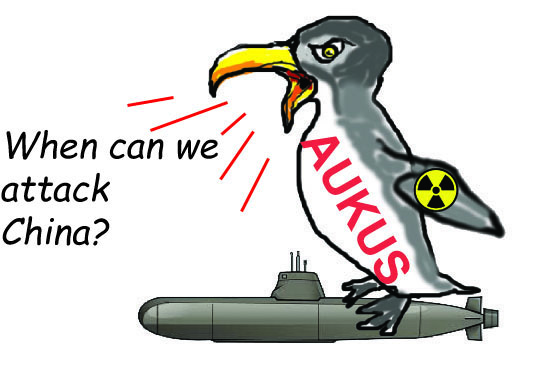
A new nuclear arms race is accelerating, but Australia won’t be doing much about this threat to global survival. This week’s budget confirms the death of Labor’s nuclear disarmament diplomacy. Former diplomat Philip Dorling explains.
At his AUKUS submarine announcement on 14 March 2023, Prime Minister Anthony Albanese spoke of Australia’s “proud record of leadership” in nuclear non-proliferation. On 17 April Foreign Minister Penny Wong trumpeted Labor’s “proud history” of championing practical disarmament efforts”.
Labor does have a history of disarmament and non-proliferation leadership. In the 1990s Foreign Minister Gareth Evans was an outstanding diplomatic activist with Australia playing important roles in negotiation of the Chemical Weapons Convention, extension of the Nuclear Non-Proliferation Treaty, and the Comprehensive Nuclear Test Ban Treaty. Evans argued before the International Court of Justice that the use and threat of nuclear weapons is illegal. The Canberra Commission produced a landmark report charting steps to achieve the elimination of nuclear arsenals.
Dollars for diplomacy
Foreign Minister Wong is the latest custodian of Labor’s tradition of middle power disarmament diplomacy. But what are Labor’s priorities now? Well, at the end of the day, money talks and in Tuesday’s Federal Budget the Department of Foreign Affairs and Trade (DFAT) picked up an extra $74.6m for nuclear diplomacy.
Of that, $52.7m is for DFAT to provide “international policy advice and diplomatic support for the nuclear-powered submarine program.” Another $21.9m will go to the Australian Safeguards and Non-Proliferation Office (ASNO) to support the establishment of safeguard arrangements with the International Atomic Energy Agency (IAEA) for the AUKUS project.
All the new money is to support AUKUS.
AUKUS safeguards
For the AUKUS project to proceed within the framework of Australia’s non-proliferation obligations, Australia must negotiate a special arrangement with the IAEA to allow the use of highly enriched uranium in submarine reactors. We already have a Comprehensive Safeguards Agreement (CSA) with the IAEA that covers civilian nuclear activities. Article 14 of the CSA allows for negotiation of an arrangement with the IAEA to oversee the use of nuclear material for non-explosive military purposes, i.e. nuclear naval propulsion.
It’s challenging to combine the safeguards transparency with the secret world of nuclear submarines; but the Australian Government and IAEA Director General Rafael Grossi appear confident an arrangement can be agreed to enable the IAEA to provide credible assurances that submarine fuel is not being used to manufacture nuclear weapons.
The Government has already affirmed that Australia will be provided with complete, sealed reactor units from which the removal of any nuclear material would be extremely difficult. The reactor fuel will “not be in a form that can be directly used in nuclear weapons without further chemical reprocessing, requiring facilities that Australia does not have and will not seek”. Australia’s wider non-proliferation obligations, including acceptance of IAEA inspections anywhere, anytime will remain in place.
A few days before the 14 March AUKUS announcement, Albanese and Wong wrote to Grossi to open formal negotiations. ASNO Director General Geoff Shaw also forwarded “preliminary design information” to the IAEA.
Diplomatic dogfight
However despite what DFAT describes as Australia’s “impeccable non-proliferation credentials”, the negotiations are already politically contentious with China claiming AUKUS “poses serious nuclear proliferation risks”. Beijing alleges Australia is “coercing the IAEA Secretariat into endorsement on the safeguards issue”. Chinese diplomats are demanding an “intergovernmental process” involving all IAEA members with any new arrangement “jointly discussed and decided by the international community”.
Australia’s government doesn’t want AUKUS derailed. We’re relying on advice from the IAEA in 1978 that states an Article 14 arrangement can be negotiated with the IAEA Secretariat before being provided to the IAEA Board of Governors for “appropriate action”. Australia would like Grossi to simply submit the negotiated arrangement to the Board as information. However the Board may insist on subjecting the arrangement to its approval. China and Russia will demand that, and they’ll likely vote against any arrangement regardless of its terms. IAEA Board approval is by no means assured. Even if the Board does approve, China won’t leave the matter there. A fractious dispute could drag on for years.
That’s why $74.6m has been committed to AUKUS diplomacy. This large and complex campaign will involve negotiation with the IAEA Secretariat and engagement with the 35 countries on the IAEA Board, indeed with all 176 members. Australia will be funding plenty of IAEA projects, seminars and workshops. In terms of diplomatic effort it’s equivalent to running for election to a seat on the United Nations Security Council, only more controversial and already actively opposed by China and Russia. All this comes with big opportunity costs.
A new nuclear arms race
The international situation is deeply worrying. Tension between China and the United States over Taiwan continues to rise. There’s already a naval arms race of which AUKUS is a small part, but the bigger strategic shift is manifest with China’s expansion of its nuclear forces. Construction of hundreds of new silos for a greatly expanded strategic missile force raises the prospect that Beijing is seeking an arsenal much closer to parity with the US.
At the same time, Russia has suspended the New START nuclear arms treaty which will expire in 2026. Moscow’s development of new and potentially destabilising delivery systems makes the future strategic calculus more uncertain. In turn, the prospect of three way nuclear arms competition with China and Russia has led to calls in the US Congress for an expansion of US nuclear forces.
Australian diplomats express concern about “the opaque nuclear arsenal build up in our region”. Others are less coy about the nuclear danger. Veteran foreign policy analyst Professor Joseph Siracusa recently warned that “We are literally on the eve of destruction .
The demise of Labor’s disarmament diplomacy
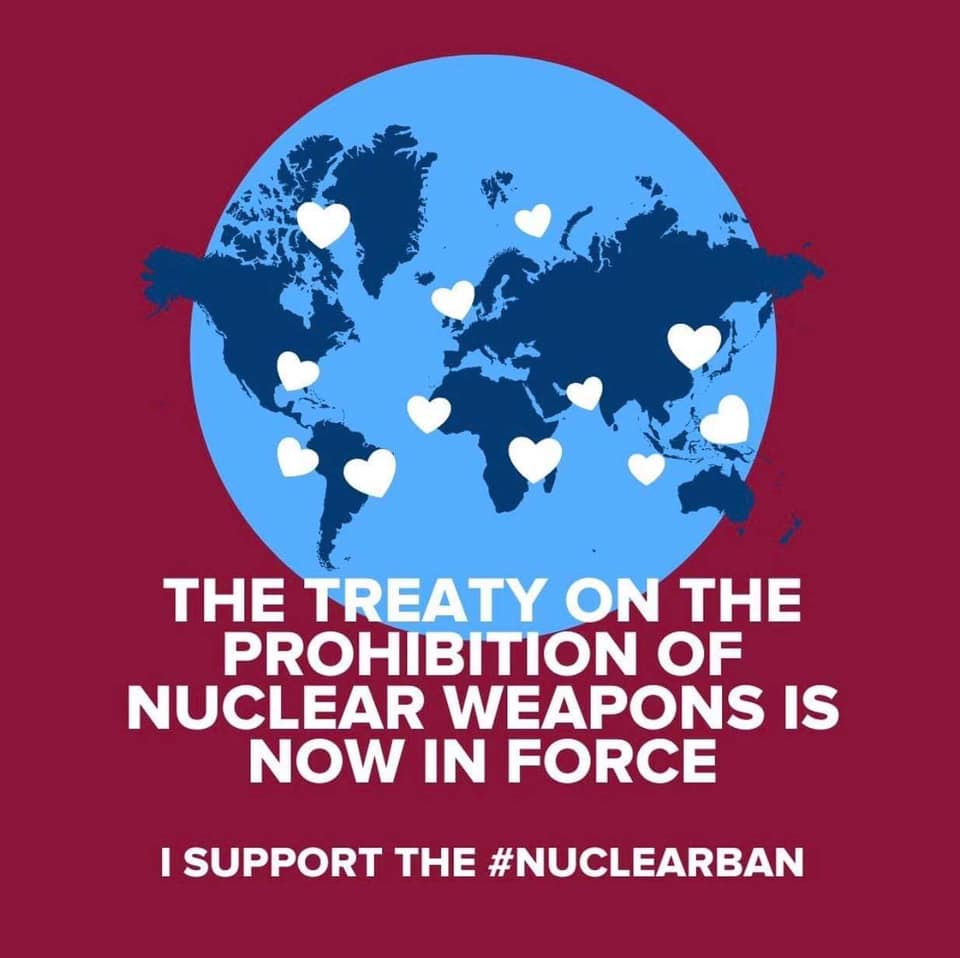
Labor’s national platform commits the government to move to join the Treaty on the Prohibition of Nuclear Weapons (TPNW), a recent agreement produced under UN auspices to advance nuclear disarmament. Albanese championed Labor’s 2018 commitment to sign the TPNW. In June last year a large group of former Australian Ambassadors and High Commissioners urged the new government to follow through and join the TPNW as demonstration of “a principled foreign policy … that advances the global common good”.
The United States has no enthusiasm for the TPNW and DFAT worried that the new Labor Government would be receptive to something that could complicate AUKUS, especially ensuring bipartisan support in the US Congress.
They needn’t have been concerned. Labor’s pledge to join the TPNW was a dead letter the moment Labor’s leadership signed up to the nuclear submarine project. DFAT submissions released under FOI show Wong agrees that TPNW isn’t a priority. She massaged Labor rank and file concerns by sending Labor backbencher Susan Templeman as an observer to the first TPNW states parties meeting in Vienna in June 2022. But as DFAT noted, “our attendance as an observer did not represent a decision to join the TPNW.”
Questioned in March by independent MP Zoe Daniel about the backflip, Albanese again referenced Labor’s “proud history” of disarmament efforts, but wouldn’t commit to joining the TRNW.
Lost opportunity
Australia could be working with TPNW countries to put an international spotlight on the dangers of a new nuclear arms race. Realistic and practical measures that could be pursued include those proposed by former ASNO Director General John Carlson; pressing nuclear weapon states for “no first use” commitments, a cap on existing arsenals, no modernisation or new weapons and a draw down towards minimum deterrence capabilities.
However with AUKUS dominating the agenda, there isn’t any room for the middle power diplomacy once practiced by Gareth Evans. Instead, Australian diplomats are busy defending our nuclear submarine pact. At a recent meeting in Geneva on nuclear risks, Australian spent nearly as much time and effort rebutting Chinese allegations about AUKUS as what was devoted to substantive issues.
The Government’s budget allocation to DFAT shows they know they have a long diplomatic fight on their hands. It will suck the life out of Australian disarmament diplomacy. We’ll be talking ad nauseam about AUKUS while a nuclear arms build-up makes the world much less safe.
Labor’s disarmament activism is dead, cannibalised by AUKUS.
Philip Dorling has some thirty years of experience of high-level political, public policy and media work, much of that at the Australian Parliament.
He has worked in the Australian political environment from most angles, in both the national and state levels of government including as a senior executive; as a senior policy adviser for the Federal Labor Opposition and for cross bench Senators; and as an award-winning journalist in the Federal Parliamentary Press Gallery.
Speaking to the Australian Broadcasting Corporation (ABC) this week, Labor Prime Minister Anthony Albanese gave his most extensive comments on the plight of Julian Assange since coming to office in May 2022. Albanese feigned concern for the WikiLeaks publisher, but defended the entire anti-democratic framework of “national security” secrecy under which he is being persecuted.
Albanese is in London for the coronation of King Charles. He is also holding discussions with the British government, centring on AUKUS, the aggressive militarist pact between the two countries and the US, aimed at preparing for war against China.
In the same city, Assange has been incarcerated in the maximum-security Belmarsh Prison for more than four years, most of that time on remand. The sole purpose of his detention is to facilitate a US extradition request. The American government is seeking to imprison Assange for up to 175 years for exposing its war crimes in Iraq and Afghanistan and its global diplomatic conspiracies.
Albanese’s comments have been presented widely as his “strongest” in defence of Assange. Throughout his prime ministership, Albanese has sought to avoid even mentioning the WikiLeaks publisher, even though Assange is an Australian citizen and the world’s most significant political prisoner.
Albanese’s long silence, which included his tenure as opposition leader, was clearly a product of political hostility to Assange and WikiLeaks. But as demands for the Labor government to defend Assange grew, Albanese and his colleagues changed tack. They could not speak openly about Assange, supposedly because that would compromise unspecified “quiet diplomacy” they were conducting on his behalf.
Documents obtained via freedom of information requests by lawyer Kellie Tranter have not turned up a single trace of this “quiet diplomacy.” That includes correspondence between the relevant Australian government bodies and its counterparts in the US and Britain.
In the ABC interview, Albanese repeated his refrain that “enough is enough” in relation to the Assange case and “this matter needs to be brought to a close.” These formulations are deliberately ambiguous. They do not even indicate how the case should be “brought to a close,” much less demand that the Biden administration drop the prosecution.
Albanese added: “It needs to be worked through, we’re working through diplomatic channels, we’re making very clear what our position is on Mr Assange’s case.” But again, it is not at all “clear” what the Labor government’s position actually is. Moreover, almost a year of purported “quiet diplomacy” has not altered the course of Assange’s persecution by one iota.
Asked about this, Albanese replied: “I know it’s frustrating. I share the frustration. I can’t do more than make very clear what my position is.” He claimed that the US government was “clear” on Labor’s position, but would not even commit to raising Assange when Biden visits Australia later this month.
Albanese expressed “concern” for Assange’s health, but did not indicate he would do anything about it. It is over three years since hundreds of doctors first warned that the deterioration of Assange’s medical condition could result in his death behind bars, and demanded he be released from Belmarsh Prison.
In the comments that some Assange supporters have presented as most hopeful, Albanese stated: “I think that when Australians look at the circumstances, look at the fact that the person who released the information [Chelsea Manning] is walking freely now, having served some time in incarceration but is now released for a long period of time, then they’ll see that there is a disconnect there.”
Again, this is miles away from a demand that the Biden administration end its prosecution, or a defence of a persecuted Australian journalist. It is more in the manner of, “it is unfortunate that this is occurring, but what can one do?”
That was, in fact, the entire thrust of Albanese’s remarks. Labor had raised the issue, he claimed, made its “position clear” and Assange’s fate was in the hands of Britain and the US. That is diametrically opposed to the repeated aggressive diplomatic and legal interventions Australian governments have previously mounted to free citizens imprisoned abroad.
The fraudulent character of Albanese’s purported defence of Assange was underscored by the fact that his comments were immediately endorsed by opposition Liberal Party leader Peter Dutton. Dutton, a former policeman, is an extreme right-wing figure, who speaks most openly for the repressive state forces that are seeking Assange’s destruction.
Above all, Albanese’s remarks were aimed at placating the growing public support for the WikiLeaks founder and subordinating it to a “quiet diplomacy” that could not be any quieter. Among some prominent Assange supporters, Albanese’s remarks have had their desired effect. They have proclaimed that the Labor government has now demonstrated its commitment to Assange’s freedom, presenting this as a fact to be celebrated.
Such positions, it must be stated, are a self-deluding fantasy that obstructs a genuine fight for Assange’s freedom, lets those involved in his persecution off the hook and creates favourable conditions for a US extradition. Unfortunately, it is not hard to envisage such individuals proclaiming one “victory” after another, right up until Assange is dispatched to his US persecutors.
Several questions must be posed: If Albanese were waging a determined struggle for Assange’s freedom, would he be fawning over King Charles and British Prime Minister Rishi Sunak, the figures who hold the key to Assange’s cell? Would he be preparing to roll out the red carpet for Biden when the US president visits Australia in several weeks? Would he not make demands of the British and US governments, as Australian administrations have when defending other persecuted citizens?
Those who promote the illusion that Assange’s freedom will be granted by one or another benevolent faction of the establishment, without any genuine political struggle, invariably detach the attempted US extradition from its broader political context.
As the WSWS has explained, the US is pursuing Assange, not only as an act of retribution. It is seeking to establish a precedent for the suppression of social and political opposition, especially opposition to war. This forms part of a broader turn to authoritarianism by governments around the world, amid the deepest crisis of the capitalist system since the 1930s.
The imperialist powers are preparing for another catastrophic world war. That is the significance of the US-NATO proxy war against Russia in Ukraine, along with Washington’s confrontation with China, which is viewed as the chief threat to American imperialist hegemony.
Australia, under Albanese, is on the frontlines of these war preparations. Last month, Labor endorsed a Defence Strategic Review, calling for Australia’s largest military build-up since World War II. The review is explicit that this is in preparation for a US-led war against China.
As in the last century, war is incompatible with democratic rights. It requires the suppression of anti-war opposition, because governments are aware that workers and young people are hostile to militarism, and that the program of war will intensify a resurgence of the class struggle that is already well underway.
This basic point was essentially made by Albanese himself.
Australian Prime Minister Anthony Albanese expressed frustration at the United States’s continuing efforts to extradite WikiLeaks founder and Australian citizen Julian Assange, saying: “There is nothing to be served by his ongoing incarceration.”
The 2023 Defence Strategic Review has recommended Australia adopt a new strategic conceptual framework dubbed ‘National Defence’ that incorporates a ‘strategy of denial’. This approach is tied to a broader concept of ‘collective security’ in the Indo-Pacific and is aligned with America’s framework for ‘integrated deterrence’ of China. ‘National Defence’ is consistent with American force structure designs to develop the northern Australian expanse as an increasingly important base of operations for force-projection.
From ‘Defence of Australia’ to ‘National Defence’
The recommendation by the 2023 Defence Strategic Review (DSR) to abandon the long-standing strategic doctrine known as ‘defence of Australia’ (DoA) has been met with approval by the Albanese government, even as the doctrine had been previously eviscerated to conform with the requirements of the US alliance.
DoA reached its zenith with the release of the 1986 ‘Dibb Review’ that recommended a shift in Australia’s defence strategy from dependent expeditionary combat to ‘self-reliant’ protection of the continent and the air and maritime approaches to Australia. This was to be achieved by adopting ‘an essentially defensive posture in our region’ and employing a ‘strategy of denial’ with strike capabilities strictly limited in range to accomplish that objective………………………………….
However ………… long-standing aspirations for Australia to be an influential ‘middle power’ in international affairs, or more accurately, a ‘sub-imperial power’, which required undertaking regional ‘burden sharing’ responsibilities to preserve ‘stability’ on behalf of the US-led global order.
………………. A major turning point came in late 2001 when the Howard government committed Australia to America’s ‘global war on terror’. ……………….
……. While DoA and ‘self-reliance’ remained official strategic guidance, operationally the Australian Defence Force (ADF) largely came to serve as an adjunct to the US military.
DoA has now been jettisoned entirely by the DSR in favour of ‘National Defence’, a new strategic conceptual framework based on the prospect of higher-level direct threats to Australia’s ‘national interests’ arising from US-China competition………….. This entails abandoning a ‘balanced’ force in favour of a force structure that is ‘focussed’ on preparing for major war – with China.
…………………….. Today, it is the supposed threat to the ‘rules-based order’ that functions as the new ‘domino theory’, where legitimate concerns about Chinese assertiveness in long-standing territorial disputes in the South China Sea is imagined as a direct military threat to Australia and our ‘national interests’.
………… maintaining a ‘balance of power’ has long been a euphemism in Australian political discourse for sustaining American military dominance or ‘primacy’…………..
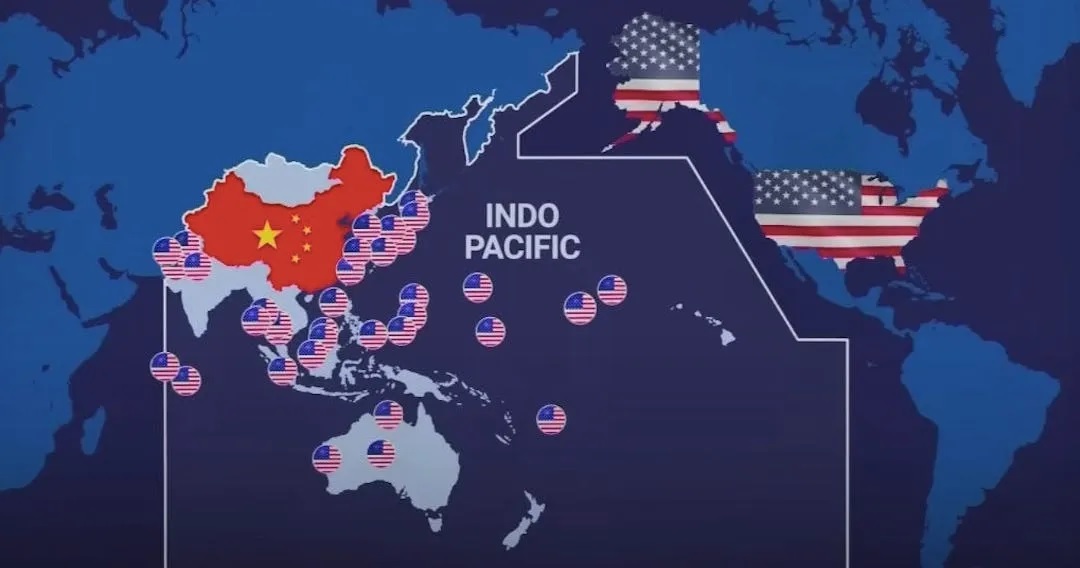
……………….. achieving ‘balance’ translates into an agenda for Australia to work even more closely with the United States, and key American security partners like Japan, to further encircle China militarily.
…………………………………..Unlike the strategic approach articulated in the 1986 Dibb Review, the ‘strategy of denial’ adopted by the DSR is tied to a broader concept of ‘collective security’ in the Indo-Pacific and is aligned with America’s framework for ‘integrated deterrence’ of China. It is consistent with American force structure designs to develop the northern Australian expanse as an increasingly important base of operations for force-projection
………..The biggest change foreshadowed by the DSR is to the Army, which will have its infantry fighting force dramatically scaled back and be optimised for littoral operations and enhanced long-range fire.
……………………………… This is the great strategic folly of AUKUS. It will equip the ADF with a potent capability to strike the Chinese mainland and, in coalition with the United States, play a frontline role in hunting China’s nuclear-armed submarine force and its critical second-strike nuclear deterrent capability.
While AUKUS risks contributing to an existential nuclear threat to China, the DSR reassures Australians that we remain safe from nuclear annihilation under the protection of America’s ‘extended nuclear deterrence’, for which there are no credible assurances, and in efforts to pursue ‘new avenues of arms control’, of which there are none, except that which the Albanese government has yet to join – the Treaty on the Prohibition of Nuclear Weapons – despite assurances by the Labor Party to the contrary
Finally, climate change is belatedly recognised as a significant national security issue in the DSR, but largely as a distraction that risks detracting from Defence’s primary objective of defending Australia against China…………………..
The DSR overstates the threat China poses to Australia, appears wilfully blind to the risks of nuclear escalation inherent in the defence strategy it recommends, and understates the existential threat of climate change which it fails to confront. What’s more, ‘National Defence’ dictates an acute focus on preparing Australia’s armed forces to integrate in a substantial way with American force structure plans to carry out what should be utterly unthinkable: a high-end war with a nuclear-armed China that risks wreaking a global catastrophe. https://johnmenadue.com/labors-serial-betrayal-of-australia/
Make no mistake, the Albanese government knows that in joining the US fight against China, Australia will be left defenceless on American withdrawal. And only a dodo could not know this risk is high. Maybe the government doesn’t appreciate that war for America is different. It is the war which matters, not the result. “Winning” is incidental.
Thinking deeply about Australia’s future is simply beyond the Albanese/ Wong/ Marles triumvirate.
Originally my editor requested a survey of Australia’s media response to the government’s Defence Strategic Review (DSR) – tackily released during the ANZAC devotions. It became clear that this was a trivial exercise. The bulk of our mainstream print, TV and radio accepted the tenet that Australia should treat China as an emerging military threat, and spend heavily against the prospect of war. None challenged it.
A sane assessment would find that China presenting a military threat to Australia is fabrication – to rival that of Iraq’s weapons of mass destruction. Thereby America itself has become a great danger to Australia. Its propensity for conflict and brutal self-interest is amply evidenced, over decades. To Washington’s strategists, Australia exists foremost as another object to be exploited for their world wide web of wars. With some distinguishing attributes. We are an ally which profitably pays it way, eagerly, for which the US is un-obligated. Meaning the US can freely entwine Australia in a war with China, then just go home when things get tough, responsibly in its view. As it does, with practised facility.
Despite our hapless, shameful experiences and ever-mounting evidence of America’s implacable hegemony our governments increasingly have conflated Australia’s interests with America’s.
Once Australians rightly could have expected a Labor government to be discerning of our unique interests. But we have to go back to Hawke and Keating to be confident of it. When America’s interests would not swamp our own. Today, it matters not which major political party holds the reins. Bipartisanly, our leaders are preparing Australia for war against the fresh superpower of China. At America’s instigation. While America complains that it lacks the resources for the job, and must rely critically upon allies. And the massive stakes unique to Australia are subordinated to those US interests.
How could anything else rate higher as an issue for Australia?
The seeds of betrayal
We are told by Defence Minister Marles that the DSR comes at a “watershed moment” and that “Australia has lost ten years of warning time.” That is, Australia should have been preparing for war long ago. In fact, Labor created the watershed moment more than ten years ago,………………………………………
Perhaps those years of Labor hand-sitting while our defences were being turned over to US objectives might have been tolerable, if the Albanese government had set about securing Australia’s interests upon gaining power. But the opposite has unfolded. Labor is accelerating spending for war.
Those with long faith in Labor had assumed that the lie of a China military threat to us would be scrutinised once the LNP government fell. Intelligence advice had to be assessed independently. Because on official Pentagon advice to the US Congress China’s forces are stretched just in trying to meet America’s threat to its periphery. But no, Labor didn’t want to know. Instead of getting to the heart of the matter promptly, a defence review was commissioned. And that same conflicted intelligence apparatus provided the foundation for it. Thereby another year has slipped by, in war preparation.
“The review’s outcome was set before it started by the politics of Labor signing up in a matter of hours to carry Scott Morrison’s Anglophone burden. Paul Keating’s charge remains unanswered that Labor’s defence policy was set by wanting to provide no target when blindsided by Mr Morrison’s submarine adventure.”
Unsurprisingly, the stench of political duplicity intensified as the review proceeded.
America’s wars are not about winning
The big betrayal is Labor’s doubling down on the path to war once in power. It is clear now that this was always the intent. What is new in the DSR is that finally a government admits that Australia is entirely dependent on the US:
4.7 However, Australia does not have effective defence capabilities relative to higher threat levels which can only be achieved by working with the United States…..
Make no mistake, the Albanese government knows that in joining the US fight against China, Australia will be left defenceless on American withdrawal. And only a dodo could not know this risk is high.
Maybe the government doesn’t appreciate that war for America is different. It is the war which matters, not the result. “Winning” is incidental. There is always Stateside to come home to. What matters is disempowerment of the adversary – degradation of state, polity, economy, infrastructure and population. That is grist-to-the-mill for the US State Department. Constantly played out by lounging analysts on buttoned leather sofas in the palatial “map room” at Foggy Bottom. Australia’s fate is amongst those gamed there, incidentally.
Even if it did, there can be little doubt now that the Albanese government has chosen to look straight ahead. It has Australia comfortably settled on America’s accelerating train to war with China. To meet a vigorous superpower on its home ground. The war is unwinnable. Impossible to imagine the residual mess. Which will endure in many dimensions for us. But that is of no matter to America. Who in the government knows, or would care?
Here is the future which the Albanese government is steering Australia into. Without a whimper within the Labor party. Thinking deeply about Australia’s future is simply beyond the Albanese/ Wong/ Marles triumvirate. Creative dimensions such as our former ambassador in Beijing Dennis Argall has espoused are beyond Labor.
The way out
While our nation is engulfed in a spiral to war, Foreign Minister Wong has demonstrated no capacity to protect it. In opposition Wong claimed to appreciate the effect of conflict with China. But now talks merely of “lowering the heat” while lining up stoically behind Marles’ indulgent militarism. Paralysed by politics.
Australia’s prospects are unthinkable. We have no alternative but to embrace wider geostrategic options. To give self-interest and self- belief a real shot.
That new road will be complex to map. And long. Our nation no longer possesses the administrative machinery critical for an independent State. Intelligence is compromised, foreign policy and defence gutted, politicised and Americanised. Fixing that is the basic first step. No doubt the nation still possesses independent, experienced, cultivated minds up for it. We can grow up. Again. https://johnmenadue.com/labors-serial-betrayal-of-australia/
While no threat from China exists, media propagandists are trying to ignite a war the likes of which we’ve never seen. John Pilger reminds us that we need to raise our voices before it’s too late.
“IN 1935, the Congress of American Writers was held in New York City, followed by another two years later. They called on ‘the hundreds of poets, novelists, dramatists, critics, short story writers and journalists’ to discuss the ‘rapid crumbling of capitalism’ and the beckoning of another war………………………………………………
The journalist and novelist Martha Gellhorn spoke up for the homeless and unemployed, and “all of us under the shadow of violent great power”. ………………………….
On 7 March, the two oldest newspapers in Australia – The Sydney Morning Herald and The Age – published several pages on “the looming threat” of China. They coloured the Pacific Ocean red. Chinese eyes were martial, on the march and menacing. The Yellow Peril was about to fall down as if by the weight of gravity.
No logical reason was given for an attack on Australia by China. A “panel of experts” presented no credible evidence; one of them is a former director of the Australian Strategic Policy Institute, a front for the Defence Department in Canberra, the Pentagon in Washington, the governments of Britain, Japan and Taiwan, and the West’s war industry.
There is no threat to Australia. None. The faraway “lucky” country has no enemies, least of all China, its largest trading partner. Yet China-bashing that draws on Australia’s long history of racism towards Asia has become something of a sport for the self-ordained “experts”. What do Chinese-Australians make of this? Many are confused and fearful.
The authors of this grotesque piece of dog-whistling and obsequiousness to American power are Peter Hartcher and Matthew Knott, “national security reporters” I think they are called. I remember Hartcher from his Israeli government-paid jaunts. The other one, Knott, is a mouthpiece for the suits in Canberra. Neither has ever seen a war zone and its extremes of human degradation and suffering.
How did it come to this? Martha Gellhorn would say if she were here. Where on Earth are the voices saying no? Where is the comradeship?
The voices are heard in the samizdat of this website and others. In literature, the likes of John Steinbeck, Carson McCullers and George Orwell are obsolete. Post-modernism is in charge now. Liberalism has pulled up its political ladder. A once somnolent social democracy, Australia, has enacted a web of new laws protecting secretive, authoritarian power and preventing the right to know. Whistleblowers are outlaws, to be tried in secret. An especially sinister law bans “foreign interference” by those who work for foreign companies. What does this mean?
Democracy is notional now; there is the all-powerful elite of the corporation merged with the state and the demands of “identity”. American admirals are paid thousands of dollars a day by the Australian taxpayer for “advice”. Right across the West, our political imagination has been pacified by PR and distracted by the intrigues of corrupt, ultra-low-rent politicians: a Johnson or a Trump or a Sleepy Joe or a Zelensky.
retired U.S. military figure” generally means someone who used to be paid by the U.S. government to advance the interests of the U.S. empire, and is now paid by corporations and/or foreign governments to advance the interests of the U.S. empire.
Among the American swamp monsters hired by Canberra is the Obama administration’s spy chief, who has an established track record of lying and manipulating to advance the interests of the U.S. empire.
Australia has been paying insiders of the U.S. war machine for consultation on how to run the nation’s military, a massive conflict of interest given that Washington has been grooming Australia for a role in its war agendas against China.
For those who don’t speak imperialist, “retired U.S. military figure” generally means someone who used to be paid by the U.S. government to advance the interests of the U.S. empire, and is now paid by corporations and/or foreign governments to advance the interests of the U.S. empire.
These corrupt warmongers rotate in and out of the revolving door of the D.C. swamp, from government to war-industry jobs to punditry gigs to influential think tanks and then back again into government, advancing the interests of the U.S. empire the entire time and growing wealthy in the process.
This dynamic allows a permanent constellation of reliable empire managers to continually exert influence around the world in support of the U.S. empire, regardless of who gets voted into or out of office in the performative display of electoral politics. It’s a big part of why U.S. foreign policy remains the same regardless of who’s officially running the elected government in Washington, and it’s a big part of why the media and arms industry which support the U.S. war machine keep playing the same tune as well.
Among the American swamp monsters Australia paid for consulting work is the Obama administration’s spy chief James Clapper, who has an established track record of lying and manipulating to advance the interests of the U.S. empire:
In 2013 Clapper committed perjury by telling the U.S. Senate under oath that the NSA does not knowingly collect data on millions of Americans, only to have that lie exposed by the Edward Snowden leaks a few months later.
In 2016 Clapper played a foundational role in fomenting public hysteria about Russia with the flimsy ODNI report on alleged Russian election interference, which remainsriddled with massiveplot holes. He would later go on to repeatedly voice the opinion that Russians are “almost genetically driven” toward nefarious and subversive behavior.
In 2020 Clapper signed the infamous and now fully discredited letter from former intelligence insiders saying the Hunter Biden laptop story was likely a Russian disinfo op, falsely telling CNN that the story was “textbook Soviet Russian tradecraft at work” and that the emails on the laptop had “no metadata” on them.
Also among the American military consultants paid by Australia is a man we just discussed the other day, William Hilarides, who will be telling Australia how to reconfigure its navy because apparently no Australians are available for that job. We now know that according to the released Pentagon documents Canberra has already paid Hilarides almost $2.5 million since 2016 for his consulting work.
This information was originally reported by The Washington Post’s Craig Whitlock and Nate Jones, who last year also broke the remarkable story that a former U.S. navy admiral named Stephen Johnson had actually served as Australia’s deputy navy secretary, a position which needless to say is not normally open to foreigners.
……………………………………… Australia has always seemed like a fairly irrelevant player on the world stage because of its impotent subservience to Washington. But it’s becoming clear it is exactly because of Australia’s blind subservience to Washington that Australia is worth paying attention to, since that relationship may well end up giving the nation a front-row seat to World War Three.
Australians are going to have to wake up to what’s being done and the abominable agendas the nation is being exploited to advance. Australians are being groomed for a military confrontation of unimaginable horror, one which absolutely does not need to take place, all in the name of something as trivial as securing U.S. planetary hegemony. Australians have got to start saying no to this, starting right now.
A thorny trans-Tasman citizenship issue has been resolved, but Prime Minister Chris Hipkin’s Brisbane trip showed nuclear sensitivities are set to linger between New Zealand and Australia.
……………………….questions then centred on an emerging long-term issue – Australia’s planned acquisition of nuclear-powered submarines – questions Albanese was unwilling to answer.
At a joint press conference on Sunday afternoon, after a citizenship ceremony where more than 200 Kiwis pledged allegiance to Australia, Prime Minister Chris Hipkins said he had discussed with Albanese his country’s new Aukus pact.
The pact between Australia, United Kingdom and the United States, will have Australia acquire nuclear-propelled in the coming three decades.
“New Zealand, like Australia, is clear eyed that there is a challenging strategic environment in the Indo-Pacific region,” Hipkins said.
……………….Albanese, asked twice at the press conference about New Zealand’s possible involvement in Aukus, veered away from answering the question, talking instead about the Pacific Island Forum and both countries co-operating on climate change.
New Zealand maintains a strong nuclear-free stance, and Hipkins on Sunday said he welcomed Albanese’s reassurance Australia remained committed to the non-proliferation of nuclear weapons.
Marshall Islands’ Hilda Heine, Palau’s Tommy Remengesau, Tuvalu’s Enele Sopoga Kiribati’s Anote Tong say the “staggering $368 billion” allocated for the deal flies in the face of Pacific island countries which are crying out for support for climate change.
They accuse Australia and its two allies of triggering an arms race and demonstrating a complete lack of recognition for the climate change security threat faced by the island nations.
Former Kiribati President Anote Tong said Australia and its allies need to do more consultations with the Pacific before the plan develops further.
LONDON, April 8 (Xinhua)http://eng.chinamil.com.cn/VOICES/16215442.html The United States, Britain and Australia have been pressing ahead with nuclear submarine cooperation despite being widely questioned, which creates nuclear proliferation risks and undermines the international non-proliferation system, the Chinese Embassy in Britain has said.
In response to a question concerning the trilateral Australia-UK-U.S. (AUKUS) cooperation on nuclear submarines, the embassy said on Friday that such cooperation will exacerbate the resurgence of the Cold War mentality, trigger a new round of arms race, and further provoke regional security and military confrontation, seriously jeopardizing regional peace, stability and prosperity.
The Asia-Pacific is now the most dynamic and fastest growing region in the world, which hasn’t come easily, the embassy said in a press release. “The AUKUS cooperation is designed to serve the U.S. geopolitical agenda to introduce group politics and Cold War confrontation into the Asia-Pacific with military deterrence. It is aimed at creating a NATO-replica in the Asia-Pacific, which runs counter to peace and stability in the region.”
The AUKUS nuclear submarine cooperation marks the first time for nuclear weapon states to transfer naval nuclear propulsion reactors and weapons-grade highly enriched uranium to a non-nuclear weapon state, it noted.
As the current International Atomic Energy Agency (IAEA) safeguards system is incapable of ensuring effective safeguards, such cooperation poses serious nuclear proliferation risks, seriously compromises the authority of the IAEA, and deals a blow to the agency’s safeguards system, the embassy said.
“If the three countries are set on advancing the cooperation, other countries will likely follow suit, eventually leading to the collapse of the international nuclear non-proliferation regime,” it said.
China urges the three countries to heed the call of the international community and regional countries, discard the outdated zero-sum Cold War mentality and narrow geopolitical mindset, earnestly fulfil their international obligations and do more things that are conducive to regional peace, stability, unity and development, the embassy said.
“This serves the fundamental and long-term interests of regional countries as well as the three countries themselves,” it said. “The UK is not a country in the region and it is unwise to overstretch itself.”
The AUKUS agreement attempts developments that will shift Australia into a zone that will threaten the existence of Australia itself.
I am not merely thinking of the militarisation of Australia, although that is definitely one likely outcome. I also have in mind our way of life that, while still set in settler-colonial assumptions that give First Nations people no substantial value in Australian society, is relatively relaxed when compared with the way of life of people in the United States. Australia has not experienced the focus upon security that high-powered militarisation associated with nuclear weapons brings. This is the world our leaders are leading us towards.
I want to take up two lines of inquiry into Aukus in this brief article. Firstly AUKUS brings together three Anglo-settled countries – two examples of settler-colonial domination that date back two centuries and more. plus of course the original Anglo-source nation, the United Kingdom. This may seem like an insignificant reference to an aspect of European colonialism that has shaped the whole world for centuries. However, Anglo colonialism has a particular complexion. Here I am drawing in part on the book by James Belich, Replenishing the Earth, about the history of Anglo colonialism. It is well-known these days in anti-colonialism circles that the Anglo slavery pursued in the Caribbean by England was the worst form of slavery, with cruelty on a scale that makes slavery in the United States seem enlightened. Anglo colonialism is typified by relations of difference that deal with colonised peoples with a vengeance. It is noteworthy that Anglo-settled countries like Australia have not at all come to terms with the cultures that pre-existed them. All invading cultures find this difficult, but Anglo-based cultures, as Belich shows, are a special case. It is no coincidence that Adolf Hitler looked with admiration to the United States for its ‘handling’ of its First Nations ‘problem’—a form of extermination of the Native American population—in how to think about the treatment of Jews and Slavs in Europe. Anglo cultures’ commitment to freedom and democracy has a repellent underbelly of racism and cultural suppression, not to mention genocidal elimination.
Significant cultural reform is always difficult but clearly the Anglo-powers have made the decision, at a time when in many respects their backs are up against the wall, to stand and fight—not for their own territory, but against the emergence of China, which was itself on the humiliating receiving end of Anglo colonialism in the nineteenth century. AUKUS in a strong sense is a thumbing of the West’s nose at all the emerging powers in Asia—on racial grounds. They must toe the line.
This is surely a crisis for an Australia seeking in the first half of the twenty-first century to survive in our region. To survive here Australia has to change its spots profoundly. It needs a form of cultural regeneration, in significant combination with Australian First Peoples, to justify its presence outside of the strategies of colonial power. While cultural change is always slow and complex, it is Australia’s only hope of both flourishing and being accepted in this region. It is also crucial because our allies are, in any case falling apart.
While I think the Voice could be the first step towards a significant and substantial change, only a weak version of the Voice, suitable for photo opportunities and feel-good policy, will survive the reassertions of this new Anglo alliance. Australia combines an especially empty form of recognition of First Nations with the arrogance of a superior colonial presence, coloured only a little by multiculturalism, and all this in a region where it has no basic right to exist.
The AUKUS alliance represents an incapacity to flexibly adjust to an emerging situation in which a new world power has emerged, one that will not go away. It is deeply ironic that the United States has fostered this emergence by its global development strategies, just as it fostered its opponents in Afghanistan at an earlier time.
That China is a new superpower is a reality—not that being a superpower is good for China or for us. Like large bureaucracies, superpowers develop self-oriented agendas related to their size, and are not to be trusted. But linking up with the remnants of the old powers to resist emergence means that Australia has resorted to a last gasp Anglo-cultural alliance rather than enter a serious process of rethinking its social composition and its place in the world.
The second line of comment is about nuclear submarines, drawing on a piece that appears in Arena Quarterly, just publishe
I want to take up two lines of inquiry into Aukus in this brief article. Firstly AUKUS brings together three Anglo-settled countries – two examples of settler-colonial domination that date back two centuries and more. plus of course the original Anglo-source nation, the United Kingdom. This may seem like an insignificant reference to an aspect of European colonialism that has shaped the whole world for centuries. However, Anglo colonialism has a particular complexion. Here I am drawing in part on the book by James Belich, Replenishing the Earth, about the history of Anglo colonialism. It is well-known these days in anti-colonialism circles that the Anglo slavery pursued in the Caribbean by England was the worst form of slavery, with cruelty on a scale that makes slavery in the United States seem enlightened. Anglo colonialism is typified by relations of difference that deal with colonised peoples with a vengeance. It is noteworthy that Anglo-settled countries like Australia have not at all come to terms with the cultures that pre-existed them. All invading cultures find this difficult, but Anglo-based cultures, as Belich shows, are a special case. It is no coincidence that Adolf Hitler looked with admiration to the United States for its ‘handling’ of its First Nations ‘problem’—a form of extermination of the Native American population—in how to think about the treatment of Jews and Slavs in Europe. Anglo cultures’ commitment to freedom and democracy has a repellent underbelly of racism and cultural suppression, not to mention genocidal elimination.
Significant cultural reform is always difficult but clearly the Anglo-powers have made the decision, at a time when in many respects their backs are up against the wall, to stand and fight—not for their own territory, but against the emergence of China, which was itself on the humiliating receiving end of Anglo colonialism in the nineteenth century. AUKUS in a strong sense is a thumbing of the West’s nose at all the emerging powers in Asia—on racial grounds. They must toe the line.
This is surely a crisis for an Australia seeking in the first half of the twenty-first century to survive in our region. To survive here Australia has to change its spots profoundly. It needs a form of cultural regeneration, in significant combination with Australian First Peoples, to justify its presence outside of the strategies of colonial power. While cultural change is always slow and complex, it is Australia’s only hope of both flourishing and being accepted in this region. It is also crucial because our allies are, in any case falling apart.
While I think the Voice could be the first step towards a significant and substantial change, only a weak version of the Voice, suitable for photo opportunities and feel-good policy, will survive the reassertions of this new Anglo alliance. Australia combines an especially empty form of recognition of First Nations with the arrogance of a superior colonial presence, coloured only a little by multiculturalism, and all this in a region where it has no basic right to exist.
The AUKUS alliance represents an incapacity to flexibly adjust to an emerging situation in which a new world power has emerged, one that will not go away. It is deeply ironic that the United States has fostered this emergence by its global development strategies, just as it fostered its opponents in Afghanistan at an earlier time.
That China is a new superpower is a reality—not that being a superpower is good for China or for us. Like large bureaucracies, superpowers develop self-oriented agendas related to their size, and are not to be trusted. But linking up with the remnants of the old powers to resist emergence means that Australia has resorted to a last gasp Anglo-cultural alliance rather than enter a serious process of rethinking its social composition and its place in the world.
The second line of comment is about nuclear submarines, drawing on a piece that appears in Arena Quarterly, just published.
The AUKUS strategy seeks to assert massive power, especially surveillance in the Pacific, surrounding China. Nuclear submarines combined with surveillance are the main focus of this attempt to cripple what actually, as I see it, cannot be stopped, in a way similar to Paul Keating’s argument. AUKUS shifts the whole emphasis away from how we protect our independence to what is needed to contain China. For Australia this seems to mean we have to achieve interoperability with US weaponary and systems, with nuclear submarines a key aspect of this. It means Australia must take a first step into adopting nuclear technology, and its consequences. We should not be assured by those who claim that it will be the last step.
Much has been written about the dangers of nuclear power and weapons over the years, to the point where it seems many in the community are now blasé about it—unless radiation waste is to be placed next door to you. Part of what the nuclear industry and its supporters have done is to launch smaller scale tactical nuclear weapons and also small-scale nuclear power plants because both large-scale nuclear weapons and large-scale power plants have unmanageable consequences and poor public acceptance, either because of non-human-scale destruction or ridiculous costs, which only keep escalating.
No one, with the exception of some military strategists, favours nuclear war. The reasons are obvious. The level of destruction of atomic bombs steps beyond our capacity to comprehend: it steps into another realm, a post-human one. Even the seemingly more mundane questions associated with nuclear waste are on another scale because they cannot be effectively disposed. All around the world nuclear waste is piling up around nuclear power stations as well as ‘storage’ of used nuclear submarines components because the waste is not of this world. There is no solution to the waste question. Nuclear waste is killing us on an increasing scale, as exposed by Kate Brown in her book A Manual for Survival. Contrary to the findings of mainstream Western science, she argues that low-level radiation is a mass killer and a general source of ill health As one Russian scientist she quotes puts it: ‘Chronic radiation is a crime’, and chronic radiation is a process that Australia has just signed up for with its nuclear submarines, adding its contribution to the systemic decline of the Earth’s environment, at least one that is suitable for human habitation.
We need to give some focus to this because it is an embarrassment to the nuclear lobby, which they handle and largely get away with by resorting to silence. But nuclear waste is a contradiction that will not go away. All attempts at solutions have failed in every part of the world. This cannot be emphasised enough.
What sort of contradiction is this?
Like nuclear technology, nuclear waste is usually simply regarded as a special category of danger. But its special effects arise out of a social process that is usually ignored. And this is a disaster because that social process is transforming our world in unprecedented ways.
This new world first burst upon us in 1945, with the practical scientific triumph of the atomic bomb. It was not merely novel. It was a consequence of the practical/conceptual reconstructions in the early twentieth century we associate with Albert Einstein and his associates. It was not merely a new theory. It was a combination of abstract academic theory with practical technology in the real world that gave birth to technoscientific society and culture, most importantly through its systematic approach to the transformation of nature. As such, academic theory entered the world of production, as an alternative or supplement to the transformations performed by the working classes, in a way that has expanded exponentially ever since. For better or worse, our world has become increasingly composed socially of the intellectually-trained.
The novelty of nuclear technology is contained within this social approach. Scientific intellectuals now uncover deep levels of the natural world, levels never before encountered by human societies that turn out to be mysterious and unmanageable. Nuclear is not the only example but it is a key one that destroys whatever it touches.
This is the world we are now entering, and doing so with great enthusiasm. It is not only a question of nuclear war. It is just as much one of the levels of security needed when dealing with what we do not know how to control. Nuclear weapons have been ‘controlled’ by such monstrosities as the Cold War and MAD (Mutually Assured Destruction) strategies that give reason a bad name. And low-level radiation has been controlled by denial of any major effects, while the environment of Planet Earth deteriorates. As Brown remarks, ‘Western researchers are discovering, like Soviet scientists before them, that radioactive decay at low doses changes the way cells behave in subtle and life-changing ways’, laying the basis for ‘chronic radiation syndrome’.
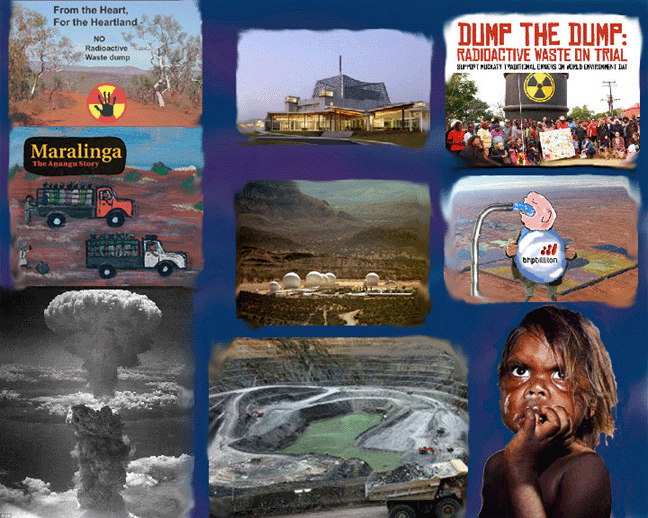
AUKUS is a strategy that pursues these outcomes systematically, our leaders planning to leave submarine waste in the desert, once again to be dealt with by First Nations people, now to be permitted by the WA Labor government. Among other things, the crime of chronic radiation poisoning needs to be sheeted home to the powers that be, and in particular now, the Albanese government.
Even among Australia’s roll call of opinionated former prime ministers, Paul Keating stands out—not least for his unmatched ability to dress down those who oppose him. But few thought he would ever turn this skill on his own political party, the Australian Labor Party, which finally seized government in 2022 after a decade in the wilderness. That was until last week, when Keating publicly condemned the AUKUS defense pact between Australia, the United Kingdom, and the United States and Prime Minister Anthony Albanese for signing it.
That tripartite deal, details of which were announced with fanfare just two days earlier, was “the worst international decision by an Australian Labor government” since conscription was attempted during World War I, Keating said during an appearance at Australia’s National Press Club. The decision to purchase nuclear-powered submarines—at a cost of up to 368 billion Australian dollars ($245 billion)—would invariably draw Australia into any potential conflict between the United States and China, he warned.
No words were minced: “Signing the country up to the foreign proclivities of another country—the United States, with the gormless Brits, in their desperate search for relevance, lunging along behind is not a pretty sight.”
Another former prime minister, Malcolm Turnbull of the Liberal Party, also chimed in with concerns, though he put them slightly more delicately.
…………….Turnbull has questioned whether the use of U.S. submarines—employed as a stopgap until British-designed, Australian-built subs are complete—could compromise Australia’s sovereignty. ……………….
Sam Roggeveen, the director of the international security program at the Sydney-based Lowy Institute, told Foreign Policy that his sovereignty concerns regarding AUKUS stretch beyond personnel. “When you build a weapon system that is almost specifically designed to operate thousands of kilometers to our north, and which is perfectly suited to fighting a military campaign against China,” he said, “then at the final moment when the call comes from the White House—‘Will you take part in this war, or won’t you?’—it will be very difficult, almost impossible, for Australia to say no.”
………… Should this relationship continue to devolve, AUKUS could prove “very dangerous” to Australia, dragging the country into a conflict between the two great powers. Ultimately, more debate was needed about the deal, he said, particularly because Australia will bear all of its cost and risk………………………………………………………….
“Many rank-and-file [Labor] members would and do agree with Keating’s criticism, if not all aspects of his argument,”said Chris Wallace, a political historian and professor at the University of Canberra. And some local branches, the bedrock of the party, have recently been pushing back against the deal.
Similarly, the Nobel Peace Prize-winning International Campaign to Abolish Nuclear Weapons, which was founded in Australia in 2007, warned that AUKUS posed “both a major proliferation risk and could be seen as a precursor to Australia acquiring nuclear weapons.” The organization said the purpose of the submarines was, clearly, “to support the [United States] in a war in northeast Asia. Whether with China, North Korea or Russia, there is an alarming risk of any such war escalating to use of nuclear weapons.”
Recent polling suggests the Australian people may also be coming around to Keating’s point of view. Leading pollster Essential found this month that the public’s belief that AUKUS would make Australia more secure has fallen to just 40 percent, down from 45 percent when the pact was first announced back in 2021. On the question of the nuclear-powered submarines in particular, Essential reported that 55 percent of people surveyed either thought the purchase was unnecessary or too expensive.
…………………………………. “There is no rational basis for the Albanese government facilitating the withering expense of nuclear submarines,” Keating wrote, “other than to suit and comply with the strategic ambitions of the United States—ambitions which slice through Australia’s future in the community of Asia, the basis of our rightful and honourable residency.”
The backlash to the recent announcement, from adversaries and allies alike, Wallace said, should prompt the Albanese government to go back to the drawing board and actually vet whether the deal—including the procurement of submarines powered by weapons-grade uranium—was the best option for Australia. “Instead, the government made the announcement first and expected everyone to back in behind it,” she said. “They were dreaming.”
The Albanese government is weighing whether to make a dramatic break with the United States and sign an anti-nuclear weapons treaty that would aggravate Washington and launch a new era in Australian security policy.
Anti-nuclear campaigners are urging the government to join over 90 countries and sign the Treaty on the Prohibition of Nuclear Weapons (TPNW) before the next election, a step that would see Australia abandon a key pillar of the US alliance by removing itself from America’s “nuclear umbrella” in the Asia-Pacific.
Labor’s national platform commits the party to signing and ratifying the treaty – which prohibits member states from participating in any nuclear weapon activities – but only after certain conditions are met.
Prime Minister Anthony Albanese has been a strong supporter of signing the treaty, describing the idea as “Labor at our best”.
The US strongly opposes the treaty and has previously urged friendly nations not to support it, on the grounds it would undermine peace and security.
……………………… A spokeswoman for Foreign Minister Penny Wong said the government will consider the treaty “systematically and methodically as a part of our ambitious agenda to advance nuclear non-proliferation and disarmament”.
“There are a number of complex issues to be considered,” she said.
…………………………………….. Gem Romuld, Australian director of the International Campaign to Abolish Nuclear Weapons, said “if the government is committed to non-proliferation and disarmament, it will sign the TPNW during this term of government”.
“That would be warmly welcomed by countries across the Asia-Pacific, most of which have already signed the treaty, as well as most of the Australian public,” she said.
Romuld acknowledged ratifying the treaty would represent a “big change for Australia, ending a practice we have had in our security policy for a couple of decades” by prohibiting Australia from hosting American assets armed with nuclear weapons, such as B-52 bombers.
………….. Romuld said the AUKUS pact – under which Australia will acquire a fleet of nuclear-powered submarines – does not prevent the government from signing the treaty. “In fact it only underlines the importance of it,” she said.
………………….
Labor MP Josh Wilson, the chair of the joint standing committee on treaties, said the TPNW represented a “much-needed jolt of momentum in the global nuclear disarmament effort”.
How could a conversation between President Biden, PM Albanese and PM Sunak, which he was in just two weeks ago, not be the most important kind of quiet diplomacy to use to free Julian Assange? And why wasn’t it used?
Foreign Affairs Minister Penny Wong has all but confirmed in Parliament the government is doing nothing to bring the world’s foremost political prisoner home. What’s the scam with “quiet diplomacy”?
Despite claiming the government is deploying “quiet diplomacy” to urge the US to free Julian Assange, and despite the government committing to a $368b spend on submarines – the biggest transfer of public money in Australia’s history – to US and UK weapons makers, there is no evidence whatsoever that our elected representatives have even muttered one word on the matter.
Thursday at 2:14 pm, Senator Shoebridge stood up in question time and asked Senator Wong a question about Julian Assange. He asked whether Prime Minster Anthony Albanese had used the opportunity created by the March 14, AUKUS ‘Kabuki Show’ to lobby for the release of Assange.
Senator Wong did all things possible to avoid having to say “no.”
Shoebridge acknowledged the implied “no” when he asked further:
How could a conversation between President Biden, PM Albanese and PM Sunak, which he was in just two weeks ago, not be the most important kind of quiet diplomacy to use to free Julian Assange? And why wasn’t it used?
Wong again ducked and weaved and then said, “We are doing what we can between government and government, but there are limits to what that diplomacy can achieve.”
wo and half hours later, in the last working minute of the day that Parliament was set to rise until May, the Department of Foreign Affairs sent me the response to an FOI request for “all cablegrams sent between the Department of Foreign Affairs and Trade and the Embassy of Australia, Washington DC, since 24 November 2022 that relate to Julian Paul Assange”. They advised:
“Thorough searches conducted by the Consular Operations Branch and the United States, United Kingdom & Canada Branch found no documents.”
The scam is, that while the government purports to be working quietly in background on the release of Julian Assange, the reality is that they are doing nothing.
The sham that is the Assange affair, a scandal of monumental proportions connived in by the AUKUS powers, shows no signs of abating. Prior to Prime Minister Anthony Albanese assuming office in Australia, he insisted that the matter dealing with the WikiLeaks publisher would be finally resolved. It had, he asserted, been going on for too long.
Since then, it is very clear, as with all matters regarding US policy, that Australia will, if not agree outright with Washington, adopt a constipated, non-committal position. “Quiet diplomacy” is the official line taken by Albanese and Australian Foreign Minister Penny Wong, a mealy-mouthed formulation deserving of contempt. As Greens Senator David Shoebridge remarks, “‘quiet diplomacy’ to bring Julian Assange home by the Albanese Government is a policy of nothing. Not one meeting, phone call or letter sent.”
Kellie Tranter, a tireless advocate for Assange, has done sterling work uncovering the nature of that position through Freedom of Information requests over the years. “They tell the story – not the whole story – of institutionalised prejudgment, ‘perceived’ rather than ‘actual’ risks, and complicity through silence.”
The story is a resoundingly ugly one. It features, for instance, stubbornness on the part of US authorities to even disclose the existence of a process seeking Assange’s extradition from the UK, to the lack of interest on the part of the Australian government to pursue direct diplomatic and political interventions
Former Australian Foreign Minister Julie Bishop exemplified that position in signing off on a Ministerial Submission in February 2016 recommending that the Assange case not be resolved; those in Canberra were “unable to intervene in the due process of another’s country’s court proceedings or legal matters, and we have full confidence in UK and Swedish judicial systems.” Given the nakedly political nature of the blatant persecution of the WikiLeaks founder, this was a confidence both misplaced and disingenuous.
The same position was adopted by the Australian government to the United Nations Working Group on Arbitrary Detention (WGAD), which found that same month that Assange had been subject to “different forms of deprivation of liberty: initial detention in Wandsworth prison which was followed by house arrest and his confinement at the Ecuadorean embassy.” The Working Group further argued that Assange’s “safety and physical integrity” be guaranteed, that “his right to freedom of movement” be respected, and that he enjoy the full slew of “rights guaranteed by the international norms on detention.”………………………….
At the time, such press outlets as The Guardian covered themselves in gangrenous glory in insisting that Assange was not being detained arbitrarily and was merely ducking the authorities in favour of a “publicity stunt”………………………………
The new Australian High Commissioner to the United Kingdom, Stephen Smith, has kept up that undistinguished, even disgraceful tradition: he has offered unconvincing, lukewarm support for one of Belmarsh Prison’s most notable detainees. ……………………………………
As with his predecessors, Smith is making his own sordid contribution to assuring that the WikiLeaks founder perishes in prison, a victim of ghastly process.
As for what he would be doing to impress the UK to reverse the decision of former Home Secretary Priti Patel to extradite the publisher to the US, Smith was painfully predictable. “It’s not a matter of us lobbying for a particular outcome. It’s a matter of me as the High Commissioner representing to the UK government as I do, that the view of the Australian government is twofold. It is: these matters have transpired for too long and need to be brought to a conclusion, and secondly, we want to, and there is no difficulty so far as UK authorities are concerned, we want to discharge our consular obligations.”……………………… https://theaimn.com/inglorious-inertia-the-albanese-government-and-julian-assange/
David Noonan will speak on public interest concerns over the new Roxby Downs Indenture Act 2026 on BHP copper-uranium mining and ore processing in SA, and on how AUKUS may face SA with a High-Level nuclear waste agenda.
Dr Jim Green will discuss international developments in the field of nuclear power including ‘small modular reactors’ and Generation 4 ‘advanced’ nuclear reactor concepts.