The Day Australian Sovereignty Died
Australian Independent Media, August 2, 2023, by: Dr Binoy Kampmark
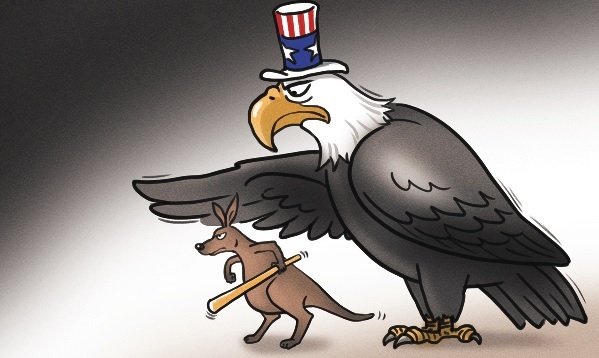
If a date might be found when Australian sovereignty was extinguished by the emissaries of the US imperium, July 29, 2023 will be as good as any. Not that they aren’t other candidates, foremost among them being the announcement of the AUKUS agreement between Australia, UK and the US in September 2021. They all point to a surrender, a handing over, of a territory to another’s military and intelligence community, an abject, oily capitulation that would normally qualify as treasonous.
The treason becomes all the more indigestible for its inevitable result: Australian territory is being shaped, readied, and purposed for war under the auspices of closer defence ties with an old ally. The security rentiers, the servitors, the paid-up pundits all see this as a splendid thing. War, or at least its preparations, can offer wonderful returns.
The US Secretary of Defense, Lloyd Austin III, was particularly delighted, though watchful of his hosts. His remit was clear: detect any wobbliness, call out any indecision. But there was nothing to be worried about. His Australian hosts, for instance, proved accommodating and crawling.
Australian Defence Minister Richard Marles, for instance, standing alongside Austin, US Secretary of State Antony Blinken and Australian Foreign Minister, Penny Wong, declared that there was “a commitment to increase American force posture in respect of our northern bases, in respect to our maritime patrols and our reconnaissance aircraft; further force posture initiatives involving US Army watercraft; and in respect of logistics and stores, which have been very central to Exercise Talisman Sabre.” To the untutored eye, Marles might have simply been another Pentagon spokesman of middle-rank…………….
Australian real estate would be given over to greater “space cooperation”, alongside creating “a guided weapons and explosive ordnance enterprise in this country, and doing so in a way where we hope to see manufacturing of missiles commence in Australia in two years’ time as part of a collective industrial base between the two countries.” Chillingly, Marles went on to reiterate what has become something of a favourite in his middle-management lexicon. The efforts to fiddle the export-defense export control legislation by the Biden administration would create “a more seamless defence industrial base between our countries.” Seamless, here, is the thick nail in the coffin of sovereignty.
Moves are also underway to engage in redevelopment of bases in northern Australia, in anticipation of the increased, ongoing US military presence. The RAAF Base Tindal, located 320km south-east of Darwin in the Northern Territory, is the subject of considerable investment “to address functional deficiencies and capacity constraints in existing facilities and infrastructure.” The AUSMIN talks further revealed that scoping upgrades would take place at two new locations: RAAF Bases Scherger and RAAF Curtin.
Australia’s Defence Intelligence Organisation will also be colonised by what is being termed a “Combined Intelligence Centre – Australia” by 2024. This is purportedly intended to “enhance long-standing intelligence cooperation” while essentially subordinating Australian intelligence operations to their US overlords. Marles saw the arrangement as part of a drive towards “seamless” (that hideous word again) intelligence ties between Canberra and Washington. “This is a unit which is going to produce intelligence for both of our defence forces … and I think that’s important.”
……….. Under the Albanese government we have reverted completely to our worst selves on defence. We’re going to do almost nothing consequential over the next 10 years other than get the Americans to do more on our land.” ……… Australia might be at war with China under US-direction before a decade is up, vassalized warriors eager to kill and be killed. https://theaimn.com/the-day-australian-sovereignty-died/
Australia Agrees To Build US Missiles; US Dismisses Australian Concerns About Assange
The reason Blinken keeps repeating the word “risk” here is because the Pentagon already publicly acknowledged in 2013 that nobody was actually harmed by the 2010 Manning leaks that Assange is being charged with publishing, so all US officials can do is make the unfalsifiable assertion that they could have potentially been harmed had things happened completely differently in some hypothetical alternate timeline.
CAITLIN JOHNSTONE, JUL 30, 2023, https://www.caitlinjohnst.one/p/australia-agrees-to-build-us-missiles?utm_source=post-email-title&publication_id=82124&post_id=135542172&isFreemail=true&utm_medium=email
Two different news stories about US-Australian relations have broken at around the same time, and together they sum up the story of US-Australian relations as a whole. In one we learn that Australia has agreed to manufacture missiles for the United States, and in the other we learn that Washington has told Australia to go suck eggs about its concerns regarding the US persecution of Australian journalist Julian Assange.
The relationship between Australia and the United States is all the more clearly illustrated by the way they are being reported by Australia’s embarrassingly sycophantic mainstream press.
In a Sydney Morning Herald article published Friday titled “‘Hugely significant’: Australia to manufacture and export missiles to US,” the US-educated war propagandist Matthew Knott exuberantly reports on the latest development on Australia’s total absorption into the American war machine.
“Australia is set to begin manufacturing its own missiles within two years under an ambitious plan that will allow the country to supply guided weapons to the United States and possibly export them to other nations,” Knott reports,” adding that the “joint missile manufacturing effort is being driven by the war in Ukraine, which has highlighted a troubling lack of ammunition stocks in Western nations including the US.”
Knott — perhaps best-known for being publicly told to “hang your head in shame” and “drum yourself out of Australian journalism” by former prime minister Paul Keating over his virulent war propaganda on China — gushes enthusiastically about the wonderful opportunities this southward expansion of the military-industrial complex will offer Australians.
“As well as creating local jobs, a domestic missile manufacturing industry will make Australia less reliant on imports and provide a trusted additional source of munitions for the US,” Knott writes ecstatically in what has somehow been presented by The Sydney Morning Herald as a hard news story and not an opinion piece.
An article published the next day, also in The Sydney Morning Herald and also by Matthew Knott, is titled “Assange ‘endangered lives’: Top official urges Australia to understand US concerns”.
It’s not unusual to see this type of propagandistic headline designed to convey a specific message above Knott’s reporting on this subject; in 2019 he authored a piece which was given the bogus title “‘A monster not a journalist’: Mueller report shows Assange lied about Russian hacking”.
“The United States’ top foreign policy official has urged Australians to understand American concerns about Julian Assange’s publishing of leaked classified information, saying the WikiLeaks founder is alleged to have endangered lives and put US national security at risk,” Knott writes. “In the sharpest and most detailed remarks from a Biden administration official about the matter, US Secretary of State Antony Blinken said Assange had been involved in one of the largest breaches of classified information in American history and had been charged with serious criminal conduct in the US.”
Blinken’s remarks came during a press conference for the Australia–US Ministerial Consultations (AUSMIN) forum on Saturday, in response to a question asked by Knott himself.
Here are Blinken’s comments in full:
“Look, as a general matter policy, we don’t really comment on extradition matters, extradition proceedings. And so, I really would refer you to our Department of Justice for any questions about the status of the criminal case, whether it’s with regard to Mr Assange or the other person in question. And I really do understand and can certainly confirm what Penny said about the fact that this matter was raised with us as it has been in the past. And I understand the sensitivities, I understand the concerns and views of Australians. I think it’s very important that our friends here understand our concerns about this matter. And what our Department of Justice has already said repeatedly, publicly, is this, Mr Assange was charged with very serious criminal conduct in the United States in connection with his alleged role in one of the largest compromises of classified information in the history of our country. The actions that he is alleged to have committed risked very serious harm to our national security, to the benefit of our adversaries and put named human sources at grave risk, grave risk of physical harm, grave risk of detention. So, I say that only because, just as we understand sensitivities here, it’s important that our friends understand sensitivities in the United States.”
The reason Blinken keeps repeating the word “risk” here is because the Pentagon already publicly acknowledged in 2013 that nobody was actually harmed by the 2010 Manning leaks that Assange is being charged with publishing, so all US officials can do is make the unfalsifiable assertion that they could have potentially been harmed had things happened completely differently in some hypothetical alternate timeline.
In reality, Assange is being persecuted by the United States for no other reason than the crime of good journalism. His reporting exposed US war crimes, and the US wishes to set a legal precedent that allows for anyone who reveals such criminality to be imprisoned in the United States — not just the whistleblowers who bring forth that information, but publishers who circulate it. This is why even mainstream press outlets and human rights organizations unequivocally oppose his extradition; because it would be a devastating blow to worldwide press freedoms on what is arguably the single most important issue that journalists can possibly report on.
So here is Australia signing up to become the Pentagon’s weapons supplier to the south — on top of already functioning as a total US military/intelligence asset which is preparing to back Washington in a war with China, and on top of being so fully prostrated before the empire that we’re not even allowed to know if American nuclear weapons are in our own country — being publicly hand-waved away by Washington’s top diplomat for expressing concern about a historic legal case in which an Australian citizen is being persecuted by the world’s most powerful government for being a good journalist.
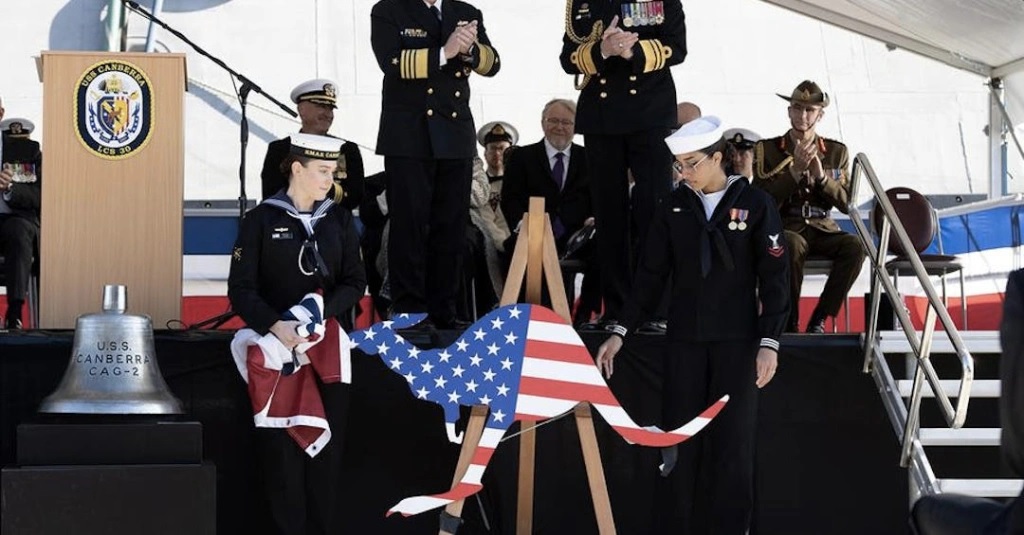
You could not ask for a clearer illustration of the so-called “alliance” between Australia and the United States. It’s easy to see that this is not an equal partnership between two sovereign nations, but a relationship of total domination and subservience. I was only half-joking when I wrote the other day that our national symbol should be the star-spangled kangaroo.
Australia is not a real country. It’s a US military base with marsupials.
Australian National Sovereignty and Economic Welfare in Peril? Feedback from the AUSMIN Meeting in Brisbane

Behind the scenes intrigues by defence chiefs and intel services through their media releases are a quite inadequate substitute for these democratic consultations.
Hopes of US co-operation in releasing Julian Assange who is languishing in Belmarsh Prison in London while awaiting extradition to the USA to face charges for breaches of the US Espionage Act were dashed at the recent AUSMIN Meeting.
July 30, 2023. by: The AIM Network, By Denis Bright
Decades ago – in 1951 – the ANZUS Pact promised ongoing consultations about strategic policies within the US Global Alliance. Now, from the elite surroundings of Queensland’s Government House in Brisbane, media statements from AUSMIN have taken everyone back to school days. Our elected leaders are now the principals in a frightening new age in which preparation for war is a key element in foreign and strategic policies (Joint Statement from AUSMIN 29 July 2023):
Minister for Foreign Affairs Penny Wong and Deputy Prime Minister and Minister for Defence Richard Marles hosted the U.S. Secretary of State Antony J. Blinken and Secretary of Defense Lloyd J. Austin III on 29 July in Brisbane to advance the Australia-U.S. Alliance and their cooperation in the Indo-Pacific and globally. Building on the high tempo of engagement between leaders and ministers, including the meeting between Prime Minister Albanese and President Biden in May 2023, the Ministers and Secretaries (the principals) determined that the Alliance has never been stronger. Based on a bond of shared values, it remains a partnership of strategic interest – premised on a common determination to preserve stability, prosperity, and peace.
For our visiting US Principals, it seems that peace will be delivered by exporting cluster bombs to extend the war in Europe.
National sovereignty is always imperiled by unnecessary secrecy like the Treaty of London (1915) which moved Italy from neutrality to becoming a participant in the Great War (1914-18) at the instigation of the British Government.
Extracts from the Treaty of London 1915
ARTICLE 2. On her part, Italy undertakes to use her entire resources for the purpose of waging war jointly with France, Great Britain, and Russia against all their enemies…………………………….
ARTICLE 16. The present arrangement shall be held secret.
It would have been better for Italy if a brave Julian Assange from the era told the Italian people about the secret strategic deals with Britain in 1915. Italy’s involvement in the Great War brought family tragedies, mass immigration, financial ruin and the rise of fascism in its wake.
The current militarization of the global economy by potential friend and foe alike will ultimately be ended by accidental conflict or economic recession from burnt out commitments and distortion of investment flows globally. Going too far by Australian leaders risks schism in the Labor Movement as in the Great War or tensions within the Labor Party during the Cold War in the 1950s and more recently when New Zealand withdrew from the ANZUS Pact over visits by naval vessels that were either nuclear powered or carrying nuclear weapons or both in the 1980s.
If there is a chink in the armour of public support for Australia’s defence commitments to the US Global Alliance, it lies in medium and long-term concerns about the costs of the AUKUS defence commitments which are apparent in the Lowy Institute’s 2023 Polling.
It would have been better for Italy if a brave Julian Assange from the era told the Italian people about the secret strategic deals with Britain in 1915. Italy’s involvement in the Great War brought family tragedies, mass immigration, financial ruin and the rise of fascism in its wake.
The current militarization of the global economy by potential friend and foe alike will ultimately be ended by accidental conflict or economic recession from burnt out commitments and distortion of investment flows globally. Going too far by Australian leaders risks schism in the Labor Movement as in the Great War or tensions within the Labor Party during the Cold War in the 1950s and more recently when New Zealand withdrew from the ANZUS Pact over visits by naval vessels that were either nuclear powered or carrying nuclear weapons or both in the 1980s.
If there is a chink in the armour of public support for Australia’s defence commitments to the US Global Alliance, it lies in medium and long-term concerns about the costs of the AUKUS defence commitments which are apparent in the Lowy Institute’s 2023 Polling.
The financial costs of the submarine deal is the real chink in favourable Australian public opinion towards more participation in the US Global Alliance.
Despite the outpouring of patriotic rhetoric at the launching event in Mobile, Alabama, Austal Limited Australia had not finalized its Australian taxation commitments from an annual revenue of $579.4 million in 2020-21 by 2 November 2022. The tax owing under review by the ATO was a paltry $28 million due to legalized tax minimization by the company’s accountants. Austal’s explanation of these processes is well covered in the 2022 Annual Report from Austal Australia which can easily be perused by interested readers.
Orders for AUKUS vessels and commitments to the QUAD Defence Arrangements will provide windfall revenue for the military and industrial complexes of Britain and the USA for a generation ahead until 2050. In the traditions of the original ANZUS Defence Alliance of 1951, our bipartisan strategic commitments were always consistent with adherence to the UN Charter and to open discussion of defence arrangements.
Behind the scenes intrigues by defence chiefs and intel services through their media releases are a quite inadequate substitute for these democratic consultations.
Hopes of US co-operation in releasing Julian Assange who is languishing in Belmarsh Prison in London while awaiting extradition to the USA to face charges for breaches of the US Espionage Act were dashed at the recent AUSMIN Meeting. Defence analyst Chelsea Manning who actually released the Pentagon documents to Julian Assange for publication had his charges commuted by President Obama in 2017.
These documents are largely in the public domain through sites like ChatGPT which can retrieve the gist of most items released but without adequate referencing by the AI robots at Opensystems in San Francisco. Readers can avail themselves of the resources of ChatGPT in the absence of full and frank media releases from Australian government strategic agencies.
Environmental risks of nuclear-powered ship visits to Australian ports also add to the policy dilemmas facing Australians.
It was the Morrison Government which welcomed the ageing French nuclear powered submarine to HMAS Sterling near Perth in late 2020 en route to naval manoeuvres near Guam and likely stealth operations in the South China Sea to test China’s maritime intelligence. Such manoeuvres in troubled waters are hazardous operations. This epic seven-month voyage to the Indo-Pacific Basin was well covered in this YouTube video.
The New York Times (31 March 1994) and other global media outlets of the nuclear accident involving the nuclear-powered submarine off Toulon. ChatGPT has a blind spot about the reporting of this incident from media monitoring:
Ten sailors died today in an accident aboard a French nuclear-propelled submarine that was taking part in naval exercises in the Mediterranean off Toulon, the Defense Ministry announced.
A ministry spokesman said that the Émeraude, a 2,400-ton Rubis-class attack submarine, did not carry nuclear missiles and that its 48-megawatt nuclear reactor was not damaged in the accident, which occurred when a burst pipe released high pressure steam into a turbine compartment.
“The steam is certainly not radioactive,” Rear Adm. Philippe Roy said at a news conference in the southern port city of Toulon this evening.
Hours after the accident, the navy recalled three other nuclear-propelled submarines — two from the Mediterranean and one from the Atlantic — pending an investigation. “We are recalling them because we are asking questions about what happened,” Admiral Roy said.
Since I covered this topic the WA State Police Minister’s Office has kindly provided details of protocols operating for the containment of accidents involving nuclear powered ship visits which possibly carry nuclear weapons under Don’t Ask Won’t Tell Protocols operating within the US Global Alliance……………………………………………………………………………….
Nuclear powered vessels from countries in the US Global Alliance have been visiting Australian ports since 1960. The details of these visits can be monitored on the web sites of the Australian Radiation Protection and Nuclear Safety Agency and the Departments of Defence itself in both Australian and the USA.
Specialist staff within DFAT will of course have access to some classified documents generated by the US Department of Defense and its related intel networks. To guard against the emergence of any new generation of Australians wishing to follow in the traditions of Chelsea Manning of Oklahoma, it is my understanding from personal communications from just one staff member on my reporting rounds for AIM Network that personal phones and communication systems are all monitored by local intel services and probably by overseas agencies as well.
Whilst ChatGPT is tightening up on the topics on which it is able to release information, it can still provide a wealth of anecdotal information to assist in the reporting of hearsay on strategic and intelligence matters. Reporters can work on this anecdotal information by perusing reliable documents in the public domain such as annual reports of companies within the global military industrial complexes.
Like the manufacturers of lethal weapons during the Great War, not all corporate data can be withheld from potential investors and curious members of the general public. Corporations here and overseas will make windfall profits from defence contracts. ChatGPT could offer these details of key defence companies operating in Australia:
- Thales Australia: Thales is a major defense contractor with operations in various sectors, including aerospace, defense, security, and transportation. They have a significant presence in Australia and are involved in projects such as armoured vehicles, naval systems, and communications.
- Austal: Austal is an Australian shipbuilding company known for designing and manufacturing high-speed aluminum vessels for defense and commercial purposes.
- BAE Systems Australia: BAE Systems is a global defense company with a significant presence in Australia, involved in areas such as maritime, aerospace, and land systems.
- Rheinmetall Defence Australia: Rheinmetall is a German defense company with operations in Australia, focusing on armored vehicles and defense technology.
- ASC (Australian Submarine Corporation): ASC is a government-owned company that specializes in submarine maintenance, sustainment, and upgrades.
US Companies operating in Australia who are likely to gain from international strategic tensions include:
- Lockheed Martin Australia: Lockheed Martin is a prominent U.S. defense contractor, and its Australian subsidiary, Lockheed Martin Australia, operates in the country. They are involved in various defense projects, including aerospace, cybersecurity, and naval systems.
- Boeing Defence Australia (BDA): Boeing, a major U.S. defense and aerospace company, has a subsidiary known as Boeing Defence Australia. BDA is actively engaged in providing defense products, services, and solutions in Australia, including aviation and intelligence systems.
- Northrop Grumman Australia: Northrop Grumman, another U.S. defense company, has a presence in Australia through its subsidiary Northrop Grumman Australia. They focus on delivering advanced defense and security technologies and systems.
- General Dynamics Land Systems – Australia (GDLS-A): General Dynamics is a U.S. defense contractor, and its Australian subsidiary GDLS-A is involved in the design, engineering, and support of military land systems.
- Raytheon Australia: Raytheon, a major U.S. defense and technology company, has a presence in Australia through its subsidiary Raytheon Australia. They are active in areas such as defense systems, cybersecurity, and intelligence.
Inquisitive readers can easily check which prominent Australian family is a big shareholder in Austal Limited which manufactured the USS Canberra in Mobile, Alabama prior to its commissioning in Sydney on 22 July 2023. With so many millions to spare, this family is a prominent investor in the Ukrainian Development Fund with just a small holding of US $500 million.
More than a century ago during the Great War (1914-18) peace initiatives were by-passed because both sides of the conflict in Europe hope for strategic advantages from continuing the fighting. These peace initiatives involved the Vatican under Pope Benedict XV and ultimately diplomatic engagement between the warring parties in 1916-17.
More than a century later, Pope Francis has authorized his peace envoy in Cardinal Matteo Zuppi of Bologna to visit Washington, Kiev, Moscow and Beijing to sound out the possibilities for an end to the current conflicts with colleagues from the Vatican secretariat of state. As in the Great War, initial efforts are on behalf of the civilian victims of warfare. These efforts became mainstream in the Great War as noted by Philip Zelikow in his book for the US Woodrow Wilson Institute.
he Road Less Travelled: The Secret Battle to End the Great War, 1916-1917
For more than five months, from August 1916 to the end of January 1917, leaders from the United States, Britain, and Germany held secret peace negotiations in an attempt to end the Great War. They did so far out of public sight – one reason why their effort, which came astonishingly close to ending the war and saving millions of lives, is little understood today. In The Road Less Travelled.
As Australia is not a current non-permanent member of the UN Security Council, our immediate efforts for some token welfare support for the victims of war can be made through the efforts of NZ’s UN Ambassador Carolyn Schwalger (NZ Department of Foreign Affairs and Trade). NZ is still officially outside the US Global Alliance but is kept well in the loop by the Australian Government.
Supporting governments which are involved in the use of cluster bombs to counter Russian aggression against Ukraine is dramatically at odds with the values of the broader Labor Movement and this opposition should be taken up by delegates from the progressive wings of the Labor Party within the National Conference. Supporters of lobbyists from the commercial military industrial complexes across the US Global Alliance have no affinity with Labor Values and should be exposed by committed delegates who believe in peace and disarmament.
https://theaimn.com/australian-national-sovereignty-and-economic-welfare-in-peril-feedback-from-the-ausmin-meeting-in-brisbane/more https://theaimn.com/australian-national-sovereignty-and-economic-welfare-in-peril-feedback-from-the-ausmin-meeting-in-brisbane/
The Star-Spangled Kangaroo
CAITLIN JOHNSTONE, JUL 27, 2023 https://www.caitlinjohnst.one/p/the-star-spangled-kangaroo?utm_source=post-email-title&publication_id=82124&post_id=135485598&isFreemail=true&utm_medium=email
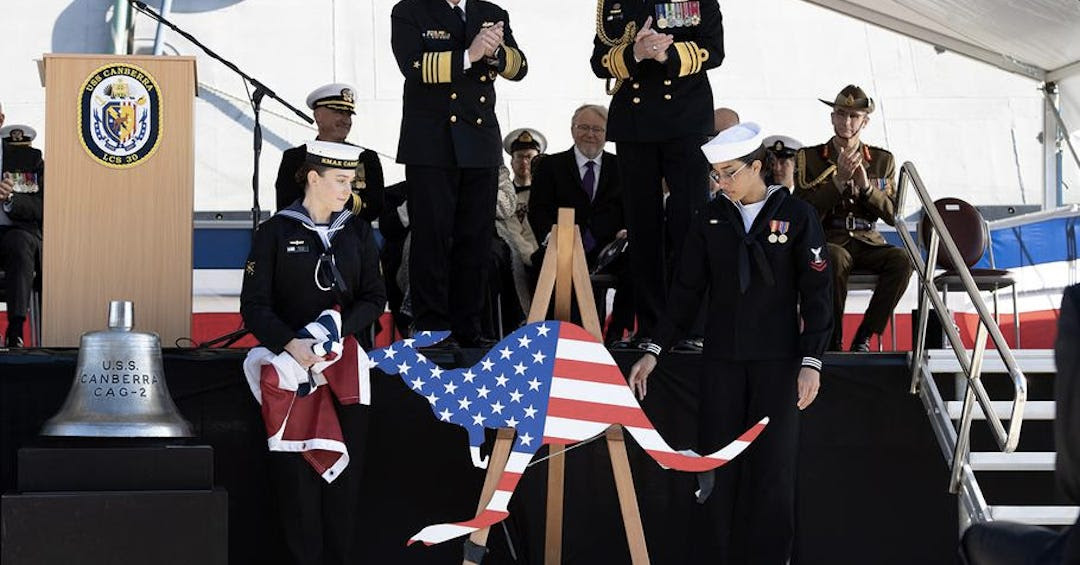
A new US warship has been ushered into service in Sydney. The ship is called the USS Canberra to honor the military union of the United States and Australia, and, if that’s still too subtle for you, it has a literal star-spangled kangaroo affixed to its side.
That’s right: the first US warship ever commissioned in a foreign port has been emblazoned with a kangaroo covered in the stars and stripes of the United States flag. An Australian officer will reportedly always be part of the staff of the ship, to further symbolize the holy matrimony between Australia and the US war machine.
“I can think of no better symbol of this shared future than the USS Canberra,” gushed US ambassador to Australia Caroline Kennedy. “Built by American workers at an Australian company in Mobile, Alabama, her crew will always include a Royal Australian Navy sailor, and from today forward, she will proudly display a star-spangled kangaroo.”
And you know what? She’s right. Not because of her giddy joy over the complete absorption of Australia into the US military apparatus of course — that’s a horrifying nightmare which is increasingly putting this nation on track toward a frontline role in Washington’s war plans against China. But she’s right that the star-spangled kangaroo and the ship which carries it is a perfect symbol for the way these two nations have become inseparably intertwined.
In fact, I’d take it a step further. I’d say the star-spangled kangaroo should be the new symbol for our entire nation.
I mean, we might as well, right? Australia is not a sovereign nation in any meaningful way; we’re functionally a US military/intelligence asset, and according to our defence minister Richard Marles our own military is being moved “beyond interoperability to interchangeability” with the US war machine so they can “operate seamlessly together, at speed.”
The US imprisons Australian journalist Julian Assange for exposing US war crimes like he’s the personal property of the Pentagon, and when the US doesn’t like our Prime Minister because he’s too keen on Australian independence or perceived as too friendly with China, they simply replace him with another one.
We even found out recently that Australians are not permitted to know if the US is bringing nuclear weapons into this country. That is a secret the US keeps from all of us, and our government respects their privacy on the matter.
So I think the star-spangled kangaroo is an entirely appropriate symbol for this country. Put it on our flag. Put it on our money. Put it on all our warships and planes, and on every military uniform. When you walk into an Australian government building, Yankarooey (or whatever stupid Aussie nickname we make up for the thing to mask our own cognitive dissonance) should be the first thing everyone sees.
Undignified? Certainly. Humiliating? Absolutely. An admission that Australia is not a real nation? Of course. But at least it would be honest. If we’re going to act like Washington’s subservient basement gimp, we may as well dress the part.
Nuclear weapons:“Oppenheimer” won’tmake a difference, but Australia can
The Interpreter GARETH EVANS, 26 July 23
The movie missed a chance to galvanise a renewed campaign, to better protect against existential danger than rely on sheer dumb luck.
Oppenheimer is a big disappointment for those of us who hoped that this super-hyped, all-star-cast new movie might give new life to the nuclear disarmament cause, creating new awareness of nuclear risks and energising popular support for their elimination – maybe even influencing senior policymakers in the way that the 1983 telemovie The Day After was, famously, an epiphany for Ronald Reagan.
…………………………… while making clear that the Hiroshima and Nagasaki bombs were big bangs, and the Edward Teller’s anticipated H-bomb much bigger still, it is no part of the film’s mission to convey the sheer flesh and blood horror of these most indiscriminately inhumane weapons ever devised.
Oppenheimer’s moral qualms about massive civilian death tolls, and the catastrophic potential of an internationally unregulated post-war nuclear arms race, are not as clearly or forcefully explained as they could be. And the film takes it as given that the bomb-dropping (not the Soviet Union’s almost simultaneous declaration of war) was the decisive factor in Japan’s surrender – an historically flawed storyline, but one that remains critical to this day in keeping alive belief in the utility of nuclear weapons.
So, with no new help from the cinema, it’s back to the same old frustrating drawing board for nuclear risk reduction and disarmament campaigners.
The need for effective advocacy and action here has never been more compelling. Nearly 13,000 nuclear warheads are still in existence, with a combined destructive capability of close to 100,000 Hiroshima- or Nagasaki-sized bombs, and stockpiles, especially in our own Indo-Pacific region, now growing again. The taboo against their deliberate use is weakening, with Russia’s President Vladimir Putin talking up this prospect in language not heard since the height of the Cold War. Longstanding nuclear arms control agreements are now either dead (ABM, INF, Open Skies) or on life support (New START).
Moreover, the risk of use through human or system error or miscalculation is greater than ever, not least given new developments in AI and cyber-offence capability. That we have not had a nuclear weapon used for nearly 80 years is not a result of statesmanship, system integrity and infallibility, or the inherent stability of nuclear deterrence. It has been sheer dumb luck, and it is utterly wishful thinking to believe that this luck can continue in perpetuity.
…………………………..what can reasonably be hoped for, and sooner rather than later, is a serious global commitment to nuclear risk reduction.
Australia has a more useful role in this enterprise than many may imagine, with our generally strong record on arms control – including bringing to conclusion the Chemical Weapons Convention – and our nuclear credentials burnished by the ground-breaking Keating government-initiated Canberra Commission on the Elimination of Nuclear Weapons, the Howard Government’s role in getting the Comprehensive Test Ban Treaty to a vote, and the more recent Rudd government-initiated Australia-Japan International Commission on Nuclear Non-Proliferation and Disarmament.
The most commonly proposed risk-reduction measures – and central elements in the Australia–Japan commission’s proposed “minimisation” agenda – may be described as the “4 Ds”. They are Doctrine (getting universal buy-in for a No First Use (NFU) commitment), Deployment (drastically reducing the number of weapons ready for immediate use), De-alerting (taking weapons off high-alert, launch-on warning readiness) and Decreased numbers (reducing the overall global stockpile to less than 2,000 weapons).
A world with low numbers of nuclear weapons, with very few of them physically deployed, with practically none of them on high-alert launch status, and with every nuclear-armed state visibly committed to never being the first to use them, would still be very far from perfect. But one that could achieve these objectives would be a very much safer world than we live in now.
What has been most depressing about Australia’s performance in recent years, which it is very much to be hoped will now change, is that even these realistic objectives have not been actively supported. Australia’s status as a close US ally and, as such, one of the “nuclear umbrella” states, gives us a particularly significant potential role in advancing some key elements of the risk-reduction agenda just described.
The most immediately useful step we could take would be to support the growing international movement for the universal adoption of No First Use doctrine by the nuclear-armed states. ………………… At the NPT Review Conference concluded in New York in August 2022, a great deal of support was evident for such No First Use commitments as part of a larger risk reduction agenda. But the delegation of our new Labor government made no contribution to that debate. I live in hope that that position will change. https://www.lowyinstitute.org/the-interpreter/nuclear-weapons-oppenheimer-won-t-make-difference-australia-can
New Zealand’s anti-nuclear stance means it won’t play a role in Australia’s submarine plans
New Zealand’s commitment to remaining nuclear-free means it won’t play a role in Australia’s defense plans to acquire nuclear-powered submarines, the leaders from both countries said Wednesday
ABC News, By NICK PERRY Associated Press, July 26, 2023
WELLINGTON, New Zealand — New Zealand’s longstanding commitment to remaining nuclear-free means it won’t play a role in Australia‘s plans to acquire nuclear-powered submarines, the leaders from both countries said after meeting Wednesday…………………………………………………………. more https://abcnews.go.com/International/wireStory/new-zealands-anti-nuclear-stance-means-play-role-101659242
Japan Doesn’t Want to Fight for Taiwan and Neither Do Other US Allies
if Japan fought alongside the US in a hypothetical conflict with China over Taiwan, the Japanese civilians and economy would suffer greatly. What’s more, in a conflict between two nuclear powers, China and the US, Japan may itself become a nuclear target,
22.07.2023 Ekaterina Blinova https://sputnikglobe.com/20230722/japan-doesnt-want-to-fight-for-taiwan-and-neither-do-other-us-allies-1112066099.html
Despite Japan bolstering its military capabilities under the nation’s new Defense Buildup Program, it appears to have zero appetite to engage in direct confrontation with China over Taiwan, Western media and think tanks say.
US military facilities in Okinawa, Japan, might play a central role in any Taiwan crisis, according to the Western press. Moreover, American military analysts have almost unanimously agreed that Japan is “the most likely US ally to contribute troops” in a potential US conflict with China over the island.
Back in October 2021, War on the Rocks, a US online media outlet, quoted a Japanese poll which appeared to indicate that 74% of respondents would support their government’s military engagement in the Taiwan Strait against China. The report further speculated about the possibilities of circumventing the country’s Constitution, which limits Japan’s ability to participate in conflicts.
Bold statements made by some Japanese officials also seemed to confirm Tokyo’s resolve. One of them, former Minister of Defense Yasuhide Nakayama, insisted in June 2021 that Taiwan is a “red line” and that “we have to protect Taiwan as a democratic country.” Japan and Taiwan are geographically close and any possible military actions over the island could potentially affect Japan’s Okinawa prefecture, Nakayama argued at the time.
Is China Going to Take Taiwan by Force?
The People’s Republic of China, which considers Taiwan its inalienable part, has repeatedly stated that it is going to reunite with the island peacefully, referring to years of fruitful collaboration with the former Taiwanese government formed by members of Kuomintang Party.
The Kuomintang can make a spectacular comeback during the Taiwanese general elections, scheduled for January 2024. The party’s victory could nip the fuss around Taiwan’s secessionism and potential conflict in the bud. Even US lawmakers admit it, considering the Kuomintang’s win a potential “threat” to Washington’s plans in the Asia-Pacific.
Biden Fast-Tracks Arming of Taiwan
For their part, the Biden administration and American legislators have repeatedly issued provocative statements with regard to the island, with the US president claiming time and time again that Washington is ready to “protect” Taiwan “militarily.” The US has also bolstered arms sales to the island.
In late June, Biden approved two potential arms sales totaling $440 million to Taiwan, including ammo and other military equipment. Earlier, in March, the US State Department approved a $619 million sale of hundreds of missiles to Taiwan to arm its new US-made F-16 jet fighters. Moreover, the Biden administration has started to use fast-track authority for accelerating the pace of the arming of Taiwan. The same mechanism has been used by Biden to speed-up Ukraine’s militarization.
Japanese Leadership Seems Unhappy With US Bellicosity
The unfolding situation has apparently given shivers to the Japanese leadership. The Wall Street Journal broke on Monday that the Japanese government is ready to give permission to the US to use bases in Japan in the case of conflict over Taiwan, but Tokyo’s own participation is unlikely.
Per the report, Washington invited Tokyo to consider using its Self-Defense Forces, especially the Maritime Self-Defense Force for hunting for Chinese submarines around the island of Taiwan and for other military missions.
Presently, Japan is home to about 54,000 US troops, according to the Council on Foreign Relations. It also hosts the headquarters of the US Navy’s 7th Fleet and the 31st Marine Expeditionary Unit.
Tokyo’s concerns have certain grounds. In May, Japanese scholar Kiyoshi Sugawa wrote for Responsible Statecraft, the online magazine of the Quincy Institute (a DC-based think tank), that if Japan fought alongside the US in a hypothetical conflict with China over Taiwan, the Japanese civilians and economy would suffer greatly. What’s more, in a conflict between two nuclear powers, China and the US, Japan may itself become a nuclear target, Sugawa warned.
The DC-based think also refers to the recent Japanese polls which indicate that just 11% of Japanese respondents consider it possible to fight alongside the US against China, while 27% said that their forces should not cooperate with the US military at all. The majority (56%) said that providing logistical support to the US would be more than enough in the event of the conflict.
Nobody Wants to Die for Uncle Sam
What’s more, Japan is not the only US ally unwilling to fight with China over Taiwan. The Australian government has recently signaled that it gave no promises to Washington about military participation in a potential conflict. The Philippines does not want to get dragged into the conflict, either.
When it comes to South Korea, it also lacks any enthusiasm of joining the US in a combat operation in the Taiwan Strait. Western observers draw attention to the fact that South Korean President Yoon Suk-yeol avoided meeting with then-US House Speaker Nancy Pelosi in Seoul after her controversial tour to Taiwan. The Diplomat suggested that Seoul has at least three reasons to avoid a possible war over the island. First, the China market accounts for 30% of South Korea’s total trade; second, Seoul fears that a Taiwan conflict would increase “the North Korean threat”; third, for Seoul friendly relations with Beijing is a guarantee against a conflict with Pyongyang.
Still, there is yet another US regional treaty ally, Thailand. However, according to the DC-based think tank, it’s completely impossible to force Bangkok to fight against China for the sake of Taiwan.
While muddying the waters of the Taiwan Strait, the US risks staying face-to-face with China which would mean a defeat in a possible military standoff, judging from the US’ earlier war game simulations.
Congressional Concerns: Stalling Nuclear Submarines for Australia

Australian Independent Media July 23, 2023, Dr Binoy Kampmark
Any security arrangement with too many variables and multiple contingencies, risks stuttering and keeling over. Critical delays might be suffered, attributable to a number of factors beyond the parties concerned. Disputes and disagreements may surface. Such an arrangement is AUKUS, where the number of cooks risk spoiling any meal they promise to cook.
The main dish here comprises the nuclear-powered submarines that are meant to make their way to Australian shores, both in terms of purchase and construction. It marks what the US, UK and Australia describe as the first pillar of the agreement. Ostensibly, they are intended for the island continent’s self-defence, declared as wholesomely and even desperately necessary in these dangerous times. Factually, they are intended as expensive toys for willing vassals, possibly operated by Australian personnel, at the beckon call of US naval and military forces, monitoring Chinese forces and any mischief they might cause.
While the agreement envisages the creation of specific AUKUS submarines using a British design, supplemented by US technology and Australian logistics, up to three Virginia Class (SSN-774) submarines are intended as an initial transfer. The decision to do so, however, ultimately resides in Congress. As delighted and willing as President Joe Biden might well be to part with such hulks, representatives in Washington are not all in accord.
Signs that not all lawmakers were keen on the arrangement were already being expressed in December 2022. In a letter to Biden authored by Democratic Senator Jack Reed and outgoing Republican Senator James Inhofe, concerns were expressed “about the state of the US submarine industrial base as well as its ability to support the desired AUKUS SSN [nuclear sub] end state.” Current conditions, the senators went on to describe, required “a sober assessment of the facts to avoid stressing the US submarine industrial base to the breaking point.”
On May 22, a Congressional Research Service report outlined some of the issues facing US politicians regarding the procurement of the Virginia (SSN-774) submarine for the Australian Navy……………………………
The report has proven prescient enough. Republicans on the Senate Armed Services Committee have realised that stalling aspects of AUKUS might prove useful, if it entails increasing military spending beyond levels set by the current debt-limit deal………………………………………
Then came another problem: almost 40% of the US attack submarines would be incapable of deployment due to maintenance delays………………………….
The terms, for Wicker, are stark. “To keep the commitment under AUKUS, and not reduce our own fleet, the US would have to produce between 2.3 and 2.5 attack submarines a year.”…………………………………………..
Such manoeuvring has caught the Democrats off guard……………………………………………..
As US lawmakers wrestle over funds and the need to increase submarine production, the Australian side of the bargain looks flimsy, weak, and dispensable. With cap waiting to be filled, Canberra’s undistinguished begging is qualified by what, exactly, will be provided. What the US president promises, Congress taketh. Wise heads might see this as a chance to disentangle, extricate, and cancel an agreement monumentally absurd, costly and filled with folly. It might even go some way to preserve peace rather than stimulate Indo-Pacific militarism. https://theaimn.com/congressional-concerns-stalling-nuclear-submarines-for-australia/
US Republicans threaten to block AUKUS deal

By Anthony Galloway, The Age, July 21, 2023
Australia’s AUKUS submarine deal with the United States has hit a hurdle with Senate Republicans threatening to block the sale unless President Joe Biden boosts funding for the domestic production line.
Republican members of the Senate Armed Services Committee on Friday moved to block legislation which would enable the sale of US Virginia-class submarines to Australia.
Under the AUKUS deal, Washington was set to sell Canberra between three and five of its own nuclear submarines in the 2030s before Australia begins building a new class of boat with Britain.
But the ranking Republican on the Senate Armed Services Committee, senator Roger Wicker, said Biden needed to commit more money to guarantee “we have enough submarines for our own security before we endorse that pillar of the agreement”.
Wicker said Australia’s commitment of US$3 billion ($4.4 billion) for the US production line would not be enough to meet the needs of both countries.
“The president needs to submit a supplemental request to give us an adequate number of submarines,” he told US news outlet Politico…………………………………………………….. https://www.theage.com.au/politics/federal/foolish-us-republicans-threaten-to-block-aukus-deal-20230721-p5dqc3.html
UK campaigners call on Australian PM to withdraw Kimba nuke dump threat.

UK campaign groups opposed to nuclear waste dumps were ‘delighted’ to hear that their counterparts in Australia, the Barngarla Determination Aboriginal Corporation, have just won their court case against the imposition of a similar dump on their Traditional Lands.
In a historic judgement given earlier this week (18 July), Her Honour Justice Charlesworth in the Federal Court of Australia handed down a decision to quash Federal Government plans to move nuclear waste from the reactor at Lucas Heights to an unwanted waste dump at Napandee near Kimba in South Australia. Justice Charlesworth charged government officials with ‘pre-judgement’ and ‘apprehended bias’.
In March, the UK/Ireland Nuclear Free Local Authorities joined Radiation Free Lakeland, Millom against the Nuclear Dump / South Copeland against GDF, and Guardians of the East Coast, which are local groups fighting plans to locate a so-called Geological Disposal Facility in either West Cumbria or East Lincolnshire, wrote a joint letter to the Australian Government to raise their international objections to the plan.
Our objections were that there was no need for such a dump as the facility at Lucas Heights has capacity to take the waste and that the rights to the land by the Traditional Owners were being wilfully and shamefully disregarded, contrary to international law, with the government giving no proper consideration to the position of the Barngarla.
The attempt to impose a nuclear waste dump is all par for the course in Australia with the ill-treatment of Indigenous Peoples by corporations, political elites and the military over nuclear matters having an established history, with First Nation territories ravaged by uranium mining or shattered by British atomic weapon testing.
Following the damning judgement, the four British organisations have today written to the Prime Minister of Australia Anthony Albanese asking him to ‘take the honourable and courageous course of action’, withdraw the plan and ‘leave the Barngarla in peace’.
A copy of the letter and a message of solidarity will be sent to the Barngarla Determination Aboriginal Corporation. more https://www.nuclearpolicy.info/news/uk-campaigners-call-on-australian-pm-to-withdraw-kimba-nuke-dump-threat/
Start from scratch call as nuclear dump plan shelved
Yahoo Sport, Tim Dornin, Wed, 19 July 2023
The Commonwealth needs to go back to the drawing board on plans for a nuclear waste dump and put all options back on the table, the South Australian government says.
Following the Federal Court’s move to set aside a decision to build the dump on SA’s Eyre Peninsula, Deputy Premier Susan Close said it was important for the Commonwealth to take a cautious approach to where the facility might best be located.
“I think it’s important they start from the beginning about where it’s most suitable,” she said.
“Where is the material coming from, where is the geological stability and where is the community acceptance?”
Dr Close said the previous coalition government had botched the process, exaggerating the urgency for the facility and excluding the Indigenous community.
“As a result, it’s come a cropper in the court, as it should have,” she said.
The deputy premier said given the level of angst surrounding the Kimba location in SA, it would be best to start from scratch.
The previous government decided to build the dump at Napandee, near Kimba, in November 2021, when it announced it had acquired 211 hectares of land with the proposed facility subject to heritage, design and technical studies…….
But the proposal faced strong opposition from the Barngarla traditional owners and environmental groups.
Earlier this year the Barngarla went to the Federal Court seeking a judicial review of the government’s declaration and on Tuesday Justice Natalie Charlesworth upheld one of their four grounds.
She said the only appropriate order was to set aside the whole of the declaration made by former resources minister Keith Pitt.
The Barngarla Aboriginal Determination Corporation welcomed the decision, describing the fight against the dump as crucial to First Nations people around the country.
Resources Minister Madeleine King said Labor had worked with the Barngarla people in the last term of parliament to ensure they secured the right to seek judicial review of the decision to acquire the site and that she would review the judgment. 2023
https://au.sports.yahoo.com/start-scratch-call-nuclear-dump-072229979.html
NATO’s talk of further Asian engagement should be feared by Australia
Independent Australia, By Binoy Kampmark | 13 July 2023
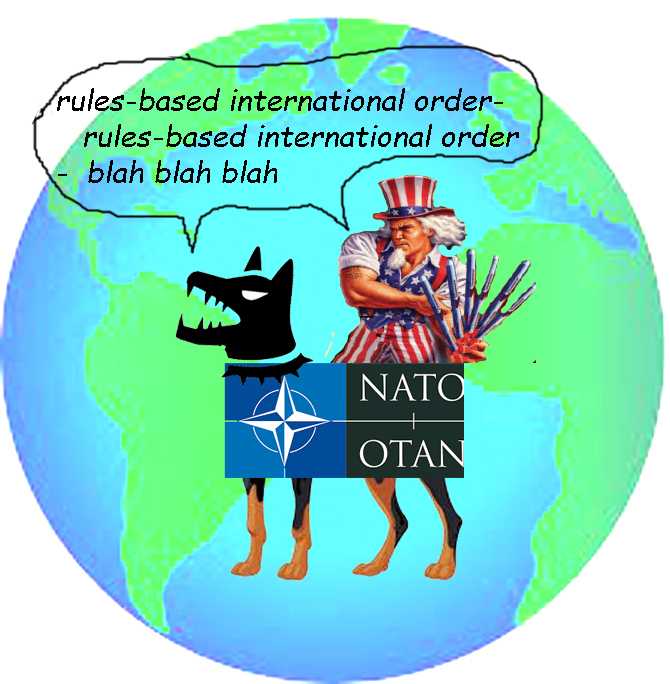
The North Atlantic Treaty Organization has undermined its mission to foster stability, becoming a vessel of U.S. power. Where NATO goes, war is most likely — Australia should take note, writes Dr Binoy Kampmark.
SINCE THE end of the Cold War, the North Atlantic Treaty Organization (NATO) has distinctly strayed from its original purpose. It has become, almost shamelessly, the vessel and handmaiden of U.S. power, while its burgeoning expansion eastwards has done wonders to upend the applecart of stability. ………………………………………………………………………………………………………………..
A continent was thereby destabilised. The true beneficiaries proved to be the tapestry of warring rebel groups characterised by sectarian impulses and a voracious appetite for human rights abuses and war crimes.
The Ukraine War has been another crude lesson in the failings of the NATO project. The constant teasing and wooing of Kyiv as a potential future member never sat well with Moscow, and while much can be made of the Russian invasion, no realistic assessment of the war’s origins can excise NATO from playing a deep, compromised role.
The Alliance is also proving dissonant among its members. Not all are exactly jumping at the chance of admitting Ukraine. ………………………………………
– Biden did draw the logical conclusion that bringing Kyiv into an alliance of obligatory collective defence during current hostilities would automatically put NATO at war with Moscow.
With such a spotty, blood-speckled record marked by stumbles and bungles, any suggestions of further engagement by the Alliance in other areas of the globe should be treated with abundant wariness.
The latest talk of further Asian engagement should also be greeted with a sense of dread.
According to a recent July statement:
‘The Indo-Pacific is important for the Alliance, given that developments in that region can directly affect Euro-Atlantic security. Moreover, NATO and its partners in the region share a common goal of working together to strengthen the rules-based international order.’
With these views, conflict lurks.
The form of that engagement is being suggested by such ideas as opening a liaison office in Japan, intended as the first outpost in Asia. It also promises to feature in the NATO Summit to take place in Vilnius on 11 and 12 July, which will again repeat the attendance format of the Madrid Summit held in 2022.
That new format featuring the presence of Australia, Japan, New Zealand and the Republic of Korea – or the AP4 – should have induced much head-scratching. But the Australian Strategic Policy Institute (ASPI), Washington’s beady eyes in Canberra, celebrated this ‘shift to taking a truly global approach to strategic competition’.
NATO Secretary General Jens Stoltenberg is also much in favour of such competition, warning member states of Beijing’s ambitions.“We should not make the same mistake with China and other authoritarian regimes”, he suggested, alluding to a dangerous and flawed comparison between Ukraine and Taiwan.
Cautioned Stoltenberg:
“What is happening in Europe today could happen in Asia tomorrow.”
One of the prominent headscratchers at this erroneous reasoning is French President Emmanuel Macron. Taking issue with setting up the Japan liaison office, Macron has expressed opposition to such expansion by an alliance which, at least in terms of treaty obligations, has a strict geographical limit. ……..
In 2021, Macron made it clear that NATO’s increasingly obsessed approach with China as a dangerous belligerent entailed a confusion of goals:
Said Macron:
“NATO is a military organisation; the issue of our relationship with China isn’t just a military issue. NATO is an organisation that concerns the North Atlantic, China has little to do with the North Atlantic.”
Such views have also pleased former Australian Prime Minister Paul Keating, whose waspish ire has also been trained on the NATO Secretary General.
In his latest statement, Keating condemned Stoltenberg as ‘the supreme fool’ of ‘the international stage’.
Declared Keating:
‘Stoltenberg, by instinct and by policy, is simply an accident on its way to happen.’
China, Keating said,
“… represents 20 per cent of humanity and now possesses the largest economy in the world… and has no record for attacking other states, unlike the United States, whose bidding Stoltenberg is happy to do”.
The record of this ceramic-breaking bloc speaks for itself. In its post-Cold War visage, the Alliance has undermined its own mission to foster stability, becoming Washington’s axe, spear and spade. Where NATO goes, war is most likely. Countries of the Indo-Pacific, take note. https://independentaustralia.net/politics/politics-display/natos-talk-of-further-asian-engagement-should-be-feared-by-australia,17709
AUKUS, Congress and Cold Feet
May 31, 2023, Dr Binoy Kampmark, https://theaimn.com/aukus-congress-and-cold-feet
The undertakings made by Australia regarding the AUKUS security pact promise to be monumental. Much of this is negative: increased militarisation on the home front; the co-opting of the university sector for war making industries and defence contractors; and the capitulation and total subordination of the Australian Defence Force to the Pentagon.
There are also other, neglected dimensions at work here: the failure, as yet, for the Commonwealth to establish a viable, acceptable site for the long term storage of high-grade nuclear waste; the uncertainty about where the submarines will be located; the absence of skills in the construction and operational level in Australia regarding nuclear-powered submarines; and, fundamentally, whether a nuclear-powered Australian-UK-US submarine (AUKUS SSN) will ever see the light of day.
One obstacle, habitually ignored in the Australian dialogue on AUKUS, are the rumbling concerns in the US itself about transferring submarines from the US Navy in the first place. These concerns are summarised in the Congressional Research Service report released on May 22, outlining the background and issues for US politicians regarding the procurement of the Virginia (SSN-774) submarine. “One issue for Congress is whether to approve, reject, or modify DOD’s AUKUS-related legislative package for the FY2024 NDAA [National Defense Authorization Act] sent to Congress on May 2, 2023.” This includes requested authorisation for the transfer of “up to two Virginia-class SSNs to the government of Australia in the form of sale, with the costs of the transfer to be covered by the government of Australia.”
A laundry list of concerns and potentially grave issues are suggested, and the report is clear that these are not exhaustive. They are also bound to send shivers down the spine of the adulatory Canberra planning establishment, so keen to keep Washington interested. There is, for instance, the question as to whether the transfer of the Virginia-class boats should be authorised as part of the 2024 financial year, or deferred “until a future NDAA.”
There is also the matter about how many submarines should be part of the request, whether it remains up to two as per the current request, or larger numbers. With those numbers also comes the dilemma as to what vintage they will be: those with less than 33 years of expected service life, or newly minted ones with the full 33-year period of operational service. (We can already hazard a guess on that one.)
The issue of cost also looms large. What will Australia, for instance, pay for the Virginia-class vessels, and furthermore, the amount that would be needed as “a proportionate financial investment” in Washington’s own “submarine construction industrial base.” Such a potentially delicious state of affairs for US shipbuilders, who will be receiving funds from the Australian purse to accelerate ship-building efforts.
Other issues suggest questions on operational worth. What would, for instance, be the “net impact on collective allied deterrence and warfighting capabilities of transferring three to five Virginia-class boats to Australia while pursuing the construction of three to five replacement SSNs for the US Navy.” The transfer of US naval nuclear propulsion technology would come with its “benefits and risks” and should also be cognisant of broader implications to US relations with countries in the Indo-Pacific, not to mention “the overall political and security situation in” in the region.
The report takes note of sceptics who claim this “could weaken deterrence of potential Chinese aggression if China were to find reason to believe, correctly or not, that Australia might use the transferred Virginia-class boats less effectively than the US Navy would.” This is a rather damning suspicion. Will Australian sailors either have the full capacity and skills not only to use the weaponry in their possession, but actually comply with US wishes in any deployment, even in a future conflict?
-ADVERTISEMENT-
The report is particularly interesting from the perspective of assuming that Australia will retain sovereign decision-making capacity over the use of the vessels, something that can only induce much scoffing. “Australia might not involve its military, including its Virginia-class boats, in US-China crises or conflicts that Australia viewed as not engaging important Australian interests.” On that score, the report notes remarks by Australia’s Defence Minister Richard Marles made in March 2023 that are specifically underlined to concern Congress. Of specific interest was the claim that “no promises” had been made by Australia to the United States “that Australia would support the United States in a future conflict over Taiwan.”
This is a charming admission that members of the US Congress may well be pushing for a quid pro quo: we authorise the boat transfer; you duly affirm your commitment to shed blood with us in the next grandly idiotic battle.
There is also a notable pointer in the direction of whether an individual SSN AUKUS should even be built. Sceptics, it follows, could argue that it would be preferable that US nuclear submarines “perform both US and Australian SSN missions while Australia invests in other types of military forces, as to create a capacity for performing other military missions for both Australia and the United States.”
This is exactly the kind of rationale that will confirm the holing of Australian sovereignty, not that there was much to begin with. But those voices marshalled against AUKUS will be able to take heart that Congress may, whatever its selfish reasons, be a formidable agent of obstruction. President Joe Biden, his successors, and the otherwise fractious electoral chambers certainly agree on one thing: America First, followed by a gaggle of allies foolishly holding the rear.
AUKUS may turn out to be the largest financial swindle perpetrated by the United States and the United Kingdom against Australia and other Asia Pacific nations

Now, it appears that Australia is becoming yet another naval base for the deployment of US and British fleets in the Asia-Pacific Region, including the basing of US nuclear submarines in 2026, without any hope of restoring economic ties with China and, consequently, the prior level of welfare in the near future. This is in addition to paying “compensation” under the guise of investing in unfeasible defense plans.
https://journal-neo.org/2023/05/20/aukus-may-turn-out-to-be-the-largest-financial-swindle-perpetrated-by-the-united-states-and-the-united-kingdom-against-australia-and-other-asia-pacific-nations/ 20.05.2023 Author: Bakhtiar Urusov
Equipment for the country’s ground forces “arrives with depressing regularity,” years behind time, and substantially over budget, according to a report issued on April 19 by the British Parliament’s Budgetary Control Committee. For instance, the programs, which provide new Ajax armored fighting vehicles and Morpheus tactical communication and information systems, have faced significant difficulties. According to the MPs’ assessment, the issue is made worse by underfunding of the defense budget expenditures and the pound’s declining purchasing value in relation to the dollar.
Ten days later, on April 28 this year, the Royal Navy informed the public about the decision to decommission the HMS Prince of Wales aircraft carrier, launched just four years ago (in 2019), to be used as a donor for spare parts for the HMS Queen Elizabeth aircraft carrier of the same class. According to the Royal Navy, the $3.72 billion aircraft carrier has docked more frequently than it has participated in naval operations, and the most recent maintenance cost $42 million.
This dispiriting news came just a month after the leaders of the US, the UK, and Australia had disclosed their ambitious long-term plans to build a nuclear-powered submarine fleet for Canberra on the basis of British technology, which will cost the Australian budget $245 billion.
When it comes to extremely sophisticated projects like nuclear submarines, it seems inconceivable that the parties involved would be so irresponsible as to neglect to evaluate the contractors’ capacity to meet their obligations. Still, if you trust the claims made by senior US, British, and Australian officials, the opposite is true in the case of AUKUS. Canberra would never have consented to work together on submarine design and construction with Great Britain’s waning technological strength otherwise. The example of the HMS Prince of Wales aircraft carrier shows that not only is Great Britain unable to complete a big naval project, but it is also facing significant technological difficulties in order to satisfy present ambitions for defense construction and equipment upgrades.
In the realm of economic crime, assigning work to a contractor who is known to be unable to perform is fraud, money laundering, or corruption.
In the context of Anglo-Saxon big politics, this appears to be retaliation against a certain sector of Australia’s elites for Canberra’s departure from a coordinated approach to restrain the PRC back in the day. This is primarily about the carefree era when Australia and China’s trading and economic relations remained unbroken, providing Canberra with significant revenue from exports to the PRC of a wide range of items, from wine and agricultural products to hard coal and other minerals.
Now, it appears that Australia is becoming yet another naval base for the deployment of US and British fleets in the Asia-Pacific Region, including the basing of US nuclear submarines in 2026, without any hope of restoring economic ties with China and, consequently, the prior level of welfare in the near future. This is in addition to paying “compensation” under the guise of investing in unfeasible defense plans.
All nations, including India, Japan, the Republic of Korea, New Zealand, and some ASEAN members that have been invited to participate in the AUKUS, should take a closer look at this alliance.
Bakhtiar Urusov, a political observer, exclusively for the online magazine “New Eastern Outlook.”
Pentagon seeks authority to transfer nuclear submarines (and costs) to Australia
Finally, the Pentagon is also asking Congress for permission to accept Australian payments to bolster the U.S. submarine industrial base. Australia has offered to make an undisclosed sum of investments in the U.S. submarine industrial base as part of AUKUS.
Defense News, By Bryant Harris and Megan Eckstein 17 May 23
WASHINGTON — The U.S. Department of Defense asked Congress to authorize the transfer of nuclear-powered submarines to Australia as part of the trilateral AUKUS agreement with the U.K.
Three legislative proposals, submitted on May 2 and first posted online Tuesday, would greenlight the sale of two Virginia-class submarines to Australia, permit the training of Australian nationals for submarine work and allow Canberra to invest in the U.S. submarine industrial base………………
“Importantly, the proposals spell out a clear path forward to facilitate the transfer of Virginia-class submarines to Australia while ensuring we have the necessary authorities to accept the Australian Government’s investments to enhance our submarine industrial base capacity and provide training for Australian personnel.” – Rep. Joe Courtney of Connecticut, the top Democrat on the Armed Services Committee’s sea power panel
AUKUS stipulates that Australia will buy at least three and as many as five Virginia-class submarines in the 2030s as part of phase two of the agreement, giving Congress more than a decade to authorize the sale. This year’s proposal, which the Pentagon hopes will become part of the fiscal 2024 National Defense Authorization Act, asks that Congress approve just two of those submarines “without a deadline to consummate the transfers and without specifying the specific vessels to be transferred.”
The proposal argues that this “small amount of flexibility is necessary” since the transfers depend on Australian readiness to operate the submarines, which will involve developing Australia’s submarine industrial base through training and appropriate shipyard infrastructure.
To that end, a second legislative proposal would authorize U.S. defense service exports directly to Australia’s private sector in order to train its own submarine workers……..
Finally, the Pentagon is also asking Congress for permission to accept Australian payments to bolster the U.S. submarine industrial base. Australia has offered to make an undisclosed sum of investments in the U.S. submarine industrial base as part of AUKUS.
The Pentagon states in the legislative proposal that those funds would be used to “add a significant number of trade workers” that will help address “the significant overhaul backlog” for the Virginia-class submarine. Australian monies would also be used for “advance purchasing of components and materials that are known to be replacement items for submarine overhauls” and “outsourcing less complex sustainment work to local contractors.”
Congress is also making its own investments to expand the U.S. submarine industrial base as the Navy ultimately aims to build two Virginia-class and one Columbia-class submarines per year. Courtney helped secure $541 million in submarine supplier development and $207 million in workforce development initiatives as part of the FY 23 government funding bill.
Austal USA, the American subsidiary of Australia-based Austal, plans to open a new facility at its shipyard in Mobile, Alabama to begin construction on nuclear submarine modules for General Dynamics’ Electric Boat shipyard in Connecticut, which produces both Virginia and Columbia-class submarines. Austal expects it will need 1,000 new hires in Mobile to staff that facility.
At Electric Boat, the prime contractor for the Virginia- and Columbia-class submarine programs, the hiring need will be even greater. The company currently employs more than 19,000 people, after hiring 3,700 new workers in 2022, according to local newspaper The Day. But the company needs to hire 5,750 new workers this year, to manage attrition and to help grow the workforce to about 22,000 to handle the increased workload.
The legislative proposal notes that Australian funds “would be applied to recruitment, training, incentivizing, and retention of key skilled trades, engineering and planning personnel in both nuclear and non-nuclear disciplines that are required by the additional AUKUS workload.” https://www.defensenews.com/congress/2023/05/17/pentagon-seeks-authority-to-transfer-nuclear-submarines-to-australia/
1 This month
17 October, Free Public Talk on Nuclear Issues in South Australia
David Noonan will speak on public interest concerns over the new Roxby Downs Indenture Act 2026 on BHP copper-uranium mining and ore processing in SA, and on how AUKUS may face SA with a High-Level nuclear waste agenda.
Dr Jim Green will discuss international developments in the field of nuclear power including ‘small modular reactors’ and Generation 4 ‘advanced’ nuclear reactor concepts.


Help Aunty Sue Protect Her Land and Sacred Sites From Destructive Rocket Testing.
.

Australians deserve the truth
about
AUKUS – https://aukuspublicinquiry.com/

PETITION – To: Prime Minister Anthony Albanese and the Australian Labor Government

of the week – Australians for War Powers Reform (AWPR)
To see nuclear-related stories in greater depth and intensity

