7.30 Report: Sarah Ferguson Opens Up New Perspectives on the AUKUS Nuclear Submarine Deal
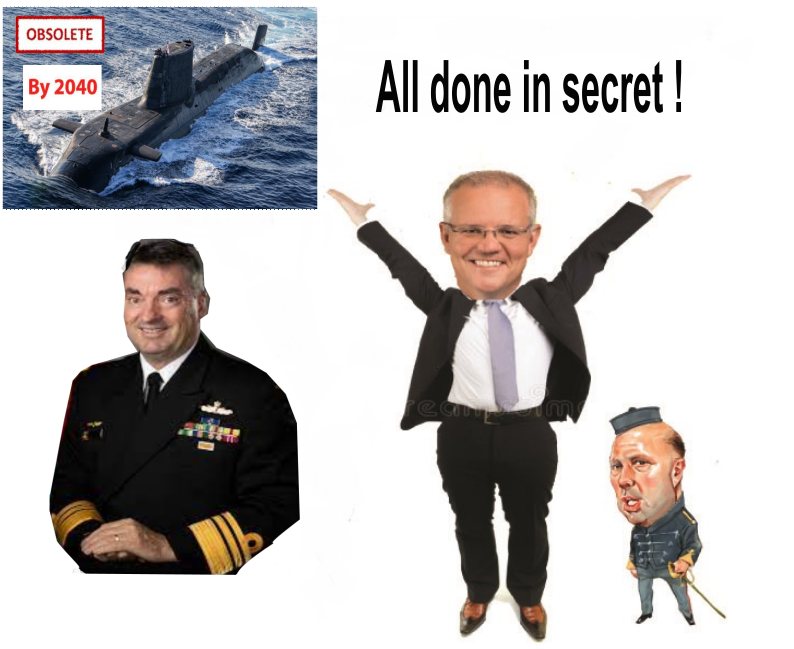
The secrecy associated with the formation of the Submarine Taskforce should be of great concern to Australians of all persuasions as our partners in France had no clues about what was happening behind the scenes as they made preparations to supply the contracted diesel submarines that more fully complied with commitments to the South Pacific Nuclear Free Zone with the support of New Zealand and other island states. No wonder that President Macron had little respect for Scott Morrison. (The video and the news clip of the French President’s remarks are available here.)
February 14, 2023 By Denis Bright
Sincere appreciation must be extended to the Albanese Government for allowing Vice Admiral Jonathan Mead AO to be interviewed in some depth on the 7.30 Report (13 February 2023). Sarah Ferguson was up to speed again in her interviewing skills with a seasoned naval officer who was assigned to active service in the Persian Gulf in 2006 as Captain of HMAS Parramatta.
The Vice Admiral’s understanding of nuclear technology being applied in the selection of the new submarine options was of course beyond reproach through his involvement with the clandestine Nuclear Submarine Taskforce established by the Morrison Government. Our US allies are great salespersons for the Anglo-American military industrial complexes in the post-Brexit era.
At least Britain’s BAE Systems as potential manufacturers of the AUKUS Submarines paid some tax in 2020-21 with a payment of $26.293 million to the ATO on a revenue base of $1.062 billion and a declared taxable income of just $123.484 million. The US military and aerospace giant Lockheed Martin kept its tax bill to $14.891 million on an income take of just over half a billion and a taxable income of $53.056 million (ABC News Taxation List, 2 November 2022).
The concerns of ordinary Australians about the financial and security costs of the AUKUS Submarine deal extend well beyond concerns about the technical capacity of those sealed reactors which are expected to operate for 30 years for the full life of the submarines until the year 2070 approaches.
The secrecy associated with the formation of the Submarine Taskforce should be of great concern to Australians of all persuasions as our partners in France had no clues about what was happening behind the scenes as they made preparations to supply the contracted diesel submarines that more fully complied with commitments to the South Pacific Nuclear Free Zone with the support of New Zealand and other island states. No wonder that President Macron had little respect for Scott Morrison. (The video and the news clip of the French President’s remarks are available here.)
…………………………………………………….. The Naval News video admitted that the Émeraude had transited the South China Sea in stealth mode. This was confirmed by coverage from France 24 (12 February 2021). Perhaps the stealth mode was to test the awareness of Chinese vessels and shore installations. Other military French vessels have done navigation runs through the Taiwan Straits which is always provocative when the current Democratic Party (DPP) holds power in Taipei and is calling for a formal declaration of independence from China to cheers from far-right global opinion.
…………….For China, the Taiwan Straits are definitely disputed waters as most countries in the US Global Alliance supported a One China Policy fifty years ago. This should have ended the US practice of using Taiwan for propaganda purposes throughout the Cold War.
……………………….. Just imagine the outrage in the Murdoch press if Chinese submarines made jaunts into Bass Strait to annoy the naval officers at HMAS Cerberus or to scare students at the Vice Admiral’s old secondary school at St. Bede’s in Mentone if the remnants of the federal LNP tried to establish Tasmania as an Independent Nationalist State with the support of a friendly US Administration.
Annoying China as well as alienating some ASEAN nations and members of the Pacific Island Forum will not assist with the current repair work on trading and investment relations with China.
The proposed AUKUS submarine deal imposes frightful financial burdens on Australia during inflationary times in which costs estimates for the AUKUS submarines extends into the 2040s (The Guardian 14 December 2021). Losses on trade and investment opportunities with China would of course extend these costs with 43 per cent of our exports destined to China at present (Latest data from Trading Economics).
Taiwan can assist to defuse tensions by giving a guarantee that it is not about to make a declaration of independence from the mainland. Relations between Taiwan and the Mainland seem to be improving again as China reverts to commercial diplomacy over displays of military strength. This style of diplomacy at least ensures that the economy of Taiwan is more fully integrated with the Mainland. Over 12,000 Taiwanese students were studying in Chinese academic institutes prior to the COVID-19 epidemic.
Despite all the negative media coverage of China in the Murdoch press, 42 per cent of Taiwan’s exports went to China in 2021-22 and 22 per cent of Chinese imports originated in either China or Hong Kong (CNBC 4 August 2022). Many Taiwan-based companies and services operate in China and Hong Kong.
With President Tsai Lng-wen unable to seek a third term as President in 2024, the popularity of the DPP seems to be on the wane. The opposition KMT gained 50.14 per cent of the vote at the recent local government elections on 26 November 2022 and controls fourteen local government areas to five held by the Democratic Progressive Party (DPP).
The Taiwanese electorate is undoubtedly evaluating the sustainability of nationalist rhetoric favouring a declaration of Taiwanese independence while the Australian government is negotiating those AUKUS submarine deals.
Signs of some thawing in cross-strait relations include a recent visit by the vice-chairman of the KMT to China and the restoration of more frequent fast ferry services between China’s Fujian Province and the adjacent Taiwanese islands of Kinmen and Matsu which are just a few kilometres off-shore.
There is great scope for the 7.30 Report to extend its coverage of the upsurge in regional strategic tensions with China after election cycles in Taiwan which bring the DPP into office. Re-election of the KMT in Taiwan in 2024 may totally defuse the current situation and leave Australians to bear the financial costs of the AUKUS submarine deal.
Opportunities exist to invite guest speakers onto future 7.30 Report programs to consider the impact of nuclear-powered submarines on the South Pacific Nuclear Free Zone which was ratified by all South Pacific nations as well as differing viewpoints on commercial ties with China.
Extending the South Pacific Nuclear Free Zone Treaty to coverage ASEAN Countries, the South China Sea and Taiwan might be a logical extension for consideration.
Toning down provocative visits by unfriendly naval vessels can be part of a Win-Win Deal to avoid future flyovers by Chinese jets.
Even the jellyfish in Moreton Bay are not very welcoming about the prospects of nuclear-powered ships:
According to a leading marine biologist and jellyfish expert Lisa-ann Gershwin, if the fleet is based in Brisbane, which is one of the shortlisted sites of the Australian government, the nuclear-powered submarines may be forced into an emergency reactor shutdown by swarms of jellyfish.
Gershwin added that Brisbane is “close to the absolute worst place” for a nuclear submarine base, due to the conditions in Moreton Bay and the usual jellyfish blooms.
Safety protocols for nuclear powered ships which sometimes carry nuclear weapons into Australian ports have been prepared by all states and territories as the ACT has its Jervis Bay facility which is separated from land-locked Canberra. The Queensland Government has made its precautions public in the publication Nuclear Powered Warship Visits to the Port of Brisbane.
Perhaps more public discussion as presented on the 7.30 Report can give the Australian government more wriggle room before the contracts are signed to initiate the AUKUS submarine deal. Payment of $835 million has already been made by the Albanese Government to France for breach of contract on the previous arrangements as negotiated by Malcolm Turnbull’s Government.
Appeals from our US allies for more military commitment from Australia and more use of the Pine Gap electronic base for offensive operations have landed Australia in compromising situations for decades from interventions in Vietnam to Afghanistan. The nostalgia for a return to the Cold War era with new military bases in the Philippines is an unfortunate regression. The ASEAN region to our north is better off left as a zone of peace and sustainable development.
By the time Australians discuss these issues, there may be a KMT Government in Taipei, and peaceful Win-Win scenarios may make the AUKUS deal redundant. Cheers then to the 7.30 Report’s contribution to strategic sanity. This style of reporting offers guest speakers who are saturated in knowledge of their specialist topics. I can only promote discussion and would be a real novice in head-to-head discussions with the Vice Admiral.
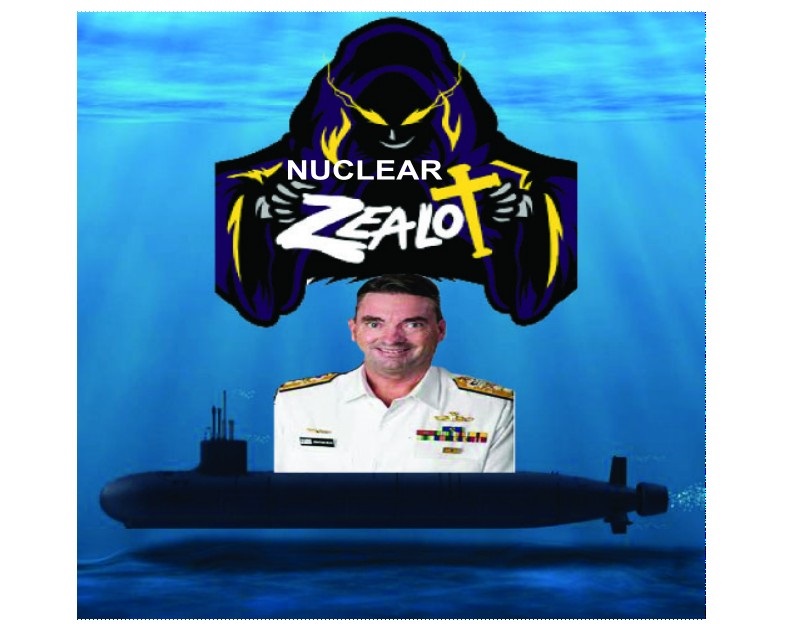
Nuclear zealot Jonathan Mead touts nuclear-powered submarines- Australia to have “full control” – (oh yeah?)
Australian commanders to have complete control over nuclear-powered submarines and reactors
ABC 7.30 / By Sarah Ferguson and James Elton, 13 Feb 23
Australian Navy commanders will have full operational control over their submarines and the powerful nuclear reactors onboard, despite the potential presence of US or UK engineers.
Key points:
- US or UK personnel may go to sea on Australian nuclear submarines
- Australian technicians will understand “every detail” of how the reactors work
- Construction in Adelaide shipyards may begin by end of 2020s
Vice Admiral Jonathan Mead, chief of the AUKUS submarine taskforce, has rejected criticisms that the nuclear propulsion program, based on US technology, would undermine Australian sovereignty.
“When we take command of our first boat, we will have sovereign capability,” he told 7.30‘s Sarah Ferguson in an exclusive interview.
Details of extensive plans to build a fleet of eight boats powered with weapons-grade uranium will be revealed next month.
Vice Admiral Mead was asked what would happen onboard in the event of any dispute over the nuclear reactor, including following an accident, between a US or UK engineer and the boat’s Australian commander.
“We would expect anyone, be it a foreign engineer or an Australian engineer, to provide advice,” he said.
But the commanding officer of that submarine, the Australian, would have “command and control over the reactor, over the submarine – unequivocal”.
Australians will understand ‘every detail’ of welded-shut nuclear reactors
The defining feature of the submarine deal is that the highly enriched uranium reactors that power the boats will be supplied by either the US or UK, and “welded shut”.
The use of weapons-grade fuel means the reactors do not need to be opened for refuelling over the 30-plus-year life of the boat. Reactors that run on low-enriched uranium, like those used by the French and Chinese navies, do require refuelling.
This also means Australia will not need to manufacture nuclear fuel – one of the commitments the country has made to the International Atomic Energy Agency.
Vice Admiral Mead said Australia would, however, be sending people to US “design facilities” so we would understand “every element of detail of that reactor”.
No Australian reactors … for now
Asked if Australia is considering building its own nuclear reactors in the future, Vice Admiral Mead said: “We are not envisioning that at the moment, we haven’t gone into that at the moment.”
The senior Navy official has spoken previously about the need for the AUKUS program to have public support.
Asked what would happen to an Australian nuclear-propelled submarine that was hit by a missile, Vice Admiral Mead said he could not reveal the technical details but that “nuclear-powered submarines are designed for exacting standards”.
He also said that submariners receive only minimal doses of radiation onboard – less than an ordinary person walking the streets of a capital city.
UK or US-designed boat, and when will we see them?
Addressing the scale of the program, Vice Admiral Mead said if Australia wanted to begin construction of new boats in Adelaide “towards the end of this decade” the government would need to quickly finalise the construction of a revamped shipyard.
He also described the extraordinary staffing requirements of the project, requiring nuclear physicists, chemists and engineers, as well as specialist tradesmen.
One of the biggest questions around AUKUS is whether Australia would be left without a functioning submarine force before the new boats are launched, as the ageing Collins fleet approaches retirement.
Vice Admiral Mead said unequivocally there would be no gap, but would not be drawn on the Navy’s specific plans.
The UK defence secretary, Ben Wallace, recently suggested a new submarine design the three countries could share was under consideration.
Asked whether that strategy would further delay the delivery of new submarines, Vice Admiral Mead reaffirmed there would be no gap in Australia’s capability.
China is the motivation
Vice Admiral Mead said rapid changes in the Indo Pacific had sharpened strategic competition.
“We’ve also seen in recent years a significant modernisation in the Chinese military, particularly the Navy,” he said.
Australia’s current fleet of Collins class submarines run on diesel-electric engines that are extremely quiet when running off the battery.
Nuclear submarines have massive range and the stealth advantage of not needing to resurface, but they do have reactor components that can’t be easily switched off to “go quiet”.
The pros and cons of nuclear and conventional submarines have led defence analysts to suggest a new generation of diesel submarines should be considered as well, particularly to operate closer to the Australian coastline – while the nuclear boats could be prioritised for operations further away from the mainland.
But Vice Admiral Mead said the nuclear submarines would be a good option in both theatres.
“Nuclear-powered submarines provide a capability to deploy away from the home shore, or to deploy close to home shore,” he said.
Pressed on whether conventional submarines would be quieter for closer operations, Vice Admiral Mead said under some circumstances nuclear submarines could be “just as quiet”.
“It’s often more to do with the age and the technology of the submarine that we are dealing with,” he said.
Vice Admiral Mead said the purpose of nuclear-powered submarines was to “put the greatest question of doubt in the enemy’s mind” and “if necessary, respond with massive firepower”.
This type of game-changing capability, he said, would change Australia’s “strategic personality”. https://www.abc.net.au/news/2023-02-13/australian-commanders-complete-control-over-nuclear-submarines/101965182
Australia’s Taiwan nightmare
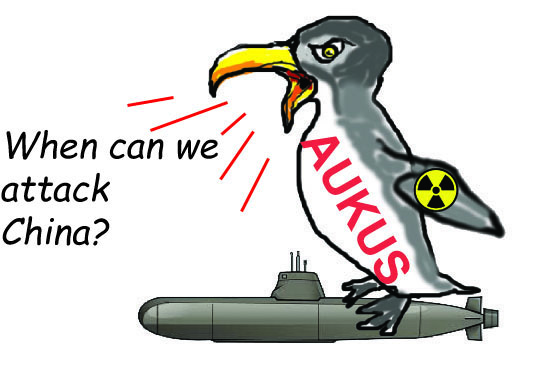
As one stands back from all of this, it become very clear that Canberra has completely ignored Malcolm Fraser’s vital warning that, “Giving America the power to say when Australia goes to war is the most dangerous position that Australia can bear”.
Any shooting war with China will very likely be a war that has ultimately been provoked by Washington to serve US interests. It is equally likely that the US will deafen us all with a propaganda onslaught
By Richard Cullen, Feb 6, 2023 https://johnmenadue.com/how-australia-created-the-taiwan-nightmare-for-itself/?fbclid=IwAR30kyoG_TGvb9CXqA4TW5uUl-Rhskpz9OIXbeAxc66AqzW7nirLr6v6IWo
Australia has been persuaded, enticed and strongarmed into taking gravely dangerous decisions. But Australia is a sovereign state and its fingerprints are, ultimately, all over the formation of its terrible abdication of national independence.
We need to pay particular attention to a definitive insight advanced by Paul Keating: Taiwan is not a vital Australian interest. In fact, it is an entity that could help unravel decades of remarkable, positive development in Australia, if we allow this to happen.
We know that the US is now a deeply disturbed super-power. Last year, the respected American commentator, Tom Plate, writing in the South China Morning Post, emphasised the “unseemly primal lust” with which the US jumped into the Ukraine war converting a “regional crisis into an increasingly global one”. Plate added that only the US had been able to parlay “its exceptional brand of American exceptionalism into a preposterous permanent innocence”.
The profound dangers arising from Australia’s far too close association with Washington’s global-control agenda have been stressed for over 50 years, first by Gough Whitlam, as he became Prime Minister in 1972, and even more emphatically by his once arch-rival, (former Prime Minister) Malcolm Fraser, who published a lengthy book in 2014 arguing that, “[G]iving America the power to say when Australia goes to war is the most dangerous position that Australia can bear.” He added that, “If America [unilaterally] uses forces deployed out of Australia, how can an Australian Prime Minister say we are not involved?”
Sensing the rising risk of grave danger, former Prime Minister, Paul Keating, around two years ago, argued with customary clarity that: “Taiwan is not a vital Australian interest. We have no alliance with Taipei”.
The former US Secretary of State, Colin Powell said, in 2004, that: “Taiwan is not independent. It does not enjoy sovereignty as a nation”. Almost 20 years later, Taipei enjoys dwindling recognition, now in the low-teens, from a handful of smaller states. Beijing is recognised as the sole, ultimate sovereign of China (including Taiwan) by the vast majority of nation-states, some 170 of whom recently reaffirmed their commitment to this centrally important One China principle.
Keating stressed that Australia should not be drawn into a military engagement over Taiwan, “US-sponsored or otherwise”, and said Taiwan was “fundamentally a civil matter” for China. These comments, predictably, were not well received in Taipei. If anything, the distressed nature of this response implicitly confirmed the position Keating outlined. Taiwan has been an intrinsic part of China for over 300 years, at least, since well before the French Revolution and the creation of the US and long before Australia was first settled by Europeans.
As for Japan’s leaders, Keating calls them the Bourbons of the Pacific – they have learned nothing and forgotten nothing, we’re still trying to find our security from Asia rather than in Asia. Furthermore, Professor Ravina, from the University of Texas, reminded us last year that, “Japan looks a lot like a one-party state” adding that, “the Liberal Democratic Party (LDP) has governed Japan almost exclusively since the end of World War II”. Declassified CIA documents, Ravina says, have confirmed that the LDP was covertly supported by the US “with millions of dollars” after it was established.
Japan is now avidly re-militarising at great expense, with a malevolent eye fixed on China yet again. Canberra has recklessly adopted Japan as a new primary military ally, despite the active veneration of Japan’s military history – which embodies an almost unparalleled record of military barbarism – by certain influential elite-factions.
Meanwhile, the current Democratic Progressive Party (DPP) leadership in Taiwan refuses to endorse the One China principle (unlike the main opposition Kuomintang Party (KMT)) and it keeps testing how far it can push a pro-independence stance short of moving audaciously in that direction. This is combined with much mutual cross-strait political glaring – even as the economic coupling continues to deliver outstanding reciprocal benefits, year after year. Within the DPP, the more extreme faction is anxious to keep pushing the independence project. Any sort of candid negotiations with Beijing over this fraught relationship are simply off the agenda for the DPP. There is at least an even-chance that the DPP will retain power, at the expense of the KMT, at the next Presidential Election in January, 2024.
Although the US ritually claims it still supports the One China principle it does so within the context of persistent, Taiwan-separatist dog-whistling. This was highlighted in a recent Common Dreams article by the prominent peace activist, Joseph Gerson, who insisted that the US should “cease encouraging Taiwanese independence”.
Malcolm Fraser told the ABC, in 2014, that he saw no difference between the Abbott Coalition Government in Australia and the Labor Governments led by Rudd and Gillard in their misguided, excessively pro-Washington policy setting, when he criticised the way Gillard had put American troops into Darwin. Fraser also forcefully highlighted the acute danger posed to Australia by the presence of US spy-bases in Australia in his book – especially Pine Gap.
In 2018, Prime Minster Turnbull, flicked the switch to serious China-thumping over Huawei (without any “smoking gun” evidence, in Turnbull’s later, own words). Since then, we have witnessed the desperately ill-conceived, uncertain and hugely expensive AUKUS nuclear submarine decision and the latest agreement to station nuclear-capable US bombers near Darwin. Very recently, the new Labor Government in Canberra has eagerly announced a plan to acquire an expensive set of the latest mobile missiles from the US.
Arguably worst of all, is the shocking Force Posture Agreement (FPA), signed with the US in 2014 by Foreign Minister Julie Bishop, which provides the legal basis for, as Bevan Ramsden recently revealed, “the comprehensive US militarisation of Australia, especially the Northern Territory, thus setting up Australia as a US forward base from which to launch its next war”.
Meanwhile, Australia and its mainstream media outlets have happily played host to diplomatically disgraceful, ongoing levels of China-threat war-drumming from the Japanese Ambassador in Canberra. John Menadue recently told us that, “The Japanese Embassy in Canberra is leading the anti-China campaign in Australia.” While Allan Behm wonders if this particular Ambassador, who describes himself a former spymaster, aspires “to be a legend in his own lunchtime”. One can be forgiven for wondering if this Canberra-based, Japanese campaign may be part of a wider US-shaped project to guard against any back-sliding on China-glaring, following the change of government last year in Australia.
Then there is the Australian Strategic Policy Institute (ASPI), which maintains a constant focus on advancing the grand China Threat narrative. John Queripel recently argued persuasively that, when you follow the money you discover that ASPI is a “front for US propaganda”.
As one stands back from all of this, it become very clear that Canberra has completely ignored Malcolm Fraser’s vital warning that, “Giving America the power to say when Australia goes to war is the most dangerous position that Australia can bear”. And, in the course of doing so, they have made the severe geopolitical risk faced by Australia far worse. Canberra has now placed the essence of the decision on when Australia may go to war against China into the hands of the three least trustworthy, triggering-parties one can imagine: Washington, Tokyo and Taipei. In all three places, reckless Anti-Beijing elements enjoy inordinate influence.
What a catalogue of cringe-making, very expensive, immature belligerence Australia has racked-up. And let’s not forget that all of this, piled-on, antagonistic military activity and expenditure is primarily directed at Australia’s leading current and best-ever, long-term trading partner. It takes one’s breath away.
Any shooting war with China will very likely be a war that has ultimately been provoked by Washington to serve US interests. It is equally likely that the US will deafen us all with a propaganda onslaught claiming that any Beijing military action responding to provocations was unprovoked – and don’t dare think otherwise. Any such war will almost certainly visit extreme harm on the global economy and surely prove to be catastrophic for the Australian political-economy and devastating for Taiwan, just for starters. US arms suppliers can be expected to power onwards and upwards, however.
Australia has certainly been persuaded, enticed and strongarmed into taking the gravely dangerous decisions outlined above. But Australia is a sovereign state. It has agency. Australia’s fingerprints are, ultimately, all over the formation of this terrible abdication of national independence.
If matters are ever to be put right, we first must not forget that America is, as Professor Adam Tooze argues, addicted to greatness and haunted by its loss and it has crafted “an extraordinarily aggressive techno-military objective” to champion its superiority over China.
Next, we have to remember how, once-upon-a-time, 50 years ago, we began growing up as a sovereign state within Asia. We must recollect what we have been told so clearly by Whitlam and Fraser and avow that Australia’s national interest is our paramount concern. We can be entirely sure that Washington, Tokyo and Taipei are never going to tell us this: they will each work to advance their own dangerously tilted agendas.
Finally, we have to pay particular attention to the conclusive insight provided by Paul Keating: Taiwan is not a vital Australian interest. In fact, it is an entity that could very much help unravel decades of remarkable, positive development in Australia, if we allow this to happen.
The US is preparing Australia to fight its war against China
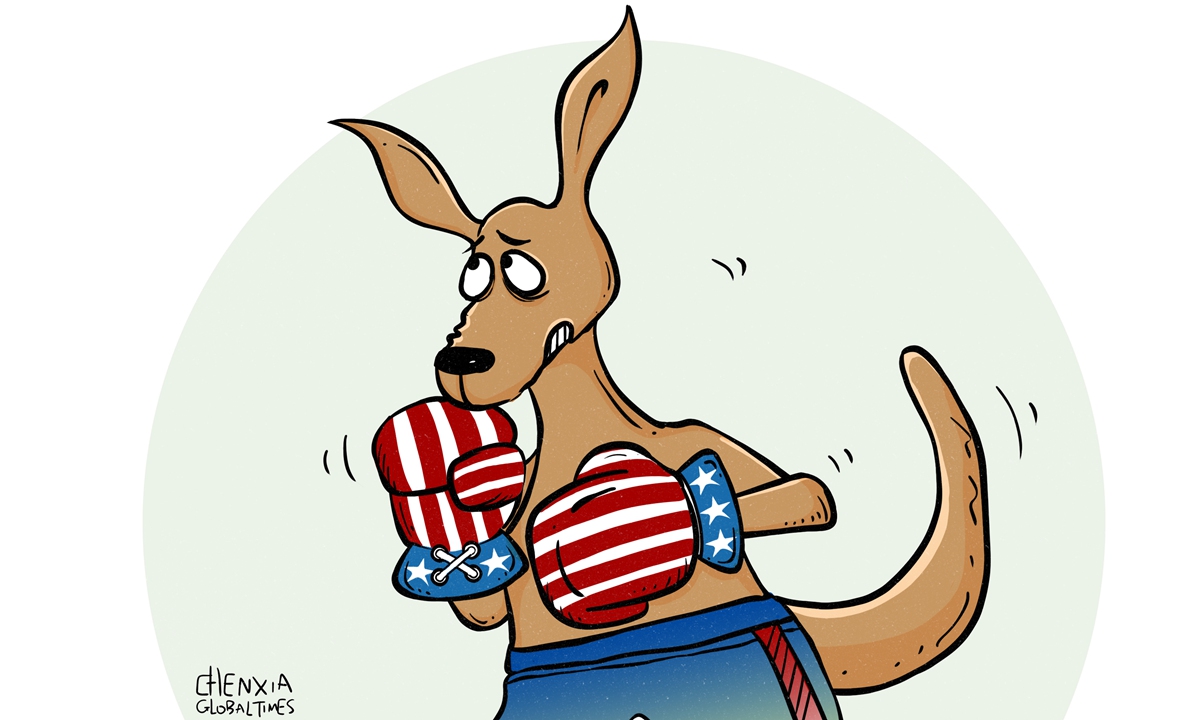
The United States is not preparing to go to war against China. The United States is preparing Australia to go to war against China.
Defence and military weapons manufacturing industries in Australia are now largely owned by US weapons corporations – Lockheed Martin, Raytheon, Boeing, Thales, NorthropGrumman. The deep integration of Australia’s defence industries and economy into the US military-industrial complex greatly influences Australia’s foreign/defence policies.
The Threat. All these preparations are justified by the false premise that China presents a military threat. China has not invaded anywhere. It has never proposed use of force against other countries. It has enshrined in its Constitution the ‘Three No’s – No military alliances; No military bases; No use, or threat to use, military force. China has, however, reserved the right to use force to prevent secession by Taiwan.
Guardian, By John Lander, Feb 1, 2023 Edited transcript of a speech to the Committee for the Republic, Salon, 18 January 2023.
The ANZUS Treaty
A look at the ANZUS Treaty and the way it has been manipulated over time will explain why I have come to this conclusion.
Originally defensive in concept, the ANZUS Treaty was seen by Australia from its very beginning as a means to “achieve the acceptance by the USA of responsibility in SE Asia” (Percy Spender) to shield Australia from perceived antagonistic forces in its region. It has, however, developed into an instrument for the furtherance of US ability to prosecute war globally – previously in Iraq and Afghanistan, currently against Russia and potentially against China.
The ANZUS Treaty, usually referred to in reverential tones as “The Alliance”, has been elevated to an almost religious article of faith, against which any demur is treated as heresy amounting to treachery. Out of anxiety to cement the US into protection of Australia, the Alliance has been invoked as justification for Australia’s participation in almost every American military adventure – or misadventure – since WW II.
Unlike NATO or the Defence Treaty with Japan, the ANZUS treaty actually provides no guarantee of protection, merely assurances to consult on appropriated means of support in the event that Australia should come under attack.
On the other hand, the Alliance has facilitated the steady growth of American presence in Australia, to the point that it pervades every aspect of Australian political, economic, financial, social and cultural life. Australians fret about China “buying up the country”, but American investment is ten times the size.
They are unaware or uncaring that almost every major Australian company across the resources, food, retail, mass media, entertainment, banking and finance sectors has majority American ownership. Right now US corporations eclipse everyone else in their ability to influence our politics through their investment in Australian stocks.

The transfer of Australian assets to American ownership has continued unabated: In the second half of 2021 then Treasurer Josh Frydenberg approved the transfer of $130 billion of Australian assets to foreign private equity funds, benefiting Goldman Sachs who facilitated the transactions, by multimillions of dollars. Josh Frydenberg now is employed by Goldman Sachs:
- Sydney Airport – Macquarie Bank led by a NY investment banker
- AusNet (electricity infrastructure) $18 billion takeover by Brookfield – NY via Canada
- SparkInfrastructure (electricity) $5.2 billion takeover by American interests
- AfterPay financial transaction system $39 billion takeover
- Healthscope, second-biggest private hospitals group (72 Hospitals) taken over by Brookfield and now controlled in the Cayman Islands.
The USA and the UK between them represent nearly half of all foreign investment. China plus Hong Kong represents 4.2%. The 4 big “Aussie” banks are dependent on foreign capital which dictate local banks’ policies and operations.
Defence and military weapons manufacturing industries in Australia are now largely owned by US weapons corporations – Lockheed Martin, Raytheon, Boeing, Thales, NorthropGrumman. The deep integration of Australia’s defence industries and economy into the US military-industrial complex greatly influences Australia’s foreign/defence policies.
That, plus US capture of Australia’s intelligence and policy apparatus through the “Five Eyes” network and ASPI (which has lobbyists from American arms manufacturers on a Board headed by an operative trained by the CIA) means that the US is able to swing Australian policy to support America in almost all its endeavours.
Despite the fact that it contains no guarantee of US protection of Australia, the Treaty and further arrangements under its auspices, such as the 2014 Force Posture Agreement and now AUKUS, have greatly facilitated US war preparation in Australia. This has accelerated exponentially in the past few years. The US now describes Australia as the most important base for the projection of US power in the Indo-Pacific.
Indicators of war preparations
* 2,500 US marines stationed in Darwin practicing for war with the Australian Defence Forces, soon to include the Japanese Defence Forces
* Establishment of a regional HQ for the U.S. Indo-Pacific Command in Darwin
* Lengthening the RAAF aircraft runways in Northern Territory at our expense for servicing US fighters and bombers
* Proposed stationing of 6 nuclear weapons-capable B52 Bombers at RAAF Tindal in NT
* Construction of massive fuel and maintenance facilities in Darwin NT for US aircraft
* Proposed acquisition of eight nuclear-propelled submarines at the cost of $170 billion for hunter-killer operations in the Taiwan Strait
* Construction, at the cost of $10 billion, of a deep water port on Australia’s east coast for US and UK nuclear powered and nuclear missile-carrying submarines
* The long-established satellite communications station known as Pine Gap in central Australia has recently, and is still being, expanded and upgraded. It is key to the command and control of US forces in the Indo-Pacific (and even as far afield as Ukraine)
The Government and right wing anti-China analysts and commentators, whose opinions dominate main stream media, accept the Defence Minister’s contention that this militarisation enhances Australia’s sovereignty by strengthening the range and lethality of Australia’s high-end war-fighting capability to provide a credible deterrent to a potential aggressor.
Many analysts and commentators outside the governing elite, including myself, argue that these arrangements effectively cede Australian sovereignty to America. This is especially because of the provisions of the Force Posture Agreement of 2014, entered into under the auspices of ANZUS.
I understand that a paper has been circulated to the Committee, expounding the details of the FPA, so in summary, it gives unimpeded access, exclusive control and use of agreed facilities and areas to US personnel, aircraft, ships and vehicles and gives Australia absolutely no say at all in how, when where and why they are to be used.
All Australian analysts, whether sympathetic or antipathetic to China, agree on one point. That is, that if the US goes to war against China over the status of Taiwan, or any other issue of contention, Australia will inevitably be involved.
The Threat
All these preparations are justified by the false premise that China presents a military threat. China has not invaded anywhere. It has never proposed use of force against other countries. It has enshrined in its Constitution the ‘Three No’s – No military alliances; No military bases; No use, or threat to use, military force. China has, however, reserved the right to use force to prevent secession by Taiwan.
It has recently rapidly increased its defence capability in response to the fearsome US naval presence and war-fighting exercises just off its coastline. Its defence budget is one third that of the US and the bases that it has constructed in the South China Sea pale into insignificance compared to the hundreds of bases that the US has ranged all around China.
So, if China is not a military threat, why is it designated as the primary systemic threat of the collective West, led by the US? The answer lies in the word “systemic”. China has expressed a determination to revamp the global financial system to make it fairer for developing countries. Kissinger is reputed to have said: “If you control money, you control the world”. The US currently controls world finance and China (with Russia) is out to change that.
The US, which played the leading part in the establishment of the post-World War II institutions, has become a leading revisionist, abandoning the UN for “coalitions of the willing”. The US has declined to join important Conventions like those on the Law of the Sea and on Climate. It has refused to accept the jurisdiction of the International Court of Justice and the International Criminal Court, and has exempted itself from the Genocide Convention. It has played a leading part in the weakening of the World Trade Organisation by imposing trade restrictions on other countries, while not agreeing to new appointments to the WTO’s appellate tribunal, so preventing that body from functioning.
China is the second-largest (or by some calculations, the largest) economy in the world. It is the major trading partner of over 100 countries, mainly in the global south, but including Australia and a number of other Western countries. Hence China has the clout to undermine the “international rules-based order” set up by, and for the benefit of, the West.
China has already established an alternative to the Anglo-American international financial transaction system: – the Cross-border Interbank Payments System CIPS, (in which, ironically a number of Western banks are shareholders). In collaboration with Russia and within the BRICS (Brazil, Russia, India, China & South Africa) China is creating an alternative to the almighty dollar as the preferred currency for trade and for national reserve holdings.
It seems that the US has concluded that, since it can’t constrain China economically, it will have to get it bogged down in a long-drawn-out war to hinder its economic growth and hamper its infrastructure development cooperation with other countries. On 25 March 2021 President Biden vowed to prevent China from overtaking the US as the most powerful country in the world – “not on my watch” he said.
Nevertheless, the latest CSIS computer modelling, like previous modelling by the Rand Corporation, indicates that all involved in a Sino-US war would lose.
Proxy War
All of these analyses overlook one significant point. US determination to pursue the Wolfowitz doctrine of preventing the rise of any power that could challenge US global supremacy (neither Russia, nor Europe, nor China) has not diminished, but has morphed into a strategy of fighting its adversaries by proxy.
This has been clearly demonstrated by the war in Ukraine. A White House press briefing on 25 January 2022, before the Russian intervention, stated that “the US, in concert with its European partners, will weaken Russia to the point where it can exercise no influence on the international stage”.
Political leaders from Biden, through Pelosi and on to Members of Congress have told Ukraine that “your war is our war and we are in it for as long as it takes”. Congressman Adam Schiff put it bluntly that “we support Ukraine… to fight Russia over there, so that we don’t have to fight it over here”.
In the case of China, defined in the NDS as the principal threat to the US, the proxy of choice is clearly Taiwan. The strategy envisages:
• a world-wide media campaign (going on for several years already) to portray China as the aggressor;
• goading China into taking military action to prevent Taiwan’s secession;
• leaving Taiwan to conduct its own defence, with constant resupply of arms and equipment from the US, at great profit to the military/industrial complex;
• sustaining Taiwan sufficiently to keep China ‘bogged down’, thus hampering its economic development and its infrastructure cooperation with other countries;
• avoiding direct military engagement, in order to maintain the full capacity of US forces, while China’s would be significantly depleted; Although Biden has publicly re-affirmed adherence to the ‘One China’ principle, the US has been goading China by;
• stationing the bulk its naval power off the coast of China;
• ‘freedom of navigation’ and combat exercises in the South China Sea and Taiwan Straits;
• visits by senior US officials using US military aircraft;
• creation of a putative ‘Air Defence Identification Zone’ (ADIZ) extending well over mainland territory and then alleging Chinese violation of it;
• secretly providing military training personnel (whilst denying it);
• including Taiwan in the Summit for Democracy (9-10 December 2021), implying it is a separate country;
Many Australian politicians, (although not the present government), joined in goading China, by encouraging Taiwan to consider the possibility of declaring independence, which would trigger military action by China.
If Australia were to make good on its promise to ‘save Taiwan’, it would be devastated:
• The Australian navy would be obliterated, given the disparity between China’s and Australia’s forces;
* command/control centres (and possibly cities) in Australia could be wiped out by Chinese missiles. Australia has no anti-missile defence;
• To preserve its own assets, and to forestall the descent into nuclear conflict, the US would not engage directly in defence of Australia;
• US ‘support’ would be through massive arms sales to replace our losses – just as in Ukraine – at further profit to the US military/industrial complex;
• ASEAN is unlikely to support Australia. It has renewed and up-graded its Comprehensive Strategic Partnership with China. Each member country has infrastructure projects under China’s BRI, which they would not want to jeopardise in a ‘no-win war’;
Support from India is unlikely, despite its membership of the Quad – which is nothing more than a consultative dialogue. India has security commitments to China under the SCO and gets its arms from Russia, which has a “better than treaty” relationship with China.
• Australia relies heavily on China for many daily necessities. In a war, deliveries from China would be severely disrupted.
The increasing size of China’s economic (and, by extension military) strength, to which Australia contributes important resources and from which it derives so much benefit, is portrayed as a threat to Australia’s security. This has Australia trapped in the absurd policy paradox of preparing to go to war against China to protect Australia’s trade with China.
Recent developments in Taiwan, particularly the county and municipal elections, which caused the President, Tsai Ingwen, to resign her leadership of the pro-Independence Party, suggest that Taiwan prefers the status quo and is unwilling to be the proxy of the US in a war with Beijing.
Australia thus becomes the potential proxy.
In the name of the Alliance, American service personnel (active and retired) are now embedded in Australian defence policy making institutions and in command and control positions within the ADF. All of the American military assets installed in Australia under the Alliance and the AUKUS deal, are now “interchangeable” with the ADF, making it possible to use them as putative Australian forces against China, while the US stands aside and maintains the same pretence of “no engagement”, as it is doing in Ukraine.
This is why I said at the beginning that the US is preparing to send Australia to war against China.
Whilst these are the dangers that the ANZUS Alliance poses for Australia if the US instigates a war against China, there are risks for the US also.
1. There would be crippling expense that further exacerbates the US wealth divide and related domestic political breakdown. Supplying the weaponry and everything else required for a proxy war with China would be a bigger drain on the US budget than the Ukraine conflict. The expenditure would flow back to the military industrial complex, constituting a further massive transfer of wealth from the ordinary taxpayer to the plutocrat billionaires. It would blow out the already unsustainable national debt, and either take away from expenditure on essential services and infrastructure, or, if they print money, further blow out inflation. The political and social breakdown that the US is already suffering as a consequence of its real economic decline and widening wealth gap could only intensify to breaking point.
2. The slide into a direct war would probably be inevitable. Planning a proxy war is all very well as an academic exercise, but sticking with those plans when the fighting starts will be very difficult. There are already lunatic politicians and “experts” in the US who think America can win a direct war, so when China starts bombing Australia, and good old Aussie “mates” are dying in massive numbers, the voices of those in the US advocating direct engagement will be amplified. Combined with the already extreme polarisation of US politics in which ONLY war is bipartisan, the risk that extremists will take the US into direct conflict, and a nuclear showdown with China, is very serious.
3. The folding in of Japan into the AUKUS arrangements will increase the risk that Japan would be obliged to assist Australia in any military conflict with China. The US, because of its Defence Treaty with Japan, would then be obliged to join in the fighting, vitiating its plan to avoid direct military engagement.
A point of historical irony:
I’ll wind up with a bit of historical irony, in which I was personally involved:
In the early 70’s, we had been kept completely in the dark about the secret Kissinger visits to China, until the plan for Nixon to visit was announced. Feeling blindsided by a momentous change in US policy towards China, we produced Policy Planning Paper QP11/71 of 21 July 1971.
It recognised.. “political disadvantage resulting from the manner in which the United States conducts its global policies” and argued that this would mean that. “The American alliance, in a changing power balance, will mean less to us than it has in the past.”
It went on:
“If anything, this argument has been strengthened by recent United States actions and America’s failure to consult us on issues of primary importance to Australia. Accordingly, we shall need, now more than ever, to formulate independent policies, based on Australian national interests and those of our near neighbours…”
This is even more true today than it was in the 1970’s. For example, Australia was not consulted in the precipitate US withdrawal from Afghanistan, despite our role as ‘loyal’ supporter of the US in that ill-advised conflict. Our indignant protestations were met with Biden’s statement that “America acts only in its own interests”.
Our present predicament is due largely to the failure of a succession of Australian Governments to take this analysis to heart and act upon it. Prime Minister Fraser, who replaced Whitlam, ironically came to a very similar view towards the end of his life, which he set forth in detail in his book ‘Dangerous Allies’, but too late to do anything about it. He identified the paradox that Australia needs the US for its defence, but it only needs defending because of the US.
A couple of pertinent quotes, first from the late Jim Molan:
“Our forces were not designed to have any significant independent strategic impact. They were purely designed to provide niche components of larger American missions.”
We were, in his view, abdicating our own defence and cultivating complete dependence on the Americans.
And from Chris Hedges:
“Finally, the neo-cons who have led the U.S. into the serial debacles of Afghanistan, Iraq, and now Ukraine, costing the country tens of trillions of dollars and even greater amounts of destroyed reputational capital, will claim their customary immunity from any accountability for their savage failures and cheerily move on to their next calamity. We need to be on the lookout for their next gambit to pillage the treasury and advance their own private interests above those of the nation. It will surely come.”
An (incomplete) list of some of the commentators from whom I have drawn:
John Menadue – former secretary PM&C
Richard Tanter – military analyst, Nautilus Foundation
Brian Toohey – author (political and historical analysis)
Mike Scrafton was a senior Defence executive, and ministerial adviser to the minister for defence
Paul Keating was the prime minister of Australia from 1991 to 1996.
Geoff Raby AO was Australia’s ambassador to China (2007–11); He was awarded the Order of Australia for services to Australia–China relations and to international trade.
Gregory Clark began his diplomatic career with postings to Hong Kong and Moscow. He is emeritus president of Tama University in Tokyo and vice-president of the pioneering Akita International University.
Dr Mike Gilligan worked for 20 years in defence policy and evaluating military proposals for development, including time in the Pentagon on military balances in Asia.
Jocelyn Chey AM is Visiting Professor at the University of Sydney and Adjunct Professor at Western Sydney University and UTS. She formerly held diplomatic posts in China and Hong Kong. She is a Fellow of the Australian Institute of International Affairs.
Joseph Camilleri is Emeritus Professor at La Trobe University in Melbourne, a Fellow of the Australian Academy of Social Sciences, and President of Conversation at the Crossroads
David S G Goodman is the Director, China Studies Centre, University of Sydney.
Geoff Miller was Director-General, Office of National Assessments, deputy secretary, Department of Foreign Affairs, Ambassador to Japan and the Republic of Korea, and High Commissioner to New Zealand.
Cavan Hogue was Ambassador to USSR and Russia. He also worked at ANU and Macquarie universities.
Former Australian PM Tony Abbott joins board of UK climate sceptic thinktank

Christina’s note: The mad monk rides again. Madder than ever. As he’s an enthusiastic promoter of the nuclear industry, it is puzzling that Abbott is still a climate denialist.
Nowdays, the nuclear industry pushes their lie that nuclear beats global heating. So a good nuclear zealot should believe in climate change.
Abbott says ‘we need more genuine science and less groupthink’ in announcing position at Global Warming Policy Foundation
Guardian. Graham Readfearn 7 Feb 23
The former Australian prime minister Tony Abbott has joined the board of a UK-based thinktank that has been highly critical of climate science and action on global heating.
Since its launch in 2009, the Global Warming Policy Foundation has become known for its consistent attacks on climate science, the risks of global heating and – more recently – policies to reach net zero greenhouse gas emissions.
The group, founded by the former Thatcher government treasurer Sir Nigel Lawson, is facing a complaint from three UK MPs and a not-for-profit campaign group accusing the GWPF of inappropriately claiming status as an educational charity while carrying out lobbying and skewed research.
Abbott said he was pleased to join the foundation “because it’s consistently injected a note of realism into the climate debate”………………
Dr Jerome Booth, the foundation’s chairman, said Abbott brings “a global perspective and policy insight at the very highest level” and he would help the group “to foster a culture of debate, respect and scrutiny in policy areas that are currently dominated by intolerance, high emotions, moral reasoning and confusion”.
Abbott is currently an adviser to the UK government’s Board of Trade. His name was raised last month as a possible replacement for the late senator Jim Molan in the upper house.
During his prime ministership between 2013 and 2015, Abbott drove to dismantle much of the country’s public policy architecture on climate change, successfully repealing a legislated price on carbon, defunding the independent Climate Commission but failing to dismantle the Climate Change Authority and the Australian Renewable Energy Agency.
In 2017, he flew to London to deliver the GWPF’s annual lecture, where he suggested natural factors could be to blame for global warming, that CO2 was a trace gas and hinted at a global conspiracy to tamper with temperature data to make global heating seem worse.
The foundation is seen as influential among some conservatives. Conservative MP Steve Baker resigned as a GWPF trustee when he became minister for Northern Ireland.
A group of Conservative MPs and peers – several with links to the foundation – have formed the Net Zero Scrutiny Group, which has used the GWPF’s work as part of its advocacy.
The GWPF’s non-charitable arm – the Global Warming Policy Forum – runs a project called Net Zero Watch, which claims to scrutinise climate and decarbonisation policies.
The foundation has several Australian links. As the Guardian reported, one of its earliest funders was Australian billionaire hedge fund manager Sir Michael Hintze, who last year was handed a seat in the House of Lords at the recommendation of the former UK prime minister Boris Johnson.
Four Australian climate sceptics sit on the GWPF academic advisory board, including mining industry figure Prof Ian Plimer and controversial marine scientist Dr Peter Ridd of the Institute of Public Affairs, an Australian thinktank known to promote climate science denial.
The late Cardinal George Pell also delivered a GWPF annual lecture in 2011.
Presenting a report last year, the GWPF’s director, Dr Benny Peiser, said: “It’s extraordinary that anyone should think there is a climate crisis.”
Last year three MPs – one each from Labor, the Greens and the Liberal Democrats – joined with a not-for-profit campaign group to complain to the UK’s Charity Commission.
The group questioned if the GWPF was breaking charity rules by commissioning unbalanced research and carrying out political advocacy from charitable funds……………….. https://www.theguardian.com/australia-news/2023/feb/07/former-australian-pm-tony-abbott-joins-board-climate-sceptic-thinktank-global-warming-policy-foundation
Kiwis firmly remain anti-nuclear as AUKUS submarines draw near
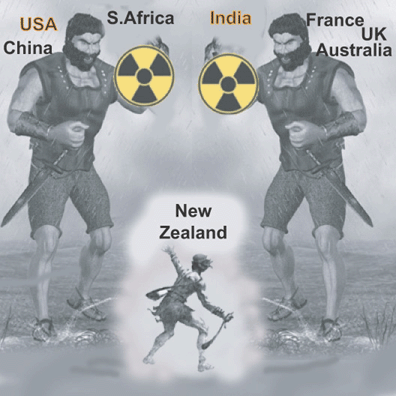
Andrew Tillett, Political correspondent, Financial Review, 7 Feb 23
Canberra | New Zealand’s new prime minister, Chris Hipkins, has indicated no watering down of his country’s anti-nuclear stance just weeks out from Australia unveiling its AUKUS submarine plan and says China remains an “incredibly important partner” following talks with Prime Minister Anthony Albanese.
But Mr Hipkins promised he would speak out when disagreeing with China as needed in response to questions over whether he would follow the approach of his predecessor Jacinda Ardern, who often took a softer line on Beijing’s behaviour in the region.
Mr Albanese hosted Mr Hipkins, making his first overseas trip since succeeding Ms Ardern last month, at Parliament House on Tuesday, with the two leaders discussing the impact of the deteriorating global economy on their respective countries, climate change, security and Pacific co-operation.
“Many other countries don’t have the same closeness as New Zealand and Australia, and that’s something that we will never take for granted in New Zealand. We’re able to tackle issues together in ways that other countries can’t,” Mr Hipkins said.
Despite the declaration of closeness, Mr Hipkins maintained Australia’s plan to acquire nuclear-powered submarines with American and British help would not change New Zealand’s nuclear-free status.
“Our foreign policy position hasn’t changed just because there’s a change of prime minister, the government’s foreign policy is the same as it was under prime minister Ardern,” Mr Hipkins said.
“Australia, the US and the UK are incredibly important security partners for New Zealand, but our nuclear-free policy hasn’t changed either.”
The AUKUS members are poised to unveil within weeks the so-called optimal pathway to acquire nuclear submarines………………………….. https://www.afr.com/politics/federal/kiwis-firmly-remain-anti-nuclear-as-aukus-submarines-draw-near-20230207-p5cih6
Aukus: Biden urged to fast-track research into submarines using non-weapons grade uranium
US lawmakers are concerned that if Australia’s new nuclear submarines use enriched fuel it could undermine global non-proliferation system
Guardian Daniel Hurst 4 Feb 23
The Biden administration is being urged to fast-track research into submarines that do not use weapons-grade uranium, as four Democratic politicians warn the Aukus deal with Australia makes the task “even more pressing”.
Australia’s deputy prime minister, Richard Marles, arrived in the United States for crucial talks with the defense secretary, Lloyd Austin, on Friday (US time), amid renewed congressional concerns about aspects of the flagship Aukus project.
With March looming as the deadline for key decisions on how Australia acquires at least eight nuclear-powered submarines with help from the US and the UK, all three countries maintain the work remains on track.
But in the latest sign of congressional jitters, four politicians from Joe Biden’s party have sounded the alarm about broader risks to the global nuclear non-proliferation system.
A newly published letter coordinated by Bill Foster, a physicist serving as US representative for an Illinois congressional district, asks the Biden administration to ramp up research into alternatives to using weapons-grade uranium to power submarines.
It adds to concerns already raised by experts that if the Australian submarines are powered by highly enriched uranium (HEU), other countries may seek to follow the precedent – even though they will not be armed with nuclear weapons…………………….
in a letter to the administrator of the NNSA and the navy secretary, the politicians formally requested a detailed report on “the feasibility and performance impact of a Virginia-Class replacement SSN(X) nuclear-powered attack submarine” that is fuelled by a low-enriched uranium (LEU) reactor with a life-of-the-ship core.
They said previous reports indicated it “may be feasible for the navy to use LEU fuel for naval nuclear propulsion, as France and China already do”……………….
“Minimizing the global presence of HEU by reducing its use in military applications would reduce the risks associated with making and transporting HEU and demonstrate significant leadership on nonproliferation,” the letter said…………….
James Acton, a co-director of the Nuclear Policy Program at the Carnegie Endowment for International Peace, has previously argued that Aukus depends on “a glaring and worrying loophole in IAEA safeguards” that could be exploited by others.
This loophole allows non-nuclear weapon countries to remove the fissile material they need for the submarine reactors from the stockpile monitored by the IAEA………………………………………………..
In the National Defense Authorization Act for Fiscal Year 2023, which was signed by Biden in late December, the US Congress requested Austin to order an independent assessment of the “challenges” to implementing Aukus……….. https://www.theguardian.com/australia-news/2023/feb/03/aukus-biden-urged-to-fast-track-research-into-submarines-using-non-weapons-grade-uranium
The American Colony of Australia
19 Feb 2021Western media portrays Australia as a beautiful nation with independent people and a close ally of the United States. But the American Empire has no allies, only vassal states. Australia became a colony of the American empire in 1975 after an Anglo-American coup. Australians noticed nothing since Australia had been an British colony since its inception and dispatches military forces when ordered to fight empire wars.
China objects to more nuclear sub talks among UK, U.S, Australia
BEIJING, Feb 3 (Reuters) – China “firmly objects” to further cooperation between Britain, U.S. and Australia on nuclear submarines, its foreign ministry said in a regular briefing on Friday.
Chinese foreign ministry spokesperson Mao Ning said, “China is gravely concerned about this and firmly objects to it,” in response to a question that cited a media report saying British Prime Minister Rishi Sunak’s visit to the United States in March may yield announcements on more nuclear submarine cooperation…………. Reporting by Yew Lun Tian and Joe Cash ; Writing by Liz Lee; Editing by Christian Schmollinger https://www.reuters.com/world/china-objects-more-nuclear-sub-talks-among-uk-us-australia-2023-02-03/
US makes diplomatic move targeting China
Washington sends diplomats to Solomon Islands after 30-year absence
https://www.rt.com/news/570836-us-embassy-solomon-islands/ 2 Feb 23
The US embassy in the Solomon Islands reopened on Thursday, decades after being shut down as redundant, amid concerns in Washington about the South Pacific archipelago’s overtures to Beijing.
The mission in Honiara will consist of a charge d’affaires, a “couple” of State Department employees and a “handful” of locals, according to Associated Press, which described the reopening as part of an effort to “counter China’s push into the Pacific.”
In a pre-recorded statement, US Secretary of State Antony Blinken said that through its new embassy, Washington will be “better positioned” to advance democracy and “tackle shared challenges.”
Located about 1,800 kilometers northeast of Australia, the Solomons last hosted a US diplomatic mission in 1993, when the State Department decided to downsize due to the end of the Cold War. The US had played a key role in liberating the archipelago from Japanese occupation during the Second World War, in the bloody Guadalcanal campaign.
In 2019, however, Honiara decided to transfer its diplomatic relations with China from the nationalist exiles in Taiwan to the Communist government in Beijing. The decision touched off riots in Guadalcanal, with protesters targeting Chinese businesses and setting fire to the prime minister’s residence.
In 2022, Honiara signed a security agreement with China, causing further alarm in the US and Australia. The State Department informed Congress that reopening the embassy was a priority given China’s “growing influence” and fears of a military build-up in the Solomons.
The US had told the Solomons that Washington would have “significant concerns and respond accordingly” to any “permanent military presence, power-projection capabilities, or a military installation” by China.
The Australian government said any kind of Chinese naval base in the archipelago would be a “red line” for Canberra, while some commentators even called for invading the islands.
In response to those concerns, Solomon Islands Prime Minister Manasseh Sogavare said that Australia remains the “security partner of choice,” and issued assurances that there would be no Chinese military base, insisting the security pact with Beijing “had solely domestic applications.”
Anthony Albanese supports the AUKUS menage a trois – USA, UK, Australia – despite criticism, and the incompetence in the industry
| CAUCUS ON AUKUS Prime Minister Anthony Albanese says he would’ve signed up to AUKUS had he been leader at the time, Guardian Australia reports, despite calls from former Labor PM Paul Keating to walk away. The diplomatic menage a trois is not just about nuclear submarines, Albo continued — it’s a defence pact between “friends” in an “insecure world”. Incidentally, Defence Minister Richard Marles and Foreign Affairs Minister Penny Wong will meet with their British counterparts today before Marles heads to the US — it’s prep work for the revelations next month about how exactly we will get to own at least eight subs. It comes as the British navy is urgently investigating whether someone repaired one of its nuclear submarines with superglue, the BBC reports, which honestly sounds like a Monty Python skit. |
Julian Assange’s Biggest Fight in Notorious Prison Isn’t Over Extradition
NewsWeek, BY SHAUN WATERMAN ON 01/27/23 “…………………………………………….. Assange’s physical and mental health have declined severely during more than a decade in confinement — first sheltering from U.S. authorities in the Ecuadorian embassy in London from 2012-2019, where he lived in two rooms and never left the building, and for the last almost four years, since he was dragged from the embassy by British police in April 2019, in Belmarsh fighting extradition.
…………………… The proceedings in London continue to drag on. It has been more than a year since the High Court cleared the way for his extradition and his appeal was filed in August. But the court continues to weigh it, with no deadline to reach a decision. Even if he loses, there remains the possibility of an appeal to the British Supreme Court, or to the European Court of Human Rights. Assange could be in the U.S. within months, but he might remain in Britain for years.
His family says that with uncertainty about his extradition hanging over him like the sword of Damocles, he has lost weight and become depressed and anxious.
A confinement of uncertain duration
The worst part about the confinement is having no idea when or how he would be able to leave, Stella Assange said. “It is the uncertain duration that makes it so hard to bear … It’s a kind of torture.”…………..
The uncertainty has exacerbated Assange’s physical and mental deterioration, his wife said. In October 2021, during a High Court hearing about his extradition, Assange, attending via video link from Belmarsh, suffered a “transient ischaemic attack” — a mini-stroke. He has been diagnosed with nerve damage and memory problems and prescribed blood thinners.
“He might not survive this,” she said.
As a remand prisoner, not convicted or sentenced, and facing extradition, not prosecution, Assange is an anomaly in Britain’s most secure prison — designed to hold “Category A” inmates such as IRA militants, jihadis and murderers. One of a tiny handful of unconvicted prisoners, prison regulations require him to be treated differently, his wife said.
“He’s supposed to be able to get visits every day, he’s supposed to be able to work on his case,” she said, “But that’s only on paper. The way the prison system works, it is more efficient to treat everyone like a Cat A prisoner rather than to try to adapt the rules for individuals. In reality, that just doesn’t translate at all.” She said Assange is allowed one or two legal visits, and one or two social visits each week.
In between visits, time can stretch. And the isolation has been hard on him……………………………..
Phone calls, his half-brother Gabriel Shipton told Newsweek from Assange’s native Australia, are limited to 10 minutes. “You’ll just be getting into it and click, it’s over.”
Neither the governor’s office at Belmarsh, nor the press office for the British Prison Service, responded to emails requesting responses to detailed questions.
A source of inspiration and power
Assange gets thousands of letters and parcels from all over the world, Stella Assange said, but the authorities interdict banned items, such as books about national security, paintings and other forbidden objects.
His father, John Shipton, told Newsweek from Australia that Assange draws a lot of inspiration and power from the letters that people write to him. During their phone conversations, he will often read snippets or recall memorable letters, Shipton said. “He loves getting them … You can hear him light up a bit” when he talks about them………………………………………… more https://www.newsweek.com/2023/02/10/julian-assanges-biggest-fight-notorious-prison-isnt-over-extradition-1774197.html
Documents show no sign Albanese government lobbied the US to bring Julian Assange home

https://michaelwest.com.au/documents-show-no-sign-albanese-government-lobbied-the-us-to-bring-julian-assange-home/, by Rex Patrick | Jan 24, 2023
The government is hosting a media freedom roundtable yet Freedom of Information inquiries show no evidence of entreaties to the Biden administration to free Australia’s number one victim of political and media persecution, Julian Assange. Actions speak louder than words, writes Rex Patrick.
When Independent MP Monique Ryan stood up in the Parliament in late November and asked Prime Minister Anthony Albanese if his Government would intervene to bring Australian journalist Julian Assange home, those in the community that care about freedom of the press were provided with a glimmer of hope.
The PM answered: “I, some time ago, made my point that enough is enough. It is time for this matter to be brought to a conclusion. In that, I don’t express any personal sympathy with some of the actions of Mr Assange. I do say though that this issue has gone on for many years now, and when you look at the issue of Mr Assange and compare that with the person responsible for leaking the information, Bradley Manning, now Chelsea Manning, she is now able to participate freely in US society.”
He went on to say:
The government will continue to act in a diplomatic way, but can I assure the member for Kooyong that I have raised this personally with representatives of the United States government. My position is clear and has been made clear to the US administration that it is time that this matter be brought to a close.
Press protections or press protection?
When the Attorney General, Mark Dreyfus MP, KC announced on the 19th of this month that he was calling together media organisations to discuss improved protections for press freedom, Assange supporters could also reasonably crack a smile. Dreyfus pronounced:
“The Albanese Government believes a strong and independent media is vital to democracy and holding governments to account. Journalists should never face the prospect of being charged or even jailed just for doing their jobs.”
But it’s now clear there’s a big difference between saying, and doing. A set of Freedom of Information (FOI) requests has bought the Government’s Assange façade crumbling to the ground.
In response to a Freedom of Information request to the Prime Minister for all correspondence or other records of communication sent after 23 May 2022 by or on behalf of the Prime Minister, the Hon Anthony Albanese MP, to United States President Joe Biden that related to Julian Paul Assange, his office has come up with nothing.

In response to a Freedom of Information request to the Attorney General for correspondence or records of communication between him and his US counterpart Merrick Garland that relates to Assange his office also came up bare.
FOI Response from Houston Ash, Senior Adviser to the Attorney-General
It’s a response that’s left independent MP Monique Ryan disturbed.
“The US Government’s prosecution of Australian journalist and publisher Julian Assange poses a major threat to press freedom around the world. Unfortunately, the evidence now available shows that, contrary to their statements, Prime Minister Albanese and his Ministers have done little to secure Mr Assange’s freedom. None of them has written to their US counterparts to press for the espionage prosecution to be dropped”, said Ms Ryan.
She’s now rightly called on the government to disclose exactly what they have done, and will do, to secure Assange’s release.
In media statements she referred also to a further request made to Foreign Minister Penny Wong’s office for Assange related correspondence between her and United States Secretary of State Antony J Blinken. It also drew a blank.

Ms Ryan observed:
“If the Albanese Government was serious about working to secure an end to the US prosecution and Mr Assange’s release, then he and his Ministers would have raised the matter formally, in writing, with their counterparts at the top levels of the US Government”, It is now confirmed that they have not done so via any formal means.”
Ms Ryan went on to highlight the Attorney’s duplicitous stand. “Last week, in announcing a forthcoming national media roundtable, Attorney-General Dreyfus declared that ‘Journalists should never face the prospect of being charged or even jailed just for doing their jobs‘.” Julian Assange is an Australian journalist who faces lifelong imprisonment for doing his job.”
The Independent MP for Kooyong has signalled her intent to take the matter further. “When the Federal Parliament reconvenes in February, the Government will need to explain – in much more detail – when we can expect to see Mr Assange return to Australia”
The Albanese Government has been caught out saying something but not meaning it. They just want to appear that they’re doing something, when behind the scenes they’re doing very little, if anything much at all.
Nothing is to be gained by the continuing prosecution of Julian Assange. The US espionage prosecution sends precisely the wrong message at a time when freedom of the press is under threat in many countries worldwide.
The Albanese Government serve the United States better, and promotes a solid position itself, in pressing for the attack on Assange and media freedom to stop.
Push in US Congress to exempt Australia from International Traffic in Arms Regulations, so that it can import nuclear submarines.

Democrat push to grant Australia a waiver to import nuclear subs earlier than expected
SMH, ByFarrah Tomazin, January 21, 2023 —
Washington: A maze of US regulations and export control laws stand between Australia and the multibillion-dollar AUKUS submarine agreement, prompting a key ally of the pact in Congress to propose a blanket exemption to accelerate delivery of the nuclear-powered fleet.
Democratic congressman Joe Courtney, who recently spearheaded a bipartisan defence of the Australia-UK-US pact amid jitters from some of his Washington colleagues, wants Australia to be given a waiver from strict US export controls that could otherwise derail the agreement.
The International Traffic in Arms Regulations is one set of rules which could delay for years the transfer of crucial technologies at a time when Australia is racing to bolster its submarine capacity before the retirement of its Collins-class fleet.
Defence Minister Richard Marles has said the government will announce by March which type of submarine it will acquire, after receiving a recommendation from Jonathan Mead, the head of the Nuclear Powered Submarine Taskforce.
The announcement is expected to provide the first concrete insights into the cost, timing and procurement of the AUKUS deal. The modelling so far has suggested that if the submarines are produced in Australia, as the government has suggested, the earliest possible delivery date would be 2055.
While President Joe Biden supports AUKUS, he needs the backing of a divided Congress to make good on his promise to share American submarine secrets with Australia.
Courtney, who co-chairs the bipartisan “AUKUS caucus” and is regarded as one of Congress’ top navy experts, said a potential solution to the difficulties posed by US law would be to pass an exemption, with the support of the Pentagon, allowing Australia to bypass rules such as the International Traffic in Arms Regulations and related nuclear submarine laws, for the strict purpose of advancing AUKUS……………………………….
Australian officials have for years been pushing their US counterparts to reform their treatment under arms regulations, and the issue was front and centre of the December Australian-US Ministerial consultations between Marles and US Secretary of Defence Lloyd Austin…………
In response to questions from this masthead, a spokesman for the Australian Department of Defence said it was anticipating that export arrangements would need to change “to ensure technology and expertise could be transferred seamlessly and effectively among AUKUS partners, as well as their respective industrial bases, within a suitably designed protective framework”…………
At a seminar last week, Democratic congressman Adam Smith, a ranking member of the House of Representatives armed services committee, also warned that while AUKUS was “a great idea, with a lot of promise” it “could also go bloop” unless some regulatory restrictions were eased.
And Mark Watson, the director of the Australian Strategic Policy Institute’s Washington office, suggested that “an AUKUS express lane is what we need” to avoid delaying or derailing the project due to the maze of red tape and complex US laws surrounding it.
But the regulatory hurdles are not the only difficulty the alliance faces.
One of the concessions Republican congressman Kevin McCarthy made this month to secure the speakership of the House of Representatives was a vote on a framework that caps discretionary spending at fiscal 2022 levels. Some fear that this could result in the US defence budget being cut in real terms, which Courtney warned “could have a very negative effect on AUKUS”.
Helping Australia acquire nuclear submarines will also test America’s submarine manufacturing industry, which has already been strained by the COVID pandemic. https://www.smh.com.au/world/north-america/democrat-push-to-grant-australia-a-waiver-to-import-nuclear-subs-earlier-than-expected-20230120-p5ce4e.html
Australia’s nuclear submarine plan – a source of disagreement in US Congress

Who is going to build our nuclear submarines? Financial Review 13 Jan23.……………………………………………………………. At the heart of the problem is this simple fact: according to current projections, the US needs to turn out two submarines a year, but only around 1.3 per year are coming out of its naval shipyards.
The deficit in shipyard capacity is a problem that affects maintenance and refits as well as new boat construction. Last year, Rear Admiral Doug Perry, director of undersea warfare requirements in the US Navy, admitted that of America’s 50 attack submarines, “18 were either in maintenance or waiting to go in maintenance”. That figure should be closer to 10.
‘Zero-sum game’
In the words of senators Reed and Inhofe, “what was initially touted as a ‘do no harm’ opportunity to support Australia and the United Kingdom and build long-term competitive advantages for the US and its Pacific allies, may be turning into a zero-sum game for scarce, highly advanced US SSNs”.
Reed and Inhofe will have been briefed in detail by US officials, and presumably those classified briefings led them to conclude that the projected additional demand from the AUKUS program would come at the expense of America’s own military preparedness.
…………………………….. the back-and-forth [in the USA regarding Austrsalian submarines] shows that wider congressional commitment could be put under strain if the program comes to be seen as improving Australian capability while stretching the US to breaking point.
1 This month
17 October, Free Public Talk on Nuclear Issues in South Australia
David Noonan will speak on public interest concerns over the new Roxby Downs Indenture Act 2026 on BHP copper-uranium mining and ore processing in SA, and on how AUKUS may face SA with a High-Level nuclear waste agenda.
Dr Jim Green will discuss international developments in the field of nuclear power including ‘small modular reactors’ and Generation 4 ‘advanced’ nuclear reactor concepts.


Help Aunty Sue Protect Her Land and Sacred Sites From Destructive Rocket Testing.
.

Australians deserve the truth
about
AUKUS – https://aukuspublicinquiry.com/

PETITION – To: Prime Minister Anthony Albanese and the Australian Labor Government

of the week – Australians for War Powers Reform (AWPR)
To see nuclear-related stories in greater depth and intensity

