Australia’s ‘optimal pathway’ on AUKUS
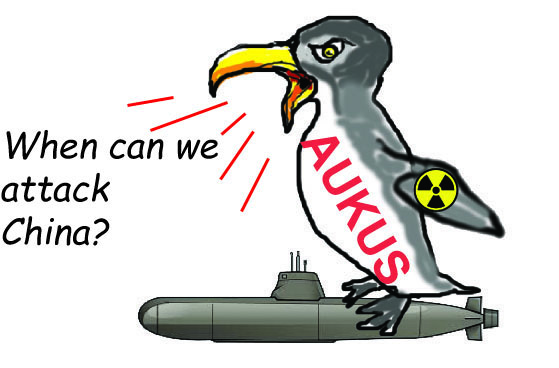
‘Optimal pathway’ is Prime Minister Albanese’s way of describing the obscure, tortuous AUKUS process
By Alison BroinowskiJan 12, 2023 https://johnmenadue.com/australias-optimal-pathway-into-or-out-of-aukus/
Just in time, the fundamental faults of AUKUS are being exposed in Canberra and Washington.
This development is not only due to the mounting concern among Australian civil society groups. The Australian mainstream media are now discussing the hitherto unmentionable drawbacks of AUKUS. But it’s because two US Senators, Democrat Jack Reed and Republican James Inhofe (since retired) warned President Biden that the US can’t meet its own submarine needs, let alone Australia’s. They also cautioned about American statutes and regulations that would have to be changed.
Their concern came just in time, for the AUKUS agreement between Australia, the US and the UK is promised for March. As any Australian who’s been asking the Morrison and Albanese governments for the details for the past year knows well, there are none. For the nuclear-powered submarines, we don’t know the cost of the weaponry, the dates of delivery, or the training, staffing and crewing requirements, and it’s a good guess that the government doesn’t either.
In a rare burst of candour, Peter Jennings, whose constant theme at ASPI was and remains to urge more Australian spending on American weapons directed at ‘deterring’ China, is now concerned that if Australia/China relations improve, that could compromise secret US nuclear technology to be shared with Australia. But he still wants the agreement.
What is AUKUS if not a means to deter China?’ he asks, adding that if AUKUS fails, so could ANZUS (Australian, 10 January 2023: 9). Jennings’ concerns may open the AUKUS can of worms, which as he implies, also contains a festering mass of unresolved problems for the ANZUS alliance.
ANZUS was negotiated in 1951 as the bare minimum commitment Australia, New Zealand and the US were prepared to make to defend each other. With no effectively binding clauses – apart from Article 1 where they undertake to refrain from the threat or use of force, consonant with international law and the UN Charter – its unwritten purpose was to contain Japan. Talked up for decades, it acquired mythical significance for Australia’s mateship with the US. But would the US defend Australia if that wasn’t in America’s interests?
That nagging doubt was raised with Julia Gillard, as Prime Minister, by Kim Beazley who knew that whatever else the US would not defend, it would fight for a base. The ‘joint facilities’ at Pine Gap, Narrungar, and Northwest Cape weren’t enough: in 2011 Australia proposed US Marine deployments in the Northern Territory. Under the Coalition, the Force Posture Agreement of 2014 went further, giving ‘unimpeded access’, exclusive control and use of agreed facilities and areas to US personnel, aircraft, ships and vehicles. As Bevan Ramsden pointed out here on 10 January, the sovereignty horse has bolted. US-Australia ‘Force Posture Agreement’ undermines sovereignty, must be terminated
It is too late for Prime Minister Albanese to assure Australians that the nation’s ‘sovereign interest’ will be protected: it hasn’t been for more than a century during which alliances to Britain and the US circumscribed Australian sovereignty. It is meaningless for Malcolm Turnbull, having done nothing to arrest the process of ‘interoperability’ with the US as prime minister, now to lament that AUKUS diminishes Australian sovereignty. The nuclear-powered submarines will have to be bought from, operated by and maintained by the US, and Australia’s defence forces are already ‘interchangeable’ with America’s, as Defence Minister Richard Marles has said. Some face-saving concessions to the UK’s submarine industry will further complicate the agreement.
Australia ‘cannot do everything ourselves’, says Retired Rear Admiral Peter Clarke. What if any of this Australia can do ourselves he didn’t go into. Proof of Clinton Fernandes’ description of Australia as a ‘sub-imperial power’ is becoming stronger by the day, even as its ‘power’ element diminishes.
When political leaders adopt defence jargon, the rest of us should reach for our fact-checkers. ‘Optimal pathway’ is Prime Minister Albanese’s way of describing the obscure, tortuous AUKUS process. ‘When we talk about optimal pathway, we talk about not just the issue of what is built, but how it is built, as well as the optimal pathway in building a capacity of skills in the Australian workforce’, he said. Opposition leader Peter Dutton tried for a clearer answer, saying that Australia was really dependent on buying US submarines to ‘keep the region safe’. That too remains debatable.
Our leaders don’t say which countries in our region want Australia to ‘keep it safe’. Most of our regional neighbours are safely managing their relations with others now, without our submarines. They will have to wait until 2040 for that to change. In the meantime, Australia might seek their advice about a shared vision for a safe region. How Australia confronting the PRC with armed force is going to deter China – from reclaiming Taiwan, perhaps – is never explained. Peter Jennings hopes Australia can match China’s growing submarine fleet and join the US to stop the ‘Chinese Communist Party dominating the Indo-Pacific’. But how and when will we do so, and at what cost?
What our leaders always leave out is why we should do all this. Before the AUKUS deal is signed and it’s too late, Australians need a clear answer. That needs to be more reliable than citing the ANZUS insurance policy. Australia’s interests in our region are not interchangeable or interoperable with those of the US, nor are they identical, and they should be sovereign.
Dr Alison Broinowski AM is a former diplomat, author and academic. She is President of Australians for War Powers Reform.
Dear US Congress, thank you for saving Australia from itself

by Rex Patrick | Jan 7, 2023 https://michaelwest.com.au/dear-us-congress-thank-you-for-saving-australia-from-itself/
Is “bad news” out of US Congress about an AUKUS nuclear submarine deal a blessing in disguise? Former submariner and senator Rex Patrick says US politicians, though acting in the interests of the US, may save Australia from itself, and $170 billion too.
We are concerned that what was initially touted as a ‘do no harm’ opportunity to support Australia and the United Kingdom and build long-term competitive advantages for the US and its Pacific allies, may be turning into a zero-sum game for scarce, highly advanced U. SSNs,” wrote the Democrat and Republican heads of the Senate Armed Services Committee.
“Over the past year, we have grown more concerned about the state of the US submarine industrial base as well as its ability to support the desired AUKUS SSN [Nuclear Submarine] end state”.
“We believe current conditions require a sober assessment of the facts to avoid stressing the US submarine industrial base to the breaking point.”
These two Senators have nailed it.
Scotty’s greatest marketing moment
The AUKUS submarine was a ‘brain fart’ of Prime Minister Scott Morrison who was facing disquiet within the Liberal Party ranks (I know; as a Senator and submariner, they were raising the issue with me) over the French designed Attack Class replacement submarine program.
It was an idea supported by a Defence Department which had, in the 12 years since the future submarine project had been initiated, spent five billion taxpayer dollars delivering no submarine, and more than $8.5 billon on other failed projects.
On the morning of September 16, 2021, Morrison stood up in a stage-managed announcement staring US President Biden, then UK Prime Minister Boris Johnson and Morrison. Apart from the fact that President Biden didn’t know Morrison’s name, it was Morrison’s greatest ‘Scotty from Marketing’ moment.
While waving a big and distracting nuclear submarine hand to the camera, his other hand was behind his back silently putting a death to the French submarine program, something that would very shortly after cause a diplomatic rift between Australia and France.
Then opposition leader, Anthony Albanese, was given a briefing on AUKUS and the new submarine plans just 24 hours prior to the announcement. In the face of the oncoming election, Albanese made the political call to give the announcement Labor’s full support. Indeed, pursuing a ‘small target’ political strategy, Labor was embarrassingly desperate to avoid a fight about national security.
Not good for Australia
It was only after the dust had settled that the right questions started to be asked; simple questions like how much, when and where?
The cost soon emerged. The French submarine program has taken an expensive $50 billion submarine program and blown out to an unaffordable $90 billion. The AUKUS submarine was to invoke a cost ‘chain reaction’, coming in at a bankrupting $170 billion. We were jumping out of the financial frying pan and into the fire.
2040 what?
The commissioning date soon emerged. 2040! Noting the rationale for the switch from a French to an AUKUS program was the rising geo-political tension in our regions, the AUKUS submarine was to be delivered even later that the French solution. In an environment where Defence itself had warned our defence procurement warning time had been reduced to less than 10 year, it made no sense to embark on a program that delivers a first capability in 20 years.
Then the build discussions started. The nuclear submarine was not to be built in Australia, rather the US. We were going to sell out Australia industry, and in particular our hard-won competent submarine sustainment industry. We were going simply export $170B, most of the jobs and a sovereign capability the taxpayer had spent billions developing.
Not good for the US either
And the US Congress is now coming to the realisation that the AUKUS program will not be good for the US either.
Supporting Australia’s submarine program will put even more pressure on the US submarine industry trying to build 12 new Columbia Class ballistic missile submarines and meet the demands of supplying the US Navy with its own Virginia Class submarines.
This is not surprising. The US Congressional Research Service has been issuing reports for the better part of a decade that highlight the growing pressures on and limited capacity of the two American submarine construction facilities. The industrial capacity problem is already acute.
The old Los Angeles Class submarines are retiring faster that the Virginias can be brought online.
Now the Senate Armed Services Committee has finally realised what would be involved in supporting the AUKUS submarine.
Please help pal!
Not having built or operated nuclear submarines before, and as the only country in the world that would be operating nuclear submarines without an established nuclear power industry, Australia’s dependency on the US would be significant. Training, shipbuilding, operating and maintaining a nuclear submarine, nuclear safety … we would need a lot of help with all of it.
We are talking about nuclear reactors. The US can’t half commit to this. AUKUS nuclear submarines will be a considerable distraction to the entire US submarine enterprise at a time when they don’t need distraction.
But the public concerns of the senators only tell half the story.
China conflict looms, before the subs arrive
Conflict between the US and China is more likely to occur in the next decade, than in the 2040’s when a first AUKUS nuclear submarine would be fully operational.
A decision by the US to support an AUKUS nuclear submarine would be a decision resigning their close Asia-Pacific ally to the operating of ageing Collins class submarines in the very period a high-end submarine partnering capability was needed most.
Stupid and stupider, but political momentum
The whole AUKUS nuclear submarine thing has a political momentum about it which will bring about national security downsides for both countries.
As indicated above, the Labor Party leadership signed up to this massive project on 24 hours’ notice and little information. Now, completely captured by the ‘Department of Largely Failed Procurement and No Accountability’, Albanese, Defence Minister Richard Marles and Defence Industry Minister Pat Conroy have been supplied with a full barrel of naval Kool Aide, and they’re chugging it down.
Cold hard analysis, such as that being conducted by the US Congress, might be the only thing that saves Australia from itself.
Australia’s Prime Minister’s words offer hope to Assange faithful
https://independentaustralia.net/politics/politics-display/pms-words-offer-hope-to-assange-faithful,17072, By John Jiggens | 15 December 2022,
In Parliament recently, Prime Minister Anthony Albanese gave his most powerful statement yet in response to a question about Julian Assange’s persecution, writes Dr John Jiggens.
ON 30 NOVEMBER in Parliament, Independent “Teal” member for Kooyong Monique Ryan asked Prime Minister Anthony Albanese what his Government was doing to support Julian Assange.
Ryan stated:
“Journalists obtaining and publishing sensitive information is in the public interest and essential to democracy. Julian Assange is still detained in Belmarsh prison, charged by a foreign government with acts of journalism.”
She asked the Prime Minister bluntly:
“Will the government intervene to bring Mr Assange home?”
Prime Minister Anthony Albanese responded with his most powerful statement yet on the Assange question:
Some time ago, I made my point that enough is enough. It is time for this matter to be brought to a conclusion. The Government will continue to act in a diplomatic way. But can I assure the member for Kooyong that I have raised this personally with representatives of the United States Government.
My position is clear and has been made clear to the U.S. Administration. I will continue to advocate as I did recently in meetings that I have held. I thank the member for her question and for her genuine interest in this, along with so many Australian citizens.
Albanese questions pointless legal action against Assange
I asked John Shipton, Julian Assange’s father – who recently spoke in Brisbane – what he thought of Anthony Albanese’s comments.
He replied in his characteristic generous way by first praising Monique Ryan for her question — adding he thought she would make a magnificent contribution to parliament as she had done in her previous medical career.
Shipton said:
“As for Anthony Albanese, he stands firmly alongside 88 per cent [referring to a recent poll] of the Australian population in firmly requesting that Julian be returned home to Australia to his family and home, and for this, we give our very warm support.”
Monique Ryan’s question came just days after five leading media outlets released an open letter denouncing the U.S. prosecution of Julian Assange.
The letter, from editors and publishers of The New York Times, The Guardian, Le Monde, Der Spiegel and El País, which had been media partners with WikiLeaks in publicising the Chelsea Manning material, warned that the Assange indictment sets a dangerous precedent and threatens to undermine America’s First Amendment and the freedom of the press.
The letter declared:
‘Publishing is not a crime.’
John Shipton was pleased with this development too. For many years, he said, the most important institutions in legacy media have abandoned Julian — in fact, assisted in bringing about the decline in Julian’s public persona.
Said Shipton:
Legacy media, making such an important statement from the most important media outlets in the Western world — particularly ‘The New York Times’ which seem to be very close to the White House and to the Democratic Party – coming from ‘The New York Times’, this is vital assistance in bringing Julian home to Australia. The persecution of Julian Assange by the United Kingdom and the United States must stop.
Others central to the Assange campaign also commented on Albanese’s response to Ryan’s question.
Said Gabriel Shipton, brother of Julian Assange:
“Finally the Prime Minister has publicly called for this endless persecution of Australian publisher Julian Assange to be brought to an end. Australians will be keenly watching to see how the U.S. reacts and if it will respect the calls of the Australian public and Government to show mercy to Australian citizen Julian Assange.”
Assange campaign legal advisor Greg Barns SC declared:
When an Australian prime minister raises concerns about an Australian citizen’s treatment by the U.S., it is a serious matter, given the strength of the alliance between the two countries. It is clear that Mr Albanese understands the injustice of the Assange case. Australians rightly expect their government to intervene in cases where Australians are detained overseas in unjust circumstances.
Said Assange campaign solicitor Stephen Kenny:
It was reassuring to hear the words of the Prime Minister. However, words need to be backed by action and we would hope that the Prime Minister’s representation has been heard in the United States. Action from the United States will determine if our Prime Minister has any influence in our relationship with the United States. For Julian’s sake, I sincerely hope he does.
Pursuing Assange in a US court could cause even more embarrassment than the WikiLeaks’ publications.
It’s possible that pursuing Assange in a US court could cause even more embarrassment than the WikiLeaks’ publications. As the years have passed, we have learned that a Spanish security firm recorded his every move and those of his visitors and legal counsel in the Embassy of Ecuador. This was passed to the CIA, and was used in the US case for his extradition. The trial of Daniel Ellsberg for leaking the Pentagon Papers failed because his psychiatrist’s records were stolen by investigators, and this should set a precedent for Assange.
Enough is enough for Albanese on Assange: our allies may respect us if we say this more. https://johnmenadue.com/enough-is-enough-for-albanese-on-assange-our-allies-may-respect-us-if-we-say-this-more/ By Alison Broinowski, Dec 2, 2022
The Prime Minister’s surprise revelation that he has raised the case against Julian Assange with US officials and urged that charges of espionage and conspiracy be dropped opens up many questions.
Mr Albanese thanked Dr Monique Ryan for her question on Wednesday 31 November, giving what appeared to be a carefully prepared and timed answer. The Independent MP for Kooyong sought to know what political intervention the government would make in the case, observing that public interest journalism is essential in a democracy.
The news flashed around between Assange supporters in and outside Parliament, and reached the Guardian, the Australian, SBS, and Monthly online. Neither the ABC nor the Sydney Morning Herald carried the story, even the next day. SBS reported that Brazil’s president-elect Luiz Inacio Lula da Silva expressed support for the campaign to free Assange.
But two days earlier, on Monday 29 November, the New York Times and four major European papers had printed an open letter to the US Attorney-General Merrick Garland, deploring the assault on media freedom which the pursuit of Assange represented.
The NYT, the Guardian, Le Monde, Der Spiegel and El Pais were the papers which in 2010 received and published some of the 251,000 classified US documents provided by Assange, many revealing American atrocities in Afghanistan and Iraq.
US Army intelligence analyst Chelsea Manning gave them to Assange, who redacted names of people he considered could be harmed by publication. A senior Pentagon serving officer later confirmed that no-one had died as a result. Manning was imprisoned, and then pardoned by Obama. Assange spent seven years in diplomatic asylum in the Embassy of Ecuador in London before British police removed him and he was imprisoned for breach of bail condition.
Assange has been in Belmarsh high security prison for three years, in poor physical and mental health. Court proceedings against him over extradition to face trial in the US have been farcical, biased, oppressive, and excessively prolonged.
In Opposition, Albanese said ‘Enough is enough’ for Assange, and he has at last done something about it in Government. What exactly, with whom, and why now, we don’t yet know. The PM’s hand may have been forced by the major dailies’ letter to Attorney-General Garland, which made Australian politicians and media appear to be doing nothing. Or he may have raised the Assange case in his recent meetings with Biden, at the G20 for example.
Another possibility is that he was talked into it by Assange’s barrister, Jennifer Robinson, who met with him in mid-November and spoke about the case at the National Press Club. When I asked if she could say if she and Albanese discussed Assange, she smiled and said ‘No’ – meaning she couldn’t, not that they didn’t.
Monique Ryan made the point that this is a political situation, requiring political action. By raising it with US officials, Albanese has moved away from the previous government’s position that Australia couldn’t interfere in British or American legal processes, and that ‘justice must take its course’. That wasn’t the approach Australia took to secure the freedom of Dr Kylie Moore-Gilbert, imprisoned for espionage in Iran, or of Dr Sean Turnell from jail in Myanmar. It isn’t Australia’s approach in China either, where a journalist and an academic remain in detention.
By taking up Assange’s case, Albanese is doing nothing more than the US always does when one of its citizens is detained anywhere, or than the UK and Canada quickly did when their nationals were imprisoned in Guantanamo Bay. Australia allowed Mamdouh Habib and David Hicks to spend much longer in US custody before negotiating their release. We might gain more respect from our allies if we adopted their speedy approach to these cases, than we do by subservience to British and American justice.
It’s possible that pursuing Assange in a US court could cause even more embarrassment than the WikiLeaks’ publications. As the years have passed, we have learned that a Spanish security firm recorded his every move and those of his visitors and legal counsel in the Embassy of Ecuador. This was passed to the CIA, and was used in the US case for his extradition. The trial of Daniel Ellsberg for leaking the Pentagon Papers failed because his psychiatrist’s records were stolen by investigators, and this should set a precedent for Assange.
Even though Biden once called Assange a ‘hi-tech terrorist’, as President he is now an advocate of human rights and democratic freedoms. This might be a good time for him to put them into practice. Doing so would make both Biden and Albanese look better than their predecessors.
Nuclear submarines will be ‘massively expensive’ – (even Australia’s right-wing is waking up to this!)
Nuclear submarines will be ‘massively expensive’ https://www.skynews.com.au/opinion/peta-credlin/nuclear-submarines-will-be-massively-expensive/video/0cd71d146d5b824255a40e9a2ce6c56b
Former ASPI Executive Director Peter Jennings says Australia’s nuclear submarines will be “massively expensive”.
“I’ve said for the whole thing including training and bases and weapons, as well as the submarine itself, think of about one per cent of gross national product, so something like AU$20 billion a year forever,” he told Sky News host Peta Credlin.
Parking Lot B-52: does the escalation of US troops and installations make Australia a bigger target?
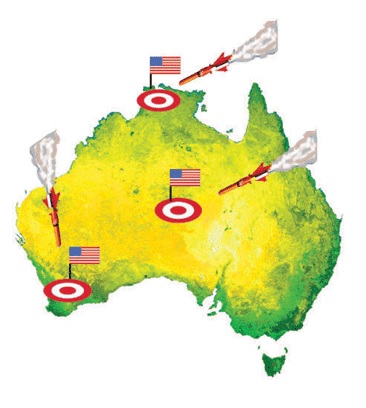
we are particularly concerned about what’s going on now and the speed with what’s going on now. As well as about how little we know or are being told.”
Then there is the matter of what is a base, when is a base a base, and whether Australian authorities are kept in the dark about what their US allies are doing.
“If our objective is to be a deputy sheriff to the US, as the 51st state of the Union, then eight nuclear submarines is the answer.”
Michael West Media, by Callum Foote | Dec 5, 2022
The Department of Defence is refusing to confirm how many American troops are stationed in Australia, who pays for it, or even why. The rising deployment of troops and B-52 bombers however, and Pine Gap, make Australia a target in event of war between China and the US. Callum Foote reports.
The Department of Defence has refused to reply to inquiries into how many US military personnel are currently stationed in Australia. It’s not just soldiers, it’s weapons too.
An ABC Four Corners investigation recently revealed that the US is preparing to develop the Tindal air base near Katherine, 320kms south of Darwin, to host up to six nuclear-capable B-52 bombers. Today it was revealed the US is trying to sell Australia the latest American bomber, the B-21 Raider, and rotate the aircraft through Australia.
Experts fear that the stockpiling of US weaponry in the Northern Territory would make Australia a target in the event of war between China and the US.
Despite the escalating presence of US troops and military hardware on Australian soil however, the Department of Defence has refused to reply to inquiries into how many US military personnel are currently stationed in Australia. Refused to reply full-stop.
We don’t even know who is funding it.
And as Chinese satellites could pick up the deployment of troops and US military installations, the secrecy is unwarranted.
B-52s here for the long haul
According to independent think tank Lowy Institute, B-52s have been deployed in the Northern Territory since at least the 1970s and military personnel training regularly in Australia since 2005.
The federal government has yet been unclear about the purpose of the deployment of the bombers in Australia. However, experts believe that the rising tensions between China and the US in the South China Sea is cause for alarm.
Alison Broinowski, the president of Australians for War Powers Reform, an anti-war advocacy group, says her network is concerned about the rising militarisation of the Northern Territory.
“We’re all very concerned about this,’’ Broinowski told MWM. ‘’It’s not new of course – the signs of it being planned go back for years. But we are particularly concerned about what’s going on now and the speed with what’s going on now. As well as about how little we know or are being told.”
Broinowski is a former diplomat, academic and author. A significant amount of her opposition to the militarisation of the NT comes down to secrecy.
“The very fact that it was undertaken in secret and would remain secret were it not for revelations from journalists we still wouldn’t know because they are doing this in secret,’’ Broinowski said.
Political commentator and former diplomat Bruce Haigh suspects the oft-cited number of 2500 rotating US troops stationed in Australia doesn’t paint the full picture.
“They give the official figure at 2500 and say that they rotate but I understood that those troops are becoming more permanent.”
To the purpose of the thousands of US marines stationed in Darwin, Haigh says, officially, it’s for joint training exercises with the Australian Defence Force but we don’t know”.
“A lot of money being spent on upgrading these bases hasn’t yet gone through the parliamentary committee system so we don’t know where in the Defence budget this money is coming from.”
Between Pine Gap, Tindal Air Force Base and thousands of US marines deployed in Darwin the exact figure is unknown. The US also has access to almost all Australian military bases with US naval personnel also coming in and out of the Stirling Naval Base in Fremantle, according to Haigh.
Then there is the matter of what is a base, when is a base a base, and whether Australian authorities are kept in the dark about what their US allies are doing.
Broinowski says the government has little oversight of many of the facilities that the US has interested in “although we call them Australia joint facilities they are for all intents and purposes American bases. About which our government knows as little as it used to know in the olden days about Pine Gap”……………………………
According to former submariner and senator, Rex Patrick, government is captured by the Defence Department which is in turn captured by the US. The post-AUKUS treaty decision to jettison the French submarine deal and agree to a bigger program to buy submarines from the US or UK reflects an Australian subsidy for the struggling submarine industries in those countries.
“If our objective is to be a deputy sheriff to the US, as the 51st state of the Union, then eight nuclear submarines is the answer. “If our objective is ‘‘defence of Australia’’, with the ability to forward deploy boats to operating bases in Singapore, Malaysia, Guam or Japan, in support of our allies and friends, then 20 AIP boats is the answer.” https://michaelwest.com.au/b-52s-in-australia-unknown-american-troops/
Pursuing Assange in a US court could cause even more embarrassment than the WikiLeaks’ publications.
It’s possible that pursuing Assange in a US court could cause even more embarrassment than the WikiLeaks’ publications. As the years have passed, we have learned that a Spanish security firm recorded his every move and those of his visitors and legal counsel in the Embassy of Ecuador. This was passed to the CIA, and was used in the US case for his extradition. The trial of Daniel Ellsberg for leaking the Pentagon Papers failed because his psychiatrist’s records were stolen by investigators, and this should set a precedent for Assange.
Enough is enough for Albanese on Assange: our allies may respect us if we say this more. https://johnmenadue.com/enough-is-enough-for-albanese-on-assange-our-allies-may-respect-us-if-we-say-this-more/ By Alison Broinowski, Dec 2, 2022
The Prime Minister’s surprise revelation that he has raised the case against Julian Assange with US officials and urged that charges of espionage and conspiracy be dropped opens up many questions.
Mr Albanese thanked Dr Monique Ryan for her question on Wednesday 31 November, giving what appeared to be a carefully prepared and timed answer. The Independent MP for Kooyong sought to know what political intervention the government would make in the case, observing that public interest journalism is essential in a democracy.
The news flashed around between Assange supporters in and outside Parliament, and reached the Guardian, the Australian, SBS, and Monthly online. Neither the ABC nor the Sydney Morning Herald carried the story, even the next day. SBS reported that Brazil’s president-elect Luiz Inacio Lula da Silva expressed support for the campaign to free Assange.
But two days earlier, on Monday 29 November, the New York Times and four major European papers had printed an open letter to the US Attorney-General Merrick Garland, deploring the assault on media freedom which the pursuit of Assange represented.
The NYT, the Guardian, Le Monde, Der Spiegel and El Pais were the papers which in 2010 received and published some of the 251,000 classified US documents provided by Assange, many revealing American atrocities in Afghanistan and Iraq.
US Army intelligence analyst Chelsea Manning gave them to Assange, who redacted names of people he considered could be harmed by publication. A senior Pentagon serving officer later confirmed that no-one had died as a result. Manning was imprisoned, and then pardoned by Obama. Assange spent seven years in diplomatic asylum in the Embassy of Ecuador in London before British police removed him and he was imprisoned for breach of bail condition.
Assange has been in Belmarsh high security prison for three years, in poor physical and mental health. Court proceedings against him over extradition to face trial in the US have been farcical, biased, oppressive, and excessively prolonged.
In Opposition, Albanese said ‘Enough is enough’ for Assange, and he has at last done something about it in Government. What exactly, with whom, and why now, we don’t yet know. The PM’s hand may have been forced by the major dailies’ letter to Attorney-General Garland, which made Australian politicians and media appear to be doing nothing. Or he may have raised the Assange case in his recent meetings with Biden, at the G20 for example.
Another possibility is that he was talked into it by Assange’s barrister, Jennifer Robinson, who met with him in mid-November and spoke about the case at the National Press Club. When I asked if she could say if she and Albanese discussed Assange, she smiled and said ‘No’ – meaning she couldn’t, not that they didn’t.
Monique Ryan made the point that this is a political situation, requiring political action. By raising it with US officials, Albanese has moved away from the previous government’s position that Australia couldn’t interfere in British or American legal processes, and that ‘justice must take its course’. That wasn’t the approach Australia took to secure the freedom of Dr Kylie Moore-Gilbert, imprisoned for espionage in Iran, or of Dr Sean Turnell from jail in Myanmar. It isn’t Australia’s approach in China either, where a journalist and an academic remain in detention.
By taking up Assange’s case, Albanese is doing nothing more than the US always does when one of its citizens is detained anywhere, or than the UK and Canada quickly did when their nationals were imprisoned in Guantanamo Bay. Australia allowed Mamdouh Habib and David Hicks to spend much longer in US custody before negotiating their release. We might gain more respect from our allies if we adopted their speedy approach to these cases, than we do by subservience to British and American justice.
It’s possible that pursuing Assange in a US court could cause even more embarrassment than the WikiLeaks’ publications. As the years have passed, we have learned that a Spanish security firm recorded his every move and those of his visitors and legal counsel in the Embassy of Ecuador. This was passed to the CIA, and was used in the US case for his extradition. The trial of Daniel Ellsberg for leaking the Pentagon Papers failed because his psychiatrist’s records were stolen by investigators, and this should set a precedent for Assange.
Even though Biden once called Assange a ‘hi-tech terrorist’, as President he is now an advocate of human rights and democratic freedoms. This might be a good time for him to put them into practice. Doing so would make both Biden and Albanese look better than their predecessors.
Will USA take any notice at all, as Australia’s Prime Minister and world media call for Julian Assange’s release?
The telling question here is whether Albanese will get any purchase with the Washington set. While enjoying a reputation as a pragmatic negotiator able to reach agreements in tight circumstances, the pull of the US national security establishment may prove too strong. “We now get to see Australia’s standing in Washington, valued ally or not,” was the guarded response of Assange’s father John Shipton.
Julian Assange and Albanese’s Intervention https://theaimn.com/julian-assange-and-albaneses-intervention/ December 1, 2022, by: Dr Binoy Kampmark
The unflinching US effort to extradite and prosecute Julian Assange for 18 charges, 17 of which are chillingly based upon the Espionage Act of 1917, has not always stirred much interest in the publisher’s home country. Previous governments have been lukewarm at best, preferring to mention little in terms of what was being done to convince Washington to change course in dealing with Assange.
Before coming to power, Australia’s current Prime Minister Anthony Albanese had made mention of wishing to conclude the Assange affair. In December 2019, before a gathering at the Chifley Research Centre, he described the publisher as a journalist, accepting that such figures should not be prosecuted for “doing their job”. The following year, he also expressed the view that the “ongoing pursuit of Mr Assange” served no evident “purpose” – “enough is enough”.
The same point has been reiterated by a number of crossbenchers in Australia’s parliament, represented with much distinction by the independent MP from Tasmania, Andrew Wilkie. In a speech given earlier this year to a gathering outside Parliament House, the Member for Clark wondered if the UK and Australia had placed their relations with Washington at a premium so high as to doom Assange. “The US wants to get even and for so long the UK and Australia have been happy to go along for the ride because they’ve put bilateral relationships with Washington ahead of the rights of a decent man.”
The new Australian government initially gave troubling indications that a tardy, wait-and-see approach had been adopted. “My position,” Albanese told journalists soon after assuming office, “is that not all foreign affairs is best done with the loudhailer.”
Documents obtained under freedom of information also showed an acknowledgment by the Albanese government of assurances made by the United States that the WikiLeaks founder would have the chance to serve the balance of any prison sentence in Australia. But anybody half-versed in the wiles and ways of realpolitik should know that the international prisoner transfer scheme is subordinate to the wishes of the relevant department granting it. The US Department of Justice can receive the request from Assange, but there is nothing to say, as history shows, that the request will be agreed to.
Amidst all this, the campaign favouring Assange would not stall. Human rights and press organisations globally have persistently urged his release from captivity and the cessation of the prosecution. On November 28, The New York Times, the Guardian, Le Monde, El País and Der Spiegel published a joint open letter titled, “Publishing is not a Crime.”
The five outlets who initially worked closely with WikiLeaks in publishing US State Department cables 12 years ago have not always been sympathetic to Assange. Indeed, they admit to having criticised him for releasing the unredacted trove in 2011 and even expressed concern about his “attempt to aid in computer intrusion of a classified database.”
Had the editors bothered to follow daily trial proceedings of the extradition case in 2020, they would have noted that the Guardian’s own journalists muddied matters by publishing the key to the encrypted files in a book on WikiLeaks. A mortified Assange warned the State Department of this fact. Cryptome duly uploaded the cables before WikiLeaks did. The computer intrusion charge also withers before scrutiny, given that Chelsea Manning already had prior authorisation to access military servers without the need to hack the system.
But on this occasion, the publishers and editors were clear. “Cablegate”, with its 251,000 State Department cables, “disclosed corruption, diplomatic scandals and spy affairs on an international scale.” They had “come together now to express [their] grave concerns about the continued prosecution of Julian Assange for obtaining and publishing classified materials.”
Very mindful of their own circumstances, the media outlets expressed their grave concerns about the use of the Espionage Act “which has never been used to prosecute a publisher or broadcaster.” Such an indictment set “a dangerous precedent, and threatens to undermine America’s First Amendment and the freedom of the press.”
The same day of the letter’s publication, Brazil’s President-elect Lula da Silva also added his voice to the encouraging chorus. He did so on the occasion of meeting the WikiLeaks editor-in-chief Kristinn Hrafnsson and Joseph Farrell, an associate of the organisation, and expressed wishes that “Assange will be freed from his unjust imprisonment.”
The stage was now set for Albanese to make his intervention. In addressing parliament on November 30 in response to a question from independent MP Monique Ryan, Albanese publicly revealed that he had, in fact, been lobbying the Biden administration for a cessation of proceedings against Assange. “I have raised this personally with the representatives of the US government.”
The Australian PM was hardly going to muck in on the issue of the WikiLeaks agenda. Australia remains one of the most secretive of liberal democracies, and agents of radical transparency are hardly appreciated. (Witness, at present, a number of venal prosecutions against whistleblowers that have not been abandoned even with a change of government in May.)
Albanese drew a parallel with Chelsea Manning, the key figure who furnished WikiLeaks with classified military documents, received a stiff sentence for doing so, but had her sentence commuted by President Barack Obama. “She is now able to participate freely in society.” He openly questioned “the point of continuing this legal action, which could be caught up now for many years, into the future.”
For some years now, the plight of Assange could only be resolved politically. In her address to the National Press Club in Canberra delivered in October this year, Assange’s lawyer Jennifer Robinson acknowledged as much. “This case needs an urgent political solution. Julian does not have another decade to wait for a legal fix.” This point was reiterated by Ryan in her remarks addressed to the prime minister.
The telling question here is whether Albanese will get any purchase with the Washington set. While enjoying a reputation as a pragmatic negotiator able to reach agreements in tight circumstances, the pull of the US national security establishment may prove too strong. “We now get to see Australia’s standing in Washington, valued ally or not,” was the guarded response of Assange’s father John Shipton.
UK GOVERNMENT DEPLOYED 15 STAFF ON SECRET OPERATION TO SEIZE JULIAN ASSANGE
New information raises further concerns about the politicisation of the WikiLeaks founder’s legal case.
https://declassifieduk.org/uk-government-deployed-15-staff-on-secret-operation-to-seize-julian-assange/ MATT KENNARD, 28 NOVEMBER 2022
- Assange had been granted asylum by a friendly country to avoid persecution by the US government for his journalistic activities
- But Home Office had eight staff, and the Cabinet Office had seven, working on secret police operation to arrest Assange
- Ministry of Justice, which controls England’s courts and prisons, refuses to say if its staff were involved in operation
- Foreign Office refuses to say if its premises were used
The British government assigned at least 15 people to the secret operation to seize Julian Assange from the Ecuadorian embassy in London, new information shows.
The WikiLeaks founder was given political asylum by Ecuador in 2012, but was never allowed safe passage out of Britain to avoid persecution by the US government.
The Australian journalist has been in Belmarsh maximum security prison for the past three and a half years and faces a potential 175-year sentence after the UK High Court greenlighted his extradition to the US in December 2021.
‘Pelican’ was the secret Metropolitan Police operation to seize Assange from his asylum, which eventually occurred in April 2019. Asylum is a right enshrined in the Universal Declaration of Human Rights.
The operation’s existence was only revealed in the memoirs of former foreign minister Sir Alan Duncan which were published last year. The UK government routinely blocks, or obfuscates its answers to, information requests about the Assange case.
But the Cabinet Office recently told parliament it had seven officials working on Operation Pelican. The department’s role is to “support the Prime Minister and ensure the effective running of government”, but it also has national security and intelligence functions.
It is not immediately clear why the Cabinet Office would have so many personnel working on a police operation of this kind. Asked about their role, the Cabinet Office said these seven officials “liaised” with the Metropolitan Police on the operation.
The Home Office, meanwhile, told parliament it had eight officials working on Pelican. The Home Office oversees MI5 and the head of the department has to sign off extraditions to most foreign countries. Then home secretary Priti Patel ordered Assange’s extradition to the US in June.
‘Disproportionate cost’
Other government ministries refused to say if they had staff working on Pelican, including the Ministry of Justice (MoJ).
The MoJ is in charge of courts in England and Wales, where Assange’s extradition case is currently deciding whether to hear an appeal. It is also in control of its prisons, including Belmarsh maximum security jail where Assange is incarcerated.
When asked if any of its staff were assigned to Pelican, the MoJ claimed: “The information requested could only be obtained at disproportionate cost.”
It is unclear why the Home Office, a bigger department with more staff, could answer such a question, but the MoJ could not. There is no obvious reason why the MoJ would have staff assigned to Pelican, so revelations that it did would cause embarrassment for the government.
Meanwhile, the Foreign Office told parliament it had no staff “directly assigned” to Pelican, but refused to say if people working on the operation were located on its premises.
‘Julian Assange’s Special Brexit Team’
Sir Alan Duncan, foreign minister for the Americas from 2016-19, was the key UK official in the diplomatic negotiations between the UK and Ecuador to get Assange out of the embassy. In his memoirs he wrote that he watched a live-feed of Assange’s arrest from the Operations Room at the top of the Foreign Office alongside Pelican personnel.
After Assange had been imprisoned in Belmarsh, Duncan had a drinks party at his office for the Pelican team. “I gave them each a signed photo which we took in the Ops Room on the day, with a caption saying ‘Julian Assange’s Special Brexit Team 11th April 2019’”, he wrote.
Ecuador’s president from 2007-17, Rafael Correa, recently told Declassified he granted Assange asylum because the Australian journalist “didn’t have any possibility of a fair legal process in the United States.”
He added that the UK government “tried to deal with us like a subordinate country.”
In September 2021, 30 former US officials went on the record to reveal a CIA plot to “kill or kidnap” Assange in London. In case of Assange leaving the embassy, the article noted, “US officials asked their British counterparts to do the shooting if gunfire was required, and the British agreed, according to a former senior administration official.”
These assurances most likely came from the Home Office.
What caused the Anthony Albanese China change? Better advisors?
Pearls and Irritations, By Bruce HaighNov 23, 2022,
To say that the Australian Prime Minister, Anthony Albanese, has been poorly advised would be an understatement. For reasons best known to himself he picked up and ran with a posse of advisers from the corrupt and inept Morrison regime. A big mistake.
They ran with a strong anti-China pro-AUKUS line. They briefed and backgrounded the press accordingly. It was frustrating and disappointing to watch. They were in thrall to and in some instances being paid by the US Industrial/Military complex. Australian Strategic Policy Institute, (ASPI ), being a case in point. Through the Washington Post we learnt that Morrison had installed senior US defence officers and officials in the Australian department of defence. Their influence still pervades. They are credited with having wrecked the French submarine deal.
These influencers and the many other players combining to bring us the sum total of the US alliance have brought considerable pressure on the Australian government to adopt a hostile stance against China and to go all the way with AUKUS. As I write Australian taxpayer money is being poured into defence facilities in Australia to make them ready for US use, from nuclear submarines to B52’s and marines.
None of these preparations have been put to the Australian people. All are, for whatever reason, secret. No thought has been given to tabling details relating to AUKUS in the Australian Parliament.
Albanese has been swept along and until now has been prepared to go with these arrangements which fundamentally challenge Australian sovereignty and were designed to wreck our trading and diplomatic relations with China. All to advantage the United States. This orgy of self-destructiveness was overseen and orchestrated by so called think tanks, some university based, sympathetic public servants and defence officers whose careers have come to depend on following ‘the line’, even down to believing that the acquisition of nuclear submarines and the basing of B52’s is somehow beneficial to Australia. The media, particularly the Murdoch media, has been captive to this narrative. Some such as Sheridan, Hartcher and Grant have sought to lead it.
Albanese rattled the sabre, sometimes bizarrely. ………………………………..
In contrast, mostly behind the scenes, the Foreign Minister, Penny Wong, worked assiduously and with great intellectual rigour to build bridges to the Chinese. …………………………..
Albanese secured his meeting with Xi, I would say largely on the efforts of Wong whose advice was finally listened to. Faced with Prime Ministerial loss of face the hawks in Canberra buckled to the very sensible approach Wong and her advisers had taken toward China.
Has Albanese learnt anything from this? The lesson should be that he ceases to listen to adviser’s once close to Morrison. If the Labor party wishes to implement their ambitious and long overdue reforms, they can no longer afford to keep these people on board.
Home Affairs, Immigration, Defence all need a strong broom through them. Twenty five years of LNP immaturity, selfishness, greed, corruption and absence of an agenda that included the public good has wreaked havoc and urgently needs to be addressed.
Wong has a formidable mind, she is strong character, more people in the Labor Party should be heading her advice and accepting her judgement. https://johnmenadue.com/what-caused-the-anthony-albanese-china-change-better-advisors/
Albanese must use Xi meeting to return us to the Howard-Abbott golden age of Australia-China relations (this from Murdoch’s Sky News !!!)
Good leadership isn’t about exclusivity. It’s about the careful management of competing interests and alliances and a recognition we need to lean on China for economic success and prosperity.
Sky News Sherry Sufi SkyNews.com.au Contributor and Political Commentator November 16, 2022
It feels like yesterday when Prime Minister Tony Abbott hosted Chinese Premier Xi Jinping in 2014 for a State Reception at Parliament House, Canberra.
In his address, Xi praised Australia’s goodwill towards China.
The fact that this friendship has since deteriorated with our largest trading partner is lamentable.
Prime Minister Anthony Albanese’s recent willingness to meet with Xi should be welcomed by both sides of politics.
A meeting of this nature is long overdue.
In recent years, there has been no shortage of quasi-apocalyptic warnings by commentators about China’s emerging global assertiveness.
The one-sided nature of this commentary hasn’t helped de-escalate the tensions either.
We’ve been fixated on China’s treatment of Uighur minorities in Xinjiang, its overreach in Tibet, Hong Kong and Taiwan, as well as its handling of COVID-19.
China insists there is no persecution of minorities.
Rather, it’s only cracking down on Uighur separatist terrorists affiliated with the East Turkestan Islamic Movement (ETIM).
The United States had ETIM listed as a terrorist organisation from 2002 to 2020.
The listing was only removed after the pandemic when relations with China began to deteriorate — intriguing in its own right.
Chinese intellectuals argue that if China had been the one to annex a strategically vital British port city — let’s say Portsmouth — and turned it into a Chinese colony for 156 years, Britain would also be doing all it could to re-integrate the liberated territory back into its administrative architecture.
That’s how China sees Hong Kong.
China maintains the US actively backed the Kuomintang party during the Chinese Civil War (1927-1949) because the American objective was to run an American-aligned vassal state — Taiwan — in the middle of the South China Sea.
That’s how China sees Taiwan — an American puppet in China’s maritime backyard.
Yet the US would never, for instance, tolerate China backing Puerto Rican separatists and running a Chinese-aligned vassal state in the middle of the Gulf of Mexico in America’s maritime backyard.
Every time the Chinese hear us say “China can’t be trusted because it’s militarising the South China Sea” — they chuckle at our hypocrisy.
Guess what, the South China Sea was already heavily militarised — just not by the Chinese, but by our allies, the Americans.
For decades, the US has hosted combat-ready military bases across South Korea, Japan, the Philippines and Guam.
We keep telling ourselves “our problem is the Chinese government, not Chinese people”.
This almost implies that since we’re not anti-Chinese “people” somehow that gives us a free pass to be anti-Chinese on everything else — including its right to manage strategic risks using precedents set by none other than the US itself.
Let’s face it, Australian governments since the Abbott era inserting themselves into Chinese domestic affairs has brought us zero benefits for Australia.
As for those wondering, should we just let China bully us economically?
Obviously not — but there’s more to this than simplistic rhetoric.
Remember, it wasn’t China that forced Australian businesses to export our iron ore, coal, copper, precious stones, cotton, barley, wine, dairy, beef and seafood among other commodities.
Australian businesses made conscious decisions to enter into agreements with Chinese trading partners due to the allure of lucrative mutual benefits — that is Capitalism 101.
Free trade is what gave China economic leverage over us. …………………………………………
What’s not reasonable is running one-sided commentary on how China deals with its domestic issues across Xinjiang, Tibet, Hong Kong or Taiwan.
That stuff was never our core business…………………………………………
It’s now up to Albanese to return us to the golden age of Australia-China relations.
Dr Sherry Sufi is a Political Commentator and Analyst. His PhD thesis was on language and nationalism. https://www.skynews.com.au/insights-and-analysis/albanese-must-use-xi-meeting-to-return-us-to-the-howardabbott-golden-age-of-australiachina-relations/news-story/96780217a608f66f9daa52f47f99ceb4
US nuclear strategy gravely threatens global security
https://www.globaltimes.cn/page/202211/1279678.shtml By Kong Jun Nov 16, 2022 The US Department of Defense recently released its 2022 Nuclear Posture Review (NPR), which continues the US’ consistent Cold War mentality and hegemonic logic, plays up great power competition and bloc confrontation, and exploits nuclear deterrence as a geopolitical tool. The international community is widely concerned that the US nuclear strategy will severely deteriorate the global strategic security environment.
The NPR shows that the incumbent US administration has not adopted a policy of “no first use” of nuclear weapons or the policy that “the sole purpose of our nuclear arsenal weapons is to deter -and, if necessary, retaliate for – a nuclear attack against the United States or its allies” as it promised during the 2020 presidential campaign, but has continued its longstanding policy of reserving the option of launching a preemptive nuclear strike.
While shouting the slogan of “reducing the role of nuclear weapons,” the US claims to deter nuclear and non-nuclear strategic attacks with nuclear weapons. Its hypocrisy is evident for all to see. Daryl G. Kimball, executive director of the Arms Control Association, recently published an article that suggested the NPR “sends muddled messages about the role of nuclear weapons in US defense strategy and foreign policy at a time when the United States should be more clearly de-emphasizing the salience of nuclear weapons and the threat of nuclear weapons use.”
The US nuclear strategy undermines strategic mutual trust among major powers. The US has long pretended to be a victim, hyping up nuclear threats from China and Russia and exaggerating that “by the 2030s the United States will, for the first time in its history face two major nuclear powers as strategic competitors and potential adversaries,” and openly tailored its nuclear deterrence strategy against China, Russia and other countries. The size of China’s nuclear arsenal is not on the same level with that of the US, and China has pledged to “no first use” of nuclear weapons at any time and under any circumstances. The US’ hyping up of the “China nuclear threat theory” will not change the fact that the US’ nuclear weapons pose a threat to the world, nor will it justify its nuclear expansion. Instead, it will only severely impair the strategic security relations of major powers.
The US nuclear strategy raises the risk of nuclear conflict. US President Joe Biden expressed his opposition to his predecessor’s plan to deploy a low-yield nuclear warhead called the W76-2. However, the NPR has retained this type of nuclear warhead and earmarked it for tailored deterrence against China and Russia, and also stated its intention to deploy a new B61-12 nuclear bomb. In January, the Joint Statement of the Leaders of the Five Nuclear-Weapon States on Preventing Nuclear War and Avoiding Arms Races reiterated that “a nuclear war cannot be won and must never be fought.” Going back on its own words, the US is developing nuclear weapons for combat use, in a complete disregard of the consequences of increasing the risks of nuclear conflict.
The US nuclear strategy stimulates a nuclear arms race. As a country with the largest nuclear arsenal, the US bears special and primary responsibilities for nuclear disarmament and should reduce its nuclear weapons in accordance with the international consensus. Regrettably, the US does not have any substantive nuclear disarmament measures, but instead seeks to upgrade its nuclear triad. The US expansion of nuclear arsenal has undermined global strategic balance and stability. It cannot be ruled out that other nuclear-weapon States will follow suit. It will also stimulate non-nuclear-weapon States to develop nuclear weapons of their own or seek “nuclear umbrella,” thereby impeding the international arms control and disarmament process.
The US nuclear strategy undermines the international nuclear non-proliferation and disarmament regime. Washington talks about strengthening regional nuclear deterrence and detailed plans to deploy strategic bombers, dual-capable fighter jets and even nuclear weapons in the Asia-Pacific region. This is exactly the same as its nuclear submarine cooperation with the UK and Australia under AUKUS and its connivance of the talks about nuclear sharing in Japan and the ROK, which fully exposes the reality that it puts geopolitical self-interest above nuclear non-proliferation obligations and is a complete destroyer of the international nuclear non-proliferation system.
Washington mentions China dozens of times in the report and speculates on and smears the modernization of China’s nuclear capabilities. In fact, since possessing nuclear weapons, China has explicitly undertaken not to be the first to use nuclear weapons at any time and under any circumstances, and unconditionally committed itself not to use or threaten to use nuclear weapons against non-nuclear-weapon states or nuclear-weapon-free-zones, and always keeps its nuclear capabilities at the minimum level required for national security. The US, which has long been in a hegemonic position, should change its hegemonic mentality of maliciously speculating about other countries.
At the moment, the global security structure, as well as international arms control, disarmament and non-proliferation mechanisms, are facing the most severe challenge since the end of the Cold War. The risk of nuclear arms race and nuclear conflict keeps rising. How the US uses its huge nuclear arsenal has a major bearing on world peace and development. We urge the US to abandon the Cold War mentality and the logic of hegemonism, pursue a rational and responsible nuclear policy, and play its due role in maintaining global strategic stability and world peace and security.
Australia sticks to US nuclear subs despite French criticism
Australia’s prime minister says he remains committed to building a fleet of submarines powered by U_S_ nuclear technology despite the French president describing the plan as a “confrontation with China.”
abc news, ByROD McGUIRK Associated Press, November 18, 2022, CANBERRA, Australia –– Australia’s prime minister said Friday he remained committed to building a fleet of submarines powered by U.S. nuclear technology despite the French president describing the plan as a “confrontation with China.”…………..
Prime Minister Anthony Albanese has stood by the so-called AUKUS agreement to embrace nuclear technology since he came to power at elections in May. Whether Australia opts for a version of the U.S. Virginia-class or British Astute-class submarine will be announced in March………..
Macron on Thursday criticized the AUKUS deal, telling reporters that France had offered Australia, which has no nuclear energy industry, diesel-electric subs that could be independently maintained.
“It was not in a confrontation with China because these were not nuclear-powered submarines,” Macron said through an interpreter.
But Albanese’s predecessor Prime Minister Scott Morrison chose the “exact opposite: To enter into a confrontation by going nuclear,” Macron added.
When the AUKUS deal was announced in September last year, China’s foreign ministry condemned the export of U.S. nuclear technology as “highly irresponsible.” Some of Australia’s neighbors fear it could lead to an arms race in the region………
Macron on Thursday said the prospect of France supplying Australia with submarines remained “on the table.”
Albanese said Australia was continuing to discuss with France “how we can cooperate in defense.”……………… https://abcnews.go.com/International/wireStory/australia-sticks-us-nuclear-subs-french-criticism-93538269
Australia’s reassessment of the Treaty on the Prohibition of Nuclear Weapons
https://www.icanw.org/australia_tpnw 15 Nov 22,
At the United Nations in October, Australia formally ended five years of opposition to the 2017 Treaty on the Prohibition of Nuclear Weapons. Rather than voting against an annual UN General Assembly resolution urging countries to join the landmark treaty – as it had done in previous years under its former conservative government – Australia abstained for the first time. Campaigners welcomed this shift as a “small but important step forward”.
Indonesia and New Zealand, two of Australia’s closest neighbours, also praised the move. The Indonesian ambassador to Canberra, Siswo Pramono, said the change would “give encouragement to others to believe that we are on the right path” in seeking a world free of nuclear weapons: “Your voice matters. Your stance matters.” New Zealand’s foreign ministry said it was “pleased to observe a positive shift” in Australia’s position and “would, of course, welcome any new ratifications as an important step to achieving a nuclear-weapon-free world”.
But the United States warned Australia against joining the treaty, arguing it could hamper defence arrangements with its allies, as the treaty “would not allow for US extended deterrence relationships, which are still necessary for international peace and security”. It added: “The United States does not believe that progress toward nuclear disarmament can be decoupled from the prevailing security threats in today’s world.”

ICAN Australia’s director, Gem Romuld, said Australia must make its own decision on joining the TPNW based on the will of the Australian people. “It’s no surprise that the US don’t want their allies to sign on, because if we claim protection from their so-called ‘nuclear umbrella’ then it helps justify their continued retention and possible use of these illegal and indiscriminate weapons,” she said. An opinion poll in March found 76 per cent of Australians support signing the TPNW, with 6 per cent opposed and 18 per cent undecided.
Until last month’s UN vote, Australia was the only member of a regional nuclear-weapon-free zone treaty to oppose the annual resolution on the TPNW. Nuclear-weapon-free zones cover 116 countries, including all those in Southeast Asia and the South Pacific – many of which were instrumental in the negotiation and adoption of the TPNW in 2017. Under the 1985 South Pacific Nuclear Free Zone Treaty, Australia accepted a legal obligation never to acquire nuclear weapons or host them on its territory.
Following the election of a Labor government this May, Australia began a reassessment of its position on the TPNW. According to the foreign ministry, it is examining a number of important questions “to inform [Australia’s] approach to the TPNW in close consultation with partners, and civil society stakeholders”. Specifically, it is “taking account of the need to ensure an effective verification and enforcement architecture, interaction of the [TPNW] with the Nuclear Non-Proliferation Treaty (NPT) and achieving universal support”.
The review stems from a resolution adopted by the Australian Labor Party at its national conference in 2018, which committed the party to sign and ratify the TPNW in government after considering the above factors. Anthony Albanese, the Labor leader and new prime minister, initiated the resolution. He said at the time: “Our commitment to sign and ratify the nuclear weapon ban treaty in government is Labor at its best.” The party reaffirmed its position in 2021.
Three in four federal Labor parliamentarians, including Mr Albanese, have also individually pledged to work for Australia’s signature and ratification of the treaty. So too have parliamentarians from the Australian Greens and other parties. In September, 10 independent federal parliamentarians issued a joint statement urging the Labor government to “make use of every opportunity to advance Australia’s position in support of the [TPNW]”, and a cross-party parliamentary friendship group for the TPNW was formed.
As evidence of the Labor government’s “constructive engagement” with the TPNW, Australia attended as an observer the first meeting of states parties to the TPNW in Vienna in June. Susan Templeman, a Labor parliamentarian, headed the official delegation. Ahead of the meeting, 55 former Australian ambassadors and high commissioners sent a letter to the prime minister urging him to act swiftly on Labor’s pre-election pledge to sign and ratify the treaty.
“Membership of the TPNW is compatible with Australia’s alliance commitments and will make a positive contribution to the security objectives we share,” the ex-diplomats wrote. “We have previously signed and ratified treaties – on landmines, cluster munitions and nuclear testing – to which the United States is not a party.” Notably, three other Asia–Pacific countries designated by the United States as major non-NATO allies are TPNW states parties: New Zealand, the Philippines and Thailand.
According to the Albanese government, it “shares the ambition of TPNW states parties of a world without nuclear weapons and is committed to engaging constructively to identify possible pathways towards nuclear disarmament”. Its decision to attend the first meeting of states parties, its abstention on the recent UN vote, and its ongoing engagement with civil society organisations, including ICAN, reflect this commitment.
While a formal cabinet decision to support and join the TPNW is still pending, the government’s initial steps in this direction are cause for optimism. “We look forward to a formal decision by the Albanese government to sign and ratify the TPNW – in line with its pre-election pledge,” said Ms Romuld. “The overwhelming majority of Australians support joining this treaty, and progress towards disarmament is more urgent than ever.”
Australia “should not face intimidation from so-called allies under the auspices of defense cooperation”

Australia “should not face intimidation from so-called allies under the auspices of defense cooperation,” said Kate Hudson, general secretary of the Campaign for Nuclear Disarmament. “The TPNW offers the best chance for lasting global peace and security and a clear road map for nuclear disarmament.”
‘So Irresponsible’: US Condemned for Warning Australia Against Joining Anti-Nuclear Treaty.
Australia “should not face intimidation from so-called allies under the auspices of defense cooperation,” said one advocate. https://www.themoscowtimes.com/2022/11/08/russia-us-eye-nuclear-arms-reduction-talks-in-coming-weeks-kommersant-a79313 JULIA CONLEY, November 9, 2022, Anti-nuclear weapons campaigners rebuked the Biden administration on Wednesday over its opposition to Australia’s newly announced voting position on the Treaty on the Prohibition of Nuclear Weapons, which could signal the country’s willingness to sign on to the agreement.
As The Guardian reported, the U.S. Embassy in Canberra warned Australian officials that the Labour government’s decision to adopt an “abstain” position regarding the treaty—after five years of opposing it—would obstruct Australia’s reliance on American nuclear forces in case of a nuclear attack on the country.
Australia’s ratification of the nuclear ban treaty, which currently has 91 signatories, “would not allow for U.S. extended deterrence relationships, which are still necessary for international peace and security,” the embassy said.
The U.S. also claimed that if Prime Minister Anthony Albanese’s government ratifies the treaty it would reinforce “divisions” around the world.
Australia “should not face intimidation from so-called allies under the auspices of defense cooperation,” said Kate Hudson, general secretary of the Campaign for Nuclear Disarmament. “The TPNW offers the best chance for lasting global peace and security and a clear road map for nuclear disarmament.”
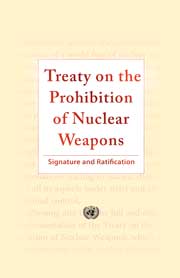
The TPNW prohibits the development, testing, stockpiling, use, and threats regarding the use of nuclear weapons.
The Australian chapter of the International Campaign to Abolish Nuclear Weapons (ICAN) noted that Albanese’s vocal support for achieving nuclear disarmament puts him in line with the majority of his constituents—while the U.S., as one of nine nuclear powers in the world, represents a small global minority.
According to an Ipsos poll taken in March, 76% of Australians support the country signing and ratifying the treaty, while only 6% are opposed.
Albanese has won praise from campaigners for his own anti-nuclear advocacy, with the prime minister recently telling The Australian that Russian President Vladimir Putin’s nuclear saber-rattling “has reminded the world that the existence of nuclear weapons is a threat to global security and the norms we had come to take for granted.”
“Nuclear weapons are the most destructive, inhumane, and indiscriminate weapons ever created,” Albanese said in 2018 as he introduced a motion to commit the Labour Party to supporting the TPNW. “Today we have an opportunity to take a step towards their elimination.”
Labour’s 2021 platform included a commitment to signing and ratifying the treaty “after taking account” of factors including the development of “an effective verification and enforcement architecture.”
Australia’s decision to change its voting position comes as the U.S. is planning to deploy nuclear-capable B-52 bombers to the country, where the weapons will be positioned close enough to strike China.
Gem Romuld, Australia director of ICAN, said in a statement that “it’s no surprise the U.S. doesn’t want Australia to join the ban treaty but it will have to respect our right to take a humanitarian stance against these weapons.”
“The majority of nations recognize that ‘nuclear deterrence’ is a dangerous theory that only perpetuates the nuclear threat and legitimizes the forever existence of nuclear weapons, an unacceptable prospect,” Romuld added.
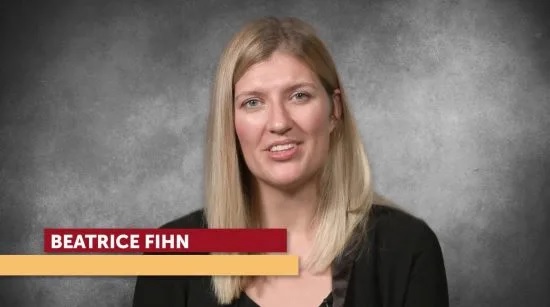
Beatrice Fihn, executive director of ICAN, called the U.S. embassy’s comments “so irresponsible.” “Using nuclear weapons is unacceptable, for Russia, for North Korea, and for the U.S., U.K., and all other states in the world,” said Fihn. “There are no ‘responsible’ nuclear armed states. These are weapons of mass destruction and Australia should sign the TPNW!”
1 This month
17 October, Free Public Talk on Nuclear Issues in South Australia
David Noonan will speak on public interest concerns over the new Roxby Downs Indenture Act 2026 on BHP copper-uranium mining and ore processing in SA, and on how AUKUS may face SA with a High-Level nuclear waste agenda.
Dr Jim Green will discuss international developments in the field of nuclear power including ‘small modular reactors’ and Generation 4 ‘advanced’ nuclear reactor concepts.


Help Aunty Sue Protect Her Land and Sacred Sites From Destructive Rocket Testing.
.

Australians deserve the truth
about
AUKUS – https://aukuspublicinquiry.com/

PETITION – To: Prime Minister Anthony Albanese and the Australian Labor Government

of the week – Australians for War Powers Reform (AWPR)
To see nuclear-related stories in greater depth and intensity

