French navy warns AUKUS nuclear submarine plan will be ‘much more difficult’ for Australia
By defence correspondent Andrew Greene. 29 July 22,
One of France’s most senior defence figures is warning Australia that acquiring nuclear submarines will be “much more difficult” than the now scrapped plan to build a new fleet of conventionally powered boats.
Key points:
- French military chief Nicolas Vaujour was in Sydney for talks with Australian and US military leaders at the high-powered defence conference
- Vice Admiral Vaujour says he was “surprised” at Australia’s decision to obtain nuclear-powered submarines
- France proposed the two countries organise joint naval training drills
As both nations look to reset relations following the diplomatic fallout from last year’s AUKUS announcement, the French military’s Chief of Operations of the Joint Staff is signalling a “new era” of cooperation involving more naval exercises and cooperation.
Vice Admiral Nicolas Vaujour has travelled to Sydney for talks with Australian Defence Force Chief General Angus Campbell and other military leaders at the high-powered Indo-Pacific Chiefs of Defence (CHODs) Conference………………………………
Fleet of nuclear submarines will be sent by Britain to Australia as a threat to China

- Britain is to send a fleet of nuclear submarines to Australia port of Perth
- Deployment is seen as a warning to China in the Asia-Pacific region
- Move is part of AUKUS (Australia, UK and United States) security alliance
https://www.dailymail.co.uk/news/article-11037405/Fleet-nuclear-submarines-sent-Britain-Australia-warning-China.html By DEFENCE EDITOR FOR THE DAILY MAIL, 22 July 2022,
Britain is to send a fleet of nuclear submarines to the Pacific in a decisive move to thwart Chinese aggression in the region.
The dramatic decision could see UK subs based in Australia until 2040, operating within striking distance of China.
Admiral Sir Tony Radakin, the head of the Armed Forces, will agree the arrangement at a naval conference in Sydney next week. Assigning submarines to patrol the South China Sea will be Britain’s most assertive move yet against Beijing.
According to reports in Australia, Royal Navy submarines would be based at Perth on the country’s western coast and Australian submariners would be incorporated into British crews to improve their skills.
Basing the Royal Navy boats thousands of miles from UK shores is part of the AUKUS (Australia, United Kingdom and United States) security alliance.
AUKUS was set up last year primarily to confront Chinese military expansionism in the Indo-Pacific. Australia has become embroiled in a trade war and diplomatic stand-off with China. The deepening of defence ties with the UK is likely to cause further outrage with the Communist regime, which is vehemently opposed to AUKUS.
The Royal Navy declined to say last night how many of its submarines could be relocated to Australia, as all operational details surrounding Britain’s sub-surface fleet are classified.
The ‘Pacific tilt’ was signalled last year as part of the MoD’s Integrated Review.
The review set the target for the UK to become ‘the European partner with the broadest and most integrated presence in the Indo-Pacific’.
But given that China possesses the world’s biggest navy, some questioned the merits of such a deployment, arguing Britain’s boats would be massively outnumbered and outgunned.
Last night the MoD said: ‘It is UK policy that we do not comment on matters relating to submarine activity or operations.’
Nancy Pelosi’s planned trip to Taiwan – ‘Unprecedented, foolish, dangerous’ -says former Australian Prime Minister
Due to the sensitivity of travelling to Taiwan – which neither America nor Australia officially recognises diplomatically, no serving president, vice president or prime minister has visited the democratic island of 24 million people.
Unprecedented, foolish, dangerous’: Keating attacks Pelosi’s planned trip to Taiwan, The Age, By Eryk Bagshaw. July 25, 2022,
Singapore: Former prime minister Paul Keating has accused US House Speaker Nancy Pelosi of inflaming tensions with Beijing and risking a military conflict by planning to visit Taiwan next month.
Pelosi, who sits behind President Joe Biden and Vice President Kamala Harris in American political seniority, would be the highest-level serving US official to visit Taiwan since the White House established diplomatic ties with Beijing in 1979.
Keating said in a statement on Monday evening that it was hard to imagine “a more reckless and provocative act”.
“Across the political spectrum, no observer of the cross-straits relationship between China and Taiwan doubts that such a visit by the Speaker of the American Congress may degenerate into military hostilities,” he said.
“If the situation is misjudged or mishandled, the outcome for the security, prosperity and order of the region and the world (and above all for Taiwan) would be catastrophic.”………………………
Keating has been critical of US and Australian policy toward Beijing, arguing that Taiwan’s future was a civil matter for China, and it was not “a vital Australian interest”. But that argument has been resisted by the Coalition, Labor and Taipei which have developed stronger unofficial ties in the past decade through trade offices, while officially maintaining Australia’s “one-China policy”.
Due to the sensitivity of travelling to Taiwan – which neither America nor Australia officially recognises diplomatically, no serving president, vice president or prime minister has visited the democratic island of 24 million people.
Biden last week publicly rebuked Pelosi’s plans for the trip. “The military thinks it is not a good idea right now,” he said.
Keating said a visit by Pelosi would be “unprecedented – foolish, dangerous and unnecessary to any cause other than her own”.
“Over decades, countries like the United States and Australia have taken the only realistic option available on cross-strait relations. We encourage both sides to manage the situation in a way that ensures that the outcome for a peaceful resolution is always available,” he said.
“But that requires a contribution from us – calm, clear and sensitive to the messages being sent. A visit by Pelosi would threaten to trash everything that has gone before.”
The Financial Times, which first reported Pelosi’s plans to travel to Taiwan last week, said the Biden administration had been warned privately by Chinese officials about a potential military response to her visit. Pelosi has not publicly confirmed her plans, despite members of Congress being invited to travel with her.
There has been no official comment from Taiwan’s President Tsai Ing-wen or Foreign Minister Joseph Wu since the potential visit by Pelosi was first reported, highlighting the sensitivity of the situation………….
https://www.theage.com.au/world/asia/unprecedented-foolish-dangerous-keating-attacks-pelosi-s-planned-trip-to-taiwan-20220725-p5b4g4.html
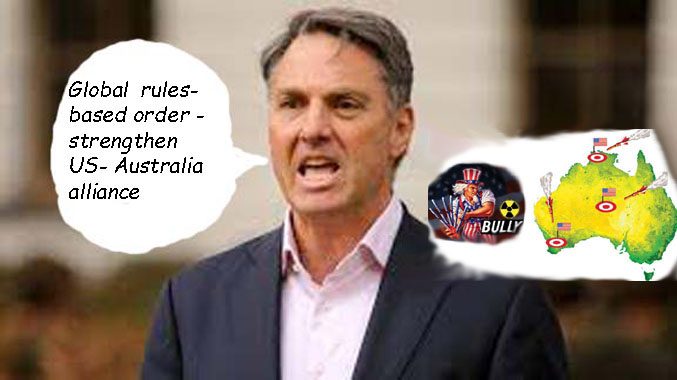
Defence Minister Richard Marles is confident about AUKUS, nuclear submarines, and non-proliferation of nuclear weapons. Not everyone is so sure
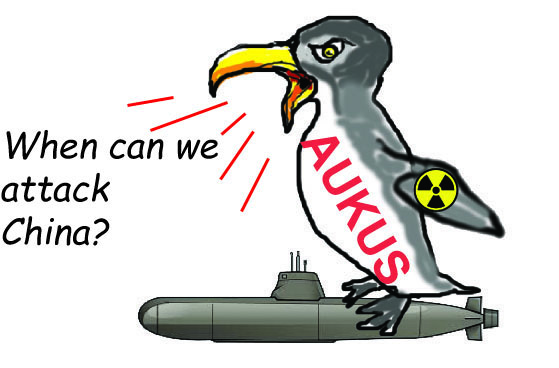
Australian National University emeritus professor of strategic studies Hugh White argues there are risks in making the AUKUS agreement at all.
In his new Quarterly Essay, Sleepwalk to War – Australia’s Unthinking Alliance with America, White warns it takes the alliance too far in the strategic contest with China.
Richard Marles on AUKUS nuclear safeguards , The Saturday Paper, By Karen Middleton. 23 Jul 22
” …………………………… “Non-proliferation was a condition of our support for AUKUS from the outset, when we were in opposition,” Marles says in an interview with The Saturday Paper, on his return from Washington, DC, this week.
While there, he discussed progress on the trilateral nuclear technology transfer agreement between Australia, Britain and the United States……..
The first non-nuclear country to seek nuclear-powered submarines, Australia will be required to sign a special International Atomic Energy Agency (IAEA) safeguards agreement. The document is likely to run to hundreds of pages, specifying in minute detail how the material will be handled – accounting for every gram – and with the tightest restrictions on its use. Amid some concern among international law specialists about exploiting existing treaty language around “peaceful use”, the wording will be designed to leave no wiggle room for more malign countries wanting to follow suit.
The greatest potential legal obstacles lie in the fact that the nuclear material is for use on a military platform. Australia’s lack of a nuclear power industry could be a reassurance, reducing the risk. Every aspect of the use and management of the enriched uranium – including in the event of an emergency – will need to be codified.
Marles says Labor’s party room will demand further assurances before consenting to move to the agreement’s next stage, which will involve the choice of future submarine design and how to resolve any capability gap in the meantime. He is confident the concerns can be addressed……………..
Navigating the non-proliferation safeguards with the IAEA is just one of the challenges for the new government in seeking to enact the monumental security agreement it has inherited.
Marles will not say if a Labor government would have taken the same decision as then prime minister Scott Morrison and his Defence minister Peter Dutton to dump the multibillion-dollar French contract for conventional submarines and switch to an American or British nuclear-powered option instead………………
“We have been supportive of the AUKUS agreement when it was announced, and we are supportive now.”
It’s clear that it wouldn’t have happened the same way, not least because of Labor’s volatile internal politics around nuclear energy.
In senior levels of the new government, there is a view that this is part of what motivated Morrison in pushing for the nuclear option to be sealed and announced with such haste. Some are convinced he believed it would wedge Labor on nuclear energy, an intergenerationally contentious issue within the party and particularly in Albanese’s Left faction.
……………….. in Labor’s upper ranks, suspicion about Morrison’s motivation raised further questions about the then prime minister’s attitude to national security.
Now in government, Labor is focused on bringing the wickedly complex submarine acquisition to completion and ensuring national security is not compromised any further along the way.
There’s a high pile of issues to be resolved before Australia has nuclear-powered submarines in the water. With the contract to buy up to 12 Attack-class submarines from France now scrapped in favour of the AUKUS agreement, the government has to decide whether to opt for the American Virginia-class boat or the British Astute-class alternative. While it hopes to get the first of whichever it chooses by the late 2030s, Marles has warned it could be the early 2040s.
That means filling the gap in the meantime.
With the existing six Collins-class submarines already extended from their initial retirement date of 2026 into the 2030s, there is a growing view in government that they will have to be extended again. What else may be required – in the form of some other possible stopgap purchase – is still unclear.
In an apparent bid to force Marles to clarify options, Peter Dutton wrote last month that he had planned to buy two American submarines to plug the capability gap. He said he had “formed a judgment that the Americans would have facilitated exactly that”.
The Saturday Paper understands that Dutton’s public commentary angered Britain, because of its presumption that Australia would choose the American option…………..
Just back from US consultations, Marles dismisses outright Dutton’s assertion about planning to buy two early American boats……………………
there are expensive decisions to be made with enormous consequences for Australia’s security.
By March next year, Marles wants to be able to announce which submarine he has chosen and when the first one will be in the water, quantify the capability gap and explain how it will be filled, outline the cost, describe industry arrangements for construction and detail the undertakings to be given to the IAEA to meet non-proliferation obligations. All this in the next eight months.
He has also vowed to produce a new force posture review in the wake of the 2020 Defence strategic update, which raised fresh questions about the strategic landscape in the region. …..
Delivering submarines makes AUKUS central to that. There is much debate on what else the agreement is meant to be and whether it makes Australia more or less dependent on the US.
In the AUKUS paperwork that has gone before the parliament so far, the submarine deal is described as its “first initiative”.
“AUKUS is about much more than submarines,” says Asia Society Australia executive director Richard Maude, who was foreign policy and security adviser to prime minister Julia Gillard and chief author of the 2017 Foreign Policy White Paper.
“AUKUS is a central platform for more co-operation and sharing of technologies that the Australian Defence Force wants.”
Maude says the issue is the nature of the submarines, not AUKUS. “The risk in AUKUS stems not from the agreement itself but from the decision to jump from a conventional to a nuclear-powered submarine.”
He points to concerning reports from the US that the Virginia-class submarine program’s production time line and costs are blowing out, raising further questions about delivery of an American boat.
“So, it’s not just our capability,” Maude says. “It’s our partner’s capability.”
Australian National University emeritus professor of strategic studies Hugh White argues there are risks in making the AUKUS agreement at all.
In his new Quarterly Essay, Sleepwalk to War – Australia’s Unthinking Alliance with America, White warns it takes the alliance too far in the strategic contest with China.
Maude says the issue is the nature of the submarines, not AUKUS. “The risk in AUKUS stems not from the agreement itself but from the decision to jump from a conventional to a nuclear-powered submarine.”
He points to concerning reports from the US that the Virginia-class submarine program’s production time line and costs are blowing out, raising further questions about delivery of an American boat.
“So, it’s not just our capability,” Maude says. “It’s our partner’s capability
Defence Minister Richard Marles downplays any broader binding role for AUKUS.
“AUKUS is not a security alliance. That’s not what it is,” he says. “Sharing capability and building technology – it doesn’t seek to be any more than that.”
Asked if it will mean an expansion of the US bases at Pine Gap or North West Cape, he would not comment…………………..
At the top of the decision pile for the “first initiative” is which submarine to buy. Neither the British nor the American version is exactly the right fit in size, crewing requirements or capability.
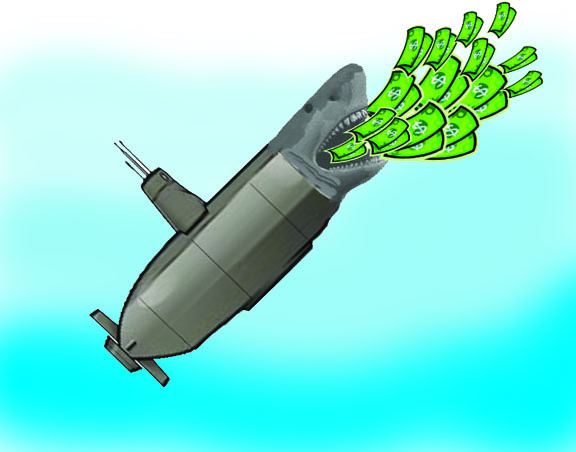
Whichever way they turn, the cost is horrendous at a time when the nation is a trillion dollars in debt…………………….
In Jakarta, there were assurances about respect, in the wake of Indonesian anger that it was not given an AUKUS heads-up. When AUKUS was announced last year, Indonesia said it intended at the next NPT review conference to seek to address what it calls the treaty’s “loophole” that would allow Australia to acquire nuclear-powered submarines. Dealing with nuclear weapons, proliferation and “peaceful use”, the NPT does not specifically go to the issue of nuclear-powered vessels. Rescheduled from January, the conference is in the US next month.
The new government has also had to reassure the nations of the Pacific.
At the recent Pacific Islands Forum, secretary-general Henry Puna, from Cook Islands, presented a report on the South Pacific nuclear treaty, known as the Treaty of Rarotonga, and “other nuclear issues”. The Saturday Paper asked the forum secretariat this week for a copy of the report but did not receive a response before time of press.
Ahead of the forum – and after a visit from Foreign Affairs Minister Penny Wong – Samoan Prime Minister Fiamē Naomi Mata’afa voiced the concerns of some Pacific countries that they were not consulted on AUKUS.
Dr Tess Newton Cain, project leader of the Pacific hub at Griffith University, says there is some unhappiness about a US pattern of using Australia as a diplomatic and defence conduit instead of approaching Pacific nations directly.
“Some of this reflects a belief in the US administration and the US policy community that a good way of understanding the Pacific is to listen to Australia and New Zealand,” Cain says. “From the Pacific side of things, that’s not necessarily how people would see it.”
Overlaying that, Pacific nations have a heightened sensitivity to nuclear matters. Having been the unhappy historical hosts of nuclear testing, they’ve had their own experience with the mushroom cloud. https://www.thesaturdaypaper.com.au/news/politics/2022/07/23/exclusive-richard-marles-aukus-nuclear-safeguards#mtr
AUKUS – contrived to foster the unrealistic and unattainable aims of American foreign policy

The wounded bison is thrashing about with its sole survival plan to wreck the China shop and it doesn’t care if it takes us with it. In fact, it is better to set Australia up as a primary target than Hawaii and the west coast of the US.

Anthony Albanese has not attempted to get his head around foreign relations, in particular China. He is stupidly relying on the people who advised Morrison. People like the head of ONI, the LNP favoured, Shearer and the US arms funded, ASPI. Neither should be allowed near a Labor government. They continue to push the LNP/AUKUS agenda.
https://johnmenadue.com/aukus-contrived-to-foster-the-unrealistic-and-unattainable-aims-of-american-foreign-policy/ By Bruce Haigh, Jul 20, 2022 ,
In all of my experience, AUKUS is the worst example of abuse within the so-called American alliance.
It is a prescription for failure and considerable loss of face for Australia amongst its neighbours, friends in the region and more widely spread friends and trading partners. In fact, the region has shown no support for the proposal and indicated disquiet.
Involvement with the US in the disastrous Vietnam, Iraq and Afghanistan wars should have given cause for thought, but no, a supine media, lack of debate within academic institutions and amongst what remains of an intellectual class has seen the AUKUS proposal gain ‘acceptance’ by politicians without so much as question or query. And this in the complete absence of planning detail and cost analysis.
There has been a lot of poppycock about acquiring nuclear submarines and of having them built in Australia with a lead time to delivery of 20 to 30 years. Only child politicians and their puerile advisers would be prepared to swallow such rubbish. The submarine deal was always a smokescreen to get US nuclear armed submarines based in Australia. The so-called deal was a sop to public opinion and for the moment it has worked with a China hating, US loving, Murdoch led MSM. Where is the sense in spending over $200 billion in the face of a one Trillion-dollar debt? The money would be far better spent on health, education and infrastructure.
AUKUS is nothing more than a US takeover of northern Australia as an operational base against China. Australia has rolled over and the new Minister for Defence, Marles, has gone so far as to offer full integration of the ADF into US force structures.
The most appalling defence acquisition program over 20 years has left Australia without a viable fighting force. Whose decision was it to buy the upgraded version of the Abrams tank? As an ex-tank man, I can say the decision is entirely without merit and smacks of lining US pockets at Australian taxpayer’s expense. The US has a history of foisting rubbish on the ADF, such as the F35, and Australia under leaders such as the toadying and incompetent, John Howard, of rolling over and accepting them.
Instead of weeks, which the US proposed, Labor was given just 24 hours to consider the AUKUS ‘proposal’ by the devious Morrison; it agreed in order to avoid a wedge in the face of the election. Anthony Albanese agreed to something that he knows nothing about. And to prove it he continues to grind on about nuclear submarines.
The Americans thought they were very clever in dragging the British in on the deal. Anyone but the arrant, arrogant and colonial Johnson would have demurred. The UK in AUKUS is unlikely to survive the departure of the incompetent Johnson. The British east of the Suez is the material for jokes. After Brexit they are much reduced and once the Queen dies their prestige will be on sale in second hand shops. The US made a mistake in dragging the UK in. They probably thought it would add some weight to their containment of China.
AUKUS is all about the US and its rivalry and competition with China. It wants to use what Australia has on offer, a base to confront, and when the time comes, to attack China. There is nothing in it for Australia. We are not threatened by China. It is and should remain a major trading partner.
The wounded bison is thrashing about with its sole survival plan to wreck the China shop and it doesn’t care if it takes us with it. In fact, it is better to set Australia up as a primary target than Hawaii and the west coast of the US.
Darwin will become the centre of a US centre monitoring (controlling) all sea and air movements in a wide zone embracing much of the north of Australia with what will be termed a joint operations command. Tindal is being expanded along with Stirling in order to take US arms and delivery vehicles.
The QUAD is a quad in name only. India with its strong ties to Russia was never in it beyond the extent of Modi’s ego. South Korea and Japan will always play their own game depending on who is in power in Washington and Beijing. NATO moving into the so-called Indo-Pacific is little more than a US induced wet dream on the part of Stoltenberg who has absorbed nothing of Nordic notions of social justice and dialogue. No doubt the US is pleased with the NATO announcement seeing further China containment as having been achieved.

Anthony Albanese fans the fires of AUKUS with incomprehensible talk of submarines and staying in step with allies but much more so with his inflammatory statements about China. Penny Wong has outdistanced her Coalition predecessor by leagues. She took on the very difficult task of rebuilding the relationship with China after the oafishness of Morrison and Payne over Wuhan and Covid. She is succeeding. She has deployed a nuance which is a pleasure to watch She has brought her considerable intelligence to bear. She has been subtle and tough minded. She is the person of the moment. Australia got what it needed.
Not so with Anthony Albanese. He has done his best to wreck Wong’s good work. He talks of the continuing danger posed by China, forgetting the AUKUS takeover. He says China has changed and we haven’t? What does he think Morrison did? He trashed twenty years of relationship building, including a most successful visit to Australia by Xi Jinping in November 2014. And he and Dutton banged the drums of war as an election ploy.
Anthony Albanese has not attempted to get his head around foreign relations, in particular China. He is stupidly relying on the people who advised Morrison. People like the head of ONI, the LNP favoured, Shearer and the US arms funded, ASPI. Neither should be allowed near a Labor government. They continue to push the LNP/AUKUS agenda.
Penny Wong is not in that camp, which is lucky for the rest of the country. Albanese must learn to do his own thinking and to find the courage to sack and distance himself from the pernicious influence of Morrison’s dangerous and undermining advisers.
Australia’s price tag for nuclear submarines could soar by $billions
AFR Andrew Tillett, Political correspondentJul 20, 2022
New US government reports warn that Australia could be saddled with billions of dollars of higher costs to build the most up-to-date nuclear submarines, and have cast fresh doubts on America’s defence industry being able to contribute to a speedy acquisition of boats.
Defence Minister Richard Marles wants to announce a preferred design and acquisition pathway in the first quarter of next year, but the Congressional Research Service said the US Navy’s Virginia class submarine program was suffering from construction delays and a maintenance backlog, curtailing the availability of boats already in service…………………………….. (subscribers only)
more https://www.afr.com/politics/federal/australia-s-price-tag-for-nuclear-submarines-could-soar-by-billions-20220719-p5b2p7
Global action urged to block AUKUS plan on transfer of nuclear materials

The submarine purchase, if realized, “will be the first time” after the Nuclear Non-Proliferation Treaty went into force in 1970 that nuclear weapon states transfer tons of weapons-grade nuclear materials to a non-nuclear-weapon state
The plan is high on the agenda of the 10th Review Conference of the Parties to the Treaty on the Non-Proliferation of Nuclear Weapons, which is scheduled to open in New York on Aug 1 http://global.chinadaily.com.cn/a/202207/21/WS62d898fda310fd2b29e6d83a.html By ZHANG YUNBI | CHINA DAILY | Updated: 2022-07-21,
A report written by leading Chinese nuclear security researchers urged the global community to use an upcoming global conference on nuclear nonproliferation to deter the collaboration of the United States and the United Kingdom to transfer weapons-grade nuclear materials through nuclear-powered submarines to Australia.
“The weapons-grade nuclear materials to be transferred to Australia by the two countries would be sufficient to build as many as 64 to 80 nuclear weapons,” said Zhao Xuelin, a leading engineer at the China Institute of Nuclear Industry Strategy.
Such a move would be in “serious violation” of the objectives and purpose of the nonproliferation treaty and would cause enormous harm, he said.
“Washington has been busy building up blocs and small circles like AUKUS to shore up its overwhelming advantage in military areas and secure its hegemony in the Asia-Pacific and the whole world,” said Liu Chong, director of the Institute of International Security of the China Institutes of Contemporary International Relations.
“Such moves have run counter to many countries’ need to seek common security. The trilateral bloc’s members seek their own security at the cost of the other countries, sabotaging global security,” he added.
Zhang Yan, president of the China Arms Control and Disarmament Association, noted that the AUKUS partnership is a new political and military alliance that serves the US’ “Indo-Pacific Strategy”, which aims to provoke regional confrontation and step up a geopolitical zero-sum game.
The submarine purchase, if realized, “will be the first time” after the Nuclear Non-Proliferation Treaty went into force in 1970 that nuclear weapon states transfer tons of weapons-grade nuclear materials to a non-nuclear-weapon state, Zhang said.
“The US, the UK and Australia should seriously respond to the concerns of the international community and earnestly fulfill their obligations under international law,” he added.
Pan Qilong, chairman of the China Institute of Nuclear Industry Strategy, said the AUKUS nuclear-powered submarine collaboration sets a dangerous example of illegal transfer of weapons-grade nuclear materials.
Such a “blatant act of nuclear proliferation” has triggered widespread concern and criticism from the international community, he added
The US, Britain and Australia should “stop taking double standards” and halt their collaboration on nuclear-powered submarines, said the research report issued on Wednesday in Beijing.
Two leading Chinese nuclear research agencies-the China Arms Control and Disarmament Association and the China Institute of Nuclear Industry Strategy-issued the report.
“The international community should take action to urge the AUKUS countries to revoke their wrong decision, and jointly safeguard the integrity, authority and effectiveness of the international nuclear nonproliferation regime,” the report said.
The research report is the first of its kind made by Chinese think tanks focused on the collaboration of the three nations, and it offers abundant evidence and data to prove how the AUKUS countries-Australia, the UK and the US-affect the international nuclear nonproliferation system and stir up the arms race, Foreign Ministry spokesman Wang Wenbin said on Wednesday.
The report is the latest proof that the international community’s concerns on AUKUS collaboration “are well-founded by facts”, he added.
Washington, London and Canberra built the AUKUS trilateral security partnership last year. That prompted anger within and outside the Asia-Pacific region as they announced a plan to allow Australia to purchase nuclear-powered submarines from the UK.
The plan is high on the agenda of the 10th Review Conference of the Parties to the Treaty on the Non-Proliferation of Nuclear Weapons, which is scheduled to open in New York on Aug 1.
The conference, a top-level global meeting that aims to prevent a nuclear arms race and checks on the status quo of nuclear materials around the world, has been delayed for two years due to the COVID-19 pandemic.
Documents show Australian Labor government supports Assange’s extradition to the US
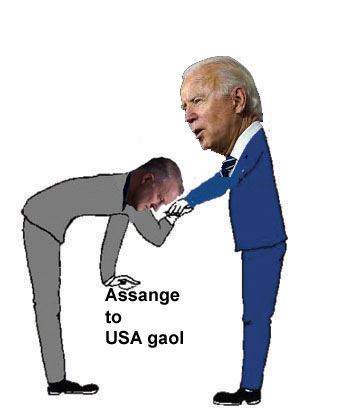
as far as the Labor government is concerned, Assange’s extradition is a done deal.
the greatest mistake defenders of Assange could make would be to harbour illusions that Labor will act to free the WikiLeaks founder.
as far as the Labor government is concerned, Assange’s extradition is a done deal.
the greatest mistake defenders of Assange could make would be to harbour illusions that Labor will act to free the WikiLeaks founder.
https://www.wsws.org/en/articles/2022/07/18/rqbf-j18.html Oscar Grenfell @Oscar_Grenfell, 18 July 22,
Documents obtained by lawyer Kellie Tranter and published on the Declassified Australia website cast a damning light on the Australian Labor government’s role in facilitating the continued imprisonment of WikiLeaks publisher Julian Assange and his extradition to the US.
The material gives the lie to the claims of Labor supporters that the newly-elected government may be seeking to secure Assange’s freedom through backroom diplomacy, despite the refusal of Labor ministers to condemn the attempted US extradition and prosecution.
They show that Labor is willing to let Assange be sent to the US, despite doctors and his family warning that it would be a death sentence. A successful extradition would also set a sweeping precedent for attacks on journalists and political dissidents globally.
Assange faces 17 charges under the Espionage Act, and 175 years imprisonment, for publishing true information exposing massive US-led war crimes in Iraq and Afghanistan.
Tranter, a longstanding legal advisor to Assange, has for many years filed freedom of information requests aimed at acquiring official documents revealing the role of Australian governments in the persecution of Assange. Those released by Declassified Australia are the first she has published since the Labor government was installed after the May 21 federal election.
The two documents are redacted. What is present, however, gives a sufficient picture of Labor’s acquiescence to Assange’s extradition, and the cynical, duplicitous character of the ambiguous public statements its leading representatives have made.
The first are internal “talking points” prepared for Attorney-General Mark Dreyfus on June 2. It is entitled: “Julian Assange – International Transfer of Prisoners process – talking points and background.” Its heading indicates the central preoccupation of the document, which states:
“Prisoner transfers cannot be agreed between governments in advance of a person being a prisoner (after a criminal trial, conviction and sentencing) in a particular country, and require the consent of the prisoner;
“International prisoner transfers to Australia are initiated by an application from a prisoner after the prisoner has been convicted and sentenced;
“If surrendered, convicted and sentenced in the US, Assange could apply under the ITP scheme to serve his sentence in Australia;”
In other words, Assange is to be extradited to the US, where the former Trump administration and the CIA plotted to kidnap or assassinate him from London in 2017, before settling on a pseudo-legal criminal indictment. He would be hauled before a kangaroo court in the District of Virginia, with a jury stacked by the very same CIA officers and their relatives. The hearings would proceed in secret and Assange’s detention regime would be one of total isolation.
With this hanging over his head, the document suggests that perhaps Assange will feel compelled to plead guilty to the “crime” of journalism revealing the illegal killings of civilians, torture and other violations of international law.
Tranter notes that following a redacted section, the document continues: “However, the UK High Court’s judgment does note that the US has provided an assurance that they will consent to Mr Assange being transferred to Australia to serve any custodial sentence on him if he is convicted.”
The US “assurances” are not worth the paper they are written on. Their sole aim was to overcome an earlier British court ruling, which found that Assange’s extradition would be “oppressive” because of his deep on-going health issues and the horrific conditions in which he would be held in a US prison.
The assurances, accepted by a British High Court as bona fide last October, asserted that Assange’s conditions of detention would not be as bad as his lawyers claimed. But those very assurances made plain that the intelligence agencies, including the CIA, would have complete control over the circumstances of Assange’s imprisonment, which could be changed at any time.
The second, June 8 document, is a “ministerial submission,” entitled “Julian Assange – extradition request from the United States to the United Kingdom.” It recommends that Dreyfus “note” the situation confronting Assange, in the lead up to an announcement by British Home Secretary Priti Patel on whether she would approve extradition. Several weeks later, Patel gave her green light.
The submission to Dreyfus bluntly stated: “The UK Home Secretary is due to make a final decision on Mr Assange’s extradition to the US by 20 June. Mr Assange will have one final avenue of appeal with the leave of the High Court, otherwise he must be extradited within 28 days of the Secretary of State’s decision.”
And again: “If Mr Assange is extradited, convicted and sentenced in the US, he may apply for transfer to Australia under the International Transfer of Prisoner’s Scheme. This will require the consent of the US and Australian authorities.
“The UK High Court’s judgment notes that the US has provided an assurance that it will consent to Mr Assange being transferred to Australia to serve any custodial sentence imposed on him if he is convicted.”
Later on, the document stated: “‘If Mr Assange is convicted and sentenced to imprisonment in the US, it will be possible for him to apply under the ITP scheme to serve the remainder of his sentence in Australia. A transfer would also require the consent of the US, the Australian Government (through you as Attorney-General), and the relevant minister in the state into whose prison Mr Assange would be transferring.
“In making any such decision, the department would provide you with advice on factors such as the extent to which the transfer would assist the prisoner’s rehabilitation, sentence enforcement, community safety and any relevant humanitarian considerations, in addition to any conditions of transfer required by the US.’”
In other words, as far as the Labor government is concerned, Assange’s extradition is a done deal.
Also striking is the fact that the documents do not countenance the possibility that he would be found “not guilty” in a US court. The entire thrust of the two documents is that the extradition and successful prosecution have already been stitched up, in a conspiracy involving the British government, the UK courts, the American authorities and the Labor administration.
Once Assange were in the US, moreover, the documents acknowledge that any “prison transfer” would be dependent upon the acquiescence of the American government whose President, Joe Biden, has previously branded Assange as a “high-tech terrorist.” A prison transfer, even in the unlikely event that it occurred, would mean years more of Assange’s incarceration, in Britain, the US and then Australia.
The contempt of the government for Assange is summed up by the reference to “factors such as the extent to which the transfer would assist the prisoner’s rehabilitation.” Assange does not need to be rehabilitated. He is a heroic journalist who has done a major service to humanity. It is the war criminals he has exposed who need to be placed in an institution.
Obviously it is unknown what is contained in the redacted section. It may deal with the elephant in the room, which is excluded from the rest of the documents. Assange’s doctors, lawyers and family have all testified that the WikiLeaks founder would take his life if he were to be extradited to the US. That judgment was effectively upheld by the British District Court, before it was overturned on the basis of the bogus US assurances.
All of the talk about “prison transfers” and the like is therefore window dressing for what would amount to a death sentence.
The documents reveal the sinister character of statements by Labor leaders, including Prime Minister Anthony Albanese, Foreign Minister Penny Wong and Dreyfus, that the Assange case has ‘gone on for too long,” and “needs to be brought to a close.” When asked by journalists, each has refused to elaborate on what this precisely means.
One thing that is entirely absent from the documents is any suggestion that Labor has so much as suggested the US government drop the charges against Assange and end the extradition proceedings. The continuation of the judicial frame-up and victimisation is taken as given.
The documents vindicate the warnings of the Socialist Equality Party that the greatest mistake defenders of Assange could make would be to harbour illusions that Labor will act to free the WikiLeaks founder.
The 2010-2013 Gillard Labor government initiated Australia’s collaboration with the persecution of Assange. Gillard slandered Assange by falsely claiming that he had broken Australian laws. Assange publicly accused Gillard and other senior ministers of secretly collaborating with the American state against him and other Australian citizens associated with WikiLeaks.
Those actions were bound up with the Gillard government’s full-throated support for the “pivot to Asia,” a vast military build-up aimed at preparing for an aggressive US-led war against China.
A decade on and the military preparations are far advanced. The new Labor government is functioning as an attack dog of the Biden administration throughout the region. Last week, during a visit to Washington, Defence Minister Richard Marles hailed the US-Australia alliance as “unbreakable,” as he outlined a further massive military-build up.
The documents confirm that the fight for Assange’s freedom requires a political struggle by the working class, the social constituency for democratic rights, against the Labor government and all of its defenders. A Labor government will only intervene diplomatically and legally to free Assange, if it is forced to do so by a mass movement from below.
China Reaffirms Support for ASEAN’s Nuclear Weapon-Free Zone
https://jakartaglobe.id/news/china-reaffirms-support-for-aseans-nuclear-weaponfree-zone BY :JAYANTY NADA SHOFA. JULY 11, 2022
Jakarta. China recently pledged to take its ties with ASEAN to greater heights, among others, by backing the Southeast Asian bloc’s nuclear-weapon-free treaty.
China reaffirmed its readiness to ink the protocol to the treaty when its senior diplomat Wang Yi visited the ASEAN Secretariat in Jakarta on Monday.
“We will continue to support ASEAN’s efforts in building a nuclear-weapon-free zone and reaffirm that China is ready to sign the protocol to the Treaty of Southeast Asia Nuclear-Weapon-Free Zone at any time,” Wang Yi said at the ASEAN Secretariat.
According to Wang Yi, over the past years, China has made several historic milestones in its ties with ASEAN, among others, in regard to the country’s support to help keep the Southeast Asian region free of nuclear arms.
“[China was] the first to publicly express its willingness to sign the protocol to the Southeast Asia nuclear-weapon-free zone,” Chinese Foreign Minister Wang Yi said.
In 1995, the ten ASEAN member states, including Indonesia, agreed to a nuclear weapons moratorium treaty known as the Bangkok Treaty.
The protocol for this treaty is open for signature by the five nuclear-weapon states recognized by the Non-Proliferation Treaty, namely China, France, the UK, the US, and Russia.
The protocol obliges its signatories not to use or threaten to use nuclear weapons within the zone or against any state party to the treaty. To date, none of the nuclear-weapon states has penned the protocol.
Chinese President Xi Jinping has pledged to sign the protocol as early as possible. Xi Jinping made this commitment at last year’s China-ASEAN Special Summit, which marked the 30th anniversary of dialogue relations between the two sides.
Why Australia’s Labor government refuses to defend Julian Assange

WSWS Oscar Grenfell@Oscar_Grenfell, 6 July 22, When the Labor Party scraped into office following the May 21 federal election, some supporters of Julian Assange voiced hopes that the new government would defend the WikiLeaks publisher because he is an Australian journalist and citizen undergoing persecution abroad.
The crudest and most thoughtless expression of these hopes came in the form of an update to a petition demanding that the Australian government act to free Assange. Over the course of almost three years, the petition has been signed by more than 730,000 people, and has served as an important focal point for the latent, mass support that exists for Assange.
But on July 4, the petition’s founder declared that it was no longer necessary to issue any demands on the Australian government. The sole evidence provided was that Labor Prime Minister Anthony Albanese had purportedly signed the petition, and that some members of the government have hinted that it may engage in “quiet diplomacy” on behalf of Assange. “Now that we confirm that the Prime Minister of Australia is one of us and together with all of our collective 731,000 Signatories to this petition we will together move forward with direct representations to the responsible Public Officers in both the USA and Britain,” the update declared.
It was necessary to “understand that the Australian Government does have a right to negotiate the matter of freedom of Julian Assange in the best way they see to secure his freedom… We do not intend to work against any action being taken in different ways by any individual Signatory”—i.e., Albanese.
“[W]e will move forward in a peaceful, harmonious and inclusive manner,” the update declared, that is with regards to the Labor government.
To be blunt, such statements are exercises in wilful delusion. Since forming government, Labor has not issued anything that even could be described as weasel-words in support of Assange. Its attitude towards the WikiLeaks publisher is barely concealed hostility.
The greatest mistake defenders of Assange could make would be to allow a right-wing pro-war Labor government to lead them around by the nose. Such a course would serve to demobilise the mass backing that Assange has among workers and young people, and create the political conditions required for Labor to bury his plight and ensure that extradition from Britain to the US proceeds without hindrance.
The petition update promoted the latest comments on Assange by a member of the government. In an Australian Broadcasting Corporation “Law Report” radio program on June 28, Labor’s Attorney-General Mark Dreyfus again stated that the Assange case had “gone on for too long.” It was this comment that was highlighted on the petition.
But what, of substance, did Dreyfus actually say?
Introducing the subject of Assange, midway through the interview, the host noted warnings that the attempted US prosecution of Assange would set a dangerous precedent of US law being imposed globally.
Assange, an Australian citizen, is facing prosecution in the US, for documents he published while in Europe, exposing American war crimes in Iraq and Afghanistan. Citing Assange legal advisor Greg Barns, the interviewer asked if Dreyfus was troubled by this attempt to extend the reach of American legislation to an Australian citizen with no legal connection to the US?
The attorney-general brushed the question aside. “The United States has long legislated in an extra-territorial way and I think that all other countries have understood that for a long time,” he said. In other words, the US government can do what it likes.
Dreyfus continued: “It is not open to the Australian government to directly interfere with either the jailing of Mr Assange in the United Kingdom or the extradition request that has been made by the United States.”
As with all other Labor ministers, Dreyfus presented Assange’s imprisonment and threatened extradition as a bona fide, lawful procedure. But Assange’s detention, in a maximum-security British prison, without conviction, has been denounced by outgoing United Nations Rapporteur Nils Melzer as state torture.
The US extradition effort is akin to a pseudo-legal lynching. Assange is to be imprisoned, for 175 years, under the draconian Espionage Act, for publishing true information revealing the illegal actions of the American government. Such an operation recalls dissidents being hurled into a dungeon cell, with the key thrown away, during medieval times.
Credible allegations are now on the public record, moreover, that the Trump administration and the CIA discussed kidnapping or assassinating Assange in 2017, before filing an indictment and an extradition request.
Dreyfus again made reference to the possibility of diplomatic representations on Assange’s behalf.
In a highly revealing exchange, the interviewer noted: “The government has said it would like to see this matter brought to an end, but hasn’t exactly said how it would prefer it to come to an end.” Would the government seek to have the charges against Assange dropped in the United States? she asked. “I am not going to canvas what will be the resolution of this case,” Dreyfus replied.
In other words, the attorney-general’s vague statements are worthless. Why would anyone believe that a government minister, who will not even state publicly that the charges against Assange should be dropped, would be fighting for his freedom behind closed doors?
Dreyfus’ vague references to “representations” are like a bone to a hungry dog, meant to placate Assange’s supporters, as is the cloak and dagger operation of Albanese possibly signing the petition.
The real position of Labor has been spelled out by two of its most prominent leaders, Foreign Minister Penny Wong and Defence Minister Richard Marles.
Marles stated last month: “This is a matter for the United Kingdom. Like any Australian citizen facing legal proceedings abroad, he will be provided consular assistance.”
The position is identical to that of the previous Liberal-National Coalition government. Consular support means monitoring the extradition case and the decline of Assange’s health. It is the antithesis of a diplomatic and political intervention to free Assange.
For his part, Albanese has sought to dodge the issue of Assange for the past six weeks. He refuses to mention the WikiLeaks founder’s name, even when directly questioned about the topic. The only passionate comments he has made on the case were in an angry denunciation of Twitter users calling on the Labor government to take action.
It is hardly a mystery why Labor refuses to defend Assange.
The primary focus of the new government has been a foreign policy blitz, orchestrated in the closest of collaboration with the Biden administration, which is seeking Assange’s extradition.
Wong and Albanese have been on one foreign visit after another, seeking to shore-up US dominance in the Indo-Pacific, and to further American imperialism’s confrontation with China, which threatens nuclear war.
The highpoint came last week, when Albanese attended the NATO summit in Madrid. There, he gave full support to a new NATO doctrine, which labels Russia and China as threats and calls on member states to prepare “for high-intensity, multi-domain warfighting against nuclear-armed peer-competitors.”
The persecution of Assange is retribution for his exposure of past war crimes. But it is also a preparation for new, and even greater crimes, associated with these US-led plans for what is nothing short of a global war. The aim is to intimidate the mass anti-war sentiment that exists among workers and young people, and to establish a precedent for further frame-ups and victimisations. The Labor government is fully committed to Washington’s war measures, so it is hostile to Assange. ………………………… https://www.wsws.org/en/articles/2022/07/07/isae-j07.html?fbclid=IwAR0KI1GXMtRjNi5gMnnDCcCiFsGuXMVqQKQcD1XNx2edJay1aEwTdLlSzmI
Jacinda Ardern says New Zealand’s no-nuclear line on AUKUS subs met with ‘understanding and appreciation’ in Australia

ABC NEWS, 7 July 22, New Zealand Prime Minister Jacinda Ardern has reaffirmed her country’s long-standing policy of not allowing nuclear-powered vessels in its waters, saying the rule was well understood in Australia.
Key points:
- Jacinda Ardern says New Zealand will continue to take a “strong, principled position” on its nuclear-free zone
- New Zealand banned ships with nuclear weapons and nuclear-powered vessels in its waters in 1987
- Ms Ardern says New Zealand’s defence policy would remain focused on the Pacific
Asked by 7.30 host Sarah Ferguson if there were “any circumstances” in which an Australian nuclear-propelled submarine might dock in a New Zealand port in the future, Ms Ardern said the policy was set.
“But, actually, you know, I’ve only ever encountered understanding and appreciation of that position,” she said.
“We’ve taken a strong, principled position and we’ll continue to do so. That doesn’t change the relationship we have with Australia or their understanding of our position.”
Ms Ardern has been in Australia this week for her second meeting with Prime Minister Anthony Albanese as well as meetings with state premiers………………………………….
A question of neutrality
Ms Ardern was also asked about a recent security pact struck between Solomon Islands and China, which some analysts warn could provide a pretext for the basing of Chinese troops or vessels in the Pacific Island nation.
The Solomon Islands government has repeatedly ruled out a military base.
…….. “We believe that escalation in our region and a militarisation in our region is not necessary, not called for, and not wanted. So we’re very clear on that.”
Asked if New Zealand would join Australia in increasing its defence capability in response to China’s military expansion, Ms Ardern said it was up to Australia to explain its own rationale for its defence strategy.
New Zealand’s defence policy would remain “Pacific-focused”, she said………………..
“It is not for New Zealand, or Australia, to dictate the relationships that Pacific Island neighbours have with others.”
She said China pursuing closer ties with Pacific Island nations was not a new phenomenon and that Solomon Islands had been on a “trajectory” of closer links with Beijing over a “number of years”. https://www.abc.net.au/news/2022-07-07/jacinda-ardern-new-zealand-nuclear-policy-met-with-understanding/101216094
Albanese’s extreme language against China is out of place now, and against Labor tradition
Even the hawkish former defence Minister Peter Dutton told National Press Club that he did not believe China wanted to occupy Australia. Why then do both sides of politics go out of their way to make an enemy of China. It is a recklessly provocative policy that could cause many Australians to die unnecessarily.
Albanese blasted China for not condemning Russia’s invasion of Ukraine but exempted India which did the same.
China has not been in major war since 1950. Nor has it killed anyone in the South China Sea or near Taiwan, where it is accused of behaving more aggressively. All major countries accept Taiwan is part of China.
What is Anthony Albanese up to! https://johnmenadue.com/what-is-anthony-albanese-up-to/ By Brian Toohey. Jul 6, 2022
Anthony Albanese has shown during his recent trip to Europe that he is a prime minister addicted to hyperbole and oblivious to how countries can change in unexpected ways.
He told NATO leaders China aimed to become the most powerful nation in the world and its strengthening relations with Moscow “posed a risk to all democratic nations”. It’s most unlikely all democratic countries will be at risk. For a start, Russia will be in no condition to go to war with any other country after its abhorrent decision to invade Ukraine. It could be bogged down for years in a guerrilla war. China faces a growing number of countries, including those in NATO, which are committed to containing its military and economic growth.
Albanese said in Europe that China is trying to “build up alliances to undermine what has historically been the Western Alliance in places like the Indo Pacific”. Historically, however, most Asian countries, including India and China, have been there a lot longer than the Western intruders are likely to last. The US may be the exceptional state. It annexed Hawaii in 1898 and made it an American state in 1959. But there is a plausible chance America will not remain a democracy in coming years. While nothing is certain, China may become a democracy sometime after a discredited President Xi is deposed or dies. If so, it is entirely feasible the public may elect a majority Communist government led by a moderate reformist. No one knows. Alternatively, the US may become an autocratic state with a feral Supreme Court while China remains an autocratic state with an unpopular and futile determination to achieve “Zero Covid”.
The story of other members of the Western alliance is one of momentous change. Britain took Hong Kong by force in 1842 as a base for peddling opium produced in India by the British East India Company. India won its independence from Britain in 1947 and Hong Kong was handed back to China in 1977. France had a cumulative 100 years as the colonial power in Indochina until booted out by the Viet Minh in 1953. However, it retained its colonial possessions in the Pacific Islands. Albanese told President Macron in Paris that France was an Indo Pacific power which could help contain China’s “growing ambitions” in the region.
Albanese told President Macron in Paris that France was an Indo Pacific power which could help contain China’s “growing ambitions” in the region.
Albanese blasted China for not condemning Russia’s invasion of Ukraine but exempted India which did the same. Labor’s Defence Minister Richard Marles earlier warmly praised India and said it is “central to Australia’s worldview and defence planning”. It also has a Hindu supremacist government that actively discriminates against Islamic members of the population.
While in Europe, Albanese falsely claimed that Australia always obeys the international rules. If it had, it would not have helped the US and the UK invade Iraq. The invasion killed or seriously injured large numbers of people and rendered even more homeless. It also allowed terrorist groups to operate in Iraq when none were present under Saddam Hussein. Albanese’s misleading assertion dishonours Labor’s leader at the time, Simon Crean, who opposed the invasion as a breach of the rules forbidding the use of military aggression in international relations.
Albanese caught the attention of his European audience when he complained that China had “economically coerced” Australia. A fuller picture would have acknowledged Australia officially took more than 100 anti-dumping complaints against China, despite usually frowning on such measures as potentially harming free trade. China eventually retaliated with tariffs and anti-dumping measures on some Australian exports to China. Albanese gives no sign that he understands China is not the only one who should back off.
China has not been in major war since 1950. Nor has it killed anyone in the South China Sea or near Taiwan, where it is accused of behaving more aggressively. All major countries accept Taiwan is part of China. Some of China’s opponents, including senior US Republican politicians, seem intent on goading it into using military force against Taiwan. Fortunately, Taiwanese leaders seem to understand that the island will not be attacked unless they declare independence. China could make this less likely by granting Taiwan a genuine status as autonomous region. One reason China won’t grant independence is this would make the island a convenient base to stage attacks against the mainland. Nevertheless, an experienced observer Geoff Raby says China won’t attack the island as this would involve the killing fellow ethnic Han Chinese which would be highly unpopular.
China makes claims to territorial waters in the South China Sea that other littoral countries also claim. The Pentagon acknowledges China withdrew six land claims to settle borders disputes. If it wants to be more accommodating, China could settle some of the extreme territorial sea claims that were originally made by the Communist Party’s political opponent, the Nationalist Party, before 1949. Taiwan also makes these claims. Ideally, China Sea could follow the Antarctic example and offer to turn South China Sea into a demilitarised zone beyond the 12 nautical mile offshore line.
There is no dispute that China is building up its armed forces. But its spending is no match for the US which is spends as much as the next nine countries together, including China. China has good reason to respond to a US military build up. In 2009, the US announced it had developed an Air/Sea Battle Plan for a war with China, to destroy much of its air and naval forces and blockade all its ports and maritime routes. The details have changed, but in 2011 the US also adopted a “pivot” to the Pacific with goal of deploying 60 per cent of its forces there. It is also actively engaged in building new bases on Pacific islands within striking distance of China while the Albanese government loudly opposes any hint that China might try to build naval base in the Pacific, or even in nearby Cambodia. US and Australian forces also constantly undertake surveillance missions close to China.
In these circumstances, it is vital to try to ease tensions on all sides to avoid what would be a terrible war. In the past, Labor would be among those urging support for new arms control agreements and expanding all channels for the potential combatants to talk. Ben Chifley, Bert Evatt, Gough Whitlam, Bill Hayden, Gareth Evans and Paul Keating all made significant efforts to actively promote peace. Anthony Albanese is supporting a large arms buildup, which is not the same thing.
Well before Albanese’s European trip, he stressed the Labor government would support the Coalition’s new security pact between Australia, the UK and the US (AUKUS). No one has given a convincing explanation for why we need AUKUS on top of the Australian New Zealand US (ANZUS) security treaty signed back in 1951.
The UK adds nothing of value. In 1968 the then Labour Prime Minister Harold Wilson announced that Britain would withdraw its military bases from “East of Aden”. This was a good policy reflecting the fact that Britain no longer ruled the waves. Wilson also refused to send British troops to the Vietnam war, partly because the country couldn’t afford it. Yet Britain retained its “special relationship” with the US. A subsequent government restored a military base in the Middle East, but now Boris Johnson, a disastrous prime minister, has given British military forces a role in confronting China in the Asia-Pacific.
Although the text of AUKUS has not been released, it states the US and UK are prepared to sell nuclear submarines to Australia. They would’ve done that without AUKUS. They would also have done so for other countries such as Japan, South Korea, Vietnam and Singapore, but they see more advantages in writing operating modern conventionally powered ones. NATO members without nuclear subs could buy them, but don’t because it doesn’t make military or financial sense. Yet Labor still wants buy eight nuclear subs, almost certainly from the US, so it can fire cruise missiles from nuclear submarines operating far from Australia into China. This is an extremely bad idea on both strategic and cost grounds. It will only provoke China which çan fire more missiles into Australia than Australia can fire into it. We could do more to defend Australia from closer to home with a mix of weapons at a much lower cost. Moreover when our nuclear submarine fires the first missile into China it will be detected and almost certainly sunk.
Plausible estimates put the cost of eight US nuclear submarines at $171 billion. (This is from a government that says it can’t afford to increase the miserable level of the New Start Allowance.) The risks of buying nuclear are on the upside, particularly as Australia wants to build them here.
The first submarine, probably a version of the US Virginia class attack ones, will not be operationally available until the early 2040s and the last by 2060. A leading US defence analyst Winslow Wheeler cautions that the Virginia class has maintenance problems and is not available for much of the time. He says that over 33 years they have only performed 15 six monthly deployments.
The former Senator Rex Patrick, an ex-submariner, says that conventionally powered submarines are now commonly equipped with air independent propulsion (AIP), which makes them quieter than nuclear submarines which have to keep their reactor cooling pumps going and use noisy big meshing gears between the steam turbines and propellers. Others point out that nuclear subs can be detected by their constant release of hot water; by leaving wakes on the surface when run at high speeds and by blue green lasers that will penetrate water by 2040.
Patrick says that figures given to the parliament show Australia could buy 20 modern off-the-shelf conventional submarines for $30 billion – not $171 billion for nuclear submarines that don’t meet our requirements.
Another downside of buying nuclear subs is that we would have to meet our obligations to declare any fissile material under our control to the International Atomic Energy Agency which acts on behalf of the Nuclear non-Proliferation Treaty (NPT). However, the US will refuse to give us the required information about the highly enriched, weapons grade uranium in the reactors.
A further problem is that several Pacific Island leaders don’t want Australia to buy nuclear submarines. Nor, as Foreign Minister Penny Wong discovered on her recent visit to Malaysia, do its leaders.
Australian public opinion does not unambiguously support Labor’s strategy. The latest Lowy Institute’s annual poll shows over 51 per cent believe Australia should remain neutral in a military conflict between China and the US.
Even the hawkish former defence Minister Peter Dutton told National Press Club that he did not believe China wanted to occupy Australia. Why then do both sides of politics go out of their way to make an enemy of China. It is a recklessly provocative policy that could cause many Australians to die unnecessarily.
AUKUS submarines: Beasts of nuclear proliferation
The AUKUS security partnership, announced last September by Australia, the United States and Britain, has muddied the pool of non-proliferation.
The precedent of permitting Australia to be the only non-nuclear weapons state with HEU-propelled technology is also seismic on another level.
For one thing, Article III of the NPT exempts naval reactors from nuclear safeguards, which threatens a pillar of the non-proliferation regime — limiting the production and use of highly enriched uranium (HEU) which can be used, in turn, to make nuclear weapons.
There will be nothing stopping China and Russia doing what the United States and Britain promise to do: proliferate naval reactor technology and long-range missiles with a nuclear capability.
https://www.greenleft.org.au/content/aukus-submarines-beasts-nuclear-proliferation Binoy Kampamrk, July 6, 2022, Issue 1352,
When faced with the option of acquiring nuclear technology, states have rarely refused. Since the splitting of the atom and the deployment of atomic weapons in war, the acquisition of a nuclear capacity has been a dream. Those who did acquire it, in turn, tried to restrict others from joining what has become, over the years, an exclusive club.
Members of this club engage in elaborate ceremonial claims that their nuclear weapons inventory will eventually be emptied. Non-nuclear weapons states allied to such powers go along with appearances, taking comfort that nuclear weapons states will offer them an umbrella of security.
This hypocrisy underlines such arrangements as the Treaty on the Non-Proliferation of Nuclear Weapons (NPT).
Central to the document is the discouragement of non-nuclear weapons states from weaponising nuclear technology, as long as members of the nuclear club pursue “good-faith” disarmament negotiations. While it is true to say that the NPT probably prevented a speedier, less infectious spread of the nuclear virus, it remains a constipated regime of imperfections that has only delayed proliferation.
Most tellingly of all, most non-nuclear weapon states have complied with their undertakings whereas nuclear weapons states have not: they have disregarded serious multilateral nuclear disarmament. Nor do they have an incentive to alter current arrangements, given that any changes to the NPT can only take place with the unanimous support of the three treaty depositories: Russia, Britain and the United States.
The NPT supporters pour scorn on alternative approaches to nuclear weapons, such as the Treaty on the Prohibition of Nuclear Weapons (TPNW), which held its first meeting of state parties in Vienna from June 21—23.
While the Anthony Albanese government sent Susan Templeman MP to the meeting as an observer, Canberra has remained consistently opposed to the TPNW as a threat to the accepted disarmament and NPT framework. Dated and spurious concepts, such as extended nuclear deterrence and the interoperability of Australian and US military systems, tend to be common justifications.
The AUKUS security partnership, announced last September by Australia, the United States and Britain, has muddied the pool of non-proliferation.
A central component of the agreement is a promise to share nuclear propulsion technology with Australia, thereby enabling it to acquire eight nuclear submarines, to supposedly be built in Adelaide.
While much of this is wishful thinking — Australia has no expertise in the field and will have to rely on expertise from the other two — the glaring problem with AUKUS is what it does to non-proliferation arrangements.
While former Prime Minister Scott Morrison said the agreement would comply with Australia’s own non-proliferation commitments, such confidence is misplaced.
For one thing, Article III of the NPT exempts naval reactors from nuclear safeguards, which threatens a pillar of the non-proliferation regime — limiting the production and use of highly enriched uranium (HEU) which can be used, in turn, to make nuclear weapons.
Non-proliferation experts have not been enthusiastic with the promised new Royal Australian Navy submarines. Daryl G Kimball, director of the Arms Control Association, noted the salient difference between deepening defence cooperation with allies on the one hand and proliferating “sensitive HEU nuclear propulsion tech in contravention of US and global nonpro principles”.
Hans Kristensen, director of the Nuclear Information Project at the Federation of American Scientists, greeted AUKUS with gloom when it was announced. Its provisions on nuclear technology would “further intensify the arms race in the region and the dynamics that fuel military competition”.
The International Atomic Energy Agency’s (IAEA) Director General Rafael Mariano Grossi is visiting Australia to discuss safeguards of nuclear material used for naval propulsion.
This is nothing short of problematic, given that IAEA inspectors are unable to inspect such material for extended periods of time when the vessel is at sea. Grossi described this process as “quite complex”, although he wants Australia to commit to non-proliferation alongside the acquisition of nuclear technology.
“There is a period of 18 months which was given by the three partners — the United States, United Kingdom and Australia — to define how the project is going to be implemented but, already we have started this interaction, this joint work of technical levels so that we can reconcile both things.”
Prior to Grossi’s visit, Foreign Minister Penny Wong reiterated Australia’s “longstanding” support of the “IAEA’s mission to harness the peaceful use of nuclear technology in areas like medicine, industrial processes and environmental monitoring, as well as upholding the international nuclear non-proliferation regime”.
The world Wong described is distinctly pre-AUKUS. Despite promises of “open and transparent engagement with the IAEA on nuclear safeguards”, the whinnying horse of proliferation has bolted from the stable. Assurances to avoid the future development of nuclear weapons capability in Australia or a national nuclear fuel cycle also ring hollow.
The precedent of permitting Australia to be the only non-nuclear weapons state with HEU-propelled technology is also seismic on another level.
There will be nothing stopping China and Russia doing what the United States and Britain promise to do: proliferate naval reactor technology and long-range missiles with a nuclear capability. [Dr Binoy Kampmark lectures at RMIT University.]
Julian Assange files new appeal fighting extradition to US.
Washington Examiner. by Ryan King, Breaking News Reporter, July 01, 2022
WikiLeaks founder Julian Assange is appealing the United Kingdom’s order to extradite him to the United States.
Two appeals were filed in the High Court of Justice in London to challenge the extradition, and the court will decide whether to evaluate the case, Assange’s attorney Gareth Peirce announced, according to the Wall Street Journal……………………………………
Friday was the deadline for Assange to appeal the extradition order, according to the BBC. He is being held at Belmarsh prison in London.
His lawyers claimed that he could face up to 175 years behind bars if he stands trial in the U.S., but the U.S. argued he will likely face between four and six years.
A myriad of groups championing freedom of the press urged the U.K. not to extradite Assange, arguing that doing so could set a bad precedent and hamper press freedoms in the future. For example, the International Federation of Journalists has expressed concerns the move could pose a “chilling effect” on journalists worldwide.
“The US pursuit of Assange against the public’s right to know poses a grave threat to the Fundamental tenets of democracy, which are becoming increasingly fragile worldwide,” the group said. “Irrespective of personal views on Assange, his extradition will have a chilling effect, with all journalists and media workers at risk.”
“The case sets a dangerous precedent that members of the media, in any country, can now be targeted by governments, anywhere in the world, to answer for publishing information in the public interest,” the group added.https://www.washingtonexaminer.com/policy/courts/julian-assange-files-appeal-fighting-extradition
Mr Albanese goes to Madrid: Australia on the alliance path to Global Nato
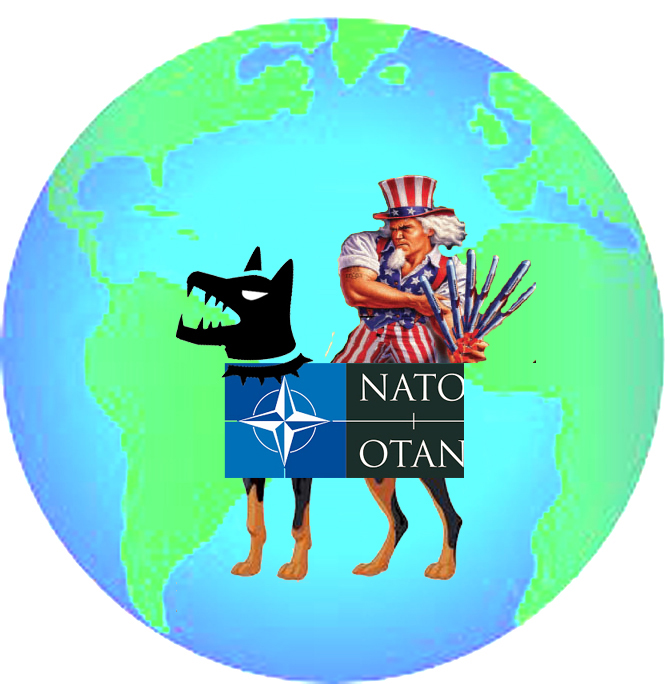
Albanese’s trip to the leaders’ summit of a US-dominated alliance centred on the other side of the world will prepare the way for deeper Australian integration into a broadened Nato.
Above all, in one respect Mr Albanese’s rush to Madrid is not so different from his predecessor’s cajoling of Washington and London to help out a mate with the anachronistic PR nonsense of AUKUS and the gift horse of a ‘privileged’ offer to allow Australia to buy massively expensive American or conceivably British nuclear-powered submarines.
https://johnmenadue.com/mr-albanese-goes-to-madrid-australia-on-the-alliance-path-to-global-nato/ By Richard TanterJun 30, 2022, While most eyes rest on the remains of Scott Morrison’s failed attempt at a khaki election through last September’s announcement of a backward-looking AUKUS alliance, prime minister Anthony Albanese’s trip to Madrid for the North Atlantic Treaty Organisation summit points to a much more significant shift in Australia’s alliance with the United States – ‘a global alliance of democracies’, aka Global NATO.
Scott Morrison’s AUKUS centring on agreement with the US and UK to provide Australia with submarine nuclear propulsion evoked derision about its back to the 1950s strategic vision and despair about what promises to be the worst and most consequential of Australia’s numerous recent politically-driven defence procurement choices.
The submarines debacle apart, AUKUS for the most part remains a matter of two or three lines of unpromising promises in media releases, largely dealing with matters already the subject of bilateral agreements or dimly-seen possible futures like quantum computing for defence purposes.
The most recent, if somewhat limp, nudge to keep the Albanese government on the nuclear submarine track came at the National Press Club when the Lowy Institute’s Michael Fullilove mocked an informed questioner concerned about the deal’s implications for the tattered nuclear Non-Proliferation Treaty. This widely-held worry – if first Australia, then serious nuclear weapon-wannabes Brazil and South Korea – was in fact unimportant Fullilove replied, since experts such as former Foreign Minister Gareth Evans have assured us are under control.
At the same time the US has just added its confidence booster to this process with a bill before Congress for an Australia-U.S. Submarine Officer Pipeline Act that would allow two RAN submariners a year to attend a seven-week nuclear reactor training, take the US Navy’s Submarine Officer Basic Course, and then deploy aboard a US nuclear-powered submarine.
This only leaves the imponderables of deciding the strategic rationale of the mission to which the submarines are to be solution, the actual technical requirements that would be entailed by that mission, the design of the submarine, the choice of country and lead contractors for the build, the development of a full-scale naval nuclear-engineering safety and maintenance regime, and a brief discussion of the lifetime costs likely to be more than a couple of multiples of the $100 billion estimate for the French submarines.
What could possibly go wrong?
And that’s before any discussion of opportunity costs – even for alternative contenders for defence spending, let alone meeting non-military requirements for a secure Australia – of the lifetime costs of a commitment to nuclear submarines that are likely to move towards the half trillion dollar mark.
But Albanese’s trip to the leaders’ summit of a US-dominated alliance centred on the other side of the world will prepare the way for deeper Australian integration into a broadened Nato.
For over a decade US and Nato officials and Australian defence advisors have been calling for ‘a global alliance of democracies’. The Australian prime minister, together with the leaders of Nato’s other ‘Asia-Pacific partners’ from Japan, New Zealand and South Korea, will participate in the launch of the first formal iteration of Global Nato with Nato’s Strategic Concept 2022.
Two decades of high tempo deployment of Australian military under Nato auspices in the disastrous wars in Afghanistan and the Middle East have conditioned the Australian Defence Force to close operational coordination and interoperability with US-led Nato ground, air, and naval forces.
Defence planners have gradually integrated Nato into high-level Australian strategic planning, first as an ‘Asian partner’ Nato along with Japan, South Korea and New Zealand, and recently as an ‘Enhanced Strategic Partner’.
Nato’s centrality to the hyper-multinational International Security Assistance Force in Afghanistan provided the first and possibly most important Australian escalator into Nato.
While replete with consequences as lethal for the people of Afghanistan as they were dysfunctional for all of the alliance militaries involved, ISAF, together with the parallel US-orchestrated Combined Maritime Forces in the western Indian Ocean from 2002, provided deep operational experience and ‘learnings’ for a Nato-centred US-led coalition on a scale approaching a multilateral ‘global’ presence.
Nato’s Strategic Concept 2022 is to be formalised at the Madrid Summit, representing a maturation of US post-Cold War planning for a major step towards an integrated global defence alliance after seventy years of US-dominated Nato in Europe and the limitations of bilateral hub-and-spokes alliances in Asia.
Most importantly, apart from integrating its Asian partners more closely, the new Strategic Concept is to prepare Nato ‘against all threats, from all directions’.
Full membership of Nato for any of these Asian partners will be a long way off, not least because the governing institutions of a now 30 member country nuclear alliance will need adjustment, even assuming there is no uncomfortable internal opposition as Turkey has mounted against the admission of Sweden.
For the present, Australia, Japan and Korea – and possibly New Zealand – will be drawn into Nato’s seemingly endless rounds of political, diplomatic, military and civil society consultations (though the last is in practice a most attenuated and selective grouping of actual national and international civil society).
US-led military interoperability drives will be coupled with injunctions for closer political and strategic planning coordination between Canberra and Brussels (aka Washington).
But there can be little doubt of the ultimate goal for Washington in the construction of ‘an alliance of democracies’ with global reach.
The follies of AUKUS distract attention from the scale of the quiet achievement of the United States in rescuing Nato from post-Cold War obsolescence, latterly assisted greatly by the Russian war against Ukraine.
Drawing the line from Kyiv to Taipei, ‘we know’, the Prime Minister said, ‘that there is an alliance that has been reached as well between Russia and China. There are implications for our region, given the strategic competition that is in our region, which is why this Nato summit comes at such a critical time’.
As Mr Albanese rightly put it Russia’s ‘brutal invasion is against the rule of law’, and carries implications for ‘all of those who cherish democracy, who cherish the rule of law, and who cherish the rights of nations to be sovereign’.
Yet Australia needs to tread carefully.
The warm glow of rhetorical solidarity with Ukraine facing World War 2-scale Russian attack tends to veil the fact that multiple US-auspiced Nato interventions in the Middle East, North Africa and Afghanistan have led, via great destruction, to evident defeat or specious ‘mission accomplished’.
Moreover the list of Nato members and partners does not provide an unsullied list of countries honoured for their respect for democracy, rule of law, or sovereignty.
Mr Albanese might like to chat about the rule of law with Victor Orbán from Hungary or Recep Tayyip Erdoğan from Turkey, or indeed with Boris Johnson – or mull over the battered state of American democracy with Joe Biden.
Perhaps a stopover by his RAAF plane in Diego Garcia might prompt some thoughts about British respect for the rule of law – in certain respects, such as the forced dispossession of the indigenous Chagos Islanders to make way for a giant US military base often used by Australia, more egregious than China’s violations of international law somewhat further east.
Above all, in one respect Mr Albanese’s rush to Madrid is not so different from his predecessor’s cajoling of Washington and London to help out a mate with the anachronistic PR nonsense of AUKUS and the gift horse of a ‘privileged’ offer to allow Australia to buy massively expensive American or conceivably British nuclear-powered submarines.
By all means, let us make common cause with governments we find congenial – when our interests do in fact genuinely align. Defence coordination and cooperation with democratic states in our principal areas of strategic interest is a must for Australia. The problem is that Europe is not such an area, and neither was the Middle East, Afghanistan, nor Nato’s latest fronts in North Africa and the Sahel.
Thinking about an alliance of democracies is not inherently foolish. The problem comes when the form of periodic elections is confused with the substance of democracy. It may seem carping to point to the Orbans and Erdoğans of Nato, but with Marine Le Pen possibly just one more election away from the Elysée, the authoritarian threat in Europe is palpably real.
Remarking on a British prime minister’s announced willingness to trash international agreements for political gain at the risk of re-starting a war in Northern Ireland may seem unoriginal, it is scarcely beside the point with talk of new alliances built on rule of law.
Most seriously of all, we should be talking about the risk of a precipitous decline, or even collapse, of democracy in the United States extremely seriously. Appalling as it is, the Supreme Court decision abolishing US women’s rights to control their bodies is but the latest blow to the unexamined claim for the United States to still be called a global model of democracy.
The view in Canberra seems to be that the US alliance has survived the threat of Trump, so it’s back to business as usual, and onward to ever closer union – with the path leading now through Brussels. Yet the dangers to Australia from unconsidered reliance on a country with both systemic dysfunction and deep anti-democratic impulses at its heart should not be ignored.
The common element between the swooning Australian interest in Global Nato and the Morrison fiasco with AUKUS and the manifold problems of its submarine element is that in both cases a considered assessment of whether Australian national interests align with those of the United States – in this case in the guise of Nato – is absent.
The new Australian foreign minister has started a commendable reset of Australian regional relations in an effort to recover, at least as a start, from the wreckage of a decade of coalition policy.
In a series of important statements on foreign policy in recent years Penny Wong eloquently has made the case for understanding that a proper consideration of our national interest cannot be separated from the long and sometimes difficult process of working out who we are.
Interests very largely flow from identity, especially when it comes to reading a map of threats and opportunities. Why then would the first foreign policy ventures of a new prime minister be tied to an alliance with the other side of the world – for Australia, the old world?
1 This month
17 October, Free Public Talk on Nuclear Issues in South Australia
David Noonan will speak on public interest concerns over the new Roxby Downs Indenture Act 2026 on BHP copper-uranium mining and ore processing in SA, and on how AUKUS may face SA with a High-Level nuclear waste agenda.
Dr Jim Green will discuss international developments in the field of nuclear power including ‘small modular reactors’ and Generation 4 ‘advanced’ nuclear reactor concepts.


Help Aunty Sue Protect Her Land and Sacred Sites From Destructive Rocket Testing.
.

Australians deserve the truth
about
AUKUS – https://aukuspublicinquiry.com/

PETITION – To: Prime Minister Anthony Albanese and the Australian Labor Government

of the week – Australians for War Powers Reform (AWPR)
To see nuclear-related stories in greater depth and intensity

