Aukus plan to expedite Australia’s nuclear sub construction an act of nuclear proliferation under ‘naval nuclear propulsion’ cover: Chinese mission to UN.
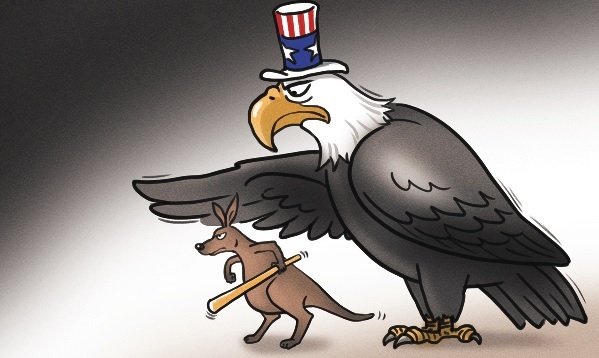
https://www.globaltimes.cn/page/202209/1276076.shtml By Leng Shumei and Hu Yuwei , Sep 26, 2022 , The Chinese mission to the UN in Vienna warned in an exclusive statement sent to the Global Times on Sunday that the latest move by AUKUS to plan to expedite Australia’s nuclear submarine construction is a blatant defiance of and trampling on the international nuclear non-proliferation system, and is an act of nuclear proliferation under the pretext of “naval nuclear propulsion.”
A spokesperson of the Chinese mission to the UN and other international organizations in Vienna made the comment after leaders of the US, UK and Australia said on Friday marking the one-year anniversary of the AUKUS security pact that they have made “significant progress” toward Australia acquiring a nuclear-powered submarine.
In disregard of the serious concerns of the international community on the trilateral nuclear submarine deal, the US is insisting on and even making reckless remarks about accelerating the deal, which is a blatant defiance of and trampling on the international nuclear non-proliferation system, the spokesperson told the Global Times in the statement.
China has repeatedly pointed out that the nuclear submarine deal among the three countries violates the Treaty on the Non-Proliferation of Nuclear Weapons (NPT), the IAEA Comprehensive Safeguards Agreement (CSA) and Additional Protocols (AP). It is an act of nuclear proliferation under the pretext of “naval nuclear propulsion,” the statement noted.
The US regards China as an “imaginary enemy.” The act of inciting Indo-Pacific competition seriously undermines regional peace and stability, which shows that the US has a wrong understanding of China, of the world and of itself, it said.
We hope that the US side will abandon the Cold War mentality, abandon the use of nuclear submarine cooperation among the three countries to contain China, abandon the trampling of international rules for geopolitical purposes, and work with China to implement the important consensus of the two heads of state, and practice mutual respect, peaceful coexistence, win-win cooperation, and shoulder the responsibility of a major country, read the statement.
Leaders of the US, UK and Australia said in a statement on Friday “We are steadfast in our commitment to Australia acquiring this capability at the earliest possible date,” according to Reuters.
The Biden administration is exploring an arrangement to expedite Australia’s acquisition of nuclear-powered submarines to respond to China’s growing military might by producing the first few submarines in the US, The Wall Street Journal reported on Saturday, citing some Western officials.
The idea is to provide Australia with an initial nuclear-powered fleet by the mid-2030s, while a longer-term effort is under way to give Australia the capability to produce nuclear-power submarines at home, according to The Wall Street Journal.
Chinese experts warned that Australia should also be alert that it is sleepwalking into a US trap to serve as the latter’s pawn in the US’ strategy against China. But they also believed that it would not be easy to implement the plan given the lack of spare shipbuilding capacity in the US and in Britain.
In August, the US admiral in charge of building new Columbia-class ballistic missile submarines said producing nuclear-power subs for Australia would interfere with the US’ efforts to build its own submarines unless a major effort was made to expand the American industrial base, according to the Wall Street Journal.
It is questionable how feasible the plan actually is, Chen Hong, president of the Chinese Association of Australian Studies and director of the Australian Studies Centre at East China Normal University, told the Global Times on Sunday.
The nuclear-powered submarine deal under AUKUS is a blatant, irresponsible act of nuclear proliferation, and once again proves that AUKUS countries are practicing a “double standard” on nuclear non-proliferation and using the deal as a tool for geopolitical gamesmanship, Ambassador Wang Qun, China’s Permanent Representative to the United Nations in Vienna, told the Global Times in a recent exclusive interview.
Song Zongping, a Chinese TV commentator, warned it is already a fact that the US is dedicated to nuclear weapons proliferation.
But more importantly, the US is pushing its frontier against China to Australia by weaponizing Australia with nuclear submarines. The Australia’s nuclear-submarine fleet would be a squadron of and be controlled by the US, Song noted.
In the Friday statement, the AUKUS leaders – US President Joe Biden, UK Prime Minister Liz Truss and Australian Prime Minister Anthony Albanese – also said they had made “significant strides” in other areas, including hypersonic weapons, cyber, electronic warfare capabilities and additional undersea capabilities, according to Reuters.
Chen warned that by enhancing cooperation under AUKUS in these aspects, Australia does not understand that it is actually sleepwalking into a trap to serve as a pawn for the US’ strategy against China.
Currently, the nuclear-powered submarine deal under AUKUS attracts the most attention, but cooperation under AUKUS is far more complex as the organization’s long-term strategic aim is to contain China’s development, Chen noted.
Australia is being pushed into the teeth of the storm in the US’ strategy against China. It should be on high alert that it probably is sacrificing its own national security for other countries’ national interests, Chen warned.
China, and others, see the International Atomic Energy Agency as biased in supporting AUKUS nuclear submarines plan

Ed note. My problem with the IAEA is that it is NOT an impartial body, on matters nuclear
China accuses IAEA of issuing a ‘lopsided’ report on AUKUS nuclear submarines plan, more https://www.abc.net.au/news/2022-09-14/china-iaea-lopsided-aukus-nuclear-submarines-report/101441254 By foreign affairs reporter Stephen Dziedzic 15 Sept 22
China’s Foreign Affairs Ministry has launched a furious attack on the UN nuclear watchdog over AUKUS, accusing the International Atomic Energy Agency (IAEA) of issuing a “lopsided” report about Australia’s plan to build nuclear submarines while ignoring widespread concerns about its ramifications for non-proliferation.
Key points:
- The IAEA issued a report to member states which said it was “satisfied with the level of engagement” from Australia, the UK and US
- A Chinese Foreign Ministry spokeswoman slammed the report, saying China was “gravely concerned about the substance” of it
- China has lobbied against AUKUS accusing the three countries of undermining the non-proliferation treaty
Last week the IAEA sent member states a confidential report on Australia’s move to develop the submarines drawing on nuclear submarine technology provided by the United States and the United Kingdom.
China has lobbied relentlessly against the deal in international forums, accusing the three countries of undermining the non-proliferation treaty and fuelling a regional arms race.
However Reuters reported last Friday that the IAEA issued a confidential report to member states which said it was “satisfied with the level of engagement” with the agency from all three nations so far.
Earlier this week the IAEA Director General Rafael Grossi struck a similar tone while addressing the agency’s Board of Governors, saying the Secretariat had held four “technical meetings” with the three AUKUS members so far and suggesting it was comfortable with the way they were handling the matter.
But on Tuesday Chinese Foreign Ministry spokeswoman Mao Ning slammed the report, saying China was “gravely concerned about the substance.”
“This report lopsidedly cited the account given by the US, the UK and Australia to explain away what they have done, but made no mention of the international community’s major concerns over the risk of nuclear proliferation that may arise from the AUKUS nuclear submarine cooperation,” she said.
“The report turns a blind eye to many countries’ solemn position that the AUKUS cooperation violates the purpose and object of the NPT.”
IAEA report finds AUKUS non-proliferation risks ‘limited’
While China has repeatedly attacked Australia, the United States and the United Kingdom over the agreement, this is the first time it has publicly excoriated the IAEA over the matter.
US and Australian officials have privately accused Beijing of gross hypocrisy over its public attacks on AUKUS, pointing out that China has been rapidly developing its own fleet of nuclear powered submarines — including submarines capable of launching nuclear weapons.
But nuclear non-proliferation advocates have also raised serious concerns about AUKUS, suggesting that it will establish a dangerous precedent by allowing a non-nuclear state to acquire nuclear propulsion technology for the first time.
Indonesian diplomats have also repeatedly made it clear they’re uneasy about the plan, and the country’s foreign ministry recently claimed recently that it won widespread support at the United Nations nuclear non-proliferation review conference for its plan to monitor nuclear material in submarines more closely.
Reuters reported last week that the IAEA report acknowledged Australia’s argument that the non-proliferation risks posed by AUKUS were limited because it would only be provided with “complete, welded” nuclear power units which would make removing nuclear material “extremely difficult.”
It reportedly also said the material within the units could not be used in nuclear weapons without chemical processing which requires facilities which Australia does not have and will not seek..
Aw gee shucks – Australia can be IMPORTANT if we lead USA’s attacks with our AUKUS submarines !

Marles said nuclear subs would make “the rest of the world take us seriously”,
Final design and cost of Australia’s nuclear submarines to be known in early 2023, Defence minister Richard Marles links the cutting-edge technology to Australia’s economic and trade success
Guardian, Josh Butler, Thu 15 Sep 2022 The defence minister, Richard Marles, says Australia’s pathway to acquiring nuclear submarines is “taking shape”, flagging key decisions within months about which ship to use, how to build it and boosting the country’s defence-industrial capability.
On the first anniversary of the Aukus pact, Marles said nuclear subs would make “the rest of the world take us seriously”, linking the cutting-edge technology to Australia’s economic and trade success.
Final design and cost of Australia’s nuclear submarines to be known in early 2023
Defence minister Richard Marles links the cutting-edge technology to Australia’s economic and trade success…………………………….
On the first anniversary of the Aukus pact, Marles said nuclear subs would make “the rest of the world take us seriously”, linking the cutting-edge technology to Australia’s economic and trade success.
“The optimal pathway is taking shape. We can now begin to see it,” he said. “With Aukus there’s a really huge opportunity beyond submarines of pursuing a greater and more ambitious agenda.”……..
Marles, also the deputy prime minister, said the first steps toward acquisition of nuclear submarines were on track. In a briefing call with journalists this week, he said the current timeline had Australia slated to make initial announcements in the first part of 2023.
The government plans to give answers to five questions by that time: the final design; when it can be acquired; what capability gap that timeline will create and solutions to plug it; the cost; and how Australia’s plans comply with nuclear non-proliferation obligations.
The government is said to be choosing between building American or British ships, or some hybrid. Marles said the government was not ready to announce which type of submarines would be built but hinted Australia’s design could be “trilateral” in nature………..
In a press conference with Marles in the UK earlier this month, the British defence secretary, Ben Wallace, said future submarine designs may see a combination of British, American and Australian components.
“We are on to our next design and our new one and that might well be fully shared with all three nations as a collaborative design,” he said.
The cost of the submarine program is not yet known but is expected to be in the tens of billions. Marles linked the Aukus arrangement not only to military but economic security, saying a boosted submarine fleet would protect freedom of navigation through vital shipping routes.
“We need a highly capable defence force which has the rest of the world take us seriously and enables us to do all the normal peaceful activities that are so important for our economy,” he said………

V Adm Jonathan Mead, the chair of the nuclear submarine taskforce, also spoke of protecting “sea lanes” on the call.
Mead said the navy was investigating workforce challenges, such as how to build and crew the ships – which may involve placing Australian staff in British and American nuclear schools or agencies, laboratories and shipyards
“The exchange of these personnel will be both ways and won’t just involve our submariners,” he said.
Facilities to build and maintain the submarines in Australia are part of the equation. Defence this year pinpointed Brisbane, Newcastle and Port Kembla as possible sites for an east coast nuclear base and consultation with those communities is said to be in its early stages.
Marles also spoke of building Australia’s defence-industrial capability on the back of the nuclear process…………………..“We hope Aukus can help develop a genuinely seamless defence industrial base across the US, the UK and Australia.”…………………….
A report from the Australian Strategic Policy Institute (Aspi), released on Thursday, recommended further investment in other Aukus streams like hypersonic missiles and artificial intelligence technology, to help plug a capability gap while the submarines are built………..
Such short-term investment may force government to make “difficult choices and trade-offs” in its defence strategic review, also slated for March, Aspi said. https://www.theguardian.com/australia-news/2022/sep/15/final-design-and-cost-of-australias-nuclear-submarines-to-be-known-in-early-2023
Australia needs a non-nuclear submarine – the TKMS TYPE 218SG would be fine – just do it, Richard Marles!

This article is definitely worth the read! Highly possible we may not be getting nuclear subs in Australia – and the reasons why!
National Times The Answer is staring Richard Marles in the Face. ( Article by Politics Australia) 17 Sept 22

It was fomer Australian Prime Minister Scott Morrison’s rank incompetence, stupidity and arrogance that has landed Australia in its Submarine replacement program dilemma.
But all this goes back the Liberal Party and its bizarre idea to buy French Nuclear Submarines and have them convert back to a conventional propulsion system. This meant a complete redesign of the existing hull to accommodate diesel engines, fuel tanks and bank of batteries.
Just what were our Defence Planners thinking, obviously the French must have been laughing all the way to the bank.
All this was done in the face of existing and proven conventionally designed submarines. Submarines that were available at the time.

It was only because Scott Morrison wanted to appear the big man by cancelling the French submarine contract and tugging his forelock to the British and the Americans who held out the distant promise of Australia buying British or American Nuclear Submarines. In reality it was about basing existing American submarines here for them to operate out of Australia.
As it turns out the current and forecast British and American building programs have no scope to add in an extra eight or so submarines for Australia’s needs and never intended to.
Then there was Peter Dutton’s desperate political pitch that Australia could lease a couple of Nuc Boats from the Americans, another stupid idea.
At present Richard Marles is doing an ‘all the way with LBJ’ routine, sticking to the script with Australia purchasing Nuclear Submarines. Having Nuc Boats isn’t just a matter of tying them up at the Port of Darwin, Freemantle, or Sydney. There needs to be specific infrastructure to accommodate, service and maintain these expensive pieces of kit and that is something Australia does not have.
Sure, the proponents of Nuclear Submarines will argue that Nuc Boats have unlimited range and would be able to conduct long range patrols right up into the South China Sea, in cooperation with the Americans, and remain on station undetected for weeks and weeks on end.
While in theory this is true, Nuc Boats and to a lesser degree conventional submarines are governed by the same logistical problem that faced the Germans in WWII and that is the amount of food they need to carry.
Politics Australia can assure our readers that a Nuc Boat’s endurance is governed by the amount food it can carry which obviously limits its time on station.
So, let’s look at some basic economics.
If it were to occur, Australia might purchase a current Virginia class submarine which costs $US3.6 billion ($5.2 billion) but as reported in the Australian Financial Review by Andrew Tillett who reports that estimates for the new design put the price tag at between $US5.8 billion ($8.4 billion) and $US6.2 billion ($9 billion) per boat.
However, the cost of a German 218 class submarine is $1.36 Billion.
For instance, the German 212A, 214 and 218 class submarines are very capable and are equipped with Air Independent Propulsion.
The Air Independent Propulsion allows submarines to stay underwater longer before surfacing to recharge the battery that powers its systems. The battery is charged by a diesel engine that needs air to operate.
As such, the Type 218SG Submarine can last underwater two times longer than Australia’s current Collins Class submarines. “That makes the submarine even more stealthy and mysterious because it can be all over the place without coming up,”
They have a crew of 30 and can stay submerged for 3-4 weeks.
Australia could buy 10 class 212A or 218 submarines off the shelf for approximately $15B by around 2030,
It’s widely known the Germans are very keen to do a deal with Australia over Submarine purchases.
The conventional Submarines are quieter than nuke boats and could be maintained in Australia.
Nuclear submarines are unmaintainable in Australia and would have to be maintained in the USA. Crews in the vicinity of 100 to 137 add to the costs, and if ever delivered, it won’t be until at least 2045 at a cost of more than $150B.
Food for thought, isn’t it?
Richard Marles has to stop dithering and tugging his forelock to the Americans and think about Australia’s needs first and not those of the Americans and their anti-China stance.
Richard Marles can order German, Japanese, Spanish or Swedish conventional submarines and have them delivered in a timely manner whilst still maintaining Australia’s best interests.
Stop dithering Richard Marles and just ‘do it’
China, AUKUS clash over nuclear subs
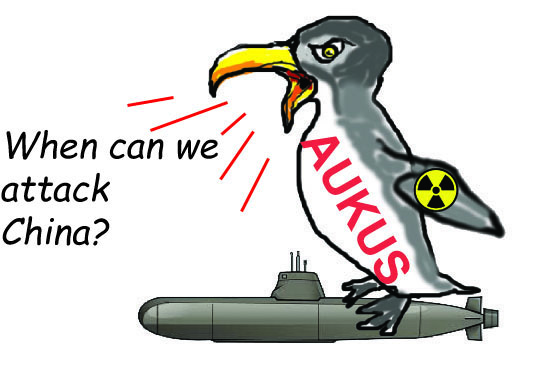
By Francois Murphy, South Coast Register, September 17 2022 China has clashed with the countries in the AUKUS alliance at a meeting of the UN nuclear watchdog over their plan to supply Australia with nuclear-powered submarines, capping a week in which Beijing has repeatedly railed against the project.
Under the alliance between Washington, London and Canberra announced last year, Australia plans to acquire at least eight nuclear submarines that International Atomic Energy Agency (IAEA) chief Rafael Grossi has said will be fuelled by “very highly enriched uranium”, suggesting it could be weapons-grade or close to it.

To date no party to the nuclear Non-Proliferation Treaty (NPT) other than the five countries the treaty recognises as weapons states – the United States, Russia, China, Britain and France – has nuclear submarines.
The vessels can stay underwater for longer than conventional subs and are harder to detect.
“The AUKUS partnership involves the illegal transfer of nuclear weapon materials, making it essentially an act of nuclear proliferation,” China said in a position paper sent to IAEA member states during this week’s quarterly meeting of the IAEA’s 35-nation Board of Governors……………………
The AUKUS countries and the IAEA say the NPT allows so-called marine nuclear propulsion provided necessary arrangements are made with the IAEA.
China disagrees in this case because nuclear material will be transferred to Australia rather than being produced by it.
It argues the IAEA is overstepping its mandate and wants an unspecified “inter-governmental” process to examine the issue at the IAEA instead of leaving it to the agency.
In its seven-page position paper, China said AUKUS countries were seeking to take the IAEA “hostage” so it could “whitewash” nuclear proliferation.
Nuclear submarines are a particular challenge because when they are at sea their fuel is beyond the reach of the agency’s inspectors who are supposed to keep track of all nuclear material.
IAEA chief Grossi has said he is satisfied with the AUKUS countries’ transparency so far……………………
https://www.southcoastregister.com.au/story/7906718/china-aukus-clash-over-nuclear-subs/?cs=202—
Australia’s Defence Strategic Review and the loss of Australia’s strategic autonomy to the US
https://johnmenadue.com/the-defence-strategic-review-and-the-loss-of-australias-strategic-autonomy-to-the-us/, Pearls and Irritations, By John Menadue, Sep 8, 2022
Over the next two weeks we will be running a series of articles to focus on the Defence Strategic Review (DSR) which is headed by Sir Angus Houston and the Hon. Stephen Smith.
In becoming a US proxy, even patsy, we are on a risky and dangerous path.
Smith was Minister for Defence when the Gillard Government committed to US Marines in Darwin. As Minister he told us in 2011 that ‘Australian troops are making good progress in Uruzgan province…the Taliban is losing ground’. On the domestic front he told us in 2016 that Mark McGowan was a failed party leader. He offered himself, unsuccessfully, for ALP preselection for a State seat in order to defeat McGowan.
The review was announced on 3 August with submissions closing on 30 October.
But is it a genuine review? Minister Marles called it a ‘snap review’. Stephen Smith has told the Western Australian newspaper that a ‘draft report with initial findings would be given to the Minister for Defence Richard Marles on November 1’. That is one day after submissions close!
My major concern however is that this Review will be dominated by the Washington Club and its derivative media followers with the mistaken but widespread and spurious view that China is a military threat to Australia. The Club is very ignorant of Chinese history. It trash talks and goads China day after day.
This Review takes place against a successful anti China campaign in Australia waged by organisations like the Australian Strategic Policy Institute, the Office of National Intelligence, politicians and importantly by our media including the ABC. There has been a colonisation of the mind by western media.
Our new Prime Minister is also not immune to the anti China infection. His first rushed overseas trip was to join the anti China group at QUAD and NATO.
As set out in the terms of reference for the Review on Critical information Requirements. ‘the review is to be informed by the intelligence and strategic assessment of the most concerning threats which challenge Australia’s security’.
It’s clear to everyone that the unstated assumption in setting up this Review is that China is a threat in some undefined way.
Although not naming China, Angus Houston was quickly out of the blocks after the announcement of the Review by commenting that ‘the deteriorating strategic environment facing Australia is the worst I have seen in my lifetime’.
But is that so? Is China a threat?
China may be a threat to the United States Empire with its 800 bases world wide, including 19 in Japan and ROK ringing China, but it is not a threat to the United States or Australia.
Countries of our region have built more balanced and better relations with China than we have.
In the last forty years the US has waged numerous illegal wars resulting in the death and displacement of millions of people. In that time China has not waged a single war.
China will become a threat to us if we continue on our present very dangerous path of acting as a US proxy and tying ourselves ever more closely to the United States a county that is the most violent in the world and almost always at war.
As Jeffrey Sachs put it in a recent interview, ‘A new database …has just shown that there have been more than 100 military interventions by the United States since 1991. It’s really unbelievable’.
On the domestic front the US is more and more a failing or failed state.
Will the US fall into the Thucydides Trap by refusing to accept its own decline and fearful of a rising power, China.
In considering the ‘China threat’ what is the evidence? What is China’s intent? What is its capability to threaten Australia? How does Chinese history inform us? Are China’s security concerns largely limited to its own borders and relations with buffer states?
In Australia today we are witnessing a new version of the “yellow peril’. We seem unable to shake ourselves free of our racist history.
As Hugh White has described it, our unthinking alliance with America means that we may be sleep walking to war with China.
We need to take resolute action to slow the rapid ceding of our national sovereignty to the US. In becoming a US proxy, even patsy, we are on a risky and dangerous path.
The series starts tomorrow.
Anti-AUKUS campaign ramps up over U.S.-China war talk
Independent Australia By Bevan Ramsden | 1 September 2022,
Given our massive commitment to military spending and continuous “war talk”, protests within the peace movement are growing to prevent Australia from entering another disastrous U.S.-led war, writes Bevan Ramsden.
INDICATORS THAT preparations are being made for war are coming thick and fast.
The 2021 announcement of the AUKUS (Australia, UK and the U.S.) military pact and Australia’s acquisition of nuclear-powered submarines (either from the USA or the UK) has heightened and broadened public concerns about Australia’s deeper involvement in another potential U.S.-led war — this time with China.
Intensifying war talk and massive spending on war preparations have not gone unnoticed in the Australian community. It has provoked a response which is rapidly spreading that our foreign policies may be taking us into an unnecessary and avoidable war, not heading towards security and peace.
A recent Lowy Institute poll showed that just over half the Australian population is not in favour of supporting the United States in a war against China.
The city councils of both Newcastle and Wollongong are united in opposing the establishment in their cities of port facilities for nuclear-powered submarines and the Brisbane City Council has reaffirmed its commitment to a nuclear-free city.
A number of trade unions – the Electrical Trades Union (ETU) Queensland branch, the Maritime Union of Australia (MUA) and the NSW Teachers Federation to name only a few – have strongly condemned AUKUS and the planned acquisition of nuclear-powered submarines.
Community organisations including Friends of the Earth, the Australian Conservation Foundation (ACF), Women’s International League for Peace and Freedom (WILPF), Pax Christi, Australians for War Powers Reform and the Independent and Peaceful Australia Network (IPAN) have likewise condemned the planned acquisition of nuclear-powered submarines.
Heightened public concerns and opposition to a war with China come largely in response to the formation of the Australian Anti-AUKUS Coalition (AAAC).
More than 25 community, peace, faith organisations, trade unions and hundreds of individuals have united to campaign nationally against preparations for a possible war with China and to oppose nuclear submarines and the AUKUS war pact. Public anti-AUKUS protests have occurred in Perth, Adelaide, Melbourne, Wollongong, Sydney, Newcastle, Brisbane and Darwin with more planned in coming months.
The AAAC is currently coordinating the gathering of hundreds of signatures from individuals and organisations for a national advertisement to be published in a major national newspaper on 16 September, the anniversary of the announcement of AUKUS and the purchase of nuclear submarines.
The proposed advertisement reads as follows:
We call on the Government of Australia in the interests of peace and security for the Australian people and the region:
- to advise its AUKUS partners that Australia will not be involved in a war against China over Taiwan or disputed territorial waters in the South China Sea or any other country and will not allow use of Australian territory for that purpose;
- to sign and ratify the United Nations Treaty on the Prohibition of Nuclear Weapons; and
- to cancel military spending for AUKUS war preparations, including cancellation of the acquisition of nuclear-propelled submarines, so that urgent domestic social needs (climate change mitigation, education, health including public hospitals and housing) can be better addressed.
Further, a petition initiated in November 2021 by IPAN in conjunction with the Australian Anti-Bases Campaign Coalition has received 25,500 signatures.
The petition is headed ‘No Nuclear Submarines; End U.S dominance; Healthcare not Warfare’ and reads in part:
‘The Australian Government must withdraw from AUKUS, stop the development of nuclear submarines and end integration into the U.S. military.’
The Australian Government’s commitment to purchasing billions of dollars in weaponry, mainly designed for offensive war and interoperability with the U.S. military – not specifically for the self-defence and sovereignty of Australia – is evidence of the Government’s preparations for a potential war against China thousands of miles away from Australia.
Previous governments have committed close to one-quarter of a billion dollars on so-called defence but these items suggest war preparations coordinated with the United States, aimed at containing and/or confronting China militarily.
Some of these commitments include:
- Upgrading the (RAAF) Royal Australian Air Force’s Tindal aircraft runway to take U.S. B1 bombers, which are capable of carrying nuclear weapons, at a cost of $1.1 billion.
- Building a huge fuel site in the Northern Territory to power U.S. fighter jets (estimated $270 million).
- Acquiring 135 U.S. M-1A2C Abrams tanks at a cost of $3.5 billion.
- Developing high-speed, long-range missile defence systems at a cost of up to $9.3 billion.
- Acquiring eight nuclear-propelled submarines at a cost that experts predict will blow out to $170 billion-plus (these hunter-killer subs are designed for operation at long distances from Australia and are too large to be effective in the relatively shallow coastal waters of Australia).
- $10 billion to build a port on the east coast of Australia to service nuclear-powered submarines — and we are told it will be made available to the U.S. and UK for servicing their nuclear-powered and probably nuclear-armed submarines.
- Seventy-two F-35 fighter bombers will be purchased from the U.S. at a cost of about $16 billion.
- Purchasing nine frigates at a cost of $35 billion.
The costs to Australia of having over 2,000 U.S. marines stationed in the Northern Territory each year are unknown as questions by IPAN to the Federal Minister for Defence evoked the answer: “It is a matter of national security and cannot be divulged.”
These foreign troops stationed on our soil are not under the control of the Australian Government. They take their orders from the U.S. Indo-Pacific Command which has recently established a regional headquarters in Darwin.
………………………………….. The strongest indicator of preparation for war has been Australia joining with the U.S. and UK in what purports to be a war pact – AUKUS – but appears purpose-built to contain and/or confront the Chinese militarily. This new alliance was entered into without any parliamentary or public discussion and has been imposed dictatorially upon the Australian people.
The change of government has not seen, as yet, any change in this general thrust to prepare for war. The Albanese Government supports AUKUS. And while PM Albanese and Foreign Affairs Minister Penny Wong have sought to use more moderate language towards our neighbours on their recent overseas tours in an attempt to heal relations broken by the previous Coalition Government, the thrust of their foreign policy has not changed.
In a speech recently in the USA, Defence Minister Richard Marles called for the integration of our ADF with the U.S. military rather than interoperability, which was the policy of the previous Australian Government.
This would mean loss of sovereign control of our own ADF to the U.S.
………………………………………….. Every stop should be pulled out to prevent Australia from being drawn into yet another disastrous U.S.-led war. The peace movement is growing rapidly to do its best to prevent that from happening.
If you wish to add your signature to the national newspaper advertisement protesting the military spending for AUKUS war preparations, including cancellation of the acquisition of nuclear-propelled submarines, click here…………………….
more https://independentaustralia.net/life/life-display/anti-aukus-campaign-ramps-up-over-us-china-war-talk-,16718
Richard Marles reaffirms Australia’s commitment to the one-China policy and ‘stabilising’ Canberra-Beijing relations
The Defence Minister and acting Prime Minister reiterated Australia’s support for the one-China policy and said its principal motive was to see a “de-escalation of tensions” in the Taiwan Strait.
Sky News Miriah Davis, Digital Reporter, August 14, 2022 –
Richards Marles has reaffirmed Australia’s commitment to the one-China policy as Canberra moves towards “stabilising” its relationship with Beijing.
Speaking with Sky News Australia’s Kieran Gilbert on Sunday, the Defence Minister and acting Prime Minister said Australia’s principal motive was to see a “de-escalation of tensions” in the region.
“What we want to see is a return to normal peaceful behaviour what underpins that, from Australia’s point of view, is not wanting to see any unilateral change to the status quo across the Taiwan Strait,” he said.
“That means we have a one-China policy that’s been the status quo in Australian policy, and indeed for the United States and other countries, for a very long period of time.”
Under Australia’s version of the one-China policy Taiwan is acknowledged as a province of China and is not recognised as its own country, however, the policy allows for unofficial contact including visits from MPs on parliamentary delegations.………………………………………………….
The United States, in decline but still able to kill us all.
The march of folly in American strategic policy has enshrined the madness of control by a giant defence industry and defence budget now past $800 billion.
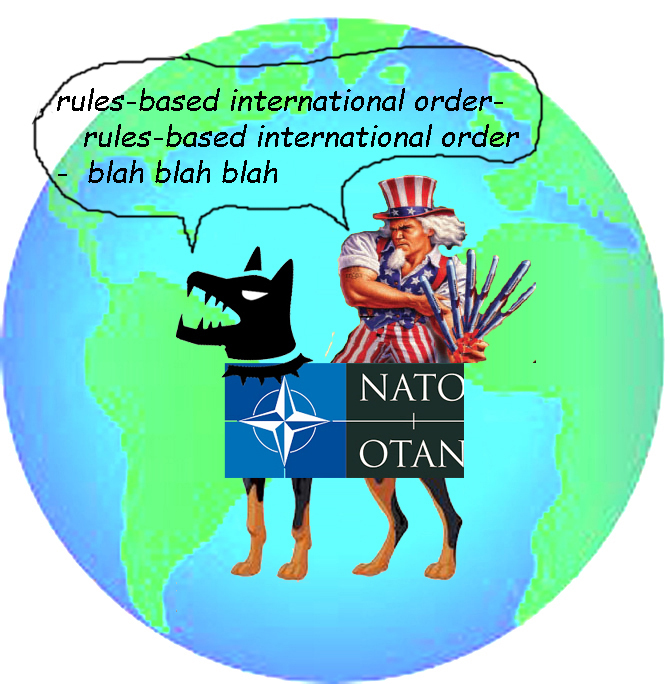
The fiercely presented wearisome trope of commitment to a Rules Based International Order is quite suddenly unmasked as an American Establishment desire to maintain a unipolar control of the world, with violence.
The fiercely presented wearisome trope of commitment to a Rules Based International Order is quite suddenly unmasked as an American Establishment desire to maintain a unipolar control of the world, with violence.
The global dominance of the United States, in so many fields, from space, to science, to entertainment, to sport, to novelty in the development of the English language, has been taken for granted, is part of our fabric of Australian existence.
Reinforced by the Covid Era of Isolation, Netflix, Facebook, and Computer Games and inability even to get to Bali or Thailand let alone China, we are now in a noisy metal barrel where even dissident voices seem projections from the dissident voices of the US, similarly muted and squeezed. At a time when the US and its roles in the world are suddenly dramatically changing.
The undoing of the United States, the collapse of the imperial centre, is happening with little awareness in Australia. Our generally oblivious mindframes affect the capacity of political leaders to reflect upon or point to core problems of our world. Richard Adams, the author of Watership Down, that great rabbit adventure full of meaning for human society, coined the rabbit language word ‘tharn’ for the mental state of rabbits caught in the headlights and stuck. We are a tharn nation, gabbling about entertainments and irritations, eyes glued to the seatback monitor, not wanting to know that the plane is crashing.
Heed these markers:
- The Americans were first to the moon, but NASA after the retirement of the space shuttle has depended on Russian rockets to get to their joint space station. The Russians are now planning to remove the propulsion units of the station which keep it from crashing, their property, for use on a bigger new venture. America is losing in space, though US private business has appallingly taken the lead in cluttering near space with junk.
- The fiercely presented wearisome trope of commitment to a Rules Based International Order is quite suddenly unmasked as an American Establishment desire to maintain a unipolar control of the world, with violence. This is being unmasked in much of the world if not NATO and AUKUS and the conservative acolytes in Japan and ROK. Ideological assertions of democracy versus autocracy, built by vilification and isolation of China and Russia, is rotting from the head as big democracies are in serious trouble.
- We are doing OK in Australia, our minds from age 12 filled with bubblegum flavoured vape and Tiktok, graduating to Facebook and the metaverse, and with a newer, kinder, kinda-tealish government we can all go to sleep, take off our masks and order American franchised fast food. Or real Aussie drinks. But while we have had a narrow focus on bad boys in the SAS we fail to review our complicity in the great crimes of the twenty first century, led by champions of democracy, smashing the lives of people in a number of countries far more violently than has the Ukraine war so far. Biden and his Secretary of State were advocates for invasions of Afghanistan and Iraq, so appallingly bringing down bad governments and making countries ungovernable. Creating Al Qaeda and ISIS in the process, directly through funding and arming extremists (in Afghanistan beginning before the Russians were invited into Afghanistan) and via embitterment of ordinary people. The world is destabilised, American control is widely undone.
- The march of folly in American strategic policy has enshrined the madness of control by a giant defence industry and defence budget now past $800 billion. Poverty of foreign policy has led to regimes of sanctions which have been substantially shaped by Richard Nephew whose book reveals that far from focusing on potentates and oligarchs, the targets of sanctions must be ordinary people and the purpose is to inflict pain and weaken resolve (his words). Consider sanctions related deaths in Iraq Venezuela Cuba, Afghanistan Pain but no loss of resolve, hatred not submission. The US official study of the effects of strategic bombing on Germany in World War II by J K Galbraith and others long ago suggested morale and resolve were increased by the bombing of cities and civilians. And yet we have the ongoing commitment to defend and achieve democracy by mass murder, with constant focus on disruption, regime change, and violence… not on peace.
- Jeffrey Sachs has recently returned to the themes of his 2013 book on the 50th anniversary of President John Kennedy’s Commencement Speech at American University in 1963. Speaking in the aftermath of the Cuban Missile Crisis, Kennedy spoke of peace not as an event or a state but a constant process of engagement. We now have no such thing, we are in an Age of Hostility, Meanness, Folly, and Decay.right wing is fervently in support. Stanley Kubrick made a movie about such madness, we are sleeping through it.
Australia recognises, as does the United States, that Taiwan is part of China. Though the media vague up the history, China kicked the Portuguese and Dutch out of Taiwan early in the 1600s, long before the greatest land grab in history, of Britain over the Australian continent, could even be imagined as the British didn’t know it was there then. The government in Taipei is the Government of the Republic of China. The large opposition party in the National Assembly is the Kuomintang, ruling party of the government of the Republic of China that lost the revolutionary war on the mainland in 1949 and retreated to Taiwan. The ROC held the China seat in the UN until 1971 with American backing. The majority of local governments in Taiwan are governed by the KMT because the party of the national government is on the nose both because of its independence-advocating foreign policy and corruption allegations. Pelosi’s visit risks great power war as not seen since 1945. The American right wing is fervently in support. Stanley Kubrick made a movie about such madness, we are sleeping through it.
The US economy is in serious trouble………………………………….
The US campaign for unipolar dominance has included partly fabricated propaganda against China and Russia. This no longer convinces or concerns a wide sweep of the world beyond NATO, the G7, the EU and AUKUS. Mix in enough lies and it all seems lies.
The summit meeting of BRICS in June seemed a more constructive meeting than the G7. The countries of Eurasia also have the Shanghai Cooperation Organisation SCO. The Iran,Russia, Turkey summit meeting in Tehran in July 2022 seems to have been more successful than President Biden’s visit to Saudi Arabia to meet also other Arab leaders, a visit described by the Wall Street Journal as worse than an embarrassment,…………………………..more https://johnmenadue.com/the-united-states-in-decline-but-still-able-to-kill-us-all/
Taiwan not worth a mushroom cloud
Many talk about “national interest”; the need for security; and standing up for principles. But with Taiwan the choice may be more stark: allow the Chinese Communist Party to take it over or engage in a nuclear war.
Principles are meaningless amid nuclear devastation, and so is national interest and security.
http://www.crispinhull.com.au/2022/08/08/taiwan-not-worth-a-mushroom-cloud/?utm_source=mailpoet&utm_medium=email&utm_campaign=crispin-hull-column Crispin Hull 8 Aug 22,
The odd thing about the visit by the Speaker of the US House of Representatives to Taiwan was that it was done by a woman, Nancy Pelosi. Usually, women in government tend to be the negotiators and compromisers, not the aggressors and agitators.
Why not just leave well alone?
Why create for future schoolchildren (if there are any survivors) one of the “Ten Causes of the Third World War”: Pelosi’s visit to Taiwan. Just as we learned that the 10 causes of World War I and World War II included equally trivial misjudgments.
And, take note, as far as the Chinese leadership is concerned, Pelosi is not a legislator, separate from the executive government, making a visit off her own bat, because they could not conceive of such a thing. For them, she is part of the US Government. So, to them, the trip was a deliberate provocation.
The other puzzling thing about Taiwan is the way the US, on the one hand, talks the talk of defending democratic Taiwan against the bully China, but on the other hand officially accepts that Taiwan is part of China.
The US did that on January 1, 1979, when it recognised the People’s Republic of China and established diplomatic relations with it as “the sole legitimate government of China”. On the same day, the United States withdrew its recognition of, and terminated diplomatic relations with, the Republic of China (Taiwan) as the government of China.
In 1979, of course, Taiwan was not a democracy so it did not really matter in principle which of the two autocracies was the “sole legitimate government of China”. At the time, the US “national interest” suggested that the trade opportunities with mainland China were too good and democracy was not being undermined by the de-recognition of semi-autocratic Taiwan.
After Taiwan evolved into a democracy in 1996 with the first free, open, and fair election for the presidency, the US had a “whoops” moment, followed by nearly three decades of juggling three balls in the air: the principle of supporting democracy; supporting US national trade interests; and opposing ever-growing Chinese influence.
The three are hopelessly incompatible, even as the first and the third become ever more urgent. The solution for the US could have been dreamt up by the Chinese communists themselves: “deliberate ambiguity”.
The US should go back to that. More importantly, Australia should go back there, irrespective of what the US does. The west should play the long game with China and wait for it to go the way of the Soviet Union caused as the economic cost of not playing by the rules results in unsustainable pressure on the regime.
Already China is paying a penalty for its trade trashing of Australia. Australia has now found other markets. China has come back cap in hand for some of those goods and Australia has said, “No thanks, you are too unreliable because you do not follow the rules and legal principle.”
In any event, we should not, in the perspicacious words of defence expert Hugh White, “sleepwalk into war”.
If democratic Taiwan is so important to defend, why doesn’t the US officially recognise it as a nation? And if it does not recognise Taiwan as an independent democratic nation, why threaten military action if the central government of the nation that the US does recognise as exercising sovereignty over Taiwan sends in its army and police forces to physically exercise that sovereignty?
Not being a democracy is not a cause for war, nor is the overthrow of democracy in one part of a country a cause for war. If they were, the world would be in a constant state of war.
Pelosi’s visit coincided with the Rim of the Pacific naval exercise (RIMPAC), but to Chinese Communist Party chiefs it was not a coincidence.
Twenty-six nations, 38 surface ships, four submarines, nine national land forces, 170 aircraft and 25,000 military personnel took part.
From a Chinese perspective this is a tad threatening. To us it is benign. To Taiwan and Australia firing rockets over Taiwan and the seas around it is a tad threatening, To the Chinese it is a benign military exercise in its own back yard
Of course, China is jealous as well as threatened by RIMPAC. China has no friends, just nations it bribes or debt-burdens into military co-operation.
But the danger point comes when the US goes beyond seeking voluntary co-operation with allies and friends and aims for full military integration and interoperability.
The trouble here is that the US military exerts influence verging on control over the US Government. Its top military officer has a seat on the National Security Council (not just an advisory role). Both General Douglas MacArthur (Korea) and General Curtis Le May (Cuba) urged the use of nuclear weapons.
Mercifully, Presidents Truman and Kennedy stood up to them, but Biden is no Truman or Kennedy. Moreover, a change in Administration usually means little change in the military-industrial complex’s way of doing things.
In Australia, a change of Government has also meant very little change to the lock-step American Alliance – until now.
The new Defence Minister, Richard Marles, has ordered a Defence Forces Review. Maybe it will start questioning the pattern of blindly joining every major US military folly (Vietnam, Afghanistan and Iraq, for example), irrespective of whether it has anything to do with us.
Many talk about “national interest”; the need for security; and standing up for principles. But with Taiwan the choice may be more stark: allow the Chinese Communist Party to take it over or engage in a nuclear war.
Principles are meaningless amid nuclear devastation, and so is national interest and security.
It is unfortunate that 23 million people would go under the Chinese Communist jackboot, but that is better than going under a nuclear mushroom.
We allowed them to imprison, murder, and torture the Uyghurs and Tibetans and did nothing. What is the difference with Taiwan? Maybe it is just a good case to bolster a profitable arms race.
Australian Prime Minister Albanese refuses to meet with Assange’s family
The claim that Australia cannot intervene in the legal case is being advanced by Labor MPs across the board, including those who previously postured as defenders of the WikiLeaks founder.
https://www.wsws.org/en/articles/2022/08/06/rbnb-a06.html Oscar Grenfell@Oscar_Grenfell5 6August 2022 In a revealing development last Wednesday, Prime Minister Anthony Albanese refused to meet with the family of incarcerated WikiLeaks publisher Julian Assange when they visited the Australian federal parliament in Canberra.
Assange’s father John Shipton and his brother Gabriel Shipton met with Independent and Greens MPs, but were reportedly unable to secure meetings with Albanese, Foreign Minister Penny Wong or Attorney-General Mark Dreyfus.
The snub expresses, again, the real attitude of the Labor government to Assange, Australia’s most famous political prisoner. In line with its commitment to US-led militarism, including the confrontations with Russia and China, Labor is intensely hostile to Assange because of his exposure of US-led war crimes in Iraq and Afghanistan.
While making highly ambiguous statements about the Assange case having “dragged on too long,” the Labor administration has refused to use its diplomatic and legal powers to secure his freedom since it was installed after the May 21 election.
This amounts to a green light for Assange’s extradition from Britain to the US, where he faces Espionage Act charges and 175 years in prison for publishing true information about the illegal wars and global diplomatic conspiracies of American imperialism.
In comments to the Guardian after their visit, both Shiptons condemned the Labor government’s failure to defend Assange and demanded that it immediately intervene.
Gabriel Shipton recalled one of the few occasions on which Albanese explicitly referenced the WikiLeaks founder. Asked about the Assange case last December, Albanese purportedly told a shadow cabinet meeting, “enough is enough”—a refrain cited publicly by several Labor MPs.
But Shipton noted: “It is months ago now that he said this stuff and made the statement that enough is enough, but when is enough, enough? Julian’s still in prison. He’s been there for three years and he is not a convicted criminal.”
Shipton added: “They could pick up the phone and call Joe Biden and make it a non-negotiable. We are strategically vital to the US at the moment, they need our resources, if it was made a non-negotiable, Julian would be here tomorrow.”
The Labor government, however, is serving as the closest of partners with the Biden administration. Albanese and Wong have met repeatedly with the US president. The primary focus of their first months in office has been on foreign policy.
Labor has functioned as an attack dog for the Biden administration throughout the Asia-Pacific, with Wong continuously traveling the region to demand that its leaders sign up unequivocally to the US-led aggression against China.
Shipton pointed to the obvious hypocrisy at the heart of Labor’s refusal to defend a persecuted citizen and journalist. “We’re dealing with this prosecution or persecution that in any normal circumstance would be seen as totally illegal, and if it was Iran doing it to somebody, or China, or Vietnam, the government would be calling them out,” he said.
Shipton continued: “It is not just about Julian’s life and his wellbeing, it is a matter of principle, and if Australia wants to be the sort of country that calls out nations on their press freedom record, they could definitely be more vocal.”
John Shipton commented on a recent Declassified Australia article. It cited internal briefings to the Labor government, indicating that the sole focus of Labor’s “diplomacy” in the Assange case, was to consider a possible prison transfer from the US to Australia.
This would only be an option after Assange had been extradited and convicted on frame-up charges in a US court, a process that could take years or decades. It would, moreover, be entirely conditional on the agreement of the US government.
John Shipton said this scenario was “grotesque.” He pointed to the spate of extraordinary abuses carried out as part of the US pursuit of Assange. They have included the theft of Assange’s legal documents, unlawful spying on him and discussions within the Trump administration and the American Central Intelligence Agency in 2017 on kidnapping or assassinating him in London.
For Labor to refuse to intervene until after Assange’s extradition was “the most feasible way for them to continue to sit on their hands and do nothing.”
Such a course of action would also amount to a death sentence. Assange’s psychologists and doctors have testified, under oath, that he would take his life were he to face imminent dispatch to his US persecutors. In addition, the WikiLeaks publisher’s physical health is failing, expressed most sharply in a minor stroke last October.
On the same day the Shiptons visited parliament, Greens Senator David Shoebridge noted in question time that Labor MPs had claimed the government was engaged in “quiet diplomacy” on Assange’s behalf. “Quiet diplomacy can’t be no diplomacy,” Shoebridge stated, before asking: “What exactly is the government doing to secure the release of this Australian citizen, journalist and whistleblower?”
In reply, Trade Minister Don Farrell stated again that the case had “gone on for too long” and should be “brought to a close,” without giving any indication of how this would take place.
Farrell said Australia was not a party to the extradition case, which was between Britain and the US, and “respected” the legal processes of both parties. This line replicates that of the previous Liberal-National Coalition government. It amounts to a green light for the extradition and a declaration that Labor will do nothing.
Assange’s extradition hearings are not a routine “legal matter” but a monstrous frame-up. They involve the persecution of an Australian journalist for his publishing activities. This is a frontal assault on the most fundamental democratic norms, including press freedom.
In numbers of cases, Australian governments have actively used their diplomatic and legal powers to secure the freedom of citizens persecuted abroad, even when such attacks have taken a pseudo-legal form.
This was the case with Peter Greste, a journalist freed from an Egyptian prison in 2015, after being framed-up on “national security” charges. The same occurred with James Ricketson, a documentary filmmaker who had phony “espionage” charges leveled against him in Cambodia, and Kylie Moore-Gilbert, an academic who was accused by Iran of being a spy.
The claim that Australia cannot intervene in the legal case is being advanced by Labor MPs across the board, including those who previously postured as defenders of the WikiLeaks founder.
It was repeated in a recent Consortium News interview by Labor backbencher Julian Hill. He insisted there were “limits to what we can do because Australia and the Australian government are not parties to the case, that’s just a fact.” Hill also defended Albanese’s supposed “quiet diplomacy.”
Hill has changed his tune since Labor took office. In August 2020, for instance, he stated: “The UK claims to be a rule of law country guaranteeing a fair trial, open justice and due process. What a joke!… The persecution and treatment of Julian Assange are unconscionable. This is inherently political and our government is too cowardly to defend him, to even demand that he gets a fair trial.”
Hill could now say the same about Albanese, the Labor government and himself.
For their part, the Greens posture as defenders of Assange. But they have rejected calls for a party campaign fighting for his freedom and buried the WikiLeaks publisher’s plight during the election.
The Greens’ entire orientation is to deepen their collaboration with the Labor government, expressed last week in their backing for Albanese’s climate bill, which will do nothing to address global warming and is premised on defending the interests of the coal and gas barons.
As the Socialist Equality Party has insisted, the fight for Assange’s freedom requires a struggle against the entire political establishment, and its program of war and authoritarianism. This must be based on mobilising the Australian and international working class, the constituency for a genuine fight against capitalist reaction and in defence of democratic rights.
Does Australia actually need nuclear submarines?
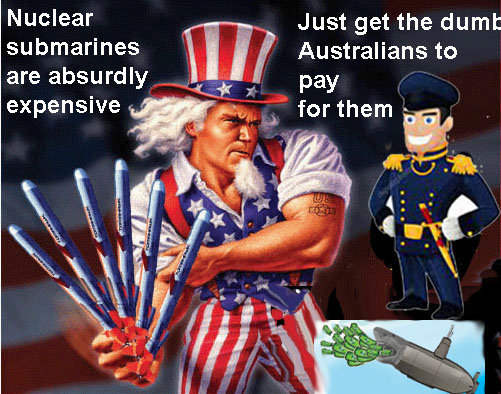
“It’s obvious the real policy is to subsidise the US Navy’s submarine budget. Some will be located in Australia, with Australian flags and personnel, but they’re essentially US boats operated in the US’s great power interests. We’re paying for them to set up part of their current and future fleet in Australia.”
fewer than two of Australia’s eight nuclear submarines would be operationally available, on average, each year. And the cost of the purchases is likely to be stunning, possibly as high as $171 billion……………….. No other country has bought this type.
“Australia could buy 20 high-quality, off-the-shelf, modern submarines for $30 billion.”
influential Australian intelligence and defence officials are ignoring the point that there is no need for Australian submarines to spend much time in China’s waters
Gilligan also warns that the shallow and warm waters around Australia’s north are unsuited to large nuclear submarines.
As experts question the diplomatic, strategic and economic rationale behind Australia’s purchase of nuclear-powered submarines, the gaps in the country’s defensive fleet could be filled by conventional subs. https://www.thesaturdaypaper.com.au/news/politics/2022/08/06/does-australia-actually-need-nuclear-submarines#mtr By Brian Toohey. 6 Aug 22,
In 1992, an Australian Oberon-class submarine entered the crowded waters of Shanghai’s port and became entangled in fishing nets. It had to surface for crew members to cut it free with axes. Chinese Navy sailors witnessed this, but nevertheless the submarine escaped. Had it not, the crew would’ve been imprisoned and Australia widely condemned and potentially convicted for an outrageous breach of international law.
Almost a decade earlier, the Australian Navy had seriously considered scrapping submarines, according to former senior Australian Defence official Mike Gilligan. A study in 1985 had concluded they offered “little marginal benefit to Australia’s defences yet inflict a large marginal cost”. The cost could’ve been much higher given the tremendous risks the government allowed the navy to take, snooping in Chinese and Russian waters on behalf of the Americans, who wouldn’t put their nuclear submarines in danger.
Australia now faces some tough and highly consequential decisions with respect to its fleet. Some experts in the defence field question not only the utility of nuclear-powered vessels but the diplomatic, strategic and economic commitment they entail.
In Washington last month, Defence Minister Richard Marles said Australia, the United States and Britain were moving from “interoperability to interchangeability in defence hardware”. This would effectively mean Australia could not buy high-quality defence equipment from other countries if there was a higher-cost American or British version available. Professor Clinton Fernandes at the UNSW Canberra campus says, “It’s obvious the real policy is to subsidise the US Navy’s submarine budget. Some will be located in Australia, with Australian flags and personnel, but they’re essentially US boats operated in the US’s great power interests. We’re paying for them to set up part of their current and future fleet in Australia.”
Australia has a short and patchy record on submarine purchases. The government acquired many major weapons during World War II. None were submarines. That capability had to wait until the first of a total of six Oberon-class submarines was commissioned in 1967 from a Scottish shipyard. They operated satisfactorily but weren’t considered the nation’s most important military assets.
After Kim Beazley became Defence minister in the Hawke government, he gambled on the value of submarines by ordering six large, battery-powered versions to be built in Adelaide. No other country has bought this type.
The first was commissioned in 1966 and the last in 2003. Called the Collins class, it was based on a good Swedish design. But Beazley greatly increased its size and complexity, partly by adding American equipment that proved completely useless. Maintenance problems drove annual sustainment costs to $670 million. Often only two or three were available at a time, although availability later improved. And none attended the 2010 Rim of the Pacific event – known as Rimpac, the world’s largest international maritime warfare exercise, held biennially near Hawaii.
Former prime minister Scott Morrison and his successor, Anthony Albanese, have taken a much bigger gamble than Beazley did, with their commitment to buy at least eight nuclear attack submarines – almost certainly the American Virginia class. One of the US’s most highly regarded defence analysts, Winslow Wheeler, recently pointed out the Virginia-class subs have been available only 15 times in 33 years for their six-monthly deployments. This suggests fewer than two of Australia’s eight nuclear submarines would be operationally available, on average, each year. And the cost of the purchases is likely to be stunning, possibly as high as $171 billion when accounting for inflation, according to the Australian Strategic Policy Institute, and more recent estimates are above $200 billion. The costliest previous military acquisition, for the Australian Air Force, is the inflation-adjusted $16.6 billion program cost for 72 F-35 fighter jets.
Former submariner, naval consultant and South Australian senator Rex Patrick says, “Australia could buy 20 high-quality, off-the-shelf, modern submarines for $30 billion.”
Patrick also makes the point that nuclear submarines are often “defeated” in exercises by ultra-quiet conventional submarines.
Major new developments are making conventional submarines even more formidable than the nuclear versions. More powerful sensors mean submarines can be detected by the noise they make and by their passage through the Earth’s magnetic field. In addition, nuclear submarines can be detected by the wake they leave at high speeds, as well as the hot water they release from cooling their nuclear reactors, operating loud steam engines and other equipment. In future, submarines may also be detected by blue-green lasers that make the ocean more transparent.
A prize-winning essay published in the US Naval Institute’s magazine Proceedings in June 2018 said the US Navy would do well to consider acquiring “some quiet, inexpensive and highly capable diesel-electric submarines”. Until recently, conventionally powered submarines frequently had to rise close the surface to expose a mast and snorkel to obtain fresh air for their diesel engines to recharge the batteries. This process can be detected by radar.
Most conventionally powered submarines – except Australia’s – use what is called air independent propulsion (AIP), which allows them to remain silent for four to six weeks before snorkelling. That often entails using a hydrogen fuel cell to propel the submarine, but it takes up significant space on the vessel.
In a major change, Japan’s new Taigei-class submarines don’t need AIP because they’re equipped with particularly efficient lithium-nickel-cobalt-aluminium oxide batteries, rather than the lead-acid batteries that the Australian Navy prefers, due in part to the risks of lithium-ion batteries catching fire. Other navies are increasingly confident the new types of battery will prove safe. Hans Ohff, a submarine specialist and visiting fellow at Adelaide University, told The Saturday Paper, “Generally speaking, lithium-ion batteries have a 1.5-times range advantage over lead-acid at lower speeds and an incredible four-times range advantage at high speeds.”
Since the Collins class is due to start retiring in 2026, a replacement is urgently required to help fill the gap until the first nuclear submarine might arrive, near 2045, and the last in 2065. Senator Patrick says the time it takes to do this can be reduced by choosing one of the three available “off-the-shelf” submarines: Japan’s Taigei, which has passed numerous tests demonstrating the safety of its new batteries; Singapore’s Type 218SG, made by Germany’s thyssenkrupp Marine Systems; and the Spanish S-81. The latter two still use conventional lead-acid batteries, but Ohff says a French and German joint venture is under way to develop their own lithium-ion batteries.
These options have advantages and drawbacks. The new Taigei class – of which Japan is acquiring 22 – requires a costly crew of 70 per vessel. The Type 218SG’s German manufacturer is the biggest submarine exporter in the world, with an enviable reputation for low maintenance costs across its range. Extensive automation means it needs only 28 crew members, and the vessel has a longer range than the Taigei’s 12,500 kilometres. Spain’s S-81 has a crew of 32 but a less experienced manufacturer.
With China being the principal concern of Australian diplomatic and defence policymakers, Ohff says the navy will never accept off-the-shelf submarines unless it can “Australianise” them – meaning they must have the range to operate for long periods, many thousands of kilometres away, probably in Chinese waters or nearby. Ohff says the navy’s preferences would take a minimum of 10 years to deliver the first boat and additional two-year intervals for the following boats. He says delivery of a Swedish “Son of Collins” could take nine years.
Patrick says influential Australian intelligence and defence officials are ignoring the point that there is no need for Australian submarines to spend much time in China’s waters: Japan, South Korea, Singapore and Vietnam have high-quality submarines closer to China. The main attraction of nuclear submarines for these officials is they could fire subsonic cruise missiles at land targets in China from more than 1000 kilometres off its coast. However, cruise missiles can be shot down by fighter planes overhead. Once a nuclear submarine fired its missiles, it would be detected and swiftly targeted. Even if it survived, reloading would require the help of a tender – a large depot ship that supplies and supports submarines – probably from the distant base at Fremantle, which recently hosted a reloading for a US nuclear submarine. In any event, an attack on Chinese territory could provoke a heavy counterattack on Australia’s forces or its mainland.
Gilligan says most of the capability offered by submarines is better provided by Australia’s maritime and land-based aircraft. He says submarines, including nuclear ones, are slow compared to aircraft. Technically, a plane could sink a ship off Australia’s west coast in the morning, refuel, then sink another off the east coast in the afternoon. Gilligan also warns that the shallow and warm waters around Australia’s north are unsuited to large nuclear submarines.
Deploying nuclear submarines far from Australia marks a return to the previously discredited doctrine of “forward defence” in South-East Asia that concentrated on a big British naval base in Singapore, which was swiftly overrun by the Japanese in 1942. When this doctrine failed during the Vietnam War, the Coalition government in the late 1960s adopted a “defence of Australia” doctrine, which survived until its recent abandonment. Patrick and other proponents of this latter doctrine expect a revised doctrine would put more emphasis on having medium-sized conventional submarines to help deny hostile forces access to the approaches to Australia, unless they could detect and destroy all the submarines, drones, planes and land-based missiles blocking their way.
Finally, from a defence perspective, much of the planning around nuclear submarines assumes – implausibly – that Chinese and US policies will proceed in a predictable way until past 2060. A purely geopolitical analysis, however, could easily underplay the disruptive role of climate change.
In purely geopolitical terms, the region may become more peaceful or more dangerous. The only urgency for Australia is to forget about nuclear submarines and get some conventionally powered submarines to enhance deterrence.
A clarification about China and Taiwan
Norman Realname, 5 Aug 22,

I’m grateful to a reader for providing this explanation.
I still think that it’s a pretty bad idea for USA and Australia to start a probable World War 3 over Taiwan.
The Republic of China (ROC) and the People’s Republic of China (PRC) are NOT synonyms and should not be used as such. The ROC has NO control over Hong Kong; it’s a semi-autonomous territory ruled by the PRC under the “one country, two systems” arrangement, as per treaty. Thus, grumbling about democratic subversion aside, there was no question of the PRC’s sovereignty over it.
The ROC, however, DOES have control over Taiwan, and the PRC does NOT. As to why this is the case, the most oversimplified answer is that the Chinese Civil War never fully ended and both governments claim to rule the territory of the other, but since the PRC has the de facto control of almost all of it, it’s recognized as the “real” China. The more complicated answer is that since democratization the ROC government no longer wants to rule the mainland and sees itself as a separate Taiwanese nation but is forbidden to relinquish its territorial claims (under threat of invasion) by the PRC who view Taiwan as integral Chinese territory and would interpret any movement away from them as secession (even though the PRC has never actually ruled over Taiwan).
The US and China differ over their interpretation of the situation. The PRC’s One China PRINCIPLE states that there is only one China, and Taiwan is a part of China. The US’s One China POLICY states that they *acknowledge* the PRC’s position on the matter, without actually saying whether or not they agree that Taiwan is part of China. In other words: the US generally agrees there is only one China, but they’re not sure (read: deliberately ambiguous) whether Taiwan is part of it.
Fundamentally, while the PRC has been successful in preventing international recognition of the ROC (Taiwan), they do not control the territory and cannot control the territory without:
1. The ROC (Taiwanese) government agreeing to hand over power peacefully to the PRC.
2. A full-scale military invasion of Taiwan aimed at the surrender and/or destruction of the ROC (Taiwanese) government.
To compare the situation to Hong Kong, – the crucial difference is the People’s Republic of China did not need to roll in their military to fight some theoretical Hong Kong military in order to be able to tell Hong Kong what to do.
Australia urged to prove it is a safe nuclear custodian as Aukus comes under scrutiny at UN.

Non-nuclear state Australia’s handling of nuclear-powered submarines will have to be ‘impeccable’, Australia Institute says
https://www.theguardian.com/australia-news/2022/aug/01/australia-urged-to-prove-it-is-a-safe-nuclear-custodian-as-aukus-comes-under-scrutiny-at-un Tory Shepherd, Mon 1 Aug 2022
Australia needs to step up in the fight to stop nuclear conflict, and to prove to the world it is a safe nuclear custodian, a new report argues.
The report by the Australia Institute comes ahead of a major global conference that starts on Monday in New York, where Australia’s Aukus submarine deal will come under scrutiny.
The report argues it is time to revive the UN non-proliferation treaty, which was struck after the Cuban missile crisis and in the midst of the cold war, and aims to stop the spread of nuclear weapons and to achieve complete disarmament.
Allan Behm, the Australia Institute’s director of international and security affairs, said the treaty was “in trouble”. It was not just the “nuclear pariah states” and the nuclear threats from the Russian president, Vladimir Putin, in the context of the war in Ukraine, he said, but also the threat of a domino effect if the mainstream nuclear powers see no option but to follow other countries in nuclear expansion.
Australia should “play a truly constructive role in highly uncertain times”, Behm argued, and work with other countries on “verifiable disarmament”.
Separately, the UN has set up a taskforce to ensure Australia’s plan to buy nuclear powered submarines from either the US or the UK will not breach the treaty.
Aukus was formed in part to counter China’s rise in the region, and China has been fiercely critical of it. Now, two thinktanks linked to the Chinese government have accused Australia of harbouring a desire for nuclear weapons, and declared Aukus will trigger a nuclear arms race and violate the treaty because it will likely use weapons-grade uranium to power the boats.
A Dangerous Conspiracy: The nuclear proliferation risk of the nuclear-powered submarines collaboration in the context of Aukus was released by the China Arms Control and Disarmament Association and the China Institute of Nuclear Industry Strategy.
“The Aukus nuclear-powered submarines collaboration is a serious violation of the object and purpose of the NPT, sets a dangerous precedent for the illegal transfer of weapons-grade nuclear materials from nuclear-weapon states to a non-nuclear-weapon state, and thus constitutes a blatant act of nuclear proliferation,” the report states.
China will attend the UN’s Tenth Review Conference of the Parties to the Treaty on the Non-Proliferation of Nuclear Weapons alongside a 16-strong Australian delegation.
In disrupted times, with the treaty under pressure, a shoring up of the rules-based order is needed to avoid chaos, Behm said.
“This is nowhere truer than in the domain of nuclear arms control and disarmament, where the existential threat of humanity’s nuclear annihilation runs in parallel with the threats from global warming and pandemics,” he said.
“And in the case of nuclear disarmament and global warming, the major treaty that underpins global efforts has been undermined by the constant shift of the ‘middle ground’ away from high aspiration towards the lowest common denominator as key players erode the substance of earlier agreements.”
Australia is a non-nuclear state, but will acquire a fleet of submarines with nuclear reactors on board. The very nature of a reactor on a military vehicle makes it harder to monitor. The monitoring of all nuclear assets is critical to ensure enriched uranium is not diverted to weapons manufacturing.
If Australia gets the green light, other nations could use that precedent to argue for their own hard-to-monitor nuclear reactors (Iran already has).
This is why Australia’s handling of the situation will have to be “impeccable”, Behm said.
Australia has to let its diplomats function effectively and set policy targets to “regain the momentum on arms control and disarmament diplomacy that Australia displayed in previous decades”, he said.
“If it proceeds, Australia’s decision to acquire nuclear-powered submarines under the auspices of the [Aukus] will require impeccable non-proliferation credentials on Australia’s part.”
Australia can help work towards disarmament via the comprehensive test ban treaty (which bans all nuclear weapons testing), a fissile material cut-off treaty (to reduce national stockpiles of enriched uranium or plutonium), a no first use declaration (don’t be first to pull the trigger) and negotiations to reduce arsenals and delivery systems.
Sixteen Australian officials will take part in the treaty conference, led by the Labor senator Tim Ayres. Australia’s arms control and counter-proliferation ambassador, Ian Biggs, will also be there, and it is understood that the test ban and fissile material treaties will be priorities.
“Australia’s delegation to the Tenth Review Conference of the Parties to the Treaty on the Non-Proliferation of Nuclear Weapons (NPT) will work over the four weeks of the meeting to address pressing nuclear proliferation challenges and advocate for practical steps towards nuclear disarmament,” a spokesperson from the Department of Foreign Affairs and Trade said.
1 This month
17 October, Free Public Talk on Nuclear Issues in South Australia
David Noonan will speak on public interest concerns over the new Roxby Downs Indenture Act 2026 on BHP copper-uranium mining and ore processing in SA, and on how AUKUS may face SA with a High-Level nuclear waste agenda.
Dr Jim Green will discuss international developments in the field of nuclear power including ‘small modular reactors’ and Generation 4 ‘advanced’ nuclear reactor concepts.


Help Aunty Sue Protect Her Land and Sacred Sites From Destructive Rocket Testing.
.

Australians deserve the truth
about
AUKUS – https://aukuspublicinquiry.com/

PETITION – To: Prime Minister Anthony Albanese and the Australian Labor Government

of the week – Australians for War Powers Reform (AWPR)
To see nuclear-related stories in greater depth and intensity

