AUKUS hypersonic announcement will ‘escalate global tensions’, warns CND
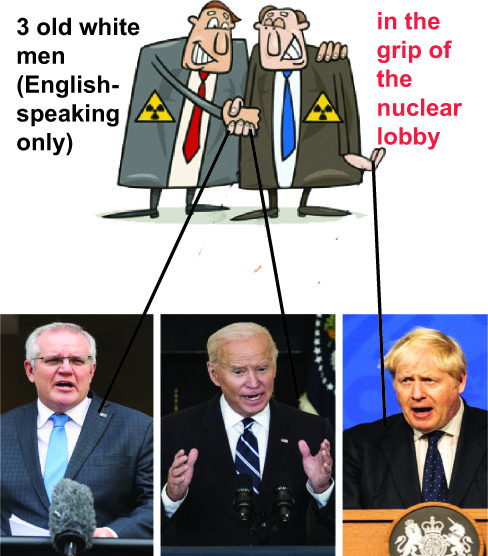
”………………… In a joint statement on Wednesday, the trio announced that they would now “commence new trilateral cooperation on hypersonics and counter-hypersonics, and electronic warfare capabilities. ”
Growing proliferation
Australia is already co-operating with Washington on hypersonic weapon development as part of the Southern Cross Integrated Flight Research Experiment (SCIFiRE). UK officials said they will not be formally joining SCIFiRE. They will instead co-operate in research and development in the area so they can expand their options.
Hypersonic missiles travel at five times the speed of sound and can be armed with either conventional or nuclear warheads. Faster than cruise missiles, they can in theory evade existing air defence systems. The US, Russia, and China have all undertaken testing of the weapon.
CND General Secretary Kate Hudson said: “The latest expansion of the AUKUS military pact will further escalate global tensions, at a time when the threat of nuclear war is at its highest in decades. The announcement that a programme initially centred on providing a non-nuclear state with nuclear-powered submarines – in itself risking wider nuclear proliferation – will now include hypersonic missiles, is of great concern. This AUKUS expansion will accelerate arms racing in the Asia-Pacific region, leading to increased militarisation, and potentially helping provoke conflict over Taiwan. Not to mention the fact that military budgets are already escalating – what will the opportunity cost be for embarking on a whole new class of weaponry be?” https://cnduk.org/aukus-hypersonic-announcement-will-escalate-global-tensions-warns-cnd/
Australia’s Parliament has little control over military matters, and Prime Ministers kow tow to USA and the White Anglosphere to go to war

Australia is an “active, eager participant in the US-led order” and restricting the Australian parliament’s control over the military has been “… a decision taken by the Australian government — at a bipartisan level — and implemented by senior policy planners.
Meanwhile the Australian parliament has “deliberately restricted its own powers on intelligence matters”
,Australia has ”reaffirmed its whiteness in its commitment to expansion of the “Five Eyes” intelligence sharing arrangements between the US, Britain, Canada, Australia and New Zealand and, of course, to the controversial 2021 AUKUS nuclear submarine deal, which was nurtured in great secrecy”
White and might is right: the secrets which push us into other people’s wars, https://www.michaelwest.com.au/the-dirty-secret-that-pushes-australia-into-other-peoples-wars/ By Zacharias Szumer|April 2, 2022 Is playing deputy to America’s sheriff the reason Australian war powers remain unreformed? It’s clear that our politicians remain muddled on this critical issue, writes Zacharias Szumer.
For decades, minor parties in Australia have introduced bills seeking to give parliament greater control over military deployments. In the debates and inquiries that have followed, a wide range of objections have been raised.
We are told that, as military deployments are often made on the basis of confidential information, this information cannot be publicly disclosed to the parliament. Another common objection is that parliamentary decision-making would reduce the flexibility and speed needed to carry out military operations safely and effectively.
Most of the opposition to war powers reform, received as part of Michael West Media’s ongoing survey of politicians, follows similar lines. You can see myriad responses here.
However, some experts think there might be another reason — one that Australian pollies may be uncomfortable acknowledging.
Kowtowing to empires
Clinton Fernandes, professor of international and political studies at the University of NSW and former Australian army intelligence officer, contends that the bipartisan reluctance to infringe upon this executive prerogative should be understood within Australia’s ”sub-imperial” geopolitical strategy.
In basic terms, Australia has sought to integrate itself into the global strategy of great powers — firstly the British and, from 1942 onwards, the United States. In a 2020 article, Fernandes argues that this sub-imperial strategy has meant the “effective exclusion of the legislative and judicial branches of government from Australia’s national-security policy”.
Fernandes does not believe that Australian politicians and policy officials have been forced against their will into this position. Rather, he argues that Australia is an “active, eager participant in the US-led order” and restricting the Australian parliament’s control over the military has been “… a decision taken by the Australian government — at a bipartisan level — and implemented by senior policy planners.
“Australian strategic planners understand that this means a reduction in sovereignty, but they accept it because it achieves a higher objective — upholding US imperial power.”
In addition to limiting parliament’s control over military deployments, Fernandes argues that Australia’s position as a “sub-imperial power” also limits parliamentary oversight of intelligence gathering. In the US, “intelligence committees and judiciary committees in the Senate and House of Representatives are regularly briefed about all authorised intelligence-collection programs, and relevant members of Congress receive detailed briefings prior to each re-authorisation,” Fernandes says.
Five Eyes and whiteness
Meanwhile the Australian parliament has “deliberately restricted its own powers on intelligence matters” through measures such as the Intelligence Services Act 2001 which ‘prevents the Parliamentary Joint Committee on Intelligence and Security from ‘reviewing the intelligence gathering and assessment priorities’ or ‘reviewing particular operations that have been, are being or are proposed to be undertaken’ by ASIS, ASIO and the other intelligence agencies, and likewise ‘the sources of information, other operational assistance or operational methods’ available to the agencies”.
Dr Greg Lockhart, an historian and Vietnam War veteran, supports Fernandes’ argument, but stresses the importance of seeing Australia’s sub-imperial strategy through the lens of a wider “cultural self-deception” around racial anxieties. “Fear of the ‘yellow peril’ meant that our Anzac expeditionary strategic reflex was from its inception race-based,” he says. ‘It was also primarily defensive; it depended on “great and powerful” white friends for protection in our region; it has always depended on being in the Anglosphere”.
Dr Lockhart argues that, although the overtly racist rhetoric of the White Australia policy is largely a thing of the past, “our strategic culture is still inseparable from the Anglosphere, from wherein we have never needed to reassess its whiteness”.
Recently, he says, Australia has ”reaffirmed its whiteness in its commitment to expansion of the “Five Eyes” intelligence sharing arrangements between the US, Britain, Canada, Australia and New Zealand and, of course, to the controversial 2021 AUKUS nuclear submarine deal, which was nurtured in great secrecy”.
“And with secrecy comes deception. Sounding like a US proxy in the Pacific while asserting Australian ‘sovereignty’, Scott Morrison’s government “announces it is in ‘lockstep’ with “our allies”, while trumpeting the threat of China’s communism, territorial expansion, abuse of human rights, or its implied role as the origin of Covid 19 — anything but the anxiety about Chinese numbers, ethnic difference, and independent power that has shadowed Australian history since the 1800s – and that now determines the security culture’s mindless dependence on the US.’’
Seen in this wider cultural context, Lockhart believes that “the Constitution was never going to impose legislative or judicial restraints on the autocratic war powers of the sub-imperial state. Since the First World War in 1914, almost every Anzac expedition has been a British or American imperial one. The exceptions are the Pacific campaign in 1942-1945 and Timor in 1999-2000. And in all those imperial campaigns the decision for war has been made undemocratically by the prime minister acting in secret conclave with only a handful of advisers”.
Parliamentary war powers
Fernandes and Lockhart aren’t alone in suggesting that there’s a relationship between strategic objectives and parliamentary control, or lack thereof, over the military. In their encyclopaedic 2010 study of war powers around the world, scholars Wolfgang Wagner, Dirk Peters and Cosima Glahn noted that several Central and Eastern European states — Bulgaria, the Czech Republic, Hungary and Slovakia — abolished parliamentary approval for war in the process of joining the US-led North Atlantic Treaty Organisation (NATO).
The authors argue that ‘’NATO accession apparently amplified the trade-off between creating legitimacy through procedures of ex ante parliamentary control and gaining efficiency through lean, executive-centred decision-making. From NATO’s perspective, having the governments of some member state tied by domestic parliamentary veto power must seem highly unattractive.’’
However, many of the more powerful NATO countries have far more wide-ranging parliamentary war powers than Australia or the aforementioned junior NATO partners. Although contested, the US War Powers Resolution significantly limits the President’s freedom to order military action without congressional authorisation.
For almost two decades in Germany, all major military deployments have been put to parliament for a vote. In the UK too, a parliamentary convention of seeking approval for military deployments in the House of Commons has also evolved over the past two decades.
Today’s thought: Australia, Liberal and Labor, mindlessly toes the USA propaganda line

Christina Macpherson 1 April 22, UKraine President Volodymyr Zelensky addressed the Australian Parliament – to enthusiastic applause, a standing ovation. Fair enough. He’s a brave guy, with a good cause.
Did any of those donkeys in the Parliament understand that Zelensky has been trying to negotiate a peace deal with Russia? A dea lthat would involve Ukraine NOT joining NATO, and would involve fair treatment and some autonomy for the ethnic Russian areas in the Donbas, and recognition of Crimea as part of Russia. (nb. Crimea was not ”annexed” by Russia. They overwhelmingly voted to join Russia).
Do Australia’s sycophantic politicians understand that Joe Biden refuses to join in those negotiations? Do they understand that this war could have been prevented by the USA? That this is another, more sophisticated version of the proxy wars that USA has been orchestrating for decades?
Anthony Albanese, spineless opponent of the Liberal’s blustering bully Scott Morrison, joined in the fervour, comparing Putin to Hitler. All agreed that Australia must send more weapons so Ukraine – must join USA in continuing its lucrative, preferably endless, fight against Russia – a fight to the last Ukrainian!
Report to U.S. Congress on AUKUS agreement, allows Australia access to Highly Enriched Uranium and Plutonium
Report to Congress on AUKUS Nuclear Cooperation, News USNI, March 16, 2022 On December 1, 2021, President Joseph Biden submitted to Congress an “Agreement among Australia, the United Kingdom, and the United States for the Exchange of Naval Nuclear Propulsion Information.” This In Focus explains the agreement’s substance, as well as provisions of the Atomic Energy Act (AEA) of 1954, as amended (P.L. 83-703; 42 U.S.C. §§2153 et seq.), concerning the content and congressional review of such agreements.
An accompanying message to Congress explains that the agreement would permit the three governments to “communicate and exchange Naval Nuclear Propulsion Information and would provide authorization to share certain Restricted Data as may be needed during trilateral discussions” concerning a project to develop Australian nuclear-powered submarines. This project is part of an “enhanced trilateral security partnership” named AUKUS, which the three governments announced on September 15, 2021. The United States has a similar nuclear naval propulsion arrangement only with the United Kingdom pursuant to the bilateral 1958 Mutual Defense Agreement.
The partnership’s first initiative, according to a September 15 Joint Statement, is an 18-month study “to seek an optimal pathway to deliver” this submarine capability to Australia. This study is to include “building on” the U.S. and UK nuclear-powered submarine programs “to bring an Australian capability into service at the earliest achievable date.” The study is “in the early stages,” according to a November 2021 non-paper from Australia, the United Kingdom, and the United States, which adds that “[m]any of the program specifics have yet to be determined.”
Agreement Details
The agreement, which the governments signed on November 22, 2021, permits each party to exchange “naval nuclear propulsion information as is determined to be necessary to research, develop, design, manufacture, operate, regulate, and dispose of military reactors.”
As noted, this information includes restricted data; the AEA defines such data to include “all data concerning … the use of special nuclear material in the production of energy.” The AEA and 10 C.F.R. Part 810.3 define special nuclear material as plutonium, uranium-233, or enriched uranium.

The agreement, which entered into force on February 8, 2022, is to remain in force until December 31, 2023, when it will “automatically extend for four additional periods of six months each.” Any party may terminate its participation in the agreement with six months written notice. Should any party abrogate or materially violate the agreement, the other parties may “require the return or destruction” of any transferred data.
The agreement includes provisions to protect transferred data. For example, no party may communicate any information governed by the agreement to any “unauthorized persons or beyond” the party’s “jurisdiction or control.” In addition, a recipient party communicating such information to nationals of a third AUKUS government must obtain permission from the originating party. The agreement includes an appendix detailing “security arrangements” to protect transferred information. Download the document here. https://news.usni.org/2022/03/16/report-to-congress-on-aukus-nuclear-cooperation
While Scott Morrison froths against Putin, Australia rushes to become a top weapons seller to the world

Australian leaders would sound less hypocritical and less vulnerable to criticism if they displayed a consistent interest in in peace, in social justice, in principles of non-violence and were enthusiastic champions of universal human rights.
To challenge Putin avoid Australian aggression https://johnmenadue.com/to-challenge-putin-avoid-australian-aggression/ By Stuart Rees, Mar 2, 2022 Australia’s determination to become the 10th most successful (up from 20th) manufacturer and exporter of arms adds ammunition to the argument that we have no explicit policy for peace.
Scott Morrison frothing about Putin can be replaced by some acknowledgement of our part in a world order gone wrong.
In response to Russia’s invasion of Ukraine, the Australian Prime Minister fumes about aggression that will not be allowed and the raft of government sanctions that will be imposed. In defence of democracy, he says, Australia’s sanctions policy is in lock step with other peace living nations, but there’s something bogus with these claims.
If your country has been a consistent and enthusiastic champion of peace, of non violence and of principles of world order nurtured by respect for human rights, then it would be plausible to challenge chronic abusers of international law. But television images of Scott Morrison frothing about the new iron curtain encircling Ukraine, would look more convincing against a backdrop of radical changes in Australia’s domestic and foreign policies.
A start could easily be made by adopting the Uluru statement and giving Indigenous people due recognition in the constitution. A genuine effort to repudiate the past and build a new future.
That initiative needs to be followed immediately by ceasing our unfathomably evil conduct towards asylum seekers and the special sadism reserved to reject refugees’ appeals to be reunited with their families. The trifecta in these cruelty stakes concerns the political bullies’ brave determination to prevent the Sri Lankan family and their little girls from returning to Bilolea.
Continue readingUK court should slap down the US Justice Department in the Assange case

UK court should slap down the US Justice Department in the Assange case https://thehill.com/opinion/judiciary/591776-uk-court-should-slap-down-the-us-justice-department-in-the-assange-case?fbclid=IwAR1FwC11pSY_hGdiCvIdBqIj6mttfTheEDtcNR3EUpQG38xWS3-ZRC6TLhw
BY JAMES C. GOODALE, 6 Feb 22, As the lead attorney for the New York Times in the “Pentagon Papers” case in 1971, I’ve been doing a slow burn ever since over the government’s behavior in that instance: lies, disregard of court rules, arrogance, destruction of documents. All of this was brought to mind earlier this week when a British court hinted in the Julian Assange case that the U.S. government has acted in the same way once again.
It asked Britain’s supreme court to determine the appropriateness of a late filing by the government that completely undercut a ruling that Assange could NOT be extradited to the U.S. This followed British trial court Judge Vanessa Baraitser, who was hearing Assange’s extradition case, ruling that Assange might commit suicide if held in a U.S. prison in solitary confinement under what is called Special Administrative Measures (SAMs) and, so, he could not be extradited.
As soon as she announced her decision, the U.S. government filed assurances that Assange would not be held in that kind of detention, although it reserved the right to revoke the assurance if circumstances changed.
The judge was unmoved by this assurance, but she was reversed on appeal. The U.K.’s supreme court has now asked to consider the timeliness of this filing.
I do not believe the U.S. government’s assurances are worth the paper on which they have been written. Its behavior in this case has been rampant. Most outrageously, the CIA discussed a plot to kidnap Assange from the Ecuadorian Embassy in London, where he was holed up, and to kill him. The CIA also tapped into conversations in the Ecuadorian Embassy, including those with Assange’s lawyers.
There is not much question whether all of this is true. There was testimony about it in open court, and Mike Pompeo, the CIA director at the time and later secretary of State during the Trump administration, has conceded that there is “some truth” in the foregoing.
I do not pretend to be particularly familiar with the extradition laws of the U.K. But common sense tells me that you deliver highly important documents about a case — such as government assurances — before the case begins, not after it has been decided. U.K. counsel representing the U.S. disagrees, saying he can deliver documents when he wants and if he loses the appeal, he will start the extradition proceedings all over again.
This is the very same arrogance that was on display in the Pentagon Papers case, in which then-U.S. Solicitor General Erwin Griswold said the usual rules of evidence did not apply. His view of the law manifested itself in his introduction of new evidence in the case anytime the government was so moved. The claims were always extravagant: Publication of the new evidence would be a disaster for the country’s national security, etc., etc. They never were. Indeed, most of them turned out to be previously published.
The other principal fallacious claim made by the government back then was that the Times had revealed that the United States had broken the Vietnamese code. This also proved to be so much hogwash.
The government also destroyed — or, in its words, “lost” — New York Times briefs in the case. It prevailed upon me to give them these briefs to protect national security and to be returned if the government indicted the Times. A later research request evoked the response “they were lost.”
We do not know if the U.K.’s supreme court will take the Assange case to determine the issue of the timing of the U.S. government’s filing. Let’s hope that it does and then decides the U.S. government should not get away with the latest example of its less than appropriate behavior in a national security case.
James C. Goodale is the former general counsel and vice chairman of the New York Times and the author of “Fighting for the Press: The Inside Story of the Pentagon Papers and Other Battles.”
Information wars: are we getting a fair view of China’s treatment of Uyghurs?
Information wars: are we getting a fair view of China’s treatment of Uyghurs?
MICHAEL WEST MEDIA|By Michael Sainsbury|February 3, 2022 ”……………………..
The Five-Eyes/China Propaganda War,
There is a propaganda war. It pits the China Communist Party against the West, led by the Five Eyes – the US, UK, Canada, Australia and New Zealand. To these we can also add Japan and South Korea, China’s mutually wary north Asian neighbours.
The latest battle in the war is being fought here in Australia over the Australian Strategic Policy Institute’s report Uyghurs for Sale: ‘Re-education’, forced labour and surveillance beyond Xinjiang. Its main theme is the re-education camps in Xinjiang and subsequent sending Uyghurs out for what it describes as forced labour in factories in the east of China in tough conditions, although they are paid rather than enslaved.
Considering that many of these factories are used by well-known Western clothing and retail brands, the report has sent shockwaves through the industry, with some withdrawing work from these factories.
Lawyer and activist Jaq James has prepared a lengthy rebuttal. Her paper, The Australian Strategic Policy Institute’s Uyghurs for Sale Report: Scholarly Analysis or Strategic Disinformation?, offers as a detailed unpicking ASPI’s reporting as loose/fudged and often second and third hand, as well as resulting in Uyghurs losing their jobs.
| Lead author on ASPI’s report is analyst, journalist and comedian Vicky Xu. Xu and her work have received widespread publicity in mainstream media. Yet the coverage has been devoid of scrutiny. Scrutiny has come however in independent media, particularly in John Menadue’s Pearls and Irritations, which has run stories by Jaq James and others questioning Xu’s claims. The biggest problem with both the reports is a lack of context…………https://www.michaelwest.com.au/information-wars-are-we-getting-a-fair-view-of-chinas-treatment-of-uyghurs/ |
US and British governments are effectively using “lawfare” to ensure Assange’s continued detention
Although the threat of imminent extradition has been stayed, Assange stands on thin ice. What began as a case on the most fundamental rights of journalists to expose war crimes and torturehas been whittled away by the British judiciary to the single question of how “assurances” of Assange’s safety should be given by one criminal state to another.
Whatever the outcome, the US and British governments are effectively using “lawfare” to ensure Assange’s continued detention, even though he has been convicted of no crime.
Assange granted leave to appeal to UK Supreme Court against extradition, https://www.wsws.org/en/articles/2022/01/24/assa-j24.html?pk_campaign=assange-newsletter&pk_kwd=wsws Oscar Grenfell, Thomas Scripps, 24January 2022
The UK High Court has provided WikiLeaks founder Julian Assange a route to appeal to the Supreme Court in his extradition case against the United States government.
Assange is seeking to overturn the High Court’s direction last December that he be extradited, against the earlier ruling of the lower Magistrates’ Court that to do so would be “oppressive” on health grounds.
The High Court upheld a US appeal against the Magistrates’ Court ruling despite accepting evidence of Assange’s intense physical and psychological ill-health. It also did not contest the likelihood that the conditions he would be subjected to in the US, as discussed throughout the entire preceding court process, would likely result in his death by suicide.
The December ruling was overwhelmingly based upon supposed US assurances, issued months after deadlines had elapsed, that Assange’s conditions in an American prison would not be as bad as previously accepted.
With numerous caveats and loopholes, the US assurances asserted that Assange would not be held under Special Administrative Measures (SAMs), a regime of total isolation, to which those convicted of terrorism offenses, along with drug lords and major serial killers, are sometimes subjected in federal prison.
The High Court found that the Magistrates Court should have solicited such assurances prior to its ruling.
In response to Assange’s request for leave to appeal this decision yesterday, the judges certified a single point of law of public importance, the requirement for an issue to be heard in the Supreme Court. This was: “In what circumstances can an appellate court receive assurances from a requesting state which were not before the court of first instance in extradition proceedings [in this case, the magistrates’ court].”
Assange’s lawyers had argued that “profound issues of natural justice arise where assurances are introduced by the Requesting State for the first time at the High Court stage… These issues have never been addressed by the Supreme Court.”
As his solicitors elaborated in an explanatory note, “There has long been a general approach by the courts that requires that all relevant matters are raised before the District Judge appointed to consider the case in the Magistrates’ Court,” but this has been undermined by the treating of assurances as “issues” rather than “evidence”, allowing them to be introduced at a later stage in proceedings.
“The defence argument is that despite being as demanding of close evidential scrutiny as the evidence already heard, and despite the content of the assurances being applicable to the testimony of witnesses already heard but not to be heard again, assurances have been afforded a different procedural position.”
The assurances in question, accepted in “good faith” by the High Court, are given by a state with a decades-long history of lies and dirty tricks whose record in the Assange case was exposed a month before the High Court ruling as including plans to kidnap and assassinate the heroic journalist.
Based on the statements of 30 former US officials, Yahoo! News revealed that the Trump administration and the Central Intelligence Agency (CIA) had discussed kidnapping or assassinating Assange when he was a political refugee in Ecuador’s London embassy in 2017. The US indictment was first conceived of as a pseudo-legal cover for a possible CIA rendition.
The character of that indictment, as a concoction from spies and criminals, had been proven in June 2021. Sigurdur “Siggi” Thordarson, whose testimony still forms a crucial part of the indictment, admitted that all his substantive allegations against Assange were lies proffered in exchange for immunity from US prosecution. The star US witness is reportedly facing prosecution in Iceland on fraud charges, having been convicted of child molestation and embezzlement offenses prior to his latest collaboration with the American government.
Although the threat of imminent extradition has been stayed, Assange stands on thin ice. What began as a case on the most fundamental rights of journalists to expose war crimes and torturehas been whittled away by the British judiciary to the single question of how “assurances” of Assange’s safety should be given by one criminal state to another.
The Magistrates’ Court upheld the sweeping US attacks on democratic rights contained in the attempt by a state to prosecute a journalist for publishing true information about its unlawful activities. This forced Assange to defend the US appeal on the grounds of the threat to his mental health posed by extradition and imprisonment in the US. The High Court’s acceptance of the US appeal means Assange’s defence is now limited to the question of when assurances should have been provided.
In keeping with the UK’s courts’ trashing of democratic rights throughout this case, the High Court rejected out of hand the point of appeal that the assurances are worthless because the US asserts the right to withdraw them if Assange violates, or is alleged to have violated, certain conditions.
Assange’s lawyers argued “oppressive treatment” is barred, “whether or not the requesting state justifies its imposition by reference to conduct.”The High Court replied that it did not consider these arguments to “raise certifiable points” for the Supreme Court’s consideration.
It is now technically down to the Supreme Court to agree to hear Assange’s case; it would be highly unusual, though not impossible, for it to refuse to consider an issue certified by the High Court.
If Assange’s appeal is unsuccessful and his case is sent to Home Secretary Priti Patel to rubber-stamp his extradition, then his lawyers can seek to cross appeal the Magistrates’ Court’s original decision on the substantive issues of the case—press freedom, the espionage act and the bar on extradition for political offences. But leave to do so is not assured and would mean years more incarceration as the new appeal works its way through the courts.
Whatever the outcome, the US and British governments are effectively using “lawfare” to ensure Assange’s continued detention, even though he has been convicted of no crime.
He remains in the maximum-security Belmarsh Prison, dubbed the UK’s Guantanamo Bay. With the British government allowing the mass spread of Omicron, in the latest stage of its homicidal “herd immunity” policy, the prison has reportedly been hit by COVID outbreaks. Assange, because of his fragile health, is at intense risk of succumbing to the virus. The repeated prison lockdowns intensify his isolation.
A mutual suicide pact: Australia’s undeclared nuclear weapons strategy

A mutual suicide pact: Australia’s undeclared nuclear weapons strategy, Pearls and Irritations, By Michael McKinleyJan 20, 2022 As the world’s nuclear arsenals build even more killing power, the need for Australia to abandon this perilous defence arrangement only increases.
The conventional wisdom has it that in the matter of nuclear weapons Australia is an exemplary international citizen. According to the Standard Version, it diligently supports the various nuclear arms control and disarmament regimes, and adheres to the position which regards nuclear weapons as instruments of nuclear deterrence and thus of the stable relations between major powers. Nuclear war-fighting is eschewed. Virtue is asserted. Res ipsa loquitor. The problem is that both claims are not only false, but embedded within what passes for defence policy with increasing willed ignorance, deceit and dishonesty.
At issue is the Australia’s unqualified general support for the various postures the US adopts and the particular role which it provides through the joint Australia-US facilities at Pine Gap and Northwest Cape. Their status as integral components in US global nuclear strategy – and thus nuclear targets in the event of major, peer-to-peer-war challenges the concept of government by consent of the governed.
The arrangements and agreements between Canberra and Washington have never been made public; indeed, successive governments have been industrious in their attempts to close off anything resembling national dialogue or debate on them.
This, of course, is a traditional and dishonourable tradition. Its origins are to be found in the official dishonesty surrounding Australia granting the British government the right to conduct a series of nuclear weapons tests at Maralinga, Emu Plains and the Montebello Islands from 1952 to 1963.
Unabated, it has coarsened the legal and ethical fabric of the nation’s security and foreign policy ever since to the point where the obvious has to be restated because, essentially, it no longer gives cause for shame, outrage, or anger.
Consider just six issues on which policymakers and mainstream national security commentators and scholars have been mute.
Diplomacy, it seems, has been substituted for by bellicose statements by high-level military and civilian personnel which exhibit, little more than its relegation to an irrelevance beyond its cosmetic utility.
Second, there is proliferation by stealth. The US initiative to modernise its nuclear arsenal by installing the burst-height compensating super-fuze has extraordinary implications. It effectively triples the killing power of its ballistic missiles and, as described by three of America’s most respected weapons analysts (Hans Kristensen, Matthew McKinzie and Theodore Postol) in the Bulletin of the Atomic Scientists the situation is one in which the US has developed “the capacity to fight and win a nuclear war by disarming enemies with a surprise first strike.”
Third, the advent of weapons with warheads described as “variable yield,” “low yield,” “clean” (sic), or “mini nukes” has encouraged declarations at the highest levels in the US that, under certain circumstances, nuclear weapons have “tactical” utility. And they are a matter of pride: as the head of US Strategic Command told a congressional committee in 2020, these innovations made him “proud to be an American.”
Fourth, this embrace of tactical nuclear weapons cannot be separated from the explicit intention to envisage nuclear weapons as inescapably enmeshed in the overarching concept of deterrence. Put another way, for Admiral Richard, and those of a like mind, there is no meaningful distinction to be made between conventional and nuclear deterrence: they comprise a single entity, the former being dependent on the latter for its intellectual and strategic credibility.
By extension the fifth comes into focus: the US to continuing to reserve to itself the right to a nuclear first strike. In 2020, in testimony before the Senate Armed Services Committee, General Tod Wolters, commander of US European Command and Supreme Allied Commander Europe, went so far as to enthuse over it with this endorsement: “I’m a fan of flexible first use policy.”
Sixth and finally, there is nuclear deterrence itself. The term is employed in polite conversation as though it was simply a technical description; in reality, however, it is an obscenity and this becomes obvious when its explicit principle is confronted.
In simple terms it is a mutual suicide pact to the preserve the status quo of the time. Richard Tanter on this site has accurately described Australia’s position within the alliance and under the nuclear umbrella as one which it expects the US to commit genocide in the name of the country’s defence.
An important point is missed here: this understanding or expectation has never been put to the Australian people. ………… …… https://johnmenadue.com/a-mutual-suicide-pact-australias-undeclared-nuclear-weapons-strategy/
AUKUS an unwelcome guest at the table of nuclear disarmament.
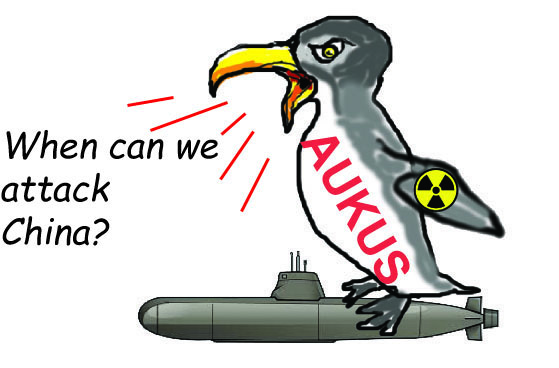
AUKUS is emblematic of a belligerence that is at odds with moral and ethical demands for the future. It posits a vision of military aggression and confrontation that increase the risk of war and war turning nuclear; and concedes authoritarianism and lack of debate as defining principles for the present
AUKUS an unwelcome guest at the table of nuclear disarmament, Pearls and Irritations,
By Sanjay BarboraJan 16, 2022 Despite many shortcomings, the Non-Proliferation Treaty remains a symbol of an inconsistent effort to ensure a world without threats of nuclear war.
The 2022 Review Conference (RevCon) of the Parties to the Nuclear Non-Proliferation Treaty (NPT) which was to meet from January 4 to 28 in New York has been postponed because of the resurgent virus. Consultations are under way to set a new meeting time.
………………As governments and civil society consider their priorities for the review conference, what then are we to expect? This question assumes greater significance for Australia, as the country’s leaders respond to the changing climate following the hastily announced AUKUS trilateral pact for the supply of nuclear-powered submarines to Australia in 2021.
Three closely related aspects ought to be considered by the country’s decision makers as they address the review conference. They are (a) Australia’s commitment to international obligations, (b) security implications of the proposed AUKUS submarines, and (c) reactions within civil society, either as they exist now or as may be anticipated in the future.
………………. In the past, Australia’s stated position was to aim for greater accountability from the Nuclear Weapons States (NWS), while widening the scope of non-nuclear weapons states (NNWS) to pursue the development of domestic nuclear energy. However, this position was undermined by its active opposition to and attempts to derail the Treaty on the Prohibition of Nuclear Weapons (TPNW) adopted by the UN General Assembly in 2017.
A decision to acquire nuclear-powered submarines under the AUKUS partnership would threaten this fraught history with further uncertainties. It would offer the United States an even greater say in Australian foreign policy in the Asia-Pacific-Indian Ocean region.
The specious defence that eight-nuclear propelled submarines do not constitute a breach of Australia’s commitment to nuclear disarmament and non-proliferation has two obvious problems.
Firstly, politicians and political commentators have made it clear that current tensions with China have played a substantial role in the current government’s decision to override earlier agreements for creating domestic capacities to build submarines with French support.
Secondly, this dystopian vision of a future world of nuclear showdowns could encourage governments of other NNWS in the region and elsewhere to follow a similar disingenuous narrative for nuclear militarisation.
In any case, the pathway from civil use to military weaponisation remains an issue of concern, that any sovereign country might follow. This could undo several decades of Australian diplomacy that sought to place the country as a reliable partner for securing peaceful policies and development in the Asia-Pacific-Indian Ocean region.
AUKUS is emblematic of a belligerence that is at odds with moral and ethical demands for the future. It posits a vision of military aggression and confrontation that increase the risk of war and war turning nuclear; and concedes authoritarianism and lack of debate as defining principles for the present…………..
The NPT Review Conference, therefore offers an opportunity to revive Australian civil society’s responsibility to reiterate its commitment to regional and global peace and a world free of nuclear weapons.
Professor Sanjay Barbora, Tata Institute of Social Sciences, India, is a Research Affiliate with the University of Melbourne’s Initiative for Peacebuilding. This article was stimulated by a closed-door roundtable discussion, “Would AUKUS undermine the NPT?” hosted by the Initiative for Peacebuilding on December 10. https://johnmenadue.com/aukus-an-unwelcome-guest-at-the-table-of-nuclear-disarmament/
Despite war-mongering Peter Dutton, a Defence review finds it not necessary to overturn Darwin port agreement with Chinese company

No security issues over Darwin port lease, A Defence review has found no national security grounds to recommend the federal government overturn the 99-year lease of the Port of Darwin to Chinese company Landbridge. https://www.canberratimes.com.au/story/7565412/no-security-issues-over-darwin-port-lease/ DECEMBER 29 2021 The national security committee of cabinet has considered the review it commissioned to re-examine the 2015 agreement under which Landbridge won the bid to operate the port in a deal worth $506 million, The Australian reports. Defence Minister Peter Dutton had pushed the review amid deepening tensions between Beijing and Canberra. The government is still reviewing the matter but the Defence review recommendation makes it more difficult for it step in and overturn the port lease. Scott Morrison has said the port lease was “undertaken by the former Territory government and it was not a lease that was approved by the federal government – it was not”.He also said the government would only act in relation to the port lease “if there is advice from the Defence Department or our security agencies that change their view about the national security implications of any piece of critical infrastructure”. The defence department also undertook a review of a Chinese company acquiring 50 per cent of shares in the Port of Newcastle back in March 2018 and found no concerns with the transaction. |
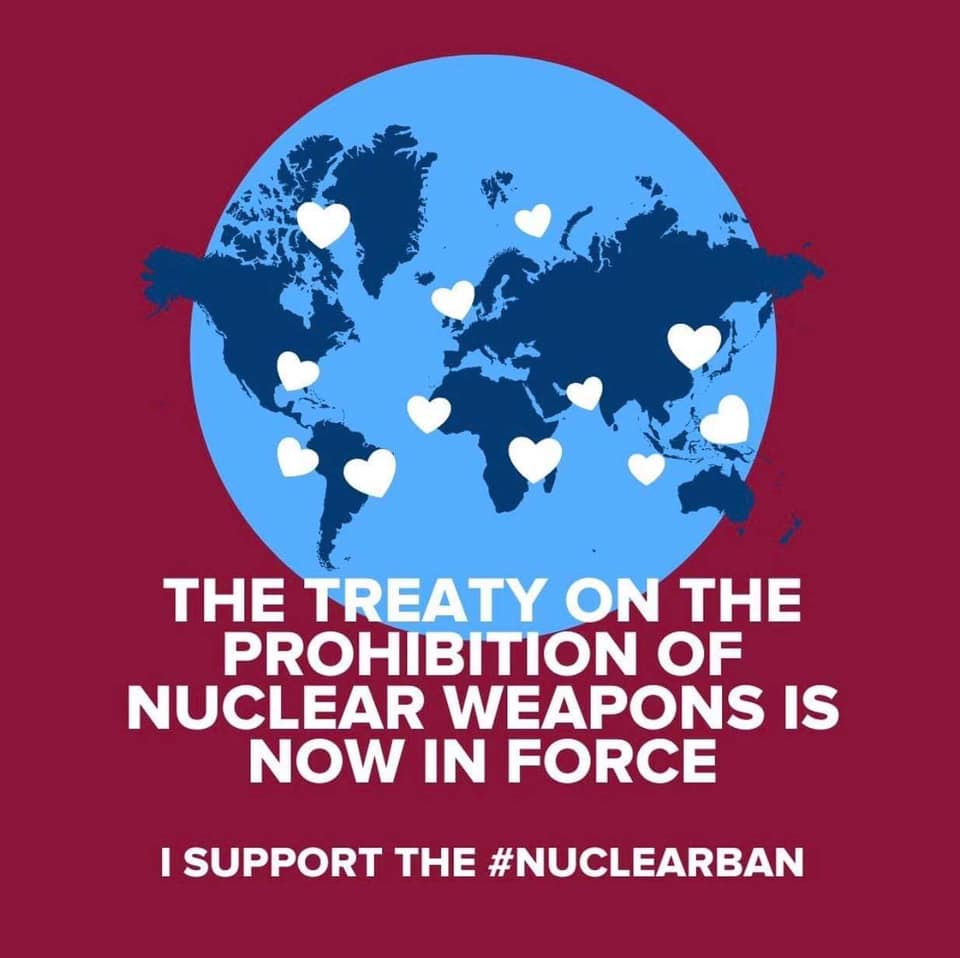
Australians, like other nationalities, need to put pressure on their government to join the UN Treaty on the Prohibition of Nuclear Weapons (TPNW)
Nuclear weapons free future https://www.echo.net.au/2021/12/nuclear-weapons-free-future/ ByThe Echo Mick & Deborah Stacey, Ballina , December 26, 2021 Whilst the federal government is ‘rattling sabres’, and spending more on so-called defence, the movement to abolish nuclear weapons is gathering momentum.
There are now 58 countries who have ratified the UN Treaty. Boston, New York City and Minneapolis have joined the ICAN Cities Appeal, along with Ballina, Byron Bay and Lismore.
New York City have begun divesting public pension funds from nuclear weapons companies, as have a major Australian superannuation fund and the first Finnish pension fund. The Financial Times wrote a story about how weapons companies are starting to be impacted by this growing pressure from investors.
The first meeting of State Parties to the UN Treaty on the Prohibition of Nuclear Weapons (TPNW) will take place at the United Nations in Vienna, 22–24 March, 2022.
Sweden, Finland, Switzerland, Germany and Norway are not yet ready to join the TPNW, but they have already announced they will attend the meeting as observers. So, it is up to us to put pressure on our government (whoever they may be) to do likewise.
Check out: www.ICANW.org. Here’s to a safe nuclear weapons free future.
Independent MP Andrew Wilkie implores the Prime Minister to pick up the phone to the US president and UK prime minister to end the prosecution of Julian Assange.
MP urges PM to pick up phone over Assange, https://www.mandurahmail.com.au/story/7548246/mp-urges-pm-to-pick-up-phone-over-assange/?cs=9397Dominic Giannini
MP urges PM to pick up phone over Assange, https://www.mandurahmail.com.au/story/7548246/mp-urges-pm-to-pick-up-phone-over-assange/?cs=9397
- Dominic Giannini 12 Dec 21
Independent MP Andrew Wilkie has implored the prime minister to pick up the phone to the US president and UK prime minister to end the prosecution of Julian Assange.
The former intelligence analyst said the prosecution of Mr Assange has always been political which meant it could be solved politically by Prime Minister Scott Morrison.
“The reality is this has always been an intensively political matter and it can be solved politically by Scott Morrison picking up the phone to Joe Biden and Boris Johnson,” Mr Wilkie told the ABC.
It comes after reports the 50-year-old WikiLeaks founder suffered a stroke in prison in October.
“Jail is killing Julian Assange,” Mr Wilkie said.
“There is no way he will survive continued incarceration in the UK.”
Mr Assange has just suffered a legal blow after the UK High Court ruled he could be extradited to face charges in the US.
Mr Assange’s lawyers say they intend to appeal the decision in the UK’s highest court.
PM under pressure to end Assange ‘lunacy’
PM under pressure to end Assange ‘lunacy’ Blue Mountains GazetteMarty Silk and Tiffanie Turnbull
PM under pressure to end Assange ‘lunacy’ Blue Mountains Gazette
11 Dec 21, The federal government has “raised the situation” of WikiLeaks founder Julian Assange’s confinement with the UK and US, but has stopped short of calling for the Australian to be released.
The 50-year-old is wanted in the US over the publishing of thousands of secret US diplomatic and military files, some of which revealed war crimes in Iraq and Afghanistan.
Assange is also accused of trying to recruit hackers to provide WikiLeaks with classified US information, and if found guilty could face up to 175 years’ imprisonment……………
Assange’s lawyers intend to challenge the court’s ruling with another appeal, this time in the UK’s Supreme Court.
Federal Independent MP Andrew Wilkie is calling on Prime Minister Scott Morrison to “end this lunacy” and demand the US and UK allow Assange to be released.
“Mr Assange should be looking forward to spending Christmas with his two young boys and his fiancee, but instead he’s facing a 175-year jail sentence and the very real possibility of living out his final days behind bars,” he said in a statement.
“He is a hero, not a villain, and journalism is not a crime.
“Again the United Kingdom proves it’s a lackey of the United States and that Australia is delighted to go along for the ride.”
The Department of Foreign Affairs and Trade said it respected the UK legal process and Australia was not a party to the case………..
The UK court’s decision has drawn ire from the United Nations’ special rapporteur on torture, Nils Melzer, who sharply criticised the verdict.
“This is a shortcoming for the British judiciary,” Mr Melzer told the DPA news agency on Friday.
“You can think what you want about Assange but he is not in a condition to be extradited,” he said, referring to a “politically motivated verdict”.,,,,,,,,,,,,,,,,
How the military-industrial complex has captured Australia’s top strategic advisory body

AUSTRALIA CAPTURED – How the military-industrial complex has captured Australia’s top strategic advisory body, MICHELLE FAHY, DECLASSIFIED AUSTRALIA 9 DECEMBER 2021
The Australian Strategic Policy Institute has veered away from its founding vision of providing an array of independent diverse views, to now promote an aggressive militaristic solution to the heightened tensions in Australia’s region.
The Australian Strategic Policy Institute (ASPI) in Canberra is the government’s primary source of outside-government advice, research and analysis on military and strategic affairs. Since its establishment in mid-2001, it has veered away from its founding vision.
There is a jarring disconnect between the lofty goals of independence expressed in ASPI’s charter, and the infiltration of ASPI by tentacles of the military-industrial complex. This has been barely mentioned in Australia’s mainstream media.
A Declassified Australia investigation has uncovered a casebook example of ‘state-capture’, with the development of deep connections between ASPI, and the world’s largest and most powerful military weapons manufacturers.
Australia is a significant participant in the global arms trade at present. Its $270-billion decade-long spending spree upgrading weapons and war machines is large by international standards, and Australia is increasingly becoming an arms seller too. As Australia moves militarily ever closer to the US, even defence insiders say the defence industry is ‘awash with money’.
The wars in Iraq, Afghanistan, Syria and Yemen have made the world’s biggest weapons manufacturers richer, larger, and more influential. At the lesser-known end of the spectrum, the Yemen war is notable for its extensive human rights abuses and war crimes: it has created the world’s largest humanitarian crisis. Despite pleas from the UN, the arms still flow and the war continues. The weaponry for this war has been supplied by the world’s top arms manufacturers, including Lockheed Martin, BAE Systems, Boeing, and missile-maker Raytheon.
ASPI and the Weapons Lobby
The Australian subsidiaries of these and other global weapon-makers have been regular ASPI sponsors for years. Some of them have successfully used the back door to gain access to ASPI’s top table, its governing council. ASPI council members have included former senior military officers, defence ministers, and federal MPs who are also on arms and cyber company boards. It has also included former and current arms industry executives. The challenge to ASPI’s independence is large and real.
ASPI’s founding charter, since it was established in 2001 by then prime minister John Howard with bipartisan support from Labor leader Kim Beazley, declares it must ‘operate independently of Government and of the Defence Organisation’.
Further, it states that ‘the perception, as well as the reality, of that independence would need to be carefully maintained’. Thus, from the outset, the government was acknowledging how such an important think tank would be vulnerable to capture by vested interests, both ideological and commercial………..
Our investigation shows that the ASPI council has numerous members who represent or have close links to the military-industrial complex. Of the 11 non-executive directors on ASPI’s governing council, five sit on the boards or advisory boards of weapons or cybersecurity corporations, while numerous past council members have had similar connections.
The current council includes former Howard defence minister Robert Hill. He’s on the supervisory board of German weapon-maker Rheinmetall’s Australian subsidiary, which is supplying Defence’s $5 billion of Boxer combat reconnaissance vehicles, and will soon also produce and export ammunition for the US Joint Strike Fighter program. Hill is also chair of Viva Energy Group, a major supplier of fuel to the Australian Defence Force (ADF)…………………….
Declassified Australia put questions to ASPI and the current council members. Dr Nelson declined to comment. No other council member responded by deadline. ASPI replied saying it manages conflict of interest matters in line with other Australian proprietary limited companies, and that ‘Council members will recuse themselves from discussions which may give rise to the perception of a conflict of interest matter’.
ASPI has a history of council members with interests in the defence industry. Jim McDowell was chief executive of BAE Systems in Australia for a decade, and then ran BAE in Saudi Arabia, where the Saudi military has since used BAE arms in the catastrophic war in Yemen. Returning to Australia, he was engaged by Liberal defence industry minister Christopher Pyne, and Defence, on numerous sensitive defence projects while also on ASPI’s Council. BAE Systems is in the running to provide Australia’s planned nuclear-powered submarines under the AUKUS pact.
Former Labor senator Stephen Loosley’s Council membership, including seven years as chair, coincided with board roles at French arms multinational Thales Australia, manufacturer of the Austeyr, the service rifle for all the Australian military, as well as armoured vehicles, submarine sonars and munitions. The Thales group has been accused of selling weapons to the Indonesian military who are running a war in West Papua against the independence movement.
Former Labor defence minister Kim Beazley was an ASPI distinguished fellow for two years in 2016-2018. For the majority of that time he was on the board of Lockheed Martin Australia while writing regularly for ASPI, without ASPI disclosing his board position at Lockheed.
………..ASPI’s independence is drawn into question not just by its board appointees but also by some research fellows. One recent example is the former director of cyber, intelligence and security at BAE Systems Applied Intelligence, Rajiv Shah, who cowrote a report on collaboration within the intelligence community that was sponsored by BAE Systems. Shah is now an ASPI fellow and a consultant to government and industry. ASPI does not disclose either in the report nor in his website bio Shah’s previous employment with BAE Systems, one of the world’s top 10 arms companies. Dr Shah did not respond to questions.
Declassified Australia does not imply any illegality by any past or present ASPI council members, fellows, or staff. The issue is the deep involvement of people associated with global weapons manufacturers, and the potential for, and perception of, conflicts with ASPI’s charter of independence.
The Reshaping of ASPI
At its foundation, the ASPI Council was instructed by the government to ensure its independence. As set down by the defence minister, it is required not only to be ‘politically non-partisan’ but also, most crucially, to ‘reflect the priority given to both the perception and substance of the Institute’s independence’.
The Howard government had envisaged that ASPI would do this by maintaining a ‘very small’ permanent staff while relying mostly on short-term contracts, secondments and similar arrangements for its research work. It would not publish views in its own name but would provide a forum for the views of a wide variety of outside experts.
20 years on, ASPI has morphed into a very different organisation.
A decision by Labor prime minister Kevin Rudd to make Stephen Loosley the ASPI Council chair in 2009, while Loosley was on the Thales Australia board, tested perceptions of independence. Then, in 2012, the Gillard Labor government appointed the current executive director directly from the senior position of Deputy Secretary of Strategy in the Defence Department. In the late 90s, Peter Jennings had been chief of staff to Liberal defence minister Ian McLachlan when the Howard Government first mooted the idea of creating ASPI.
Under this new leadership, ASPI set about expanding. Staff numbers have quadrupled in nine years from 14 to 60, plus there are now 29 research fellows and nine interns.
ASPI receives its core funding via a grant from the Defence Department. In 2018, the Morrison government approved a $20 million grant to cover five years’ of ASPI operations. In May 2021, this grant was increased by $5 million to cover two years of operations of a new Washington DC office.
Since 2012, ASPI has vigorously pursued additional funding. Within two years, annual income from commissioned research jumped from $37,000 to $1.1 million, and sponsorships were up 235% to $746,000. ASPI’s own-sourced revenue has continued to grow dramatically. In 2011-12, ASPI received less than $500,000 above its base funding, by 2020-21 it had exploded to $6.7 million.
The single largest source of ASPI’s funding in 2020-21, beyond its core funding, was from the US Government’s Departments of Defense and State ($1.58m), followed by additional funding from Defence ($1.44m) and other federal government agencies ($1.18m). The NSW and Northern Territory governments provided $445,000. In the private sector, the largest source was social media, tech and cybersecurity companies ($737,362), with Facebook ($269,574), Amazon ($100,000) and Microsoft ($89,500) being the largest. From the arms industry, ASPI received $316,636, with more than two-thirds of that coming from two of Australia’s largest defence contractors, Thales ($130,000) and BAE Systems ($90,000).
In 2019-20, Twitter gave ASPI $147,319 for its cyber research. Significantly, Twitter last week announced a partnership with ASPI said to be dealing with misinformation from the Chinese communist party that was seeking to counter evidence of human rights abuses in Xinjiang. As a result of ASPI’s research, thousands of “state-linked accounts” were shut down by Twitter.
While the cash from the arms industry may not appear substantial, as we have seen, the arms industry wields its major influence via its representatives finding their way on to seats at the top table.
The substantial extra funding from the US government, Defence and other Australian government departments, as well as corporate interests, provides a real challenge to ASPI’s responsibility to remain independent. It raises serious questions about undue influence, including foreign influence, at ASPI.
ASPI responded to our questions about protecting the perception of its independence by saying it retains ‘complete editorial independence on the material we choose to research’. It said it would not accept funding from parties attempting to constrain its editorial independence.
But just what does the US government get in return for its $1.57 million funding of ASPI, beyond its research projects on human rights violations, disinformation, and cybersecurity in China?
And what might BAE Systems get for its $90,000 grant to ASPI, other than a new report on the need for a ‘collaborative and agile’ intelligence community?
And what about Thales Australia, in return for its $130,000 grant to ASPI, beyond just being lead sponsor of the 2020 ASPI Conference?
The answer for them all, is ‘influence’.
ASPI’s role in advising the Australian government on defence strategy and procurements and cybersecurity would better serve the Australian people if it was to return to its original charter of researching and publishing a diversity of views from a position of uncompromised independence.
MICHELLE FAHY is an independent writer and researcher, specialising in the examination of connections between the weapons industry and government, and has written in various independent publications. She is on twitter @FahyMichelle, and on Substack at undueinfluence.substack.com https://declassifiedaus.org/2021/12/09/australia-captured/?fbclid=IwAR0_MMo3hIrY7uDHK4d2l5M-nxdsGBFyA_6Xtim8jxjotqPkMXmFheeGNWM
1 This month

of the week – Australians for War Powers Reform (AWPR)
To see nuclear-related stories in greater depth and intensity
 Antinuclear