Bizarre twists in USA’s war on Julian Assange and Wikileaks
Britain’s Guantanamo: is Julian Assange a terrorist? https://www.michaelwest.com.au/britains-guantanamo-is-julian-assange-a-terrorist/ By Gary Lord|October 18, 2021
As Julian Assange prepares to face a British court for possibly the last time, threatened with up to 175 years detention in a US supermax prison, journalist Gary Lord, explores the latest bizarre twists in the US effort to extradite the Wikileaks founder and the silence of global media.
Julian Assange likes to say that censorship is “always an opportunity” that should be welcomed because it indicates that “there is something worth looking at”. He also says that it is a sign of weakness because it “reveals a fear of reform”.
So it’s interesting that recent bombshell stories about Assange himself are being censored by global media giants. As the WikiLeaks founder prepares to face a British court for possibly the last time on October 27, threatened with up to 175 years detention in a US supermax prison, perhaps this media censorship is something worth looking at?
wo major stories have emerged since a UK judge ruled against Assange’s extradition to the United States (on health grounds only) at the start of this year.
Firstly, Icelandic media revealed in June that the US prosecution’s prize witness, a convicted pedophile and fraudster who has since been jailed, had withdrawn his testimony against Assange.
Sigurdur Thordarson, who worked for Wikileaks in 2010 but embezzled over $50,000 from the organization, admitted to fabricating key accusations in the US indictment. This important story was almost totally ignored by global media.
Secondly, some 30 anonymous US officials recently confirmed that CIA boss Mike Pompeo, US President Donald Trump, and other staff “at the highest levels” of the Trump administration actively discussed assassinating Julian Assange, and even enlisted UK government support to shoot out airplane tyres if required.
The US government officially designated WikiLeaks a “non-state hostile intelligence service” in order to provide legal cover for any violent action, with “sketches” including possible shootouts with Russian agents on the streets of inner London.
The USA’s FAIR media watch group investigated the extraordinary lack of media coverage this astonishing revelation received, noting that “BBC News, one of the most-read news outlets in the world, appears to have covered the story just once — in the Somali-language section of the BBC website”.
The New York Times, the Washington Post, and many other major media outlets totally ignored it. The Guardian published just two articles about it; by comparison, they devoted 16 articles to alleged Russian government attempts to murder Alexei Navalny.
Sadly, this media censorship of Assange is not new, even if it does appear to be reaching new heights of absurdity. Another widely ignored story is the relentless and invasive spying on Assange and his visitors – including lawyers, family and journalists – while he was in the Ecuadorian embassy.
A Spanish court is currently investigating allegations that UC Global, the company that supposedly provided “security” at the behest of the Ecuadorian government, was secretly working for the CIA as a client of former Las Vegas casino mogul Sheldon Adelson, a major supporter of Donald Trump.
Max Blumenthal first reported back in May 2020 that these spies also discussed plots to kidnap or poison Assange.
A “fix” or media apathy?
How to explain the widespread lack of mainstream media interest in such shocking news stories which could easily be given front page importance?
Are we to assume that “the fix is in”? Is this part of a deliberate effort to suppress public support for Assange, ahead of his inevitable extradition? If so, who is behind it, and what does it say about the politicisation of the British court system, never mind global media organisations? If not, how else can we understand it?
It’s well known that Assange fell out with many of his old media partners following the 2010 Cablegate publications, but most of those journalists still argue that the Australian should not be extradited for the “crime” of journalism.
Editorials in the Guardian, New York Times, the Sydney Morning Herald and other newspapers have called for the US extradition case to be dropped. But the media fraternity’s “support” for Assange has never extended to a full-blown campaign, such as we saw when (for example) Peter Greste was jailed.
In fact, there has been a remarkable lack of Western media interest in Assange’s court case – coupled with smears, lies and poor reporting – for over a decade.
Italian journalist Sefania Maurizi, who has worked closely with WikiLeaks for many years, appears to be the only journalist who bothered to lodge Freedom of Information requests about the Assange case with the British and Swedish governments.
A “non-state hostile intelligence service”
She discovered that the Crown Prosecuting Service, which was then controlled by Sir Keir Starmer (now UK Labour Party leader), advised Swedish prosecutors not to come and question Assange in London, and not to “get cold feet” and close the case. “Please do not think this case is being dealt with as just another extradition,” they wrote – then they deleted all their emails!
In Australia, lawyer Kellie Tranter has been putting Aussie journos to shame by lodging her own FOI applications and sharing the results. Maurizi also has FOI applications lodged with the Australian and US governments, but they have been stalled for years with no explanation.
Assange and WikiLeaks still enjoy huge public support around the world. So why don’t big media organisations want more online clicks from readers digging into these amazing stories?
A clue may come from the CIA’s determination to get WikiLeaks officially designated a “non-state hostile intelligence service”. This legal designation would surely make media reporting on WikiLeaks the subject of increased government attention and maybe even censorship.
All the AUKUS countries have now adopted extreme new “anti-terror” laws that include Orwellian restrictions on the media. Maybe it’s time for AUKUS journalists to ask whether WikiLeaks is also officially designated a “non-state hostile intelligence service” in Canberra and London?
Is it possible that Julian Assange – who has been held in “Britain’s Guantanamo Bay” since 11 April 2019 – has been secretly defined as some new form of “information terrorist“? And if so, would our media today even be allowed to report it? Gary Lord is the author of Julian Assange biography “Wikileaks: a True History“
AUKUS nuclear submarines deal must be abandoned
AUKUS nuclear submarines deal must be abandoned, Pearls and Irritations, By Brian TooheyOct 13, 2021
Australia doesn’t need nuclear powered submarines, especially given the Australia’s long-standing support for the world’s nuclear non-proliferation goals.
The White House failed to think beyond its Anglo-Saxon allies in London and Canberra when agreeing to sell Australia eight nuclear submarines.
The US’s north Asian allies Korea and Japan are much closer to China and more at risk, however slight. The Japan Times responded with a cool headed article spelling out the folly of the decision. It said the US, “has put at risk long-standing but fragile global pacts to prevent the proliferation of dangerous nuclear technologies”.
It also reported that US Navy ships “use about 100 nuclear bombs worth of Highly Enriched Uranium (HEU) each year”.
Although the US or the UK is supposed to build Australia eight nuclear-powered attack submarines under as new agreement called AUKUS, there is no realistic way this can occur without trashing Australia’s long-standing support for the world’s nuclear non-proliferation goals.
One of the key problems is the US Navy insists it is essential to use uranium enriched to 93 per cent to obtain the main fissile isotope of U-235, the same level as in nuclear weapons. It also insists it couldn’t switch to low levels of enrichment without greatly increasing the costs and size of the submarines as well as the construction time.
This means the US Navy will reject Malcolm Turnbull’s suggestion to get the French to supply non-weapons grade fuel. The British can’t help as they get their HEU fuel from the US. The enrichment to 93 per cent compares to around 40 per cent for Russian and Indian submarines. The French only enrich to 7.5 per cent, China to about 5 per cent and civilian power reactors to around 3.5 per cent. Anything less that 20 per cent is defined as low level enrichment.
The White House’s attitude has changed since the 1980s when the US blocked Canada’s attempts to buy nuclear submarines from the UK or France.
Nevertheless, some members of the US Congress and senior officials want the navy to shift to low enrichment to eliminate proliferation problems.
A nuclear problem
In a letter to The New York Times, former US undersecretary of state for arms control and international security Rose Gottemoeller said the proposal to share HEU-fuelled submarines with Australia “has blown apart 60 years of US policy” designed to minimise the use of HEU uranium.
“Such uranium makes nuclear bombs, and we never wanted it in the hands of non-nuclear-weapon states, no matter how squeaky clean,” she said.
Of the seven nuclear weapons states, five have nuclear submarines. Australia will be the first non-nuclear weapons state to get nuclear submarines. The understandable concern is that other allies will want similar treatment, expanding the risk that weapons grade uranium will be stolen or diverted.
In some interpretations, a loophole exempts naval nuclear reactors from the International Atomic Energy Agency’s anti-proliferation requirements.
But there are numerous other agreements that Australia might have to comply with if it stores HEU in its submarines.
In addition, the AUKUS agreement includes Australian access to other technologies, including Tomahawk long-range cruise missiles for the navy’s Hobart-class destroyers. Because the Tomahawk can be armed with nuclear or conventional explosives, this could make it difficult to comply with the Missile Technology and Control Regime which Australia has strongly backed.
Another hurdle stems from the Howard government’s passage of a parliamentary act in 1999 outlawing just about all nuclear activities, apart from mining and exporting uranium. If circumstances prevent the US from maintaining all the nuclear aspects of Australia’s future submarines, this might spark calls for the rapid construction of nuclear facilities here. But the necessary amendments to the 1999 act could be blocked in the Senate.
Prime Minister Scott Morrison can’t credibly commit Australia to never engaging in nuclear proliferation. In the 1960s, Liberal prime minister John Gorton took preliminary steps to develop Australia’s own nuclear weapons, explaining to the US secretary of state Dean Rusk that he did not trust the US to defend Australia if it had to use nuclear weapons. A prime minister sharing Gorton’s assessment could emerge at any time.
Perhaps the White House will overrule the navy after a protracted battle to ensure the new submarines use low enrichment uranium posing no proliferation problem.
Nuclear submarines are not essential
However, the deal would still make no sense for Australia.
Government sources are widely quoted as saying the cost of the new submarines will be well over $100 billion, yet the first one won’t be operational until after 2040 and the last until after 2060. By then, the submarines would be obsolete death traps, susceptible to detection and destruction by several existing and new technologies.
The time scale reinforces the entire air of unreality about acquiring these submarines, only a couple of which may be operationally available at any one time.
Some commentators suggest Australia must buy the submarines to help the US counter a Chinese threat to Taiwan.
But no one knows what will happen to China or the US in a radically uncertain future. By 2060, China may be the dominant country in Asia, it may have returned to its earlier policy of living in Confucian harmony with its neighbours………………..
 |
Deathly Silence: Journalists Who Mocked Assange Have Nothing to Say About CIA Plans to Kill Him
Deathly Silence: Journalists Who Mocked Assange Have Nothing to Say About CIA Plans to Kill Him https://fair.org/home/deathly-silence-journalists-who-mocked-assange-have-nothing-to-say-about-cia-plans-to-kill-him/, JOHN MCEVOY,YAHOO! NEWS (9/26/21) A BOMBSHELL REPORT DETAILING THE US CENTRAL INTELLIGENCE AGENCY’S “SECRET WAR PLANS AGAINST WIKILEAKS,” INCLUDING CLANDESTINE PLOTS TO KILL OR KIDNAP PUBLISHER JULIAN ASSANGE WHILE HE TOOK REFUGE IN THE ECUADORIAN EMBASSY IN LONDON.
Following WikiLeaks‘ publication of the Vault 7 files in 2017—the largest leak in CIA history, which exposed how US and UK intelligence agencies could hack into household devices—the US government designated WikiLeaks as a “non-state hostile intelligence service” (The Hill, 4/13/17), providing legal cover to target the organization as if it were an adversarial spy agency.
Within this context, the Donald Trump administration reportedly requested “sketches” or “options” for how to kill Assange, according to the Yahoo! expose (written by Zach Dorfman, Sean D. Naylor and Michael Isikoff), while the CIA drew up plans to kidnap him. (Assange was expelled from the embassy in 2019 and has since then been in British prison, fighting a demand that he be extradited to the US to face charges of espionage—FAIR.org, 11/13/20.)
Shortly after publication, former CIA director Mike Pompeo (Yahoo! News, 9/29/21) seemed to confirm the report’s findings, declaring that the former US intelligence officials who spoke with Yahoo! “should all be prosecuted for speaking about classified activity inside the CIA.”
Ghoulish indifference
It would seem that covert plans for the state-sanctioned murder on British soil of an award-winning journalist should attract sustained, wall-to-wall media coverage.
The news, however, has been met by Western establishment media with ghoulish indifference—a damning indictment of an industry that feverishly condemns attacks on press freedom in Official Enemy states.
BBC News, one of the most-read news outlets in the world, appears to have covered the story just once—in the Somali-language section of the BBC website (Media Lens on Twitter, 9/30/21).
Neither the New York Times or Washington Post, two of the world’s leading corporate news organizations, have published any articles about Assange since July 2021.
To its credit, since the story first broke on September 26, the Guardian has reported twice on the CIA-led conspiracy to kill or kidnap Assange. But to offer perspective, during the week after Russian opposition figure Alexei Navalny was reported to have been poisoned by the Russian government, the Guardian published 16 separate pieces on the issue, including video reports and opinion pieces.
Similarly, a Nexis search of British newspapers for the word “Navalny” brings up 288 results from August 20–25, 2020. The same search for “Assange” between September 26–October 1, 2021, brings up a meager 29 results—one of which, a notable exception, was a Patrick Cockburn piece in the Independent (10/1/21).
Crucial relief
As is typical of stories that embarrass the Western intelligence services, independent media provided crucial relief to the backdrop of chilling indifference, with the Grayzone’s Aaron Maté (YouTube, 9/30/21) conducting a rigorous interview with one of the report’s authors, Michael Isikoff.
Indeed, the Grayzone (5/14/20) was the first outlet to provide evidence of a CIA-linked proposal to “kidnap or poison Assange” in May 2020. The story, however, was almost universally ignored, suggesting that, as Joe Lauria wrote in Consortium News (10/2/21), “until something appears in the mainstream media, it didn’t happen.”
One thing the corporate media cannot be accused of with regards to Assange, however, is inconsistency. After a key witness in the Department of Justice’s case against the publisher admitted to providing the US prosecution with false testimony, a detail that should
ordinarily turn a case to dust, the corporate media responded by ignoring the story almost entirely. As Alan MacLeod wrote for FAIR.org (7/2/21):
The complete uniformity with which corporate media have treated this latest bombshell news raises even more concerns about how fundamentally intertwined and aligned they are with the interests of the US government.
Even after it was revealed that the UC Global security firm that targeted Assange had also spied on journalists at the Washington Post and New York Times, neither outlet mounted any
protest (Grayzone, 9/18/20).
Perhaps most remarkably, UK judge Vanessa Baraitser relied on a falsified CNN report (7/15/19) to justify the CIA’s spying operation against Assange (Grayzone, 5/1/21). Now, CNN’s website contains no reports on the agency’s plans to kill or kidnap Assange.
The prevailing silence has extended into the NGO industry. Amnesty International, which refused in 2019 to consider Assange a prisoner of conscience, has said nothing about the latest revelations. Likewise, Index on Censorship, which describes itself as “The Global Voice of Free Expression,” hasn’t responded to the story.
The establishment media’s dismissal of Assange supports Edward Herman and Noam Chomsky’s framework of “worthy” and “unworthy” political dissidents, with Assange situated firmly in the latter camp.
The present circumstances become even more deplorable upon consideration of the corporate journalists who arrogantly diminished, or even delighted in, Assange’s concerns for his own safety.
Continue readingUS and UK begin jostling to supply Australia with nuclear submarine fleet
US and UK begin jostling to supply Australia with nuclear submarine fleet, ABC By defence correspondent Andrew Greene‘ 10 Oct 21, ‘……….In 2021, the Australian Defence Force is again considering what role the Royal Navy could play in developing its next submarines, or whether like many modern acquisitions, it will focus on interoperability with American technology.
Under the AUKUS partnership struck in September, the leaders of the United Kingdom and the United States have agreed to work with Australia on how to build a new class of nuclear-powered submarines.
Over the next 18 months, the Nuclear-Powered Submarine Task Force inside the Department of Defence will lead a study into the numerous regulatory issues involved in the ownership and operation of nuclear-powered boats.
While the design is not yet known, or what the criteria will be, for many commentators the existing British Astute-class is emerging as an early favourite for Australia to replace the Collins-class fleet
Others inside the defence industry believe any nuclear-powered Australian submarine will need to be an American boat, based on the Virginia-class so that it can be serviced at nearby US bases in Guam or Japan.
Both the British and US options have various advantages and disadvantages, which highlight the extraordinarily complex process the ADF faces to select a nuclear-powered submarine — which may never actually eventuate.
Already the regulatory challenges appear significant, as nothing is more complex and costly in the military world than nuclear-powered submarines, particularly for a country with no domestic nuclear industry.
In the United States, an eminent group of former officials and experts has written to President Joe Biden warning the AUKUS deal could threaten national security by encouraging hostile nations to obtain highly enriched uranium (HEU).
Australia insists it will uphold its commitments under the Nuclear Non-Proliferation Treaty, but the engineering sector warns it will be a steep learning curve for the Defence Department.
The now dumped Attack class submarine being designed by France’s Naval Group was based on the Barracuda class, which lost three years in development because of less complex regulatory issues associated with low enriched uranium (LEU).
“This is a very long-term effort that’ll be decades, I think, before a submarine goes in the water,” US Chief of Naval Operations Admiral Mike Gilday predicted last month………… https://www.abc.net.au/news/2021-10-10/us-and-uk-begin-jostling-for-nuclear-submarine-contract/100525756
Nuclear submarine deal needlessly raises tensions — Highly Enriched Fuel a particular danger

World needs to work together, not provoke further conflict
Nuclear submarine deal needlessly raises tensions — Beyond Nuclear International 10 Oct 21, s
Proposed US/UK nuclear-powered submarines for Australia jeopardise health while escalating an arms race no one can win
Joint statement by International Physicians for the Prevention of Nuclear War and its affiliates in Australia, UK and USA: Medical Association for Prevention of War (Australia); Medact (UK); Physicians for Social Responsibility (USA)
Physicians in the countries involved in the proposal announced on 16 September for Australia to acquire nuclear-powered submarines with UK and US assistance are concerned this plan will jeopardise global health and security. Under this proposal, Australia would become the seventh country to use nuclear propulsion for its military vessels, and the first state to do so which does not possess nuclear weapons, or nuclear power reactors. These submarines are to be armed with sophisticated long-range missiles including US Tomahawk cruise missiles. These submarines would increase tensions and militarisation across Asia and the Pacific region, fuel an arms race and risk deepening a new cold war involving China.
The wrong decision at the wrong time
Humanity is in the midst of a major pandemic, and facing twin existential threats of dire urgency — global heating and the growing danger of nuclear war. People everywhere desperately require our leaders to work together to address these major challenges, which can only be solved cooperatively.
Beginning on November 1, the UN Climate Change Conference will be held in Glasgow, when leaders have a choice to condemn humanity to cascading climate catastrophe, or step up and take the decisive and ambitious actions needed to drastically reduce greenhouse gas emissions and keep warming within 1.5 degrees. COVID vaccines are still out of reach for most of the world’s poor people. If ever there was a time to build goodwill and focus on cooperation to complex global problems rather than escalate military confrontation, that time is now.
Our leaders should be focussing their energies not on escalating a new cold war arms race with China, but on building peaceful cooperation to address urgent shared threats with the government of the world’s most populous and largest greenhouse gas emitting nation.
Instead, this plan will raise tensions, make cooperation more difficult, drive proliferation of ever more destructive weapons, divert vast resources needed to improve health and well-being and stabilise our climate, and increase the risks of a slide to armed conflict between the world’s most heavily armed states, risking nuclear escalation in which there can be no winners.
Spreading nuclear bomb fuel
Commendable international efforts over decades to reduce production, use and stockpiles of highly-enriched uranium (HEU) worldwide have been supported by Australia, UK and US, including through the Nuclear Security Summits led by President Obama. In its role as G7 president, the UK has committed to ‘reinvigorate the aim of minimising production and use of Highly Enriched Uranium (HEU)’.
UK and US nuclear-powered submarines use HEU as fuel, which is directly usable in nuclear weapons, including those of the simplest design easiest for terrorists to build. Indeed their current naval reactor fuel is enriched to 93% and was originally produced for use in nuclear warheads. They have resisted and delayed efforts to convert their naval reactors to much less proliferation-prone low-enriched uranium fuel, as France and China have done, and any conversion to LEU is not likely before the late 2030s at the earliest.
So it seems very likely that any Australian nuclear submarines built with US or UK naval reactors over the next 20 years will also use HEU. Precisely because of the proliferation dangers of naval reactor fuel, the US has previously gone to considerable lengths to thwart the spread of naval reactors, such as in the 1980s blocking Canada from buying nuclear attack submarines from France and the UK.
A loophole exists in the international safeguards required under the nuclear Non- proliferation Treaty (NPT): states without nuclear weapons can remove fissile materials (which can be used to build nuclear weapons) from safeguards for a temporary period for use in military applications short of nuclear weapons. No nation has yet done this in relation to naval nuclear reactors.
The quantities of HEU involved are large. As Sebastien Philippe from Princeton University has estimated, a fleet of between 6 and 12 nuclear submarines as proposed, operated for about 30 years, will require between 3 and 6 tons of HEU. The International Atomic Energy Agency (IAEA) stipulates that 25 kg of HEU would enable a nuclear weapon, even though US nuclear weapons are known to contain an average of only 12 kg of HEU.
So HEU fuel for the proposed Australian submarines would involve 120 to 240 times the amount of HEU as the IAEA stipulates is sufficient to build a nuclear weapon, and it could be out of international safeguards for decades. Philippe has aptly characterised this as “a terrible decision for the non-proliferation regime”. It discredits all three nations’ claims to support a treaty curbing fissile materials, and would make such a treaty harder to verify.
The Australian government proclaims its support for strong nuclear safeguards, while falsely claiming that the safeguards obligations in the UN Treaty on the Prohibition of Nuclear Weapons (TPNW) are weaker than those under the NPT 3 (they are, in fact, stronger). Its plan to drive large amounts of HEU in reactors roaming the oceans for decades through a loophole in its safeguards does not indicate good faith on safeguards and non-proliferation.
This proposal needs careful independent scrutiny and strong new safeguards provisions to ensure Australia fulfills its obligations under both the NPT and the South Pacific Nuclear Free Zone Treaty. The latter goes further than the NPT in prohibiting the stationing of any nuclear explosive device in the territory of a state party.
The UK announcement in March of a planned 40% increase in its nuclear arsenal is in breach of its NPT obligations, as the UN Secretary-General has stated. The UK and US are modernising their nuclear arsenals, both in breach of their now 51-year-old legally binding NPT commitment to disarm.
Australia acquiring nuclear-powered submarines could well encourage other states, such as South Korea, Japan and Iran to pursue a similar path. Proliferation of submarines or other vessels with lifespans of several decades that are fuelled by weapons-grade HEU will encourage uranium enrichment, wider use and storage of HEU, and will set back and make more difficult control and elimination of fissile materials…….. https://beyondnuclearinternational.org/2021/10/10/nuclear-submarine-deal-needlessly-raises-tensions/
Press Freedom Groups React to reports of CIA plots to kidnap, assassinate Assange
Australian Gov morally and legally obliged to immediately remove @withMEAA member and Australian citizen Julian #Assange from harm’s way If kidnapping and assassination actively considered by CIA @MarisePayne must act now. This MUST STOP #BringJulianHome
— President of MEAA, director of Walkleys Foundation Marcus Strom
Press Freedom Groups React to reports of CIA plots to kidnap, assassinate Assange https://dontextraditeassange.com/press-clip/press-freedom-groups-react-to-reports-of-cia-plots-to-kidnap-assassinate-assange/?fbclid=IwAR3RQx5yU7u5rLGUStrkGSCpKaD5wYmRDF41isUSEDuLSUjMxmaElsMr6e4 This incredible story strikes right at the heart of the prosecution case against Julian Assange. They have repeatedly asserted that this is not a political case. This shows that it absolutely is, and that the legal attack on Assange came very close to becoming an actual physical assault and kidnapping and possibly an attempted murder. It also shows that the British authorities were willing to participate in this grotesque plan and to participate in gun battles on London streets in pursuit of Assange. British journalists, lawmakers, and citizens must now ensure that the government drops the case against Assange and answers questions about their willingness to participate in illegal acts.
Freedom of the Press Foundation: After shocking story about CIA illegal acts, Biden admin must drop Assange charges immediately.
“The CIA is a disgrace. The fact that it contemplated and engaged in so many illegal acts against WikiLeaks, its associates, and even other award-winning journalists is an outright scandal that should be investigated by Congress and the Justice Department. The Biden Administration must drop its charges against Assange immediately. The case already threatens the rights of countless reporters. These new revelations, which involve a shocking disregard of the law, are truly beyond the pale.” — Executive director Trevor Timm
National Union of Journalists: CIA reportedly plotted to kidnap and assassinate Julian Assange
“I am calling on the UK home secretary to explain whether the security services had any involvement in, or knowledge of, these plans. Furthermore, it is clear that when the US appeal against the dismissal of its extradition application in respect of Assange is heard in October, it should be dismissed out of hand and its subject released at once.” — NUJ general secretary Michelle Stanistreet
Reporters Without Borders: Alarming reported CIA plot against Julian Assange exposed
“If true, these allegations of a CIA threat to Assange’s life are alarming, and underscore the very serious risk he remains at in detention, which would be exponentially heightened if the US is successful in securing his extradition. The exposed alleged plots that could cause severe harm or loss of life to Assange or his associates are threats to press freedom itself. The Biden administration must act immediately to distance itself from these shocking reports of the Trump administration’s actions, close the case against Assange once and for all, and allow for his release from prison before any further harm is caused.” — RSF’s Director of International Campaigns Rebecca Vincent
Defending Rights & Dissent: DRAD Condemns Outrageous CIA Attacks on Assange and Press Freedom
“Regardless of the targets, such actions are illegal and immoral.That the CIA seriously considered resurrecting some of its most criminal tactics of the Global War on Terror and Cold War is cause for serious alarm. That the target was an award winning journalist, however, makes these revelations all the more chilling.” — Defending Rights & Dissent’s Policy Director Chip Gibbons
The International Federation of Journalists: US: CIA reportedly plotted to kidnap and assassinate Julian Assange
“If these accusations are true, it would cast a long shadow over all independent journalism and they would once again prove that extraditing Assange to the United States would put his life at serious risk. We are calling for a full investigation and for the British authorities to release him immediately.” — IFJ General Secretary Anthony Bellanger
IPI – The Global Network for Independent Journalism
The revelation by @YahooNews that the CIA considered kidnapping or assassinating @wikileaks founder Julian Assange is deeply disturbing. IPI reiterates its call on the US government to abandon its prosecution of Assange under the Espionage Act.
ACLU – American Civil Liberties Union
This new report highlights that the prosecution of Julian Assange poses a grave threat to press freedom. We’ll say it again: The government needs to drop its charges against him.
MEAA – Media Entertainment and Arts Alliance
Australian Gov morally and legally obliged to immediately remove @withMEAA member and Australian citizen Julian #Assange from harm’s way If kidnapping and assassination actively considered by CIA @MarisePayne must act now. This MUST STOP #BringJulianHome
— President of MEAA, director of Walkleys Foundation Marcus Strom
Australians for Assange call for help – save our failing democracy, as USA continues, by despicable means, their case against him.
Australians for Assange 11 Oct 21
Dear Friends, John [Julian’s father] is headed back to London for Julian’s appeal trial to be held on the 27th & 28th of October.
Despite the incredible admission of lying by the US key witness, AND also revelations of a CIA plan to kidnap and assassinate Julian in London…the US is continuing with the case…this beggars belief.
We now know the US has been spying, plotting to kill and colluding with a known criminal to manufacture evidence.In John’s own words, “there is a Mount Everest of criminality surrounding Julian…and right at the very peak they even plotted to put poison in his cup…it makes you feel sick.”Everyone’s rights are being crushed and so to our “Justice” systems.
We must act to save what little is left of our democracy.Please help support John through this dark time in our history. Many thanks to those who have contributed already and even several times. The cost to Julian’s family is both emotional and financial…everyone’s help is critical to continue the campaign. WE MUST WIN! https://au.gofundme.com/f/saving-julian-assange
https://www.facebook.com/search/top?q=australians%20for%20assange
Scott Morrison’s bromance with Boris Johnson is being tested, because Morrison might not attend Glasgow climate conference
They have bonded over nuclear submarines at the White House and Welsh lamb washed down with Australian wine in Downing Street — but the budding bromance between Boris Johnson and Scott Morrison is being tested by the Australian prime minister’s reluctance to travel Glasgow for the Cop26
climate change summit.
Morrison has said he has not made a “final decision” on whether to attend the event at the end of the month as it would mean another spell in quarantine for him, just as Australia prepares to reopen its international borders. This excuse has not gone down well in the Johnson camp.
Times 10th Oct 2021
Growing pressure for Australia to scrap the plan for nuclear submarines fuelled by Highly Enriched Uranium (HEU)

Experts warn Joe Biden supplying nuclear submarines to Australia threatens US security
Malcolm Turnbull says reactor not a ‘plug and play’ power pack as former US officials raise national security concerns, Guardian Tory Shepherd, Fri 8 Oct 2021 Malcolm Turnbull says reactor not a ‘plug and play’ power pack as former US officials raise national security concerns.
There is growing pressure on the new Aukus partners to scrap plans to use weapons-grade uranium on submarines.
A group of former US officials and experts has written to the US president, Joe Biden, warning the deal could threaten US national security by encouraging hostile nations to obtain highly enriched uranium (HEU).
At the same time, the former Australian prime minister Malcolm Turnbull says if Australia does buy the submarine reactors without a domestic nuclear industry – and therefore the nuclear expertise – it will be “more plug and pray” than “plug and play”.
The former Nato deputy secretary general Rose Gottemoeller has called on Australia to make a new deal with France to use their uranium, which is not weapons grade. That would heal the rift with France and ease nuclear proliferation fears, she said.
In the letter to Biden, the seven signatories called on him to commit to using low-enriched uranium (LEU), which is what the French use in their submarine program.
“The Aukus deal to supply Australia with nuclear-powered attack submarines fuelled with weapons-grade uranium could have serious negative impacts on the global nuclear non-proliferation regime and thereby on US national security,” wrote the group, which includes former White House officials.
At the heart of their concern is that if Australia, as a non-nuclear country, gets HEU then other countries would use that example to justify their own acquisition of the material.
Iranian officials intimated to the UN that, like Australia, they might want HEU for naval purposes.
France described Australia’s decision to ditch the $90bn submarine project in favour of the Aukus deal as a “stab in the back”, while Australia has argued that switching to nuclear-propelled submarines is strategically necessary.
There will now be an 18-month process to work out the details of the deal, which has come under heavy criticism.
Turnbull told Guardian Australia that the government should have stuck with the French deal, bought an initial three diesel-electric boats, then switched to their LEU technology.
That would be the “honest and straightforward” course, and would speed up the process because crews would already train in a very similar boat.
“(And) we wouldn’t have double-crossed France and destroyed people’s trust in Australia,” he added.
He said one of the reasons Australia had chosen France over Germany and Japan was the possibility of transitioning to nuclear……………
Morrison has said Australia won’t need a nuclear industry because the reactor will be made overseas then put into the Australian-built boat.
Taiwan endorses AUKUS pact, asks Australia for help in war with China
Taiwanese Foreign Minister warns his country is preparing for war with China, asks Australia for help, ABC, by defence correspondent Andrew Greene and Stan Grant 4 Oct 21, Taiwan’s Foreign Minister warns his nation is preparing for war with China and urges Australia to increase intelligence sharing and security cooperation as Beijing intensifies a campaign of military intimidation.
Key points:
- Taiwan’s Foreign Minister Joseph Wu warns of looming war with China and urges closer cooperation with Australia
- Dozens of Chinese military aircraft have flown into Taiwanese airspace in recent days
- Mr Wu has also thanked Australia for supporting Taiwan’s bid to join a new trade pact
Dozens of aircraft from the People’s Liberation Army (PLA) have flown sorties into Taiwan’s Air Defence Identification Zone (ADIZ) since Friday, prompting the self-ruled island to scramble its own military jets.
Speaking to the ABC’s China Tonight program, Taiwan’s Foreign Minister Joseph Wu declared that if the PLA were to launch an actual strike, his democratic state would be ready to repel it……………
Australia does not formally recognise Taiwan diplomatically, but the federal government regularly calls for a “peaceful resolution” of differences between China and the small independent nation through dialogue and without the threat or use of force or coercion.
A communique issued after last month’s AUSMIN meetings between Australia and the United States declared that “both sides stated their intent to strengthen ties with Taiwan, which is a leading democracy and a critical partner for both countries”.
Taiwan endorses new AUKUS pact, won’t seek its own nuclear submarines
Taiwan has also welcomed the recent establishment of the AUKUS strategic partnership between Australia, the United Kingdom, and the United States, as well as the growing activity between the Quad allies, the US, India, Australia and Japan.
……………….The Taiwanese Foreign Minister said that unlike Australia, his nation would not be trying to acquire nuclear-powered submarines, because it has a “different war strategy”.
Defence analyst Professor Clinton Fernandes from the University of New South Wales warns it would be difficult for the US and allies to prevent any invasion attempt by China……….. https://www.abc.net.au/news/2021-10-04/taiwan-preparing-for-war-with-china/100511294
Unknowns about Australia’s proposed nuclear submarines, especially weapons proliferation risks
U.S., UK Pledge Nuclear Submarines for Australia, October 2021 Arms Control Association,
By Julia Masterson, Australia could become the first non-nuclear-weapon state to field a nuclear-powered submarine as part of a new trilateral security partnership with the United States and United Kingdom known as AUKUS. The initiative was unveiled at a joint virtual press conference held Sept. 15.
…………… The United States has shared nuclear submarine propulsion technology only with the UK, a product of a series of Cold War agreements aimed to counter Soviet influence in Europe.
The UK Royal Navy operates three nuclear-powered submarine systems: the Vanguard-class ballistic missile submarine and the Astute- and Trafalgar-class attack submarines. Johnson said the AUKUS partnership will provide “a new opportunity to reinforce Britain’s place at the leading edge of science and technology, strengthening our national expertise.”
Morrison said that Australia will work with Washington and London over the next 18 months “to seek to determine the best way forward to achieve” a conventionally armed nuclear-powered submarine fleet. He also said that the submarines will be constructed “in Australia in close cooperation” with the UK and the United States. The submarines will reportedly be finished in time to be fielded in the 2040s. Early reports suggest Australia may lease U.S. or UK nuclear-powered submarines in the meantime, but the details remain unclear.
At a press conference in Canberra on Sept. 16, Morrison noted that “[n]ext-generation nuclear-powered submarines will use reactors that do not need refueling during the life of the boat. A civil nuclear power capability here in Australia is not required to pursue this new capability.”
A senior Biden administration official appeared to confirm on Sept. 20 that the vessels will be powered with HEU, as UK and U.S. submarines are, when they commented on Australia’s fitness for “stewardship of the HEU.” It remains unclear who would supply Australia with the fissile material necessary to fuel the submarines or whether the nuclear-powered submarines might be provided through a leasing arrangement.
Another unknown is whether the submarine design will be based on existing U.S. or UK attack submarines or an entirely new design. One of the reasons that Australia may lease U.S. or UK vessels in the near term is to “provide opportunities for us to train our sailors, [to] provide the skills and knowledge in terms of how we operate,” Australian Defense Minister Peter Dutton told reporters Sept. 19, suggesting the new submarines may share a similar design.
The AUKUS initiative is not limited to the new submarine project. It will also facilitate the sharing of information in a number of technological areas, including artificial intelligence, underwater systems, and quantum, cyber-, and long-range strike capabilities. Morrison said Australia will also enhance its long-range strike capabilities through the purchase of Tomahawk cruise missiles and extended range Joint Air-to-Surface Standoff Missiles.
………. Australian, UK, and U.S. officials have endeavored to assure the international community that the initiative does not pose a heightened proliferation risk………
Most nonproliferation experts, however, say the concern is not necessarily with Australia’s intentions but the precedent that the nuclear-powered submarine-sharing scheme would set. Although Australia’s new submarines would be conventionally armed, they clearly would be deployed for military use and will reportedly utilize HEU, which can also be used for nuclear weapons………
In a Sept. 21 letter to the editor published in The New York Times, Rose Gottemoeller, former U.S. undersecretary of state for arms control and international security, criticized the proposal to share HEU-fueled submarines with Australia. The proposal, she wrote, “has blown apart 60 years of U.S. policy” designed to minimize HEU use. “Such uranium makes nuclear bombs, and we never wanted it in the hands of nonnuclear-weapon states, no matter how squeaky clean,” she said.
As recently as May 2021, the UK and United States declared that they wanted to “reinvigorate” efforts to minimize the use of HEU, according to the official statement laying out the goals for the G7 Global Partnership Against the Spread of Weapons of Mass Destruction. (See ACT, June 2021.) Reducing the production and use of HEU “enjoys broad support but requires more solid political support,” the statement said.
Senior Biden administration officials have called the decision concerning Australia “a one-off,” implying that similar arrangements would not be made with other U.S. allies.
Despite support for the new initiative among the three capitals, the AUKUS partnership risks undermining U.S. and UK relations with allies, particularly France……………
Paris also cancelled a French-UK defense minister’s summit scheduled for the week of Sept. 20.https://www.armscontrol.org/act/2021-10/news/us-uk-pledge-nuclear-submarines-australia
Russia warns that AUKUS is a ” a great challenge to the international nuclear non-proliferation regime.”
AUKUS deal leaves Russia ‘concerned’ that Australia will have nuclear-powered submarines, ABC 1 Oct 21, Russia says it is concerned that the AUKUS defence agreement between Australia, Britain and the United States will allow Australia to enter the select group of nations that operate nuclear-powered submarines.
Key points:
- Deputy Foreign Minister Sergei Ryabkov said the pact is a challenge to global nuclear non-proliferation
- The EU has delayed free trade talks with Australia for a month but denies it is in retaliation for ripping up a submarine deal with France
- The AUKUS announcement has angered China which has previously questioned Australia’s willingness to improve relations
Currently the United States, Russia, Britain, France and China operate such submarines.
The three-way pact, under which Australia will obtain nuclear submarine technology from the United States, has angered France and concerned China since it was announced………..
We are also concerned about the … partnership that will allow Australia, after 18 months of consultations and several years of attempts, to obtain nuclear-powered submarines in sufficient numbers to become one of the top five countries for this type of armaments,” Mr Ryabkov was quoted as saying by Russia’s TASS news agency.
“This is a great challenge to the international nuclear non-proliferation regime.”
China’s Foreign Minister Wang Yi said earlier in the week that the security pact brings a hidden danger to regional peace, stability and international order.
Foreign ministry spokesman Hua Chunying also questioned whether Australia really cared about improving relations with China.
The defence pact has worried some of Australia’s closer neighbours…………. https://www.abc.net.au/news/2021-10-02/russia-concerned-about-aukus-and-nuclear-submarines/100509258
Australian govt will take 18 months at least to find out if we’re leasing nuclear submarines
Will the RAN lease nuclear-powered submarines? ADM By Max Blenkin | Canberra | 30 September 2021
There’s much we don’t yet know about how we will acquire our new submarines. Even the Government and Defence don’t know, which is why they have launched a task force, led by Vice Admiral Jonathan Mead, to consider the way ahead, reporting back in around 18 months.
There appear to be just two contenders – the US Virginia-class SSN and the British Astute-class SSN, both in-service and in current production.
Of the Astutes, seven are planned, with four in service and two under construction. Boat number one, HMS Astute, was laid down in 2001 with the last, HMS Agincourt, to be commissioned in 2026.
Of the Virginias, 66 are planned, with 19 completed and 11 under construction. The first boat, USS Virginia, was laid down in 1999. No date has been set for the last, but, assuming it happens and the current production schedule is maintained, it’s likely to be in the late 2030s with service life through to the 2060s.
On the face of it, the Virginias seem the best boat for Australia, with live production in the period Australia stands up its line and significant commonality of combat system and weapons with the Collins boats.
On the other hand, the Astute’s Thales and Atlas sensors have significant commonality with Collins…………
Defence Minister Peter Dutton acknowledged on September 21 he’s amenable to leasing, which isn’t a new idea.
Here’s analyst Professor Ross Babbage in a paper published by the Kokoda Foundation in 2011:
“A variant of this military off-the-shelf (MOTS) approach with yet other potential advantages would be to enter into a long-term leasing arrangement with the USN whereby the RAN simply operated ten or twelve Virginia boats for a specified number of years (say 25) with the USN contracted to provide all, or most, of the logistic support within its own supply system.”
The big question is: will this approach get Australian submariners into nuclear submarines a decade or more sooner than waiting for Australian-manufactured boats?
With AUKUS comes reports from the UK that Britain will base some of its Astute-class nuclear attack submarines in Australia under the agreement to achieve a persistent presence in the Indo-Pacific.
The Times newspaper quoted unnamed UK government sources saying AUKUS opened opportunities for basing in Australia which could include deep maintenance, so boats did not need to return to their home port in Faslane, Scotland, for upkeep.
This is still a long way off, with The Times report saying this would happen once Australia began building a fleet of nuclear boats.
The report seems to indicate this would be more like extended deployments down under, rather than permanent basing of RN boats and their crews in Australia.
It would surely follow that this applies just as well to US submarines, which currently make only occasional port visits…… https://www.australiandefence.com.au/news/will-the-ran-lease-nuclear-powered-submarines
IAEA concerned that AUKUS coud weaken non-proliferation system
Nuclear inspection under AUKUS deal ‘very tricky’ – IAEA chief, Sky News, Jonathan Talbot, Deputy Editor, 430 Sep 21,
Nuclear inspections of Australia under the AUKUS deal will be “very tricky” and could lead to a weakened non-proliferation system, says the head of the UN International Atomic Energy Agency.
The AUKUS deal which sees Australia acquire nuclear-powered submarine technology will make nuclear inspections “very tricky”, according to the head of the United Nations International Atomic Energy Agency (IAEA).
“It is a technically very tricky question and it will be the first time that a country that does not have nuclear weapons has a nuclear sub,” IAEA Director General Rafael Grossi told BBC’s HARDtalk.
The IAEA keeps track of all nuclear material in countries – like Australia – that have ratified the Non Proliferation Treaty (NPT).
One of its primary tasks is to ensure nuclear materials are not being siphoned off for use in a nuclear bomb.
Mr Grossi confirmed NPT signatories can exclude nuclear material from IAEA inspection while that material is fueling a submarine – a rare exception to the agency’s supervision of nuclear materials.
“A country… is taking highly enriched uranium away from inspection for a period of time, which could result in a weakening of the nuclear non-proliferation regime,” he said.
“What this means is that we, with Australia, with the United States and with the United Kingdom, we have to enter into a very complex, technical negotiation to see to it that as a result of this there is no weakening of the nuclear non-proliferation regime.”
One challenge posed by Australia’s purchase of nuclear-powered submarines concerns the fact these vessels are designed to be undetectable and therefore beyond the reach of IAEA inspectors…
“China has taken note of the statements of Director General Grossi” and is “vigilant about AUKUS and the plan for nuclear submarine cooperation,” spokesperson of the Chinese Foreign Ministry, Hua Chunying, said during the ministry’s daily press conference.
The provision of nuclear materials to a non-nuclear-weapon state will exclude weapons-grade highly-enriched uranium from necessary supervision and pose huge nuclear proliferation risks.”
Ms Hua also said AUKUS displayed a “typical contempt of rules” by the “Anglo-Saxon clique” and will undercut the non-proliferation system and other efforts to create nuclear free zones. “In brief, this is a malicious exploitation of loopholes in international rules for out-and-out proliferation activities.
“Supervisions on the Australian nuclear submarines will set a precedent, concerns the rights and obligations of all IAEA member states, especially signatories to the NPT, and will have far-reaching impact on the international non-proliferation system.”
China is not alone in its concerns about AUKUS.
Indonesia and Malaysia have come out strongly against Australia’s acquisition of nuclear-powered submarines.
Singapore – Australia’s most reliable ally among ASEAN member states – has also expressed worry.
Writing in The Conversation, James Chin, Professor of Asian Studies at the University of Tasmania, said this is because “many of them think there is no such thing as acquiring nuclear-powered submarines without the prospect of acquiring nuclear weapons in the future.”……. https://www.skynews.com.au/australia-news/defence-and-foreign-affairs/nuclear-inspection-under-aukus-deal-very-tricky-iaea-chief/news-story/1e5b391af8622cbc9450f181c1a28047
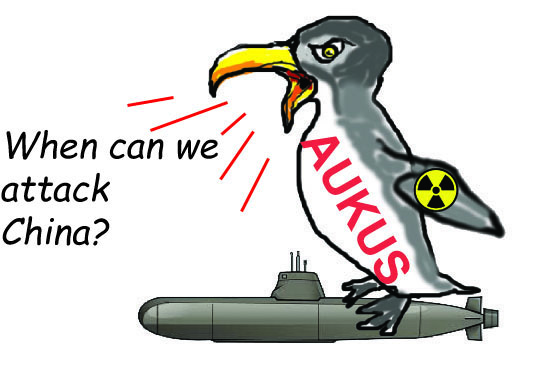
AUKUS and confronting China throws fuel on the fire of Indo-Pacific tensions. An accelerating arms race will follow.

Australia commits fully to China containment
Canberra is now a fully paid-up member of a China containment front, whether it wants to admit it, or not. In the process, it has yielded sovereignty to the US by committing itself to an interlocking web of military procurement decisions that includes the acquisition of a nuclear-propelled submarine fleet.
New drives to counter China come with a major risk: throwing fuel on the Indo-Pacific arms race SMH, Tony Walker Tony Walker is a Friend of The Conversation.Vice-chancellor’s fellow, La Trobe University September 27, 2021 An accelerating arms race in the Indo-Pacific is all but guaranteed now that China finds itself a target of new security arrangements — AUKUS and the Quad — aimed at containing its power and influence.
This has the makings of a new great game in the region in which rival powers are no longer in the business of pretending things can continue as they are.
The AUKUS agreement, involving Australia, the US and UK to counter China’s rise means a military power balance in the Indo-Pacific will come more sharply into focus.
The region has been re-arming at rates faster than other parts of the world due largely to China’s push to modernise its defence capabilities.
In their latest surveys, the London-based International Institute of Strategic Studies (IISS) and the Stockholm International Peace Research Institute (SIPRI) report no let-up in military spending in the Indo-Pacific. This is despite the pandemic.
SIPRI notes a 47% increase in defence spending in the Indo-Pacific in the past decade, led by China and India.
China can be expected to respond to threats posed by the new security arrangements by further expediting its military program.
It will see the formation of AUKUS as yet another attempt to contain its ambitions — and therefore a challenge to its military capabilities.
The Quad makes clear its ambitions
Unambiguously, AUKUS implies a containment policy.
Likewise, the further elevation of the Quad security grouping into a China containment front will play into an atmosphere of heightened security anxiety in the Indo-Pacific.
The four Quad participants – the US, Japan, India and Australia – have their own reasons and agendas for wanting to push back against China.
After their summit last week in Washington, the Quad leaders used words in their joint statement that might be regarded as unexceptional in isolation.
Together with other developments such as AUKUS, however, the language was pointed, to say the least:
Together, we re-commit to promoting the free, open, rules-based order, rooted in international law and undaunted by coercion, to bolster security in the Indo-Pacific and beyond.
The “beyond” part of the statement was not expanded on, but might be read as a commitment to extend the Quad collaboration globally.
All this has come together at the dawn of a new US administration whose members include several conspicuous China hawks, and at a moment when China has shown itself to be ever-willing to throw its weight around.
Beijing’s crude campaign against Australian exports in an effort to bend Australia’s policy to its will is a prime example. It is doubtful an AUKUS or an invigorated Quad would have emerged without this development.
The Obama administration talked about pivoting to the Asia-Pacific without putting much meat on the bones.
Under President Joe Biden, this shift will be driven by a hardening in American thinking that now recognises time is running out, and may already have expired, in the US ability to constrain China’s rise.
These are profound geopolitical moments whose trajectory is impossible to predict.
Australia commits fully to China containment
Canberra is now a fully paid-up member of a China containment front, whether it wants to admit it, or not. In the process, it has yielded sovereignty to the US by committing itself to an interlocking web of military procurement decisions that includes the acquisition of a nuclear-propelled submarine fleet.
Whether these submarines are supplied by the US or Britain is a bit immaterial since the technology involved originates in America.
The submarines will not be available for the better part of two decades under the most optimistic forecasts. However, in the meantime, Australia could base US or British submarines in its ports or lease American submarines.
Meanwhile, Australia is committing itself to a range of US-supplied hardware aimed at enhancing the inter-operability of its military with the US.
This is the reality of fateful decisions taken by the Morrison government in recent months. Such a commitment involves a certain level of confidence in America remaining a predictable and steadfast superpower, and not one riven by internal disputes.
Australian defence spending likely to rise. What is absolutely certain in all of this is that an Indo-Pacific security environment will now become more, not less, contentious. …………………………………
What other Indo-Pacific nations are doing
Many other Indo-Pacific states can now be expected to review their military acquisition programs with the likelihood of a more combative security environment.
Taiwan, for example, is proposing to spend $US8.69 billion (A$11.9 billion) over the next five years on long-range missiles, and increase its inventory of cruise missiles. It is also adding to its arsenal of heavy artillery.
South Korea is actively adding to its missile capabilities. This includes the testing of a submarine-launched ballistic missile.
Seoul has also hinted it might be considering building its own nuclear-propelled submarines (this was among President Moon Jae-in’s election pledges in 2017). Signs that North Korea may have developed a submarine capable of firing ballistic missiles will be concentrating minds in Seoul.
All this indicates how quickly the strategic environment in the Indo-Pacific is shifting.
Australia — perhaps more so than others — is the prime example of a regional player that has put aside a conventional view of a region in flux. It now sees an environment so threatening that a policy of strategic ambiguity between its custodial partner (the US) and most important trade relationship (China) has been abandoned.
The price tag for this in terms of equipment and likely continuing economic fallout for Australian exporters will not come cheap. https://theconversation.com/new-drives-to-counter-china-come-with-a-major-risk-throwing-fuel-on-the-indo-pacific-arms-race-168734
1 This month

of the week – Australians for War Powers Reform (AWPR)
To see nuclear-related stories in greater depth and intensity
 Antinuclear