China reprimands Australia on AUKUS and submarines that risk nuclear weapons proliferation, and make Australia target.
Chinese FM urges Australia to correct irresponsible moves, fulfill its nuclear non-proliferation obligations Global Times Nov 04, Chinese Foreign Ministry spokesperson Wang Wenbin on Thursday commented on Australia’s signing of the AUKUS deal with the US and the UK, saying it is an “extremely irresponsible” move that create risks and undermine regional peace and stability, urging Australia to abandon the Cold War mentality and fulfill its international nuclear non-proliferation obligations.
The French ambassador to Australia Jean-Pierre Thebault lashed out on Australian Prime Minister Scott Morrison on Wednesday over a scrapped $67 billion submarine deal previously signed between two countries. ….
Commenting on the French ambassador’s remarks on Australia, Wang noted that the AUKUS nuclear submarine cooperation is not just a diplomatic spat between a few countries, but a serious matter that will create risks of nuclear proliferation and undermine regional peace and stability.
“It is extremely irresponsible for the Australian government to ignore its international nuclear non-proliferation obligations and the serious concerns of regional countries and the international community in pursuit of its own interests,” Wang said……..
Chinese military experts warned that Australia’s signing of the deal will potentially make itself a target of a nuclear strike if a nuclear war breaks out even when Washington said it won’t arm Canberra with nuclear weapons, because it’s easy for the US to equip Australia with nuclear weapons and submarine-launched ballistic missiles when Australia has the submarines. https://www.globaltimes.cn/page/202111/1238189.shtml
Australia at COP26 – a damaging presence

COP26: it’s half-time at the crucial Glasgow climate change summit – and here’s the score, The Conversation, Wesley Morgan, 5 Nov 21, Research Fellow, Griffith Asia Institute and Climate Council researcher, Griffith University
………………….Missing the moment: The Australian Way
While the rest of the world is getting on with the race to a net-zero emissions economy, Australia is barely out of the starting blocks. Australia brought to Glasgow the same 2030 emissions target that it took to Paris six years ago – even as key allies pledged much stronger targets.
Prime Minister Scott Morrison arrived with scant plans to accompany his last-minute announcement on net-zero by 2050. The strategy titled The Australian Way, which comprised little more than a brochure, failed to provide a credible pathway to that target. It was met with derision across the world.
On the way to Glasgow, at the G20 leaders meeting in Rome, Australia blocked global momentum to reduce emissions by resisting calls for a phase out of coal power. Australia also refused to sign on to the global pledge on methane.
Worse still, Australia is using COP26 to actively promote fossil fuels. Federal Energy Minister Angus Taylor says the summit is a chance to promote investment in Australian gas projects, and Australian fossil fuel company Santos was prominently branded at the venue’s Australia Pavilion.
The federal government is promoting carbon capture and storage as a climate solution, despite it being widely regarded as a licence to prolong the use of fossil fuels. The technology is also eye-wateringly expensive and not yet proven at scale……. https://theconversation.com/cop26-its-half-time-at-the-crucial-glasgow-climate-change-summit-and-heres-the-score-170869
Foreign Minister Marise Payne to visit South-East Asia to ease fears over AUKUS, submarine plan
Foreign Minister Marise Payne to visit South-East Asia to ease fears over AUKUS, submarine plan, ABC, By foreign affairs reporter Stephen Dziedzic, 3 Nov 21, Foreign Minister Marise Payne will conduct a major visit to South-East Asia in the coming days as the federal government moves to calm anxieties about Australia’s nuclear submarine program and bed down a new strategic partnership with peak regional body ASEAN.
Key points:
- Indonesia has raised concerns Australia’s submarine program could fuel an arms race in the region
- Chinese ministers and officials have been attempting to rally support for their stance
- Defence Minister Peter Dutton says nations are welcoming efforts to balance China’s military might
Senator Payne is expected to visit Indonesia, Malaysia, Cambodia and Vietnam on the trip.
Cambodia has just taken over the chairmanship of the Association of Southeast Asian Nations (ASEAN), while both Malaysia and Indonesia have sharply criticised Australia’s plan to build nuclear-powered submarines under the AUKUS technology pact with the United Kingdom and the United States.
The ABC has been told Indonesia’s President Joko Widodo “repeatedly and forcefully” raised concerns about the nuclear submarines program when Prime Minister Scott Morrison met virtually with ASEAN leaders last week, reiterating Indonesia’s concerns the program could fuel an arms race in South-East Asia…………………………. https://www.abc.net.au/news/2021-11-03/foreign-minister-marise-payne-in-se-asia-to-rally-aukus-support/100589452
Australia’s credibility at a low point, with Scott Morrison’s lying and appalling performance at COP26
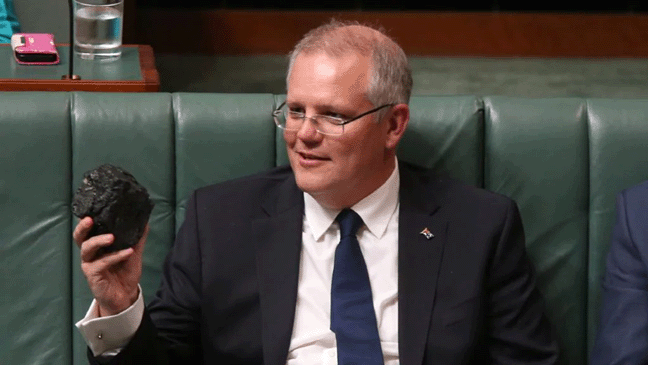
Bonne chance? Australia might need it on AUKUS nuclear submarines deal https://www.canberratimes.com.au/story/7492847/bonne-chance-australia-might-need-it/ 2 Oct 21,
The AUKUS nuclear submarines deal had better pay off, because the costs for Australia are beginning to appear far greater than first suggested.
In case Prime Minister Scott Morrison really thought some time, and some space, would quell Emmanuel Macron’s anger at the announcement – which abruptly ended a $90 billion submarines contract with France’s Naval Group – the French president disabused him of that idea on Sunday.
Mr Macron knew very well what he was doing when he spoke to Australian journalists about the AUKUS deal, and Mr Morrison’s actions. There was an air of calm calculation about his words. If his intent was to express the depth of his disappointment, the damage the nuclear submarines deal had done to the Australia-France relationship, and to raise questions about Mr Morrison’s handling of the AUKUS move, then he was bang on target.
He didn’t overplay his anger, and even couched his disapproval of Mr Morrison’s actions with a respectful recognition of Australia and France’s friendship and shared history.
With two words, he also highlighted what is becoming increasingly clear about the AUKUS nuclear submarines arrangement: As an exercise in Australian defence procurement, it appears chimeric.
“Good luck,” he said, noting that far from a signed contract, Australia right now has to wait 18 months for a review before the next steps in its new quest for submarines. Bonne chance, Australia.
This is where the nation sits less than a couple of months after the AUKUS deal, in a region with heightening geopolitical tensions and unresolved questions about Australia’s ability to defend itself. Australia is falling out with its friends (France), while its closest ally gives a different version of events in the lead-up to the AUKUS announcement (it was “clumsy”, Joe Biden says).
In hindsight, the AUKUS announcement seems true to form for Mr Morrison. It was high in marketing, fanfare and gloss, but lacking in substance, ham-fisted in execution and questionable in the respect it afforded to those who deserved it.
Add Australia’s reputation as obstructing progress in international climate talks, its pathetically bare minimum net zero by 2050 position, and its refusal to support international agreements phasing out coal, and the nation cuts an increasingly lonely figure on the world stage.
Mr Morrison’s trip overseas for both G20 and COP26 is, at this stage, disastrous. Australia’s credibility seems to be ebbing, not just because of AUKUS but on climate action, too. Middle powers cannot afford to put their reputations at risk like this.
US and UK must stop’: Chinese diplomat warns New Zealand audience of Australia’s nuclear ambitions
US and UK must stop’: Chinese diplomat warns New Zealand audience of Australia’s nuclear ambitions, Stuff, Thomas Manch , Nov 02 2021 A senior Chinese diplomat has warned a New Zealand audience that Australia will not only acquire nuclear-powered submarines in the coming decades, but nuclear weapons.
And it was claimed Australia’s purchase of nuclear-powered submarines would mean “more nuclear arms race … more nuclear tests, and nuclear pollution” in the Pacific.
China’s deputy chief of mission in New Zealand, Wang Genhua, made the claim about Australia’s nuclear ambitions during an event about the new defence pact between Australia, the United Kingdom, and the United States – dubbed AUKUS – on Monday evening.
“Australia is going to own nuclear-powered submarines. It will be almost necessary for them to equip nuclear weapons as the next step. The step just couldn’t be prevented,”
The AUKUS pact, announced in September, has Australia acquiring nuclear-powered submarines from the UK and US in the coming decades, in a bid to counter China’s growing influence in the Asia-Pacific region. The move grates against New Zealand’s anti-nuclear stance.
China, which has expanded its footprint into the contested waters of the South China Sea, was quick to condemn the AUKUS pact as irresponsible, “Cold War zero-sum mentality” that would undermine peace in the region.
The comments from Wang come as the fallout from AUKUS continues, with French President Emmanuel Macron accusing Australia’s Scott Morrison of lying about the deal.
Morrison, along with US and UK leaders, have insisted the nuclear-powered submarines Australia intended to acquire in the coming decades would only be equipped with conventional (non-nuclear) weapons, and the countries’ nuclear proliferation obligations will be met………… https://www.stuff.co.nz/national/politics/126854210/us-and-uk-must-stop-chinese-diplomat-warns-new-zealand-audience-of-australias-nuclear-ambitions
France’s President Macron quite clear that Scott Morrison lied to him
I don’t think, I know’: French President Macron says Scott Morrison lied to him. SMH, By Bevan Shields, November 1, 2021 Rome: French President Emmanuel Macron says Scott Morrison lied to him over the cancellation of a mammoth submarine contract, in a dramatic escalation of tensions between the two leaders.
Asked by The Sydney Morning Herald and The Age at the G20 summit in Rome whether he could trust Morrison again, Macron replied: “We will see what he will deliver……..
When also asked whether Morrison lied, Macron said: “I don’t think, I know.”………
In Rome, Macron noted Australia had ditched a signed contract for a known submarine program in exchange for an 18-month review into how it can acquire nuclear-powered submarines from the US and UK……….
US President Joe Biden used a meeting with Macron on the eve of the G20 to claim he was unaware that France had not been given advance notice that Australia had resolved to tear up a $90 billion submarine contract……I was under the impression that France had been informed long before that the deal was not going through…..https://www.smh.com.au/world/europe/i-don-t-think-i-know-french-president-macron-says-scott-morrison-lied-to-him-20211101-p594sx.html
Indonesia wants non-peaceful nuclear submarines to be subject to nuclear non-proliferation treaty (surprise, surprise, Australia doesn’t agree)
Caution over nuclear treaty covering subs, Canberra Times, Dominic Giannini, 29 Oct 21,
Australian officials say they don’t believe there is merit in expanding the nuclear non-proliferation treaty to nuclear-powered submarines.
Indonesian officials have said they would seek a “fourth pillar” to include the non-peaceful usage of nuclear technology, closing a “loophole” exposed by Australia’s nuclear-submarine deal with the US and UK.
They say other countries could seek to follow Australia, which would be the first non-nuclear weapons state to acquire nuclear submarines.
Foreign affairs department officials rejected the need to expand the treaty, saying the acquisition of nuclear-propelled submarines was in accordance with Australia’s non-proliferation requirements……
The Indonesians raised concerns about the potential for an arms race in the region after Australia announced its plans to acquire nuclear-powered submarines through the AUKUS partnership…….. https://www.canberratimes.com.au/story/7488125/caution-over-nuclear-treaty-covering-subs/
Indonesia, Malaysia, and the Director General of the IAEA all anxious about Autralia’s planned nuclear submarines
We feel the heat’: Malaysia cool on Australian submarines, SMH, By Chris Barrett, October 21, 2021 Singapore: Australia’s attempts to ease south-east Asian anxiety about its submarine ambitions continue to fall short, with Malaysia deeply concerned despite acknowledging the difference between nuclear power and nuclear arms.
The Philippines, Singapore and Vietnam have welcomed the AUKUS pact between Australia, the United States and the United Kingdom, as well as Australia’s plans to enhance its military capability with varying degrees of enthusiasm. But Indonesia and Malaysia are fearful its acquisition of nuclear-propelled submarines will ramp up tension and trigger an arms build-up in the region.
It is a view not disputed by Rafael Grossi, the director general of the International Atomic Energy Agency, who on Wednesday said the prospect of other countries seeking to follow Australia and develop their own nuclear-powered submarines “cannot be excluded”.
The Morrison government has sought to address consternation in Jakarta and Kuala Lumpur by sending Vice Admiral David Johnston, the Vice Chief of the Defence Force, to the region for talks but two of Australia’s most important neighbours are unconvinced.
……….. . Saifuddin said nuclear power was “not something that will make Malaysians and I believe many ASEAN people comfortable”……… He said some ASEAN member nations would raise the issue with Australia, a dialogue partner of the regional bloc, when leaders convened for a three-day virtual summit next week.“During the next ASEAN [leaders meeting] there is the ASEAN-Australia summit. I believe some member states want to raise the issue with Australia during the summit,” he said.
“I don’t think it is useful to evaluate whether we are satisfied with [Australia’s] explanation. The issue is still there.“
…. He said Malaysia didn’t want to have to choose sides in the geopolitical rivalry between the US and China.
……. Grossi, the head of the IAEA, the United Nations nuclear watchdog, said Australia’s pursuit of a fleet of nuclear-powered submarines as a non-nuclear armed nation needed to be closely monitored. https://www.smh.com.au/world/asia/we-feel-the-heat-malaysia-cool-on-australian-submarines-20211020-p591o6.html
IAEA chief: Aukus could set precedent for pursuit of nuclear submarines
Guardian, Julian Borger 20 Oct 21, Special taskforce convened by IAEA to look into Aukus deal as Iran hints at fresh pursuit of its 2018 naval nuclear propulsion program
The head of the UN’s nuclear watchdog has said other states could follow Australia’s example and seek to build nuclear-powered submarines, raising serious proliferation and legal concerns.
Rafael Grossi, the director general of the International Atomic Energy Agency (IAEA) said during a visit to Washington that he had set up a special team to look into the nuclear safeguards and legal implications of the Aukus partnership announced last month, in which the US and UK will help Australia build a fleet of nuclear-powered submarines.
If the plan is carried through, it would be the first time a non-nuclear weapons state has acquired nuclear-powered submarines. It reflects a grey area in the 1968 Nuclear Non-Proliferation Treaty, which allows fissile material to be removed from IAEA safeguards for such purposes.
The procedures by which the agency would ensure that the fuel, removed from agency oversight, is not diverted to making nuclear weapons have yet to be worked out………..
Grossi said it “cannot be excluded” that other countries would use the Aukus precedent to pursue their own nuclear submarine plans.
Canada and South Korea have both contemplated building nuclear-powered submarines, which can stay underwater longer and are quieter than their conventional counterparts. Brazil too has an ongoing nuclear submarine project……….. https://www.theguardian.com/world/2021/oct/19/iaea-aukus-deal-nuclear-submarines
Concern in Association of Southeast Asian Nations about Australia’s nuclear submarines
Indonesia, Malaysia concerned about Australia’s nuclear subs. By NINIEK KARMINI , 18 Oct 21,
JAKARTA, Indonesia (AP) — The foreign ministers of Malaysia and Indonesia expressed concern Monday that Australia’s plan to obtain nuclear-powered submarines may increase the rivalry of major powers in Southeast Asia.
The U.S., Britain and Australia announced last month that they have formed a security alliance that will help equip Australia with nuclear-powered submarines. The alliance will reshape relations in the Indo-Pacific region and beyond……..
“This situation will certainly not benefit anyone,” Indonesian Foreign Minister Retno Marsudi said after meeting with her Malaysian counterpart, Saifuddin Abdullah, in Jakarta. “We both agreed that efforts to maintain a peaceful and stable region must continue and don’t want the current dynamics to cause tension in the arms race and also in power projection.”
The two ministers said at a joint news conference that they agreed to strengthen the unity and centrality of the Association of Southeast Asian Nations and urged all members of the bloc to contribute to the stability, security, peace and prosperity of the region and respect international law.
Saifuddin said having a near-neighbor build new nuclear-powered submarines could encourage other countries to come more frequently into Southeast Asian territory………………………..
ASEAN’s members are Brunei, Cambodia, Indonesia, Laos, Malaysia, Myanmar, the Philippines, Singapore, Thailand and Vietnam. Brunei is chair of the bloc this year.
ASEAN has formal partnerships with several countries including Australia, China, Canada, New Zealand, South Korea and Pakistan as well as the European Union.
Malaysia and Indonesia share many similarities in religion, language and culture. https://apnews.com/article/business-asia-australia-indonesia-global-trade-fbbf5b52e6822d01cdc11c8a5870ebb4
Bizarre twists in USA’s war on Julian Assange and Wikileaks
Britain’s Guantanamo: is Julian Assange a terrorist? https://www.michaelwest.com.au/britains-guantanamo-is-julian-assange-a-terrorist/ By Gary Lord|October 18, 2021
As Julian Assange prepares to face a British court for possibly the last time, threatened with up to 175 years detention in a US supermax prison, journalist Gary Lord, explores the latest bizarre twists in the US effort to extradite the Wikileaks founder and the silence of global media.
Julian Assange likes to say that censorship is “always an opportunity” that should be welcomed because it indicates that “there is something worth looking at”. He also says that it is a sign of weakness because it “reveals a fear of reform”.
So it’s interesting that recent bombshell stories about Assange himself are being censored by global media giants. As the WikiLeaks founder prepares to face a British court for possibly the last time on October 27, threatened with up to 175 years detention in a US supermax prison, perhaps this media censorship is something worth looking at?
wo major stories have emerged since a UK judge ruled against Assange’s extradition to the United States (on health grounds only) at the start of this year.
Firstly, Icelandic media revealed in June that the US prosecution’s prize witness, a convicted pedophile and fraudster who has since been jailed, had withdrawn his testimony against Assange.
Sigurdur Thordarson, who worked for Wikileaks in 2010 but embezzled over $50,000 from the organization, admitted to fabricating key accusations in the US indictment. This important story was almost totally ignored by global media.
Secondly, some 30 anonymous US officials recently confirmed that CIA boss Mike Pompeo, US President Donald Trump, and other staff “at the highest levels” of the Trump administration actively discussed assassinating Julian Assange, and even enlisted UK government support to shoot out airplane tyres if required.
The US government officially designated WikiLeaks a “non-state hostile intelligence service” in order to provide legal cover for any violent action, with “sketches” including possible shootouts with Russian agents on the streets of inner London.
The USA’s FAIR media watch group investigated the extraordinary lack of media coverage this astonishing revelation received, noting that “BBC News, one of the most-read news outlets in the world, appears to have covered the story just once — in the Somali-language section of the BBC website”.
The New York Times, the Washington Post, and many other major media outlets totally ignored it. The Guardian published just two articles about it; by comparison, they devoted 16 articles to alleged Russian government attempts to murder Alexei Navalny.
Sadly, this media censorship of Assange is not new, even if it does appear to be reaching new heights of absurdity. Another widely ignored story is the relentless and invasive spying on Assange and his visitors – including lawyers, family and journalists – while he was in the Ecuadorian embassy.
A Spanish court is currently investigating allegations that UC Global, the company that supposedly provided “security” at the behest of the Ecuadorian government, was secretly working for the CIA as a client of former Las Vegas casino mogul Sheldon Adelson, a major supporter of Donald Trump.
Max Blumenthal first reported back in May 2020 that these spies also discussed plots to kidnap or poison Assange.
A “fix” or media apathy?
How to explain the widespread lack of mainstream media interest in such shocking news stories which could easily be given front page importance?
Are we to assume that “the fix is in”? Is this part of a deliberate effort to suppress public support for Assange, ahead of his inevitable extradition? If so, who is behind it, and what does it say about the politicisation of the British court system, never mind global media organisations? If not, how else can we understand it?
It’s well known that Assange fell out with many of his old media partners following the 2010 Cablegate publications, but most of those journalists still argue that the Australian should not be extradited for the “crime” of journalism.
Editorials in the Guardian, New York Times, the Sydney Morning Herald and other newspapers have called for the US extradition case to be dropped. But the media fraternity’s “support” for Assange has never extended to a full-blown campaign, such as we saw when (for example) Peter Greste was jailed.
In fact, there has been a remarkable lack of Western media interest in Assange’s court case – coupled with smears, lies and poor reporting – for over a decade.
Italian journalist Sefania Maurizi, who has worked closely with WikiLeaks for many years, appears to be the only journalist who bothered to lodge Freedom of Information requests about the Assange case with the British and Swedish governments.
A “non-state hostile intelligence service”
She discovered that the Crown Prosecuting Service, which was then controlled by Sir Keir Starmer (now UK Labour Party leader), advised Swedish prosecutors not to come and question Assange in London, and not to “get cold feet” and close the case. “Please do not think this case is being dealt with as just another extradition,” they wrote – then they deleted all their emails!
In Australia, lawyer Kellie Tranter has been putting Aussie journos to shame by lodging her own FOI applications and sharing the results. Maurizi also has FOI applications lodged with the Australian and US governments, but they have been stalled for years with no explanation.
Assange and WikiLeaks still enjoy huge public support around the world. So why don’t big media organisations want more online clicks from readers digging into these amazing stories?
A clue may come from the CIA’s determination to get WikiLeaks officially designated a “non-state hostile intelligence service”. This legal designation would surely make media reporting on WikiLeaks the subject of increased government attention and maybe even censorship.
All the AUKUS countries have now adopted extreme new “anti-terror” laws that include Orwellian restrictions on the media. Maybe it’s time for AUKUS journalists to ask whether WikiLeaks is also officially designated a “non-state hostile intelligence service” in Canberra and London?
Is it possible that Julian Assange – who has been held in “Britain’s Guantanamo Bay” since 11 April 2019 – has been secretly defined as some new form of “information terrorist“? And if so, would our media today even be allowed to report it? Gary Lord is the author of Julian Assange biography “Wikileaks: a True History“
AUKUS nuclear submarines deal must be abandoned
AUKUS nuclear submarines deal must be abandoned, Pearls and Irritations, By Brian TooheyOct 13, 2021
Australia doesn’t need nuclear powered submarines, especially given the Australia’s long-standing support for the world’s nuclear non-proliferation goals.
The White House failed to think beyond its Anglo-Saxon allies in London and Canberra when agreeing to sell Australia eight nuclear submarines.
The US’s north Asian allies Korea and Japan are much closer to China and more at risk, however slight. The Japan Times responded with a cool headed article spelling out the folly of the decision. It said the US, “has put at risk long-standing but fragile global pacts to prevent the proliferation of dangerous nuclear technologies”.
It also reported that US Navy ships “use about 100 nuclear bombs worth of Highly Enriched Uranium (HEU) each year”.
Although the US or the UK is supposed to build Australia eight nuclear-powered attack submarines under as new agreement called AUKUS, there is no realistic way this can occur without trashing Australia’s long-standing support for the world’s nuclear non-proliferation goals.
One of the key problems is the US Navy insists it is essential to use uranium enriched to 93 per cent to obtain the main fissile isotope of U-235, the same level as in nuclear weapons. It also insists it couldn’t switch to low levels of enrichment without greatly increasing the costs and size of the submarines as well as the construction time.
This means the US Navy will reject Malcolm Turnbull’s suggestion to get the French to supply non-weapons grade fuel. The British can’t help as they get their HEU fuel from the US. The enrichment to 93 per cent compares to around 40 per cent for Russian and Indian submarines. The French only enrich to 7.5 per cent, China to about 5 per cent and civilian power reactors to around 3.5 per cent. Anything less that 20 per cent is defined as low level enrichment.
The White House’s attitude has changed since the 1980s when the US blocked Canada’s attempts to buy nuclear submarines from the UK or France.
Nevertheless, some members of the US Congress and senior officials want the navy to shift to low enrichment to eliminate proliferation problems.
A nuclear problem
In a letter to The New York Times, former US undersecretary of state for arms control and international security Rose Gottemoeller said the proposal to share HEU-fuelled submarines with Australia “has blown apart 60 years of US policy” designed to minimise the use of HEU uranium.
“Such uranium makes nuclear bombs, and we never wanted it in the hands of non-nuclear-weapon states, no matter how squeaky clean,” she said.
Of the seven nuclear weapons states, five have nuclear submarines. Australia will be the first non-nuclear weapons state to get nuclear submarines. The understandable concern is that other allies will want similar treatment, expanding the risk that weapons grade uranium will be stolen or diverted.
In some interpretations, a loophole exempts naval nuclear reactors from the International Atomic Energy Agency’s anti-proliferation requirements.
But there are numerous other agreements that Australia might have to comply with if it stores HEU in its submarines.
In addition, the AUKUS agreement includes Australian access to other technologies, including Tomahawk long-range cruise missiles for the navy’s Hobart-class destroyers. Because the Tomahawk can be armed with nuclear or conventional explosives, this could make it difficult to comply with the Missile Technology and Control Regime which Australia has strongly backed.
Another hurdle stems from the Howard government’s passage of a parliamentary act in 1999 outlawing just about all nuclear activities, apart from mining and exporting uranium. If circumstances prevent the US from maintaining all the nuclear aspects of Australia’s future submarines, this might spark calls for the rapid construction of nuclear facilities here. But the necessary amendments to the 1999 act could be blocked in the Senate.
Prime Minister Scott Morrison can’t credibly commit Australia to never engaging in nuclear proliferation. In the 1960s, Liberal prime minister John Gorton took preliminary steps to develop Australia’s own nuclear weapons, explaining to the US secretary of state Dean Rusk that he did not trust the US to defend Australia if it had to use nuclear weapons. A prime minister sharing Gorton’s assessment could emerge at any time.
Perhaps the White House will overrule the navy after a protracted battle to ensure the new submarines use low enrichment uranium posing no proliferation problem.
Nuclear submarines are not essential
However, the deal would still make no sense for Australia.
Government sources are widely quoted as saying the cost of the new submarines will be well over $100 billion, yet the first one won’t be operational until after 2040 and the last until after 2060. By then, the submarines would be obsolete death traps, susceptible to detection and destruction by several existing and new technologies.
The time scale reinforces the entire air of unreality about acquiring these submarines, only a couple of which may be operationally available at any one time.
Some commentators suggest Australia must buy the submarines to help the US counter a Chinese threat to Taiwan.
But no one knows what will happen to China or the US in a radically uncertain future. By 2060, China may be the dominant country in Asia, it may have returned to its earlier policy of living in Confucian harmony with its neighbours………………..
 |
Deathly Silence: Journalists Who Mocked Assange Have Nothing to Say About CIA Plans to Kill Him
Deathly Silence: Journalists Who Mocked Assange Have Nothing to Say About CIA Plans to Kill Him https://fair.org/home/deathly-silence-journalists-who-mocked-assange-have-nothing-to-say-about-cia-plans-to-kill-him/, JOHN MCEVOY,YAHOO! NEWS (9/26/21) A BOMBSHELL REPORT DETAILING THE US CENTRAL INTELLIGENCE AGENCY’S “SECRET WAR PLANS AGAINST WIKILEAKS,” INCLUDING CLANDESTINE PLOTS TO KILL OR KIDNAP PUBLISHER JULIAN ASSANGE WHILE HE TOOK REFUGE IN THE ECUADORIAN EMBASSY IN LONDON.
Following WikiLeaks‘ publication of the Vault 7 files in 2017—the largest leak in CIA history, which exposed how US and UK intelligence agencies could hack into household devices—the US government designated WikiLeaks as a “non-state hostile intelligence service” (The Hill, 4/13/17), providing legal cover to target the organization as if it were an adversarial spy agency.
Within this context, the Donald Trump administration reportedly requested “sketches” or “options” for how to kill Assange, according to the Yahoo! expose (written by Zach Dorfman, Sean D. Naylor and Michael Isikoff), while the CIA drew up plans to kidnap him. (Assange was expelled from the embassy in 2019 and has since then been in British prison, fighting a demand that he be extradited to the US to face charges of espionage—FAIR.org, 11/13/20.)
Shortly after publication, former CIA director Mike Pompeo (Yahoo! News, 9/29/21) seemed to confirm the report’s findings, declaring that the former US intelligence officials who spoke with Yahoo! “should all be prosecuted for speaking about classified activity inside the CIA.”
Ghoulish indifference
It would seem that covert plans for the state-sanctioned murder on British soil of an award-winning journalist should attract sustained, wall-to-wall media coverage.
The news, however, has been met by Western establishment media with ghoulish indifference—a damning indictment of an industry that feverishly condemns attacks on press freedom in Official Enemy states.
BBC News, one of the most-read news outlets in the world, appears to have covered the story just once—in the Somali-language section of the BBC website (Media Lens on Twitter, 9/30/21).
Neither the New York Times or Washington Post, two of the world’s leading corporate news organizations, have published any articles about Assange since July 2021.
To its credit, since the story first broke on September 26, the Guardian has reported twice on the CIA-led conspiracy to kill or kidnap Assange. But to offer perspective, during the week after Russian opposition figure Alexei Navalny was reported to have been poisoned by the Russian government, the Guardian published 16 separate pieces on the issue, including video reports and opinion pieces.
Similarly, a Nexis search of British newspapers for the word “Navalny” brings up 288 results from August 20–25, 2020. The same search for “Assange” between September 26–October 1, 2021, brings up a meager 29 results—one of which, a notable exception, was a Patrick Cockburn piece in the Independent (10/1/21).
Crucial relief
As is typical of stories that embarrass the Western intelligence services, independent media provided crucial relief to the backdrop of chilling indifference, with the Grayzone’s Aaron Maté (YouTube, 9/30/21) conducting a rigorous interview with one of the report’s authors, Michael Isikoff.
Indeed, the Grayzone (5/14/20) was the first outlet to provide evidence of a CIA-linked proposal to “kidnap or poison Assange” in May 2020. The story, however, was almost universally ignored, suggesting that, as Joe Lauria wrote in Consortium News (10/2/21), “until something appears in the mainstream media, it didn’t happen.”
One thing the corporate media cannot be accused of with regards to Assange, however, is inconsistency. After a key witness in the Department of Justice’s case against the publisher admitted to providing the US prosecution with false testimony, a detail that should
ordinarily turn a case to dust, the corporate media responded by ignoring the story almost entirely. As Alan MacLeod wrote for FAIR.org (7/2/21):
The complete uniformity with which corporate media have treated this latest bombshell news raises even more concerns about how fundamentally intertwined and aligned they are with the interests of the US government.
Even after it was revealed that the UC Global security firm that targeted Assange had also spied on journalists at the Washington Post and New York Times, neither outlet mounted any
protest (Grayzone, 9/18/20).
Perhaps most remarkably, UK judge Vanessa Baraitser relied on a falsified CNN report (7/15/19) to justify the CIA’s spying operation against Assange (Grayzone, 5/1/21). Now, CNN’s website contains no reports on the agency’s plans to kill or kidnap Assange.
The prevailing silence has extended into the NGO industry. Amnesty International, which refused in 2019 to consider Assange a prisoner of conscience, has said nothing about the latest revelations. Likewise, Index on Censorship, which describes itself as “The Global Voice of Free Expression,” hasn’t responded to the story.
The establishment media’s dismissal of Assange supports Edward Herman and Noam Chomsky’s framework of “worthy” and “unworthy” political dissidents, with Assange situated firmly in the latter camp.
The present circumstances become even more deplorable upon consideration of the corporate journalists who arrogantly diminished, or even delighted in, Assange’s concerns for his own safety.
Continue readingUS and UK begin jostling to supply Australia with nuclear submarine fleet
US and UK begin jostling to supply Australia with nuclear submarine fleet, ABC By defence correspondent Andrew Greene‘ 10 Oct 21, ‘……….In 2021, the Australian Defence Force is again considering what role the Royal Navy could play in developing its next submarines, or whether like many modern acquisitions, it will focus on interoperability with American technology.
Under the AUKUS partnership struck in September, the leaders of the United Kingdom and the United States have agreed to work with Australia on how to build a new class of nuclear-powered submarines.
Over the next 18 months, the Nuclear-Powered Submarine Task Force inside the Department of Defence will lead a study into the numerous regulatory issues involved in the ownership and operation of nuclear-powered boats.
While the design is not yet known, or what the criteria will be, for many commentators the existing British Astute-class is emerging as an early favourite for Australia to replace the Collins-class fleet
Others inside the defence industry believe any nuclear-powered Australian submarine will need to be an American boat, based on the Virginia-class so that it can be serviced at nearby US bases in Guam or Japan.
Both the British and US options have various advantages and disadvantages, which highlight the extraordinarily complex process the ADF faces to select a nuclear-powered submarine — which may never actually eventuate.
Already the regulatory challenges appear significant, as nothing is more complex and costly in the military world than nuclear-powered submarines, particularly for a country with no domestic nuclear industry.
In the United States, an eminent group of former officials and experts has written to President Joe Biden warning the AUKUS deal could threaten national security by encouraging hostile nations to obtain highly enriched uranium (HEU).
Australia insists it will uphold its commitments under the Nuclear Non-Proliferation Treaty, but the engineering sector warns it will be a steep learning curve for the Defence Department.
The now dumped Attack class submarine being designed by France’s Naval Group was based on the Barracuda class, which lost three years in development because of less complex regulatory issues associated with low enriched uranium (LEU).
“This is a very long-term effort that’ll be decades, I think, before a submarine goes in the water,” US Chief of Naval Operations Admiral Mike Gilday predicted last month………… https://www.abc.net.au/news/2021-10-10/us-and-uk-begin-jostling-for-nuclear-submarine-contract/100525756
Nuclear submarine deal needlessly raises tensions — Highly Enriched Fuel a particular danger

World needs to work together, not provoke further conflict
Nuclear submarine deal needlessly raises tensions — Beyond Nuclear International 10 Oct 21, s
Proposed US/UK nuclear-powered submarines for Australia jeopardise health while escalating an arms race no one can win
Joint statement by International Physicians for the Prevention of Nuclear War and its affiliates in Australia, UK and USA: Medical Association for Prevention of War (Australia); Medact (UK); Physicians for Social Responsibility (USA)
Physicians in the countries involved in the proposal announced on 16 September for Australia to acquire nuclear-powered submarines with UK and US assistance are concerned this plan will jeopardise global health and security. Under this proposal, Australia would become the seventh country to use nuclear propulsion for its military vessels, and the first state to do so which does not possess nuclear weapons, or nuclear power reactors. These submarines are to be armed with sophisticated long-range missiles including US Tomahawk cruise missiles. These submarines would increase tensions and militarisation across Asia and the Pacific region, fuel an arms race and risk deepening a new cold war involving China.
The wrong decision at the wrong time
Humanity is in the midst of a major pandemic, and facing twin existential threats of dire urgency — global heating and the growing danger of nuclear war. People everywhere desperately require our leaders to work together to address these major challenges, which can only be solved cooperatively.
Beginning on November 1, the UN Climate Change Conference will be held in Glasgow, when leaders have a choice to condemn humanity to cascading climate catastrophe, or step up and take the decisive and ambitious actions needed to drastically reduce greenhouse gas emissions and keep warming within 1.5 degrees. COVID vaccines are still out of reach for most of the world’s poor people. If ever there was a time to build goodwill and focus on cooperation to complex global problems rather than escalate military confrontation, that time is now.
Our leaders should be focussing their energies not on escalating a new cold war arms race with China, but on building peaceful cooperation to address urgent shared threats with the government of the world’s most populous and largest greenhouse gas emitting nation.
Instead, this plan will raise tensions, make cooperation more difficult, drive proliferation of ever more destructive weapons, divert vast resources needed to improve health and well-being and stabilise our climate, and increase the risks of a slide to armed conflict between the world’s most heavily armed states, risking nuclear escalation in which there can be no winners.
Spreading nuclear bomb fuel
Commendable international efforts over decades to reduce production, use and stockpiles of highly-enriched uranium (HEU) worldwide have been supported by Australia, UK and US, including through the Nuclear Security Summits led by President Obama. In its role as G7 president, the UK has committed to ‘reinvigorate the aim of minimising production and use of Highly Enriched Uranium (HEU)’.
UK and US nuclear-powered submarines use HEU as fuel, which is directly usable in nuclear weapons, including those of the simplest design easiest for terrorists to build. Indeed their current naval reactor fuel is enriched to 93% and was originally produced for use in nuclear warheads. They have resisted and delayed efforts to convert their naval reactors to much less proliferation-prone low-enriched uranium fuel, as France and China have done, and any conversion to LEU is not likely before the late 2030s at the earliest.
So it seems very likely that any Australian nuclear submarines built with US or UK naval reactors over the next 20 years will also use HEU. Precisely because of the proliferation dangers of naval reactor fuel, the US has previously gone to considerable lengths to thwart the spread of naval reactors, such as in the 1980s blocking Canada from buying nuclear attack submarines from France and the UK.
A loophole exists in the international safeguards required under the nuclear Non- proliferation Treaty (NPT): states without nuclear weapons can remove fissile materials (which can be used to build nuclear weapons) from safeguards for a temporary period for use in military applications short of nuclear weapons. No nation has yet done this in relation to naval nuclear reactors.
The quantities of HEU involved are large. As Sebastien Philippe from Princeton University has estimated, a fleet of between 6 and 12 nuclear submarines as proposed, operated for about 30 years, will require between 3 and 6 tons of HEU. The International Atomic Energy Agency (IAEA) stipulates that 25 kg of HEU would enable a nuclear weapon, even though US nuclear weapons are known to contain an average of only 12 kg of HEU.
So HEU fuel for the proposed Australian submarines would involve 120 to 240 times the amount of HEU as the IAEA stipulates is sufficient to build a nuclear weapon, and it could be out of international safeguards for decades. Philippe has aptly characterised this as “a terrible decision for the non-proliferation regime”. It discredits all three nations’ claims to support a treaty curbing fissile materials, and would make such a treaty harder to verify.
The Australian government proclaims its support for strong nuclear safeguards, while falsely claiming that the safeguards obligations in the UN Treaty on the Prohibition of Nuclear Weapons (TPNW) are weaker than those under the NPT 3 (they are, in fact, stronger). Its plan to drive large amounts of HEU in reactors roaming the oceans for decades through a loophole in its safeguards does not indicate good faith on safeguards and non-proliferation.
This proposal needs careful independent scrutiny and strong new safeguards provisions to ensure Australia fulfills its obligations under both the NPT and the South Pacific Nuclear Free Zone Treaty. The latter goes further than the NPT in prohibiting the stationing of any nuclear explosive device in the territory of a state party.
The UK announcement in March of a planned 40% increase in its nuclear arsenal is in breach of its NPT obligations, as the UN Secretary-General has stated. The UK and US are modernising their nuclear arsenals, both in breach of their now 51-year-old legally binding NPT commitment to disarm.
Australia acquiring nuclear-powered submarines could well encourage other states, such as South Korea, Japan and Iran to pursue a similar path. Proliferation of submarines or other vessels with lifespans of several decades that are fuelled by weapons-grade HEU will encourage uranium enrichment, wider use and storage of HEU, and will set back and make more difficult control and elimination of fissile materials…….. https://beyondnuclearinternational.org/2021/10/10/nuclear-submarine-deal-needlessly-raises-tensions/
1 This month
17 October, Free Public Talk on Nuclear Issues in South Australia
David Noonan will speak on public interest concerns over the new Roxby Downs Indenture Act 2026 on BHP copper-uranium mining and ore processing in SA, and on how AUKUS may face SA with a High-Level nuclear waste agenda.
Dr Jim Green will discuss international developments in the field of nuclear power including ‘small modular reactors’ and Generation 4 ‘advanced’ nuclear reactor concepts.


Help Aunty Sue Protect Her Land and Sacred Sites From Destructive Rocket Testing.
.

Australians deserve the truth
about
AUKUS – https://aukuspublicinquiry.com/

PETITION – To: Prime Minister Anthony Albanese and the Australian Labor Government

of the week – Australians for War Powers Reform (AWPR)
To see nuclear-related stories in greater depth and intensity

