Australian govt keeps mum about Japan’s plan to dump nuclear waste-water into the Pacific (no suprise – it originated from Australian uranium)

Australian Government quiet over Japan’s nuclear waste condemnation, Independent Australia, By Dave Sweeney | 23 April 2021While Japan faces international backlash over its decision to dump contaminated wastewater, Australia remains quiet due to its part in the Fukushima disaster, writes Dave Sweeney.
AGAINST A BACKDROP of runners carrying a small torch to light the Olympic flame for the July Tokyo Olympics, there are growing flames of discontent over the Japanese Government’s plan to release large volumes of contaminated wastewater from the stricken Fukushima nuclear plant directly into the Pacific Ocean.
…………Whatever the water’s pathway, it is now polluted. And, with the volume growing each day, direct ocean disposal is the quickest and cheapest management option.
The aqua dump plan, set to start in two years and continue in stages for years to come, has attracted fierce domestic and international criticism.
In a rare moment of unity, Taiwan has condemned the move while China has described the plan as “extremely irresponsible”. South Korea has seen street protests and a move from President Moon Jae-in to explore legal options, including through the International Tribunal for the Law of the Sea.
A Philippines presidential spokesperson highlighted that “we are one ecosystem… we are interconnected” and three U.N. Human Rights rapporteurs specialising in food, toxics and the environment declared that the release ‘into the marine environment imposes considerable risks to the full enjoyment of the human rights of concerned populations in and beyond the borders of Japan’.
TEPCO has stated that the water will be treated before release using a system known as A.L.P.S. — the Advanced Liquid Processing System.
However, TEPCO’s assurances are cold comfort to many.
The company was caught out in 2018 having falsely claimed that earlier releases contained no radioactive materials. This time, TEPCO has changed its tune and acknowledges that radioactive tritium will be released along with the dumped water. Tritium is very difficult to separate from water as it is a radioactive isotope of hydrogen that remains active for between 60-100 years.
Many observers also hold grave concerns that other longer-lived radioactive wastes including ruthenium, cobalt, strontium and plutonium could also be discharged into the Pacific given that not all are always captured by the A.L.P.S. process.
This concern has seen Pacific activists refer to the Japanese nuclear sector as a house without a toilet and the Pacific Islands Forum declare that:
‘…steps have not been sufficiently taken to address the potential harm to our Blue Pacific Continent, including possible environmental, health, and economic impacts. Our fisheries and oceans resources are critical to our Pacific livelihoods and must be protected.’……..
Critics are concerned that the plan is not based on the best possible technology, but rather being driven by corner and cost-cutting.
Japanese and international groups and experts called for other options to be fully evaluated before direct release was approved. These include continued interim tank storage, enhanced evaporation and mortar solidification, where contaminated water is mixed with cement and sand and stored. This technique is used to manage liquid contaminants at other nuclear facilities, including Savannah River in the USA.
Some Australian environment groups have criticised the direct dumping plan and used the recent tenth anniversary of the Fukushima disaster to call on the Japanese Government to reconsider this approach.
To date, the Australian Government has made no comment or call. This is hardly surprising given that Australian uranium was inside the Fukushima reactors at the time of the meltdown. Since this time, successive Australian governments have avoided any comment or criticism and instead prioritised trying to find new markets for our flatlining uranium sector.
As an island nation steeped in coastal culture and salt-water stories, the deliberate degradation of our shared global waters should be a concern. The long-term protection of communities, cultures, creatures and currents needs to be given preference over short-term nuclear industry expedience. Dave Sweeney is the Australian Conservation Foundation’s nuclear-free campaigner and was a founding member of ICAN. You can follow him on Twitter @nukedavesweeney. https://independentaustralia.net/politics/politics-display/australian-government-quiet-over-japans-nuclear-waste-condemnation,15015
Scott Morrison’s climate summit speech was littered with downright dodgy claims,
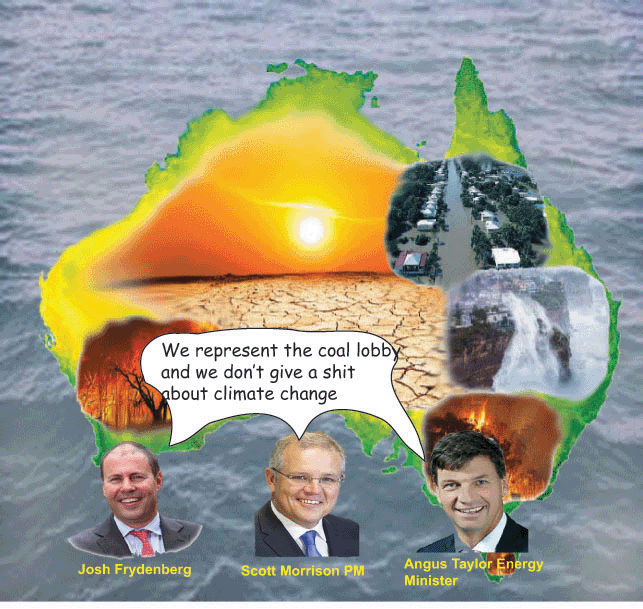
Scott Morrison’s climate summit speech was littered with downright dodgy claims, https://thenewdaily.com.au/news/politics/australian-politics/2021/04/24/scott-morrison-climate-summit-facts/ Richie Merzian, I have sat through countless speeches on climate change from world leaders, both working for the government and outside it, and Prime Minister Scott Morrison’s rant at President Joe Biden’s climate summit last night was one of the worst performances I have ever seen.
Technical glitches and the dreaded mute button were the least of Morrison’s worries, as he mounted the (virtual) stage, armed with three-word slogans, self-congratulations, and downright dodgy greenhouse gas emission numbers.
Most major nations before him (and there were many) had pledged stronger climate targets or concrete policies to curb carbon pollution. Japan and Canada vowed significant increases on their 2030 targets. India and the Republic of Korea announced new partnerships with the United States. Even Brazil, a highly problematic country in the climate space, announced it would advance its carbon neutrality target by a decade.
In contrast, Morrison’s speech was heavy on bluster, light on policy. No new commitments were brought to the table, further cementing Australia’s inadequate Paris target of a 26-28 per cent reduction in greenhouse gas emissions by 2030. Then like the dinner guest that turns up to a pot-luck empty-handed and complains about what others have brought, Morrison dismissed the serious efforts of other nations whilst offering nothing himself.
When it came time to talk numbers, Morrison’s claim that we have reduced emissions by 19 per cent broadly and 36 per cent excluding exports, had me and many others dumfounded. Where did these numbers come from? What dodgy accounting tricks were at play? Turns out 19 per cent is cherry-picked from the middle of the pandemic and the 36 per cent number is just off the reservation. The PM is reinventing UN accounting rules, asking the world to forget about the rising emissions from the production of gas and coal we export!
If there is one thing we can establish, Morrison can always be relied upon for accounting tricks. Until recently, the Morrison government tried to cash in on leftover carbon credits from the last climate agreement, to avoid reducing emissions required under the current Paris Agreement. This is What dodgy accounting tricks were at play? Turns out 19 per cent is cherry-picked from the middle of the pandemic and the 36 per cent number is just off the reservation. The PM is reinventing UN accounting rules, asking the world to forget about the rising emissions from the production of gas and coal we export!
If there is one thing we can establish, Morrison can always be relied upon for accounting tricks. Until recently, the Morrison government tried to cash in on leftover carbon credits from the last climate agreement, to avoid reducing emissions required under the current Paris Agreement. This is akin to attempting to use an old Starbucks loyalty card to pay for a Big Mac. Only after he was named and shamed by his international peers did Morrison back away from this dodgy loophole.
Much like a guest knows there are topics you do not talk about at a dinner party, every world leader knows the formalities and conventions of a climate summit. Every world leader it seems, bar Morrison. After undermining the speakers before him by belittling ‘targets’ and ‘promises’ with a tone-deaf arrogance, Morrison went on to awkwardly name-check his big-polluting industry mates, and claim Australia would somehow replicate the US’ success in Silicon Valley through our own ‘hydrogen valleys’.
Morrison rattled off ‘pioneering Australian companies’ from BHP to RioTinto, seemingly forgetting he was speaking on the international stage not addressing the Business Council of Australia at some inner-city wine bar. Perhaps most bizarre, was the name-dropping of Allan Finkel. While most Australian’s probably don’t know who Allan Finkel is, let alone the rest of the world – those who do, likely know him as the former Chief Scientist whose controversial views on gas sparked an open letter from leading Australian scientists.
In December 2019, when I watched Angus Taylor address the United Nations climate talks in Madrid without acknowledging the catastrophic bushfires that were devastating the nation, I thought I’d seen Aussie climate diplomacy at its worst. Then came Morrison’s performance at this summit.
Fortunately, the US had placed Morrison so far down the speaking list that President Biden had already left the room.
The United States – the world’s largest economy and second-largest polluter after China kicked off the event by announcing it would at least halve emissions by 2030, a target that Australia Institute research shows Australia should replicate. If it did, then we would have something to brag about.
Richie Merzian is Climate & Energy Program Director at The Australia Institute. You can follow him on Twitter at @richiemerzian.
Unrelenting dishonest propaganda leading us to war against China
Not sleepwalking but marching with eyes wide open to war. Independent Australia, By William Briggs | 13 April 2021 While the USA moves towards war, anti-China rhetoric grows on a daily basis and the idea of war is being sold as the “right” thing, writes Dr William Briggs.
A LIE told often enough can become accepted, but it can never be the truth. China has been declared a threat to all that we hold dear, but it is just not so. China, for all its faults, is not a threat and nor is it practising genocide!
The Uyghur genocide claim gets bigger as each day dawns. Peter Hartcher, in The Age on the 10 April, writes of this genocide and of ‘the evil genius of the system of genocide with Chinese characteristics.’ The “genius” according to Hartcher is that the Chinese are allowing the Uyghurs to live. What a clever and cunning genocide that is!
The plight of the Uyghurs is but the latest lurid episode in a sustained and enormously successful push to demonise China in the eyes of the world. The motivations behind this are simple enough. China’s economic star is rising and America’s best days are behind it.
The world is certainly on the edge of a precipice. There is a broad acceptance, despite an embarrassing lack of evidence, that China is an enemy and, as an enemy, a threat. Nobody is ever eager for war, but people have often enough been persuaded that war is an acceptable option. This is particularly so when an existential threat exists, or in this case, is manufactured. The potential for war, justifications for it and warnings of how it might almost “accidentally” become a reality have come to dominate thought……..
If the USA goes to war with China, it will not be by chance. It has been meticulously planned, costed, budgeted for and the weapons, including “low-yield” nuclear weapons, have been manufactured and deployed by the USA. The world should be aghast at such blatant preparations, but it is not. Those who would take us to war need first to convince us that we have no option, that we are protecting freedom, that we are standing for justice and that a threat exists that the enemy is engaging in genocide.
In the space of just a decade, the people have come to accept this. China has gone from economic saviour of the world to arch enemy. Governments begin the process but could not be expected to convince the people alone. Television and print media: editorials, opinion pieces from leading journalists and international editors, columnists and experts, have all played a decisive role.
A recent poll by the Lowy Institute showed that in 2018, 52 per cent of Australians believed that China would act responsibly in the world. Two very short years later and that figure had dropped to just 23 per cent! The polls are then used by the same anti-China crusaders to prove that a problem exists. They are happy to ignore the effect that a daily barrage of anti-China campaigning can do and how it can shift people’s views…….
The most recent reporting of the treatment of the Uyghurs is that the Chinese are engaged in a campaign of genocide. Genocide was practised in Nazi Germany, in Kampuchea, in Rwanda, in Armenia, in Australia, but to suggest that the Chinese behaviour towards the Uyghurs, while quite possibly repressive, even reprehensible, is genocidal is ludicrous.
There has been discrimination and persecution. Life, for the Uyghurs, has never been easy. However, the West paid little or no attention to these people until about the time that the USA began to talk of “containing” China. It was, for the USA, a fortuitous discovery.
The Chinese, at the end of the 20th Century, waged a campaign against Islamist separatist groups that had become active within the Uyghur population. Violence met violence and conditions worsened for the Uyghurs. None of this concerned Washington. What happened to make things change so dramatically? The Chinese, in all likelihood, did step up repressions but the USA have manipulated events to suit a specific propaganda purpose.
Uyghur stories become more and more horrifying. The Western media was once content to rail against the existence of “re-education” camps. Then it was reports of campaigns of mass rape and then mass sterilisation programs. This morphed into claims of social genocide. Reports of forced labour emerged and evolved into stories of slave labour. The term “social” genocide came into use but has now been shortened to genocide.
This ramping up of rhetoric has one real purpose. China must, at every turn, be shown to be a malignant force. The editorialists, international editors, columnists and journalists have become a willing and shameless weapon in this campaign. If it all ends in war it will not be a chance thing. The world will not be “sleepwalking”.
Nobody wants war but we are being prepared for it. https://independentaustralia.net/politics/politics-display/not-sleepwalking-but-marching-with-eyes-wide-open-to-war,14982#.YHZ_2MRzAdY.twitter
Chinese-Australian uranium and rare earths mining company meets political opposition in Greenland
Left-wing party opposed to rare earth mining project wins Greenland election, A left-wing environmentalist party opposed to a controversial mining project won a clear victory in Greenland’s parliamentary election, according to results released Wednesday. https://www.france24.com/en/europe/20210407-left-wing-party-opposed-to-rare-earth-mining-project-wins-greenland-election 7 Apr 21,
With 36.6 percent of the vote, Inuit Ataqatigiit (IA) was ahead of Siumut, a social democratic party that has dominated politics in the Danish territory since it gained autonomy in 1979.
“Thank you to the people who trusted us to work with the people in the centre for the next four years,” IA leader Mute Egede said on KNR public television after the results were announced.
IA, which was previously in opposition, is expected to grab 12 out of the 31 seats in the Inatsisartut, the local parliament, up from eight currently.
But without an absolute majority, the most likely scenario is that IA joins forces with smaller parties to form a coalition. Siumut, which headed the outgoing government, was partly weakened by internal struggles. It gained 29.4 percent of the vote, still two percentage points higher than its results in the 2018 election.
The dividing line between the two parties was whether to authorise a controversial giant rare earth and uranium mining project, which is currently the subject of public hearings.
The Kuannersuit deposit, in the island’s south, is considered one of the world’s richest in uranium and rare earth minerals — a group of 17 metals used as components in everything from smartphones to electric cars and weapons.
IA has called for a moratorium on uranium mining, which would effectively put a halt to the project.
Divisions over Kuannersuit originally triggered the snap election in the territory after one of the smaller parties left the ruling Siumut coalition.
Opponents say the project, led by the Chinese-owned Australian group Greenland Minerals, has too many environmental risks, including radioactive waste.
Egede told KNR he would immediately start discussions to “explore different forms of cooperation” before forming a coalition government.
The 34-year-old, who has been a member of the Inatsisartut since 2015, took over the reins of the left-green party a little over two years ago.
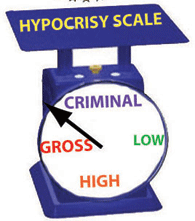
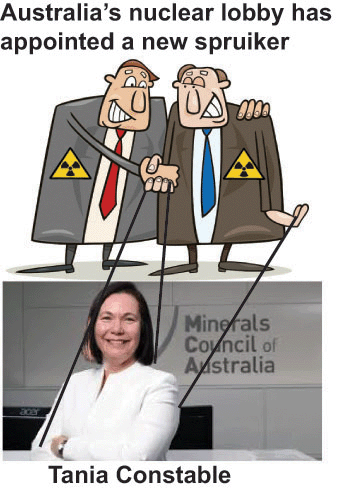
Minerals Council of Australia trying to influence European Commission, to push for fossil fuels and nuclear
|
The Minerals Council of Australia has weighed into a European commission climate policy debate, urging it to back fossil fuels with carbon capture use and storage (CCS) and nuclear power on a list of environmentally friendly developments.
In a written submission to the commission, the minerals council (MCA) said a proposed EU taxonomy for sustainable activities intended to shape investment under a European green deal was inconsistent in how it dealt with clean technologies because it favoured solar, wind and biofuels over nuclear and CCS. The mining lobby group said it was concerned this approach would have a flow-on effect on the types of energy investments backed by EU-based companies across the globe and “increase the cost of reducing CO2 emissions”. It called for an overhaul. InfluenceMap, a London-based thinktank that tracks corporate climate lobbying, said the MCA’s submission suggested it wanted to export its “negative approach to climate policy” by pushing for changes in other parts of the world that would allow continued use of coal and gas. The MCA submission argued there was “no valid basis” for treating CCS and nuclear differently given EU countries currently used coal, gas and nuclear……….. But InfluenceMap’s program manager, Rebecca Vaughan, said the MCA appeared concerned a science-led approach to dealing with the climate crisis would hurt the industries it represented. “While the MCA says it wants the EU to take a technology neutral position, its submission appears to advocate for the continued use of coal and gas with carbon capture utilisation and storage, which is clearly at odds with the commission’s science-based policy,” Vaughan said. The MCA has long been accused of hindering action to tackle the climate crisis in Australia, and campaigned aggressively against Labor’s two attempts to introduce a carbon pricing scheme. In recent years it has come under pressure to change its anti-climate stance from its biggest members, BHP and Rio Tinto. It followed the big mining companies facing repeated calls from their investors to abandon the MCA over its commitment to coal. It resulted in the MCA releasing a climate plan that said it was committed to the Paris agreement and reaching net zero emissions, but did not include a timeframe in which that target should be reached. The EU taxonomy is intended to help it meet a target of at least a 55% cut in its emissions below 1990 levels by 2030 on the way to net zero by 2050 by defining what activities are considered environmentally sustainable and warrant investment support. The commission said it expected the taxonomy would “create security for investors, protect private investors from greenwashing, help companies to plan the transition, mitigate market fragmentation and eventually help shift investments where they are most needed”.
The final version of the EU’s sustainable finance rules was due in January but a decision was delayed until April after 10 countries objected to the initial proposal because they wanted gas to be deemed a sustainable energy source. Nuclear energy plays a significant role in some EU countries but has been found to be in decline in the developed world, and to be more expensive and less efficient at reducing emissions than renewable energy……….. Nuclear energy remains banned in Australia. Some Coalition MPs and industry leaders want the prohibition lifted. https://www.theguardian.com/australia-news/2021/mar/21/australias-miners-urge-europe-to-define-nuclear-power-and-fossil-fuels-with-carbon-capture-as-sustainable |
|
Transnational Memory and the Fukushima Disaster: Memories of Japan in Australian Anti-nuclear Activism
Transnational Memory and the Fukushima Disaster: Memories of Japan in Australian Anti-nuclear Activism https://epress.lib.uts.edu.au/index.php/portal/article/view/7094
Alexander Brown https://orcid.org/0000-0002-3582-9658, Jan 28, 2021
Abstract
This paper argues for the importance of transnational memories in framing Australian anti-nuclear activism after the Fukushima disaster. Japan looms large in the transnational nuclear imaginary.
Commemorating Hiroshima as the site of the first wartime use of nuclear weapons has been a long-standing practice in the Australian anti-nuclear movement and the day has been linked to a variety of issues including weapons and uranium mining.
As Australia began exporting uranium to Japan in the 1970s, Australia-Japan relations took on a new meaning for the Indigenous Traditional Owners from whose land uranium was extracted.
After Fukushima, these complex transnational memories formed the basis for an orientation towards Japan by Indigenous land rights activists and for the anti-nuclear movement as a whole.
This paper argues that despite tenuous organizational links between the two countries, transnational memories drove Australian anti-nuclear activists to seek connections with Japan after the Fukushima disaster. The mobilisation of these collective memories helps us to understand how transnational social movements evolve and how they construct globalisation from below in the Asia-Pacific region.fic region.
Australian government’s brazen duplicity concerning Julian Assange
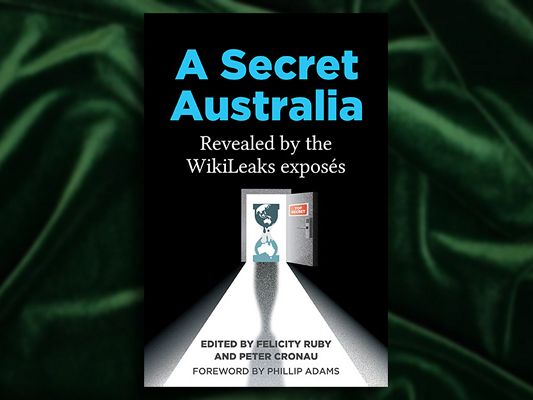 What Assange and WikiLeaks said about Australia, https://www.smh.com.au/culture/books/what-assange-and-wikileaks-said-about-australia-20210129-p56xyo.html
By Jessie Tu February 4, 2021 He has been called “truth-telling hero”, “evil and perverted traitor”, “heroic, trickster, mythical – reviled”. Robert Manne called him the “most consequential Australian of the present time”. The new US President has called him a “high-tech terrorist”.
The protean narratives of Julian Assange, who will be 50 in July, have been brewing since 2010, when his website published “The Afghan War Diaries”, “Iraq War Logs” and “Collateral Murder”, a video showing the US military killing two Reuters employees in Iraq.
December marked 10 years since Assange has been “arbitrarily detained” in Britain, according to Felicity Ruby and Peter Cronau in their introduction to A Secret Australia – a collection of 18 essays that survey the impact WikiLeaks has had on Australia’s media landscape and the consequences of our government’s attraction towards America’s intelligence and military empire.
The potpourri of authors and thinkers includes Julian Burnside, Antony Loewenstein, Scott Ludlam and Helen Razer, who critique “the powers opposed to openness and transparency” and examine the evidence, “not the likelihoods, the probabilities, the suspicions, and assumptions” around the “subversive, technology-based publishing house”.
WikiLeaks invented a “pioneering model of journalism” – one that embodied the “contemporary spirit of resistance to imperial power”, says Richard Tanter, from the school of political and social sciences at the University of Melbourne. It brought renewed debates on free speech, digital encryption and questions around the management and protection of whistleblowers who risk their lives to expose covert, deceitful actions by governments.
The documents exposed the “brazen duplicity” of the Australian government towards its citizens and presented “off-stage alliance management conversations”, Tanter writes. They invited the layperson into the green room of the performance that is politics and international diplomacy.
WikiLeaks unmasked reports that showed governments recommending media strategies to deceive the public, demonstrating their unethically utilitarian approach to international diplomacy and governance and “enlightened the public on the dark corners of wars”, writes journalist and author Antony Loewenstein.
Assange is still in a cell at London’s Belmarsh Prison, facing an appeal by the United States in its bid to extradite him to face charges for the 2010 publications. He is continuing to be “denied adequate medical care” and “denied emergency bail in light of the COVID-19″, says Lissa Johnson, a clinical psychologist and writer for New Matilda – one of the few Australian publications that have paid genuine attention to the WikiLeaks saga.
In Australia, there’s been a “striking absence of a solid debate on WikiLeaks in the mainstream public discourse”, according to Benedetta Brevini, a journalist and media activist who insists that our concerning “lack of a thorough and sustained debate” is incomprehensible. Loewenstein calls Australia’s lack of journalistic solidarity with Assange “deeply shameful”. He says we have an “anodyne media environment” – perhaps not unsurprising, considering our highly concentrated media market, one of the most severe in the world.
The standout essays come from Guy Rundle and Helen Razer – whose amusing voice cuts through the somewhat parched tenor of cold academic-speak that lightly threads through the other essays. Her addition is a breath of fresh air in the middle of a chain of same-same arguments.
The most useful essay is Rundle’s take on the historical basis for WikiLeaks. He surveys the swirling currents of Australian history that led to its founding, identifying WikiLeaks as a continuation of political activist Albert Langer’s resistance to capital.
“We need a whole new organisation of how recent Australian history is told,” Rundle concludes, seconding Lissa Johnson’s opinion that we demand citizens who “cut across the acquiescence and consent, remove the deadbolt on the torture chamber door, turn down the music and expose what is going on inside”. This collection of polemics, though at times repetitive, takes us closer to a future where these demands no longer seem beyond reality.
Biden administration presses for Julian Assange to be extradited to USA
Biden administration files appeal pressing for Assange extradition, Yahoo News, Sat, 13 February 2021 The administration of US President Joe Biden has appealed a British judge’s ruling against the extradition of WikiLeaks founder Julian Assange, a Justice Department official said Friday.
A brief filed late Thursday declared Washington’s desire to have Assange stand trial on espionage and hacking-related charges over WikiLeaks’ publication of hundreds of thousands of US military and diplomatic documents beginning in 2009.
The Justice Department had until Friday to register its stance on Judge Vanessa Baraitser’s January 4 ruling that Assange suffered mental health problems that would raise the risk of suicide if he were sent to the United States for trial.
“Yes, we filed an appeal and we are continuing to pursue extradition,” Justice Department spokesman Marc Raimondi told AFP.
After Baraitser’s decision, which did not question the legal grounds for the US extradition request, Donald Trump’s administration moved to appeal.
But Biden’s stance was not clear, and he was pressured by rights groups to drop the case, which raises sensitive transparency and media freedom issues.
After WikiLeaks began publishing US secrets in 2009, then-president Barack Obama, whose vice president was Biden, declined to pursue the case.
Assange said WikiLeaks was no different than other media constitutionally protected to publish such materials.
Prosecuting him, too, could mean also prosecuting powerful US news organizations for publishing similar material — legal fights the government would likely lose.
But under Trump, whose 2016 election was helped by WikiLeaks publishing Russian-stolen materials damaging to his rival Hillary Clinton — the Justice Department built a national security case against Assange.
In 2019 the native Australian was charged under the US Espionage Act and computer crimes laws with multiple counts of conspiring with and directing others, from 2009 to 2019, to illegally obtain and release US secrets……….
Assange has remained under detention by British authorities pending the appeal.
Earlier this week 24 organizations, including Human Rights Watch, Amnesty International USA and Reporters Without Borders, urged Biden to drop the case.
“Journalists at major news publications regularly speak with sources, ask for clarification or more documentation, and receive and publish documents the government considers secret,” they said in an open letter.
“In our view, such a precedent in this case could effectively criminalize these common journalistic practices.”
Assange’s fiancée Stella Moris said in a statement that Baraitser’s January decision that Assange was a high risk for suicide and that US prison facilities were not safe remained a strong reason to deny extradition.
Baraitser “was given clear advice by medical experts that ordering him to stand trial in the US would put his life at risk,” she said.
“Any assurances given by the Department of Justice about trial procedures or the prison regime that Julian might face in the US are not only irrelevant but meaningless because the US has a long history of breaking commitments to extraditing countries,” she said https://au.news.yahoo.com/biden-administration-files-appeal-assange-171637702.html
French nuclear attack submarine visted Australia, then on to patrol the South China Sea
|
French Nuclear Attack Boat Patrolled South China Sea https://news.usni.org/2021/02/10/french-nuclear-attack-boat-patrolled-south-china-sea By: Xavier Vavasseur, February 10, 2021 A French Navy Rubis-class nuclear-powered submarine (SSN) patrolled the South China Sea, the French minister of armed forces announced in a series of tweets.
French armed forces minister Florence Parly called the patrol “a striking proof of the capacity of our French Navy to deploy far and for a long time in connection with our Australian, American and Japanese strategic partners.” On Monday night, Parly shed some light on the current deployment of Rubis-class SSN FS Emeraude (S604) to the Pacific region. In a series of messages on Twitter, she said: “Since September, a nuclear attack submarine (SSN Émeraude) and a support vessel (BSAM Seine) have sailed up to 15,000 km from the coasts of mainland France in the Indian Ocean and the Pacific. This extraordinary patrol has just completed a passage in the South China Sea. A striking proof of the capacity of our French Navy to deploy far and for a long time in connection with our Australian, American and Japanese strategic partners. Why such a mission? To enrich our knowledge of this area and to affirm that international law is the only rule that is valid, whatever the sea in which we sail. Nation of the Indo-Pacific (~ 2 million inhabitants), France has the 2nd largest exclusive economic zone in the world (11 million km2 of which 9 are in the Indo-Pacific). We intend to protect our sovereignty and our interests.” Naval News first reported about Emeraude’s mission to the Pacific when it stopped over in Australia. The submarine then visited the U.S. naval base in Guam and participated in an anti-submarine warfare (ASW) exercise with the U.S. Navy and JMSDF. Following an exercise with the Indonesian Navy Emeraude will likely be joining the French carrier strike group which is set to depart this week for the Indian Ocean and Persian Gulf region. |
|
Julian Assange nominated by French parliamentarians for Nobel Peace Prize
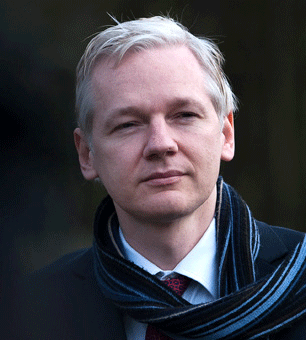 A Nobel Peace Prize for Julian Assange! https://melenchon.fr/2021/01/28/un-prix-nobel-de-la-paix-pour-julien-assange/ Thursday 28 January 2021, I decided to nominate journalist Julian Assange for the Nobel Peace Prize, as I have the power to do as a parliamentarian. Julian Assange is a hero of freedom. The WikiLeaks initiative has raised awareness of war crimes and serious human rights abuses. It is right that the peoples of the world express their gratitude to him. A Nobel Peace Prize for Julian Assange! https://melenchon.fr/2021/01/28/un-prix-nobel-de-la-paix-pour-julien-assange/ Thursday 28 January 2021, I decided to nominate journalist Julian Assange for the Nobel Peace Prize, as I have the power to do as a parliamentarian. Julian Assange is a hero of freedom. The WikiLeaks initiative has raised awareness of war crimes and serious human rights abuses. It is right that the peoples of the world express their gratitude to him.
On January 4, 2021, British justice refused his extradition to the United States, but maintained his imprisonment. More than ever, Julian Assange needs the protection of the peoples of the world. Granting him the Nobel Peace Prize would allow that.
|
|
|
Red Cross celebrates Nuclear Ban Treaty- an incremental process towards elimination of nuclear weapons
 Crucial to sign up for a nuclear-free celebration. https://www.theage.com.au/national/crucial-to-sign-up-for-a-nuclear-free-celebration-20210121-p56vtl.htmly Kym Pfitzner Crucial to sign up for a nuclear-free celebration. https://www.theage.com.au/national/crucial-to-sign-up-for-a-nuclear-free-celebration-20210121-p56vtl.htmly Kym Pfitzner
January 22, 2021 — It’s taken 75 years since the bombing of Hiroshima and Nagasaki to reach the historic day when we finally have a ban on nuclear weapons enshrined in international law.
Today is a day for celebration. From January 22, all nations that ratified the Treaty on the Prohibition of Nuclear Weapons are banned from possessing, developing or having any direct dealings with these weapons of mass destruction. This development heralds progress towards a safer and more humane world. The Red Cross and Red Crescent Movement across the globe has been striving towards this moment for three-quarters of a century. How timely it is to achieve this milestone after a year of uncertainty and difficulties. I commend the 86 countries which have already signed this important treaty – from Austria to Zimbabwe – and particularly the 51 nations that have ratified it. They’ve put the interests of humanity and the environment above other considerations. I’d like to remind all other nations of our organisation’s inability to provide any remotely adequate medical or humanitarian response to a nuclear crisis and call on all countries which are yet to sign – including Australia, the nuclear-armed nations, and some of their allies – to do so now. But today should still be celebrated. It’s the dawn of new era in which the last weapon of mass destruction to be regulated by international law will finally begin to be controlled. Other weapons that cause unacceptable harm – contrary to the laws of war – have already been banned, such as cluster munitions, anti-personnel landmine and chemical weapons. Nuclear weapons are incompatible with the rules of international humanitarian law. The laws of war are unambiguous: weapons must be able to distinguish between civilians and combatants, as only combatants can be legally attacked. Weapons must not cause superfluous injury or unnecessary suffering. Their effects must be proportionate to their military objective. And weapons cannot be used if they cause widespread, long-term and severe damage to the environment. Rather than leaving the fate of these weapons to the handful of countries that legally own them, and which were not fulfilling their obligation to work towards their elimination, the public debate has been reframed from being defined as a matter of defence policy, to being about the unacceptable humanitarian consequences of use of nuclear weapons. We know all about those consequences. Members of the Red Cross and Red Crescent Movement were there when the bombs fell on Hiroshima and Nagasaki. There was little they could do to deal with the immediate needs of those needing help, or to alleviate the long-term suffering of the people on the ground. The impacts lasted decades and, devastatingly, even affected the children of those who survived those bombs. Research is still being conducted to determine whether the illnesses being experienced by descendants – two generations later – can be explained by mutations in their DNA that was caused by radiation. With the coming into force of this treaty, let’s hope we’re getting closer to the time that we’re never that helpless again. We want Australians to know that nuclear weapons are not an acceptable defence policy option. They are barbaric tools that cause hellish devastation and untold suffering to civilians. Some critics argue the treaty is toothless because the nuclear-armed nations and their allies have not yet signed it. This ignores the reality of International law-making, which is that creating new norms is an incremental process. It takes patience and persistence. No weapon has ever been eliminated without first being studied, stigmatised and prohibited. With the advent of a vaccine for COVID-19, we can be cautiously hopeful that the end of the current global pandemic is in sight. Unfortunately, though, we can’t rely on medical science to save us from the impacts of a nuclear attack. There can be no vaccine for the health effects of a nuclear weapon. Elimination is the only option. This is why we believe in a future without nuclear weapons. Kym Pfitzner is the CEO of Australian Red Cross. |
|
|
Australia could sign the Nuclear Ban Treaty and still keep its military co=operation with America
 The nuclear weapons ban treaty is groundbreaking, even if the nuclear powers haven’t signed The Conversation 22, 2021 Tilman Ruff– Honorary Principal Fellow, School of Population anobal Health, University of Melbourne,
The UN Treaty on the Prohibition of Nuclear Weapons (TPNW) was adopted at the United Nations in 2017 and finally reached the milestone of 50 ratifications in October. The countries that have signed and ratified include Austria, Ireland, Mexico, New Zealand, South Africa, Nigeria and Thailand.
The treaty completes the suite of international bans on all major weapons considered unacceptable because of their indiscriminate and inhumane effects, including anti-personnel landmines, cluster munitions, biological and chemical weapons………
The TPNW strengthens the current nuclear safeguards found in the 1970 Treaty on the Non-Proliferation of Nuclear Weapons by requiring all states that join to have comprehensive provisions in place and not allowing states to weaken their existing safeguards.
The treaty provides the first legally binding multilateral framework for a process by which all nations can work toward eliminating nuclear weapons………
Further, the TPNW is the first treaty to commit member nations to provide long-neglected assistance for the victims of atomic bombs and weapon testing. It also calls for nations to clean up environments contaminated by nuclear weapons use and testing, where feasible.
Nuclear-armed states have been put on notice
Currently, 86 nations have signed the TPNW, and 51 have ratified it (meaning they are bound by its provisions). The treaty now becomes part of international law, and the number of signatories and ratifications will continue to grow……..
While any treaty is technically only binding on the states that join it, the TPNW establishes a new international legal standard against which all nuclear policies will now be judged.
The treaty, in short, is a game-changer, and the nuclear-armed and dependent countries have been put on notice. They know the treaty jeopardises their claimed right to continue to threaten the planet with their weapons, as well as their plans to modernise and maintain their nuclear arsenals indefinitely…………
The strength of the opposition is a measure of the treaty’s importance. It will have implications for everything from defence policies and military plans to weapons manufacturing to financial investments in the companies that profit from making now illegal nuclear weapons………….
A ‘dangerous’ belief nuclear weapons enhance securityWould joining the treaty mean nations like Australia, Japan, South Korea and NATO members would have to end their military cooperation with nuclear-armed states like the US? No. There is nothing in the TPNW that prevents military cooperation with a nuclear-armed state, provided nuclear weapons activities are excluded. Countries like New Zealand and Kazakhstan have already demonstrated that joining the treaty is fully compatible with ongoing military cooperation with, respectively, the US and Russia. In a recent letter urging their governments to join the treaty, 56 former presidents, prime ministers and defence and foreign ministers from these nations said: By claiming protection from nuclear weapons, we are promoting the dangerous and misguided belief that nuclear weapons enhance security. As states parties, we could remain in alliances with nuclear-armed states, as nothing in the treaty itself nor in our respective defence pacts precludes that. But we would be legally bound never under any circumstances to assist or encourage our allies to use,
The signatories include two former NATO secretaries-general, Willy Claes and Javier Solana. Ban treaties have been proven to work with other outlawed weapons — landmines, cluster munitions and biological and chemical weapons. They have provided the basis and motivation for progressive efforts to control and eliminate these weapons. They are now significantly less produced, deployed and used, even by states that haven’t joined the treaties. We can achieve the same result with nuclear weapons. As Hiroshima survivor Setsuko Thurlow said at the UN after the treaty was adopted, This is the beginning of the end of nuclear weapons. https://theconversation.com/the-nuclear-weapons-ban-treaty-is-groundbreaking-even-if-the-nuclear-powers-havent-signed-153197 |
|
|
Morrison government gets in early to disparage nuclear ban treaty, but Labor supports it
 New nuclear treaty will be ‘ineffective’: DFAT, SMH, Anthony Galloway, January 21, 2021, Australia says a new United Nations nuclear treaty signed by more than 80 countries will be ineffective in eliminating nuclear weapons from the world.The Morrison government has not signed the Treaty on the Prohibition of Nuclear Weapons, which comes into effect on Friday.
The treaty, signed by 86 countries, bans signatories from testing, developing, producing, stockpiling or threatening to use nuclear weapons.
The Australian government decided not to sign the treaty on the basis that it failed to recognise the realities of the current international security environment.
Government sources confirmed there was concern about how the treaty would affect Australia’s dealings with the United States, including intelligence sharing through the Pine Gap satellite surveillance base near Alice Springs, because it banned signatories from doing anything to assist a nuclear weapon state in its nuclear plans.
New Zealand, which is part of the Five Eyes intelligence-sharing agreement with the US, Australia, Canada and Britain, has signed the treaty…….
Opposition foreign affairs spokeswoman Penny Wong said Labor welcomed the treaty.
“After taking into account the need to ensure an effective verification and enforcement architecture, the interaction of the treaty with the Nuclear Non-Proliferation Treaty, and achieve universal support, a Labor government would sign and ratify the treaty,” she said.
“Australia can and should lead international efforts to rid the world of nuclear weapons. A Labor government would work with our allies and partners to this end and would always act consistently with the US alliance.”
Helen Durham, director for international law and policy at the International Committee of the Red Cross, said all countries should sign the treaty as it was the “most explicit and clearest expression that the horrific weapons need to be banned”.
“It deals not only with their use but also with their threat of use, with their stockpiling, with their production, with their development and their testing,” she said.
“This treaty is a great opportunity to move a very stagnated, to date, agenda forward and we would encourage every state to take up this opportunity.”
Dave Sweeney, co-founder of the International Campaign to Abolish Nuclear Weapons, said the treaty was a “sign of hope for our planet”.
“The changed status of nuclear weapons means Australia faces a clear choice,” he said. “We either choose to be a responsible and lawful member of the global community or we remain silent and complicit in plans to fight illegal wars https://www.smh.com.au/politics/federal/new-nuclear-treaty-will-be-ineffective-dfat-20210121-p56vst.html
Australian government complicit in nuclear weapons, silent on Nuclear Weapons Ban Treaty
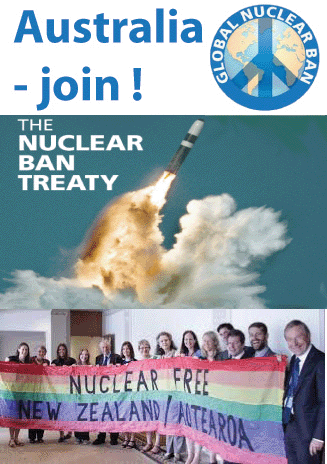 Nuclear weapons illegal from 22 January https://www.miragenews.com/nuclear-weapons-illegal-from-22-january/ 21 Jan 21, As President Joe Biden takes charge in the United States – and is expected to immediately move to rejoin the Paris climate agreement – this week also sees a very significant shift in the global status of nuclear weapons. Nuclear weapons illegal from 22 January https://www.miragenews.com/nuclear-weapons-illegal-from-22-january/ 21 Jan 21, As President Joe Biden takes charge in the United States – and is expected to immediately move to rejoin the Paris climate agreement – this week also sees a very significant shift in the global status of nuclear weapons.On Friday 22 January the UN Treaty on the Prohibition of Nuclear Weapons takes effect, making nuclear weapons finally and formally illegal under international law. “This is a sign of hope for our planet,” said Dave Sweeney, ACF nuclear free campaigner and co-founder of ICAN, the International Campaign to Abolish Nuclear Weapons. “Nuclear weapons pose an existential threat. They are weapons of mass and indiscriminate murder. From this week, they are illegal under international law.” The treaty prohibits signatories from testing, developing, producing, stockpiling or threatening to use nuclear weapons. It also obliges parties to support the widespread adoption of the treaty and address the human and environmental impacts of nuclear testing. While the treaty cannot force non-signatories – including the USA, China and Russia – to disarm, it will increase the political, legal and economic pressure on these nations and their allies. The Morrison government has opposed the progress of the treaty and refuses to support or sign the initiative. Labor has committed to sign and ratify the treaty when it is next in government. The Greens and some cross benchers also support the treaty. “The changed status of nuclear weapons means Australia faces a clear choice,” Dave Sweeney said. “We either choose to be a responsible and lawful member of the global community or we remain silent and complicit in plans to fight illegal wars. “It’s time for Australia to be on the right side of law and history – this treaty is the best way to finally get rid of the world’s worst weapons. We should celebrate it and support it.” The ban follows years of advocacy led by ICAN, the International Campaign to Abolish Nuclear Weapons, which started in Melbourne in 2007 and was awarded the Nobel Peace Prize in 2017 for drawing attention to the catastrophic humanitarian consequences of any use of nuclear weapons and for its efforts to achieve a treaty-based prohibition of such weapons. ICAN briefing paper on the Treaty on the Prohibition of Nuclear Weapons and Australia /Public Release. The material in this public release comes from the originating organization and may be of a point-in-time nature, edited for clarity, style and length. View in full here. |
|
|
How will Entry Into Force of the Nuclear Weapons Ban Treaty impact non weapons states parties, including Australia?
 How will EIF impact non states parties, including Australia? https://icanw.org.au/wp-content/uploads/Australia-EIF-of-the-TPNW.pdf How will EIF impact non states parties, including Australia? https://icanw.org.au/wp-content/uploads/Australia-EIF-of-the-TPNW.pdf16 Jan 21, While non states parties are not legally bound to the terms of the treaty, the norms set out and strengthened by the treaty can shape their behaviour and build pressure for them to join. The entry into force of the treaty puts Australia out of step with international law. While Australia has joined every other treaty that prohibits indiscriminate or inhumane weapons, the Nuclear Non-Proliferation Treaty and the South Pacific Nuclear Free Zone Treaty, it has not yet signed or ratified the ban on nuclear weapons. This position is contested by a growing nationwide movement and at all levels of government. The treaty reveals Australia’s complicity in the problem by including nuclear weapons in its defence posture.
****
As a country with a devastating history of nuclear testing, Australia will be obliged to take action as a state party to assist survivors of nuclear testing and take steps towards remediating contaminated environments. These obligations should be informed by and developed in collaboration with impacted First Nations people, nuclear test veterans, civil society, public health and other experts.
****
Entry into force of previous ban treaties has led to a substantial decrease in the production and deployment of prohibited weapons such as cluster munitions and landmines, both by states parties and non states parties. EIF will also impact the flow of funds to nuclear arms producing companies. Financial institutions often choose not to invest in “controversial weapons,” which are typically weapons prohibited by international law. The entry into force of the TPNW clearly puts nuclear weapons in this category and will likely trigger additional divestment, including by Australian banks and superannuation funds.
****
EIF of the treaty will further stigmatise nuclear weapons, including in Australia, by: Prompting further debate: more than 250 federal, state and territory parliamentarians have declared their support for the treaty and the federal Opposition, the Australian Labor Party, has committed to sign and ratify the treaty in government. Decision-makers will continue to be asked to engage with this new piece of international law.
****
Institutionalisation: entry into force will entrench the treaty’s place in the international legal architecture for nuclear weapons. It is already referenced in international fora as signatories and states parties proudly declare their commitment to nuclear disarmament.
****
Impacting alliances: all states parties in alliances with nuclear-armed states will be required to renounce the use of nuclear weapons on their behalf, and ensure they are not assisting with the use or threat of use of the weapons. Once a state party, Australia will need to cease any policy that countenances and supports the use of nuclear weapons. Other US allies, including New Zealand and Thailand, have already joined the treaty.
****
It will take years to build the necessary political will for some states to join the nuclear weapon ban treaty. Shifting nuclear weapons from a symbol of status to a liability of shame is slow, yet crucial, work. As the signatures and ratifications of the treaty continue beyond entry into force, non states parties will face increasing criticism from their citizens, international organisations and other states. Almost all of Australia’s neighbours in the Pacific and Southeast Asia support the treaty. It is only a matter of time before Australia joins the treaty and thereby becomes part of the solution to these abhorrent weapons.
|
|
1 This month
17 October, Free Public Talk on Nuclear Issues in South Australia
David Noonan will speak on public interest concerns over the new Roxby Downs Indenture Act 2026 on BHP copper-uranium mining and ore processing in SA, and on how AUKUS may face SA with a High-Level nuclear waste agenda.
Dr Jim Green will discuss international developments in the field of nuclear power including ‘small modular reactors’ and Generation 4 ‘advanced’ nuclear reactor concepts.


Help Aunty Sue Protect Her Land and Sacred Sites From Destructive Rocket Testing.
.

Australians deserve the truth
about
AUKUS – https://aukuspublicinquiry.com/

PETITION – To: Prime Minister Anthony Albanese and the Australian Labor Government

of the week – Australians for War Powers Reform (AWPR)
To see nuclear-related stories in greater depth and intensity

