The Court Of Public Opinion And The Blood-Curdling Untold Story – on Julian Assange
This prospect prompted the UN Working Group on Arbitrary Detention and 33 EU parliamentarians to issue strongly worded statements to both the UK and Ecuadorian governments in December last year, warning against facilitating the prosecution of a journalist, editor and publisher for “publishing the truth”. The statements demanded Assange’s “immediate release, together with his safe passage to a safe country”, and reminded the UK of its “binding” legal obligations to secure freedom for Assange.
A critical task for propagandists such as those waging a psychological war on Wilkileaks, then, is to feed audiences material that supports official narratives and exclude that which does not. Since its inception, the smear campaign against Julian Assange and Wikileaks has been remarkably concerted and consistent in that regard.
With the new year, however, news broke that the International Monetary Fund (IMF) had offered Ecuador a $10 billion bailout in return for handing Julian Assange over to the United States. This bounty came on top of earlier US pressures and inducements, reportedly including increased oil exports, military co-operation and another $1.1 billion in IMF loans, with the US representative of the IMF instructing Ecuador that it must “resolve” its relationship with Julian Assange in order to receive the IMF money.
Australian Barrister Greg Barns has called it the blackmailing of a nation. News website 21st Century Wirecalled it “one of the biggest international bribery (or extortion) cases in history.”
While there is “not a single shred of evidence that any of [Wikileaks’] disclosures caused anyone harm”, writes journalist and author Nozomi Hayase, what Wikileaks did do in 2010 was expose thousands of previously unreported civilian deaths in Iraq and Afghanistan. These deaths included the nonchalant gunning down of children, journalists and their rescuers, and other “indiscriminate violence… torture, lies [and]bribery”, writes Chris Hedges. According to Pentagon Papers whistleblower Daniel Elsberg, the leaks exposed “a massive cover-up over a number of years by the American authorities”.
Julian in ‘critical danger’, new rules ‘torture’ – Assange mother *AUDIO*
The Psychology Of Getting Julian Assange, Part 2: The Court Of Public Opinion And The Blood-Curdling Untold Story, New Matilda, By Dr Lissa Johnson February 25, 2019 In her ongoing special investigation into the detention of Julian Assange, Dr Lissa Johnson turns to the art of smear, and how to corrupt a judicial system.
On Friday 14th February, the Editor in Chief of news website Consortium News, Joe Lauria, visited Sydney to host a ‘Politics in the Pub’ event: Whistleblowing, Wikileaks and the Future of Democracy. The event took place in anticipation of upcoming rallies to free Assange…….
. It is imperative that we pressure the Australian government to make sure its citizen, Julian Assange, is protected from the lawlessness of the American Empire.” Continue reading
Malaysian environmentalists and consumer groups dispute Lynas’ claims about radioactive wastes

Lynas is being unscientific, not SAM or CAP https://www.malaysiakini.com/letters/471173 SM Mohamed Idris 6 Apr 2019 Sahabat Alam Malaysia (SAM) and the Consumers Association of Penang (CAP) refer to the letter by Lynas Malaysia reported in Malaysiakini on 5 April 2019, which says that our recent statements about the plant’s wastes are “false and ignore scientific fact.”
The controversy is over the definition of wastes from the Lynas’ water leach purification (WLP) process, which contains thorium and uranium.
Lynas claims that the wastes are naturally-occurring radioactive material (called NORM), while we claim that the wastes are not naturally-occurring, but have been technologically-enhanced and should be called technologically-enhanced naturally-occurring radioactive material known as TENORM.
Citing “two eminent scientists”, Lynas states as fact that “the small amount of thorium and uranium in the WLP generated are not man-made but naturally occurring radionuclides found in soil, water and in food.”
Lynas is clearly distorting the facts.
First of all, the thorium and uranium containing wastes generated by Lynas are not found to naturally occur in the Gebeng area, where the plant is located. On the contrary, the raw material which is processed by the Lynas plant is lanthanide concentrate that contains the thorium, uranium and the rare-earth.
This raw material is processed and imported from the Mount Weld mine in Australia and is brought to Malaysia. It is then subject to further processing in Gebeng by Lynas.
Therefore, how can it be said that say that the thorium and uranium are naturally occurring in the soil, water and in food when they were not there before in the Gebeng area, if not for the Lynas operations?
Moreover, what is even more significant is that we are talking about the generation of an accumulated amount of more than 450,000 metric tonnes of radioactive wastes from the Lynas operations thus far. To call this naturally-occurring radioactive material is indeed unscientific.
Secondly, the wastes that Lynas has generated from the WLP process clearly falls within the definition of TENORM, as defined by the US Environmental Protection Agency (USEPA) as: “Naturally occurring radioactive materials that have been concentrated or exposed to the accessible environment as a result of human activities such as manufacturing, mineral extraction, or water processing.”
The USEPA also states that “technologically enhanced” means that the radiological, physical, and chemical properties of the radioactive material have been concentrated or further altered by having been processed, or beneficiated, or disturbed in a way that increases the potential for human and/or environmental exposures.”
Indeed, Lynas seems to have forgotten that its own Radiological Impact Assessment of 2010 refers to the residues from its operations as TENORM.
Moreover, in a study co-authored by, Dr. Sukiman Sarmani (the “eminent scientist” that Lynas refers to in its letter) and three others (published in 2014 on the Lynas plant residue), shows that the WLP residue has a high radioactivity of Thorium 232 compared to the natural background levels of Malaysian soils and therefore comes under the purview of the regulatory authorities.
These facts fortify our position.
Lynas in its letter also refers to us as “unqualified people.”
For the record, SAM and CAP have very deep and detailed knowledge of how rare-earth plants can impact public health and the environment, having had years of considerable experience from being involved in the Asian Rare Earth (ARE) case in Bukit Merah, Ipoh.
We assisted the people of Bukit Merah over many years countering the claims of ARE, the Atomic Energy Licensing Board, the International Atomic Energy Agency and others.
This we did by being engaged and involved with many scientists and public health experts both from Malaysia and abroad, who helped the community battle in the courts, that finally led to its closure. We have over the years documented the serious health impacts suffered by the Bukit Merah community, that continue till today, due to the impacts of low-level radiation.
Surely our rich experience and knowledge cannot simply be dismissed by the likes of Lynas. SM MOHAMED IDRIS is president of both environmental movement Sahabat Alam Malaysia (SAM) and NGO Consumers Association of Penang (CAP).
About torture, about pyschology, about the persecution of Julian Assange
John Pilger speaks out for Julian Assange
an example of the sensitive, clandestine, real-world CIA psychology deployed against ‘terrorists’ and enemies of the state, as Julian Assange and Wikileaks have been branded.
In this case, the adversary in the US crosshairs has been not only Julian Assange and Wikileaks, but the global populations that Wikileaks seeks to inform. It is our own vulnerabilities – the vulnerabilities in the information processing systems of all human beings – that have been leveraged and exploited in order to undermine and discredit Wikileaks.
The fundamental psychological task is to render truth suspicious and deceit reassuring, war criminals virtuous and their critics corrupt, pacifism threatening and violence comforting, abuse of power righteous and resistance reprobate, torture forgivable and whistleblowing a crime, censorship a bastion of democracy and free speech a menace to be overcome. Much as George Orwell foresaw.
In order to justify the psychological war on Wikileaks, US powerbrokers have branded Wikileaks and Assange “anti-American” “terrorists”, a “non-state hostile intelligence service” and “enemy combatants”. Bolstered by these factually indefensible slurs, Julian Assange now faces imminent extradition to the United States to face secret charges, most likely for 2010 scoops exposing US war crimes in Iraq and Afghanistan.
Peace is bad. War is good. Truth is dangerous. Censorship will set you free. These are the positions underpinning the war on Wikileaks.
 The Psychology Of Getting Julian Assange, Part 1: What’s Torture Got To Do With It? https://newmatilda.com/2019/02/19/psychology-getting-julian-assange-part-1-whats-torture-got/ Dr Lissa Johnson on February 19, 2019
“…. Assange faces extradition to the United States and secret charges for his publishing activities should he step outside the Ecuadorian Embassy in London. This cross-border, extraterritorial persecution threatens not only Assange’s health, and possibly his life according to a recent UN statement, but poses grave legal risks both to journalism and dissent…..
The Australian rallies join a growing international chorus of organisations and individuals sounding increasingly urgent alarms over Julian Assange’s plight, and its implications for freedom of speech and democratic rights.
Late last year, as secret US charges against Julian Assange surfaced, and the threat of his imminent extradition to the US loomed, the United Nations Working Group on Arbitrary Detention (UNWGAD) issued a strongly worded statement to the UK Government, having previously ruled twice that Assange is being arbitrarily detained in the Ecuadorian Embassy in London.
In its statement, the UNWGAD demanded that the UK abide by its “binding” legal obligations and “immediately” secure freedom for Julian Assange. The UN reminded the UK Government that “human rights treaty law is binding law, it is not discretionary law. It is not some passing fancy”.
The same fears prompted 33 EU parliamentarians to write a similarly strongly worded letter to the British Prime Minister, the Ecuadorian President and the UN Secretary General on December 10th, condemning the “very serious and egregious violations of human rights in the heart of Europe.” They called for Assange’s “immediate release, together with his safe passage to a safe country.”
Two German MPs followed with a visit to the Ecuadorian Embassy on December 20th, at which they denounced the violation of Assange’s “fundamental rights” and expressed their “demand that this case has to be solved: that no publisher, no editor, no journalist is detained because of publishing the truth”.
The politicians’ and UN statements added to previous condemnations of Assange’s persecution from Human Rights Watch, Amnesty International, the American Civil Liberties Union, the Committee to Protect Journalists, and a former senior lawyer for the UNHCR and UN Expert on the Promotion of International Order.
All of these leading legal and human rights authorities have been making essentially the same fundamental point: that Julian Assange is being persecuted for publishing truth in the public interest, placing public interest journalism itself at risk, along with freedom of speech and other democratic and human rights principles.
It is the same fundamental point made by several speakers at an earlier Australian rally to free Julian Assange, held in Sydney in June last year. John Pilger spoke at that rally also.
Pilger’s important 2018 speech, however, like the rally itself, was subject to a near total, if not total, mainstream media blackout. So if you missed it, that may be why. And if you haven’t followed the US war on Wikileaks from the outset, as I hadn’t when I attended last year’s rally, Pilger’s speech is a powerful way to bring yourself up to speed. Continue reading
Environment Minister Melissa Price confirms Malaysia’s request for Australia to take back Lynas’ radioactive trash
 Minister confirms Malaysian request on Lynas waste, Fin Rev 2 Apr 19 Brad Thompson Environment minister Melissa Price has confirmed receiving a letter from her Malaysian counterpart requesting collaboration on the removal of low-level radioactive waste produced by Lynas Corporation.
Ms Price’s office said on Tuesday that it was premature to comment further until the request had been properly considered.
Malaysia wants Australia to accept 450,000 tonnes of waste created at the Lynas plant near Kuantan in the processing of rare earths from the company’s Mount Weld mine in Western Australia.
A spokesman for Ms Price said Australia’s Department of the Environment and Energy handled import permit applications for hazardous materials on a case-by-case basis.
Similarly, the Australian Radiation Protection and Nuclear Safety Agency handled import permit applications for radioactive material on a case-by-case basis.
It remains unclear how the Lynas waste will be classified. It is understood West Australian authorities would also have to sign off on the transport of any waste within the state, possibly all the way back out to the remote Mount Weld mine.
Lynas refuses to concede it will have to find a way to remove low-level radioactive waste from Malaysia to keep its operations going, despite increasing political pressure.
The Wesfarmers’ takeover target said on Tuesday that it continued to engage productively with the Malaysian government over the waste issue.
Lynas remains optimistic it can resolve the issue within Malaysia despite an order to remove the waste by September if it wants to continue operating its $800 million Kuantan plant.
Lynas, led by Amanda Lacaze, declined to comment on the Malaysian minister’s formal request for the Australian government to collaborate on the waste removal………
Wesfarmers is reported to have told Lynas it is willing to build a first-stage processing plant at Kwinana, south of Perth, to overcome the waste issue. Connect with Brad on Twitter.Email Brad at bradthompson@afr.com.au https://www.afr.com/business/mining/environment-minister-confirms-malaysian-request-on-lynas-waste-20190402-p51a1x?fbclid=IwAR3P_yvHRTW0Z3LAj1bBwWTkFrfdiLP0S9wmykaxQoY-QZfymcRZXtG5U5g
Malaysia wants Australia to help remove Lynas’ radioactive trash from rare earths processing
Malaysia turns up heat on Australia over Lynas waste, Brad Thompson, Fin Rev, 1 Apr 19, A senior Malaysia politician says the Australian government has been asked to collaborate on the removal of low-level radioactive waste produced by Lynas Corporation’s rare earths processing operations.
Deputy environment and climate change minister Isnaraissah Munirah Majilis said an official letter requesting collaboration had been sent to the Australian government last month, in another sign Malaysia is determined to have the waste removed despite suggestions from Lynas it is close to …… (Subscribers only) https://www.afr.com/business/mining/history-stacks-up-against-wesfarmers-and-rare-earths-plant-20190401-p519q3
Hypocrisy in Scotland. For political reasons, First Minister Nicola Sturgeon refused to meet Aboriginal nuclear waste protestor
 Gaffe reveals why Sturgeon refused to meet nuclear waste protestor https://theferret.scot/sturgeon-nuclear-waste-protestor/ James McEnaney on March 14, 2019 The Scottish Government has mistakenly revealed that Nicola Sturgeon refused to meet an Aboriginal nuclear waste protestor in an attempt to avoid political damage – not because she was too busy, as her officials said.
 Internal emails uncovered by The Ferret reveal that the First Minister was advised to turn down a request for a meeting in 2018 so as not to become a “focus for criticism”. But officials said the public reason given for her refusal would be “on the standard basis of diary pressures”.
Campaigners reacted with sadness, saying that the Scottish Government’s “ears are closed”. The government stressed that it had “very limited scope” to address the issues raised.
Nuclear fuel was sent from an Australian research reactor to Dounreay on the north coast of Scotland for reprocessing in the 1990s. The resulting radioactive waste, amounting to 51 cemented drums, was originally due to be returned to Australia for disposal.
But under the terms of a waste substitution deal in 2014, Scottish and UK governments agreed that the drums should stay at Dounreay. Instead, the plan is to send four containers of “radiologically equivalent” waste to Australia from the Sellafield nuclear complex in Cumbria.
Two sites have been identified for a planned store for the waste in south Australia – Wallerberdina Station, near Hawker, and Kimber – both of which face opposition from indigenous communities. The Ferret reported in February that Scottish ministers had been advised that they had powers to prevent the waste being exported to protect human rights.
Australia participating in the Waigani Convention, – banning import of nuclear wastes to island countries, controlling their transport
 Ban of hazardous radioactive wastes tops agenda, https://fijisun.com.fj/2019/02/21/ban-of-hazardous-radioactive-wastes-tops-agenda/ Fiji Sun, by Ministry of Environment, 21 Feb 2019
 The Waigani Convention – on banning import of radioactive wastes, and controlling their transboundary movement
Waigani Convention, SPREP – Pacific Environment The Convention to Ban the Importation into Forum Island Countries of Hazardous and Radioactive Wastes and to Control the Transboundary Movement and Management of Hazardous Wastes within the South Pacific Region, also known as Waigani Convention, entered into force in 2001.
The Waigani Convention is modelled on the Basel Convention and constitutes the regional implementation of the international hazardous waste control regime (Basel, Rotterdam and Stockholm Conventions. There are however some differences between the two conventions: the Waigani Convention covers also radioactive wastes and extends to the Exclusive Economic Zone (200 nautical miles) rather than the territorial sea (12 nautical miles) under Basel.
The Convention is also strongly related to the Convention on the Prevention of Marine Pollution by dumping of wastes and other Matters, 1972 (London Convention)…….
Members are listed – include Australia, the Cook Islands, Fiji, Kiribati, Niue, Papua New Guinea, Samoa Tonga, Tuvalu, and Vanuatu. Other parties to the Waigani Convention included the Federated States of Micronesia, New Zealand and the Solomon Islands……more https://www.sprep.org/convention-secretariat/waigani-convention
Courageous indigenous appeal to Scotland to stop sending nuclear waste – stop indigenous cultural genocide
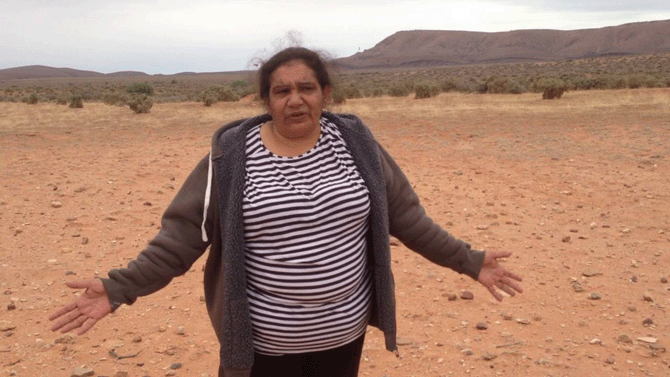 Last ditch aborigine appeal to Scotland to stop nuclear waste transfers to Australia, https://www.heraldscotland.com/news/17391290.last-ditch-aborigine-appeal-to-scotland-to-stop-nuclear-waste-transfers-to-australia/?ref=fbshr&fbclid=IwAR3r2Lqdv0V66rc7I8PrKJme4mkAsIx2Wtd5bv-Vy_XeT1i3GOgi_Mr By Martin Williams @MWilliamsHT 29 Jan 19, SOME of the Aborigines who live in and around a sacred burial place in South Australia can still remember the clouds of poison that were the result of Britain’s nuclear bomb tests in the 1950s.
Fiji PM tells Scott Morrison- Australian coal is killing the Pacific
 Australian coal is killing the Pacific, Fiji PM tells Scott Morrison, Fiji has firmly told Australia to shift away from coal and fossil fuels because climate change is hurting Pacific island nations. SBS 18 Jan 19 Australia must not put the interests of a single industry above the lives of Pacific nations battling climate change, Scott Morrison has been firmly told.At an official dinner in Fiji to mark a newly announced partnership between the two nations, Fijian Prime Minister Frank Bainimarama explicitly told Australia to do better.
He said the only way to guarantee the survival of Pacific island countries was for Australia to shift away from fossil fuels.
“I urged your predecessor repeatedly to honour his commitment to clean energy,” Mr Bainimarama said on Thursday night in Suva.
“From where we are sitting, we cannot imagine how the interests of any single industry can be placed above the welfare of Pacific peoples and vulnerable people in the world over.
“Rising seas threaten whole communities, forcing them to endure the trauma of relocating from land they’ve endured for generations.
“Fijian farmers are watching their crops perish in soil that has been spoiled by the heightened salinity that is associated with sea level rise.”
Mr Bainimarama said the evidence of climate change was clear in the disappearing coastlines in Bangladesh and worsening flooding in the United States.
“And in Australia as well, where soaring temperatures have reached record highs in several major cities just this week,” he said.
“This cannot be written off as a difference of opinion.
“Consensus from the scientific community is clear and the existential threat posed to Pacific island countries is certain.”
Mr Morrison responded in his speech, praising Mr Bainimarama for Fiji’s global leadership on climate change…….https://www.sbs.com.au/news/australian-coal-is-killing-the-pacific-fiji-pm-tells-scott-morrison
 |
ReplyForward
|
Australian Julian Assange in new danger as Ecuador caves in to USA pressure (and Australian govt does nothing)
 More troubles for Julian Assange as ecuador bows to pressure to extradite him following this letter, http://thewikidaily.com/more-troubles-for-julian-asange-as-ecuador-bows-to-pressure-to-extradite-him-following-this-letter/ We have been monitoring Julian asange’s asylum in Ecuadorian embassy in britain to outline the dangers the computer proggrammer and wikileaks founder face in coming future and it seems alot have been happening lately than the mainstream media’s are reporting.
Ecuador has begun a “Special Examination” of Julian Assange’s asylum and citizenship as it looks to the IMF for a bailout, the whistleblowing site reports, with conditions including handing over the WikiLeaks founder.
Former Ecuadorian President Rafael Correa tweeted an image of the letter he received from the State Comptroller General on December 19, which outlines the upcoming examination by the Direction National de Auditoria.
The audit will “determine whether the procedures for granting asylum and naturalization to Julian Assange were carried out in accordance with national and international law,” and will cover the period between January 1, 2012 and September 20, 2018.
Assange has been in the Ecuadorian Embassy in London since he sought asylum there in 2012. He was granted Ecuadorian citizenship last December in a bid to protect him from being extradited to the US where he fears he faces secret charges for publishing US government cables and documents.
WikiLeaks tweeted the news on Wednesday, joining the dots between the audit and Ecuador’s consideration of an International Monetary Fund bailout. The country owes China more than $6.5 billion in debt and falling oil prices have affected its repayment abilities.
According to WikiLeaks, Ecuador is considering a $10 billion bailout which would allegedly come with conditions such as “the US government demanded handing over Assange and dropping environmental claims against Chevron,” for its role in polluting the Amazon rainforest.
Assange’s position has increasingly been under threat under Correa’s successor, President Lenin Moreno, with Ecuadorian authorities restricting his internet access and visitors.“I believe they are going to turn over Assange to the US government,
Labor is right to support a nuclear ban treaty
 The cold war is back. Labor is right to support a nuclear ban treaty https://www.theguardian.com/commentisfree/2018/dec/28/the-cold-war-is-back-labor-is-right-to-support-a-nuclear-ban-treaty
Labor’s pledge to commit to nuclear disarmament puts the alternative party of government on the right side of history.
The gulf between the shenanigans of way too many politicians, and the growing urgency of grave and looming threats has rarely seemed wider. Action on crucial issues languishes while parliamentarians make naked grabs for power, acting in the interests only of themselves. Poor personal behaviour seems endemic. On the two unprecedented dangers looming over all humanity – nuclear war and climate disruption – Australia has been not just missing in action, but actively on the wrong side of history, part of the problem rather than the solution.
The government’s own figures demonstrate that our country, awash with renewable sun and wind, is way off track to meet even a third of its greenhouse gas emissions reduction target by 2030 – itself nowhere near enough.
Not only is nuclear disarmament stalled, but one by one, the agreements that reduced and constrained nuclear weapons, hard-won fruit of the end of the first cold war, are being trashed. All the nuclear-armed states are investing massively not simply in keeping their weapons indefinitely, but developing new ones that are more accurate, more deadly and more “usable”. The cold war is back, and irresponsible and explicit threats to use nuclear weapons have proliferated. Any positive effect that Australia might have on reducing nuclear weapons dangers from the supposed influence afforded us by our uncritical obsequiousness to the US is nowhere in sight. Our government has been incapable of asserting any independence even from the current most extreme, dysfunctional and unfit US administration. The US has recently renounced its previous commitments under the nuclear non-proliferation treaty (NPT); we have said nothing.
The one bright light in this gathering gloom is the 2017 UN treaty on the prohibition of nuclear weapons. For its role in helping to bring this historic treaty into being, the International Campaign to Abolish Nuclear Weapons (Ican) was awarded the Nobel peace prize for 2017 – the first to an entity born in Australia. This treaty provides the first comprehensive and categorical prohibition of nuclear weapons. It sets zero nuclear weapons as the clear and consistent standard for all countries and will help drive elimination of these worst weapons of mass destruction, just as the treaties banning biological and chemical weapons, landmines and cluster munitions have played a decisive role in progressing the elimination of those other indiscriminate and inhumane weapons. The treaty lays out a clear pathway for all states, with and without nuclear weapons, to fulfil their binding legal obligation to accomplish nuclear disarmament. It is currently the only such pathway.
Regrettably, the Australian government was the most active “weasel” in opposing the treaty’s development at every step and was one of the first to say it would not sign, even though we have signed every other treaty banning an unacceptable weapon.
Hence the Labor party’s commitment at its recent national conference in Adelaide that “Labor in government will sign and ratify the Ban Treaty” is an important and welcome step. It is a clear commitment, allowing no room for weaselling.
The considerations articulated alongside this commitment are fairly straightforward and consistent with the commitment. First, recognition of the need for “an effective verification and enforcement architecture” for nuclear disarmament. The treaty itself embodies this. Governments joining the treaty must designate a competent international authority “to negotiate and verify the irreversible elimination of nuclear weapons” and nuclear weapons programmes, “including the elimination or irreversible conversion of all nuclear-weapons-related facilities”. Australia should also push for the same standard for any nuclear disarmament that happens outside the treaty.
Second, the Labor resolution prioritises “the interaction of the Ban Treaty with the longstanding Nuclear Non-Proliferation Treaty”. The treaty has been carefully crafted to be entirely compatible with the NPT and explicitly reaffirms that the NPT “serves as a cornerstone of the nuclear disarmament and non-proliferation regime”, and that its full and effective implementation “has a vital role to play in promoting international peace and security”. All the governments supporting the treaty support the NPT, and the NPT itself enshrines a commitment for all its members to “pursue negotiations in good faith on effective measures relating to cessation of the nuclear arms race at an early date and to nuclear disarmament”. The UN secretary general, Antonio Guterres, and the International Committee of the Red Cross are among those who have affirmed that the treaty and the NPT are entirely consistent, complementary and mutually reinforcing. Even opponents of the treaty recognise that prohibition is an essential part of achieving and sustaining a world free of nuclear weapons.
Third, the Labor resolution refers to “Work to achieve universal support for the Ban Treaty.” This too is mirrored in one of the commitments governments take on in joining the treaty, to encourage other states to join, “with the goal of universal adherence of all States to the Treaty.”
An Australian government joining the treaty would enjoy wide popular support in doing so – an Ipsos poll last month found that 79% of Australians (and 83% of Labor voters) support, and less than 8% oppose, Australia joining the treaty.
Australia would also stop sticking out like a sore thumb among our southeast Asian and Pacific Island neighbours and be able to work more effectively with them. Brunei, Cook Islands, Fiji, Indonesia, Kiribati, Laos, New Zealand, Malaysia, Myanmar, Palau, Philippines, Samoa, Thailand, Timor-Leste, Tuvalu, Vanuatu and Vietnam have already signed the treaty.
Most importantly, joining the treaty and renouncing nuclear weapons would mean that Australia would become part of the solution rather than the problem of the acute existential peril that hangs over all of us while nuclear weapons exist, ready to be launched within minutes. Time is not on our side. Of course this crucial humanitarian issue should be above party politics. The commitment from the alternative party of government to join the treaty and get on the right side of history when Labor next forms government is to be warmly welcomed. It is to be hoped that the 78% of federal parliamentary Labor members who have put on record their support for Australia joining the treaty by signing Ican’s parliamentary pledge will help ensure Labor keeps this landmark promise.
• Dr Tilman Ruff is co-founder of the International Campaign to Abolish Nuclear Weapons (Ican) and Nobel peace prize winner (2017)
Australian Labor Party’s very limited support for the United Nations nuclear ban treaty
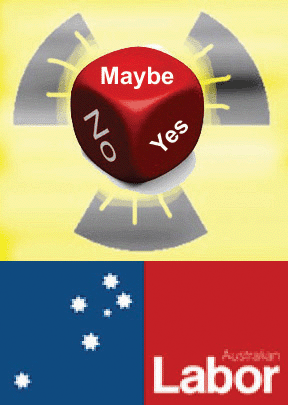 Bill Shorten wins cautious agreement on foreign aid, recognising Palestine and nuclear ban treaty, SMH, By Michael Koziol
18 December 2018 A federal Labor government will pursue the recognition of Palestine, a treaty banning nuclear weapons and an increase to foreign aid – but final decisions will be left for cabinet under an agreement struck between the party’s factions.Three controversial issues in the foreign relations portfolio were settled in backroom deals on Tuesday morning to ensure there were no contentious votes and Labor leader Bill Shorten ended the party’s national conference on a united note.The changes to Labor’s platform urge the next Labor government to recognise Palestine as a sovereign state as an “important priority”, but leaves the final decision to cabinet acting on expert advice.Labor has also given in-principle agreement to the United Nations nuclear ban treaty – but only after taking account of whether nuclear-armed states had signed up (so far none have) and whether they were abiding by the treaty’s terms…….
Senator Wong and defence spokesman Richard Marles led the negotiations, while the Left’s Anthony Albanese was heavily involved in the nuclear talks ……..
The controversial nuclear treaty bans states from using, producing or stockpiling nuclear weapons, and prohibits them from assisting any other state to engage in such activities.
Mr Marles – who has criticised the treaty as “the non-nuclear world thumbing its nose at the nuclear world” – said it was “no secret” some in Labor were sceptical about the treaty and its impact on Australia’s alliance with the US.
A Labor government would need to be “certain” the treaty would not endanger that alliance, Mr Marles told the conference, and it was essential there was a realistic pathway for nuclear powers to sign up.
As recently as October, Senator Wong said there was “no realistic prospect” of any nuclear states signing the treaty, let alone ratifying it, and it would have “no effect” without their endorsement……https://www.smh.com.au/politics/federal/bill-shorten-wins-cautious-agreement-on-foreign-aid-recognising-palestine-and-nuclear-ban-treaty-20181218-p50mw8.html
Australia’s credibility on the line at UN climate talks.
COP24 sees Australia walk climate tightrope amid ‘Paris Rulebook’ deadlock, ABC Weather , By Ben Deacon 15 Dec 18 The COP24 Climate talks in Poland have been extended through the weekend, as nations remain deadlocked over how to implement the Paris agreement.
The aim of the annual United Nations conference is to determine what collective action the world takes on climate change. AUDIO: Australia walks climate talks tightrope (AM)
More than 100 ministers and more than 1,000 negotiators from around the globe have been hammering out the so-called ‘Paris Rulebook’ with an eye to defining how pledges will be put into action.
In the thick of it all has been the Australian delegation, which has been walking a tightrope between the Paris obligations and support for fossil fuels.
In a defining moment at COP24, protesters disrupted a pro-fossil fuel event on Monday that had been organised by the Trump administration.
On stage, the only non-American panellist at the event was Australia’s Ambassador for the Environment, Patrick Suckling.
“Fossil fuels are projected to be a source of energy for a significant time to come,” Mr Suckling said.
Fossil fuel event ‘damaged’ Australia’s credibility
The Director of the Climate & Energy Program at the Australia Institute, Richie Merzian, believes Australia jeopardised its influence in the COP process by appearing at the US event.
“Everyone picked up on the fact that Australia was on the panel with the Trump appointees,” Mr Merzian said.
“I think it even made the New York Times and the Washington Post.
“It really damaged, I think, Australia’s credibility here.”……. https://www.abc.net.au/news/2018-12-15/australia-walks-climate-tightrope-at-cop24/10623558
Australian government’s hypocritical performance at UN Climate Summit
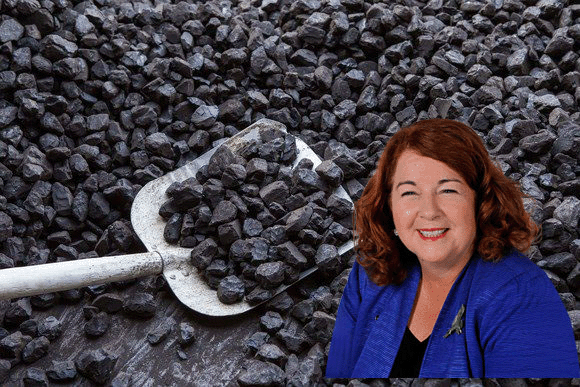
‘New energy future’: Minister touts Australia at climate summit, Brisbane Times, By Peter Hannam,13 December 2018 — Australia is moving “towards a new energy future”, powered by unprecedented investments in renewable energy, Environment Minister Melissa Price has told a summit in Poland even as the country earned a “fossil of the day award for its poor climate policies.
In a speech on Wednesday at the COP24 climate talks in Katowice, Ms Price said Australia was “committed to the Paris Agreement” and the development of a “robust rulebook” to implement the global pact agreed in 2015…….
Richie Merzian, a climate researcher with The Australia Institute, said Minister Price’s speech “relied almost entirely on policies her government tried to kill-off or water down”.
He also criticised the climate finance pledge, saying Prime Minister Scott Morrison “had trashed and cut support for UN’s key climate finance body, the Green Climate Fund”.
‘Fossil of the Day’
The network also raised the issue, first reported by the Herald, that Australia had “remained silent” about whether it planned to use any surplus from the Kyoto Protocol period – possibly 400 million tonnes worth – to count against its Paris target.
Ms Price’s Labor counterpart, Mark Butler, has also continued to not rule out the use of any Kyoto credits for its post-2020 targets.
“It’s not clear whether the so-called rulebook for the Paris Agreement will allow a carryover,” Mr Butler told Radio National on Thursday.
“If it does, we would have to consider any conditions about that,” he said, adding, “my bias is to steer very clear of cop-outs and accounting tricks when it comes to climate change policies.”
Greens climate spokesman Adam Bandt said: “It is disappointing that Mark Butler has left the door open to cooking the books to meet their Paris commitment. The analysis is clear that up to a quarter of Labor’s target could be met by fake Kyoto credits if they follow the Coalition and pull the same dodgy accounting tricks.” https://www.brisbanetimes.com.au/environment/climate-change/new-energy-future-minister-touts-australia-at-climate-summit-20181213-p50m3f.html
1 This month

of the week – Australians for War Powers Reform (AWPR)
To see nuclear-related stories in greater depth and intensity
 Antinuclear