BYTHE WIRE STAFFON19/01/2018The Ministry of External Affairs hopes India’s ‘credentials’ are taken into account as and when a decision is taken (on its NSG application). New Delhi: India on Friday joined the Australia Group which aims to stop the development and acquisition of chemical and biological weapons, a move that may take the country an inch closer to joining the Nuclear Suppliers’ group (NSG).
This is the third multilateral export control group – after the Missile Technology Control Regime (MTCR) and Wassenaar Arrangement – that India has become a member of.
In a press release, the 42-member Australia Group said there had been “very strong support” for India’s membership at its plenary meeting in June 2017. Following that, “consensus was reached intersessionally” to admit India to the club. “India then reaffirmed its intention to join the group,” said the announcement.
The Ministry of External Affairs said that the series of multilateral export control groups that India has joined “helps in establishing our credentials” for joining the NSG. India joined the MTCR in June 2016, followed by the Wassenaar Arrangement in December 2017.
Pacific rift: When nuclear tests made France a dirty word, SMH, Damien Murphy, 1 Jan 18 “…….the 1985 sinking of the Greenpeace vessel Rainbow Warrior by French operatives, union outrage, peacenik panic and maintenance of uranium exports shaped Australia’s response to Paris’ decision to start letting off bombs as far away as possible from La Belle France.
In a June 5 report to cabinet about possible resumption of French tests, the minister for foreign affairs, Gareth Evans and the minister for Pacific Island affairs, Gordon Bilney, said memories of the Rainbow Warrior were strong and New Zealand could be expected to postpone official visits and suspend military-related co-operation with France.
The ministers were concerned about Australia looking as hard-nosed as New Zealand.
“New Zealand will obviously be hoping that Australia’s response is similar to theirs,” the ministers said. “Wellington’s response may have an impact in Australia if it is significantly stronger than ours.”
The ministers advised treading softly so as not to make nuclear testing dominant in the bilateral relationship and stop the French from taking retaliation.
“Three specific areas of current Australian interest could be targeted by the French: Australia’s (United Nation’s) Security Council bid, market access for special Australian products such as kangaroo meat, and Australia’s candidature for the position of secretary-general of the South Pacific Commission.”
On June 13, president Jacques Chirac announced the resumption of nuclear tests in the South Pacific.
The Keating government hardened up its act.
On June 22 cabinet decided to recall Australia’s ambassador and Australian Defence Force staff from Paris, suspend Australian ship and aircraft visits to French territories and ban French ship visits and “not progress” collaboration on military logistics and equipment or exchange classified information.
Cabinet maintained the policy of not negotiating any new uranium contracts with France while it was conducting nuclear tests in the South Pacific.
“These measures are in line with the government’s consistent policy on this issue, which has been to respond in a measured, graduated way, leaving open every avenue for France to respond to South Pacific concerns,” an attachment to a cabinet minute noted.
French nuclear test tensions threatened Olympic Dam expansion plans, declassified Cabinet documents reveal, Peter Jean, The Advertiser, January 1, 2018
THE FRENCH NUCLEAR TESTING
KANGAROO meat and other exports to Europe could be jeopardised if Australia took a hard line against French nuclear testing in the South Pacific, the Keating cabinet feared in 1995.
A ban on uranium exports to France could also have put at risk a potential $1 billion expansion of South Australia’s Olympic Dam.
The resumption of underground nuclear testing in French Polynesia sparked boycotts of French businesses in Australia and plunged the Labor government into a diplomatic and political crisis.
Mr Keating recalled Australia’s Ambassador from Paris and suspended some defence co-operation with France, including ship visits and training arrangements.
In a May cabinet submission ahead of the nuclear tests, Foreign Affairs Minister Gareth Evans and Pacific Island Affairs Minister Gordon Bilney warned that Australia’s interests could be damaged if the Government overreacted.
“Australia’s response should also be shaped so as to limit French retaliation in those sectors of the relationship we wish to see preserved,’’ the submission said.
“Three specific areas of current Au1stralian interest could be targeted by the French: Australia’s Security Council bid, market access for special Australian products such as kangaroo meat, and Australia’s candidature for the position of Secretary-General of the (South Pacific Commission).’’
There were widespread calls for Australia to suspend uranium exports to France but this would have led to the Government having to pay compensation to mining companies with existing contracts.
Australia had already imposed a ban on new uranium export contracts with French companies until France agreed to a comprehensive nuclear test ban treaty.
PM silent on Nobel prize when world needs him to speak up, PETER BOYER, Mercury, Malcolm Turnbull is rarely stuck for words, but the award of the 2017 Nobel Peace Prize to an organisation founded in Australia has left him speechless.
The International Campaign to Abolish Nuclear Weapons, or ICAN, was set up a decade ago in Melbourne. ICAN’s current director, Swedish lawyer Beatrice Fihn, received the award at a gala ceremony in Oslo, Norway last week.
Geneva-based Fihn is one of just three salaried staff — the other two are in Australia — on the ICAN payroll. For an organisation that knows how to survive on almost nothing, the $1.42 million that comes with the prize promises a long future.
In early October, when the prize was first announced, a spokesman for the Prime Minister acknowledged “the commitment of ICAN and its supporters to promoting awareness of the humanitarian consequences of nuclear weapons”, adding that banning these weapons was not the answer. Foreign Minister Julie Bishop, who a fortnight earlier stressed Australia’s commitment to “a world free of nuclear weapons”, made no comment. She and the PM remain silent.
To put ICAN’s achievement into context, five months ago this tiny organisation managed to win the support of enough UN member countries — 122 of them — to vote into existence the legally binding Treaty on the Prohibition of Nuclear Weapons, which aims to eliminate these weapons.
Every Latin American country, including Brazil, Argentina and Mexico, voted for the treaty. So did Ireland, Austria, Switzerland, Finland, nearly all African countries, Kazakhstan, Mongolia and most of the Middle East including perennial antagonists Saudi Arabia and Iran.
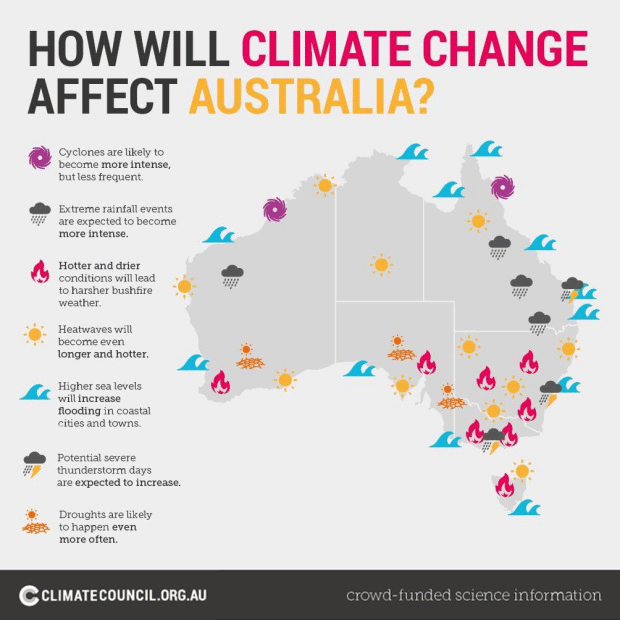
Australia facing climate disaster on its doorstep, government’s white paper warns
Foreign policy paper says climate-related conflict and migration could put Australia’s economic interests under pressure, Guardian, Katharine Murphy, 23 Nov 17,Climate change is creating a disaster on Australia’s doorstep, with environmental degradation and the demand for sustainable sources of food undermining stability in some countries, especially “fragile states”, according to the Australian government’s first foreign policy white paper in more than a decade.
The new white paper, released on Thursday, contains warnings over the disruptive effects of climate change in Australia’s immediate region, noting that many small island states will be “severely affected in the long term”, and the coming decade will see increased need for disaster relief.
The white paper notes the demand for water and food will rise, with the world’s oceans and forests under intense pressure. It notes climate change and pressure on the environment could contribute to conflict and irregular migration, impacting specifically on Australia’s economic interests.
Pacific Island nations urge world leaders to act as islands expected to sink
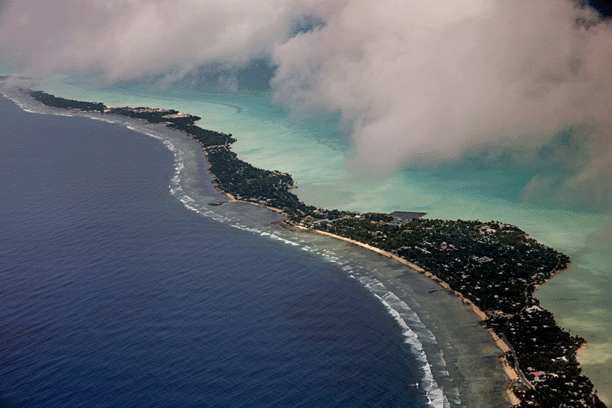
AUSTRALIA’S tropical island neighbours may exist today, but their leaders have urged us to help them from sinking. news.com.au, Matt Young@MattYoung 14 Nov 17 A LARGE swath of Pacific Island nations are slowly being eaten away until residents will be forced to evacuate and the islands eventually sink into the sea — and it’s coming sooner than we think.
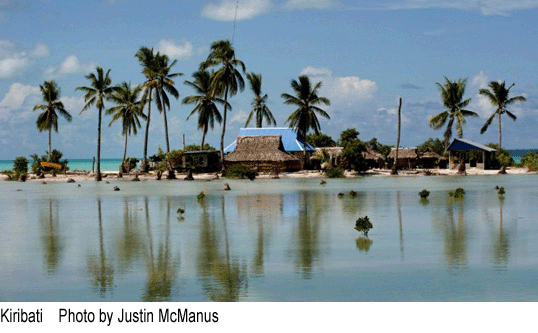
This modern-day Atlantis is thanks to sea levels across small island nations that have seen a dramatic rise over the past few decades, a rate of up to 3-4 times larger than the global average. Tuvalu, in the western Pacific Ocean, will reportedly be uninhabitable by 2050, while its island neighbour Kiribati, is expected to be fully submerged by 2100.
The Maldives, which has the lowest elevation in the world and a population of 427,000, may also have sunk by the end of the century.
It has led experts — including Professor Tim Flannery, climate change expert and Professor at La Trobe University — to believe we are “on a trajectory that will see those nations compromised”.
Malcolm Turnbull calls North Korea ‘criminals’, urges Hong Kong to help, SMH, Lindsay Murdoch, 12 Nov 17, Hong Kong: Prime Minister Malcolm Turnbull has accused North Korea of being one of the world’s most “cunning, sophisticated criminals,” involved in many serious crimes, including drug trafficking, in his strongest condemnation yet of the dictator Kim Jong-un.
Paladin has ignored our requests to provide its estimate of the cost of rehabilitating Kayelekera, but we can safely say that the figure will be multiples of the US$10 million bond. Just keeping Kayelekera in care-and-maintenance costs US$10–12 million annually.
As things stand, if Paladin goes bankrupt and fails to rehabilitate Kayelekera, either rehabilitation will be coordinated and funded by the Malawian government (with a small fraction of the cost coming from Paladin’s bond) or the mine-site will not be rehabilitated at all.
It does Australian companies investing in mining ventures abroad no good whatsoever to leave Kayelekera unrehabilitated, a permanent reminder of the untrustworthiness and unfulfilled promises of an Australian miner and the indifference of the Australian government.
The company’s environmental and social record has also been the source of ongoing controversy and the subject of countless critical reports.
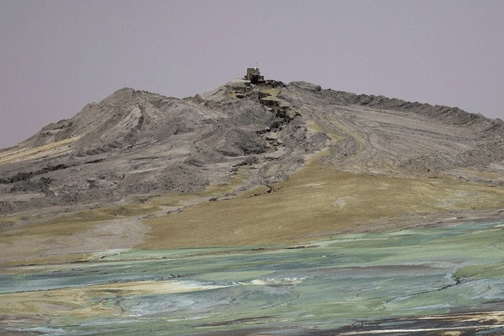
Julie Bishop, the WA government, Paladin and its administrators from KPMG need to liaise with the Malawian government and Malawian civil society to sort the rehabilitation of Kayelekera. An obvious starting point would be to prioritise the rehabilitation of Kayelekera if and when Paladin goes bankrupt and its carcass is being divided up. (picture below shows uranium sludge going to river)
Perth-based uranium mining company Paladin Energy was put into administration in July and the company is teetering on the brink of bankruptcy. Critics of the uranium industry won’t miss the company if it disappears. Other uranium mining companies won’t miss Paladin; in an overcrowded market, they will be pleased to have less competition.
But the looming bankruptcy does pose one major problem. Paladin’s Kayelekera uranium mine in Malawi, the ‘warm heart of Africa’, needs to be rehabilitated and Paladin hasn’t set aside nearly enough money for the job.
Under the leadership of founder and CEO John Borshoff, described as the grandfather of Australian uranium, Paladin has operated two uranium mines over the past decade. The Langer Heinrich mine in Namibia was opened in 2007, and Kayelekera in 2009.
They were heady days ‒ there was an endless talk about a nuclear power ‘renaissance’ and the uranium price tripled between June 2006 and June 2007. Continue reading →
Australia is expected to face renewed criticism when its Pacific Island neighbour Fiji chairs a key UN climate meeting from Monday.
The Conference of the Parties 23rd meeting takes place in the German city of Bonn and will be chaired by Fiji – the first time a Pacific nation has chaired such a major meeting.
Pacific Island leaders are expected to make the most of the global spotlight on the region, which is under threat from rising sea levels.
While Australia has provided a $300 million climate change package for the Pacific, the region’s leaders are demanding a moratorium on new coal mines.
Fiji-based lecturer on international politics Dr Wesley Morgan said he expects the government’s support for the planned Adani coal mine in North Queensland to be a target.
“Australia will be facing a lot of heat. Pacific Island countries and Pacific Island leaders are outraged that Australia, the world’s largest coal exporter, is planning to subsidise the construction of the world’s largest export coal mine.”
The Australia Institute executive director Ben Oquist said the planned Adani coal mine will produce more emissions a year than the Pacific Islands combined.
“I think the controversy surrounding that Adani mine is going to put extra pressure on the Australian Government as those Pacific countries want to see Australia move away from coal, not having a big neighbour in the region effectively subsidising what will be the world’s biggest coal mine,” he said.
Environment Minister Josh Frydenberg is leading Australia’s delegation to the Bonn meeting and will defend the mine. Continue reading →
Yes – it’s true – Australia is sending fossil-fuel-and-nuclear stooge Josh Frydenberg off to Germany to sabotage the UN climate conference!
Ever since Kyoto, 1997, when the Australian delegation kept everybody up until 4 a.m to make sure of watering down climate action, Australia has been ?proudly subverting international climate action.
Frydenberg is adept at twisting things, to make himself look good, while he’s really no more than an agent for the polluting industries. He might find this harder than usual, in Bonn, where the Murdoch media does not hold sway.
Frydenbeg might find that the Pacific Islanders’ case for action on climate will be better received than his advocacy for Australia’s coal industry.
Look – we’re an international disgrace on our punishment of refugees. We’v e long been an international disgrace on our climate inaction.
Here’s hoping that Frydenberg and the rest of the Australian polluting shills don’t succeed again.
IT’S TIME THAT AUSTRALIA JOINED OUR ISLAND NEIGHBOURS AND THE WORLD IN FIGHTING CLIMATE CHANGE
If the deal does go ahead with backing from Chinese state-owned enterprises, it could see Australia providing big direct and indirect subsidies to a company effectively owned by an Indian billionaire and the Chinese Government.
Adani: Chinese state-owned company could help bankroll Carmichael coal mine, ABC News, 2 Nov 17 By business reporter Stephen Long For years it has been a mystery where Adani would get the money to build its giant Carmichael coal mine in North Queensland.
Key points:
Chinese state-owned enterprise CMEC in negotiations with Adani
Deal would involve CMEC given manufacturing contract in return for procuring finance
Some close to the negotiations sceptical about deal being finalised
Now we may have the answer.
The ABC has learned that a Chinese state-owned enterprise, China Machinery Engineering Corporation (CMEC), is in negotiations with Adani and its principal engineering and procurement contractor, Downer EDI.
If the deal goes ahead, it would see CMEC awarded contracts to build key mining plant and equipment in return for China’s financial backing of the Carmichael mine.
CMEC is listed on the Hong Kong stock exchange, but is 78 per cent owned by the giant Chinese state-owned enterprise China National Machinery Industry Corporation Ltd, or Sinomach. Continue reading →
could it be that our own government is walking into the middle of an economic contest between China and India for control over industry and infrastructure?
Surely our government wouldn’t be using public money to subsidise Adani’s mine, undermining its own country’s interest and supporting China to strengthen its grip on power and infrastructure in countries neighbouring India?
Last month I claimed that using a $900 million, publicly funded loan to bail out Adani’s otherwise unviable Carmichael coal mine proposal was the height of absurdity.
The Australian government has been equally desperate, creating an agency and filling it with taxpayers’ money so we can fund a project opposed by the majority Australians.
But the government’s efforts to support Adani stretch well beyond the financial.
Pacific Islanders call for Australia not to fund Adani coalmine, Caritas says thousands face threats to their wellbeing, livelihoods and ‘their very existence’ due to rising sea levels, Guardian, Naaman Zhou, 1 Nov 17, Pacific Islanders whose homes face eradication by rising sea levels have called on Australia to not fund the Adani Carmichael coalmine, as a new report reveals the worsening impact of climate change across Oceania.
Residents of the endangered islands have described their forced displacement as like “having your heart ripped out of your chest” as they called on the Australian government to do more to combat climate change.
A report released by international aid group Caritas on Wednesday found that thousands of Pacific people across the region faced “threats to their wellbeing, livelihoods and, in some places, their very existence” due to rising sea levels, king tides and natural disasters brought about by climate change.
n Papua New Guinea, 2,000 households across 35 coastal communities were displaced by coastal erosion over the past year. In Samoa, 60% of the village of Solosolo was relocated to higher ground.
In the Torres Strait, 15 island communities were identified as at risk over the next 50 years.
The mayor of the Torres Straight Island regional council, Fred Gela, described the forcible removals as like having your heart ripped out “because you are told you’re not able to live on your land”.
Erietera Aram, a resident of Kiribati who works for the Department of Fisheries, said he decided to visit Australia to ask its government to take action.
“We talk about the Adani coalmine,” he said. “That’s a new one. I think it’s not a good idea – it makes the world worse for all of us. It is inconsiderate of other humans on this planet.
“We didn’t think of Australia as a country that would do that. We looked at it as our bigger brother. Proceeding with that new mine is a sad move. We live together in the environment but it’s like they are ignoring us.
“We’re two metres above sea level. With the sea level rise, most of our lands have been taken by coastal erosion. We love our country and we want our children to live there as well, hopefully forever. It’s hard to talk about leaving the place where you belong.”
Julie Bishop warns Donald Trump’s Iran backflip could weaken pressure on North Korea, SMH, David Wroe, 29 Oct 17,
Foreign Affairs Minister Julie Bishop has said there is a “powerful argument” that US President Donald Trump’s threat to scrap the Iran nuclear deal could imperil efforts to negotiate a peaceful outcome with North Korea.
In a significant sharpening of Australia’s public rhetoric on the Obama-era Iran agreement, Ms Bishop said she had asked US officials, including Secretary of State Rex Tillerson, how they would counter the argument that North Korea could not trust the US if it walked away from previous international agreements…..
The US President vowed during his election campaign to tear up the deal, but this month kicked the issue to the US Congress, effectively demanding it either come up with a tougher approach or he would follow through on his threat to scrap it.
By endorsing the argument that ditching the deal could set back efforts to negotiate with North Korea over its nuclear program, Ms Bishop has taken the firm, if diplomatically sensitive position, of pressuring the White House not to push ahead with what many international experts say would be a self-defeating move but one in which Mr Trump is personally invested.
Ms Bishop said she had discussed the matter with American officials last month after Iran mounted the argument to the United Nations General Assembly that the US would lose credibility including in its stand-off with North Korea.
Ninety organisations have joined ICAN to call for Australia to sign and ratify the Treaty on the Prohibition of Nuclear Weapons.
In an open letter addressed to Malcolm Turnbull the groups warn of the “existential threat” that nuclear weapons pose. “There are no safe hands for nuclear weapons. We face a clear choice: continue to let these weapons spread and risk their inevitable use, or eliminate them”.
The letter is signed by a range of health, union, student, Indigenous, humanitarian, environment and faith organisations from across Australia. It highlights the urgency of disarmament amidst current heightened risks of nuclear conflict.
“There is no argument – moral, ethical or rational – for the retention of weapons with the capability to end life on Earth. No person or group of people should wield that kind of power,” Stuart McMillan, President of the Uniting Church in Australia.
“The Treaty on the Prohibition of Nuclear Weapons provides the necessary vehicle for nations to walk away from these unacceptable, and now illegal, weapons. Australia has signed the treaties banning chemical and biological weapons, landmines and cluster munitions. It’s time to take genuine action against these weapons by signing and ratifying the ban treaty,” said Tilman Ruff from ICAN.
The signatories to the letter include World Vision Australia, Oxfam Australia, Save the Children Australia, ChildFund Australia, the Australian Council of Trade Unions and the Uniting Church in Australia.
David Noonan will speak on public interest concerns over the new Roxby Downs Indenture Act 2026 on BHP copper-uranium mining and ore processing in SA, and on how AUKUS may face SA with a High-Level nuclear waste agenda.
Dr Jim Green will discuss international developments in the field of nuclear power including ‘small modular reactors’ and Generation 4 ‘advanced’ nuclear reactor concepts.