If North Korea attacks USA with nuclear warhead, Australia will join US in fight – Deputy PM Barnaby Joyce
Australia will join US in fight against North Korea if war breaks out, Yahoo News, JULY 6, 2017 Australia would join military action against North Korea if the rogue nation fires a nuclear warhead at the United States, acting Prime Minister Barnaby Joyce has confirmed.
As Malcolm Turnbull heads to Germany for talks with other G20 leaders, Mr Joyce is ramping up pressure on China to step in and “stop this madness”.
His call comes after US ambassador to the United Nations Nikki Haley warned that America would use force “if we must” against North Korea, after Pyongyang tested an intercontinental ballistic missile (ICBM) with the potential to reach Darwin or Alaska.
“No one should ever go too far in testing the resolve of the United States of America,” Mr Joyce told Sky News on Thursday.
“If North Korea was to deliver a warhead into the United States of America then the ANZUS alliance would be called in.”……One of Australian’s most senior military commanders insists the risk of a strike on the country’s north by North Korean remains low.
Chief of Joint Operations Vice Admiral David Johnston says that despite Pyongyang’s aggressive demonstrations, the range and capability of the missile launched this week is still to be determined.
“There is very little risk at the moment to the northern part of our country,” he told reporters in Canberra……Given the low threat to Australia’s mainland, Vice Admiral Johnston says there hasn’t been an immediate focus on amassing a system to defend against missiles.
The focus now was on applying diplomatic pressure on North Korea to stop their nuclear program and the development of missile technology.
“Where there’s emerging issues that require military support, the ADF has the capability to provide the government (with) options and we’re able to do so.” https://au.news.yahoo.com/a/36295225/australia-will-back-us-if-nuclear-war-breaks-out-with-north-korea/#page1
Greens Senator Scott Ludlam at nuclear weapons ban treaty talks
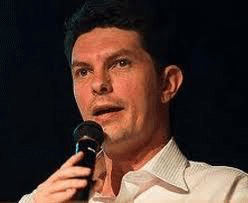
 Ludlam, not Australia, in New York for nuclear weapons ban treaty talks, Greens Senator Scott Ludlam has slammed Australia for not taking part in talks on a global ban on nuclear weapons. By Andrea Nierhoff, SBS News, 6 July 17, Senator Ludlam is in New York with delegates from 120 countries to discuss a treaty to ban nuclear weapons around the world.
UN poised to adopt nuclear weapons ban treaty today
 The United Nations is set to adopt a global treaty to ban nuclear weapons (Friday 7 July (New York time)) – a long-awaited historic event marred by Australia’s boycott of negotiations.
“This is the biggest step towards nuclear disarmament that we have seen since the end of the Cold War,”  said Associate Professor Dr Tilman Ruff, the Melbourne-based founding chair of the International Campaign to Abolish Nuclear Weapons (ICAN), who is attending the UN talks in New York.
“It comes at a time of growing international nuclear tension, where the risks of armed conflict escalating to the use of nuclear weapons is real and would be a humanitarian and environmental disaster,” he said.
“Pressure must now build on Australia to sign up to the treaty, as it has to treaties for the elimination of other weapons of mass destruction – biological and chemical, and other inhumane indiscriminate weapons such as landmines and cluster munitions.”
More than 130 nations are involved in the UN talks, including New Zealand and Indonesia, but Australia, at the behest of the United States, has boycotted the process. It is the first time ever that Australia has not participated in multilateral disarmament negotiations.
“If passed today, the treaty will stigmatise possession of nuclear weapons by any state, provide a source of legal, political, ethical, economic and civil society pressure on nuclear armed states to disarm, and encourage financial institutions to divest from companies that produce nuclear weapons,” said Tim Wright, Asia-Pacific director of ICAN.
“Of vital interest to Australia and the Pacific, it will also promote addressing the rights and needs of victims of nuclear use and testing, and of remediating contaminated environments,” he said.
“By failing to be involved in these negotiations, Australia has relinquished its responsibilities to its own Indigenous people, and to many others affected by nuclear testing in our region,” Mr Wright said.
Media please note:
Delegates at the UN will decide on Friday —by acclamation or vote—whether to adopt the treaty. If adopted, as is expected, it will open for signature on September 20, after which states will pursue ratification. Once 50 states have completed this process, the treaty will become binding international law.
ICAN Australia and Pacific representatives are available in New York and Australia for interviews, before and after the treaty’s expected adoption on Friday, New York time (likely Saturday morning, Australian time).
Video footage is available of addresses to the UN treaty conference plenary session (Thursday NY time) by: Australian Greens Senator Scott Ludlam, Vanessa Griffen (Fiji), FemLINK Pacific, ICAN Asia-Pacific director Tim Wright.
North Korea’ latest intercontinental ballistic missile would be able to hit Darwin
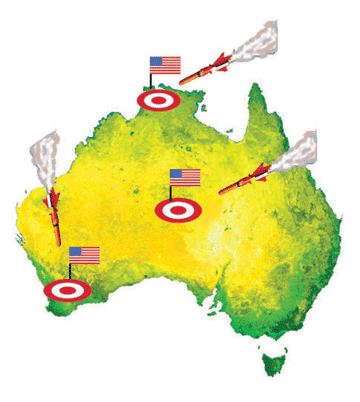 Australia now within range of new North Korean missile, as calculations show it could fly far enough to hit Darwin
- The ‘landmark’ test of a Hwasong-14 missile was overseen by leader Kim Jong-Un
- It was fired from a site in the North Phyongan province into the Sea of Japan
- It is believed to have reached an altitude of 2802 km and flew 933 km
- The North has long sought to build nuclear missiles capable of reaching the US
- Weapons analysts say the missile has the capability to travel up to 6,700km
- Darwin is only 5,750km from Pyongyang, putting Australia into the firing line
Experts say the missile could reach a maximum range of 6,700km on a standard trajectory, meaning it would be able to hit Darwin, which is 5,750km from Pyongyang.
David Wright, of the Union of Concerned Scientists, wrote on the organisation’s allthingsnuclear blog that the available figures implied the missile ‘could reach a maximum range of roughly 6,700 km on a standard trajectory’.
‘That range would not be enough to reach the lower 48 states or the large islands of Hawaii, but would allow it to reach all of Alaska.’ …………http://www.dailymail.co.uk/news/article-4664328/Australia-range-new-North-Korean-missile.html#ixzz4ltt8SE9M
Australian politicians condemn North Korea’s missile test
 North Korea’s missile test condemned by Australia, ABC News, By political correspondent Louise Yaxley 4 Jul 17 Australia has condemned North Korea after it said it had successfully tested a new intercontinental ballistic missile capable of hitting “anywhere in the world”.
Foreign Minister Julie Bishop called it a provocative act that is in breach of numerous United Nations Security Council resolutions. “North Korea continues to threaten its neighbours while undermining regional and global security,” Ms Bishop said in a statement. “North Korea’s long-term interests would be best served by ceasing its nuclear and missiles programs and focusing on improving the lives of its long-suffering people.”
The statement echoed her remarks after a North Korean missile test in April.
US Vice President Mike Pence was visiting Australia when that test occurred and declared the “era of strategic patience” over.
Ms Bishop said North Korea was “on a path to achieving nuclear weapons capability and we believe Kim Jong-un has a clear ambition to develop an intercontinental ballistic missile capable of carrying a nuclear payload as far as the US”.
“That would mean Australia would be in reach,” Ms Bishop said.
Australia ‘blindly and zealously toeing the US line’
Those comments angered North Korea, which singled out the US deployment of marines to Darwin as evidence of preparation for war. A North Korean Foreign Ministry spokesman said Australia was “blindly and zealously toeing the United States line”.
“If Australia persists in following the US’ moves to isolate and stifle North Korea … this will be a suicidal act of coming within the range of the nuclear strike of the strategic force of North Korea,” the spokesman said.
Defence Industry Minister Christopher Pyne responded by saying the location of US marines in Darwin was a longstanding government policy. “It’s not in any way a preparation for a conflagration on the Korean Peninsula,” he said. “Obviously, we want to avoid any such military action and we want the North Koreans to behave as well as they can, like reasonable, international citizens.
“That means ending their missile testing and not preparing for a nuclear war with either the United States, Japan, South Korea or anyone else for that matter.”……..http://www.abc.net.au/news/2017-07-04/north-korea-missile-test-condemned-by-australia/8677922
United Nations committee encourages Australia to rethink its support for coal mining industry
In a periodic review of Australia’s performance under a UN treaty on human rights, released this week, the committee noted: “environmental protection has decreased in recent years as shown by the repeal of the Emissions Trading Scheme in 2013, and the State party’s ongoing support to new coal mines and coal-fired power stations”.
In light of this, the committee of 18 international human rights experts encouraged Australia to “review its position in support of coal mines and coal export”.
The Australian government has remained a staunch supporter of the proposed Carmichael mine project, coal from which will generate more carbon emissions than New York City each year it operates.
On a trip to India in April, prime minister Malcolm Turnbull claimed the project would create “tens of thousands of jobs” for Australians – a claim that has been discredited by Adani’s own experts and a Queensland court.
A government infrastructure fund is weighing an application for a near-$1bn loan to Adani for a railway to transport the coal to the coast.
Australian ministers have often argued the Adani mine is backed by a “moral case” for supplying Indians with cheap electricity. The experts on the CESCR are elected by state parties based on their “high moral character”. They include an Indian representative.
The UN recognises that climate change is a threat to human rights. Coal mining and other highly-polluting industries could therefore be viewed as contravening international treaty obligations.
Aside from curbing coal mining, the CESCR recommended Australia’s government immediately introduce new measures to cut its growing carbon emissions and expand renewable energy production. http://www.climatechangenews.com/2017/06/29/un-committee-urges-australia-rethink-support-adani-mine/
Australia’s Karina Lester at United Nations conference on a nuclear weapons ban treaty
 South Australian woman Karina Lester presents anti-nuclear speech to United Nations in New York http://www.adelaidenow.com.au/news/south-australia/south-australian-woman-karina-lester-presents-antinuclear-speech-to-united-nations-in-new-york/news-story/be7b9ecb4ae5e0f0c568908f117c4be9 Erin Jones, The AdvertiserJune 23, 2017
KARINA Lester’s family remembers the ground shaking and a black mist rolling towards them when nuclear tests were carried out at Emu Field, in the state’s Far North. The residents of Walatina community, 150km south of the explosion, were given no notice of the British tests, in 1953, but they would suffer from lifelong health affects.
Her father, Yankunytjatjara elder Yami Lester, became blind as a result of the testing, while others suffered skin infections, auto-immune diseases and severe vomiting.
Ms Lester shared the poignant story with world leaders in New York this month in a four minute address to the United Nations conference on a nuclear weapons ban treaty. “It was certainly a once-in-a-lifetime opportunity to present to the UN,” Ms Lester said. “It’s really important to be able to share these stories otherwise we forget. “We learn so much about world wars but we don’t hear the history of what happened here.”
The treaty talks have been supported by more than 120 countries, but Australia and those with nuclear powers, including Russia and the United States have boycotted the conference.
Countries which signed the treaty would be forbidden from developing or manufacturing nuclear weapons and they would need to get rid of any weapons they already possess.
“It was disappointing as an Australian person to speak about what happened in our own backyard, when your country wasn’t even in the room,” Ms Lester said.
“This is an opportunity for nations to get together and completely ban nuclear weapons, instead of spending trillions of dollars to improve their technology.”
Ms Lester, of North Plympton, also took part in sessions with Hiroshima survivors to further share stories of the how nuclear weapons affect humanity.
“You can’t help but be moved when you hear those stories from people who survived and what they remember from when the blast when off,” she said.
Talks on the global treaty to outlaw nuclear weapons conclude on July 7.
Ukraine uranium sales plan: Unreasonable, unstable and unsafe
In a statement tabled in the Senate last night, the Turnbull government has confirmed it will seek to proceed with selling Uranium to Ukraine despite significant safety and security concerns raised by the Joint Standing Committee on Treaties.
Uranium exports to Ukraine
“Australia, the nation that fuelled Fukushima should not sell uranium to the country that gave us Chernobyl,” said the Australian Conservation Foundation’s Dave Sweeney.
In February a JSCOT investigation found that existing safeguards were ‘not sufficient’ and there was a risk Australian nuclear material would disappear off the radar in Ukraine.
The government has ignored JSCOT’s recommended pre-conditions around risk assessment and recovery of nuclear materials and is looking to advance the deal despite the risks of war, civil unrest and nuclear insecurity in the eastern European country, which is involved in hostilities with Russia.
“The treaties committee’s report found ‘Australian nuclear material should never be placed in a situation where there is a risk that regulatory control of the material will be lost’, yet this is exactly what could happen under the deeply inadequate checks and balances that apply to exported Australian uranium,” said Mr Sweeney.
“JSCOT recommended the Australian government undertake a detailed and proper risk assessment and develop an effective contingency plan for the removal of ‘at risk’ Australian nuclear material prior to any sales deal.
“Unreasonably and irresponsibly the government response fails to credibly address this. Australia should be very cautious about providing nuclear fuel to an already tense geo-political situation in eastern Europe.
“Ukraine’s nuclear sector is plagued by serious and unresolved safety, security and governance issues.
“Two-thirds of Ukraine’s aging fleet of 15 nuclear reactors will be past its design lifetime use-by date in just four years.
“This is an insecure and unsafe industrial sector in a highly uncertain part of the world. Australian uranium directly fuelled Fukushima and this deeply inadequate response shows the government has learnt little and cares less”.
Senator Scott Ludlam asks inconvenient questions about Australia’s role in nuclear weapons ban negotiations
Senator LUDLAM: …I want to turn to the opening day of the nuclear weapons ban treaty negotiations, 27 March this year. Having failed to prevent these negotiations occurring, the Trump administration’s ambassador to the UN held a protest outside the UN General Assembly Hall. Did Australia participate in the protest?
Senator LUDLAM: So we just stood there in mute solidarity with the Trump administration? As 130 UN member states started serious work on negotiating a nuclear weapons ban treaty, we were outside the room in a protest?
It is a shame that there will be no Australian representatives at the UN because these talks are scheduled to conclude at the end of June or early July
 FOREIGN AFFAIRS, DEFENCE AND TRADE LEGISLATION COMMITTEE, UN – Nuclear Weapons Ban, 31st May 2017 http://parlinfo.aph.gov.au/parlInfo/download/committees/estimate/0a6ef7dd-2f88-423a-a01b-23b5c5b4e4c0/toc_pdf/Foreign%20Affairs,%20Defence%20and%20Trade%20Legislation%20Committee_2017_05_31_5055.pdf;fileType=application/pdf
Pg- 20
Senator LUDLAM: Can I speak to someone on the UN Conference to Negotiate a Legally Binding Instrument to Prohibit Nuclear Weapons?
Senator LUDLAM: Can I speak to someone on the UN Conference to Negotiate a Legally Binding Instrument to Prohibit Nuclear Weapons?
Mr Sadleir: Yes, Senator.
Senator LUDLAM: It is good that you are here, Mr Sadleir, because I want to ask a couple of questions about a meeting that occurred between 4 and 8 July 2016 that I understand you were present at. You and Ms Jane Hardy travelled to Washington, DC to meet with a range of, I understand, quite senior State Department and National
Pg – 21
Security Council people to discuss what was then referred to as the UN open-ended working group on nuclear disarmament. Can you confirm for us on the record that that meeting occurred and that you were in attendance?
[Here it took an extraordinarily long time for Mr Sadleir to admit that he was at this meeting]
‘……..Senator LUDLAM: I have not asked what you discussed yet. Were you in attendance at that meeting? Mr Sadleir
? Mr Sadleir: I was certainly in Washington. I would need to check my diary to get the precise dates but I was certainly there around that time.
Senator LUDLAM: I think that what will happen when you check the dates is that you will come back and confirm that you were in fact there. I will let you check the record. I would appreciate that. What was the purpose of those meetings? Continue reading
Turnbull government ignoring new government in South Korea
Given that there is new leadership in Seoul, Canberra needs to review its stance on North Korea and discuss it with the Moon administration.
Calling North Korea’s nuclear program a threat to Australia isn’t going to solve the North Korean problem.
It’s time for Australia to review its Korea policy and take South Korea more seriously.
 Turnbull’s policy towards North Korea crucially ignores South Korea, Guardian, Continue reading
Australia’s diplomats called “weasels” on Australia’s stand against nuclear weapons ban treaty
Anti-nuclear campaigners are scathing.
“Australia’s disruptive behaviour at the working group only served to isolate us from the vast majority of nations who are now working to ban nuclear weapons at the United Nations,” said Gem Romuld from ICAN.
“Australia’s moves backfired when the working group voted overwhelmingly in support of a ban; it was a wake-up call for DFAT.
“Australia is standing with the Trump administration and clinging to the dangerous concept that these weapons of mass destruction make us safe
Australia’s stance on the nuclear weapons ban treaty – and why our diplomats were labelled ‘weasels’, ABC News By political reporter Stephen Dziedzic 3 June 17 Scott Ludlam ……….”Weasels. They called us weasels.”Did other delegates refer to the Australian delegates as weasels?”
It was an unusual question, but officials from the Department of Foreign Affairs and Trade (DFAT) sitting opposite the Senator did not look confused. They knew exactly what he was talking about.
And the exchange that followed briefly illuminated the most recent global negotiations to end nuclear weapons — and Australia’s role in them.
What’s the new agreement?Right now, more than 120 nations are trying to introduce a ban on nuclear weapons. A United Nations panel has now released a draft treaty. States who sign it would be forbidden from developing or manufacturing nuclear weapons. They would also have to get rid of any weapons they already possess.
The treaty’s champions argue the proliferation of nuclear weapons is an existential threat to humankind. And they say the woeful pace of global disarmament proves there is a compelling need for a new agreement that would exert moral pressure on states to disarm.
But there are plenty of problems.
First, none of the nine nuclear powers — including the US, Russia, China and the UK — support the new treaty.
Neither does Australia. The Federal Government has refused to take part in the treaty negotiations.
Why does Australia oppose the ban treaty? First, Australia argues that the treaty ignores geopolitical reality. Hardheads in the Government say that while everyone would like to see a world without nuclear weapons, the strategic environment is actually becoming more volatile and dangerous.They argue the US nuclear umbrella provides vital deterrence, and protects Australia.
For example, DFAT talking points obtained by the International Campaign to Abolish Nuclear Weapons (ICAN) say Australia “must be realistic about the environment in which we operate — North Korean provocations and nuclear tests are a case in point”……….
Why were we called the weasels? Continue reading
Sweden cancels investigation of Julian Assange, removes arrest warrant
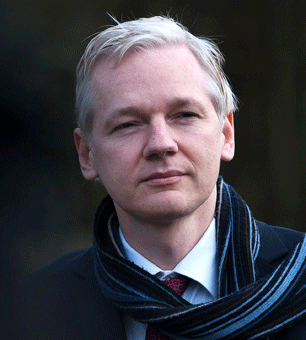 Sweden shuts down Julian Assange rape investigation, TT/The Local news@thelocal.se 19 May 2017, Swedish prosecutors have decided to end the rape investigation into Julian Assange and lift the Europe-wide arrest warrant against him, but UK police say they will still arrest him.In a statement on its website, the Swedish prosecution authority said that the “Director of Public Prosecution, Ms Marianne Ny, has today decided to discontinue the investigation regarding suspected rape (lesser degree) by Julian Assange”.
“I have therefore today lifted the decision to remand Julian Assange in his absence,” she added.
In a press conference later in the day, Ny elaborated that it was not possible to formally serve Assange with notice of the suspicions against him, a prerequisite under Swedish law if the investigation was to progress further:
“Ecuador granted legal assistance and made it clear that all measures would be performed with full voluntary participation of Mr. Assange (…) Formal issues are important in a legal system in terms of legal certainty, it is important to be able to serve the suspect with suspicions. The decision to discontinue the investigation is not because we’ve been able to make a full assessment of the evidence, but because we didn’t see possibilities to advance the investigation. So we won’t make any statements on the issue of guilt”………
Assange’s lawyer Per Samuelsson said his client was now considering suing Sweden.
“It’s not about money but redress,” Samuelsson told news agency TT.
He added that he believed Assange would eventually try to move to Ecuador.
The WikiLeaks founder’s lawyer filed a request at Stockholm District Court earlier in May asking for an end to the arrest warrant against his client, arguing it should be dropped now that the US has expressed a desire to charge the 45-year-old.
Assange had been remanded in custody by Sweden ‘in absentia’ over a 2010 rape allegation, and has been taking refuge inside Ecuador’s embassy in London since 2012 in order to escape the warrant, citing fears he may be extradited to the US to be tried over WikiLeaks’ publication of thousands of classified documents.
One of Assange’s lawyers, Melinda Taylor, indicated earlier on Friday that the preliminary investigation into him being closed or the lifting of the European arrest warrant would not necessarily mean the Australian would make a hasty exit for Ecuador.
“The first thing one likely needs to do is seek guarantees from the British authorities that he won’t be seized in some other way,” she told news agency TT.
Both British and American authorities have “consistently refused to confirm or deny” if there is a request for extradition to the US, she said. Assange is also accused of breaching his bail conditions in the UK for fleeing to Ecuador’s embassy, she noted.
And in a statement released on Friday afternoon, the Metropolitan Police confirmed it is obliged to arrest Assange should he leave the embassy…….
When the Swedish announcement was made on Friday, WikiLeaks commented through its Twitter account that the “focus now moves to the UK”……
After refusing to travel to Sweden for questioning, Assange was grilled last December by an Ecuadorian prosecutor on questions provided by Swedish officials, with Swedish prosecutor Ingrid Isgren present.
He has always maintained that he is innocent of the rape accusation from 2010….https://www.thelocal.se/20170519/breaking-sweden-lifts-arrest-warrant-against-julian-assange-and-ends-investigation
The plight of Kiribati Island – desperate need for Australia’s help
Our country will vanish’: Pacific islanders bring desperate message to Australia, Guardian, 14 May 17, Kiribati and other low-lying countries are under threat from climate change, and while their people would rather stay behind, they may be left with no choice “……… i-Kiribati man Erietera Aram is in Australia delivering his message about the reality of climate change in his country, and of its immediacy. Each discussion, he says, is like a drop of water, adding to the one before it, slowly building understanding of the existential threat to his people and place.
“Climate change is not something off in the future, it’s not a problem for later. We are living it now,” he says.
The archipelago of Kiribati – 33 tiny coral atolls spanning 3.5m square kilometres of ocean – is the world’s lowest-lying country, with an average height above sea level of just two metres.
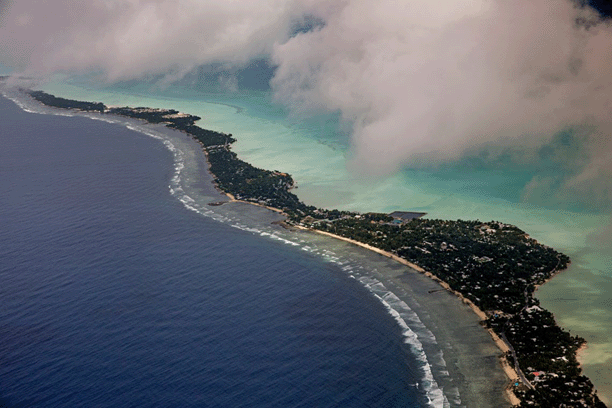
Most of the 113,000 i-Kiribati live crammed on to Tarawa, the administrative centre, a chain of islets that curve in a horseshoe shape around a lagoon.
“My place is very small,” Aram says. “If you stand in the middle, you can see water on both sides. We are vulnerable. One tsunami, one tsunami and our whole country will disappear.”
Already, there is less and less of Kiribati for its inhabitants. The coastline is regularly being lost to king tides and to creeping sea levels, and in a very real sense, there is nowhere to go.
The loss of land is causing conflict – Tarawa is growing ever more densely crowded, as families living on the coastline are forced inwards, infringing on another’s claim.
The next round of multinational climate talks in November – COP 23 – will be chaired by Fiji, and is expected to swing particular focus of the global climate debate to the Pacific, where comparatively minuscule amounts of carbon are produced, but the effects of climate change have been felt first, and most acutely.
Assuming the COP presidency, the Fijian prime minister, Frank Bainimarama, said he would “bring a particular perspective to these negotiations on behalf of some of those who are most vulnerable to the effects of climate change – Pacific Islanders and the residents of other small island developing states and low-lying areas of the world”…….https://www.theguardian.com/world/2017/may/14/our-country-will-vanish-pacific-islanders-bring-desperate-message-to-australia
Fiji wants Australian PM to lobby Trump to stay with Paris climate deal
 Fiji asks Turnbull to lobby Trump to stay with Paris climate deal, REneweconomy, By Giles Parkinson on 2 May 2017 Fiji prime minister Frank Bainimarama, who will host this year’s climate change talks in Bonn, has asked Australia prime minister Malcolm Turnbull to urge US president Donald Trump to stay within the Paris climate treaty.
In his first address as president of COP23, Bainimarama told the Carbon Markets Institute conference in Melbourne on Tuesday that he had written a letter to Trump, who has dismissed climate science as a Chinese hoax, urging the US to stay within the Paris agreement.
Bainimarama met with Turnbull at the PM’s home in Sydney on Sunday and said he had asked Turnbull to convey the message to Trump when he meets with him next week.
“My message to Donald Trump, and the message that I hope Malcolm Turnbull will also convey is ‘Mr President, do not abandon the Paris agreement, please stay the course’.”
Bainimarama said it was clear from the latest climate science that the world is running out of time, and it may already be too late to avoid many of the impacts.
“Climate change is not a hoax, it is frighteningly real,” he said. “Billions of people are losing the ability to feed themselves … We need to limit the damage … failure is not an option.”
He has appointed a climate science denier, Scott Pruitt, to lead the Environment Protection Agency; appointed deniers to numerous other key portfolios; and has sought to roll back all climate change and clean energy initiatives, and remove rules restricting what he calls “clean coal.”
However, a decision on whether to leave the Paris deal, expected last week, has been delayed………http://reneweconomy.com.au/fiji-asks-turnbull-to-lobby-trump-to-stay-with-paris-climate-deal-96273/
Donald Trump could get Australia involved in war
every US ally is now on notice – you cannot rely on Trump’s America in a crisis
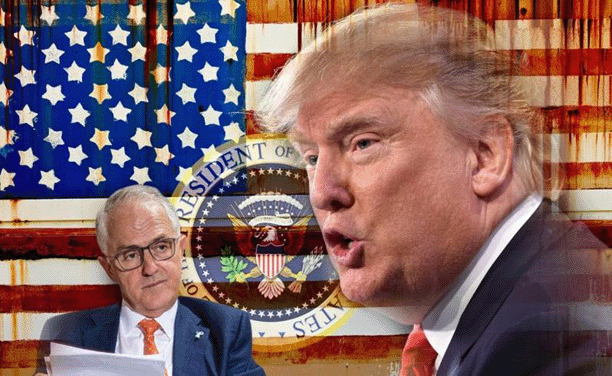
US Allies Now On Notice, The Age, Peter Hartcher, 2 May 17 It was five years ago that a senior US official brought to Canberra the sobering news that North Korea was turning its missiles towards Australia for the first time. He [Campbell, a former senior Pentagon official] has an update…….. .
“But the devastation of the South would be horrific – millions killed.”
A further restraint on any idea of a preemptive US strike to destroy North Korea’s nuclear facilities, says Campbell, is that there is recent evidence that the regime has distributed the nuclear infrastructure around the country and the US could not be fully confident that it knows every location.
There are no easy options. Trump has said that he’s expecting China’s Xi Jinping to do the hard work of deterring Kim from any further provocation. Xi says that Washington and Beijing are united in seeking to prevent the nuclearisation of the Korean peninsula.
But North Korea is nonetheless one of only two allies of China, and there are limits to how far it will go in pressing its ally. Campbell says he expects that “in the end, China will disappoint” American expectations……
He’s not impressed by Trump’s handling of the problem to date: “In a crisis like this the tendency is for the US to bring its allies closer. The president has instead roiled South Korea with his comments – it’s crazy….. In the midst of a crisis that Donald Trump has described his most urgent national security priority, he has picked a fight not with his adversary but with his ally.
In the past week or so, even as North Korea threatens an imminent attack on South Korea, Trump has chosen to denounce the US free trade agreement with Seoul as the “worst deal ever” and demanded renegotiations.
He has insulted his South Korean ally by saying in an interview that the country was once “part of China”, a falsehood that seems to concede to China a greater scope for legitimate influence over Seoul.
And, astonishingly, he has even demanded publicly that the South Korean government, which goes to an election in a month’s time, must pay for the defensive missile interception system that the US is installing on South Korean soil.
Malcolm Turnbull will strike a pose with Trump this week on the deck of a retired warship in New York Harbour to affirm the strength of the alliance with the US. Everyone will play happy allied families in a carefully choreographed performance.
But the reality of US alliances under Trump is not the cheerful one to be played out on the USS Missouri but Trump’s treatment of America’s South Korean ally.
Every US ally needs to note that, exactly when South Korea needs America most, Trump is putting pressure on it, picking a fight with it on trade and defence, publicly belittling it.
Turnbull has to do what he can to preserve as much of the alliance as he can. But every US ally is now on notice – you cannot rely on Trump’s America in a crisis. ….http://www.theage.com.au/comment/donald-trump-is-learning-a-lesson-from-north-korea–and-so-are-us-allies-20170501-gvwpbm.html
1 This month
17 October, Free Public Talk on Nuclear Issues in South Australia
David Noonan will speak on public interest concerns over the new Roxby Downs Indenture Act 2026 on BHP copper-uranium mining and ore processing in SA, and on how AUKUS may face SA with a High-Level nuclear waste agenda.
Dr Jim Green will discuss international developments in the field of nuclear power including ‘small modular reactors’ and Generation 4 ‘advanced’ nuclear reactor concepts.


Help Aunty Sue Protect Her Land and Sacred Sites From Destructive Rocket Testing.
.

Australians deserve the truth
about
AUKUS – https://aukuspublicinquiry.com/

PETITION – To: Prime Minister Anthony Albanese and the Australian Labor Government

of the week – Australians for War Powers Reform (AWPR)
To see nuclear-related stories in greater depth and intensity

