Greg Hunt’s gaffe over UNESCO and the Great Barrier Reef
 How Greg Hunt and his department turned good news into an international scandal
The full draft of the Unesco report on climate change reveals many mentions of Australia were actually positive, Guardian, Michael Slezak, 31 May 2016 Greg Hunt has conducted one of the strangest manoeuvres of his already rather gymnastic career, over the erasure of Australia from a United Nations report on climate change.
Guardian Australia had broken the story that all mentions of Australia and the Great Barrier Reef had been scrubbed from the report at the request of the environment department.
Hunt first denied knowing about it but then justified the move with reasons that went beyond those provided by the department.
In fact the full draft report, obtained exclusively by Guardian Australia, reveals many of the mentions of Australia were positive – but their removal turned what would have been a relatively good news story into an international scandal. Continue reading
NASA scientist and European Space Agency dismayed at CSIRO climate research cuts
‘Dismay’: NASA scientist appeals to CSIRO not to cut global climate efforts, The Age, May 12, 2016 Peter Hannam Environment Editor, The Sydney Morning Herald
A top scientist from US space agency NASA has appealed to CSIRO to abandon plans to cut a key monitoring program that it says will undermine Australia and the world’s ability to monitor and predict climate change. Continue reading
Liberal coalition plans nuclear submarine fleet so that we can fight China
Coalition plans nuclear-powered submarine fleet over long term. Fin Rev, by Aaron Patrick and Phillip Coorey, 1 MAY 16
Some of Australia’s new submarines could be nuclear-powered by the time they enter service, making them much more potent against the huge Chinese navy.
One of the reasons French ship builder Direction des Constructions Navales Services, also known as DCNS, won the $50 billion contract was its ability to switch easily to a nuclear version of the submarines being designed for the Royal Australian Navy.
That is because the Australian diesel-powered Shortfin Barracuda will be a shorter, lighter version of a nuclear submarine already being manufactured by DCNS in Cherbourg on the English Channel.
Cabinet ministers and defence officials have already discussed the possibility of switching from diesel engines to nuclear power part-way through the construction contract, political, government and industry sources say.
The Coalition wants to keep the option open in case public opposition to nuclear power changes in the future. National polls taken from 2006 to 2009 found between 35 and 50 per cent of Australians supported introducing nuclear power, a study by the National Academies Forum showed.
DCNS, which is majority owned by the French government, is expected to start building the Australian submarines in Adelaide next decade. The last one might not be completed until 2050.
The other bidders for the contract, Germany’s Thyssenkrupp Marine Systems and Japan’s Kawasaki Heavy Industries and Mitsubishi Heavy Industries, don’t make nuclear submarines………..
The government, which has been criticised for opting to build the submarines in Australia, said it was not considering switching to a nuclear-powered version………
Another drawback of nuclear reactors is that, unlike diesel motors, they can’t be turned off to make the submarine silent.
Australia’s submarines are unusual. They would be the only conventionally powered ones that used pump jets for propulsion rather than propellers, Stephan Fruehling, a defence expert at the Australian National University’s College of Asia and the Pacific, said.
The Coalition government quietly supports developing a nuclear industry in Australia and on Friday proposed storing radioactive waste on a remote South Australian cattle station.
It has encouraged the South Australian Labor government to push ahead with a debate over storing spent nuclear rods from overseas. Given the submarines will be built in Adelaide and South Australia has some of the largest uranium deposits in the world, the state could one day become the centre of an Australian nuclear industry. http://www.afr.com/business/manufacturing/coalition-plans-nuclearpowered-submarine-fleet-over-long-term-20160429-goieal
Were those French submarines chosen so that t they could later be NUCLEAR submarines?
 Why did we agree to pay too much for French submarines? THE AUSTRALIAN
APRIL 29, 2016 Robert Gottliebsen,Business Spectator columnist Melbourne The evidence now mounting shows that the submarine tender is one of the most irregular ever conducted in Australia. Defence officials in the US, Japan and Germany are shocked at what is now being revealed.
Within 24 hours of the tender being announced, both sides are saying different thingsso, as anyone experienced with tenders knows, that means the deal has every prospect of becoming a disaster. (The good, the bad and the ugly of the submarine tender process, Apr 29)
There is mounting evidence that the French do not want to build the first two submarines in Australia. They need to make the first two submarines back home.
In Paris, they were shocked that Prime Minister Malcolm Turnbull was so definitivein his statement that all 12 submarines would be built in Australia.
To understand how this bizarre situation developed and the implications that stem from it, we need to go back to the defence white paper which estimated the cost of the 12 submarines at $50bn (we learned later that this is an inflation-adjusted figure).
At the time, the Japanese were mystified because they knew their tender was less than half that and the German “all local” tender was even lower — probably under $20bn…….
Why would you need 4,000 French workers — three times the number of Australian workers required for the German bid — when 12 submarines are to be built in Australia?
The other strange aspect of the submarine tender is that the submarines are not going to be delivered until 2033 or 2034. The Germans were offering to have submarines available around 2028.
But maybe there was something about doing the deal with the French that has not been disclosed. Perhaps a group of defence officials believe longer term that Australia needs nuclear submarines because of their greater range. Given its 15 years before the first submarine arrives, everyone would have forgotten what Malcolm Turnbull said this week. Indeed, he will have retired.
To build a nuclear submarine in Australia requires a change in the legislation, and a nuclear industry, which we don’t have, although the climate is changing and South Australia looks set to become a nuclear hub.
When the tender was first announced, I noted that there might be a nuclear agenda but at that stage I had no idea of the tendering mess (Australia’s defence options open up, April 27).
If it’s a nuclear submarine that Australia wanted, then it would have only been fair the other tenderers know about it and be given an opportunity to include a nuclear option. http://www.theaustralian.com.au/business/opinion/robert-gottliebsen/why-did-we-agree-to-pay-too-much-for-french-submarines/news-story/9ed179b276d13922c15d767873c6dea2
Submarines to Australia – the Australia-France “contract of the century”
In a possible signs of things to come, France’s ambassador to Australia, Christophe Lecourtier, said future ties would not just be limited to submarines.
Australia-French relations: from nuclear villains to submarine purveyors, AFR, 28 Apr 18, “……France winning, against hefty odds, the $50 billion contract to supply 12 French-designed submarines for the Australian Navy. State-controlled defence contractor DCNS won out over Germany’s ThysennKrupp Marine Systems and Japan’s Mitsubishi Heavy Industries to build 12 conventional submarines in Australia, a coup hailed by the French media as “the contract of the century”…… Continue reading
Petition against South Australia waste dump plan launched by USA Nuclear Information Service
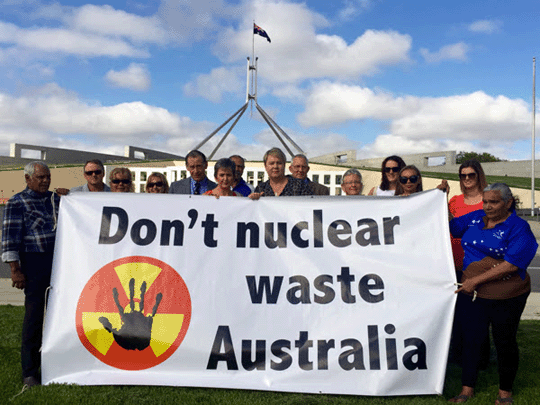 Help stop A Global Mobile Chernobyl! Nuclear Information and Resource Service, 23 Apr 16, A group of politicians and businesspeople are developing a plan to build an international high-level nuclear waste dump in South Australia–a nation that has no commercial nuclear reactors. The plan is strongly opposed by many South Australians and by an overwhelming majority of Aboriginal people, who own the land.
The Australian Nuclear Free Alliance, representing Aboriginal people from across Australia, calls on nuclear nations NOT to dump nuclear waste in Australia. The nuclear industry has a track record of Aboriginal dispossession and environmental pollution–from atomic bomb tests to uranium mining to nuclear waste dump proposals.
NIRS is supporting our friends in Australia and we hope you, and your organization, will too, by signing on to a petition of support by going here. You can also learn more about the issue at this site.
Individuals: please sign the simple statement of support below.
Dear friends in the Australian Nuclear-Free Alliance community,
Thank you for your commitment to “Keep It in the Ground” by your efforts to stop uranium mining in your lands.
We stand with you. We, the people, must and will stop the dirty, deadly and deceptive nuclear industry. We have heard that your lands are now being targeted by global nuclear waste companies. We are the community of Nuclear Information and Resource Service supporters. Collectively and as individuals, we commit to speak out and act to prevent your home from becoming a dumping ground for global nuclear waste.
Our planet and our struggle is shared and NIRS and ANFA are stronger together.
Thank you for standing for health, hope and your home. We stand with you.
USA only – 847 signatures so far http://org2.salsalabs.com/o/5502/p/dia/action3/common/public/?action_KEY=22778
Australia cuts aid to Africa, encourages Ugly Australian Mining Companies
Last year, the International Consortium of Investigative Journalists released a report called Fatal Extraction: Australian Mining Companies Digging a Deadly Footprint in Africa. It reported that Australian mining companies were the most rapidly expanding of all mining investors in Africa. From 2000 to 2009, prospecting licences held by Australian companies in Botswana alone increased from 14 to 260.
According to the report, Australian mining companies were responsible for multiple cases of negligence, unfair dismissal, violence and environmental law-breaking across Africa. It claims that since 2004 more than 380 people have died in mining accidents or in offsite skirmishes connected to Australian mining companies in 13 countries in Africa.
In comparison with Australia, African tax regulations are relatively flexible, while wages and working conditions, environmental protection, and occupational health and safety laws are weak.
Last year Foreign Minister Julie Bishop announced that the Australian government would actively promote the interests of the mining sector ahead of economic aid to Africa.
Australian miners in South Africa In the wake of a local activist’s murder, Australian mining interests in Africa are being called into question. https://www.thesaturdaypaper.com.au/news/resources/2016/04/09/australian-miners-south-africa/14601240003106 PHILLIP WALKER 9 Apr 16 Thee assassination of South African community activist Sikhosiphi “Bazooka” Radebe was shocking but sadly not surprising.
On the night of his death – March 22 – Radebe had warned his colleagues in the Amadiba Crisis Committee of a hit list. An hour later, two men masquerading as police arrived at Radebe’s house and shot him eight times in the head.
Radebe had been opposing titanium mining at Xolobeni, on the ancestral land of the Pondo people on South Africa’s east coast. The mining company involved is Australian-based Mineral Commodities Limited.
At Radebe’s funeral last weekend, Chief Cinani, representing the Queen and the Royal House of the amaMpondo, criticised the government’s acceptance of Australian investment and investment from the Indian business family the Guptas. “I am blaming the government because the government gave permits for those Australians, while people were saying ‘no’ to the government . It is clear that the business community is ruling the government. It is not only about the Guptas. Now we have seen the Australians. People are coming here with huge sums of money to divide the people.”
Through its director, Mark Caruso, Mineral Commodities Limited (MRC) and its South African subsidiary, Transworld Energy & Minerals Resources (TEM), have long been in dispute with the Amadiba community. The latest tragedy marks an escalation of hostility in a conflict now entering its 10th year. Continue reading
It’s wrong to sell Australian uranium to critically unsafe Ukraine
The Zaporizhia nuclear facility is Europe’s largest and is only 200 kilometres from the conflict zone in eastern Ukraine. Some commentators have described nuclear plants in the region as pre-deployed nuclear targets and there have already been armed incursions during the recent conflict period.
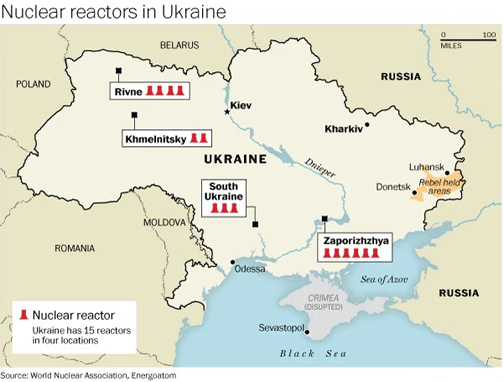
Australia shouldn’t sell its uranium to Ukraine http://www.smh.com.au/comment/australia-shouldnt-sell-its-uranium-to-ukraine-20160331-gnv0no.html, Dave Sweeney, 31 Mar 16 Foreign Affairs Minister Julie Bishop’s announcement this week to sell Australian uranium to Ukraine is an ill-advised and dangerous retreat from responsibility.
With timing and placement that a satirist could only dream of emulating – April Fool’s Day, the month of the 30th anniversary of the Chernobyl meltdown and while attending a nuclear security summit – Bishop is set to sign a uranium supply agreement this week with Ukrainian President Petro Poroshenko.
Australia, the country that directly fuelled Fukushima now plans to sell uranium to Ukraine, the country that gave the world Chernobyl – hardly a match made in heaven.
Thirty years ago the Chernobyl nuclear disaster spread fallout over large swathes of eastern and western Europe and five million people still live in contaminated areas in Belarus, Ukraine and Russia.
Serious containment and waste management issues remain at Chernobyl with a massive concrete shield now under construction in an attempt to enclose the stricken reactor complex and reduce the chances of further radioactive releases.
Against this backdrop there are deep concerns over those parts of the Ukrainian nuclear sector that are not yet infamous names, including very real security concerns about nuclear facilities being targeted in the current conflict with Russia. Continue reading
The country that fuelled Fukushima to sell uranium to the country that gave us Chernobyl

 Australian Conservation Foundation, Dave Sweeney, 30 Mar 16 The Foreign Minister’s plan to sell Australian uranium to Ukraine is a dangerous retreat from responsibility, the Australian Conservation Foundation said today.
Foreign Minister Julie Bishop has announced she will sign an agreement this week with Ukrainian President Petro Poroshenko to supply Australian uranium to Ukraine.
“Australia, the country that directly fuelled Fukushima plans to sell uranium to Ukraine, the country that gave the world Chernobyl – this is hardly a match made in heaven,” said ACF nuclear free campaigner Dave Sweeney. “Thirty years since the Chernobyl nuclear disaster five million people still live in contaminated areas in Belarus, Ukraine and Russia.
“There remain serious containment and waste management issues at Chernobyl and there are very real security concerns about Ukrainian nuclear facilities being targeted in the current conflict with Russia.
“Australia has properly suspended uranium sales to Russia – it makes no sense to start selling uranium to Ukraine now.
“There can be no nuclear business-as-usual in the shadow of Fukushima – a disaster that was fuelled by Australian uranium.
“Following Fukushima the UN Secretary-General called for Australia to have a dedicated risk analysis of the impacts of the uranium sector – this has not happened and needs to.
“This deal and the recent deal with India – which was signed despite a recommendation by the Joint Standing Committee on Treaties (JSCOT) that Australia not supply uranium to India at this time or on these terms – are a dangerous retreat from responsibility.”
France, (and everybody else) touting sales of nuclear submarines to Australia
France pitches nuclear submarine option Sky News, , Thursday, 24 March 2016 “………As part of its sales pitch, DCNS is touting a nuclear growth path.
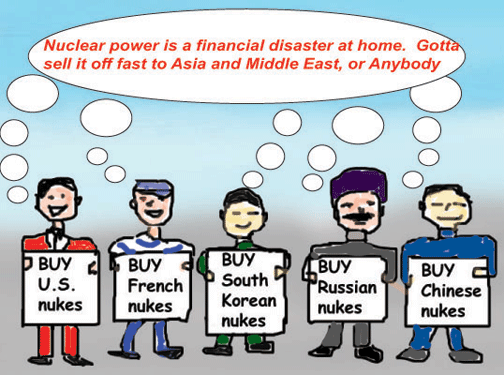
‘If, in 2050, Australia wants a nuclear submarine, they can design a nuclear submarine,’ DCNS chief executive Herve Guillou told AAP this week in Cherbourg. The DCNS bid offers Australia the eventual capability to come up with our own submarine whether nuclear or conventionally powered. Deputy chief executive Marie-Pierre De Bailliencourt says the Shortfin Barracuda was conceived from a vessel designed to nuclear standards, especially safety. That’s all way down the track.
In the meantime DCNS has to convince the Australian competitive evaluation process panel its proposal is better than those of Germany or Japan. German firm TKMS is proposing its 4000-tonne Type 216, a new design based on its widely exported Type 214. The Japanese government is offering its 4200-tonne Soryu-class boat, manufactured by Mitsubishi Heavy Industries and Kawasaki Shipbuilding Corporation.
Of the three designs, only the Soryu actually exists and is in service with Japanese navy. However, it would still need substantial modifications to meet Australian requirements for range and endurance……….
This will be Australia’s biggest-ever defence procurement by a large distance, costing as much as $50 billion for acquisition and perhaps $150 billion through their life. Continue reading
Australian uranium fuelled Fukushima nuclear reactors at time of the catastrophe
Fukushima five years on, and the lessons we failed to learn, Guardian, Dave Sweeney, 11 Mar 16 “…….In October 2011 it was formally confirmed to the Australian parliament that not only was Australian uranium routinely sold to the corner-cutting Tepco but that a load of true blue yellowcake was fuelling the Fukushima complex at the time of the disaster. Australian radioactive rocks were the source of Fukushima’s fallout.
Surely after directly fuelling disaster Australia would have taken some steps to review and possibly reconsider our role in the global nuclear trade?
The UN thought so. In September 2011 the UN secretary-general called on Australia to conduct “an in-depth assessment of the net cost impact of the impacts of mining fissionable material on local communities and ecosystems”.
This has never happened. It needs to, and Australia’s uranium sector deserves some long overdue scrutiny.
The most recent independent assessment of the Australian uranium industry – a Senate inquiry in October 2003 – found the sector characterised by underperformance and non-compliance, an absence of reliable data to measure contamination or its impact on the environment and an operational culture focussed on short term considerations…….http://www.theguardian.com/commentisfree/2016/mar/11/fukushima-five-years-on-and-the-lessons-we-failed-to-learn
The dangers in Australia’s uranium deal with India
The blame, in this case, falls on the Australian Government, who went against the wishes of its joint committee to carry on with the agreement – and ignored existing loopholes in the safeguards – that may provide the opportunity for nuclear proliferation
This is a great opportunity for Australia to consider the several alternative energy exportation means available to them that are just as likely to succeed and without risking regional instability in the Indo-Pacific region. These include solar and wind power
It is vital that Australia rethinks the impact of exporting uranium to India while maintaining its strong bilateral relations with the country. The Government must also come to realise how this deal can affect the current dynamics of South Asia, the wider Indo-Pacific region and the perception of Australia across the global community. Regional instability in an already volatile region is the last thing Australia needs to get involved in.
The cost of Australia’s uranium deal with India https://independentaustralia.net/politics/politics-display/the-cost-of-australias-uranium-deal-with-india,8723#.VtIfhLJpus0.twitter

THERE IS NO DOUBT that the civil nuclear deal recently signed by Australia and India, for the purpose of exporting uranium, has raised various important questions regarding the use of Australian uranium in India.
Despite these questions being asked, various government officials have reassured the international and domestic community that the deal will build on the bilateral relationship between the two nations, through economic and strategic means.
Yet, it is quite clear that there are various risks involved on Australia’s part, which in turn, can significantly hamper their geopolitical reputation and affect their bilateral relationships with other nations — potentially leading to instability in South Asia. Continue reading
China criticises Australia’s ‘Cold War mentality’,in its planned $150 billion military spendup
Defence white paper shows Australia’s ‘Cold War mentality’, says China, February 26,2016 Philip Wen China correspondent for Fairfax Media
Shanghai: China has accused Australia of maintaining a “Cold War mentality” with its alliance with the United States, following the release of the Turnbull government’s defence white paper which criticised China’s role in rising tensions in the South China Sea.
At a regular press briefing in Beijing, Defence Ministry spokesman Colonel Wu Qian said China was “seriously concerned” about the contents in the white paper, and that it was “firmly opposed to the accusations against China’s construction activities on the islands and reefs in the South China Sea”.
“We urge the Australian side to cherish the hard-won good momentum of development in bilateral relations, and don’t take part in or conduct any activities that may compromise the stability in the region,” Colonel Wu said at Thursday’s briefing, alluding to pressure on Australia to join the United States in sailing warships within 12 nautical miles of China’s artificial islands in the sea in so-called freedom of navigation operations…….. http://www.smh.com.au/world/defence-white-paper-shows-australias-cold-war-mentality-says-china-20160226-gn4d6j.html#ixzz41PmdN1zf
Australia breaches Paris climate agreement, damages economy, by cutting CSIRO climate modelling
 CSIRO climate cuts will breach Paris agreement and cost economy – report
Cuts to climate modelling and measuring research contradict Australia’s pledge to strengthen commitments to climate science, the Climate Council says, Guardian Michael Slezak 21 Feb 16 Cuts to the CSIRO’s climate modelling and measuring research will breach Australia’s obligations under the recent Paris agreement and will result in huge costs to the economy, a report by Australia’s Climate Council has found.
The report adds to a chorus of eminent bodies and individuals criticising the move, which the CSIRO made after almost no consultation with its own scientists or other research institutions.
Earlier in the month it was revealed CSIRO would be cutting up to 350 staff from climate research programs over two years. Over the following weeks, the organisation’s chief executive Larry Marshallexplained that would result in a loss of about 50% of the staff working in climate modelling and measuring.
In a report titled “Flying Blind: Navigating Climate Change without the CSIRO,” the Climate Council said governments and businesses relied on the CSIRO’s climate modelling and measuring work to make billion-dollar decisions and if the cuts went ahead, would be relying on “guesswork”.
The report notes Australia and the rest of the world agreed to strengthen commitments to climate science at COP21 in Paris in December. “The recently announced cuts to climate science mean that Australia has already reneged on one of its obligations under the Paris commitments,” it concludes.
It cites a number of examples of decisions and industries that have relied on the modelling and measuring performed by the CSIRO:………
An open letter signed by more than 2800 scientists raised similar concerns. In response to the chorus of criticisms, Marshall initially said the response was more like religion than science, and compared climate scientists to oil lobbyists in the 1970s…….
It was revealed in Senate estimates that CSIRO executives did not consult with organisations like the Bureau of Meteorology who depend on CSIRO modelling until 24 hours before the cuts were made public.
Even Ken Lee, the director of the division that would take the brunt of the cuts was only told about the cuts four days before they were announced.
The Climate Council, which produced the new report, is a crowd-funded body that seeks to provide authoritative information on climate change to the community. It was created after the Abbott government cut the Climate Commission when it took government in 2013, and seeks to perform the same job. http://www.theguardian.com/environment/2016/feb/22/csiro-climate-cuts-will-breach-paris-agreement-and-cost-economy-report
World’s best-known climate crusader Al Gore urges Australian Government rethink on CSIRO cuts
FORMER US vice president and climate crusader Al Gore has added to the chorus of protest at plans to cull CSIRO’s ocean and atmosphere research positions, of which as many as 193, or 80 per cent, are in Hobart..
http://www.themercury.com.au/news/tasmania/worlds-bestknown-climate-crusader-al-gore-urges-australian-government-rethink-on-csiro-cuts/news-story/feda0e3aaaea4aba128e540d5c4de015
1 This month
17 October, Free Public Talk on Nuclear Issues in South Australia
David Noonan will speak on public interest concerns over the new Roxby Downs Indenture Act 2026 on BHP copper-uranium mining and ore processing in SA, and on how AUKUS may face SA with a High-Level nuclear waste agenda.
Dr Jim Green will discuss international developments in the field of nuclear power including ‘small modular reactors’ and Generation 4 ‘advanced’ nuclear reactor concepts.


Help Aunty Sue Protect Her Land and Sacred Sites From Destructive Rocket Testing.
.

Australians deserve the truth
about
AUKUS – https://aukuspublicinquiry.com/

PETITION – To: Prime Minister Anthony Albanese and the Australian Labor Government

of the week – Australians for War Powers Reform (AWPR)
To see nuclear-related stories in greater depth and intensity

