Federal parliament’s Joint Standing Committee on Treaties deliberating on uranium sales to India
To its credit, parliament’s treaties committee seems to be taking the problems with the India agreement seriously. If the committee recommends the deal be revised or rejected the onus will be on the government to take the problems seriously.
 No yellow cake for India http://www.onlineopinion.com.au/view.asp?article=17350 y Dave Sweeney – Monday, 18 May 2015 Despite widespread controversy around planned uranium sales to India, including from the government’s own former Director General of the Australian Safeguards and Non-Proliferation Office, the
moves to Melbourne this week taking evidence from groups concerned about security, safety and environmental impacts. Independent security analysts and representatives of the Uniting Church will join national environment groups Friends of the Earth and the Australian Conservation Foundation to highlight concerns over the contested sales plan. Continue reading
Uranium mine rejected in Arctic region
 Arctic uranium mine rejected, Mining Australia, 13 May, 2015 Cole Latimer A proposed uranium multi-billion dollar uranium mine slated for Canada’s Arctic region has been knocked back.
French nuclear energy giant Areva’s Kiggavik uranium mine has been opposed by the Nunavut region’s Impact Review Board (IRB), according to CBC.
The mine was proposed on the edge of a caribou calving ground. The US$2.1 billion project would feature an underground operation, and four open pits……….
Further north in Greenland, Australian miner Greenland Minerals and Energy has taken major steps forward to develop its Kvanefjeld rare earths and uranium project, after last year signing an MoU with a Chinese firm to ramp up its supply chain and minerals processing capability.
The Greenland Government has even touted its lack of a mining tax to attract the interest of other Australian miners looking to develop the country’s rich reserves of untapped minerals. http://www.miningaustralia.com.au/news/arctic-uranium-mine-rejected
Opposition to Australian uranium/rare earths mining company in Greenland
Uranium opponents look to other sectors for job growth Opponents of uranium mining in southern Greenland have put forward a list of proposals they believe can create jobs and in the process make a highly contested mine unnecessary The Arctic Journal, May 13, 2015 – By Kevin McGwin In the town of Narsaq, on Greenland’s southern tip, debate is coming to a head over whether residents can make do without a near-by mine that will create jobs, but which some fear will make the town unliveable.The concerns come as Greenland Minerals and Energy, an Australia-based mining outfit, closes in on final approval to begin production rare earths, a mineral vital for use in modern technologies……
in order to extract rare earths, GME will also need to mine uranium as a by-product, and that has raised fears, particularly among farmers, sheep farmers and those making a living off tourism, that dust from the open-pit facility will taint the region’s soil and water, and in the process spoil the region’s image. Continue reading
Trans Pacific Partnership – a gift to corporations against people and the environment
Scarier still is the part of the TPP that will give corporations the right to sue governments for lost profits. The proceedings will be conducted before secret corporate tribunals.
Foreshadowing nasty corporate suits are what is happening now in Australia, Egypt, and Germany.
Philip Morris, an American tobacco company, is suing Australia for prohibiting the sale of cigarettes to underaged smokers in that country.

Why Obama Is Making the Mistake of Pushing the TPP (Trans-Pacific Partnership) Michael E. Drake Democratic Perspectives on the corporate take-over of America, 15 May 15
He has convinced himself that American labor cannot compete with labor forces in the rest of the world, particularly in Asia. He said, “That ship has already sailed.” Obama has given up. He has given in to corporate interests who want things both ways for the sake of short term profit. Corporations, who recognize no international boundaries, insist on producing goods for the lowest possible cost in labor. Continue reading
Compelling case against the Trans-Pacific Partnership

 Sovereignty For International Investors (Trans-Pacific Partnership (TPP)) http://tm.durusau.net/ May 11th, 2015 Elizabeth Warren makes a compelling case against the Trans-Pacific Partnership in The Trans-Pacific Partnership clause everyone should oppose, where she says:…
ISDS [Investor-State Dispute Settlement] would allow foreign companies to challenge U.S. laws — and potentially to pick up huge payouts from taxpayers — without ever stepping foot in a U.S. court. Here’s how it would work. Imagine that the United States bans a toxic chemical that is often added to gasoline because of its health and environmental consequences. If a foreign company that makes the toxic chemical opposes the law, it would normally have to challenge it in a U.S. court. But with ISDS, the company could skip the U.S. courts and go before an international panel of arbitrators. If the company won, the ruling couldn’t be challenged in U.S. courts, and the arbitration panel could require American taxpayers to cough up millions — and even billions — of dollars in damages.
If that seems shocking, buckle your seat belt. ISDS could lead to gigantic fines, but it wouldn’t employ independent judges.Instead, highly paid corporate lawyers would go back and forth between representing corporations one day and sitting in judgment the next. Maybe that makes sense in an arbitration between two corporations, but not in cases between corporations and governments. If you’re a lawyer looking to maintain or attract high-paying corporate clients, how likely are you to rule against those corporations when it’s your turn in the judge’s seat? Continue reading
Australia’s coal lobby blamed for stalling the uranium deal with India
Is Australian coal-lobby blocking uranium deal with India?, Economic Times By IANS | 1 May, 2015, By Rekha Bhattacharjee SYDNEY: After India signed a deal with Canada on uranium imports during Prime Minister Narendra Modi’s visit to Ottawa, questions are being raised as to why it has taken Canberra so long to clinch a similar pact.
While there are 1,300 mining firms in Australia, production is dominated by very large firms such as BHP Billiton, Rio Tinto, Xtrata,Shell Ch .. …
Australian company Paladin discharges uranium sludge into rivers in Malawi
Malawi: Paladin Starts Discharging Uranium Wastes Into Public Rivers, AllAfrica, By Bishop Witmos Karonga April 23: Few months after Paladin Africa Limited differed with civil society organizations (CSOs) and some chiefs in Karonga over the disposition of uranium wastes into public water, the company has started discharging the effluent into Sere River.
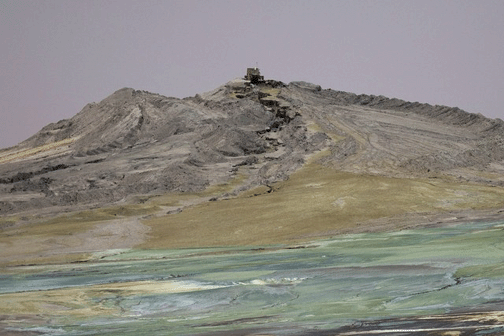
Paladin Africa Limited, a member of the Paladin Energy group of companies, suspended its operations at Kayelekera Mine in the district in May, 2014, due to unstable uranium prices at an international market. The project is now on care and maintenance.
Malawi News Agency (Mana) has established Paladin invited Paramount Chief Kyungu and the District Commissioner (DC) for Karonga, Rosemary Moyo, to a meeting in Lilongwe early April this year (2015),to brief them about the company’s recent decision.
Paladin Africa Acting General Manager in Malawi, Greg Walker, confirmed in a telephone interview that the company, indeed, started releasing the uranium wastes into the public rivers………
Sere River flows into North Rukuru River, then into Lake Malawi.
When asked why the company decided to brief Paramount Chief Kyungu and the Karonga DC about their action in Lilongwe instead of explaining it to the general populace of Karonga, Walker said the company conducted enough meetings with relevant authorities in the district……..
Despite the decision by Paladin to start discharging its effluent into the public water, some people in the district feet it would have been safer if the company had constructed another dam where the wastes would be transferred into.
Chairperson for Karonga District Council, Patrick Kishombe, said in an interview the plan to release the waste water from the storage dam into Sere River is raising fears amongst communities who feel the water is not fully treated and could be a health hazard.
“This, I believe, will lead into many hazards, like killing of fish in Lake Malawi and may also cause skin cancer to some people,” said Kishombe.
Uranium contains gamma rays, particles that cause skin cancer to human kind, according to experts.
In developed nations, mining companies construct a stable tank that stores all the wastes, ready for transportation to recommended disposal sites. ……http://allafrica.com/stories/201504231621.html
Abbott’s funding of Bjorn Lomborg – a travesty of climate science and economics
 Lomborg’s influence over key ministers in the Abbott government is quite well-known. He is seen to be at the centre of much of federal cabinet’s climate groupthink………
The real travesty of funding Lomborg’s newest franchise is that it comes from the same government that defunded the Climate Commission. This was composed of Australia’s best climate scientists, economists and energy experts, with an operating cost of A$1.5 million per year. This, more than even the most horrendous of storms, really exposes the parlous state of the Abbott government’s desertion of future generations
As such, one has to have some sympathy for Lomborg, who is a strange kind of “climate change refugee”. In 2012, the Danish government pulled all funding from his centre. Since, he has only set up shop in countries that have strong climate change-denying lobbies – both in the private sector and within mainstream media. He has enjoyed this in the US.
Lomborg operates by attaching himself to these centres as an adjunct professor, which will be his title at UWA, rather than a staff member. This offers the freedom to command remuneration well above a professorial salary – such as the US$775,000 he was paid in 2012 by the CCC and the US$200,484 paid for his work in 2013……… Continue reading
“Australia now holds the fate of the world’s climate in its hands”.
The government has indicated it will take a ‘technology neutral’ approach, which explains why Australia is the only nation in the world to axe the (carbon) tax, and efforts to slash the Renewable Energy Target by more than half.
Last year, the federal government approved the world’s largest coal fields in Queensland’s Galilee Basin – resources which the Climate Council reports “can not be developed” because they are “inconsistent with tackling climate change”.
Collectively, the proposed mines would create more emissions than nations like Australia, the UK, Italy and South Africa.
Why The Fate Of The World’s Climate Is Largely In Australia’s Hands, New Matilda, By Thom Mitchell, 23 Apr We’re told Australia’s contribution to global warning is minimal. A report out today proves that’s a dangerous lie. Thom Mitchell explains.
As American academic Bob Massey put it, “Australia now holds the fate of the world’s climate in its hands”.
In its pursuit of a solution to the ‘budget emergency’ Australia is using up the ‘carbon budget’ at a rate incompatible with the global goal of limiting temperature rises to below two degrees, a Climate Council report out today has demonstrated.
While Australia is under increasing pressure to announce an ambitious target to limit emissions at home, the report makes clear that it is our reliance on fossil fuel exports that is doing the real damage.
By actively seeking to prolong the dying revenue stream, which has buoyed the economy through the past decade, the Australian government is doing massive damage to the remaining ‘carbon budget’.
At a recent talk in Sydney, Massey was blunt. “If your government and mining companies decide to develop all of the coal and gas currently planned, already on the books, our children will be forced to endure a world very different from what we know,” he said.
To avoid such a world, scientists have developed the ‘carbon budget’ which, put simply, is the amount of carbon dioxide humans can emit into the atmosphere before temperature rises reach two degrees above pre-industrial levels.
On that basis, if all of Australia’s coal were burnt, it would use up two thirds of the ‘carbon budget’. Effectively, 90 per cent of the continent’s coal must stay in the ground. Continue reading
International nuclear lobby pleased with Abbott’s gift to climate contrarian Lomborg
 Nuclear lobby backs Abbott’s $4m gift to climate contrarian Lomborg, Independent Australia Giles Parkinson 23 April 2015, When push comes to shove to act on global warming, Big Mining will wheel in nuclear as a ploy to stall the take up of renewables. Is pro-nuclear Bjorn Lomborg’s thinktank in WA just a cynical move by Abbott to kill the clean energy industry? RenewEconomy’s Giles Parkinson runs the ruler over the nuclear option. THE PRO-NUCLEAR lobby has welcomed the decision by the Abbott government to award $4 million to Bjorn Lomborg, a climate “contrarian” who favours nuclear energy and opposes deployment of renewable energy.
Michael Schellenberger, president of the US-based Breakthrough Institute, a pro-nuclear think tank, tweeted over the weekend that the Australian government’s granting of funds to Lomborg was no different to the German government’s funding of an environmental think tank that favours renewable energy.
The difference may be that the Energiewende, or energy transition, is official bipartisan government policy in Germany. But Australia does not – at least officially, although its actions suggest otherwise – embrace climate obstructionism and nuclear technology. And it has defunded independent climate analysis such as that from the Climate Commission.
The tweet from the Breakthrough Institute might be unremarkable, but for that institution’s recent alliance with the pro-nuclear lobby in Australia, and the joint release of an “EcoModernist Manifesto” last week that says present day renewables are incapable of providing zero carbon energy, and that nuclear fission is the only technology capable of meeting most, if not all, the energy demands of a modern economy.
This, it would appear, seems to concur with the not-so-subtle secret agenda of Australian Coalition government policy. Continue reading
Australia’s crumbling international reputation – questions on climate policy
 UN Countries Question Australia Over Climate And Energy Policy http://cleantechnica.com/2015/04/20/un-countrys-issue-australia-questions-climate-energy-policy/ by Joshua S Hill
Australia’s clean energy and climate policy (or lack thereof) has been brought back back into international focus again these last few weeks, as the country’s politicians continue to bicker over the Renewable Energy Target. Such political uncertainty has also led several major UN nations to present Australia with questions to explain their lack of political support for a cleaner future, with Brazil even going so far as to highlight Australia’s “low level of ambition.”
Over the past week, two reports have shown that the current political bickering has cost Australia’s renewable energy industry dearly, not to mention worldwide coverage concerningAustralia’s poor performance and unwillingness to commit to agreed upon climate facts and goals.
On Monday of last week, the Australian Bureau of Statistics (ABS) released a report which showed that the country’s renewable energy sector lost almost 2,500 jobs over 2013-14. According to the figures published by the ABS, renewable energy industry jobs dropped 15%, or 2,300, from the peak of 14,890 recorded in 2011-12.
Two days later, a new analysis from Bloomberg New Energy Finance showed that investment in the Australian renewable energy industry plummeted 90% over the 12 months since 31 March, 2014, “stifled by more than 13 months of policy uncertainty.”
We’re going backward if you compare us to quite a wide range of countries,” Andrew Thomson, managing director of Acciona Energy in Australia, said by phone to Bloomberg. “For companies operating in Australia, many would be saying, it’s getting extremely difficult here, why don’t we take a look at the broader region, Southeast Asia for example.”
These two reports followed a white paper published by the Australian Government on its energy policy, which was subsequently pulled apart by news agencies and industry representatives the country over.
So it comes as no real surprise, then, that United Nations’ countries are also going to be asking questions of Australia. The UN has compiled a list of questions presented to Australia (PDF) from a number of countries, including from big emitters like the United States and China. Even countries like Saudi Arabia and Brazil got in on the action, calling in to question Australia’s “initiative to support sustainable development” and Australia’s “level of ambition.”
Of the over 35 questions presented to Australia in the March session of the UN, not a single one has an answer from Australia — and that, ladies and gentlemen, is the most telling point of it all.
China, USA, Brazil critical of Australia’s poor policies on climate change
China and other big emitters challenge Australia over its climate change policies, The Age, Adam Morton and Tom Arup April 20, 2015 The world’s biggest greenhouse gas emitters, including China and the US, have questioned the credibility of Australia’s climate change targets and “direct action” policy in a list of queries to the Abbott government.
In the latest sign of diplomatic pressure over Canberra’s stance on global warming, China accused Australia of doing less to cut emissions than it is demanding of other developed countries, and asked it to explain why this was fair.
Beijing also questioned whether the Abbott government’s emissions reduction fund – the centrepiece of its direct action policy, under which the government will pay some emitters to make cuts – would be enough to make up for the axed carbon price and meet Australia’s commitment of a minimum 5 per cent emissions cut below 2000 levels by 2020.
The questions have been lodged with the United Nations for Australia to answer in the lead-up to the December climate summit in Paris, where the world is supposed to sign a global deal to combat climate change. Continue reading
Jetsetting for South Australia’s Pro Nuclear Royal Commissioner, and who else?
 International nuclear-site visit on cards for royal commissioner MEREDITH BOOTH THE AUSTRALIAN APRIL 18, 2015
http://www.theaustralian.com.au/business/mining-energy/international-nuclear-site-visit-on-cards-for-royal-commissioner/story-e6frg9df-1227308901763
Unlike other wealthy nations, Australia fails to release post-2020 emission goals on time
 Australia not among rich nations releasing post-2020 emission goals on time, The Age April 1, 2015 Lisa Cox and Peter Hannam Australia has been left behind by most other wealthy nations in failing to disclose its post-2020 carbon reduction goals by the first quarter of 2015 as agreed at a global gathering in Peru last December.
The 28-nation European Union has announced that it would cut greenhouse gas emissions by at least 40 per cent on 1990 levels by 2030. On Tuesday, US President Barack Obama formalised in a submission to the UN the United States’ commitment to cuts that were first revealed in a landmark announcement with China last year………
Assuming the US goal was unchanged from the pledge made by President Obama during a visit to China last October, Australia would need a much deeper goal than its current bipartisan aim of slicing gas emissions by 5 per cent of 2000 levels by 2020 to keep up, said Pep Canadell, a CSIRO research scientist and executive director of the Global Carbon Project.
“If you want the effort to be proportional to what US and Australia committed for the 2005-2020 period, it would be something like [a cut of] 17 per cent by 2025 [for Australia],” Dr Canadell said.
Australia joined Canada in holding off on making any commitments for now.
The Abbott government’s issues paper, released on Saturday, appears to lay the groundwork for Australia to argue for special treatment in the talks because of the country’s heavily resource-based economy………
Emissions from power plants in the 12 months to September totalled 181.9 million tonnes, or about 1.5 million tonnes more than for the year to June.
If the emissions shift were to be maintained, it would increase emissions from electricity generators by about 4 per cent this year, Hugh Saddler, principal consultant with Pitt & Sherry, said.
John Connor, chief executive of the Climate Institute, said it was a poor showing by Australia to fall short of the March 31 goal for releasing its post-2020 target.”Australia, as a wealthy country with over 20 years’ experience in detailed climate policy analysis, should be amongst those – including Mexico – who have met that deadline,” Mr Connor said……. http://www.theage.com.au/environment/climate-change/australia-not-among-rich-nations-releasing-post2020-emission-goals-on-time-20150401-1mc2t2.html
Grave consequences could result from Australia’s unwise uranium deal with India
Australia and India face a graver test than cricket Against the backdrop of Australia and India squaring up in the World Cup cricket, the two nations now face a test with much graver consequences, write Dave Sweeney and Jim Green. SBS News, 26 Mar 15 When Prime Minister Tony Abbott signed a uranium deal with Indian Prime Minister Narendra Modi last September, he praised India’s “absolutely impeccable non-proliferation record”. This praise came despite the reality that India is actively expanding its nuclear weapons arsenal and its missile delivery capabilities.
Mr Abbott declined to answer serious questions about India’s nuclear weapons program or the inadequate safety standards in and inadequate regulation of its civil nuclear program. Instead, he offered a cricketing cliché, declaring that Australia and India trust each other on issues like uranium safeguards because of “the fundamentally ethical principle that every cricketer is supposed to assimilate – play by the rules and accept the umpire’s decision”.
Gaining comfort from clichés while ignoring inconvenient truths might work for those in Canberra and mining company boardrooms but it fails any real world test.
The proposed India uranium agreement is currently being considered by federal parliament’s treaties committee, and it has yet to be ratified by parliament. Submissions to the treaties committee have raised many serious concerns − and not just from the usual suspects.
Those raising concerns and objections include John Carlson, former Director-General of the Australian Safeguards and Non-Proliferation Office; Ron Walker, former Chair of the International Atomic Energy Agency (IAEA) Board of Governors; Prof. Lawrence Scheinman, former Assistant Director of the US Arms Control and Disarmament Agency; Princeton University physicist Dr M.V. Ramana; and nuclear arms control expert Crispin Rovere.
The uranium agreement with India weakens Australia’s nuclear safeguards standards, increases the chances of Australian uranium finding its way into Indian weapons and would lead to further undermining of nuclear checks and balances. If the uranium agreement is approved there will be sustained pressure for Australia to apply equally inadequate standards to other uranium customer countries. As John Carlson notes in his submission: “If the Government does compromise Australia’s safeguards conditions, inevitably this will lead to other agreement partners asking for similar treatment.”
Mr Carlson’s critique carries particular weight given that for over two decades he was the head of Australia’s nuclear safeguards office……..http://www.sbs.com.au/news/article/2015/03/26/comment-australia-and-india-face-graver-test-cricket
1 This month

of the week – Australians for War Powers Reform (AWPR)
To see nuclear-related stories in greater depth and intensity
 Antinuclear