Australia is letting down Pacific Islanders on Climate Change
 But he and Pacific nations like Palau have won no favours from their big neighbour, Australia. Palau has publicly expressed disappointment with Australia’s and Canada’s climate change position.
He recently told Radio Australia the Pacific is disappointed about the Australian government’s moves to abolish the Climate Change Council and the Climate Change Authority, as well as the carbon tax.
Marshall Islands’ President Christopher Loeak says it’s not too late for climate action to save the Pacific http://www.abc.net.au/news/2014-01-21/an-climate-change/5210462 Is it too late to save low-lying Pacific nations from being lost forever because of rising sea levels?
The President of Marshall Islands, Christopher Loeak, doesn’t think so and he’s been on a relentless campaign to get the world to listen to his message.
He does concede time is running out, but has been encouraged by news that a number of nations recently announced they’d signed up to the Majuro Declarationto cut emissions. “We were really happy that the United States agreed to join and also European Union and in the United States, Hawaii also has agreed to join,” he told Radio Australia. Continue reading
Wikileaks reveals weak wobbly wording of Trans Pacific Partnership’s secret environment plans
 Secret draft of TPP talks on environment show few enforcement measures SMH, January 17, 2014 Peter Martin Economics correspondent A secret draft of what would be Australia’s biggest trade agreement shows it will be toothless in enforcing environmental agreements.
The draft environment chapter of the twelve-nation Trans Pacific Partnership agreement published by WikiLeaks proposes next to no enforcement  mechanisms with those that are suggested opposed by each of the 12 nations other than the United Stastes.
A summary on the WikiLeaks website says the draft makes use of the ‘get out clause’ approximately 43 times, using language such as: “Where possible and appropriate, the Parties shall seek to complement and utilise their existing cooperation mechanisms and take into account relevant work of regional and international organisations.”
The word “may” is also found 43 times in the 23-page draft.
 Governments are urged to “…make every effort to arrive at a mutually satisfactory resolution…”, “…take measures to prevent…”, “…make best efforts…”, “…exercise restraint in taking recourse…”, and retain “the right to make decisions…”.
WikiLeaks says other favourite words are “enhance” (12), “consider” (12), “encourage” (11), “address” (10), “endeavour” (9) and “seek” (9).
A report from the chairpersons of the environment section of the agreement despairs at ever getting meaningful agreement saying the so-called “red line” or non-negotiable positions appear irreconcilable.”Many of the red lines for some parties were in direct opposition to the red lines expressed by other parties,” it says.
“It bears emphasising that it is these differences that have prevented the environment working group from reaching agreement on all aspects of the chapter.”
Australia is siding with Brunei, Canada, Chile, Japan, Malaysia, Mexico, New Zealand, Peru, Singapore and Vietnam in opposing US moves to give the resolutions of biodiversity, climate change, fisheries and conservation more force.
The environment chapter is the second published by WikiLeaks. The first, on intellectual property showed the US with Australian support attempting to impose on other countries tougher rules that would have strengthened the hand of copyright owners in disputes with consumers.
Each of the negotiating parties has resolved to keep the draft chapters secret until the negotiations are completed, meaning the chapters published by WikiLeaks are the only parts of the agreement in the public domain. http://www.smh.com.au/federal-politics/political-news/secret-draft-of-tpp-talks-on-environment-show-little-enforcement-measures-20140117-30y8f.html#ixzz2qmVF0V00
Australia voted with USA against Declaration for Rights of Indigenous Peoples
TPPA Environment Chapter & Chair’s Commentary Posted by WikiLeaks Issues for NZ 1Professor Jane Kelsey 16 January 2014 (NZDT) The consolidated draft text of the Environment chapter of the Trans-Pacific partnership Agreement and the accompanying chair’s commentary have been posted in Wikileaks (http://wikileaks.org/tpp-enviro). The documents are dated 24 November 2013, the final day of the 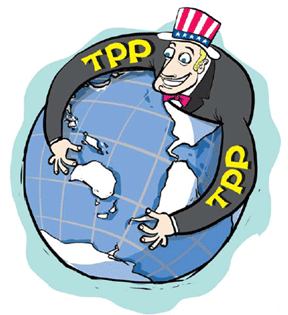 Salt Lake City round in November…..
The most egregious threat to the environment is the investment chapter, in particular the prior consent by all countries except Australia to investor-state dispute settlement (ISDS). The vast majority of investment arbitrations under similar agreements involve natural resources, especially mining, and have resulted in billions of dollars of damages against governments for measures designed to protect the environment from harm caused by foreign corporations. The US is also demanding that contracts between investors and states that involve natural resources also have access to ISDS.
Chapters that may impact on environmental measures, with some examples, include:…..
Austrlalian Government colluded with British to deny justice to Maralinga Aborigines and veterans
Independent senator for South Australia Nick Xenophon plans to step up pressure this year to ensure those affected by the nuclear tests can be compensated properly.
 UK opposed compensation for Maralinga nuclear victims BRENDAN NICHOLSON DEFENCE EDITOR THE AUSTRALIAN JANUARY 01, 2014 THE Anangu Aboriginal people who inhabited the Maralinga area of South Australia called it ”puyu” or ”black mist” the dirt that rolled across the landscape and sickened, blinded and killed them.
As the Hawke government faced growing pressure for fair compensation for those affected by fallout from the British nuclear bomb test program at Maralinga and Emu fields and the Monte Bello Islands between 1952 and 1963, it ran into strong opposition from United Kingdom officials. Continue reading
How Australia caved in to Britain, in not properly cleaning up Maralinga bomb sites
 Why cabinet sought only a partial clean-up of British nuclear test site Archives give new insight into Hawke government’s response to royal commission on weapons testing in Maralinga region Paul Chadwick theguardian.com, Wednesday 1 January 2014
 Gareth Evans, the energy minister at the time, said ‘a non-confrontational approach’ had been adopted in dealing with the Thatcher government.
The complete rehabilitation of areas of Australia used to test British nuclear weapons may not be possible, the Hawke cabinet was advised in 1986.
Cabinet was warned that a full clean-up may have been more expensive than the British government would be willing to contemplate, according to documents released this week by theNational Archives.
They provide new insights into the Hawke government’s response to the recommendations of the McClelland royal commission into British nuclear tests in Australia. Continue reading

Australia willing to market uranium to Indonesia, despite nuclear weapon worries.
Threats of a nuclear Indonesia and a provocative New Guinea BRENDAN NICHOLSON DEFENCE EDITOR THE AUSTRALIAN JANUARY 01, 2014 AT a time of frosty relations with Jakarta, the Hawke government was warned that Indonesia ultimately might aim to obtain nuclear weapons.
Cabinet also was concerned that Australia might be drawn into conflict in the region as the result of impulsive and unwise behaviour by a poorly led government in Papua New Guinea……..
Despite the concerns raised in the briefing paper about Indonesia’s possible nuclear ambitions, it went on to suggest that Australia might supply Indonesia with uranium to increase its influence with Jakarta and to serve its “commercial, strategic and non-proliferation objectives”.
The paper said the nuclear program should be closely monitored, and it warned that a nuclear accident in Indonesia could have serious effects on areas of northern Australia…….http://www.theaustralian.com.au/in-depth/cabinet-papers/threats-of-a-nuclear-indonesia-and-a-provocative-new-guinea/story-fnkuhyre-1226792638737#
Australia can have defence co-operation without supporting nuclear weapons
NO-NUKE AUSTRALIA THWARTS NUCLEAR FREE WORLD BY NEENA BHANDARI* | IDN-INDEPTH NEWSANALYSIS
SYDNEY (IDN) – 17 Dec 13 “…..Defence cooperation sans nukes possible “To make matters worse, Australia’s increasing military involvement with the US is making particularly the huge and expanding military spy base at Pine Gap near Alice Springs an even higher priority nuclear target in the event of any war the US gets embroiled in with China or any other nuclear armed state,” Ruff, who is also co-president International Physicians for the Prevention of Nuclear War, told IDN.
New Zealand’s healthy and growing defence cooperation with the US makes plain that it is perfectly feasible for countries to have a military relationship with the US which excludes nuclear weapons. “Pursuing such a path would be the best thing Australia could do to actually help in freeing the world from nuclear weapons,” Ruff added.
Advocates for a nuclear free world argue that a global ban on nuclear weapons can be achieved through sustained public pressure and leadership from governments. Former Prime Minister Malcolm Fraser, who was critical of Australia’s decision not to endorse the humanitarian statement, is of the view that the current Australian Government may wish to please the US even more than the previous government. Continue reading
In secrecy, Australian government about to sign up to Trans Pacific Partnership
Australia ‘stumbling block’ on tobacco law ,The Age, Peter Martin, Economics correspondent , 14 Dec 13, “…….Australia’s Trade Minister Andrew Robb has indicated he is prepared to trade Australia’s previous opposition to investor state dispute settlement clauses in exchange for greater access to markets for commodities such as sugar. He returned from the talks on Tuesday.
An Australia Institute survey released on Friday finds only 11 per cent of Australians ‘‘definitely know’’ about the Trans-Pacific Partnership negotiations.
Almost 90 per cent think the details of such deals should be made public before they are signed.
Told that the US wants the right for its corporations to sue governments, 75 per cent are opposed.
Asked whether they trust the Australian government when it says it will not sign an agreement which will push up the price of prescription drugs, 67 per cent say no.
http://www.smh.com.au/national/australia-stumbling-block-on-tobacco-law-20131212-2zae7.html#ixzz2nP2JxdzM
Israel pressurising Australia to muck up the UN – Iran nuclear deal

 Israel wants Australia to use its influence in UN Security Council to amend nuclear deal with Iran SMH, December 11, 2013 Peter Hartcher, Israel has urged Australia to use its new found influence to force a much tougher deal on Iran over its nuclear program.
Israel’s Minister for the Economy, Naftali Bennett, told Prime Minister Tony Abbott that Israel ”badly wants a deal” to halt Iran’s nuclear progress, Mr Bennett said.
Israel is deeply unhappy with the terms of the interim deal negotiated by the five permanent members of the United Nations Security Council – the so-called P5 – plus Germany on November 24. ……..Australia can be an important factor in shaping the final deal, due in six months, Mr Bennett said, because it is a member of the UN Security Council next year and also the chairman of the council’s sanctions committee on Iran.
Iran has agreed to freeze parts of its nuclear program and dilute its most highly concentrated uranium in return for a partial easing of the international sanctions that have forced it into recession.
Israel’s essential demand is that Iran be forced to surrender its nuclear fuel-making machinery. Where the P5+1 deal has allowed Iran to keep its centrifuges for concentrating uranium into nuclear fuel, Israel wants them removed. : http://www.smh.com.au/federal-politics/political-news/israel-wants-australia-to-use-its-influence-in-un-security-council-to-amend-nuclear-deal-with-iran-20131210-2z42x.html#ixzz2nBQ2kJxj
Read more: http://www.smh.com.au/federal-politics/political-new
Australia appears to be caving in to USA in the Trans Pacific Partnership
 The commentary also says that Australia has worked with Japan and the US on a revised version of the controversial annex which deals with government regulation of medicine prices, including Australia’s Pharmaceutical Benefits Scheme, while most other countries are opposing it.
Trade Minister Robb said last week that Australia was prepared to agree to give investors the right to sue governments over Australian laws which they claimed harm their investment, which we have experienced in the Philip Morris case.
It is also worrying that the government appears to have agreed with the US refusal to support proposals from the World Intellectual Property Organisation, which assist developing countries to get access to cheaper generic medicines. Most other countries have agreed to support these proposals
TPP talks in Singapore rocked by leaked document By Dr Patricia Ranald (AFTINET Convener) 11 DEc 13,I arrived in Singapore after a week in Bali at the World Trade Organisation talks, at which the US tried but did not succeed in blocking developing countries, led by India, from taking measures to ensure they can make basic food available for the poorest in their countries. A compromise was reached which means that developing countries can continue to do this. AFTINET working group member Peter Murphy was also at the WTO meeting and has done a longer report……
The TPP negotiations here in Singapore are of course still secret, and governments are not making any public statements. The US has set the agenda of bilateral and small group meetings. They are desperate to pressure others to agree to their proposals so they can announce that the agreement is on track to be finalised by the end of the year. Continue reading
Corporations more powerful than governments, in secret Trans Pacific Partnership deal
One of the most controversial provisions in the talks includes new corporate empowerment language insisted upon by the U.S. government, which would allow foreign companies to challenge laws or regulations in a privately run international court.
Previously leaked TPP documents have sparked alarm among global health experts, Internet freedom activists, environmentalists and organized labor, but are adamantly supported by American corporations and the U.S. Chamber of Commerce. The Obama administration has deemed negotiations to be classified information — banning members of Congress from discussing the American negotiating position with the press or the public. Congressional staffers have been restricted from viewing the documents
Obama Faces Backlash Over New Corporate Powers In Secret Trade Deal HUFFINGTON POST 12/09/2013 WASHINGTON –– The Obama administration appears to have almost no international support for controversial new trade standards that would grant radical new political powers to corporations, increase the cost of prescription medications and restrict bank regulation, according to two internal memos obtained by The Huffington Post. Continue reading
Nuclear war avoided: Prof Des Ball awarded for peace diplomacy
 Award for man who helped avoid nuclear catastrophe Standard, By JARROD WOOLLEY Dec. 10, 2013, A FORMER Timboon man who is credited with helping save the world from nuclear annihilation has been awarded the Australian National University’s (ANU) highest honour.
Professor Des Ball, who spent his formative years in Timboon, was presented the Peter Baume Award last month, recognising a career of global significance and an association with the ANU lasting almost five decades………
Professor Ball progressed from a prize-winning economics student who was arrested for climbing a statue of King George V during an anti-Vietnam War rally, to blowing the lid on the secret military facility at Pine Gap during a Senate hearing on treaties in 1999.
Despite his outspoken criticism of US government policy, he was personally invited by President Jimmy Carter to critique the USA’s nuclear defence plans during the Cold War — his analysis persuading the US that its plan to destroy selected Soviet targets would not work in practice.
At the end of last year, a book of essays honouring the iconoclastic scholar contained a contribution from the former president saying Professor Ball had helped save the world from a potential nuclear holocaust.
The book, Insurgent Intellectual: Essays in Honour of Professor Desmond Ball, quoted Mr Carter as saying Professor Ball’s “counsel and cautionary advice, based on deep research, made a great difference to our collective goal of avoiding nuclear war”…….http://www.standard.net.au/story/1961594/award-for-man-who-helped-avoid-nuclear-catastrophe/?cs=12,
Tax office investigating “charity” status of anti-wind farm group
 Tax office deciding if anti-wind farm group Waubra is a charity SMH, December 9, 2013 Madeleine Heffernan The tax office is deciding whether an anti-wind farm group linked to former Liberal MPs should retain its favourable tax treatment.
The Waubra Foundation has been classified a ”health promotion charity” by the tax office, meaning its ”principal activity is promoting the prevention and control of disease in humans”.
It has also been granted deductible gift recipient status by the Australian Taxation Office, and donations of more than $2 to it are tax-deductible…….
Donations to Waubra have helped fund legal challenges against wind farm developments.
Former health minister Michael Wooldridge is a director of Waubra, and former MP Alby Schultz is its patron.
The foundation says its main aim is to ”educate others about the known science relating to the adverse health impacts of infrasound and low-frequency noise.”
The health effects of wind farms has become an increasingly vexed question in the countryside, where there are dozens of farms operated by companies including AGL and Origin Energy.
Sydney academic Simon Chapman says the number of health problems linked to wind farms has reached 216. He has argued that bad publicity about the farms makes it more likely people will report feeling sick around them.
”Wind turbine syndrome” – health problems ranging from headaches, dizziness and insomnia, purportedly the result of the turbines’ low-frequency sounds – is not recognised as a medical condition……..
A spokesman for Greens senator Richard Di Natale expected the review into Waubra’s status by the tax office and the Australian Charities and Not-for-profits Commission to be finished this month.
The tax office has refused to comment, but described Waubra’s situation as ”curious”.
In a recent Senate Estimates, Senator Di Natale asked how the tax office determined that an illness a group purported to prevent was actually an illness.
Tony Poulakis, the ATO’s assistant commissioner, small and medium enterprise, replied: ”I have to admit to not knowing the procedure in which we made those determinations well enough to answer your question.”
Chris Jordan, ATO commissioner, responded that ”It does sound a curious situation, but we will certainly take that on notice.”http://www.smh.com.au/business/tax-office-deciding-if-antiwind-farm-group-waubra-is-a-charity-20131208-2yzdk.html#ixzz2n0iIozkH
Trans Pacific Partnership can allow foreign companies to sue Australian governments
If you believe that Australians should get to choose their own policies and have their basic democratic rights honoured and protected, without fear of legal retribution by foreign corporations then please sign this petition!
Don’t let foreign corporations sue Australia over our policies on GE crops, coal seam gas, health & more! https://secure.avaaz.org/en/petition/Dont_let_foreign_corporations_sue_Australia_for_millionsbillions_over_our_policies_on_GE_crops_coal_seam_gas_more/ The decision by Prime Minister Abbott to reverse the blanket prohibition on ‘investor-state dispute settlement’ (ISDS) provisions in Australia’s upcoming trade negotiations has the potential to irreversibly damage Australia’s national interests by limiting Australia’s ability to set its own policies when it comes to health, the environment, social policies and more.
This is because this new policy will give foreign corporations the right to sue the Australian Government if they believe our policies will damage their corporate interests.
This means that biotechnology corporations could sue Tasmania and South Australia over their respective moratoriums / bans on Genetically Engineered (GE) crops. New South Wales could be sued over their environmental guidelines on coal seam gas extraction and any communities choosing to enact a moratorium on coal seam gas extraction could be sued as well. Pharmaceutical companies could sue Australia over our Pharmaceutical Benefit Scheme (PBS). We could also be sued if we ever wanted to ban harmful pesticides or institute stricter environmental standards in any area of our economy that might impact the interests of a foreign corporation. And that’s just to name a few…
And if you think this all sounds so totally outrageous that it couldn’t possibly happen to us here in Australia, then its well worth considering the impact of what ISDS provisions are currently doing in Canada Continue reading
Tony Abbott has trashed Australia’s international reputation on climate change
But over the next six months, Abbott intends to trash the very mechanisms that could deliver this increased ambition – the carbon price, the renewable energy target and the Clean Energy Finance Corporation – along with the independent advisory body, the Climate Change Authority, that could possibly counter the advice from his inner circle of mad ideologues to whom the words “climate change”, “green” and “clean energy” are as inflammatory as the names Fairfax and the ABC.
On the international stage, in the climate change arena, Australia’s reputation has been shattered
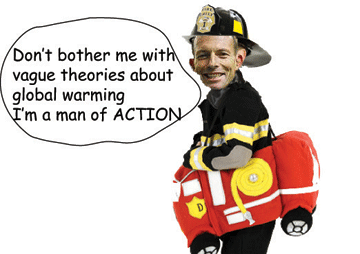 Australia backing into climate change corner, MacroBusiness, 29 Nov 13, Carbon Economyon November 25, 2013 Cross-posted from Giles Parkinson at Reneweconomy. Tony Abbott has some homework to do. Over the next 15 months he is going to have to figure out how it is that Australia will meet its contribution to a new treaty that aims to limit global warming to 2°C.
He’s not the only one. More than 190 nations associated with the UN climate talks agreed on Saturday on a series of milestones that will hopefully take the world to a meaningful climate agreement in Paris in 2015. As part of that agreement, ministers will meet in June next year, country leaders in September, and by the first quarter of 2015, they will need to lay their targets on the table.
For Abbott this could be quite a challenge. Firstly, Australia, as one of the wealthiest nations in the world, and the biggest emitter per capita of any industrialised nation, will be expected to pull its weight. Continue reading
1 This month

of the week – Australians for War Powers Reform (AWPR)
To see nuclear-related stories in greater depth and intensity
 Antinuclear