Some important details on the Trans Pacific Partnership
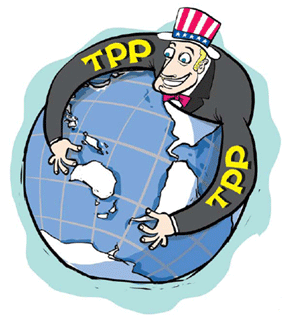 Article 12.8 gives rights holders the right to demand personal information about customers of Internet Service Providers – or other service providers – on a mere accusation. . This is a fundamental attack on the privacy of the citizens of all signatory countries. There is nothing to stop rights holders going on extensive fishing expeditions, searching through millions of users, looking for people to sue. This power is not granted to law enforcement without due process. Handing such powers to corporations without any requirement to show a breach has occurred is an attack upon the process of law. We have a right to not be placed under surveillance by companies based upon their word that illegal activity has occurred
 Pirate Party Australia’s Presentation to Trans-Pacific Partnership Stakeholders Meeting in Melbourne March 4, 2012 Here is the speech that was presented by Pirate Party Australia President David Campbell at 11.45am at the TPPA stakeholders meeting in Melbourne. Thanks to Simon Frew (Deputy President) for authoring the speech and Mozart Palmer (Media Relations) for his contributions.
Pirate Party Australia, like many other attendees at the intellectual property section of this Agreement negotiation, first became aware of the proposed intellectual property provisions of the Trans-Pacific Partnership Agreement when the United States negotiating position was leaked last year.[1]
Much of the content of the leak is a wish-list for old media corporations who refuse to adapt to the Internet and instead pay massive “donations” to their government in order to push their legislative agenda against the interests of modern society. This wish-list echoes that of the intellectual property segments of the Stop Online Piracy Act – known as SOPA – and the Anti-Counterfeiting Trade Agreement – known as ACTA. The US TPPA provisions have been nicknamed “the son of ACTA”. The proposed solutions to online file-sharing will fundamentally change the operation of the Internet, to its detriment.
The extreme position of the leaked United States’ Intellectual Property chapter is highlighted by the unprecedented request for the negotiating texts to remain secret for four years after the agreement is signed. This secrecy is a perversion of democracy. The public would not be given a chance to oppose such a draconian attack on both the Internet and the civil liberties of citizens in all of the signatory countries. All of this to protect the corporate interests of a small sector of one industry? What about the cost to our democratic rights?……..
In Australia, we have seen the harm that tighter intellectual property restrictions can cause through the Australia–US Free Trade Agreement. The Productivity Commission, a body that investigates the economic benefit or hindrance of various Australian economic policies, warned that agreeing to intellectual property provisions in free trade agreements needs to be subjected to a rigorous cost/benefit analysis.
The Australia–US Free Trade Agreement is believed to cost the Australian economy between 88 million and 763 million dollars a year in copyright enforcement alone. This is wealth being directly transferred from Australia to the United States – there is no net benefit to Australia derived from the tighter restrictions.[2]
If the US delegation gets its way, that and more will be forced upon your people and local economy, to what benefit? We urge delegates to reject the inclusion of any intellectual property provisions in your own national interests as they WILL harm your economies. Continue reading
AUDIO: Marshall Islands angry at Tony Abbott’s dismissal of climate change-bushfire link
 AUDIO: Marshall Islands angered by Australian PM Tony Abbott’s dismissal of climate change link to bushfires http://www.abc.net.au/news/2013-10-25/an-marshalls-bushfires/5044714 The Marshall Islands Government is unhappy at Australian Prime Minister Tony Abbott’s dismissal of
  a link between the bushfires in New South Wales, and climate change……Senator Tony de Brum, the Minister in Assistance to the Marshall Islands President, said while it is difficult to tie any one event to climate change, his country is concerned at Mr Abbott’s dismissal of the issue…….”We’ve been watching the fires in Australia over the past few years and can say that we’ve been impressed with their ferocity and the threat that they project to our friends in that part of the world,” he told Pacific Beat.
“But I don’t think that we should just wave this thing off as something that is natural to Australia and is part of life in Australia and therefore not connected in any way to climate change.”
Senator de Brum said Australia should first be looking inward to what it is doing to fight against the impact of climate change.
“Just last month with the blessing of the new Environment Minister Greg Hunt, the Australian Government committed to being a climate leader by supporting the Majuro Declaration for climate leadership – this was the key outcome of the Pacific Island Forum,” he said.
“Australia should step up and be a leader in climate change and not be a laggard.”
Australian rare earths company Lynas still on the nose in Malaysia
Residents though remain highly sceptical and opposition candidates running on an anti-Lynas platform won a raft of seats around the plant, in the May general election.
Lynas lost more than $107 million last financial year, and has informed the market that it’s set to report another quarter of reduced output, as it continues to work on the plant’s operational issues.
Deutsche Bank’s Chris Terry says the company’s share price is now around 40 cents, compared with its peak value of $2.30 in early 2011
Australian rare earths miner Lynas Corporation sparks fresh anger in Malaysia ABC News, Kate Arnott for Newsline 9 Oct 13Australian rare earths miner Lynas Corporation is refusing to publicly disclose the location of a permanent waste storage facility for its processing plant in Malaysia.
Earlier this year, Lynas started commercial production of rare earths, which are used in a wide range of high tech equipment, but the plant on the east coast of peninsular Malaysia has been plagued by operational problems. Continue reading
Abbott govt accelerates sale of uranium to India, as India fires another nuclear-capable missile
 India, Australia to hold third round of nuclear talks IANS | http://ibnlive.in.com/news/india-australia-to-hold-third-round-of-nuclear-talks/427039-3.html?utm_source=ref_article Oct 07, 2013 New Delhi: India and Australia, under the new dispensation of Prime Minister Tony Abbott, are hoping to hold a third round of talks on nuclear cooperation in December this year, said a top official on Monday. Secretary (East) in the external affairs ministry Ashok K Kantha said Abbott has “made positive comments about the need for expediting, accelerating negotiations between India and Australia on nuclear cooperation”.

“We already have held two rounds of negotiations, and we are hoping to hold a third round of negotiations if possible in December this year.  We have not yet firmed up the dates. But I believe there is a strong desire on both sides to try and bring these negotiations to a successful conclusion at an early date,” said Kantha at a briefing in New Delhi.
India test fires nuclear capable missile from Odisha Tribune, By Web Desk October 7, 2013 ODISHA: India test-fired a nuclear-capable Prithvi-II missile from a test range at Chandipur, Odisha on Monday, Express News reported……The Prithvi II missile was inducted into India’s Strategic Forces Command in 2003 and is the first missile developed by DRDO under India’s IGMDP (Integrated Guided Missile Development Program.
The missile is capable of carrying 500 to 1000 kilograms of warheads according to The Hindu.
On September 14, India successfully test-fired for a nuclear-capable missile that can reach Beijing and much of Europe. http://tribune.com.pk/story/614650/india-test-fires-nuclear-capable-missile-from-odisha/
Trans Pacific Partnership could override Australian law, but will Abbott resist this?
The progressive think tank, the Australia Institute, put out a statement within hours of the release of the Coalition Trade policy, attacking the Coalition’s “hidden agenda” which would see “health and the environment sacrificed for free trade”.
It highlights the threat that ISDS provisions pose to pharmaceutical, tobacco and environmental legislation in particular.
“The Howard Government successfully resisted pressure from the US Government but now the Coalition has signalled its intention to sell out Australian sovereignty.”
 provisions of the Trans-Pacific partnership are increasingly encountering resistance within other negotiating nations, which are concerned that the American agenda is more about protecting the interests, particularly the intellectual-property interests, of its big corporations than it is about free trade
Abbott: Open For Business — And Multinational Lawsuits The Global Mail By Mike Seccombe September 20, 2013 ………You’re probably familiar with the fact that a group of tobacco companies including Philip Morris brought a case to the Australian High Court, on the basis that the government had effectively stolen its intellectual property by enforcing plain packaging. It got lots of media coverage.
Less publicised is the fact that having failed in the High Court, the company now is pursuing the matter via a bilateral trade agreement signed between Australia and Hong Kong in the early 1990s, which includes ISDS provisions.
The contempt such an action shows for Australian legal process and sovereignty, says Patricia Ranald, is plain. “They’re saying: ‘We’re going to ignore the High Court, when it says we’re not entitled to compensation; we’re going to go off and find an obscure trade agreement to sue you under’.” Continue reading
So is Tony Abbott going to sign us up to the (rotten) Trans Pacific Partnership deal?
And then there’s the big one, the US-driven Trans-Pacific Partnership Agreement (TPP), now being negotiated
“The Government has not and will not accept provisions that limit its capacity to put health warnings or plain packaging requirements on tobacco products or its ability to continue the Pharmaceutical Benefits Scheme’ – [Gillard Labor Government]
Abbott: Open For Business — And Multinational Lawsuits The Global Mail By Mike SeccombeSeptember 20, 2013 Labor rejected it outright. Even the Howard government issued America with a rare “no” over the legislation, declaring it contrary to national interests. But now the Abbott Coalition is flirting with a trade agreement that would allow companies, acting increasingly in secret, to sue Australia if they don’t like its regulations…….. the Howard government was at first almost pathetically keen to do a deal with the United States.
In the end, however, Australians’ growing hostility to the trade agreement forced Howard, for once, to say “no” to George Bush.
It wasn’t a blanket refusal of an Australia-United States Free Trade Agreement (AUSFTA); a deal was eventually stitched up and began operating in 2005. The “no” was to one of America’s key demands: a provision called Investor-State Dispute Settlement, or ISDS.
What this arcane phrase refers to is the right of foreign companies to sue national governments of the signatory countries, not in domestic courts, but in opaque international forums, if they think some element of that government’s policy is harming their interests.
If a mining company, for example, is unhappy with environmental safeguards which inhibit its operations, if a pharmaceutical company is unhappy with the prices it gets for its drugs, if a chemical company is upset with the banning of an agricultural pesticide, if a tobacco company does not like laws restricting cigarette sales, ISDS provisions in trade agreements give them the means to challenge government policy and to seek compensation. Continue reading
Trans Pacific Partnership a political minefield for the Abbott government
Opening Australian governments to lawsuits over resource extraction, foreign land purchases, pharmaceutical benefits and health measures is a potential minefield for the new government.
Trade treaty stance the same, despite promise, http://www.theage.com.au/business/trade-treaty-stance-the-same-despite-promise-20130922-2u7wm.html#ixzz2fkoj8kHt The Age September 23, 2013 Peter Martin
Foreign corporations wanting to sue Australian governments will have to cool their heels. New trade minister Andrew Robb says Australia’s negotiating position on the Trans Pacific Partnership Agreement remains the same despite an election commitment to overturn the blanket prohibition on ”investor-state dispute settlement” provisions.
The previous government declared point-blank that Australia would never again sign an agreement that included the provisions. One of the few trade agreements Australia has signed with such a clause allowed a Hong Kong-based subsidiary of tobacco giant Philip Morris to take Australia to an international tribunal over its plain-packaging laws, despite having lost its case in the High Court. Continue reading
Abbott government tight-lipped about Australia’s presence at Global Climate Fund in Paris.
Coalition no comment on UN climate meeting, The Age, September 23, 2013 Peter Hannam Carbon economy editor
Australia’s international commitment to tackling climate change is in doubt with the Abbott government refusing to say if a senior bureaucrat will lead a key meeting of a giant new United Nations fund for developing nations.
Ewen McDonald, acting director-general of Australia’s main aid arm AusAID, is scheduled to co-chair the board meeting of next month’s Global Climate Fund in Paris. The fund is intended to become a conduit for state and private funds of up to $US100 billion ($106 billion) a year by 2020 to help poorer nations shift to low-carbon energy. ”The [fund’s] Interim Secretariat expects that Mr McDonald will attend and co-chair the meeting,” said a spokeswoman for the fund.
AusAID’s executive, though, would not say whether Mr McDonald will take his leadership role in France. The Department of Foreign Affairs, which Prime Minister Tony Abbott directed to absorb AusAID, also refused to comment. Greg Hunt, the new environment minister, referring to Australia’s support for the fund refused to say if Mr McDonald would go to the Paris meeting. Continue reading
Abbott govt likely to speed up uranium sales deal with India
Australian Election Seen Likely to Speed Talks with India on Uranium Deal National Journal, By Rachel Oswald, Global Security Newswire September 11, 2013 WASHINGTON — Newly elected leaders in Australia likely will push to conclude a trade agreement aimed at allowing uranium exports to India, issue experts told Global Security Newswire.
While it was earlier predicted to take two years to conclude the export negotiations, a new Liberal-National government led by conservative leader Tony Abbott likely will push to have trade discussions finished “within the year,” according to Amitabh Mattoo, director of the Australia India Institute at the University of Melbourne. Continue reading
Tony Abbott about to make the mistake of signing Australia up to the Trans Pacific Partnership
PM-elect Tony Abbott speaks with US president Barack Obama about Syria conflict ABC News By political correspondent ABC News, Simon Cullen, 12 Sept 13 US president Barack Obama has phoned Prime Minister-elect Tony Abbott to congratulate him on the Coalition’s election win.A spokesman for Mr Abbott says the pair reaffirmed the strong relationship between the two countries, …..
The two leaders also discussed the need to improve trade and investment links in the region, and agreed to work cooperatively towards the Trans-Pacific Partnership….
.http://www.abc.net.au/news/2013-09-12/tony-abbott-barack-obama-syria-diplomacy/4953584
Australia’s hypocrisy on the South Pacific Nuclear Free Zone Treaty
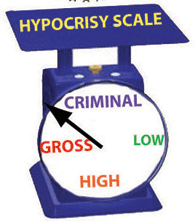 Declassified documents from the National Archives of Australia, including the 1985 Cabinet minute about the SPNFZ Treaty, show clearly that Australia designed the treaty to protect US interests in the Pacific, including the deployment of nuclear-armed warships and the testing of nuclear missiles.
Hayden’s cabinet submission includes details of Australian negotiating positions in the final months before the treaty was signed:
(iii) Australia oppose the inclusion in the draft SPNFZ Treaty of a ban on missile tests.
(iv) Australia oppose the inclusion in the draft SPNFZ Treaty of a ban on the facilitation of the stationing of nuclear weapons,
Delaying the nuclear-free zone in the Pacific, Inside story, 27 Aug 13 As Pacific leaders gather this week in the Marshall Islands, the United States continues to delay ratification of the South Pacific Nuclear Free Zone Treaty. Using previously classified documents Nic Maclellan recounts a history of opposition to a nuclear free Pacific, and a reminder that Australia could be breaching the treaty
AT THE height of the nuclear arms race between the United States and Soviet Union, a treaty to create a South Pacific Nuclear Free Zone, or SPNFZ, was opened for signature on Hiroshima Day, 6 August 1985, at the Pacific Islands Forum meeting in Rarotonga. Twenty-eight years after it was signed on that day by Australia, New Zealand and island nations, the United States still hasn’t ratified its protocols, Continue reading
Malawi losing $millions due to its poor uranium deal with Paladin Energy
Malawian dies on duty at Kayelekera Uranium Mine in Karonga, By Nyasa Times Reporter July 31, 2013
| “………The tragic incident has cast a shadow over the company which is already facing mounting criticism following reports the country was losing out from the favourable tax regime agreed with the company by the former administration of late President Bingu wa Mutharika. |
Last week, the United Nations’ Special Rapporteur on the Right to Food, Olivier de Schutter, also reiterated that Malawi was losing out due to tax incentives given to Paladin……..
As a result of tax incentives, one estimate suggests that Malawi may lose between US$ 205 million and US$ 281 million over the 13 years of the project.
But the current government of Joyce Banda has indicated it has started negotiations with the company to have the agreement reviewed. http://www.nyasatimes.com/2013/07/31/malawian-dies-on-duty-at-kayelekera-uranium-mine-in-karonga/
Australian company Paladin’s uranium contract with Malawi -the “worst possible swindle”
 Malawi gov’t and Paladin: Act on Kayelekera uranium raw deal now! By Veronica Maele-Magombe Nyasa Times, By Veronica Maele-Magombe July 30, 2013 Since last week’s stinging observation by UnitedNations (UN) Special Raportuer on the Right to Food Olivier De Schutter regarding Malawi’s Kayelekera Uranium Mine deal, two elusive culprits remain pretty much intact in their hard shells. It is as if the country’s most guarded contract between government and Australiancompany, Paladin Africa Ltd has not been unravelled as the worst possible swindle. Continue reading
UN says Malawi is getting a poor deal from Australian uranium mining company Paladin
 UN rubbishes Malawi’s Paladin uranium deal, fertilizer subsidyBy Hudson Mphande, Nyasa Times July 23, 2013 United Nations Special Raportuer on the Right to Food Olivier De Schutter who was in Malawi for an assessment of the food situation in the country has rubbished Kayerekera uranium mine deal between Malawi and Australian Paladin Mining Company saying the Southern African country has had a raw deal that is robbing the poor.
The UN Raportuer said the uranium mining deal was one of the investments in Malawi through which the country is losing resources that could otherwise make a difference in food security and other pro-poor initiatives. He said in the life span of the mine Malawi is expected to lose almost US$281 million…
“Mining companies are exempt from customs duty, excise duty, value added taxes on mining machinery, plant and equipment. They can also sign special deals on the rate of royalty owed to the government. I believe that there are more reasons that investors would come to Malawi without such incentives,” he said.
De Schutter was addressing journalists in the capital Lilongwe at the end of his 11-day tour of the country.
He bemoaned that due to illicit financial flows, tax envasion as well as tax incentives that the country offer to both domestic and foreign companies currently Malawi was failing to get maximum use of its resources.
De Schutter said that revenue losses from special tax incentives to Paladin Africa Mining alone are estimated at almost K67 billion (US$205 milion) since the mine started its operations and could reach almost K92 billion (US$281 million) over its13-year lifespan.
“Paladin alone is costing the budget more than US$20 million (almost K8 billion) a year in taxes,” he said.
He added: “I am convinced that unless combined with a comprehensive enhancement and optimisation of tax revenue, current macro-economic reforms may not have substantive positive impacts. There is need for
Malawi to examine its national tax laws and policies towards preventing illicit capital flight. As mining develops, Malawi can simply not afford business-as-usual.”
The UN Special Raportuer said it is estimated that the country has lost over 10 percent of its growth domestic product (GDP) to illicit outflows and tax evasion over the period 1980 to 2009……..
De Schutter also specifically expressed concerns on the country’s current minimum wage currently at K371 ($1.12) per day, describing it as the lowest in the world…… The UN special rapporteur said he will give a report and his recommendations to both the UN Human Rights Commission and the Malawi Government. http://www.nyasatimes.com/2013/07/23/un-rubbishes-malawis-paladin-uranium-deal-fertilizer-subsidy/
Paladin Energy – the Ugly Australian uranium mining company in Malawi
the British silently stole our uranium and left when their projections did not add up to their whims, and now we have the Aussies who are refusing to deal fairly.
Honestly I loved Crocodile Dundee the movie but this Aussie corporation turning Malawi land into some ‘plunder outback’ is making me sick
Killing Malawians through the rotten extractives deals: The case of Paladin’s uranium mining Nyasa Times, by Patrica Masinga, 24 April 13, Malawi has in the few weeks been engaged by a plethora of stakeholders discussing strategies to revive, or more on the ground, reclaim the benefits that Malawians are been milked of by the so-called extractive industry multi-national corporations.
They call themselves investors, and government believes that the Malawi Development Goals (MDGs – who cares if it’s the second phase) will be boosted, particularly that mining alone through Kayerekera of Paladin Energy Limited group of companies (trading as Paladin (Africa) Ltd in Malawi?) could provide a large economic base.
But that is all a fat lie. Paladin and many other foreign multinational mining countries are least interested to contributing to the Malawi economic growth. They are here to milk the country – exploiting all that it has rich in minerals and dump us when the time is right even poorer.
Imagine, to screw Malawians of their rightful economic gains, the company, incorporated in Australia first listed on the Australian Stock Exchange (ASX) on March 29, 1994 under code ‘PDN’, and quickly changed its name from Paladin Resources NL to Paladin Resources Ltd in 2000 and listed under the Toronto Stock Exchnage (TSX) in Canada April 29, 2005, and again changed its name to Paladin Energy Ltd in November 2007 and listed on the Namibian Stock Exchnage on February 2008.
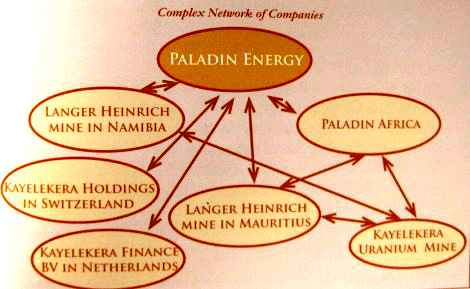
By such trends, one is compelled to question the motive, considering also that in Namibia itself the company owns the Langer Heinrich Uranium Mine where it started production in 2008 and has Kayerekera Uranium Mine as its second largest mining venture in this part of Africa acting also as a good supllment to the Langer Heinrich Uranium Mine. Continue reading
1 This month

of the week – Australians for War Powers Reform (AWPR)
To see nuclear-related stories in greater depth and intensity
 Antinuclear