USA’s military strategy in the Pacific could lead Australia into a nuclear war
|
|
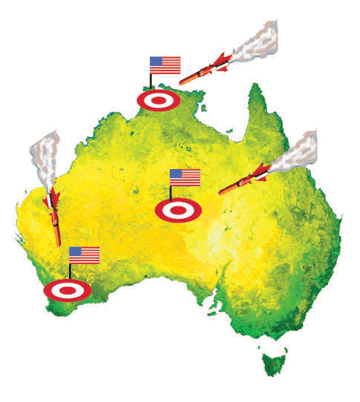 US strategy could result in nuclear war,
The concept risks making the Chinese military an enemy.
The paper, written by the institute’s senior analyst for defence strategy, Benjamin Schreer, urges the Australian government to keep a cautious distance from the plan for now. Australia would likely play a role in the strategy, particularly with US Marines stationed in Darwin. The plan assumes any conflict between the US and China – most likely over Taiwan or Chinese skirmishing with Japan – would remain below the level of nuclear strikes.
But Dr Schreer writes that “such an outcome is far from certain”. Part of any US plan to strike at China would involve “blinding” the People’s Liberation Army by hitting its surveillance, intelligence and command systems.
This could provoke panic on the Chinese side and “consequently increase the chances of Chinese nuclear pre-emption”, he writes.
“AirSea Battle thus raises the spectre of a series of miscalculations on both sides if Beijing perceives conventional attacks on its homeland as an attempt to disarm its nuclear strike capability.”
The paper coincides with rising tensions between China and Japan over territorial disputes in the East China Sea, and between China and Vietnam in the South China Sea.
US military planners are developing the AirSea Battle plan in response to the shift in the strategic balance as China’s growing military might threatens to end more than half a century of US dominance on the western Pacific rim.
China’s long-range missiles, submarines and stealth bomber squadrons could soon threaten US bases and aircraft carrier groups in the region, potentially deterring the US from coming to the aid of Taiwan or Japan in the event of a conflict.
The plan sees US forces withstanding the first round of Chinese attacks, then carry out their “blinding” campaign. US carrier battle groups would then hit Chinese missile launchers. Meanwhile, US submarines and long-range missiles would strike at the Chinese airforce. The US could also blockade oil supplies and other resources – likely with Australian help.
While Australia would inevitably be drawn into any such conflict, the institute urges the government not to publicly endorse the plan for now, but rather demand a clearer explanation of how Washington would enact the plan, and its political goals. “[It] risks making the Chinese military an enemy” when the US, Australian and allied grand strategy is ”aimed at integrating Beijing in a co-operative Asian security order”.
Australian uranium company Paladin will now have to renegotiate its deal with Malawi
 Malawi to renogotiate with Paladin on the Kayerekera uranium deal http://www.malawitoday.com/news/128733-malawi-renogotiate-paladin-kayerekera-uranium-deal 14 April 2013, ZODIAK RADIO Malawi has finally succumbed to pressure from activists to start re-negotiating with Paladin Africa Limited on the Kayerekera Uranium deal in a last ditch attempt to create a win-win situation.
First on the proposal is to remove the confidentiality clause on the agreement such that it be made public before rectifying other strings within the deal.
Minister of Mines Mr John Bande confirmed that discussions are underway with Paladin Africa Limited on the matter.
“We are working out on modalities to discuss in public the agreement between Kayerekera and the Malawi Government,” said Bande.
Bande blamed the previous regime for putting a confidentiality clause on the license. “Now government is working to remove that clause so that the deal can be discussed in public,” said Bande.
Critics have continuously called on government to re-negotiate the license, saying Malawi is getting a raw deal from it.
Issued in 2009 the Kayerekera uranium mine license is for a period of 15 years and is subject to renewal.
The license among others also allowed the miner to open an off-shore account.According to the deal, Malawi was meant to be collecting a meager US$ 100 million in taxes annually from the deal.
Necessity for Australia to promote a nuclear free Middle East zone
How, then, are we to explain Australia’s relative inaction when it comes to supporting moves to denuclearise the Middle East? The only plausible explanation is the close relationship with the United States. Australia’s political leaders appear unwilling to say or do anything that might be construed in Washington as conflicting with US priorities and preferences.
What might a more independent Australia do to promote a Middle ……East WMD-free Zone? Four modest but important initiatives suggest themselves. The first would be a prime ministerial statement strongly supporting the establishment of such a zone and explaining how this objective is in line with Australia’s security and economic interests…….
11 April 2013 Joseph Camilleri and NAJ Taylor
Despite Australia’s obvious national interests in the Middle East, our leaders have been strangely silent about the alarming security threats in that region, write Joseph A Camilleri and NAJ Taylor.
Weapons of mass destruction – biological, chemical and nuclear – are once again buzz words in the international corridors of power. In Australia, North Korea has attracted media headlines, but the more disturbing and far less predictable situation unfolding in the Middle East has yet to receive the attention it deserves.
The unresolved Israeli-Palestinian conflict, the Iran nuclear dispute, Western-led interventions, popular uprisings, conflict in Syria, and actual and potential regime changes have combined to create a highly volatile and dangerous security environment in that region. Continue reading
North Korea’s declaration about a nuclear attack
With the world on alert, experts say North Korea does potentially have the capability of hitting Australia with a missile – but only if they’re very lucky.
University of NSW Professor of International Security Alan Dupont recently told defence correspondent Ian McPhedran that North Korea had only a “rudimentary” intercontinental ballistic missile system.
“The capability is pretty rudimentary and has more to do with pretence than substance,” he said.
North Korea declares it has given approval for a nuclear attack on the United States VIDEOSand GRAPHICS
- From: News Limited Network http://www.news.com.au/world-news/north-korea-gives-final-approval-for-nuclear-attack-on-united-states/story-fndir2ev-1226612136732
- April 04, 2013
- North Korean army says it has ‘final approval’ for nuclear attack
- United States to move anti-missile system to Guam
- Two advanced missile destroyers moved closer to North Korea
-
NORTH Korea says it has approved a nuclear attack on the United States in its latest threat as US Defence Secretary Chuck Hagel warned Pyongyang to back down. Continue reading
Discontent in Malawi over Australian uranium company Paladin’s mining deal
There is growing belief among some sections of the society that Malawi is losing out on the Kayerekera mining and have since called on the government to renegotiate the deal.
Leader of Malawi’s opposition People’s Transformation Party (Petra) Kamuzu Chibambo — who is also a prominent lawyer— said unless the deal were renegotiated, Malawi would continue to lose out in the mining sector and called upon all Malawians to galvanise their voices to press government to enter into negotiation with the miners.
Paladin has MK3.9bn environmental bond for Malawi uranium mine -Walker, Nyasa Times, 3 April 13, Australian Miner Paladin Energy Limited, operators of the Kayerekera Uranium Mine in Karonga district have a US$10 million Environmental Performance Bond with two commercial banks in Malawi to among other things cater for rehabilitation costs for signs of default during and after mine life.
“Paladin has a MWK 3.9 Billion (US$10 Million) Performance Bond in place to satisfy the environmental obligations of Clause 18.14(a). This comprises a US$ 5 Million Performance Bond with Standard Bank Limited and US$ 5 Million Performance Bond with Nedbank Malawi Limited,” Paladin General Manager for International Affairs Greg Walker toldNyasa Times in an email response.
The bond, in the form of irrevocable letters of credit, will deal with issues like water and environment contamination and the eventual clean up.
A letter of credit is a letter from a bank guaranteeing that a buyer’s payment to a seller will be received on time and for the correct amount. In the event that the buyer is unable to make payment on the purchase, the bank will be required to cover the full or remaining amount of the purchase.
The bond further obliges the company to sensitize people on the potential dangers associated with radioactive substances and prevention procedures. Continue reading
Western uranium mining companies not liked by some Malawians
 Paladin has MK3.9bn environmental bond for Malawi uranium mine -Walker Nyasa Times
April 3, 2013 “…... Nach Sale Says: Ngoma, you cannot take away the fact that western investors are highly exploitative and their governments hypocritical. They talk about the the mathematics and accounts of investment but at the end of the day they benefit more and their governments take that same money and give us as aid.
Tony Abbott would abolish the Climate Commission, sack Professor Tim Flannery
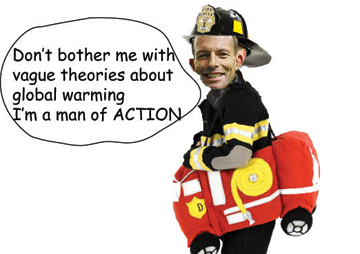 A Climate Commission report released on Wednesday examined links between Australia’s extreme weather and human-induced climate change. It found natural events were being influenced by climate change, because greenhouse gases are accumulating and trapping extra energy in the Earth’s atmosphere and oceans.
”When the carbon tax goes, all of those bureaucracies will go and I suspect we might find that the particular position you refer to goes with them,” Mr Abbott told Macquarie Radio on Wednesday. Continue reading
Ben Zygier was betrayed
Ben Zygier didn’t betray his country. Ben Zygier was betrayed. Between his two home countries, he was placed in a situation he couldn’t deal with.
Israel allowed itself to cross three boundaries: a Mossad man was asked to retain Australian citizenship – leading to a dual-loyalty dilemma; the identity that he was instructed to use as a cover was his real Australian identity; and, worst of all, he was sent to operate in his homeland.
The prime minister must send a letter to the Zygier family – that have been broken by their son’s breakdown – saying, “Your son was not a traitor.”.
 Ben Zygier was no traitor, he was betrayed, Haaretz, 22 Feb 13, By Sefi Rachlevsky He wanted to contribute to Israel and did not mean to betray both his homelands, or his father for that matter. Israel cast him into a situation from which he could only be liberated by death..
… The fundamentals of its [Israel’s]power have not changed since David Ben Gurion established them: might, the support of friendly powers, the mobilization of world Jewry that can also influence their home countries, and the memory of the Holocaust. But the Zygier affair highlights how in an existential moment, Israel isn’t “only” immoral, but tramples arrogantly over these fundamentals without observing any boundaries…..
Deep and stubborn silence by Australian and Israeli governments about Ben Zygier’s death
Ben Zygier: the silence surrounding Prisoner X The Conversation, Felix Patrikeeff 22 February 2013, When Melbourne man Ben Zygier, an alleged agent of Mossad, or perhaps a double agent, died in December 2010, his end was barely perceptible.
He had been held anonymously in solitary confinement at a high-security prison in Israel. A notice of his death appeared on the Internet, and then promptly disappeared. His name was not made known at the time.
It had to be secured by Australian investigative journalists. Continue reading
Mystery of Ben Zygier’s death: Australia calls on Israel to explain
“I need to know what the contact was between Australian agencies and those of Israel, and I need to see what the Israelis want to tell Australia,” Carr stated. “The key is to get all the information.”“…The Haaretz newspaper reported on Friday that Israel has agreed to pay millions in compensation to Zygier’s family.
A source told the newspaper that Israel agreed to pay millions of shekels several weeks ago, after an investigation concluded that Zygier’s death had been a suicide and before the affair was exposed by the Australian media….”
Australia wants Israel to provide details on death of ‘Prisoner X’ Feb 17, 2013 PressTV Australia has called on the Israeli regime to provide details about the death of an Australian-Israeli ‘Mossad agent’ who allegedly committed suicide in an Israeli prison in 2010.
Australian Foreign Minister Bob Carr said on Sunday that the ministry was seeking answers in a “formal report” from the Tel Aviv regime over the circumstances surrounding the suspicious death of 34-year-old Ben Zygier known as ‘Prisoner X.’
On February 12, reporter Trevor Bormann revealed on Australian Broadcasting Corporation (ABC) that the prisoner who had worked for Mossad for ten years was “found hanged in a cell with state-of-the-art surveillance systems” near Tel Aviv in December 2010. Carr told reporters in Sydney that the Australian government had “asked” the Israeli regime “for a contribution to that report.”
The Australian foreign minister said Canberra wanted Tel Aviv to “submit… an explanation of how this tragic death came about.”
“I need to know what the contact was between Australian agencies and those of Israel, and I need to see what the Israelis want to tell Australia,” Carr stated. “The key is to get all the information.”
Following the ABC revelation, the Tel Aviv regime was forced to admit that Zygier had been jailed under a false identity “for security reasons” despite nearly two years of Israel’s efforts to cover up the secret.
on February 14, a report by the New York Times said Zygier was among the 26 suspects in a murder plot in which Mahmoud al-Mabhouh, a Hamas official, was tracked and killed in his hotel room hours after his arrival in Dubai, the United Arab Emirates, in January 2010.
The assassins had reportedly used fake passports from Australia, Britain, Ireland, Germany and France, among other countries.
The report added that ‘Prisoner X’ had provided the officials in Dubai with “names and pictures and accurate details” in exchange for protection.
However, the Israeli regime kidnapped him from his hideout and jailed him over treason nearly a month after the operation over the speculation that he had been on the verge of exposing Tel Aviv’s secrets about the passports. http://www.presstv.ir/detail/2013/02/17/289354/israel-should-explain-prisoner-x-death/
Paladin and Rio Tinto uranium mining companies – the Ugly Australians in Malawi and Namibia, despite Bob Carr’s praise
 What have interested Australian companies, or the Australian government, done to address these concerns?…….
what should we make of Australian Defence Force chief General David Hurley’s alarming indication that there might be a role for the ADF in protecting “Australian interests” in Africa?
Multinational miners: magnanimous or malevolent? Kellie Tranter – lawyer and Humna Rights Activist, FEBRUARY 1, 2013 BY KELLIE TRANTER “……..Malawi “…….Minister Carr praised the work of Australian mining company Paladin, referring to its strong corporate social responsibility. Paladin operates Malawi’s biggest uranium mine, the Kayelekera.
In June 2008, The Bench Marks Foundation released a report ‘Corporate Social Responsibility and the Mining Sector in Southern Africa’ which suggested that when Paladin struck its deal with the Malawi government to mine uranium, it was agreed that it would get a 100% capital write off, a reduction in corporate tax from 30% to 27.5% and a scrapping of the 10% resource rent tax. Paladin was also to be exempt from the standard 17.5% import VAT or duty and a royalty rate reduced from 5% to 1.5% in the first three years and 3% thereafter.
Now Malawi’s opposition party, the People’s Transformation Movement (PETRA), have given the Malawi Government a 14 day ultimatum to explain why the Kayelekera deal cannot be renegotiated. However, there are reports that the agreement with the previous government (of late President Mutharika, a former World Bank economist) includes a clause that the government will not take any action that will seriously change the financial aspects of the project for the period of 10 years. Residents are also concerned that the Malawi Government retains only a 15% equity in Paladin (Africa) Limited (PAL) a subsidiary of Paladin and has given “breathing space” on taxes for 10 years. Continue reading
Assange remains in legal limbo as Sweden not keen to press charges against hm
 With Assange in Diplomatic Limbo, Sweden in No Rush to Press Rape Charges , 01 February 2013 By Alissa Bohling, Truthout | News Analysis With Julian Assange remaining in diplomatic limbo in London, Sweden refuses his offer for an interview, leading some to suspect they are not anxious to pursue allegations of rape that have been lodged against him……
In an October 2012 letter to US Attorney General Eric Holder, they asked the Department of Justice to give its word that Assange will not be extradited, subject to indefinite detention or prosecution under the Espionage Act for the activities of WikiLeaks, but with no response, he and his Swedish accusers remain in legal limbo, calling into question whether Assange’s civil liberties and the women’s right to take their accusations through the criminal justice process can both be upheld.
Government Tactic of Smearing Whistleblowers Continue reading
Australia’s overseas aid used to promote image of Paladin and Bannerman uranium mining companies
 Paladin, which has been the subject of some controversy in Malawi over job cuts, was last year linked to a funding application through its employees’ charity – Friends and Employees of Paladin for African Children.
Paladin’s (African) Ltd general manager, international affairs, Greg Walker, who was invited late last year to be Australia’s honorary consul to Malawi, was involved in the process, according to 2012 correspondence from Australia’s ambassador to Zimbabwe, Matthew Neuhaus, to Mr Walker. The letter obtained under freedom of information confirmed Mr Walker’s successful application for the employees’ charity funding proposal.
The Aidwatch director Thulsi Narayanasamy said it was not the place of the Australian aid program to fund the corporate social responsibility programs of wealthy mining companies.
Firms use tax money for aid projects : http://www.smh.com.au/money/tax/firms-use-tax-money-for-aid-projects-20130129-2ditd.html#ixzz2Jbp0RzOT January 30, 2013 Rory Callinan
WEALTHY resource companies operating overseas are tapping into Australian taxpayer funds to set up aid projects potentially benefiting their corporate social responsibility credentials.
Aid and mining watchdogs have expressed concerns about the practice, arguing the corporations are wealthy enough to bankroll their own aid and that linking donations to controversial mine operations is a conflict of interest.
Nine mining companies all operating in Africa have been linked to the successful applications via the Foreign Affairs Department’s Direct Aid Program – a scheme that allows heads of missions to give up to $30,000 to local causes.
About $215,000 of taxpayers’ money went to the mining company-conceived projects last financial year, including a school for the deaf, providing trade skill training to local workers, establishing women’s groups and digging wells. Two applications involved uranium mining companies, Paladin Energy in Malawi and Bannerman Resources in Namibia. Continue reading
Australia in UN: opportunity to return to principle on nuclear disarmament, and negotiations with Iran
despite the window of opportunity that Australia has open to it as chair of a number of relevant committees on the UN Security Council, Carr’s recent statements are devoid of any talk of global disarmament, or of a just dialogue between Iran, Israel and the West. The Australian government instead seems intent on reforging the policy bonds of the “Coalition of the Willing” which proved so morally, politically and economically disastrous in 2003.
Julia Gillard must not continue to take Australia further down the path of moral decay in the area of non-proliferation and disarmament as I’ve elsewhere argued she has done. Now on the Security Council, Australia must use its role to push for what Prime Minster Gillard herself promised  in the candidate brochure:
… a lead role in advancing disarmament and non-proliferation efforts and continuing our longstanding efforts to promote respect for international law.
The decay of Australia’s nuclear ethic, Aljazeera, NAJ Taylor, 26 Jan 13, Australia must use its new position in the UN Security Council to push for conciliation with Iran. Within three days of Australia taking the chair of the UN Security Council committees overseeing “Iran’s WMD proliferation activities”, Foreign Minister Bob Carr announced that Australia is to adopt severe economic sanctions against Iran that are “broadly aligned” with those already actioned by the US, Britain and European Union.
Thursday’s announcement is bitterly disappointing, for it draws to the fore a deep moral inconsistency in Australia’s recent nuclear dealings.
Simply put, Iran is alleged to have an active nuclear weapons programme, despite it having undertaken a number of international obligations – including the primary instrument of the nuclear regime, the nuclear Non-Proliferation Treaty. Continue reading
Chinese warning to Australia not to join in USA militarism
Colonel Liu said the US was building ”a
mini-NATO” to contain China, with the US and Japan at its core and
Australia within its orbit.
China colonel raises nuclear spectre, SMH, January 23, 2013 John
Garnaut, Beijing A CHINESE military officer has raised the spectre of
nuclear weapons and warned Australia not to side with the United
States and Japan as a territorial dispute in the East China Sea
continues to escalate.
Senior Colonel Liu Mingfu, of the National Defence University, blamed
America’s ”orchestration” and Japan’s ”militarism” for rising
tensions Continue reading
1 This month

of the week – Australians for War Powers Reform (AWPR)
To see nuclear-related stories in greater depth and intensity
 Antinuclear