Dutton’s nuclear plan requires ‘huge’ new bureaucracy.
“Every single dollar spent on nuclear will come from the taxpayer. So of course, that will lead to a bureaucracy.
Opposition Leader Peter Dutton has criticised what he calls Labor’s “big government” approach and “wasteful” spending
A “huge” new bureaucracy, numbering thousands of extra public servant positions, would need to be created by the Coalition to establish and support an Australian nuclear power industry, according to the minister for public service, Katy Gallagher.
The proposal for a civil nuclear power program, as described by shadow energy minister Ted O’Brien last year, included “institutional architecture” that he said would entail an expansion of the regulatory agency, the Australian Radiation Protection and Nuclear Safety Agency (ARPANSA), a new independent nuclear energy coordinating authority and a government business enterprise to be called Affordable Energy Australia.
That architecture raises questions in the midst of the current opposition attacks on the growth and efficiency of the bureaucracy under the Albanese government. The Coalition’s election campaign push to cut government spending, sharpened by the nomination last week of Senator Jacinta Nampijinpa Price to lead a proposed efficiency department, has focused so far on paring back the public service.
The Coalition’s coal-to-nuclear strategy appears to defy that objective, as it requires building a large department “from scratch”, Gallagher tells The Saturday Paper. “We haven’t run state energy systems for so long,” the minister says. “It would be up there with departments like, you would think, Services Australia. Probably a bit smaller than the NDIA [National Disability Insurance Agency, Defence. It would be thousands of public servants.”
Gallagher likens the bureaucratic infrastructure for a nuclear power industry, which the Coalition has said would be taxpayer funded, to Labor’s creation of the Climate Change Department of more than 2500 staff. She expects more than that would be needed, including outside Canberra, for the Coalition plan to build its proposed seven nuclear power plants across five states.
“It would be planning, construction, safety, getting the skills. I don’t even know how you’re going to get the skills into that,” Gallagher said. “It’d be a lot of travel because you’re all around the country.”
Last year, O’Brien revealed that, under the Coalition’s plan, a coordinating authority would determine how much nuclear power is produced at each of the seven proposed sites before it enters the national energy mix.
“In terms of exactly how many on any plant, we’ll be leaving that to the independent nuclear energy coordinating authority,” he told the ABC’s Insiders last June. “It is right we want multi-unit sites. That’s how to get costs down.”
The shadow minister was not available for an interview. In response to emailed questions, O’Brien did not address the size of a civil nuclear power bureaucracy or the cost of expanding nuclear agencies and creating new ones, but acknowledged that “a highly skilled nuclear workforce will be paramount to ensuring the success of this plan”.
In his response, O’Brien gave more detail about the nuclear program, including outlines of private and public partnerships and a proposition to include the Australian Safeguards and Non-Proliferation Office (ASNO), which looks after Australia’s international treaty obligations.
“Experience is not cheap, because you’ll have to get it from overseas … we’ll be having to buy that in, at expense. You don’t just train someone up over a two-year period.”
“The ARPANSA legislation will be amended to allow the licensing and regulation of civilian nuclear facilities, including power stations,” the shadow minister said. “ARPANSA will have its resources increased to prepare to license the establishment projects and advice will be sought regarding the merits of regulatory consolidation of ARPANSA and ASNO.
“The independent Nuclear Energy Coordinating Authority will lead community consultation and manage a process to select experienced nuclear companies to partner with Government to deliver these projects.
“Affordable Energy Australia will be financed by the federal government through a combination of debt and equity and, through its partnership arrangements with experienced nuclear companies, will own, develop and operate the establishment projects.”
A former energy adviser to Britain’s Thatcher government says the Coalition is trivialising the bureaucratic support needed for a local nuclear power industry.
Greg Bourne, who is a former president of BP Australasia and is a councillor on the Climate Council, said the experience in the UK showed that the nuclear part of the electricity industry had to be regulated, as “no one commercially wanted it”.
He says established nuclear power countries in comparable democracies such as the United States have very large regulatory organisations rigorously covering issues such as skills, construction, safety, finance and radioactive waste.
“What you would need to do – almost certainly getting the people from overseas, building ARPANSA’s strength – it’s not a trivial act,” Bourne tells The Saturday Paper.
“They will have to build a complete set of public servants, for want of a better word, to be able to advise Department of Energy … on what can be done, what can’t be done, the pace at which it can be done and so on.”
The scale of the Coalition’s nuclear proposal, Bourne says, is obviously a far cry from Australia’s experience with its sole reactor, the 20-megawatt nuclear medical reactor at Lucas Heights in southern Sydney.
“We will have to buy experience. And buying experience is not cheap, because you’ll have to get it from overseas,” he says. “People will be coming in with different models. European models… a number of United States, Canadian models. They’ll all be coming in with different things, but we’ll be having to buy that in, at expense,” he says. “You don’t just train someone up over a two-year period.
“Lucas Heights is a very, very different thing. The people there are good. They understand what they’re doing. I do not think that [the Coalition] will be able to grab the head of the nuclear agency from Lucas Heights, and then that person will have credibility with two gigawatt-size reactors.”
The public service minister suggests that if the nuclear bureaucracy were to be added to the Department of Climate Change, Energy, the Environment and Water (DCCEEW), not only would the department need to be “a lot larger” but there would likely be “a huge consultant bill”, over decades. “You’d be paying for all of that before anything gets happening.”
The Albanese government, meanwhile, is moving to accelerate household electrification efforts, through a deal with the Senate crossbench to support Labor’s Future Made in Australia legislation. The government aims for 82 per cent of power to be sourced from renewable energy by 2030 – a plan the Coalition has derided as “unrealistic”.
Energy Minister Chris Bowen revealed this week he used ministerial powers at the end of last year to direct the Australian Renewable Energy Agency to consider funding solar panels and home batteries. However, the basis of Labor’s transition plan, Bowen says, is private-sector funded.
“Every single dollar spent on nuclear will come from the taxpayer. So of course, that will lead to a bureaucracy. Our plan is based on private-sector investment. Theirs is based on public investment and a bureaucracy,” the minister tells The Saturday Paper.
He points to the lack of detail in the Coalition’s planning, in contrast with its demands for more detail in the lead-up to the Indigenous Voice to Parliament vote: “They campaigned against an alleged government bureaucracy in the referendum, and they’re proposing at least two new government organisations.”
The Coalition’s plan to build seven nuclear power plants to replace Australia’s ageing coal-fired power stations is backed by a contested set of costings, prepared by Frontier Economics and released late last year, amounting to roughly $300 billion spread over 50 years. The modelling suggests the Coalition plan is $263 billion cheaper than Labor’s renewables proposal, but a wide range of economists have countered that the costings lack crucial information about how the figures were calculated, and are based on a scenario of dramatically lower energy use than is realistic.
The delays in getting the reactors on line have also drawn strong criticism. The opposition insists its plan, under the best-case scenario, would begin producing electricity by 2035, but this is five years earlier than the earliest estimate by the Australian Academy of Technological Sciences and Engineering, and assembling the necessary regulation and skills is a key component of that timeline.
The Coalition’s energy spokesman says the opposition’s civil nuclear policy is well formed and ready to start.
“[T]his policy follows the most comprehensive study ever undertaken by an Opposition, learning from experts in 10 nations about their decarbonisation policies while keeping prices down, the lights on and ensuring energy security,” O’Brien said in his statement.
“Upon entering government, the Coalition will be ready to implement a detailed energy policy immediately, informed by global best practices and established relationships.”
Opposition Leader Peter Dutton has criticised what he calls Labor’s “big government” approach and “wasteful” spending that he says has exacerbated inflation in the lead-up to an election that will be heavily focused on the cost of living.
His most cited example is the 36,000 additional Average Staffing Level places in the public service funded by Labor over three budgets.
The opposition leader now has four frontbenchers whose portfolios cover the public service, two of whom are solely tasked with zeroing in on waste and efficiency: Jacinta Nampijinpa Price and James Stevens.
While Dutton isn’t explicitly referencing as its inspiration the Elon Musk-led Department of Government Efficiency in the US, he’s elevating the mission within his ranks just as the Trump administration takes over. Australia’s richest person, Gina Rinehart, has long urged the Coalition to emulate the MAGA policy agenda.
“Our argument is to bring that role, that function, into [the Department of the] Prime Minister and Cabinet as a key central agency, and then to have the authority of Prime Minister and Cabinet to run the operation of senior efficiencies achieved across every department of the Commonwealth,” the Coalition leader told reporters in Perth on Tuesday.
“And that’s something that we would take very seriously.”
Dutton says Labor’s spending on public service positions is a question of “priorities”. Speaking to reporters in his electorate of Dickson last weekend, the opposition leader said, “That’s money that we could be spending elsewhere to provide support to people during Labor’s cost-of-living crisis, or into defence or into security and into priorities for Australians otherwise.
“I just don’t think any Australian can say that their lives are simpler or better off today because of the tens of thousands of additional public servants that the prime minister’s employed in Canberra.”
The plans for cuts have been flagged for at least six months.
“The first thing we’ll do is sack those 36,000 public servants in Canberra, that’s $24 billion worth,” Nationals leader David Littleproud told commercial radio station Triple M in August.
The figure for additional public servants equates to 20 per cent of the workforce, a boost that entailed rebuilding positions lost to more expensive outsourced labour. The cost cited by the opposition is over four years.
An audit, ordered by the Albanese government soon after the 2022 election, found that the Coalition government in the 2021-22 financial year alone spent $20.8 billion on almost 54,000 contractors and external providers. The bulk of the external labour was employed in the defence, social services and agriculture portfolios.
The 36,000 figure under the Albanese government, confirmed in federal budget papers, also covers Labor’s moves to rein in Centrelink and other government call centre waiting times, as well as additional staffing to reduce chronic backlogs in claims and visa processing times.
Gallagher, who is also finance minister, accepts that efficiencies remain to be made within government. She adds that $92 billion was saved over the past three Labor budgets and mid-year updates.
“We’ve had over $4 billion saved from not using consultants as much as the former government did,” the senator says.
She says there is an ongoing effort in explaining the worth and work of the public service.
“It’s always up to us to explain what we’re doing and why we’re doing it, but I would say to Peter Dutton, go and speak to a veteran who actually is getting their pension now, who’s getting their appropriate payment. There was a 40-month wait for people to get their pension,” she told reporters last week. “What he wants to pretend is that you don’t need anyone to do these jobs. Two thirds of these jobs are in the regions. They’re in every part of Australia.”
Peter Dutton’s nuclear energy policy is unclear policy
January 18, 2025 Michael Taylor, https://theaimn.net/peter-duttons-nuclear-energy-policy-is-unclear-policy/
Peter Dutton’s signature nuclear energy policy has rightly been subject to significant criticism and analysis, highlighting several key issues:
- The policy has been criticised for its potential high costs. Reputable sources suggest that nuclear energy is likely to be significantly more expensive than renewable energy alternatives. For instance, the Climate Council estimates that it could increase household electricity bills by $665 annually, and the CSIRO’s GenCost report indicates that nuclear power is at least twice as expensive as renewables.
- The timeline for establishing nuclear power in Australia is considered overly ambitious. It’s estimated that it would take at least 15 years to get reactors up and running, which means significant delays in addressing immediate energy needs. This delay could lead to continued reliance on fossil fuels, thus increasing emissions rather than reducing them.
There are substantial environmental concerns related to nuclear power, including the management of nuclear waste, the risk of accidents, and the overall environmental footprint (which the industry says is nil) when considering the lifecycle of nuclear facilities. Dutton’s policy doesn’t adequately address these risks, particularly in a country such as ours with no prior nuclear energy infrastructure.- Implementing nuclear power requires overcoming significant political and regulatory hurdles. Opposition from state governments, along with existing federal bans on nuclear energy, presents legal and political obstacles. The need for new legislation and the potential for compulsory land acquisition further complicates the policy’s execution.
- The policy could deter investment in renewable energy by creating uncertainty about the future energy landscape. Investors might be reluctant to commit to long-term renewable projects if there’s a possibility that the energy market will shift towards nuclear, potentially leading to higher energy costs and less economic growth.
There are valid doubts about public support for nuclear power in Australia, particularly given historical opposition. The proposed choice of sites for nuclear reactors raises questions about community consent.- The policy focuses on nuclear at the expense of more immediately deployable and cost-effective renewable solutions (Sydney Morning Herald, paywalled). The argument is that renewable energy can be scaled up more quickly to meet current and future energy demands without the risks associated with nuclear.
- There has been a noted absence (Sydney Morning Herald, paywalled) of comprehensive costings from the Coalition for their nuclear plan, leading to skepticism about the economic claims made by Dutton. This lack of transparency has been highlighted as a major flaw.
- In summary, the policy is economically risky, environmentally questionable, and politically contentious, potentially leading to higher energy prices, slower adoption of clean energy, and increased reliance on fossil fuels in the interim.
- It looks as though Dutton is on a loser with his nuclear energy policy. He pursues it at his political peril.
Dutton’s nuclear plan to wipe out Australia’s aluminium smelters

Australian Financial Review, Chris BowenMinister for Climate Change and Energy, 19 Jan 25
The Coalition’s costings are predicated on large industrial facilities in the southern and eastern states of Australia halving their energy use by the end of 2030, and keeping it there.Chris BowenMinister for Climate Change and Energy
Of all the problems with Peter Dutton’s nuclear energy costings released in the dying days of 2024, probably the biggest is that the entire policy assumes much of Australian heavy industry closes over the next few years.
This is particularly ironic as Mr Dutton claims with a straight face that nuclear power is necessary for industrial growth.
The details of his so-called policy costings reveal the only way the Coalition can make nuclear energy appear cheaper than it is – even Ted O’Brien admits he’s not predicting nuclear will bring power bills down – is to assume Australia will need a lot less power.
It indicates an extraordinary degree of pessimism about Australia’s manufacturing future, specifically for electricity-hungry industries like aluminium smelting.
In releasing those figures, the Coalition has tied themselves to a future scenario predicated on large industrial facilities across the southern and eastern states of Australia halving their energy use by the end of 2030 – and keeping it there.
Specifically, the model Peter Dutton has adopted as the basis for his energy policy, shows a material drop and then permanent flatlining in industrial electricity demand for Victoria, Tasmania, Queensland and NSW.
That is, less than half the energy we need to power our biggest industrial users right now – let alone to enable growth in the future.
We need to be planning an energy system for economic growth.
Peter Dutton says he supports the aluminium industry, but his own nuclear costings rely on shutting it down.
Analysis of the timing of large loads coming off, shows it coinciding with the end dates of existing power purchase agreements for each of Australia’s four aluminium smelters across those states.
It shows a Liberal Party either cavalier about, or comfortable with Tasmania’s Bell Bay smelter closing in less than 12 months by January 2026, Portland’s smelter winding down in July 2027, plus NSW’s Tomago and Queensland’s Boyne smelter gone by July 2029…………………………………………………………………
As someone who wants to lead a country, why would Dutton be planning for an economy that’s smaller and an industrial sector that’s worse off with no growth opportunities, before he’s even begun? Why bank on job losses to bring down the cost of his electricity system?
And if you’re not planning for a contracting economy, then where’s your credible energy policy to meet growing demand in the next five, 10 and 20 years?
We need to be planning an energy system for economic growth. We need to be planning an energy system for the future, one that has bigger industry, ………………………………………………………. more https://www.afr.com/policy/energy-and-climate/dutton-s-nuclear-plan-to-wipe-out-australia-s-aluminium-smelters-20250119-p5l5l4
Lack of detail Dutton Launches Much to Do About Nothing campaign

January 17, 2025 John Lord Australian Independent Media
You might remember the relentless scrutiny that Peter Dutton applied during the Voice referendum regarding Labor’s proposal. He would challenge the Prime Minister each day, demanding more specifics when many felt the key points were already apparent. Like Tony Abbott or Donald Trump, Dutton seems poised to adopt a campaign strategy that embraces a lack of detail in the upcoming election. He plans to present broad, sweeping outlines of potential policies and actions he might pursue in office rather than delving into the intricacies and specifics many voters desire.
A prime example of the shortcomings in leadership is Peter Dutton’s vague and often frustrating approach to nuclear policy, which raises more questions than it answers. The most effective leaders possess a vast reservoir of accurate information, readily available for reference at any moment. John Howard exemplified this quality, as did Kim Beazley and Peter Costello. In recent times, however, there have been few who can match this standard. Julia Gillard stood out for her sharp insights, while Kevin Rudd’s exceptionally agile mind distinguished him from his peers. Anthony Albanese, in particular, demonstrates an extraordinary ability to recall even the slightest of details; a skill honed during his tenure as Minister for Infrastructure, where he developed an almost uncanny depth of knowledge.
It is precisely in this area that Peter Dutton is likely to struggle. During the frenetic pace of an election campaign, when rapid-fire questions bombard a candidate at their most vulnerable, his lack of depth in detail will become apparent. In politics, it is always the meticulous attention to detail that can make or break a leader…………………………………………….
Dutton emerged from a long yawn to play catch-up politics on Sunday, 12 January, to launch the Coalition’s unofficial election campaign.
During a 38-minute hastily put-together address at a rally in Melbourne, he depicted the forthcoming election as a pivotal “sliding doors moment” for the future of Australia. At this event, he unveiled the Coalition’s rallying cry, “Let’s get Australia back on track,” which resonated with the audience eager for detail. Alongside this slogan, Dutton introduced a new brochure that detailed twelve key governing priorities designed to steer the country in a different direction. In his speech, he strongly criticised the current Labor government, labelling it one of the most “incompetent governments” Australia has ever seen (after only three years, he had forgotten his own) and described the leadership of Prime Minister Anthony Albanese as among the weakest in the nation’s history……..
So, with little detail, Dutton launched his Much to Do About Nothing campaign.
Michelle Grattan wrote about Dutton’s launch:
“What it wasn’t, though, was detailed. The specifics of what a Dutton government would do, and how it would do it, remain unclear.”…… https://theaimn.net/lack-of-detail-dutton-launches-much-to-do-about-nothing-campaign/
Dutton’s new nuclear nightmare: construction costs continue to explode
The latest massive cost blowout at a planned power station in the UK demonstrates the absurdity of Peter Dutton’s claims about nuclear power in Australia.
Bernard Keane and Glenn Dyer. 16 Jan 25, https://www.crikey.com.au/2025/01/16/peter-dutton-nuclear-power-construction-costs/?utm_campaign=daily&utm_medium=email&utm_source=newsletter
Peter Dutton’s back-of-the-envelope nuclear power plan has suffered another major hit, with new reports showing the expected cost of the newest planned UK nuclear power plant surging so much its builder has been told to bring in new investors.
The planned Sizewell C nuclear plant in Suffolk, to be built by French nuclear giant EDF in cooperation with the UK government, was costed at £20 billion in 2020. According to the Financial Times, the cost is now expected to double to £40 billion, or $79 billion.
The dramatic increase in costs is based on EDF’s experience with Hinkley Point C, currently being built in Somerset, which was supposed to commence operations this year but will not start until at least 2029. It was initially costed at £18 billion but is now expected to cost up to £46bn, or $90 billion.
So dramatic are the cost blowouts that EDF and the UK government have been searching, with limited success, for other investors to join them in funding Sizewell.
Meanwhile across the Channel, France’s national audit body has warned that the task of building six new nuclear reactors in France — similar in scale to Peter Dutton’s vague plan for seven reactors of various kinds around Australia — is not currently achievable.
The French government announced the plan in 2022, based on France’s long-established nuclear power industry and its state-owned nuclear power multinational EDF, with an initial estimate of €51.7 billion. That was revised up to €67.4 billion ($112 billion) in 2023. It is still unclear how the project will be financed, with little commercial interest prompting the French government to consider an interest-free loan to EDF.
The cour de comptes also noted the “mediocre profitability” of EDF’s notorious Flamanville nuclear plant, which began producing electricity last year a decade late and 300% over budget. It warned EDF’s exposure to Hinckley was so risky that it should sell part of its stake to other investors before embarking on the construction program for French reactors. The entire program was at risk of failure due to financial problems, the auditors said.
That France, where nuclear power has operated for nearly 70 years, and where EDF operates 18 nuclear power plants, is struggling to fund a program of a similar scale to that proposed by Dutton illustrates the vast credibility gap — one mostly unexplored by a supine mainstream media — attaching to Dutton’s claims that Australia, without an extant nuclear power industry, could construct reactors inside a decade for $263 billion. Based on the European experience — Western countries that are democratic and have independent courts and the rule of law, rather than tinpot sheikhdoms like the United Arab Emirates — the number is patently absurd.
Backed by nonsensical apples-and-oranges modelling by a Liberal-linked consulting firm that even right-wing economists kicked down, the Coalition’s nuclear shambles is bad policy advanced in bad faith by people with no interest in having their ideas tested against the evidence. The evidence from overseas is that nuclear power plants run decades over schedule and suffer budget blowouts in the tens of billions — and that’s in countries with established nuclear power industries and which don’t suffer the kind of routine 20%+ infrastructure cost blowouts incurred by building even simple roads and bridges in Australia.
But good luck finding any of that out from Australian journalists.
Leaked polling shows regional support for renewables.

Colin Packham, January 14th, 2025, https://www.theaustralian.com.au/business/mining-energy/leaked-polling-shows-regional-support-for-renewables/news-story/aeba90ecc98aaa1f39698cfdaa237459
Leaked polling commissioned by renewables industry body The Clean Energy Council has found regional voters support renewable energy rather than nuclear power due to concerns about environmental impacts and the promise of economic opportunities from large-scale wind and solar projects.
Should the polling — seen by The Australian but not yet released publicly — be accurate, it indicates the Coalition has just months to reverse the sentiment ahead of an election where the opposition hopes to sway voters with its centrepiece strategy of building seven nuclear power stations.
A record number of Australians are struggling to pay their utility bills, a situation the Coalition hopes will result in a friendly swing to it when voters return to the polls. But, the research by Freshwater Strategy — a widely respected polling firm — shows regional voters remain concerned about nuclear energy despite also holding misgivings about renewables.
The poll showed regional respondents believed renewables would deliver larger benefits for them than metropolitan voters, as the transition sees a spree of new jobs and offers of financial sweeteners.
Both regional and metropolitan voters said they believed nuclear power is environmentally damaging, a stance which fuelled their broad concern about the fuel source.
The concern over nuclear power was sharper with Labor and Greens voters. Voters who identified as Coalition voters had a far weaker commitment to renewables than Greens voters.
Such a sentiment would aid the Coalition in cementing its standing with its core voter base, but the polling also found those yet to make up their minds about voting intentions had a favourable view on renewables.
These swing voters strongly believed renewables would lower power bills, the polling found.
The Coalition has insisted nuclear will lower power bills and remains the only feasible way Australia is going to meet its net zero emissions by 2050 commitment.
Recent polling shows the Coalition ahead in a two-party preferred vote as years of high inflation and 13 interest rate rises has led to simmering anger among voters.
The federal Labor government hopes for some reprieve from the Reserve Bank of Australia via an interest rate cut or two by May. Labor must return to the polls by May and the market has in recent weeks ramped up bets of a loosening of fiscal policy at the central bank’s meeting in February.
Labor hopes its re-election prospects will be bolstered and has committed Australia to a rapid transition away from coal. Labor has cemented its plan to have renewables generate 82 per cent of the country’s electricity by 2030 — a commitment which requires significant amounts of new wind, solar and batteries.
Some 100,000km of high voltage transmission lines will also need to be built by 2050 if Australia is to meet net-zero emissions targets, which threatens to cause significant upheaval to regional communities.
States and territories have steadily increased their financial compensation offers to affected communities but pockets of opposition remain.
Federal Energy Minister Chris Bowen continues to insist Australia will meet its 2030 targets, though independent figures have said the timetable is increasingly unlikely.
Colin Packham Colin Packham is the energy reporter at The Australian. He was previously at The Australian Financial Review and Reuters in Sydney and Canberra.
Critical Archival Encounters and the Evolving Historiography of the Dismissal of the Whitlam Government (Part 4)

COMMENT. This is heavy stuff.
I include it because it goes to explain how it came about that the USA pretty much owns Australia. USA has pretty much owned every Prime Minister since Whitlam.
Gough Whitlam had the guts to question the value of USA’s Pine Gap military intelligence hub.
So he paid the price for his courage
January 10, 2025 AIMN Editorial, By Jenny Hocking, Continued from Part 3
Kerr always claimed that the decision to dismiss the Whitlam government was his alone, that the leader of the opposition, Malcolm Fraser, did not know and that he had spoken to the High Court Chief Justice Sir Garfield Barwick only after he had reached his decision, and that the Palace was in no way involved. Sir Martin Charteris wrote on the Queen’s behalf to the Speaker, Gordon Scholes, soon after the dismissal; “The Queen has no part in the decisions which the Governor-General must take in accordance with the Constitution”.
This narrative of the Governor-General faced with an impossible decision and with no other option available but to dismiss the elected government, was well captured by the Sydney Morning Herald’s editorial the following day: “the course he [Kerr] has taken was the only course open to him”. In its recitation of Kerr’s statement of reasons, released within hours of the dismissal, the editorial makes no mention of the half-Senate election despite its pronouncement on whether other options were available to Kerr.
The invisibility of the half-Senate election is one of the notable features of much of the immediate commentary. Which is all the more puzzling since Whitlam was at Yarralumla on 11 November in order to call the half-Senate election, as Kerr well knew. Yet, in his statement of reasons, Kerr made scant reference to it and indeed misrepresented the half-Senate election in a way that then carried into much of the historical assessments to come………………………………………………………………………………………………………………….
Whitlam was due to announce the half-Senate election to the House of Representatives on the afternoon of 11 November 1975, and his signed letter to Kerr setting out the details for it was in his hand as he arrived in the Governor-General’s study. It can be found today among Kerr’s papers in the National Archives, with Kerr’s handwritten notation in the upper right corner: “the recommendation was not made”. The early histories of the dismissal were unaware of just how close Whitlam had been to calling the half-Senate election, some see it only as an option considered and not taken, while others fail to mention it at all.
………………………… The half-Senate election takes its place as a critical dismissal moment much overlooked by historical assessments, alongside the 1974 double dissolution election and the motion of no confidence in Malcolm Fraser two hours after his appointment as Prime Minister.
……………………………………………………. In a strident editorial rebuke “Sir John was wrong”, The Age alone among the immediate commentaries on Kerr’s precipitate action, which it termed his “Yarralumla coup d’etat”, implicitly invoked Hasluck’s response in 1974 of granting the election pending the passage of supply:
We are not convinced the decision he [Kerr] took was the only one open to him, or that it was necessary to take it now […] we should like to know if Sir John considered the possibility of urging Mr. Fraser to allow the Senate to pass interim Supply so that a half-Senate election could be held.
Central to the narrative of lonely inevitability, Fraser and Kerr repeatedly denied having any prior contact or warning before the dismissal,
…………………… after a decade of denial Fraser admitted his prior knowledge of the dismissal and his agreement on the terms of his appointment with Kerr. …………………..
………………………………………………………………………………It is an understatement to say that this shared agreement between the Governor-General and the soon to be appointed Prime Minister lacking the confidence of the House, regarding a policy decision directly affecting the Governor-General himself, raises serious political, ethical, and constitutional issues………………………………………………………. more https://theaimn.net/critical-archival-encounters-and-the-evolving-historiography-of-the-dismissal-of-the-whitlam-government-part-4/
PM sharpens attack on nuclear in election-style tour
Maitland Mercury, By Kat Wong and Tess Ikonomou, January 7 2025 –
Anthony Albanese is testing new lines of attack as he hurtles through key battlegrounds ahead of an official election campaign.
The prime minister has embarked a whirlwind tour of Queensland, the Northern Territory and Western Australia just months before voters are expected to go to the polls.
A federal election must be held by late May and, while Mr Albanese is yet to pull the trigger, the trip might be seen as a soft campaign launch………………………………………………….
Labor has renewed its offensive against the opposition’s $330 billion bid to set up seven nuclear reactors.
It initially aimed its criticism at safety and environment concerns, leaning on the nuclear fears of older generations.
But its latest attack highlights cost, viability and time, with a particular focus on economic consequences for the Sunshine State.
Fresh analysis released by Labor shows the coalition’s plan assumes it will cost Queensland more than $872 billion in lost output by 2050 and treasurer Jim Chalmers said Mr Dutton’s “economic madness” would leave Queensland households worse off.
“As a Queenslander, I won’t sit back and watch Peter Dutton push energy prices up and growth down right across the state,” he said…………………………………………………………… more https://www.maitlandmercury.com.au/story/8860529/pm-sharpens-attack-on-nuclear-in-election-style-tour/
The Coalition’s coal-keeper plan
The widespread concern among energy experts is that the introduction of nuclear into the power system would result in renewables, including rooftop solar, being switched off for extended periods, lest the grid be overwhelmed with power, and to assure the financial viability of nuclear generators.
According to analysis by the peak body for the renewables industry, the Smart Energy Council, “up to five million rooftop solar systems will be switched off, and the average power price bill will more than double” as a result.
The Coalition’s nuclear proposal offers no outlook for lower household bills, and the political debate obscures the fact that the plan is undeliverable.
By Mike Seccombe, 21 Dec 24, https://www.thesaturdaypaper.com.au/news/environment/2024/12/21/the-coalitions-coal-keeper-plan
There are really only two possibilities. Either Peter Dutton and Angus Taylor do not understand the basics of the Coalition’s signature nuclear power policy or they are deliberately, repeatedly broadcasting a falsehood.
At December 13’s Brisbane press conference where the opposition leader and shadow treasurer released the long-awaited costings of the Coalition’s nuclear plan, contained in modelling by Frontier Economics, both men said it showed their policy would cut electricity bills by 44 per cent.
In fairness it should be noted the council has a big vested interest, but the fact remains that Price’s published modelling appears to ignore the impact of nuclear on renewables. As Hamilton noted, in Price’s modelling “these capacity factors [that is, the amount of time renewables are generating power] do not change with the introduction of nuclear producing 38 per cent of generation nearly 24/7.”
In response to the Hamilton critique, Price argued it was already the case that renewables were sometimes turned down or off because there is too much generation. He said this problem would increase as the share of renewables increased.
“This is because you have to build vast amounts of renewables to produce enough electricity to meet demand, and since you never know whether they will produce at the same time or at different times, inevitably you end up at times with too much electricity.”
He did not, however, address the cost issue. And he conceded that under his model, less renewables infrastructure would be built.
The broader point, however, is that this was not apparent in his published work.
Normal protocol in the modelling world is to provide detail of the data on which a model is built, says Professor Warwick McKibbin of the ANU Crawford Centre.
“You should be transparent. That’s just standard good practice. If you can’t see that data that underpins the work, then how do you know what’s been assumed? How do you assess the value of it?” he says.
It doesn’t take an internationally renowned economic modeller to tell us that – every primary-school maths teacher instructs their students to show their work. But when the Smart Energy Council contacted Price, seeking the data underpinning his assumptions, the reply was a single word: “No.”
Dutton did it again on Tuesday at a press conference in Adelaide, called to promote the candidacy of Nicolle Flint, a member of his hard-right faction, for the seat of Boothby at the coming election.
“The work of Frontier says that over time electricity prices will be 44 per cent cheaper under our policy than Labor’s,” he said.
On Wednesday, Taylor repeated the claim. The opposition plan, he said, “will bring down electricity bills by 44 per cent. There’s no doubt about that.”
It’s not true. In fact, the Frontier report specifically says, on page 18: “We do not, at this stage, present any results for the prices, as this will depend on how the cost of new capacity will be treated in the future.”
What the Frontier modelling actually concludes is something quite different: that the total cost of upgrading and running the national electricity market out to 2050 – when we are committed to reaching net zero greenhouse emissions – would be 44 per cent less under one scenario including nuclear power than under another not including nuclear.
That claim, too, is misleading, according to many economists and energy experts, because it compares “apples and oranges” – that is, two dissimilar scenarios labelled “step change” and “progressive”.
The first scenario, step change, is premised on Australia electrifying its economy in a big way between now and 2050, largely using renewable energy to power vehicles, homes, existing industries and energy-hungry new ones, such as data centres and AI services, in a robustly growing economy. The other is premised on a future in which that transition away from coal, gas and oil is slower and growth is significantly smaller.
“This is unequivocally about politics, not policy. The Coalition’s $331 billion nuclear fantasy is a coal- and gas-keeper energy transition plan for Australia, funded by taxpayers.”
According to the modelling produced pro bono for the Coalition by Danny Price, managing director of Frontier, the step change scenario without nuclear would cost $594 billion. The progressive scenario with nuclear would cost $331 billion, a difference of $263 billion, or 44 per cent.
But that does not equate to a similar reduction in prices for consumers. Not if the economy ends up being smaller, with less demand for electric power.
Simon Holmes à Court, businessman, energy analyst and director of pro-renewables body The Superpower Institute, summarises the opposition’s case as “we’re going to pay $263 billion less for electricity, but it’s for a lot less electricity”.
“And meantime, we have to pay an extra $500 billion for fossil fuels.”
His calculation factors in the long lead times involved in building nuclear capacity. The Price model would see 13 gigawatts of nuclear commissioned across Queensland, New South Wales and Victoria by 2050. The first unit would not come online until 2036 – and even this is a highly optimistic forecast. According to the CSIRO, a more realistic timeline is 15 years, not 11, to get the first one up and running. Other experts suggest even longer.
The Price model would see only a small amount of nuclear power before 2039 and the whole 23 gigawatts not operational until 2049.
In the meantime, his report says, Australia would have to extend the life of its fleet of coal-fired power plants.
“Already,” says Nicki Hutley, economist, former banker and now a councillor to the Climate Council, “at any one time, about 25 per cent of coal is down because it is ageing and is either under planned or unplanned repairs. What does that do to power prices when you don’t have enough supply to meet demand?”
In his report, Price suggested the problems with coal-fired plants could be ameliorated by introducing much more gas into the grid, but the cost of that, he wrote, “has not been modelled”.
Nor would the extra costs incurred by a delayed transition to renewables only be financial. More fossil fuels would be burnt, so more planet-warming gases would be emitted.
According to Price’s own modelling, the emissions intensity – the amount of greenhouse gas produced per unit of power generated – remains vastly higher under his plan than the government’s, all the way out to 2046.
The fact that emissions under the Price–Dutton nuclear plan eventually come down to the same level as the government’s renewables-heavy plan is beside the point, says Dylan McConnell, an energy systems analyst at UNSW Sydney.
“The pathway there is more important than the destination, in some respects, because it’s the cumulative emissions that matter,” he says.
By his calculations, as well as those of Hutley and the Climate Council, Steven Hamilton of the George Washington University, and the Tax and Transfer Policy Institute at the Australian National University, the extra cumulative emissions under the Coalition policy would be enormous.
The Price–Coalition plan would produce about 2.5 times the emissions of the government’s preferred step change model – 1.65 billion tonnes, compared with 0.6 billion, according to Hamilton’s analysis, which was published in The Australian Financial Review this week.
And that is in the electricity sector alone, Hamilton wrote.
Add in the costs outside the generation sector, arising from things such as greater consumption of petrol and diesel resulting from the slower take-up of electric vehicles under the Coalition plan, and the cumulative emissions rise even more. To a total of more than 1.7 billion tonnes, according to Holmes à Court.
Those extra emissions “would blow our carbon budget”, says Hutley. “No wonder the opposition wants to abandon the 43 per cent emissions reduction target,” she says, “because you can’t possibly get anywhere near it under this policy.”
Scrapping that 2030 reduction target set by the current government would breach the Paris climate agreement and make Australia an international “pariah”, she says.
Hutley stresses that she has no objection to nuclear power, per se.
“It’s not ideology. It is purely and simply about the numbers. And I just can’t make them add up. You can’t just say we’re going to produce a grid with a whole lot less energy and that’ll cost us less.”
A large part of the problem in trying to make sense of the Price modelling, Hutley and others say, lies in the assumptions that underpin it. Some, like the capital cost per kilowatt of installed capacity, are generally seen as implausibly low.
Price factors in a cost of $10,000 a kilowatt, although the actual delivered costs of nuclear plants in comparable Western countries are about double that.
Others are simply mystifying, such as his assumed “capacity factors” for nuclear generation compared with wind and solar. Skipping the technical details, the essence of the issue is that nuclear runs more or less continuously, producing a constant amount of relatively expensive electricity. Renewables, by contrast, are intermittent, depending on the sun and wind, but produce cheap electricity.
The widespread concern among energy experts is that the introduction of nuclear into the power system would result in renewables, including rooftop solar, being switched off for extended periods, lest the grid be overwhelmed with power, and to assure the financial viability of nuclear generators.
According to analysis by the peak body for the renewables industry, the Smart Energy Council, “up to five million rooftop solar systems will be switched off, and the average power price bill will more than double” as a result.
An approach to the shadow minister for climate change and energy, Ted O’Brien, seeking the data got no response at all.
Experts interviewed by The Saturday Paper noted other worrying or peculiar aspects of the opposition’s policy, including the party of business’s vision of a nuclear industry wholly funded by government.
They say the reason is that the private sector would not risk investing.
But perhaps the biggest mystery, says Holmes à Court, is why Dutton and co chose to bring on this fight.
Opinion polling shows nuclear is not a popular option with the public, in contrast with wind and particularly solar. More pertinently, it is a policy that almost certainly can’t be implemented any time soon.
The Dutton Coalition would have to win both houses of federal parliament in order to overturn a ban on nuclear legislated under the Howard government in 1998 as part of a deal with the Greens. The odds of that happening are very long.
On top of that, Queensland, Victoria and NSW also have bans on nuclear power and show no inclination to reverse them, even though the Liberal National Party of Queensland now holds government.
“A little-known fact,” says Holmes à Court, “is that Queensland made it a requirement that there be a plebiscite to un-ban nuclear. That’s a lovely little poison pill that they left in the legislation.”
That being the case, why pursue it?
Because it is a means of exploiting voter concerns about the cost of living, even if it relies on the untrue promise of a 44 per cent reduction in electricity prices.
And because it avoids another round of the climate wars that have riven the conservative parties for decades. Those wars played a major part in the demise of several Coalition leaders, including Malcolm Turnbull, twice – the second time as a consequence of the plotting of Peter Dutton.
What the nuclear policy actually does is kick the energy-policy can down the road. It promises to get to net zero by 2050, but in the meantime to keep the electricity system running on fossil fuels for another decade or more.
Indeed, says Stephanie Bashir, of the energy consultancy Nexa Advisory, it is a mistake to consider it a serious policy at all.
“This is unequivocally about politics, not policy,” she says.
“The Coalition’s $331 billion nuclear fantasy is a coal- and gas-keeper energy transition plan for Australia, funded by taxpayers,” she says.
And that about sums it up.
Dutton must face coal, hard facts. Nuclear will not work
December 27, 2024, https://www.theage.com.au/national/nsw/dutton-must-face-coal-hard-facts-nuclear-will-not-work-20241227-p5l0tj.html
The owners of our coal-fired power plants have pointed to the biggest single flaw in Peter Dutton’s nuclear plan: those plants will all be gone before the first reactor can make an appearance, and long before the last is up and running (“Coal chiefs query Dutton’s nuclear bet”, December 27). Even if the owners wanted to keep them operating, it’s doubtful they could – not without spending inordinate amounts of money. That money, inevitably, would be courtesy of the taxpayer. All so we can enjoy energy at double the cost of renewables. Why can’t the opposition see what all the rest of us can? Or is it just a ploy to delay action on climate change for 20 more years? Ken Enderby, Concord
In March this year, it was reported that AGL, Australia’s largest power supplier, had ruled out taking part in Dutton’s nuclear push. It is instead pressing ahead with long-term plans to transform its legacy coal sites into low-carbon industrial energy hubs, including renewable energy, grid-scale batteries and manufacturing operations for green technologies. The Hunter Energy Hub is to occupy the old coal station Liddell and AGL’s Bayswater coal-fired generator, which is due to retire no later than 2033. Coal stations are ageing and in constant need of repair. Dutton will not include the consequent necessary budget support for coal in his costings, but taxpayers should. Fiona Colin, Malvern East (Vic)
Dutton’s plans depend upon his assumption that the existing coal-fired power plants will keep going until 2050 when nuclear plants replace them. In the Herald article, the Australian Energy Council said Dutton’s assumption was “brave”. “Brave” was a word reserved for impending disaster, that uber-bureaucrat Sir Humphrey Appleby would use to his prime minister Jim Hacker when the latter was contemplating doing something ridiculous. Life imitates art. Joe Weller, Mittagong
We don’t need to replace the soon-to-be redundant 19th century baseload power from ageing coal plants with poisonously expensive and slow-to-build nuclear plants that won’t be ready in time.
We are now well through the transition to a modern, computer-controlled grid that can handle the variable power coming from thousands of sources during the night and millions of sources during the day when rooftop solar is also available. I type this letter on a battery-powered device that was charged yesterday from the grid. An off-the-grid house with solar, wind, batteries and a small generator has no baseload power; one which is on all the time whether needed or not, just clever computer controls managing the balance between the available power and the load. Larger examples are every aeroplane in flight, and every ship away from port. The long-term safety of nuclear and its waste management is another issue. Peter Kamenyitzky, Castle Hill
When is the leader of the opposition going to wake up to the fact that his nuclear option is simply a bad idea? The facts are in. Nuclear will be considerably more expensive and not operational in time. It has no plan for waste disposal and our coal-fired power stations will have closed. This is a classic example of stubborn ideology overwhelming common sense. Bill Young, Killcare Heights
Is Dutton’s persistently promoted nuclear power proposal really a smoke screen over a plan to continue the use of coal, then gas, indefinitely? And to hell with the global heating consequences. Douglas Mackenzie, Deakin (ACT)
We’ve heard from experts, state and local governments, community leaders and now from the fossil fuel operators themselves: not only is it not a technically feasible plan, Dutton’s idea for nuclear power plants is unworkable, from a purely practical perspective. After all the studies and debate demonstrating how Dutton’s plan is economically, technically and practically dead in the water, why do we devote more money and energy giving this oxygen-thieving waste of space the time of day? Frederick Jansohn, Rose Bay
The Coalition has conveniently excluded many of the costs associated with its nuclear plan. The owners of the existing coal-fired plants are well aware of the incredible expense of maintaining them beyond their use-by dates. Eraring is a good example and that extension was only for a couple of years. Additionally, the expenditure involved in the disposal of nuclear waste and the inevitable extraordinary liabilities associated with the future decommissioning of nuclear plants was ignored in Dutton’s costings. If in doubt, check Britain out. Roger Epps, Armidale
The Australian election as a game of cricket: cost of living is the issue, but does Nature bat last?

December 26, 2024 , By Noel Wauchope, https://theaimn.net/the-australian-election-as-a-game-of-cricket-cost-of-living-is-the-issue-but-does-nature-bat-last/
It is not nice to talk about politics at this happy festive time. But you can talk about cricket. Indeed, in Melbourne, it is your patriotic duty. So, I will – sort of.
A prestigious political analyst, Paul Bongiorno, writes in The Saturday Paper about the focus of campaigning for the 2025 Australian federal election. He sees both political parties emphasising the economy, and the “cost of living”. But Bongiorno warns that climate change could suddenly become once more the big factor in the political game, if summer does bring bushfires and floods.
Bongiorno argues that Dutton and the Liberal Coalition are out to stop renewable energy development:
“If the Dutton-led Coalition manages to take the treasury benches, the brakes will be dramatically applied to climate action. The energy transition would be stalled and billions of dollars of new-energy investment put in jeopardy.A key Labor strategist says… it would take only another summer of catastrophic bushfires or floods to significantly jolt public opinion.”
Bongiorno goes on to argue that “The portents here are not favourable for Dutton.” And he cites powerful arguments about “deep flaws” in Dutton’s energy plan’s economic modelling. Bongiorno draws the conclusion that if climate change extremes hit Australia, voters will recognise the value of renewable energy, and vote for the present Labor government’s policies on climate action.
If only that would be the effect of weather disasters – Australian voters embracing action on climate change – the development of renewable energy and energy conservation!
Paul Bongiorno is a much-admired and well-informed analyst. And I am presumptuous to doubt his opinion. But I do doubt it. Look what happened in 2023, with the Australian public first supporting the concept of an Aboriginal Voice to Parliament, but finally voting a resounding “No” to that plan.
How did it happen?
We are in a different era of media and opinion. We are in extraordinary times. When it comes to national elections, people still do vote according to what they see as “their best interest”. It’s just that now, due largely to the power and influence of “social” media, information about “one’s best interest” has become very confusing.
We thought that the Internet would give everyone a voice. And it did. But very soon the new information platforms found money and power could be bought by corporate interests, and indeed, that they themselves could become ultra-lucrative corporations. The media has become a smorgasbord of conflicting information, with so much of it not fact- checked. The “old” media still checks its facts (though I’m not sure about Sky News), but the old media has always been beholden to corporate influence. Even the ABC is circumspect in what it covers, and what it omits – and still makes sure to provide “balance”, even when one side is plainly unreasonable.
Anyway, for the old media to compete – the news has to be preferably exciting, dramatic, even violent. Except for sport and feel-good stuff.
In the new zeitgeist of 24 hour information barrage from so many different outlets, political news can be, and indeed is, swamped by cleverly designed brief messages, from forces like the Atlas Network, from the dominant global fossil fuel corporations. That swamping propelled many Australians to vote against the Aboriginal Voice.
In political news, media emphasis has shifted dramatically away from facts to personalities. In the USA, Donald Trump was seen as a strong, confident, interesting man, as against weak, indecisive, (and female) Kamala Harris. In Australia, there’s an obvious contrast between careful, measured, Anthony Albanese, and strong, outspoken Peter Dutton. In the USA, it didn’t matter that Trump offered few positive policies, so in Australia, the Liberal Coalition does the same.
In the USA, with a population of 334.9 million, approximately 161.42 million people were registered to vote. But only about 64% of these actually did vote in the 2024 general election. So, the majority of Americans don’t vote anyway. Trump was elected by a minority. The rest either didn’t care, or weren’t able to vote.
The Australian election system is so different. With compulsory voting, preferential voting, and the nationwide and highly reliable Australian Electoral Commission (AEC), most Australians do vote. You’d think that with factual news being provided by mainstream media, climate change information would become so important to voters, in the event of summer weather disasters. Paul Bongiorno thinks so.
I think so, too, But the advantage for Peter Dutton in the current national mood might be twofold.
First, Dutton is still that “tough, decisive person” with a tough plan, too – nuclear power instead of renewables. Secondly, the Dutton plan can so easily be marketed as the only real solution to global heating – nuclear power portrayed as “emissions free”, and “cheaper” than solar and wind power.
Never mind that there are substantial greenhouse gas emissions from the total nuclear fuel cycle. Never mind the astronomic cost. Never mind problems of radioactive wastes, safety, and weapons proliferation. The very telling point is that nuclear reactors cannot be up and running in time to have the needed effect on cutting greenhouse emissions. The time for effective action is now, not decades later.
Action on climate change is critical for Australia – and now!
But for the global nuclear lobby, getting Australia as the new poster boy for nuclear power – is critical – now!
Nuclear power should be a dying industry. There is ample evidence of this: reactors shutting down much faster than new ones are built, and of the mind-boggling cost of decommissioning and waste disposal. However, “peaceful” nuclear power is essential to the nuclear weapons industry – with the arms industry burgeoning in tandem with the increasing risk of nuclear war. It seems that the world cannot afford to weaken this war economy.
And the cost and trouble of shutting down the nuclear industry with its tentacles in so many inter-connected industries, and in the media, and in politics, is unimaginable.
The old poster boy, France, has blotted its nuclear copybook recently with its state energy company EDF deep in debt, and things rather crook with its latest nuclear station. But hey! What about Australia, a whole continent, with a national government perhaps ready to institute nuclear power as its prime energy source, and all funded by the tax-payer!
The long-promised nuclear renaissance might really come about – led by Australia, the energetic new nation, with its AUKUS nuclear submarines, with brand-new nuclear waste facilities, and kicking off this exciting new enterprise – nuclear power. This is the opportunity for a global nuclear spin machine to gear up for an onslaught on Australia. They really need the Liberal-National Coalition to win this election.
Dutton will be fed with the right phrases to regurgitate. It’ll be all about a “balanced” economy – nuclear in partnership with renewables and so on, if people have any worries about that. All the same, there are those problems of pesky independent politicians like Monique Ryan and David Pocock, and there’s still the ABC, Channel 9 TV and its print publications.
First, I’m hoping that Australia does avoid bushfires and floods this summer. And second, I’m hoping that in the event of climate disasters, Australians will choose the Labor Party with its real plan for action against climate change, and reject the Coalition with its nuclear power dream. There is a good chance of this result.
I’m hoping that Paul Bongiorno is right, if climate change does bat last in the election game, and that I am wrong about the power of personality politics + slick lies.
The LNP’s nuclear policy is working just fine
by Michael Pascoe | Dec 23, 2024, https://michaelwest.com.au/peter-duttons-nuclear-policy-is-working-just-fine/
Peter Dutton’s nuclear energy announcement has been totally nuked, so to speak,but Michael Pascoe argues it is nonetheless working just fine.
If a major Australian political party has had a core policy more quickly and comprehensively debunked, destroyed and generally defenestrated than the LNP’s nuclear power play, I can’t remember it. But that’s irrelevant to Peter Dutton and Atomic Ted O’Brien.
Despite the near universal rubbishing of the Coalition’s costings, allegedly supplied gratis by economic modeller Danny Price, the stunt is doing exactly what Dutton’s Trumpy playbook said it would do.
cheaper clean energy avoiding much more expensive and unsightly renewable energy spending by Labor.
That all credible media coverage effectively called that promise bullshit doesn’t matter. The promise was still being broadcast, still being talked about, still being reinforced.
For the votes the LNP is chasing, believing or disbelieving the promise is a matter of choice, political choice. Who do you believe, Labor or LNP?
Weak, faltering Albanese or strong, decisive Dutton?
Experts … who needs ’em?
Dutton and the LNP’s media wing have already done the groundwork to undermine those contrary opinions, no matter how numerous or expert.
The CSIRO has a political agenda, the criticism is coming from that “woke” ABC and “left-wing” newspapers, sources not to be trusted, Dutton copying Trump’s very successful “fake news” campaign.
“But, but, but,” you might argue, “these are fake nuclear costings! They have been totally exposed!”
I doesn’t matter. It’s not new that the LNP’s nuclear promise doesn’t add up. All the expert opinions rubbishing last week’s costings had already eviscerated the economics and credibility of the promise since Dutton made it back in May, before the Budget.
The Climate Council’s response back then is as solid an example as any. Dutton’s absolutely false claim that a nuclear reactor’s waste would only fill a Coke can continues to be a joke. Yet, it is unretracted.
Zero difference to Dutton’s polling
That’s seven months of steady, consistent, multifaceted dismissal of the LNP’s core energy and climate policy. Has it made any difference to Dutton’s polling? Well, as his rise in the polls shows, it certainly hasn’t harmed and has probably helped.
Once again, in this age of impressionism politics the detail of a policy being sensible or nonsense doesn’t matter. What counts is the impression it might leave of leadership.
The figures spat out by Danny Price’s modelling aren’t a surprise either. If you search on any issue, you can always find a consultant with a contrary view.
As a leading climate scientist once told me, there is a scientific basis to the three percent of climate scientists who don’t believe in anthropogenic climate change: there will generally be about three per cent of a group that will have a contrary view to overwhelming evidence.
change: there will generally be about three per cent of a group that will have a contrary view to overwhelming evidence.
Coalition media in cahoots
The staged-managed LNP/Murdoch costings reveal last week was a demonstration of Steve Bannon’s “flooding the zone”, starting with the Murdoch media simplifying, swallowing and promoting the nonsense in preview and rolling on with the flood of detailed critical analysis elsewhere, analysis that meant little-to-nothing to the voters Dutton is after.
The LNP’s nuclear policy was adopted without concern for costings. It was the vibe, opposition. The perpetrators knew some figures could be found to suit. Mere details.
There was a hint of that in the Saturday Paper’s story on Danny Price. Mike Seccombe quotes Price:
“What happened was I did an interview on the ABC about nuclear, because I was already doing some stuff in this area. And then the Opposition, Ted O’Brien’s office, contacted me and said they’d be interested in talking about my work. That would have been a few months ago.”
“The truth does not matter”
A “few” months ago? When it comes to months and years and measuring time and such, formulating a major policy in whatever period that would take before the Budget back in May sounds like more than a “few” months to me.
Total opposition. Grab the headlines, look strong and decisive, promise something the eventual failure of which would occur long after you’ve departed the scene, keep promising it, keep opposing whatever the government is doing. Some concurring figures can always be found along the way.
It works. It’s working. The truth does not matter. That’s what the polls are telling Dutton.
That’s what worked and works for Trump. Before the US Presidential election, Trump promised voters he would return prices to pre-COVID levels. It was obviously nonsense, obviously a lie. Doesn’t matter. It was part of Trump’s impression and now that he has been elected, it matters even less as he walks away from the promise.Shadow treasurer Angus Taylor is promising the LNP nuclear show will lower power bills by 44 per cent.
Yeah, right.
The worry for Australia is that the LNP shows every indication of continuing to follow the Trump path, the next step of which is ever greater lawfare.
Trump is suing a pollster and local newspaper over an incorrect poll in Iowa that had him losing that solidly Republican state, claiming the poll was election interference.
That is a fearsome warning to other media and pollsters.
The American ABC network settled a Trump defamation action over a little careless wording around rape/sexual assault, paying Trump $US15 million. The common view is the case would have been defensible, but ABC doesn’t want to be seen opposing Trump.
Given how small and impoverished independent media is in Australia, Dutton taking that next Trumpy step is frightening. A defamation action doesn’t have to be credible to be very effective. It just has to be started by a party with plenty of resources against a party with few.
Teals will baulk
Peter Dutton has backers with effectively endless resources. With such a frightening prospect, the only good news from the LNP’s nuclear fairytale is that it should make it impossible for the community independents, the Teals, to support a Dutton minority government.
The Teals are not stupid. They are committed to climate policy, a raison d’etre for them.
But if Dutton’s impressionist politics momentum continues, the Teals won’t matter either.
Communities vent frustration at Coalition’s nuclear plan for their towns
By Joanna Woodburn, ABC Central West, 22 Dec 24,
In short:
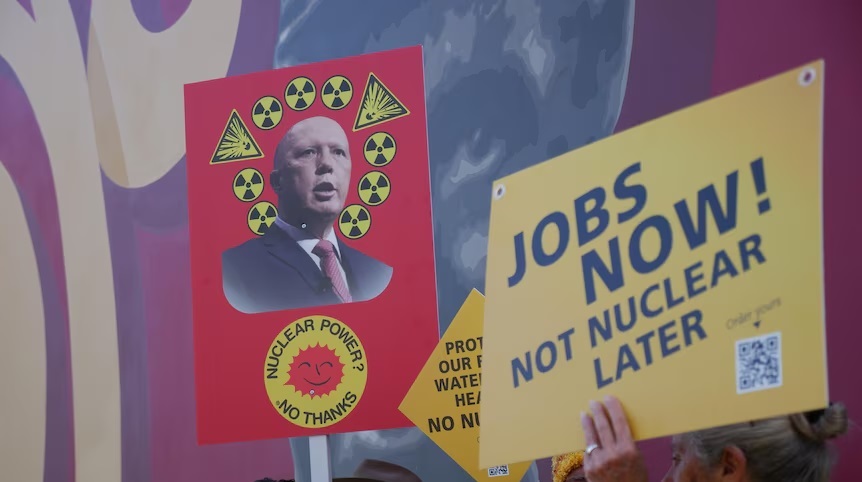
Regional communities have shared their views on the federal Coalition’s plan for seven nuclear reactors around Australia.
A parliamentary inquiry has heard pleas for more detail about the proposal, but people have been told to wait for “all the facts”.
What’s next?
The federal committee is due to deliver its report by April 2025.
Opposition leader Peter Dutton has promised his vision to build seven nuclear reactors around Australia will “keep the lights on”.
But people in the communities earmarked to host the plants feel they are being left in the dark as to what the Coalition’s plan means for them.
“What are we actually signing up for?” New South Wales Hunter Valley resident Tony Lonergan said.
Mr Dutton has so far released the locations of the proposed reactors and the costings.
The Coalition wants to build nuclear plants on the sites of seven coal-fired power stations which have shut, or are earmarked to close, at Tarong and Callide in Queensland, Mount Piper near Lithgow and Liddell in NSW, Port Augusta in South Australia, Loy Yang in Victoria’s Latrobe Valley and Muja near Collie in Western Australia.
“I can’t help but feel that politicians see our region as apathetic, desperate and an easy target,” Lithgow resident Tom Evangelidis said.
In the absence of few other details, Labor established a federal inquiry into nuclear power which generated more than 800 submissions from individuals, business owners, industry groups and MPs.
The House Select Committee on Nuclear Energy, which will cease to exist after the inquiry, has toured Australia to hear from the residents whose towns have been selected to host the nuclear reactors.
Wait for ‘the facts’
A repeated request throughout the inquiry has been for the Coalition to explain what technology would be used, how much water would be needed, where the waste would be stored, how it would be transported and whether the infrastructure and technology were safe.
“Even after [the Lithgow hearing] there’s very poor details on will there be one here? When? And those concerns [about] land, safety concerns, environmental concerns; those are all very major concerns and I’ve seen no answers here today,” former NSW mining union executive Wayne McAndrew said.
“The Coalition is proposing the seven sites and I’ve seen nothing from them either.”
The inquiry’s deputy chair, Liberal MP Ted O’Brien, repeatedly told witnesses their communities would have access to a two-and-a-half year “on the ground” consultation process where people’s questions would be answered.
Outside the Port Augusta hearing, SA Liberal MP for Grey, Rowan Ramsey, urged people to wait.
But these assurances have not pacified witnesses.
“That’s not adequate in supporting the general public in forming opinions on things that affect everyone and nor is it adequate for people just to be expected to read or interpret a lengthy report,” Patsy Wolfenden from the Mingaan Wiradjuri Aboriginal Corporation in NSW said at the Lithgow hearing.
“We have agendas that are political and are imposed upon communities without their engagement and without their initial consent in the first place,” Associate Professor Naomi Godden from Edith Cowan University told the Collie hearing in WA.
Jobs promise
One of the Coalition’s key promises is secure employment for coal industry workers who will be out of a job when their power stations close.
In the Latrobe Valley, the Loy Yang power station in Traralgon is due to shut in 2035, which is the same year the Coalition wants its first reactors to be operating.
Local resident Adrian Cosgriff said power station workers were being given false hope, and instead should be encouraged to consider transitioning to the burgeoning renewable energy industry. “Get our coal workers involved, attract other industries as much as we can, so that when they start coming out of those power stations there’s actually work for them,” Mr Cosgriff said.
At Collie in WA, Daniel Graham from the Australian Manufacturing Workers’ Union shared some of the questions and concerns being posed by members.
“What am I going to do? Looking at the nuclear timeline, [I’m] just not sure how that matches up and how that’s going to help Collie,” Mr Graham told the inquiry…………………………………………………. https://www.abc.net.au/news/2024-12-22/coalitions-nuclear-plan-frustrates-communities-at-inquiry/104730522
The glaring gaps and unanswered questions in the Coalition’s nuclear plan and costings.
Peter Dutton’s vision doesn’t address the climate crisis anytime soon and cost savings are based on a comparison with Labor’s proposal that produces 45% more electricity
Graham Readfearn and Josh Butler, 13 Dec 24, https://www.theguardian.com/australia-news/2024/dec/13/australia-nuclear-power-costings-frontier-economics-plan-peter-dutton-coalition-policy?fbclid=IwY2xjawHUXJZleHRuA2FlbQIxMQABHSLJcWqEbGOzAYkAVsppgXxhFjGsXpZLdVYB4J2Fn2n1iyTzXrnP5XMYRg_aem_g_g5MDvHcqIrdVL96ybbNA
The Coalition has revealed further details of its plan to build nuclear reactors in Australia, claiming it could deliver an electricity system costing $263bn less than the Albanese government’s plans to power Australia on renewables backed by storage and gas.
The Coalition is relying on Frontier Economics modelling to argue its nuclear vision for seven reactors across the country would be 44% cheaper than the government’s renewables-led plan.
So what do we need to know about the Coalition’s proposal?
Does the plan address the climate crisis?
Not for about 25 years. Frontier’s modelling shows the amount of CO2 released for every megawatt hour of electricity generated under the Coalition’s nuclear plan.
The report shows the “emissions intensity” of electricity stays much higher with nuclear than without until sometime between 2046 and 2049 – after which electricity would be slightly cleaner.
This is mostly because, under the Coalition, the modelling shows more coal stays in the grid for longer, releasing more CO2.
Any delays in rolling out nuclear reactors, which experts say is very likely, would lead to higher emissions for longer.
The Coalition’s chosen scenario to develop the electricity grid is in line with a 2.6C rise in global temperatures by the end of the century.
Is the Coalition’s plan comparable to the government’s?
No. The Coalition says its plan delivers an electricity system that costs 44% less than the government’s proposal – a saving of $263bn.
But the detail in the Frontier Economics report shows this 44% cost reduction comes as a result of comparing two different scenarios for the future of the electricity grid.
The Australian Energy Market Operator (Aemo) looks at three scenarios for the electricity grid and Frontier based its modelling on two of them – called “progressive change” and “step change”. The Albanese government prefers step change.
Frontier says the “progressive” scenario is preferred by the Coalition and adding nuclear to this “is 44% cheaper than the step change future as envisaged by the federal Labor government”.
The problem here is obvious. We are not comparing apples with apples.
Tristan Edis, director of Green Energy markets, says the “progressive change” scenario “involves total electricity consumption in 2052 of 311TWh, whereas step change is 450TWh or almost 45% greater electricity demand”.
So the Coalition’s plan to deliver nuclear is based on a scenario where Labor’s preferred plan is producing 45% more electricity than the Coalition’s.
Clearly, a system producing more power will cost more. Dr Dylan McConnell, an energy systems expert at UNSW, says without adding nuclear, Aemo’s “progressive change” costs are about $133bn less than for “step change”.
The “progressive change” scenario being promoted by the Coalition assumes much slower roll-outs of electric vehicles, rooftop solar and the electrification of homes and businesses.
That suggests consumers would miss out on any cost savings from running electric vehicles or using less gas in their homes for cooking and heating (as well as the cuts in emissions that come with using less fossil fuels).
How realistic is the Coalition’s timeline for building reactors?
Frontier Economic’s report suggests the first nuclear power would enter the grid in 2036 – but many experts say this is wildly optimistic.
The CSIRO estimates it would take at least 15 years for Australia to establish the necessary legal and regulatory functions and then finance, commission and build a working reactor.
Energy expert Simon Holmes à Court laid out his own timeline this week saying there was “not a hope in hell” a nuclear reactor could be working before 2040. He said his own optimistic scenario put the date at 2044.
What other roadblocks does Peter Dutton face?
Dutton said because the Coalition was in opposition it hadn’t been able to begin the negotiations needed to make nuclear a reality in Australia.
Before a single nuclear energy plant could be built, the Coalition would have to win the next federal election.
Then, a Dutton-led government would have to overturn a Howard-era national ban on nuclear energy – with laws passing both Houses of Parliament. If Dutton winning a majority in the lower house seems a tough ask, getting such a plan through a likely hostile Senate would be even harder.
Then, the Coalition would have to see various state governments overturn their bans on nuclear energy. Finally, state leaders would need to be onboard to support reactors being built in their back yards.
As Guardian Australia has reported, Labor governments and Coalition oppositions in New South Wales, Victoria, Queensland and South Australia are either outright opposed to the plan or have failed to endorse it. The new Queensland Liberal premier, David Crisafulli, ruled out nuclear during that state’s recent election campaign.
Dutton has pointed to constitutional powers to override state objections if necessary. He has also noted the openness of SA’s Labor premier, Peter Malinauskas, to nuclear.
How much will electricity cost under the Coalition’s nuclear plan?
Dutton claimed the nuclear option would mean “a 44% saving for taxpayers and businesses” but does that translate into cheaper power prices?
Frontier’s report says it does not “present any results for the prices [of wholesale electricity] as this will depend on how the cost of new capacity will be treated in the future”.
In other words, they don’t know what the cost of power will be.
How have critics responded?
The climate change and energy minister, Chris Bowen, criticised the Coalition for not detailing how the nuclear plan would affect consumer power bills and pointed to other modelling showing it could push up bills by $1,200 a year.
He claimed the Frontier report contained “fundamental errors” and “heroic assumptions”, pointing out it assumed Australia would consume less power than Aemo’s modelling forecast. Bowen also criticised the report for using cheaper prices to produce nuclear power than the CSIRO and AEMO accounted for.
The federal Greens leader, Adam Bandt, called it a “con job for coal”, noting the nuclear strategy relied on extending the life of fossil fuels.
The Australian Chamber of Commerce And Industry said the plan needed to be scrutinised thoroughly. It wasn’t critical but called for “long-term certainty” for the business community regarding power prices and reliability.
The Clean Energy Council said it would be a “disaster” for power bills and dramatically slow the rollout of renewables like rooftop solar.
Rod Campbell, of the Australia Institute, said the nuclear plan was a “distraction to prolong fossil fuel use and exports”.
Economics of Coalition’s nuclear modelling are worth nothing
There may well still be good reasons to favour nuclear. But on the basis of this modelling, the economics isn’t one of them
Australian Financial Review, .Steven Hamilton, Columnist, 16 Dec 24
On Friday, the Coalition finally released the economic modelling underpinning its plan to produce more than a third of our electricity via nuclear by 2050.
I approached the modelling – produced pro-bono by Frontier Economics – with an open mind. I have no issue with nuclear power so long as the economics stack up. To date, I am yet to read a convincing analysis in its favour in the Australian context.
Alas, after studying the modelling very carefully, I can confirm it is worth about what the Coalition paid for it.
Most critical reporting has focused on the Coalition’s decision, bundled along with nuclear, to abandon the “step change” scenario the government is counting on, which would see significantly greater electricity generation to support widespread electrification of households, transport and business.
But this is a red herring. While the Coalition’s claim that its plan will cost 44 per cent less than the government’s plan relies on the abandonment of step change, the modelling presents both step change and the Coalition’s preferred “progressive” scenario with and without nuclear power.
Within the progressive scenario, nuclear is claimed to reduce costs by a still-substantial 28 per cent. How does the modelling reach such a conclusion? Through sleights of hand, unrealistic assumptions and sheer physical impossibilities.
The first red flag is the odd choice to conduct all cost comparisons across the entire 2025-2051 period. To understand why this matters, consider that the Coalition’s plan involves two big changes.
First, a big slowdown in the renewables rollout paired with delays to coal closures; second, the transition to nuclear of the remaining coal-fired power beginning in 2035, but mostly in the 2040s.
So the claimed cost reductions over 2025-2051 are not driven primarily by nuclear being cheaper than firmed renewables, but by already-sunk coal-fired generation being cheaper than new firmed renewables.
From 2025-2051, nuclear accounts for just 15 per cent of electricity generated; but in 2051, it accounts for 38 per cent. So while the cost difference for 2025-2051 is 28 per cent, the cost difference in 2051, when both systems are fully up and running and producing near-zero-emissions power, is just 12 per cent. And that’s the comparison that matters.
Of course, we should not pretend the decision to swap renewables for coal in the interim is costless. The modelling shows that this will generate two and a half times the emissions from electricity generation from 2025-2051 than Labor’s plan.
That represents 1 billion tonnes of emissions, and that’s ignoring additional emissions outside the electricity sector. Using the Australian Energy Regulator’s “value of emissions reductions” carbon pricing framework, that’s worth $180 billion in today’s dollars. And we can say goodbye to our Paris commitment.
far more capital investment – nuclear or renewables – will be required under the Coalition’s plan than the modelling claims.
So what is driving the claimed 12 per cent cost advantage in 2051? Two key things.
The capital cost of nuclear is assumed to be $10,000 per kilowatt, which then falls by 1 per cent per year from today despite the fact that the first nuclear plant isn’t due until 2035, and most not until the 2040s. So around $8500 per kilowatt in 2040.
But the Centre for Advanced Nuclear Energy Systems at MIT, in an independent assessment of the cost of the next AP1000 units at Vogtle, Georgia, puts the capital cost at a greenfield site at around double this, and that’s likely conservative.
Moreover, historical experience has shown that nuclear costs tend to rise, not fall, as additional units are built. This alone blows through that 12 per cent cost gap.
But there is a bigger problem. Because nuclear is so capital-intensive, the biggest economic challenge it faces is to operate at a high utilisation or “capacity factor”.
s noted by nuclear advocacy group the Nuclear Energy Agency (NEA): “At high levels of renewable generation, for example, as implied by the EU’s 30 per cent renewable penetration target, the nuclear capacity factor is reduced and the volatility of wholesale prices greatly increases whilst the average wholesale price level falls.”
“The increased penetration of intermittent renewables thereby greatly reduces the financial viability of nuclear generation in wholesale markets where intermittent renewable energy capacity is significant,” they say.
But this is completely ignored in the modelling. It assumes an extraordinarily high capacity factor for nuclear of 90 per cent despite 38 per cent of electricity coming from nuclear and 54 per cent from renewables.
This implies nuclear is prioritised to generate near maximum at all times. But then renewables must be forced to serve only residual demand regardless of whether or not the sun is shining or the wind is blowing, pushing down their capacity factor.
Yet the modelling assumes high renewables capacity factors of 26 per cent for solar and 36 per cent for wind. But the real smoking gun is the fact that these capacity factors do not change with the introduction of nuclear producing 38 per cent of generation nearly 24-7. You might imagine storage could soak up surplus energy, but the modelling assumes far less storage with nuclear but with a similar capacity factor.
In practice, one of two things has to happen. Either nuclear’s capacity factor must be reduced below 90 per cent to something closer to coal’s 60 per cent, or renewables’ capacity factor must be reduced to make room for nuclear. Either way, far more capital investment – nuclear or renewables – will be required under the Coalition’s plan than the modelling claims. Which again blows that 12 per cent gap out of the water.
In summary: there may well still be good reasons to favour nuclear. But on the basis of this modelling, the economics isn’t one of them. https://www.afr.com/policy/energy-and-climate/economics-of-coalition-s-nuclear-modelling-are-worth-nothing-20241214-p5kydg?fbclid=IwY2xjawHUWzJleHRuA2FlbQIxMQABHdLavxsUUY_GjBH3PWkhXPoaK5h50Pyy9Zu1WWEt2adqfbAkKQ9zrFsJbg_aem_kbpsngTqQ-zFGfa9cL6s4Q
1 This month

of the week – Australians for War Powers Reform (AWPR)
To see nuclear-related stories in greater depth and intensity
 Antinuclear