The Australian Electoral Commission is having words with Nuclear for Australia as the group spends $100,000s on its campaign.
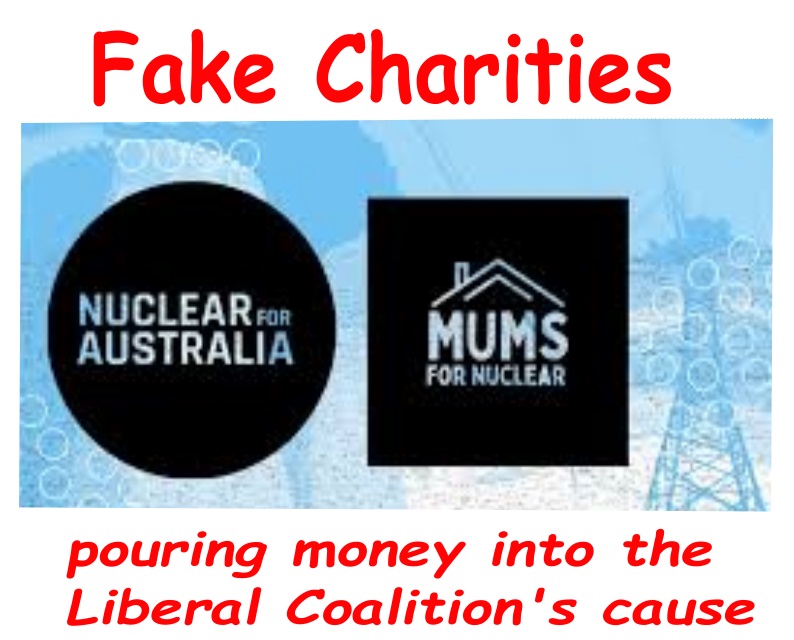
A ‘non-partisan’ pro-nuclear lobby group has ramped up its spending ahead of the federal election — but has not declared what spending is on ‘electoral matters’.
Cam Wilson, Mar 28, 2025, https://www.crikey.com.au/2025/03/28/nuclear-for-australia-mums-for-nuclear-aec-campaign-spending/
Australia’s election regulator has reminded a Nuclear for Australia-affiliated group of its legal obligations, as the pro-nuclear lobby group spends hundreds of thousands of dollars to support a policy promoted by the Coalition.
In the past week, “Mums for Nuclear” ran more than $16,000 of Facebook and Instagram advertisements, in addition to a newspaper advertisement in The Age. None featured electoral authorisations, although the digital advertisements were classified as pertaining to “social issues, elections or politics” on Meta’s platform.
The group is an offshoot of Nuclear for Australia (NfA), a purportedly “nonpartisan” group started by then 16-year-old Will Shackel in 2022. Last year, Crikey reported that the group’s website listed Liberal Party-linked “digital political strategist” James Flynn as an author on some of its content. Flynn had also liked the group’s tweets on his personal account and criticised Labor’s energy policy on Sky News.
Nuclear for Australia did not respond to repeated requests for comment.
Since then, there have been other connections between NfA and Liberal politicians. Tony Irwin, one of its “expert working group” members, appeared at an August Liberal Party state fundraising event. Lenka Kollar, who featured in Mums for Nuclear’s newspaper advertisement and is also on NfA’s expert group, leads a firm that reportedly ran a “grassroots community engagement program” for shadow minister for climate change, energy, energy affordability and reliability Ted O’Brien.
In the lead-up to the federal election, NfA has emerged as one of the loudest advocacy groups on energy and climate policy, kicking off a blitz of advertising. In the past 90 days, the group has spent more than $156,575 on Meta ads on its account (out of $195,002 spent since it started). In January, the group paid for Miss America 2023, Grace Stanke, to come to Australia and do a publicity tour promoting nuclear energy. The campaign was promoted by PR agency Markson Sparks!’ Max Markson.
The group says it received charity status in March 2024 and that, up to that point, its primary funding was from patron Dick Smith, “who covered establishment legal fees and our founder’s trip to COP28”. In March this year, Smith claimed he had donated “more than $80,000” to the group and previously said in July 2024 that it was “more than $100,000”.
Since NfA received charity status, it has accepted donations from the public. Shackel says the group does not “accept funds from any political party, nor any special interest group, including the nuclear industry, including any think tanks”.
A financial statement filed with the charity regulator states that the group received $211,832 in donations and bequests between October 31, 2023, and June 30, 2024. In that time, the group spent $125,489 on “other expenses/payment”, which does not include employee salaries or payments.
However, the group did not file an AEC third-party return for this period. According to the AEC, any group that spent more than $12,400 on “electoral expenditure” in the 2023-24 financial year would be required to disclose its expenditure and donors. Whether NfA would qualify is unclear. The group has an electoral authorisation on its website and social media accounts.
Out of the $125,000 the group spent that year, it’s unknown how much — if any — is considered “electoral expenditure”. The AEC defines this as expenses with the dominant purpose of creating and communicating electoral matters to influence the way electors vote in a federal election. Complicating this further, charities like NfA are allowed to advocate on policy issues but can be deregistered for promoting or opposing a party or candidate.
The AEC can investigate and warn groups it suspects have not correctly authorised communications about an electoral matter. An AEC spokesperson did not disclose whether it considered Mums for Nuclear’s advertisement to be on an electoral matter, only that it had communicated with the group.
“The AEC is addressing disclosure and authorisations considerations directly with the entity Mums for Nuclear. Should this entity be required to register as a significant third party or an associated entity, they will appear on the AEC’s Transparency Register,” they said.
Opposition Leader Peter Dutton interrupted by anti-nuclear protester while visiting XXXX factory in Brisbane
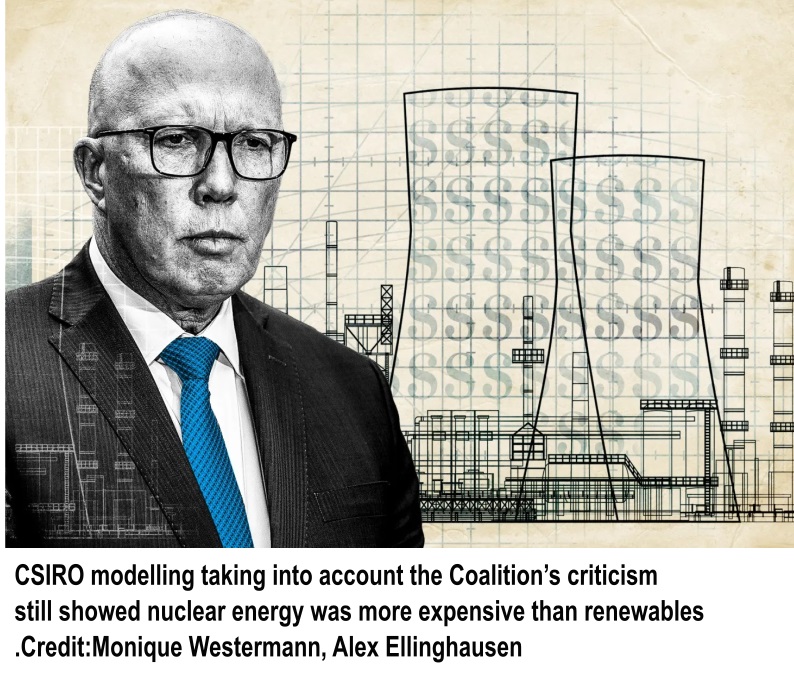
Opposition Leader Peter Dutton has been interrupted by an anti-nuclear protester representing Rising Tide during his first official campaign event in Brisbane.
Patrick Staveley, Digital Reporter. Sky News, 29 Mar 25
Peter Dutton has been heckled by a protester just over an hour after Prime Minister Anthony Albanese endured a similar incident in a chaotic start to the first full day of the election campaign for both parties.
The Opposition Leader visited the XXXX brewery in Brisbane on Saturday in his first official campaign event, where he was interrupted by a protester purportedly representing environmental group Rising Tide.
A woman held up a sign that read: “No new gas or nuclear” with “Rising Tide” scribbled underneath as she shouted towards Mr Dutton. Footage showed the woman emerge right next to Mr Dutton wearing a hi-vis vest appearing to blend in with the media in the brewery.
“Why are you lying to the Australian people about the cost of nuclear and gas,” she asked.
“It’s going to cook the country, it’s going to cook our country,” she continued as security began to eject her from the premises.”….
“Industry experts have already agreed your plan’s not going to work. Why are you lying to the Australian people?” she said.
A Rising Tide statement revealed Natalie Lindner was the woman who carried out the protest, in the fifth incident where the group has interrupted a politician’s event in the past fortnight.
It follows the disruptions of Angus Taylor’s press conference, Mr Dutton’s speech to the Lowy Institute, Jim Chalmers’ pre-budget speech and a Liberal Party fundraiser.
Ms Lindner made comment in the statement, claiming Mr Dutton’s nuclear scheme “will actively worsen the cost of living and climate crisis”.
Sky News Political Reporter Cameron Reddin asked Mr Dutton whether the protests would change how he would campaign over the next five weeks.
Mr Dutton defended his plan, arguing it would bring prices down contrary to the protester’s claims…………………………………. https://www.skynews.com.au/australia-news/politics/watch-live-opposition-leader-peter-dutton-speaks-from-brisbane-as-first-full-day-of-federal-election-campaign-begins/news-story/a50a58931665f83b360cfa67c69f10a5
Numbers don’t lie: $0 for nuclear, $1.3bn for polluting gas and bucketloads of climate harm in Opposition’s budget reply.
“While there’s plenty of cash being splashed on gas, no dollars are set aside for nuclear. Is this a genuine policy, or was it always just a ploy for more coal and gas?
March 27, 2025 AIMN Editorial, Climate Council , https://theaimn.net/numbers-dont-lie-0-for-nuclear-1-3bn-for-polluting-gas-and-bucketloads-of-climate-harm-in-oppositions-budget-reply/
Opposition Leader Peter Dutton’s budget reply details the Liberal-National Party’s polluting policies on energy and climate change:
- $0 for nuclear begs the question: is the party now walking away from their highly controversial energy scheme?
- A whopping $1.3 billion in handouts for multinational gas corporations during a cost-of-living crisis
- Zero mention of climate change, net zero or escalating costs of disasters is a head-in-the-sand approach to Australians suffering from worsening climate disasters
The Federal Opposition’s policies put more Australians in the crosshairs of escalating climate-fuelled disasters, the Climate Council summed up in response to tonight’s budget reply.
Their policies help the polluting gas industry with handouts and promises to wave through more projects. It continues their poor track record on climate change with more of the same: more excuses, more delays, and more harmful climate pollution from coal and gas. The Coalition still has no credible plan to deal with climate change, or replace our ageing coal generators.
Climate Council CEO Amanda McKenzie said; “While Australians are struggling in a cost-of-living crisis, the Liberal-National Coalition is focused on handing out $1.3 billion to the gas industry, and waving through their polluting projects. This tramples all over the progress we’re making to cut climate pollution and protect our environment. It’s reckless and destructive.
“While there’s plenty of cash being splashed on gas, no dollars are set aside for nuclear. Is this a genuine policy, or was it always just a ploy for more coal and gas?
“Combine their expensive nuclear scheme with bucketloads of gas, and you have a climate disaster that locks in at least two billion more tonnes of climate pollution from coal and gas.
“They still have no plan to cut climate pollution. They’re wilfully risking our kids’ future by kicking the climate can decades down the road. With coal-fired power stations on the way out, and the climate crisis accelerating, we need energy solutions for today. More renewable energy and storage is the fastest way to get power bills under control, the quickest way to replace coal as it retires, and the only way to secure a safer future for our kids and our communities.”
Shadow Treasurer Angus Taylor appears to struggle sharing cost of Coalition’s nuclear policy
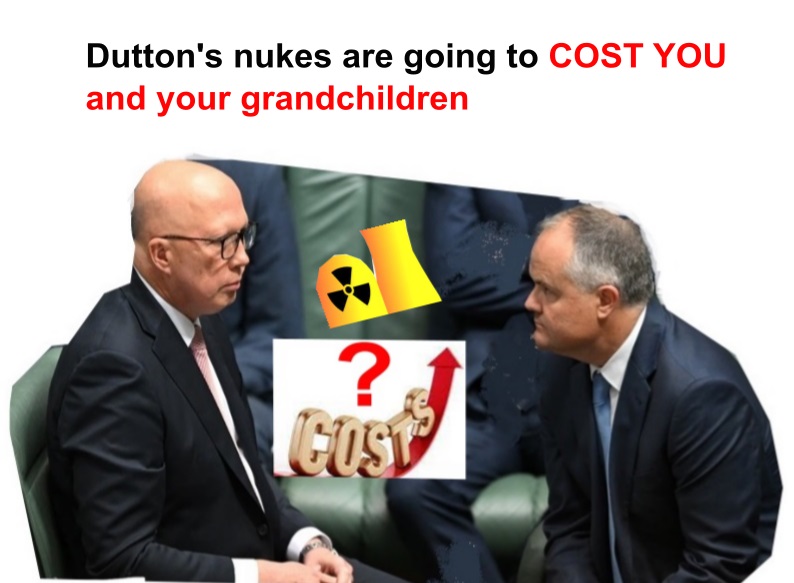
Shadow Treasurer Angus Taylor appeared to repeatedly stumble over the cost of the Coalition’s flagship nuclear policy.
Jessica Wang, March 23, 2025, news.com.au
Shadow Treasurer Angus Taylor has repeatedly refused to directly answer questions around the cost of the Coalition’s nuclear policy, in a confusing pre-budget interview on the Opposition’s flagship policies.
Appearing on ABC’s Insiders on Sunday, Mr Taylor was repeatedly questioned by host David Speers on the cost of the Coalition’s plan to build seven state-owned reactors by 2050, with the first two reactors set to come online by 2035.
Despite the Opposition releasing its costing policies conducted by Frontier Economics in December, which said the Coalition’s energy plan would cost $331bn, Mr Taylor repeatedly avoided giving a figure.
Instead he stuck to the Coalition’s attack lines, stating: “44 per cent less than the alternative (Labor’s plan)”.
“I’m just asking what it’s going to cost Australia to build nuclear power?” said Speers, for asked Mr Taylor for the costing details 14 times.
Sharing multiple variations of the same answer during the three-minute grilling, Mr Taylor responded with: “44 per cent less than the alternative,” before comparing the costings between the two policies.
The Frontier modelling suggested the total cost of Labor’s policy, which includes its renewables rollout, transmission lines and gas would cost about $642bn to 2050, figures Labor has rejected.
The figures contradicts $122bn figure put forward by the Australian Energy Market Operator, which covers generation, storage and transmission infrastructure……………………………………………………. https://www.news.com.au/national/politics/shadow-treasurer-angus-taylor-appears-to-struggle-sharing-cost-of-coalitions-nuclear-policy/news-story/cd3cd5cf13ea68b8fc33fb7bd80c0ea4
Dutton’s seat a target in $2m union war against nuclear
David Marin-Guzman, AFR, 24 Mar 25
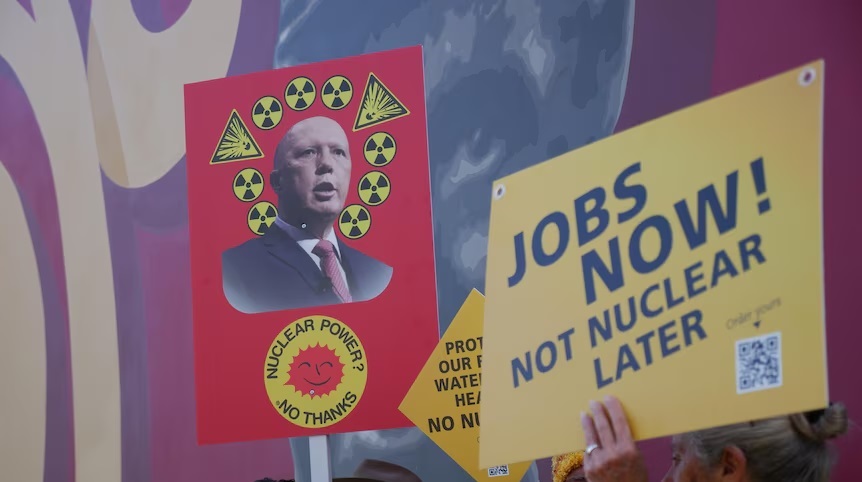
Unions will spend more than $2 million on an anti-nuclear energy campaign targeting the Coalition in key electorates ahead of the federal election, including Opposition Leader Peter Dutton’s own marginal Queensland seat.
The Electrical Trades Union is leading the campaign, involving television, FM radio and digital ads, with $1.5 million funding and is backed by the Maritime Union of Australia and the plumbers’ union, which are spending $400,000 and $200,000, respectively.
The campaign is one of the most significant union spends in the election and will attack the huge cost and time involved in building nuclear plants and question nuclear as the fix to energy concerns.
It will target a dozen Liberal and Labor seats in play across the east coast, including Hunter, Reid and Banks in NSW – the latter held by opposition foreign affairs spokesman David Coleman – and McEwen, Hawke, Dunkley and Bruce in Victoria.
In Queensland, the ads will focus on Capricornia, held by Liberal MP Michelle Landry, the inner-Brisbane seat of Bonner held by Liberal MP Ross Vasta, the regional seat of Flynn held by Nationals MP Colin Boyce, Labor’s working-class Brisbane seat of Blair, and Dutton’s seat, Dickson, which he holds by a margin of 1.7 per cent.
This is not a fear campaign’
The unions will also campaign in Moore in Western Australia, which the Liberals held by less than 1 per cent in the 2022 election. Electrician turned lawyer and ETU member Tom French is challenging for the seat on behalf of Labor after Liberal MP Ian Goodenough was ousted in pre-selection last year.
ETU national secretary Michael Wright, whose union holds a historic opposition to nuclear, said the ads ask: “How does a nuclear reactor built in 2045 keep the lights on in 2025?”
“Nuclear is too little energy for too much money coming too late,” he said. “This is not a fear campaign. It’s grounded in science and where this country is. If you can engage people with the facts you don’t need to scare people. Nuclear just doesn’t make sense.”
Plumbing and Pipe Trades Employees Union national secretary Earl Setches said Dutton was peddling a “nuclear fantasy”.
“We will not support a plan that costs out at, best guess, $600 billion to power only 4 per cent of the grid and will take over 20 years to become reality,” he said.
“Australian workers need a real secure plan for their future and this nuclear scheme will not provide that security. It will, in fact, kill jobs.”
MUA national secretary Paddy Crumlin said maritime workers were already working on offshore energy projects that promised jobs for “generations of Australian seafarers and wharfies”.
“A sudden shift to nuclear energy will bring that work to a standstill,” he warned.
Building trust in renewables
Dutton has said “nuclear energy will set us up for the next century” and criticised Labor’s early scare campaign as “childish” and “embarrassing”.
However, the advertisements, which run the slogan “Dutton’s Nuclear Plan: Why?” and feature experts, electricians and farmers, avoid the memes of three-eyed fish initially shared by Labor MPs when the opposition leader announced his plans……………………..
In WA, the union campaign would focus on water concerns in the state by emphasising that nuclear power consumes about 1.4 times more water than coal to produce the same amount of electricity.
Wright said the ETU had a particular interest because Dutton’s nuclear plans and opposition to renewables were “already delaying projects and that costs my members jobs”…………………………… https://www.afr.com/politics/dutton-s-seat-a-target-in-2m-union-war-against-nuclear-20250321-p5llh8
Coalition must provide clear answers on nuclear policy

March 24, 2025 AIMN Editorial, Australians for Affordable Energy https://theaimn.net/coalition-must-provide-clear-answers-on-nuclear-policy/
The Coalition must provide immediate and detailed answers about its nuclear energy policy after Shadow Treasurer Angus Taylor failed to confirm even basic costs.
Australians for Affordable Energy is calling for clearer policy and direct answers from the Coalition, with households deserving transparency on a policy that could reshape the nation’s energy mix and increase household bills.
“The continued failure to provide clear details on the costs, timelines and locations of the proposed nuclear rollout is unacceptable,” AFAE spokesperson Jo Dodds said.
“Australians are already doing it tough with soaring power prices and cost-of-living pressures. They deserve to know how much this nuclear plan will cost them – not just vague promises and evasive responses.”
Mr Taylor on Sunday repeatedly deflected when asked for key details on the financial impact of the Coalition’s nuclear proposal.
“Energy policy is not a guessing game,” Ms Dodds said.
“Before the Coalition asks Australians to sign up to nuclear power, they need to come forward with detailed and credible answers. Australians expect honesty and transparency from our political leaders, especially when it comes to something as critical as energy security and affordability.
“This nuclear plan remains a risky and uncertain proposition for Australian households and businesses.”
AFAE welcomes the Federal Government’s announcement of additional power bill relief, but it is only a temporary fix to a deeper affordability crisis.
“Relief will always be welcomed by struggling households, but these rebates are a band-aid on a long-term problem,” Ms Dodds said.
“What Australians really need is a comprehensive, sustainable energy policy that lowers prices over the long term, not short-term handouts to mask rising costs.”
Liberals must abandon unpopular nuclear policy and return to winning formula
Liberals Against Nuclear, 21 Mar 25
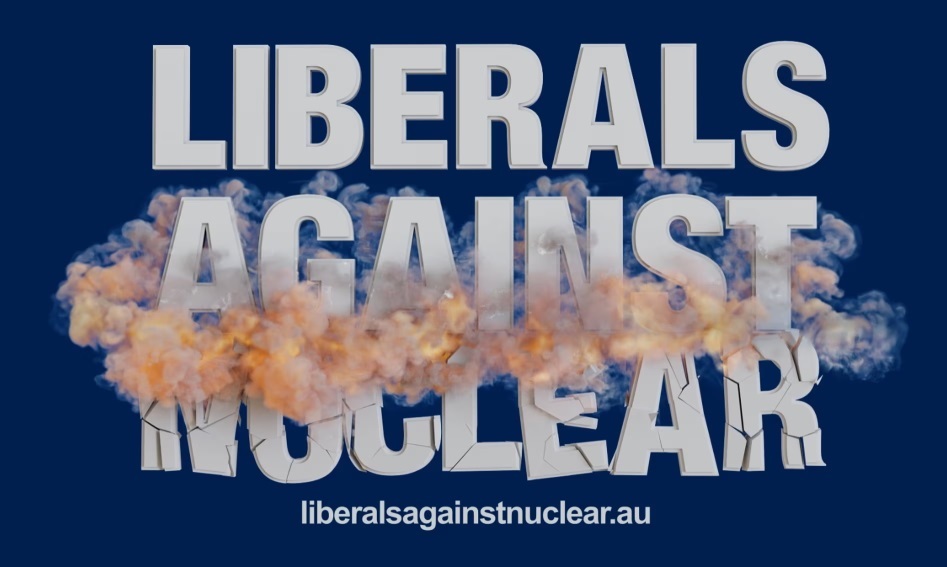
The Liberal Party’s conspicuous silence on nuclear energy in its advertising confirms the policy does not have internal party support, is electoral poison and must be dumped.
The Liberal Party’s conspicuous silence on nuclear energy in its advertising confirms the policy does not have internal party support, is electoral poison and must be dumped.
An analysis of Meta’s advertising library published today in the Nine newspapers reveals the Liberal Party has not used the word “nuclear” in any of its 24 paid social media advertisements currently running, having last funded promotion of its nuclear power policy in November 2024. Additionally, it was revealed earlier this week that only nine of the Coalition’s candidates for the upcoming election are promoting nuclear energy on their campaign websites.
“The Liberal Party’s actions speak louder than words,” said Andrew Gregson, spokesperson for Liberals Against Nuclear. “They avoid mentioning nuclear in their advertising because they know voters don’t want it. If the party leadership knows this policy is unpopular enough to hide from voters, they should abandon it so they can win the election and put Peter Dutton in the Lodge.
Recent Resolve Political Monitor polling shows just 21 percent of voters favor government subsidies for nuclear energy.
“The party’s silence on nuclear in its advertising suggests internal polling matches what we’re seeing publicly – nuclear is a losing proposition. People just don’t want to be lumbered with public debt and massive government intrusion.”
Liberals Against Nuclear is calling on party leadership to return to the winning formula that has historically delivered electoral success for the Liberal Party: lower taxes and strong borders.
“The Liberal Party knows how to win elections – by focusing on economic management through tax relief for hardworking Australians and ensuring our national security through strong border protection,” Gregson said.
“The absence of nuclear policy from almost all candidate websites says loudly what no one wants to say out loud – candidates know it’s either electoral poison in their electorates or, more likely, they realise the building and running seven government-owned nuclear plants is a terrible policy that contradicts core liberal values. Building a massive socialist project will force them to raise taxes, grow the debt, and have government running an enterprise that belongs in the private sector. It’s a bit awkward when your signature policy – nuclear – is the one policy you’re trying to avoid. The simple answer is to dump it
“Voters are desperate for immediate relief on power bills, not a $600 billion nuclear scheme that delivers nothing for decades. The Liberal Party should focus on immediate tax relief for struggling families and businesses while developing practical energy solutions that align with liberal values of smaller government and free markets.
“If the Liberal Party leadership feels they have to hide this policy in their advertising, they should take the next logical step and formally abandon it before it costs them the election.”Media contacts:
Andrew Gregson +61 432 478 066
www.liberalsagainstnuclear.au
Liberal supporters launch election ad campaign against Peter Dutton’s plan to build nuclear power plants
Liberals Against Nuclear say the policy would increase bureaucracy and impose ‘massive taxpayer-backed risk’
Adam Morton Climate and environment editor, 18 Mar 25, https://www.theguardian.com/australia-news/2025/mar/18/liberal-supporters-launch-election-ad-campaign-against-peter-duttons-plan-to-build-nuclear-power-plants
A group of Liberal supporters has launched an advertising campaign against the party’s plan to build taxpayer-funded nuclear power plants, arguing it “betrays Liberal values”, divides the party and “hands government back to Labor”.
The new advocacy group Liberals Against Nuclear says it rejects the Coalition’s policy as it would require the government to borrow tens of billions of dollars, swell the bureaucracy and impose “massive taxpayer-backed risk”.
Peter Dutton’s proposal would involve eventually building nuclear reactors at seven sites across the country, mostly after 2040. In the short term, the Coalition says it would slow the rollout of renewable energy, attempt to extend the life of ageing coal-fired power plants and rely more on gas-fired power.
The Liberals Against Nuclear spokesman is Andrew Gregson, a former Tasmanian Liberal director and candidate who said he was not currently a party member but remained a supporter. He declined to say how many supporters the group had or name other members, but said those involved were concerned the nuclear policy was driving “free market and middle ground voters” to support “teal” and other independent MPs in seats the Coalition must win to return to government.
“We’re trying to save the party from a policy that will gift seats to their opponents,” he said. “Nuclear technology itself isn’t the issue. It’s the socialist implementation being proposed that trashes Liberal values.
“If nuclear energy is so good then the market will back it without massive government intervention.”
The group is running television, digital and billboard ads that argue “many Liberals are against nuclear”. One of the ads shows a woman reading a newspaper article that quotes the Nationals senator Matt Canavan as saying “nuclear fixes a political issue for us but ain’t the cheapest form of power” and cites a report by the Institute for Energy Economics and Financial Analysis that found the Coalition proposal would lead to a $665 increase in average power bills. The ads ask the opposition leader, Peter Dutton, to “please dump nuclear”.
Gregson said they would run across the country and be particularly targeted in marginal seats, including those held by teal MPs. He said the ads were aimed at the party, not voters.
Liberals Against Nuclear said polling had suggested only 35% of Australians backed nuclear energy, and that support collapsed once voters understood the policy details. Its website raises concerns about the policy driving up national debt and creating safety and security risks.
Gregson said dropping the policy would cause the Coalition a “couple of days’ worth of negative publicity” but would not cost it the election. “Nuclear power is the big roadblock preventing the Liberals getting to The Lodge,” he said.
Asked about the campaign on the Seven Network, Dutton said his policy was “based on the international experience” and claimed it would bring electricity costs down by 44% and provide “stability in the market”.
The Climate Change Authority, a government agency, found the Coalition’s proposal would add an extra 2bn tonnes of carbon dioxide to the atmosphere and make it “virtually impossible” for Australia to reach net zero by 2050, a position the opposition claims to support.
Labor has a target of 82% of generation coming from renewable energy by 2030, up from the current level of nearly 45%. The authority said that under the Coalition’s plan there would probably not be 82% of electricity from zero emissions technology – renewables and nuclear – until 2042.
Independent experts have suggested the Coalition policy would likely lead to household power bills being higher than under Labor’s policy as there would be less generating capacity competing in the grid. They have also said it would increase the risk of the electricity supply becoming unreliable at peak times as it was more reliant on old coal power plants that are nearing the end of their expected operating lives.
Peter Dutton interrupted mid-speech by anti-nuclear protesters
By Josh Hohne Mar 20, 2025, 9 News
Opposition Leader Peter Dutton and Shadow Treasurer Angus Taylor have been interrupted by anti-nuclear energy protestors today in Sydney.
Dutton was addressing the Lowy Institute think tank when two protestors began heckling him.
“Why are you lying to the Australian people about the cost of nuclear,” one of the protesters said as he was escorted out by security and federal police.
He held a banner reading “Nuclear lies cost us all”.
After a pause, Dutton continued with his address.
Later in his speech about the Coalition’s election priorities, he was interrupted again by a man speaking from the sidelines……………………………………..
The protesters were part of the Rising Tide environmental group.
“The Coalition’s scheme to force nuclear into Australia’s energy grid is going to cost $600 billion to the taxpayer, add up to $1200 to people’s energy bills, and produce 1.6 billion tonnes of climate pollution by 2050,” Zack Schofield, one of the protesters, said afterwards.
Hours after interrupting Dutton, the same protesters disrupted another press conference, this time forcing Shadow Treasurer Angus Taylor to relocate his media opportunity.
Schofield again interrupted Taylor.
Taylor quickly packed up his team and began relocating to another location.
Dutton and Taylor aren’t the first to be interrupted by protesters this week, with climate activists cutting off Treasurer Jim Chalmers during a pre-budget speech on Tuesday. https://www.9news.com.au/national/peter-dutton-interrupted-mid-speech-protesters-nuclear-energy/eaed0bf8-0e02-4617-b2de-1cab1c419830
Bob Carr says Aukus a ‘colossal surrender of sovereignty’ if submarines do not arrive under Australian control

Former foreign minister says it is ‘inevitable’ US won’t supply nuclear-powered submarines under Aukus.
Guardian, Ben Doherty, 20 Mar 25
Australia faces a “colossal surrender of sovereignty” if promised US nuclear-powered submarines do not arrive under Australian control, former foreign affairs minister Bob Carr has said, arguing the US is “utterly not a reliable ally” to Australia.
“It’s inevitable we’re not getting them,” Carr told the Guardian, ahead of the release of a report from Australians for War Powers Reform that argues the multibillion-dollar Aukus deal had been imposed upon Australia without sufficient public or parliamentary scrutiny.
“The evidence is mounting that we’re not going to get Virginia-class subs from the United States,” Carr said, “for the simple reason they’re not building enough for their own needs and will not, in the early 2030s, be peeling off subs from their own navy to sell to us.”
Under “pillar one” of the planned Aukus arrangement, it is proposed the US would sell Australia between three and five of its Virginia-class nuclear-powered submarines in the early 2030s before the Aukus-class submarines were built, first in the UK, then in Australia
However, the US has already forecast it might not have capacity to spare any of its Virginia-class boats, the Congressional Research Service instead floating a proposal in which: “instead of … them being sold to Australia, these additional boats would instead be retained in US Navy service and operated out of Australia”.
Carr said that alternative would leave Australia without Australian-flagged submarines and no control of when, and to where, those boats were deployed.
“It involves the total loss of any sovereign submarine capacity and, more than that, a colossal surrender of Australian sovereignty in general.”
Australia, Carr said, needed to look past the “cheerful flag-waving propaganda” of the proclaimed Aukus deal, saying the alternative likely to be presented by the US would leave Australia “totally integrated in American defence planning and we’ll be hosting even more potential nuclear targets”.
Australians for War Powers Reform, a group that advocates for parliamentary oversight of the decision to send Australian troops to war, launched a report on Thursday morning arguing that the Aukus deal – signed by the Morrison government in 2021 and adopted by its Albanese-led successor – had been instituted without any public or parliamentary scrutiny.
“The public and the national parliament have been kept in the dark every step of the way,” the report argues.
“The Aukus pact has become a textbook example of how to disenfranchise the community, providing almost no transparency or democracy in a sweeping decision which will affect Australia for decades.”
Aukus and the Surrender of Transparency, Accountability, Sovereignty argues the multi-decade, multibillion-dollar Aukus deal was presented to the Australian public without any discussion, consultation, and without parliamentary debate. The current forecast cost of “pillar one” of Aukus – to buy US Virginia-class submarines and build Aukus subs – is $368bn to the 2050s.
The report raises concerns over vague “political commitments” offered by Australia in exchange for the Aukus deal, as well as practical concerns such as where and how nuclear waste would be stored in Australia.
“Aukus has no legitimate social licence because the public has been shut out of the process, and as a result, scepticism and cynicism have increased.”
Dr Alison Broinowski, AWPR committee member and a former Australian diplomat, said Australia’s agreement to the Aukus deal was manifestation of a structural flaw in Australia’s democracy, where decisions to go to war, or to make consequential defence decisions, were not subject to parliamentary scrutiny or public debate.
Broinowski said Aukus was acutely significant because of its size and potential consequence “and yet the same failure to be frank with the people characterises every government this country has had, during every war there’s been”.
She argued Australia had no control over Aukus. “We don’t know what Trump’s going to do and we have no control over what he does. And so we’re left hoping for the best, fearing the worst and with absolutely no way of controlling or influencing what happens, unless we first get ourselves out of Aukus.”……………………………….more https://www.theguardian.com/australia-news/2025/mar/19/bob-carr-aukus-submarine-deal-us-australia-relationship
Nuclear policy blocking Liberal gains

Liberals Against Nuclear, 19 Mar 25
A Redbridge poll released today confirms what Liberals Against Nuclear has been warning about: the Coalition’s nuclear energy position is actively preventing its path to an election win.
New RedBridge polling puts Labor ahead 51-49 on two-party preferred terms. The data reveals that despite the Coalition’s leadership’saggressive pro-nuclear campaign, voters aren’t buying it. Those believing nuclear energy is unsafe rising from 35% to 39% over the past year. Only 38% of voters believe nuclear would reduce power prices – barely moving from 37% a year ago
“The nuclear power policy is the single biggest roadblock preventing the Liberals from winning government,” said Andrew Gregson, spokesperson for Liberals Against Nuclear. “The Liberal Party’s nuclear fixation is alienating the very voters we need to win back.
“The numbers don’t lie. This policy betrays core liberal principles by requiring tens of billions in government borrowing, expanding bureaucracy, and imposing massive taxpayer-backed risk. It’s driving free-market centrist voters directly to the Teals and independents in must-win seats.”
RedBridge director Tony Barry, a former Coalition strategist, is quoted in today’s News Corp papers emphasizing that “the Coalition needs to return to its key equities of economic management.”
The data confirms the coming election will likely be decided by preferences, with both major parties struggling to reach the 76 seats needed for majority government. This makes winning middle-ground voters crucial – exactly the demographic being alienated by the nuclear position.
“We’re urging party leadership to pivot back to our core economic management strengths and abandon this policy that contradicts core principles.”
Media Contact: Andrew Gregson +61 432 478 066
www.liberalsagainstnuclear.au
Liberals Against Nuclear launches campaign to return party to core values.
Liberals Against Nuclear
A new advocacy group, “Liberals Against Nuclear,” launched today with an advertising campaign aimed at persuading the Liberal Party to abandon its nuclear energy policy position so it can win the coming election.
The group spokesman is Andrew Gregson, former Tasmanian Liberal director, candidate, and small businessman.
“Nuclear power is the big road block preventing the Liberals getting to the Lodge,” Gregson said. “This is big government waste that betrays liberal values, splits the party, and hands Government back to Labor. It’s time for our party to dump nuclear.
“This policy contradicts core liberal principles by requiring tens of billions in government borrowing, swelling the bureaucracy, and imposing massive taxpayer-backed risk.”
The campaign launch includes television advertising, digital content, and billboards questioning the Liberal Party’s support for nuclear. The ads highlight how nuclear energy requires billions in upfront government borrowing, with international experience showing inevitable cost blowouts.
“As John Howard said: “For Liberals the role of government should be strategic and limited.” Yet this nuclear policy gives us bigger government, higher taxes to pay for it, more debt, and less freedom as the state takes over energy production,” Gregson said.
The group warns that the nuclear policy is driving free market and middle ground voters directly to the Teals and other independents in must-win seats. Recent polling shows just 35% of Australians support nuclear energy, with support collapsing once voters understand the policy details.
The group warns that the nuclear policy is driving free market and middle ground voters directly to the Teals and other independents in must-win seats. Recent polling shows just 35% of Australians support nuclear energy, with support collapsing once voters understand the policy details. https://liberalsagainstnuclear.au/
The Coalition MP who tried to stop the solar farm that will help save thousands of local jobs

What is clear is that if the LNP had its way, and was in a position to deliver on its ideological infatuation with coal and nuclear, old energy paradigms and its obsession with “baseload”, then the smelters and the refineries would not survive beyond the end of the decade.
Giles Parkinson, Mar 16, 2025, https://reneweconomy.com.au/the-coalition-mp-who-tried-to-stop-the-solar-farm-that-will-help-save-thousands-of-local-jobs/
If you ever need an example of the idiocy and the ignorance behind the Coalition and LNP campaign against renewable energy in Australia, a good place to start would be the federal MP for Flynn, Colin Boyce.
The LNP member has staged a relentless campaign against renewables, and the proposed Smoky Creek solar project in his electorate in particular. Boyce has argued that they are “reckless”, and he has amplified numerous scare campaigns about heat islands and toxic runoffs, and even homelessness that these projects allegedly cause.
Just a few weeks ago, Boyce argued that wind and solar could not possibly provide the necessary power for the biggest employer in his own electorate, and the biggest energy consumer in the state, the Boyne Island smelter.
“The Gladstone community and the Boyne smelter rely heavily on reliable, predictable and affordable power. The reality of wind and solar output, for anyone enjoying their air-conditioning in this current heat, is that it cannot provide any of this,” Boyce wrote on his web page on January 22.
“It is not a 24-hour baseload solution. It isn’t always windy and it’s certainly not that sunny after 7pm.” Nuclear, Boyce suggested, is the only solution to replace coal fired power.
How wrong, how ill-informed, and how irresponsible can a local MP be?
Last week, Rio Tinto – the owner of the Boyne Island aluminium smelter and the Yarwun and Queensland Alumina refineries that together employ more than 3,000 people in Gladstone alone – announced the future of these assets will be secured, precisely because they have been able to sign deals for wind, solar and battery storage.
Rio Tinto last week signed 20-year off take deal with the 600 MW Smoky Creek solar farm and its huge 600 MW, 2,400 MWh DC coupled battery, adding to the previously announced contracts with the 1.4 GW Bungaban wind project and the 1.2 GW Upper Calliope solar project.
“These agreements are integral to repowering our Gladstone aluminium operations with affordable, reliable and lower carbon energy for decades to come,” said the head of Rio Tinto Australia Kellie Parker.
“For the first time, we have integrated crucial battery storage in our efforts to make the Boyne aluminium smelter globally cost-competitive, as traditional energy sources become more expensive.”
Rio Tinto says the deal with the Smoky Creek solar and battery means the company now has contracts in place for 80 per cent of its bulk energy needs in Gladstone, and 30 per cent of its “firming” requirements. But it is confident, given the plunging cost of battery storage technologies, that this gap can be readily addressed.
What is clear is that if the LNP had its way, and was in a position to deliver on its ideological infatuation with coal and nuclear, old energy paradigms and its obsession with “baseload”, then the smelters and the refineries would not survive beyond the end of the decade.
Coal fired generation is now too costly and the local coal generators are getting old, the alumina and aluminium products must compete in a world that demands low emission supplies, and nuclear is too far away – and way too expensive – to help.
Boyce’s argument against Smoky Creek is a taste of the nonsense, lies and deliberate misinformation peddled by the LNP, the Murdoch media, conservative “think-tanks” and nuclear boosters and then recycled back through frightened and ill-informed constitutents.
Boyce’s arguments against the Smoky Creek project included claims about “run -off” from solar farms affecting the barrier reef, of destroyed farming land, of businesses lost, and homelessness.
He has warned of “heat islands” (a disproved nonsense) and in 2023 wrote to the regulator warning that his constituents were “lying awake at night, concerned about the radiation and heat energy will affect their herds, their families, and their health.”
Boyce has long campaigned against Smoky Creek, standing up in Queensland state parliament in May, 2021, as the then member for Callide, complaining that the project would only employ five people on a full time basis. He didn’t consider the thousands of jobs that could be saved by the project going ahead.
That speech to parliament – you can watch the video here – was delivered less than five hours after the Callide coal generator, experienced a devastating explosion that very nearly caused a state-wide blackout, and might have were it not for the intervention of big batteries that the Coalition still dismisses as useless.
But Boyce, without a hint of irony, declared that the Callide explosion “reiterates the fact that we need baseload power.”
The biggest employer in his electorate, and the biggest consumer of energy in Australia, begs to differ. Perhaps it’s time that Boyce and his LNP colleagues listen to what they have and other experts have to say.
Giles Parkinson is founder and editor of Renew Economy, and of its sister sites One Step Off The Grid and the EV-focused The Driven. He is the co-host of the weekly Energy Insiders Podcast. Giles has been a journalist for more than 40 years and is a former deputy editor of the Australian Financial Review. You can find him on LinkedIn and on Twitter.
‘In Defence of Dissent’

Mapping the repression of protest rights in Australia and identifying strategies communities can use to protect them.
Our new report in collaboration with Grata Fund analyses key trends in the restriction of protest rights in Australia – corporate clampdown on opposition, criminalisation of peaceful protest, over-policing, government misuse of emergency powers and the use of notification systems as approval regimes for protests. Using data from legal observer organisation and independent media sources, the report provides a picture of protest repression around Australia between 2019-2024.
The report identifies litigation and legislative pathways to protecting the right to protest that can be used by protestors, advocates, community organisations and campaigners.
Email the report to your MP
1. Find your local State and Federal MP’s email using this tool: https://heymp.com.au/
2. Email your State and Federal MP and cc’ing in anastasia.radievska@australiandemocracy.org.a
3. If you don’t get a response and have capacity, please call your MP to follow up.
A report from Australian Democracy Network and Grata Fund has found that protest rights in Australia are being severely restricted through corporate clampdown on opposition, criminalisation of peaceful protest, over-policing, government misuse of emergency powers and the use of notification systems as approval regimes for protests.
Key findings include:
Imprisonment sentences for civil disobedience have increased ten-fold in the last five years, with nine activists engaged in civil disobedience have been sentenced to a combined total of 50 months imprisonment.
Police appear to be engaging in over-policing, particularly at protests by marginalised groups including protests carried out by First Nations communities and South West Asian and North African (SWANA) communities.
Communities peacefully engaging in protest have been increasingly subject to heavy-handed militarised policing, including more frequent deployment of dangerous police weapons such as OC spray (pepper spray), tear gas, batons, rubber bullets and flash-bang grenades.
The use of OC spray has increased in the last year, having been used at 11 protests in 2023-24, compared to seven in the five years prior.
People with physical disabilities and children are being seriously impacted by heavy-handed, militarised policing. For example, three incidents involved people with disabilities, with police removing a person from their wheelchair in one instance, and forcefully moving and damaging a wheelchair in another. Four involved children, including four children aged 16 and under being pepper sprayed and a child in a pram caught up in a police kettle, a controversial police tactic also known as containment or corralling.
Protest notification and pre-approval regimes are increasingly operating as de facto ‘authorisation’ systems, which runs counter to Australia’s democratic obligations under international law. The use of permit systems as de-facto authorisation regimes has had a particular influence on First Nations groups, with a First Nations group in the NT having been required to pay for their own traffic control in January 2024 as a precondition to obtaining authorisation from police to carry out protests when there are no recorded instances of other groups having to do so.
Sign the Declaration of our Right to Protest
1 This month


Help Aunty Sue Protect Her Land and Sacred Sites From Destructive Rocket Testing.
.

Australians deserve the truth
about
AUKUS – https://aukuspublicinquiry.com/

PETITION – To: Prime Minister Anthony Albanese and the Australian Labor Government

of the week – Australians for War Powers Reform (AWPR)
To see nuclear-related stories in greater depth and intensity

