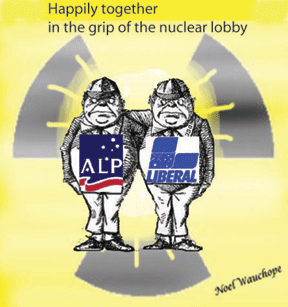
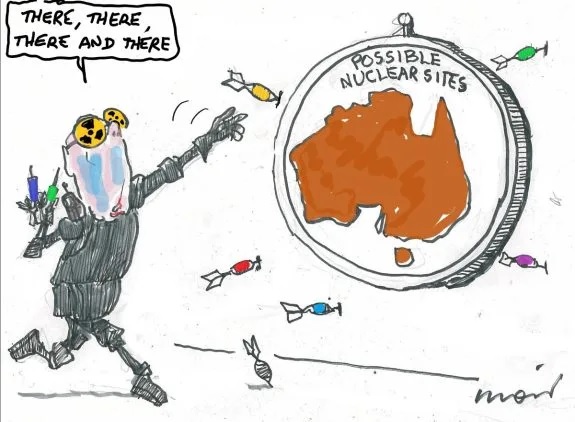
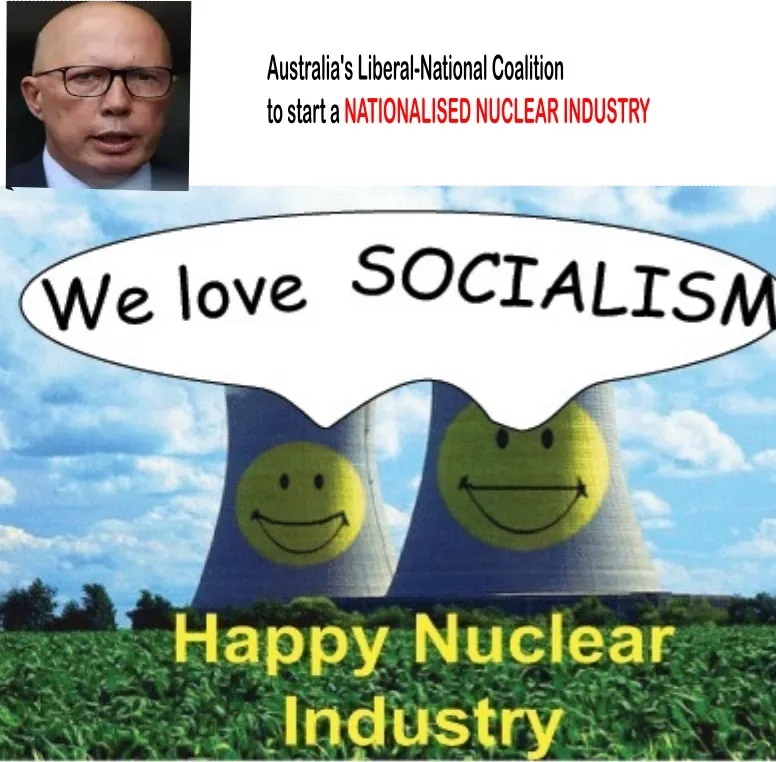
I’m thinking that the nuclear lobby loves the ALP even more than it loves the Liberal Coalition opposition party.
Advance Australia, and the U.S-controlled Atlas Network are powerful and well-funded groups dedicated to molding public opinion on behalf of wealthy right-wing groups. They did a fine job in 2023 of destroying Australian support for the 2023 Australian referendum on the indigenous Voice to Parliament.
I was expecting them to pretty much run riot in support of the Liberal Coalition’s plan for a nuclear Australia. That does not seem to have happened. Why not?
Advance “kicked off with outright lies“, but has been rather quiet lately. And the Atlas Network is nowhere in sight, although its modus operandi is secretive anyway, spreading simplistic memes.
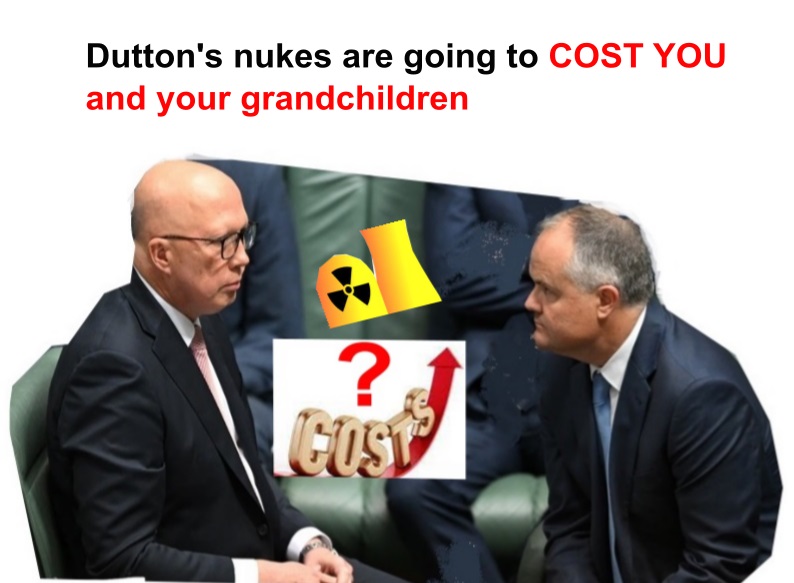
My conclusion is that Peter Dutton’s Liberal Coalition campaign is so inept, so incompetent, that it has turned out to be counter-productive to the party’s cause. There’s just so much evidence of this ineptitude – particularly when it comes to the estimated costs of setting up seven nuclear power plants around Australia. The latest of many examinations of these costs is – “Coalition’s nuclear gambit will cost Australia trillions – and permanently gut its industry.” Half-baked plans to keep old coal-power plants running for many years until nuclear is “ready”, no mention of plans for waste disposal, – the tax-payer to cop the whole cost. Even a suave sales magician like Ted O’Brien has not been able to con the Australian public. The party’s incompetence is on show in other ways, too, unconnected to the nuclear issue.
But what of Labor? They have been remarkably quiet on the nuclear issue – focussing on their own rather ha[f-baked plans for housing. It’s all cost-of-living issues – and I don’t deny that this is important. But nuclear rarely gets a mention – except when Labor finds it useful to mention the costs.
It doesn’t look as if Peter Dutton’s Liberal Coalition has a hope in hell of getting a majority win for its nuclear platform.
But does the nuclear lobby really care? I’m afraid not. You see, the Labor Party, supposedly opposed to the nuclear industry, has a long tradition of caving in on nuclear issues. From 1982 – a weak, supposed “no new uranium mines” policy became a “three mines uranium policy” 1984 then a pathetic “no new mines policy” in the 1990s. Backing for South Australia’s uranium mines further weakened Labor anti-nuclear policy.
Over decades, Labor luminary Gareth Evans has been acclaimed for his supposed stance against nuclear weapons. But he’s done a disservice to the nuclear-free movement, in his long-standing position in favour of “the contribution that can be made by nuclear energy capable of providing huge amounts of energy, and just as clean as renewables in its climate impact”. Evans has always been close to the International Atomic Energy Agency, in his complacency that nuclear power has nothing to do with nuclear weapons!
Labor has always been officially opposed to nuclear power, but at the Federal level, and some State levels, there have always been significant Ministers like Bob Hawke, and Martin Ferguson, who pushed for the nuclear industry. To his credit, Anthony Albanese for a long time held out against the nuclear industry. Even up until 2024, he was still trying .
Why did Albanese agree to this deal, arranged between the Morrison Liberal government, and the USA and UK? Apparently, he did so, after just a two-hour briefing, with no documents provided, on the previous day. Labor Caucus was presented with it as a fait accompli. No vote was taken.
I can only conclude that Albanese’s decision was based on that time-honored fear of Labor looking “weak on security”.
In one fell swoop, Labor’s anti-nuclear policy was wrecked. The nuclear submarines will mean nuclear reactors on Australia’s coast. The will mean nuclear waste disposal in Australia, including foreign nuclear waste from the second-hand submarines. They will surely eventually mean nuclear weapons, as who can really tell if a nuclear-powered submarines has or has not got nuclear weapons? (The Chinese will be very wary about them.)
“In 2024, Australian Prime Minister, Anthony Albanese, made undisclosed “political commitments” with its AUKUS partners in an agreement for the transfer of naval nuclear technology to Australia, sparking concerns about the potential for high-level radioactive waste to be stored in the country. “
The global nuclear lobby works across national boundaries to promote its industry. It does well with Russia – as government clamp-down on dissent makes it easier to expand the industry in all its forms, and to market nuclear power to Asian ana African countries.
The nuclear industry is well aware of the problems in maintaining the belief that nuclear is clean, cheap, and climate friendly. But above all, it’s the nuclear-waste problem that its most expensive and difficult obstacle. Here’s where Australia has always looked appealing. All this nonsense about getting small nuclear reactors is just a distraction . The industry knows that small nuclear reactors are fraught with difficulties – too expensive, requiring too much security, public opposition at the local level, still needing too much water……… But to keep the global industry going, a nuclear-waste-welcoming country would be such a boost.
Well, it is early days, even for the prospect of those AUKUS nuclear submarines ever actually arriving. But in the meantime – the whole AUKUS thing has quietly introduced the Australian public to the idea that nuclear submarines are OK, and so are their wastes, and so are USA nuclear weapons based in Australia.
So, really, the Australian Labor Party has done a much better job of promoting the nuclear industry, than the fumbling Liberal Coalition could.
We are fortunate inn Australia to have proportional representation in our election. If you care about keeping Australia nuclear-free, you don’t have to vote for either of the big parties.
Teals and Greens are under political attack from a new pro-fossil fuel, pro-Israel astroturfing group, adding to the onslaught by far-right lobbyists Advance Australia. Wendy Bacon and Yaakov Aharon with the story.
On February 12 this year, former prime minister Scott Morrison’s principal private secretary Yaron Finkelstein, and former Labor NSW Treasurer Eric Roozendaal, met in the plush 50 Bridge St offices in the heart of Sydney’s CBD. The powerbrokers were there to discuss election strategies of for astroturfing campaign group Better Australia 2025 Inc.
Finkelstein now runs his own discreet advisory firm Society Advisory, while also a director of the Liberal Party’s primary think-tank Menzies Research Centre. Previously, he worked as head of global campaigns for the conservative lobby firm Crosby Textor (CT), before working for Morrison and as Special Counsel to former NSW Premier Dominic Perrottet.
Roozendaal earned a reputation as a top fundraiser during his term as General Secretary of NSW Labor and a later stint for the Yuhu property developer. He is now a co-convenor of Labor Friends of Israel.
The two strategists have previously served together on the executive of the NSW Jewish Board of Deputies, where Finkelstein was vice-president (2010-2019) and Roozendaal was later the chair of public affairs (2019-2020).
Better for whom?
Better Australia Chairperson Sophie Calland, a software engineer and active member of the Alexandria Branch of the Labor party attended the meeting. She is a director of Better Australia and carries formal responsibility for electoral campaigns (and partner of Israel agitator Ofir Birenbaum).
Also present was at the meeting was Better Australia 2025 member Alex Polson, a former staffer to retiring Senator Simon Birmingham and CEO of firm DBK Advisory. Other members present included another director Charline Samuell, and her husband, psychiatrist Doron Samuell.
Last week, Doron attracted negative publicity when Liberal campaigners in the electorate of Reid leaked Whatsapp messages where he insisted on referring to Greens as Nazis. “Nazis at Chiswick wharf,” Samuell wrote, alongside a photograph of two Greens volunteers.
The Better Australia group already have experience as astroturfers. Their “Put The Greens Last” campaign was previously directed by Calland and Polson under the entity Better Council Inc. in the NSW Local government elections in September 2024. The Greens lost three councillors in Sydney’s East but maintained five seats on the Inner West Council.
But the group had developed bigger electoral plans. They also registered the name Better NSW in mid-2024. By the time the group met for the first time this year on January 8, their plans to play a role in the Federal election were already well advanced. They voted to change the name Better NSW Inc. to Better Australia 2025 Inc.
Calland and Birenbaum
Group member Ofir Birenbaum joined the January meeting to discuss “potential campaign fundraising materials” and a “pool of national volunteers”. Birenbaum is Calland’s husband and member of the Rosebery Branch of the Labor Party.
But by the time the group met with Finkelstein and Roozendaal in February, Birenbaum was missing. The day before the meeting, Birenbaum’s role in the #UndercoverJew stunt at Cairo Takeaway cafe was sprung.
This incident focused attention on Birenbaum’s track record as an agitator at Pro-Palestine events and as a “close friend” of the extreme-right Australian Jewish Association. The former Instagram influencer has since closed his social media accounts and disappeared from public view.
The minutes of the February meeting lodged with NSW Fair Trading mention a “discussion of potential campaign management candidates; an in-depth presentation and discussion of strategy; a review and amendments of draft campaign fundraising materials”. All of this suggests that consultants had been hired and work was well underway.
The group also voted to change Better Council’s business address and register a national association with ASIC so they could legally campaign at a national level.
On March 4, Calland registered Better Australia as a ‘significant third party’ with the Australian Electoral Commission. This is required for organisations that expect their campaign to cost more than $250,000.
Three weeks later, Prime Minister Albanese called the election, and Better Australia’s federal campaign was off to the races.
Labor or Liberal, it doesn’t matter…
According to its website, Better Australia’s stated goals are non-partisan: they want a majority government, “regardless of which major party is in office”.
“In Australia, past minority governments have seen stalled reforms, frequent leadership changes, and uncertainty that paralysed effective governance.”
No evidence has been provided by either Better Australia’s website or campaigning materials for these statements. In fact, in its short lifetime, the Gillard Labor minority government passed legislation at a record pace.
Instead, it is all about creating fear. A stream of campaigning videos, posts, flyers and placards carrying simple messages tapping into fear, insecurity, distrust and disappointment have appeared on social media and the streets of Sydney in recent weeks.
On Easter Friday, placards warning voters, “Don’t let the Teals trick you” greeted beachgoers arriving at Bondi Beach.
Wentworth independent Allegra Spender wasted no time posting her own video telling voters she was unfazed, and for her electorate to make their own voting choices rather than fall for a crude scare campaign.
Spender is accused of supporting anti-Israel terrorism by voting to reinstate funding for the United Nations aid agency UNRWA. Better Australia warns that billionaires and dark money fund the Teal campaign, alleging average voters will lose their money if Teals are reelected.
It doesn’t matter that most Teal MPs have policies in favour of increasing accountability in government or that no information is provided about who is backing Better Australia.
Anti-Green, too
The anti-Greens angle of Better Australia’s campaign sends a broad message to all electorates to ‘Put the Greens Last’. It aims to starve the Greens of preferences. The campaign message is simple: the Greens are antisemitic, support terrorism, and have abandoned their environmental roots.
It does not matter that calls unite the peaceful Palestine protests for a ceasefire, or that the Greens have never stopped campaigning for the environment and against new fossil fuel projects.
Better Australia promotes itself as a grassroots organisation. In February, Sophie Calland told The Guardian that “Better Australia is led by a broad coalition of Australians who believe that political representation should be based on integrity and action, not extremist or elite activism.”
It has very few members and its operations are marked by secrecy, and voters will have to wait a full year before the AEC registry of political donations reveals Better Australia’s backers.
It fits into a patchwork of organisations aiming to influence voters towards a framework of right-wing values, including
support for the Israel Defence Force, fossil fuel industries, nationalism and anti-immigration and anti-transgender issues.
Advance Australia (not so fair)
Advance is the lead organisation in this space. It campaigns in its own right and also supports other organisations, including Minority Impact Coalition, Queensland Jewish Collective and J-United. Advance claims to have raised $5 million to smash the Greens and a supporter base of more than 245,000. It has received donations up to $500,000 from the Victorian Liberal Party’s holding company, Cormack Foundation.
In Melbourne, ex-Labor member for Macnamara, Michael Danby, directs and authorises ‘Macnamara Voters Against Extremism’, which pushes voters to preference either Liberals or Labor first, and the Greens last. Danby has spoken alongside Birenbaum at Together With Israel rallies.
L-R Michael Danby, Ofir Birenbaum, unionist Michael Easson OAM, and Rabbi Ben Elton. Source: Together With Israel Facebook group
The message of Better Australia – and Better Council before it – mostly aligns with Advance. These campaigns target women aged 35 to 49, who Advance claims are twice as likely to vote for the Greens as men of the same age.
The scare campaign targets female voters with its fear-mongering and Greens MPS, including Australia’s first Muslim Senator Mehreen Faruqi, and independent female MPS with its loathing.
Meanwhile, Advance is funded by mining billionaires and advocates against renewable energy.
Labor standing by in silence
Better Australia is different from Advance, which is targeting Labor because it is an alliance of Zionist Labor and LIberal interests. Calland’s campaign may be effectively contributing to the election of a Dutton government. In the face of what would appear to be betrayal, the NSW Labor Party simply stands by.
The NSW Labor Rules Book (Section A.7c) states that a member may be suspended for “disloyal or unworthy conduct [or] action or conduct contrary to the principles and solidarity of the Party.”
Following MWM’s February exposé of Birenbaum, we sent questions to NSW Labor Head Office, and MPs Tanya Plibersek and Ron Hoenig, without reply. Hoenig is a member of the Parliamentary Friends of Israel and has attended Alexandria Branch meetings with Calland.
MWM asked Plibersek to comment on Birenbaum’s membership of her own Rosebery Branch, and on Birenbaum’s covert filming of Luc Velez, the Greens candidate in Plibersek’s seat of Sydney. Birenbaum shared the video and generated homophobic commentary, but we received no answers to any of our questions.
According to MWM sources, Calland’s involvement in Better Australia and Better Council before that is well known in Inner Sydney Labor circles. Last Tuesday night, she attended an Alexandria Branch meeting that discussed the Federal election. She also attended a meeting of Plibersek’s campaign.
No one raised or asked questions about Calland’s activities. MWM is not aware if NSW Labor has received complaints from any of its members alleging that Calland or Birenbaum has breached the party’s rules.
After all, when top Liberal and Labor strategists walk into a corporate boardroom, there is much to agree on.
It begins with a national campaign to keep the major parties in and independents and Greens out.
MWM has sent questions to Calland, Finkelstein, and Roozendaal, regarding funding and the alliance between Liberal and Labor powerbrokers but we have yet to receive any replies.
Wendy Bacon is an investigative journalist who was the Professor of Journalism at UTS. She worked for Fairfax, Channel Nine and SBS and has published in The Guardian, New Matilda, City Hub and Overland. She has a long history in promoting independent and alternative journalism.
She is a long-term supporter of a peaceful BDS and the Greens.
Yaakov Aharon Yaakov Aharon is a Jewish-Australian living in Wollongong. He enjoys long walks on Wollongong Beach, unimpeded by Port Kembla smoke fumes and AUKUS submarines.
New analysis by independent public interest think tank Climate Energy Finance (CEF) looks at the economic implications of the nuclear pathway modelled by Frontier Economics for Australia’s energy transition – cited extensively by the Federal Coalition to defend its nuclear plan. The analysis reveals a massive hollowing out of Australian industry, permanently higher total energy costs, uncosted and unabated carbon pollution, and trillions of dollars in lost GDP.
The CEF analysis exposes damaging flow-on costs to the economy for which the Frontier modelling fails to account.
Combined with Frontier’s extreme underestimation of the capital costs of building nuclear reactors, these costs accumulate to $4.3 – 5.2 trillion by 2050, 13-16 times the $331bn price tag for a nuclear Australia assumed by Frontier Economics.
These costs include an estimated:
$3.5 trillion in cumulative undiscounted lost GDP through to 2050;
An $111-332bn in nuclear capex costs, which the Frontier modelling erases all but $13.5bn of by failing to both amortise nuclear’s capital investment costs incurred after 2050 and account for inevitable expensive retrofits;
$234bn in higher fuel costs due to slower electrification meaning consumers and businesses are forced to rely on higher cost fossil fuels for longer;
$72-720bn in economic damage from up to 2.0bn of additional tonnes of CO2 emissions;
$100bn in lost export revenue from the aluminium industry alone, likely to collapse under the drastically reduced industrial electricity demand in the nuclear scenario.
Report author Tim Buckley, CEF Director and a former Managing Director of global investment bank Citigroup, said:
“It strains credulity that the Frontier Economics nuclear report is riddled with shortcomings which completely undermine its credibility as a work of serious energy transition analysis, given this is the central modelling being relied upon by the Opposition for its key energy and climate policy offering of the 2025 Federal election.
“The largest share of the Frontier-modelled ‘savings’ in energy transition investment comes at the cost of delivering much weaker outcomes for Australia, including an assumption the Australian economy’s GDP is $300bn lower annually by 2051. This represents an astonishing $3.5 trillion in cumulative GDP forgone.
“This is as weak as the Opposition Leader recently declining to accept the settled climate science because he is ‘not a scientist’.
It beggars belief that this is the best the party representing itself as alternative federal government can come up with, as the nation stands on the brink of an immense generational opportunity to remake itself as a global renewables superpower and green energy trade and export leader in a rapidly decarbonising world.”
The economists said all the outlined [clean renewable energy] benefits would be delivered much faster and at a fraction of the cost of nuclear energy.
economists said the $330 billion price tag for the nuclear plan was likely to go much higher and was based on questionable modelling for the coalition.
“Major Australian firms are increasingly signing agreements to purchase electricity from solar and wind farms – recent examples include Rio Tinto, BHP Mitsubishi, Telstra, Woolworths, Coles.”
An open letter from 60 Australian economists has rejected the coalition’s nuclear energy plan, promoting instead the subsidising of household clean energy policies, including incentives for home battery storage.
The organiser of the letter, Gareth Bryant, an associate professor in political economy at the University of Sydney, says the letter is intended as an intervention in the election campaign.
“As economists, energy analysts and policy specialists we strongly support government investment in household clean energy and industrial electrification and not in nuclear energy,” the letter says.
It says simple household clean energy upgrades can deliver immediate cost-of-living benefits and reductions in carbon emissions, and electrification can safeguard the future of industrial jobs and the communities that rely on them.
The economists, from a range of Australian universities and other tertiary institutions, said the construction of nuclear power plants would take at least 15 years at a cost of at least $330 billion.
“It would result in higher household energy costs, drain investment away from renewable energy and energy-intensive manufacturing, and leave the Australian economy precariously over-dependent on increasingly automated mineral extraction,” the letter says.
The economists said they support a nationwide program to upgrade homes and industry with clean renewable energy.
They said the technologies to fund should include large-scale home electrification with smart appliances to deliver bill savings, energy-efficiency upgrades and battery storage, which can save surplus solar for night-time use, and hot water retrofits for more efficient water heating.
“An extensive number of studies have found household electrification and energy upgrades would generate immediate household savings, helping to address cost-of-living pressures,” the letter says.
It says modelling for ACOSS found that with energy efficiency upgrades the average household would save almost $3500 a year.
The economists said their pathway would be anti-inflationary, due to less reliance on volatile international gas markets and it would benefit Australian manufacturing which requires low-cost, secure electricity.
“Major Australian firms are increasingly signing agreements to purchase electricity from solar and wind farms – recent examples include Rio Tinto, BHP Mitsubishi, Telstra, Woolworths, Coles.”
The economists said all the outlined benefits would be delivered much faster and at a fraction of the cost of nuclear energy.
The coalition’s nuclear plan proposes to build seven nuclear reactors with the first of these not operational until 2035.
The coalition plan had a number of flaws, the economists said, including higher household energy costs.
“Independent modelling by the Institute of Energy Economics and Finance found it would increase the electricity bill of an average household by $665 per year.”
The coalition nuclear plan would have detrimental impacts on the Australian economy, the economists said.
It would decrease bank and investor certainty, which will in turn increase the cost of renewable energy.
Opposition Leader Peter Dutton has defended his nuclear plan, saying it would help reduce carbon emissions and deliver lower cost electricity and gas, and reliable energy.
But the open letter economists said the $330 billion price tag for the plan was likely to go much higher and was based on questionable modelling for the coalition.
Investing in nuclear power would take away money that could be invested in more cost-effective household clean energy, they said.
“Today, with rising geopolitical tensions, trade wars, and accelerating climate breakdown, sovereign capability is even more critical,” the economists said.
“Renewables enable Australia to maintain this capability – nuclear does not.”
Renewable energy developers are pressing Opposition Leader Peter Dutton to reveal how much more wind and solar would be allowed to join the electricity grid under his plan to embrace nuclear reactors, amid intensifying doubts about what technology mix the Coalition is targeting.
Dutton says his plan for taxpayers to fund and own nuclear facilities would be cheaper than Labor’s strategy. To support this claim, he cites modelling from Frontier Economics comparing the total cost of the government’s renewables-dominated proposal against the Coalition’s competing vision for a grid powered 37 per cent by nuclear generation and 54 per cent by renewables.
But when quizzed about the impact of slowing the renewable rollout to ensure it did not exceed 54 per cent of the 2050 power mix, opposition energy spokesman Ted O’Brien insisted there was “no policy we have which is capping any technology”………………………………..
…..representatives for some of Australia’s largest renewable energy companies said O’Brien’s indication that the Coalition did not intend to stick to the technology mix outlined in its own modelling raised serious questions about its case for nuclear.
The Clean Energy Council, an industry group, has demanded urgent clarification on how much additional wind, solar and batteries the Coalition intended to allow beyond 54 per cent.
“There are enormous questions as far as their plans and targets for renewable energy are concerned,” Clean Energy Council chief executive Kane Thornton said.
The Coalition had stated its nuclear plan would significantly reduce the need for “industrial-scale” renewable energy and transmission lines in regional areas, Thornton said.
“Is that no longer the case? Have they changed their policy? And if so, what level of renewable energy deployment will they be targeting?” he asked.
Whether the 54 per cent ceiling on renewables in the Frontier modelling would constitute a “hard and fast cap” is a question that has come up in recent meetings between clean energy developers and the Coalition, according to industry sources, who requested anonymity to discuss private briefings.
The share of electricity generated from sun, wind and water is expanding each year in Australia, already comprising about 40 per cent of the power grid.
“If Peter Dutton is elected, he will find out that the [renewables] market is more mature than he might have anticipated,” one source said. “Even if it wanted to, the industry’s momentum will be difficult to slow.”
As Australia’s ageing coal-fired power plants near the end of their lives, Labor has followed the Australian Energy Market Operator’s advice about the best and lowest-cost path to transition away from coal. Those measures include accelerating the build-out of renewables, backed up by transmission lines, and fast-starting gas-fired turbines and storage assets such as batteries and pumped hydroelectric dams to stash clean energy for when it’s not sunny or windy……………..
Against the urging of the energy industry, the Coalition is promoting a “coal-to-nuclear” transition, which relies on keeping polluting coal-fired power plants in the grid for potentially another 25 years until nuclear facilities are up and running.
The nation’s biggest coal plant operators, including AGL, say their ageing generators cannot continue operating that long without raising the risk of higher prices for consumers and more sudden outages.
Dutton often says his nuclear plan would lead to a 44 per cent reduction in people’s energy bills compared with what they would be under Labor. However, the Coalition’s policy costings make clear there has been no analysis of electricity price impacts.
The Frontier Economics report calculated that the Coalition’s plan for the electricity grid would be 44 per cent cheaper to build and operate than Labor’s – not that power prices would be 44 per cent cheaper.
Tony Webb New Community Journal, Vol 23 (1) Issue 89 p 37
The Coalition’s plan for our energy future including Nuclear power plants is based on: Delivering half the electricity anticipated as needed to power homes and industry and transition to zero carbon emissions. Assuming cost of building nukes in Australia which has no experience of doing this will be about half what the most nuke-favourable evidence world-wide from countries that do have the experience suggests is needed. Assuming these can be built in less than half the time evidence suggests they take to build. Ignoring the evidence that current official radiation-induced cancer-risk-estimates, on which standards for worker OH&S are based, are less than half what the evidence from nuclear power plant workers in Europe and North America suggests is the inevitable and unavoidable reality. Also, ignoring that the cardio-vascular and heart disease risk from such exposures is double that expected and the childhood leukaemia risk in the community near these plants has been similarly under- estimated. Not to mention that the coalition’s costings ignore the long-term costs of decommissioning these plants, the management, and (perhaps . . . . Dutton dream on!) eventually finding a solution for long-term storage (never ‘disposal’) of the highly radioactive wastes – Nor to mention the fact that state and federal legislation currently prohibits such nuclear power plants and is unlikely to be overturned any time in the near future. And – despite this overwhelming evidence that the whole silly idea is half-baked – in fact a smokescreen for continuing climate denial and extending use of polluting and planet life-threatening fossil fuels, inface of this the Coalition doubles down on it with backing from sections of the media and the fossil fuel lobby.
Brad Battin says he had a conversation with the federal opposition leader about the ‘language’ he would use about plans to build a nuclear reactor in eastern Victoria
The Victorian opposition leader says he discussed the language he would use to distance the state party from the federal Coalition’s campaign to build a nuclear reactor in the Latrobe Valley, telling Peter Dutton “it’s your campaign”.
The Loy Yang coal-fired power station in the Latrobe Valley east of Melbourne is one of seven proposed sites for the federal Coalition’s proposal to build nuclear reactors, the centrepiece energy policy the federal Liberal leader will be taking to the 3 May poll.
He confirmed he had not spoken to anyone in the federal Coalition about its two-and-a-half-year consultation plan for each proposed nuclear site, with the issue “barely raised” at all on the campaign trail.
However, Battin said a conversation had taken place with Dutton and his office about how he would handle questions on the policy.
“I’ve had the conversation with Dutton and his office around what my language is going to be, which is basically saying, ‘We’re happy to have a conversation at the right time. But for us, it’s your campaign at the moment. Our priority, our focus, is on gas,’” he said.
Battin said the federal Coalition would need state parliament to overturn Victoria’s Nuclear Activities (Prohibitions) Act of 1983, which bans the construction and operation of nuclear facilities in the state. Asked if he would be happy with that law being overturned, he said: “I’ll let you know on 4 May.”
Without the support of state parliament, Battin said a Dutton government would face a “difficult process” under section 109 of the constitution, which allows federal law to override state law in the case of conflict.
At his campaign launch on Sunday, Dutton vowed that Australia would become a “nuclear-powered nation” under the Coalition if elected. He said nuclear energy would reduce the need for “sprawling solar and windfarms or laying down 28,000km of transmission lines”.
Battin, however, said most Victorians wanted cheaper energy but “don’t know what the answer to that is yet”.
He said that as existing gas fields in Victoria’s Gippsland and Otway basins continue to deplete, the state should prioritise expanding onshore gas exploration instead.
The comments mark a shift in tone for Battin, who has spent months sticking to a carefully worded position that the Victorian Coalition was open to an “adult conversation” about the policy. He has also repeatedly refused to provide a personal view on nuclear energy.
The Coalition’s pitch for nuclear power in Australia appears to be struggling for support among some key voters, as the nation prepares to vote on its energy future.
New data from the ABC’s Vote Compass survey shows respondents are divided on nuclear energy, while support for climate change action appears to have softened.
About 47 per cent of ABC Vote Compass respondents said they strongly disagreed or somewhat disagreed with building nuclear power plants, while 38 per cent were somewhat or strongly supportive.
Perth local Gabriel Maddock said she’s made up her mind on nuclear energy, and it is a decision she is making with her young children in mind.
“I don’t think it will be better for the environment, it’s going to be hugely expensive, and I think there’s serious safety risks,” the 35-year-old told the ABC.
ABC Vote Compass found views towards nuclear were split along party lines, while men were more supportive, and those over 65 were the age group most likely to be unsupportive.
According to Vote Compass data, 29 per cent of males strongly disagree with the plan while 41.9 per cent of females disagree.
However, the data shows strong support from those who intend to vote for the Coalition with 44 per cent saying they agree Australia should build nuclear power plants.
This contrasts with those who plan to vote for independents, Labor and the Greens — with just 7, 5, and 4 per cent respectively in strong agreement.
This data comes from a sample of more than 270,000 and has been demographically weighted…………………………………………………………………………………………………
The Coalition is promising by 2050 Australia will get 38 per cent of its power from nuclear energy, 54 per cent from renewables, and 8 per cent from storage and gas.
Meanwhile, Labor plans to have a grid almost totally powered by renewable energy, with the target of reaching 82 per cent of renewable energy by 2030 and fully renewable by 2050.
Ms Maddock is concerned that a switch to nuclear power would lead to more carbon emissions in the shorter term.
“From a climate perspective, it seems like it’s solving one environmental issue with another, because nuclear waste is a very difficult thing to deal with,” she said.
“Why would we do that when we could continue developing our renewable power, something Australia is really in a position to be a leader in.”……………………………………………………………………………
Vote Compass is an educational tool designed to promote electoral literacy and civic engagement. While not a conventional public opinion poll, Vote Compass responses can be analysed using statistical methods similar to those used in polling to try to adjust for sampling bias.
Advance has also focused on the anti-renewables movement, appearing at “energy forums” across the country and events held by groups set up to oppose the roll-out of offshore wind and solar energy.
Spokesperson acknowledges supply of flyers, T-shirts and corflutes to ‘dozens of community groups’ seeking to defeat party’s candidates.
The rightwing advocacy group Advance has acknowledged it is paying for election materials attacking the Greens to be used by third-party groups during the election campaign.
“Advance is working with hundreds of volunteers from dozens of community groups to defeat Greens candidates and we make no apology,” a spokesperson said.
The spokesperson said Advance did not fund groups directly but “we absolutely pay for anti-Greens campaign material to be at the disposal of volunteers”.
“This includes 2m flyers and thousands of T-shirts and corflutes.
“Again, we make no apologies.”
The group’s plan to focus its election campaign on reducing the Greens vote has been no secret. Advance’s executive director, Matthew Sheahan, claimed in a February email to supporters it had already raised $7.6m to “smash the Greens” and about $2m to target Labor. The group has spent more than $200,000 in the past week to promote posts from Facebook pages with names such as “Greens Truth”.
But it has not previously talked publicly about the extent of its support for other groups hostile to the Greens, including those that take exception to the party’s position on the Israel-Gaza war or on renewable energy.
The type of assistance Advance has on offer was revealed by two Jewish advocacy groups at a forum hosted by the Australian Jewish Association (AJA).
Simonne Whine of J-United, which campaigned against the Greens in the recent Prahran byelection in Victoria, said her group had reached out to Advance to get its campaign started.
“They were fantastic, efficient, strategic, well resourced,” she said. “They supplied the flyers, the T-shirts and the corflutes, and shipped everything to Melbourne, helping us hit the ground running.” Advance even paid for a picnic to thank volunteers, Whine said.
During last year’s Queensland state election, the Queensland Jewish Collective (QJC) also focused on the Greens vote in Brisbane seats such as Maiwar and Moggill. One of the group’s directors, Roz Mendelle, told the AJA forum QJC had spoken with Advance after seeing its work during the campaign against the Indigenous voice to parliament.
“When time came … to do something against the Greens here in Brisbane, I knew who to turn to,” Mendelle said, claiming that Advance kept “a healthy distance” while the campaign was under way. According to an event invitation seen by Guardian Australia, QJC held a volunteer event with Advance in February.
Mendelle is a co-director of a new group, Minority Impact Coalition (MIC), which has started a billboard campaign against Labor and the Greens in multiple states. A spokesperson for both groups said neither QJC nor MIC had received materials or funding from Advance.
“We had agreed to share volunteers for the federal election,” she said. “However, our volunteers do not want to work with Advance at the federal election so we have made the decision to do our own groundforce campaign.”
During the AJA briefing, Mendelle showed an image of a billboard paid for by QJC that read: “The Greens: They’ve changed for the worse.”
“This is also inspired by the Advance messaging,” she said. “But from there, we gained our footing, and we decided to just speak our truth.” MIC is using the same mobile billboard provider as Advance in Queensland, NSW and Victoria – STT Advertising.
In return, Advance has also used content from groups such as J-United on social media, sharing pictures of its “local grassroots community members” on its Greens Truth Facebook page.
The likely electoral impact of the anti-Greens strategy remains somewhat elusive. The Greens hold only four seats in the lower house, of which the three they won in Brisbane at the last election appear vulnerable. They have six senators up for re-election. By contrast, six new teal independent MPs were elected in 2022 – if they hold those seats or even increase their numbers, they might be expected to have a greater say in the event of a hung parliament.
“They’ve clearly worked out how to get conservative people fired up enough to throw money at them, and the way to do that is by attacking the Greens,” said Peter Lewis, the executive director of Essential, which is conducting qualitative research for the ALP. “But it’s not going to do anything to help the Liberals win back teal seats.”
The Advance spokesperson said: “Our campaign against the Greens won’t defeat teals because it was never meant to. We have been crystal clear for the past 18 months that our focus is on the Greens this election.”
Sheahan told an Australian Jewish Association forum in 2024: “Our goal is to just expose the Greens policies so that people don’t vote for them … A partial benefit will be that we think that will also reduce the teal vote.” His logic for that claim was unclear.
Anti-renewables
Advance has also focused on the anti-renewables movement, appearing at “energy forums” across the country and events held by groups set up to oppose the roll-out of offshore wind and solar energy.
As Guardian Australia has previously documented, the Facebook account for Advance spokesperson Sandra Bourke is active in dozens of local Facebook groups and pages opposing renewable projects in places such as Lake Borumba and Mount Fox in Queensland, regularly sharing Advance content.
Bourke is a regular speaker at these rallies and events – unusually for the outfit, which generally avoids a public-facing presence.
Grant Piper is the former chair of the National Rational Energy Network (NRen), which brought together community groups opposed to renewable energy projects and hosted events including the Reckless Renewables rally in Canberra last year.
That’s where Piper first met Advance. “We didn’t tie any formal knots, but we could tell we were pushing after the same thing when it comes to renewables,” Piper said.
NRen, which has rebranded as Let’s Rethink Renewables, has had discussions with Advance “all the way through”, he said, although it has remained independent. Bourke, one of NRen’s original members, is now Advance’s spokesperson and the face of its campaign against the Greens.
According to Piper – who appeared in Advance’s anti-renewables Dollars & Destruction video series – the organisation is a natural ally for groups that feel they are mostly excluded from the conversation taking place in parliament and the media.
“Advance is helping get publicity for the grassroots people who have been shut out of everything,” he said.
Others who have teamed up for the Greens Truth campaign include groups that emerged from the anti-lockdown movement, the Freedom party and Reignite Democracy Australia – which makes clear to prospective volunteers that their details will be shared with Advance.
Another NRen member and former One Nation candidate, Katy McCallum, was the MC at a “Goodbye Greens Rally” in Brisbane in late March, where QJC also appeared. Along with other event backers such as the Libertarian candidate Jim Willmott, she thanked Bourke and Advance for their help at the event.
“If our other good mate Sandra Bourke … from Advance hadn’t have jumped on, this would not be happening today,” she said.
Thank you, Peter Garrett, for telling it like it is in his take-down of the Coalition’s ill-conceived, expensive and dangerous nuclear energy policy (“I’ve spent my life fighting nuclear: Here’s what Dutton isn’t telling you about his reactors” March 30). Peter Dutton and his cronies have been allowed to get away with their ridiculous nuclear thought bubble for too long. The Labor Party has been relatively weak in its criticism of what is essentially a “smoke and mirrors” idea to present an alternative to developing renewable energy and to appease the fossil fuel lobby in the bargain. The anti-nuclear energy message needs to be hammered out to all Australians before the election. It is simply a backward and disastrous way to go. Robert Hickey, Green Point
Thank you so much, Peter Garrett, for your insightful article. You have most eloquently summed up my thoughts and fear of Australia going down the rabbit hole of nuclear power. As a kid, I witnessed the psychological stress of the Cold War when it was thought that our world could end any day, with Russia and America in full conflict. It’s why Australians turned its back on nuclear all those years ago. For those of my era that have read Peter’s article, please share it with your children and get them to share among their friends. I’ve yet to see a mushroom cloud of destruction coming from a solar panel or pumped hydro. Ray Gilmour, Blaxland
Peter Garrett’s article makes very convincing points. Another negative aspect of these proposed nuclear reactors is the amount of cooling water which is required for them to function. These hypothetical nuclear reactors would require at least twice as much water as the existing coal-fired power stations use, and yet we live on the driest inhabited continent. These reactors sound like another thought bubble from Mr Dutton. Evan Bailey, Glebe
These communities weren’t asked if they want nuclear reactors in their backyard, and have been told it’s happening whether they like it or not.
“Proposed nuclear communities are asking key questions about nuclear reactors which have not been answered: Where is the water coming from? Where is the waste being stored? Where is the detail?“
These communities weren’t asked if they want nuclear reactors in their backyard, and have been told it’s happening whether they like it or not.
“Proposed nuclear communities are asking key questions about nuclear reactors which have not been answered: Where is the water coming from? Where is the waste being stored? Where is the detail?
Nuclear support has melted down in proposed nuclear communities, new polling released by a not-for-profit organisation working with regional communities for more than a decade, RE-Alliance, revealed today.
Energy attitudes polling by respected research firm 89 Degrees East and commissioned by the Renew Australia for All campaign has revealed support for building nuclear reactors at just:
27% in Gladstone
24% in the rest of Central Queensland
24% in Bunbury
22% in Central West NSW which includes Lithgow
32% in Hunter
31% Gippsland.
Further, the same polling showed just 13% of people polled thought nuclear reactors would bring down their bills the fastest (see table below on original ).
The sample size for the polling was 200 local residents in Gladstone, 151 in Central West NSW, 151 in Bunbury, 145 in Central Queensland excluding Gladstone, 301 in Hunter, 300 in Gippsland. Those polled were asked: How do you feel about developing large-scale nuclear energy infrastructure?
RE-Alliance National Director, Andrew Bray, said he was not surprised support for nuclear had bombed, because community engagement is key.
“RE-Alliance stands by the principle that all energy developments in regional Australia need broad community support – whether it’s for solar, wind, batteries, coal, coal seam gas or nuclear reactors,” Mr Bray said.
“Support for nuclear reactors seems to be melting down in the regions who’ve been told they are hosting them.”
These communities weren’t asked if they want nuclear reactors in their backyard, and have been told it’s happening whether they like it or not. Community engagement is by no means easy, but you’ve got to at least try. It’s no surprise support is so low.
“Proposed nuclear communities are asking key questions about nuclear reactors which have not been answered: Where is the water coming from? Where is the waste being stored? Where is the detail?
“Communities also don’t believe that nuclear power is capable of bringing down their energy bills anytime soon and see renewable energy solutions as a better bet. 72% of people said renewables would bring down bills faster, compared to just 13% who said nuclear.
“We see multiple polls from Porter Novelli, CSIRO, 89 Degrees East and more showing strong support for renewable energy on local farmland, between 66% and 71%. Now the polling shows us support for nuclear reactors in these regions is between 22% and 32%.
“Regional communities have enough uncertainty already. Let’s stop with the whiplash and stay the course on a shift to renewable energy which is already almost halfway done.”
Full results of the two poll questions can be found in the Appendix below (on original).
Note: The difference between a poll and a survey is survey respondents select themselves whereas respondents to a poll are selected by the pollster, weighted so the sample accurately represents the population being sampled, by gender, age group, occupation, and so on.
“Editors and reporters should carefully evaluate whether to report online surveys, having regard to their scope and methodology. They should be cautious of open-access online polls where the sample size and the exact questions asked are unknown and the results have been generated by self-selecting respondents.”
The polling was administered online with recruitment sourced from a consumer opt-in panel provided by Pure Profile, weighted to ensure a representative sample in line with ABS proportions for age, gender and location.
This study was conducted by the research firm 89 Degrees East as part of a larger poll with a total sample size of 5,952 Australians. The sample included a nationally representative poll of 2,014 Australians, with an additional boost sample of 1,900 Australians residing in Renewable Energy Zones (REZs). To ensure robust representation within each REZ, quotas and targeted postcode sampling boosts were applied.
The confidence level of the general population sample is +/- 2.14% at the 95% confidence level. Fieldwork was conducted by 89 Degrees East in March 2025. 89 Degrees East is a member of The Research Society of Australia and the Australian Polling Council.
Dutton has not visited Australia’s only nuclear reactor and has not received a brief from our country’s expert agency on the policy area he was developing. For completeness, I also asked the Government’s nuclear safety regulator, ARPANSA, if Dutton had visited them or sought advice from them. FOI came up with the same answer from them. Nothing at all.
Is Peter Dutton’s proposed ‘rollout’ of modular nuclear reactors real policy or just politics? What research has he done to develop the policy? Not much, it seems. Rex Patrick reports.
In September 2020, the Morrison Government released a Low Emissions Technology Statement that placed Small Modular Reactors (SMR) on a list of watching brief technologies. SMR developments were to be monitored to see if they might play a part in Australia’s energy future.
Consistent with that listing, the Government directed the Australian Nuclear Science and Technology Organisation (ANSTO) to join an International Atomic Energy Agency (IAEA) Coordinated Research Project focused on the Economic Appraisal of SMRs to provide information to assist in evaluating the technology’s economic viability.
ANSTO assembled a team to prepare, among other things, a case study on Australia’s potential to adopt SMR technologies in the future and analyse financing options for the technology. As part of that project, ANSTO even supported a University of Queensland PhD thesis on SMRs.
Flip flop politics
Peter Dutton, a minister in the Government that commissioned the ANSTO work, came out mid-way through 2023 with a proclamation of the Coalition’s plans for Australian to adopt SMRs as a preferred tool in our movement towards net zero carbon emissions.
In doing so Dutton opened himself up to a political battering because of the nascent state of SMR development around the world and huge questions around costs.
As Peter Dutton talks up nuclear power, it is not surprising to see Andrew Liveris shifting his pitch from a ‘gas led recovery’ to a call for Small Modular Reactors (SMRs) to be considered for the 2032 Brisbane Olympics. Dutton is engaged in politics, Liveris in fantasy. Rex Patrick reports on the nuclear distraction.]
Undeterred, in early March Dutton doubled down on nuclear power, switching his thinking to large nuclear power plants scattered about the country. As public controversy raged about the new plans, Dutton has started reinjecting SMRs into the total mix.
There are now to be a mix of economic and taxation incentives for the local communities targeted by the Coalition to host a nuclear reactor.
“Somewhere in a Coalition back office, there’s a whiteboard with a map waiting to be unveiled.”
In response to their hip flip to a larger nuclear power plant and his small flop back to SMRs, I thought MWM set out to see if Dutton has visited ANSTO or taken a brief from them in relation to his plans.
After all, there’s no shortage of precedent for parliamentary oppositions to seek factual briefings from government agencies, especially on complex and specialised subjects.
Missing homework
In response to their hip flip to a larger nuclear power plant and his small flop back to SMRs, I thought MWM set out to see if Dutton has visited ANSTO or taken a brief from them in relation to his plans.
After all, there’s no shortage of precedent for parliamentary oppositions to seek factual briefings from government agencies, especially on complex and specialised subjects.
In a recent nuclear estimates brief prepared for the CEO of ANSTO, the first two paragraphs stated:
“As the custodian of Australia’s nuclear expertise and capabilities, ANSTO is well positioned to advise governments, Australian parliaments, and members of the public on the technical aspects of nuclear power and nuclear power developments globally.”
“ANSTO has significant insight into what other countries and jurisdictions are doing around the world in terms of nuclear power.”
As mentioned above, ANSTO was specifically engaged by the former Coalition Government to take a look at SMRs. So, I was left gobsmacked when a Freedom of Information request I made to ANSTO to find out what Dutton’s interactions with ANSTO had been over the past five years returned nil information.
Dutton has not visited Australia’s only nuclear reactor and has not received a brief from our country’s expert agency on the policy area he was developing. In some measure, it explains the flip-flopping and limited detail in many of his announcements.
For completeness, I also asked the Government’s nuclear safety regulator, ARPANSA, if Dutton had visited them or sought advice from them. FOI came up with the same answer from them. Nothing at all.
Politics, not policy
You can’t develop policy just by chin-wagging at party room meetings and with briefs from vested business interests. That’s not how it works. You have to get independent and expert advice, and in the case of nuclear matters, a vital place to get that advice in Australia is ANSTO and ARPANSA.
So, just what policy work has Dutton done? In large part, he appears completely dependent on the Google skills of his little-known Climate Change and Energy spokesperson, Ted O’Brien.
With a background in marketing, O’Brien has no ministerial experience, so the practicalities of major project implementation may be quite novel for him. He did once chair a parliamentary committee inquiry into nuclear energy, but as so often is the case, the research there was largely done by the committee secretariat, with O’Brien just adding a thin layer of pro-nuclear evangelism on the top.
It’s pretty safe to say that, in the absence of comprehensive briefs from and engagement with Australia’s leading experts, Dutton is not engaging in serious policy development. Rather it’s a manoeuvre to achieve political differentiation and keep the anti-renewals, climate-change-denying core of his Coalition happy.
Dutton’s approach to policy development, in this instance, says just as much about him as it does about his nuclear plans.
Rex Patrick is a former Senator for South Australia and earlier a submariner in the armed forces. Best known as an anti-corruption and transparency crusader, Rex is running for the Senate on the Lambie Network ticket next year – www.transparencywarrior.com.au.
The Electrical Trades Union is targeting Peter Dutton’s nuclear plan with a $2 million ad campaign focusing on key federal electorates, including the opposition leader’s own seat of Dickson in Queensland.
Running under the slogan “Dutton’s Nuclear Plan: Why?”, the campaign seeks to deliver a powerful message through TV, radio, and digital platforms.
Featuring electricians, farmers, and policy experts, the ads question what the union says are “serious flaws in the nuclear plan around cost, timelines, and value for money”.
“The campaign highlights nuclear power’s enormous water consumption, which is 1.4 times greater than coal, a point that will resonate strongly in water-stressed areas like Western Australia,” ETU national secretary Michael Wright says.
Wright says the campaign will make voters aware of the costs, “impractical timelines, and job-killing consequences of Peter Dutton’s nuclear energy proposal”.
“Peter Dutton’s nuclear proposals are an expensive, impractical fantasy,” he says.
“Australia needs a new generation to keep the lights on today, in 2025. A nuclear power plan for 2045 is worse than useless – it is killing energy workers’ jobs. With 40% of the grid already powered by renewables and batteries, ETU members are building the energy transition today.
“Every day that Dutton pushes his nuclear fantasy for the 2050s is a day spent destroying and delaying real jobs and projects in 2025. Dutton’s plan would cost $600 billion, take more than 20 years to get off the ground, and provide only four percent of our energy needs.
“This isn’t a plan—it’s a delay tactic that puts thousands of jobs and the nation’s energy security at risk.”
Dutton last year announced he will go to the upcoming federal election promising to build seven nuclear power stations. He has promised the first sites could be operational between 2035 and 2037, years earlier than what the CSIRO and other experts believe is feasible.
Australia will head to the polls on 3 May for the federal election.
Today’s voter has it tough, especially younger Australians who get much of their information from apps. It’s daunting to sort fact from fiction in the Wild West world of online media, where hidden agendas and speculative opinion are rife. All the more so when a party’s policy only truly makes sense if viewed through a wider lens.
Opposition Leader Peter Dutton’s promise to build seven small-scale nuclear reactors, ostensibly to help meet future energy needs while keeping carbon emissions at bay, therefore needs to be seen for what it really is: a staggeringly bad idea, a stunt and a con. It is a backdoor attempt to pander to the fossil-fuel lobby – and under the electoral spotlight, more people will figure that out.
Younger voters understandably won’t know that a generation their age once packed the Sidney Myer Music Bowl with Midnight Oil, INXS and other friends to “Stop the Drop”. They won’t remember our Nuclear Disarmament Party campaign, which won Senate seats in Western Australia and NSW in the ’80s. They can’t know what it was like to grow up during the Cold War era or live through horrific meltdowns at the Three Mile Island, Chernobyl and Fukushima nuclear power plants, which were also “completely safe” until the day that they weren’t. But generations Y and Z can still smell a rotten idea when they give it a good sniff.
One example is the fanciful assumption that nuclear plants could be built in 12 years. Twenty years would be more likely – if they are built at all. Cost overruns and safety issues are equally certain. And the carbon consequences of prolonging our old coal-fired power generators are dire.
This deceptive proposal has all the Trumpian hallmarks: a quasi policy announcement intended to serve sectional interests – in this case, fossil-fuel conglomerates – while simultaneously serving up a cartoon enemy as ideological whipping boy, namely renewable energy.
Australia has abundant sunlight, plenty of wind, plus lots of pumped hydro resources that can all be converted by increasingly efficient technologies. Stored batteries are ramping up, too. The butterfly has emerged from the chrysalis and taken to the skies – the renewable energy transition is well under way. Construction costs will keep coming down. Supply will keep going up. The future is already here.
By wrenching the country off this course, Dutton’s plan would leave old, dirty, coal-fired power stations staggering on at increasing risk of breakdown, putting off the day of reckoning when we finally stop polluting and heating our world and get on with using affordable, reliable energy that does not cause more climate chaos.
What possible reason is there for Australia to embark on building a completely new, expensive energy infrastructure we don’t need and which, incidentally, is already illegal in states where the reactors are meant to go?
Nuclear energy features eye-watering costs, which history repeatedly shows blow out. It features risks associated with managing radioactive waste for tens of thousands of years. It is also a massive safety risk from both accidents and attacks.
To cap the charade, this policy comes from the parties that supposedly champion free enterprise and want to reduce government spending, yet the hundreds of billions of dollars needed to fund the Coalition’s nuclear plan are to be borne by all of us, the taxpayer. Go figure!