The Productivity Commission has warned of possible political interference in the investment decisions, and former treasurer Wayne Swan described it as a government “slush fund” operated by a board stacked in favour of the mining industry.
Bank calls for more transparency on Northern Australia Infrastructure Facility’s $5b loan scheme
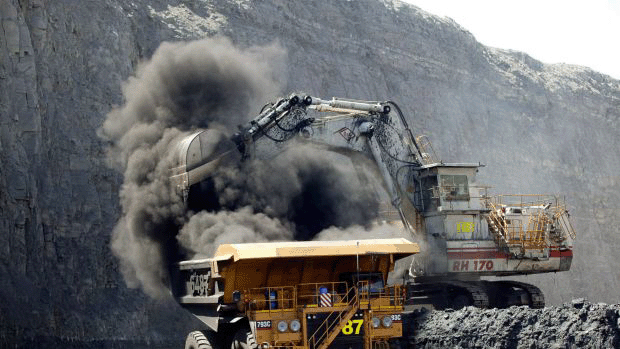 ‘More transparency needed’: Bank questions secrecy of $5b loan scheme, Newcastle Herald, 24 Aug 2017 A $5 billion infrastructure loan scheme derided as a secretive Turnbull government slush fund has attracted further criticism – this time from a major bank.
National Australia Bank – whose own industry is plagued by claims it is opaque and untrustworthy – has raised concerns that the Northern Australia Infrastructure Facility, a controversial government loan scheme designed to kickstart private sector investment in the north, lacks transparency.
NAB also warned that the fund was taking a “lender of last resort” approach that may not provide the economic shot-in-the-arm that Northern Australia requires.
The bank’s concern adds to a chorus of complaint that the much-vaunted infrastructure fund, which headlined the 2015 federal budget, is cloaked in secrecy, lacks governance and exposes taxpayers to a high risk of losing their money.
South Australia calls for Federal Govt loan for Port Augusta solar plant
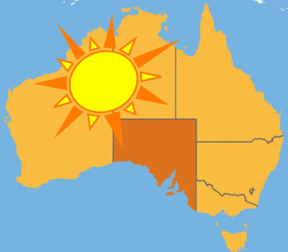 Premier Jay Weatherill calls on Federal Government to provide $110m loan for $650m Port Augusta solar plant, Adam Langenberg, Luke Griffiths, The AdvertiserAugust 23, 2017 PREMIER Jay Weatherill has dared the Federal Government to block a $110 million loan banked on to finance Port Augusta’s $650 million solar thermal plant……
Mr Frydenberg was in Whyalla on Wednesday as he launched a $30 million battery storage facility on the Yorke Peninsula, as revealed by The Advertiser yesterday.
He said it would play an important role in securing South Australia’s electricity network.
Less than two months after the State Government announced its deal with US billionaire Elon Musk’s Tesla, Mr Frydenberg unveiled plans that would see the Federal Government’s Australian Renewable Energy Agency fund up to 40 per cent of a 30MW, 8MW/h battery.
Electranet will design and build the battery before leasing out its commercial operation to a yet-to-be-decided energy retailer.
To be located at Dalrymple — one of the electricity network’s “weak points”, according to Mr Frydenberg — it is expected to be connected to the grid by February 2018.
The Tesla battery, to be located in Jamestown, will be 100MW, 129MW/h.
“We don’t claim to have the biggest battery or the biggest system, what we do claim is to be putting in place practical, cost-effective, needed policy solutions and practical solutions to the challenges SA faces,” Mr Frydenberg said prior to presenting at the Global Maintenance Upper Spencer Gulf conference in Whyalla…….
In his speech, Mr Koutsantonis declared the Upper Spencer Gulf an economic participation region under the State Government’s industry participation policy.
Local businesses will now be given a 20 per cent weighting when vying for public project work.
“We have seen how successful this policy has been since it was implemented in northern Adelaide and now we want to replicate those achievements in the Upper Spencer Gulf,” he said. http://www.adelaidenow.com.au/news/south-australia/premier-jay-weatherill-calls-on-federal-government-to-provide-110m-loan-for-650m-port-augusta-solar-plant/news-story/40c4bb6cffce77e1c2cf0f5816fd1334
Malcolm Turnbull in Tasmania – praising wind and solar power!
 Turnbull trumpets Tasmania’s ability to lead the country in renewable energy, ETHAN JAMES, AAP, Mercury, August 18, 2017 Prime Minister Malcolm Turnbull has trumpeted Tasmania’s ability to lead the nation in renewable energy at the state’s Liberal Party council meeting.Mr Turnbull today addressed 250 delegates at the annual conference in Launceston, the party’s final gathering before a state election in March. He praised Liberal Premier Will Hodgman’s economic management in a speech that touched on energy, terrorism and mental health.
In India, Customs Department accuses Adani of fraud, as Adani bids forAustralian coal loan
 If true, one effect of the alleged scheme would have been to move vast sums of money from the Adani Group’s domestic accounts into offshore bank accounts where it could no longer be taxed or accounted for.
Adani mining giant faces financial fraud claims as 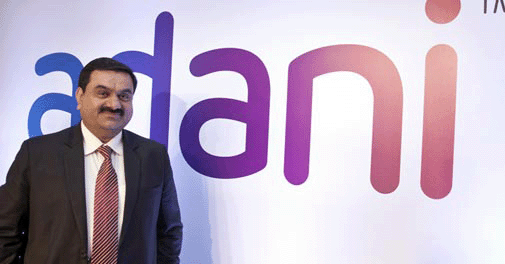 it bids for Australian coal loan, Exclusive: Allegations by Indian customs of huge sums being siphoned off to tax havens from projects are contained in legal documents but denied by company, Guardian, Michael Safi in Delhi, 16 Aug 17, A global mining giant seeking public funds to develop one of the world’s largest coal mines in Australia has been accused of fraudulently siphoning hundreds of millions of dollars of borrowed money into overseas tax havens.
Indian conglomerate the Adani Group is expecting a legal decision in the “near future” in connection with allegations it inflated invoices for an electricity project in India to shift huge sums of money into offshore bank accounts.
The directorate of revenue intelligence (DRI) file, compiled in 2014, maps out a complex money trail from India through South Korea and Dubai, and eventually to an offshore company in Mauritius allegedly controlled by Vinod Shantilal Adani, the older brother of the billionaire Adani Group chief executive, Gautam Adani.
Vinod Adani is the director of four companies proposing to build a railway line and expand a coal port attached to Queensland’s vast Carmichael mine project.
The proposed mine, which would be Australia’s largest, has been the source of years of intense controversy, legal challenges and protests over its possible environmental impact.
Expanding the coal port to accommodate the mine will require dredging an estimated 1.1m cubic metres of spoil near the Great Barrier Reef marine park. Coal from the mine will also produce annual emissions equivalent to those of Malaysia or Austria according to one study.
One of the few remaining hurdles for the Adani Group is to raise finance to build the mine as well as a railway line to transport coal from the site to a port at Abbot Point on the Queensland coast.
To finance the railway Adani hopes to persuade the Northern Australia Infrastructure Facility (Naif), an Australian government-backed investment fund, to loan the Adani Group or a related entity about US$700m (A$900m) in public money.
While it awaits the decision on the loan, in Delhi the company is also expecting the judgment of a legal authority appointed under Indian financial crime laws in connection to allegations it siphoned borrowed money overseas.
The Adani Group fully denies the accusations, which it has challenged in submissions to the authority.
The investigation
News of the investigation was first reported in India three years ago, but the full customs intelligence document reveals forensic details of the workings of the alleged fraud which have not been publicly revealed.
The 97-page file accuses the Adani Group of ordering hundreds of millions of dollars’ worth of equipment for an electricity project in western India’s Maharashtra state using a front company in Dubai.
To read the pdf click here. Continue reading
A Northern Australia Infrastructure Facility funded Adani rail link could create a $billion ghost train
Government loan to Adani will create ‘billion-dollar ghost train’, Senate told https://www.theguardian.com/environment/2017/aug/11/government-loan-to-adani-will-create-billion-dollar-ghost-train-senate-told
Public governance specialist raises concerns over the way the Northern Australia Infrastructure Facility is conducting itself, Guardian, Michael Slezak, 11 Aug 17, If the federal government funds a rail link to Adani’s proposed Carmichael mine, it will become known as the “government-funded billion-dollar ghost train”, an expert in public governance has told the Senate.
Thomas Clark, a professor at the University of Technology Sydney, who has decades of experience in public and corporate governance, appeared before a Senate inquiry into the operation and governance of the Northern Australia Infrastructure Facility (Naif), which is considering a $900m loan to Adani’s rail link.
He said the way Naif was conducting itself neglected years of reforms in public finance, and risked returning Australia to an era “when the public sector was discredited”.
Clark criticised Naif’s lack of transparency, pointing to its lack of disclosure of conflicts of interests and refusal to disclose whether or not Adani had applied for funding.
The former minister for resources Matthew Canavan has acknowledged that Naif is considering a loan application by Adani for the railway, and an Adani spokesman confirmed that the company had sought a loan.
Clark said the fact the Naif board was considering the loan for the rail link showed it was was not conducting itself properly. He said it would not benefit the larger community, would harm other coalmines and industries, and threaten the Great Barrier Reef.
“The worry is that the Naif’s structure and processes, and the way the board has been selected and so on has neglected all of that reform and thrown us back to an era of long ago when the public sector was quite discredited.”
He said the corporate history of Adani – which has been implicated in several environmental disasters and governance questions – would make the company ineligible for government funding.
“The serious concern is that if this rail project goes ahead and is funded, it will not only prove a financial and energy disaster, it will also announce to the world the poor standards and poor public governance that allowed this disaster to occur and utilised tax payer money to fund it,” Clark said.
“This will not enhance the reputation of Australia internationally for sound governance and probity in public finance.
“Undoubtedly if Naif funds this Carmichael project, it will become renowned as the government-funded billion-dollar ghost train – a useless waste of taxpayer money to enrich a company based in the Cayman Islands, which the Australian public will not forget or forgive.”
The Senate hearing continues on Friday, and will include an appearance by Naif officials.
Energy executives tell Turnbull they aren’t interested in prolonging life of coal plants
Executives also tell prime minister that policy uncertainty is contributing to rise in power prices, Katherine Murphy, Guardian, 9 Aug 17 Senior energy executives have taken the opportunity of a face-to-face meeting with Malcolm Turnbull to argue policy certainty is required to help lower power prices for consumers – and to signal they are not interested in prolonging the life of coal plants……..
Government backbenchers report being under huge pressure from their constituents over soaring power bills but internal divisions have prevented the Turnbull government, thus far, from resolving whether it wants to adopt the Finkel recommendation of a new clean energy target.
The message the executives delivered to the top echelons of the government was the country needed policy action that would lower or stabilise wholesale electricity prices, not just a focus on retail prices.
After the talks, the prime minister was asked whether he would deliver a full response to the Finkel review by the end of the year.
Turnbull hedged, saying the government was waiting on additional information from the Australian Energy Market Operator about the amount of dispatchable power required to stabilise the grid after the departure of major coal plants which are coming to the end of their operating life.
He said the government would receive that information on 1 September…….
The government will hold another meeting with the same group of executives on 18 August to hear progress.
A report released by the Grattan Institute five months ago highlighted the problems addressed in Wednesday’s meeting.
The Grattan report pointed out that consumers struggle to find better deals to reduce their power bills because they find the market too complicated. It also argued that, if energy retailers failed to clean up their act, political pressure would increase for price regulation given the rapid escalation in energy costs.
On Tuesday night, the Greens called for price regulation by the end of 2017. https://www.theguardian.com/australia-news/2017/aug/09/energy-chiefs-tell-turnbull-they-arent-interested-in-prolonging-life-of-coal-plants
$1 billion loan to Adani Carmichael mine project a big loser for taxpayers?
 Adani loan too much of a risk for taxpayers according to independent study, The Age, Mark Kenny, 31 July 17,
A $1 billion concessional loan to the controversial Adani Carmichael mine project in Queensland’s Galilee Basin could expose taxpayers to a high risk of losing their money, according to an independent business analysis.
The economic assessment of the troubled project’s outlook found the collapsing coal price, the uncertain global picture for thermal coal, and the $21.7 billion project’s heavy reliance on external financing contributed to a high risk for taxpayers.
Among the problems was Adani’s hope of using the Northern Australia Infrastructure Facility to fund a key part of the project – a rail link to Abbot Point – while relying extensively for security on the availability of other, as yet unsecured, debt and equity financing.
The assessment was done by the business consulting firm, ACIL Allen, and commissioned by the Australian Conservation Foundation. The study was fully independent of both the ACF and Adani, and forms the basis of a submission from the environmental group to a Senate Economics References Committee currently examining the “Governance and Operation of the Northern Australia Infrastructure Facility”.
Noting that a number of unknown commercial factors made definitive third-party assessment problematic, ACIL Allen found there were multiple reasons why a public loan from the Northern Australia Infrastructure Facility appeared risky……..
ACIL Allen also highlighted a contradiction between the Infrastructure Facility’s rationale, which is to provide finance to economy enhancing infrastructure projects that are unable to secure private capital funding, while also relying on the project principals’ assurances that adequate private investment will become available for the mine to go ahead.
“It is not clear how the Northern Australia Infrastructure Facility could meet the direction from government that there be an expectation of full repayment of the loan with interest, while providing support only if commercial financiers do not provide sufficient finance for the project to proceed. It seems that the expectation could not be high if sufficient private sector finance is not forthcoming.”….
ACIL Allen said amid the uncertainties, “one thing is clear” about the project. “The substantial decline of thermal coal prices since 2011 has stripped in excess of $A40 per tonne from profit (after adjusting much larger US$ price declines for depreciation of the $A). This has raised doubts about the likelihood of any significant surplus of revenue over full costs (including a reasonable risk-adjusted rate of return on investment) in medium- and long-term timeframes.”http://www.theage.com.au/federal-politics/political-news/adani-loan-too-much-of-a-risk-for-taxpayers-according-to-independent-study-20170731-gxmarj.html
Matt Canavan makes it quite clear that he WAS the Minister For Mining
 Canavan comes out as “minister for mining sector,” internet gets really mad, REnewecono0my, By Sophie Vorrath on 28 July 2017 Australia’s recently resigned resources minister has unleashed a torrent of public criticism, after posting a heartfelt note of farewell to “the mining sector” on his Facebook page.
Canavan stood aside as federal minister for resources and northern Australia this week after it was revealed he held dual Australian and Italian citizenship. He has blamed his mother for the oversight, and is mounting a legal battle to remain in the Senate.
“It has been such an honour to represent the Australian mining sector over the past year,” the July 27 post begins.
“From the small, gambling explorers and prospectors to the large, world-beating multi-nationals, the industry provides rich and diverse experiences that can take you to the smallest towns of outback Australia to the biggest cities in the world.”
The note, which also touches on the current state of commodity prices and jobs, sparked instant outrage from readers, who noted Canavan was “supposed to represent the people of Queensland, and not private mining companies.”……http://reneweconomy.com.au/canavan-comes-minister-mining-sector-internet-gets-really-mad-65405/
Labor state conference dumps Barron River branch anti-Adani motion at last minute
Chris Calcino, The Cairns PostJuly 29, 2017 AN anti-Adani motion from members of Labor’s Barron River branch has been scrapped before the party’s State Conference today.
Barron River was among three branches calling for Labor to pull support for the Carmichael coal mine whose motions were abandoned after a meeting of Labor’s agenda committee on Wednesday……http://www.cairnspost.com.au/news/cairns/labor-state-conference-dumps-barron-river-branch-antiadani-motion-at-last-minute/news-story/de67ccd746bf5af3770802f50cabfa45
Resignation of Australia’s Minister Representing The Coal Industry – Matt Canavan
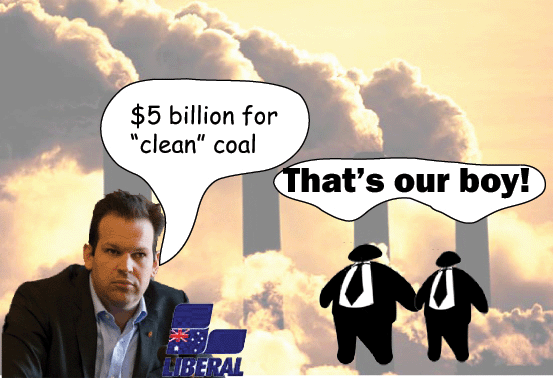 Out with “minister for Adani” – in with a minister for renewables? http://reneweconomy.com.au/minister-adani-minister-renewables-48967/#undefined.uxfs By Sophie Vorrath on 26 July 2017
An alliance of Australia’s top environmental NGOs, formed to oppose the development of what would be the nation’s largest coal mine in northern Queensland, has seized on the resignation of federal resources minister, Matt Canavan, as an opportunity for the Turnbull government to appoint an energy agnostic replacement, and to drop its support for the controversial Adani coal project.
Fat chance, but here’s the idea.
Stop Adani Townsville said on Wednesday that Canavan had acted less like a resources minister and more like “the self appointed minister for Adani” – the Indian company behind the massive proposed Carmichael coal mine and rail project in the Galilee Basin – while steadfastly ignoring the “enormous opportunities” in the state’s north for renewables.
Canavan, who quit Federal Cabinet on Tuesday after it was revealed he had “unwittingly” taken out dual Italian citizenship, is, indeed, well known for his pro-fossil fuels stance, as well as for his indifference to the Paris climate treaty, and the science behind it.
Some notable recent quotes from the minister, who also oversees the northern Australia portfolio, include “Stop trying to save the planet” – Tweeted in response to Queensland’s zero emissions target; and “forget about climate change.”
But most notably, Canavan has been a staunch defender of the virtually indefensible Adani coal mine, often using highly questionable data to support his argument, despite the weight of evidence showing it to be environmentally unviable, and loaded with financial risk.
“This unexpected turn of events is an opportunity for the Turnbull government to rule out the $1 billion public loan to Adani for its private rail line and leave the success of the mine project to the market,” said Stop Adani Townsville member Wendy Tubman on Wednesday.
Canavan has also been one of a number of key conservative ministers pushing for the development of a new coal-fired generator in northern Queensland, preferably funded by the government’s Northern Australia Infrastructure Fund.
Meanwhile, as we reported here in May, there is some 4,200MW of large-scale wind and solar projects, all of them in central to northern Queensland, and billions of dollars worth of other projects in the pipeline, including biofuels and even a battery gigafactory in Townsville.
“Townsville and the region are sitting on a gold mine of opportunities,” Oliver Yates, the former head of the Clean Energy Finance Corporation and a spokesman for Future North, told RenewEconomy at the time.
Said Tubman: “A gross error of Canavan has been to politicise the work of the Northern Australia Infrastructure Facility, turning it into a slush fund for the Turnbull government, which appears desperate to support Gautam Adani’s private business interests.
“Poll after poll show Queenslanders want large-scale renewable energy projects not a dangerous coal mine that will fuel climate change and destroy the Reef.
“Three times as many Queenslanders oppose taxpayer subsidies from Federal or State governments to the Adani mine as support them,” she said.
World Vision leader scathing about Defence Industry Minister Christopher Pyne’s plan for Australia to export weapons
‘Profiting from bloodshed’: Tim Costello criticises Christopher Pyne weapons export plan, SMH, Amy Remeiki , 17 July 17
World Vision Australia chief Tim Costello said Australia would be “exporting death” and “profiting from bloodshed” if it followed through on Defence Industry Minister Christopher Pyne’s plan to see the nation become a major arms exporter. Speaking to Fairfax Media, Mr Pyne said he wanted to see Australia not only build but design military assets, such as warships, on par with other players and allies such as Britain, France and Germany to help bolster the nation’s influence and reinforce relations.
But Mr Costello strongly criticised the plan, which he said carried terrible consequences.
“This is a government that has cut humanitarian aid, which saves lives, to the lowest level in our history, and it is now seriously discussing the merits of becoming a major weapons manufacturer and exporter,” he said.
“The government says this is an export and investment opportunity – but we would be exporting death and profiting from bloodshed. Mr Costello said it was naive to imagine Australia could control whose hands the weapons ended up in, once they were sold…….http://www.smh.com.au/federal-politics/political-news/profiting-from-bloodshed-tim-costello-criticises-christopher-pyne-weapons-export-plan-20170717-gxcomj.html
Clear opposition to nuclear development in South Australia: no further tax-payer money should be wasted on it
 “…….Mr Parnell said the laws — changed last year to allow public consultation on the issue — must be reinstated now Premier Jay Weatherill said the nuclear debate was dead.
“The Government has already wasted over $13 million of taxpayers’ money on this dump proposal and I want to make sure that any future public relations exercises for harebrained schemes like this won’t be funded without Parliament’s approval,” Mr Parnell said.
“There are still too many diehard nuclear dump supporters inside both the old parties for us to trust them with public money.”
Mr Weatherill last year said the Government was still committed to a referendum on the issue, but would not do so until there was bipartisan support.
But he went further in June, saying he would not revisit the nuclear debate even if he wins the 2018 election.
The Liberal Party said it was opposed to a nuclear facility in SA after the Government’s citizens’ jury process overwhelmingly rejected it.
Two thirds of the 350-member panel said they did not wish to pursue nuclear storage under any circumstances….” The Advertiser, 19 July 17
Queensland Liberal National Party refuses to pull out of Paris Climate Accord

 LNP members vote down call to pull out of Paris Climate Accord at Queensland convention, ABC News By Chris O’Brien, 16 July, Queensland Liberal National Party members have steered away from a potentially divisive move against Australia’s global climate position, while the party leader also vowed not to be distracted by federal squabbles in the lead up to the next election.
The party’s annual convention voted down a motion calling on the Commonwealth to pull out of the Paris Climate Accord, after two former presidents warned against undermining the Prime Minister.
“This motion is really about just putting the knife into the Federal Government,” immediate past president Bruce McIver said.
“They’ve agreed on it on our behalf, and I think if we don’t believe we should vote this down today, we are doing them an injustice.”………http://www.abc.net.au/news/2017-07-16/lnp-members-vote-down-call-to-pull-out-of-paris-climate-accord/8713210
Climate denialism rules the Liberal Party – and is bringing about a split within it
The most senior Liberal expressing doubt is former prime minister John Howard, who remains an influential figure in conservative circles.
Some of Mr Turnbull’s conservative critics cite his belief in global warming as evidence he is too left-wing for the Liberal Party.
The split within the Liberal Party is illustrated by its own think tank, the Menzies Research Centre.
 More than half of federal Liberal MPs ‘don’t trust’ climate science: think tank http://www.afr.com/news/policy/climate/more-than-half-of-federal-liberal-mps-dont-trust-climate-science-think-tank-20170714-gxb7r2 The majority of federal Liberal MPs are not convinced the science behind climate change is settled and support reductions in emissions of greenhouse gases for political reasons, according to an prominent conservative think tank.John Roskam, the executive director of the Melbourne-based Institute of Public Affairs, said he hadn’t conducted a formal count but found most Liberal politicians shared his doubts about what many experts say is the greatest global threat to mankind.
“More than 50 per cent are solid sceptics and more than 50 per cent feel they need to be seen to do something,” he said in an interview. “The science is not settled.”
The overwhelming majority of climate change scientists accept the atmosphere is warming and humans are responsible. The burning of fossil fuels contributed to an increase in atmospheric carbon dioxide from 280 parts per million before 1800 to 396 parts per million in 2013, according to the Australian Academy of Science. Continue reading
Australian States and Federal Govt approve 49 Finkel recommendations, but split on Clean Energy Target
 COAG splits over clean energy target, but 49 Finkel ideas approved http://reneweconomy.com.au/coag-splits-over-clean-energy-target-but-49-finkel-ideas-approved-97105/ By Giles Parkinson on 14 July 2017
Four Labor states and governments have formalised their push to purse their own clean energy target mechanism, officially breaking away from the federal government after the Coalition refused to endorse the Finkel Review’s recommendation on the issue.
The COAG energy council meeting in Brisbane endorsed 49 of the 50 recommendations from the Finkel Review, and endorsed the decision to get rid of the “limited merits review” that affects network spending. However, the federal government said it could not commit to a clean energy target.
South Australia, Victoria and Queensland, along with the ACT, said they would ask the Australian Energy market Commission to study how a CET might be implemented by the states saying “they can’t wait any longer”.
It is not clear how long this will take, and how quickly legislation can be introduced, or if it can survive state-based partisan politics given that both the South Australia and Queensland Labor governments are facing elections in the next 12 months.
The role of the ACT is also unclear, given that it will reach its target of 100 per cent renewable energy by 2020.
These same states this week all committed to zero net emissions by 2050, in a ceremony marking the visit of former vice-president and climate campaigner Al Gore.
“It is incredibly frustrating that despite the overwhelming community support for a market mechanism, the Federal Government is still resisting committing to all 50 Finkel recommendations,” South Australia energy minister Tom Koutsantonis said in a statement.
“Opposition from the coal lobby and the right wing of his party is preventing the Prime Minister from acting in the interests of all Australians.”
The federal Coalition has been riven by divisions over the proposed CET, with conservative commentators unanimously condemning the idea, and the rump of Far Right Coalition MPs also voicing their opposition.
Federal energy minister Josh Frydenberg said COAG had agreed a “significant set of reforms …. to ensure a more affordable and reliable energy system.”
The recommendations include the creation of an Energy Security Board. Each jurisdiction will send through a name; and the next few weeks the states will agree on a chair and deputy chair. The other members will be the heads of the three main energy industry regulators, rule-makers and operators.
1 This month

of the week – Australians for War Powers Reform (AWPR)
To see nuclear-related stories in greater depth and intensity
 Antinuclear