Dutton to reveal just how much he’s gambling on nuclear power
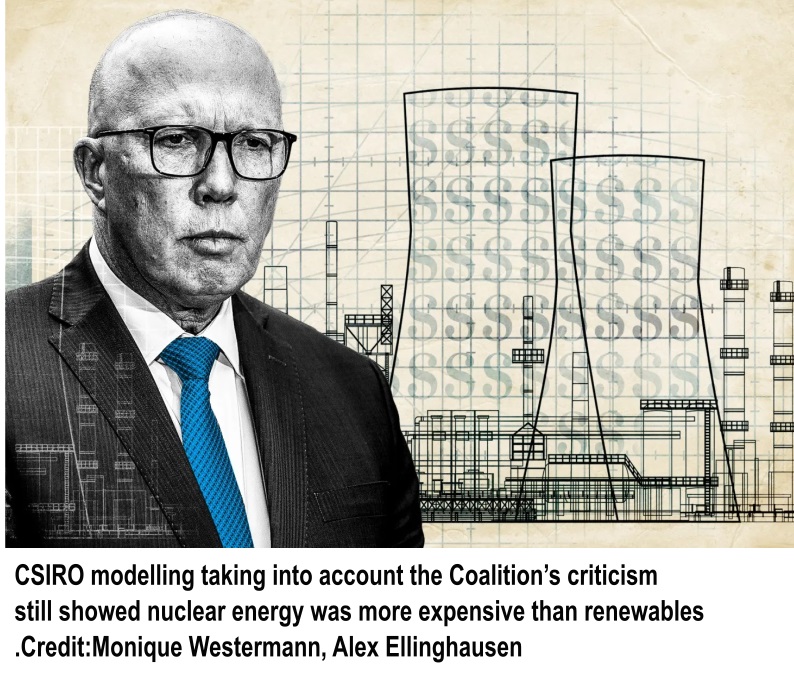
By James Massola, Paul Sakkal, Mike Foley and David Crowe, December 12, 2024 , https://www.theage.com.au/politics/federal/dutton-to-reveal-just-how-much-he-s-gambling-on-nuclear-power-20241210-p5kxai.html
Opposition Leader Peter Dutton will ask Australians to support hundreds of billions of dollars in new spending on nuclear energy, including a controversial move to use taxpayer subsidies to build the industry while promising to bring down household electricity bills.
The Coalition pledge comes as an exclusive survey reveals deep concerns about use of taxpayer funds to start the sector, with only 21 per cent of voters in favour of taxpayer investments or subsidies for nuclear power.
The Resolve Political Monitor, conducted for this masthead, showed renewable energy was more popular, with 45 per cent of voters backing subsidies for rooftop solar and 34 per cent supporting subsidies for home batteries – an option Labor is exploring as an election policy next year.
Dutton is expected to reveal more details of his plan on Friday with a pledge to build seven full-scale nuclear power stations, rather than smaller “modular” reactors, to deliver baseload electricity and lower the nation’s greenhouse gas emissions.
Coalition MPs will be briefed on the plan in a party room meeting on Friday morning at 10am.
A key part of the plan will be an assumption that coal-fired power stations will continue to operate while a Coalition government awards contracts to build the nuclear plants, even though energy companies are planning to stop using coal over the next two decades.
Recent modelling by consultancy Frontier Economics for the Coalition put a cost of $642 billion on Labor’s renewables rollout to 2050. As first reported by this masthead last week, the opposition will claim its nuclear plan will cost about $400 billion over the same period.
Subsidising power sources
Q: Which, if any, of the following do you think deserve subsidy or investment by taxpayers?
Rooftop solar
45%
Home batteries
34%
Renewables in general, such as wind and solar
33%
Large-scale batteries
28%
Large-scale solar farms
26%
Nuclear-powered electricity
21%
Hydro-electric energy from dams
21%
Natural gas-powered electricity
20%
Large-scale wind turbines on land
19%
Large-scale wind turbines off the coast
19%
Undecided
15%
Coal-fired electricity
13%
None of these
9%
n=1604
Source: Resolve Political Monitor
Energy Minister Chris Bowen rejects the $642 billion figure and stands by the energy grid operator’s forecast of $122 billion. The dispute is based on different ways of accounting for costs in the future.
Opposition veterans affairs spokesman Barnaby Joyce, one of the most outspoken proponents of nuclear power within the Coalition, said Australians had to decide whether “you want a grid that works or you don’t”.
Asked about earlier reports of a $500 billion projected cost, Joyce told this masthead: “It always was going to be this much. But we are spending $24 billion for pumped hydro, which gives maybe a day of power, and then you have to pay for transmission lines. The per-reactor price is lower.”
A key part of the Coalition argument is the cost blowout in the Snowy 2.0 project to generate more hydropower in the Snowy Mountains, while a nuclear project in the United Arab Emirates, backed by South Korean company KEPCO, has delivered results on time.
Joyce contrasted the Coalition plan with the controversial plan for the Hinkley Point C reactor in the United Kingdom, which is behind schedule, or the use of small modular reactors (SMR) in other countries.
“We are not devising a new reactor like in England, and we aren’t using an SMR,” he said.
“We are doing this with proven technology like in the UAE, it’s more economical that way. And that means the time frame can be realistic.”
Another member of the shadow cabinet, who asked not to be named, said most Australians were not concerned about nuclear power being rolled out as it would not be built anywhere near their homes.
“The biggest positive is that Peter has floated a big idea, a difficult idea, and he’s had the courage to do it. The debate over this will end up being modelling at 50 paces,” they said.
The Resolve Political Monitor found 34 per cent of voters supported the use of nuclear power, while 28 per cent were against it. Another 24 per cent said they did not have a strong view but were open to the government investigating its use.
The survey, conducted by research company Resolve Strategic, found 54 per cent of Coalition voters supported nuclear power while only 21 per cent of Labor voters and 15 per cent of Greens supporters said the same.
The question was: “There has been some debate about the use of nuclear power in Australia recently. What is your own view on the use of nuclear power in Australia?” The question did not outline the Coalition policy, given it had not been released.
The Resolve Political Monitor surveyed 1604 eligible voters from Wednesday to Sunday, generating results with a margin of error of 2.4 per cent.
While many Australians remain open to nuclear energy, views have tended to shift against the energy source since the survey asked about the issue more than one year ago.
The survey in October last year found that 33 per cent supported nuclear power and 29 per cent were open to the government investigating its use, leading to a total of 62 per cent who were prepared to back or consider it. This total slipped to 58 per cent in the latest survey.
The number of voters against nuclear increased from 24 per cent in October last year to 28 per cent in the latest survey.
In a separate question about taxpayer subsidies, the Resolve Political Monitor found 45 per cent of voters supported federal investments or subsidies for rooftop solar – the most favoured option. In contrast, only 13 per cent supported taxpayer subsidies for coal-fired electricity.
Power bills would rise by about $665 a year to repay the cost of building seven nuclear plants, according to analysis by the Institute for Energy Economics and Financial Analysis, based on the repayments needed to fund the average of construction costs from reactors recently built around the world.
The Coalition policy assumes a smaller addition of renewable energy to the electricity grid compared to government policy, which forecasts an increase in the share of renewable energy to 82 per cent of the grid by 2030.
The opposition has claimed the influx of renewables, which currently supply 40 per cent of electricity, will increase power bills and the risk of blackouts and disrupt regional communities where wind and solar farms are built.
Another key point of difference is the opposition’s assumption that the nation’s coal plants will run for decades longer than the Australian Energy Market Operator (AEMO) has forecast.
AEMO predicts that 90 per cent of coal-fired generation will be shut down before 2035, with closures complete by 2040.
The opposition has said its first nuclear reactor will be completed by 2035, while experts including the CSIRO say 2040 is the earliest possible date. A fully operational fleet of nuclear reactors cannot be expected before 2050.
Peter Dutton’s bid to politicise top science agency is ‘absurd’, former CSIRO energy director says.

Glenn Platt says opposition leader’s ‘lazy’ response to report undermines science.
Graham Readfearn, Guardian, 11 Dec 24
A former CSIRO energy director has said Peter Dutton’s attempt to politicise the national science agency’s work on the likely costs of nuclear reactors is “incredibly disappointing” and “absurd”.
The opposition leader attacked the CSIRO after its latest GenCost report reaffirmed that electricity from nuclear energy in Australia would be at least 50% more expensive than power from solar and wind, backed up with storage.
Dutton claimed: “It just looks to me like there’s a heavy hand of Chris Bowen in all of this.”
Prof Glenn Platt, of the University of Sydney and an energy industry entrepreneur, was research director on energy at CSIRO before leaving the national science agency in 2021.
He said instead of debating the substance of the CSIRO’s report, Dutton’s response was “lazy” and undermined the scientific process.
“It’s incredibly disappointing. It’s lazy just to say that you must have been politicised because the answer isn’t what you like,” said Platt, a fellow of the Australian Academy of Technological Sciences & Engineering.
The Coalition is expected to reveal details this week on the costs of building taxpayer-funded nuclear reactors at seven sites of coal-fired power stations around the country.
CSIRO’s annual GenCost report details the likely costs of different electricity generation technologies in Australia.
Bowen, the energy minister, said GenCost was “an independent report with no role by any member of parliament or minister”, and said Dutton should apologise to the agency.
Dutton has previously claimed the agency’s GenCost report had been “discredited”, prompting the agency’s chief executive, Doug Hilton, to hit back, saying the criticism was unfounded.
The latest report said evidence from other western democracies suggested it would take at least 15 years to plan, develop and build a nuclear reactor in Australia. A future Coalition government would have to repeal federal laws banning nuclear energy and negotiate on several state bans…………………………..more https://www.theguardian.com/australia-news/2024/dec/11/peter-duttons-bid-to-politicise-top-science-agency-is-absurd-former-csiro-energy-director-says
The Coalition told the CSIRO to redo its nuclear report. It’s bad news for Dutton
Mike Foley, December 9, 2024 , https://www.smh.com.au/politics/federal/the-coalition-told-the-csiro-to-re-do-its-nuclear-report-it-s-bad-news-for-dutton-20241205-p5kw6t.html
Nuclear power is still about 50 per cent more expensive than renewables, the CSIRO has found, even after the science organisation changed its modelling to accommodate criticism from the Peter Dutton-led Coalition that it had unfairly favoured wind and solar energy sources.
The report found the lowest cost projections for nuclear power would only match the highest projections for renewable energy, a major challenge to Dutton’s claim that nuclear is needed to cut electricity bills.
Dutton is preparing to release the long-anticipated costings of his party’s nuclear policy this week.
Dutton has fiercely criticised the government’s plan to boost the share of renewables to 82 per cent of the grid by 2030, claiming it is making electricity supply less reliable and more expensive.
He has instead pledged to create a “coal-to-nuclear transition” if elected, overturning state and federal bans on nuclear energy and building seven plants across the country.
“When you look at 19 of the top 20 economies in the world, they all have nuclear, or they’ve signed up to the latest generation nuclear technology. Australia is the only outlier,” Dutton told reporters in Tasmania on Sunday.
Highlighting the significance of the CSIRO’s findings, opposition energy spokesperson Ted O’Brien met with the science agency after its previous GenCost report in May found renewables were the cheapest form of energy and asked it to redo the modelling with key assumptions changed.
O’Brien declared that CSIRO should acknowledge a nuclear plant would be in near-constant use – generating power 93 per cent of the time – while also extending the assumed lifespan from 30 years to 80 years.
Proponents consider these factors crucial to reflect the real-world benefits of nuclear power plants and have argued that renewables get an unfair advantage when they are not adequately reflected in modelling.
CSIRO accommodated these requests and still found the cost of nuclear energy was significantly higher than “variable renewables”, namely wind and solar power backed up with batteries and a major transmission-line rollout.
“The cost range for variable renewables with integration costs is the lowest of all new-build technology capable of supplying reliable electricity in 2024 and 2030,” GenCost said.
The ratio of how long an energy generator is operational compared with sitting idle, known as the capacity factor, is key to the cost of its energy.
O’Brien claimed in May that CSIRO modelling should use the United States’ average capacity factor for a nuclear plant of 93 per cent.
In responding to O’Brien, CSIRO said it was appropriate to use a range of capacity factors, given the 15 coal plants in eastern Australia ran on average 60 per cent of the time and a nuclear plant would slot into the grid as a replacement for coal.
CSIRO’s modelling showed that, adjusted for Australian conditions, a traditional large-scale nuclear plant that was operational 90 per cent of the time would generate electricity at $155 a megawatt hour. With a utilisation rate of 53 per cent, it would cost $252 a megawatt hour.
In contrast, wind farms would generate power at $56 to $96 a megawatt hour, using a conservative range of capacity factors based on how often they were expected to run. Under a similar calculation, solar farms would generate power for between $35 and $62 a megawatt hour.
O’Brien’s second contention, that CSIRO should factor in an 80-year life span for a nuclear plant, rather than the 30-year life it assumed, made the economics more favourable because there was more time to repay loans.
CSIRO ran the numbers for a plant over 60 years. It found this would deliver a discount of 11 per cent on the original cost. However, most of this saving would be gobbled up by refurbishment costs, typically about $3 billion, needed when a plant was 40 years old.
The figures would be similar for a 100-year-old plant because it would need several refurbishments.
“Long-term operation of nuclear is not costless,” GenCost said. “Extension costs are incurred and are significant.”
CSIRO found a grid with 90 per cent renewables would produce electricity for between $106 and $150 a megawatt hour, including $40 billion in expenditure on the rollout, with new transmission lines as well as batteries and gas plants to back up wind and solar farms.
While GenCost provided a range of projections, the above costs were calculated in today’s dollars and assumed the current price of construction.
GenCost uses a levelised cost of energy calculation to price energy from various technologies. This represents the price needed for an electricity generation plant to earn back the cost of its construction and running costs over its lifespan.
CSIRO will update its GenCost report based on further feedback from stakeholders.
Policy bum Dutton has two big ideas. They’re both in bad trouble
Peter Dutton has two big ideas: cut migration and build nuclear power plants. He’s now abandoned one, and we know the other will be a disaster.
Bernard Keane, Crikey.com Dec 09, 2024
This opposition caper is pretty easy, Peter Dutton must have been thinking throughout the year. Just bag the government, disappear from the media cycle if things ever get hectic, and let the Reserve Bank’s smashing of the economy do the job of undermining government support.
At some point, however, he was going to have to produce at least some policy. Not too soon, and not too much — just enough to look like he has some sort of plan. It should have been doable. After all, he has the entirety of News Corp on his side to praise his policy offerings, and the fencesitters and bothsiders of the press gallery in other outlets won’t criticise Dutton without making sure they offer equal criticism of the government.
But that overlooks the fact that Dutton is, to use a term made famous by Paul Keating, a policy bum. There is nothing in his political history that indicates either ministerial competence or policy nous. He was an indifferent health minister who failed to push through a Medicare copayment. As immigration and then home affairs minister, he lost control of borders to organised crime and failed to fix the many basic problems of the Immigration Department. His shorter time at Defence was of a Marlesian quality — a blithe indifference to the department’s many failings, while shrilly yelling at China.
Dutton’s limited forays into policy as leader have been characterised by confusion. It’s still not clear exactly what the Coalition’s tax policy is, with the initial opposition confusion in the aftermath of Labor’s changes to the stage three tax cuts — remember those — lasting to this very day: when even your mates at News Corp say you’re “kicking the can down the road“, it’s not a good sign.
………………………………………………………………………………………………………………………….. But the confusion has now gotten worse…………………………………………………………………………
Dutton’s other signature policy, an unprecedented, fiscally devastating entry of the government into power generation, will receive some time in the spotlight this week with Dutton having promised for the umpteenth time he’ll release details of it. That the Coalition is busy trying to invent numbers for Labor’s policy to argue that the hundred-billion-plus cost of nuclear reactors is the cheap option suggests no amount of fake “independent modelling” or Panglossian assumptions have been able to get the costing down to anything reasonable.
In that context, it’s worth reading the CSIRO’s latest GenCost report, which sets out to address the complaints of nuclear power fans and the Coalition that the assumptions behind its 2023 demolition of the economic case for nuclear power (and, it shouldn’t be forgotten, Labor’s carbon capture and storage scam) were unfair.
The opposition complained that the lives of nuclear reactors are much longer than modelled. GenCost notes that nuclear power plants can indeed run for many decades, but they need refurbishment to do so, and renewables plants can run for similar lives at a much lower refurbishment cost.
The opposition complained the CSIRO should have used a US power capacity figure of 93%, not the global nuclear industry average of 80% or the Australian coal-fired power plant average of 59%. GenCost pointed out it uses the same capacity range for all power sources, and it’s not prudent financially to assume the best-case scenario.
The opposition complained that nuclear power plants could be up and running in 10-15 years and not 15 years as GenCost assumed. Gencost points out that nuclear construction times have now blown out by 2.2 years recently, and that the only countries building reactors quickly are non-democracies that don’t have to worry about public consultation.
But what about changing costs for different power sources? Well:
The capital costs of onshore wind generation technology increased by a further 8% in 2023-24 and another 2% in 2024-25 while large-scale solar PV has fallen by 8% in consecutive years. Large-scale battery costs improved the most in 2024-25 falling by 20% in 2024-25.
Even with some of the tweaks demanded by the Coalition, the latest GenCost report shows large-scale nuclear is significantly more expensive than coal, gas and solar or wind with firming capacity. The only things large-scale nuclear is cheaper than is carbon capture and storage, and small modular reactors — which are at least twice the cost of any other energy source and three times the cost of the cheaper ones.
Dutton might be better off abandoning any policy and simply going to the election with nothing more than incessant criticism of Labor. He’s a policy bum, and any time he opens his mouth on his own policies, he confirms it. https://www.crikey.com.au/2024/12/09/peter-dutton-immigration-nuclear-energy/
If you don’t know, vote no on nuclear
Paul SEKFY,
Yarranbella. News Of The Area – Modern Media – , https://www.newsofthearea.com.au/letter-to-the-editor-if-you-dont-know-vote-no-on-nuclear?fbclid=IwY2xjawHCJhpleHRuA2FlbQIxMQABHfZmi7k4NSrBSYSgCBdH1DMvb4qmQAyFkXq6z6NPT1O3fwFestYaRYCKdg_aem_Ce9U6F-WQb71jMpXOintCw
THE fatuous debate about potential nuclear power options for Australia cannot be taken seriously.
There is no credible evidence supporting any such proposal either economically or environmentally in the Australian context.
The most recent Royal Commission, in 2016 in South Australia, into the nuclear fuel cycle concluded as much.
The history of nuclear power plant accidents and disasters should sound enough warning.
There is an increasing level of radioactive pollution due to the nuclear fuel cycle more generally and the ongoing release of radioactive material continues.
We now have a nuclear waste storage facility in South Australia due to our AUKUS agenda, but we have not been able to locate a necessary more permanent nuclear waste storage facility anywhere.
Sensible people do not want one to be anywhere.
This should signal game over but sadly not.
The economics do not add up and the time taken to build reactors will not assist in meeting our essential carbon reduction targets.
Further concentration of power generation capital in the hands of a wealthy few, regardless of suggested initial taxpayer investment is clearly not desirable or justifiable.
Just look at the coal and oil industries in terms of their dominant power and influence.
Owned by an elite few, they continue to pollute and expect subsidies to do so.
We now recently have seen how this folly grows.
Locally we have proponents of nuclear power promoting that it is somehow in our interests to pay them our money to hear these paid proponents spruik their theories.
Creative and clever solutions to energy and climate are needed, not this dangerous misdirection.
If you don’t know, vote no is the most appropriate advice with regard to the nuclear issue.
Surely a more sensible nuclear agenda for humanity and us Australians is a ban on nuclear weapons.
Dutton axes third wind farm ahead of nuclear pitch

AFR Phillip Coorey, Dec 5, 2024
Peter Dutton has upped the ante on energy ahead of the release of his nuclear power policy, vowing to scrap plans for a massive wind farm off the NSW central coast if elected.
The opposition leader’s pledge to not proceed with a wind farm off the coast of the Hunter, north of Sydney, takes to three of the six wind farms proposed by the Albanese government the Coalition would abolish.
The others are off the NSW Illawarra coast and the West Australian coast. The remaining three off the Victorian and South Australian coasts are likely to be spared.
Mr Dutton made the announcement in the Labor seat of Paterson, in the Hunter Valley, where the wind farm proposal has polarised the community and which the Coalition is targeting at the next election……………………………………………………………………. more https://www.afr.com/politics/federal/dutton-axes-third-wind-farm-ahead-of-nuclear-pitch-20241205-p5kvzv
Dutton to claim nuclear rollout will end up cheaper than renewables
The Age , By Paul Sakkal, December 5, 2024
Key points
- Peter Dutton will reveal his costings for seven nuclear plants as soon as next week.
- They are expected to claim the opposition’s energy grid plan – including renewables, gas and nuclear – will cost ‘significantly less’ than Labor’s.
- The opposition claims Labor’s renewables-led approach will cost $642 billion, while the government relies on a $122 billion figure.
Peter Dutton will claim the Coalition’s nuclear-backed grid will cost less to deliver than Labor’s renewables-led approach, escalating a war over the key cost-of-living issue ahead of next year’s federal election.
The opposition leader will reveal his costings for seven government-backed nuclear plants as soon as next week. This masthead has confirmed the Coalition will claim its energy grid plan – including renewables, gas and nuclear – would cost less than Labor’s.
“It will be significantly less than Labor,” one top Liberal said of the tightly held nuclear costings. Another opposition source suggested the total cost of the Coalition’s energy system rollout would be about $500 billion. The opposition claims Labor’s plan would cost $642 billion………………………………………… https://www.theage.com.au/politics/federal/dutton-to-claim-nuclear-rollout-will-end-up-cheaper-than-renewables-20241205-p5kw09.html
Nuclear energy inquiry draws emotional response in Port Augusta

By Annabel Francis and Arj Ganesan, ABC North and West SA, 7 Dec 24
In short:
The select committee conducting an inquiry into nuclear power generation in Australia has triggered strong opinions from both sides of the fence.
Aboriginal leaders, resident representatives, and leaders from the mining and energy sector have spoken during a hearing at Port Augusta.
What’s next?
Should the opposition win the next election, it has promised to hold a two-and-a-half year consultation period over its nuclear plans.
The federal government’s select committee inquiry into nuclear power generation at Port Augusta has stirred strong emotions among those making a submission.
For anti-nuclear activist and Yankunytjatjara Anangu woman Karina Lester, it is a debate she is tired of having.
“Governments change, committee members change … organisations, company members, CEOs of companies change,” Ms Lester said.
“Those of us that are in the frontline are constantly needing to remind governments of the impacts of nuclear in our communities.
“Aboriginal people of South Australia have always said no to nuclear.”
Ms Lester, who gave evidence at a select committee hearing in Adelaide, describes herself as a survivor of the Emu Field nuclear tests.
She said Indigenous people had seen the impacts of nuclear technology first-hand.
Her father, Yami Lester, went blind at the age of 16 following British weapons testing in Maralinga in South Australia in the 1950s.
Ms Lester said she feared Indigenous groups would suffer if the federal opposition’s nuclear plans went ahead.
“Aboriginal communities are always the solution or pressured to be the solution for the waste issues,” she said.
“The history shows us that locations identified are locations that are First Nations or Aboriginal people’s traditional lands.”
Port Augusta’s former coal power station was one of seven sites that was earmarked as a possible location for the opposition’s nuclear energy plan.
The Nukunu Wapma Thura Aboriginal Corporation, which holds native title over the proposed site, has voiced strong opposition to any nuclear proposal.
“Aboriginal people throughout the region and state of South Australia have historically and overwhelmingly opposed nuclear energy, and the storage of its waste,” a spokesperson said.
Greg Bannon from the Flinders Local Action Group gave evidence at the public hearing in Port Augusta about the potential risk of a nuclear accident.
He has opposed nuclear technology for decades and said the time to switch to nuclear energy had passed. “I think it’s old technology, and I don’t think we need it,” he said.
Mr Bannon said any accident or error would not only have a devastating impact on the local community but also on vulnerable marine ecologies, such as the giant Australian cuttlefish that aggregates about 50 kilometres away from Port Augusta……………………………https://www.abc.net.au/news/2024-12-06/nuclear-energy-hearing-emotional-port-augusta/104694596
Peter Dutton cops backlash over push to build seven nuclear power stations in Australia
Opposition wants nuclear power plants over Anthony Albanese’s renewables
Daily Mail 4th Dec 2024, By BRETT LACKEY FOR DAILY MAIL AUSTRALIA
Aussies have hit back at plans to build nuclear power stations in the country as the Coalition ramps up its push to establish seven sites as part of its election promise.
Parliament’s House Select Committee on Nuclear Energy is investigating the proposal and is travelling around the country hearing views from local communities.
At a meeting in Traralgon in Victoria’s Gippsland region on Tuesday angry locals fired up at the plan, which would see one of the new nuclear plants built at the currently winding down Loy Yang coal plant just 10 minutes out of town.
The other six locations Peter Dutton has outlined for nuclear plants are at the coal plant sites of Tarong and Callide in Queensland, Liddell and Mount Piper in NSW, Port Augusta in SA and Muja in WA.
‘We do not need nuclear in Australia. We need to be pushing more renewable energy and the technology will develop more and more as we go to keep the lights on,’ president of community group Voices of the Valley, Wendy Farmer, told the meeting.
Shadow energy minister Ted O’Brien, also the committee’s deputy chair, asked if it was ‘just a no’ from Ms Farmer or if she was interested in studying whether nuclear could be a safe and effective form of electricity.
‘The Coalition have told us that they would consult with us for two and a half years but then they would go ahead with nuclear, whether we wanted it or not and our community would have no rights of veto,’ Ms Farmer fired back.
‘How can we trust the Coalition to have an independent study when you say proposal but where’s the proposal?’
Darren McCubbin, the CEO of Gippsland Climate Change Network, got a standing ovation when he told the meeting renewables were ‘ready to go’ while nuclear power stations would require years of consultations and reports.
‘I’d like to congratulate Mr O’Brien for recognising that we don’t have the science, that we need a work plan, that we need two and a half years of consultation,’ Mr McCubbin said.
‘Good on him for coming here and saying we don’t know the answers and we need to find them because they don’t have the answers.’
Mr McCubbin pointed to the 2GW of Victorian offshore wind power projects slated to be online by 2032, which would increase to 5GW by 2035.
Look right now we’ve got a stream towards renewables, we’ve got targets in place. We’ve got an industry waiting to go, we’ve got people coming from all over the world looking in Gippsland and saying we have a way of transitioning out [of coal-fired electricity].
‘We’ve got the science, we’ve got the community [support]. We’ve had Star of the South [wind farm project] here for five years doing community consultation and I appreciate that you recognise you haven’t done that.
‘So we’re ready to go and putting things off for two and a half years to have work plan after work plan and work plan is not a solution for jobs and growth within our region.’
A recent Demos AU poll of 6709 adults between July 2 and November 24 found that 26 per cent of women said nuclear would be good for Australia, compared with 51 per cent of men.
But only one in three of the men surveyed were willing to live near a nuclear plant.
Almost two-thirds (63 per cent) of women said they don’t want to live near a nuclear plant and more than half (57 per cent) said transporting radioactive waste isn’t worth the risk.
The report card follows polling by Farmers For Climate Action that found 70 per cent of rural Australians support clean energy projects on farmland in their local areas and 17 per cent were opposed.
That support came with conditions, including proper consultation and better access to reliable energy.
Sanne de Swart, co-ordinator of the Nuclear Free Campaign with Friends of the Earth Melbourne, claimed nuclear electricity would ‘increase power bills, increase taxes and increase climate pollution’.
The independent Climate Council said it was concerned the coalition was relying on one private sector ‘base case‘ for nuclear costings rather than expert advice such as from the Australian Energy Market Operator.
‘What’s crucial is that any new investment is made at the least cost to Australian consumers,’ a council spokesperson said. ‘Only renewables – solar, wind, hydro – together with energy storage is capable of delivering on this, and it’s being built right now,’ the council said.
Minister for Climate Change Chris Bowen recently took a swipe at Peter Dutton and the Coalition’s nuclear proposal saying that it would take too long to get the plants up and running.
‘Net zero by 2050 is not optional. Which means the critical decade is now.’
With six years to go to reach the legislated target of a 43 per cent reduction in greenhouse gas emissions, he said the nation was on track to meet it and to make 82 per cent renewable electricity in the national grid by 2030.
On Wednesday the House Select Committee was told legal requirements to make the former coal sites safe to build nuclear reactors will take decades of rehabilitation before they can be used.
‘We’re talking significant periods of time of two or three decades,’ Victoria’s Mine Land Rehabilitation Authority chief executive Jen Brereton said. https://www.dailymail.co.uk/news/article-14154479/Australia-nuclear-power-plant-locations-backlash.html
The seven ways the Federal Coalition could cook the books on nuclear costings

December 5, 2024, The AIM Network, Climate Council, https://theaimn.com/the-seven-ways-the-federal-coalition-could-cook-the-books-on-nuclear-costings/
Australians are being kept in the dark about the true costs of the Federal Coalition’s risky and expensive nuclear scheme.
The Federal Coalition’s heavy reliance on the first of two Frontier Economics reports paints a damning picture of the methods they may use to fudge the nuclear numbers and mislead Australians. We’ve already seen them cherry-pick numbers and use them to make misleading claims in Parliament.
Climate Councillor and economist Nicki Hutley said: “The Federal Coalition’s nuclear scheme would cost Australians a bomb. It’s a risky, expensive fantasy that would see Australians paying more than $100 billion for a fraction of the electricity we need. The real danger is delaying real solutions–like building more renewables, which is the most affordable way to keep the lights on.”
The Climate Council has identified five furphies Australians are likely to see in the Federal Coalition’s nuclear costings:
1) Comparing apples with oranges: We’ve already seen the Federal Coalition use inaccurate comparisons in the first Frontier Economics report on the cost of the shift to renewables. They inflated the cost by including ongoing fuel and maintenance expenses—which we’re already paying and which will actually drop in a renewables-led grid. On top of that, they didn’t use present value terms, a standard economic practice that accounts for the true cost over time.
Nicki Hutley, Climate Councilor and Senior Economist, said: “It’s alarming to see the Federal Coalition knowingly compare costs that are for totally different things. If we’re going to have a debate on the economics of building renewable power and storage, it needs to be based on best practice economics, not a false and misleading comparison.”
2) Excluding the cost of attempting to keep our ageing coal stations open: AEMO expects all our outdated, unreliable and polluting coal-fired power stations to close by 2038 at the latest, with over 90% shutting down in the next 10 years. But the Federal Coalition wants to keep these creaking old coal power stations open while waiting at least 15 years or more for nuclear reactors. This would cost taxpayers a bomb in constant maintenance and fault repairs. Keeping just one coal power station open, Eraring in NSW, could cost taxpayers more than $225 million per year. Renewable power back by storage is the only solution ready now to fill that gap left by coal and secure reliable, affordable power for Australian homes and businesses.
3) Excluding the cost of managing highly radioactive nuclear waste:Toxic nuclear waste needs to be safely stored for 100,000 years – an enormous and costly responsibility. In Canada, storing the long-term waste from their nuclear program in an underground facility is expected to cost at least $33 billion AUD, excluding the costs already incurred to manage waste on nuclear reactor sites.
Nicki Hutley, Climate Councilor and Senior Economist, said: “Any plans to build nuclear reactors must include the staggering long-term costs of managing highly radioactive nuclear waste. Ignoring these costs now will unfairly burden our kids, grandkids and future generations.”
-Advertisement-
4) Failing to consider the cost of climate change: The Federal Coalition’s nuclear scheme won’t cut climate pollution. In fact, building nuclear reactors would mean burning more polluting coal and gas in the meantime, which could see a further 1.5 billion tonnes more harmful climate pollution produced by 2050 – the equivalent of running the Eraring coal power station in NSW for another 126 years. Australians would pay the price in worsening unnatural disasters and skyrocketing insurance costs.
Nicki Hutley, Climate Councilor and Senior Economist, said: “Nuclear would cost us dearly, by delaying urgent cuts to climate pollution that would expose Australians to more unnatural disasters like bushfires, floods and heatwaves and driving up economic losses through higher insurance costs and disaster recovery bills. We should be focusing on cutting costs and climate pollution by rolling out more clean, reliable and affordable renewable power.
5) Ignoring Australia’s growing electricity needs: As Australia’s population and economy grows, keeping up with the community’s electricity needs is essential. The Australian Electricity Market Operator’s plan for our grid, the Integrated System Plan, expects power demand to double by 2050. We need more power to meet this need, and any assessment of cost needs to account for this. Assuming less might make costs look cheaper, but is inaccurate.
6) Ignoring the risk of cost blowouts: The Federal Coalition’s nuclear costings are likely to rely on rose-tinted assumptions, ignoring the very real possibility of massive cost overruns and delays that have plagued international nuclear projects.
For example, the UK’s Hinkley Point C energy facility is running 14 years late, at a cost three times its original estimate—now sitting at a staggering $90 billion AUD. Assuming nothing will go wrong with nuclear reactors in Australia flies in the face of international experience and puts taxpayers at enormous financial risk.
Nicki Hutley, Climate Councilor and Senior Economist, said: “Nuclear is simply a non-starter for Australia. The risks are immense—blowouts in cost and time, unresolved waste storage issues, and outdated technology. Projects like the UK’s Hinkley Point C show that nuclear is a financial black hole, while renewables are delivering results today.”
7) Ignoring the cost of transmission upgrades: The Federal Coalition assumes nuclear reactors can avoid the costs of necessary transmission upgrades, despite these investments being approved and supported by the previous Liberal-National Government.
Australia’s electricity grid needs substantial upgrades to meet growing energy demands and replace ageing coal-fired power stations. Building reactors near old coal stations won’t avoid the need for new transmission: the transmission previously used for coal is already being used by new batteries, wind and solar, and more investment is being planned. New transmission is needed no matter which energy source we build, and will make our grid stronger and more efficient.
Amanda McKenzie, CEO of the Climate Council, said: “Peter Dutton could cook the books with some creative accounting to sell this fantasy. Our old coal plants are retiring in the next decade, and we need to keep investing in low cost renewables to keep the lights on, create thousands of jobs in regional Australia, and ensure we cut climate pollution further and faster.
“Let’s focus on what’s already working. Renewables are cutting pollution, creating jobs, and lowering power bills right now.”
A sneak preview of Peter Dutton’s nuclear costings
Tristan Edis, Dec 2, 2024, , https://reneweconomy.com.au/a-sneak-preview-of-peter-duttons-nuclear-costings/
Any day now, we should be provided with an estimate from the Liberal-National Coalition and/or Frontier Economics on what Peter Dutton’s plan for nuclear power will cost us.
Keep in mind we already have plenty of sources of information for what nuclear power costs based on real-world experience.
The chart below,[ on original] based on analysis by myself and Johanna Bowyer, shows the power price required for nuclear power plants to be commercially viable compared to current wholesale energy costs passed on to residential power consumers.
These power prices are based on the cost of actual power plants which have either been committed to construction or which provided tender construction contract offers over the past 20 years across Europe and North America.
Our research indicates that conventional nuclear power stations cost anywhere between $14.9 to $27.5 million per megawatt to construct. They also accumulate significant finance interest costs over a lengthy construction period ranging between 9 to 18 years.
While yet to be commercialised small modular reactors are promised to achieve shorter build times, they don’t exist, except on the drawing board.
The only one that has progressed to a construction contract in the developed world would have cost $28.9 million per megawatt. These are the range of costs and build times that the Coalition and/or Frontier Economics should be using if they want to be realistic.
This would lead to the uncomfortable conclusion that household power bills would need to rise by around $665 per year for nuclear power plants to recover their costs from the electricity market.
Oddly, Ted O’Brien and Angus Taylor didn’t think real world experience with nuclear projects was a valid basis for assessing the cost of their plan. That, of course, makes one wonder what they might have in mind.
Here are four ways they might instead approach their costing:
1) Apply the shoulda, coulda, woulda approach to costing nuclear power plants also known as a “nth of a kind” costing;
2) Assume all transmission upgrade costs can be avoided with nuclear even though the prior Liberal-National Government approved and supported these transmission projects when in government;
3) Assume coal power plants never grow old;
4) Assume the damage from emissions released prior to 2050 don’t matter
We look at those claims in detail.
1) Look out for ‘NOAK’ or the shoulda, coulda, woulda approach to costing
Advocates for nuclear power aren’t terribly fond of using costs based on real-world experience. Instead they like to apply the shoulda, coulda, woulda approach to power plant costing.
This is where they assume away all the things that almost always go wrong with nuclear power plant construction, and imagine what should, could, or would happen if the real world would just stop being so damn unco-operative.
This typically requires that:
1. Construction companies and component suppliers stop making mistakes and stop seeking to claim contract variations;
2. Members of the community and politicians welcome nuclear projects with open arms and stop seeking to obstruct and delay them;
3. Nuclear plant designers get their designs perfect right from the start, avoiding the need to make adjustments on the fly as construction unfolds;
4. Financiers stop worrying about risk;
5. The community and politicians loosen-up about the small risk of radioactive meltdowns and apply less onerous safety requirements;
6. Construction staff aren’t tempted away to non-nuclear projects with offers of better pay or a more reliable stream of work;
7. Safety regulators work co-operatively and flexibly (compliantly?) with industry; and
8. Power companies en masse commit to ordering lots of reactors from a single supplier well in advance of when needed to enable the supply chain of nuclear equipment suppliers to achieve mass economies of scale and learning.
You generally know that these types of assumptions have been made in a nuclear costing because that costing will be described as a “nth of a kind” or NOAK cost.
The idea here is that incredibly high costs that were incurred in building all the prior nuclear power plants were an anomaly because they involved a whole bunch of mistakes and inefficiencies that the industry will learn from.
So, after they build several more and get progressively better, they’ll eventually reach the “Nth” number of plants, and all the problems that made prior plants so expensive will be ironed out.
At exactly what number plant do we reach N?
Well that’s usually a bit rubbery.
Under pressure from the nuclear lobby, you’ll find this NOAK costing approach is commonly adopted by the International Energy Agency, the US Department of Energy and even Australia’s CSIRO adopted a nuclear NOAK costing for its GenCost publication.
Unfortunately, while these agencies are generally good sources of information, the Nth power plant seems to always be a few more nuclear power plants away from being realised.
In reality the cost of building nuclear reactors has historically got worse rather than better over time in the western world.
The chart below [on original] illustrates the construction cost experience for pressurised water reactors in the US (in blue) and France (in red). Note this was based on a 2011 paper and omits the more recent and even worse cost experience detailed in the report by Bowyer and myself.
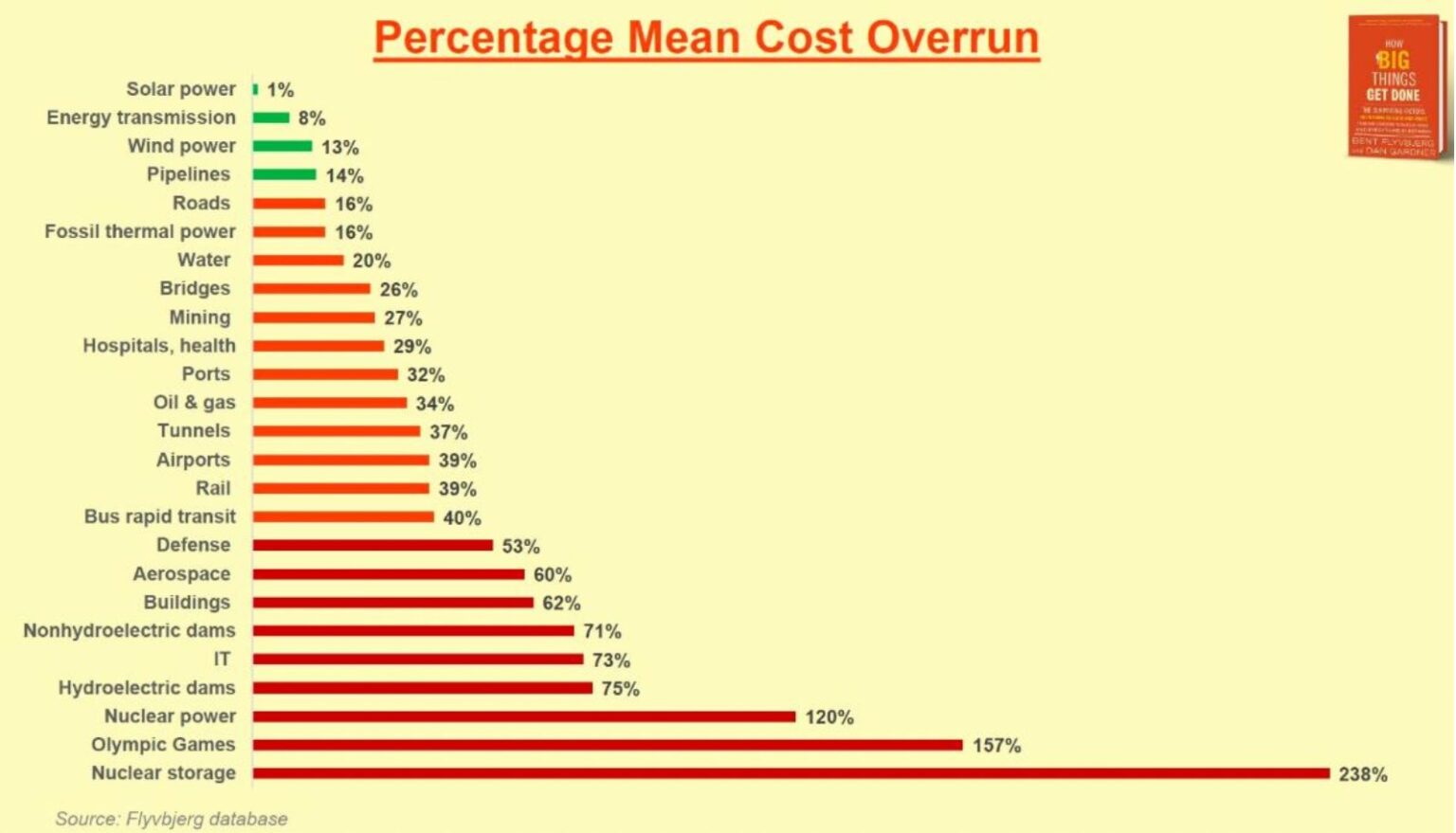
Bent Flyvberg – a professor in construction management at Oxford University and author of the bestselling book, How Big Things Get Done, has helpfully compiled a huge database of how major construction projects across the globe have performed against their original budgets.
This database reveals just how unreliable are the costings provided by the nuclear industry and its proponents. As the chart below published by Flyvberg reveals, the mean cost overrun of nuclear power projects stands at 120%, with only Olympic Games and Nuclear Waste Storage Facilities managing worse cost over-runs.
Meanwhile look at what types of projects perform well [graph at top of page]– notice anything?
For the journalists reading this article your task is simple – when the Coalition or Frontier Economics release their nuclear plan costing you need to ask them the following:
(1) Can you please provide us with a written assurance from the CEO of an experienced nuclear technology provider, like Westinghouse, EDF or Korea Hydro and Nuclear Power, confirming they are willing to enter into a fixed price contract to build a nuclear power plant in Australia for the cost and timeframe used in your costing?
If instead they cite to you the experience of the Barakah Plant in the United Arab Emirates let’s say, then you can always ask them:
So, like the United Arab Emirates, will you be:
– allowing the mass importation of construction labour from developing countries;
– removing the right of workers to collectively organise and bargain;
– exempting nuclear construction projects from paying Australian award wages; and
– banning the right to peacefully protest?
2) All transmission expansion costs are the fault of Labor and can be avoided with nuclear power
It should be acknowledged that transmission network expansion projects in this country are also being hit by large budget blow outs which involve multi-billion dollar costs. We need to do a far better and more judicious job in the roll out of transmission projects in this country.
It’s also true that several of these projects are critical to supporting ongoing expansion of wind and solar power. Ted O’Brien and David Littleproud have been highly critical of these new transmission projects and claimed extra transmission costs can be avoided by rolling out nuclear.
Given this, their forthcoming costing will probably suggest all of these new transmission costs can be sheeted home to Labor’s Renewable Energy Policies.
But this would also indicate that O’Brien and Littleproud suffer from amnesia. That’s because the major transmission expansions which are incurring the largest costs were actively pushed by the former Coalition Government which both of them served in.
Read more: A sneak preview of Peter Dutton’s nuclear costingsThe prior government “welcomed” and helped underwrite the new 900 kilometre transmission interconnector between SA and NSW.
In the lead up to the 2019 election, they vowed to build a second electricity interconnector between Tasmanian and the mainland.
In January 2020 the Federal Coalition entered into a funding deal with the NSW Government to upgrade transmission lines across north, central and southern NSW.
As part of the 2020 budget, Angus Taylor and a range of National Party MPs announced funding support for an 840km transmission line across inland Queensland which they declared was a “commitment to regional jobs, industry development and affordable reliable power.”
Then, leading into the 2022 election, they announced they would underwrite construction works on a major new transmission line between NSW and Victoria.
Then Energy Minister Angus Taylor’s press release at the time spoke glowingly about the benefits of new transmission, stating:
“Our investment in this project will support reliable electricity supply, deliver substantial cost savings and help keep the lights on for Australian families, businesses and industries.
This builds on the Morrison government’s record of judicious investment of over $800 million in priority transmission projects recommended by AEMO’s Integrated System Plan – projects that stack up for consumers.”
3) Relying on coal power plants that never grow old
It is almost guaranteed that the Coalition’s costing model will assume we can rely on the existing coal power stations to keep powering on for another decade or two with no deterioration in their reliability, before they then switch to nuclear power.
This is a very handy assumption to make because it allows you to avoid or delay significant costs involved in building the new, replacement power stations before the nuclear plants miraculously come to the rescue.
Yet while it might be a handy modelling assumption, it probably isn’t a realistic one.
To keep coal power plants reliable, especially when they are several decades old, requires ongoing significant expenditure on maintenance and replacement parts. Plus, even with this expenditure there can reach a point where a plant is so old it will continue to suffer serious reliability problems.
A good example of the risks and limitations of refurbishment is the case of the attempt to refurbish Western Australia’s Muja A and B coal generating units of 240 megawatts.
In 2007 these units, which were approaching 50 years of age, were mothballed. But by 2009 the WA Government announced they would be recommissioned due to a gas shortage that had afflicted the state. At the time the cost was estimated to be $100m.
The cost of refurbishment subsequently blew out to $290 million and in 2012 one of the units suffered an explosion due to corroded piping, injuring a worker.
A subsequent investigation highlighted a range of technical problems with the plant that made refurbishment challenging, but in 2013 the government chose to press on and sink a further $45 million into the project, claiming it would have a lifetime of 15 years and ultimately recover its costs.
However, even after refurbishment was completed it was reported by the West Australian newspaper the generating units were “plagued by operational and reliability problems, generating electricity just 20 per cent of the time. By 2018 the WA Government decided to cut their losses and shut Muja A and B permanently.
AGL’s Liddell Power Station is another case in point. AGL argued that a ten year life extension would cost $900m, and decided it wasn’t worth it. A government taskforce which sought to second guess AGL on the closure noted,
“a Liddell extension meets the maximum power output requirement.
This means it could provide sufficient capacity to maintain current levels of reliability in NSW as long as it is actually available during peak demand conditions. However, the increasing risk of outages as the plant ages gives rise to an increasing possibility those outages would lead to supply shortfalls.
Liddell already has a high outage rate compared with other NSW coal generators…. There is a risk that upgrades to make the plant compliant with safety and other regulation would not alter its upward trajectory of faults and unplanned outages.”
The other issue is that owners of power plants are likely to face considerable difficulty raising finance to undertake such refurbishment.
Delta Electricity, the owner of the Vales Point B coal power station, revealed in a rule change request to the AEMC that it was facing significant difficulty accessing bank finance stating, “A significant number of financial institutions…are no longer providing financing facilities to fossil fuel generators”.
The rule change request asked that Delta be able to provide cash, rather than a bank guarantee to AEMO to meet prudential requirements for trading purposes.
It explained that the bank providing its current guarantee was unwilling to continue with this arrangement because lending to a coal generator was in breach of environmental policies governing its financing practices.
In a search to find another lender Delta found, “during the refinancing process that 13 of the 15 lenders declined due to ESG [Environment, Social and Governance] constraints, which included the Big-4 Australian banks.
“Both of the remaining financial institutions were prepared to offer a bank guarantee facility to provide credit support related only to requirements for mining rehabilitation obligations and renewable Power Purchase Agreements.”
Some conservative politicians might like to pass this off as some short-term, woke fashion that will pass once they reach power. But it won’t pass, because bankers don’t like to lend money to risky commercial ventures.
Some conservative politicians might think global warming is an idea promoted by a mass conspiracy of meteorological science agencies across the globe to impose a socialist, world-wide government. However, most people think that’s a bit far-fetched.
Conservative politicians that think climate change is a hoax aren’t always in power, so bankers recognise there is a significant risk coal generators will be subject to emission control policies that will undermine their commercial viability.
This isn’t a distant risk, because such policies (which often are targeted towards supporting growth of renewable energy) have already been implemented.
4) The damage caused by power plant emissions in the years prior to 2050 don’t matter
Carbon dioxide and a range of other greenhouse gas emissions released by fossil fuel extraction and combustion last many decades once released into the atmosphere. Consequently, the extent of global warming is a function of the accumulated stock of greenhouse gas emissions in the atmosphere built up over time.
It isn’t a function solely of emissions in the single year of 2050. If we manage to achieve net zero emissions in 2050, but have polluted the hell out of the atmosphere in the preceding years then global warming will be very bad indeed.
A tonne of CO2 emitted this year and each of the years preceding 2050 will cause damage to society that is worth something to avoid. Any economist worthy of calling themselves an economist knows that the value of this avoided damage needs to be taken into account in any attempt to properly cost alternative options for our electricity system.
The Australian Energy Regulator provides one such option for valuing this in its paper – Valuing emissions reductions.
It should be noted the AER’s attaches significantly lower value to avoiding emissions than the United States Environmental Protection Agency recommends in the years prior to 2050, and very far below values used by the UK Government.
If the Liberal-National Party’s policy leads to slower emission reductions (even if they ultimately deliver net zero by 2050) this carries a serious penalty for our children and future children.
If it is ignored from their economic analysis, can we come to any other conclusion than the Liberal-National Party think climate change is so unimportant its impacts can be ignored?
Tristan Edis is director of analysis and advisory at Green Energy Markets. Green Energy Markets provides data and analysis on energy and carbon abatement certificate markets to assist clients make informed investment, trading and policy decisions.
Australia’s top environment groups – Submission to Government Inquiry into Nuclear Power Generation in Australia.
Friends of the Earth Australia
Australian Conservation Foundation
Greenpeace Australia Pacific
The Wilderness Society
Climate Action Network Australia
Nature Conservation Council (NSW)
Environment Victoria
Conservation SA
Queensland Conservation Council
Conservation Council of WA
Environment Centre NT
Solutions for Climate Australia
Arid Lands Environment Centre
Environment Tasmania
Environs Kimberley
Cairns and Far North Environment Centre
Submission to the House Select Committee on Nuclear Energy Inquiry into Nuclear Power Generation in Australia. November 2024 – (23 pages)
EXECUTIVE SUMMARY
Our groups maintain that federal and state legal prohibitions against the construction of
nuclear power reactors have served Australia well. We strongly support the retention of
these prudent, long-standing protections.
Claims that nuclear reactors could be generating electricity in Australia by 2035‒37 do not
withstand scrutiny. Introducing nuclear power to Australia would necessitate at least 10
years for licensing approvals and project planning, and around 10 years for reactor
construction. Nuclear power reactors could only begin operating around the mid-2040s at
the earliest. Most or all of Australia’s remaining coal power plants will be closed long before
nuclear reactors could begin supplying electricity.
Small modular reactors (SMRs) do not exist. The so-called operating SMRs in Russia and
China were not built using serial factory production methods. They could not even be called
prototype SMRs since there are no plans to mass-produce these reactor types using serial
factory production methods. SMRs are best thought of as Smoke & Mirror Reactors: they do
not exist. A few small reactors are under construction (in China, Russia and Argentina) but
once again serial factory production methods are not being deployed.
Construction timelines for the so-called SMRs in Russia and China were protracted: 9 years
in China and 12 years in Russia. In both countries, planning plus construction took 20 years
or more.
After costs rose to a staggering A$31 billion per gigawatt, US company NuScale abandoned
its flagship SMR project in Idaho last year. This led the Australian Coalition parties to
abandon their SMR-only nuclear policy. Worse was to follow. In mid-2024, French utility EDF
announced that it had suspended development of its Nuward SMR and reoriented the
project “to a design based on proven technological building blocks.” In May 2023, Ultra Safe
Nuclear claimed at an Australian Senate hearing that the company is building SMRs in North
America. In fact, the company has not begun building SMRs anywhere and in October 2024
the company announced that is pursuing a sale process under Chapter 11 of the US
Bankruptcy Code.
Many other SMR projects have failed. The French government abandoned the planned
ASTRID demonstration fast reactor in 2019; Babcock & Wilcox abandoned its Generation
mPower SMR project in the US in 2017; Transatomic Power gave up on its molten salt
reactor R&D in 2018; MidAmerican Energy gave up on its plans for SMRs in Iowa in 2013;
TerraPower abandoned its plan for a prototype fast neutron reactor in China in 2018; and
the US and UK governments abandoned consideration of ‘integral fast reactors’ for
plutonium disposition in 2015 and 2019, respectively.
The SMR sector is littered with failed and abandoned projects, false claims and false dawns
Large reactor construction projects have also suffered catastrophic cost overruns and
delays. In both of Australia’s AUKUS partner countries, early cost estimates were proven to
be wrong by an order of magnitude:
- One project in the US was abandoned in 2017 after A$13.9 billion was wasted on the
failed project, in South Carolina. Another project ‒ the twin-reactor Vogtle project in the
state of Georgia ‒ reached completion at a cost 12 times higher than early estimates, and 6‒
7 years behind schedule. Not a single reactor is currently under construction in the US. Not
one. - In the UK, the Hinkley Point twin-reactor project was meant to be complete in 2017 but
construction didn’t even begin until 2018 and the latest cost estimate is 11.5 times higher
than early estimates. No other reactors are under construction in the UK. The UK National
Audit Office estimates that taxpayer subsidies for the Hinkley Point project could amount to
£30 billion (A$58.4 billion). The Hinkley Point reactors are being built by French utility EDF.
France’s only recent domestic reactor construction project has also been a disaster: the
reactor is still not operating 17 years after construction began and costs increased six-fold to - A$31 billion.
If we were to make the heroic assumption ‒ the absurd assumption ‒ that reactor
construction projects in Australia would fare as well (or as badly) as those in the US and the
UK despite Australia’s lack of experience and expertise, they would be 20+ year projects and
costs would range from A$23.8 ‒ 27.9 billion per gigawatt. Or A$31 billion per gigawatt for
unproven NuScale SMR technology.
The two most significant economic modelling studies of Australia’s energy options are the
Net Zero Australia 2023 analysis and CSIRO’s annual GenCost analyses. Both make extremely
generous assumptions about nuclear costs ‒ indeed both assume costs several times lower
than real-world experience in the UK and the US ‒ yet nuclear power is still found to be
uneconomic in both studies.
Pursuing the nuclear path would be a recipe for increased power bills, increased taxes and
increased greenhouse emissions. And it would pose unnecessary risks of catastrophic
accidents and produce high-level nuclear waste for future generations of Australians to
manage for millennia.
There are currently no operating deep underground repositories for high-level nuclear waste anywhere in the world. The one operating deep underground repository for long- lived intermediate-level nuclear waste − the Waste Isolation Pilot Plant in the US state of New Mexico ‒ suffered a chemical explosion in a waste barrel in 2014 due to inept management and inadequate regulation.
Efforts to establish national radioactive waste facilities (repositories and stores) in Australia
for low- and intermediate-level waste have repeatedly failed since the 1990s. Decades of
failure do not inspire confidence that far more complex high-level nuclear waste challenges
from a nuclear power program would be responsibly managed in Australia.
Claims that converting coal power plants to nuclear plants will be straightforward and advantageous rest on untested assumptions rather than real-world success stories. Coal-to-nuclear transitions could potentially reduce nuclear costs by using some existing
infrastructure but nuclear power would still be far more expensive than firmed renewables
(i.e. renewable systems with storage capacity). No coal power plants have been repurposed
as nuclear plants in the US or the UK, so purported synergies and cost savings are
speculative.
There is no social license to introduce nuclear power to Australia. The Coalition’s nuclear
power policy is not supported by state governments in the five states being considered.
There is little or no support from Coalition parties in those states. The nuclear policy is not
supported by the energy industry, including the owners of the sites being targeted for
nuclear reactors. The policy is not supported by scientists. It is not supported by the public ‒
nuclear power recently regained its status as Australian’s least popular energy source ‒ or
by First Nations communities. The Coalition’s nuclear policy does not even enjoy widespread
support within the Coalition: deep rifts are evident.
While nuclear power has been stagnant for more than 20 years, renewable energy is
growing strongly around the world. Last year, nuclear power capacity fell by 1.7 gigawatts
while renewable additions amounted to 507 gigawatts ‒ record growth for the 22nd
consecutive year. This year, the same pattern is repeating: nuclear stagnation and record
renewables growth. Nuclear power accounts for a declining share of global electricity
generation ‒ currently 9.1%, barely half its historic peak ‒ whereas the renewables share
has grown to 30.2%. The International Energy Agency expects turbocharged growth in the
coming years with renewables reaching 46% by 2030. Renewable energy sources currently
generate over three times more electricity than nuclear reactors, and will likely generate
five times more by the end of the decade.
The energy transition is well underway in Australia, with renewables supplying nearly 40%
of the National Electricity Market. Nuclear power has no place in this transition. As
Australia’s leading scientific organisation CSIRO says, nuclear power “does not provide an
economically competitive solution in Australia” and “won’t be able to make a meaningful
contribution to achieving net zero emissions by 2050.”……………………………………………………………………………………………………………………………………………………………………………………………………………………………more https://www.aph.gov.au/Parliamentary_Business/Committees/House/Select_Committee_on_Nuclear_Energy/Nuclearpower/Submissions
Frisson vs fission in nuke fantasy vs facts
What’s hot and what’s not in the contest of ideas? The Grattan Institute reckons SMRs are too hot to handle and renewables play it cool.
by MURRAY HOGARTH, 26 November 2024, https://thepolitics.com.au/frisson-vs-fission-in-nuke-fantasy-vs-facts/?fbclid=IwY2xjawGzOJ9leHRuA2FlbQIxMQABHdspzuMHENz02Lj8EZ5cQ2dLAjLtF07_Y9DOMfUzUO4galMDnSzr7KEP3w_aem_VAbXVviTwHaKR6W26dn-Rg
This week the quickfire Senate inquiry into a social media age ban has been hit with 15,000 submissions in a bit over 24 hours. Meanwhile, the months-long House select committee inquiry into nuclear energy is yet to hit 300.
Sure most of the social media age ban submissions will follow a template propagated by vested-interest outrage from Elon Musk, the world’s richest man, X/Twitter owner and now self-styled “First Bro” in the Trump US presidency team. But the raw numbers are a sobering reminder of what’s hot and what’s not when it comes to voter attention and the political sausage-making machine and, to borrow the new word of the year, the “enshittification” of our public policy decision-making.
Of course it’s not apples and apples to compare the social media age ban and the fate of the energy transition. The former is an impossibly subjective behavioural challenge for society, here and internationally, which could be rushed into law this week for pre-election political expediency. The latter is a far-reaching, fundamental matter of economic and environmental strategy for the nation, which will be decided one way or the other at a federal election by May at the latest.
Will it continue to be renewables-led with a gas top-up under the current Labor government? Or a switch to nuclear-led under a resurrected Coalition government, keeping dirty coal for longer and burning a lot more carbon-polluting gas for 15 to 20 years while reactors get legalised, planned and built?
Reality bites
The last time Australia had a national nuclear energy inquiry, in 2019, about 300 submissions were received, and a number of the same interested parties are back in similar numbers for the 2024 version of the debate which has been running for more than 60 years. The too-niche nuclear contest is like that. Ideologically enduring. Factually selective. Passionately partisan. Conducted largely removed from mainstream political sentiment or awareness of detail, and also remote from economic reality.
Yet it’s of monumental national importance, given that the energy transition will decide both the shape and success of the economy in the 21st century, and how we respond to the great global imperative of climate action and net zero decarbonisation by 2050. Which is where a relatively brief submission to the nuclear energy inquiry from the Grattan Institute, the widely respected independent public policy think-tank, becomes worthy of particular attention.
Titled “Nuclear energy for Australia? Not Plan A and probably not Plan B”, the Grattan submission has been written by energy experts Tony Wood and Alison Reeve, and it reflects a facts-over-fantasy approach to the question it poses. For starters, it considered the same question more than a decade ago, in 2012, and finds not much has changed. Except, that is, that the Liberal-National Coalition has put nuclear energy at the heart of its climate and energy election pitch, and is leading in the national polls.
Fraught with danger
Grattan says:
“Nuclear power generation is banned in Australia. The Australian Radiation Protection and Nuclear Safety Act 1998 and the Environment Protection and Biodiversity Conservation Act 1999 both prohibit nuclear power. Similar prohibitions exist under the laws of every state and territory. Recent interest in nuclear power and the initiation of this inquiry have been largely triggered by a proposal from the federal Coalition for nuclear power to be part of its policy platform for the next federal election.”
Cost and technology uncertainty was (and remains) the key barrier:
“Grattan’s headline conclusion in 2012 was that uncertainty about the probable cost of nuclear power in Australia would continue until there was a weight of practical experience in deploying current reactor designs in countries with similar economic and regulatory conditions. But unlike some other countries such as the UK, Australia could afford to wait for this to happen, because Australia has multiple options to ensure its overall energy security. Given this, Australia should wait to see the economics of new nuclear deployment in other countries before considering any commitment to build nuclear power plants here.”
Fast-forward to 2024 and the picture for nuclear, the Coalition’s Plan A, remains the same:
“Since the publication of that report in 2012, little has happened to change our views. The cost of nuclear has not improved over that time, and large-scale nuclear construction timelines continue to blow out.”
But what has changed dramatically is the cost and technology picture for renewables, although that’s not without its challenges:
“Since 2012, the cost of solar and wind generation has fallen dramatically and renewables’ share of power generation has increased from about 10% to about 40%. The pace of deployment has recently slowed, mostly due to challenges in building the transmission network capacity in areas where there is insufficient capacity to connect more distributed generation. These challenges have been caused by escalating costs, slow regulatory approvals, and failure to secure local social licence for this new infrastructure.”
B stands for bad news
Nor does Grattan see the case for nuclear being enhanced or saved by the new, as yet commercially unproven technology, focus on small modular reactors (SMRs), which it dubs Plan B:
“Although more than 80 designs are in development, their economic competitiveness is still to be proven in practice. Recent work by the Academy of Technological Sciences and Engineering suggests a mature market for SMRs is unlikely before the mid to late 2040s. This means they are no quicker an option for Australia than is large-scale nuclear.”
What is needed, according to Grattan, is a major, very objective overhaul of the national electricity market (NEM) to make it fit for purpose in a new energy era:
“The review must be approached as a co-design exercise between consumers, industry and politicians, drawing on the deep expertise of the market bodies. It has to acknowledge and accommodate political and physical realities as well as technocratic theory. It cannot be held hostage by ministers insisting that various technologies must be in or out.”
Apparently reading Grattan’s collective mind — although really just responding to a blindingly obvious and long overdue need — Climate Change and Energy Minister Chris Bowen announced today exactly such a review of Australia’s main electricity grid and market, led by an expert independent panel, to run for 12 months.
Grattan also takes an even-handed view of long-term political failure by Australian governments to come to grips with the real issue for climate and energy: decarbonisation:
“The single biggest challenge facing energy markets is decarbonisation. And yet, with a couple of honourable exceptions, governments are consistently shy about stating explicitly what this means and by when it should happen.”
The 2019 nuclear energy inquiry, dominated by the then-Coalition government, found in favour of a shift towards nuclear. The 2024 version, dominated by the Labor government, and just months out from an election, will inevitably find itself opposing such a shift. All of which will make Australians not much the wiser. In this debate, even more than most, the role of independent experts and fact-based analysis is more important than ever.
A footnote
Former NSW Liberal treasurer and energy minister Matt Kean participated in a debate last night organised by Macquarie University in Sydney around the topic “Australia’s Future Energy Mix — Is Nuclear Part of the Solution?” As though in some parallel political universe, where Liberals can be renewables champions and climate action true-believers, Kean is now the Labor-appointed chair of the Climate Change Authority, which advises the government on emissions targets. He warned that waiting 20 years for nuclear power would destine Australia to a less reliable, more expensive, dirtier energy future, saying:
“And let me tell you what that looks like. It looks like a breakdown of our precious ecosystems and biodiversity. Just look at the Great Barrier Reef and the coral bleaching that is going on there that is going to be baked into the system. Look at the Arctic ice sheets. Look at sea level rise, and look at the fact that large tracts of Australia will be uninhabitable because they are unlivable. That’s what the science tells us. And the science is not something that’s happening in the future. It’s happening now.
“I was the treasurer of NSW. It’s those that say the cost of taking action on climate change is too high. Let me tell you, I had to foot the bill because we hadn’t taken action on climate change to fund the worst natural disaster event that we’ve ever seen in the Lismore floods that followed the worst bushfires the country had ever seen, the Black Summer bushfires that followed the worst drought our nation had ever seen. So anyone sitting there saying, oh, you know, the cost of taking action on climate change is too much. Let me tell you, the cost of not acting on climate change will be far, far greater. How we get to net zero matters just as much as the goal itself.”
He may be an ex-politician now, if not forever, but Kean remains the nation’s best political communicator on the climate crisis and energy challenge by far.
Coalition-linked nuclear expert questioned by parliament over coal industry ties

by political reporter Tom Lowrey, 22 Nov 24, https://www.abc.net.au/news/2024-11-22/coalition-nuclear-expert-questioned-coal-funding/104629770
In short:
A Labor-led committee has questioned a nuclear expert with close links to the Coalition over whether he made a potentially misleading statement to parliament over his funding for research.
Adjunct professor Stephen Wilson told a committee hearing he had not received funding from the “fossil fuel” sector, but government MPs are pointing to comments that contradict that.
What’s next?
Professor Wilson has denied that he “personally received payment from ‘fossil fuel’ companies” to fund his work looking into nuclear power.
A nuclear expert from the University of Queensland and a conservative think-tank have been questioned over possibly misleading parliament over funding for his work.
Parliamentary officials, writing on behalf of the Labor-led committee looking into nuclear power, have written to adjunct professor Stephen Wilson to clarify his ties to the coal industry.
In response to questions from the ABC, Professor Wilson said he had not “personally” received funding from the “fossil fuel” sector for his work on nuclear power.
Professor Wilson gave evidence to the inquiry last month in his capacity as a nuclear expert with the Institute of Public Affairs, a conservative think-tank.
He has been regularly cited by the Coalition as an advocate for the technology, which forms the centrepiece of the Coalition’s energy policy heading into the next election.
Professor Wilson travelled to North America with shadow energy minister Ted O’Brien on a nuclear study tour in 2023, including meetings with executives from nuclear giant Westinghouse.
He has also spoken at events with Mr O’Brien, criticising the current government’s renewables-led energy approach and talking up the potential of nuclear power.
During the evidence Professor Wilson gave to the nuclear inquiry in October, he was asked if he had “accepted donations from the fossil fuel industry to fund your research on energy”.
“No, I have not,” he replied.
n a letter sent this week, officials have pointed to comments made by Professor Wilson in a speech delivered to an IPA event in mid-2023.
In a transcript of the speech, Professor Wilson describes his work with the IPA’s energy security research program, and thanks donors for their support.
“I have taken on the challenge of working with Scott [Hargreaves] and the IPA staff, supported and encouraged by the far-sighted group of donors that Nick Jorss is bringing together,” he said.
Mr Jorss is the executive chairman of coal miner Bowen Coking Coal, and chair of lobby group Coal Australia.
The letter seeks “clarification on what appears to be contradictory information on the issue of donorship”.
The committee now questioning Professor Wilson was set up by the government in the House of Representatives to scrutinise nuclear power, which the Coalition has committed to ahead of the next election.
Professor Wilson has been cited by Opposition Leader Peter Dutton in speeches making the case for the Coalition’s proposed pivot to nuclear power.
In a speech in July last year, Mr Dutton quoted Professor Wilson calling on Australia to “prepare real options to deploy nuclear energy … in case we need them.”
The ABC contacted Professor Wilson with questions over the sources of his funding, and whether he had misled the committee.
In response, he denied having directly receiving funding from ‘fossil fuel’ sources for his work.
“I have not personally received payment from ‘fossil fuel’ companies for my research into the need for Australia to embrace carbon-free, nuclear energy,” he said.
“I have advocated strongly for years, in my own capacity, for energy policy to be developed and implemented on a rational basis.
“As an energy engineer and economist with 30 years’ experience in the economics and dynamics of energy systems around the world, and electricity and resources markets, I understand how vital it is for Australia to have energy security. Encouragingly, more and more Australians are starting to share this view.”
Submissions to Parliamentary Inquiry into nuclear power generation in Australia – (Part one).

The Committee will inquire into matters referred to in the resolution of appointment and is required to present its final report by no later than 30 April 2025. https://www.aph.gov.au/Parliamentary_Business/Committees/House/Select_Committee_on_Nuclear_Energy/Nuclearpower
Submissions to this Inquiry have now closed, and are being published at https://www.aph.gov.au/Parliamentary_Business/Committees/House/Select_Committee_on_Nuclear_Energy/Nuclearpower
So far, 202 submissions have been published. My plan is to go through them all. So far, I have read through just the first 20 submissions 19 by male writers, one female. 12 were opposed to nuclear power, 7 were in favour of nuclear power, and one was unable to be read.
Arguments were around topics of energy needs, indigenous concerns, environmental impacts, and radioactive waste. I plan to outline these as I read through more submissions.
1 This month

of the week – Australians for War Powers Reform (AWPR)
To see nuclear-related stories in greater depth and intensity
 Antinuclear