Alan Finkel on nuclear issues – he is (cautiously) pro nuclear
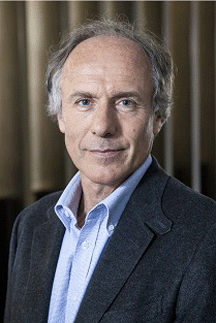 Finkel, in his Submission to the South Australian Nuclear Fuel Chain Royal Commission, gives qualified support to that (now dead) nuclear waste import plan, and vague support to nuclear power.
Importantly, Finkel is opposed to Australia being the test place for the first Generation IV reactors.
Liberal MP Jane Prentice speaks out in favour of nuclear power
 What about nuclear energy, Liberal MP asks https://au.news.yahoo.com/a/35957568/what-about-nuclear-energy-liberal-mp-asks/#page1 – on June 14, 2017 As the federal coalition debates the future of energy policy, one Liberal MP believes nuclear power should be on the table.
If the government was going to look to the future all sources of energy must be considered, Queenslander Jane Prentice said. “I think it’s another discussion we need to have,” she told reporters in Canberra the morning after the coalition party room debated Chief Scientist Alan Finkel’s energy security report.
“It’s clean.”
Labor’s assistant energy spokesman Pat Conroy said it would take 15 years to build up a nuclear industry, which would be more expensive than renewables. “It is a red herring by people who aren’t serious about combating climate change,” he said on Wednesday.
“Leave aside the environmental implications, if you want to get cheap energy in this country that’s reliable you need to invest in renewables.”
Former treasurer Wayne Swan doesn’t think nuclear power has a role in Australia. “They sound pretty desperate don’t they,” he said of the coalition.
New South Wales DEPUTY Premier John Barilaro renews calls for nuclear power
 Call for nuclear debate as NSW government arrives in Singleton, Newcastle Herald, MICHAEL McGOWAN 15 Jun 2017, DEPUTY Premier John Barilaro renewed his calls for nuclear power to be “part of the debate” about the state’s future energy mix before a cabinet meeting in Singleton on Thursday.
As debates about the role of coal-fired electricity in Australia’s energy mix heat up, and plants like Liddell and Bayswater in the Hunter approach their use-by date, Mr Barilaro said nuclear “should always be on the table” as a replacement source of energy.
“Right now those power stations are run by those companies and they will make those long-term decisions [but] when it comes to baseload energy gas, coal and nuclear should always be on the table,” he said.
“As a nation we’re going to export uranium, we’re going to possibly bring back waste, but yet we don’t want to use it for our own energy sources.”
Those comments come in the wake of the release of the Finkel Review into energy security released last week, which recommended governments implement a new Clean Energy Target which would provide incentives for new generators that produce electricity below an emissions baseline…..http://www.theherald.com.au/story/4731625/call-for-nuclear-debate-as-nsw-government-arrives-in-singleton/
Tomago Aluminium boss wants government to invest in nuclear energy
Finkel review: Tomago Aluminium chief executive says nuclear energy should be an option, Newcastle Herald, 14 Jun 2017, THE boss of NSW’s largest electricity user, Tomago Aluminium, has welcomed increased energy security requirements recommended in the Chief Scientist Alan Finkel’s energy market reform report.But the smelter’s chief executive, Matt Howell, says he believes that if Australia’s politicians were “brave” they would consider nuclear energy……
The Clean Energy Target (CET) would provide incentives for new generators that produce electricity below an emissions baseline that, for the purposes of the Finkel Review, was modeled using 0.6 tonnes of carbon per megawatt hour.
While it’s prompted dissent in some parts of the government because it points investment incentives away from coal-fired electricity, the scheme has been welcomed by others because it’s essentially technology neutral.
That’s prompted some to call for the government to consider investment in nuclear energy, and Mr Howell is one of them. …..
But Shortland MP Pat Conroy says nuclear isn’t an option because it’s too expensive.
“One, it would take 15 years to build up a nuclear industry and secondly, the levelised cost of energy for nuclear is well above the cost of renewables,” he told reporters in Canberra on Wednesday.
“Leaving aside the environmental implications, if you want to get cheap energy in this country that’s reliable, you need to invest in renewables.”
NSW Deputy Premier John Barilaro has previously called for a debate about introducing nuclear energy to the state’s energy mix, and on Thursday Port Stephens MP Kate Washington accused the Nationals of wanting “to discuss any energy alternative except renewables”. http://www.theherald.com.au/story/4730851/be-brave-and-use-nuclear/
Federal Inquiry needed: Adani should be questioned on history on environment and ‘allegations of fraud, corruption
Push for Adani to appear before Senate inquiry into infrastructure fund https://www.theguardian.com/business/2017/jun/15/push-for-adani-to-appear-before-senate-inquiry-into-infrastructure-fund Greens say miner should be grilled on environmental history and ‘allegations of fraud, corruption and the use of tax havens’,  Guardian, Joshua Robertson 15 June 17, The Greens will push for Adani to front a federal Senate inquiry into Australia’s infrastructure fund and “grill” the miner on its overseas environmental and business record.
The Senate on Wednesday passed a motion for an inquiry into the Northern Australia Infrastructure Facility, which is considering a $900m concessional loan to Adani for a railway as part of its massive proposed Queensland coal project.
The Queensland Greens senator Larissa Waters said she would seek to have Adani appear before the inquiry to “grill them” on their environmental history and “the allegations of fraud, corruption and the use of tax havens”.
Waters said the company would be asked why it needed “a billion taxpayer dollars” if the mine, which would export up to 60m tonnes of coal a year to Asia, was financially viable.
A spokesman for Adani, which has denied any wrongdoing in relation to claims of invoicing fraud under investigation in India, did not immediately respond to a request for comment.
The inquiry motion came a day after reports emerged that Adani Enterprises, the parent company of the Australian mine venture, had been in talks about establishing a weapons venture with an arms business that had earlier been banned in India amid a corruption probe. An Adani spokesman told the Economic Times of India that the company abandoned early talks with the arms business as it was not comfortable with the idea.
The motion was passed with Labor and Greens support in the face of opposition by the government.
The inquiry, to be run by the economics references committee, will examine the “adequacy and transparency” of the $5b infrastructure fund’s project assessment and approval processes.
It will also scrutinise processes around Naif board appointments, including assessments of conflict of interest, and policies to manage these.
Jason Clare, the Labor shadow minister for resources and northern Australia, told parliament there had been a “cover up” around governance questions surrounding a Naif board member, Karla Way-McPhail.
Clare said an estimates hearing a fortnight ago had established that Way-McPhail, the CEO of two mining services companies that could benefit from Adani’s success, was a “personal friend” of the minister overseeing the Naif, Matthew Canavan, and was put forward by him as a board candidate.
“And this government refuses to say whether she was in the room for [Naif board] discussions about these projects or whether she recused herself,” Clare said.
Governance questions like that had prompted the inquiry and a separate Labor call for the Australian National Audit Office to investigate NAIF, he said.
The inquiry will look at the adequacy of Naif’s investment mandate, risk appetite statement and public interest test guiding decisions of its board.
It will also examine the role of state and territory governments, and any agreements with the federal government, around the fund.
Waters claimed the NAIF was “not about encouraging investment in Northern Australia” but “creating a slush fund to prop up the dying coal industry”.
Clare said it was a “fair bet” that Pippa Middleton’s Northern Territory honeymoon would “probably deliver more economic development to the north” than the Naif in its first two years.
No projects had yet been funded yet more than $600,000 had been spent on salaries and expenses for board members, he said.
“All we know is that over the last two years they have had 119 enquires for funding, they are apparently considering 60 active deals, but there are only four that are currently subject to due diligence.”
A spokeswoman for Canavan said: “The NAIF is accountable to the parliament and will cooperate with requests, as it always has done including through appearances at Senate estimates.
“This inquiry does not add any level of accountability as it is already possible for the Senate to call the NAIF before a committee, even if it’s not on a scheduled estimates day.”
Liberal hard right oppose the Finkel Clean Energy Target
 George Christensen signals he won’t vote for Finkel’s clean energy target
LNP backbencher says he and most of the Nationals won’t vote for any clean energy target that penalises coal, Guardian, Katharine Murphy, 15 June 17, The LNP backbencher George Christensen has signalled he won’t vote for a new clean energy target because it won’t end the decade long climate wars – because Labor will “out Finkel us on Finkel”.
Christensen said on Wednesday evening that he saw no prospect of achieving policy stability on climate and energy policy through bipartisanship, because the gulf between the major parties was too wide.
“Given the history of climate policy in this place, given we’ve got the Labor party pushing 50% renewable energy targets … given we’ve got some Labor MPs talking about no more coal-fired power at all – how are we, honestly, going to have policy stability?” the outspoken MP told Sky News.
Christensen said he had no intention of voting for a clean energy target that penalised coal and neither would the bulk of the National party. “I’m out. I won’t support that”.
He said that, rather than legislating a clean energy target, the government would be better off building high-efficiency coal-fired power stations to replace the ageing coal fleet. Christensen contended that approach would reduce carbon pollution.
The backbencher’s public declaration of opposition follows an extraordinary Coalition party room meeting on Tuesday night in which government MPs ventilated their concerns about the Finkel review, which recommends introducing a clean energy target to deliver policy certainty for investors and reduce emissions……
The former prime minister Tony Abbott – who was a vocal participant in the special party room meeting, and floated the desirability of the government buying the Hazelwood power station – continued his public critique of the Finkel reviewon Wednesday afternoon.
Abbott said the “problem” with the review was it was “all about reducing emissions”. He said Australia did not need to conform with the commitments he made as prime minister in the Paris climate accord if those commitments “clobbered” power prices…..
In an interview with Guardian Australia this week, the chief scientist said it would be surprising if governments used the overhaul of energy policy to incentivise new coal-fired power stations.
He pointed out that modelling associated with the review did not envisage new coal power stations being built…..https://www.theguardian.com/australia-news/2017/jun/14/george-christensen-signals-he-wont-vote-for-finkels-clean-energy-target
Turnbull once again in a bind with Liberal climate denialists over Clean Energy Target plan
 Tensions erupt in Turnbull government over climate and energy policy, The Age, James Massola, 14 June 17, Climate-change policy has ignited tensions within the federal government, with a group of backbench MPs led by Tony Abbott confronting Malcolm Turnbull over the proposed Clean Energy Target in a special party room meeting.
As one MP in the room put it afterwards: “Malcolm could lose his leadership over this if he doesn’t listen to us.”
The disquiet means that Environment and Energy Minister Josh Frydenberg is likely to have little choice but to significantly modify the Clean Energy Targert (CET), as proposed in chief scientist Alan Finkel’s review, to keep the backbench on-side as he finalises the Coalition’s policy response, which is expected as soon as the end of July.
If he does, Mr Frydenberg runs the risk of putting Labor offside – particularly if the policy is too coal-friendly – and dashing the chance of the major parties striking compromise and ending the climate policy wars.
According to several MPs in the room, at least 21 backbench MPs raised concerns about the CET, while five spoke in favour of it and five were said to be non-committal.
Another senior MP in the room said while 32 people had spoken, one third of the speakers had been in favour of the Finkel review’s recommendations, one third opposed them outright and one third expressed concerns but were non-committal. Continue reading
Giles Parkinson outlines ways to improve the Finkel Energy plan
 Five ways to improve Finkel’s energy blueprint http://reneweconomy.com.au/five-ways-to-improve-finkels-energy-blueprint-60985/ By Giles Parkinson on 13 June 2017 [good graphs]
First thing first, this scheme won’t amount to a hill of beans unless the Paris climate targets are adopted, and that does not mean the modest down-payment from the Coalition on which this blueprint is modelled, but a serious attempt to deliver on the pledge to limit average global warming to well below 2°C.
Quite why the chief scientist didn’t choose to make much of the chief science questions is a bit of a mystery, but he did underline the importance of bipartisan and federal and state agreement on this. The reaction, to date, shows this is as difficult now as it was when the climate-denying, fossil fuel-backing Coalition hard right thrust Tony Abbott to the head of the party in 2009.
Can we see some modelling please? The actual energy blueprint is vague on details. Some results of the modelling are shown, such as the modest fall in consumer bills (above), and the lingering presence of coal-fired generation in 2050 (25 per cent).
But the inputs are not revealed, neither are comparisons with other options, or how they are stress-tested with a 2°C target. Most consumer watchdogs would warn against buying something with so little information, and no warranties, but that is – in effect – what we are being asked to do. Or, at least, may be what the Coalition back bench is being asked to do.
The gentailers have too many vested interests to protect, so a better and more efficient mechanism would be for a new authority to auction capacity at various points along the target. This has been used very effectively across the world, and at state level too. It gets a good price and avoids the market being held to ransom.
Be smarter about energy storage. There is no doubt that many solar plants, and wind farms, will be happy to add battery storage to their installations, and Finkel’s report acknowledges that these combinations will beat either gas or coal on both costs and emissions. But Finkel’s proposed obligation for ALL new wind and solar plants to have storage seems like regulatory overkill, adding unnecessarily to prices.
Only in South Australia has the penetration of wind and solar reached a level where storage is now required, according to the CSIRO, which suggests that anything under 40 per cent wind and solar is “trivial” to the management of the grid (presuming the grid managers are on top of their brief). So making a no-argue requirement now seems overkill, and the approach of the Victoria and Queensland state governments – calling for bids for cheapest storage – as they roll out more wind and solar seems more sensible.
Make this transition quicker, smarter, cleaner. As we noted last week, this is not Grid 2.0, it’s actually not a whole lot different from business as usual. This review was an opportunity to redefine those boundaries, but comes up short, mainly because it does not focus enough on the implications and the benefits of all the solar and storage added behind the meter by households and businesses. The CSIRO estimates $200 billion will be spent by consumers over the next three decades.
They will want to know that this investment is worth it, and they are not locked in to a utility business model that has failed to evolve, and continues to impose costs on consumers. Indeed, half of their bills comes from the transport of electricity, which means that even if the wholesale component was free, it could not match the cost of solar and storage. Which does not mean, for a moment, that everything would go off the grid, or should; but unless there is some regulatory recognition that technology changes and costs are moving fast, then they will simply not be prepared to deal with it.
And let’s not forget, all consumers will be wanting more than $90 savings a year over the next decade after seeing their bills going up $300 a year. That’s one step forward and three steps back. There is simply no reason why more savings cannot be delivered, given the falling cost of wind, solar and storage.
Josh Frydenberg, Minister For Fossil Fuel Energy, prevents hybrid renewable energy plus battery storage microgrid at Lord Howe Island
 Lord Howe microgrid in doubt as Frydenberg rules out wind turbines http://reneweconomy.com.au/39084-2/, By Sophie Vorrath on 13 June 2017 One Step Off The Grid
Plans to install a hybrid renewable energy plus battery storage microgrid at New South Wales’ Lord Howe Island, and slash its diesel fuel use, have hit a major political snag, after the federal energy minister intervened to rule out the wind power component of the long-awaited, ARENA-backed project.
The project – which has been in the works for some six years now, and in 2014 won a $4.5 million grant from the Australian Renewable Energy Agency and a $5.6 million loan from NSW Treasury – was to install 500kW of wind, 400kW solar PV and 400kWh of battery storage, in an effort to cut the island’s diesel usage by two-thirds.
Just one year ago the Lord Howe Island Board called for tenders for the installation of the first stage of the project’s development.
But the Board’s manager of infrastructure and engineering services, Andrew Logan, said Minister Frydenberg had ruled, late last week, that the impacts of the proposed two 250kW wind turbines on the Island’s World and National Heritage values – particularly on its ‘visual landscape’ – were unacceptable. Continue reading
Senator Scott Ludlam probes the Australian government’s plan to dump Lucas Heights’ nuclear waste on rural South Australia
 Assuming that the long-lived intermediate-level stuff does go to the sites that you are busy characterising at the moment, how long is it envisaged that it actually stays there before it gets taken somewhere else?
Mr B Wilson: We cannot give a definitive answer on that because we have not commenced a process to identify a permanent disposal solution for the long-lived intermediate-level waste—
Senator LUDLAM: Ouch!
if the really dangerous intermediate-level stuff is to be stored there you cannot tell them how long it is meant to be there for
so we kind of do not really know what is going on there or how long it is meant to be there for.
 ECONOMICS LEGISLATION COMMITTEE, Department of Industry – RADIOACTIVE WASTE 1st June 2017
Full Transcript here: http://parlinfo.aph.gov.au/parlInfo/download/committees/estimate/e3ddf88b-3e9c-4546-9d90-8f646689a98c/toc_pdf/Economics%20Legislation%20Committee_2017_06_01_5134.pdf;fileType=application%2Fpdf
Senator Canavan: I have been to Hawker and I am going there again tomorrow, and I would like to put on record my thanks to many in the Hawker community who engage in this process. Some have certainly changed their mind as they have come to have more understanding of it. I think you have probably been to Lucas Heights, and it I think it makes a big difference to people when they see it. There is a lot of misinformation spread about this, and we are trying to engage with people in a genuine way in good faith to give them the information to make informed decisions.
Senator LUDLAM: Who is spreading this information, Senator Canavan?
Senator Canavan: I hear it from time to time. I do not have any particular allegations to make about individual groups here, but you do hear lots of information from time to time about the potential danger of this material. But, of course, as you would probably know, much of the low-level waste is stored safely at Lucas Heights, a place where people go to and from work every day.
Senator LUDLAM: That begs the question of why it needs to move. ……
Senator LUDLAM: Staying in South Australia: has there been any consideration at all—this is for the department or the minister, whoever wants to take this one on—of the tension between the proposed national radioactive waste facility and the existing South Australian legislation, which would be the Nuclear Waste Storage Facility (Prohibition) Act 2000? The tension between the fact that your entire project is presently illegal under South Australian law: what is being done about that?
Mr B Wilson: We are certainly aware of the South Australian prohibition under their law. However, the National Radioactive Waste Management Act that we operate under overrides South Australian law.
Senator LUDLAM: And that is it? You are just going to squash them? Or are there discussions progressing with the South Australian government?….
Senator LUDLAM: Is the department, or you, Senator Canavan, or any of the federal agencies or other actors in communication with the South Australian government environment or heritage departments, or representatives of any body, actually, in relation to the tension between the two acts?
Senator Canavan: I have raised it with the South Australian government. They have indicated that they may seek to make changes. I am not aware of the status of that at the moment. Obviously, they have their own process, which is a separate to ours, on radioactive waste. Certainly, the issue has been raised. Mr Wilson is also right that we are confident that is not a barrier to this project. But Mr Wilson will be giving you that.
Mr B Wilson: We engage—I would have to characterise it as infrequently—with the South Australian government. It is more in the line of updating where we are. We have not had any recent engagements. They are certainly very well aware of the prohibitions under their law about what the South Australian government and its officials can do in this space….
When I said that the National Radioactive Waste Management Act overrides South Australian law, that is the fact. But what we are trying to do in the development of this project is to develop it and act in a way that is consistent with requirements under other South Australian legislation. For instance, in terms of Indigenous heritage protection and other aspects. While we are not necessarily bound by those laws we want to act in a way that is consistent with them.
Senator LUDLAM: With waste that is as dangerous as this, I am very glad to hear it! Is the department still accepting site nominations?
Senator Canavan: The government remains open to further nominations, as we announced on selecting the Hawker site last year. But the ones we have announced are those that we are proceeding with at this stage.
Senator LUDLAM: Wallerberdina and two at Kimba. Continue reading
Marcia Langton “poorly informed” on Adani coal mine, says leading native title lawyer
 Leading Indigenous lawyer hits back at Marcia Langton over Adani Tony McAvoy says traditional owners are ‘proud and independent’ and are not being used by anti-mining activists to block the $16bn mine, Guardian, Joshua Robertson, 9 June 17, One of Australia’s leading native title lawyers has spoken publicly for the first time as a traditional owner fighting to stop the Adani mine, a campaign he said was driven by “proud and independent people” who were among the best-informed Indigenous litigants in the country.
Tony McAvoy SC, who became Australia’s first Indigenous silk in 2015, said the Wangan and Jagalingou people were keenly aware of how their priorities differed from environmentalist allies in a battle to preserve their Queensland country from one of the world’s largest proposed coalmines.
McAvoy dismissed claims by the prominent Indigenous academic Marcia Langton that Indigenous people had become “collateral damage” as the “environmental industry” hijacked the Adani issue.
He said the rhetoric of Langton and Warren Mundine, who likened anti-Adani campaigners to colonial oppressors running roughshod over Indigenous self-determination, “serves a purpose for them but is just so inaccurate”.
The barrister said to suggest that “the greens are puppet masters pulling the strings and we’re somehow puppets” was wildly off the mark and disrespectful to the many families opposing the mine, including his.
The W&J are the only Indigenous group in Australia to have, in McAvoy, a senior counsel with expertise in native title law within their ranks.
“We are likely to be one of the best informed claimant groups in the country, we have many people who are experienced in native title, including my own input, and representation by an extraordinary team of lawyers,” he said.
McAvoy is part of a contingent within W&J who have mounted legal challenges to an Indigenous land use agreement (Ilua) with Adani, contesting the right of pro-Adani representatives to approve a deal previously spurned by their claim group. The miner resurrected an Ilua last year with majority support in the W&J native title applicant, then sought to register it with the native title tribunal.
But the W&J opponents challenged the deal in the federal court, on grounds including that the pro-Adani applicant members were voted out in a claim group meeting, and that a rival meeting that endorsed the Adani deal was not legitimate.
Then Adani’s hopes suffered a blow with the McGlade native title case, which found that an Ilua was invalid because not all Indigenous representatives had signed it.
The shock precedent prompted the government to put up a bill changing native title legislation to safeguard what it argued were hundreds of Iluas thrown into doubt because they had a majority but not all the signatures of claimants.
The bill also contains amendments that would pave the way for Adani’s unregistered, contested Ilua.
McAvoy said Langton was “very poorly informed” on the Adani issue.
He and a swathe of the W&J argue there should be no rush to pass law changes dealing with critical issues around Indigenous property rights through future land access deals.
McAvoy argues for “splitting the bill” to validate Iluas already registered with the National Native Title Tribunal, but not those unregistered, such as Adani’s. McAvoy said he hoped this proposal would find favour with Labor and crossbench senators, with the bill due for voting as early as next week.
But the group raises its own funds for its legal challenges.
“And more than that, we are very, very aware that our interests of preserving our country are not entirely aligned with the green interests,” he said……..
A land access deal is crucial to Adani gaining finance for the mine, initially needing $3.3bn.
The miner last week cited the end of this year as its deadline for finance. But the federal court this week signalled a trial to decide the fate of Adani’s deal with the W&J would take place in March 2018.
McAvoy said that even if the Senate “amends the Native Title Act in the way proposed [by the government], that proceeding is still to run its course”. https://www.theguardian.com/environment/2017/jun/09/leading-indigenous-lawyer-hits-back-at-marcia-langton-over-adani
Energy report sparks coal debate in Federal Parliament
Federal Labor warns negotiations over a new proposed clean energy target will fail if the government insists on fresh coal generation.
http://www.theaustralian.com.au/national-affairs/climate/western-sydney-mp-craig-kelly-calls-for-fresh-review-of-finkel-reports-effects-on-economy/news-story/d9ecbbaeeda47e69d8355e32acd4e2c2
Senator Scott Ludlam asks inconvenient questions about Australia’s role in nuclear weapons ban negotiations
Senator LUDLAM: …I want to turn to the opening day of the nuclear weapons ban treaty negotiations, 27 March this year. Having failed to prevent these negotiations occurring, the Trump administration’s ambassador to the UN held a protest outside the UN General Assembly Hall. Did Australia participate in the protest?
Senator LUDLAM: So we just stood there in mute solidarity with the Trump administration? As 130 UN member states started serious work on negotiating a nuclear weapons ban treaty, we were outside the room in a protest?
It is a shame that there will be no Australian representatives at the UN because these talks are scheduled to conclude at the end of June or early July
 FOREIGN AFFAIRS, DEFENCE AND TRADE LEGISLATION COMMITTEE, UN – Nuclear Weapons Ban, 31st May 2017 http://parlinfo.aph.gov.au/parlInfo/download/committees/estimate/0a6ef7dd-2f88-423a-a01b-23b5c5b4e4c0/toc_pdf/Foreign%20Affairs,%20Defence%20and%20Trade%20Legislation%20Committee_2017_05_31_5055.pdf;fileType=application/pdf
Pg- 20
Senator LUDLAM: Can I speak to someone on the UN Conference to Negotiate a Legally Binding Instrument to Prohibit Nuclear Weapons?
Senator LUDLAM: Can I speak to someone on the UN Conference to Negotiate a Legally Binding Instrument to Prohibit Nuclear Weapons?
Mr Sadleir: Yes, Senator.
Senator LUDLAM: It is good that you are here, Mr Sadleir, because I want to ask a couple of questions about a meeting that occurred between 4 and 8 July 2016 that I understand you were present at. You and Ms Jane Hardy travelled to Washington, DC to meet with a range of, I understand, quite senior State Department and National
Pg – 21
Security Council people to discuss what was then referred to as the UN open-ended working group on nuclear disarmament. Can you confirm for us on the record that that meeting occurred and that you were in attendance?
[Here it took an extraordinarily long time for Mr Sadleir to admit that he was at this meeting]
‘……..Senator LUDLAM: I have not asked what you discussed yet. Were you in attendance at that meeting? Mr Sadleir
? Mr Sadleir: I was certainly in Washington. I would need to check my diary to get the precise dates but I was certainly there around that time.
Senator LUDLAM: I think that what will happen when you check the dates is that you will come back and confirm that you were in fact there. I will let you check the record. I would appreciate that. What was the purpose of those meetings? Continue reading
Giles Parkinson analyses the Finkel Energy Report – and finds it mediocre at best
the conservatives will protest anyway, and it is difficult to see how Labor can endorse a plan that undercuts renewable energy so comprehensively, and completely ignores the Paris climate agreement
 Finkel decoded: The good, the bad, and the very disappointing http://reneweconomy.com.au/finkel-decoded-the-good-the-bad-and-the-very-disappointing-84273/By Giles Parkinson on 9 June 2017
Our coverage of the main Finkel findings can be found here, along with the reaction, and a look at his modelling. Here is our initial take on what the final Finkel Review all means.
This is not Grid 2.0
In the first draft of the Finkel Review, chief scientist Dr Alan Finkel spoke of an “unstoppable” energy transition, driven by new technologies and the role of the consumer.
But but he may just have found a way for skittish politicians and incumbent utilities to throw a spanner in the works and slow it down. This report had the opportunity to redefine the energy markets. But, to borrow an expression, it reads more like history ++ at best, rather than Grid 2.0.
That’s because Finkel has been focused on trying to find a pathway through the toxic energy politics in Australia, and accommodating the Coalition’s modest climate targets, rather than seizing the moment and outlining what can and should happen, and what Australia would need to do to meet the Paris climate targets.
That it only modeled the Coalition’s initial down-payment for the Paris climate deal. It shows it a path to reach that, but not its likely obligations in a world that vowed to cap average global warming at “well below 2°C” and so can be seen as a huge victory for the incumbents.
We need a plan
Finkel emphasises there is no plan right now, and one is needed to manage the scale of the transition. “We need a plan,” he says.
So he has recommended a whole series of actions, including the Clean Energy Target and only because of opposition to the emissions intensity target. Other options such as a high renewable energy target were not considered, even though its is clear that wind and solar are the cheapest forms of new energy, Continue reading
Pro-coal Liberals oppose Finkel energy report, Greens not happy either
Finkel review: Government backbenchers question clean energy target report, ABC News, 9 June 17 By political reporters Matthew Doran and Tom Iggulden Pro-coal backbenchers within the Liberal Party have already begun undermining a report from the chief scientist Alan Finkel, as Labor foreshadows pulling support for the proposal if new coal-fired power stations are built.
Key points:
- Senator Eric Abetz accusing Finkel of using “creative assumptions” to come up with recommendations
- MP Craig Kelly calling for another report, different attempts at modelling
- Australian Energy Council says Dr Finkel’s report presents “less political” option
Dr Finkel’s report proposes a clean energy target (CET) to help reduce carbon emissions and lower electricity prices for households by about $90 per year.
Tasmanian Liberal senator Eric Abetz is accusing the chief scientist of using “creative assumptions” to come up with his recommendations for a CET.
Western Sydney Liberal backbencher Craig Kelly is calling for another report to be done into the economic effect of setting aggressive emissions reduction targets.
He said he would not support a benchmark emission target of 0.6 tonnes of carbon dioxide per megawatt hour, which is the level Dr Finkel has used in his report to model economic effects. …….http://www.abc.net.au/news/2017-06-10/pro-coal-backbenchers-undermining-finkel-report-labor-threats/8606652
1 This month

of the week – Australians for War Powers Reform (AWPR)
To see nuclear-related stories in greater depth and intensity
 Antinuclear