It means the costs of cleaning up oil spills from exploration wells would be tax deductible, and could be held over and “uplifted” into future years at an annual rate of 17.5%……
 “The rules are written so if a company created an oil spill with their exploration rig, they could make a profit from it,” – Greens senator Peter Whish-Wilson
“A standard tax deduction for an oil spill clean-up would be bad enough, but in this case the deduction grows in value every year. No other sector, no other set of businesses gets such ridiculous and costly deductions.”
Taxpayers to pay for oil spill clean-ups under petroleum resource rent tax https://www.theguardian.com/australia-news/2017/feb/25/taxpayers-to-pay-for-oil-spill-clean-ups-under-petroleum-resource-rent-tax Treasury confirms companies would be able to claim tax deduction for expenses incurred from cleaning up pollution, Australian taxpayers will be forced to subsidise the clean-up costs of oil spills in the Great Australian Bight thanks to the terms of the controversial petroleum resource rent tax. Continue reading →
February 25, 2017
Posted by Christina Macpherson |
AUSTRALIA - NATIONAL, environment, politics |
Leave a comment
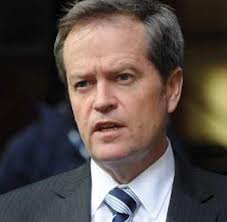
 Shorten goes on front foot over 50% renewables ‘target’, The Conversation, Michelle Grattan, Professorial Fellow, University of Canberra February 22, 2017 Australia could be the “energy capital of Asia” but instead it is going backwards, Bill Shorten will say in a speech on Thursday, vigorously defending Labor’s target of 50% of Australia’s electricity coming from renewables by 2030.
As the government floats the prospect of help for cleaner-coal power stations and attacks Labor for committing too strongly to renewables, Shorten will say that to achieve the ALP’s 50% target much more private investment in renewable generation and technology will be needed than the amount required to get to the legislated Renewable Energy Target (RET). The RET is for 23.5% of Australia’s electricity generation in 2020 to come from renewable sources.
He will say that what is required is an emissions-intensity scheme (EIS) for the electricity sector, ongoing support for research and investments in renewable energy technology, and a plan to modernise the National Electricity Market.
The speech comes as an Essential poll this week found nearly two-thirds (65%) approved of Labor’s target of 50%; 18% disapproved. Support for the policy was 55% among Coalition voters.
After much debate last week about the precise nature of Labor’s 50% commitment – whether it was a “goal” or a “target” – Shorten will take a more assertive line. “Forget the word games – 50% renewables by 2030 is Labor’s target, our goal, our objective and our aspiration,” he will say.
“We can be the energy capital of Asia. And if Australia nails the energy question, we will collect a growth dividend that can set us up for the century.
“But despite the prize on offer, despite all our natural advantages, we’re not just stuck in the gates – we are going backwards.
“When the Coalition came to office and declared war on the RET scheme, investment in large-scale renewables fell by 88% in one year.
“After being rated one of the four most attractive destinations in the world for renewable energy investment in 2013, we now don’t even crack the top ten.
“In the last three years, the world has added nearly three million jobs in renewables energy – and Australia has lost 3000,” Shorten will say, speaking at Bloomberg…….
The first and most important step to provide that certainty and to assist the transition to renewable energy is to establish an EIS for the electricity sector, he will say. An EIS rewards energy generators that produce pollution levels lower than a set benchmark.
An EIS would drive investment in new sources of energy – renewables but also gas, Shorten will say.
“An EIS doesn’t rely on taxpayer funding or government officials making investment decisions. It leaves both decisions and funding to the private sector, to the market,” he will say. “It will reduce power bills and reduce pollution.”
Malcolm Turnbull has ruled out an EIS despite the preliminary report of the Finkel inquiry into future security of the national electricity market giving it a positive nod…….https://theconversation.com/shorten-goes-on-front-foot-over-50-renewables-target-73460
February 24, 2017
Posted by Christina Macpherson |
AUSTRALIA - NATIONAL, energy, politics |
Leave a comment
More than 70% believe Coalition not doing enough on energy – poll
Guardian Essential survey shows a clear majority supports Labor’s goal of sourcing 50% of energy from renewables by 2030, Guardian,
A majority of voters surveyed in the latest Guardian Essential poll supports Labor’s renewable goal, suggesting Coalition attacks are not working. Guardian, Katharine Murphy, 21 Feb 17, More than 70% of voters think the Turnbull government is not doing enough to ensure affordable, reliable and clean energy for Australian households and businesses – and a clear majority also supports Labor’s goal of sourcing 50% of energy from renewable sources by 2030.
The latest Guardian Essential poll suggests that the Turnbull government’s relentless partisan attacks on Labor’s 50% renewable energy policy, and its concerted efforts early in the new political year to position itself as the party of cheaper and more secure power, haven’t yielded the desired result.
The poll shows 71% of the sample think the federal government is not doing enough to ensure affordable, reliable and clean energy – and only 12% rate the current effort as satisfactory.
Even among their own constituency, Liberal and National voters, 62% of the sample said the government was not doing enough.
When asked about the ALP’s aspirational goal to source 50% of energy from renewable sources by 2030, 65% of voters registered their approval of the concept.
The policy – which has been repeatedly branded reckless and ideological by the prime minister – won strong majority approval from both Labor and Green voters. Coalition voters were also more likely to approve of the target than disapprove.
The political campaign by the government hasn’t moved the dial in any significant way. Attitudes to the policy have changed little since it was unveiled by Bill Shorten in 2015.
Voters were also divided about whether or not Australia should build new coal-fired power stations but a clear majority opposed the idea. Forty-five per cent of the sample said it was a bad idea and 31% supported building new coal-fired power stations.
The people positive about the idea of building new coal-fired power stations were Liberal/National voters (47%),men (39%) and people aged 65 and over (53%)……
Most voters are also attributing power blackouts in South Australia to failures of the energy market in responding to extreme weather events (45%), rather than to problems with too many windfarms……https://www.theguardian.com/australia-news/2017/feb/21/more-than-70-believe-coalition-not-doing-enough-on-energy-poll
February 22, 2017
Posted by Christina Macpherson |
AUSTRALIA - NATIONAL, energy, politics |
Leave a comment
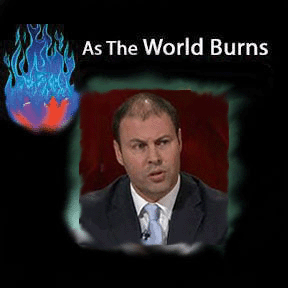
 Frydenberg on blackouts: No mention of failing network, gas, software, REneweconomy, By Giles Parkinson on 21 February 2017 Federal energy minister Josh Frydenberg has put the blame for recent blackouts in South Australia directly on the state’s high penetration of wind and solar, and attributed no blame to network faults, storms or failing gas plants.
In a speech on energy security to the right-leaning Sydney Institute on Monday night, Frydenberg listed four black-out events that had hit South Australia since and including the “unprecedented” state-wide outage on September 28.
 He made no mention of the fierce storms, the falling power lines, the network faults that caused outages in December and February, or the role of gas plants that sat idle, or had to shed capacity because of the heat and other technical faults.
Nor did he mention the software glitch that meant 90,000 households, rather than 30,000, suffered power cuts in South Australia earlier this month when demand hit record highs.
Instead, Frydenberg pointed only to the roles of wind and solar, both of which he said were producing at a fraction of their capacity when the rolling blackouts were implemented.
“This means that the days of easily forecastable supply are over,” he said. “Nowhere was this more clear than during the last South Australian blackout, when 90,000 consumers lost power.”
An Australian Energy Market Operator report last week said the cause of the problem was bad forecasting, not just of supply, but of demand. It was caught short when demand spiked and could not wake a gas generator from its slumber.
Another 300MW of gas capacity was unavailable because it was broken – with half of it failing in the hours before the blackout. Wind energy was producing twice as much power as had been forecast a day earlier. Solar was the only local generation that produced exactly as predicted.
As AEMO told the Senate inquiry last week: “It is going back to the unforced and unplanned outages that eroded our reserves at that time in such a short period of time.
“Yes, we knew the wind would drop-off and we knew the solar would drop-off at a particular time, but our reserves were fine up until the point when we had forced outages.” i.e. the gas plants.
Frydenberg also spoke of South Australia’s price spikes, but made no mention of similar price spikes in Queensland and South Australia.
Indeed, average wholesale electricity prices in coal-dependent Queensland so far this month have average $301/MWh, nearly 50 per cent more than South Australia last July ($201/MWh), when network supplies from Victoria were restricted by an upgrade and which helped trigger the Coalition’s anti-renewable campaign.
In February this year, NSW has averaged $214/MWh while South Australia has averaged $210/MWh. In January, average wholesale prices in Queensland were at $197/MWh, while in South Australia they averaged just $84/MWh.
AEMO, in its report, has insisted that it is not the nature of wind energy or solar that have contributed to the various blackouts. Frydenberg, however, is having none of it….http://reneweconomy.com.au/frydenberg-on-blackouts-no-mention-of-failing-network-gas-software-19688/
February 22, 2017
Posted by Christina Macpherson |
AUSTRALIA - NATIONAL, energy, politics |
Leave a comment
We have now reached a time where an overwhelming majority of the world’s nations are ready to outlaw nuclear weapons, just as the world outlawed chemical and biological weapons and land mines.
There is no reason why we should not be providing leadership in the effort to ban nuclear weapons.
Australia must play our part. Malcolm Turnbull should commit to attending the 2017 negotiating conference. If Australia fails to participate, this will tarnish our international reputation as a disarmament supporter and, in doing so, fail to act to promote safety in our world.
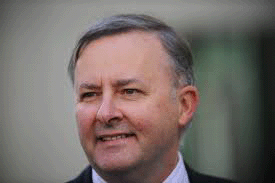 AUSTRALIA MUST PLAY ITS PART IN ABOLISHING NUCLEAR WEAPONS , ANTHONY ALBANESE MP, SPEECH TO THE TOM UREN MEMORIAL FOUNDATION FOR THE INTERNATIONAL CAMPAIGN TO ABOLISH NUCLEAR WEAPONS , 12 Feb 17
 In 1961 John F Kennedy told the United Nations:
Today, every inhabitant of this planet must contemplate the day when this planet may no longer be habitable. Every man, woman and child lives under a nuclear sword of Damocles, hanging by the slenderest of threads, capable of being cut at any moment by accident or miscalculation or by madness. The weapons of war must be abolished before they abolish us.
It is incredible to think that almost six decades on, this threat still exists. We must continue to dedicate ourselves to eliminating this threat. Every nation has a responsibility to work for a world free of nuclear weapons.
Australia is no exception.
That is why the work of ICAN in Australia and around the world, in helping to progress the disarmament agenda, is so important.
I come to this debate with the benefit of the testimony of a man who saw the horror of nuclear weapons first hand. Tom Uren was imprisoned in a POW camp on the island of Omuta on 9 August 1945. Just after 11am, the US detonated an atomic bomb over the city of Nagasaki about 80km away. Estimates of the death toll ranged between 40,000 and 80,000. That’s men, women and children. Nuclear weapons don’t discriminate.
Continue reading →
February 20, 2017
Posted by Christina Macpherson |
AUSTRALIA - NATIONAL, politics, weapons and war |
Leave a comment
Josh Frydenberg flags changes to allow CEFC to invest in carbon capture and storage, ABC News, AM By Eliza Borrello, 20 Feb 17, Federal Energy Minister Josh Frydenberg has revealed the Government is considering lifting a ban on allowing the Clean Energy Finance Corporation (CEFC) to invest in carbon capture and storage……At the moment the CEFC, the Government’s green bank, is not allowed to invest in it.
But amid the Coalition’s renewed support for coal-fired power, Mr Frydenberg said that could change…..
Shadow Energy Minister Mark Butler said it would require the kind of legislation Labor would strongly oppose. “This would be an outrageous act of vandalism against a successful financing mechanism for renewable energy, for energy efficiency projects and for genuine low-carbon technology,” he said.”It’s no real surprise, I guess, because the Liberal Party has never really supported the CEFC. “It tried to abolish it for three years and now seems committed to making it a finance mechanism for the coal industry, which is unable to attract finance from the private sector.”
Government interested in low-emission coal-fired plants Mr Frydenberg said he was also interested in investment in high-efficiency, low-emission coal-fired plants.
Currently they are not green enough for the CEFC to invest in, but Mr Frydenberg has flagged changing the rules. “The Government could issue a new mandate to the CEFC which would then inform its guidelines and would make possible an investment in a high-efficiency low-emission power plant,” he said……
But Mr Butler said the market was not interested in the kind of plants Mr Frydenberg was suggesting.
“It doesn’t reflect the reality in the electricity industry. No-one in the industry is talking about the reality of building new coal-fired power stations,” he said. http://www.abc.net.au/news/2017-02-20/government-interested-in-carbon-capture-tech-frydenberg-says/8284682
February 20, 2017
Posted by Christina Macpherson |
AUSTRALIA - NATIONAL, energy, politics |
Leave a comment
most of the Mineral Council’s biggest members are multinationals, listed on Australian and overseas stock exchanges. Could their membership fees or fighting fund donations be used for the MCA’s political campaigns if foreign donations were banned? Should their individual contributions be revealed?
Deep-pocketed miners don’t like it when those with different views wield clout, Guardian, Lenore Taylor @lenoretaylor 18 February 2017 In 2010 the mining industry’s $22m campaign against Kevin Rudd’s resources tax helped bring down a prime minister. For years it has spent huge sums on donations and advertising and lobbying to exert enormous political influence. But the deep-pocketed miners really don’t like it when those with different views find the cash and the smarts to wield some clout.

February 20, 2017
Posted by Christina Macpherson |
AUSTRALIA - NATIONAL, politics |
Leave a comment
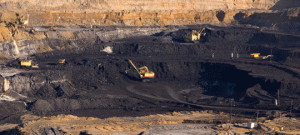 The Adani Brief: our summary https://www.acf.org.au/adani_brief_summary
https://groups.google.com/forum/#!topic/wgar-news/QkXUYq11cmQ 15 February 2017:
“Background
The brief is the result of months of international investigation by Environmental Justice Australia and
USA-based environmental law non-profit EarthJustice into the global legal compliance record of the Adani Group.
It puts governments and private stakeholders on notice that backing Adani’s Carmichael
coal mine and rail project in Queensland’s Galilee Basin
may expose them to financial and reputational risks.
“Key findings
“Environmental destruction:
Adani Group companies have a record of environmental destruction and non-compliance with environmental regulations.
Some examples are: …
“‘Black money’: …
“Bribery and illegal exports: …
“Confusing and opaque corporate structures: …
“This is a company the government is entrusting: … ”
The Adani Brief:
What governments and financiers need to know
about the Adani Group’s record overseas
https://groups.google.com/forum/#!topic/wgar-news/QkXUYq11cmQ
https://envirojustice.org.au/sites/default/files/files/Submissions%20and%20reports/The_Adani_Brief_by_Environmental_Justice_Australia.pdf
February 20, 2017
Posted by Christina Macpherson |
business, environment, politics, Queensland, secrets and lies |
Leave a comment
Why is Labor so hopeless at defending renewables policy? REneweconomy By Giles Parkinson on 16 February 2017 Federal Labor has effectively abandoned its 50 per cent renewable energy target after its leaders failed hopelessly to identify the obvious arguments to defend the policy.
Instead – less than a week after the Coalition made idiots of themselves by bringing a lump of coal into Question Time, Labor appears to have thrown its lot in to a new scheme that could mean little new wind and solar over the coming decade.
The feeble backsliding was revealed by climate and clean energy spokesman Mark Butler on Thursday, trying to cover the tracks of a pathetic performance from his leader, Bill Shorten, on the ABC Radio “AM” program a day earlier.
And by defending him, Labor appears to have thrown the renewables industry under a bus. Butler effectively admitted there would be no stand-alone renewable energy target, instead of relying on an emissions trading scheme to bring on wind and solar.
And what do the architects of that EIS expect will happen under such a scheme? As we pointed out in detail late last year, no growth at all in large-scale wind and solar between 2020 and 2030. The EIS has been designed to support gas, not wind and solar.
According to the modelling commissioned by the Australian Energy Market Commission, under an EIS fossil fuels will thrive and still make up 80 per cent of the country’s electricity mix by 2030. By adopting that policy, Labor could be killing wind and solar in its tracks, or at least after the end of the current target in 2020.
Let’s go back one step: The only thing more frustrating about the Coalition government’s attack on renewable energy in Australia has been the hopeless effort put up by Labor in defending its 50 per cent renewable energy target for 2030.
Prime Minister Malcolm Turnbull and his ministers, despite operating in a debate almost devoid of facts, is running rings around Labor by accusing it of risking both surging electricity prices and regular blackouts. Labor’s response has been ordinary at best.
Leader Bill Shorten gave the impression of being a rabbit in the headlights when interviewed on ABC Radio’s AM program on Wednesday, when asked four times about the potential cost of the target……
One thing that we’ve learned from the rise of Trump, Brexit and One Nation is that even without facts, clarity wins votes. Labor had the advantage of having facts on its side, but now it looks like they’ve gone and thrown it away.
As The Greens Adam Bandt noted, this is a capitulation, a betrayal and an act of cowardice. And everyone has a right to be angry. http://reneweconomy.com.au/why-is-labor-so-hopeless-at-defending-renewables-policy-67678/
February 20, 2017
Posted by Christina Macpherson |
AUSTRALIA - NATIONAL, politics |
Leave a comment
 SA power cuts: Nuclear energy should be considered as solution, state Liberals say, ABC News 9 Feb 17 Despite opposing a high-level nuclear waste dump in South Australia, state Liberal leader Steven Marshall is now proposing nuclear power as a potential solution to the state’s energy reliability issues….
A citizens’ jury rejected high-level nuclear waste storage in November, prompting Mr Marshall to declare plans of “turning South Australia into a nuclear waste dump” were “now dead”. But today he said that did not mean he or his party were against the production of high-level nuclear waste in South Australia, via nuclear energy generation.
“We’ve never ruled out the nuclear opportunity for energy. We made it very clear that we were not in the slightest bit interested in continuing to pour money into the hopeless case which was a nuclear repository in South Australia,” he said.
“The royal commissioner ruled out nuclear energy in South Australia but there will be a time when it may become viable, and desperate times call for desperate solutions, and we are in a desperate situation.”
Mr Marshall denied the policy was hypocritical, but did not offer an explanation as to what would become of the highly radioactive spent fuel rods if a nuclear reactor was built in South Australia….. http://www.abc.net.au/news/2017-02-09/sa-power-cuts-could-be-solved-by-nuclear-energy-say-liberals/8256814
February 10, 2017
Posted by Christina Macpherson |
politics, South Australia |
Leave a comment
 Why coal-fired power handouts would be an attack on climate and common sense
The evidence suggests the push for government help is an attempt to squeeze money out of unwise investments made at the end of the mining boom, Guardian, 9 Feb 17, Michael Slezak, The recent coordinated push for new coal-powered electricity generators in Australia comes as the industry is on its last legs.
The intensified push for government handouts can be seen as a last-ditch attempt for the coal industry to squeeze some money out of the unwise investments it made at the end of the mining boom.
Here are the facts and figures that point towards that conclusion.
The coal industry knows that to stop runaway climate change all coal-powered generators need to close
Australia joined 174 countries and the European Union in 2015, signing the Paris agreement. In doing so, Australia agreed to do its part in keeping the global temperature rise “well below” 2C.
It also commits countries to achieving net-zero emissions “in the second half of this century”.
That agreement, designed to stop runaway climate change, requires that all of Australia’s coal-fired generators close.
According to the International Energy Agency, OECD countries such as Australia need to shut down almost all of their coal-fired power stations by about 2035.
And the rest of the world will need to phase out coal power by 2050, it says. [excellent graph on original] With coal-fired power stations taking up to a decade to build, and designed to last 30 or 40 years, building new ones now is obviously inconsistent with those commitments.
In particular, Australia has committed to reducing its emissions by 26% below 2005 levels by 2030 – a commitment that is not strong enough to limit global warming at 2C and will need to be “ratcheted up”.
But the Australian government recently released projections of the country’s carbon emissions showing that current policies are going to cause emissions to rise to 2030, not drop, leaving Australia overshooting that commitment by a long way. [graph on original] …….
New coal is the most expensive form of energy
While the proponents of coal talk about coal power being “cheap and reliable”, they are wrong on both fronts. Coal is now the most expensive form of new power. According to Bloomberg New Energy Finance, the cost of energy from a new coal power plant would be $134-$203/MWh.
That’s more expensive than wind, solar or highly efficient combined-cycle gas (costing $61-$118/MWh, $78-$140/MWh and $74-$90/MWh, respectively)………
The global coal industry recently saw its biggest player, Peabody, go bankrupt in the US. If companies are forced to take write-downs for these projects by admitting they will never go ahead, it could mean the end for some of the companies.
At his National Press Club address last week, Malcolm Turnbull appeared to point to this as the reason he is now looking to subsidise the most expensive and dirtiest form of energy, saying that it could help our mining industry. He said: “As the world’s largest coal exporter, we have a vested interest in showing that we can provide both lower emissions and reliable baseload power with state-of-the-art, clean, coal-fired technology.” https://www.theguardian.com/environment/2017/feb/07/why-coal-fired-power-handouts-would-be-an-attack-on-climate-and-common-sense
February 10, 2017
Posted by Christina Macpherson |
AUSTRALIA - NATIONAL, climate change - global warming, politics |
Leave a comment
Carmichael mine jobs need ’21 times the subsidies’ of renewables, says lobby group
Federal funding for Adani project amounts to $683,060 a job, compared with $32,191 a worker in Queensland’s clean energy sector, 350.org says, Guardian, Joshua Robertson, 8 Feb 17, Clean energy projects in Queensland are already on track to create more employment than Australia’s largest proposed coalmine, which if funded federally would cost taxpayers 21 times more per job, according to new study.
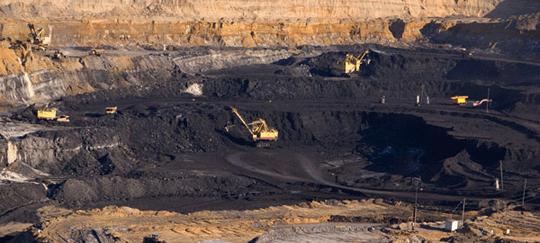
Federal government agencies are investing $71.4m in seven solar farms and a windfarm in Queensland, which are set to deliver a total of 2,218 jobs, according to analysis by climate advocacy group 350.org.
Adani’s proposed Carmichael coal project in central Queensland, which has obtained conditional approval for a $1bn federal infrastructure loan, is predicted to deliver 1,464 jobs.
The level of federal subsidy for Adani would amount to $683,060 a job, compared with $32,191 a worker in Queensland’s clean energy sector.
The Queensland government has accused the federal government of misrepresenting key data while talking up coal in an ideological attack on renewable energy. Continue reading →
February 10, 2017
Posted by Christina Macpherson |
AUSTRALIA - NATIONAL, energy, politics, Queensland |
Leave a comment
 Solar battery rebate scheme pushed by Greens in WA election pitch, ABC News , 9 Feb 17 By Laura Gartry More than 100,000 WA households could be entirely powered by their own solar energy using battery storage within five years under a 50 per cent tax rebate proposed by the Greens.
In one of first major election commitments by the party, Upper House candidate Tim Clifford said the cost of battery units were currently out of reach for a lot of people.
The Greens’ proposed rebate would allow individuals to get up to half the cost of their storage system covered to a maximum of $5,000 in the first year and tapering off to $1,500 in five years.
The $290 million scheme would also provide a $5,000 upfront grant to install solar for families earning less than $80,000. Households with solar panels in WA are looking to batteries as a way to offset the sharp fall in rebates Synergy pays them for their electricity.
It is hoped the scheme would kick-start the industry and drive down the cost of units and power bills.
Energy Minister Mike Nahan said a possible battery subsidy was discussed, but would not be implemented by the Government…..
Mr Clifford said up to 3,000 WA businesses could also benefit, allowing their battery storage assets to be depreciated over three years rather than 15, which could pay off their battery storage unit within 10 years.
The scheme would be co-funded from the removal of federal fossil fuel and mining subsidies……http://www.abc.net.au/news/2017-02-08/solar-rebates-mooted-by-greens-wa-election/8252706
February 10, 2017
Posted by Christina Macpherson |
energy, politics, Western Australia |
Leave a comment
Australia’s richest woman, the mining magnate Gina Rinehart, is also reportedly backing Bernardi and joined him in meetings in New York in late 2016 with key figures from the Donald Trump camp.
Rinehart has previously supported speaking tours by Lord Christopher Monckton, the British climate science denier once described as a “vaudeville artist” by a former version of Malcolm Turnbull (the one that claimed to care deeply about climate change).
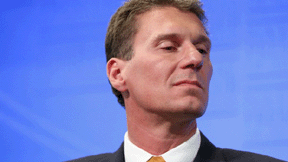 How Cory Bernardi was inspired to push climate denial from US conservative groups, Guardian, Graham Readfearn, 7 Feb 17 Climate science denial group the Heartland Institute helped inspire Cory Bernardi and Malcolm Roberts to push back against policies to cut emissions I
If the dissident conservative senator Cory Bernardi’s new political party shares the views of its founder, then we can chalk up it up as another fringe party firmly in the climate science denial camp.
Ignoring mountains of evidence from multiple lines of inquiry carried out over many decades, Bernardi has for a long time chosen to listen instead to fake experts pushing talking points that walk like zombies through barbecue conversations across Australia.
A Bernardi-led party would join One Nation, Family First, the Liberal Democratsand Rise Up Australia in rejecting the evidence for action on cutting greenhouse gas emissions.
Many of the climate change talking points pushed individually and collectively by these political groups perfectly match the propagandised science pushed by conservative “free market” thinktanks in the US.
Like Bernardi, the likes of One Nation and Family First have taken their cues and inspiration from that US network of ideological “thinktanks”that push climate science denial as if their lives, or their salaries, depended on it.
Let me explain.
Bernardi has been much more than just an outspoken politician who thinks human-caused climate change is mostly a fraud and that carbon prices are just “a form of socialism”.
Bernardi has been a funder and an organiser of the opposition to action on climate change in Australia for years. Continue reading →
February 8, 2017
Posted by Christina Macpherson |
AUSTRALIA - NATIONAL, climate change - global warming, politics |
1 Comment
 Is Malcolm Turnbull’s priority really just keeping the lights on?, Guardian, Kristina Keneally, 6 Feb 17 It seems Turnbull is basing his core political agenda for 2017 on a rare weather event. It’s a textbook definition of being buffeted by events rather than shaping them Imagine a severe thunderstorm had not hit South Australia last September and caused a state-wide blackout. What on earth would the Turnbull government have to talk about?
The day after the South Australian storm, the energy minister, Josh Frydenberg, nominated “energy security” as the government’s number one priority.
Last week at the National Press Club, Malcolm Turnbull said that this year his government would prioritise energy security and storage.
The Turnbull government is basing its core political agenda for 2017 on a once-in-50-years weather event. This must be the textbook definition of a government buffeted by events rather than shaping them.
Let’s set aside – for a moment – the happenstance nature of the Turnbull government’s top policy priority and instead consider the relevance of its pitch to voters. What does energy security even mean? When was the last time you used that phrase in conversation? Does it have something to do with defence? Is it keeping our power plants safe from attack?
And if that is the Turnbull government’s priority, well, that’s pathetic. So much for innovation, agility, jobs and growth, and budget repair. The Turnbull government is flat out making sure our fridges are still running and we can still charge our mobile phones. They have no ambition or time for anything greater.
But the biggest joke of all is that Turnbull can’t even manage to pretend for more than a week that energy security is his number one priority. Last night Turnbull told Channel Nine’s Laurie Oakes that “what I set out is our agenda for this year and what we’re going to deal with is energy prices”.
Energy security and energy prices. Yeah, they are not the same thing. Continue reading →
February 8, 2017
Posted by Christina Macpherson |
AUSTRALIA - NATIONAL, energy, politics |
Leave a comment






 Antinuclear