Turnbull’s over-riding ambition is to last at least one day longer as prime minister than Abbott. That means that he will remain beholden to the right, who are ready to push the self-destruct button at any moment in the fervent belief that they can win power, if not immediately then after a single term of Labor.
Like Trump, Turnbull’s energy policy is based on “alternative facts”http://reneweconomy.com.au/like-trump-turnbulls-energy-policy-is-based-on-alternative-facts-25100/ By Giles Parkinson on 7 February 2017 The first few weeks of the Trump administration have been extraordinary, and quite frightening – not just because of the incompetence of a president who appears to be little more than a self-obsessed idiot, but by the actions of the dangerous ideologues at the helm of the world’s biggest economy and military power.
There have been shocks across the policy spectrum, but probably none more so than in climate and clean energy, where Trump has promised to throw the baby out with the bathwater, quit the Paris deal, disband or dismember environmental regulations, “re-invent” coal, stop renewables and build more gas 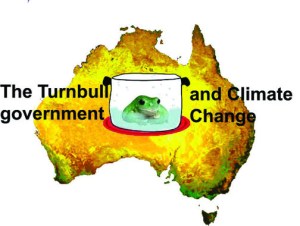 pipelines.
It might sound stone-cold crazy to many people in Australia, but it should be familiar: There is little that Trump and his regime is doing on climate and clean energy that has not already achieved, or attempted, by the current Coalition government in Canberra. Continue reading →
February 8, 2017
Posted by Christina Macpherson |
AUSTRALIA - NATIONAL, climate change - global warming, energy, politics |
Leave a comment
Resources Minister Matt Canavan opens $5 billion infrastructure fund for clean-coal power stations, ABC News, 3 Feb 17 By political reporter Henry Belot Resources Minister Matt Canavan has opened the $5 billion Northern Australia Infrastructure Fund to fund new so-called clean-coal power stations.
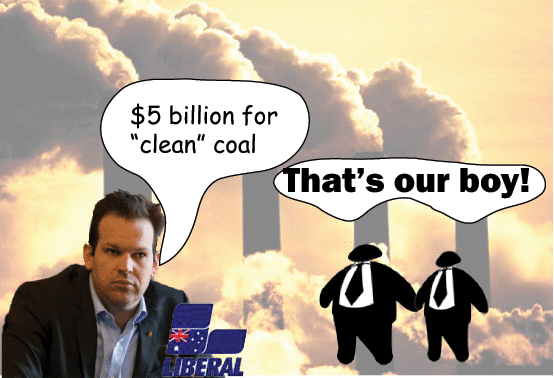
Key points:
- The Federal Government has invested close to $590 million in clean-coal technology since 2009
- Australia does not have a high-efficiency, low-emission power station
- Prime Minister Turnbull announced the push for more clean-coal technology earlier this week
Senator Canavan’s comments come days after Prime Minister Malcolm Turnbull said Australian industry had an obligation to be at the forefront of coal technology.
Treasurer Scott Morrison has also not ruled out using money set aside in the Clean Energy Finance Corporation to pay for new generation power stations.
Mr Canavan said he had received interest from energy generators to tap into the billion-dollar investment fund and explore North Queensland. “I’ve received some interest over the past week associated with our commitment to build base load power stations, including to support clean coal options,” he told ABC AM. Mr Canavan would not say which companies had expressed interest but said there were viable options near the Galilee Basin and other parts of the state’s north.
The Federal Government has invested close to $590 million in clean-coal technology since 2009 but Australia does not have a high-efficiency, low-emission power station. The Resources Minister cited a 2012 report by industry consultants GHD, which indicated clean-coal power stations could be commercially viable in Australia’s north.
Mr Canavan dismissed comments by some Australia’s energy generators — including AGL and Energy Australia — saying new power stations would be expensive to build and require significant public funds……
Bloomberg New Energy finance researcher Leonard Quong said new coal would be the most expensive form of energy supply. “New coal is made particularly expensive due to the substantial carbon, reputation, trading and construction risks the technology presents to an investor,” he said.
The renewed focus on clean-coal has drawn criticism from Labor and the Greens, who have accused the Government of trying to protect “the coal club”.
Opposition spokesman for climate change and energy Mark Butler said a preference for coal over renewables would mean higher power bills for Australians. Greens leader Richard Di Natale said the cleanest form of electricity would remain wind and solar, while raising concerns about the cost of new base-load coal plants. http://www.abc.net.au/news/2017-02-03/infrastructure-fund-opened-for-clean-coal-power-stations/8237866
February 4, 2017
Posted by Christina Macpherson |
AUSTRALIA - NATIONAL, climate change - global warming, politics, Queensland |
Leave a comment
 Nuclear Fuel Cycle Watch South Australia, 4 Feb 17 Seems like Australia put a lot of effort to get other nations to call “High Level Waste” intermediate level. It didn’t work. USA, Canada, France, Japan and UK still call Vitrified reprocessed waste “High Level”.
 From Hansard: “Mrs CROSIO – If we have international definitions, why in evidence we have received do they keep on saying that ANSTO refer to their waste at one level as intermediate waste where America would classify that same waste as high level waste? Why are we different?
February 4, 2017
Posted by Christina Macpherson |
AUSTRALIA - NATIONAL, Federal nuclear waste dump, politics |
Leave a comment
Push for coal-fired power Malcolm Turnbull has formed a new, powerful cabinet committee to oversee national energy policy.
Turnbull taskforce to push coal-fired power for north The Australian February 4, 2017 DENNIS SHANAHAN Political Editor Canberra MICHAEL OWEN, Malcolm Turnbull has formed a new, powerful cabinet committee to oversee national energy policy as the government proposes to use some of the $5 billion Northern Australia Fund to help build a new, commercially viable coal-fired power station in northern Queensland……
As parliament resumes next week the Prime Minister is putting energy security and lower power prices at the heart of the Coalition’s policy and political campaign with the new cabinet sub-committee — including Mr Turnbull, Barnaby Joyce, Julie Bishop, Scott Morrison, Mathias Cormann, Josh Frydenberg, Matt Canavan and Arthur Sinodinos — starting to co-ordinate and develop a national energy policy…….
Mr Turnbull and the Treasurer have flagged using funds from the Clean Energy Development Fund for modern coal-powered generators the government has convinced the $100 billion Asia Infrastructure Investment Bank to lend for coal-fired electricity generation in Asia. Senator Canavan, the Minister for Northern Australia, yesterday suggested the government help fund a coal-fired power station in the Galilee Basin in Queensland……
“We back clean-coal options in the north and I want to make clear that we will back investment in clean coal through our $5bn Northern Australia Infrastructure Facility. We set up that facility to build infrastructure in the north, to build specific infrastructure like power stations,” Senator Canavan said….
The minister said Mr Turnbull had announced that the “Australian government would look at encouraging the development of a clean coal-fired power station in Australia”. “This will be a clear difference between us and the Labor Party. We support coal…….. http://www.theaustralian.com.au/business/mining-energy/turnbull-taskforce-to-push-coalfired-power-for-north/news-story/e15cbb9f03c1922f909780ccbffd41cb
February 4, 2017
Posted by Christina Macpherson |
AUSTRALIA - NATIONAL, business, climate change - global warming, politics, Queensland |
Leave a comment
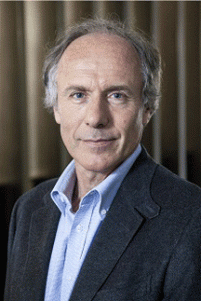 Eight reasons why Dr Finkel is great news for Australia’s energy future http://reneweconomy.com.au/eight-reasons-why-dr-finkel-is-great-news-for-australias-energy-future-70270/ By Valdis Dunis on 1 February 2017
Our electricity grid looks likely to progress more systematically to a cleaner more secure future thanks to Australia’s Chief Scientist Dr Alan Finkel being brought in – to lead the analysis and policy recommendations. For those who could not make Tuesday night’s 2.5 hour session in Adelaide with him, here are some of the key comments made by him and his team:
1. Dr Finkel and SA’s Chief Scientist Leanna Read both see the grid becoming 100% renewable powered as the end point. Continue reading →
February 3, 2017
Posted by Christina Macpherson |
AUSTRALIA - NATIONAL, energy, politics |
Leave a comment

“The stranded asset risks of investing in new coal-fired power plants are clear to almost all,” Buckley said. “At some point a carbon tax or ETS is inevitable and would need to be priced in.”
Buckley said if that happened, the CEFC could well be stranded with any loan it’s given to coal power stations.
How Malcolm Turnbull could ignore the facts and fund the myth of ‘clean’ coal, Guardian, Michael Slezak 2 Feb 17 The Coalition could use the Clean Energy Finance Corporation to finance new coal power stations but it wouldn’t be cheaper than renewables Just a few months ago, the idea that a new coal power station would ever be built in Australia seemed laughable. Banks, energy companies and even the Turnbull government seemed to accept the inevitable decline of the coal industry.
But, since then, the Turnbull government has been furiously talking up the idea of “clean” coal. And while no bank is likely to finance the building of a new coal-fired power station here, Turnbull and his ministers have been indicating the government might themselves fund them.
There’s been a lot of spin in this debate, so here are some facts……..
The Clean Energy Finance Corporation cannot currently fund coal (but the government could change the rules) Continue reading →
February 3, 2017
Posted by Christina Macpherson |
AUSTRALIA - NATIONAL, business, politics |
Leave a comment
 How Malcolm Turnbull could ignore the facts and fund the myth of ‘clean’ coal, Guardian, Michael Slezak 2 Feb 17 “….. Turnbull said in his National Press Club speech on Wednesday that “it’s security and cost that matter most, not how you deliver it”.
But new coal technology is not cheaper than renewable energy.
The US Energy Information Agency recently compared the cost of energy from various types of coal power plants and renewable energy plants.
They found that ultra supercritical coal power plants were about twice as expensive to build per unit of energy, compared to wind farms, and almost 40% more expensive than solar farms. Then coal power stations have higher ongoing maintenance costs, as well as significant fuel costs, compared with the wind and solar where the fuel is free.
Dylan McConnell from the Melbourne Energy Institute at the University of Melbourne said if those costs were recovered through energy prices, that would push energy prices up.
Tennant Reed from the Australian Industry Group recently pointed outthat wholesale electricity prices that are currently worrying big energy consumers have been sitting at about $75 per MWh. But recent projections by the CSIRO suggest the ultra supercritical coal generators would produce electricity at a cost of about $80 per MWh.
“To build a coal plant with such costs, investors would need to expect wholesale prices to rise even above looming levels and stay there for decades,” Reed wrote.
Reed also pointed out that the $80 per MWh projection was optimistic, since it was assuming that the power plants were being used at about 80% of their capacity, which was much higher than was generally the case.
Meanwhile, new wind and solar will produce electricity at about $75-85/MWh today and that price will decrease in coming years.
Buckley says: “So renewables are already at grid parity or cheaper than new USC coal-fired power, they can be built more modularly and five times faster, they have 100% emissions reduction relative to the PR spin called ‘clean coal’, they conform to our Paris CO2 commitments and they are likely to get finance – unlike a new coal-fired power plant.” https://www.theguardian.com/environment/2017/feb/02/how-malcolm-turnbull-could-ignore-the-facts-and-fund-the-myth-of-clean-coal
February 3, 2017
Posted by Christina Macpherson |
AUSTRALIA - NATIONAL, climate change - global warming, politics |
Leave a comment
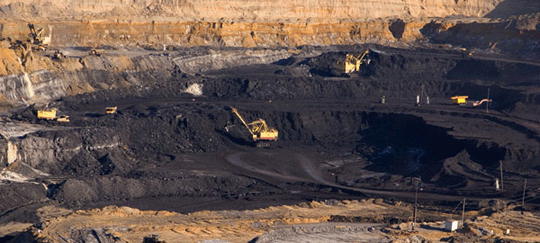 Most Australians oppose government’s $1bn Adani loan for coal railway line https://www.theguardian.com/environment/2017/jan/31/most-australians-oppose-governments-1bn-adani-loan-for-coal-railway-line
More than half of Liberal voters also oppose plan to loan Indian company $1bn to build a rail line between proposed Carmichael coalmine and Abbot Point, Guardian, Michael Slezak, Three-quarters of Australians, including most Liberal voters, oppose the government giving a $1bn loan to Adani to build a rail line between its proposed Carmichael coalmine and the Abbot Point shipping terminal.
The government’s Northern Australia Infrastructure Fund (Naif) granted Adani “conditional approval” for a $1bn loan in December last year.
The rail line, if built, would allow Adani to build the country’s biggest coalmine and open up the Galilee Basin to further mines by linking them to an export terminal.
Coral scientists have argued the coal needs to stay in the ground if the Great Barrier Reef is to be protected from the impacts of climate change.
The government has argued there is no definite link between the coal from the Adani mine being burned and climate change, and the resources minister, Matthew Canavan, has said the mine would “be a good thing for the environment”.
But a ReachTel poll of 2,126 people across Australia conducted on 12 January, commissioned by GetUp, found 74.4% of respondents said “no” when asked whether “lending $1bn to an offshore mining company to build a coal rail line is a good use of public money”.
Just 16.2% of respondents thought it was a good use of public money, with 9.5% saying they didn’t know.
The opposition was strong regardless of voting intention, with 53.7% of those who said they would vote Liberal opposing the loan. Just over 80% of “undecided” voters, 85.5% of Labor voters and 89.9% of Greens voters said the loan was a bad use of public money.
A previous survey of people living in the region that would host the mine found two-thirds opposed public money being used to support the mine. Analysis from Greenpeace has suggested the rail project does not meet the requirements for a loan under the scheme, since it will not be “of public benefit” and it is not clear Adani will be able to repay the loan.
GetUp’s Miriam Lyons said: “A mere 16% of Australians think this is a good way to invest public money. While we see hospitals and schools starved of resources, the government sees fit to hand over a billion bucks to build Adani’s shiny new train.”
Lyons called on Malcolm Turnbull to stop the loan going ahead.
“Prime minister Turnbull’s not even playing for his own team – only 32% of Liberal voters agree with this use of public money,” she said.
February 1, 2017
Posted by Christina Macpherson |
AUSTRALIA - NATIONAL, climate change - global warming, politics, Queensland |
Leave a comment
 Abbott to PM: scrap RET or face fury SIMON BENSON The Australian January 30, 2017
Tony Abbott has unleashed another critique on Malcolm Turnbull’s leadership, using his Achilles heel — climate change — to accuse the government of treating voters like “mugs” if it did not scrap the renewable energy target.
In his second swipe at the Prime Minister in as many weeks, his predecessor said the Coalition would lose all credibility if it did not move to quickly rein in the push to generate more renewable energy.
In a speech yesterday to a Young Liberals conference in Adelaide, Mr Abbott accused the government of “losing touch” with its traditional supporters. The escalation of rhetoric contained a charge that the government not only lacked leadership in Mr Turnbull but that the Coalition was at risk of electoral collapse. It also reveals Mr Abbott is willing to risk further alienation from his own government….
“……our first big fight this year must be to stop any further mandatory use of renewable power.”
The comments build on remarks Mr Abbott made two weeks ago but indicate that he has no intention of remaining silent as the government struggles to regain momentum after a horror start to the year.
They come as Mr Turnbull is due to deliver a major speech to the National Press Club in Canberra on Wednesday.
The Prime Minister will becoming increasingly frustrated with Mr Abbott’s intervention on the RET, knowing that the government is unlikely to go as far as Mr Abbott is suggesting……
“Australia has almost limitless reserves of clean coal and gas. We should have the world’s lowest power prices. Instead, we’re making it harder and harder to use coal and gas through the renewable energy target — so that power is getting more expensive and less reliable,” he said…..
“Alcoa is in trouble, Arrium is in trouble, Port Pirie is in trouble, even Roxby Downs has a problem.
……….“What used to be called the silent majority, Hillary Clinton’s ‘deplorables’, might often lack a voice but they sure haven’t lost their vote.
“Voters will punish governments and parties that they think have lost the plot — and so they should.
“So that’s our challenge for 2017: to tackle real problems in a meaningful way so that people’s lives get better, not worse — and to do so in ways that make sense to our strongest supporters.” fury http://www.theaustralian.com.au/news/nation/abbott-to-pm-scrap-ret-or-face-fury/news-story/944645cff4bbaff67fb4ee5da6980dde
January 30, 2017
Posted by Christina Macpherson |
AUSTRALIA - NATIONAL, energy, politics |
Leave a comment
Neither Canavan nor Frydenberg responded to questions about the costs of building new coal power stations
 Australia’s coal power plan twice as costly as renewables route, report finds
Researcher says new coal plants aimed at reducing emissions would cost $62b, while the cost using renewables would be $24-$34bn, Guardian Michael Slezak, 27 Jan 17, A plan for new coal power plants, which government ministers say could reduce emissions from coal-generated electricity by 27%, would cost more than $60bn, a new analysis has found.
 Achieving the same reduction using only renewable energy would cost just half
as much – between $24bn and $34bn – the report found.
The resources minister, Matthew Canavan, and the energy and environment minister, Josh Frydenberg, have been arguing for new coal power plants to be built in Australia. Continue reading →
January 28, 2017
Posted by Christina Macpherson |
AUSTRALIA - NATIONAL, climate change - global warming, energy, politics |
Leave a comment
 ‘Dump RET when America walks away from Paris’ The Australian, January 23, 2017, A growing number of government MPs, including some on Malcolm Turnbull’s front bench, say Australia should dump the Renewable Energy Target and its carbon emissions reduction commitments under the Paris climate agreement if Donald Trump walks away from the deal.
Conservative MPs have told The Australian they believe there is no point in remaining committed to the Paris accord without the US locked into action on climate change, a phenomenon the new President has previously labelled a Chinese “hoax”.
Former prime minister Tony Abbott and South Australian senator Cory Bernardi have both publicly argued for the scrapping of renewable energy targets, saying that would allow the government to campaign more forcefully against Labor on energy policy.
One conservative MP said the view was “getting a lot of traction very quickly”, while another said that opinion was already “widespread” within the Coalition partyroom. The push comes as many MPs express frustration that the government has made little political mileage out of Labor’s policy to lift the renewable target to 50 per cent by 2030……
But MPs said Mr Abbott’s opinion piece published in The Weekend Australian this month advocating a shift in policy was “not helpful”, saying it would make it more difficult to convince the Prime Minister of the merits of the political strategy.
Another said that regardless of the RET target, the government would seek to incentivise the building of new coal-fired power stations…… http://www.theaustralian.com.au/news/nation/dump-ret-when-america-walks-away-from-paris/news-story/c6863739afb25e205d67a321ce70b954
January 23, 2017
Posted by Christina Macpherson |
AUSTRALIA - NATIONAL, climate change - global warming, energy, politics |
Leave a comment
 Why the public is not buying Coalition attack on wind and solar, REneweconomy By Jonathan Gifford on 20 January 2017 What is it that the general public appears knows about renewables and electricity prices that much in the conservative side of politics, and the federal energy minister Josh Frydenberg, do not?
2017 has kicked off with another round of attacks on renewable energy targets, both state and federal. They display fundamental misunderstandings of renewable energy, its deployment capabilities, costs and impacts on electricity prices. The good news: the public isn’t buying it.
As working life, business and the public debate gets back into full swing after the holiday period, attacks on renewable energy and targets have, unfortunately, also resumed. The Australian, unsurprisingly, is leading the charge, and elected officials have added their voices to the unrelenting campaign of misinformation.
Most worryingly Energy and Environment Minister Josh Frydenberg is playing a prominent role. On Wednesday he penned an OpEd in the Australian Financial Review in which he got stuck into the Victorian and Queensland state governments’ RETs.
On Friday, The Australian gave him a platform to attack renewable energy by way of a rebuttal to the Labor opposition climate change spokesman Mark Butler’s arguments for a 50 per cent by 2030 RET.
While Frydenberg’s argumentation in today’s Australian specifically addresses the Labor 50% RET, it is riddled with direct attacks on renewable energy itself.
Frydenberg argues that RETs lead to higher power prices. To support this he says that power prices rose rapidly under Labor, that a 50% RET will drive out coal generation – implicitly increasing prices – and that it will require $48 billion in new investment in generation capacity.
The Energy Minister then cites AEMC findings that the RET will have “the highest cost of abatement,” that it does not encourage emissions reductions beyond renewable generation.
(RenewEconomy editor Giles Parkinson has already pointed out that the AEMC modelling actually shows the opposite, that the RET is actually a cheaper option, even given the AEMC modelling’s ridiculously expensive costing of wind and solar).
Despite this and other lines of argument, it appears that the Australian public is just not buying it. There continues to be evidence that renewable energy remains widely popular with Australians, to which their continued adoption of rooftop solar and increasingly battery storage attests. And polling continues to confirm this.
GetUp released the findings of a ReachTEL poll it conducted on January 12 today, in which it asked 2,126 householders what they believe are behind rising power prices.
The leading response, with 58%, was that “privatization and the lack of competition between the big energy companies” were behind the price hikes. The next response was “undecided,” with 24.2% and renewable energy in third place, with 17.7%.
“The owners of the poles and wires have been gold-plating the grid, spending billions of their customers’ money building far more grid infrastructure than we needed.”
Taking the RET in isolation, as a policy to drive the shift towards less emission intensive electricity generation as Frydenburg does, is also mischevious.
In combination with overdue electricity market reforms and the pricing of externalities, such as carbon pricing, in combination with renewable targets has repeatedly been shown to deliver a lower-cost energy transition……..
GetUp’s Miriam Lyons weighs in on the South Australia debate, saying that it is indeed “an example of what’s wrong with the current system” with its botched electric utility privatisation and the lack of competition.
“The Liberal Olsen government didn’t break up the generators when it privatized electricity – they chose to make as much from the sell-off as possible in the short term, rather than creating a genuinely competitive market,” says Lyons. “The price-gouging by gas companies that we saw in South Australia last year is a direct result of that.”
GetUp notes that it is encouraging to see public support for renewables and RETs hold fast, but that the battle against the demonization of renewables on the basis that they leads to higher electricity prices is far from over.
“This polling shows that the fossil fuel lobby’s campaign isn’t convincing most Australians – yet.” http://reneweconomy.com.au/public-not-buying-coalition-attack-wind-solar-36457/
January 21, 2017
Posted by Christina Macpherson |
AUSTRALIA - NATIONAL, energy, politics |
1 Comment
State and national environment groups condemn yesterday’s decision by the Environment Minister to approve the Yeelirrie uranium mine, which the EPA recommended be rejected in August 2016.
Conservation Council of WA Director Piers Verstegen said, “The approval goes against the advice of the EPA, against the wishes of the local community, and against the economic reality that this project is not feasible.
“This decision sets a shocking new precedent for WA environmental law – a decision which clearly and knowingly breaches one of the core objectives of the Environmental Protection Act, the Precautionary Principle. This decision allows the extinction of multiple unique wildlife species which exist nowhere else on Earth, which raises some serious legal questions.
“The EPA has made it clear that this project threatens the extinction of unique wildlife. If the Minister allows wildlife of any sort to become extinct for the sake of an unwanted and uneconomic uranium mine, then all of our wildlife is at risk everywhere.
“Minister Jacob and the Barnett Government has long held an ideological position that uranium should be mined – against the wishes of the community, against market reality, and now against the recommendations of the State’s independent environment umpire and the future of unique species.
“In the last few months, the decision to go ahead with the Roe 8 project in known breach of environmental policy, and now to reject EPA advice for the sake of an unviable uranium mine, demonstrates that the Government is willing to put their ideology ahead of their responsibility to protect the environment, and ahead of public interest.”
CCWA Nuclear Free Campaigner Mia Pepper said, “Despite the Minister’s recent rush to see uranium mined in WA, and after two terms of a pro-uranium Government, not one of the WA uranium proposals will have final approvals granted before the State election in March – and none will be economically viable.
“This project and the Minister’s approval will continue to be strongly contested by state and national conservation groups and the local community, and will continue to struggle to attract investors.”
January 20, 2017
Posted by Christina Macpherson |
environment, politics, uranium, Western Australia |
Leave a comment
No Minister, Australia doesn’t need last century’s expensive, outdated energy http://reneweconomy.com.au/no-minister-australia-doesnt-need-last-centurys-expensive-outdated-energy-19673/ By Matthew Rose on 17 January 2017Resources Minister Matt Canavan’s suggestion that Australia could meet its climate targets by replacing ageing power stations with emerging ‘low emission’ coal-fired technology is an unrealistic fantasy that would cost billions and set back genuine efforts to tackle global warming, the Australian Conservation Foundation said today.
The Australian reports today that research commissioned by Senator Canavan estimates Australia’s climate pollution could be cut by ‘up to 27 per cent’ if the country’s coal-based power stations ran on ‘ultra-super-critical’ coal technology.
There is not a single so-called ultra-super-critical coal fired power station in Australia. The vast majority of Australia’s coal fired power stations use old sub-critical technology and most are well past their use-by dates, being more than 30 years old, on average.
Senator Canavan is proposing that Australia builds a whole new fleet of coal-fired power stations at unknown cost (likely to be in the hundreds of billions of dollars) at a time when the rest of the world is moving away from coal fired power.
It is hard to imagine a company that would be prepared to build these huge white elephants, just waiting to become stranded assets.
French company Engie has pulled out of Hazelwood and two of Australia’s biggest electricity generators, AGL and Origin, have set timetables for the exit of their coal fired power stations and have been clear they won’t be making any more investments in coal.
Even if finance for these fantasy plants was found, the costs would never be recouped over the lifetime of the assets, considering Australia’s Paris climate commitments.
In contrast, investments in new renewable energy, which has zero fuel cost, will still be useful and productive in decades to come.
Research released by ACF in December shows strong clean energy policies would generate an additional 90,700 jobs across Queensland by 2030.
If Senator Canavan cares about jobs and a healthy future he would stop spruiking last century’s dirty energy and start securingthe tens of thousands of new jobs that flow from strong clean energy policies.
Matthew Rose is an economist with the Australian Conservation Foundation.
January 20, 2017
Posted by Christina Macpherson |
AUSTRALIA - NATIONAL, climate change - global warming, politics |
Leave a comment










 Antinuclear