Community Views Report released by Nuclear Fuel Cycle Royal Commission Consultation and Response Agency
 Key Findings of the ‘Community Views Report’.
Nuclear Fuel Cycle Royal Commission Consultation and Response Agency, November 2016, ‘Community Views Report’.
Jim Green, 13 Nov 16 Page 19: The report states: “Over thirty per cent (31%) of South Australians interviewed in the three rounds of telephone surveys supported the storage and disposal of nuclear waste from other countries in the state, while 53% opposed the proposal and 16% were unsure or didn’t know enough.”
Page 18: The report distinguishes ‘representative feedback’ (participation in telephone surveys and focus groups by random selection) from self-selected feedback (feedback forms, online survey, conversation kit). In the representative feedback (4016 people), 43% of people supported or strongly supported continuing to explore the nuclear waste dump proposal, while 37% were opposed or strongly opposed. In the self-selected feedback (4499 people), 64% of people opposed or strongly opposed continuation, more than double the 29% who supported or strongly supported continuation.
Adding the figures together (which the report does not do):
1727 + 1305= 3032 people support continuing to explore the proposal
1486 + 2879 = 4365 people oppose continuing to explore the proposal
Page 34: Within the structured channels of feedback forms and telephone and online surveys, 198 people who identified as Aboriginal or Torres Strait Islander provided feedback. In terms of support for continuing to explore the establishment of a nuclear storage facility for international waste in SA, 34% of Aboriginal people in the representative sample (total 56 people) were supportive and 50% were opposed, compared to 16% supportive and 73% opposed in the self-selected feedback (total 138 people).
Combining the figures (which the report does not do):
Support continuing to explore the proposal: 19 + 22 = 41 people
Oppose continuing to explore the proposal: 28 + 101 = 129 people
The report states (page 9): “Many [Aboriginal] participants expressed concern about the potential negative impacts on their culture and the long-term, generational consequences of increasing the state’s participation in the nuclear fuel cycle. There was a significant lack of support for the government to continue pursuing any form of nuclear storage and disposal facilities. Some Aboriginal people indicated that they are interested in learning more and continuing the conversation, but these were few in number.”
Page 22: How confident are you that nuclear waste can be transported and stored safely?
Confident or very confident 20%
Not confident or not at all confident 70%
In four places the report produces survey results regarding what the next steps should be. In all cases the most common response was that the nuclear waste dump proposal should be stopped. In three of the four cases, stopping the proposal was vastly more popular than the second most common response:
p.23: 28% stop the proposal vs next most common response 7%
p.26: 18% stop the proposal vs next most common response 17%
p.29: 25% stop the proposal vs next most common response 8%
p.31: 28% stop the proposal vs next most common response 8%
Page 24: Self-selected feedback channels showed that confidence that the government would consider community views in its decision was low at 20%, with 70% not confident.
Page 28: Asked about confidence in government’s ability to regulate any new nuclear industry activities in South Australia, 43% of the representative sample (total 4016 people) said they were not confident, compared with 38% who were confident. Of the self-selected feedback (total 3330 people), 74% were not confident and 18% were confident.
Combining the figures (which the report does not do):
Confident: 1526 + 599 = 2125
Not confident: 1726 + 2464 = 4190
Page 30: On the question of confidence that a nuclear waste disposal facility would bring significant economic benefits to SA, 66% of the people who submitted online surveys, feedback forms and conversation kits (self-selected feedback) were not confident.
Senator Nick Xenophon- nuclear waste dump “a stinker of an idea” – bury it forever.
 Nuclear waste storage industry in SA ‘dead for eternity’, Senator Nick Xenophon says
 , Adelaide Now State Political Editor Daniel Wills, The Advertiser November 13 INDEPENDENT Senator Nick Xenophon has declared nuclear waste storage in SA “a stinker of an idea” which should be “buried for eternity” as political support for the project collapses.
Queensland government gives Adani coal mine special privileges
Qld Labor exempts Adani mine from public submission and appeals on groundwater http://www.edoqld.org.au/news/qld-labor-exempts-adani-mine-from-public-submission-and-appeals-on-groundwater/ Environmental Defenders Office (EDO) 9 November 2016:
“The Queensland Labor government last night passed the Environmental Protection (Underground Water Management) and
Other Legislation Amendment Bill 2016 (EPOLA Bill) and Water Legislation Amendment Bill 2015 (WLA Bill).

““The Queensland Parliament has passed last minute amendments to the Labor Government’s groundwater protection laws.
The effect is that the public, be they conservation groups or local landholders, won’t have any submission or appeal rights
on groundwater licences relating to the Adani Carmichael mine,” said Jo Bragg, CEO of Environmental Defenders Office (EDO) Queensland.
“Adani will still be required to obtain an associated water licence, introduced through the EPOLA Bill.
However, an exemption has been explicitly carved out for Adani
which removes the public and the Court’s power to undertake normal scrutiny of this licence. … ”
Water reforms passed
– exemption from public scrutiny for Adani and retrospective dewatering approval
demonstrate regulatory capture by mining industry
http://www.edoqld.org.au/news/water-reforms-passed-exemption-from-public-scrutiny-for-adani-and-retrospective-dewatering-approval-demonstrate-regulatory-capture-by-mining-industry/ Environmental Defenders Office (EDO) 10 November 2016:
” … two last minute amendments are highly concerning as to their impact on proper management of our water resources
in Queensland from mining impacts, and suggest regulatory capture:
“X Exemption for Adani from public and Court scrutiny of groundwater impacts of Carmichael coal mine …
“X Retrospective approval of dewatering activities for many mines in Qld! … ”
Green groups fume over Adani’s water licence exemption
http://www.dailymercury.com.au/news/green-groups-fume-over-adanis-water-licence-exempt/3110429/
http://www.qt.com.au/news/green-groups-fume-over-adanis-water-licence-exempt/3110429/
NO FURTHER PUBLIC MONEY should be spent on nuclear industry, by the South Australian taxpayer.
 South Australian ‘citizens’ jury’ rejects nuclear dump, Green Left RENFREY CLARKE. Adelaide, November 11, 2016 “………Lack of confidence Also striking is the complete lack of confidence voiced by the jurors in the ability or willingness of the state’s politicians to manage radioactive materials responsibly. “No evidence of regulatory bodies … to act independently and to be funded properly to adequately regulate an industry,” the report observes. As evidence, the report cites examples that include a radioactive tailings site at Port Pirie on which children were allowed to play for decades, and which was prone to flooding by high tides.
Dealt with brusquely is an issue that promises to be highly contentious in coming months. “There was agreement that … NO FURTHER PUBLIC MONEY should be spent by the South Australian taxpayer.”
Weatherill, however, shows signs of planning to do exactly that.
The jury’s verdict is not binding on the government. After months of implying that the jury’s recommendation would be viewed as definitive, the Premier has now switched to stressing the “fifty thousand” South Australians whose views his “roadshow” supposedly canvassed.
The dump process, Weatherill made clear in his address to the jury on receiving its report, is not yet dead.
“Mr Weatherill said the ‘very clear position’ of the jury would be combined with other government research about the state-wide views of the nuclear industry, as Cabinet considers whether to push ahead,” the Advertiserreported on November 7.
“All of those perspectives need to be weighed up,” Weatherill said. “We don’t expect that this is a debate that will be concluded any time soon.” Weatherill is now due to present a formal position to parliament on the dump proposal, probably around the end of November. But if he tries to force the scheme through as he has suggested, the political costs for his government will be dire.
On the question of the dump, South Australians seem overwhelmingly to accept the verdict of their Citizens’ Jury peers. On November 7 an informal Channel 7 poll asked: “Should the state government now abandon its nuclear storage plans?” The response was: Yes 86%, No 14%.
Charged with legitimising the dump, the jury has very likely ended the scheme. But anti-dump activists would be foolish to quit their campaigning just yet. https://www.greenleft.org.au/content/south-australian-%E2%80%98citizens%E2%80%99-jury%E2%80%99-rejects-nuclear-dump
Nuclear dump now South Australia 2018 election issue
 Nuclear fuel cycle: Opposition says Jay Weatherill’s dream of SA nuclear dump ‘is now dead’, ABC News, 11 Nov 16 By Leah MacLennan Opposition Leader Steven Marshall has announced he will not support the building of a high-level nuclear waste facility in South Australia, saying there is too much at risk…….
Citizens’ Jury effectively exploded South Australian Labor govt’s nuclear plans
 South Australian ‘citizens’ jury’ rejects nuclear dump, Green Left RENFREY CLARKE. Adelaide, November 11, 2016 To the fury of business spokespeople, South Australia’s “Citizens’ Jury on Nuclear Waste” has effectively exploded plans by the state Labor government to host the world’s largest nuclear waste dump.
The jury was intended by Premier Jay Weatherill to lend his scheme a garnish of popular consent. But in their final report on November 6, the jurors instead concluded that the dump plan should not go ahead “under any circumstances”. The vote was overwhelming, with two-thirds of jury members opposing the government’s projections.
Both as science and public policy, the jury’s finding made superb sense. But the verdict was more than that.
From the ordinary working people of South Australia, it was a message to their “betters”: “Be damned. We don’t trust you to defend our interests. Given the chance, we’d send you to hell.”
It was like Brexit. Or the street parties held when Margaret Thatcher died.
To reach their verdict, the jurors — initially numbering 350 and chosen as a representative slice of society — defied an intensive propaganda campaign mounted by the state authorities over several years at a reported cost of $10 million.
The government, Weatherill insisted from the outset, would never go ahead with its dump scheme unless the population, including indigenous people, was shown to be solidly behind the plan. To make the case for the proposal, a Royal Commission on the Nuclear Fuel Cycle was held, headed by former South Australian Governor Rear Admiral Kevin Scarce. The commission’s final report, key sections of it drafted by nuclear industry consultants, was delivered in May.
As anticipated, the commission urged constructing a “deep repository” to house as much as a third of the world’s current stock of high-level reactor wastes. Most of the immense cost, South Australians were promised, would be borne by client countries anxious to rid themselves of a growing mountain of spent nuclear fuel. The eventual net flow of revenues to the South Australian government was put at a dazzling $51 billion.
Nuclear spruikers
Following the royal commission was a “consultation” program dubbed by critics the “nuclear roadshow”. For months, teams of pro-nuclear spruikers toured the state’s urban centres. Supposedly seeking the views of the population on nuclear issues, program staffers mounted slick presentations uncritically promoting the commission’s findings.
Pounding still broader numbers of South Australians into line was a drum-beat of pro-nuclear articles in the Murdoch-owned Adelaide Advertiser.
Within the government’s strategy the role of the Citizens’ Jury, which met for the first time in June, was to produce a report voicing at least conditional assent to the dump plans. Weatherill and his cabinet would then have claimed public support for beginning the process, predicted eventually to cost taxpayers $300–600 million, that would see the sites for interim and final dumps chosen, the location selected for a dedicated port, and prospective clients scouted.
Though strong on the rhetoric of “consultative leadership” and “deliberative democracy”, the Weatherill government clearly did not mean to let in-depth debate get in the way of a suitable jury verdict. Control over the jury process was handed to a team of “facilitators” put together by the firm DemocracyCo. The latter compiled a list of 160 “expert witnesses”, skewed strongly towards nuclear advocates, to address the jurors.
A script drawn up by the facilitators would rush the jurors through hurried workshops, many held simultaneously. Jurors would have little chance to question witnesses at length, or to gain a feel for the broad progress of the discussion.
The government’s ploys seemed watertight. But on November 6, they were shown to have failed completely.
“Multiple threads of concern are present that undermine the confidence of jurors in the Royal Commission report’s validity,” the jury’s final report stated. “These concerns collectively combine to affect a powerful NO response.”
“Green activists kill inquiry”
What had gone wrong? In the view of Nigel McBride, chief executive of the peak association Business SA, the jurors had been got at by “green activists determined to kill further inquiry”.
“They ran an absolutely undiluted campaign of fear and misinformation,” McBride was quoted by the Advertiseras saying: “The people who were going to die in a ditch over this were the naysayers, the rest of us were calling for an informed investigation … It’s disappointing. An extraordinary amount of effort and resources and time has gone into it.”
The truth is less sinister. Chief Executive of the Conservation Council of SA Craig Wilkins pinpointed it in a press release:
“The nuclear industry likes to push a myth that the more people get to understand nuclear issues, the more supportive they are. Well, 350 South Australians have spent over 40 hours hearing about a nuclear dump for SA and the more they heard about it, the less they liked [it].”
The real problem that brought the nuclear dumpsters undone was simple: before a demanding audience that had other sources of information, the pro-nuclear side was incapable of putting forward convincing arguments.
Dissatisfied with the witnesses on offer, the jurors invited experts of their own choice, to talk to them, including Friends of the Earth anti-nuclear campaigner Jim Green, Australia Institute Chief Economist Richard Denniss, and University of South Australia Adjunct Professor Richard Blandy, all incisive public critics of the dump scheme.
The jury’s final report is not a polished document. Those who worked on it, however, obviously took their task with enormous seriousness. Their rejection of the pro-dump case, it is fair to say, rested on two main grounds: the refusal by the dump’s proponents to address the objections of traditional indigenous landowners and the gross flaws in the economic case for the dump as put forward by the royal commission.
As related by the Adelaide Independent, Weatherill in the past had “told a national television audience that a dump would ‘require essentially the explicit consent of traditional owners’ and that ‘if it did not exist, it wouldn’t happen’.”
In a two-hour session before the whole Citizens’ Jury, more than a dozen well-known Indigenous elders made it plain that no consent was being given or ever would be.
“Indigenous, community and social consent is absolutely required,” the jury’s report notes. “Currently not provided and a resounding ‘No’…”
The economic case for the dump, prepared for the royal commission by the nuclear industry consulting firm Jacobs MCM, is savaged in the report. “Many (jurors) have no confidence in the economics of the project. … The assumptions made (as) to potential income are based on assumptions with little support.”
Eighty-two per cent of the jurors, the report notes, were inclined to view the economic risks of the scheme as too great. https://www.greenleft.org.au/content/south-australian-%E2%80%98citizens%E2%80%99-jury%E2%80%99-rejects-nuclear-dump
Time to dump the nuclear dump
The Greens welcome indications from the State Opposition today that the proposed international high-level nuclear waste dump for South Australia will soon be just a bad dream.
“From Day One, the Greens have said that this project is ill-conceived, economically reckless and posed enormous reputational damage for our State,” said Mark Parnell MLC, Parliamentary Leader, Greens SA.
“Following the Citizens’ Jury’s overwhelming rejection of the dump last weekend, the Government now needs to step in quickly and announce the project to be over.
“One thing that everyone has agreed is that without social consent, the project can’t proceed. With the opposition now apparently siding with the Greens, it is clear that Parliament will reject any move to progress a nuclear dump in SA.
“South Australia’s economic future should be driven through green jobs, renewable energy, advanced manufacturing and promoting our GM-free fresh produce,” concluded Mark Parnell.
Nuclear lobby loses support of its top business stooge, Nigel McBride
 DUMPED: Nuclear repository “dead” as Marshall draws election battleline, InDaily, Tom Richardson, 11 Nov 16 Jay Weatherill has lost his fiercest advocate for a nuclear waste dump, a proposal that appears to have no hope of proceeding, with Business SA chief Nigel McBride telling InDaily today the plan was now “dead”. As Liberal leader Steven Marshall this morning intensified his position against proceeding any further with planning for a future high-level repository, and days after a citizens’ jury flatly rejected the proposal, McBride said: “Between the Liberals and the citizens’ jury, the thing is dead.”
His resignation that “realpolitik” would not allow any further investigation of the plan – which a royal commission had estimated would pump billions of dollars into the state’s economy – followed the Opposition Leader unilaterally withdrawing his party’s support ahead of a partyroom meeting on Monday……..
[Labor Premier Jay Weatherill] refused to concede the project was doomed, reiterating that the Government would assess the fruits of a broader community consultation before deciding a path forward – prompting Marshall to declare the issue a key election battleground…….
Crucially, Marshall today stamped his authority on the partyroom decision, saying: “We’ll have our discussion on Monday [but] I’m quite confident we’ll make a decision that we won’t support any further investigation of this proposal.”
“I’ve been out talking to the people of SA, and my parliamentary colleagues have been out talking to people of SA… the people of SA do not support this proposal, there’s too much economic risk…….
Marshall’s manoeuvre today appears to have imposed an insurmountable one, though he was clear the “death knell” was sounded by the decision of the citizens’ jury – a process he has consistently derided…..
[Nigel McBride said] between the Liberals and the citizens’ jury, the thing is dead. “I’m not happy about it, but we’ll have to live with it.”McBride said that “having put it in the hands of the jurors, the realpolitik of this is the only way it would have got up was with the absolute support of both sides of politics”. “It was always a long shot,” he said……http://indaily.com.au/news/local/2016/11/11/dumped-nuclear-repository-dead-as-marshall-draws-election-battleline/
South Australian nuclear waste plan – “dead and buried” say Liberals

 Premier fails to garner support from SA public for nuclear waste dump claims Opposition leader Marshall Sheradyn Holderhead Political Reporter, The Advertiser November 10, 2016 THE push to establish a nuclear waste dump in South Australia is “all but dead and buried”, Opposition Leader Steven Marshall has declared.
Before returning from visiting the world’s most advanced nuclear disposal facility, Mr Marshall told The Advertiser it was clear from Finland’s experience that the public had to be on board.
“Personally, I have a much greater ambition for SA than becoming the world’s nuclear dump,” he said.
Mr Marshall said the decision that two-thirds of the citizen’s jury did not want the proposal pursued under any circumstance was “a complete failure to get the public onside”.
“Finland is the world leader in creating a permanent repository for nuclear waste. They have spent 40 years getting to this point. And that’s just for their own waste,” Mr Marshall said.
“The clear message here is that this policy from (Premier) Jay Weatherill — that he could receive a Royal Commission report and then make a decision within a matter of months — was ill-conceived. The things they (Finland) have achieved took decades, not months.
“The Citizen’s Jury result showed that Jay Weatherill could not be trusted to deliver on such a significant project. He couldn’t even get Gillman right.”
Today, a group of environmentalists will hand Mr Weatherill a petition with 35,000 signatures calling on the Government to abandon plans for a nuclear waste dump.
The group includes indigenous leaders Enice Marsh, Lesley Coulthard, Regina and Vivianne McKenzie, Tony Clark, Karina and Rose Lester and representatives from conservation groups.
Australian Conservation Foundation campaigner Dave Sweeney said burying nuclear waste in SA would leave an “unwelcome toxic legacy for hundreds of thousands of years”.
Mr Marshall said Finland’s Onkalo nuclear waste disposal facility was “impressive”.
He said that while he was not worried about the safety of such a facility, he had “serious concerns” about economic return. “The longer we look at this issue, the more questions are raised about the viability of this project,” he said. “Nothing I saw in Finland waylaid those concerns.”
A Liberal joint party room meeting would be held on Monday to discuss Mr Marshall’s report from Finland and to hear from Liberal MPs Rob Lucas and Dan van Holst Pellekaan, who were members of the parliamentary committee investigating the proposal.
Earlier this week, Mr Weatherill said the Government would wait for a community views report that includes results from 30,000 online surveys and in-person feedback provided by 16,000 people, before making a decision on how to proceed.
He said the jury decision would be given “substantial weight” in the final government position to be announced to Parliament before the end of the year.
The Government expects to receive the community views report, compiled by consultants, early next week.
Labor Party pressure on South Australian Premier Jay Weatherill to dump nuclear plan
 Jay Weatherill will be forced to abandon nuclear waste storage plan, Labor sources say
Premier Weatherill’s nuclear political quagmire (a martyr for the nuclear religion?)
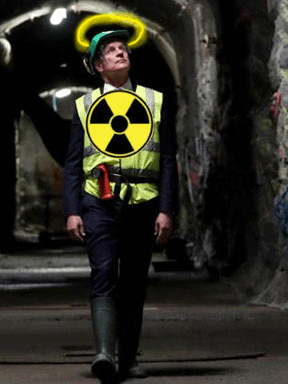 With citizens dissenting, Labor party members preparing for internal debate and anticipation building among nuclear industrialists, the Weatherill government has waded into a political quagmire, in which it now stands waste-deep.
Simplify Day won’t ease nuclear tension in South Australia, Online opinion, By Dan Monceaux, 9 Nov 16 “……If support for future high-level nuclear waste storage had been demonstrated by the Citizens Jury, or granted by Traditional Owners, repealing legislative barriers would have been the necessary next step before opening the gate for further investment. The Jury’s report recommends against such reforms, casting doubt on the nature and content of the policy announcement expected later this month.
The Jury has also called for the State Government to draw no more from the public purse. To date the State has committed $13 million dollars to the Royal Commission, Citizens’ Jury and ‘Get to Know Nuclear’ public relations campaigns combined.
The jury’s objections have no doubt stolen some wind from the sails of supporters. The Premier now risks compounding the identified problem of a lack of trust in government, if he is to announce any further financial commitment to explore the Commission’s proposal. Meanwhile, dissenting voices within the South Australian Labor party will likely draw confidence from this as the party heads towards a contentious Special Convention on the topic. Continue reading
Weatherill champion for nuclear waste, likely to bite the political dust
Citizens’ jury decision spells nuclear disaster for Weatherill, Crikey, The citizens’ jury bombshell has left Jay Weatherill facing an unwinnable political conundrum, writes InDaily senior reporter Tom Richardson, 7 Nov 16 And either way, he will have to abandon one of two projects most closely associated with his premiership………nuclear was never genuinely on the political agenda until Weatherill put it there. It was in the Liberal policy grab-bag entitled “we support this but can’t be arsed genuinely advocating for it”, and on the extended wishlist of people like Business SA’s Nigel McBride…….
Steven Marshall wasn’t here to turn the knife on behalf of the oposition, because he is currently touring nuclear facilities in Finland, to make up for the bipartisan tour he pulled out of back in September.
Bipartisan support may be important, but nonetheless, for a nuclear waste dump to succeed it needed a champion from the nominal political left. And in putting it firmly on the agenda, Weatherill anointed himself that champion…….
If he forges on with the waste dump, he will be thumbing his nose at the findings of the citizens’ jury, effectively abandoning any pretence of consultative leadership and “riding roughshod” over public opinion — the very thing he criticised about the Rann administration.
If, however, he takes the jury’s unequivocal red light as an unnavigable road-block, he might as well hand back the keys right now.
For that will entail, once again, a term of sound and fury signifying nothing.
Weatherill has gambled plenty on the assumption that the will of the jury will reflect a grudging admiration for his “boldness” in putting the nuclear issue on the agenda.
Instead, it reflected a complete disconnect between the government and the governed, a lack of trust and a lack of faith that this administration — or any other — can deliver on such a proposal……
In an intriguing interview in September, Weatherill suggested his “courage” in tackling risky reform would be rewarded at the ballot box………
In the end, the most tangible upshot of the millions of dollars and thousands of hours spent on the question of a prospective high-level nuclear waste dump could be that the federal government’s comparatively uncontroversial low-to-medium-level repository is quietly green-lit.
In other words, the Government’s grandest achievement will have been to help allow something that it successfully blocked 12 years ago. (Incidentally, blocking it back in 2004 was also regarded as its grandest achievement at the time.)
The citizens’ jury has exposed a fatal flaw of the Weatherill administration’s brand right now. Like the nuclear waste on which it has staked its future, it is both toxic and heading for a deep hole.
Weatherill has shown himself deft at extricating himself from such situations in the past, but with little more than a year before he faces the polls he is haunted by a prophesy of his own creation.
“You ain’t seen nothing yet,” he warned us…And two years on, he couldn’t have been more right…….https://www.crikey.com.au/2016/11/07/citizens-jury-goes-nuclear-on-weatherills-political-dreams/
Premier Jay Weatherill’s political future on the line?
Where to now, for Premier Weatherill’s nuclear dream? Online Opinion, Noel Wauchope 8 Nov 16 On November 6th, to the surprise of all, South Australia’s Nuclear Citizens Jury came up with a report that overwhelmingly rejected the government’s plan for importing and storing high level nuclear waste. Over four days of witness hearings, and deliberations, the 350 members of the jury were tasked with producing an answer to this question:
Under what circumstances, if any, could South Australia pursue the opportunity to store and dispose of nuclear waste from other countries?
The jury’s answer:
Under no circumstances should South Australia pursue opportunity to store and dispose of nuclear waste from other countries for reasons of consent, economics, trust and safety.
An over-riding consideration was the lack of Aboriginal consent:……..
The Jury strongly recommends that there be no further amendment to the Nuclear Waste Storage Facility (Prohibition) Act at this time.
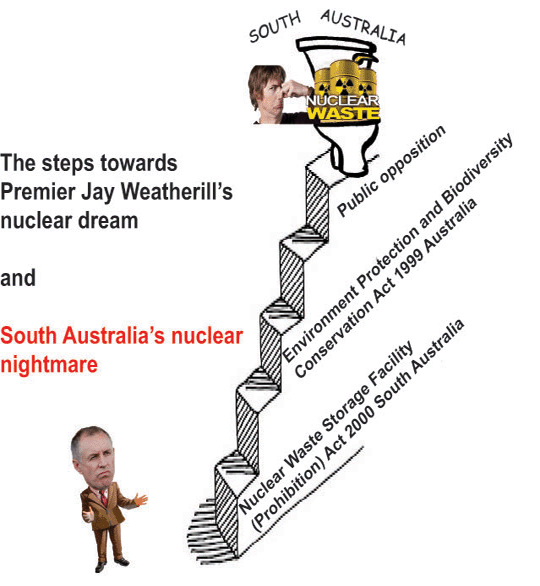
Many in the Jury felt strongly that if the nuclear waste proposal is to go ahead no further public money should be spent at this time. Any further analysis should be conducted and funded by key players within the industry.
Weakening or repealing this law is the first goal in the nuclear lobby’s plan set out in the report by Nuclear Fuel Cycle Royal Commission South Australia.
The jury was critical of the “Perceived lack of objectivity of Royal Commission Report”…….
A “yes” result might have been problematic, drawing national attention to this extraordinary plan to make Australia be the first country on the planet to invite in the world’s radioactive trash.
But a “No” vote – nobody expected that, and you could see by Weatherill’s rather fixed and strained smile on receiving the report, that it is causing some angst in the government. And no doubt, in the nuclear camp in general.
However, one can be sure that they will quickly regroup, and refresh their campaign. Premier Weatherill made it clear that the discussion will continue…….
everyone seems to agree that the Jury’s report is at least a “setback” for the nuclear waste plan, as the Financial Review describes it. It also raises questions about Premier Weatherill’s political future. Weatherill has been praised as an example of political courage. Weatherill prides himself on taking risks.
 He could decide to cut the losses to the State, and pull out from the plan now. Perhaps Weatherill has invested too much energy and involvement with the nuclear lobby, to take such a step. As Macbeth said, when considering stopping his ambitious but dangerous cause – “”I am in blood stepped in so far that should I wade no more, Returning were as tedious as go o’er,” http://www.onlineopinion.com.au/view.asp?article=18640

The SA Government should now dump its plans for a nuclear waste dump.
 The Australia Institute team, 8 Nov 16 Yesterday, 350 ordinary citizens handed the SA Government a “stunning and overwhelming rejection” of its plans to build nuclear waste dump in South Australia.
The citizens’ jury’s task was to consider whether South Australia should import high level nuclear waste from other countries and bury it for money. After hearing about the proposal from various experts, more than two thirds of them said no, not “under any circumstances”.
The Australia Institute’s involvement focused on an area that no one else was challenging: the dodgy economic modelling and heroic estimates of how much money the dump would deliver to the state.
Richard Denniss addressed the citizens’ jury last weekend, highlighting a few key points:
- The economic modelling supporting the claims of hundreds of billion dollars in benefits was deeply flawed.
- The project was risky, involving high level waste being stored in above-ground ‘temporary’ storage for over 100 years.
- That parts of the Nuclear Royal Commission’s report had actually been written by nuclear industry lobbyists.
Richard’s appearance was just the latest part of our involvement in the SA nuclear debate. In July, Rod Campbell had addressed an earlier citizens’ jury, leading to the headline in The Australian: Citizens’ jury questions economics of SA nuclear dump.
Our earlier submission on the economics of the dump and headline appearance on Today Tonightmade a big impact, with the Royal Commissioner, Kevin Scarce, saying he would take our submission “apart piece by piece.” We have also had a number of opinion pieces published on the subject.
Commissioner Scarce never did find anything wrong with our submission. But the citizens of South Australia have taken his work apart, piece by flawed piece. The Citizen’s Jury final report outlined concerns about the lack of consent from Traditional Owners, and showed that while 70% opposed the nuclear waste dump, 82% thought the economic case made was weak. Here’s a quote from the jury’s final report:
“It is impossible to provide an informed response to the issue of Economics because the findings in the RCR are based on unsubstantiated assumptions. This has caused the forecast estimates to provide inaccurate, optimistic, unrealistic economic projections.”
The SA Government should now dump its plans for a nuclear waste dump.
The Australia Institute aims to produce research that matters, and this is a case where we can see how lots of hard work over a long period changes minds. The Citizens’ Jury is to be congratulated for delivering a big win for the South Australian taxpayer, Traditional Owners, the environment, and common sense.
Will Australia back coal at the UN climate talks?
 What’s in store at the Marrakech climate talks – and will Australia still back coal?, Guardian, Graham Readfearn,6 Nov 16
The US presidential race is guaranteed to prove a distraction at the Morocco COP22 gathering, where action is on the agenda. he Australian government takes a delegation to the United Nations climate change talks in Morocco starting Monday – two weeks that are sure to be dominated by, well, who knows?
Because, during the first week, the United States will go to the polls to pick a new president – an event that will act like a giant weapon of mass distraction in Marrakech.
The Republican candidate, Donald Trump, has pledged to pull the US out of the UN process on climate change and cancel the global deal agreed at the last talks in Paris…….
aside from the distraction of US politics, what else for Marrakech – a meeting known as COP22 (so called, if you must ask, because this is the 22nd meeting of the conference of the parties to the UN framework convention on climate change)? And what about Australia’s position?
Since the Paris agreement was gavelled last December, the process to ratify the deal has been ongoing.
This process, known as “entry into force”, required at least 55 “parties” representing about 55% of global greenhouse gas emissions to ratify the agreement.
This threshold was met on 5 October and the deal will enter into force right about … now!…….
Australia has still not ratified the Paris agreement but there are reports this could happen before the talks close on 18 November……
Australia pledged that by 2030, it would cut emissions between 26% and 28% below where they were in 2005.
While the Department of Foreign Affairs and Trade stands by the target as being ambitious and fair, there are many critics who say it’s anything but……
Australia remains an influential country in the talks, owing in part to its position as chair of the umbrella group of countries – one of many negotiating groups.
As yet there has been no formal announcement from the Australian government on who will attend, but there is an expectation among some that the foreign minister, Julie Bishop, will be there for the “high-level segment” that starts in week two.
The Australian delegation will also have a new diplomat in charge. Replacing Peter Woolcott as climate change ambassador is Patrick Suckling, who took over the role in February after serving as Australia’s high commissioner in India.
During his time in New Delhi Suckling made several statements supporting the controversial Carmichael mega-coalmine project in Queensland, being proposed by Indian company Adani.
“This project will drive economic growth and create more than 6,000 jobs in Australia,” he said in 2014. “It will also boost India’s development by providing electricity to 100 million Indians.”
In one report in the Economic Times, Suckling was quoted as saying the Australian government was trying to tighten legal rules around who could and could not challenge coalmines through the courts (a theme that has re-emerged in recent weeks).
“We are actively thinking of possible ways to limit the scope of litigation to only those with a real standing in a project,” he was quoted as saying.
Language like this tends not to go down well with the army of NGOs, campaigners and civil society groups who attend the climate talks and have given Australia more then a fair share of “fossil” awards over the years.
The perception among many has been that Australia has sought to defend the coal industry too many times at UN meetings.
Will Australia stake its reputation on coal again? https://www.theguardian.com/environment/planet-oz/2016/nov/05/whats-in-store-at-the-marrakech-climate-talks-and-will-australia-still-back-coal
1 This month
15 April – Zoom –Nuclear Power is Not the Solution
Apr 15, 2026 01:00 AM in Canberra, Melbourne, Sydney

Join the International Physicians for the Prevention of Nuclear War (IPPNW) on Tuesday, April 14th for a timely webinar exploring the risks associated with nuclear power and challenging the myth that it offers a simple, safe, carbon-free solution to the climate crisis

of the week – Australians for War Powers Reform (AWPR)
To see nuclear-related stories in greater depth and intensity
 Antinuclear