Josh Frydenberg talks renewable energy – but no action from this government
Coal fan Frydenberg’s figleaf fluttering in the wind
Environment and Energy minister Josh Frydenberg is claiming to be a convert to the cause of renewables but the grim truth is that this government has no interest in meaningful climate action., Crikey, Bernard Keane Alarmed at the criticism of his appointment as combined energy and environment minister, Josh Frydenberg has launched a media campaign to overhaul his image as that of the man who recently insisted there was a “strong moral case” for burning more coal and starting economically unviable new coal mines like Adani’s Carmichael project (not to mention his loathing of environmental groups).,… (subscribers only) https://www.crikey.com.au/2016/07/28/frydenberg-on-renewables-and-coal-but-no-real-action/
What chance for truth at the South Australian Nuclear Parliamentary Inquiry?
 Well, not a whole lot, because out of the six members of this Inquiry, only one, Mark Parnell, has an antinuclear position. the other five all belong to political parties that, to put it mildly, are friendly to the nuclear industry:
Hon Tom Kenyon MP Labor’s “ true believer in SA’s nuclear potential”
Mrs Annabel Digance MP – Labor party. well, we all know how Labor MPs toe the party line, no matter what the evidence.
South Australian Nuclear Royal Commission Did Not Give The Citizens’ Jury The Full Picture
 Submission to JOINT COMMITTEE ON FINDINGS OF THE NUCLEAR FUEL CYCLE ROYAL COMMISSION Makes the case that Australians are being denied the bigger picture, and the NFCRC was deliberately or negligently selective in their assessment of evidence received. https://www.academia.edu/27087058/Submission_to_Joint_Committee_on_Findings_of_the_Nuclear_Fuel_Cycle_Royal_Commission
“………I believe that the South Australian people have a right to know about the implications of all relevant nuclear materials handling processes and their consequences for human health and the environment in advance of making or influencing any government decision to accept or reject spent nuclear fuel.
I am concerned that the Citizens’ Jury currently tasked with simplifying the Nuclear Fuel Cycle Royal Commission may not comprehend the full extent of the Commission’s recommendations- that is, that they are seeking to enable currently prohibited industrial activities across the whole nuclear fuel cycle.[1] Nuclear Fuel Cycle Royal Commission, Government of South Australia, ‘Nuclear Fuel Cycle Royal Commission Report’, 2016: pg. XV. http://yoursay.sa.gov.au/system/NFCRC_Final_Report_Web.pdf . Accessed 2016-07-01……..
3. the question arises: how selective or otherwise was the process of assembling its Final Report and recommendations? Why was certain information received not included in the Commission’s final report?
4. the first Citizens’ Jury did not hear from a presenter who was appropriately knowledgeable on matters of radio-biology and the pathways and effects of exposure to nuclear materials in environmental or occupational contexts (with respect to uranium and nuclear fuel). The only medical professional to address the jurors for any significant length of time was Associate Professor Michael Penniment.
It is my opinion that by not providing fundamental information about the connection between radiationexposure and the development of cancers and leukaemia, the Department of the Premier andCabinet is preventing the jurors from being able to adequately consider risks, which being bombarded by the opportunity of waste storage, and the numerous mechanical processes which would need to occur to enable it………
CHERNOBYL In his presentation to the jurors, Penniment went on to describe the consequences of Chernobyl incorrectly, stating that only 28 people died as a result of the incident, and that those were the first responder clean-up workers. This misinformation conflicts with all recent accounts of the disaster, including those published in the Nuclear Fuel Cycle Royal Commission’s own Final Report. No-one present in the room was able to correct him……
5 I supplied evidence to the Commission for its consideration demonstrating the different approaches taken to measuring and estimating the human health consequences of Chernobyl in my submission to the Tentative Findings. I had hoped that the Commission would compare these with its own references to UNSCEAR and the WHO. No such comparisons were reflected in the Final Report…….
FUKUSHIMA In the case of the 2011 Fukushima disaster, the Commission’s final report fails to reflect the gravity, extent of harm and technical complexities related to the incident and the response thus far……
6. [On the health effects on nuclear workers]
The Commissioner’s response to my question and correction demonstrate that the Commissioner was at that time unaware of the problematic nature of the elevated risk of cancers and leukemias experiencedby nuclear industry workers, despite my submissions. This also confirmed that the evidence I provided to the Commission was ignored, either wilfully or negligently. I reach this conclusion with confidence, given Chad Jacobi’s recent admission that all submissions were read by the Commission, and by him personally.[11]
I have received further confirmation from the Royal Commission’s Chief of Staff, Greg Ward that Chad Jacobi was the chief author of the final report. If Jacobi read all of my submissions, what cause did he have to ignore the evidence that I provided?
NUCLEAR FACILITY EFFLUENT & EMISSIONS In my submissions to the Commission, I drew attention to several studies which identified or analyses clusters of leukemias in close proximity to nuclear facilities…….. The Commission chose not to include this controversial subject in its final report, despite a preliminary search revealing a substantial number of peer-reviewed medical research papers exploring this topic……..
NUCLEAR FUEL LEASING The Final Report refers to the prospect of establishing a nuclear fuel leasing scheme in South Australia, contingent on the establishment of a permanent storage facility for spent nuclear fuel. The report then goes on to say that such a program could provide a competitive advantage capable of improving prospects for the development of additional uranium processing activities in South Australia……..This process of gradual expansion into enrichment and fuel processing is summarised….
By my assessment, these statements reveal the broader intent of the Commission’s recommendations, yet this information is buried deep inside the body of the Final Report. The Commission suggests that South Australia work with established nuclear industrial players to add value to the currently exported product: uranium oxide concentrate.
RECOMMENDATIONS
South Australian govt spruiking nuclear waste dump to TAFE students
SA govt’s Nuclear Consultation and Response Agency (CARA)TAFE SA will host a Video Conference (VC) for students on Thursday 28thJuly between12-1pm. Mr John Phelan, CARA’s Director of Engagement, will provide information during this session.
TAFE SA Video Conference (VC) Campus Locations – Thursday 28th July 12pm – 1pm
South Australian Greens prevented law that would give full rein to taxpayer funded nuclear promotion
 Nuclear waste dump ‘spruiking’ with taxpayers’ money stopped by Greens http://www.abc.net.au/news/2016-04-14/nuclear-waste-dump-‘spruiking’-with-taxpayers’-money-stopped/7325076 14 Apr 2016 An attempt to change the law in South Australia to allow public money to be spent on promoting a nuclear waste dump has been stopped with the Greens claiming a victory.
A law passed in 2000 to stop public funds from being used in any activity associated with a nuclear waste facility.
The State Government had tried to amend the law to allow consultation with the community on the results of the Nuclear Fuel Cycle Royal Commission. Greens MLC Mark Parnell said the proposed change was too wide ranging and the Upper House had stepped in to protect taxpayers.
“The Greens do accept that we do need to have a public debate,” he said.”We’re confident we know what the result will be but nevertheless the Government says they only want to consult, they don’t want to spruik and they don’t want to plan for a nuclear waste dump.”
He said the Government had attempted to “overreach”.”The law now says that the Government can use public money to consult the community but they’re not to use public money for promoting or designing or even buying land for a nuclear waste dump.”
Questions about Senator Sean Edwards’ nuclear waste proposal
 Nuclear Fuel Cycle Watch, Andrew Allison July 21 Rumour has it that once of the anonymous countries that Sean Edwards will not name is South Korea. One might speculate about where the money for Sean Edwards’ very glossy submission to the NFCRC came from? ….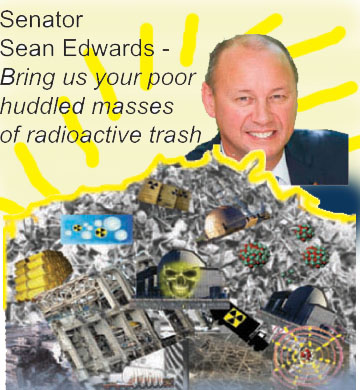
I have many reservations about Sean Edwards’ proposal, but two obvious questions come to mind:
1/ If the deep-underground storage of nuclear waste is a “solved” problem and South Australia can supposedly acquire and implement the technology at low cost (leading to high profits…) then why can’t South Korea do that?
2/ If the generation IV reactors are going to solve the waste storage problem then why can’t an advanced technological country like South Korea do that? https://www.facebook.com/groups/1021186047913052/
Nick XenophonTeam backs 40pc renewables
Xenophon party backs renewables but wants Senate electricity inquiry The Australian July 25, 2016
NXT federal MP Rebekha Sharkie, who won the Adelaide Hills seat of Mayo from Liberal Jamie Briggs, said the party was committed to the renewables target, but NXT wanted a Senate inquiry into electricity prices “so we can get the arguments on the table and look to a solution”.
Ms Sharkie believed a second interconnector between South Australia and the eastern states could help the situation, though it had been discussed for 15 years without action…….http://www.theaustralian.com.au/news/nation/xenophon-party-backs-renewables-but-wants-senate-electricity-inquiry/news-story/3a2920c0274a22994f377395acb6b5bc
Turnbull’s gift to the nuclear and coal industries – Minister Josh Frydenberg
It’s time the Turnbull Cabinet came clean on energy http://www.sbs.com.au/news/article/2016/07/21/comment-its-time-turnbull-cabinet-came-clean-energy Forget 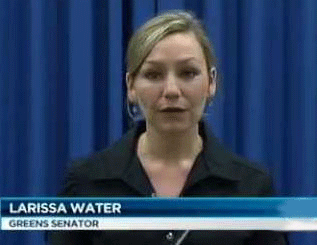 merging the environment and energy portfolios – we need Minister for the Environment and for Clean Energy, writes Senator Larissa Waters.
21 JUL 2016 – In an ideal world, combining the federal environment portfolio with the federal energy portfolio, as Malcolm Turnbull has just done in his Cabinet reshuffle, would make perfect sense.
But in today’s political context, which sees big mining companies pour mega donations into the two big parties, it’s a troubling move, especially as the responsibility for the merged ministry falls to Josh Frydenberg.
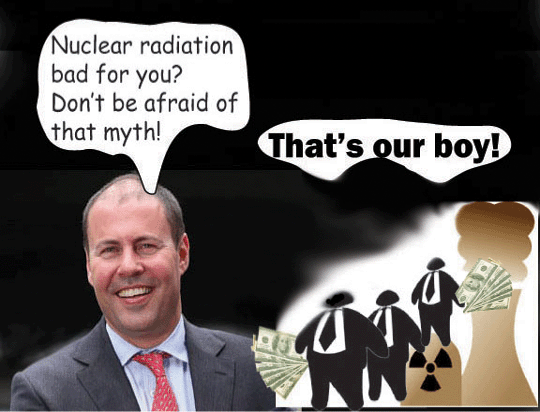
Minister Frydenberg is a well-known coal supporter who has argued for nuclear power from his first speech in the Parliament. Alarmingly, Frydenberg’s appointment could signal Malcolm Turnbull’s support for nuclear is growing since he left uranium mining, processing and storage ‘on the table’ late last year, even though nuclear power is a dangerous, expensive and slow-off-the-ground distraction from job-rich renewable energy.
As Resources Minister, Frydenberg pushed ahead with a proposed nuclear waste dump in South Australia that stands to financially benefit a landholder who happens to be a retired Liberal politician, despite opposition from Traditional Owners.
Championed by Andrew Bolt as ‘Mr Coal’, the former Resources Minister believes there is a “moral case” for the Adani mega-coal mine. He argues that the coal mine will lift people in India out of energy poverty, ignoring the fact that four out of five people without electricity in India are not connected to an electricity grid so can’t access coal-fired power.
The solution to energy poverty in India is localised renewable energy. Unlike coal, clean energy doesn’t cause millions of premature deaths every year through air pollution a year or pollute local water supplies.
Given Minister Frydenberg’s track record, his approach to his role as Environment and Energy Minister threatens to be very different from what is required to save our Great Barrier Reef and safeguard our very way of life from global warming.
To give the Reef a chance and to protect our Pacific neighbours from sea-level rise, the title really should be Minister for the Environment and for Clean Energy. We need an ambitious, rapid transition to clean energy that embraces storage technology for reliability, provides assistance to communities affected by the end of fossil fuels, and helps workers with training to benefit from this job-rich 21st century industry.
Malcolm Turnbull’s Cabinet re-shuffle gives no indication that his government is up for the task of leading this necessary national transition from dirty to clean energy. Mr Turnbull has announced the largest Cabinet team in 40 years but despite the size and the breadth of issues covered in his colleagues’ titles, climate change has been completely ignored.
Climate change is the biggest economic challenge we face and a stand-alone Minister and Department would provide a serious advantage in meeting it.
Instead climate change has been completely forgotten and environment has been relegated to a part-time role for a known coal-loving, nuclear fan.
No wonder the fossil fuel lobby is happy.
Shortly after Minister Frydenberg’s appointment was announced, The Australian Petroleum Production and Exploration Association put out a glowing media release. The Qld Resources Council executive Michael Roche said the sector had “won the trifecta”, in energy and environment and with Matt Canavan, who questions climate science while cheering on coal, taking over from Frydenberg as Resources Minister.
Some environment groups carefully expressed qualified hope that the merger of environment and energy could assist in the economic transition we so desperately need toward clean energy.
I’d love nothing more than for that to be true. However, the environment movement’s caution is well warranted, given the control fossil fuel companies exert over both the old parties.
As political donations are not disclosed in real time, we’ll have to wait for at least half a year to find out which big mining companies have donated with the aim of holding on to the polluting status quo.
From the looks of Malcolm Turnbull’s Cabinet reshuffle though, the dirty donations continue to be more than enough to keep the Prime Minister forgetting about the once-genuine concern he seemed to have for future generations surviving global warming.
Queensland Senator Larissa Waters is the Australian Greens Deputy Leader and climate change spokesperson.
Taxpayer to fund Adani coal project – says new ‘Environment” Minister Josh Frydenberg
 Frydenberg signals $5 billion taxpayer frolic with Adani’s unwanted
fossil flop, Independent Australia Sophie Vorrath 24 September 2015 In a shock interview yesterday, the Turnbull Government’s new energy and resources minister, Josh Frydenberg, signalled that taxpayers would be stumping up funds for Adani’s unpopular Carmichael coal mine.Renew Economy’s Sophie Vorrath reports.
IF AUSTRALIA’s new Prime Minister and refreshed front bench are showing signs of being more progressive about renewable energy investment and R&D, it looks like they are also going to be far more candid about coal, and their plans to invest heavily there, too.
In an interview with Fairfax media on Wednesday, the newly sworn in energy and resources minister Josh Frydenberg was crystal clear on the government’s intent to use taxpayer money from its $5 billion Northern Infrastructure Fund to help get the Adani-owned Carmichael coal mining project off the ground.
And he was equally clear that the Turnbull Government’s attitude to developing new coal projects – despite the smart money being on all untapped fossil fuel resources staying in the ground, and despite the fact that most banks and institutional investors won’t touch the Galilee Basin project with a 10 foot barge pole – remains the same as the Abbott Government’s. Frydenberg told the AFR, repeating the mantra of his former boss:
[Carmichael coal mine is] a very important project, which will see significant investment in Australia and provide electricity to millions of people in the developing world,”
Anti-development activism can create major delays in projects and send investment offshore, and you have to be very conscious of that when there are such large time frames involved and we are competing internationally for investment in this country.
The trouble is, the sort of investment Frydenberg sees Australia competing for is looking more like divestment to the rest of the world, with a new report showing that there is now an estimated $2.6 trillion in coal, gas and other fossil fuel assets set to be dumped from the investment portfolios of 430 institutions and 2,040 individuals around the world…….https://independentaustralia.net/environment/environment-display/frydenberg-signals-5-billion-taxpayer-frolic-with-adanis-unwanted-fossil-flop-,8193
Hypocrisy of Malcolm Turnbull on Climate Change
 Three minutes to midnight and our politics ignores the climate threat The further burning of vast carbon reserves is an attack on the human species, writes scientist Dr Andrew Glickson. Crikey, 19 July 16
— Malcolm Turnbull, 2010 … (subscribers only) https://www.crikey.com.au/2016/07/19/inaction-on-climate-change-crime/
Nick Xenophon wants inquiry in South Australia’s renewable energy issues
Nick Xenophon blames SA energy woes on ‘bad’ renewables rules, AFR, by Angela Macdonald-Smith, 20 July 16 South Australian Senator Nick Xenophon says the state’s energy problems are due to “bad decisions” in the design of the renewable energy target legislation that failed to take into account the impact of more intermittent generation on wholesale prices……..
Mr Xenophon said he would raise the suggestion of a Senate inquiry into renewable energy to consider issues as to whether some types of energy should attract a higher weighting in renewable energy certificates if they produced more reliable power, and to consider potential incentives for battery storage.
SA Treasurer Tom Koutsantonis says those blaming the state’s energy woes on its push into renewables have “completely misunderstood” the situation and insists the fault lies in the lack of a real national electricity market.
Australia’s new Environment Minister “Mr Coal (and Nuclear)” – Josh Frydenberg
For environmentalists, climate scientists, and any Australian who wants the Great Barrier Reef to outlive them, there’s good news and there’s bad news.
The good news is that Greg Hunt is no longer the Environment Minister, stripped of the title and bumped across to the position of Industry, Innovation, and Science, as part of Malcolm Turnbull’s first post-election Cabinet reshuffle.
The bad news is the name of the man who will replace him.
Josh Frydenberg, formerly the Minister for Resources, Energy and Northern Australia, is set to take over the portfolio, which has ominously been extended to include both environment and energy.
Frydenberg has been a major advocate for coal, and has echoed Tony Abbott’s belief that the mineral is “good for humanity”. In an interview with Andrew Bolt last year, Frydenberg said “I certainly believe in the moral case that Tony Abbott and others have put that our coal, our gas, our energy supplies do lift people out of energy poverty, and that’s going to be an important theme of my term in this role.”
In the interview Bolt described the Minister as the “new Mr Coal”.
During the conversation the soon-to-be Environment Minister parroted Hunt’s defence of the government’s Direct Action climate change policy, and rehashed the claim that Adani’s planned mine in the Galilee basin would create 10,000 jobs – despite the fact Adani’s own expert witness quoted a far lower number to a Queensland court.
Frydenberg has also been an at times bizarrely enthusiastic advocate for mining, describing resource development as an iconic Australian endeavor.
“Resources is to the Australian economy what the baggy green is to Australian sport: totemic; iconic; indispensable to our national story and synonymous with our national identity,” he said in February 2016.
And he’s not the only one with a curious relationship to coal and the climate who has found himself newly in charge of a portfolio relevant to both. Replacing Frydenberg as Minister for Resources is Senator Matt Canavan, who has said the science on climate change is becoming “less certain”……….
“Mr Frydenberg has repeatedly showed himself to be unfit for office. From spruiking the benefits of coal and gas to blocking the price on pollution and saying no to investing in clean energy, he has consistently put the big polluters ahead of the people he was elected to represent,” 350.org Australia Campaigns Director Charlie Wood said at the time.
Turnbull’s selection of Frydenberg appears to confirm the Prime Minister’s adapted willingness to back off on strong climate action, an issue which helped end his first stint as Liberal leader. https://newmatilda.com/2016/07/18/malcolm-turnbull-just-made-mr-coal-his-environment-minister/
South Australia’s coming renewable energy revolution- Craig Wilkins at Parliamentary Inquiry

South Australian Liberals keen to obstruct wind energy projects?
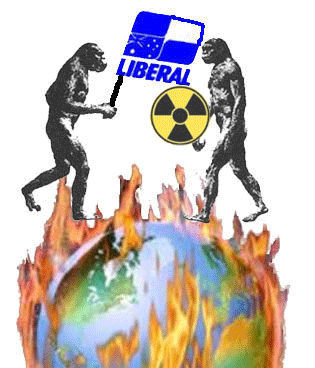 Libs pushing for wind farm changes
ALL new wind farm projects would have to undergo an assessment to see how they would affect the electricity market before being approved, if changes proposed by the Opposition were adopted…. (subscribers only )
http://www.adelaidenow.com.au/news/south-australia/sa-liberals-pushing-for-all-new-wind-farms-to-be-assessed-for-their-impact-on-the-electricty-market/news-story/c52442ad2d7640d9b23ee4372b75eb6a
South Australia’s Premier Jay Weatherill and his Citizens’ Jury Nuclear Deception
 Weatherill trumps up Citizens’ Jury Report in push for SA nuke waste dump, Independent Australia 15 July 2016, Noel Wauchope, who has been covering the Nuclear Fuel Cycle Royal Commission for IA, calls SA Premier Jay Weatherill out over a sleight of hand following the Nuclear Citizen’s Report this week.
SA Premier Jay Weatherill received the Nuclear Citizen’s Jury Report on 10 July. He said that it was a “commonsense” report and that:
“they [the jury] are asking us to also change the legislation to undertake that work”
(i.e: the work of investigating overseas markets for sending nuclear wastes to South Australia)
Here’s where the sleight of hand comes in. That call to change legislation did not come from the Citizens’ Jury. It came from the pro-nuclear Nuclear Fuel Cycle Royal Commission (NFCRC), and the jury was merely doing its appointed task — which was to paraphrase the NFCRC’s recommendations. Throughout the jury process, the jury members were reminded that they had no brief to make any decisions or recommendations and they conscientiously stuck to that rule.
Now I think we know why Weatherill was so adamant that this group be called a “jury”. A later group of 350 members, will also be called a “jury”. There is some possibility that this number 350 could be taken as an adequate sample of the South Australian population of 1.712 million. So again, by regurgitating the NFCRC’s recommendations, this might conceivably be portrayed as the “verdict”of the people. That’s a lot safer than a referendum. …….
NFCRC is over, and finished, but hey — not so! The next move is a massive public advertising process and this kicked off with the recent Citizens’ Jury, which, while being organised by the South Australian firm DemocracyCo, was master-minded and controlled by NFCRC personnel. The witnesses were predominantly pro-nuclear, speakers from NFCRC were prominent and NFCRC staff were present at many, if not all, sessions.
Several times, during hearings, and Q and A sessions, the jury was reminded of the necessity to change State and Federal legislation.
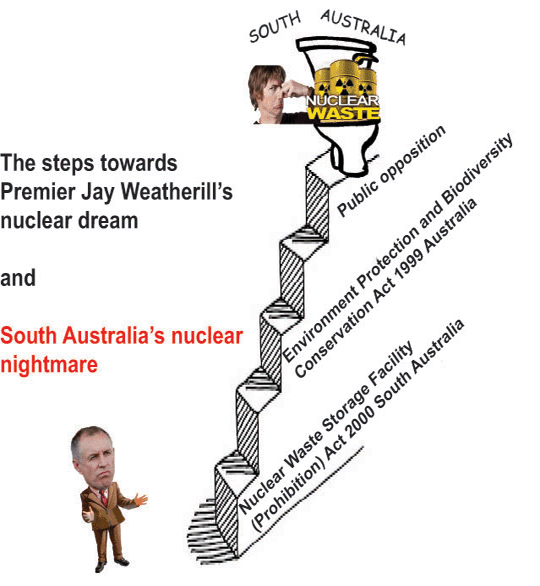
This process had, in fact, already begun, with legislative change that had to be made retrospective, seeing that the government had already spent $7.2 million on the Royal Commission. It is rare for legislation to be made retrospective. As the Greens’ Mark Parnell commented:
‘The retrospective clause is basically saying that if anyone did anything illegal we now legalise it.’
The South Australia Nuclear Waste Storage Facility (Prohibition) Act 2000 used to say:
13 — No public money to be used to encourage or finance construction or operation of nuclear waste storage facility
(1) Despite any other Act or law to the contrary, no public money may be appropriated, expended or advanced to any person for the purpose of encouraging or financing any activity associated with the construction or operation of a nuclear waste storage facility in this State
This section was amended in May 2016. The government wanted to remove Section 13, altogether. However, after several efforts on this, (Greens’ Mark Parnell objecting), Section 13 was amended, to include a new provision:
‘(2) Subsection (1) does not prohibit the appropriation, expenditure or advancement to a person of public money for the purpose of encouraging or financing community consultation or debate on the desirability or otherwise of constructing or operating a nuclear waste storage facility in this State.’
That was a small step forward for the nuclear cause.
Now for a bigger step. The government needs to drastically amend the South Australia Nuclear Waste Storage Facility (Prohibition) Act 2000. Later on, they need to get changes made to the national legislation — The Environment Protection and Biodiversity Conservation Act 1999 (the EPBC Act). They’d probably like these national powers to be removed and have these topics placed under State laws.
In building their argument for changing the law, the Weatherill Government needs to gather persuasive evidence about the proposed economic bonanza to come from importing foreign nuclear wastes. That means another round of expensive trips overseas, and a lot of advertising and promotional meetings in South Australia.
All this can now be justified, because, according to the government, the Citizens’ Jury called for more information, especially on economics, and even more importantly, called for changing the law on importing nuclear waste.
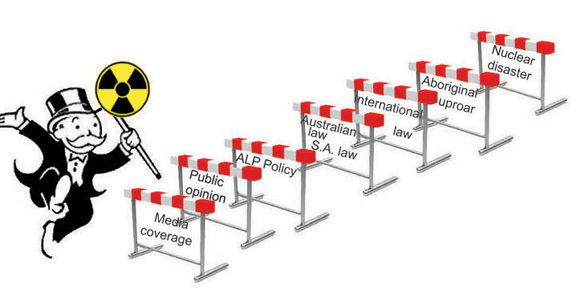
The fact that this jury group diligently summarised the Royal Commission report, without themselves making any recommendations, will almost certainly get lost in the onslaught of pro-nuclear hype that is about to descend upon the South Australian population. https://independentaustralia.net/environment/environment-display/weatherill-trumps-up-citizens-jury-report-in-push-for-sa-nuke-waste-dump,9237
1 This month
7 April – WEBINAR – Australia and the Doomsday Clock – Preventing nuclear war through NoFirstUse and other policies
Online | Tuesday April 7, 4:00-5:30pm, Australian Eastern Time / 8:00-9:30am Central Europe Time
– Access the registration link
15 April – Zoom –Nuclear Power is Not the Solution
Apr 15, 2026 01:00 AM in Canberra, Melbourne, Sydney

Join the International Physicians for the Prevention of Nuclear War (IPPNW) on Tuesday, April 14th for a timely webinar exploring the risks associated with nuclear power and challenging the myth that it offers a simple, safe, carbon-free solution to the climate crisis

21 April Webinar: No Nuclear Weapons in Australia
Start: 2026-04-21 18:00:00 UTC Canberra, Melbourne, Sydney (GMT+10:00)
End: 2026-04-21 19:30:00 UTC Canberra, Melbourne, Sydney (GMT+10:00)
Event Type: Virtual
A virtual link will be communicated before the event.
Host Contact Info: australia@icanw.org

of the week – Australians for War Powers Reform (AWPR)
To see nuclear-related stories in greater depth and intensity
 Antinuclear