South Australian Govt’s “Simplify Day” – aimed at removing nuclear restriction laws?
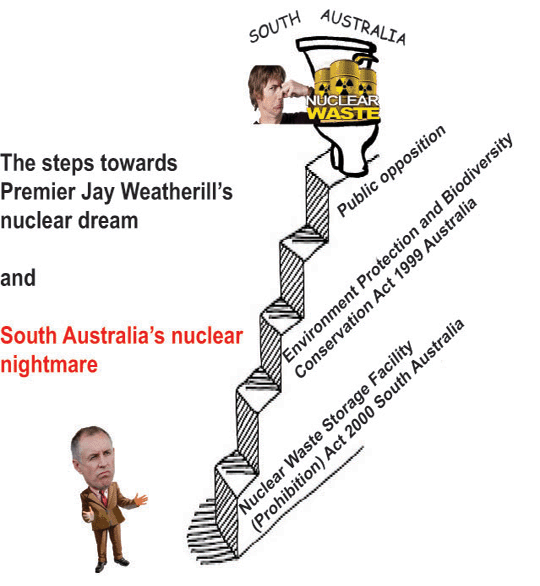
The Premier has announced that the first ‘Simplify Day’ will be held on 15 November, 2016 to repeal out-dated and redundant legislation that impacts on the Government’s ability to deliver on its 10 Economic Priorities.
In the lead-up to Simplify Day a consultation process is being held to seek the views of businesses and the community on how red tape can be removed for businesses, including any legislation that may be outdated or unnecessary.
Should you wish to know more about this initiative or make a submission visit the YourSAY website at www.yoursay.sa.gov.au.
The consultation period is open until 13 August, 2016.”
What’s the Australian govt doing – buying pro nuclear opinion in the Flinders Ranges?
Hookina Newsflash 4th August 2016
Cindy K. Hoskin Fight To Stop Nuclear Waste In The Flinders Ranges 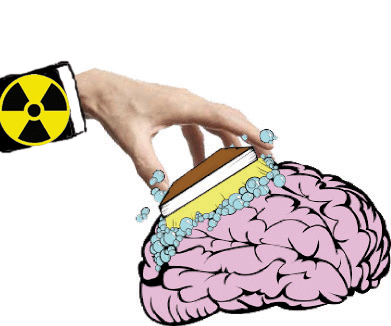 https://www.facebook.com/groups/941313402573199/ August 2 Here is the latest from port pirie. Tonight there is a paid invited meeting for nuclear in port pirie. A business man was rang on his moble and offered payment to attend, they asked his age which is 48, their reply was that they had enough over the 45 age limit and were seeking people under that age. Has any one else heard this? I have the number that this call came from if any one is interested.
GREENS APPLAUD RARE WIN AGAINST URANIUM MINE AT YEELIRRIE
 http://greens.org.au/news/wa/greens-applaud-rare-win-against-uranium-mine-yeelirrie August 3, 2016
The Greens have urged WA Environment minister Albert Jacobs to uphold the EPA’s advice to reject the controversial Yeelirrie uranium in the Goldfields of WA.
“The Yeelirrie uranium mine was first proposed in the 1970’s and has faced strong local and state wide community opposition for decades,” said Greens nuclear spokesperson Scott Ludlam.
“Today’s decision by the EPA should be the final nail in a proposal that should never have seen the light of day.
“The onus is now on Albert Jacobs to score a rare win for the WA environment and shut this proposal down once and for all.”
Senator Ludlam congratulated pastoralists, anti-nuclear campaigners and local Traditional Owners for their tireless work to oppose a project that would have been an environmental disaster.
New Climate Denialist One Nation Senator warns on United Nations Climate Plot

Malcolm Roberts: One Nation senator-elect says UN trying to impose global government through climate chance policy, ABC News, By political reporters Stephanie Anderson and Matthew Doran, 4 Aug 16 New One Nation senator-elect Malcolm Roberts has argued the United Nations is trying to impose global government through climate change policy.
Mr Roberts is one of three One Nation senators joining party leader Pauline Hanson in the new-look Upper House, after the final vote count was finalised today.
In an interview on ABC local radio, Mr Roberts said there were a number of movements undermining Australian sovereignty.
“Do you think the UN’s trying to impose some sort of global government through climate change policy?” 774 ABC Melbourne host Rafael Epstein asked.
“Definitely,” replied Mr Roberts……….
United Nations ‘driving’ climate scienceMr Roberts, a prominent climate change sceptic with the Galileo Movement, also renewed calls for an inquiry into CSIRO’s climate change research.
Mr Roberts, whose latest press release stated that he “spent the last nine years working pro bono checking alarmist climate claims”, said he wanted to repeal any legislation put in place “as a result of the claim that humans affect global climate as a result of our use of hydrocarbons fuels, coal, oil, natural gas”.
Describing himself as a scientist, he said “we need to stop these ridiculous lies based on climate”.
“I went looking into the agencies that have been spreading the climate science,” he said.
“I started finding out things about the CSIRO and Bureau of Meteorology.
“That led me then to the UN, which has been driving this.
“Then I started following the money trails. It’s important to understand the motives.”……..http://www.abc.net.au/news/2016-08-04/final-senate-make-up-confirmed-with-11-crossbenchers/7689788
To the ‘Minister for Adani’ — Matthew Canavan — “No Still Means No”
~ Wangan & Jagalingou People http://wanganjagalingou.com.au/qa-correction-to-the-minister-for-adani-matthew-canavan-no-still-means-no/ 2 August 2016
“On ABC’s Q&A last night, National Party Senator, Matthew Canavan – the ‘Minister for Adani’– made a vague reference to “native title” groups’ near unanimous support for the proposed Carmichael mine.
He complained that the media doesn’t cover such supposed ‘good news’, as though his Government’s interests are not constantly boosted in the press. …
“What the Minister failed to mention, or referred to only obliquely, is that we have several legal cases running to demonstrate that Adani does not have our free, prior, informed consent, they have engaged in conduct ‘analogous to fraud’ and that, along with the State and some statutory representatives,manipulated the native title process to override our rights and interests and divide our people. … “
Renewed focus on CSIRO and climate change will not reverse damage done by Turnbull govt
CSIRO’s renewed climate change focus will not reverse damage done by job cuts: scientists, ABC News, PM , 4 Aug 16 By Felicity Ogilvie and staff Some of Australia’s top climate scientists say new instructions given to the CSIRO to renew its focus on climate science will not be enough to reverse the damage done by previous jobs cuts.
The Federal Government’s new Science Minister Greg Hunt has instructed the CSIRO to renew its focus on climate science.
Climate scientists from around the country, meeting in Hobart to discuss how climate change will affect Australia’s future, say they are having a hard time keeping up with the changes in how climate science at the CSIRO is being run.
CSIRO Fellow Dr John Church, an expert in estimating and understanding global and regional sea-level rise, is one of the 275 CSIRO scientists who are losing their jobs.
“This is only a step in the right direction, it certainly doesn’t recover all the positions that have been lost,” Dr Church told PM.
University of Tasmania polar scientist Matt King said Dr Church was irreplaceable, and said he was finding it hard to digest the directive given by Mr Hunt…….
Dr Rintoul said damage had been done to Australia’s international reputation as a result of the CSIRO job cuts…….he also agreed that CSIRO staff losses would have a major negative impact on Australian research.
“In short, John Church is irreplaceable and some of our staff are similarly irreplaceable. So there are areas of science that Australia used to be strong in that we will no longer be as strong in and we’ll need to rebuild,” he said…….http://www.abc.net.au/news/2016-08-04/csiro-climate-focus-wont-reverse-job-cut-damages-say-scientists/7691928
Josh Frydenberg, the Minister for Gas, er, I mean Environment
 http://www.weeklytimesnow.com.au/news/politics/josh-frydenberg-out-of-step-on-gas/news-story/992e76062fe5e3a14c28a745548d4779
The Victorian MP maintained his stance against the moratorium this week, leading environmental critics to say he was out of step with the rest of the state — and his Victorian Coalition colleagues.
The State Government is preparing to release its gas policy, expected before parliament resumes on August 16. The Victorian Coalition has already said it wants the moratorium extended until 2020.
Mr Frydenberg first flagged his concern about Victoria‘s moratorium in February when he was resources and energy minister.
This week he said the shift away from coal was not a bad thing, but the South Australian energy crisis proved there was a need for a reliable base power source, which should be gas.
“We shouldn’t have blanket moratoriums on unconventional gas like we have in Victoria and NSW because you need more gas and gas suppliers,” he told the Australian Financial Review.
Friends of the Earth’s Cam Walker said this was “profoundly out of step” with Victoria, where 73 communities have declared themselves gas field-free, many in Coalition-held seats. “The argument that gas is a bridging and back-up fuel is outdated,” he said.
Environment groups welcome EPA recommendation to reject Yeelirrie uranium proposal
 The Conservation Council of WA and the Australian Conservation Foundation have welcomed the WA EPA’s recommendation not to approve the proposed Yeelirrie uranium mine.
The decision was based on the unacceptable risks the plan posed to subterranean fauna and also addresses wider environmental and community concerns.
“This is an important decision that prioritises the survival of a number of different species and the health and wellbeing of the local community,” said CCWA nuclear free campaigner Mia Pepper.
“CCWA’s submission to the EPA identified the likely extinction of several species of underground fauna, known as stygofauna and troglofauna if the proposal were approved and it is pleasing to see the EPA has considered that evidence.
“The EPA recommendation has been met with great relief among pastoralists, Aboriginal communities and environment groups who continue to campaign against uranium mining in WA. “The former proponent of the Yeelirrie uranium mine, BHP Billiton, conducted extensive and systematic surveys of subterranean fauna.
“This is an important decision that highlights the importance of extensive surveying for subterranean fauna and acting to prevent extinctions.”
 National environment groups have joined their state counterparts in welcoming the EPA’s call.“We congratulate the EPA for making this important, clear and strongly evidence based recommendation,” said the Australian Conservation Foundation’s Dave Sweeney.
“ACF expects and looks forward to the Environment Minister upholding the EPA’s recommendation.”
Goodbye and good riddance to nuclear stooge Senator Sean Edwards
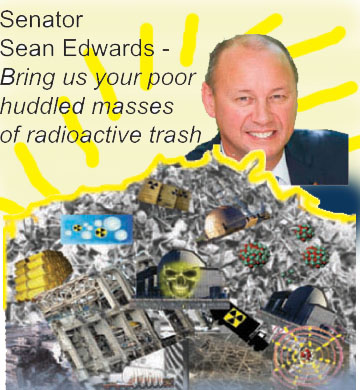 Outgoing senator Edwards lost his seat after winning the fifth spot on the Liberal ticket.
“I’ve lobbied heavily for South Australia’s expanded involvement in the nuclear fuel cycle, producing a substantial submission to the SA Nuclear Fuel Cycle Royal Commission in the process, and it now appears the state will do just that. This will deliver hundreds of billions of dollars in sovereign wealth to South Australia.”– http://www.adelaidenow.com.au/news/south-australia/bob-day-wins-12th-senate-spot-for-south-australia-labor-and-liberal-senators-out/news-story/ab561f14c51aebce726b9852fb7b52b6
New Minister for Resources, Matt Canavan , a climate change denier
 One of their [climate denialists] cheerleaders is Frydenberg’s successor in the resources portfolio, Queensland senator Matt Canavan.
Canavan has form as a climate science doubter. A fortnight ago he told Sky News that the impact of carbon emissions had been “overhyped” by “certain interest groups” — in line with an earlier newspaper article in which he advocated funding “scientists who take a different view”.
 , PETER BOYER, Mercury
“I absolutely accept that man is contributing to climate change,” he declared. But that is not really how it is. Saying we are contributing to climate change is like saying the sun contributes to a warm day, or Hawthorn contributed to winning last year’s AFL premiership.
In the cautious words of the Intergovernmental Panel on Climate Change, there’s a 95 to 100 per cent chance that human activities have been the dominant cause of observed warming since the mid-20th century. We have not just contributed to climate change — we have caused it.
In the same Lateline interview, Frydenberg said Australia’s 2030 target — emissions 26 to 28 per cent lower than in 2005 — was “very ambitious” and among the highest in the world on a per-capita basis.
We have already heard the same from Abbott, Hunt and Turnbull.
All have failed to acknowledge our unhappy record of long being the G20’s highest per-capita emitter, skated over much tougher European targets, and ignored completely the all-important target of zero emissions.
He is playing to the many holdouts in the Coalition who still do not accept the real and present danger of climate change and the rising urgency to address it. Continue reading
Australia’s potentially powerful political constituency – solar power home-owners
Regardless of what the industry’s lobbyists and media barrackers say, renewables are cutting the cost of power and making it more reliable….
The next big threat to the old business model, however, is storage

According to figures compiled by the environment group Solar Citizens before the recent election, just 2352 of the 90,000-odd voters in Frydenberg’s affluent inner Melbourne electorate of Kooyong had solar panels on their roofs.
That placed Kooyong 132nd of 150 federal electorates for rooftop solar. Kooyong is typical of what Solar Citizens found in their study of rooftop solar. More affluent electorates tend to have lower take-up rates……
out in the ’burbs, and in the rural and regional areas, rooftop solar is big. The seat of Dawson, for example, based on Mackay in North Queensland, has more than 10 times as many houses with rooftop solar as Frydenberg’s electorate. Yet voters there just returned George Christensen, a climate change denier who sits on the extreme right wing of the Nationals. Ipswich, home town of Pauline Hanson, has even more solar panels up.
Dickson in Brisbane, held by another arch-conservative, Peter Dutton, has more than 35,000 solar roofs, and the eighth-highest penetration of solar in the country. And the number one electorate for rooftop solar is the huge rural South Australian seat of Grey. There, according to Solar Citizens, some 41,000 constituents have invested $140 million to install more than 80,000 kilowatts of solar, resulting in an annual abatement of 54,000 tonnes of the main greenhouse gas, carbon dioxide. The seat is held by Rowan Ramsey for the Liberals, although he was given a nasty scare from the Nick Xenophon Team at the election. Continue reading
Nick Xenophon – only a referendum is adequate to resolve South Australia’s nuclear waste decision
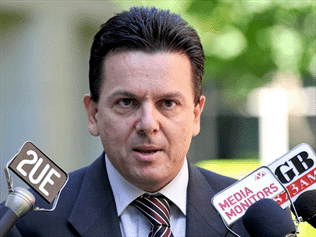 South Australian Premier Jay Weatherill says a final decision on a nuclear waste dump is still years away. SBS World News, AAP 29 JUL 2016
The state government on Friday launched a three-month community consultation program on the recommendations rising from a Royal Commission into the Nuclear Fuel Cycle…….Mr Weatherill says whatever the outcome of that process, a final decision on the dump is still some way off, and will be proceeded by a series of “gated decisions” to move ahead cautiously…….
But South Australian independent Senator Nick Xenophon said only a referendum of all South Australian voters would be adequate for such a momentous decision.
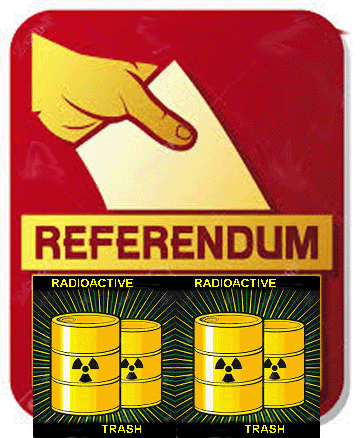
“Because once we have a nuclear dump, that’s it. We will be known as the nuclear dump capital of the world,” he said.
South Australian Greens MP Mark Parnell also criticised the consultation process which he said had ignored the history of failures, cost overruns and risks associated with waste storage.
“The government says it wants South Australians to have the facts, but it has chosen just some of the facts to present,” he said. http://www.sbs.com.au/news/article/2016/07/29/sa-dump-decision-years-away-says-premier
Electricity industry in a panic about renewable energy’s success
Disruptive power, The Age, Richard Denniss , 29 July 16 The Productivity Commission is  criticising the Trans Pacific Partnership, the head of the Australian Competition and Consumer Commission is criticising privatisation, and the electricity industry is worried that competition from renewables might deliver lower prices to consumers. What on earth is happening to the Neo-liberal “agenda”?
We are witnessing a watershed moment in Australia’s economic and political debate. The grand narrative of “market good-government bad” is dead. Killed by the rent seekers and vested interests that couldn’t resist overselling the benefits to the same consumers and taxpayers they were busy gouging.
The mining industry can’t help asking for taxpayers to subsidise their rail lines…….
It’s hard to maintain the argument that government spending is bad for the economy when even the Institute of Public Affairs supports taxpayer funding for dams and coal railway lines in far northern Australia…….
The PC, which now refers to so-called “free trade agreements” as “preferential trade agreements”, recently said that the TPP includes provisions of “questionable benefit” to Australia. It was once heresy to suggest that a document called a ”free trade agreement” could do anything other than facilitate trade, but now the Lefties at the PC are encourage us to scrutinise the detail. Rules matter…….
the banks, the mining companies and the media moguls that shouted the loudest about “free markets” have always spent up big on lobbyists to ensure they got the rules they wanted. But now the cat is out of the bag. …….
As more and more batteries are installed in homes and businesses the peak load on the transmission network will be reduced, meaning that we will be able to save billions of dollars on line upgrades within and between towns and cities. Should that windfall accrue to those with an obligation to maintain the network, to the people who install the batteries, or be shared in some way? Rules matter……..
South Australia has cheaper electricity today than it had in 2007. There were no black outs during the so-called “crisis” and the vast majority of residential and industrial customers who are on long-term contracts didn’t even notice the five-minute surges in the wholesale spot price. When the interconnector upgrade is complete, and if a new interconnector with NSW is built, not only will SA be able to rely on more power from other states when the wind is calm, but SA will be able to export a lot more cheap energy when the wind does what it usually does in SA which is blow hard.
The fear that SA may soon be an even bigger exporter of cheap wind power is what is behind the recent “debate”. Their best chance to protect their profits is to ensure that the “market regulations” restrict the growth prospects for their main competitors. Rules matter. After years of getting the rules they wanted by arguing that they simply wanted “free markets” Australian rent seekers are now forced to win public debates about why we should give them the rules they want. It’s not going well for them.
Richard Denniss is the chief economist for The Australia Institute. http://www.theage.com.au/comment/disruptive-power-20160728-gqgazk.html
The influence of mining companies on governments, especially Queensland
Greasing The Wheels: Report Lays Bare Extraordinary Govt Access For Queensland Miners, New Matilda By Hannah Aulby on July 29, 2016 There’s something rotten in the state of Queensland, and it smells a lot like gas and mining. Hannah Aulby explains.
There is little doubt that the mining industry enjoys a higher level of access and influence over government in Australia than the average citizen. It’s often difficult to measure exactly how far that influence extends, but at other times it becomes glaringly obvious.
A report released today by The Australia Institute and the Australian Conservation Foundation shows that the influence of the mining industry on government in Queensland is systematic and ongoing.
The report, ‘Greasing the Wheels: the systematic weaknesses that allow undue influence of mining companies on government, a Queensland case study’, provides six case studies of mining companies using political donations, high level political access, gifts and the ‘revolving door’ to influence legislation in their favour.
It shows that Beach Energy, Sibelco, Karreman, New Hope, Adani and Linc Energy have all received favourable treatment from government including retrospective mining project approvals, revocation of environmental protections and reversals of party mining policies.
These case-studies are just the tip of the iceberg. In recent days Linc Energy and QRC have provided fresh insights into a frightening trend…… https://newmatilda.com/2016/07/29/greasing-the-wheels-report-lays-bare-extraordinary-govt-access-for-queensland-miners/
Nuclear Weathervane Weatherill wavers on his anti – referendum stance
 SA nuclear waste dump referendum vote still possible, Premier Jay Weatherill says http://www.abc.net.au/news/2016-07-28/referendum-on-sa-nuclear-waste-dump-still-possible/7668412 By political reporter Nick Harmsen The South Australian Government may not be in a position to make a final decision on whether to pursue an international high-level nuclear waste dump this year, Premier Jay Weatherill has said.
The Premier has previously said the Government’s plans to make a decision clear to parliament in November.
But Mr Weatherill today told a budget estimates committee any decision this year was likely to be just the first step. “I’d like to be in a position to make a decision about whether we’re able to pass the first threshold,” he said.
“And there is an important go/no-go threshold that needs to be considered by the parliament.”
The Government has assembled a series of citizens’ juries to help inform its decision.
Mr Weatherill told the committee he would not rule out holding a referendum on the nuclear issue.
But he said a referendum would not provide the level of nuance required. “In particular, some green groups are calling for a referendum,” he said.
“Of course they’re the same green groups that don’t want a referendum on gay marriage. But leaving aside that little internal inconsistency for the moment, I think I [a referendum] tends to close down debate rather than allow it to be developed.”
1 This month
17 October, Free Public Talk on Nuclear Issues in South Australia
David Noonan will speak on public interest concerns over the new Roxby Downs Indenture Act 2026 on BHP copper-uranium mining and ore processing in SA, and on how AUKUS may face SA with a High-Level nuclear waste agenda.
Dr Jim Green will discuss international developments in the field of nuclear power including ‘small modular reactors’ and Generation 4 ‘advanced’ nuclear reactor concepts.


Help Aunty Sue Protect Her Land and Sacred Sites From Destructive Rocket Testing.
.

Australians deserve the truth
about
AUKUS – https://aukuspublicinquiry.com/

PETITION – To: Prime Minister Anthony Albanese and the Australian Labor Government

of the week – Australians for War Powers Reform (AWPR)
To see nuclear-related stories in greater depth and intensity

