Great Barrier Reef should be a central election issue – Tim Flannery

 Saving Great Barrier Reef from climate change should be central election issue, says Tim Flannery http://www.theguardian.com/environment/2016/may/17/saving-great-barrier-reef-climate-change-should-be-central-election-issue-says-tim-flannery
Scientist says lack of attention to climate change is ‘staggering’ given it is Australia’s last chance ‘to close down coal-fired power stations and save the reef’, Guardian, Calla Wahlquist, 17 May 16, Tim Flannery says preserving the Great Barrier Reef from coral bleaching linked to climate change should be a central issue in the federal election campaign.
Flannery, a scientist and member of the Climate Council, said the lack of attention paid to climate change so far in the eight-week campaign was “staggering”.
“This needs to be the reef election,” he told Guardian Australia. “This is the last moment I think that we can realistically expect that we can enact some policies … to close down coal-fired power stations and save the reef.
“Other issues are still going to be there in another four years. This one won’t.”
A study in April found that almost 93% of the Great Barrier Reef had been affected by global bleaching, part of a global coral bleaching event that scientists say was caused partly by El Niño and partly by background global warming.
The aerial survey, conducted by James Cook University, found the bleaching was most severe in reefs north of Port Douglas, where about 81% of reefs were assessed as having severe bleaching. Prof Terry Hughes, head of the National Coal Bleaching Taskforce, told Guardian Australia last month that the mortality rate in coral reefs in that area was already at more than 50%.
Hughes said it was five times worse than the last two bleaching events, in 1998 and 2002, when 40% of the reef escaped bleaching.
Coral bleaching has also been recorded in Western Australia’s Kimberley region, where between 60-90% of some reefs are reported to be bleached. Continue reading
Parry Agius – founding member of Uranium lobby group – should not be on “independent” Nuclear Advisory Board.
The South Australian government will make the decision on whether or not to make that State become the world’s nuclear toilet.
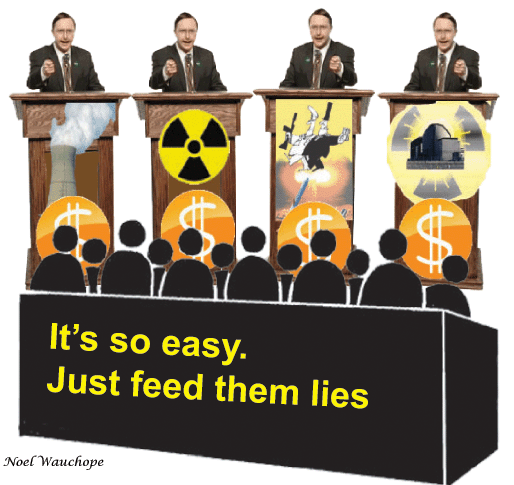 However, they’ll still go through a process of informing and consulting the community, beforehand. That will be the job of the new Nuclear Fuel Cycle Royal Commission Consultation and Response Agency :-
It will “draw upon existing government expertise and expertise from the Royal Commission itself to to increase awareness of the Royal Commission’s report and facilitate the community consultation process.”
The other one, Nuclear Fuel Cycle Royal Commission Consultation and Response Advisory Board, will oversee the Agency throughout the consultation process. That’s the one chaired by John Mansfield, and with Adjunct Professor Daniela Stehlik, Rebecca Huntley, Professor Deb White, and Parry Agius.
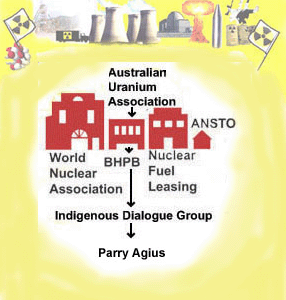
I don’t think that Parry Agius should be on this supposedly independent Board. He is a founding member of the Australian Uranium Association’s Indigenous Dialogue Group. He’s also been a member of the Resources Industry Development Board in South Australia.
South Australian Premier creates two new Nuclear Advisory Agencies
 Premier Jay Weatherill, 17 May 16 Cabinet has approved the establishment of the Nuclear Fuel Cycle Royal Commission Consultation and Response Agency and the appointments to the Nuclear Fuel Cycle Royal Commission Consultation and Response Advisory Board…
Last week I announced that the Government would establish these two bodies, and today I confirm that Cabinet has approved the establishment of the Nuclear Fuel Cycle Royal Commission Consultation and Response Agency and the appointments to the Nuclear Fuel Cycle Royal Commission Consultation and Response Advisory Board.
The purpose of the new agency, which will draw upon existing government expertise and expertise from the Royal Commission itself, will be to increase awareness of the Royal Commission’s report and facilitate the community consultation process.
The independent Advisory Board will oversee the Agency throughout the consultation process.
The Board will be chaired by the Honourable John Mansfield, Member of the Order of Australia and retiring Justice of the Federal Court of Australia, who will commence the role immediately after his retirement from the Federal Court.
The other members of the board will be:
- Parry Agius, former Chief Executive Officer of the South Australian Native Title Service; – 3 –
• Adjunct Professor Daniela Stehlik, Griffith University, is one of Australia’s leading social scientists in the fields of sustainability, human services and social cohesion with a particular focus on families and communities.
• Rebecca Huntley, Social researcher and former Director of The Mind & Mood Report, Australia’s longest running social trends report;
• Professor Deb White, Director of Cancer Research at the South Australian Health and Medical Research Institute (SAHMRI)
The outcomes of this community engagement process will help inform the government’s response to the Report, which I intend to deliver to the Parliament by the end of this year…. http://www.premier.sa.gov.au/images/speeches/NuclearFuelCycleRoyalCommission.pdf
South Australia sets up parliamentary inquiry on proposed nuclear waste importing
 SA to set up inquiry into nuclear dump https://au.news.yahoo.com/sa/a/31626088/sa-to-set-up-inquiry-into-nuclear-dump/ AAP on May 17, 2016, The South Australian government will set up a parliamentary inquiry into whether the state should host a nuclear waste dump.
Premier Jay Weatherill says a joint select committee will help inform the government’s response to the nuclear fuel cycle royal commission, which recommended the state pursue building such a facility.
A citizen jury will also be selected by an independent panel to identify key questions about the issue, while a second jury will be asked to produce a report outlining community views.
Jay Weatherill could now be in a dither over nuclear waste dump proposal
Jay Weatherill: Nuclear waste and citizens’ juries, Independent Australia 17 May 2016 Jay Weatherill has announced the establishment of “citizens’ juries” to debate the Royal Commission’s recommendation in favour of a nuclear waste dump for SA— and angered both sides of politics in the process. Noel Wauchope reports.
NEITHER the Left nor the Right is happy with the South Australian Premier’s plan for “citizens’ juries” on the question of importing nuclear waste.
Jay Weatherill will surely be remembered as the quintessential flip flop Premier. In past years, Weatherill was a Labor Left faction opponent of the nuclear fuel cycle and a strong supporter of renewable energy. In the face of the collapse of the car industry in SA and the uncertainty around the shipbuilding and submarine contracts, he was enticed by the nuclear lobby to do an about turn on the nuclear industry.
He went off to the Paris climate summit, preaching about “low carbon electricity” — which is nuclear lobby code for nuclear energy, not “renewable” energy. However, he had earlier described nuclear power as not being viable.
Weatherill went on to set up the Nuclear Fuel Cycle Royal Commission, led by pro-nuclear Kevin Scarce and with a team in which nuclear power experts predominated. It produced – no surprises here – the recommendation for South Australia to set up a nuclear waste importing industry, in thewords of Kevin Scarce, ‘as soon as possible’.
So, the hasty programme for nuclear waste importing is underway. The first step is to be citizens’ juries. In a process run by New Democracy, 2,500 invitations are being mailed this week to potential participants — 50 will be selected for the first meeting in a month’s time and 350 for the next one in October. There are other initiatives too. The Government is launching an advertising campaign entitled, NuClear, with advertisements to be run on radio, television, print and social media. They also have a consultation website, YourSAy. All very good for the nuclear waste import plan.
But now, the plan does seem to be running into a bit of trouble.
The Advertiser ran a poll early last week was a negative result for the nuclear waste cause….
There must be sufficient anxiety in the South Australian Government and the Liberal Opposition to warrant consideration of a referendum on the subject:……..Previously, a referendum was not considered an option. …..
Meanwhile, the immediate trouble lies with this citizens’ jury plan.
Spruiking about citizens’ juries, Jay Weatherill sounds like an old style Liberal:…….In his press release about the nuclear waste plan, Weatherill said:
‘This first Citizens’ Jury will guide the debate by identifying the key issues that need to be considered during the state-wide consultation phase.’
This is not to the liking of today’sLiberals, nor today’s pro-nuclear Laborites, nor even the anti-nuclear camp.
The pro-nuke response was best expressed by Chris Kenny, in Adelaide Now:
‘Forget the citizens jury, Mr Weatherill — just make a decision. That’s what you were voted in to do!’
Liberal Opposition Leader Steven Marshall fumed:
‘This is the largest decision in the history of the state, and Jay Weatherill’s plan is to outsource it to 50 randomly selected individuals. It’s just outrageous.’…….
….. Meanwhile, on Facebook pages, and in some comments on other sites, the anti-nuclear people were up in arms, certain that the process would be stacked with pro-nuclear experts and participants would be brain-washed with nuclear advertising.
It looks as if Jay Weatherill started out on all this in socialist mode — with political and technical experts running the show. Then he aberrated into old “wet” style Liberal mode, towards participatory democracy. In the process, he seems to have pleased nobody…..https://independentaustralia.net/politics/politics-display/jay-weatherill-nuclear-waste-and-citizens-juries1,8998
Australian environment groups unite to oppose govt plans to cut their charitable status
 Federal election 2016: climate survey fires up green council of war Graham Lloyd THE AUSTRALIAN MAY 17, 2016 Peak environment groups have prepared a co-ordinated election blueprint on climate change, the Great Barrier Reef and fossil fuels, staring down threats to cut the charitable status of organisations that play politics.
The groups, including Greenpeace, WWF, the Australian Conservation Foundation and the Wilderness Society, have spent the past fortnight planning a strategy against the background of a parliamentary report that set out a road map to punish critics of the government and resource industry.
Established by Environment Minister Greg Hunt, it recommended groups be required to spend 25 per cent of fundraising on tree planting and land repair or lose tax-deductible status. It also said organisations should be made liable for illegal actions of members, supporters or volunteers.
The lower house committee recommendations were not supported by Labor members and the report included a dissenting statement from Liberal member Jason Wood. Mr Wood listed potential casualties, including Beyond Zero Emissions, Great Barrier Reef Foundation, Environment Victoria, Friends of the Earth, Greenpeace Australia, Australian Youth Climate Coalition, The Wilderness Society, EDOs of Australia, Australian Orangutan Project and Environmental Justice Australia.
Wilderness Society national campaign manager Lyndon Schneiders said: “They are also saying to a bunch of rednecks that they will deal with environment groups’ campaigns against controversial oil and gas projects.”
Former Greens leader Bob Brown said making groups responsible for the actions of members and volunteers “would be right at home in Vladimir Putin’s Russia”. Climate Change organisation 350.org said the recommendations were anti-democratic and “an unnecessary witch-hunt”.
The Wilderness Society said it made more sense to spend money lobbying to stop trees being cut down that to replant them……http://www.theaustralian.com.au/federal-election-2016/federal-election-2016-climate-survey-fires-up-green-council-of-war/news-story/b8af615de95a65ca71c609ae8990700b
Australian govt’s “Direct Action” ineffective, could even increase Co2 emissions
it was entirely possible some projects would end up, perversely, funding emissions increases.
Direct Action funds ‘spent on projects that would have happened anyway’, http://www.theguardian.com/australia-news/2016/may/16/direct-action-funds-likely-spent-on-projects-that-would-have-happened-anyway Guardian, Michael Slezak, 17 May 16,

Payments to greenhouse gas emitters more likely to go to reduction schemes that would have taken place without government funding, says economist. The government’s $2.55bn emissions reduction fund, which pays greenhouse gas emitters to pollute less, will inevitably pay for reductions that would have happened anyway, for the same reason that secondhand car markets are full of lemons, an economic analysis has concluded. Continue reading
Nuclear “Citizens’ Juries” and new South Australian campaign “Nu-Clear”
( an unfortunate title for the nuclear lobby – “Nu-Clear” – all too close to the UK’s incisive anti-nuclear publication NuClear News )
Citizens’ juries to consider SA’s nuclear future, The Mandarin, Citizens’ juries show potential as a way for governments to take the heat out of contentious issues, with evidence-informed consideration of contentious policy by regular people having the ability to reshape often staid debates.
So as South Australia is tossing up whether to create a nuclear waste dump to take spent fuel from around the world, the state government has decided to convene two citizens’ juries to consider the future of the nuclear fuel cycle in the state…….
Premier Jay Weatherill says the citizens’ jury deliberations will help South Australians have an “informed discussion” about the nuclear fuel cycle, based on the body of evidence presented in the royal commission report.
The work of the citizens’ juries and other consultation processes “will play a key role in informing the decisions we make”, he stated yesterday:
“I know that some people are worried about safety and the environment whilst others see the economic opportunities. This is why before the government decides, we want South Australians to understand the choices and to be able to put their perspective on this issue.”
Deliberations will begin next month, when a group of about 50 South Australians will be asked to identify the key questions that need to be considered during the debate.
Invitations will be sent this week to 25,000 randomly selected citizens seeking an expression of interest for their participation in the jury, with members selected by an independent, non-political organisation.
Later, in October, a second citizens’ jury of about 350 people will be convened to evaluate the feedback from the state-wide consultation and weigh up the choices and options on the important issues raised by the royal commission.
In November, this second jury will produce a report summarising the community’s position for the government to consider in its response to the royal commission’s report by the end of the year.
New agency to ‘facilitate’ debate
The government will introduce a range of other consultative measures to help it come to a decision.
An independent advisory board to guide the consultation process will soon be appointed, and a state government nuclear fuel cycle agency established to help facilitate the discussion.
A campaign titled “Nu-Clear” was launched on Tuesday to promote discussion and encourage people to explore the facts on the nuclear fuel cycle, with advertisements to be run on radio, television, print and social media.
Citizens are able to comment on the royal commission report on the state’s YourSAy consultation website.
The key questions identified by the citizens’ jury will guide a number of community consultation activities from July, which will include meetings held across the state, as well as social media engagement, information centres and a free call 1800 service.
A specific program of Aboriginal engagement will also be undertaken across SA with the guidance of Aboriginal community leaders. http://www.themandarin.com.au/64738-64738/
Australia’s coming election: climate change policy to be a vote changer
Election 2016: Climate change policy a vote winner for majority of Australians http://www.smh.com.au/federal-politics/federal-election-2016/election-2016-climate-change-policy-a-vote-winner-for-majority-of-australians-20160513-gouwbf.html May 15, 2016 Fergus Hunter Breaking news reporter Strong climate change policy is a vote-changing matter for a majority of Australians, a new poll shows, establishing the issue as an important battleground one week into the election campaign.
According to the ReachTEL survey of 2400 people, conducted for a coalition of environmental groups, 64 per cent of respondents said they would be more likely to vote for a party seeking 100 per cent renewable energy in 20 years and 48 per cent said they would be more likely to support a party reducing Australia’s net carbon emissions to zero by 2050.
The figures contrast with the Turnbull government’s avoidance of the topic. The Prime Minister did not mention climate change in his speech when kicking off the election campaign.
The Coalition’s policy is a 26-28 per cent cut on 2005 emission levels by 2030 through its multi-billion dollar emissions reduction fund and 23 per cent clean energy production by 2020.
Recently unveiled is Labor’s proposed 45 per cent cut on 2005 levels through emissions trading and restrictions on land clearing.
The Greens want a 63-82 per cent equivalent cut to emissions and 90 per cent renewable energy by 2030.
“The Prime Minister has spoken about the need to transition the economy from one dependent on mining. It is clear from this poll that an increasing number of Australians support that goal on climate change grounds,” Lyndon Schneiders, national director of the Wilderness Society, said.
“It is also clear that the vast majority of Australians recognise that we need new and powerful laws to manage that transition and to protect the places we love from the impacts of climate change.”
The poll also found:
- 56.1 per cent of people would be more likely to support a party phasing out coal-fired power, compared to 27.2 per cent unchanged and 16.6 per cent who would be less supportive.
- 66.9 per cent would be more likely to vote for a party that strengthens environmental laws protecting sites like the Great Barrier Reef, while 23.1 per cent are unaffected and 10 per cent would be less likely to support them.
- 61.9 per cent of people agree that the burning of fossil fuels causes global warming and is destroying the Great Barrier Reef, while 23.2 per cent disagree and 14.9 per cent don’t know.
A squad of environment groups, including the Australian Youth Climate Coalition, the Australian Conservation Foundation, GetUp! and Environment Victoria, are using the election to target 25 marginal seats with a doorknocking and publicity campaign on climate policy.
AYCC national director Kirsty Albion said the organisation is encouraging young people at universities and schools to enrol to vote “so that politicians start taking our future seriously and act on global warming”.
ABC on election issues: climate way down, nuclear waste import doesn’t get a mention
Election 2016: Where the parties stand on the big issues, ABC 15 May 16
“……Environment
The environment has been one of the key battlegrounds in the past two elections, with Tony Abbott’s attack on Julia Gillard’s carbon tax at the heart of his election pitch in 2013.
Despite Malcolm Turnbull previous preference for an emissions trading scheme, which saw him rolled as leader in 2009, since becoming prime minister he has maintained the Government’s direct action policy.
The carbon tax that was designed to address climate change was seen as a key reason for the downfall of the Rudd/Gillard/Rudd government, and consequently, neither party wants to impose a fixed price on carbon.
Both sides of politics have come up with different ways of attempting to reduce emissions while protecting the public and big international companies from feeling too much financial pain.
Climate change
- Both parties agree climate change is a threat and have committed to cutting Australia’s emissions by 5 per cent on 2005 levels by 2020. But from here they differ.
- The Coalition’s goal is to cut by 26–28 per cent on 2005 levels by 2030. Labor wants to cut emissions by 45 per cent on 2005 levels by 2030 and achieve net zero emissions by 2050.
- Their strategies to address climate change also differ. The Coalition opted for a “direct action” approach in which $2.55 billion in taxes is paid to companies to undertake projects which will reduce greenhouse gas emissions.
- Labor wants to introduce two emissions trading schemes — one for electricity generators and one for big industry. Labor says neither is expected to have a large impact on consumer prices.
Renewable energy
- The Coalition introduced the mandatory renewable energy target, which was then raised by Labor under Kevin Rudd.
- The Government and Labor agreed to scale back the target last year, but the Opposition has announced it would seek to increase it again if elected.
- The Coalition has promised more than 20 per cent of electricity will come from renewable sources by 2020. Labor is aiming for 50 per cent renewable energy by 2030. Continue reading
South Australian Premier Jay Weatherill sounding like an old style Liberal!
 Jay Weatherill: governments lost the art of talking to people, The Mandarin by
David Donaldson 18.02.2016 Democracies get into trouble when the judgement of experts supplants listening to the people it is supposed to represent, says South Australian Premier Jay Weatherill.
In an op-ed for DemocracyRenewal, Weatherill says the use of experts — “scientists, specialists in particular fields of knowledge and bureaucrats who come up with ‘rational’ answers to issues that they decide are the problem the community should think about” — is important, but if overzealous can disenfranchise people and create distrust in government……..
“Rather than being a threat to established institutions and reform, our Citizens’ Juries have demonstrated that the involvement of citizens in public decisions enables change and helps to restore faith in the political process. Independent evaluation has shown that the cynicism and suspicion people had felt towards government decreased as a result of being involved in the citizen jury process, with a strong interest in participating again.” http://www.themandarin.com.au/56739-jay-weatherill-governments-lost-art-talking-people/
A referendum might be held to decide on nuclear waste import plan
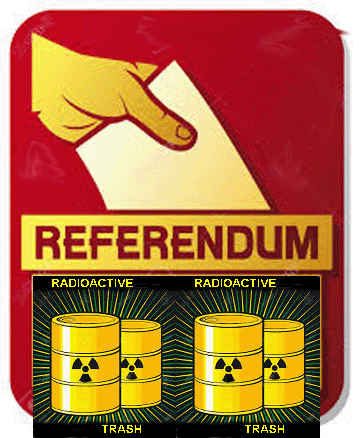 Daniel Wills: Voters’ nuclear reaction can avoid meltdowns in future May 13, 2016 The Advertiser
EVERY South Australian has been assured they can join a grand debate over a high-level nuclear waste dump for the state, but it’s no certainty that voters will get to directly decide.
The Nuclear Fuel Cycle Royal Commission’s final report this week included a strong call for the state to urgently pursue the opportunity and usher in a golden era of new wealth for SA.
Premier Jay Weatherill is holding fire until the end of the year. The State Government’s formal position is that its mind is not made up, and a combination of statewide consultation and two citizens’ juries made up of average people will help chart the course to be taken from here.
But ultimately, he’s indicated the final decision will be taken by the Cabinet, Government and 69 members of State Parliament who are put in place to make decisions on behalf of all.
The prospect of a referendum, which could be held concurrently with the 2018 state election and would effectively offer every South Australian a direct say on what would be an irreversible decision, is not being ruled out at the highest levels either major party.
If it were to occur, the electoral dynamics in two years’ time would be dramatically altered………
if a simple change to an Act of Parliament is all that’s required for a future government in coming decades and centuries to shift course, South Australians have reason to be wary.
A business case penned by Jacobs & MCM for the commission shows the state would be swimming in cash for 75 years, and then serious bills would start rolling in for the next 50……..
It’s easy to imagine a future where short-term politics triumphs over today’s best intentions…..
The next six months — with two citizens’ juries and a statewide consultation process — will shake out some of these questions and may even formally recommend a nuclear referendum…… http://www.adelaidenow.com.au/news/opinion/daniel-wills-voters-nuclear-reaction-can-avoid-meltdowns-in-future/news-story/fae428aedd70a823c06302bf15b92289
Electoral suicide for Labor? The nuclear waste dump plan.
from “Sanity” “Mr Weatherill is understood to be favouring a political decision taken without the delay and additional hassle of a referendum.” Sorry Jay, but it is reasonable to go to the “hassle of a referendum” when the the decision has such a significant impact upon our state and citizens.
Tom Koutsantonis threatened the Liberal party with a referendum on the issue (a nuclear waste dump in SA) so it would be beyond hyporitical (even for a politician) for him not to require one now.
Daniel, could you publish the results of the ‘Advertiser -Galaxy’ poll here too?
Earlier this week a survey of ‘AdelaideNow’ readers gave the following results:
Are you in favour of a nuclear waste dump in SA?
No: 61.04% (1,648 votes)
Yes: 35.63% (962 votes)
Undecided: 3.33% (90 votes)
Which indicates certain electoral suicide for any party that allows SA to become a nuclear dump.
Citizens’ Juries can be a valuable guide in nuclear decision-making
 The role of Citizens’ Juries in decision-making on nuclear waste importation, Online opinion, By Noel Wauchope 13 May 2016 On May 10th South Australian Premier Jay Weatherill announced the process by which the state will decide whether or not to host a global nuclear waste import industry, as recommended by the Nuclear Fuel Cycle Royal Commission.
The first step will be to set up a “Citizens’ Jury” of 50 participants randomly selected from 25,000 invitees statewide, to be followed later by another one of 350 participants.
I think that Weatherill might have mistaken his terms here, as a Citizens’ Jury, by definition, means a group of 10 to 12 participants. The Weatherill plan sounds more like a “Deliberative Poll”, which involves a much larger group.
A properly constituted Citizens’ Jury can be a valuable process in participatory democracy. The group of 10 or 12 people serves as microcosm of the public. …… The process depends on having the oversight of a neutral but well informed advisory panel. Questions need to be framed in a way that does not risk influencing the response. Transparency is important, and complete audio or video recordings of all jury hearings should be publicly available, although the actual jury room deliberations should be private.
The citizen jury process can be an empowering one for the participants, and, as long as it is perceived to be fair and transparent, can be a valuable democratic option for assessing public opinion. It also has the advantage of being cost-effective.
The “Deliberative Poll” method is potentially another very useful form of participatory democracy. It is a lot more expensive, and more complicated. The biggest disadvantage of the Deliberative Poll method is probably its cost. Wikipedia notes:
“Imagine how much money is needed to pay for the trips, the hotel and the food for each participant, hiring the research crew and moderators, booking a venue, etc. Additional costs can include paying for participants’ compensation so that people that are randomly selected can put aside their duties to attend the events (i.e. hiring someone to milk a participant’s cow and providing child care”
Some critics insist that funding for either of these processes should not come from on single body.
“Multiple sources of funding help to ensure that the jury’s organisers are not seen as having a financial interest in producing a verdict that supports the interests of a single funding body. To maximise the scrutiny they provide, the two or more funders should have somewhat opposing interests regarding the subject likely to be under discussion.”……
In Japan, in 2012, a Deliberative Poll formed the guide to government decision-making. The Japanese government used the Center for Deliberative Democracy’s Deliberative Polling method to both inform participants and allow them to influence policymakers about the public’s will with regard to energy production issues. As a direct result of the deliberative polling process, Japan’s national government pledged to have zero percent dependency on nuclear energy after 2030. (This decision was overturned by a later government).
The South Australian government’s decision to start with a participatory democracy process is a welcome one, provided that it is done fairly and properly. Neither a Citizens Jury nor a Deliberative Poll can be a substitute for a fully democratic process like a referendum, but either could be a valuable contributor to a wider process of decision making. http://www.onlineopinion.com.au/view.asp?article=18230
South Australian govt will decide on nuclear waste import, but let citizens talk about it anyway
Premier Jay Weatherill Thursday, 11 May 2016 Community views critical to our State’s nuclear future 1 This month
7 April – WEBINAR – Australia and the Doomsday Clock – Preventing nuclear war through NoFirstUse and other policies
Online | Tuesday April 7, 4:00-5:30pm, Australian Eastern Time / 8:00-9:30am Central Europe Time
– Access the registration link
15 April – Zoom –Nuclear Power is Not the Solution
Apr 15, 2026 01:00 AM in Canberra, Melbourne, Sydney

Join the International Physicians for the Prevention of Nuclear War (IPPNW) on Tuesday, April 14th for a timely webinar exploring the risks associated with nuclear power and challenging the myth that it offers a simple, safe, carbon-free solution to the climate crisis

21 April Webinar: No Nuclear Weapons in Australia
Start: 2026-04-21 18:00:00 UTC Canberra, Melbourne, Sydney (GMT+10:00)
End: 2026-04-21 19:30:00 UTC Canberra, Melbourne, Sydney (GMT+10:00)
Event Type: Virtual
A virtual link will be communicated before the event.
Host Contact Info: australia@icanw.org

of the week – Australians for War Powers Reform (AWPR)
To see nuclear-related stories in greater depth and intensity
 Antinuclear