South Australian ‘Citizens’ Jury’ to kick off expensive nuclear publicity juggernaut
 Jay Weatherill launches a nuclear propaganda juggernaut, Independent Australia 1 June 2016, Noel Wauchope examines Jay Weatherill’s elaborate publicity campaign featuring so-called “citizens’ juries” ahead of a nuclear waste dump in South Australia.
SOUTH AUSTRALIAN Premier Jay Weatherill is launching an all out campaign to inform the public about the recent Nuclear Fuel Chain Royal Commission‘s plan for a global nuclear waste importing industry.
This is all going to be terribly democratic, we are told. There will be “citizens’ jury” meetings on 25-26 June and 9-10 July.
I am, in fact, in favour of the citizens’ jury idea. Instead of us being “talked down” to by experts (who are likely to have a vested interest in the nuclear waste import plan), ordinary non-experts hear all the evidence and opposing opinions, discuss these and come up with a sensible verdict……
My first problem with the South Australian citizens’ juries on nuclear waste importing is that the first jury isn’t given a true jury role.
The letter sent to potential jury participants says that their task will be to:
‘… produce an independent guide to help every South Australian understand the recommendations raised by the Royal Commission’s report.’
This jury will not produce a verdict on whether or not the jury thinks that the nuclear waste import plan should go ahead….It is going to provide material for the Nuclear Fuel Cycle Royal Commission‘s information campaign. And how will this jury gather this information? Well, it will presumably be informed by the newly created Nuclear Fuel Cycle Royal Commission Consultation and Response Agency — about which nobody seems to know anything. Who are the members?……
There are other questions as to its role. A citizens’ jury is supposed to have an independent advisory panel. Who will be on this panel? It’s also supposed to have an independent monitor supervising its meetings. Who will this be? The jury will hear expert witnesses. Who will they be? And where will the jury get its documentary information? How transparent will this citizens’ jury be?
One comforting thought is that newDemocracy’s reputation is at stake if their jury process is seen to be unfair. However, will they be able to withstand the pro-nuclear pressure from the Weatherill Government and Kevin Scarce‘s Royal Commission crew?……
Meanwhile, Jay Weatherill has wasted no time in setting out the rest of the process that will follow this first Citizens’ Jury meeting….
This again raises those questions about just who will be informing the public, with what materials and so forth. And there’s another great question that nobody seems keen to answer.
How much is this nuclear publicity juggernaut going to cost taxpayers? https://independentaustralia.net/politics/politics-display/jay-weatherill-launches-a-nuclear-propaganda-juggernaut,9055
Globally unprecedented scale of Nuclear waste shipments target Australia:
 Nuclear Waste Brief by David Noonan, Independent Environment Campaigner. 3 June 16 An un-declared Australia port is targeted to receive a globally unprecedented scale of high level nuclear waste transport and shipping, facing some 100 000 tonnes of SNF waste over a circa 33 year period of proposed peak Nuclear port operations from project Year 11 to Year 45 (Jacobs MCM, Executive Summary, Figure 3 Timeline of spent fuel transfers, p.5).
This is some 25 per cent higher than the global total of 80 000 tonnes of SNF waste shipped around the world in a 45 year period since 1971 according to the World Nuclear Association report “Transport of Radioactive Materials” (Sept 2015) and the Jacobs MCM consultancy (p.152).
A total of 30 000 tonnes of high level nuclear wastes were shipped to the UK Sellafield reprocessing facility and a total of 40 000 tonnes was shipped to the French La Hague reprocessing facility, by far the world’s largest nuclear ports, in the 45 year period since 1971 (WNA report).
An undeclared Australian port is targeted to take over three times the total tonnage of high level nuclear waste shipped to Sellafield and two and a half times the total tonnage shipped to La Hague.
Some 400 waste ships of high level nuclear waste, totalling 90 000 tonnes SNF waste and requiring 9 000 transport casks, are to be brought into Australia in a 30 year period of peak port operations.
In a comparable 30 year period, there were some 160 high level nuclear waste shipments from Japan to Europe from 1969 to late 1990’s, totalling 7 040 tonnes SNF waste and involving some 4 000 nuclear waste transport casks (WNA report).
Sweden has shipped over 4 500 tonnes SNF waste around the Swedish coast to their CLAB central interim storage facility by mid-2015 (WNA report). Australia is proposed to do so every 18 months.
Questions on the location of a Nuclear port and on the safety of waste shipments:
The SA State government must publicly explain the basis for the farcical claim made by Jacobs MCM (Introduction p.11) of “an abundance of locations” suitable for deep sea Nuclear port sites in SA.
Is a new deep sea Nuclear port and high level SNF waste storage site to be imposed in the coastal region south of Whyalla? Or as reported in The Australian “World’s nuke waste may pass through NT, SA” (12 May 2016): Is the Port of Darwin also in the Nuclear target range?
The Final Report Concludes: “…if a cask was lost at sea and was irrecoverable, there is a potential for some members of the public consuming locally sourced seafood to receive a very small dose of radiation”; and Concludes that terrorist attack scenarios are conceivable and rocket attack has the greatest potential to cause a release of radiation (Appendix L – Transport risk analysis p.312).
A further Jacobs MCM desk top Concludes that radioactivity that escapes from an unrecovered and degrading cask is expected “to be diluted in thousands of cubic kilometres of seawater” (“Safety and risks in the transportation of radioactive material to and from Australia”, April 2016, p.50). see http://www.nodumpalliance.org.au/
New DemocracyCo’s co-CEO Emily Jenke says Citizens’ Jury not about manufacturing nuclear consent
Nuclear jury about the big picture, not manufacturing consent. InDaily, Tom Richardson, 3 June 16 The citizens’ jury beginning this month to debate South Australia’s nuclear future is not an attempt to manufacture the “social consent” alluded to by Royal Commissioner Kevin Scarce, but a bid to establish whether it exists, says one of the architects of the forum.
InDaily can reveal that SA-based startup DemocracyCo has won the tender to deliver the first of the two planned Citizens’ Juries, to be held over two weekends, beginning on June 25.

The company, which also convened last year’s forum on dog and cat management, will oversee a randomly-selected congregation of 50 South Australians to ponder issues surrounding the prospective local establishment of a high-level nuclear waste dump. The jury selection process was conducted by a separate company, the Sydney-based New Democracy Foundation.
New DemocracyCo’s co-CEO Emily Jenke told InDaily the process was part of a broader body of work whose aim was not to engineer public support, but to “get an understanding by the end of the year as to whether the community are comfortable continuing this discussion”.
“This process… is about understanding; it’s not trying to build social consent, but understanding whether it’s there or not,” Jenke said. Continue reading
Senator Jacqui Lambie comes out fully supporting the nuclear industry
 NUCLEAR POWER https://twitter.com/JacquiLambie
JLN notes that should the majority of Australians agree to allow the establishment of a home-grown industry of nuclear power generation; this of course will significantly de-carbonise our base-load national energy supply and achieve the same purpose as a carbon tax or ETS for the environment, while keeping the cost of electricity low and competitive with our major trading partners.

JLN notes that Australia has more than 30% of the world’s known uranium resources and has the potential to become the new Saudi Arabia of the 21stCentury, which continues to embrace the rapidly advancing technologies and new safer methods of nuclear power generation.
Labor’s community solar hubs would benefit renters and pensioners
As of February this year, more than 1.5 million Australian homes had rooftop solar panels. But Labor believes gaps exist among households unable to access the technology, such as renters, public housing tenants and apartment dwellers.
The community power hubs would work with communities to develop renewable projects by providing legal and technical expertise and start-up funding.

Projects might include community wind farms, “solar gardens” or shared arrays of solar panels for groups of renters, retrofitting social housing to promote energy efficiency and encouraging solar rooftop installations on social housing and aged-care properties.
The hubs may also provide finance for low-income earners and pensioners, such as by using council rates as financial contributions for projects.
‘Solar revolution’: Labor climate plan warms up to renters, pensioners http://www.theage.com.au/federal-politics/political-news/solar-revolution-labor-climate-plan-warms-up-to-renters-pensioners-20160601-gp8sc8.html June 1, 2016 Nicole Hasham Environment and immigration correspondent Groups of renters could share a “garden” of solar panels and the technology would be encouraged in public housing and aged-care homes in a $98.7 million Labor push to bring the “solar revolution” to those who do not own their homes.
The details came as the Greens announced a plan to double the number of paid firefighters to battle extreme bushfires, saying renewable energy is important but the effects of global warming are already being felt.
Fairfax Media polling this month showed two-thirds of voters believe the federal government is doing “not very much” or “nothing at all” to combat climate change, and Prime Minister Malcolm Turnbull’s adherence to policies of the former Abbott administration has been interpreted as a trigger for a fall in his popular appeal ahead of the July 2 election.
In Brisbane on Wednesday, Opposition Leader Bill Shorten spruiked a Labor plan to create up to 10 “community power hubs” to allow more people to access renewable energy. Labor previously flagged the measure in the release of its broader climate election policies in April. Continue reading
Labor’s renewable energy plan won’t cost taxpayers – Shorten
No net cost for renewable plan: Labor, SBS News 2 June 16 Bill Shorten insists his plan to have government departments and agencies run on 50 per cent renewables won’t cost taxpayers. Bill Shorten insists a plan to force commonwealth agencies to run on 50 per cent renewable energy will have no net cost.
But the opposition leader won’t say if the policy has been costed, relying on a government-commissioned report that found renewable energy puts downward pressure on power prices. He’s also banking on technology getting cheaper before 2030. “There’ll be no net cost,” Mr Shorten told reporters in Sydney on Thursday. “I know if you want an economic plan you’ve got to have a plan for climate change.”……..
Mr Shorten referenced an Abbott-government initiated review into the Renewable Energy Target – which recommended the policy be pared back – as proof there would be no net cost.
The RET was subsequently slashed from 41,000 gigawatt hours to 33,500 by 2020, after a lengthy stand-off between the coalition and Labor. Investment in the sector fell 88 per cent last year as a result.
Labor wants half of all Australian energy to come from renewables by 2030, while the coalition is yet to reveal a goal past 2020.
Many commonwealth services were in the ACT, which was already sourcing renewable energy, Mr Shorten said. http://www.sbs.com.au/news/article/2016/06/02/no-net-cost-renewable-plan-labor
Coalition electorates have highest proportion of solar powered homes
Liberal electorates have the highest proportion of voters who rely on solar power, and Australians using solar power are more likely to be in rural and regional marginal electorates…. (subscribers only)
http://www.afr.com/news/politics/election/coalition-electorates-have-highest-proportion-of-solar-powered-homes-20160601-gp95wc
Labor will not support Adani’s proposed $16 billion Carmichael coalmine
Not up to me to support $16 billion Adani coalmine: Shorten Opposition Leader Bill Shorten says it’s not up to him to support Adani’s proposed $16 billion Carmichael coalmine. SBS News, 1 June 16 Opposition Leader Bill Shorten has refused to throw his support behind the controversial Adani coalmine and says federal Labor would not spend any public money to help the massive project.Mr Shorten said the future of the $16 billion Adani project in Queensland’s Galilee Basin was in the hands of investors.
“When you ask if I support it, it’s not up to me to support a particular business enterprise. Whether or not the Adani coalmine goes ahead will be up to the investors of Adani,” he told ABC radio in Brisbane.
“We won’t be expending any commonwealth resources on the Adani mine.”……
Labor on Wednesday pledged $100 million to help get community renewable energy projects off the ground…….http://www.sbs.com.au/news/article/2016/06/01/not-me-support-16-billion-adani-coalmine-shorten
Infrastructure Victoria draft report includes nuclear power as an option
 ‘Bicycle highways’ through Melbourne CBD backed by cycling advocate, ABC News, 2 June 16 “….Infrastructure Victoria has proposed the cycle “highways” at a cost of $100 million, one of more than 200 ideas put forward in an options paper looking at state projects for the next 30 years…..
Australian Conservation Foundation’s environment election scorecard
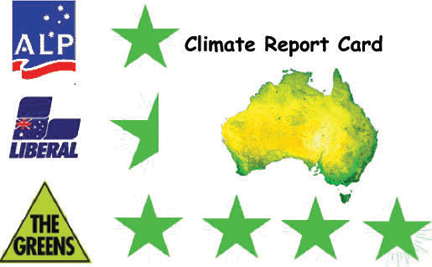 Environment scorecard rates Coalition’s policies ‘woefully inadequate’, Guardian, Gareth Hutchens, 31 May 2016 The Australian Conservation Foundation’s assessment of the parties’ policies awards the Coalition 11 points out of 100, Labor 53 and the Greens 77
The Australian Conservation Foundation has described the Coalition’s environmental policies as “woefully inadequate” in its traditional election scorecard.
It gave the Coalition 11 points out of a possible 100, Labor 53 and the Greens 77.
The ACF’s chief executive, Kelly O’Shanassy, said: “The politicians who want to lead the country must have real plans to protect people, rivers, reefs, forests and wildlife for the future.”
“The Coalition’s 11 out of 100 on the environment is woefully inadequate. If they are not prepared to lead on climate and nature, they are not fit to lead the country.
“It’s not as if conservatives can’t be good conservationists – Liberal cabinet minister Garfield Barwick was ACF’s first president; Robert Menzies signed the first Antarctic Treaty; Malcolm Fraser made Kakadu a national park; John Howard established the national greenhouse inventory and the national water initiative,” she said.
The scores were calculated by measuring the parties’ policies on clean energy, pollution reduction, and environmental protection, and comparing them with the 40 tests set out in ACF’s national agenda for 2016.
Those tests include setting stronger pollution targets to help limit global warming to less than 1.5C above pre-industrial temperatures; stopping uranium mining and export; delivering on the Murray-Darling Basin Plan; and shifting to 100% renewable energy by 2050.
The ACF decides how many marks to award for each party policy on the basis of how completely it fulfils the ACF’s tests. Where a policy unwinds existing environmental protection, the ACF awards negative marks.
An ACF spokesman said the organisation had been in contact with all three major parties this year to tell them how their policies would likely rate in its election scorecard with its policies as they stand…….
A recent poll showed climate change is one of the top four issues for voters at this election. http://www.theguardian.com/australia-news/2016/may/31/environment-scorecard-rates-coalitions-policies-woefully-inadequate
Transition to renewable energy favoured by most voters
Most voters support transition to 100% renewable energy, says Australia Institute
Polling indicates 71% would be more likely to vote for a party that supported distributed small-scale solar and storage, Guardian, http://www.theguardian.com/sustainable-business/2016/may/31/most-voters-support-transition-to-100-renewable-energy-says-australia-institute
Max Opray, 31 May 16, Battery storage technology has the potential to reshape not just the energy and transport sectors but also the upcoming Australian federal election, according to a new report.
The Australia Institute report Securing Renewables: How Batteries Solve the Problem of Clean Electricity includes polling indicating that 71% of Australians would be more likely to vote for a party that supported distributed small-scale solar and storage.
Based on a national opinion poll of 1,412 people undertaken between February and March 2016, the study also found 63% of respondents would be more likely to support a party that aims to transition to 100% renewable energy by 2030 and that 45% would be more likely to support a party that attempts to accelerate the uptake of electric vehicles.
“The combination of batteries paired with variable renewable energy such as solar and wind can now provide security of electricity supply, with zero emissions,” says the author of the report, Australia Institute strategist Dan Cass.
The report found that one in four Australians wish to create and store power in order to unplug from the grid and that 80% of the 1.5m Australian households to have already invested in rooftop solar are considering the purchase of batteries.
It also noted that the predicted boom in electric cars could see households using such vehicles when parked and plugged in as storage providers for the wider energy network.
Jobs in plenty in the renewabl energy industry
The Community Power Agency – which specialises in supporting community groups to set up a  community owned renewable energy (CORE) project – is directly working with the 70 community energy groups across Australia.
Looking towards the election, the Community Power Agency is calling on all political parties to put in place robust policy to support the growth of community energy innovation in Australia.
“In terms of the focus for the election… the ALP and the Greens have both come out with excellent renewable energy policy and have been talking about it quite a lot. They could be talking about it more. But certainly the ALP has committed $28.7 million to support community energy projects across Australia and they have also committed to a 50 per cent renewables target by 2030, so there is some good policy basis there, we are yet to see any kind of announcement on this type of thing from the Coalition which is very disappointing.
Renewable Energy is a Jobs Rich Industry http://probonoaustralia.com.au/news/2016/05/renewable-energy-jobs-rich-industry/ A Not for Profit organisation dedicated to growing the community energy sector in Australia has claimed renewable energy is a jobs rich industry.

The Community Power Agency said Australian regions and towns can maximise employment in renewable energy with community-owned projects.
It comes after a new global report released by the International Renewable Energy Agency (IRENA) showed that renewable energy jobs were on the rise, with community-owned projects to benefit most.
More than 8.1 million people around the world are now employed in renewable energy, up 5 per cent on last year.
Nicky Ison Community Power Agency director said renewable energy was a jobs-rich industry and when such projects were community-owned that created even more employment.
“The research from the US – because there are a lot more community energy programs in the US than here – shows that if you have a community ownership stake in a larger renewables project, like owning a couple of wind turbines in a larger wind farm, the economic benefit to that local community in terms of jobs, investment, money circulating in the local economy, the economic benefit is 1.5 to 3.5 times greater,” Ison told Pro Bono Australia News. Continue reading
South Australian Premier Jay Weatherill launches nuclear propaganda campaign
 Premier Jay Weatherill Sunday, May 29, 2016 Consultation on nuclear future to extend across all of South Australia http://assets.yoursay.sa.gov.au/production/2016/05/29/01/29/06/0cee3e94-ed82-4dfa-992e-a44d25cec636/nuclearconsult.pdf
Pro coal, nuclear John White still quietly running Liberal govt’s resources policy
 Turnbull’s #Innovation and #IdeasBoom is to flog fossil fuels. KaBOOM! Independent Australia Tracey Anton 28 May 2016 “………In an article in Crikey by Paddy Manning, entitled ‘Hunt pins hopes on uncompetitive clean coal technology’, Manning writes:
‘John White chairs the DICE network of companies and agencies developing the technology, and is an executive and founding shareholder of Ignite Energy Resources,(IER)’
White told Manning:
‘..It halves CO2 emissions and will be eligible for Emissions Reduction Funding under Direct Action policies.’
Not only was White in financial trouble prior to receiving over $20 million in “grants” for the DICE project but he had also incurred a loss of $6 million in the 2012 calendar year.
 White is an old Liberal heavyweight who was former Prime Minister John Howard’s right hand man in developing the Uranium Industry Framework for Australia’s nuclear future and just happens to hold dominion over thousands of square kilometres in Gippsland through the company he is shareholder and founder of, Ignite Energy Resources. He also has an uncanny knack of developing new coal technology which will reward him benefits under the Coalition’s Direct Action climate policy that he advised on.
Then there were the concerns over a $3 billion port in Gippsland when White, allegedly, was head of the (GRID) panel on transport infrastructure. That would go with his planned open cut coal minein the groundwater depleted area of Gelliondale.
Next, was the inclusion of biomass (another “clean” energy project) in the Renewable Energy Target securing White feedstock from our Gippsland forests. Now, he is telling government that his Gippsland Gas project will provide an abundance of “clean, agricultural quality” extracted water from his proposed biogenic coal gas project in the water stressed area of South Gippsland. Simply put, it is coal seam gas with the same destructive intrusions and the same hazards.
White’s most grandiose venture was to produce nuclear energy for the world by turning uranium into nuclear fuel rods, leasing them and bringing back the waste (including plutonium from the U.S. weapons industry). It’s interesting that Ignite holds leases for thorium adjacent to the iconic Ninety Mile Beach in Gippsland. Thorium – uranium’s young sister – is hailed by nuclear proponents as the green energy source of the future.
Only problem is, its exploration and mining is banned in Victoria. Bizarrely, when IA‘s Sandi Keane and I reported on White’s involvement in Ignite (‘Victorian government ignores Gippsland gasfield concerns’), the Minerals Council of Victoria rather stupidly tried to get the article pulled. They claimed we’d got the WRONG John White. We didn’t. It was a desperate act by MCA. You can find the whole story here. It seems the reason they wanted us to pull the article was because they’d applied to the former state LNP government to have the legislation banning exploration and mining of thorium and uranium repealed and didn’t want White’s name mentioned. Welcome to the shadowy world of Dr White.https://independentaustralia.net/politics/politics-display/turnbulls-innovation-and-ideasboom-is-to-flog-fossil-fuels-kaboom,9038
Greens energy plan to generate $53 billion of investment in Queensland
 Greens announce $53b clean energy plan http://www.sbs.com.au/news/article/2016/05/29/greens-announce-53b-clean-energy-plan The Greens have announced a clean energy plan for Queensland which it says will generate $53 billion of investment in projects over 15 years. “This would be delivered through a combination of direct government investment and ownership, and reverse auctions which provide bankable incentives for private sector investment.”
Queensland Greens Senator Larissa Waters said delivering a clean-energy economy would also safeguard Great Barrier Reef tourism jobs and agricultural jobs that were threatened by coal mining and coal seam gas.
“The old parties are leaving Queensland at risk of missing out on the job-rich clean energy revolution,” she said.
1 This month
17 October, Free Public Talk on Nuclear Issues in South Australia
David Noonan will speak on public interest concerns over the new Roxby Downs Indenture Act 2026 on BHP copper-uranium mining and ore processing in SA, and on how AUKUS may face SA with a High-Level nuclear waste agenda.
Dr Jim Green will discuss international developments in the field of nuclear power including ‘small modular reactors’ and Generation 4 ‘advanced’ nuclear reactor concepts.


Help Aunty Sue Protect Her Land and Sacred Sites From Destructive Rocket Testing.
.

Australians deserve the truth
about
AUKUS – https://aukuspublicinquiry.com/

PETITION – To: Prime Minister Anthony Albanese and the Australian Labor Government

of the week – Australians for War Powers Reform (AWPR)
To see nuclear-related stories in greater depth and intensity

