Turnbull cuts climate research money – spends it on ‘wind farm health effects’
 ‘Quite disgraceful’: NHMRC doles out $3.3m to study windfarm effects on health, The Age, March 23, 2016 Peter Hannam Environment Editor, The Sydney Morning Herald Australia’s top medical research body has given two researchers $3.3 million to study the effects of wind farms on human health despite its own year-long study finding no “consistent evidence” that a problem exists.
The National Health and Medical Research Council (NHMRC) awarded Guy Marks, a professor at the University of NSW $1.94m, to study the health impacts of infrasound – sound waves typically inaudible to humans – generated by wind turbines.
Peter Catcheside, an associate professor at Flinders University, secured $1.36m to investigate whether wind farms disturb sleep compared with traffic noise.
The outcomes of these studies, promoted by a so-called targeted call for research, will assist in developing policy and public health recommendations regarding wind turbine development and operations, the council said.
The research call was criticised last year, with even NSW and Victorian health officials calling for the NHMRC “to make it clear that the total available evidence (parallel and direct) suggest[s] little health risk,” according to emails from these health officials seen by Fairfax Media.
Senior members of the Abbott government, including then Prime Minister Tony Abbott, made public their opposition to wind farms. Then Treasurer Joe Hockey also dubbed wind turbines as “utterly offensive” and “a blight on the landscape”.
Simon Chapman, an emeritus professor of public health at the University of Sydney, said there had been at least 25 reviews internationally – including by the NHMRC – that showed “very little evidence of direct effects” from wind farms.
Effects that did exist could be put down to psycho-social factors, such as pre-existing antipathy to wind farms, resentment by locals who had received no benefit from turbines in their region, and anxiety of perceived health impacts, Professor Chapman said.
“It’s really quite disgraceful – it’s money literally poured down the drain,” he said. “There is no health or medical agency in the world that would give any rational priority to wind farms and health. “Potentially hundreds of researchers who had just missed on funding research would be angry as the money is being spent on wind farm research.”
Fairfax Media has sought additional comment from the NHMRC.
Senator Kim Carr, shadow science minister, said the funding came at a time when the Turnbull government was taking the axe to hundreds of scientists – including climate researchers – at the CSIRO.”The Liberals cannot plead innocence in cutting climate and manufacturing research in the CSIRO…while handing out money for contentious research into things like the supposed health effects of wind farms,” he said.
“The Abbott-Turnbull Government is hell-bent on politicising Australian research,” he said. http://www.theage.com.au/environment/quite-disgraceful-nhmrc-doles-out-33m-to-study-windfarm-effects-on-health-20160321-gnnzhe.html#ixzz43wzQSmqb
Turnbull govt “clean energy” plan designed to stall renewable energy projects?
 Green power projects to falter under Turnbull government plan, critics say http://www.theage.com.au/federal-politics/political-news/green-power-projects-to-falter-under-turnbull-government-plan-critics-say-20160322-gnooqi.html March 22, 2016 –Nicole Hasham Environment and immigration correspondent The Turnbull government would be taking a “risky gamble” with the renewable energy sector by merging two key climate action bodies and forcing vulnerable new ventures to borrow funds rather than receive grants, green power advocates say.
Guardian Australia has reported that the government intends to combine the Clean Energy Finance Corporation and the Australian Renewable Energy Agency – two bodies that provide financial support to emerging renewable technologies.
The CEFC issues loans that must be paid back while ARENA provides grants, including a focus on projects in the research and development phase that would otherwise struggle to attract investment.
There is speculation that the merger model will mean grants would be scrapped and only loans would be available – raising questions over whether projects in their very early stages would be funded at all.
Solar Citizens national director Claire O’Rourke said the plan was a “risky gamble on the future of renewables in Australia” and would harm both research and development and reduce investment in demonstration projects.
“The kinds of projects that ARENA funds won’t necessarily get support from the CEFC because the investment conditions are different,” she said.
Ms O’Rourke said Australia’s clean energy future would be jeopardised by “gambling on secure, long-term funding for major proven programs that support innovation and investment in renewables”.
ARENA has committed more than $1 billion in grants to more than 230 projects, studies, scholarships and fellowships since mid-2012.
The former Abbott government sought to abolish both ARENA and the CEFC, and a merger would ensure their survival under Prime Minister Malcolm Turnbull, who has so far refused to guarantee their future.
However Clean Energy Council Chief executive Kane Thornton said reports that the bodies could be “funded by future borrowings are of particular concern for the sector”.
“While we recognise there are opportunities for more co-ordination and a closer working relationship between ARENA and the CEFC, it is important that the government continues future support through funding for projects, innovative finance and … high-level research and capability,” he said.
The office of Environment Minister Greg Hunt did not comment.
Dispute in South Australia, as Labor govt wants to scrap law against expenditure towards nuclear waste dumping
 State Parliament has backed removing a law against investigating nuclear dumping, with dispute over when it should take effect, The Advertiser, March 22, 2016 Daniel Wills State Political Editor The Royal Commission’s tentative findings were that a nuclear dump could be constructed safely in SA STATE Parliament has taken its first step toward supporting nuclear waste storage, with bipartisan support to repeal laws that ban spending money on investigating its establishment.
However, a dispute has emerged over State Government plans to make the changes effective as of several weeks ago amid Opposition questions about if the law has already been broken.
Premier Jay Weatherill a fortnight ago announced plans to change laws enacted under the former Liberal government which stop public money being spent on encouraging a dump.
He said the move did not signal support for a dump in SA, but the laws could prevent robust debate and investigations once the final Nuclear Fuel Cycle Royal Commission report is released.
The existing law states: “no public money may be appropriated, expended or advanced to any person for the purpose of encouraging or financing any activity associated with the construction or operation of a nuclear waste storage facility in this state”.
Mr Weatherill said legal advice found the Commission did not break existing law……..
Greens MP Mark Parnell has previously told Parliament he believes the law may have been broken by commissioning telephone interviews with citizens seeking their views on storage.
Conservation SA today released a report from left-leaning think-tank The Australia Institute which cast doubts on the economic benefits of nuclear storage in SA.
Conservation SA chief executive Craig Wilkins said it “confirms what many South Australians suspect”, in that “the dump proposal being pushed seems way too good to be true”.
“Because there is no international market for high level nuclear waste, any prices, or costs underpinning any possible return for our state are pure guesswork based on assumptions and modelling,” Mr Wilkins said. “The consultants have made some extraordinarily optimistic assumptions about the price other countries will be willing to pay.
“They assume South Australia will be able to do something that even experienced nuclear countries have never managed to do, at a cheaper price.
“They also ignore the very real possibility that SA could take a cut in its GST revenue if this project did manage to make money.
“A project with this level of risk to future South Australians needs to stack up on economic grounds as well as safety and ethical ones. Our concern is that this fails on all three.” http://www.adelaidenow.com.au/news/south-australia/state-parliament-has-backed-removing-a-law-against-investigating-nuclear-dumping-with-dispute-over-when-it-should-take-effect/news-story/a9bb5ee604fc4f7e850e4a9116cbdd0d
Turnbull suggests Port Augusta solar thermal plant for federal clean energy plan
 Port Augusta solar thermal plant likely to be funded by $1 billion federal clean energy fund March 23, 2016 PETER JEAN POLITICAL REPORTER The Advertiser A LARGE solar thermal plant at Port Augusta is likely to be one of the first projects supported by a $1 billion Clean Energy Innovation Fund, to be announced by the Federal Government today.
Prime Minister Malcolm Turnbull and Environment Minister Greg Hunt will today reveal plans for the fund, which will invest up to $100 million per year in emerging technologies.
The announcement comes after the federal and state government were urged to back the development of a solar plan at Port Augusta, where hundreds of jobs will be lost when two coal-fired power stations close in May.
It is likely to cause tension with conservative elements in the Coalition, particularly those who have aligned themselves with former prime minister Tony Abbott.
“We are promoting innovation and new economic opportunities, enhancing our productivity, protecting our environment and reducing emissions to tackle climate change,’’ Mr Turnbull said last night.
“An example of a project could be a large scale solar facility with storage in Port Augusta.
“By offering innovative equity and debt products, the Clean Energy Innovation Fund can accelerate the availability of new technologies to transform the energy market, and deliver better value for taxpayers.”
American company SolarReserve had been seeking support for the development of a large solar thermal plant at Port Augusta.
Similar projects in the United States have created about 1000 construction jobs, 50 ongoing roles and 4000 indirect jobs.
A delegation of federal MPs visited a large solar power station built by SolarReserve in the American state of Nevada last year…….http://www.adelaidenow.com.au/news/south-australia/port-augusta-solar-thermal-plant-likely-to-be-funded-by-1-billion-federal-clean-energy-fund/news-story/7be66ebf70e864e8a1a9cb9a95bd83bc#load-story-comments
Mixed reaction to Turnbull’s Clean Energy Innovation Fund
Kane Thornton, chief executive of the Clean Energy Council, was this morning not totally convinced about the new fund. He told ABC radio the proposal was “really giving with one hand while taking from the other”. (The new fund will be financed by $10 million from ARENA over 10 years. )
“This proposal obviously keeps the Clean Energy Finance Corporation, and that’s a welcome development.
“But essentially it is removing funding from the Australian Renewable Energy Agency and really I guess constraining it in terms of its ability to provide capital grants to the sector into the future.”
- See the full transcript of this interview here
- Read more media articles here, in The Guardian
- Fairfax Media
And see how the extreme right wing sees the news here (It calls the destruction of the Liberal Party by Turnbull)
As we draw near to a possible election on 2 July, we’ll be watching closely. The whole world will be.
Turnbull announced $1 billion Clean Energy Innovation Fund http://www.thefifthestate.com.au/politics/turnbull-announced-1-billion-clean-energy-innovation-fund/81166 Tina Perinotto | 23 March 2016
Malcolm Turnbull has finally caved to his supporters instead of the Abbott camp by announcing early today a decisive and dramatic signal move to support climate action. He’s announced not only a $1 billion Clean Energy Innovation Fund but a commitment to retain the Clean Energy Finance Corporation AND the Australian Renewable Energy Agency.
Media today was awash with news of the fund designed to create innovation and jobs with smart grids, alternative energy such as bio fuels and large-scale solar projects.
It’s the most-vote winning confidence-boosting thing he’s done since winning office and making his statement on innovation, essentially declaring Australia was back in the land of the living, instead of the walking dead. It’s a powerful wake-up call to Labor to get back on the most important and competitive bandwagon going, the fight to save our planet AND create a innovation clean, green and lean economy. Continue reading
To thwart Tony Abbott, Malcolm Turnbull is even trying to look green
Malcolm Turnbull’s green shift another blow to Tony Abbott, The Age, March 23, 2016 –Mark Kenny Chief political correspondent Malcolm Turnbull has added to the growing differences between his administration and the previous Abbott government by reversing Coalition hostility to forward-leaning climate change policy through the creation of a new $1 billion clean energy innovation fund.
And he has bolstered that move with a formal commitment to keep the Clean Energy Finance Corporation, and the Australian Renewable Energy Agency, both of which had been set for abolition under Mr Abbott’s leadership. Continue reading
Unlike Britain,Australia is, at present, easily able to avoid a very bad nuclear deal
Secret deals: Australia’s nuclear waste plan and the UK’s Hinkley project, Independent Australia 21 March 2016, The South Australian Government scheme to import international nuclear waste has a major flaw in common with the UK’s Hinkley Point C project — secret contracts with foreign organisations, writes Noel Wauchope.
THESE TWO PLANS have something in common. Both the UK’s Hinkley Point C plan and South Australia’s nuclear waste plan are grandiose and very expensive to set up.
But, more than that, they both require the involvement of foreign governments and companies, in secret arrangements.
 The South Australian Nuclear Royal Commission‘s plan for importing international wastes already involves confidential communications from foreign companies. Put into operation, the plan will mean secret contracts — South Australia being beholden to the provisions of foreign laws regarding disclosure, shipping and transport security, insurance and other matters relating to a client nation’s high level nuclear wastes (HLNW).
Plans have been suggested for foreign companies paying up front towards the setting up of the waste facility, in exchange for “ironclad contracts”to later set up “Generation IV” nuclear reactors. With foreign governments and companies involved, South Australia is very likely to become locked in to a deal from which it cannot escape. A later decision to pull out of the scheme would certainly entail heavy compensation payments to foreign companies.
 Britain’s Hinkley Point C nuclear project is thoroughly embroiled in complicated negotiations with the government-owned companies of China and France. The major backer, Electricite De France(EDF) is in grave financial trouble and its financial director Thomas Piquemal has resigned, over this Hinkley project. EDF is being bailed out by the French government, so that the £18bn plan can go ahead. UK has had to agree to a contract with EDF, amounting to about £40bn in real terms, and providing State guarantees on insurance, among other matters. The plan locks the UK in, with compensation costs in the event of it being shut down, as shown in an unpublicised departmental “minute“:…….
Professor Catherine Mitchell, an energy policy expert at the University of Exeter, comments in The Guardian:
The £22bn “poison pill” effectively reduces the risk to zero for EDF and its backers, which is great for them. But from an outside perspective, it smacks of desperation.
There could be so many reasons over 35 years that you would want to close the plant, including rising costs, changes to the UK’s energy system or loss of public confidence……..
However, in two important ways, the Australian situation is very different from that of the UK.
Firstly, although the UK Hinkley project is big, the South Australian nuclear waste plan is ginormous. Potentially sourcing high level nuclear wastes (HLNW) from around the world – USA, Canada, Europe, Asia – would be a massive operation, many decades in the setting up, many thousands of years in carrying it out. The money involved would be not dozens of billions of dollars in costs but hundreds of billions.
Secondly, for all the millions in dollars now being spent on the Royal Commission project – the trips abroad, forums, research, public relations and so on – the plan is nowhere near the point of agreement, whereas the UK plan is well advanced…….
It is vitally important for Australia to pay attention to the Royal Commission plan and to the scrutiny of South Australian radiation expert Paul Langley. and others. Unlike Britain, Australia has the opportunity to prevent this plan, while it’s still only a gleam in the eyes of Royal Commissioner Kevin Scarce and the nuclear lobby. https://independentaustralia.net/politics/politics-display/secret-deals-australias-nuclear-waste-plan-and-the-uks-hinkley-project,8797


A South Australian Labor MP has the guts to speak out against nuclear waste dump plan
“I don’t want nuclear dump”: Labor MP http://indaily.com.au/news/local/2016/03/18/i-dont-want-nuclear-dump-labor-mp/, Tom Richardson, 18 Mar 16
Jay Weatherill could face a divided party if he forges ahead with a proposal to establish a high level nuclear waste dump in South Australia, with a long-time Labor MP telling InDaily the idea is “quite worrying” – and suggesting several colleagues share the same view.
The tentative findings of Kevin Scarce’s nuclear royal commission handed down last month found an unambiguous economic case to establish a repository, with the Premier already moving to amend the law to facilitate broader debate on the issue.
 But the debate is heating up in the corridors of parliament, with former Labor minister and Ashford MP Steph Key joining Greens MLC Mark Parnell – a vocal opponent of increasing SA’s nuclear involvement – in sponsoring a briefing for interested MPs by a noted critic of the waste dump push.
An email went out to all MPs this week, reading: “Dear colleagues, there’s been so much said about an economic bonanza from building a global nuclear waste facility – but what if the economics don’t stack up?”
“Come and hear from Dr Richard Denniss, Chief Economist, The Australia Institute,” it concluded.
The briefing will be held on Tuesday, after a public briefing by Denniss together with economist and InDaily columnist Richard Blandy, both of whom have argued against the economic case for a waste dump.
“I think it would be fairly well known that I’m an anti-nuclear person,” Key said when contacted by InDaily. “I have been for the last 40 years, and I still am.” She said she was “interested to know what [Denniss and Blandy] have to say about the costings that have been put forward so far”.
“People are saying it could help us economically [but] I don’t actually want to have a dump at all,” she said. “I’m just interested to know whether these billions of dollars cited actually stack up – Mark and I decided we’d try and offer something to people that can come along.”
Key says she believes SA should “store our own waste [and] I do have some sympathy for low level or intermediate level repository”, but she has grave misgivings about a high-level global storage facility.
“I want to know all about it… the study I have done, I think it’s quite worrying,” she said, citing concerns over transportation. “We keep getting things across the sea and then by train, presumably, and truck… what does all that mean? What’s the risk analysis of all that? There’s quite a bit to consider.”
Labor right-winger Tom Kenyon has argued passionately in favour of the repository, but Key – a Left-faction stalwart – says: “I want to have a look at all the facts before I come out and argue in a very public way about this issue.”
“And I want to talk to my colleagues, but I get the impression that quite a few of them have a lot of sympathy for my way of thinking,” she said. “I’ve spoke quite passionately at both convention and state council – and national conference – over the years, so I don’t think anyone would be surprised that I don’t think this is a good idea.
“I just remember Fukushima – five years on and there’s still just people helping with the cleanup, let alone the natural disaster that it was… it just seems like a very big risk to me, and if it doesn’t stack up financially I think people are starting to run out of arguments.”

Greens call on Nuclear Royal Commission to “get real”
 The Greens SA’s submission to the Nuclear Royal Commission’s Tentative Findings rejects the suggestion that an economic bonanza awaits our State if South Australians would only resign ourselves to becoming the world’s nuclear garbage bin.
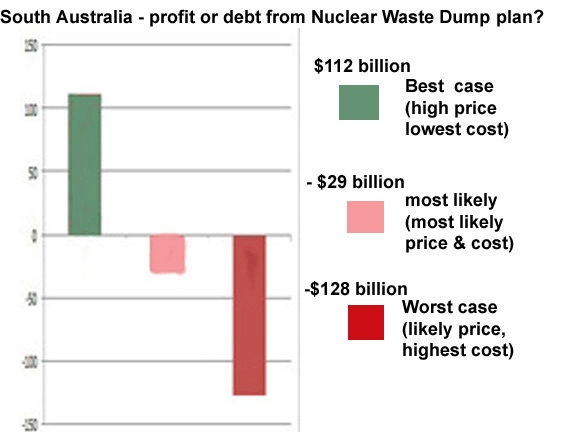
“The Royal Commission has been blinded by imaginary wealth and sucked into believing that a project that has never succeeded anywhere else in the World is South Australia’s for the taking”, said Greens SA Parliamentary Leader, Mark Parnell MLC.
“The most obvious question is being ignored: If this is such a great deal, how come no other country has grabbed it before now?
“The Greens are urging the Royal Commission to “get real” and critically examine the supposed economic benefits alongside the ongoing economic, social, environmental and reputational costs.
“Washing your hands of responsibility for a toxic legacy left to future generations is just immoral.
“The solution to South Australia’s current unemployment problems won’t be solved with mythical jobs that are decades into the future with the creation of toxic liabilities that last hundreds of thousands of year.
On releasing the “Tentative Findings” Report to the media on 15th February 2016, Commissioner Kevin Scarce stated, “The community needs to understand the risks and the benefits.” The Royal Commission’s “Tentative Findings” highlights many purported benefits but is scant on detail when it comes to the profound risks.
According to the Greens’ submission, the “Tentative Findings” suffer from:
1.Unrealistic expectations of the magnitude of the project;
2.Failure to appreciate 6 decades of international failure to solve the nuclear waste problem;
3.Missing costs, unfunded liabilities, missing contingencies and failure to recognise inevitable cost blow-outs
4.Heroic assumptions of other countries’ willingness to pay for SA to take their nuclear waste;
5.Lack of recognition of the potential for irrecoverable sunk costs and unlimited future liabilities;
6.Failure to address reputational damage and impact on other sectors of the economy; and
7.Naïve expectations that South Australia would get to keep all the profits from a nuclear waste dump in our State, without having to share them with other States.
“The Commission’s final report due on 6th May should recommend that the folly of South Australia’s increased involvement in the nuclear industry be abandoned.
“In relation to the other Terms of Reference, increased uranium mining, uranium processing or nuclear power were never really an option for SA and the Royal Commission was an expensive way to tell us what we already knew”, concluded Mark Parnell.
Labor, Liberal unite to support high-level nuclear waste dump in South Australia
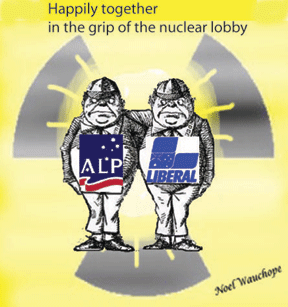 Labor, Liberal unite to support high-level nuclear waste dump in South Australia February 16, 2016 Paul Starick and Daniel Wills The Advertiser UNPRECEDENTED political support is being thrown behind South Australia becoming the global storage facility for high-level nuclear waste in return for a $445 billion bonanza.
Forging a historic united front on a decades-old issue of bitter division, Labor Premier Jay Weatherill and Liberal federal Resources and Energy Minister Josh Frydenberg are encouraging debate on a Royal Commission proposal, unveiled on Tuesday, for SA to store and dispose of hundreds of thousands of tonnes of spent nuclear fuel and waste…….http://www.adelaidenow.com.au/news/south-australia/labor-liberal-unite-to-support-highlevel-nuclear-waste-dump-in-south-australia/news-story/683296ab45e53c73432c66bbe0358e34
Turnbull govt missing the chance for Australia to lead on climate change action
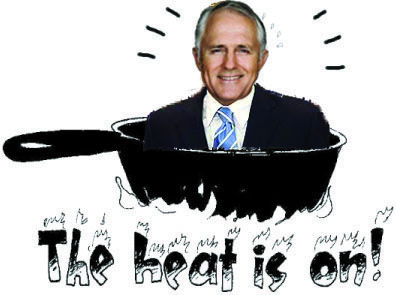 Malcolm Turnbull risks Australia’s economy with inaction on climate change, Guardian
Jonathon Porritt, 15 Mar 16
He may not want to confront climate-change deniers in his party, but it’s time for the prime minister to seize the low-carbon agenda for the opportunity it is
Even for a sympathetic observer from the UK, the politics of climate change in Australia is, to say the least, vexatious. But it’s now entering a more critical phase than ever before. The mismatch between the conclusions of the Paris agreement in December last year and the failure of Australia’s political establishment to understand what’s going on “out there in the rest of the world” is putting Australia’s entire economy at risk.
When the prime minister, Malcolm Turnbull, wrested the prime ministership from Tony Abbott in September last year, the international climate community breathed a deep sigh of relief. With the former Canadian prime minister, Stephen Harper, Abbott was seen as the most egregiously pig-headed climate-change denier in western world had ever thrown up. By contrast, Turnbull had done OK on climate change as a previous leader of the Liberal party, so it was assumed he would do a lot better second time round.
Nothing could be further from the truth. As I discovered on my latest visit, Turnbull has been utterly pusillanimous in pursuing any kind of progressive climate agenda. As part of his “oil on troubled waters” strategy, he apparently decided not to take on Abbott’s climate-denying guerilla fighters, and has offered zero leadership to Australia’s confused and polarised citizenry either before or after Paris.
For instance, he stood idly by as Australia’s world-renowned science agency, the CSIRO, announced it would cut 80% of its climate scientists, effectively ending Australia’s climate research program.
No surprise then that the New South Wales Liberals recently passed a motion, with the support of more than 70% of delegates, calling on the federal government to hold public debates between scientists from the Intergovernmental Panel on Climate Change and independent climate scientists. Basically, they are still refusing to accept that the science of climate change is settled, and are fighting an obstinate rearguard action to keep mining and burning as much coal and gas as possible.
You can see why Turnbull might be a bit nervous about confronting such a monumentally ignorant faction in his party. And he may even be reassured that such deniers still hang on elsewhere in the world. ……..
What he needs to know is that it’s all so much worse (and moving so much faster) than anyone imagined even five years ago. Instead of having decades to do what needs to be done to set the global economy on a genuinely low-carbon trajectory (as in net zero emissions by 2050, which is what Turnbull’s government signed up to in Paris), we now have little more than a decade.
Australia is uniquely vulnerable in this respect. The damage that will be done to the Australian economy as the world decarbonises at speed, leaving billions of dollars stranded in fossil-fuel assets that can no longer be developed, is almost impossible to imagine. And to rub salt into that already inflamed wound, there are few countries that will suffer more from rising average temperatures (as in forest fires, increasingly inhospitable cities, and drought-devastated rural economies) and rising sea levels……..
as it happens, not only is Australia uniquely vulnerable to the consequences of runaway climate change, it’s also extraordinarily well-placed to navigate its way through to the kind of ultra-low-carbon prosperity on which the destiny of all nations now depends.
In January a blockbuster report from the International Renewable Energy Agency (Irena) identified Australia as one of the most significant beneficiaries of this kind of accelerated shift to renewables by 2030, providing significant gains in GDP (up 1.7%) and employment, as well as socioeconomic and other environmental benefits. http://www.theguardian.com/sustainable-business/2016/mar/15/malcolm-turnbull-risks-australias-economy-with-inaction-on-climate-change
Australia’s Liberal Party Wants National Debates on whether or not Climate Change is happening!

NSW Liberals call for national debates on climate change science
The NSW Liberals have formally called on the Turnbull government to conduct public debates about climate change – including as to whether the science is settled – in a stark reminder of the deep divisions within the party over the issue.
http://www.smh.com.au/nsw/nsw-liberals-call-for-national-debates-on-climate-change-science-20160307-gnd3zn.html
The Sorry History of the Liberal Party’s Religious Conversion to Climate Denialism
Lest anyone assume that this is an issue only for the Liberals, it should be noted that the Australian Labor Party’s climate policies have hardly been consistent, veering from indifference under Paul Keating, to grave moral challenge under Rudd, and finally the “art of the possible” under Julia Gillard. Meanwhile, the arcane accounting rules around the Kyoto Protocol have allowed both Labor and Liberal governments to draw a veil over the true progress.
As economist Ross Garnaut warned in 2008, it may be that the problem is simply too wicked for our democratic system to cope.
 How climate denial gained a foothold in the Liberal Party, and why it still won’t go away, The Conversation, Marc Hudson, March 10, 2016 It seems the Liberal Party is still having trouble letting go of climate denial, judging by the New South Wales branch’s demand that the Turnbull government arrange a series of public debates on climate science.
Leaving aside the fact that this kind of town hall debate would only entrench opposing viewpoints rather than making scientific headway (a task best left to peer-reviewed journals), it is not the only recent example of Liberal Party members seeking to stoke doubts over the reality of climate change.
Last September, Liberal National Party senator Ian Macdonald told the federal parliament that Australia’s children have been “brainwashed” about human-induced climate change, which he described as “a fad or a farce or a hoax” and “farcical and fanciful”.
Two months earlier, Macdonald’s fellow LNP MP George Christensen attended the Heartland Institute’s climate sceptic conference. There he described climate concerns as “hysteria” and the stuff of science fiction.
And a month before that, rural Liberals called for a parliamentary inquiry into climate science, while urging Australia not to sign any binding agreement at December’s Paris climate talks.
This pervasive climate scepticism might make it look like this is a longstanding position within the Liberal Party. But history tells rather a different story.
The forgotten history of Liberal climate positions
South Australian Government pro-nuclear waste dump PR campaign set to roll
The Premier’s announcement today that the State Labor Government will move to repeal part of the 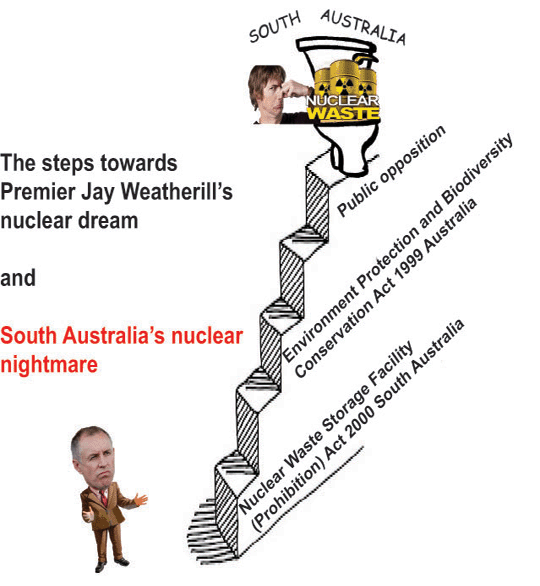 Nuclear Waste Storage Facility (Prohibition) Act 2000, indicates that a taxpayer-funded pro-nuclear waste dump public relations campaign is on its way.
The Government says the repeal is necessary in order to consult with the community over the Nuclear Royal Commission’s findings.
“That’s just not true”, according to SA Greens Leader and environmental lawyer, Mark Parnell MLC.
“The Act only prohibits the use of public money to “encourage or finance any activity associated with the construction or operation of a nuclear waste storage facility in this State”. It doesn’t preclude genuine public consultation that asks South Australians whether or not they believe SA should host a high-level nuclear waste dump. Genuine consultation with the South Australian community is allowed, even if it uses Government resources. What isn’t allowed is a biased or one-sided PR campaign that “encourages” the construction or operation of a nuclear waste dump.”
“If the Government’s intentions were honourable, it wouldn’t need to repeal this legislation.”
“What is most galling is that the Premier isn’t even prepared to wait for the Royal Commission’s final report in May before legislating to be able to spruik a nuclear waste dump. The Government had said it would wait until the end of the year before deciding what to do with the Royal Commission’s findings. Rushing now to repeal this legislation suggests that it’s mind might already be made up.
“If this legislation is repealed, the Government will be able to legally spend millions of dollars of taxpayers’ money to promote SA as the Nuclear Waste State. It will also be able to conduct detailed planning and design work for a nuclear waste dump, with only the final consent requiring Parliamentary approval,” concluded Mark Parnell.
South Australia nuclear law repeal opens door to taxpayer funded spin
Conservation Council of South Australia 7 Mar 16 The move by the Weatherill Government to repeal parts of the SA Nuclear Waste Storage Prohibition Act even before the Nuclear Royal Commission hands down its final report is deeply disappointing.
“This move is cold comfort for communities in Kimba and the Flinders Ranges who are currently in the frame for a national radioactive waste facility,” said Conservation SA Chief Executive, Craig Wilkins.
“With the Royal Commission months from handing down its final report, Premier Weatherill is clearly jumping the gun.
“The South Australian public now has every right to question how genuine the ‘listening’ process in response to the Royal Commission will be over the coming months.
“They will rightly be outraged if the Government intends to free up taxpayer funds to spin an unpopular nuclear waste dump proposal,” he said.
The object of the Nuclear Waste Storage Facility (prohibition) Act is to ‘protect the health, safety and welfare of the people of South Australia and to protect the environment in which they live by prohibiting the establishment of certain nuclear waste storage facilities in this state.’ The Act expressly bans the use of public money ‘for the purpose of encouraging or financing any activity associated with the construction or operation of a nuclear waste storage facility in this State’. This clause is now set for repeal.
Rose Lester, Yankunytjatjara Anangu woman said: “When many Anangu people have clearly expressed opposition to nuclear industry, weakening any protection is not a step in the right direction for reconciliation. It is very disheartening that people who don’t have strong connection to country change laws to suit their ideology rather than acknowledging and respecting the law of the land.”
1 This month
Chernobyl: The Lost Tapes – A good documentary on Chernobyl on SBS available On Demand for the next 3 weeks– https://www.sbs.com.au/ondemand/tv-program/chernobyl-the-lost-tapes/2352741955560
15 April – Zoom –Nuclear Power is Not the Solution
Apr 15, 2026 01:00 AM in Canberra, Melbourne, Sydney

Join the International Physicians for the Prevention of Nuclear War (IPPNW) on Tuesday, April 14th for a timely webinar exploring the risks associated with nuclear power and challenging the myth that it offers a simple, safe, carbon-free solution to the climate crisis

21 April Webinar: No Nuclear Weapons in Australia
Start: 2026-04-21 18:00:00 UTC Canberra, Melbourne, Sydney (GMT+10:00)
End: 2026-04-21 19:30:00 UTC Canberra, Melbourne, Sydney (GMT+10:00)
Event Type: Virtual
A virtual link will be communicated before the event.
Host Contact Info: australia@icanw.org

of the week – Australians for War Powers Reform (AWPR)
To see nuclear-related stories in greater depth and intensity
 Antinuclear