South Australian Laws to be repealed to allow tax-payer funding for nuclear activity
 The State Government will move this week to repeal laws that prevents it from consulting on the merits of a nuclear waste storage facility once the Royal Commission hands down its final report to Government due in May.
Section 13 of the Nuclear Waste Storage Facility (Prohibition) Act 2000, states: “Despite any other Act or law to the contrary, no public money may be appropriated, expended or advanced to any person for the purpose of encouraging or financing any activity associated with the construction or operation of a nuclear waste storage facility in this State.”
Barnaby Joyce shows his ignorance on renewable energy
Memo to Barnaby: If you want cheap electricity, nuclear is not the answer, REneweconomy, By Sophie Vorrath on 4 March 2016 [good graphs] There’s right, and there’s wrong… and then there’s Barnaby Joyce. Joyce – Australia’s LNP minister for agriculture who was recently sworn in as deputy leader of the entire country – was right when he declared the cost of electricity bills to be one of the uppermost issues for Australian consumers, in an interview with the Adelaide Advertiser on Thursday.
He was wrong, however, when he suggested that the answer to the issue of electricity prices was not renewable energy, but nuclear, what he described as the “the ultimate renewable energy”.
Joyce, as we learned in our piece last year, “Barnaby Joyce’s renewable energy target: 100% ignorance” is one of the biggest opponents of wind farms in the Coalition, and it’s a little ironic to see that his electorate is about to became a major renewable energy hub, with two large wind farms and solar farms to be built near Glen Innes.
So it’s not necessarily surprising that he took another pot shot at renewables in the Murdoch media today……….
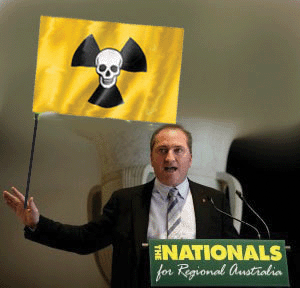
Back in 2013, he made his feelings clear, when he lamented to the Senate the “insane lemming-like desire to go to renewables” in Australia, and questioned what it would do to the national economy.
What is a little surprising is his endorsement of nuclear as a suitable and cheap alternative for new electricity generation in South Australia, as old coal-fired power is retired, when this is precisely the opposite finding arrived at by various recent and significant studies on the subject, not least of all the SA Royal Commission into nuclear power for Australia. Continue reading
From politician to mining executive and back again: how miners control Australian government policy
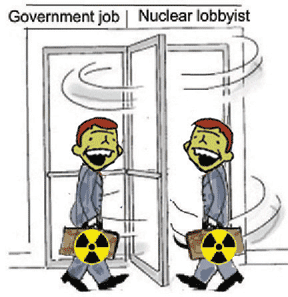 Larissa Waters: Ban donations from mining companies and stop ministers working for them, Larissa Waters, Guardian, 1 Mar 16 “……….The revolving door
Former politicians:
- Former Nationals leader and deputy prime minister John Anderson became chairman of Eastern Star Gas, the company behind the Narrabri Gas Project (which is now owned by Santos) about two years after leaving politics.
- Former Nationals leader and deputy prime minister Mark Vaile became a director and then chairman of Whitehaven coal.
- Former Labor resources minister Martin Ferguson became chairman of the APPEA Advisory Board – in October 2013 – just six months after he stopped being the minister. (The lobbying code of conduct requires an 18-month cooling-off period for ex-ministers).
- Craig Emerson, a former federal Labor trade minister went on to be a consultant for AGL Energy and Santos.
- Former foreign minister Alexander Downer was at one point a registeredlobbyist with Bespoke Approach, which included the likes of Woodside Petroleum, Xstrata, Petrochina and Yancoal among its clients.
- Greg Combet, the federal Labor climate change minister, went on to be a consultant to AGL Energy and Santos.
Political staffers:
- Bill Shorten’s current chief of staff, former Queensland Labor state secretaryCameron Milner, has also worked with Adani. He was director of Milner Strategic Services & Next Level Holdings, which is co-owned by former Liberal staffer David Moore and was reportedly providing advice to Adani on the controversial Adani Carmichael coal project.
- Ben Myers worked for Queensland Gas Company, and went on be Queensland LNP premier Campbell Newman’s chief of staff.
- Mitch Grayson worked as a staffer for Queensland LNP premier Campbell Newman in 2012 and, by early 2013, had joined Santos. Later, he re-joined Premier Newman’s office.
- Stephen Galilee, who worked as chief of staff to Ian Macfarlane as Liberal federal resources minister for three years, and chief of staff to Mike Baird as NSW treasurer and shadow treasurer, went on to be CEO of the NSW Minerals Council.
- Geoff Walsh, former adviser to Labor prime ministers Paul Keating and Bob Hawke, and a former national secretary of the Labor party, was made director of public affairs at BHP in 2007.
- Claire Wilkinson, spent a year as a senior media adviser for Labor resources minister Martin Ferguson before getting a job as a senior external affairs adviser for Royal Dutch Shell. She is now at Total E&P.
- Brad Williams, who spent four years as Mark Vaile’s chief of staff, went on to become the manager for government affairs at Inpex – an oil and gas company that has approval for a $34bn LNG project near Darwin. He is now working in government relations at another mining company, South32.
- Shaughn Morgan worked as adviser to Jeff Shaw, NSW Labor’s attorney general, before becoming the manager of government and external relations at AGL.
- Lisa Harrington was a senior adviser to Mike Baird before becoming the head of government relations at AGL Energy.
- Sarah Macnamara worked at AGL before becoming chief of staff to federal Liberal resources minister Ian Macfarlane, and was resource policy adviser to Liberal PM Tony Abbott.
- Robert Underdown was senior adviser to Liberal resources minister Ian Macfarlane before becoming the manager of the government and public policy group at Santos.
-
- Caroline Hutcherson was senior media adviser to the then Liberal NSW resources minister Chris Hartcher before working as a senior adviser to Santos, and going on to work as a senior adviser to NSW Liberal premier Mike Baird.
- Alexandra Gibson was an adviser to Christopher Pyne, before becoming a policy adviser to APPEA, the oil and gas lobby group.
- Paul Fennelly was the director of the Queensland Department of State Development, Trade and Innovation before becoming the CEO of APPEA.
- Chris Ward was an adviser to the Queensland treasurer and to the consumer affairs minister in the federal Labor government under Kevin Rudd and Julia Gillard, before taking a job as media manager at APPEA.
- Charles Perrottet was senior media adviser to the then Liberal NSW resources minister Chris Hartcher, then an executive of the NSW Liberal party before becoming a government affairs analyst at BP Australia.
- Andrew Humpherson was chief of staff to the then Liberal NSW resources minister Chris Hartcher before working as a consultant to the NSW Minerals Council.
- Emma Browning was a media adviser for the then Liberal NSW resources minister Chris Hartcher before becoming director of government relations at the NSW Minerals Council.
- Brad Emery was a media adviser to federal Liberal minister Peter Dutton before working as director of media and public affairs at the NSW Minerals Council.
- Chris Rath was media and public affairs manager at the NSW Minerals Council before working as an adviser to NSW Liberal resources minister Anthony Roberts.
- Lindsay Hermes was media and communications manager at the NSW Minerals Council before working as an adviser to federal Liberal resources minister Ian Macfarlane. http://www.theguardian.com/commentisfree/2016/mar/01/larissa-waters-ban-donations-from-mining-companies-and-stop-ministers-working-for-them
Australian govt now recognising no true threat from ‘vigilante’ green groups?
No evidence of ‘vigilante’ green groups as government crackdown falls silent, The Age, Nicole Hasham, March 3, 2016 Environment Minister Greg Hunt has failed to justify his government’s claim that “vigilante” green groups are unfairly disrupting major developments in court, a parliamentary committee says, as speculation mounts that another Abbott-era attack on the environment has been quietly abandoned.
It has been almost seven months since the government proposed new laws that would strip conservation groups of the right to launch a legal challenge to environmental approval for large infrastructure and mining projects. It followed a Federal Court bid by a grassroots community group that threw a spanner in the works of Australia’s largest coal project, Adani’s proposed Carmichael mine in central Queensland – a move former prime minister Tony Abbott described as “sabotage”.
Under the proposed changes, the right to mount a court challenge would be limited to people directly affected by a development, such as a landholder.
The move drew public outrage and stalled in the Senate after failing to win support from Labor, the Greens and some crossbenchers.
In an attempt to justify the legislation to a joint parliamentary committee on human rights, Mr Hunt claimed there was “an emerging risk of the [current laws] being used to deliberately disrupt and delay key projects”.
However, a report by the committee, which is evenly split between government and other members, said no evidence was provided about the extent and nature of this threat in cases where there was “no legitimate environmental concern”.
Mr Hunt’s office insisted the proposal “remains government policy”. However the bill is unlikely to pass without changes and Labor says the government has not sought to negotiate amendments.
Mr Butler said it appeared the bill had been “tucked away in the bottom draw in the hope that the Australian public will forget the ridiculous attacks this government has made on the environment in the past two-and-a-half years”.
It follows reports that the Turnbull government has shelved plans to abolish the Clean Energy Finance Corporation, representing another departure from Mr Abbott’s environment policies………http://www.theage.com.au/federal-politics/political-news/no-evidence-of-vigilante-green-groups-as-government-crackdown-falls-silent-20160303-gn9e7c.html
Larissa Waters explains Australia’s revolving door of polluters and politicians
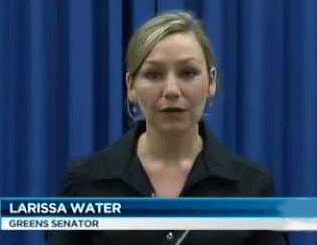 Larissa Waters: Ban donations from mining companies and stop ministers working for them, Larissa Waters, Guardian, 1 Mar 16 The fossil fuel industry’s influence on politics is disproportionate to the contribution the sector makes to employment, writes Senator Larissa Waters In Australian politics, there is a revolving door that swings round and round, fuelled by money and self-interest.
Into it go former politicians and their staffers and out pop even more highly paid mining company executives and fossil fuel lobbyists.
The list of former politicians and staffers who’ve scored cushy positions in the fossil fuel sector is depressingly long – I’ve listed just some of them that I’m aware of below.
The revolving door in part explains why there has never been a coal mine or gas project refused under our federal laws.
The massive political donations, made by this desperate industry trying to cling on through taxpayer subsidies, make up another reason for the tick-and-flick approach.
A very generous $3.7m was tipped into the pockets of the federal Liberal, National and Labor parties in the last three years – and much more when you include donations made at branch and state levels.
Such large amounts of money buys influence, and buys favourable policy settings for this dying industry. For every dollar of their $3.7m contribution to the election warchests of the big parties, they get more than $2,000 back from the taxpayer purse………..
The influence of these pervasive fossil fuel donations on our political system has left the job-rich clean energy industry to deal with the investment uncertainty created by a government ruled by climate dinosaurs.
And despite the change of prime minister and the talk of agility and innovation, the revenue-positive Clean Energy Finance Corporation and the Australian Renewable Energy Agency, which supports cutting-edge, genuinely innovative technology, are both on the Turnbull government’s chopping block.
Now is the time to be increasing public investment in job-rich clean energy to take advantage of the global transition that is already happening, while Australia is missing out.
The revolving door between politicians and the mining lobby needs to be slammed shut and political donations from fossil fuel companies must come to an end.
The Greens have legislation before the Senate to ban donations from fossil fuel companies,………http://www.theguardian.com/commentisfree/2016/mar/01/larissa-waters-ban-donations-from-mining-companies-and-stop-ministers-working-for-them
Resources Minister Josh Frydenberg would not meet Communities from outback sites designated for nuclear waste dump
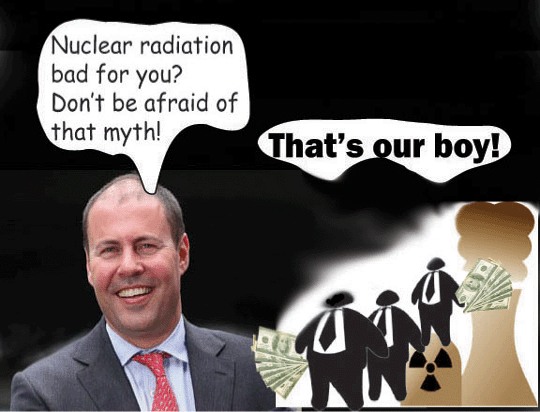 Residents ‘disappointed’ Minister Josh Frydenberg failed to meet them over nuclear waste dump concerns, ABC News, By Leah MacLennan and Natalie Whiting, 1 Mar 16 South Australian residents campaigning against a nuclear waste dump being set up in their communities have taken their fight to Canberra.
The Federal Government has a shortlist of six sites for the facility, which would house medium- and low-level waste, much of it from nuclear medicine. Representatives from all six communities have travelled to Canberra, where they have met with government advisers, but have not been able to meet Resources and Energy Minister Josh Frydenberg.
Three of the proposed sites are in South Australia,with two near the Eyre Peninsula town of Kimba.
Kimba farmer Peter Woolford travelled for two days to get to Canberra and said he was disappointed the Minister did not make time to meet with the group. “I think it’s certainly a lack of respect that’s been shown to a lot of us at the moment,” Mr Woolford said………
The group is concerned about the impact a dump could have on the environment, agriculture and land values. Andyamathanya woman from the Flinders Ranges, Regina MacKenzie, said one of the proposed sites has archaeological and spiritual significance for her people. “What little we have left, let us preserve it. Let us take it for the future,” Ms MacKenzie said.
“We’re fighting for our survival, not only our survival but our spiritual survival as well as Aboriginal people.”
Community consultation on the proposed sites will end on March 11….http://www.abc.net.au/news/2016-03-01/resident-disappointed-josh-frydenberg-failed-meet-nuclear-waste/7211416
Port Augusta community keenly concerned about renewable energy versus nuclear industry developments
Key points:
- Regional job losses and nuclear royal commission findings have some locals worried
- Government minister Geoff Brock says no nuclear decisions have been taken
- Tomato greenhouses using desalinated water are praised for creating local jobs
Hundreds of residents are expected at Port Augusta’s Central Oval complex to quiz visiting Government ministers on a range of issues including jobs.
The regional city is gearing for an imminent closure of Alinta’s Port Augusta power stations.
 Mayor Sam Johnson expressed hope a range of options including hydroponic farming and renewable energy projects would create a secure future for the Port Augusta region.
“There is an area around Port Augusta which is clearly one of the world’s best sites when it comes to wind … also [ideal for] solar virtually from just south of Port Augusta right up to Roxby Downs,” he said.”As you go over towards Whyalla and Cowell, [that area] has been identified for anyone that wants to invest in wave technology.”
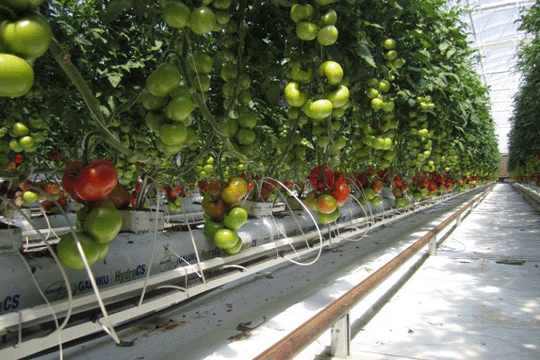
Government ministers are expected to tour Sundrop Farms’ vast tomato greenhouses at Port Augusta, which use desalinated sea water for crop production in the arid region. State Regional Development Minister Geoff Brock praised such ventures at a time of job losses elsewhere. “They will have around 200 people working there full-time and the good thing about this [is] Sundrop have just won an innovative award in Germany on an international scale,” he said.
“They’re going to have the research and development [functions] located at Port Augusta, so this is state of the art.”
Radioactive nuclear waste worries for northern SA residents Nuclear concerns will also be high on the agenda for the public forum and for Cabinet as it meets in the far north region. The Port Augusta Mayor said there was significant local concern about the future prospect of radioactive waste being transported through the northern region.
Mr Johnson said talk of a possible nuclear waste facility for the state’s north was a hot topic among residents. He said if any high-level waste was ever shipped in via Whyalla or Port Pirie, it would also be likely to be transported through Port Augusta.
 “The only way to go … is through Port Augusta, which has a two-lane bridge which has been in need of a little bit of work,” he said.
“There’s effectively no alternative detour access route and should there be an incident that occurs on that bridge then that has significant impacts not just for Port Augusta but also potentially the eco or marine environment.”…….http://www.abc.net.au/news/2016-02-28/jobs-nuclear-waste-port-augusta-forum-country-cabinet/7205842
Australia’s Labor and Liberal Parties unite in dismissing community concerns on nuclear waste dumping
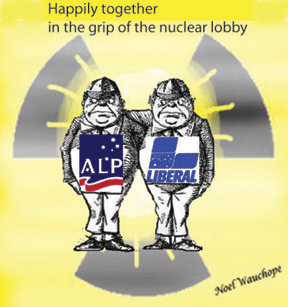 Liberal and Labor vote to ignore waste dump community concerns 22 Feb 2016 | Scott Ludlam The Labor and Libberal parties have voted together against a senate motion acknowledging the community opposition to each of the six locations shortlisted as a site for a nuclear waste dump.
“It’s not as though this motion asked a lot of the government, but for the opposition to cower from it is disappointing and weak,” Australian Greens Deputy Leader and Nuclear Issues Spokesperson Senator Scott Ludlam said today.
“The government is shirking their own process. After months of assurances that they would heed community concerns, they’re desperately trying to downplay those concerns or ignore them altogether.
“We should be investigating all avenues to minimise waste, we should have a genuinely independent inquiry to investigate long-term stewardship options for spent fuel, reprocessing wastes, and other categories of radioactive waste. And we certainly should categorically rule out the importation of international nuclear waste,” Senator Ludlam concluded.
The senate motion opposed by Labor and the Coalition can be viewed here: http://scott-ludlam.greensmps.org.au/content/motions/strong-local-opposition-all-6-proposed-nuclear-waste-dump-sites
Australian Senate passes motion calling on Western Australia to drop Anti-Protest Law
Federal Senate Urges WA Parliament To Drop Anti-Protest Law, New Matilda, By Thom  Mitchell on February 24, 2016 The Federal Senate has passed a motion calling on the West Australian government to abandon “divisive and unnecessary” anti-protest laws which have been strongly condemned by the United Nations.
The motion, introduced by Greens Senator Rachel Siewert and passed on the voices, adds to a long list of institutions and individuals who are concerned about what Colin Barnett’s government is proposing.
Last week three separate United Nations Special Rapporteurs issued a joint statement condemning the anti-protest laws, saying it would have the “chilling affect of silencing dissenters”.
“It would go against Australia’s international obligations under international human rights law, including the rights to freedom of opinion and expression as well as peaceful assembly and association,” the three Special Rapporteurs said.
Hundreds of people protested against the bill at the West Australian Parliament yesterday, and a coalition of more than 80 community organisations, legal centres, and unions have signed an open letter opposing the bill. The Federal Senate this afternoon noted “the important role public protest and free speech have played, and continue to play in a healthy democratic society”. However that role may be dramatically curtailed by the time West Australia’s Parliament adjourns tonight.
The bill is being progressed in the lower house of the state Parliament this afternoon, having moved through the upper house last week.
The legislation will inevitably pass, because the Barnett Government controls both houses, but it faced nearly a year of staunch opposition from Labor and the Greens.
The anti-protest law creates two new criminal offences. Under the first, it will become illegal to physically and intentionally prevent a lawful activity being carried out. And under the second, it will become illegal to possess with the intent of using, or to use a “thing” to prevent a lawful activity.
On top of this extremely broad drafting, there is concern that the onus of proof is reversed for both new offences. The President of the West Australian Law Society, Mathew Keogh has previously said that the bill “may erode fundamental aspects of our criminal justice system”.
“The legislation is so broad that it is almost impossible to say how they may be applied down the track,” he said……..
Senator Siewart takes a different view, arguing “were it not for peaceful protest, awful projects such as James Price Point would have gone ahead”.
“The anti-protest laws that Colin Barnett is pushing through State Parliament attacks free speech, public protest and a healthy democratic society,” Siewart said.
“I urge Colin Barnett to consider the calls of the Senate, as well as the United Nations, and abandon these divisive and unnecessary laws,” she said. https://newmatilda.com/2016/02/24/federal-senate-urges-abandonment-of-anti-protest-law-as-wa-parliament-prepares-to-pass-it/
Australian govt’s new fossil fuel “growth centre” !
Coalition digs deeper into fossil fuels with new “growth centre” http://reneweconomy.com.au/2016/coalition-digs-deeper-into-fossil-fuels-with-new-growth-centre-82395 By Sophie Vorrath on 25 February 2016
 Part of the government’s $248 million Industry Growth Centres Initiative, the Oil, Gas and Energy Resources Growth Centre was unveiled on Wednesday by federal energy minister Josh Frydenberg and minister for innovation and industry, Christopher Pyne. The ministers said they hoped the facility – in which the Turnbull government is investing $15.4 million over four years – would help position Australia’s energy and resources sector for the next wave of investment.
It will be chaired by long-time oil and gas industry executive, Ken Fitzpatrick, with a board and management team drawn from across the oil, gas, coal seam gas, coal and uranium industries.
According to the website, the growth centre’s mission is to reduce industry costs, direct research to industry needs, improve work skills, facilitate partnerships and reduce regulatory burdens.
It will also have a particular focus on improving knowledge and techniques needed to unlock Australia’s marginal gas resources like coal-seam gas – a controversial and high-cost field of exploration and production that AGL Energy recently ruled out of its repertoire to focus, instead, on the “evolution” of the energy industry.
Pyne says the new growth centre – which will be known as National Energy Resources Australia, or NERA – will work closely with researchers from universities and the newly streamlined CSIRO, the irony of which was not lost on critics of the scheme.
“Pouring millions of dollars into research for the fossil fuel industry adds insult to injury for the CSIRO climate scientists who are set to lose their jobs under Malcolm Turnbull and his government’s watch,” said Greens energy spokesman Adam Bandt on Thursday.
“Not only is the Liberal government allowing the CSIRO to cut climate science, it’s making the scientists who don’t lose their job try to breathe life into the dying fossil fuel industries.
“(It) is pouring millions of dollars into a big hole in the ground, which is directly at odds with what the science tells us we must do,” Bandt said.
The Australian Conservation Foundation said the establishment of NERA amounted to another multi-million dollar subsidy to big polluting energy companies. “This money would be better spent extending the funding of the Australian Climate Change Science Program which is due to expire in June this year,” said ACF climate program manager Victoria McKenzie-McHarg.
“The world has changed since the Paris agreement. This budget the government should focus on supporting the science, technology and clean energy innovation of the future, not keep subsidising pollution.”
“Australia’s energy and resources sectors make a vital contribution to the Australian economy,” said Frydenberg in a statement on Thursday. “During this challenging time, the Growth Centre will drive collaboration and innovation, and direct research to industry needs, ultimately improving productivity to ensure Australia remains globally competitive.”
Senate motion today on nuclear waste dumping and community opposition
 22 Feb 16 NOTICE OF MOTION
I give notice that on the next day of sitting I shall move that –
The Senate –
- Notes that
- the Australian Government has initiated a voluntary site selection process for a
national radioactive waste facility; - consecutive Ministers have confirmed that a such a facility would not proceed against the wishes of host communities;
- six sites have been selected for further assessment for shortlisting, including Hill End in New South Wales, Omanama in Queensland, Hale in the Northern Territory, Cortlinye, Pinkawillinie and Barndioota in South Australia;
- strong local opposition clearly exists at all six sites currently under consideration, and;
- Calls on the Government to:
- Acknowledge the opposition and lack of community support at all six sites
- Respect previous commitments on non-imposition and the importance of community consent and remove all six sites from further consideration
- Initiate a genuinely independent inquiry to investigate long-term stewardship options for spent fuel, reprocessing wastes, and other categories of radioactive waste, including drawing on international examples and experience;
- Investigate options for active waste minimisation, including increased use of non-reactor based methods for radioisotope production, and;
- Clearly reaffirm policy and legislative prohibitions on the importation and disposal of international radioactive waste.
SENATOR SCOTT LUDLAM
National Radioactive Waste Management Act overrides any local opposition to nuclear waste dump
 Overriding opposition, Jim Green 21 Feb 16 Bruce Wilson said it would be unlikely that the federal government would override state/territory government opposition to a repository. But that’s exactly what the federal government did the first time round (1998– 2004). And that’s exactly what the federal government did in the NT (2005– 2014). As Wilson acknowledged, the government retains the power to override state/territory governments in order to impose a radioactive waste repository/store. The government should amend the legislation so it no longer has that power.
Wilson said the National Radioactive Waste Management Act is consent-driven ‘world’s best practice’ legislation. In fact, it gives the federal government extraordinary powers to override state/territory governments, councils, communities, Traditional Owners and anyone else.
A government rep said the government gave up on the Muckaty / NT site when it realised that community support was lacking. That’s false. The government knew that a majority of Traditional Owners opposed the proposed repository/store in 2006/07 but only gave up in 2014.
Kimba residents are all too aware of the distress and division that the radioactive waste issue has created in the past six months. Muckaty Traditional Owners endured the same problems for the best part of a decade. “We’ll probably have one of the first good sleeps we’ve had in eight years,” Marlene Bennett said when the government finally stopped its thuggish attempt to impose a radioactive waste repository on an unwilling community.
Julie Bishop, Christopher Pyne, Bill Shorten do their bit for the pro nuclear dance

Opposition Leader Bill Shorten has indicated he is open to the idea as long as there is community support, an economic benefit, and reassurance of environmental protection….
Overall Ms Bishop is optimistic that public opinion is in favour of more engagement with the nuclear fuel cycle………http://www.adelaidenow.com.au/news/south-australia/australia-the-ideal-location-for-nuclear-waste-dump-says-julie-bishop/news-story/c2655249dd4f655d05bf809d6d1795c8
Australia breaches Paris climate agreement, damages economy, by cutting CSIRO climate modelling
 CSIRO climate cuts will breach Paris agreement and cost economy – report
Cuts to climate modelling and measuring research contradict Australia’s pledge to strengthen commitments to climate science, the Climate Council says, Guardian Michael Slezak 21 Feb 16 Cuts to the CSIRO’s climate modelling and measuring research will breach Australia’s obligations under the recent Paris agreement and will result in huge costs to the economy, a report by Australia’s Climate Council has found.
The report adds to a chorus of eminent bodies and individuals criticising the move, which the CSIRO made after almost no consultation with its own scientists or other research institutions.
Earlier in the month it was revealed CSIRO would be cutting up to 350 staff from climate research programs over two years. Over the following weeks, the organisation’s chief executive Larry Marshallexplained that would result in a loss of about 50% of the staff working in climate modelling and measuring.
In a report titled “Flying Blind: Navigating Climate Change without the CSIRO,” the Climate Council said governments and businesses relied on the CSIRO’s climate modelling and measuring work to make billion-dollar decisions and if the cuts went ahead, would be relying on “guesswork”.
The report notes Australia and the rest of the world agreed to strengthen commitments to climate science at COP21 in Paris in December. “The recently announced cuts to climate science mean that Australia has already reneged on one of its obligations under the Paris commitments,” it concludes.
It cites a number of examples of decisions and industries that have relied on the modelling and measuring performed by the CSIRO:………
An open letter signed by more than 2800 scientists raised similar concerns. In response to the chorus of criticisms, Marshall initially said the response was more like religion than science, and compared climate scientists to oil lobbyists in the 1970s…….
It was revealed in Senate estimates that CSIRO executives did not consult with organisations like the Bureau of Meteorology who depend on CSIRO modelling until 24 hours before the cuts were made public.
Even Ken Lee, the director of the division that would take the brunt of the cuts was only told about the cuts four days before they were announced.
The Climate Council, which produced the new report, is a crowd-funded body that seeks to provide authoritative information on climate change to the community. It was created after the Abbott government cut the Climate Commission when it took government in 2013, and seeks to perform the same job. http://www.theguardian.com/environment/2016/feb/22/csiro-climate-cuts-will-breach-paris-agreement-and-cost-economy-report
Nuclear waste dump plan for Kimba – govt ignores relevant standards and codes
 Jim Green 21 Feb 16 Some comments on the 18 Feb 2016 government ‘information session’ in Kimba regarding plans for a radioactive waste repository and above-ground ‘interim’ store for long-lived intermediate-level waste.
 1. The government ignores and breaches relevant standards and codes when it suits.
As a Kimba resident noted at the meeting, the National Health and Medical Research Council’s (NH&MRC) ‘Code of Practice for Near-Surface Disposal of Radioactive Waste in Australia (1992)’ states that “the site for the facility should be located in a region which has no known significant natural resources, including potentially valuable mineral deposits, and which has little or no potential for agriculture or outdoor recreational use”.
So the government has breached the NH&MRC Code of Practice by short-listing the Kimba sites.
Following the so-called clean-up of the Maralinga nuclear test site in the late 1990s, nuclear engineer Alan Parkinson wrote: “The Department has claimed that burial is a safe disposal method consistent with “the [NH&MRC] Code.” This was the first time that the Code had been mentioned in relation to the Maralinga project. When three of the five authors said that it was not applicable (the other two were Commonwealth public servants and would not comment), the Department claimed that it did not have to follow the Code but had chosen to do so. It made this statement despite the fact that not a single requirement of that Code was satisfied.”
(Alan Parkinson, “The Maralinga Rehabilitation Project: Final Report”,
http://www.ippnw.org/pdf/mgs/7-2-parkinson.pdf)
So the government ignores relevant standards and codes when it suits, and the government breaches relevant standards and codes when it suits. Why would anyone trust the government to safely operate a radioactive waste facility in the Kimba region in those circumstances?
Alan Parkinson summarises the problem (keep in mind that he is pro-nuclear and a nuclear engineer): “The disposal of radioactive waste in Australia is ill-considered and irresponsible. Whether it is short-lived waste from Commonwealth facilities, long-lived plutonium waste from an atomic bomb test site on Aboriginal land, or reactor waste from Lucas Heights. The government applies double standards to suit its own agenda; there is no consistency, and little evidence of logic.”
(Alan Parkinson, 2002, ‘Double standards with radioactive waste’, Australasian Science, www.foe.org.au/anti-nuclear/issues/oz/britbombs/clean-up)
1 This month
Chernobyl: The Lost Tapes – A good documentary on Chernobyl on SBS available On Demand for the next 3 weeks– https://www.sbs.com.au/ondemand/tv-program/chernobyl-the-lost-tapes/2352741955560
15 April – Zoom –Nuclear Power is Not the Solution
Apr 15, 2026 01:00 AM in Canberra, Melbourne, Sydney

Join the International Physicians for the Prevention of Nuclear War (IPPNW) on Tuesday, April 14th for a timely webinar exploring the risks associated with nuclear power and challenging the myth that it offers a simple, safe, carbon-free solution to the climate crisis

21 April Webinar: No Nuclear Weapons in Australia
Start: 2026-04-21 18:00:00 UTC Canberra, Melbourne, Sydney (GMT+10:00)
End: 2026-04-21 19:30:00 UTC Canberra, Melbourne, Sydney (GMT+10:00)
Event Type: Virtual
A virtual link will be communicated before the event.
Host Contact Info: australia@icanw.org

of the week – Australians for War Powers Reform (AWPR)
To see nuclear-related stories in greater depth and intensity
 Antinuclear