David Noonan confronts Australia’s politicians with critical unanswered questions on the AUKUS agreement – will they pretend not to hear this?
Federal Labor has failed to inform the SA community of the Health risks they face in imposed N-Subs at Port Adelaide and failed to carry out required nuclear accident Health Impact Studies.
AUKUS aims Australia buy existing US military nuclear reactors in second-hand N-Subs that are to be up to 10-12 years old, loaded with intractable US origin High-Level nuclear wastes that are also weapons usage fissile materials – and remain as Bomb Fuel long after decommissioning.
AUKUS will aim to compulsorily acquire and declare a High-Level nuclear waste dump site, with override of State laws through this Bill, long before the 2032 first purchase of a second-hand US N-Sub.
This Inquiry should respect and investigate the ‘Right to Know’ of affected Communities and Indigenous People facing federal imposed nuclear risks in an AUKUS Agreement requiring HighLevel nuclear waste & nuclear weapons usable fissile material storage and disposal facilities:
It is not credible for the JSCT to over rely on an AUKUS proponent in Defence Minister Marles.
Submission no. 154
Submission to Joint Standing Committee on Treaties Inquiry into the AUKUS 2.0 Agreement:
‘Agreement among the Government of Australia, the Government of the United Kingdom of Great Britain and Northern Ireland, and the Government of the United States of America for Cooperation Related to Naval Nuclear Propulsion’.
Public Input by Mr David J. Noonan B.Sc., M.Env.St.
Independent Environment Campaigner 1 September 2024 https://www.aph.gov.au/Parliamentary_Business/Committees/Joint/Treaties/NuclearPropulsion/Submissions
RE: National Interest, Public Safety and Indigenous Consent are compromised as the Agreement imposes N-Subs risks and untenable AUKUS military High-Level nuclear waste & nuclear weapons usable fissile material on all future generations of Australians
Dear Secretary
This Inquiry into ‘the Agreement’ (Washington, dated 4 August) goes to fundamental matters of public interest through the powers, imprimatur and pathway this AUKUS Agreement provides to an unfolding Federal Labor agenda to impose nuclear powered submarine (N-Subs) risks and nuclear reactor wastes (N-wastes), with serious consequences for Civil Society and Indigenous People in Australia.
Please consider this Public Submission, the Recommendations provided (see p.10-12) and Discussion (p.13).
I also request an opportunity to give Evidence as a Witness in a Hearing (see my Relevant Background, p.14).
This public input focuses on serious N-Sub reactor accident risks and N-waste impacts due to this AUKUS Agreement:
First: N-Subs inherent nuclear reactor accident risks & impacts are imposed on Australian Port communities without their informed consent, while the US is granted Indemnity.
Port communities face Evacuation and persons may require ‘decontamination’ and medical treatment, while children require Stable Iodine Tablets to lessen the risk of Thyroid cancer.
Second: untenable AUKUS military High-Level nuclear waste & nuclear weapons usable fissile materials are recklessly imposed as an uncosted liability on all future generations.
Continue readingThe Public Interest and Indigenous Rights in South Australia must not be compromised by an untenable Defence imposition of AUKUS military High-Level nuclear waste & nuclear weapons usable fissile material on the Woomera Area

David Noonan’s Submission to the Review of the Woomera Prohibited Area Coexistence Framework
30 August 2024
Contents:
Introduction
The public has a ‘Right to Know’ who is targeted for imposed storage of AUKUS N- wastes.
AUKUS N-wastes are a threat to the Rights of the People of SA to decide their own Future.
3 There is an onus on this Woomera Area Review to see it doesn’t add to a sad history of nuclear disrespect for Indigenous Human Rights and Interests in our State.………………….
4 Civil Society faces imposition of an AUKUS military High-Level nuclear waste dump …………………..
5 Defence is already targeting the Woomera Area as a potential region to site an imposed
AUKUS military High-Level nuclear waste dump ……………………………….
6 Indigenous People have a UN recognised Human Right to Say No to AUKUS N-wastes …………………….
7 Is US origin military High-Level nuclear waste from US N-Subs to be dumped at Woomera? ……………………………
8 Multi-billion $ N-waste Costs are ignored while the US gets Indemnity over nuclear risks ……………….
9 Recommendations
10 Discussion
The Review must be transparent on Defence roles for Woomera in AUKUS and in war
11 As to my Relevant Background
The public has a ‘Right to Know’ who is targeted for imposed storage of AUKUS N- wastes.
Minister Marles MP has still not made a promised ‘announcement’, said to be by early 2024, on
a process to manage High-Level nuclear waste and to site a waste disposal facility, he saying
“obviously that facility will be remote from populations” (ABC News 15 March 2023).
The national press (11 August 2023) reports the Woomera rocket range is understood to be the
‘favoured location’ for storage and disposal of submarine nuclear waste (“Woomera looms as
national nuclear waste dump site including for AUKUS submarine high-level waste afr.com).
Political leaders in WA, Qld and Vic have already rejected a High-Level nuclear waste disposal
site. SA’s Premier has so far only said it should go to a ‘remote’ location in the national interest.
This Review must respect the SA public and Traditional Owners rights to full disclosure of
potential nuclear risks and impacts in advance of any decisions, legislation and process to
impose AUKUS N-waste onto community in the Woomera Area or anywhere else in SA.
Defence can-not claim to have a ‘social license’ to operate in the Woomera Area while failing to
inform affected community of the AUKUS nuclear risks, the cultural and environmental impacts,
and socio-economic impacts they may face through siting for AUKUS nuclear waste storage.
Defence has so far denied South Australians their ‘Right to Know’ the nuclear risks they face.
AUKUS N-wastes are a threat to the Rights of the People of SA to decide their own Future.
The Woomera Area Review must understand that South Australians will not accept federal
Labor and Defence undemocratic imposition of AUKUS nuclear wastes in our State.
If federal Labor go ahead with storage of AUKUS nuclear wastes in SA, it will have to over-ride
State Law to impose the dump. AUKUS N-wastes are a threat to the Safety of the People of SA.
Storage and disposal of nuclear wastes compromises the Safety and Welfare of the people of
South Australia, that is why it is prohibited by the Nuclear Waste Storage (Prohibition) Act 2000.
The Reforming Defence Legislation Review also proposes to take on Defence Act powers to
override State legislation to ‘provide certainty’ to Defence roles, operations and facilities. My
input and Recommendations to the Defence Review called for transparency on these issues:
Defence should become transparent over proposed Navy High-Level nuclear waste
disposal, policy, siting process, rights and legal issues. Defence must declare whether
the SA Nuclear Waste Storage (Prohibition) Act 2000 will be respected OR is intended to
be over-ridden to impose a Navy High-Level nuclear waste storage or disposal site on
‘remote’ lands and unwilling community in South Australia. (April 2023, p.7 & Rec 6-7)
I refer the Review’s consideration to “The Politics of Nuclear Waste Disposal: Lessons from
Australia”, a Report by Dr Jim Green and Dimity Hawkins AM, Published by the Asia-Pacific
Leadership Network (January 2024). The Defence AUKUS agenda needs to learn these lessons…………………………………………………………………………………………………….
Recommendations
These Recommendations No.1-5 comprise public interest disclosures that must be required
from Defence to facilitate an informed public Review of the future of the Woomera Area:
Civil Society faces imposition of an AUKUS military High-Level nuclear waste dump
This Review must respect affected Communities and Indigenous People’s ‘Right to Know’ the
Defence imposed nuclear risks they face in intended High-Level nuclear waste & nuclear
weapons usable fissile material storage and disposal facilities.
1.1 The Review must call on Defence to publicly disclose which Australian regions and
Indigenous Peoples are currently under threat of imposed siting and compulsory land
acquisition for an AUKUS High-Level nuclear waste dump, and which – if any – existing Defence
lands are included in the regional short list that is currently being prepared.
1.2 The Review must make Defence become accountable over the future and fate of the
Woomera Area, understood in national media to be a ‘favoured location’ for storage and
disposal of submarine nuclear waste (“Woomera looms as national nuclear waste dump site
including for AUKUS submarine high-level waste afr.com AFR 11 August 2023). Noting the
Woomera Area is currently subject to a Defence ‘Review’: “to ensure it remains fit for purpose
and meets Australia’s national security requirements” – read AUKUS requirements.
1.3 Defence must become publicly accountable and declare its intension to over-ride the SA
Nuclear Waste Storage (Prohibition) Act 2000 through powers in an AUKUS Bill now before
Parliament (Sec.135 “Operation of State and Territory laws”): to impose an AUKUS nuclear
waste dump on outback lands and unwilling community in SA, by decree in federal Regulations.
This Defence agenda to impose nuclear waste storage in SA also involves Defence over-ride of
the SA Environment Protection Act 1993 and over-ride of the SA Aboriginal Heritage Act 1988.
2 Indigenous People have a UN recognised Human Right to Say No to AUKUS N-wastes
The Woomera Area Review must respect the clear views of Indigenous Labor Senator Patrick
Dodson and act in accordance with the Recommendations of a Federal Inquiry Report (Nov
2023) into the UN Declaration on the Rights of Indigenous Peoples, stating:
“the Commonwealth Government ensure its approach to developing legislation and
policy on matters relating to Aboriginal and Torres Strait Islander people be consistent
with the Articles outlined in the UNDRIP”.
2.1 This Review must seek an explanation from the federal Labor Gov as to whether they will
commit to respect and comply with the United Nations Declaration on the Rights of Indigenous
Peoples Article 29 provision of Indigenous Peoples Rights to “Free, Prior and Informed
Consent”, as a Right to Say No, over storage or disposal of hazardous materials on their lands;
OR if Federal Labor intends to claim a sanction to over-ride UNDRIP and to impose a hazardous AUKUS nuclear waste dump against the potential express wishes of Traditional Owners.
3 US origin military High-Level nuclear waste from US N-Subs to be dumped at Woomera?
The Woomera Area Review must recognise the AUKUS Agreement’s proposed importation of US
origin military High-Level nuclear wastes sourced in 10–12-year-old US Navy nuclear reactors in
second hand US Virginia Class N-Subs that will require perpetual storage in Australia:
This Review must seek a full explanation of how Defence Minister Marles claims to be able
to manage a globally unprecedented task in siting and perpetual storage & disposal of
intractable US origin High-Level nuclear wastes from second-hand US Virginia N-Subs.
It is not credible for the Review to overly rely on claims by AUKUS proponent Minister Marles.
3.1 The Review should call on Minister Marles to explain the incompatibility between the AUKUS
Agreement’s transfer of US origin Virginia Class N-Sub nuclear wastes to Australia, effective
importation of nuclear wastes sourced from the US, and the pre AUKUS Federal Labor Policy
commitment in the ALP National Platform (2021, Uranium p.96-98) to oppose overseas waste:
Labor will: 8. d. Remain strongly opposed to the importation and storage of nuclear
waste that is sourced from overseas in Australia.
4 Multi-billion $ N-waste Costs are ignored while the US gets Indemnity over nuclear risks.
There is an onus on this Review to require public $ Costings and an evidentiary basis on:
- the liability $ Cost consequent in required capability and facilities for in perpetuity High-
Level nuclear waste storage and geological waste disposal at the Woomera Area; - whether the $ Cost of High-Level nuclear waste storage and claimed geological disposal
is included in – OR is additional to – the public Cost of AUKUS at approx. A$368 billion.
These unstated, kept secret, liability $ Costs must be in the order of at least A$10’s of billions.
4.1 In the public interest the Review must require a full exposition on the array of nuclear waste
risks the AUKUS Agreement exposes the Woomera Area to and grants the US Indemnity over.
“Indemnity 22. The Agreement requires Australia to indemnify the UK and the US
against any liability, loss, costs, damage, or injury (including third party claims) arising
out of, related to, or resulting from nuclear risks (risks attributable to the radioactive,
toxic, explosive or other hazardous properties of materials) … transferred pursuant to the
Agreement (Article IV(E)).” (In the National Interest Analysis [2024] ATNIA 14)
5. The Review must be transparent on Defence’s roles for Woomera in AUKUS and in war.
Our survival is at stake, ex-Ambassador to China, Ross Garnaut has stated (20 August 2024):
“America would be damaged by war with China over the status of Taiwan, but, short of a
major nuclear exchange debilitating both great powers, its sovereignty would not be at
risk. Australia’s would be. Indeed, I doubt that Australia could survive as a sovereign
entity the isolation from most of Asia that would be likely to follow anything other than a
decisive and quick US victory in a war in which our military was engaged.”
Discussion:
Defence imposed AUKUS military High-Level nuclear waste & nuclear weapons usable fissile
material on all future generations of Australians is untenable and will be opposed at Woomera.
This Review must at least be able to facilitate informed public consideration of the future of the
Woomera Area through required full disclosures from Defence to the set of pre-requisite public
interest Recommendations No.1-5 presented in this public input.
Australian regional communities and Indigenous groups have a ‘Right to Know’ who is being
currently targeted for siting and assessment of an AUKUS nuclear waste storage / dump.
The Review must realise an answer from federal Labor over whether the UNDRIP championed
by Senator Patrick Dodson will be complied with OR over-ridden to impose AUKUS N-wastes.
Three years into AUKUS the failure to respect affected communities ‘Right to Know’ is evidence
Defence is on a seriously wrong track and is undermining trust in governance in Australia.
There is an onus is on this Review to investigate the array of serious nuclear waste risks to be
imposed on Woomera through AUKUS and subject to an Indemnity to favour US interests.
The Review must be transparent on Defence roles for Woomera in AUKUS and in war.
It is arguable that AUKUS and N-Subs bring Australia closer to a devastating war between the
US and China, including likely strikes on Australia with a real risk of nuclear weapons strikes.
For instance, the Review should consider “AUKUS: The worst defence and foreign policy
decision our country has made” by ex-Foreign Affairs Minister Gareth Evans (17 August 2024):
“… Four, the price now being demanded by the US for giving us access to its nuclear
propulsion technology is, it is now becoming ever more clear, extraordinarily high. Not
only the now open-ended expansion of Tindal as a US B52 base; not only the conversion
of Stirling into a major base for a US Indian Ocean fleet, making Perth now join Pine Gap
and the North West Cape – and increasingly likely, Tindal – as a nuclear target …
Australia’s no-holds-barred embrace of AUKUS is more likely than not to prove one
of the worst defence and foreign policy decisions our country has made, not only
putting at profound risk our sovereign independence, but generating more risk than
reward for the very national security it promises to protect.”…………………………………………………………..
Record weeks for renewables blow up Dutton’s nuclear con

The record high of low-cost wind and solar in the grid comes as we are still waiting for the costing on the Coalition’s plan to nationalise the eye-watering cost of seven nuclear plants.
Tim Buckley and Annemarie Jonson, 12 Sept 24, https://www.afr.com/policy/energy-and-climate/record-weeks-for-renewables-blow-up-dutton-s-nuclear-con-20240910-p5k9e4
It’s been a red-letter few weeks for renewables in Australia. In the last week of August, coal dropped below 50 per cent of electricity generation for the first time, as renewables’ share rose to a record high 48.7 per cent, boosted by windy conditions and low grid demand.
In August last year, coal contributed 57 per cent and renewable energy held a 37 per cent share
As in the US and Britain, where zero-emissions supply is burgeoning as fossil fuels’ contribution to generation falls, this threshold moment in Australia symbolises that the inevitable shift to clean energy is well under way and accelerating here and globally. China is deploying 23 gigawatts of renewables every month, four times what Australia does in a year.
The record-high renewable energy penetration in our national electricity market was accompanied by near record-low wholesale prices, averaging $57 per megawatt hour in the last week of August, versus $91 in August last year. This shows that more renewables equals cheaper power.
South Australia is the standard-bearer for Australia’s renewable energy future. In the past seven days, more than 75 per cent of its power use was generated by renewables, at average wholesale prices of just $37 per megawatt hour, way below the $123 average over the past year.
South Australian Energy Minister Tom Koutsantonis has revised the state’s renewables target to 100 per cent by 2027, off the back of the continued rollout of clean energy infrastructure.
This includes three big batteries announced last week under Federal Energy Minister Chris Bowen’s flagship Capacity Investment Scheme – a key driver of investment momentum underpinning the renewables build-out nationally – and major grid developments, with concomitant projected residential and business energy bill savings.
The federal government and its state counterparts are getting on with the job of accelerating our national energy transition, working to deliver the federal 82 per cent renewables by 2030 target and the resulting energy bill relief. The lower house passed the Future Made in Australia Act this week, key to the government’s vision for a renewables-powered economy.
Still no nuclear costings
Meanwhile, the federal Coalition continues to perpetuate its nuclear con, designed to blow up progress on the transformation of our energy system to low-cost, reliable firmed renewables and entrench decades more of volatile, expensive fossil fuel-based power while we wait … and wait.
Next week marks three months since Opposition Leader Peter Dutton and chief nuclear spruiker Ted O’Brien released their fact- and costings-free, one-page nuclear memo, effectively a note proposing to nationalise the eye-watering cost of construction of seven nuclear plants nationwide – in a country with zero history and expertise in nuclear power generation, on a timeframe that, by all expert accounts, will not result in any material delivery before the mid-2040s. We’re still waiting for their budget projections on this excuse for a policy.
Only this week, Dutton was reported as dismissing questions about budget impacts because he didn’t want to overload Australians with too much information, as the government released an ad citing calculation by industry body the Smart Energy Council that the nuclear energy build would cost up to $600 billion and add $1000 annually to household electricity bills.
Our estimate is that the public cost would be a minimum of $100 billion, and this would inevitably be taxpayer-funded because, unlike firmed renewables, into which private capital is increasingly flowing, there is zero investor interest in nuclear in Australia without massive government subsidies, risk transfer and guarantees.
The Coalition plan involves a fiscally negligent impost on consumers already struggling with cost-of-living pressures. The global history of huge cost blowouts and bailouts in every Western economy building nuclear exacerbates this, and should discourage even the most credulous believer.
This alone makes nuclear unviable here. But the clincher is ongoing generation costs feeding into retail prices. The 2024 GenCost report by the CSIRO and the Australian Energy Market Operator prices large-scale nuclear energy at $155 to $252 a megawatt hour. That is double their estimate of the cost of fully firmed renewable energy of $90 to $100, even after factoring in grid transmission, curtailment and battery firming costs.
The renewables surge is the way of the future. We cannot afford to entertain the Coalition’s damaging nuclear distraction.
Any government proposing nuclear here would be robbing Australians three times: once via a $100 billion public capital subsidy for nuclear reactors; again by locking in long-term hyperinflated energy prices; and third to compensate owners of the former coal power sites the Coalition has slated for nuclear, which have already built new clean energy assets, such as batteries onsite.
Progress is building on transforming our grid with superabundant wind and solar energy, distributed across rooftops and utility-scale, backed up by battery storage and modernised transmission. This now needs further acceleration, particularly given looming closures of breakdown-prone, expensive end-of-life coal power clunkers.
The evidence that firmed renewables win on cost is irrefutable, and double-digit annual deflation of battery and solar costs widens this advantage every year. The energy market operator last month confirmed it sees no energy supply reliability gaps to 2030 in the national electricity market, assuming planned renewables projects proceed on time and at the targeted scale.
The renewables surge we have experienced is the way of the future. We cannot afford to entertain the Coalition’s damaging nuclear distraction. For the sake of Australia, let’s hope that as the renewables reality rises, the Coalition’s domestic nuclear pipe dream is consigned to oblivion, where it belongs.
Any government proposing nuclear here would be robbing Australians three times: once via a $100 billion public capital subsidy for nuclear reactors; again by locking in long-term hyperinflated energy prices; and third to compensate owners of the former coal power sites the Coalition has slated for nuclear, which have already built new clean energy assets, such as batteries onsite.
Progress is building on transforming our grid with superabundant wind and solar energy, distributed across rooftops and utility-scale, backed up by battery storage and modernised transmission. This now needs further acceleration, particularly given looming closures of breakdown-prone, expensive end-of-life coal power clunkers.
The evidence that firmed renewables win on cost is irrefutable, and double-digit annual deflation of battery and solar costs widens this advantage every year. The energy market operator last month confirmed it sees no energy supply reliability gaps to 2030 in the national electricity market, assuming planned renewables projects proceed on time and at the targeted scale.
The renewables surge we have experienced is the way of the future. We cannot afford to entertain the Coalition’s damaging nuclear distraction. For the sake of Australia, let’s hope that as the renewables reality rises, the Coalition’s domestic nuclear pipe dream is consigned to oblivion, where it belongs.
Barnaby Joyce — nuclear energy not as cheap as he thinks it is
Independent Australia, By Belinda Jones | 14 September 2024,
Barnaby Joyce jumps on the nuclear energy bandwagon but gets his facts wrong, writes Belinda Jones.
THE COALITION’S NUCLEAR PLANS suffered another setback this week when it revealed that the Member for New England, Barnaby Joyce, got key nuclear facts wrong in a recent debate.
As part of the annual Bush Summit, presented by Gina Rinehart’s Hancock Prospecting and News Corp, Joyce took part in a debate with Chair of the Climate Change Authority, Matt Kean.
The Bush Summit has been an annual event on the bush calendar since 2019, which meets in rural and remote locations around the country and brings together leaders in politics, mining, agriculture and many other fields……………………………………..
Joyce had jumped on the nuclear energy bandwagon a few years earlier and has been there ever since. Joyce’s position was supported in 2019 with a push for an inquiry into the feasibility of nuclear energy by fellow National Keith Pitt and L-NP Senator James McGrath.
In 2022, Coalition donor Rinehart invested $60 million in Arafura Rare Earths. Arafura’s Nolans Project outputs involve exploration and processing of rare earths, including uranium ‘as a minor product’. A minor product that could be very lucrative if Australia had nuclear energy.
According to the Minerals Council of Australia ‘Australia’s uranium reserves are the world’s largest, with around one-third of global resources’, which might explain mining billionaire Rinehart’s embrace of nuclear energy as the transition away from coal continues…………..
Joyce’s passion for nuclear energy does beg the question — why didn’t the Coalition seize the opportunity to begin a transition to nuclear energy while they were in government from 2013 to 2022? One government minister said at the time it was because ‘financially it doesn’t stack up’.
In 2021, Morrison rejected nuclear energy because of a lack of bi-partisan support. Joyce revealed at the recent Bush Summit debate with Matt Kean that the real reason Morrison had rejected nuclear energy was because internal polling said nuclear energy was unpopular, as it still does, not because of a lack of bipartisan support.
During the recent Bush Summit debate, Joyce claimed that France and Finland’s energy is cheaper than Australia’s because they use nuclear energy.
This claim has since been fact-checked by AAP as wrong:
‘The National Party MP was responding to a suggestion that Russia’s invasion of Ukraine in 2022 had driven up power prices globally.
When asked to provide evidence for the claim, Mr Joyce’s office sent AAP FactCheck an article from the Australian Energy Council comparing household electricity prices internationally.
The analysis is from February 3, 2022, which predates the beginning of Russia’s invasion of Ukraine by three weeks.’
Currently, the Coalition has released scant details about their nuclear energy ambitions. In the absence of a clear, comprehensive, costed nuclear energy plan from which Coalition politicians can work, misinformation or disinformation is more likely to spread on the nuclear issue…………………………….
Joyce has become the self-appointed poster boy for groups opposing renewables, particularly the New England, Illawarra and Hunter regions. He will be a panelist on ABC’s Q and A next Monday. Advertised shuttle buses will likely be ferrying anti-renewables activist audience members from Muswellbrook and Port Stephens to the Newcastle studio. Joyce will be at his theatrical best, knowing he has an audience full of supporters………………………… more https://independentaustralia.net/politics/politics-display/barnaby-joyce–nuclear-energy-not-as-cheap-as-he-thinks-it-is,18977
The fake charity AMDA Foundation is exposed by Michael West Media’s Michelle Fahy.

Landforces’ brothers in arms: how a weapons peddler qualified for charitable status . https://www.michaelwest.com.au/landforces-brothers-in-arms-how-a-weapons-peddler-qualified-for-charitable-status/

by Michelle Fahy | Jun 4, 2021 The Coalition is cracking down on charitable organisations. However, the Australian charity promoting arms deals on behalf of weapons makers that profit from humanitarian catastrophes is unlikely to be in the government’s sights. With the weapons expo LandForces wrapping up in Brisbane this week, Michelle Fahy delves into the charity behind LandForces.
The Morrison government has charitable organisations in its sights. It proposes to amend the legislation covering charities so that minor legal misdemeanours by staff or supporters of a charity could be used as a prompt by the regulator for a review of a charity’s privileged status.
St Vincent de Paul told The Saturday Paper that if an activist wearing a Vinnies T-shirt refused to move along when asked by police, Vinnies could risk having its charitable status removed.
Hands Off Our Charities, an alliance of Australian charities, said in a submission to government: “The proposal is a major overreach and the need for further regulation has not been (and in our view cannot be) properly explained.”
Yet consider the activities of a not-for-profit organisation that many Australians will be astounded to discover has gained privileged charitable status – AMDA Foundation Limited (AMDA).
AMDA is the organiser of Land Forces, a biennial military and weapons exhibition running in Brisbane this week showcasing organisations “operating across the full spectrum of land warfare”.
The 600 exhibitors at Land Forces include local and multinational weapons manufacturers and other suppliers to military forces. Event sponsors include global arms corporations such as Boeing, BAE Systems, Lockheed Martin, Rheinmetall, General Dynamics, Saab and Hanwha, along with local companies Electro Optic Systems (EOS), CEA, and NIOA. Representatives from foreign governments and militaries are among the attendees.
Several of AMDA’s arms-maker sponsors have supplied their weaponry to the two countries leading the coalition fighting the war in Yemen – Saudi Arabia and the United Arab Emirates. The UN has been pleading for years for countries to cease supplying weaponry to these countries.
In late 2018, the New York Times published distressing photographs of emaciated children in Yemen dying as a result of aid blockades during the war. The mass starvation continues. UNICEF has said more than 400,000 Yemeni children under five could die preventable deaths this year.
Promoting arms deals on behalf of corporations that have profited from this unspeakable humanitarian catastrophe is the antithesis of what an Australian registered charity should be doing.
But the political posturing evident in the government’s proposed changes is unlikely to result in any repercussions for the AMDA Foundation. Instead, it is ‘activist’ environmental charities that are being targeted by the changes. Which is precisely the problem with such sweeping broad powers. They can be implemented selectively to silence voices the government does not want heard.
“It is the principle that underpins the change that is wrong, regardless of who it is used to target,” said Matt Rose, Economy & Democracy Program Manager at the Australian Conservation Foundation.
Arms trade promotion a “charitable activity”?
AMDA runs numerous major military and weapons-related trade exhibitions around Australia. Its roster of events includes Avalon, a biennial aerospace military and weapons expo in Victoria, next slated for early December 2021. The Indo Pacific Expo, a maritime warfare exhibition, is scheduled for May 2022 in Sydney.
These and other industry trade shows bring together sellers and buyers of weaponry and other military and security-related equipment. “Doing business is easy at Land Forces,” says its website, noting that Land Forces serves as a “powerful promotional and industry engagement forum”.
AMDA says it exists to help the “general community in Australia”. But the general community is not permitted to attend Land Forces nor AMDA’s other arms exhibitions. (The public can attend the Avalon Air Show, a separate public event run at the same time as the Avalon arms expo.)
AMDA is part of a group of companies registered with ACNC which operates around the country. It had 24 full-time-equivalent employees and a gross income in 2020 of $11.7 million – 32% of which came from government grants and 61% from operating revenue. Its income in 2019 was $26.2 million, mostly from operating revenue.
Revolving doors and conflicted interests
The AMDA board is an all-male affair. Its chair is former chief of the Royal Australian Navy, Christopher Ritchie, who joined the board in May 2017 while concurrently sitting on the boards of Lockheed Martin Australia (until 2020) and German naval shipbuilder Luerssen Australia, both multibillion dollar contractors to the Defence Department.
Former chief of army Kenneth Gillespie sits on the AMDA board while also sitting on the board of Naval Group, the French multinational building Australia’s controversial new submarines. Gillespie is also chair of the Australian Strategic Policy Institute (ASPI) Council, the highly influential and supposedly “independent” think tank tasked with providing strategic advice to the government.
ASPI is sponsored by Naval Group as well as other global arms manufacturers including Lockheed Martin, Thales, Saab and Northrop Grumman. ASPI has been vocal in its anti-China ‘war drums’ rhetoric, stoking regional tensions, along with the Asia Pacific arms race.
Why Aged Care Funding Scrutinised, but Military Spending Not
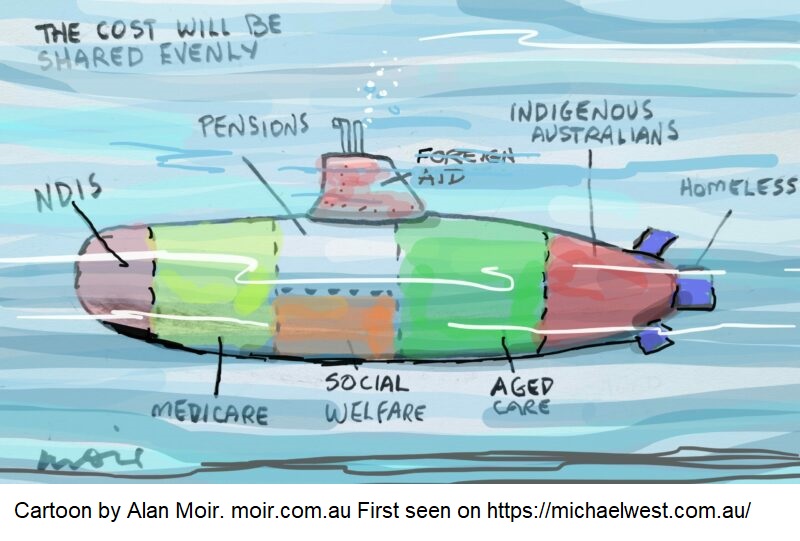
Double Standards in Public Discourse
The double standard in how we view social versus military spending is stark. While aged care is framed as a financial burden that requires higher contributions from individuals, military spending is accepted without the same level of scrutiny. Why is it that investments in the well-being of citizens are questioned while investments in military equipment go ahead without question?
Australia’s government has the financial ability to distribute more resources toward aged care without compromising national defence. By reallocating just, a fraction of the $368 billion earmarked for submarines, the aged care system could receive the necessary funding to address worker shortages, improve infrastructure, and ensure that no senior is left without quality care.
September 13, 2024 by By Denis Hay, The AIM Network
Introduction
Australia is grappling with rising demands for aged care services as its population grows older, leading to a $5.6 billion reform package to improve the sector. Yet, every dollar given to aged care is met with scrutiny, with questions about sustainability and affordability. In stark contrast, military spending – including the $368 billion given for the AUKUS submarine deal – goes ahead with far less financial scrutiny.
Why do we ask, “At what cost?” for aged care, yet overlook the same question for military projects? This article explores these double standards and how Australia’s currency sovereignty means the government has the financial capacity to fund both without compromising one for the other.
Disparities in Spending Scrutiny
I. Aged Care Reforms: Why “At What Cost” is Constantly Asked
A. Key Changes in Aged Care
The Australian government’s $5.6 billion aged care reform package aims to improve services for more than 1.4 million older Australians, helping them stay at home longer before entering institutional care. However, the reforms include higher means-tested contributions from seniors, raising concerns about affordability for lower-income individuals.
B. Challenges in Aged Care Funding
Australia’s aged care sector is facing significant challenges, even with the new reforms:
1. Workforce shortages – More than 300,000 workers are needed to meet the demand for aged care services, but underfunding is making recruitment and retention difficult.
2. Underfunding – The sector is still underfunded despite the reforms, with many care facilities still struggling to provide adequate services.
3. Increased demand – With Australia’s aging population expected to double by 2050, more funds will be needed to provide quality care.
Despite these growing challenges, aged care funding is constantly questioned. The $5.6 billion reform package was seen as necessary, but it came with a public narrative focused on budget concerns and intergenerational equity, suggesting the government is walking a financial tightrope when funding such social services.
C. Public and Political Scrutiny
Aged care spending is consistently subjected to public and political debate, with media coverage often emphasising the “cost to the taxpayer“ and generational fairness. Yet this intense scrutiny stands in stark contrast to how military spending is viewed, where multibillion-dollar defence projects move forward with little financial questioning.
II. Military Spending: An Unquestioned Cost
A. Overview of Military Expenditures
In 2023, Australia committed $368 billion over the next 30 years to the AUKUS submarine program, making it one of the largest military spending commitments in the country’s history. The overall defence budget for 2023-2024 alone reached $50 billion, marking a significant increase compared to previous years.
B. Justifications for Military Spending
Proponents of military spending often argue that defence investments are critical for national security, particularly with the growing military presence of China in the Indo-Pacific region. The AUKUS deal, which promises to deliver nuclear-powered submarines to Australia, has been framed as necessary for safeguarding Australia’s interests in the future.
However, this narrative ignores the question of cost. While $368 billion has been committed for submarines over the next three decades, far less attention is given to the financial opportunity costs – what else could be funded with such vast sums?
C. Limited Scrutiny on Defence Budgets
In contrast to aged care, military expenditures are rarely subject to serious financial scrutiny. Public debate around defence spending typically focuses on national security threats rather than the financial burden of these projects. Even when media coverage addresses military budgets, it rarely compares them to the costs of social services, leaving aged care and defence spending to occupy entirely different public conversations.
Australia’s Currency Sovereignty and the Real Limits…………………………………………………………………………..
Double Standards in Public Discourse
The double standard in how we view social versus military spending is stark. While aged care is framed as a financial burden that requires higher contributions from individuals, military spending is accepted without the same level of scrutiny. Why is it that investments in the well-being of citizens are questioned while investments in military equipment go ahead without question?
…………………………………………………………… Rebalancing Australia’s Budget Priorities
…………………..Australia’s government has the financial ability to distribute more resources toward aged care without compromising national defence. By reallocating just, a fraction of the $368 billion earmarked for submarines, the aged care system could receive the necessary funding to address worker shortages, improve infrastructure, and ensure that no senior is left without quality care. ……………..more https://theaimn.com/why-aged-care-funding-scrutinised-but-military-spending-not/
Submission -Terry Barridge – re new agreement on Naval Nuclear Propulsion – it’s dangerous, the public should vote on it.

Given the significant implications of such a security pact, it is only democratic that the Australian population has a direct say in this matter. I strongly advocate for this issue to be put to a vote, allowing the voices of Australian citizens to be heard and respected in a decision that will impact our nation’s future.
I am writing to express my concerns and opposition to the recent enhancement of the AUKUS agreement,
commonly referred to as AUKUS 2.0, between Australia, the United States, and the United Kingdom. As an
Australian citizen deeply invested in the long-term security and prosperity of our nation, I feel compelled to voice my apprehensions regarding the implications of this agreement
Firstly, I am troubled by the increased proximity of Australian military and security policies to those of the
United States. The United States, in its current geopolitical stance, appears to many as a waning power, facing significant domestic challenges and shifting international allegiances. By binding our security interests so closely with those of the United States through agreements like AUKUS 2.0, Australia risks inheriting the animosities and conflicts that are directed towards America. This alignment not only draws us into the sphere of influence of a nation facing considerable global scrutiny and criticism but also potentially makes Australia a target for those who view the United States unfavorably.
Secondly, the financial burden of AUKUS 2.0 on Australian taxpayers is a major concern. The investment
required to uphold the commitments within this agreement is substantial, and the returns – both in terms of security enhancements and economic benefits – are uncertain. In an era where economic stability is precarious, it is crucial that government expenditures are made with a clear and guaranteed return on investment. The lack of transparency regarding the financial implications and benefits of AUKUS 2.0 is worrying. Australian taxpayers deserve clarity on how their funds are being used and assurances that these expenditures will not only safeguard but also enhance our national interests.
Furthermore, in light of the current “cost of living” crisis, the financial commitment required for this deal
appears especially irresponsible. Many Australians are already struggling to manage everyday expenses, from utility bills to housing costs. Allocating substantial public funds to an uncertain and contentious military agreement further burdens the average citizen without offering immediate or transparent benefits.
Moreover, the United States has a long and contentious history of treating warfare as a business opportunity, enriching a select few at the expense of many. This perspective on military engagement should not be what we aspire to promote in our region. America’s track record in wars across the globe has often led to long-standing conflicts without clear successes, posing significant concerns about the wisdom of aligning our defense policies so closely with their strategies.
Given the significant implications of such a security pact, it is only democratic that the Australian population has a direct say in this matter. I strongly advocate for this issue to be put to a vote, allowing the voices of Australian citizens to be heard and respected in a decision that will impact our nation’s future.
I appreciate your attention to this matter and look forward to your response, outlining how you and your office will address these concerns. https://www.aph.gov.au/Parliamentary_Business/Committees/Joint/Treaties/NuclearPropulsion/Submissions
Submission – Stephen Clendinnen – re new agreement on Naval Nuclear Propulsion – oppose this costly, dangerous, AUKUS mistake
I am writing to you to oppose the proposed AUKUS deal. Here are my reasons.
1 The AUKUS deal will provoke an arms race with China which will destabilise the entire Indo-Pacific region and lead to increased conflict in our region. China is our number one trading partner. Entering an arms race with China will seriously jeopardise our economic interests with potential massive financial costs. Entering an arms race with China will also make us more of a target for attack.
2 The proposal is extremely expensive and we know from past experience that these type of high tech defence projects usually run massively over budget. So it is safe to say that the cost will be well over $386 billion.
3 The AUKUS deal will make us completely subservient to the USA. These submarines will not really be owned by Australia; the US and the UK will retain complete control over crucial technologies that operate the subs. Without active support from the US and the UK the subs will not be able to operate.
4 There are very real risks that the USA will cease to be a functioning democracy in the near future. There are no contingency plans for this eventuality. The USA is complicit in war crimes that Israel is committing through the supply of weapons. Both the Republicans and the Democrats support this policy. By entering the AUKUS agreement Australia will bear legal and moral responsibility for participating in war crimes.
5 These subs will not be built in Australia. There are massive technical and labour force impediments to this ever happening. The promises made about building submarines here are always deliberately vague about the time line.
6 The US cannot make enough of the subs for their own needs and are running way behind schedule. Delivery of submarines to Australia will be massively delayed, however Australia has already started making payments.
7 This is a very expensive proposal that gives all the benefits to the USA and the UK with many of the up front costs being paid by Australia.
8 Australia will be receiving large amounts of nuclear waste from the USA and from the UK as part of this arrangement.
Submission -James Lechte – re new agreement on Naval Nuclear Propulsion it’s not too late to walk back this AUKUS commitment
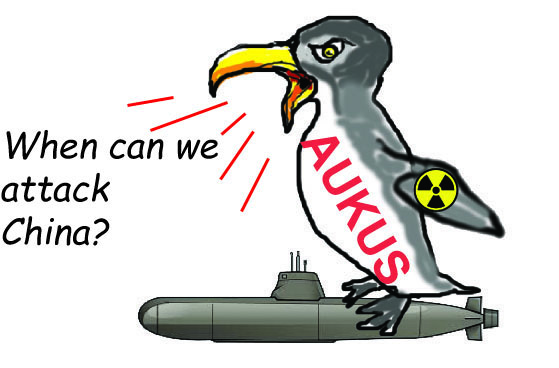
China has never in its long history shown a track record of external aggressiveness.
its highly likely that
rather than China, the US in fact may become more unstable and less trustworthy in the coming
decades, even sooner perhaps.
Submission no 19
This is formal feedback on the proposed AUKUS legislation/policy and related $ 370 billion budget
spend forecast by the current administration for the nuclear submarine acquisition from the US.
As a concerned Aussie citizen, and having had the privilege of living in Switzerland for a number of
years whilst working overseas, it brings new light on recent commentary about the AUKUS deal and
Australia’s position, held by both Labour and the Liberal National party coalition.
My feedback relates to If and how.
IF
The key question Australians deserve further dialogue over is whether or not its in our best interests
to develop a first of a kind, pro US, assertive (some would consider aggressive) defense posture in
the region. Australia is a peaceful country, with a diverse and increasingly multi-cultural pan Asian
background. History tells us that wars are difficult, do not end well nor are in any parties interests.
Whatsmore, history also tells us that deterrence based on increased defence capability is not based
in fact. Rather, strategic ambiguity – where by any threat does not understand which side we would
take in a conflict, may be a better deterrent, as it gives parties options and does not actively signal a
threat.
AUKUS removes this opportunity.
likelihood of getting into conflict. Switzerland is an excellent example here – across their history from
the late 1200s, they have managed to achieve this ambiguity, which has provided them with options
in alliances and support, in different scenarios across history.
China has never in its long history shown a track record of external aggressiveness. On the contrary,
despite them being very assertive in their economic position, often crossing the line, the latest
example from 2020/21 economic stoush with Australia highlights to us that this can be managed and
resolved, by using soft power – diplomacy, patience and dialogue. In any conflict, showdown or
threat, we have already engaged by virtue of the posture that is in question built into AUKUS. We
have no option but to engage, regardless of the rhetoric of Minister Marles suggesting that this is
within our discretion. We effectively have a target on our back.
As Ray Dalio highlights in his essays regarding world power being reshaped, its highly likely that
rather than China, the US in fact may become more unstable and less trustworthy in the coming
decades, even sooner perhaps. If this happens, where does this leave Australias options around
independence, freedom of defence action and strategic ambiguity? If this world power shift continues and China continues its ascendency, why is it in Australias interest to maintain an
aggressive posture with the new world power? This makes no sense.
How
If one is to assume that based on a long history of alliance, collaboration and defence information
and knowledge sharing, Australia should join an AUKUS alliance, then the question is how this can be
achieved whilst maintaining a) as much of the above ambiguity as possible as its in our long term
interests, and b) a commercial strategy that sees Australia have an equitable commercial
relationship, grow its economy, not primarily its debt. It is in Australias interest to have a resilient
and multi faceted defence capability, whilst also managing a careful cost benefit of investing in these
assets. This means that we need to be extremely commercial, shrewd and strategic in the use of
multiple options to fend off potential threats and get the best long term value for money. This
classically is now termed ‘Asymmetric’ capabilities. Aside from the issue of how Australian Defence
experts and the Government choose to renew this capability, one thing is for certain, we need to
develop much better commercial capabilities in this space given the quantum were talking about,
this role would be similar in scale to a Deputy capability group within the ATO or home affairs for
example, dealing with the size of the spend. We should be extremely commercially aggressive on
clawing back spend where budgets have been over run, ultimately meaning that shared success is
the primary objective for all parties.
The deal that has been presented to Australians, with scant detail, suggests that none of the above
has been achieved. On the contrary, it seems like we have entered into an agreement MAXIMISING
our partners interests and not ours. The context that this deal is/has taken shape under is that for
the health and prosperity of the region, it is in many parties (US, Japan, Indo Pacific nations etc)
interests for Australia and other nations to have strategic defence capabilities. It is also important to
note, that in doing so, we are buttressing the US’s defence posture in the region and as such,
deserve special economic consideration, just like the defence consideration (being given access to
these tools). We are also an extension of the US defence capability, given the tools being selected. It
somehow flies in the face of economic reality and pragmatism, that Australia is the sole payer at
what appears a significant premium, where the bulk of the jobs, companies and profits will go
offshore.
This is an enormous let down to Australians. A let down for the significant work and taxpayer dollars
that taxpayers are burdened by. There is no question that a) we have enormous spending
commitments over the coming decades with an ageing population and at best c class infrastructure
across the country and b) declining tax revenues combined with c) an inability to reform the tax
system so that the wealthy, mining and other multinationals pay way too little tax. It is more that
arguable that Australia simply cannot afford this luxury capability, especially until one or many of
these aforementioned planks of our economic condition are improved measurably.
Ultimately, if we have no choice but to contribute to the AUKUS pact, we should do so judiciously,
economically, and carefully. However – its not too late to maintain some form of independence by
walking back commitments to acquire nuclear submarines, which will undoubtedly be well over
budget, technologically inferior and pin us down to be a multi decade minion of the US, as one
recently put it – ‘the 51 state of the United States’. Developing a more conservative stance within
these treaties is in all Australians interests. https://www.aph.gov.au/Parliamentary_Business/Committees/Joint/Treaties/NuclearPropulsion/Submissions
Protecting the Merchants of Death: The Police Effort for Land Forces 2024
September 12, 2024, by: Dr Binoy Kampmark, https://theaimn.com/protecting-the-merchants-of-death-the-police-effort-for-land-forces-2024/—
September 11. Melbourne. The scene: the area between Spencer Street Bridge and the Batman Park–Spencer Street tram stop. Heavily armed police, with glinting face coverings and shields, had seized and blocked the bridge over the course of the morning, preventing all traffic from transiting through it. Behind them stood second tier personnel, lightly armed. Then, barricades, followed by horse mounted police. Holding up the rear: two fire trucks.
In the skies, unmanned drones hovered like black, stationary ravens of menace. But these were not deemed sufficient by Victoria Police. Helicopters kept them company. Surveillance cameras also stood prominently to the north end of the bridge.
Before this assortment of marshalled force was an eclectic gathering of individuals from keffiyeh-swaddled pro-Palestinian activists to drummers kitted out in the Palestinian colours, and any number of theatrical types dressed in the shades and costumery of death. At one point, a chilling Joker figure made an appearance, his outfit and suitcase covered in mock blood. The share stock of chants was readily deployed: “No justice, no peace, no racist police”; “We, the people, will not be silenced. Stop the bombing now, now, now.” Innumerable placards condemning the arms industry and Israel’s war on Gaza also make their appearance.
The purpose of this vast, costly exercise proved elementary and brutal: to defend Land Forces 2024, one of the largest arms fairs in the southern hemisphere, from Disrupt Land Forces, a collective demonised by the Victorian state government as the great unwashed, polluted rebel rousers and anarchists. Much had been made of the potential size of the gathering, with uncritical journalists consuming gobbets of information from police sources keen to justify an operation deemed the largest since the 2000 World Economic Forum. Police officers from regional centres in the state had been called up, and while Chief Commissioner Shane Patton proved tight–lipped on the exact number, an estimate exceeding 1,000 was not refuted. The total cost of the effort: somewhere between A$10 to A$15 million.
It all began as a healthy gathering at the dawn of day, with protestors moving to the Melbourne Convention and Exhibition Centre to picket entry points for those attending Land Forces.
Over time, there was movement between the various entrances to prevent these modern merchants of death from spruiking their merchandise and touting for offers. As Green Left Online noted, “The Victorian Police barricaded the entrance of the Melbourne Convention Centre so protestors marched to the back entrance to disrupt Land Forces whilst attendees are going through security checks.”
In keeping with a variant of Anton Chekhov’s principle, if a loaded gun is placed upon the stage, it is bound to be used. Otherwise, leave it out of the script. A large police presence would hardly be worthwhile without a few cracked skulls, flesh wounds or arrests. Scuffles accordingly broke out with banal predictability. The mounted personnel were also brought out to add a snap of hostility and intimidation to the protestors as they sought to hamper access to the Convention. For all of this, it was the police who left complaining, worried about their safety.
Then came the broader push from the officers to create a zone of exclusion around the building, resulting in the closure of Clarendon Street to the south, up to Batman Park. Efforts were made to push the protests from the convention centre across the bridge towards the park. This was in keeping with the promise by the Chief Commissioner that the MCEC site and its surrounds would be deemed a designated area over the duration of the arms fair from September 11 to 13.
Such designated areas, enabled by the passage of a 2009 law, vests the police with powers to stop and search a person within the zone without a warrant. Anything perceived to be a weapon can be seized, with officers having powers to request that civilians reveal their identity.
Despite such exercisable powers, the relevant legislation imposes a time limit of 12 hours for such areas, something most conspicuously breached by the Commissioner. But as Melbourne Activist Legal Support (MALS) group remarks, the broader criteria outlined in the legislative regime are often not met and constitute a “method of protest control” that impairs “the rights to assembly, association, and political expression” protected by the Victorian Charter of Human Rights and Responsibilities.
The Victorian government had little time for the language of protest. In a stunningly grotesque twist, the Victorian Premier, Jacinta Allan, defended those at the Land Forces conference as legitimate representatives of business engaging in a peaceful enterprise. “Any industry deserves the right to have these sorts of events in a peaceful and respectful way.” If the manufacture, sale and distribution of weapons constitutes a “peaceful and respectful” pursuit, we have disappeared down the rabbit hole with Alice at great speed.
That theme continued with efforts by both Allan and the opposition leader, John Pesutto, to tarnish the efforts by fellow politicians to attend the protest. Both fumed indignantly at the efforts of Greens MP Gabrielle de Vietri to participate, with the premier calling the measure one designed for “divisive political purposes.” The Green MP had a pertinent response: “The community has spoken loud and clear, they don’t want weapons and war profiting to come to our doorstep, and the Victorian Labor government is sponsoring this.”
The absurd, morally inverted spectacle was duly affirmed: a taxpayer funded arms exposition, defended by the taxpayer funded police, used to repel the tax paying protestors keen to promote peace in the face of an industry that thrives on death, mutilation and misery.
Submission- Jennifer Lyons -re new agreement on Naval Nuclear Propulsion- reject AUKUS and its dangerous war games
Enough of the fat cat white men making decisions, that are more about a bunch of boys playing war games than the health and future of our country.
Submission no. 17
Why would Australia spend so much money (our money, the people’s money) on something that
would put us in a volatile position with China?
America and Britain are both crumbling sick societies with useless political leaders, and here we
are following their lead.
Wake up Australia before it is too late. You are killing us, our land and my grandchildren’s future
with stupidity.
Enough of the fat cat white men making decisions, that are more about a bunch of boys playing
war games than the health and future of our country.
I am a concerned citizen and I am begging you to change.
Jennifer Lyons
Submission- G.H. Toll -re new agreement on Naval Nuclear Propulsion- Australia should pursue an independent non aligned foreign policy.
Submission no. 13
I wish to express my complete opposition to the Aukus agreement.
Australia should pursue an independent non aligned foreign policy.
We should not ratify this Aukus agreement and should refuse to continue to humiliate
ourselves by acting as a vassal state for the will of the USA.
Yours sincerely,
Mr G H Toll
Australian citizen and fully emerged Australian elder.
Voter
Melbourne
Submission- Tom Warwick -re new agreement on Naval Nuclear Propulsion- not in the public interest, designed to provoke China
The other partners in the deal take no risk and Australia agrees to accept all the risks and nuclear waste. The government who agreed to this deal is not acting in the interest of the people and is either naive or traitorous
China does not want war with Australia, China has not fired a shot in 40 years, China is trying to prove that their model of prosperity without war is superior and they are successful in doing so.
Submission no 11 https://www.aph.gov.au/Parliamentary_Business/Committees/Joint/Treaties/NuclearPropulsion/Submissions
Dear senate committee, I am a member of the Australian public, and a voter in the electorate of
Durack. I represent myself and the ordinary people of Australia.
The AUKUS deal is not in the interest of the Australian people.
The opportunities forgone by spending an exorbitant $368B on nuclear submarines is enormous, we
have great need in this country for public spending on social programmes, social and commercial
infrastructure.
Not only does the AUKUS spending not produce social good it is harmful and causes risks to
Australian society.
The other partners in the deal take no risk and Australia agrees to accept all the risks and nuclear
waste. The government who agreed to this deal is not acting in the interest of the people and is
either naive or traitorous. If naïve the government should be removed, if traitorous the government
must be prosecuted and severely punished.
The submarines are not defensive in nature, the reason why nuclear has been chosen is that they
can operate far off shore and not in Australian territorial waters to provoke and possibly attack an
adversary far away, and though it has not been explicitly stated China is the object of this
antagonism, our largest trading partner and the nation upon who most of our prosperity depends.
China does not want war with Australia, China has not fired a shot in 40 years, China is trying to
prove that their model of prosperity without war is superior and they are successful in doing so.
AUKUS is not in the public interest
AUKUS has never been demanded by the Australian people
AUKUS places an excessive financial burden in the public purse, funds that could be much
better spent on public infrastructure.
There are no guarantees that Australia will receive anything from AUKUS except public debt,
nuclear waste from Britain and USA and risk.
AUKUS is provocative to our most valuable trading partner
Please cancel AUKUS now.
Submission- Women’s International League for Peace and Freedom, Australia -re new agreement on Naval Nuclear Propulsion.
Submission no. 6 https://www.aph.gov.au/Parliamentary_Business/Committees/Joint/Treaties/NuclearPropulsion/Submissions
In contributing to this inquiry, the WILPF Australia Board will:
- Introduce WILPF Australia.
- Note that the National Interest Analysis is negligent in that it makes no serious attempt to assess
the public interest of the proposed Agreement - Highlight the significant national interest arguments against acceding to the terms of the
agreement which need to be given proper consideration - Recommend a complete rejection of the Agreement as it would serve to implement decisions
previously made without proper consideration of the national interest.
Women’s International League for Peace and Freedom (WILPF)
WILPF Australia is a feminist peace-building organisation of volunteer activists which is anti-war, antiviolence, non-profit, and non-aligned, bringing civil society together to bring about a sustainable peace.
WILPF staff, sections and members have been active and vocal supporters of the international treaty to
ban nuclear weapons for over a decade, following consistent antinuclear organising and advocacy since the dawn of the nuclear age.
The National Interest Analysis is negligent
The National Interest Analysis is predominantly a summary of what appears in the draft Agreement. There
are only two direct references to the National Interest:
- at item 6, referring to allowing access to information and material necessary to implement a
nuclear-powered submarine program - at item 10, referring to the need to achieve the “Optimal Pathway”
Other issues directly relating to the draft Agreement which would appear to be contrary to the National Interest are not considered, including:- Article IV (C) – the agreement commits Australia to paying whatever price the US or the UK wish to
charge for the “Special Nuclear Material contained in complete, welded Power Units, and other
Material as needed for such Naval Nuclear Propulsion Plants”. The statement that the prices with
be “based on the fair market price of comparable enriched uranium” at IV(B) neglects to consider
that there will be no market price for the goods under consideration. Committing Australia to
paying whatever the UK and the US wish to charge is not in the national interest - Article XI – Intellectual Property – commits Australia to handing over any intellectual property and
patents developed by Australians to the US and/or the UK where it derives from “information,
Material, or Equipment” that they have provided. This applies to both Classified and non-Classified
information. Such a sweeping commitment will ensure that Australia does not benefit from any
innovations developed here for fifty years (to 2075). It is clearly not in the National Interest
The cursory nature of the National Interest Analysis does not inspire confidence that the national interest
is foremost in the minds of the government.
More importantly, however, is the fact that the National Interest Statement takes the commitment to
embark on a nuclear-powered submarine program and the so-called “Optimal Pathway” to implement this commitment, as given. Neither of these have been subjected to National Interest assessment. The
legitimacy of all these agreements and arrangements hinges on the legitimacy of that original decision. In
the following section we set out some of the National Interest arguments that WILPF suggests should be
considered.
National Interest arguments that should have been considered
Firstly, for years, WILPF has debunked the myth that militarisation creates a safer world, showing that
more weapons and arms invariably lead to more violence, instability, and gender inequality. The
masculinist, militarist nuclear deal proposed by the US and UK is not in the National Interest because it will not make Australia safer. On the contrary, changing Australia’s defence policy to be more assertive
towards our major trading partner in the region threatens our economic well-being, our regional alliances
and exposes us to additional threats.
Secondly, the National Interest arguments concerning the nuclear waste that will result from
implementing the draft Agreement have not been considered. Disposal of high-level nuclear waste is
globally unprecedented. Our AUKUS ‘partners’, the US and UK, have proven unable to dispose of the waste\ in the 60+ years since first putting nuclear submarines to sea. It seems that the ALP’s National Platform commitment to “remain strongly opposed to the importation and storage of nuclear waste that is sourced from overseas in Australia” is yet to be considered.
Further, storage and disposal of nuclear wastes already compromises the safety and welfare of the people
in South and Western Australia. The fact that nuclear waste storage is prohibited in South Australia by the
SA Nuclear Waste Storage (Prohibition) Act 2000 can potentially be overridden by Federal law. This is
shameful, and could be an abuse of power that undermines Australians’ basic human rights
Thirdly nuclear weaponry and wastes have gendered impacts …………………………….
Fourthly Australia has a long land ongoing legacy of colonialism………………………….
WILPF Australia recommends that the agreement be rejected……………………………..
Give Me Missiles: Gina Rinehart and the Pathologies of Mining
Australian Independent Media, September 6, 2024, by: Dr Binoy Kampmark
Power should only ever be vested carefully, and certainly not in the hands of mining magnate Gina Rinehart, a creature so comically absurd as to warrant immediate dismissal in any respectable commentary. But Australia’s richest human being demands to be noticed, given the insensible influence she continues to exert in press and policy circles. Rants of smelly suggestion become pearls of perfumed wisdom, often occasioned by large amounts of largesse she disgorges on her sycophantic following.
Of late, she has been busy in her narcissistic daftness. At the National Bush Summit held last month, she proved particularly unstoppable. While advertised as a News Corp project backed by a number of Australian corporate heavies (NBN, CommBank, Woolworths and Qantas), Rinehart’s Hancock Prospecting left its unmistakable mark. The events offered a Rinehart Hall of Mirrors, self-reflecting her purchased eminence. She funded much of it; she structured it; she brought the necessary tyrannical boredom in tow.
Before remarking on some of the observations, brief mention should be made about the source of Rinehart’s animal spirit. One should never condemn, outright, the children for the sins of their parents. But she is the exception that proves the rule. Her father, Lang Hancock, was an elemental Australian version of a 20th century conquistador, an enterprising plunderer of the land and equally immune to cultural refinements and such novel notions as human rights. With barbaric clarity and genocidal suggestion, he proposed in 1984 that unassimilated members of the Indigenous populace be given the following treatment: “dope up the water up, so that they were sterile and would breed themselves out in the future and that would solve the problem.”
At the Port Hedland leg of the Bush Summit, Rinehart fantasised about having the military styled comforts offered by the US firm Rafael Advanced Defense Systems in 2011 to Israel. The Iron Dome system, used to shield Israel from rocket attacks, could just as well be deployed in Australia. But instead of focusing on protecting civilians, the batteries would be invaluable in protecting Rinehart’s own mining assets in the Pilbara.
A gorged ego, the country’s perceived welfare and mining interests are all fused in an unsteady mix of justified plunder under the cover of military protection for Hancock Prospecting. “It is no good having the resources of the Pilbara unless we can ship it out. Hence, we should have defence to keep our railways and ports open, and defend our sea lanes.” To the defensive dome could also be added “war drones, and smart sea mines.”
The next target in this spray of barking madness was government regulation – at least the sortthat impairs her extractive practices. With brattish petulance, she even claimed that Canada had treated the mining industry with greater aplomb and respect, despite having, in her words, a “socialist” Prime Minister in the form of Justin Trudeau. Various taxes, such as the Fringe Benefits Tax, should be ditched, given the damage it was doing to Northern Australia………………………………………………………………………………………………………………
…………. All liberal democracies face similar challenges: how to make sure the thick of mind remain distracted and resistant to riot, and keeping the malevolently wealthy contained within the realm of accountability. Rinehart’s commentaries suggest a desire to escape that orbit of accountability, operating as an unelected politician’s wish list. And being unelected is exactly how she likes it. The compromise and messiness of parliamentary debate and the making of policy would prove too excruciating and intolerable. Far better to intimidateelected representatives from afar, using platoons of paid-up lobbyists, consultants and cheering propagandists. When feeling generous, give them a confessional platform to ask forgiveness for their sins.
Were the fossil fuel lobby to be equipped with actual weapons, a coup would not be off the cards. A few Australian prime ministers have already had their heads, politically speaking,served on a platter to the mining industry, with Rinehart’s blessings. A depressing conclusion can thereby be drawn. Australia is a country where rule is exercised by those outside parliament. It’s Rinehart on minerals and metals and the Pentagon and the US military complex on weapons and military bases. What a stupendous state of affairs Australians find themselves in. https://theaimn.com/give-me-missiles-gina-rinehart-and-the-pathologies-of-mining/
1 This month

of the week – Australians for War Powers Reform (AWPR)
To see nuclear-related stories in greater depth and intensity
 Antinuclear