Pushing nuclear power in Queensland would be ‘hugely messy’ for a future Dutton government, constitutional law experts say

By Matt Eaton, 30 Oct 24, https://www.abc.net.au/news/2024-10-30/nuclear-power-plebiscite-peter-dutton-david-crisafulli/104532888
A clear line in the sand divides Queensland’s new Liberal National government from the federal Coalition on the topic of nuclear power.
On Sunday, just hours after the LNP’s state election victory, federal Nationals leader David Littleproud said he expected Queensland to fall into line on nuclear power if the Coalition wins the next federal election.
The Coalition has a plan to roll out nuclear power nationwide should it win office, including two nuclear power plants in Queensland.
Asked again about nuclear power yesterday, Queensland Premier David Crisafulli held firm to the LNP’s position that it will not repeal the state’s nuclear ban.
What does the law say?
Building nuclear reactors is prohibited by the Queensland Nuclear Facilities Prohibition Act 2007.
Constitutional law experts say Queensland ultimately has no legal power to stand in the way of a federal government determined to build nuclear reactors in this state.
Section 109 of the Australian Constitution is unequivocal on such a dispute: “When a law of a State is inconsistent with a law of the Commonwealth, the latter shall prevail, and the former shall, to the extent of the inconsistency, be invalid.”
But University of Queensland electoral law expert Graeme Orr thinks having a federal government override the state in this case would be nowhere near that simple.
On the contrary, he believes it would be “hugely messy”.
“There isn’t a simple precedent for this kind of thing, let alone for it being Liberal-on-Liberal conflict,” Professor Orr said.
“First of all, if the state doesn’t want to give up Crown land, the Commonwealth have to forcibly acquire that Crown land, pay for it and transfer it.”
Professor Orr said he was not opposed to nuclear power.
“My brother is a nuclear physicist in France, there’s benefits to it. But the economics of it are going to be problematic enough.”
‘A political minefield’
Australian National University legal expert Dr Ron Levy said there would be another problem.
Queensland’s nuclear prohibition bill includes a clause that if the relevant Queensland minister believes the Commonwealth is moving to construct a “prohibited nuclear facility”, the minister must seek Queenslanders’ views on the matter.
“If the federal government builds nuclear plants in the state, the people will vote on it,” Dr Levy said.
“That would not be binding — it would, however, be a political minefield for any future Dutton government.”
Professor Orr agrees the plebiscite clause makes the issue “fascinating”.
He said this clause of the Queensland law could not be overridden by the Commonwealth.
“It would have to be undone by the Queensland government, who now have a majority,” he said.
“If the Queensland government did roll over behind the scenes … that becomes like a loss of faith, particularly for the areas that are earmarked for possible nuclear power stations.”
‘No bigger rent-seeking parasite’ than nuclear industry, Matt Kean tells former Coalition colleagues in heated debate
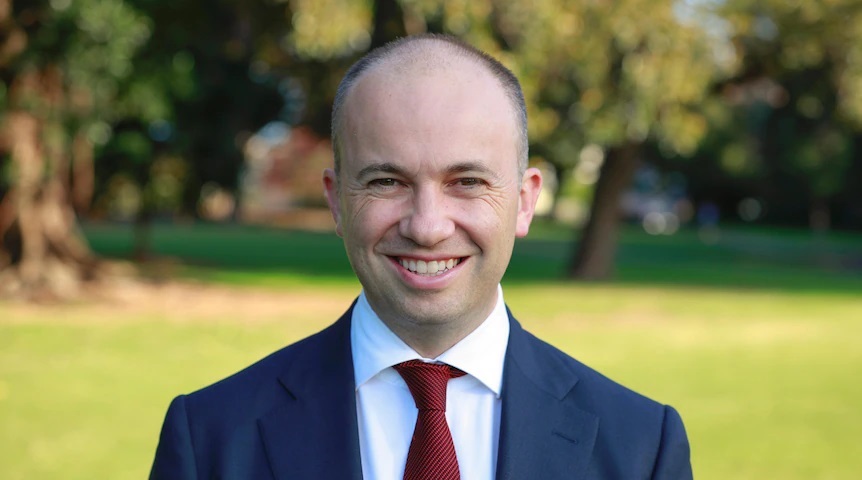
Kean, a former Liberal energy minister turned Climate Change Authority chair, clashes with senators Gerard Rennick and Ross Cadell
Lisa Cox Environment and climate correspondent, Guardian, 4 Nov 24
Matt Kean, the chair of the Climate Change Authority and a former New South Wales Liberal energy minister, has told a parliamentary estimates hearing there is “no bigger rent-seeking parasite than the nuclear industry” during a heated exchange with pro-nuclear senators.
Appearing at estimates for the first time since his appointment in June, Kean argued with the independent senator Gerard Rennick about the cost of nuclear, telling the hearing: “If you want to see who are needing rent-seeking [and] trying to pull one over the eyes of the Australian public, it’s the nuclear industry.”
Kean said the nuclear industry was “there propping up the coal industry, who want to extend their business models, squeeze out the last bits of profit at the expense of Australian consumers”.
He also clashed with the Nationals senator Ross Cadell over analysis by Australia’s science agency CSIRO, which found nuclear was the most expensive form of large-scale energy available, estimating an initial plant could cost more than $16bn.
Kean told Cadell “most rational people do trust the CSIRO, this is the body that developed wifi” and that their advice “is good enough for me and it should be good enough for our political leaders”……………….
He later told Rennick that advice from CSIRO and the Australian Energy Market Operator was that the cheapest way to replace Australia’s ageing electricity infrastructure was with renewables.
The Coalition has proposed seven sites where it says it would eventually replace coal-fired power plants with nuclear plants but not how much this would cost.
Multiple energy analysts have argued nuclear energy would be more expensive than other options and a nuclear industry would not be possible in Australia until after 2040………………………………………..
The chair of the Australian Energy Regulator, Clare Savage, told a parliamentary inquiry she did not believe nuclear plants could be built in time to cover the closure of coal-fired power plants. https://www.theguardian.com/australia-news/2024/nov/04/no-bigger-rent-seeking-parasite-than-nuclear-industry-matt-kean-tells-former-coalition-colleagues-in-heated-debate
Support for nuclear power will evaporate at next election, Chris Bowen predicts
Polling shows that Australians prefer renewables, climate change and energy minister says
Adam Morton Climate and environment editor, https://www.theguardian.com/australia-news/2024/nov/04/nuclear-power-support-australia-election-chris-bowen
Support for nuclear power is likely to evaporate once Australians face a clear choice at the next election and realise the Coalition’s policy would mean relying more on old coal plants and increased risk of blackouts, Chris Bowen says.
The climate change and energy minister said that while some polling had suggested some voters were open to nuclear plants being allowed in Australia surveys had also consistently found they preferred renewable energy.
“Every bit of research I’ve seen, public and private, says that when shown details and given a choice between nuclear and other forms of energy, nuclear fares very, very badly,” he said. “If you look at the popularity of different forms of energy, it’s solar, wind, gas, daylight, coal, nuclear, in that order, every single time.”
Support for nuclear power is likely to evaporate once Australians face a clear choice at the next election and realise the Coalition’s policy would mean relying more on old coal plants and increased risk of blackouts, Chris Bowen says.
The climate change and energy minister said that while some polling had suggested some voters were open to nuclear plants being allowed in Australia surveys had also consistently found they preferred renewable energy.
“Every bit of research I’ve seen, public and private, says that when shown details and given a choice between nuclear and other forms of energy, nuclear fares very, very badly,” he said. “If you look at the popularity of different forms of energy, it’s solar, wind, gas, daylight, coal, nuclear, in that order, every single time.”
The Coalition has named seven sites where it says it would eventually replace coal-fired power plants with nuclear plants but not how much this would cost. Multiple energy analysts argue nuclear energy would be more expensive than other options and a nuclear industry would not be possible in Australia until after 2040. The bulk of the country’s coal plants are scheduled to close in the 2030s.
The opposition has suggested it would limit the rollout of large-scale renewable energy – it has criticised Labor’s goal of 82% renewable energy by 2030 – and bridge the gap by keeping ageing coal plants running longer and using more gas-fired power.
It has not yet said what type of gas plants this means. With nuclear banned, gas is the most expensive form of electricity in the national electricity market and it use is largely restricted to “peaking” power turned on only when needed. It provided less than 3% of electricity in the national grid over the past month.
The chair of the Australian Energy Regulator, Claire Savage, told a parliamentary inquiry she did not believe that nuclear plants could be built in enough time to cover the closure of coal-fired power plants. More than a quarter of the coal power capacity in the national grid was offline on the day she gave evidence due to planned and unplanned outages.
Ontario’s huge nuclear debt and other things Dutton doesn’t understand about cost of electricity

Unfortunately for us, Dutton and O’Brien are also in a hurry. They think they can deliver nuclear power plants far faster than what many experts believe is sensible and what many countries with far more nuclear experience than ourselves have been able to achieve.
Dutton and O’Brien also want to do this via a government-owned utility, instead of via a competitive market.
ReNewEconomy, Tristan Edis, Oct 30, 2024
All of this has left taxpayers with a massive budget and timeframe blow-out. This is what happens when we leave it to politicians in a hurry to hand pick power projects.
It seems our alternative Prime Minister Peter Dutton’s favourite topic is your electricity bill. Given how much he talks about electricity prices, you’d think he might know a fair bit about what makes up your electricity bill, wouldn’t you?
According to Dutton and his Shadow Energy Minister Ted O’Brien, the problem is all about too much renewable energy in the mix. And their answer to the problem is nuclear power, as well as more gas.
According to Peter Dutton, “We can’t continue a situation that Labor has us on of a renewables only policy because, as we know, your power prices are just going to keep going up under this Prime Minister.”
Instead, according to Dutton, “we could be like Ontario, where they’ve got 60 or 70 per cent nuclear in the mix, and they’re paying about a quarter of the price for electricity that we are here in Australia.”
O’Brien, elaborated on this point by saying:
“We will have plenty of time in due course to talk about the costings [for their nuclear plan] once we release them here in the Australian context. But I point to Ontario in Canada, there you have up to 60 per cent of their energy mix in the grid, coming from zero emissions, nuclear energy. Their households pay around about 14 cents kilowatt hour. There are parts in Australia that will be paying up to 56 cents a kilowatt hour from July 1 this year.”
Once you actually delve into these numbers it becomes apparent that O’Brien and Dutton don’t seem know much about electricity costs and pricing.
But even worse, they don’t know how badly Ontario’s taxpayers and electricity consumers were burnt by their utility racking up huge debt building nuclear power plants equal to $70 billion in current day Australian dollars.
Do Dutton and O’Brien understand your electricity bill?
You can actually look up what Ontario households pay for electricity via the Ontario Energy Board’s bill calculator website.
This provides you with a break down on the charges a typical household faces depending on the utility you choose…………………………………………………
But notice there’s also other very significant items in this bill separate to the kilowatt-hour charge? There’s a “delivery” charge which is the cost of paying for the distribution and transmission poles and wires. There’s also regulatory charges and also their sales tax is known as “HST” rather than GST for us.
So the Ontario 14 cents per kilowatt-hour charge that O’Brien and Dutton are referring to covers only the wholesale energy portion of their bill.
In Australia, we pay a majority of the costs of distribution and transmission in our cents per kilowatt-hour charge, in addition to wholesale energy costs, and then we get GST added on top. O’Brien and Dutton don’t seem to have appreciated this important aspect of electricity pricing in this country, which is different to Ontario.
But it actually gets worse.
I went digging on the official government energy retailer comparison sites- www.energymadeeasy.gov.au and www.energycompare.vic.gov.au and I initially couldn’t find a single Australian retailer selling electricity at 56 cents per kilowatt-hour.
This was based on looking at offers based on a single rate tariff. Then I had a brainwave and looked at time-of-use rates. In Queensland and Victoria I still couldn’t find anyone wanting to charge me 56 cents for the peak period.
But eventually I succeeded. Right at the bottom of the EnergyMadeEasy list of retailer offers – which were ordered from best to worst – sat EnergyAustralia as the worst offer, charging 57 cents for the peak period in South Australia (although with a compensating high solar feed-in tariff of 8.5 cents)…………………………………
To help out O’Brien and Dutton, I’ve prepared the table below which provides a proper apples versus apples comparison (as opposed to apples vs peak rate bananas) –[on original ]
…………………………………………….. Ontario’s nuclear debt debacle
Yet this comparison between Ontario and Australia misses a far more important part of the story that O’Brien and Dutton seem to be blissfully ignorant of.
That is the history of the Ontario’s state owned utility – Ontario Hydro – and the unsustainable level of debt that it racked up over the 1980’s and 1990’s as a result of an ambitious nuclear plant construction program that went wrong.
While this cost is no longer apparent in current electricity prices, Ontario businesses and households were stuck with paying back CAD$38.1 billion in debt (over $70 billion in Australian current day dollars) for more than 35 years after their public utility committed its last nuclear reactor to construction in 1981.
So what went wrong?
In anticipation of large growth in electricity demand, over the 1970’s and 1980’s Ontario Hydro committed to construction 12 nuclear reactors with 9,000 MW of generating capacity. To fund the projects the public utility accessed commercial debt markets anticipating that it could comfortably repay this debt from the increased electricity demand it forecast. However, several things went wrong.
The nuclear power stations took far longer to build and were around twice as expensive to build than had been planned
– Interest rates on debt rose to very high levels by historical standards over the 1980’s in order to contain the high levels of inflation that unfolded over the 1970’s and early 1980’s. With the nuclear power stations taking longer than expected to build, interest was accumulating on this debt with far less output from the plants to offset it.
– Lastly, Ontario Hydro’s estimate of large growth in electricity demand didn’t eventuate. A 1977 forecast projected a system peak of 57,000 MW by 1997. Actual peak demand in 1997 was 22,000 MW. This meant that the very large cost and associated debt of the large nuclear expansion had to be recovered from a much smaller volume of electricity sales than it had anticipated, making it much harder to pay off the debt without substantial increases in electricity prices.
……………………………………………………………………………………………………………… “On April 1, 1999, the Ministry of Finance determined that Ontario Hydro’s total debt and other liabilities stood at $38.1 billion, which greatly exceeded the estimated $17.2-billion market value of the assets being transferred to the new entities. The resulting shortfall of $20.9 billion was determined to be “stranded debt,” representing the total debt and other liabilities of Ontario Hydro that could not be serviced in a competitive environment.”
So the CAD$38.1 billion in debt was transferred out of the electricity companies and into a special purpose government entity called the Ontario Electricity Financial Corporation (OEFC). This debt management corporation was given the following revenues to service the debt:
– Both residential and business consumers were required to pay a special “Debt Retirement Charge”. This charge was introduced in 2002 and lasted until 2016 for residential consumers and 2018 for business customers.
– The Ontario government would forgo any corporate income and other taxes owed by the offshoot electricity companies from Ontario Hydro so they could be diverted to the OEFC to pay down debt.
– If the cumulative profits of two of the new state power companies exceeded the $520m annual interest cost on their debts, then this would go towards paying stranded debt rather than dividends to the Ontario government.
None of this is apparent on current bills, but the burden of repaying the nuclear debt left the Ontario government and its taxpayers far poorer than Dutton and O’Brien seem to appreciate.
More things O’Brien doesn’t want to understand about Ontario’s nuclear power program
Dutton and O’Brien like to claim that nuclear power plants last a very long time and so therefore the large upfront cost of these plants isn’t something we should be too worried about………………………..
It’s not as simple as this. Nuclear power plants involve a range of components which are exposed to severe heat and mechanical stress. These all need to be replaced well before you get to 60 years, and such refurbishment comes at a cost.
Ontario’s experience is that refurbishment comes at a very significant cost. Less than 25 years after the Darlington Nuclear Power Plant construction was completed, it needed to commence refurbishment. The total cost? $12.8 billion in Canadian dollars or $14 billion Australian dollars.
This is partly why, even though the original nuclear construction cost debt had been largely paid down and nuclear operating costs are lower than coal or gas plant, Ontario still pays more for its electricity than we do.
This is because the current owner of the nuclear power plants – Ontario Power Generation – operates under regulated return model where the regulator grants them the right to recover these refurbishment costs from electricity consumers.
Are O’Brien and Dutton about to commit to another Snowy 2.0 budget blow-out, but on steroids?
………………………………The problem here is that when you don’t know very much and you’re spending other people’s money, ego can easily cloud your judgement. Don’t get me wrong, ego will often cloud business leaders’ judgement too. But their ability to spend money to feed their ego can only so far before either competitors or shareholders intervene.
Ontario taxpayers on the other hand realised far too late that their public utility, in cahoots with their politicians, were pursuing a nuclear vanity project built upon a poor understanding of the future, and without any competitor to discipline their ego.
Australian taxpayers have seen a similar mistake unfold with the Snowy 2.0 pumped hydro plant whose cost now stands at five times greater than the original expectation, and double what was meant to be a fixed price construction contract.
Snowy 2.0 is a parable of what goes wrong when:
– Politicians rush things leading to inadequate planning and preparation;
– Politicians fail to objectively and thoroughly evaluate alternatives; and
– Politicians fail to employ open and competitive markets to deliver end consumer outcomes.
All of this has left taxpayers with a massive budget and timeframe blow-out. This is what happens when we leave it to politicians in a hurry to hand pick power projects.
Unfortunately for us, Dutton and O’Brien are also in a hurry. They think they can deliver nuclear power plants far faster than what many experts believe is sensible and what many countries with far more nuclear experience than ourselves have been able to achieve. Dutton and O’Brien also want to do this via a government-owned utility, instead of via a competitive market.
While the budget blowout of Snowy 2.0 is bad enough, it pales into comparison with the kind of cost blow-outs that can unfold with nuclear power projects. As an example, the budget for completion of UK’s Hinkley Point C nuclear project now stands at $89.7 billion which is three times higher than what was originally budgeted.
We’ve all seen this movie before, including in Ontario, and it doesn’t end well……………………………………………………………………………………………………………….. more https://reneweconomy.com.au/ontarios-huge-nuclear-debt-and-other-things-dutton-doesnt-understand-about-cost-of-electricity/
Let’s be clear, Peter Dutton’s energy plan is more focused on coal and gas than it is on nuclear power
It seems reasonable to call the Coalition’s policy what it primarily is: a proposal to expand fossil fuels
Adam Morton, 29 Oct 24, https://www.theguardian.com/environment/commentisfree/2024/oct/29/peter-dutton-nuclear-power-plan-coal
Some news you may not have clocked last week while the focus was on important things like a royal tour: 44 of the world’s top climate scientists, including four decorated Australian professors, released an open letter warning that ocean circulation in the Atlantic is at serious risk of collapse sooner than was previously understood.
They said a string of studies suggested the Intergovernmental Panel on Climate Change, a body backed by nearly 200 countries, had greatly underestimated the possibility that the Atlantic meridional overturning circulation – or Amoc, a system of ocean currents that brings heat into the northern Atlantic west of Britain and Ireland – could in the next few decades reach a point at which its breakdown was inevitable. The cause? Rising greenhouse gas emissions.
This is consistent with what climate computer models have forecast but there are signs the circulation is weakening more rapidly than expected. Stefan Rahmstorf, from Germany’s Potsdam Institute, told my colleague Jonathan Watts that by his estimation the risk of crossing a tipping point this century so that collapse was unavoidable had increased from less than 10% to about a 50-50 chance.
If it happens, it will reshape the global climate, including cooling parts of north-western Europe so much that places such as Norway and Scotland could become unliveable while most of the planet gets hotter.
It is estimated that the northern Atlantic could rise an extra half a metre in addition to sea rise caused by global heating. Tropical rainfall would shift south, likely leading to rainforests suffering destructive droughts and regions that are now relatively dry being hit with flooding rains. Humanity would survive but the impact on ecosystems, lives and livelihoods would be, in the words of the 44 scientists, “devastating and irreversible”.
The trajectory of the Amoc echoes a similar story off Antarctica, where scientists have estimated the Southern Ocean overturning circulation, which also affects global weather patterns and ocean temperatures, has slowed by about 30% since the 1990s due to the melting of Antarctic glacial ice. This is also caused by – you guessed it – increasing temperatures linked to CO2 emissions.
I don’t raise this to suggest addressing the climate crisis is hopeless, though climate grief is real and understandable. The global effort to limit the climate emergency is not going well but amid the gloom there are some positive trends. And there is plenty of evidence that much more can be done quickly. As the mantra goes, every action – every fraction of a degree of heating avoided – counts.
I raise the warnings about the Amoc because the reality of what climate scientists are telling us is worth holding up against the energy debate in Australia, and particularly the Coalition’s nuclear power push. Too often it is completely missing from the discussion.
The central point is a familiar one: there are reams of evidence that emissions need to be cut as much and as rapidly as possible. There are other considerations that need to be met – primarily, making the project politically sustainable by ensuring energy reliability, affordability and dealing with social licence concerns. But, at the risk of stating the obvious, the overriding goal, the reason for doing any of this, is to cut pollution.
On this, the Coalition’s position fails spectacularly.
Despite all the oxygen dedicated to talking about it, the nuclear element of the opposition’s plan won’t – can’t – be more than a speculative side issue to the main game of how the country will get electricity over the next couple of decades.
The chair of the Australian Energy Regulator, Clare Savage, said in a parliamentary hearing last week it would take up to a decade to just get a nuclear regulatory framework in place. That takes us to 2035 before building even begins. The evidence from overseas is that construction of a large generator could then take twice as long again (the four nuclear plants completed in western Europe or north America this century took a minimum 18 years from announcement).
Small modular reactors? They still don’t exist, commercially.
But there are parts of the Coalition’s plan where Dutton and his climate change and energy shadow, Ted O’Brien, could move quickly – namely, limiting construction of large-scale renewable energy and instead burning more coal and gas.
Given that this is likely to be the early focus on the ground it seems reasonable to call the Coalition’s plan what it primarily is: a proposal to expand fossil fuels.
It is, of course, not the only pro-fossil fuel plan going around. The Albanese government has approved large expansions of export-focused thermal coal mines. Western Australia’s Labor government is taking the remarkable step of helping out the gas industry by no longer allowing its state Environment Protection Authority to consider climate pollution when it assesses fossil fuel developments.
But federal Labor and the Coalition are not the same on these issues. Labor has introduced some domestic climate policies, most significantly to push the country towards 82% renewable energy by 2030. In nearly every case, the Coalition supports Labor’s pro-fossil fuel plans but opposes its efforts to curtail emissions.
On coal, O’Brien accuses Labor of planning to force plants to shut early. As evidence, he points to an Australian Energy Market Operator “step change” scenario under which about 90% of coal plants will close by 2035. O’Brien says this differs markedly from the closure dates previously announced by coal plant owners.
In reality, the coal closure dates announced by companies generally don’t mean a great deal. Australia’s coal generators are becoming less reliable as they age – 26% of capacity was offline late last week – and experts including Savage have made clear their view is that the coal fleet just cannot last until a nuclear industry would be possible.
On the other, if it is possible to shut 90% of the coal fleet in a decade by accelerating renewable energy and firming support technology – as Aemo and others have suggested it is – then this is clearly good news. And a strange thing to oppose.
And, for all their rhetoric, the Coalition and its backers are yet to produce compelling evidence that explains why they think Aemo is wrong.
- Adam Morton is Guardian Australia’s climate and environment editor
Coalition’s nuclear plan is ‘today’s version of a lump of coal in parliament’, inquiry told.

Renewables advocate tells parliamentary hearing that opposition’s nuclear proposal is a ‘smokescreen’ for burning coal and gas.
Graham Readfearn, 28 Oct 24, Guardian,
The Coalition did not approach Geoscience Australia to ask about the suitability of any of the seven sites where it wants to put nuclear reactors, including asking about risks from earthquakes, a parliamentary hearing was told.
The government called the parliamentary inquiry to scrutinise the Coalition’s proposals to lift the country’s ban on nuclear energy and build taxpayer-funded reactors at seven sites.
One renewables industry figure attacked the Coalition’s plans during the hearing, saying it was a “smokescreen” to continue to burn coal and gas.
During the hearing on Monday, officials from Geoscience Australia said it would probably take two years to carry out comprehensive “geohazard” assessments for each site that would look at risks including earthquakes and tsunamis, and geological formations beneath each site such as groundwater sources and caves…………………………………………..
John Grimes, the chief executive of the Smart Energy Council, an advocacy group representing clean energy businesses, told the inquiry the Coalition’s plan was “all about attacking renewables and boosting fossil fuels”.
Grimes, recalling former prime minister Scott Morrison’s 2017 parliamentary taunt, labelled the proposal “today’s version of a lump of coal in parliament”.
“The motivation [of the Coalition’s plan] is to attack renewables and hold them back,” he said. “Nothing has changed. This is a smokescreen.”
The committee is due to deliver a final report no later than 30 April 2025, which is likely to be before the next general election. https://www.theguardian.com/australia-news/2024/oct/28/peter-dutton-liberal-coalition-nuclear-plan-parliament-inquiry
Atomic power probe shows experts divided on nuclear energy
A probe into atomic power is revealing a deep divide among experts, let alone members of Opposition Leader Peter Dutton’s own party.
Jessica Wang and Joseph Olbrycht-Palmer, news.com.au, 28 Oct 24
The Coaliton’s nuclear plan is both “peak anti-science” and Australia’s only chance of reaching net-zero by 2050, experts have told a committee probing the viability of atomic power in Australia.
Critics and advocates of the Coalition’s nuclear plan made their way to Parliament House on Monday for the house select committee on nuclear energy’s second public hearing.
The Smart Energy Council, which has estimated the plan’s cost as high as $600bn, said the Coalition’s push for atomic power was driven by “anti-renewable” ideology rather than science.
The peak body’s chief executive John Grimes accused Opposition Leader Peter Dutton of trying to frame the energy debate in masculinity.
“It’s all about attacking renewables and boosting fossil fuels,” Mr Grimes told the committee.
“That’s why Mr Dutton tells us that there are two types of electrons: the strong manly man electrons from coal and gas and nuclear and the tepid, insipid, weak electrons from renewable energy.
“The only problem is an electron is an electron in physics. There is no difference at all.
“This is peak anti-science, tin foil hat brigade, poppycock.”
He said nuclear power was “a pinnacle of human engineering” but it was not “the answer for Australia”.
……………………………..Winfield said household bills were kept artificially low under the Ontario model, despite the high cost of refurbishing ageing nuclear facilities.
“There’s a legacy of that still in the system that we are effectively subsidising electricity bills to the tune of about $C7.3 billion a year out of general revenues. That constitutes most of the provincial deficit; that’s money that otherwise could be going on schools and hospitals.”
He said that it was key to decarbonisation of countries “in the extreme north or south of the globe”, but with renewables powering up to 40 per cent of Australia’s grid, changing course did not stack up.
“We’re saying that for Australia, in the Australian context … where we have the best solar and wind resources in the world, where we have so much land you can almost not give it away … renewable energy transition is the lowest cost path to getting to low power bills, a highly reliable engineering system and the right environmental outcomes in environmental outcomes that the Australian government has signed up to internationally.
“So, it is vital that renewables plus the energy storage road map not only continue but be accelerated because that is the future. That is the answer for Australia.”
………………………………………………………………. Last week, the committee heard from Australian Energy Regulator (AER) chair Clare Savage, who said “nuclear may well have a role to play” in meeting Australia’s energy needs, but it would take a long time.
Ms Savage said the red tape associated with getting nuclear off the ground could take “eight to 10 years for a regulatory framework”.
Works to build the nuclear reactors would not be able to start until that framework was in place, she said.
Build times can vary, but recent projects overseas put it at a little north of 10 years.
Ms Savage’s comments cast serious doubt on the Coalition’s claim that it could have small modular reactors up and running by 2035 or larger reactors by 2037.
One thing most experts agree on, whether they be independent or part of government agencies, is that Australia’s fleet of coal-fired power plants only have about a decade of operational life left.
DUTTON ‘RESPECTS’ ANTI-NUCLEAR LNP PREMIER
Mr Dutton said he would continue to convince “sensible premiers” on the Coalition nuclear plan, with newly installed Queensland Liberal National Party premier David Crisafulli committing to his anti-nuclear push.
Speaking on Monday, Mr Dutton appeared unfazed by the divide between the state and federal Coalition, with the election pledge to build seven reactors by 2050, including the first two to come online between 2035-37……………………………………. https://www.news.com.au/national/queensland/politics/peter-dutton-says-he-respects-new-qld-lnp-premiers-antinuclear-stance/news-story/2e6d5000a0e988ecb504f1600ff20825—
Select Committee on Nuclear Energy – Submissions close 15 November.

https://www.aph.gov.au/Parliamentary_Business/Committees/House/Select_Committee_on_Nuclear_Energy
The House Select Committee on Nuclear Energy was established by a resolution of appointment that passed the House of Representatives on 10 October 2024.
The Committee will inquire into matters referred to in the resolution of appointment and is required to present its final report by no later than 30 April 2025. The Committee will cease to exist upon presenting its final report.
Select Committee on Nuclear Energy
We will inquire into and report on the consideration of nuclear power generation, including deployment of small modular reactors, in Australia, including:
 deployment timeframes;
fuel supply, and transport of fuel;
uranium enrichment capability;
waste management, transport and storage;
water use and impacts on other water uses;
relevant energy infrastructure capability, including brownfield sites and transmission lines;
Federal, state, territory and local government legal and policy frameworks;
risk management for natural disasters or any other safety concerns;
potential share of total energy system mix;
necessary land acquisition;
costs of deploying, operating and maintaining nuclear power stations;
the impact of the deployment, operation and maintenance of nuclear power stations on electricity affordability; and
any other relevant matter.
Delay-mongers have latched on to nuclear
Australia should be at the front of the queue, positioning our nation as a renewable energy superpower and an economic powerhouse for decades to come.
The delay-mongers have latched on to nuclear power, despite the overwhelming evidence that it can only drive up energy bills, can only be more expensive, and can only take too long to build in a cost-of-living crisis.
I suspect that even those arguing for nuclear don’t believe that we’ll ever build one of these reactors in Australia, and certainly not in time to help manage the exit of coal from the system.
Matt Kean, Former NSW treasurer, 22 Oct 24, https://www.theguardian.com/australia-news/2024/oct/22/matt-kean-fantasy-coalition-energy-policy-coal-nuclear-power?fbclid=IwY2xjawGFBTtleHRuA2FlbQIxMQABHZOLw35JiI_0LOuO7ud0lCdaODH8ws-XTXtm6BjH-aQRT5FT8Ac8UKeUTQ_aem_yTUmsY_z33BOm66Ol9MkEA
Capital markets and the private sector have often been ahead of the curve in the debate over climate change.
They were prepared to discard the nonsense that action on climate change represented a choice between our environment and our economy.
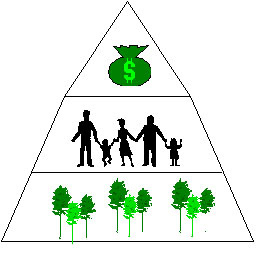
(True economics – the economy is based on a healthy environment)

(False economics – profit is the first priority – consider the environment only later)
That’s because the forces reshaping the global economy are clear, the cost of low emissions technology is coming down, and the appetite of investors to direct capital towards it is surging.
These trends are now embedded and have forever shifted the dynamics of climate policy. Consider the sheer weight of capital now pouring into the low-carbon energy transition right across the world.
It means an economic arms race to capture the next generation of investment, resource projects, exports, jobs and innovation will continue to explode right across the world.
Australia should be at the front of the queue, positioning our nation as a renewable energy superpower and an economic powerhouse for decades to come.
We should have the confidence to be bold, knowing there is a clear capacity to attract the finance for the technology and innovation needed to reduce emissions.
Our track record tells us so we have continued to build the policy architecture needed to give comfort to investors, and we can tell a story of meaningful progress against our emissions reduction goals towards a contemporary clean-energy system, and in pursuit of the next wave of ideas to sustain our success.
The integrated system plan gives us a clear national blueprint for the generation, storage and transmission infrastructure needed to sustain a reliable, secure and affordable national electricity market.
It will also depend on enabling initiatives such as the capacity investment scheme, which is revolutionising our ability to encourage new investment in dispatchable renewable energy, generation and storage.
The scale of the scheme is simply mammoth, with a target of 32 gigawatts of new capacity, comprising 23 gigawatts of renewable capacity and 9 gigawatts of clean, dispatchable capacity.
In total, it’s expected to drive $67 billion worth of investment continuing to inject renewables into the system, backed by storage and firming technology.
It is the best, most affordable way to replace capacity lost as coal-fired power stations exit the system.
That’s the advice of the CSIRO. That’s the advice of the Australian Energy Market Operator, and it’s one of the major assumptions that underpins the recently released sector pathways review produced by the Climate Change Authority, which I’m now pleased to chair.
Perhaps the biggest cost of nuclear is time.
That’s because mature and available technology allows us to step up the pace of change, by building on the rise in clean energy that has seen the transformation of our grid.
More than 40 per cent of the nation’s electricity is now generated by renewables.
We need to consider this simple fact: as renewables have poured into the system, the emissions intensity of the national electricity market, the nation’s largest grid, has dropped by more than a third, and sectoral emissions can be dramatically slashed further if we continue to invest in new solar, wind, storage and firming solutions.
We know that as much as 90 per cent of the coal-fired power that has underpinned our economy is coming to the end of its technical life by 2035. It’s an ageing technology that is already adding to price spikes and reducing reliability for households and businesses.
And if we continue to depend on it, we accelerate the rundown of the limited carbon budget available to us, we would fall behind the curve on our near-term emissions reduction targets, and we would face the prospect of irreversible damage to our environment, our economy and our way of life.
We simply can’t afford to wait and hope that bigger breakthroughs are over the horizon, and perhaps more importantly, we can’t pander to those vested interests and self-serving groups who want to delay clean and cheap energy, seemingly to benefit their own careers or their profits at the expense of the environment, the economy and our people.
Recently, for example, an illiberal drive to intervene in the market-led energy transition has been elevated from internet chat rooms and lobby groups to the national stage.
The delay-mongers have latched on to nuclear power, despite the overwhelming evidence that it can only drive up energy bills, can only be more expensive, and can only take too long to build in a cost-of-living crisis.
I suspect that even those arguing for nuclear don’t believe we’ll ever build one of these reactors in Australia, and certainly not in time to help manage the exit of coal from the system.
But they get their grabs up in the news, while the public get the growing energy bills that they can’t afford to pay.
Perhaps the biggest cost of nuclear is time. It is precious time that neither our economy nor our environment can afford, and it will once again plunge Australia back into indecision and delay.
A regime in flux lacks the stability and durability that investors need. Sensitivities will be further heightened when you add concepts that crowd out investment, forcing government-owned entities to fund, own and develop technology where Australia currently lacks capacity and that is arguably more expensive.
We don’t have the luxury of placing that bet, and that’s why, as chair of the Climate Change Authority, I will always place a premium on science, evidence, engineering and economics; that’s how we build a modern energy system.
We need to continue to give households and businesses the affordable and reliable energy they want. And it’s how we continue to harness the wall of capital washing across the world to create a clean, strong future that lifts our prosperity and protects our way of life for decades ahead.
There is a lot to do, but we can do that. We can get there and deliver cheaper, reliable energy for everyone across the country, and set our country up for a stronger and more prosperous future than any generation of Australians has ever seen. That’s the chance. Let’s grab it.
Matt Kean is the former treasurer and energy minister of NSW. He now chairs the Climate Change Authority. This is an edited extract of his speech at The Australian Financial Review’s Energy & Climate Summit.
Nuclear too slow to replace coal by 2035
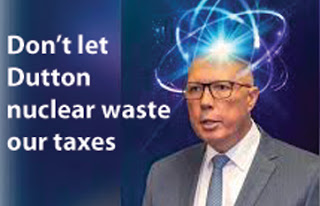
Financial Review, John Kehoe and Jenny Wiggins, 21 Oct 24
Energy executives say the development of nuclear power in Australia will be too slow to replace ageing coal-fired power plants in the next decade, as Climate Change Authority chairman Matt Kean accuses “delay-mongers” of latching onto the idea for a publicity stunt.
But beyond the urgent phase of the energy transition to renewables and gas-fired power, some executives and the energy market operator said nuclear should be left on the table as a potential energy source for Australia in the long term to keep up with rising power demand from consumers and businesses.
Opposition Leader Peter Dutton has pledged to build seven government-owned nuclear power stations by 2050 to meet Australia’s net zero emissions commitment. Under the high-level proposal, the first small modular reactor would arrive in 2035, although energy experts say this is overly ambitious and it would likely take years longer.
Australian Energy Market Operator chief executive Daniel Westerman said, “urgent and sustained investment” in renewables generation was needed to replace retiring coal-fired power stations, as well as investment in storage and transmission lines over the next 10 years.
“That is not a time frame in which nuclear will be available,” Mr Westerman told The Australian Financial Review Climate and Energy Summit on Monday……………………………………………………….
Mr Kean, a former NSW Liberal treasurer who now leads the federal government’s independent climate change advisory body, will tell the Summit on Tuesday that there was overwhelming evidence that nuclear would increase energy bills and take too long to build.
“I suspect that even those arguing for nuclear don’t believe we’ll ever build one of these reactors in Australia … and certainly not in time to help manage the exit of coal from the system – but they get their grabs in the news, while the public will get growing energy bills they can’t afford to pay,” Mr Kean will say, according to his speaking notes.
Origin Energy chief executive Frank Calabria said that to achieve the Albanese government’s 82 per cent renewable electricity target by 2030, a massive 32 gigawatts of generation needed to be brought online. “You’ll need to double that again in 2040,” Mr Calabria said.
Origin has examined small modular nuclear reactors but believes it is still early days for the technology, Mr Calabria said.
“Commercialisation and cost and scale are at least a decade away … it’s certainly into the 2030s.”
While Origin considered small reactors could be a potential future source of energy, it wouldn’t make a “single bet”, he said.
“We’re certainly not discounting it. I just wouldn’t overstate its role right today.”
The large-scale nuclear reactors promoted by the Coalition have “varying costs” and are also at least a decade away, he added.
“That for us feels much more difficult because we have got an influx of renewable energy that is going to be into the system and therefore is it going to intersect alongside that well?”
Origin is sticking with its revised target of August 2027 for shutting its Eraring coal power station in Lake Macquarie and is “agnostic” over what kind of energy replaces coal, Mr Calabria said.
The Origin boss acknowledged it would be difficult to create a reliable power system to replace coal, but expects solar panels to be installed on rooftops faster than expected.
Gas-fired power would also be needed as back-up power to solar, wind and battery-stored energy, he said.
The Albanese government is scrambling to meet an international commitment to reduce carbon emissions by 43 per cent on 2005 levels by 2030, en route to a net zero goal by 2050.
Renewable energy including solar, wind, battery storage and pumped hydro forms the backbone of the government’s plan, with gas-peaking plants backing up the intermittent renewables.
NSW Climate and Energy Minister Penny Sharpe said the key challenge for nuclear was that coal will be phased out before nuclear is ready. “Nuclear just doesn’t fit that time frame,” she told the Summit. “Our challenge is to manage the [coal] exit as quickly as we can, while replacing it with renewables.”
……………………………………. Squadron Energy chief executive Rob Wheals said the whole nuclear debate was a distraction.
“It seems like a tactic of kicking the can down the road and actually not focusing on the technologies that we know are available and are available in the time frame that we’ve got,” he said.
Political fight
Federal Climate Change and Energy Minister Chris Bowen panned the Coalition’s idea of starting a nuclear energy industry from scratch.
“The real danger in the Coalition’s nuclear scheme is the uncertainty it deliberately creates in relation to our grid. Investment is vital,” he said…………………………………….. https://www.afr.com/policy/energy-and-climate/nuclear-too-slow-to-replace-coal-by-2035-20241021-p5kjzg
Inside the room that loves Nuclear Ted

The Opposition’s fission frontman Ted O’Brien was in his element at Australia’s premier pro-nuclear conference last week, feeling the love from a hot-to-trot audience swallowing every word from a smooth-talking messiah . Freelance Journalist Murray Hogarth was there and imbibed the vibe — but not the glow-in-the-dark Kool-Aid.
by MURRAY HOGARTH., https://thepolitics.com.au/inside-the-rooms-that-love-nuclear-ted/?fbclid=IwY2xjawF8E1hleHRuA2FlbQIxMQABHeNqjz022ugJko-9VboOWN2DC-94pA7Y5ifdvNwZFTZ_YaikPJPpvYhkNw_aem_dxORDyGfCPnc4VD223hWhA 16 Oct 24
Ted O’Brien MP was confecting political outrage, playing to Australia’s ultimate pro-nuclear audience in Sydney last Friday. The day before, the Albanese Labor government had sprung a pre-election surprise on the Liberal-National coalition, and O’Brien as its nuclear torchbearer, when it forced through a tactical parliamentary inquiry into nuclear energy.
“It was hard not to be a little bit suspicious, not just because there’d been zero engagement on this,” he confided, eager to share his take on the backstory to how the Coalition had been politically blindsided and outmuscled.
O’Brien was in high dudgeon about the inquiry’s terms of reference, but mainly about its committee having four Labor government members versus two from the Coalition, a two-to-one ratio, plus one from the crossbench, a teal. That’s a clear government majority, so official committee reports will say what it wants, which is realpolitik at work. But to O’Brien it was a desperate government “very clearly trying to weaponise the parliamentary system to kill the idea that Australia should include nuclear energy as part of its mix”.
Of course, hypocrisy is quite the thing in politics. It turns out the last parliamentary inquiry into nuclear energy in 2019, which was chaired by O’Brien, and which supported partial lifting of Australia’s long-standing nuclear energy ban, was even more dominated by the then Coalition government — 5-2 also plus a single teal.
The Coalition under PM Scott Morrison then squibbed it on running a go-nuclear policy at the 2022 elections, which it lost to Labor. Yet, as the opposition, it now expects a Labor government to overturn the nuclear ban that the Coalition introduced in 1998, under the conservative leadership of PM John Howard.
Nothing for O’Brien to melt down over here. But don’t let facts get in the way of a convenient story.
Smug, glib, righteous and on the Right
O’Brien approaches a speaking platform with a radioactive level of smugness and glibness that makes me feel queasy to the core. Perhaps that’s because I’ve been overexposed to him in the past six months as I’ve tracked the emerging nuclear story: three live speeches and seemingly endless videos and television interviews. His own productions. 7.30. Insiders. Four Corners. Sky News on loop.
A committed spruiker, in an Americanised preachy showman kind of way, the ambitious O’Brien is both righteous and on the Right. To paraphrase him: nuclear is vital to our future energy mix and to achieving net zero. Labor’s 100% renewables can’t do it. Blah blah blah. Oh, and we’ll make public the costs and other key details “in due course”.
Last Friday, in contrast to my gut feeling, there was love vibing in the room when O’Brien returned to his people at Australia’s premier pro-nuclear event, the annual conference of the Australian Nuclear Association (ANA). Among this fraternity, he’s Nuclear Ted, the reactor-evangelising federal Liberal from Queensland who’s putting the fission back into the politics of energy in Australia, with a touch of frisson too for this audience.
It’s a pro-nuke constituency that has been in the Australian political wilderness seems like forever, but at least since the 1960s. Now a smooth-talking messiah has emerged, vowing to lead it to its promised land: a nuclear Australia.
If you’ve been thinking it’s mainly renewables-hating, climate-denying National Party political malcontents who are behind the Coalition’s plans — which include prolonging coal and expanding gas generation — think again.
Friends in high places
ANA conferences are where corporate big nuke and its international and local lobbyists meet Australia’s nuclear true believers. Weirdly, however, this gathering of 200 or so delegates has the Australian government as its long-standing principal sponsor. That’s right. The Albanese Labor government is sponsoring a platform for O’Brien, its would-be nuclear energy policy nemesis, to attack the government. And unsurprisingly he keeps coming back to do just that. It’s almost like the government wants O’Brien out there, talking his talk.
The government’s sponsorship comes via its main nuclear advisory agency, the Australian Nuclear Science and Technology Organisation (ANSTO), which operates the nation’s only reactor, a research and medical isotopes facility at Lucas Heights in Sydney. The other event sponsors include the Canadian nuclear engineering powerhouse AtkinsRéalis, and the Australian lobbying outfit SMR Nuclear Technologies.
ANSTO definitely isn’t meant to play politics, challenge policies of the government of the day, or otherwise advocate for nuclear energy. So it’s worth pointing out that the ANA’s president, and the conference’s main host, Dr Mark Ho, is a senior ANSTO scientist in his day job, and the event’s key organiser, Dr John Harries, is former ANSTO, as are many in the ANA orbit.
Beyond the conference, the ANA is increasingly involved in promoting nuclear energy. It and Ho helped organise the Navigating Nuclear forum in May, where O’Brien was a surprise guest speaker after it had been promoted as being “free of politics”.
The Nuclear for Australia campaign thanked Ho for joining its first public event in Lithgow — one of the Coalition’s targeted communities for nuclear reactors — several weeks ago, and Ho was billed as a speaker at an ultra-conservative, anti-renewables, pro-nuclear forum in western Sydney in September where Barnaby Joyce was a pop-up speaker, as previously reported in The Politics, before Harries stepped in to replace him.
I missed Lithgow, but I was at the Navigating Nuclear and western Sydney events. Hence my delicate stomach.
The Coalition is all over this
O’Brien gave a keynote at the ANA’s conference last year too, lambasting the Albanese Labor government then as well. His National Party colleague Dr David Gillespie MP, who spoke at the end of last Friday’s event, has been a regular at these conferences since 2018. Gillespie used the 2022 conference as a springboard for pro-nuclear lobbying through his chairmanship of the Coalition-dominated Parliamentary Friends of Nuclear Industries.
With O’Brien, they played a key role in shaping Opposition Leader Peter Dutton’s headland nuclear energy policy announcements in mid-2023. Indeed, O’Brien passed on Dutton’s greetings to last Friday’s conference, and indicated Dutton’s wish to attend a future event “in due course”.
The irony of this phrase choice may have escaped O’Brien in the moment. But he and Dutton are constantly promising the media and the Australian public that they will announce the Coalition’s nuclear energy policy costs and other details “in due course”. Thus far there is no sign of them.
As the day-long conference played out last Friday, it became more and more clear this wasn’t just a political speaker and an audience with a common interest. It’s more like they are collaborators, private sector interests included, working not just for a nuclear Australia but for a global nuclear renaissance.
One of the main industry sponsor presenters, for example, mentioned a recent economic assessment it had undertaken looking at nuclear generation for the NSW Hunter region that “isn’t public”, saying that “hopefully David and Ted can use that going forward”. Very cosy. It’s all very reciprocal and transactional. The kind of thing which Donald Trump, the self-proclaimed master of the deal turned political leader, might applaud.
It’s a fair bet that if Trump returns to the US presidency after next month’s election the Americans will be all over Australia to buy its nuclear energy technologies and services — a number of which were showcased at the 2023 ANA conference, especially Brookfield-owned Westinghouse, already on Dutton’s reactor design shopping list, and Bill Gates’s TerraPower.
The dream merchant
O’Brien, meanwhile, hung around the conference for an extra Q&A session, and actively canvassed for political support via the ANA community, inviting delegates to mobilise their networks ahead of the federal election, and make wide-ranging submissions to the Labor-dominated parliamentary inquiry into nuclear energy now underway, without feeling constrained by “Labor’s terms of reference”.
In return, O’Brien is promising the realisation of their nuclear dream. If only the Coalition can return to political power, they’ll get nuclear power, or at least that’s the bait, whatever happens down the years ahead. At one stage in the Q&A he even indicated that a future Coalition government could help promote nuclear energy development ambitions with other nations across the Asia-Pacific.
Standing in the way, however, as O’Brien the reactor evangelist tells it, is a Labor government at odds with the nation’s patriotic spirit, and “Team Australia” to revive a favoured Tony Abbott line:
“This is about Australia … But it is people in this room and beyond, who’ve been doing the heavy lifting for years. It is the intellectual capacity of people in this room and the willingness to be patriots, to put Australia first … It is very much a Team Australia effort of patriots who are prepared to engage and assist along the way.”
Oh dear, I’m feeling queasy all over again.
FOOTNOTE: A key conclusion from delving into O’Brien’s nuclear journey, and that of the Dutton Opposition over the past couple of years, is that they haven’t gone to energy experts to work out if and how nuclear fits into Australia’s energy future. Rather, they’ve gone to nuclear vested interests and true believers, and surprise! surprise! they are all for it! As are fossil-fuel diehards, who know a strategic distraction when they see one.
Australia’s democracy trashed, as Labor government + Liberal opposition join forces to push AUKUS bills through
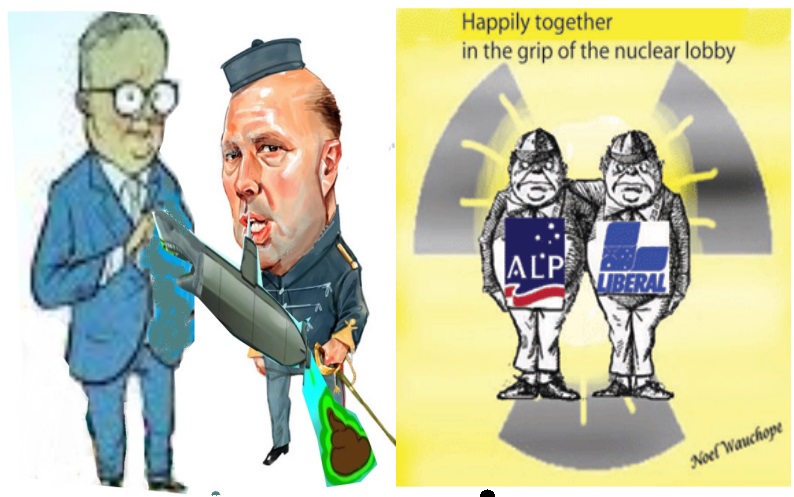

15 Oct 24, On Thurs 10th the ALP Gov & Coalition jointly forced a Senate vote on two AUKUS Bills without allowing any debate and jointly voted down all proposed amendments (see below) – see the vote at Senate Hansard extract at p.28-29 of this doc https://parlinfo.aph.gov.au/parlInfo/download/chamber/hansards/28068/toc_pdf/Senate_2024_10_10.pdf;fileType=application%2Fpdf
16 x Senators voted No:
Allman-Payne, P. J. Cox, D. Faruqi, M. Hanson-Young, S. C. Hodgins-May, S. Lambie, J. McKim, N. J. (Teller) Payman, F. Pocock, B. Pocock, D. W. Roberts, M. I. Shoebridge, D. Steele-John, J. A. Thorpe, L. A. Tyrrell, T. M. Waters, L. J.
36 x Labor & Liberal & National Senators voted Yes to AUKUS Bills.
see Australian Greens Senator David Shoebridge Media Release on 11th Oct 2024 on nuclear waste aspects:
Albanese and Dutton team up on toxic AUKUS nuclear waste deal | Australian Greens
All proposed Amendments to the AUKUS Bills were voted down by the ALP & the Coalition.
a set of Amendments by Greens Senator Shoebridge, a set by Ind Senator Thorpe, a set by Ind Senator Pocock, and a set by Senator Lambie, were voted down as four groups of amendments – see a Senate Hansard extract from p.40 to p.58 of doc: https://parlinfo.aph.gov.au/parlInfo/download/chamber/hansards/28068/toc_pdf/Senate_2024_10_10.pdf;fileType=application%2Fpdf
Premier vows to hold vote on Coalition nuclear power plan ahead of federal election
Queensland state law forbids the construction and operation of nuclear reactors and other facilities under the Nuclear Facilities Prohibition Act.
LNP leader David Crisafulli, who is on track to lead the opposition to power, stands firmly against the proposal.
Fraser Barton, Oct 15, 2024, https://reneweconomy.com.au/premier-vows-to-hold-vote-on-coalition-nuclear-power-plan-ahead-of-federal-election/
Queenslanders will be asked to vote in a plebiscite on nuclear energy at the next federal election if Labor Premier Steven Miles is re-elected.
The premier believes a separate vote on Opposition Leader Peter Dutton’s nuclear proposals can be held at the same time as the federal poll.
“I’ve said I’ll comply with the law,” the premier told reporters alongside Prime Minister Anthony Albanese on Monday.
“The law bans nuclear in Queensland but also requires the minister to hold a plebiscite as soon as they reasonably believe that the Australian government intends to build a nuclear reactor.
“Peter Dutton said the first step to get nuclear reactors in Queensland is to elect David Crisafulli – they were his words – and that means that the first step to blocking Peter Dutton’s plan for nuclear reactors is to elect me in October.”
Albanese labelled the federal coalition’s nuclear energy goals a “fantasy”.
“They don’t have a proper plan here, and it’s no wonder that they should be held to account for it,” he said.
Dutton has promised to build seven nuclear plants across Australia if the coalition wins next year’s federal election.
Dutton has previously vowed to override states who refuse to adopt the energy plan.
But Queensland state law forbids the construction and operation of nuclear reactors and other facilities under the Nuclear Facilities Prohibition Act.
LNP leader David Crisafulli, who is on track to lead the opposition to power, stands firmly against the proposal.
Political analyst John Mickel said Labor would use nuclear’s high costs and dependency on water to woo regional voters, if the plebiscite goes ahead.
“What Labor would be trying to do there is bring that issue to the fore,” he told AAP.
Plans to build nuclear plants could cost up to $600 billion and the coalition said nuclear reactors could be online by 2037.
Queensland premier will hold plebiscite on nuclear power if he wins state election
Exclusive: Steven Miles says law requires a referendum be called if the commonwealth is likely to build a ‘prohibited nuclear facility’ in the state
Andrew Messenger and Graham Readfearn, Mon 14 Oct 2024
Steven Miles will hold a state plebiscite on Peter Dutton’s nuclear power plans if he wins the 26 October poll, a move that could polarise the electorate in the Coalition’s strongest state at the next federal election.
The Queensland premier said he had received legal advice on the nuclear issue and raised the possibility of initiating a plebiscite on the same day as the federal election.
“Depending on how things play out, you could even hold that plebiscite on the same day as the federal election, to save people going to the polls twice,” Miles said in an exclusive interview with Guardian Australia.
The federal opposition leader, Peter Dutton, will take a plan for seven Commonwealth-owned nuclear power stations to the next election. That includes two in Queensland, replacing existing coal plants at Callide and Tarong.
But an obscure provision in Queensland’s 17-year-old Nuclear Facilities Prohibition Act 2007 may stand in the way. The act bans granting a grid connection, development application or generating authority to any nuclear facility.
It also requires the minister call a plebiscite if “satisfied the government of the commonwealth has taken, or is likely to, take any step supporting or allowing the construction of a prohibited nuclear facility in Queensland”.
The state opposition leader, David Crisafulli, has repeatedly ruled out changes to the law, most recently at a joint press conference with Dutton this month……………………………………………………………………………………. more https://www.theguardian.com/australia-news/2024/oct/14/queensland-premier-will-hold-plebiscite-on-nuclear-power-if-he-wins-state-election
Two Peter Dutton policies may swing Teals to Labor in a minority government
Michael West Media by Michael Pascoe | Oct 14, 2024
The scenario: a minority government after the next election, as various polls forecast.
The question: in a close-run thing, to whom would the “Teals” give the keys to the Lodge?
The hypothesis: there are two Dutton policies that should force the genuine independents to select Albanese as Prime Minister.
The perversity: neither of those policies could be expected to appeal much to voters who weren’t already in the LNP camp.
May election likely
Slipping by without much attention last week was the government changing Budget Night to March 25, effectively confirming the early May election that has always been most likely. So seven months to win any hearts and minds that are not already committed.
The makeup of the crossbench will be different. Not all the community independents – to give Teals their official name – from the Class of ’22 may be returned (for starters, vale the scratched seat of North Sydney and, therefore, Kylea Tink) and there could be newbies. From here, though, it still looks likely that Teals will have the final say on who forms government. More on that later.
Enter stage right the two key LNP policies that should make it impossible for Teals to give Dutton the nod: nuclear power and housing.
The key common issues of the Teal wave in 2022 were climate, integrity, gender, and not being Scott Morrison, all based on a pledge of listening to and reflecting their communities’ concerns.
The nuclear “concept” of a plan
Dutton’s “concept of a plan” to build multiple nuclear reactors somewhere between a distant tomorrow and eternity – an excuse for extending fossil fuel burning and reducing investment in renewables – won’t and can’t wash with any Teal genuinely concerned about climate policy.
Enter stage right the two key LNP policies that should make it impossible for Teals to give Dutton the nod: nuclear power and housing.
The key common issues of the Teal wave in 2022 were climate, integrity, gender, and not being Scott Morrison, all based on a pledge of listening to and reflecting their communities’ concerns.
As Phil Coorey reported in the AFR ($):
“If they’re not going to release the detail, we’ll do it for them,” a government member said, speaking on condition of anonymity.
“The terms of reference include an examination of how soon a nuclear power plant could be operational; the cost of building and maintaining them, the storage and transportation of fuel and waste; the feasibility of using existing coal-fired power station sites and their power lines; federal, state, territory and local government legal and policy frameworks; and the impact of power prices.”
Generally forgotten is that we had a parliamentary inquiry into nuclear power only five years ago, chaired by the LNP’s Ted O’Brien, now the shadow energy spokesman tasked with selling Dutton’s nuclear gambit.
With the Coalition dominating that inquiry, the most O’Brien could come up with was that “nuclear energy should be on the table for consideration as part of our future energy mix”, not that we should go for it.
Then, like now, O’Brien was hoping small modular reactors might become a thing and other new large reactor technologies could be the economical go.
Generally forgotten is that we had a parliamentary inquiry into nuclear power only five years ago, chaired by the LNP’s Ted O’Brien, now the shadow energy spokesman tasked with selling Dutton’s nuclear gambit.
With the Coalition dominating that inquiry, the most O’Brien could come up with was that “nuclear energy should be on the table for consideration as part of our future energy mix”, not that we should go for it.
Then, like now, O’Brien was hoping small modular reactors might become a thing and other new large reactor technologies could be the economical go.
The only certainty about the LNP’s energy/climate policy is that it would delay efforts to reduce Australia’s carbon emissions. With climate denial strong in the party, the procrastinator’s golden rule rules: Put off to tomorrow what you don’t have to do today because you might get away with not doing it tomorrow.
There is no way Teals, in conscience, could choose such a policy. Climate 2000’s Simon Holmes à Court doesn’t call the Teals’ shots, but they couldn’t expect his support if they went with the deniers and sceptics………………………………………………………………………………………………..
The minority government scenario?
The post-election negotiations will test the integrity of cross-bench members. The Teals of Liberal heritage – most obviously Allegra Spender in Wentworth and Kate Chaney in Curtin – might have to hold their noses to appoint a Labor government, but they would forfeit all personal credibility if they empowered fraudulent nuclear and housing policies.
The others – Monique Ryan, Zali Steggall, Helen Haines, Zoe Daniel, Sophie Scamps and, possibly post-May, Nicolette Boele in Bradfield – have their own professed standards to live up to. If they do, they won’t be empowering a minority LNP government.
We may also assume that Bob Katter, Rebekha Sharkie ($) and Andrew Gee (if he is returned in Calare after quitting the Nationals over the Voice referendum) go LNP, while the Greens and Andrew Wilkie prefer Labor.
The self-declared opposite of a Teal, the former Liberal Dai Le ($) in the former Labor seat of Fowler, has never pledged herself on climate or anything else for that matter, winning by being an involved local and not the parachuted-in Labor candidate, Kristina Keneally.
Her gaffe in ignorantly suggesting the Lucas Heights research facility could generate electricity indicates she would not have a problem with the Dutton nuclear fantasy – unless the parliamentary inquiry convinces her otherwise. https://michaelwest.com.au/peter-duttons-policies-may-swing-teals-to-labor-in-election/
1 This month


Help Aunty Sue Protect Her Land and Sacred Sites From Destructive Rocket Testing.
.

Australians deserve the truth
about
AUKUS – https://aukuspublicinquiry.com/

PETITION – To: Prime Minister Anthony Albanese and the Australian Labor Government

of the week – Australians for War Powers Reform (AWPR)
To see nuclear-related stories in greater depth and intensity

