Moving beyond Muckaty: next step in Australia’s radioactive waste story
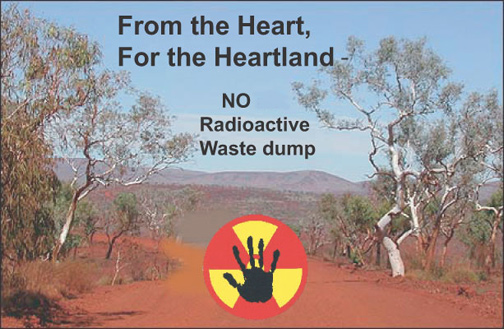 4 Mar 15 Environment groups have urged the federal government to deliver on its commitment not to impose radioactive waste storage on unwilling communities, as announced by Industry Minister Ian Macfarlane today.
The latest process to identify a site for a national nuclear waste facility follows more than 20 years of flawed and failed federal attempts to impose a dump on communities in South Australia and the Northern Territory, most recently at Muckaty, north of Tennant Creek.
“That this process is happening at all is a tribute to the tenacity of the Muckaty Traditional Owners who took sustained action to protect their country and culture,” said Beyond Nuclear Initiative convenor Natalie Wasley.
“It took more than eight years for the government to admit the Muckaty nomination was a ‘disaster’. This must not be allowed to happen to other communities.
“Environment and civil society groups will closely monitor – and engage where possible – with the revised site nomination and selection process,” she said.
The process outlined today includes federal commitments of increased transparency and a stated preparedness to consider a number of alternative siting models.
Environment, public health, Indigenous and trade union groups have called for an expert and independent Inquiry into the full range of waste management options, including decentralised nuclear waste storage instead of a centralised facility. This approach has not been adopted by Minister Macfarlane, who has opted for a limited, fast-tracked process.
“There are no compelling social or technical reasons to rush a decision on an issue that demands the highest quality decision making,” said ACF’s Dave Sweeney.
“We have time to get this issue right. The Minister’s revised process is significantly better than the previous one, but we are still a long way short of where we should be,” he said.
Most of Australia’s existing radioactive waste is securely stored at two dedicated federal sites. Reprocessed spent nuclear fuel set to return to Australia from Europe later this year will be sent to the Lucas Heights facility for interim storage. Context and comment: Dave Sweeney (ACF) 0408 317 812, Nat Wasley (BNI) 0429 900 774
Federal Liberal MP Rowan Ramsey keen for nuclear waste dump in South Australia
ROWAN RAMSEY MP Federal Member for Grey 4 Mar 15 CALL FOR VOLUNTARY LAND NOMINATIONS FOR A NATIONAL RADIOACTIVE WASTE MANAGEMENT FACILITY
Federal Member for Grey Rowan Ramsey welcomes the Australian Government’s decision to open the process for voluntary site nominations for a national radioactive waste management facility. ……
Mr Ramsey said an Independent Advisory Panel had been established by the Department of Industry and Science to assist with assessing nominations and advising the Government on which sites may be suitable for a facility.
“It is interesting that this call for volunteers has occurred when Premier Jay Weatherill has just launched a Royal Commission into the possibility of South Australia raising its participation in the nuclear industry past the simple supply of yellowcake,” Mr Ramsey said…….
Coalition offer weakening Renewable Energy Target is rejected by Labor
- Labor rejects fresh renewable energy target offer, SMH March 2, 2015 Lisa Cox National political reporter Talks between the government and Labor toward a compromise on the renewable energy target appear to have again broken down, with the Opposition rejecting a new offer on Monday.
Government sources said a proposal to set the target at 31,000 gigawatt hours of baseline power by 2020 was put to Labor on Monday afternoon in a bid to break a deadlock that has existed for more than 12 months.
Labor is understood to have rejected the offer but could not be reached for comment.
The Opposition and the clean energy industry had been pushing for a figure in the mid- to high-thirties, but government sources said 31,000 was in line with demands from some quarters of the renewables sector.
Kane Thornton, chief executive of the Clean Energy Council, said on Monday that 31,000 gigawatt hours was too large a cut from the existing target of 41,000 gigawatt hours by 2020.
“We’ve been quite transparent about our position on this,” Mr Thornton said.
“There’s a strong consensus in the renewable energy sector on a desire to resolve this.
“But there’s also a strong consensus on what reduction in the target the industry is willing to accept.
“We’ve made this quite clear and explicit – 31,000 is quite clearly a number we’re not prepared to accept.”
The failed offer continues the uncertainty that has plagued the renewables sector since the government launched a review of the target more than 12 months ago……..
Oliver Yates, the chief executive of the Clean Energy Finance Corporation, told a Senate estimates hearing last week that uncertainty over the target had set the industry back 12 years.
Pro nuclear spin hides the real motive behind South Australia’s Royal Commission – a nuclear waste import industry
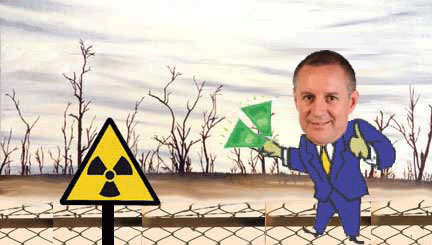
When announcing the commission last month, SA Premier Jay Weatherill said it would “explore the opportunities and risks of South Australia’s involvement in the mining, enrichment, energy and storage phases for the peaceful use of nuclear energy”.
The move caught many by surprise, not least federal opposition leader Bill Shorten, who – unlike his Labor colleague Weatherill – remains opposed to nuclear.
The announcement also generated huge amounts of free PR for the nuclear industry, as shown in the avalanche of media coverage that ensued – some deliberately balanced, some sceptical of the commission and its value, but much of it highly favourable, especially in the business press.
It is not hard to see why. As Naomi Klein contends, nuclear power is an industrial technology, organised in a corporate manner. And as psychiatrist Robert Jay Lifton points out, no technology does more to underline humanity’s dominion over nature than our ability to split the atom.
The positive spin Continue reading
Highly respected South Australian Aboriginal, Yami Lester, speaks out on nuclear waste dump plan
I’m hoping you will support us with this very important issue which has arisen from SA Goverenment regarding a Royal Commission into Nuclear Energy and proposal to store high-level nuclear waste at Maralinga, South Australia
Please read. With thanks, Yami Lester, Yankunytjatjara Walatinna Station, South Australia (08) 8670 5077
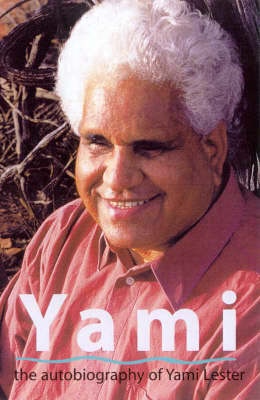 Statement on Royal Commission into Nuclear Energy and proposal to store high-level nuclear waste at Maralinga, South Australia:

In 1953 I was just ten years old when the bombs went off at Emu and Maralinga, I
didn’t know anything about nuclear issues back then, none of us knew what was happening. I got sick, and went blind from the fallout from those tests, and lot of our people got sick and died also.
Now I’m 73 years old and I know about nuclear issues, and I have some friends who know about nuclear waste, and they will fight the South Australian Government on their plans to put high-level nuclear waste at Maralinga and to develop nuclear energy in South Australia.
Why does the government keep bringing back nuclear issues when we know the problems last forever?
The Royal Commission into British Nuclear Tests in Australia (1984-85) revealed
what happened at Maralinga but it never told what happened to Aboriginal people; the findings were left open.Lawyers proved that there was radiation fallout over Walatinna, but because wenever had any doctors records to document what happened to us, (the closest clinic was Ernabella, 160km away as the crow flys and we didn’t have any transport to get there), we only had our stories and they were never written down.
A few years ago they cleaned up Maralinga from the waste that was leftover from the bomb tests; they spent $1 million, and now they’re going to put more waste back there?
That’s not fair because it’s Anangu land and they won’t be able to use that land.
Members from the APY, Maralinga-Tjarutja and Arabunna, Kokatha lands say we don’t want nuclear waste on our land.
The best thing the government can do is the leave the uranium in the ground, stop mining it.
We ask the South Australian Premier, Jay Weatherill, to talk to Aboriginal people on the lands, and to everyone who has been directly affected by the atomic tests and nuclear industry in Australia before he makes any decisions for South Australia.
Industry Minister Ian Macfarlane speaks with forked tongue on the Renewable Energy Target
What Macfarlane is essentially saying here is, ‘take my offer or I’ll leave you with scheme that we will make clear to investors does not have Coalition Party support.
And in the event that it looks like the target will not be met, we will use that as a mechanism to overcome Senate obstruction to cut the scheme back by even more than what is currently on the table’
 Macfarlane threatens: take my RET deal or else, Climate Spectator TRISTAN EDIS 27 FEB 15 , The confusing saga on the Renewable Energy Target continues with Environment Minister Greg Hunt sounding optimistic (as he seems to be about everything) that there will shortly be an agreement on the level of the target, and one that he said will “go significantly further” than 20% market share for renewable energy. Meanwhile Industry Minister Ian Macfarlane on the same day delivered a message of a rather more belligerent and less optimistic tone. Continue reading
Will South Australia’s Royal Commission be genuinely independent, or just excuse for importing radioactive trash?
If the Royal Commission brings a genuine spirit of independence and rigour, and is willing to take evidence on the nuclear sector’s performance in Australia and overseas, the report will provide a valuable contribution to domestic energy and industry policy.
An inquiry into how to get to zero emissions electricity as cheaply and rapidly as possible would have made a far more timely and valuable contribution to debates over energy policy and rebooting South Australia’s manufacturing sector than another rake through the slowly cooling ashes of the nuclear dream. Nonetheless, the lid has been lifted once again, and we can only hope that the Royal Commissioner is willing to take an unblinking look at the evidence, so that the failed hopes and broken promises of the atomic age can be set to rest once and for all
the probability that this whole exercise is designed to build the case for a national or international radioactive waste dump.
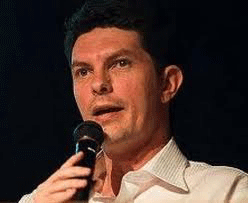 Nuclear Industry On Trial? Scott Ludlam Hopes So, New Matilda, 26 Feb 15 The debate about nuclear power in South Australia needs to be had, if only to put the issue to bed once and for all, writes Scott Ludlam.
At first glance, the decision to call a Royal Commission into nuclear technology in South Australia seems like a curious aberration from the ‘Yes Minister’ rule of inquiries: never call one unless you know in advance what it will tell you.
At the outset of this most polarising of debates, I’d like to propose a truce; particularly with those whose pro-nuclear views are motivated by the overwhelming imperative of climate change. If we respect that not all nuclear advocates intend to contaminate the gene pool and plunge us into nuclear winter, I’d ask in return that you consider the possibility that the anti-nuclear case is based on rational assessment of risks and performance, rather than pure emotion as is sometimes asserted.
For those whose motivation is a safe climate, this is a disagreement over means, not ends. Continue reading
Renewable energy leader Port Augusta does not need nuclear power – Mayor
Local mayor unhappy with city counterpart’s nuclear comments, The Transcontinental, 27 Feb 15 Port Augusta has been suggested as a “convenient” site for a nuclear reactor, just weeks after the state government announced it will establish a Royal Commission into nuclear power in SA.
Port Augusta mayor Sam Johnson is not happy, saying the suggestion treats those living in regional areas like Port Augusta as second-rate citizens……
Port Augusta mayor Sam Johnson said he’s open to an informed debate on nuclear power, but hit fiercely back at the Port Adelaide mayor’s comments, labelling the idea a “cop out”. (picture from The Transcontinental )
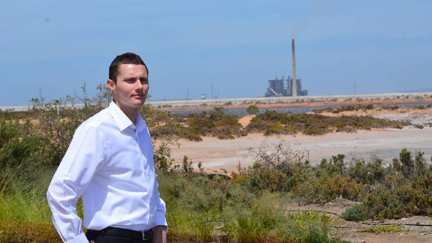
He said there’s no reason to consider putting nuclear power in Port Augusta, given the city is already leading the way in renewable energy.
“Why in the hell would we want nuclear power in Port Augusta when we’ve done so much work on renewable energy, in particular the solar thermal plant?” Mr Johnson questioned.
“We’ve had international experts actually say to us, why isn’t the government in Australia exploring renewable energy such as solar thermal given we have the best geographical climate in the world to do it?
“If the government wants to talk about nuclear, fine, happy to talk about it – but we’re already heading down a successful path…they can go and build the nuclear power plant in Unley or Norwood for all I care.”
Repower Port Augusta chairperson Gary Rowbottom suggested nuclear power is a higher risk option than renewable energy, and doesn’t see why it’s worth exploring when there’s a better option on the table for the city.
“Our current belief is that it is simply not required to take the risks and overcome all the implementation difficulties involved in ‘going nuclear’,” Mr Rowbottom said.
“We can substitute a suite of proven and developing renewable technologies in place of any need to go down the nuclear path…the commercial, health and environmental risks of nuclear are too high to justify it.
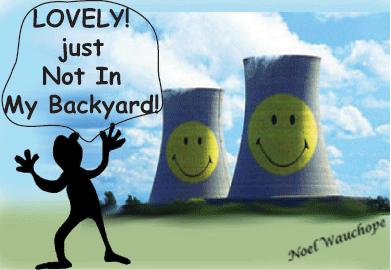 “It can be taken as somewhat offensive that the Port Adelaide/Enfield areas (Mr Johanson) are clearly saying that they are not prepared to have a nuclear reactor in their area but it is ideal and more convenient for Port Augusta to have one.”……
What do you think about having a nuclear reactor in Port Augusta?
Send your thoughts to the editor at ryan.smith@fairfaxmedia.com.au http://www.transcontinental.com.au/story/2903676/local-mayor-unhappy-with-city-counterparts-nuclear-comments/
Federal and State funding removed from top Northern Territory Environment Groups
End is nigh for NT environmental advocacy groups as funding runs out, ABC News 26 Feb 15 By Elliana Lawford Two environmental advocacy groups in the Northern Territory are set to close as government funding cuts announced last year start to bite.
The Environment Centre NT (ECNT) has told the ABC a number of staff were laid off last week and the centre has limited their operating hours from five to three days a week.
The organisation has led campaigns against uranium mining, pollution, gas exploration and water extraction licences. ECNT chair Tony Young said he was worried there would be no-one to fight for environmental issues in the Northern Territory if the centre closed.
“If there is no independent voice to point these things out then the problems continue and they are exacerbated,” he said. “The range and complexity of the environmental problems the Northern Territory faces really deserves a properly funded, independent, science-based voice … that’s what is in danger.”
The ECNT lost $185,000 in last year’s Territory budget.
The Environmental Defenders Office (EDO) is also struggling and has announced it will close on June 30, after it lost $450,000 in Federal Government funding. EDO chair Kirsty Howey said the office could not operate without financial help.
“With the cutting of federal funding at the EDO, we are looking at shutting the doors on June 30 this year,” she said.
“We just don’t have the money to survive any longer.”
NT Environment Minister Gary Higgins said he was unperturbed by the looming closures of the ECNT and the EDO……..
Labor spokeswoman Nicole Manison said both organisations were needed in the community.
“We need to have a full and independent voice for the government out there in the community,” she said.
“They bring up some pretty tough issues for governments and a good government would actually listen to them.”
Both organisations are still trying to secure independent funding that could delay their closures. http://www.abc.net.au/news/2015-02-26/environment-agencies-nt-for-the-chop/6262720
Senator Scott Ludlam on “new generation” nuclear reactors that “emit only unicorn dust”
Nuclear Industry On Trial? Scott Ludlam Hopes So, New Matilda, 26 Feb 15 “……The unthinkable consequences of a well-executed terrorist attack on an operating reactor or high-level waste store keep national security planners awake at night, with the potential for nuclear power plants to be used as pre-deployed radiological weapons by those with malevolent intent.
It seems likely that in the face of this evidence, the Royal Commission will see the industry play its last remaining card: an invitation to set aside the actual performance of existing reactors and imagine the potential of a new generation of nuclear technology: safe, clean, reliable, cheap, modular, proliferation-proof; reactors that consume only nuclear waste and emit only unicorn dust.
Forgive the scepticism: no-one has ever come remotely close to designing and building such a device, and commercial application of imaginary Generation IV reactors lies well over an indefinitely receding horizon; always just a few more years and decades away.
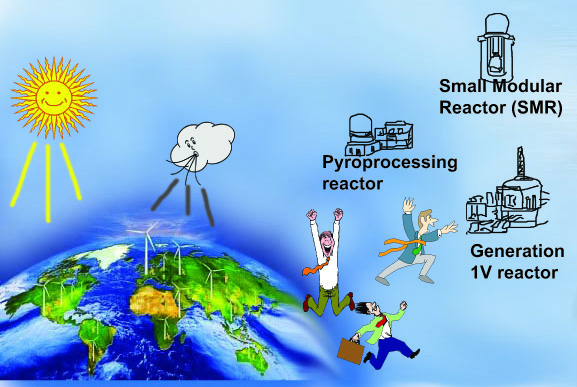
Perhaps more to the point, it may be that there are simpler ways to boil water or induce electrons to flow down a wire than the absurdity of plutonium-burning fission reactors cooled by liquid sodium.
Turning to face the timeless abundance of free solar energy presents a much simpler way forward. It is time that advocates of terrestrial nuclear power instead used their efforts to advocate for better use of the celestial nuclear reactor that sustains rather than threatens life on Earth.
The very qualities of scale, baseload delivery and centralisation that so appealed to energy planners of the 1950s make nuclear technology uniquely unsuited to the realities of the 21st century.
Emerging industrial economies like India, Africa and China’s rural hinterlands are vastly better served by decentralised renewable generators feeding local or regional-scale microgrids.
The plunging costs of solar, wind and micro-hydro generators are combining with cheap, decentralised energy storage technology – driven largely by developments in the IT and automotive industries – to drive the final nail into the fallen potential of nuclear power.
In March 2013 the cover and feature piece of the Economist magazine put the case succinctly: Nuclear Power – the dream that failed.
For the indefinite future, there will still be a need for reliable, dispatchable utility-scale power plants, but even here clean-technology has emerged to checkmate atomic energy: large-scale concentrating solar thermal plants have come online in Spain and the United States, paving the way for vastly more ambitious developments in South America and the Middle East combining cheap photovoltaics with heliostat fields heating overnight molten salt energy storage.https://newmatilda.com/2015/02/26/nuclear-industry-trial-scott-ludlam-hopes-so
Significant omissions from the Terms of Reference for the SA Nuclear Royal Commission
Will anyone take this Royal Commission seriously?
 Some Significant omissions from the Terms of Reference for the SA Nuclear Royal Commission Margaret Beavis 25 Feb 15,
Focus on Mining expansion only
No mention of old mines and contaminated areas
No mention of water issues- huge supply required for reactor and risks of contamination of waterways and aquifers. SA is a dry state.
Opportunity cost of focussing on nuclear industry instead of becoming world leader in renewables
Ignores high cost of nuclear power compared to other sources
Large subsidies needed from government preventing spending on other important issues
Lack of financial/professional conflict of interest declarations being required from all witnesses and commission members
No mention of health impacts of radiation
No provision for how state would respond to Fukushima type scenario from accident/deliberate damage
No mention of possible impacts on SA tourism, food and wine exports (especially fisheries)
Vast majority of medical waste has a very short period of radioactivity and is not the main reason for a dump.
South Australia’s Royal Commission should investigate the costs of uranium mining
The draft terms of the reference for the royal commission, released on Monday, are focused on nuclear power generation, uranium enrichment and waste storage. But the government has ruled out scaling back the state’s involvement in uranium mining, while also precluding the use of nuclear for military purposes.
Australian Conservation Foundation spokesman Dave Sweeney says the decision to exclude consideration of uranium mining is deeply disappointing. “The nuclear industry starts with uranium and so should any genuine assessment of the nuclear sector in South Australia,” he said.
The Greens have a renewable energy vision for New South Wales


 Greens’ Clean, Renewable Energy Vision For NSW http://www.energymatters.com.au/renewable-news/greens-renewable-energy-em4699/ February 24, 2015
Coal and gas fired electricity generation in NSW generates 60 million tonnes of carbon emissions annually, making the state one of the most carbon-intensive economies in the world.
The Greens’ plan includes partnering with households to support the transition away from coal-fired electricity and gas to rooftop solar, energy efficient equipment and intelligent energy trading and management.
The plan would see the creation of public sector energy agencies to provide financial support and technical advice, investment in a “smart grid” and keeping the network in public hands.
“Transformation of the state’s energy industry is inevitable,” stated Greens NSW MP John Kaye, who said it was important this process begins as soon as possible. “Premier Mike Baird’s plans will to pass control of much of the electricity network to private hands would create political and financial barriers to the remaking of the network.”
The Greens say their energy vision would slash household power bills and break the stranglehold of big private-sector energy corporations. They envision an electricity sector where households and businesses would trade roof top solar electricity and other renewable sources across a publicly-owned network.
Pursuing a 100% renewable energy based New South Wales would also create a clean power jobs boom. While there are just 1,800 jobs in NSW’s coal-fired power stations and approximately 4,000 in mining the coal these facilities burn, more than 70,000 new jobs could be created in NSW in clean energy.
The Greens state much of the $17 billion investment in electricity transmission and distribution since 2009 in New South Wales has been in the wrong kind of technology, locking the state into a centralised and expensive supply based on coal and gas.
“A 100% renewable energy NSW is possible, affordable and essential. But it will not happen as long as the old parties remain committed to coal and gas and continue to frustrate and undermine wind and solar,” says the party.
Australian governments’ political risks in promoting the really quite marginal uranium industry
Given that Australia’s uranium mining and export accounts for less than 1 percent of its hundred billion dollar mineral export business (iron ore, bauxite, coal, copper, nickel etc),36 however, these decisions by Australian leaders risked significant political capital over what has been a highly contentious issue in Australia’s recent political history
Undermining Nuclear Non-Proliferation: Energy and Security Politics in the Australia-India-Japan-U.S. Nuclear Nexus 核不拡散の土台崩し オーストラリア·インド·日本·米国間におけるエネルギーと安全保障政策 The Asia-Pacific Journal, Vol. 12, Issue 46, No. 2, November 1, 2014 Adam Broinowski “……Until 2014, along with China, Japan has also seen a boom in mostly solar and wind electricity generation. But this has been stalled by utilities who have refused to take an influx of renewable power into the grid or to reduce electricity prices.10 With fewer nuclear plants scheduled for construction around the world than for shutdown, however, the nuclear industry faces the likely prospect of contraction11 and replacement by rapidly advancing renewable energy options, including solar, wind, tidal, hydro and possibly geothermal power over the longer term.
Despite this gloomy prognosis for the uranium sector, confidence began to return to the uranium mining industry in Australia from late 2012. Continue reading
The next step in South Australia’s Nuclear Farce
OK – Now it has turned up on http://yoursay.sa.gov.au/blogs/draft-terms-of-reference
 The Premier’s media release says that you can find the Terms of Reference at www.yoursay.sa.gov.au.
I couldn’t find anything there about the subject. Perhaps later?
Symptomatic of the clumsy and inept rush that characterises this tacky Royal Commission idea.
Also no mention of personnel – other than the pro nuclear former S.A Governore Kevin Scarse. (at right) Independent, my foot!
Anyway – here are the Draft Terms of Reference Continue reading
1 This month
Chernobyl: The Lost Tapes – A good documentary on Chernobyl on SBS available On Demand for the next 3 weeks– https://www.sbs.com.au/ondemand/tv-program/chernobyl-the-lost-tapes/2352741955560
15 April – Zoom –Nuclear Power is Not the Solution
Apr 15, 2026 01:00 AM in Canberra, Melbourne, Sydney

Join the International Physicians for the Prevention of Nuclear War (IPPNW) on Tuesday, April 14th for a timely webinar exploring the risks associated with nuclear power and challenging the myth that it offers a simple, safe, carbon-free solution to the climate crisis

21 April Webinar: No Nuclear Weapons in Australia
Start: 2026-04-21 18:00:00 UTC Canberra, Melbourne, Sydney (GMT+10:00)
End: 2026-04-21 19:30:00 UTC Canberra, Melbourne, Sydney (GMT+10:00)
Event Type: Virtual
A virtual link will be communicated before the event.
Host Contact Info: australia@icanw.org

of the week – Australians for War Powers Reform (AWPR)
To see nuclear-related stories in greater depth and intensity
 Antinuclear
