Australia’s election September 7 – nuclear power, uranium, and climate change

How do the parties stack up on nuclear power and uranium mining, uranium enrichment,, nuclear wastes?

How do they stack up on climate change?
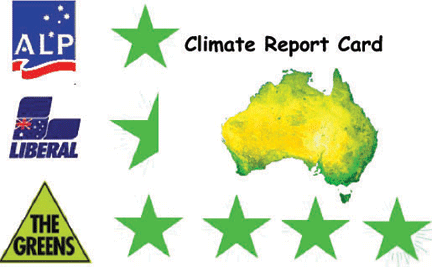
Australian Greens will stand firm in the Senate – for carbon pricing, action on climate change
 Christine Milne warns Greens must retain balance of power in Senate to block repeal of carbon tax ABC By Monique Ross 4 Sept 13, Greens leader Christine Milne has warned voters that unless her party retains the balance of power in the Senate, Tony Abbott may have free rein to “tear down carbon pricing mechanisms”.
The Opposition Leader has today reaffirmed his commitment to repealing the carbon price in favour of his Direct Action policy if he is elected to the top job. While Labor MPs have said they would block the move, Mr Abbott says that would be political suicide, and has repeatedly threatened to call a double dissolution election on the issue.
Senator Milne says the Greens are needed in the Senate to “stand firm against Tony Abbott” for the sake of the global environment. “If Tony Abbott has effective control of both houses, then he will be able to do as he likes,” she told ABC News 24’s Capital Hill.
“He will be able to tear down the carbon pricing mechanisms. He will be able to get rid of the Clean Energy Finance Corporation. Who knows what he would do to the environment.
“It is critical that the people who actually believe the science, who want this to be evidence-based policy, are there to argue it because Tony Abbott doesn’t believe in evidence-based policy. He thinks climate change is crap.”
Senator Milne rounded on Mr Abbott’s concession that his policy may not succeed in reaching Australia’s target of cutting greenhouse gas emissions by 5 per cent by 2020. “He has been able to get off the hook here. Nobody has really unpacked his Direct Action farce,” she said.
“Is he walking away from his 5 per cent reduction target? Greg Hunt says they’re not and Tony Abbott says they are.”
She did not let the Government off the hook either, saying that Greens Senators are needed to “keep Labor on track”.
“We will never support reducing action on climate change and as long as we’re there in balance of power, we will be able to shame Labor into standing up and holding the line,” she said.
“Otherwise who knows where they would go on this either.”
Earlier, Labor figures including Prime Minister Kevin Rudd and Environment Minister Mark Butler said the party would not give in to Mr Abbott’s push to repeal the carbon tax.
“Carbon pricing is fundamental to how you deal with climate change,” Mr Rudd said.
“Any alternative response to that is just intellectually dishonest.” http://www.abc.net.au/news/2013-09-03/milne-says-greens-senators-vital-to-carbon-tax-future/4932712
Carbon pricing: position of Liberal Coalition, Labor, and Greens
 AUDIO: http://www.abc.net.au/news/2013-09-03/is-carbon-pricing-key-or-ripe-for-abolition/4932722 Is carbon pricing key or ripe for abolition? ABC radio, 3 Sep 2013″………MARK COLVIN: Fourteen-and-a-half million people are eligible to vote this Saturday and already, more than one and a half million of them have had their say, either through pre-poll booths or postal votes.
If the Coalition wins, Tony Abbott says he’ll have a mandate to abolish the carbon tax, and that Labor should recognise that. And he  isn’t ruling out a double dissolution on it. But the Climate Change Minister Mark Butler says Labor won’t cave in, and the Prime Minister Kevin Rudd says pricing carbon is fundamental to dealing with climate change.
Chief political correspondent Sabra Lane…….
KEVIN RUDD: If every government took that position that he has taken, what’s the net consequence? The net consequence is that all governments would walk away from hard action on this, the planet would continue to endure global warming, and as a result, we’d provide a very uncertain future for our kids.
I think the contrast is very clear and reflects poor judgement.
SABRA LANE: He later accused Mr Abbott of walking away from the bipartisan commitment to cut CO2 emissions.
KEVIN RUDD: He’s not fair dinkum about climate change, and when yesterday he made it very explicit that he was walking away from his 5 per cent commitment if his so-called Direct Action farce did not work, then that says everything to everybody out there who follows these debates with any degree of closeness.
SABRA LANE: Tony Abbott’s often couched this election as a referendum on the carbon tax, saying if the Coalition wins he’ll consider it a mandate to scrap the tax.
But on RN (Radio National), the Climate Change Minister Mark Butler dismissed talk of mandates……..
KEVIN RUDD: Carbon pricing is fundamental to how you deal with climate change. Any alternative response to that is just intellectually dishonest…….
The Greens, meanwhile, are arguing for the status quo in the Senate. Its leader, Senator Christine Milne:
CHRISTINE MILNE: And Tony Abbott has now become so arrogant that he is assuming that he’s already got The Lodge. What he’s now coming after this week is control of the Senate as well, absolute power and control of both Houses of Parliament and the Liberal Party advertising is going in that direction.
And that’s why the Greens are standing firm saying if you don’t want Tony Abbott to have absolute power, then vote for The Greens in the Senate.
Tony Abbott abandons climate change action
 As the world warms, Abbott goes backwards The Age 4 Sept 13, Like the anectodal frogs in a gradually heated pot of water, our would-be leaders seem inured to climate change. While the major economic blocs are moving to tougher carbon pricing regimes to cut planet-warming greenhouse gas emissions, Australia’s contenders for government have shown little urgency on this issue during the federal election campaign.
Coalition leader Tony Abbott has just walked away from a long-term, albeit modest, bipartisan commitment to a 5 per cent reduction in the nation’s emissions from 2000 levels by 2020. He now promises only ”as much emission reduction as we can for the spending that we’ve budgeted”. That is not nearly enough, according to several independent analyses of the Coalition’s ”Direct Action” policy of taxpayer-funded payments to primary producers and industry to cut emissions.
Mr Abbott has shed any pretence that he sees emission cuts as a priority. Good governments, though, heed expert advice, and the advice from the Australian Bureau of Meteorology, the CSIRO, the World Meteorological Organisation and national scientific and climate research agencies around the world is clear…….
Draw the line in the Senate Very few people know this, but legally you can vote both ways on the Senate ballot paper. In other words, instead of completing either option, voters can do both: the short-cut above-line and the more time-consuming below-line procedure. Below takes precedence, but if the vote is informal the above-line option comes into play.
Call to Greg Bickley, Liberal for Bendigo: are you a climate change denialist?
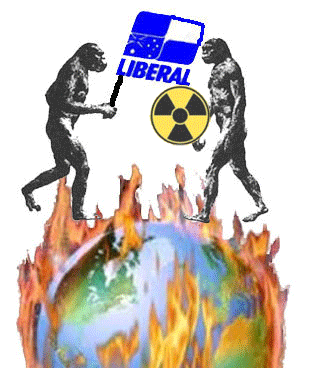 A real local would commit to renewable energy http://www.bendigoadvertiser.com.au/story/1751662/a-real-local-would-commit-to-renewable-energy/?cs=79 By Ivan Kitt, Bendigo Sept. 4, 2013,
I would like to ask Greg Bickley if he actually believes that climate change is happening, or is he a sceptic like Tony Abbott and the majority of the Coalition?
Also, does he support the need for renewable energy?
This state once supported wind farms under the previous Labor government, but under Ted Baillieu this project was scrapped, and even with the recycling of Dennis Napthine he hasn’t made any substantial announcements on climate change or renewable energy, although I believe he has agreed to establishing them in his electorate.
If you consider yourself a local Mr Bickley then you should answer yes to these questions.
Because if you don’t then you are not fair dinkum in your promises to create jobs, ease unemployment, improve the economy and support the local community these project would cover all those areas.
And it would appear that you will be a puppet on a string following the party lines and you wouldn’t be a strong voice for the community, whereas Lisa Chesters has already aired her disapproval to the asylum set-up proposed by Labor.
It would be a case of Bendigo being short-changed again by the Coalition.
Top Aboriginal body scathing about Abbott, and not keen on Labor, either
Peak Aboriginal organisation lashes Abbott and ticks off Labor BY:PATRICIA KARVELAS From:The Australian September 04, 2013 THE peak body representing Aborigines has criticised Tony Abbott for his lack of commitment to the organisation and failure to acknowledge the UN Declaration on the Rights of Indigenous Peoples, in an evaluation of the major parties that was sent to its members.
The National Congress of Australia’s First Peoples questioned the major parties on their commitment to advancing the interests of Aborigines.
It says the ALP supported the UN declaration in April 2009, and in 2010 gave moral and financial support for the establishment of the congress, but “regrettably the ALP has yet to address the declaration to any meaningful extent”.
The congress said it was not aware of the Coalition having made any official announcements on the UN declaration or the rights of first peoples.
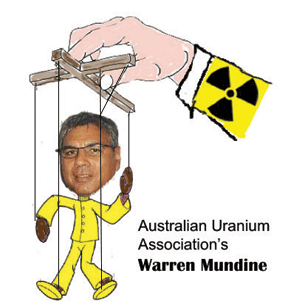
“The Coalition has not expressed support for representation and decision-making,” it said.
It noted that the Opposition Leader had instead made commitments to manage indigenous affairs from the portfolio of prime minister and cabinet, and to establish an indigenous advisory council headed by Warren Mundine. Continue reading
Liberal candidate for Hume, Angus Taylor, tipped to fight against renewable energy
 Controversial wind farm gets clean bill of health SMH, September 3, 2013 Peter Hannam “……….Opposition hopes Lyn Jarvis, a member of the Bodangora Wind Turbine Awareness Group, said her community group remains opposed to the wind farm despite the NSW Health and Planning Assessment Commission’s findings.
Ms Jarvis said the commission had ignored an independent noise assessment by Steven Cooper, an acoustics technician that found the wind turbines would be harmful.
“It’s fallen on deaf ears,” she said. “We had 94 per cent of the submissions against the development.”
The group is pinning its hopes on the election of Liberal candidate for Hume, Angus Taylor, to help lead a pushback against renewable energy, particularly wind farms.
“Hopefully, he will pull the renewable energy credits and it won’t get built – or any wind farms won’t get built in inappropriate places,” Ms Jarvis said. http://www.smh.com.au/business/carbon-economy/controversial-wind-farm-gets-clean-bill-of-health-20130903-2t1u2.html#ixzz2dxXonk7R
Australian Greens the only party to stand up and speak out for climate action
Greens say climate change being ignored http://www.heraldsun.com.au/news/breaking-news/greens-say-climate-change-being-ignored/story-fni0xqi4-1226708983674 AAP SEPTEMBER 02, 2013
THE Australian Greens say the issue of climate change has been sidelined in the federal election campaign.
The Greens’ Sydney candidate Dianne Hiles says it’s shameful how little exposure climate has had during the campaign. “It’s the elephant in the room,” Ms Hiles told AAP. “It’s so big and it’s getting so little air time.
“My concern is that we’ve just had the hottest year on record – these sort of extreme events aren’t going to go away.”The Greens are the only party prepared to stand up to Big Coal and Big Gas and stop them undermining the future viability of this country.”
Greens NSW Senate candidate Cate Faehrmann urged voters to think about the world they would be leaving their children and grandchildren.
Tony Abbott’s reputation in question, over his climate policy that won’t work
Emissions shortfall a risk to reputation : http://www.theage.com.au/federal-politics/federal-election-2013/emissions-shortfall-a-risk-to-reputation-20130902-2t165.html#ixzz2dsy1XQ51 September 3, 2013 Tom Arup Environment editor, The Age Amid its bitter campaign against the carbon price the Coalition has maintained one significant foundation – ”we may hate the method, but we will achieve the same outcome”.
That outcome is at least a 5 per cent cut to emissions by decade’s end on 2000 levels, and more ambitious reductions if the world takes actions to curb climate change. These targets have enjoyed bipartisan support for about five years.
Abbott told the audience the Coalition would not increase its spending on cutting carbon dioxide under direct action, even if its efforts were going to fall short of what is needed to meet the 2020 target. ”The bottom line is we will spend as much as we have budgeted, no more and no less. We will get as much environmental improvement, as much emissions reduction as we can for the spending that we’ve budgeted,” he said.
That budget is $3.2 billion over the next four years. Out of that, $2.55 billion will be spent paying industry and farmers to carry out projects to reduce emissions, the rest on planting trees and installing more rooftop solar. Abbott said he was confident the Coalition would meet the 5 per cent cut with the money on offer. But several independent economic modelling studies dispute this.
One, commissioned by the Climate Institute, found the Coalition was $4 billion short and direct action could instead see emissions rise 9 per cent above 2000 levels instead of 5 below. The assumptions made in Climate Institute modelling were kind to the Coalition.
Other work has found larger holes. Voters have to take Abbott on faith that what is on the table is enough to meet our emissions commitments. And at this stage there is little to support his claim. Australia’s emissions per person are some of the highest in the developed world. And we have pledged to the international community we will make inroads on our contribution to the pollution problem warming our planet. If we do not – and fall short of our promises – we discredit ourselves as a global citizen.
Tony Abbott’s subservience to climate denialists might be his undoing
The conversation on global warming has been stalled because a shrinking group of denialists fly into a rage when it’s mentioned. It’s like a family with an alcoholic father who flies into a rage every time a subject is mentioned and so everybody avoids the elephant in the room to keep the peace.For any political leader unwilling to exercise leadership on the issue, trying to respond to climate change leaves them uncertain which way to turn. Continue reading
Tony Abbott prepared to break his pledge on reducing carbon emissions
 Tony Abbott willing to break emissions pledge over funding hole The Age September 2, Jonathan Swan Opposition Leader Tony Abbott has branded the election a referendum on the carbon tax and said it would be “unimaginable” for a defeated Labor Party to stop him repealing the tax.
Mr Abbott also confirmed categorically – for the first time – that he would break the Coalition’s pledge on greenhouse reduction targets if it cost more money than he had budgeted for.
The Opposition Leader spent about 15 minutes of a 20 minute address to the National Press Club hammering Labor on the carbon tax. If elected the Coalition would repeal the tax within its first year in government, Mr Abbott promised………
Mr Abbott confirmed he was prepared to break the Coalition’s pledge to cut Australia’s greenhouse gas emissions by 5 per cent by 2020 (on the levels recorded in 2000). Estimates by Treasury and independent modelling companies suggest that the Coalition’s $3.2 billion Direct Action policy will fall several billion dollars short of reaching the targets.
“The bottom line is we will spend as much as we have budgeted, no more and no less,” Mr Abbott said. : http://www.theage.com.au/federal-politics/federal-election-2013/tony-abbott-willing-to-break-emissions-pledge-over-funding-hole-20130902-2t0fh.html#ixzz2dnJ1CXjy
Democratic Labor Party’s Geraldine Gonsalvez comes out swinging for a nuclear weapons free world
Geraldine Gonsalvez, 2 Sept 13, I am running as a candidate in the electorate of Bruce. As you all know how passionate I am about a peaceful toxic free world free of nuclear weaponsand weapons of mass destruction. You can be rest assured I will be active and vocal if by a miracle I do get elected to federal parliament towards this cause. This is a very busy week for me given my limited resources.
In Northern Territory electorate, Greens, Labor and Coalition candidates all oppose nuclear waste dump
 Solomon candidates against nuclear dump Bigpond News, August 30, 2013 Labor, the coalition and the Australian Greens rarely agree on anything, but the three candidates for Solomon are united in their opposition of a proposed nuclear waste dump in the Northern Territory.
At a community forum hosted by the ABC in Darwin on Friday, the candidates also debated marriage equality, voluntary euthanasia, housing affordability, hospitals, and schools funding.
Country Liberal Party incumbent Natasha Griggs, who holds the seat by a thin 1.7 per cent margin, said she crossed the floor on the nuclear issue to stand up for Territorians.
Greens candidate Todd Williams said: ‘The NT is viewed as easy and open and that can be foisted upon to store nuclear waste … against the wishes of traditional owners.’…….. http://bigpondnews.com/articles/Election-2013/2013/08/30/Solomon_candidates_against_nuclear_dump_901529.html
Newcastle Independent candidate calls for renewable energy in Hunter Valley
Independent calls for renewable energy manufacturing in Hunter Manufacturers Monthly, 30 August, 2013 Matt McDonald The former Kurri Kurri Aluminium Smelter site should be transformed into a hub of renewable energy manufacturing.
As the Maitland mercury reports, this is the opinion of Independent candidate for Newcastle Rod Holding.
Mr Holding believes the smelter site wNDIDATE CALLS FOR ould be a good starting point to his plan to transform other industrial areas in the electorate into renewable energy manufacturing hubs.
“It wouldn’t take a lot of money for the factories to be transformed so they could make generators or turbines,” Mr Holding said.
“There’s no reason why Newcastle can’t start exporting this technology to get away from the global warming fossil fuel disaster that’s ahead of us.”
He said that the plan would create local jobs, boost the regional economy, and also provide the Hunter with an alternative export to coal. Mr Holding said that, if elected, he would probably vote with the Greens in the House of Representatives…. http://www.manmonthly.com.au/news/independent-calls-for-renewable-energy-manufacturi
Greg Hunt (Liberal)’s carbon reduction plan based on dodgy facts
Fact Check, 30 Aug 13,
- “……..The claim: Greg Hunt says CSIRO research shows carbon emissions can be reduced by 20 per cent over 40 years using nature, soils and trees.
- The verdict: Mr Hunt quotes the figure for potential abatement accurately, but he leaves out the uncertainties and practical challenges in a large body of research and articles published by its scientists…..” http://www.abc.net.au/news/2013-08-30/greg-hunt-not-giving-full-story-climate-research/4923258
1 This month.
20 September –National Day of Action in Melbourne on the International Day of Peace


Help Aunty Sue Protect Her Land and Sacred Sites From Destructive Rocket Testing.
.

Australians deserve the truth
about
AUKUS – https://aukuspublicinquiry.com/


PETITION – To: Prime Minister Anthony Albanese and the Australian Labor Government

of the week – Australians for War Powers Reform (AWPR)
To see nuclear-related stories in greater depth and intensity
 Antinuclear