What exactly IS the Coalition’s “Direct Action” climate policy?
 The Coalition’s climate change policy: it’s the public, not polluters, who pay The Guardian, Lisa Caripis 19 Aug 13 “….. Essentially, Direct Action is a scheme that rewards entities that voluntarily reduce their emissions. So, if you’re an emitter you can propose an emissions reduction project to the government − it might be to improve your energy efficiency, store carbon in the soil or plant trees. The government compares your proposal to other project proposals, and picks the ones that will be the cheapest to implement. If it picks yours, you enter into an agreement to cut your emissions and are paid once you’ve delivered the emissions cuts.
You don’t have to be a policy expert to see where major cracks could form in this policy model. First and foremost, if the cash reward is to be the driving incentive, how large would the pool of funds need to be to drive the level of emissions reductions necessary to meet our 5-25% target? A report published last week estimates that, depending on the level of Australia’s 2020 target, it would cost $4-15bn more than the Coalition has currently budgeted. In fact, the report claims that the funding the Coalition has pledged is so inadequate that emissions would rise by 8-10% by 2020.
Under Direct Action it is the public, not polluters who pay. Is that fair? Unlike under a carbon price, there’s no cost, no disincentive, to keep polluting at the same rate. Indeed, Hunt recently suggested that the Coalition no longer even intends to penalise polluters that increase their emissions. So, Direct Action (ie taxpayer) funded projects would need to cut enough emissions to offset the emissions of non-participants.
Predicting and controlling the trajectory of Australia’s emissions under Direct Action would be quite a challenge. Without an annual cap on emissions or price per tonne of emissions as is in place under carbon price models, how would a Coalition government ensure that we are on track to meet our international obligations and reduce emissions to safe levels? What happens if projects fail to deliver the cuts as promised? Can we afford a policy that could leave our health, communities and property exposed to the substantial risks posed by climate change? …. http://www.theguardian.com/commentisfree/2013/aug/20/coalition-climate-change-direct-action
Australian renewable energy jobs at risk, due to political uncertainty
 Climate of uncertainty August 19, 2013 SMH, Ben Cubby, Tom Arup “………The renewables sector, which now employs more people than Australia’s car industry, is nervously awaiting the election result.

”Australia’s significant clean energy potential is being held back by seemingly endless rounds of review and, like the rest of the energy industry, our main need is for policy stability to drive investment in major projects,” said the chief executive of industry group the Clean Energy Council, David Green.
It comes as a survey of businesses found uncertainty about the future of the carbon price has had a negative impact on more than half the responding firms. The survey by consultants AECOM covered 180 leading companies, firms having to pay the carbon price and members of the group Business for a Clean Economy.
It found 65 per cent of businesses supported an emissions trading scheme, while 29 per cent supported a carbon tax. Just 7 per cent of businesses supported the Coalition’s direct action policy.The Business for a Clean Economy group – which was set up to endorse carbon pricing – includes energy giant AGL, furniture retailer IKEA, Westpac and multi-national Unilever.
A spokesman for the group, Andrew Petersen, said: ”While businesses across all sectors are getting on with the job of transitioning to a clean economy, substantial investment is being delayed due to the uncertainty around retention of the carbon price.” : http://www.smh.com.au/federal-politics/federal-election-2013/climate-of-uncertainty-20130818-2s55k.html#ixzz2cYRJLlFn
Confusion in the Liberal camp over climate policy
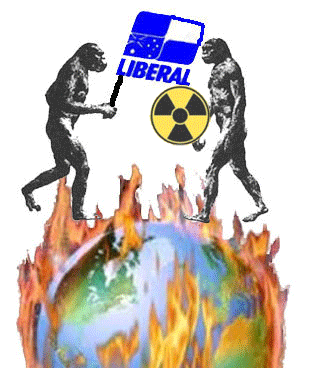 Liberal candidate unable to explain Coalition’s climate change policy http://www.abc.net.au/news/2013-08-19/liberal-candidate-unable-to-explain-coalition27s-climate-chang/4896078 20 Aug 13,
A Liberal candidate in the northern Adelaide seat of Wakefield has admitted he does not know anything about the Coalition’s climate change policy.
In a debate between Liberal candidate Tom Zorich and Labor member Nick Champion, mediator Peter van Onselen asked Mr Zorich to explain how the Coalition’s Direct Action plan would work.
Mr Zorich told the audience he was not across the issue and did not have an answer.
“I will say to you as the candidate, as a candidate, as a candidate and a businessman I’m not across everything. My opponent has already acknowledged that. I’m sorry Pete, I haven’t got much to tell you about that,” he said.
Mr Zorich’s response was met with jeers from the crowd. Continue reading
Australia’s Major Political Parties fail their Nuclear Test
Major Parties fail their nuclear test, Beyond nuclear, 19 Aug 13, The federal Liberal and Labor parties have scored poorly on a nuclear policy assessment released today by national environment, disarmament and medical groups.Beyond Nuclear Initiative, Friends of the Earth, International Campaign to Abolish Nuclear Weapons and Medical Association for Prevention of War have collaborated to produce an election policy scorecard and website (see attached) to help inform voters about party positions on a range of nuclear issues ahead of the September 7 federal election.Issues canvassed included uranium mining and export, support for nuclear weapons and nuclear power and radioactive waste management.The Coalition received one tick and Labor two while Australian Greens policies scored ten out of ten.“The major parties are out of step with many Australians and failing badly when it comes to responsible and evidence based nuclear policies. Many Australians have considered and continuing concerns and opposition that are not being recognised or reflected in policy,” said Dr Jenny Grounds from the Medical Association for Prevention of War.“Against the backdrop of Fukushima, continuing international nuclear insecurity and the need to grow clean and sustainable energy sources the major parties simply fail the nuclear test,” said Gem Romuld from the International Campaign to Abolish Nuclear Weapons.Beyond Nuclear Initiative coordinator Natalie Wasley said “While the major parties do not openly supports an international radioactive waste dump, they both actively support the controversial plan for a national dump at Muckaty in the NT. The Muckaty plan is inconsistent with industry best practice and Australia’s international treaty obligations and is being challenged in the Federal Court. Radioactive waste lasts longer than any politicians promise and it is time for Canberra to do things differently and better”.Dr Jim Green from Friends of the Earth added, “It is a disgrace and an outrage that the major parties support selling uranium to countries that have not even signed the Nuclear Non-Proliferation Treaty. It is a disgrace and an outrage that both major parties support uranium sales to Russia when they know that safeguards inspections are very nearly non-existent.”Further information and comment:Dr Jenny Grounds 0407 287 684Gem Romuld 0421 955 066Natalie Wasley 0429 900 774Dr Jim Green 0417 318 386

Coalition government would mean $4 billion lost from renewable energy funding
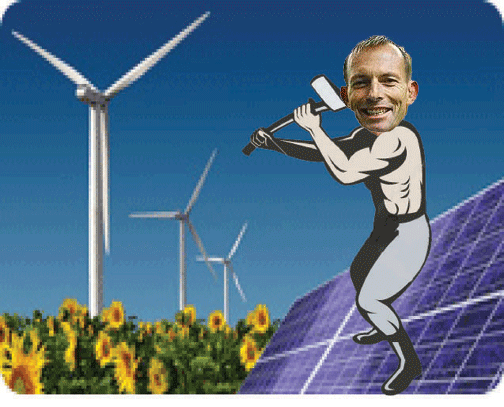 Clean energy faces $4b hit, The Age, 19 Aug 13, About $4 billion in private funding would be sucked from Australia’s solar power and renewable energy industries over the next three years if the Coalition wins government, confidential data obtained from banks and financial analysts shows.
The Coalition’s climate change plan is also about $4 billion short of the funding required to meet its pledge for a 5 per cent cut in greenhouse emissions by 2020, and is instead on track for a 9 per cent increase by then, according to analysis commissioned by the independent think tank The Climate Institute.
Although the Coalition rejects that analysis, major investors are planning for the impact if Opposition Leader Tony Abbott wins power and axes the carbon price and dismantles the clean energy finance system. They expect about $4.1 billion in private funding would be directed away from large-scale renewable power – starving the sector of capital – due to regulatory uncertainty and a lack of solid returns……
The renewables sector, which now employs more people than the car industry, is nervously awaiting the election result.
Clean Energy Council chief executive David Green said: ”Australia’s significant clean energy potential is being held back by seemingly endless rounds of review … our main need is for policy stability to drive investment.”
A major survey of businesses has found uncertainty about the future of the carbon price has had a negative impact on over half the responding firms. The survey by consultants AECOM found 65 per cent of businesses supported an emissions trading scheme, 29 per cent backed a carbon tax and just 7 per cent supported the Coalition’s direct action. http://www.theage.com.au/federal-politics/federal-election-2013/clean-energy-faces-4b-hit-20130818-2s5b9.html#ixzz2cSGq1933
Liberal and Labor pander to mining industry in plan for tax favours to Northern Territory
Greens leader Christine Milne says Labor’s vision for the north panders to the wishes of the mining lobby.
 Gone Troppo: Northern visions just ‘pie in sky’ ABC News, Staff reporters Aug 16, 2013 A respected independent think tank says both major parties are pursuing the worst idea in decades with their plans for tax incentives to encourage investment in northern Australia.
The Australia Institute executive director Richard Denniss says Labor and the Coalition are pursuing bad policy in a bid to win a handful of seats north of the Tropic of Capricorn. “The idea that the national debate should revolve around shifting billions, tens of billions of infrastructure up away from Sydney, Melbourne and Brisbane to chase a few seats up north is politics gone mad,” he said…..
Dr Denniss says it is worrying that there is bipartisan support for the ideas. “There is bipartisan consensus that people in the southern states should continue to pay taxes at the same rate so that we can build new infrastructure, so that people can pay less tax up there,” he said.
“Sydney and Melbourne are creaking under the weight of rapid population growth, and we want to build infrastructure for imaginary cities.” Continue reading
Renewable energy for a positive economic future in New South Wales Coastal Region
“Solar power, sustainable crop waste biomass and energy efficiency are big employers. Pushing the change rapidly lays the basis for a jobs-rich export industry.
“Both the major parties are captured by the fossil fuel lobby.
“The next federal election is make or break for the climate and for jobs in this electorate,”
 Energy future: gas or renewable? http://www.camdencourier.com.au/story/1710272/energy-future-gas-or-renewable/?cs=704 Aug. 16, 2013, The Greens are promoting their plan to make NSW’s electricity supply 100 percent renewable, citing the environmental, health and employment benefits for the Lyne electorate. Greens NSW MP John Kaye will be in Taree and Port Macquarie this Saturday 17 August to talk about the party’s plans for a 100% renewable energy future within 15 years.
Despite the propaganda from the coal seam gas industry and the big energy companies, Dr Kaye will be explaining why all fossil fuels and new transmission lines are unnecessary for keeping the lights on and growing the economy.
Dr Kaye, who will be joined by Ian Oxenford who is contesting the seat of Lyne in the upcoming federal election for the Greens, will outline how a transition to 100% clean green energy technologies will benefit the communities on the Mid North Coast. Continue reading
Tony Abbott’s election gamble – preferencing Labor ahead of Greens
 Tony Abbott to banish the Greens from the lower house SIMON BENSON STATE POLITICAL EDITOR THE DAILY TELEGRAPH AUGUST 14, 2013 OPPOSITION Leader Tony Abbott will today direct the Liberal Party to preference the Greens behind Labor in all seats across the country in a bid to ensure the party is wiped from the lower house of parliament.
It will mean the Greens’ only current lower house MP, Adam Bandt, will almost certainly lose his seat of Melbourne on September 7 – in an election gift to the ALP.
It will also guarantee that Deputy Prime Minister Anthony Albanese keeps his inner-city Sydney seat of Grayndler, which Labor holds with just a 4 per cent margin against the minor party. Continue reading
Heathcote locals unhappy with Victoria’s anti-wind farm laws
 Heathcote locals question Victoria’s anti-wind farm laws http://yes2renewables.org/2013/08/13/heathcote-locals-question-victorias-anti-wind-farm-laws/ August 13, 2013 by Leigh Ewbank
Yes 2 Renewables visited Heathcote recently to present to the local U3A (university of the third age) about wind energy technology. Given that Heathcote is located in the hearth of the McHarg/Macedon Ranges ‘no-go zone’ for wind farms, we took the opportunity to brief attendees about the Victorian government’s anti-wind farm laws. The presentation prompted U3A member, Louise Joy, to submitted the following letter to the editor to The McIvor Times:
Heathcote U3A “Understanding New Technology” group heard Leigh Ewbank from Friends of the Earth speak on “Wind Power” at the Guide Hall for an illuminating and entertaining two hours on Wednesday 3 July 2013 from 10 am.
Such a simple solution to the problems of pollution where unfortunately Victoria leads the way in developed countries. Renewable energy has strong public support with 94% opting for Solar and 87% for wind power. There have been Wind Power community projects planned for Woodend, Surf Coast and Anglesea with opportunities for job creation in manufacturing, construction, maintenance and computer programming. Farms in drought areas benefit, a lid is kept on Electricity prices, communities gain control over their own clean and safe energy future.
So what is stopping implementation with so much community support and so many advantages? There are strong lobby groups with vested interests against Wind Farming. In Victoria, Amendment VC 82 has created no go zones in the Yarra and McHarg Ranges, among others. Heathcote U3A members left the meeting encouraged to make known the advantages of Wind Farming and to lobby politicians to rescind Amendment VC 82.
Abbott very keen to be Australia’s “indigenous affairs prime minister”
Tony Abbott overruled advice on indigenous advisory council BY:PATRICIA KARVELAS :The Australian August 12, 2013 TONY Abbott’s proposed indigenous advisory council was only supposed to last for six months to undertake a significant review of indigenous affairs, but the Opposition Leader changed the policy late in the process.
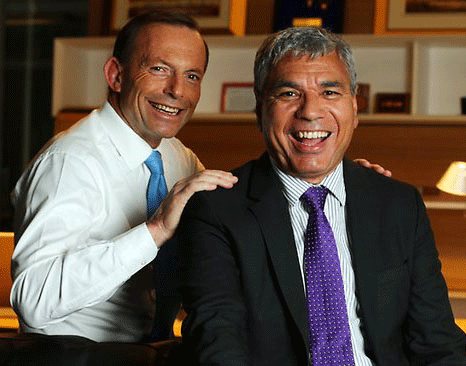
The Australian understands the policy, which had been planned over many months, was rewritten by Mr Abbott who decided, against advice, to make it a permanent feature of his government rather than a short-term audit………..
Mr Abbott ultimately made the call to create an ongoing council similar to Mr Howard’s national indigenous council, of which Mr Mundine was also a member.
Mr Mundine is committed to the objectives of Mr Abbott’s plan for indigenous affairs ……
it is understood that Mr Abbott’s desire to become the first “indigenous affairs prime minister” is so strong he decided a permanent body was a better policy and it could still perform an audit-style role. His office settled on the policy…………. The council will inform the policy implementation of a new Coalition government……….http://www.theaustralian.com.au/national-affairs/indigenous/tony-abbott-overruled-advice-on-indigenous-advisory-council/story-fn9hm1pm-1226695197188
Liberal, Labor, and Warren Mundine in lockstep on Aboriginal issues
I don’t understand why SBS World News would think that indigenous land rights are an “election issue”. Seeing that Australians face two major parties that are in lockstep about Aboriginal matters.
Both Liberal and Labor are keen to keep the Northern Territory Intervention going. Both are all out to promote the 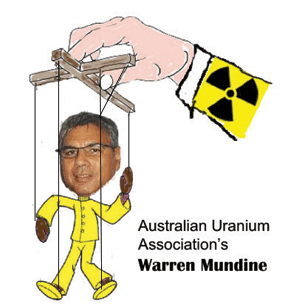 uranium industry, on Aboriginal land. Both are keen to establish a nuclear waste dump on Aboriginal land.
So – no doubt, both major parties are happy to have Aboriginal puppet Warren Mundine close to the helm of whoever wins. As for Mundine – well – he has shown how expert he is, at being “on the side of the winner”. Which definitely does not mean on the side of the Aboriginal people. – C.M
Indigenous land rights emerging as key election issue, SBS World News 12 Aug 13 “………….. the Coalition’s unveiling of its Aboriginal and Torres Strait Islander Affairs Policy, centred on a new Indigenous advisory council headed by the former President of the Labor Party Warren Mundine……. The advisory council will inform the Prime Minister on policy development and implementation, and it will start with a major review of Indigenous spending and service delivery — most notably land rights reform…….

Solar Citizens bring about Government U-turn in Western Australia – national repercussions?
 Barnett Backs Down From Solar Backflip http://www.energymatters.com.au/index.php?main_page=news_article&article_id=3885 13 Aug 13, Solar supporters rejoiced after the Western Australian State Government yesterday reversed its decision to slash the feed in tariff rate for tens of thousands of solar households.
“Quite simply, we got this decision wrong and we have to fix it,” Premier Colin Barnett said in a short statement.
“We understand that this measure would have had an unfair impact on one section of the community and it has to be reversed.”
Within hours of the original decision to slash the incentive, solar households and supporters mobilized. Mainstream and social media was buzzing with condemnation. A Solar Citizens petition was launched that very quickly attracted over 9,000 signatures protesting the reduction.
Even within the State Government’s ranks, there was dissent. Overall, the backlash was such that it had the potential to impact results in the Federal Election. Continue reading
Hear Kellie Tranter – a formidable election candidate for Wikileaks

 AUDIO: Wikileaks seeking accountability in the Senate http://blogs.abc.net.au/nsw/2013/08/wikileaks-seeking-accountability-in-the-senate.html You may have watched or heard the leader’s debate last night that covered the subjects of boats, the economy, tax and the NBN. But did you hear much about monitoring government practice, governmental and public service transparency, internet freedom or your right to protest?
The fact that you didn’t is a major failure by the system and the media who monitors it, according to the new political party; Wikileaks.You may in fact know Wikileaks as a new media organisation-come-whistlebowing operation. But it now wants to take the principles that have made it a household name and form the platform of a senate run.
As far as we know, Julian Assange is under protection in Ecuador, but will still head the Victorian senate ticket.
So what does all this mean for the Hunter? Maitland human rights lawyer Kellie Tranter will head the NSW Senate ticket, and she joined Aaron Kearney to discuss what a vote for Wikileaks actually means in the upcoming election.
Tranter believes the genesis of the Wikileaks party has come from public concern and public groundswell against government secrecy, and that if the public wants to hold the government accountable for its actions, they should cast a vote her way. When questioned about the role of Wikileaks in the senate, Tranter said the Wikileaks party and the Wikileaks organisation are separate entities and that the Wikileaks party is needed to ensure the government is held accountable for its actions.
“We are absolutely fed up with a country being dragged to the far right and we’re looking to pull that back to the middle ground,” Tranter said.
Wikileaks Party strong advocates for Aboriginal rights
 Mr Assange said that the WikiLeaks Party stands alongside all Aboriginal and Torres Strait Islander peoples in their struggle and right to self-determination. The party has an eleven member National Council, with one of its national councillors Gamilaroy man Luke Pearson. Mr Pearson, a teacher and the creator of the highly respected social media project @IndigenousX, is unfolding, alongside others, policy positions and calls for justice for Aboriginal peoples. Mr Pearson is well known for his passion for Aboriginal education as part of a true Australian society and the common good.
“[The Northern Territory Intervention] one of the saddest, if not the saddest episodes of Australian history of the past ten years. A comic-book abuse of the role of the Australian military. A terrible violation of the right of Aboriginal Australia to determine its own destiny.”
Mr Assange said that the Intervention was “…aided and abetted by the credulous mainstream media’s demonization of Aboriginals as sexual deviants.”
Julian Assange on what the WikiLeaks Party will mean to Aboriginal peoples, Wikileaks Party August 10, 2013 by Gerry Georgatos, lead WikiLeaks Party Senate candidate for Western Australia First published in The Stringer, August 10 2013
There is a new political party on the horizon – the WikiLeaks Party. Founded by Julian Assange the fledgling party is bidding for Canberra through the Senate. They have seven Senate candidates including Julian Assange.
Mr Assange was interviewed this week by The Stringer, while holed up in London’s Ecuadorean Embassy in his seeking of Asylum to protect him from the fate that Private Bradley Manning faces in the United States.
The WikiLeaks Party is polling strongly and if the polls were to reflect accurately on election day, September 7, the party would find it has three and maybe four Australian Senators. Continue reading
Australian Greens call for health care justice for nuclear test veterans
 GREENS CALL FOR MEDICAL CARE FOR AUSTRALIA’S NUCLEAR VETERANS HTTP://WWW.GREENS.ORG.AU/GREENS-CALL-MEDICAL-CARE-AUSTRALIA%E2%80%99S-NUCLEAR-VETERANS The Australian Greens have called for hundreds of Australian soldiers who were exposed to radiation from British nuclear bomb testing in the 1950s and ‘60s to automatically receive Veterans’ Gold Card health care.
“Between 1952 and 1963, more than 16,000 Australian civilians and serviceman were exposed to nuclear fallout when British nuclear weapons were tested at the Montebello Islands in Western Australia, Maralinga and Emu fields in South Australia, and over the Christmas and Malden Islands,” spokesperson Assisting on Defence, Senator Scott Ludlam said.
“Some servicemen were clad only in shorts and t-shirts when they were sent into contaminated areas while British scientists in charge looked on wearing full body protective suits.
“In the decades following, many of these men, their wives and families have reported a range of radiation-related disorders ranging from multiple miscarriages to leukaemia, cancers, and respiratory conditions.
“While many radioactive illnesses take decades to manifest after the initial exposure it is widely acknowledged that these men were dangerously exposed. Continue reading
1 This month
17 October, Free Public Talk on Nuclear Issues in South Australia
David Noonan will speak on public interest concerns over the new Roxby Downs Indenture Act 2026 on BHP copper-uranium mining and ore processing in SA, and on how AUKUS may face SA with a High-Level nuclear waste agenda.
Dr Jim Green will discuss international developments in the field of nuclear power including ‘small modular reactors’ and Generation 4 ‘advanced’ nuclear reactor concepts.


Help Aunty Sue Protect Her Land and Sacred Sites From Destructive Rocket Testing.
.

Australians deserve the truth
about
AUKUS – https://aukuspublicinquiry.com/

PETITION – To: Prime Minister Anthony Albanese and the Australian Labor Government

of the week – Australians for War Powers Reform (AWPR)
To see nuclear-related stories in greater depth and intensity

