Independent Australia exposes Abbott’s fraudulent Climate Change “Direct Action”
 Tony Abbott’s “direct action” dud, Independent Australia 9 August, 2013 Doug Evans examines the Coalition’s climate change policies …… In the Liberal Party’s election pamphlet Real Solutions for Australians the Party commits to taking:
‘…direct action to reduce carbon emissions inside Australia, not overseas — and also establish a 15,000-strong green army to clean-up the environment.’
One of the main tasks intended for the green army is proposed to be plantation tree planting for purposes of carbon storage.
Widely known as the Direct Action Policy (DAP) this ‘policy’ comprises:
-
An “Emissions Reduction Fund” of $3 billion to fund projects that would reduce carbon emissions, based on a tender process.
-
Support for projects such as “soil carbon technologies and abatement”.
-
A commitment to reducing carbon emissions by 5 percent by 2020.
In my assessment of Labor Party climate policy, I showed the inadequacy of the bipartisan 5% emissions reduction target. This time, I will address the likelihood that the measures nominated in the DAP could achieve even this modest emissions reduction. Continue reading
Election danger to Liberals in Western Australian backlash over attack on solar energy
Could Barnett’s Solar Attack Impact The Federal Election? http://www.energymatters.com.au/index.php?main_page=news_article&article_id=3884 12 Aug 13, The knee-jerk reaction by Western Australia’s government to its failure to rein in increasing power prices by targeting solar households could cost it – and the Coalition – dearly.
As mentioned on Friday, the Western Australian Government has said it will retrospectively slash the solar feed-in tariff rate for approximately 75,000 households that installed systems between mid 2010 and mid 2011.
A similar move was attempted by the New South Wales Government in 2011; which resulted in that government on the receiving end of a black eye – and the same fate may be in store for Premier Barnett, amplified by its timing.
The decision could have dramatic impacts on the Federal Election in key seats says Dr. Geoff Evans of Solar Citizens. Continue reading
Western Australia: Liberals rebel against govt reneging on solar energy deal
Liberal rebellion on solar heats up, The West, Gareth Parker and Daniel Mercer, The West Australian August 12, 2013, 2 Colin Barnett is facing a backbench revolt over the State Government’s decision to halve its rooftop solar panel subsidy, with a pair of Liberal MPs accusing the Government of lacking integrity.
The growing rebellion came as a letter from Synergy sent in 2011 emerged as a key piece of evidence in any potential legal fight over
the changes. The letter – sent soon after the Government cut the tariff in a previous revision to the scheme – says that customers entitled to the
40 cent payment would get it “for the full term of your 10-year contract”.
Government MPs have been flooded with complaints from irate voters about the decision to cut to the so-called solar feed-in tariff from
40 cents to 20 cents, with the issue spilling over to the Federal election campaign as a vote turn-er against Liberal candidates.
Maverick Hillarys MLA Rob Johnson threatened to cross the floor for the first time in his 20-year career to vote against the measure,
while Southern River MLA Peter Abetz said the Government had acted unethically.
Mr Johnson said the Government was acting with a “lack of integrity” by reneging on a deal with 75,000 solar panel owners in a bid to save
$51.2 million over the next four years. Continue reading
Western Australian government’s solar rate cuts will be fought by Labor
WA Labor promise fight over solar rate cut http://www.heraldsun.com.au/news/breaking-news/wa-labor-promise-fight-over-solar-rate-cut/story-fni0xqi4-1226695095998 AAP AUGUST 11, 2013 WEST Australian opposition leader Mark McGowan has promised to “take on” Premier Colin Barnett after the state government reneged on a 10-year undertaking for households that feed in solar power to the grid.
Mr McGowan tweeted on Sunday: “Anyone unhappy with Mr Barnett ripping up their families solar contract should come to parliament at 2.45pm Tuesday where we will take him on.” It follows Thursday’s state budget in which Treasurer Troy Buswell announced that the government would halve the residential solar feed-in tariff rate to save $51 million.
The state government believes it is safe from legal action over the decision, despite many householders expressing their outrage on talkback radio.The program, introduced in 2009, was such a success that the Liberal government had to admit in 2011 the take-up cap had been breached, costing about $46 million more than planned.
The Sustainable Energy Association says more than 75,000 WA households will be affected. Mr McGowan described the solar backflip as another “broken promise” from the Barnett government.
New obstacles to Tasmania’s solar industry
New Building Codes Threaten Tasmania’s Solar Industry http://www.energymatters.com.au/index.php?main_page=news_article&article_id=3883 12 Aug 13 Additional and pointless red tape threatens the solar industry in Tasmania say the Greens. The Tasmanian Greens have called for the Minister for Workplace Standards to review proposed new building codes for solar installations that it says would increase the cost of installing solar – and ultimately lead to job losses in the industry.
Greens Energy Spokesperson Kim Booth MP says the proposed new regulations will see Councils requiring planning fees and an accredited builder to install a solar panel system – even though solar installations are already required to be engineered, installed and inspected according to Australian Standards.
The additional costs could add 25% – 100% on to the contracted value of solar installation.
Mr. Booth says the industry is concerned only accredited builders will be legally permitted to perform installs, while suitably accredited solar installation experts are “driven off the site.”
“Ultimately, pointless red tape drives the price up for consumers and potentially drives companies out of business, something that the Property Council and the HIA should reflect on given their role in wrapping the building industry up in worthless over regulation.” The solar industry in Tasmania is facing a number challenges; including an uncertain future for the state’s feed in tariff. However, for households that install solar power systems before January 1, 2014, Tasmania’s government has proposed to keep the state’s 1:1 feed in tariff in place until 2017 – making the best time to go solar in Tasmania likely right now.
According to solar solutions provider Energy Matters, a good quality 3kW solar panel system installed in the Apple Isle can return a financial benefit of approximately $890 a year.
More than 12,500 households in Tasmania have already installed solar PV systems. In doing so, these households have not only slashed their own power bills, but have also generated employment, diversified electricity generation and allowed increased export of the state’s hydropower to mainland states; providing additional revenue for Tasmania.
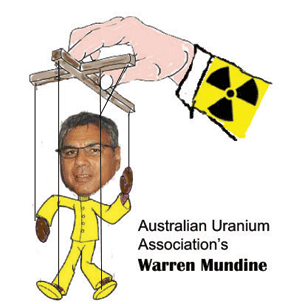
Warren Mundine , nuclear lobby’s Aboriginal spin doctor, enters election campaign
Christina Macpheson, 10 August 13, Australia’s uranium-nuclear lobby must be ecstatic. After all that Aboriginal opposition to their mines, and their nuclear waste dump plans, now their very own Aboriginal stooge has stepped in. Warren Mundine, former National President of the Labor Party, has well and truly jumped political party ship, to head a new Liberal party indigenous advisory council .
Warren Mundine has an impressive pro nuclear record. He has been promoting the nuclear industry , praising nuclear energy,saying that it is necessary for nuclear medicine. Most alarming of all, Mundine advocates the “full nuclear cycle”. That means Australia not only having nuclear power, but taking in nuclear waste from overseas countries.
Mundine’s nuclear lobbying activities have been documented on this website several times. He was appointed by Queensland Premier Newman to the uranium implementation committee. He is co-convener of the Australian Uranium Association’s Indigenous Dialogue Group,

There’ll be a few Aboriginal people who will,not be happy with Mundine’s latest effort. He’s been slammed in the past by Noongar anti-nuclear activist, Marianne McKay of the West Australian Nuclear Free Alliance.
Warren Mundine is a Director of the Australian Uranium Association
Nuclear Lobby’s Warren Mundine and Tony Abbott are kindred spirits
 Indigenous affairs: Tony Abbott says he and Warren Mundine are ‘kindred spirits’ Coalition
 leader wants to work in close partnership with Mundine, who would head a new indigenous advisory council under an Abbott government Paul Owen in Sydney and agencies theguardian.com, Saturday 10 August 2013
The Coalition leader said there was a need to convert all the good thinking from indigenous leaders such as Mundine, Noel Pearson and Alison Anderson into practical action on the ground.
“Warren and I are kindred spirits and I’m really excited at the changes that have taken place in thinking about these issues over the last decade or so,” he told ABC radio on Saturday morning.
Abbott said he wanted to work in close partnership with Mundine, who would head a new indigenous advisory council under a Coalition government, and said the arrangement could make the difference needed to improve indigenous lives…… Mundine, the executive chairman of the Australian Indigenous Chamber of Commerce, is to spell out his vision at the Garma Festival in the Northern Territory on Saturday night. That will reportedly involve abolishing a range of indigenous governance bodies and excising townships from community-owned land to allow for private ownership of homes and businesses….. http://www.theguardian.com/world/2013/aug/10/indigenous-affairs-tony-abbott-warren-mundine-kindred-spirits
Senator Ludlam asks awkward questions on Wiluna uranium mine project
 WILUNA URANIUM PROJECT – MINE CLOSURE PLAN http://www.greens.org.au/wiluna-uranium-project-mine-closure-plan Senate Standing Committee on Environment and Communications
Legislation Committee Answers to questions on notice Sustainability, Environment, Water, Population and Communities portfolio
Budget Estimates, May 2013
Topic: Wiluna uranium project – mine closure plan
Senator Ludlam asked: But how much work around mine closure had been assessed by the minister? Presumably, something must have been done or he would not have had the confidence to give this thing the tick, even a conditional tick?
Ms Jones: Through the assessment process there were assessment documentation in draft and final form. Supplementary information was sought by the minister from the proponent on issues that cut across this matter. To give a succinct response, I would probably have to take that on notice and come back to you, Senator.
Senator LUDLAM: Maybe if you could, yes. I am interested in the degree to which the approval conditions side is open-ended. Does it have any lapse date at all, or is this an approval in eternity? If the company comes back in 20 years, will it be live, or does it have a lapse date?
Answer:
The proposed action was assessed by the Western Australian Environment Protection Authority under the bilateral agreement between the Commonwealth and Western Australian Government. The State assessment report addressed the issue of mine closure, including assessment of an Environmental Management Strategy for Mine Closure and Rehabilitation provided by the proponent. The Minister considered the State assessment report. The Minister also sought further information from the proponent in relation to the long-term integrity of the tailings storage facility, which was reviewed by the Supervising Scientist Division, Geoscience Australia and the Australian Radiation Protection and Nuclear Safety Agency.
The approval is valid until 31 March 2043. Condition 2 of the approval states that if, at any time after five years from the date of this approval, the person taking the action has not commenced the action, then the person taking the action must not commence the action without the written agreement of the Minister.
Australian political parties’ policies on nuclear power and uranium mining
Well – you’d be hard put to find out about this. I scoured the web to get anything up to date about this. But no ! – in spite of all the media rubbish going on lately about how great nuclear power would be for Australia – no political party has a word to say about nuclear issues.
It seems that they think (even the Greens) that nuclear power is just irrelevant to the coming Australian election.
As for uranium mining – well despite its disastrous financial and environmental state, Australia’s mainstream media regards uranium mining as a great investment, terrific, we all love it

Indeed, the mainstream media does not cover nuclear/uranium issues as relevant. Even the current radiation crisis at Fukushima is not relevant news. (The ABC is an exception) Hiroshima Day came and went, as far as I could see, it was ignored by the mainstream media.
If it weren’t for Gem Romuld Outreach Coordinator International Campaign to Abolish Nuclear Weapons- Australia www.icanw.org.au we just wouldn’t know about our election parties’ nuclear policies.
So, thanks, Gem, for taking the trouble to let us know about party policies on nuclear power

Australian political parties’ policies on climate change and environment
 Environment policy: where the parties stand ABC, By Sarah Clarke and Andrew Greene Aug 5, 2013 After slipping from the national agenda, the environment and climate change are now back to prominence. When the ALP was elected in 2007, prime minister Kevin Rudd made climate change centre-stage at the UN climate meeting in Bali, where he declared that Australia would ratify the Kyoto Protocol.
Mr Rudd first proposed an emissions trading scheme but postponed the idea. When she became prime minister, Julia Gillard revived a carbon price, in the form of a carbon tax, as a condition for getting the independents and Greens on side to form minority government.Following her departure, Mr Rudd has declared the carbon tax “terminated” as Labor promises to move to an emissions trading scheme by July 2014, one year earlier than planned.
The Coalition plans to scale back staff in the newly created Climate Change department, and merge it with the Environment Department. Under its “Direct Action” policy a number of initiatives and agencies set up by Labor will go.
On an international scale, Australia is one of the largest per capita emitters in the developed world. Australia’s carbon pollution represents 1.5 per cent of global emissions of greenhouse gases and our emissions are projected to continue growing by almost 2 per cent a year.
What aspects do the major parties agree/disagree on?
Greenhouse gas emission reduction targets
Both ALP and the Coalition agree on the science of climate change, and have formally backed Australia’s emissions reduction target of 5 per cent by 2020. But there are some differences:
- ALP: Committed to 5-25pc reduction on 2000 levels by 2020, based on the ambition of global agreement and 80pc reduction by 2050 which is in line with the UK and Germany. Signatory to second commitment period of Kyoto Protocol for 2020 reduction and intention to ratify.
- Coalition: Committed to the 5-25pc reduction on 2000 levels based on ambition of global agreement. Review in 2015 to consider longer term target in light of international agreement. Coalition has stated “in principle” support for second commitment period of Kyoto Protocol but no position on ratifications announced.
- Greens: Committed to 25-40pc reductions on 1990 levels by 2020, net zero emissions by 2050 and the second period of the Kyoto Protocol.
Carbon price
- ALP: Carbon pricing legislated in 2011 along with independent Climate Change Authority, Clean Energy Regulator, and Australian Renewable Energy Agency. Climate Commission established administratively in February 2011 to explain the science of climate change. Announced in July 2013 bringing forward emissions trading scheme to 1 July 2014 and cutting back Energy Security Fund from $4.3 billion to $2.5 billion.
- Coalition: Committed to abolish carbon price. Abolish the Climate Change Authority, Climate Commission, and the Energy security fund. Retain the Clean Energy Regulator and the National Greenhouse and Energy Reporting Scheme (NGERS) as part of the administration of the Emissions Reduction Fund. Committed to introducing a carbon buyback via an Emissions Reduction Fund.
- Greens: Made carbon pricing a condition of supporting the Gillard Government after the 2010 election, including the creation of Multi Party Climate Change Committee. Do not support bringing forward emissions trading to 1 July 2014.
Clean Energy Finance Corp
- ALP: CEFC legislated in 2012 with funding of $10 billion over 5 years to leverage private investment to deploy and commercialise large scale renewable energy and energy efficiency projects with funding from July 1, 2013. Investment functions of Low Carbon Australia now merged into CEFC.
- Coalition: The CEFC to be axed and contracts already issued will not be acted on.
- Greens: Will oppose any attempt to repeal the CEFC.
International climate deal
- ALP: Labor supports a global deal through the United Nations negotiations and along with all member countries has agreed to set up a legally binding international deal for all major emitters by 2015 in Paris, to be up and running by 2019. Supports G20 and Major Economies Forum to shape global solution and climate deal.
- Coalition :The Coalition supports the role of the UN and will be engaged in the international negotiations. In addition, the coalition believes that as Chair of the G20 there’s an opportunity for Australia to further negotiations between the US, China, India and the EU to secure an international deal.
- Greens: Greens support a legally binding global deal through the UN negotiations by 2015.
Renewable Energy Target (RET)
- ALP: Committed to the RET of at least 20pc by 2020 which maintains target of 41,000 GWh large scale renewable energy generation by 2020. Commitment not to review RET until 2016.
- Coalition: Committed to the RET of 20pc by 2020 but will review it in 2014.
- Greens: Committed to the RET of at least 20pc by 2020 which maintains target of 41,000 GWh large scale renewable energy generation by 2020; 2030 RET target is 90pc.
Australian Renewable Energy Agency (ARENA)
- ALP: Established ARENA but cut its budget in 2013. Approx $3 billion of support maintained and receives dividends from the CEFC.
- Coalition: Maintain ARENA and accepts Labor’s budget cuts. Would not receive dividends from CEFC if it was abolished.
- Greens: Opposed Labor’s cuts to ARENA in the 2013 Budget.
Carbon farming
- ALP: Set it up and committed $290 million to Carbon Farming Futures and Skills program. $44 million for complementary improvements in Natural Resource Management planning. Adopted new international rules which allow virtually all Carbon Farming Initiative credits to be sold to all polluters in the carbon pricing mechanism.
- Coalition: Committed to keeping it, and vowed to expand to include a wider range of emissions reduction methodologies to be available for purchase via the Emissions Reduction Fund.
- Greens: Supported the establishment of the CFI and negotiated amendments under the auspices of the Multi Party Climate Change Committee adding a ‘negative list’ which bans a range of project types……. http://www.abc.net.au/news/federal-election-2013/policy/climate-change/
Hypocrisy of Foreign Minister Carr: Australia DOES have the power to help Julian Assange

Australia could seek an assurance from Sweden that following the completion of all Swedish legal proceedings that Assange would be deported to Australia. This would be an entirely appropriate outcome for an Australian citizen who has been subject to extradition to a foreign country.
If the Gillard government was able to obtain these diplomatic assurances, which are consistent with international law, then Assange would face his accusers in Sweden and not face the prospect of onward extradition to the United States.
How Australia can end the Assange stalemate The Drum Australia can help Julian Assange negotiate his legal problems while remaining consistent with the norms of international law and with the level of assistance that would be offered to other Australians, writes Donald Rothwell. …….. the UK has indicated that it does not recognise Ecuador’s granting of asylum and if Assange were to leave the Embassy he is liable to arrest and extradition to Sweden.
Ecuador revealed in mid-August – as the Assange matter reached a pivotal point- that Britain had threatened to rely on its Diplomatic and Consular Premises Act and revoke the Ecuadorian Embassy’s diplomatic protection so as to enter and seize Assange.
This threat was extraordinary and without modern precedence and it was unsurprising that the Ecuadorian Government responded with such fury. British Foreign Secretary William Hague has now downplayed any suggestion that the Ecuadorian Embassy will be raided, and emphasised Britain will act consistently with international law.
Nevertheless, Hague and the British government have made it clear that they have a legal obligation to Sweden to extradite Assange and that they will continue to seek his arrest for breach of his bail conditions……..
Australia has been remarkably silent on some of these recent developments. Throughout the year Assange has been highly critical of what he claims has been a lack of support from the Australian government, but Foreign Minister Bob Carr insists that Assange has received more consular assistance than any other Australian in similar circumstances.
The reality is that Australia can still play a proactive, and perhaps even pivotal role, in seeking to bring about a resolution to the current stalemate. Continue reading
Tony Abbott aims to shut down clean energy initiatives
 Renewables fear the worst as Tony Abbott targets clean energy REneweconomy, By Giles Parkinson on 6 August 2013 Australia’s clean energy industry leaders have been invited to a special meeting next week to discuss the future of renewable energy policy in the country and to contemplate the unpalatable, as Coalition leader Tony Abbott began his campaign with an early lead and a call to the Clean Energy Finance Corporation to cease its operations immediately.
A meeting of the CEOs of Australia’s largest companies involved in the renewable energy industry is believed to have been called by AGL Energy managing director Michael Fraser, who doubles as chair of the Clean Energy Council, to discuss strategies to protect the renewable energy target (RET). Or indeed to assess whether they have the political capital or influence to maintain the target as is under a Coalition government.
The crisis meeting comes as the Coalition takes an early lead in the first days of the election campaign, and with increasing uncertainty about the likely make-up of the Senate. The renewables industry fears that with a Coalition win, the lobbying from incumbent utilities and generators, including the Business Council of Australia, to have the RET diluted or removed will intensify, and there may be little political protection for the current target.
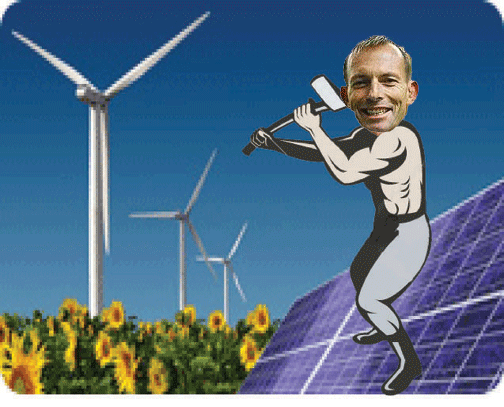
The renewable energy industry is probably the industry sector most directly affected by the outcome of this election. While Labor has vowed to push the next RET review out to 2016, the Coalition wants to have yet another review of the RET in 2014, and has expressed sympathy with pleas to dilute the fixed 41,000GWh target because of falling demand.
The uncertainty that this has created has already brought most large-scale developments to a halt. Continue reading
Labor’s “captain’s pick” Northern Territory candidate opposes Muckaty nuclear waste dump
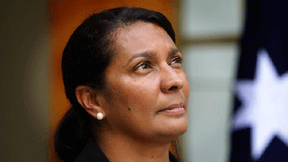 Nova happy to spoil the party, NT News XAVIER LA CANNA | August 1st, 2013 LABOR’S “captain’s pick” Senate candidate Nova Peris said she would have crossed the floor to oppose the Muckaty nuclear waste dump – and would vote against her party if she felt strongly about other issues.
Ms Peris said the Muckaty nuclear waste dump – planned to be built near Tennant Creek – was one area where she would go against Labor Party policy.
“I met with the anti-nuclear campaign people and I also met with the NT environment mob, and I have met with the Tennant Creek residents, I have met with the unions and I have met with three of the traditional owner groups,” Ms Peris told the NT News .
“In my view I do stand with them in opposing that (nuclear dump).” Continue reading
Abbott’s gung-ho plans for Northern Australia might meet Aboriginal resistance
 Developing Australia’s ‘frontier’ may be political pipedream
Stuff NZ, JAMES REGAN 29/07/2013″………ABORIGINES CONTROL THE NORTH Australia’s miners and Aborigines are uncomfortable bedfellows. The minerals beneath aboriginal land in the north can benefit the nation’s most disadvantaged people, but often mineral wealth clashes with their ancient beliefs.
In 1991 Australia’s then prime minister stopped then BHP’s planned Coronation Hill gold mine because of local Aborigines believed a giant serpent lived beneath the hill. A fifth of the Northern Territory is now owned or controlled by aboriginal groups and Abbott will need to convince them of the benefits of mining if he is to see a new resources boom.
Many Aborigines have joined environmentalist to discourage mining. Electronic sensors have even been installed in some places to warn if mining companies trespass.
The Gundjeihmi Aboriginal Corp is campaigning for the massive Jabiluka uranium deposit, 300kms (185 miles) south of Darwin, to be included in the nearby Kakadu National Park to stop further development. Resources multinational Rio Tinto’s Energy Resources of Australia Ltd subsidiary is permitted to mine uranium around the site until 2021 but only as long as it adheres to restrictions imposed by indigenous land owners.
Green politicians, likely to be key swing votes in the upper house Senate after the election, oppose Abbott’s plan.
 Reply Reply |
Forward |
 |
Click here to Reply or Forward
|
Global warming – a crisis not really recognised by Rudd or Abbott
 ”It’s a gradually building crisis, or a looming emergency, which makes it hard for people to grasp and for politicians to react to,” he says. Woods likens the rise in average global temperatures (which are incontrovertible by anyone sensible) to the frog which is slowly boiled.It might not feel like a crisis now, but we will still be cooked by the end of it.
When everything is a crisis, whom should you believe July 27, 2013 The Age, Jacqueline Maley Parliamentary Sketch Writer for the Sydney Morning Herald “………..some crises are sexier than others.
Most credible scientists would call the warming of the planet a crisis, or at least an impending problem, but you will not hear either Rudd or Abbott declare it one. For different reasons, it is not in their political  interests to do so.
Rudd has moved heaven and earth (and created a budget hole of $3.8 billion) to neutralise the opposition’s anti-carbon tax campaign. The Prime Minister acted to ease voter concern about rising cost of living pressures, which rather disrupted the Gillard government’s narrative that the cost of living had either not risen, or where it had risen, had been offset by government compensation.
It’s a confused message, and it’s difficult to believe the government has designed the best possible emissions abatement scheme when it was initially created as a political fix, and then tampered with for another political fix.
Meanwhile, though Abbott points to the Coalition’s 30-page Direct Action Plan as evidence he can be taken seriously on climate change, it is difficult to believe it is a policy area close to his heart when he has previously declared the science ”crap” (comments he made in September 2009 to a Liberal Party function, reported by the Pyrenees Advocate. Abbott has since said he believes climate change to be real).
But now the heat has come out of the carbon tax debate, which was so rageful for so long, it might actually be possible to set Direct Action side by side with the government’s emissions trading scheme, and compare the policies with (dare I write it) cool heads. Continue reading
1 This month
17 October, Free Public Talk on Nuclear Issues in South Australia
David Noonan will speak on public interest concerns over the new Roxby Downs Indenture Act 2026 on BHP copper-uranium mining and ore processing in SA, and on how AUKUS may face SA with a High-Level nuclear waste agenda.
Dr Jim Green will discuss international developments in the field of nuclear power including ‘small modular reactors’ and Generation 4 ‘advanced’ nuclear reactor concepts.


Help Aunty Sue Protect Her Land and Sacred Sites From Destructive Rocket Testing.
.

Australians deserve the truth
about
AUKUS – https://aukuspublicinquiry.com/

PETITION – To: Prime Minister Anthony Albanese and the Australian Labor Government

of the week – Australians for War Powers Reform (AWPR)
To see nuclear-related stories in greater depth and intensity

