Australian Greens’ dissenting report on The Australian Naval Nuclear Power Safety Bill .

1.1The Australian Naval Nuclear Power Safety Bill 2023 (the Bill or ANNPS) is deeply flawed legislation that is only being progressed because of the deeply flawed trilateral agreement that is AUKUS.
1.2The Bill proposes a seriously flawed regulatory model for the dangers of naval nuclear reactors and associated waste.
1.3 The proposed regulator lacks genuine independence, the process for dealing with nuclear waste is recklessly indifferent to community or First Nations interests and the level of secrecy is a threat to both the environment and the public interest.
1.4 Any amendments proposed to improve the many deficiencies of this legislation should not be interpreted as support for the Bill itself or for the AUKUS deal.
1.5 This Bill establishes a new defence naval nuclear regulator that will oversee all aspects of the nuclear production and waste cycle associated with Australian nuclear-powered submarines (and with regard to waste but not the operational activities of UK and US submarines) that operate, are constructed or decommissioned in Australia and Australian territorial waters.
1.6 This regulator will be entirely separate from the existing and long-standing nuclear regulation framework in Australia, which currently sits under the Australian Radiation Protection and Nuclear Safety Act 1998 (ARPANS Act).
Independence
1.7This Bill fails to meet the fundamental international principles of regulatory independence for safely addressing the inherent risks of nuclear power and nuclear waste.
1.8In this Bill, the proposed Australian Naval Nuclear Power Safety Regulator reports directly to the Minister of Defence. The Defence Minister is also responsible, through the Australian Defence Force, for the operation of those same nuclear submarines.
1.9 This is widely out of step with international standards of legal and functional independence for nuclear safety and is contrary to current practice on civil nuclear regulation in Australia.
1.10This is also in direct opposition to the International Atomic Energy Agency in its Fundamental Safety Principles that state: An effective legal and governmental framework for safety, including an independent regulatory body, must be established and sustained.[1]
1.11It is also not in line with the current regulation of nuclear waste in Australia. The regulator, called the Australian Radiation Protection and Nuclear Safety Agency (ARPANSA) sits in the Ministry of Health whereas the Australian Nuclear Science and Technology Organisation (ANSTO) (which operates the Lucas Heights reactor) sits in the Ministry of Industry and Science. This is to ensure the regulator is independent of the industry it oversees.
1.12As the majority report notes in some detail, the proposed model under this Bill is distinct from either the UK or US naval nuclear regulators.
1.13 In the UK, while the main naval nuclear regulator does report through the Ministry of Defence, there is a significant ongoing role for the independent civilian Office for Nuclear Regulation (ONR) in overseeing defence nuclear activities. This is formalised in the General Agreement between the Ministry of Defence and the Office for Nuclear Regulation. This agreement clearly delineates the relationship between the Ministry of Defence and the ONR in discharging their respective roles and responsibilities for the UK’s defence nuclear operations. There is no equivalent role for ARPANSA in this Bill.
In the US, the regulator is known as the Naval Nuclear Propulsion Program (NNPP). This is not run solely by Defense but rather is jointly managed and self-regulated by the civilian National Nuclear Security Administration (NNSA) that reports to the Department of Energy, and the Department of the Navy. By contrast, under this Bill the regulator will be entirely within the Department of Defence and the Defence Minister will have sole ministerial responsibility.
1.15The importance of regulatory independence was outlined in a letter to the CEO of ARPANSA from the Radiation Health and Safety Advisory Council in October 2022 that stated:
Independence of the regulator is a critical part of its effectiveness. The regulator should be independent of the operators and departments overseeing any aspect of purchase, manufacture, maintenance, and operation of the program. It is noted that some of the more significant global nuclear and radiation incidents have arisen from inadequate separation of responsibilities from regulatory capture. More than functional separation, it is important that the independent regulator can operate without influence, and with a strong voice. If a regulatory body cannot provide information on safety and incidents at licensed facilities without the approval of another organisation, issues of independence and transparency will arise. Reporting arrangements should therefore enable the regulatory body to be able to provide safety related information to the Government and the public with the maximum amount of transparency.[2]
1.16During a committee hearing, these concerns were put to the Royal Institution of Naval Architects (RINA), concerning the importance of independence in ‘social licence’:
Senator SHOEBRIDGE: We have good examples, though, of independence. ANSTO is an operator. The regulator of ANSTO reports to a different minister, and that is part of how ANSTO gets social licence. That’s a good example, isn’t it, of structural independence?……………………………………………………
ARPANSA also acknowledged that the key to their social licences was independence through reporting to a minister not associated with the industry they are regulating
1.18In further questioning concerning how this independence can be achieved with the Defence Minister having both the regulator and the body it’s regulating reporting to them, ARPANSA stated:
Senator SHOEBRIDGE: Do you agree it’s a weakness in this bill to have the operator and the regulator both report to the same minister? Or if you don’t want to adopt my phrase, tell me how you would respond to the fact that the regulator and the operator both report to the same minister, given the fundamental importance of independence?
Dr Hirth: I think it’s important to go back to the IAEA, and I think the comments made by RINA in your questions to them this morning around undue influence. Establishing reporting arrangements in order that there isn’t undue influence of interested parties does present a challenge for the Minister for Defence…………………………….
1.19Furthermore, there were concerns raised about the development of a new regulatory body, with all the concerns of independence with the ANNPS Bill, which may also lack the expertise needed……………..
The ability of the Minister through proposed section 105 to issue directions to the regulator further blurs the independence of the new regulator. This was a concern for the Australian Shipbuilding Federation of Unions (ASFU),……………………………………………
1.21Another aspect of the lack of independence concerns the staffing and leadership of the new regulator. It is true that neither the Director-General nor Deputy Director-General can be an active member of the ADF (Australian Defence Force) as specified in proposed section 109.
1.22 However, there is nothing stopping someone from immediately stepping out of the ADF and the next day becoming the Director-General or Deputy Director-General, as this exchange with Defence made clear:……………………………………………………..
1.23 Furthermore, there are no such restrictions on the staff of the regulator, which may all be drawn from active ADF personnel.
1.24 This means the supposed independent regulator of Defence can be run by someone who, the day before was in the Defence, staffed by the Defence and report to the Minister of Defence.
Recommendation 1
1.25 It is recommended that the Bill be amended to ensure a genuinely independent regulator and that the regulator reports to the Minister of Health rather than the Minister of Defence.
1.26 Alternatively, that the regulator more closely reflects the arrangements in the United States and jointly reports to both the Minister of Health and the Minister for Defence, with these Ministers jointly holding Ministerial responsibility under the Bill.
Recommendation 2
1.27 It is recommended that for transparency any direction issued under section 105 be tabled in Parliament within three days where the direction may, or will, negatively impact public health or safety.
Recommendation 3
1.28 It is recommended that section 109 be amended to:
prohibit the Director General from being a current or former member of the ADF or Department of Defence, and;
that the Deputy Director General not be a current member of the ADF or Department of Defence or have been a member of the ADF or Department of Defence for at least two years prior to any appointment.
No public or First Nations consultation
1.29This Bill allows the Minister of Defence to establish ‘designated zones’ for the storage, management and disposal of low, medium and high-level nuclear waste in any part of Australia the Minister chooses by regulation.
1.30This Bill establishes an initial two zones, one at HMAS Stirling at Garden Island in Western Australia and another at the Osborne Naval Shipyard in South Australia. Both zones are close to major metropolitan centres.
1.31Concerning future nuclear waste dumps, the Minister for Defence has indicated that they will only be on Defence land, however, that includes large parcels of land within every major population centre in the country. The Minister also said this can include ‘future’ Defence land.[9]
1.32However, the Bill does not provide even this limitation on where nuclear waste can be located. In fact, the Bill says in bold terms the waste can be on defence land or ‘any other area in Australia’ identified in the regulations. This means, with the flick of the Minister’s pen, any location in Australia can be made into a high-level nuclear waste dump.
1.33This completely excludes any consultation with the local impacted community or with First Nations people whose land and water will be targeted by Defence. With this Bill, neighbours to large defence sites like Holsworthy in Sydney or Greenbank in Brisbane are right to be concerned that they may wake up one morning, with no notice, to find they back onto a high-level nuclear waste dump.
1.34 We have seen from decades of failed attempts to set up nuclear waste sites across the country, most recently at Kimba, that Federal governments have routinely sought to override First Nations people’s claims to the land on this issue. The United Nations Declaration on the Rights of Indigenous Peoples (UNDRIP) specifies the importance of free, prior and informed consent before any such action is taken. This Bill does not even pretend to engage with these principles.
1.35 As the submission from Friends of the Earth stated:
First Nations communities have repeatedly defeated thuggish, racist governments in relation to radioactive waste facilities but that has come at a huge cost in terms of physical and mental health.[10]
1.36The few protections that the law currently gives to First Nations people over their land are removed by this Bill. The Independent and Peaceful Australia Network raised this during a hearing, stating:
There doesn’t seem to have been any notice taken of the United Nations Declaration on the Rights of Indigenous Peoples. They should have the right to prior informed consent on this issue and have full consultation before any designations are made for nuclear waste.[11]
1.37Multiple submissions also raised the comments by Dr Marcos Orellana, UN Special Rapporteur on Toxics and Human Rights, in 2023 on this issue, saying:
It is instructive that all siting initiatives by the Government for a radioactive waste repository have failed, leaving a legacy of division and acrimony in the communities. The loss of lives and songlines resulting from exposure of Indigenous peoples to hazardous pesticides in the Kimberley region, from asbestos exposure in Wittenoom in Western Australia, and from the radioactive contamination following nuclear weapons testing in South Australia, are all open wounds. Alignment of regulations with the UN Declaration on the Rights of Indigenous Peoples is a critical step in the path towards healing open wounds of past environmental injustices.[12]
1.38Concerning the proposed nuclear ‘designated zone’ in Perth, Nuclear Free WA and Stop AUKUS WA noted the importance of the areas around HMAS Stirling, stating in their submission:
Cockburn Sound and Garden Island have significant cultural value for First Nations Peoples … The ecological values of Garden Island, the proximity to Cockburn Sound make radioactive waste disposal here incompatible.[13]
1.39 It is remarkable that on an issue so vital to communities, the potential location of a nuclear waste dump, there is zero public consultation required under this Bill. Compare this to existing laws such as the National Radioactive Waste Management Act 2012, where a site must be voluntarily nominated, evaluated against technical, economic, social and environmental criteria, and offered for public consultation.
1.40 This, together with the express inclusion of the UNDRIP principles, is the minimum standard that should be expected under this Bill for public and First Nations consultation.
Recommendation 4
1.41 It is recommended that the Bill must ensure that there is free, prior and informed consent from First Nations people and the communities impacted before any designated zone is established for low, medium or high-level naval nuclear waste.
Recommendation 5
1.42 It is recommended that the Bill should expressly include reference to, and compliance with, Australia’s international obligations including the United Nations Declaration on the Rights of Indigenous Peoples.
Recommendation 6
1.43 It is recommended that the Bill should adopt the requirements for public consultation and site identification for designated nuclear zones found in the National Radioactive Waste Management Act 2012.
Transparency and collaboration
1.44 The ARPANS Act has key elements to ensure the management of nuclear waste is done in collaboration with other experts and bodies, as well as openly with the public. This Bill fails on both of these fronts……………………………………………………………………………………………
1.47 By creating a legally and functionally separate naval nuclear regulator this Bill ignores decades of experience in both the UK and the US where there is a co-regulatory civil and defence regime. This not only ignores international experience, it also ignores the decades of experience held in Australia’s civilian nuclear regulators and advisers. This is a reckless proposal that will leave Defence to be both the nuclear operator and the nuclear regulator without having ongoing advice from an independent body.
Recommendation 7
1.48 It is recommended that the Bill should require close co-operation and consultation between the proposed naval nuclear regulator and the civilian regulator ARPANSA.
Recommendation 8
1.49 It is recommended that the Bill should be amended to ensure that the Director General receives advice from the relevant nuclear safety advisory groups including the Radiation Health and Safety Advisory Council, Radiation Health Committee and the Nuclear Safety Committee.
UK and US nuclear waste dumping ground
1.50 As noted above the Bill is drafted to allow the UK and US to dump nuclear waste, including high-level nuclear waste, from their existing and decommissioned nuclear submarines in Australia.
1.51 Despite Minister Marles rejecting this as ‘fear-mongering’ when first raised, this fact was admitted by multiple witnesses, including Defence officials and BAE Systems Australia. It also flows from any even moderately close reading of the Bill.[16]
1.52 It turned out to be significantly more than this with numerous organisations confirming that this Bill indeed does allow for the dumpling of nuclear waste in Australia from UK and US submarines.
1.53 Mr Peter Quinlivian, Senior Legal Counsel, BAE Systems Australia admitted the law would permit the dumping of nuclear waste from UK nuclear submarines in the following exchange:…………………………………………………………………………………………………………………….
1.54 Mr Adam Beeson, General Counsel, Australian Conservation Foundation, further corroborated this information said:………………………………………………………………………….
1.55 Mr Kim Moy, Assistant Director-General of the Domestic Nuclear Policy Branch, Department of Defence also admitted that this Bill would allow for the dumping of foreign nuclear waste:……………………………………………………
1.56 Question on Notice 1 from Defence during this hearing also made clear that the current definition is not just limited to low-level nuclear waste, but high-level nuclear waste too.[20]
1.57 This is particularly disturbing given the UK currently has no plan to dispose of the nuclear waste from their nuclear submarines. In the UK there are now six decades of decommissioned rusting nuclear submarines that are filled with high and medium-level nuclear waste for which they have no solution.
1.58 To be clear, under this Bill, there is a real and present danger that either this government or a future government will allow UK nuclear waste to be brought to Australia. This is an extraordinary proposal and is so clearly not in Australia’s interests, let alone the interests of communities and First Nations peoples on whose land this toxic waste will be dumped.
1,59 Mr Dave Sweeny, Nuclear Policy Analyst, Australian Conservation Foundation addressed these concerns ………………………………………………………..
1.60If the AUKUS nuclear submarine deal is to splutter on, then it must not be allowed to become a back door entry for the world’s most toxic nuclear waste.
Recommendation 9
1.61 The Bill must be amended to ensure that no UK or US nuclear waste can be stored or disposed of in Australia.
Overrides other laws
1.62 This Bill also seeks to override or disregard other laws and international obligations.
1.63 For example, the Bill allows for the Minister to override State and Territory laws that might limit where the Federal Government proposes nuclear waste will be stored through proposed section 135 which reads:
If a law of a State or Territory, or one or more provisions of such a law, is prescribed by the regulations, that law or provision does not apply in relation to a regulated activity.
1.64 This issue has been noted by local communities and environmental groups including David J Noonan who stated in his submission:
The Bill is undemocratic and disrespectful to the people of SA in a proposed power under Section 135 “Operation of State and Territory laws” to over-ride any SA Laws or provisions of our Laws effectively by decree, a fiat of unaccountable federal agents to annul our Laws by naming then in Regulations.[22]
Recommendation 10
1.68 It is recommended that section 135 of the Bill should be removed to retain existing State and Territory protections for the safe treatment of nuclear materials.
Recommendation 11
1.69 It is recommended, to ensure the Bill meets the existing requirements for Australia’s nuclear safety regime to be consistent with international standards, that section 136 be amended to require functions performed to be in accordance with, rather than simply to have regard to, prescribed international agreements.
1.70 Each of the above amendments are intended to strengthen a dangerously undercooked bill. Taken together they would significantly strengthen the proposed regulatory regime to make it more independent and to ensure the public interest, public consultation and First Nations’ rights are respected.
1 .71 However, even if all were adopted, the Bill’s express purpose is to facilitate Australia spending some $368 billion to obtain a handful of nuclear submarines. This entire project comes at an eye-watering cost that strips vital public resources from addressing the climate challenge, the housing crisis and rising economic inequality in our country.
1.72 For all these reasons the Bill should be rejected by the Parliament in its entirety.
Recommendation 12
1.73 It is recommended that the Bill be rejected in full.
Senator David Shoebridge, Substitute member, Greens Senator for New South Wales
Footnotes ………………………………………………………………………………………………………………………….. https://www.aph.gov.au/Parliamentary_Business/Committees/Senate/Foreign_Affairs_Defence_and_Trade/ANNPSBills23/Report/Australian_Greens_dissenting_report?fbclid=IwZXh0bgNhZW0CMTAAAR05CTHduGYDKKcA97g2CvxUE5GZijeBqCITeyjzP0E6YtRmwA_t1EDhwE0_aem_AfsyqQjkM1ez6NUjpa-gSqQ_S_XuhvR6d41rhpWq5VIanWmfHvNRjs3Fqrq_uzaOhVymvSX39Jdbj-LRRbQGamPl
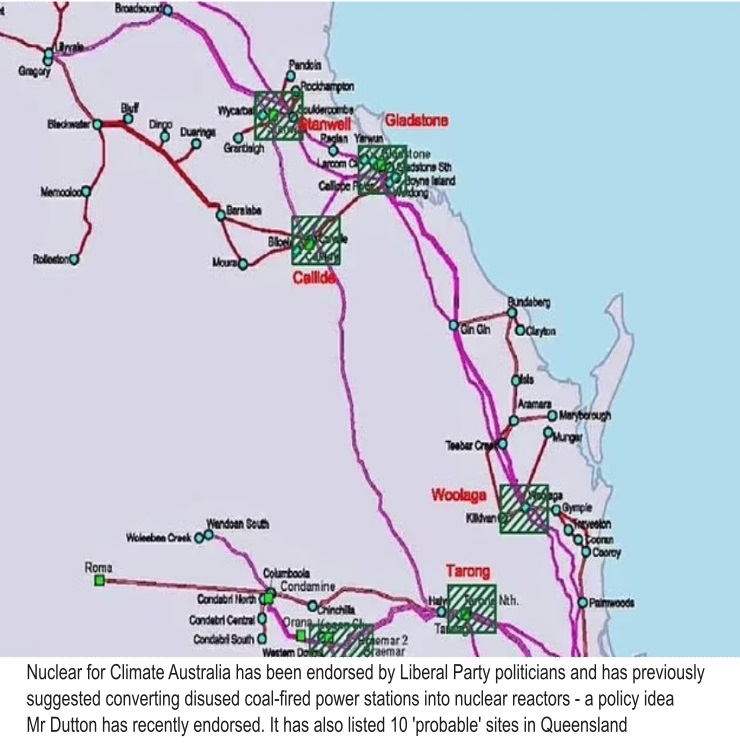
The 13 leading sites for a nuclear reactor in Australia – including a dam that supplies drinking water for a major city.
- Nuclear for Climate has Liberal Party endorsements
- It favours turning coal stations into nuclear reactors
- Also suggested Brisbane’s Wivenhoe Dam as site
By STEPHEN JOHNSON, ECONOMICS REPORTER FOR DAILY MAIL AUSTRALIA,12 May 2024
A dam that supplies drinking water near a major city could be used to cool a reactor should Australia embrace nuclear power.
Opposition Leader Peter Dutton is expected to use his upcoming Budget in Reply speech to provide more detail on potential sites for nuclear reactors, with the Coalition arguing Australia cannot solely rely on renewable energy to meet its climate change targets.

Nuclear for Climate Australia has been endorsed by Coalition MPs and its founder, a disillusioned former Labor candidate, is now advising the Opposition on nuclear energy policy.
Nuclear plants use the process of fission – splitting atoms – to heat water from the dam to create steam, which powers a turbine that creates electricity.
The dam’s water would also be used to cool down the nuclear system, with the water then recirculated back into the reactor.
‘While recirculating systems don’t add heat to the river or lake, they do consume water through evaporation,’ Nuclear for Climate Australia said……………………………
Robert Parker said Wivenhoe Dam offered cooling qualities during a drought.
‘You need to ensure that you got sufficient water in the highest demand, hot periods when everyone’s got their air conditioners going, you do not want your plant losing cooling ability,’ Mr Parker told Daily Mail Australia.
‘Smaller nuclear power plants would need to be able to get an allocation of water, particularly in the hot-weather periods out of those dams to cool themselves.
‘If the water allocation can be given to the power station, it would be a phenomenally good resource for cooling a nuclear power plant.’
This site was one of 10 ‘probable’ sites in Queensland along with another three ‘possible’ sites in the home state of Mr Dutton and the Coalition’s energy spokesman Ted O’Brien.
Opponents of nuclear power argue it is too risky to put a plant near any population centre because of the risk of meltdown, even though nuclear medical isotopes for cancer treatment are produced at Lucas Heights in suburban Sydney.
The meltdown at the Soviet-era Chernobyl plant in Ukraine in 1986 resulted in a mass leakage of radiation that devastated surrounding areas for decades, while the effects of the 2011 earthquake on the Fukushima plant in Japan also caused a major radiation event.
Other possible nuclear power plant sites
Nuclear for Climate’s 13 recommended potential reactor sites include seven existing coal-fired power stations: Callide, Stanwell, Tarong, Gladstone, Millmeran, Kogan Creek and Collinsville, along with gas-fired Swanbank in suburban Ipswich.
‘In Queensland coal fired plants were constructed adjacent to available coal mines and other infrastructure,’ it said.
‘New nuclear plants will where possible take advantage of the resource used for cooling at these plants.’
Mr Dutton has flagged the idea of potentially converting five disused coal-fired power stations into nuclear energy reactors, arguing Australia could not entirely rely on wind and solar energy to meet its target of net zero carbon dioxide emissions by 2050.
The Coalition argues the existence of electricity transmission lines from these sites meant nuclear power could be delivered affordably – unlike Labor’s $20billion Rewiring the Nation plan……………………………………….
Nuclear for Climate has also suggested Ross River in north Queensland, the existing site of a solar farm near Townsville that is also close to the sea.
The three ‘possible’ sites included Stockleigh in suburban Logan south of Brisbane, Samsonvale west of Brisbane, and the Burdekin regional in north Queensland.
Mr Parker compiled that list in 2022 but since then he has revised it to drop two sites too far inland, citing droughts……………………………………………….
Nuclear advocacy group
Nuclear for Climate was influential within Coalition circles even before Mr Dutton in March revealed a government led by him would push for a nuclear power industry.
Mr Parker, who ran as a New South Wales state Labor candidate in 2007, said he was now providing advice to the federal Coalition……………………………
In 2022, he addressed the Parliamentary Friends of Nuclear Industries, chaired by Nationals backbencher David Gillespie.
Coalition senators in 2022 also cited Mr Parker in their dissenting report on the government’s plan for Australia to source 82 per cent of its energy from renewable sources by 2030.
Hollie Hughes, Ross Cadell and Bridget McKenzie wrote their report as members of a Senate environment and communications committee who opposed the Climate Change Bill 2022, which Labor and the Greens backed.
Mr Parker’s Nuclear for Climate group had made a submission to this bill arguing Australia could not rely on renewable energy for power generation……………………………….
Mr Parker has also been endorsed in Parliament by Liberal MP Rick Wilson.
In November 2022, the assistant shadow minister from Western Australia hailed his expertise on small modular reactors that can produce 300 megawatts, or 300million watts of power.
‘Speakers like Robert Parker, founder of Nuclear for Climate Australia, described the journey of Canada’s expanding nuclear power using SMR technology,’ he said.
SITES EARMARKED FOR NUCLEAR POWER
’10 PROBABLE SITES’
COLLINSVILLE: coal-fired plant in Whitsunday region of north Queensland
MILLMERRAN: coal-fired plant in Darling Downs region of south Queensland (dropped)
CALLIDE: coal-fired plant at Biloela in central Queensland
GLADSTONE: coal-fired plant in central Queensland
TARONG: coal-fired plant in South Burnett region of south Queensland (scaled back)
STANWELL: coal-fired plant near Rockhampton in central Queensland
KOGAN CREEK: coal-fired plant north-west of Toowoomba in south Queensland (dropped)
SWANBANK: gas-fired plant in Ipswich in south-east Queensland
WIVENHOE: hydro plant north-west of Brisbane in south-east Queensland
ROSS RIVER: solar farm near Townsville in north Queensland
‘3 POSSIBLE SITES’
STOCKLEIGH: rural area west of Logan
BURDEKIN: pumped hydro in north Queensland
SAMSONVALE: rural area west of Moreton Bay in south-east Queensland
Source: Nuclear for Climate Australia’s 2022 list which founder Robert Parker has reconsidered in 2024 https://www.dailymail.co.uk/news/money/article-13394175/13-sites-nuclear-reactor-Australia.html
Nuclear waste from AUKUS nations could be on cards

Greens senator David Shoebridge, who sits on the committee, said the laws would allow the defence minister to designate any area as a nuclear waste facility.
“This runs roughshod not just over local communities but also First Nations peoples who have a long history of protecting their land from nuclear waste, from Muckaty to Kimba,” he said
“This just shows the lengths the Albanese government will go to try and keep the failing AUKUS nuclear submarine deal sputtering along.”
Andrew Brown, May 13, 2024, https://www.thenewdaily.com.au/news/2024/05/13/nuclear-waste-from-aukus-nations-could-be-on-cards
Nuclear safety laws should allow for Australia to accept low-level waste from the UK and US as part of the AUKUS submarine deal, a Senate committee has found.
An inquiry looking at how nuclear safety would be carried out as part of the $368 billion submarine deal found that while Australia should not accept high-level nuclear waste, low-level waste from the submarine programs of AUKUS nations would be accepted.
The Senate committee on Monday recommended the safety laws pass Parliament and extra oversights should be set up for nuclear regulators.
However, opponents say the laws would allow Australia to become a dumping ground for nuclear waste.
Greens senator David Shoebridge, who sits on the committee, said the laws would allow the defence minister to designate any area as a nuclear waste facility.
“This runs roughshod not just over local communities but also First Nations peoples who have a long history of protecting their land from nuclear waste, from Muckaty to Kimba,” he said
“This just shows the lengths the Albanese government will go to try and keep the failing AUKUS nuclear submarine deal sputtering along.”
However, while the committee in its report acknowledged the concern of what would happen to the nuclear waste as part of AUKUS, proper processes would be in place.
“Terms like ‘dumping ground’ are not helpful in discussing the very serious question of national responsibility for nuclear waste of any kind,” the report said.
“There is an important distinction between the categories of nuclear waste which spans from waste with lower levels of radioactivity generated by day-to-day submarine operations … to waste with higher levels of radioactivity, such as spent fuel produced when submarines are decommissioned.”
As part of the AUKUS deal, the US will sell Australia three second-hand Virginia-class submarines in the next decade before a new class of vessels will be used that are co-designed by all three nations in the pact.
In a dissenting report to the inquiry, the Greens also took aim at the oversight of the proposed Australian Naval Nuclear Power Safety Regulator.
Senator Shoebridge said the regulator reporting to the defence minister was out of step with similar bodies set up in other countries.
He said the body should instead report to the federal health minister to ensure its independence.
The report’s findings are set to be considered by the government before being brought back for debate in Parliament.
Amidst genocide and war, anti-Zionism protesters are demonised as ‘extremists’
Independent Australia, By Martin Hirst | 13 May 2024
As human rights experts warn of an ongoing genocide in Gaza, any opposition to Zionism is being egregiously labelled as extremism, Dr Martin Hirst writes.
STUDENT PROTESTERS around the world are being demonised by politicians, bureaucrats and the news media for taking a stand against genocide.
This is just an updated version of the moral panic playbook that conservatives use to demonise young people who don’t toe the establishment line.
In the last six weeks, student protests have exploded around the world on a scale not seen since the Vietnam Moratorium almost 60 years ago. These students are protesting against what human rights experts are not hesitating to call a genocide in Gaza.
This reporter knows some of the Australian leaders of these protests quite well, organising politically with them as a long-term member of Left-wing group Socialist Alternative and a writer for its newspaper, Red Flag.
We know that none of these outstanding young activists are antisemitic. We know they are better educated about Palestine from a contemporary and historical perspective than our Prime Minister and most politicians…………………………………………………
We know that these young people are on the right side of history.
We also know that attempts by political leaders, intelligence agencies, Zionist hacks, the police and some university administrators to brand these brave students as violent, dangerous and antisemitic is a bald lie.
It is the lie itself that is dangerous because it actually emboldens Zionist thugs to launch ever-more violent attacks on student encampments, causing injury and mayhem.
It is also dangerous because it is a serious attempt – carried out with planning and intent – to criminalise anti-genocide activists and to criminalise their right to political speech.
What is happening in Australia, across Europe and in the United States is the creation of a state of emergency based on these dangerous lies. Right in front of our eyes, pro-Israel elements of the ruling class are establishing the conditions for a new wave of moral panic.
Students are being demonised as the 21st-Century version of the “folk devil“. The protests are being compared to 1930s Germany – which most people who make this comparison know absolutely fuck-all about – and they are being used to launch a McCarthyite witch hunt against students and academics who stand up for Palestine.
There’s nothing new about moral panics — the phrase was coined by British sociologist Stanley Cohen in the 1970s to describe the clamour for the state to take action against “Mods” and “Rockers” — two rival youth subcultures that enjoyed different types of music.
Interestingly, the Pogroms against Jews that swept Europe in the 1920s were a form of moral panic…………………………………………………………………………………………………
A moral panic only works when those in power – who feel threatened by resistance from below – can enlist loyal handmaidens in the media to prosecute their case and amplify their fear-mongering. Now, these tactics of intimidation are aimed at silencing dissent and any vocal opposition to the Israeli slaughter in Gaza.
Make no mistake, it is happening. Take it seriously because the Zionists and the political establishment are taking it seriously……………………………………………………
Failed Liberal Minister Josh Frydenberg helped to produce a “documentary” helpfully explaining to Sky News audiences how Australia is sliding into Nazi-era pogroms because of the threat to civil order posed by the student encampments and the wider anti-genocide movement.
In the last week alone, there has been a slew of opinion columns and news pieces in The Australian slandering student encampments while ignoring the attacks mounted on them by Zionist thugs.
Andrew Bolt and the usual list of suspects are apoplectic with rage that university administrators haven’t (yet) moved to shut down the protests.
However, the universities are beginning to move. The administration at Monash University in Melbourne is demanding students remove ‘Zionists not welcome’ signs from around their encampment because of some spurious “legal advice” that it is vilification.
Police have been allowed to install surveillance cameras overlooking the Monash encampment. Vice Chancellors from the Group of Eight — Australia’s richest universities — have asked Attorney-General Mark Dreyfus to advise them if the slogans used in the encampments are “hate speech”.
This is particularly egregious because Dreyfus himself is a Zionist. Dreyfus declined to provide legal advice but urged people who feel offended to lodge complaints under Section 18a of the Racial Discrimination Act. …………………………………………………..
It is too early to tell where all of this will end, but we can confidently predict that the Labor Party will support Sarah Henderson’s call for a Senate inquiry.
Anthony Albanese is fuelling the moral panic with apparent joy. He is reported to have told a room full of senior Zionist elders and student leaders that he believes the campus protests are led by outside agitators.
Helpfully, he was able to name them too. It’s all “the Trots‘ fault”.
This is deeply ironic for two reasons:
Russian revolutionary leader Leon Trotsky was a Jew and when he fell foul of the Stalinist regime, his Jewish heritage was used against him to launch a moral panic that even spread to Australia and poisoned the minds of many good Communist Party members, including the artist Noel Counihan who famously called Trotsky a “fascist gangster”.
Albanese has also been demonised as a Trotskyist by Murdoch hacks and (former Liberal MP Bronwyn Bishop) “Kerosene Bronny“…………….. https://independentaustralia.net/politics/politics-display/amidst-genocide-and-war-anti-zionism-protesters-are-demonised-as-extremists,18594
Coalition MPs dismiss International Energy Agency advice to ditch nuclear plans

IEA chief urges Australia to prioritise ‘untapped potential in solar and wind’ as opposition pushes on with its nuclear policy
Guardian Sarah Basford Canales, Fri 10 May 2024
Coalition MPs have dismissed advice from the world’s international energy body urging Australia to ditch any nuclear plans in favour of the “untapped potential” of solar and wind power.
After the Albanese government’s announcement on Thursday that gas will remain key to the country’s energy and export sectors to “2050 and beyond”, the opposition has doubled down on its plans to unveil a nuclear energy policy before the next federal election.
While details of the plan, including the location of up to six possible sites for nuclear plants, have yet to be announced, the Nationals leader, David Littleproud, said the Coalition’s goal was to plan for a “gradual transition from coal to nuclear, gas and renewables built in the right place and in the right concentration”.
In an interview with the Australian Financial Review, the International Energy Agency (IEA) executive director, Dr Fatih Birol, said politicians in Australia should be prioritising the country’s renewable energy sources over investing in new nuclear projects…………..
Birol told Nine newspapers nuclear was not an avenue Australia should be looking at.
Birol said he hoped discussions around nuclear “can be made more factual, less emotional and political”, stressing Australia should prioritise the “untapped potential in solar and wind”…………………………………………………….
O’Brien’s Nationals colleague, Keith Pitt, similarly dismissed Birol’s advice as coming from a “Paris-based” commentator, saying the IEA has had “more positions on energy advice to Australia than the Kama Sutra”.
It is understood the Coalition will propose locating nuclear power plants on the site of retiring coal power plants, claiming the use of existing transmission infrastructure would bring down costs.
Figures released by the federal energy department last September revealed the plan could cost as much as $387bn. The analysis showed a minimum of 71 small modular reactors – providing 300MW each – would be needed if the policy were to fully replace the 21.3GW output of Australia’s retiring coal fleet.
CSIRO’s GenCost report showed that once up and running, a theoretical small modular reactor built in 2030 – which is unlikely to exist – is estimated to cost $382 to $636 per MWh while solar and wind would cost between $91 and $130 per MWh once integration costs are included.
Outside the Coalition, political support for a domestic nuclear power industry is limited.
The climate change minister, Chris Bowen, has previously accused advocates for an Australian nuclear industry as “peddling hot air”, saying Labor’s plan backs the IEA chief’s comments.
The Fremantle MP, Josh Wilson, a loud nuclear critic within Labor, questioned the Coalition’s “obsession” with the “most expensive and slowest form” of energy generation.
The independent ACT senator David Pocock, a vocal advocate for renewable energy, said nuclear power “makes no sense in this country”.
The senator’s lower house independent colleagues Monique Ryan and Kate Chaney agreed but added that Labor’s future gas strategy was also the wrong path forward.
Chaney said it was a “no-brainer” that IEA would steer Australia towards its obvious solar and wind advantages, noting it was “driven by data rather than politics”.
Ryan said Australia was once again being seen as a pariah internationally on climate policy.
The Greens leader, Adam Bandt, said the federal government should deliver “massive investment” in public solar and wind, instead of opening up more gas mines. https://www.theguardian.com/australia-news/article/2024/may/10/coalition-mps-dismiss-international-energy-agency-advice-to-ditch-nuclear-plans
Federal election 2025: Peter Dutton’s nuclear plans worry voters in Nationals-held seat of Gippsland.
‘A big risk’: Voters wary of nuclear replacing coal-fired power Tom McIlroy Political correspondent, AFR 7 May 24
Voters in Victoria’s Latrobe Valley have raised the Chernobyl and Fukushima nuclear disasters when asked about Peter Dutton’s plan to build large-scale reactors near them, suggesting strong reservations about the energy plan.
As the Coalition finalises a policy for coal-fired power station sites to host nuclear energy – and for small modular reactor technology to be deployed in other places – focus group research in the federal electorate of Gippsland showed voters had safety concerns about living near a reactor.
Mr Dutton wants nuclear to provide baseload power to firm renewable energy and ensure Australia achieves net-zero emissions by 2050.
Communities near coal plants would be called on to host nuclear facilities, with at least six sites expected to be named before the next election.
Mr Dutton says nuclear must stack up on four key criteria: safety, waste disposal, location and cost.
But a focus group of Coalition-leaning voters questioned by polling firm Redbridge last week revealed doubts in the seat held by Nationals MP Darren Chester.
One male participant said he was opposed to nuclear replacing coal-fired power at sites like Loy Yang A, Loy Yang B and Yallourn.
“I know there’s a lot of safeguards with nuclear but it is still a very big risk if something does happen,” he said.
“It uses up a lot of resources and at the end of the day, once it has used up all its radioactiveness, we have to go bury it in the desert somewhere because we can’t do anything with it.”
A woman told the group she did not know much about the plan but had strong concerns.
“The thought of it makes me want to move. I’ve got kids. I don’t want them to be exposed to something that could affect them.”
Another woman said future generations would suffer if Australia lifted the ban on nuclear power.
“We’ve seen in the past with Chernobyl. Obviously, the situation has got better and people have learnt from things but mistakes happen and it’s a risk that you have to weigh up when considering putting something into an area with population.”
Another male participant cited the 2011 accident at Japan’s Fukushima power plant. He said Australia could face the risk of a similar disaster if nuclear was developed here. Another suggested that carp in local waters would “be huge” in the event of a nuclear spill………………………………………………………..
Fellow director Tony Barry said there was “intense” opposition in Gippsland.
“There is some limited opportunity for the Coalition to leverage a perception that a nuclear reactor in the region might produce local economic benefits.
“However, the problem for the Coalition is that to overcome these wide and deep concerns and to successfully leverage the perceived benefits they will need to spend millions of campaign dollars on messaging.”…………………………………… https://www.afr.com/politics/federal/a-big-risk-voters-wary-of-nuclear-replacing-coal-fired-power-20240506-p5fp9d
Bowen says Coalition’s nuclear push would put grid reliability at risk due to delays in coal plant closures

ReNeweconomy, Giles Parkinson, Apr 26, 2024
Federal climate and energy minister Chris Bowen has again lambasted the Coalition’s pursuit of nuclear power and its intention to stop renewables, saying it would put reliability of the grid at risk because it would delay the closure of ageing and increasingly decrepit coal fired power stations.
The federal Coalition has yet to release details of its nuclear power plan, but has made no secret of its intention to halt the rollout of large scale wind, solar and storage, and has even threatened to tear up contracts with the commonwealth should it be returned to government.
The Coalition has also made it clear that it has no intention of meeting its commitment to the Paris climate targets, where the bulk of emissions reductions need to occur in the next decade.
That can’t happen if the transition to renewable energy is stopped and coal fired power plants kept on the grid to wait for nuclear some time in the 2040s. The Coalition appears only focused on the 2050 target for “net zero”.
“They know it’s a fantasy,” Bowen said in an interview with Renew Economy’s Energy Insiders podcast of the delays in the release of the Coalition energy policy. “Of course they do. But they are thinking of ways to avoid action and nuclear is the one they’ve settled on.
“Internally, in the Liberal Party, the National Party, I’m advised it is a miss. There’s a lot of anger that they’ve been foisted with this policy. You are seeing it delayed constantly because they are trying to make it stack up, and they can’t.”
Bowen says the push for nuclear is simply an excuse to keep coal fired power station operating longer, and delay renewables.
“That’s what it’s about. But there are two problems with that,” Bowen say
“There’s emissions. But perhaps even more acutely, there’s reliability. It’s a risk to our energy system, because coal fired power is the most unreliable form the power, because of the ageing nature of our coal fired power stations.
“They’ve done good work. They’ve been engineering masterpieces. But they’re very bloody old now. And they break down a lot, sometimes spectacularly, like Callide, and other times, not as spectacular, but still unexpected, and still with a big impact.
“And if we’re relying more and more on that ageing infrastructure, it’s going to be a big risk to reliability. That’s, again, another argument at the next election. And it’s an argument we’re ready for.”
Bowen also attacked the threats by National leader David Littleproud last week to tear up wind and solar contracts that could be signed under the Commonwealth, which has just announced the biggest ever auction of renewables in the country, six gigawatts of new capacity in a process that begins next month.
“I don’t think they will, and I don’t think they can,” Bowen said.
It’s entirely irresponsible – governments, parties to government, Labor and Liberal at the federal level, have consistently said, ‘we will honour contracts’.
“There’s been contracts that the previous government entered into, which I didn’t love and wouldn’t assign if I was the minister at the time, but we honour them. I don’t know what he’s talking about there, to be honest. It’s not a sensible contribution.”
Bowen says the CIS will help re-boot Australia’s transition to green energy, and meet the federal government’s 82 per cent renewable energy target by 2030, which he insists remains both ambitious and achievable. “No question in my mind,” he says.
The 6 GW CIS auction will begin in May, and will include a minimum 2.2 GW that is reserved for NSW, and 300 MW for South Australia, which is already leading the country, and the world, with a 75 per cent share of wind and solar in its in the past 12 months.
Bowen says the early indications – from the initial smaller tenders in NSW and in Victoria and South Australia – are that the CIS will succeed in getting projects moving.
“The early auction results have been outstanding, just outstanding in New South Wales. And the indications are, in terms of the size of the bids we’ve had come in for South Australia and Victoria, they are very high quality, which really indicates to me the pipeline is very strong, the interest is huge.
“The CIS is what was needed to unlock that risk matrix, to really make sure that Australia’s right at the top of the list for renewable investment decisions that are being made by multinational companies.”……………………………………………………………………………………….more https://reneweconomy.com.au/bowen-says-coalitions-nuclear-push-would-put-grid-reliability-at-risk-due-to-delays-in-coal-plant-closures/
Parliamentarians renew their support for the Treaty for the Prohibition of Nuclear Weapons
Jemila Rushton, Acting Director, ICAN Australia
Australian parliamentarians from across party lines have renewed their support for Australia joining the Treaty on the Prohibition of Nuclear Weapons (TPNW).
In a new video, members of the Parliamentary Friends of the Treaty on the Prohibition of Nuclear Weapons show that action on nuclear disarmament is beyond party politics. Their joint message demonstrates how parliamentarians from across the political spectrum are working together to see the Treaty signed and ratified.
| Featured in the video are Susan Templeman MP (ALP), Member for Macquarie, Jordan Steele-John (GRN), Senator for Western Australia, Monique Ryan MP (IND), Member for Kooyong, Russell Broadbent (IND), Member for Monash, Sam Lim MP (ALP), Member for Tangney, Louise Pratt (ALP), Senator for Western Australia, Lidia Thorpe (IND), Senator for Victoria, Sharon Claydon MP (ALP), Member for Newcastle, Josh Burns MP (ALP), Member for Macnamara, and Josh Wilson MP (ALP), Member for Fremantle. In the video, they state: |
Today, 93 countries around the world are signatories to the Treaty on the Prohibition of Nuclear Weapons – the TPNW.
They are signed up to the legally binding commitment to comprehensively ban nuclear weapons.
Developing them, testing them, producing them, assisting with them, possessing them, threatening to use them, and using them are banned.
The TPNW is giving countries and citizens across the world hope, and a new and promising pathway towards the abolition of these weapons.
It’s about understanding that what we cannot prepare for and what we can adequately respond to, we must prevent.
It’s about continuing Australian leadership when it comes to nuclear disarmament.
It’s about working with our closest neighbours and collaborating with our Pacific family.
It’s about recognising and supporting victims of nuclear weapons testing. For First Nations survivors, for Australia’s nuclear veterans.
As members of the Australian Parliamentary Friends of the TPNW, we are working together to see the Nuclear Weapons Ban Treaty signed and ratified.
We are proud of our country’s commitment to getting rid of other inhumane weapons, like landmines, cluster munitions, biological, and chemical weapons.
We welcome Australia’s engagement with the TPNW under the Albanese Government and we pay tribute to the community activism being undertaken in support of Australia joining this treaty.
History is calling.
Murrumbidgee Council launches survey on establishing nuclear power generator near Coleambally, Darlington Point or Jerilderie

from Greg Phillips -I was wondering if this was a belated April Fool’s joke. Especially since it is an “online survey” with no checks on who votes (as usual I expect it to be overrun by nuclear fanatics pretending to be locals). I think the rate payers in that area will have to pay much more attention to who they let get into the council next time.
30 April 2024 | Oliver Jacques, https://regionriverina.com.au/council-launches-survey-on-establishing-nuclear-power-generator-near-coleambally-darlington-point-or-jerilderie/59543/
Murrumbidgee Council has asked residents of Coleambally, Darlington Point, and Jerilderie to voice their opinions on the idea of establishing a nuclear power generator in their area.
“In an effort to explore diverse energy solutions, the community is invited to participate in an online survey aimed at understanding their appetite for nuclear power,” the council said in a statement.
Nuclear power plants generate electricity by using controlled nuclear chain reactions to heat water and produce steam to power turbines.
Advocates say the plants can generate clean energy without the by-products emitted by fossil fuels, while critics argue nuclear power is expensive, unreliable, possibly unsafe and it produces hazardous waste.
Murrumbidgee Council General Manager John Scarce said the council sought to understand public sentiment regarding the possible integration of nuclear power into the local energy landscape.
Mr Scarce said the concept would be contingent upon dismantling existing renewable energy infrastructure, including solar and wind farms, at the end of their operational life.
“The land would then be reclaimed for agricultural purposes, aligning with sustainability and resource optimisation goals,” he said.
The survey is designed as a precursor to gathering more information on the idea, with a view to undertaking a more formal poll in the future.
Nuclear power is banned in Australia and under current laws, nuclear power stations can’t be built in any state or territory.
At a recent event in Wagga, Essential Energy CEO John Cleland said nuclear energy would remain an important part of the global energy network, but it was an unlikely option for Australia in the near future.
“The lived experience and reality of nuclear is that all new nuclear generation built globally in the last 40 or 50 years has ended up being very expensive,” he said.
“In Australia, we have this wonderful endowment of wind and solar and existing gas reserves and systems that will provide a very robust peaking generation source going forward.
“The economic case for nuclear is challenging but we do need to continue to monitor the evolution of the technology around small-scale modular nuclear reactors because they might in time play a role.”
The Murrumbidgee Council survey can be accessed online at survey monkey and will remain open until 5 pm on 22 May 2024.
The conservative charity group figures driving the opposition leader’s pivot to nuclear energy
Dutton and O’Brien are also brazenly using the AUKUS defence agreement to bolster the case for civilian nuclear power reactors. Under AUKUS, Australia will get submarines powered by small nuclear reactors. As part of the agreement, signed by the Albanese government, Australia is responsible for disposing of the nuclear waste from the subs. That means Australia will be obliged to develop a responsible nuclear waste system. The nuclear lobby hopes this will help overcome popular resistance to a civilian nuclear waste dump in Australia.
Dutton’s nuclear power plants . The conservative charity group figures driving the opposition leader’s pivot to nuclear energy
By Marian Wilkinson, The Monthly, May 24
Five charity group figures driving the opposition leader’s pivot to nuclear energy
When Lesley Hughes agreed to lead a nocturnal wildlife tour at Sydney’s Taronga Zoo in August last year, she didn’t quite realise what she was letting herself in for. As the distinguished professor of biology explained the perils facing the animal kingdom from climate change, a disparate group of movers and shakers nodded with polite enthusiasm – among them, National Party leader David Littleproud, Liberal Party climate and energy spokesman Ted O’Brien, and Larry Anthony, the head of a lobbying firm known for pushing fossil fuel clients.
This was not the professor’s natural milieu, but, like many of the guests at the splendid harbourside function centre that wintry evening, Hughes was there to win hearts and minds in the fight to save the planet. It was the opening night of the International Climate Conference hosted by the Coalition for Conservation, an enterprising conservative charity with deep roots in the Liberal and National parties. One of its aims is to reach out to environmentalists, renewable energy experts and climate scientists to garner support for Coalition members backing the goal of getting Australia to net zero emissions.
C4C, as it’s known, had gathered an impressive line-up of speakers, including the man who led the successful 2021 United Nations Climate Change Summit in Glasgow, former United Kingdom minister Sir Alok Sharma, and His Excellency Abdulla Al Subousi, ambassador for the United Arab Emirates, whose nation was set to host the next UN climate summit in Dubai.
But as the guests tucked into the opening night dinner, one speaker sounded a jarring partisan note: C4C’s influential patron, Trevor St Baker, couldn’t resist taking a swipe at the Albanese government’s renewable energy policy. St Baker’s intervention was telling. The Queensland rich-lister was close to C4C’s chairman, Larry Anthony, a former National Party president. For years, he had employed Anthony’s lobby shop, SAS Consulting, back when he was in the coal-fired power business. Now St Baker was investing in the energy transition – electric vehicle charging and battery technology – but his passion project was nuclear energy and, in particular, introducing the idea of small modular nuclear reactors to Australia.
While St Baker’s presence was a surprise to some C4C supporters that night, his ideas on nuclear energy were about to hit the zeitgeist. He and his partners in a small nuclear consultancy, SMR Nuclear Technology, were riding the new wave of global enthusiasm for nuclear energy. Influential players, from former Microsoft boss Bill Gates to UK Prime Minister Rishi Sunak, were spruiking small and micro modular reactors as a game-changer that would help the world reach net zero emissions by 2050. In climate circles it was dubbed the “tech bro” culture, as next-generation nuclear attracted bullish headlines, and billions in private investment and government grants
The C4C climate conference was dotted with speakers enthusiastic about bringing nuclear power to Australia, few more so than the opposition’s spokesman, O’Brien. The line-up was a clear signal that the C4C charity had pivoted towards its patron’s pro-nuclear position. More importantly, it reflected the big nuclear shift by Opposition Leader Peter Dutton. In a headline-making speech a few weeks earlier, Dutton had attacked what he called “renewable zealotry”, saying that if Albanese wanted to phase out coal and gas, the only feasible and proven technology to back up renewable energy was “next-generation nuclear technologies”. Specifically, Dutton pushed the idea of small modular reactors (SMRs) and micro modular reactors (MMRs).
Dutton is now releasing more details on the opposition’s “coal to nuclear” power plans, which he argues can deliver cheaper electricity and new jobs in regions where ageing coal generators will be forced to close. So far, the plans bear a striking resemblance to a policy Trevor St Baker and SMR Nuclear Technology have been advocating for several years, in evidence and submissions to federal and state parliamentary committees, in think tanks and in energy forums. These describe in voluminous detail how small modular nuclear reactors are less costly to build than the big nuclear plants, safer and more flexible, allowing them to be sited at old coal plants already connected to the electricity grid.
Just how influential St Baker and his partners have been in the opposition’s nuclear switch is unclear. Dutton’s move to nuclear has been slammed by critics………………………………………………………
Whatever the economics of the opposition’s nuclear plan, there is no doubt about its political impact. It has reignited the partisan climate wars in Australia. Since first signalling their nuclear plans in 2022, Dutton and O’Brien have kept up a relentless attack on the Albanese government over what they call its reckless “renewables only” energy plan, blaming it for driving up household energy prices, threatening energy security, de-industrialising Australia and trampling the rights of farmers.
Professor Hughes is watching the divisive nuclear debate unfold with dismay. A director of the Climate Council, Hughes has been a lead author with the UN’s chief scientific advisory panel, the Intergovernmental Panel on Climate Change, and now sits on the federal government’s Climate Change Authority advising on its emissions reduction targets. “In my opinion, given the lack of any economic rationale for nuclear, one can only conclude that it’s a distraction to allow the fossil fuel industry to keep operating with business as usual,” she says.
Despite Dutton and O’Brien’s bullish optimism, their nuclear pivot is a big political gamble. While a rash of polls suggests support for nuclear energy is growing in Australia, some also show most Australians still don’t want a reactor in their own region, let alone a nuclear waste dump. Even Queensland’s Liberal National Party leader, David Crisafulli, has ruled out any plan to replace the state’s old coal-fired power stations with small nuclear reactors, saying it can’t happen without bipartisan support. The issue also threatens the fragile truce in the Liberal Party over climate change policy. The party’s most vocal renewable energy advocate, former New South Wales energy minister Matt Kean, has launched a stinging attack against the policy push. “I am not opposed to nuclear power,” he tells me. “I was state energy minister for five years. If nuclear power was a viable pathway to net zero, I would have done it. But it did not stack up – economically, environmentally or engineering-wise.”
Kean was speaking shortly after he resigned from his role as ambassador for the C4C environmental charity. In his frank resignation letter, he told C4C’s chair, Larry Anthony, that he saw the advocacy for nuclear power “as an attempt to delay and defer responsible and decisive action on climate change in a way that seems to drive up power prices in NSW by delaying renewables”.
Kean sees Anthony and St Baker as having an outsize influence on the charity’s shift to a pro-nuclear position. St Baker is a powerful business figure in Dutton’s home state. He’s long been a political donor to the Queensland LNP and to the state’s Labor Party. His support for nuclear power is no secret.
Talacko denies either St Baker or Anthony influenced the charity’s position on nuclear energy. “Our exploration of this technology was thorough and impartial, and our support for nuclear energy is not influenced by political agendas nor tied to financial backing from the nuclear industry,” she tells me by email. But she also says she didn’t know her charity’s key patron was a director and major shareholder of SMR Nuclear Technology. “I was not aware of Trevor’s position at this organization.”
For well over a year, C4C has played a critical role in supporting and promoting the Coalition’s push on nuclear energy. In early 2023, Talacko joined Ted O’Brien on a nuclear fact-finding trip to the United States and Canada. O’Brien’s trip was funded in part by one of C4C’s donors – which one he doesn’t say. The group was briefed by corporate executives and government officials on a range of small and medium modular nuclear reactor projects. O’Brien says Talacko returned from the trip convinced “nuclear should be part of a balanced mix”. Talacko posted O’Brien’s upbeat story about their briefings on the C4C website. None of the projects O’Brien wrote about was commercially operating. Indeed one, a much-anticipated small nuclear project in Idaho run by American company NuScale, collapsed months later because of major blowouts in costs. That was despite getting almost $1 billion in US government support. NuScale’s chief executive was blunt about the project’s future prospects, telling Bloomberg, “Once you’re on a dead horse, you dismount quickly. That’s where we are here.”
Neither O’Brien nor Talacko’s enthusiasm for next-gen nuclear was dented by what happened to NuScale. Quite the reverse. Just weeks after the collapse, in November 2023, C4C funded a delegation of Coalition MPs, as well as Talacko, to attend the UN Climate Change Conference in Dubai, COP28. O’Brien had been invited to address a meeting that the World Nuclear Association, the global nuclear lobby, was hosting with C4C at the summit. The C4C delegation included Liberal senators Andrew Bragg and Dean Smith, the Nationals’ Senate leader Bridget McKenzie, deputy leader Perin Davey and shadow trade minister Kevin Hogan, and Larry Anthony.
………………………….. the COP declaration was a triumph for the nuclear lobby, and O’Brien vowed the Coalition would sign up to the nuclear partnership if it was re-elected. Talacko posted a glowing account on C4C’s website. …………………..
But turning the heady nuclear promises in Dubai into a credible climate policy at home is proving a daunting challenge for the opposition. The first hurdle it faces is the law. Federal environment and nuclear safety laws effectively ban civilian nuclear power generation in Australia. Victoria, New South Wales and Queensland also have specific laws prohibiting it.
Overturning these laws has long been on the wish list of business lobbies such as the Minerals Council of Australia, as well as the National Party and senior Liberals, but it remains politically fraught. O’Brien admits there was no chance of it happening in this parliament.
Even Bob Pritchard thinks overturning the laws will be tough. And he worries that if Dutton goes to an election pledging to change the laws and loses, it will put the nuclear industry in Australia back years.
The opposition’s immediate problem is the lack of “social licence” for nuclear power in Australia. A majority of us are still anxious that nuclear reactors and their waste are not safe to live with. O’Brien, with help from C4C and other pro-nuclear lobby groups, is working hard to turn this around. Barely a week goes by now without an event with a panel of experts talking up nuclear energy’s role in getting to net zero emissions.
Dutton and O’Brien are also brazenly using the AUKUS defence agreement to bolster the case for civilian nuclear power reactors. Under AUKUS, Australia will get submarines powered by small nuclear reactors. As part of the agreement, signed by the Albanese government, Australia is responsible for disposing of the nuclear waste from the subs. That means Australia will be obliged to develop a responsible nuclear waste system. The nuclear lobby hopes this will help overcome popular resistance to a civilian nuclear waste dump in Australia.
It’s no coincidence Dutton recently met with executives from Rolls Royce last month to talk about nuclear power. Under AUKUS, the British company will supply the small reactors for Australia’s nuclear submarines. Rolls Royce is also trying to rapidly develop small modular reactors for civilian nuclear power with the backing of millions of dollars in UK government grants.
Veteran anti-nuclear campaigner Dave Sweeney, from the Australian Conservation Foundation, sees AUKUS as the best leg-up for the nuclear lobby in Australia for decades.
“Despite years of lobbying from the mining sector, and from pro-nuclear advocates, there has been no success in gaining a social licence for the technology in Australia,” Sweeney tells me. “But they see AUKUS as the thin edge of the wedge – the way they will expand nuclear from a defence relationship to get domestic acceptance and integration of nuclear technology and nuclear power in Australia.”
Sweeney is convinced Dutton’s nuclear plans have little chance of success. “I think that they will have their work cut out,” he says, “but there is no question that this is a very serious, systematic and resourced attempt by the pro-nuclear voices.” Like many activists who spent years campaigning on climate change, Sweeney believes the overriding aim of Dutton’s nuclear shift is political. “It unites techno-modernist Liberals with the renewable-recalcitrant Nationals in one policy framework. And it also continues business as usual – it’s no challenge to the fossil fuel interests to talk about nuclear.”………………………………………………………………………..
When the politicians returned to Canberra in February, the drums were once again beating in the climate wars. On the lawn in front of Parliament House, the “Rally Against Reckless Renewables” was in full swing. The National Party’s Barnaby Joyce was firing up the crowd of several hundred farmers and anti-renewable activists telling them, “You’re the army! This is the start!”
Joyce’s performance enraged Dr Matt Edwards, a prominent Australian solar scientist now working for Adani Solar, owned by the giant Indian power company. Edwards was also the vice chair of C4C, but he’d clearly had enough. He belted out a stinging op-ed for the Australian Financial Review laying into Joyce and what he called “the remnants of the Coalition now taking an uninspired punt on nuclear”. Edwards bluntly dismissed the opposition’s plan to replace ailing coal plants with nuclear, saying, “given high costs, long lead times and lack of investor appetite for nuclear, it is easy to cynically imagine that these plans might be used to justify extending the life of fossil generation while we wait for an atomic revolution that never comes”.
The fallout was immediate. C4C’s chairman and chief executive were furious. Dr Edwards resigned from the board. Just one more casualty in the latest round of the climate wars.
Marian Wilkinson is a multi-award-winning journalist and author. Her latest book is The Carbon Club. https://www.themonthly.com.au/issue/2024/may/marian-wilkinson/dutton-s-nuclear-power-plants#mtr
Dutton’s nuclear policy backfires
Mike Seccombe The Saturday Paper, 27 Apr 24
This much can be said for Colin Boyce: he is not one of the federal Coalition’s nuclear nimbys. He would, if necessary, agree to have a nuclear power station in his electorate…………………………………………………..
Opposition Leader Peter Dutton’s announcement on March 12 that the Coalition would “shortly” announce about six sites across the country where nuclear reactors could be built forced the issue. Dutton’s plan would put them in places where coal-fired power stations were closing down.
The promised announcement of potential nuclear sites has been pushed progressively further into the future. Initially it was expected within a couple of weeks, then before the federal budget on May 14. Last Sunday, on the ABC’s Insiders program, Dutton would not commit to a pre-budget announcement, improbably blaming the recent stabbing incidents in Sydney for the delay.
On Tuesday this week, Nationals leader David Littleproud told Sky News the Coalition parties were “not going to be bullied into putting this at any time line, but you will see it before the election”.
Whenever the announcement does eventually come, Boyce’s central Queensland electorate, Flynn, is likely to be on the list.
Boyce’s acceptance of nuclear power in his electorate is not so much an endorsement of the policy being pushed by his leaders as an acceptance that he has no other choice.
Flynn, twice the size of Tasmania and dotted with coalmines and gas wells, produces vast amounts of energy, most of which is shipped overseas.
………………………………………………………………….. Boyce says, probably correctly, “ there will be no coal-firedpower stations in Queensland operational after 2035”.
He is not happy about that and is even less happy that the state opposition supported the government’s legislated target, for he has never accepted the need to stop burning fossil fuels.
Before his election to federal parliament, Boyce served five years in the Queensland parliament, representing the coal seat of Callide. There, he argued for the construction of more coal-fired power stations. He denied the reality of human-induced climate change.
Opposition to fossil fuels, he told state parliament on June 17, 2021, was “driven by the mind-numbing, eco-Marxist Millennials and upper middle-class ‘wokes’ who have been indoctrinated with some quasi-religious belief that coal is bad and carbon dioxide is poisoning the planet”.
……………………………………………………………………. Even within the Coalition’s ranks there are some who see the move as being at least as much an attempt to address a political problem as to address the climate crisis, although most will not say so publicly.
Bridget Archer will, however. The Tasmanian MP – one among a much-depleted cohort of moderate Liberals after the 2022 election – issued a warning to her colleagues via the pages of the Nine newspapers last month that nuclear energy should not be put forward as an alternative to wind and solar.
“There is no point even having a nuclear discussion if you don’t accept a need to decarbonise, to transition away from coal and gas,” she said. “There only is a case for nuclear if there is a fairly rapid transition to large-scale renewables, otherwise why are you doing it?”
She then answered her own question: “I think part of the reason for having the discussion is to keep people in the tent on net zero.”
Others privately assess the motivations of the federal Coalition leadership more harshly. They suggest it’s not primarily about getting nuclear up but about slowing the transition to wind and solar and thereby extending the life of fossil fuels in power generation.
Certainly, the chances of getting the federal parliament to greenlight a domestic nuclear industry are remote. For about 25 years, nuclear power has been prohibited by law in Australia, and it was the Howard Coalition government that banned it, under a 1998 deal with the Greens to get other legislation through the Senate.
Given the ever-growing proclivity of Australian electors to give their votes to progressive independent candidates and Greens, there is a good chance neither major party will win majority government at the next election. Even if the Coalition did win the House of Representatives, it almost certainly would not gain a majority in the Senate. Unless Labor recanted on its vehement opposition to nuclear power, Dutton’s plan would fall at the first hurdle.
……………………………………. the available evidence suggests even those members of the federal Coalition parties who publicly spruik the Dutton policy lack the courage of their convictions.
Last month, shortly after Dutton made his big announcement, reporters for the Nine papers contacted a dozen of them.
“Twelve opposition MPs have publicly backed lifting the moratorium on nuclear power in Australia but will not commit to hosting a nuclear power plant in their own electorate,” their story began
……………………………………………….. Two points. First, the Coalition plan no longer involves small modular nuclear reactors, but instead would rely on building traditional large plants. Second, the polling to which Littleproud referred actually showed a lot of people were woefully misinformed about the cost of nuclear power.
When asked to rank sources of energy “in terms of total cost including infrastructure and household price”, 40 per cent of respondents thought solar and wind power were the most expensive, compared with 36 per cent who thought nuclear was, and 24 who picked coal and gas. Fully one third of respondents thought nuclear was the cheapest option.
They are spectacularly wrong. According to the most recent GenCost report – the annual collaboration between the Australian science agency CSIRO and the Australian Energy Market Operator (AEMO) – SMRs are by far the most expensive way of generating electricity. The “levelised cost” of power from an SMR would be $382 to $636 per megawatt hour, while solar and wind would cost between $91 and $130 per MWh.
The Dutton response was to attack the experts. He claimed GenCost underestimated the cost of renewables because it did not include expenditure on the transmission infrastructure required to integrate them into the grid.
This was untrue, as the report’s authors promptly made clear. Dutton was undeterred, however, which in turn saw the chief executive of the CSIRO, Douglas Hilton, release an open letter defending the importance of independent scientific endeavour.
Last Tuesday, the same day as Littleproud went on Sky News and maintained the falsehood that nuclear power was cheaper than wind and solar, another report was released, further confirming more wind and solar energy was simultaneously lowering both prices and emissions from the electricity sector.
The quarterly Energy Dynamics report from the energy market operator showed that in the first three months of this year, renewables provided 39 per cent of power in the east coast power grid, almost 2 per cent more than in the corresponding period last year.
……………………………..“We are increasingly seeing renewable energy records being set which is a good thing for Australian consumers as it is key in driving prices down and NEM [National Electricity Market] emissions intensity to new record lows,” AEMO’s executive general manager of reform delivery, Violette Mouchaileh, said in a media release accompanying the report…………………………………………………………………………………… more https://www.thesaturdaypaper.com.au/news/politics/2024/04/27/duttons-nuclear-policy-backfires
National Party threatens to tear up wind and solar contracts as nuclear misinformation swings polls
The campaign against renewables and for nuclear has been based around misinformation, both on the cost and plans of renewables and transmission, and on the cost of nuclear power plants, which have stalled around the world because of soaring costs, huge delays, and because no small modular reactor has yet been licensed in the western world.
That campaign has been amplified by right wing “think tanks” and ginger groups, and the Murdoch media, and largely reported uncritically in other mainstream media. It appears to be having some traction.
Giles Parkinson, Apr 23, 2024, https://reneweconomy.com.au/nationals-threaten-to-tear-up-wind-and-solar-contracts-as-nuclear-misinformation-swings-polls/
National leader David Littleproud has threatened to tear up contracts for wind and solar farm developments, in the latest broadside against large scale renewable energy from the federal Coalition.
The remarks – reported by the Newcastle Herald and later verified by Renew Economy via a transcript – were made in a press conference last week in Newcastle, when Littleproud was campaigning against offshore wind projects and outlining the Coalition’s hope that it could build a nuclear power plant in the upper Hunter Valley.
The Coalition has vowed to stop the roll out of large scale renewables, and keep coal fired power plants open in the hope that they can build nuclear power plants – recognised around the world as the most expensive power technology on the planet – some time in the late 2030s and 2040s.
No one in the energy industry, nor large energy consumers for that matter, are the slightest bit interested in nuclear because of its huge costs and time it takes to build, and because it would set back Australia’s short term emissions reductions.
But the comments about contracts are the most sinister to date, and reflect the determination of a party leader who just a few years ago described renewables and storage as a “good thing”, including the huge wind and solar projects that are being built in his own electorate, to destroy the renewables industry.
The Newcastle Herald asked Littleproud if an incoming Coalition government would consider “tearing up contracts” for renewable infrastructure contracts that had already been signed.
“Well exactly,” Littleproud said. “We will look at where the existing government took contracts and at what stage they are at.
“There are some projects on land that we will have to accept, but we are not going to just let these things happen. If that means we have to pay out part of the contracts, and we will definitely look at that. You’re not going to sit here and say today that we’re stopping it and then not following through.”
The federal government this week announced the biggest ever auction of wind and solar in Australia, seeking six gigawatts of new capacity that will be underwritten by contracts written by the commonwealth.
This will see at least 2.2 GW of new wind and solar sourced in NSW, at least 300 MW in South Australia, already the country’s leader with a 75 per cent share of wind and solar in its grid, and multiple gigawatts spread over other states.
However, the Coalition’s nuclear plans are already facing delays, having pulled back from a previous commitment to deliver the nuclear policy before the May 14 federal budget. It now only promises to release the policy before the next election, with Littleproud telling Sky News on Monday that the party “would not be bullied” into an early release.
One of the many problems with its nuclear strategy will be finding sites for the proposed power plants. The Coalition has targeted the upper Hunter as one site, but AGL, the owner of the site that houses the now closed Liddell and the still operating Bayswater coal generators, has said it is not interested because it is focused on renewables and storage.
Littlepround, however, said there are other sites in the area that could be used, although the Newcastle Herald said he declined to nominate those sites. Inevitably, they would require new infrastructure.
The campaign against renewables and for nuclear has been based around misinformation, both on the cost and plans of renewables and transmission, and on the cost of nuclear power plants, which have stalled around the world because of soaring costs, huge delays, and because no small modular reactor has yet been licensed in the western world.
That campaign has been amplified by right wing “think tanks” and ginger groups, and the Murdoch media, and largely reported uncritically in other mainstream media. It appears to be having some traction.
According to an Essential Media poll published in The Guardian on Tuesday, 40 per cent of respondents ranked renewables as the most expensive form of electricity, 36 per cent said nuclear, and 24 per cent said fossil fuels.
The poll also found a majority (52%) of voters supported developing nuclear power for the generation of electricity, up two points since October 2023, and 31% opposed it, down two points.
The most recent GenCost report prepared by the CSIRO and the Australian Energy Market Operator, like other international studies, says that nuclear power costs nearly three times more than renewables, even counting the cost of storage and transmissions.
However, the Coalition – with the support of right wind media and agitators – have led relentless campaigns against the CSIRO and AEMO, even though their nuclear costs were based on the only SMR technology that has gotten close to construction, before being pulled because it was too expensive.
The push to stop renewables comes despite reports from both AEMO and the Australian Energy Regulator that highlight how the growth in renewables has lowered wholesale power prices, despite extreme weather events and the impact of the unexpected outage of Victoria’s biggest coal generator.
The only state where wholesale electricity prices actually rose were in Queensland, which has the heaviest dependency on coal, although the state has just passed laws that lock in its 75 per cent emissions reduction target and its 80 per cent renewables target by 2030.
South Australia has already reached a 75 per cent wind and solar generation share in its grid, and aims to reach “net” 100 per cent by the end of 2027. It enjoyed the biggest fall in wholesale spot prices in the last quarter, which state minister Tom Koutsantonis said should be passed on to consumers.
“SA’s prices fell the most of any state, and the black coal dependent states of Queensland and NSW had the highest prices,” Koutsantonis said.
“These proven falls in wholesale prices are encouraging signs that we are on the right track. South Australia’s high proportion of renewables – which exceeded 75 per cent of generation in 2023 – is key to South Australian prices being far lower than the black-coal states of NSW and Queensland.
“Retail prices must fall because wholesale costs to retailers are going down.”
Dutton’s plan to save Australia with nuclear comes undone when you look between the brushstrokes
Graham Readfearn, https://www.theguardian.com/environment/2024/apr/24/duttons-plan-to-save-australia-with-nuclear-comes-undone-when-you-look-between-the-brushstrokes
The dystopian picture of renewables painted by the opposition leader is full of inconsistencies, partial truths and misinformation
The Coalition leader, Peter Dutton, has been trying to paint a picture of what life in Australia will be like if it tries to power itself mostly with renewable energy and without his technology of choice: nuclear.
Towering turbines offshore will hurt whales, dolphins and the fishing industry, factories will be forced to stop working because there’s not enough electricity and the landscape will be scoured by enough new transmission cables to stretch around the entire Australian coastline.
At the same time – so his story goes – only his option to go nuclear will save Australia from falling behind the rest of the world.
But Dutton’s dystopian image, with more brushstrokes added in an interview on the ABC’s flagship Insiders program, is a picture of inconsistencies, partial truths and misinformation.
Let’s have a look between the brushstrokes.
Is it a credible plan?
The Coalition has said it wants to put nuclear reactors at the sites of coal-fired power plants, but hasn’t said where, how big the reactors will be, when it wants them built or given an estimate on cost.
The Coalition has previously said it would give more details on its plan in time for its response to the Albanese government’s budget next month, but Dutton is now saying it will come “in due course”.
Despite this, Dutton claimed in his interview with the ABC’s David Speers that: “I believe that we’re the only party with a credible pathway to net zero by 2050.”
OK then.
28,000 kilometres?
Dutton claimed the government’s plans relied on “28,000km of poles and wires being erected” to connect renewables to the grid – a distance he said was “equal to the whole coastline of Australia”.
That’s a catchy soundbite, but where does this number come from?
According to the Australian Energy Market Operator’s most recent plan for the development of Australia’s east-coast electricity market, the most likely scenarios to decarbonise the electricity grid would require about 10,000km of additional transmission lines to be built between now and 2050.
What about the extra 18,000km? That figure comes in an estimate of what would be needed if Australia chose to become a major exporter of clean hydrogen as well as decarbonising the grid.
So about two-thirds of Dutton’s 28,000km is not so much related to decarbonising the electricity grid, but rather to an export industry that may or may not happen, to an as-yet-unknown extent.
Turning off power?
Dutton claimed: “At the moment, we’re telling businesses who have huge order books to turn down their activity in an afternoon shift because the lights go out on that grid. Now, no other developed country is saying that.”
Dutton is suggesting that businesses are being routinely forced to reduce their demand for power. This is simply not true.
Dr Dylan McConnell, an energy systems analyst at UNSW, says it’s very rare for businesses to be told by the market operator they are going to have their power interrupted.
Such “load shedding” has happened only five times in the last 15 years, he said, typically occurs in extreme conditions such as storms or coal plants going offline, and only a subset of consumers are affected.
There are two main formal voluntary schemes in place across the National Electricity Market (everywhere except NT and WA) where major electricity consumers can offer to reduce their demand for electricity at certain times, but businesses are compensated for being part of those schemes. Nobody is telling any of these businesses that they have to do anything.
Neither is it true that no other country is engaging in some sort of process where demand for electricity can be managed.
Is Australia really the only developed country engaged in what’s known as demand response? No.
The International Energy Agency lists the UK, US, France, Japan and South Korea as having large markets already in place to help their electricity systems balance the supply of electricity with demand.
McConnell said: “Demand response is becoming a common and important part of modern electricity systems. This includes countries like France and the US, which have both nuclear and demand response programs.”
G20 and nuclear
Dutton said Australia was the only G20 nation “not signed up to nuclear or currently using it”.
According to information from the World Nuclear Association, Australia is one of five G20 nations with no operating nuclear power plants, alongside Indonesia, Italy, Saudi Arabia, Germany and Turkey.
But aside from Italy, Germany and Australia, the rest do have some plans to develop nuclear power in the future. Dutton’s phrase “currently using it” allows him to capture countries like Italy that import electricity from nuclear nations.
But what’s also important to note is that among the G20 countries (actually 19 countries) nuclear is mostly playing a marginal role. Nuclear provides more than 5% of its electricity in only seven of those 19 countries.
Social licence?
Projects would need a “social licence” to go ahead, Dutton said, but there was opposition in western New South Wales where “productive” land was being sold for renewables projects.
This is a variation of a previous Dutton speech, where he lamented a supposed “carpeting of Australia’s prime agricultural land with solar and windfarms”.
The renewable energy industry’s Clean Energy Council has countered claims like this, saying even if all the country’s coal plants were replaced with solar farms, the amount of space needed would be about 0.027% of agricultural land.
The Coalition leader has been to the Hunter coast more than once where offshore windfarms are being planned, telling reporters they were a “travesty” and that they would put whales, dolphins and the fishing and tourism industries “at risk”. He told Speers the turbines would rise “260 metres out of the water”.
Dutton told the ABC that Australia should be mindful of the environmental consequences of windfarms – which is, of course, true – but his past statements have sounded more like cheerleading for voices opposed to the plans than an attempt to understand the scale and legitimacy of the concerns, some of which are being stoked by misinformation.
Dutton can’t know what impact offshore windfarms will have on fishing or tourism, but is willing in any case to use labels like “travesty”.
Nationals’ nuclear climate policy puts Australia’s Paris deal in doubt
The Age, James Massola and Mike Foley, April 25, 2024
The Coalition cannot commit to Australia’s 2030 emissions reduction targets, with senior Nationals MPs conceding a plan to adopt nuclear power would mean a future Coalition government would not comply with the Paris Agreement.
Days after Opposition Leader Peter Dutton delayed his announcement of up to six sites for future nuclear power plants – the announcement is now expected after the budget – Nationals leader David Littleproud told this masthead the path to net zero emissions by 2050 would not be linear under a future Coalition government.
The Nationals’ stated aim of slowing down the rollout of large-scale renewable energy projects, combined with the 15-year timeline for building a nuclear plant, means the Coalition would struggle if returned to power to meet Labor’s current target of 43 per cent emissions reduction by 2030.
But a Coalition government would inherit Australia’s legally binding 2030 target under the Paris Agreement, which requires nations to contribute to an international effort to keep global warming under 2 degrees.
Walking away from the Paris Agreement would infuriate Liberal moderates and MPs in metropolitan seats, where climate action is more popular; embolden the teals and other independents; and risk reigniting the climate wars fought between Nationals and Liberals in the former Morrison government.
Littleproud said “there is not a linear pathway to net zero, and trying to achieve one will have a detrimental impact on the economy. We have to have a broad-based solution rather than an all renewables approach.”
He would not commit to Australia’s climate target, set by the Albanese government, to cut emissions by 43 per cent by 2030.
“We want to wait and see what the modelling we come up with for 2030 [in the party’s new nuclear policy] says, but we won’t rush into anything …”
Experts including former chief scientist Alan Finkel and former Australian Energy Infrastructure Commissioner Professor Andrew Dyer have said it would take a minimum of 15 years for a nuclear plant to be built in Australia
Grattan Institute deputy energy director Alison Reeve said it would be impossible for Australia to reach its 2030 Paris target if there were a slowdown in the renewables rollout – including a pause to accommodate nuclear plant…………………………………………………………..
The Grattan Institute’s Alison Reeve said Australia would not hit the 2030 target under the Coalition’s nuclear push because most of the decarbonisation needed hangs off the government’s renewable goals.
“If you don’t reach that, you just don’t meet the 2030 target,” she said.
The bulk of reductions are to come from reducing coal-fired power and achieving the target to boost renewables to 82 per cent of the grid by 2030.
Reeve said cutting emissions from the energy sector by replacing fossil fuel electricity with renewables was a fundamental underpinning of Australia’s climate policy and any slowdown in wind and solar farms would make it harder for other sectors to clean up their act………. https://www.theage.com.au/politics/federal/nationals-nuclear-climate-policy-puts-australia-s-paris-deal-in-doubt-20240424-p5fm8p.html
‘A little awkward’: Coalition faces internal tension over nuclear plans
Sky News host Chris Kenny says the Coalition is in an “awkward” situation with their behind the scenes negotiations around nuclear energy.
It is reported that a rift has formed with the Coalition regarding Opposition leader Peter Dutton’s nuclear energy plans.
“Inside the Coalition, there is argument about where the nuclear power stations might be sited in this country,” Mr Kenny said.
“Apparently some MPs saying they don’t want them in their backyard.
“Sounds like there is tension.”
1 This month

of the week – Australians for War Powers Reform (AWPR)
To see nuclear-related stories in greater depth and intensity
 Antinuclear