Peter Dutton visits Queensland back country in nuclear energy push

Peter Dutton has hit the sticks to promote his controversial nuclear energy plan but remains mum on how much the “essential” project will cost.
news.com.au Nathan Schmidt, July 22, 2024
Opposition Leader Peter Dutton has for the first time spruiked the Coalition’s controversial nuclear energy plan in an electorate earmarked for a new “modular reactor”, promising the ambitious project will be more efficient than replacing wind turbines “every 25 years”.
The Liberal leader on Monday championed the contested energy project in Mount Murchison, a town of little more than 100 people in the Shire of Banana on Queensland’s central coast, following the unveiling earlier this year of the Coalition’s nuclear energy plan.
Mr Dutton flagged seven sites – two in Queensland and NSW and one each in South Australia, Victoria, and Western Australia – for potential new small-scale nuclear reactors under the plan that he promised to take to the next federal election in 2025.
Despite pushback from energy experts about the proposal’s feasibility, Mr Dutton said nuclear power would be “good for jobs” and “the underpinning of 24/7 reliable power into the future”, blaming Labor for warnings about future power shortages.
“The Coalition’s policy of renewables and gas and of nuclear (power) is absolutely essential to keeping the lights on, to having cheaper power and to making sure that we can reduce our emissions,” Mr Dutton said on Monday alongside Liberal Flynn MP Colin Boyce.
He claimed warnings by the energy regulator about brownouts were based on Labor policies. “The PM and Chris Bowen have us on this 100 per cent renewables-only path which is what’s driving up the price of your power bill. It’s what is making our system unreliable,” Mr Dutton said.
“If we want to have cheaper power, if we want greener power, and if we want reliable power, then nuclear is the way in which we’ll provide that 24/7 power into the future … let’s have an honest discussion because Australians are really struggling under this government.”…………………………………………………..
Under the plan, the Coalition proposed the government would fund the construction of the plants in partnership with experienced nuclear energy companies. The government would own the sites in a similar system set-up to the Snowy Hydro and NBN networks. https://www.news.com.au/technology/environment/sustainability/peter-dutton-visits-queensland-back-country-in-nuclear-energy-push/news-story/c4c311c83edf71a99738c76c484fc542
Dutton’s nuclear delusion an exercise in stupidity.
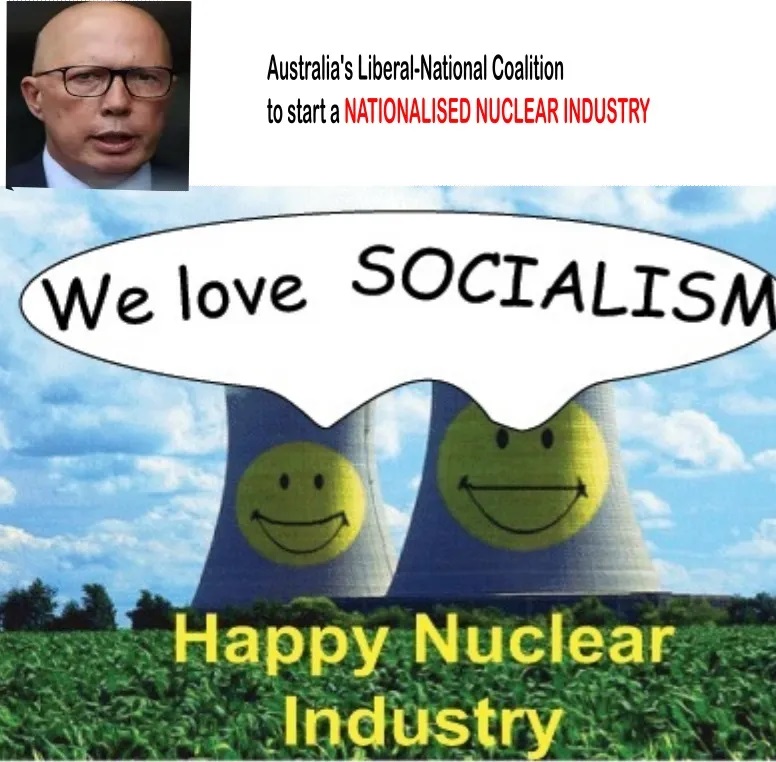
Aspects of the proposed program also go distinctly against the supposedly free market individualism so treasured by those on Dutton’s side of politics. If nuclear power was to become the fundamental means to decarbonise the Australian economy by 2050, it would entail crushing levels of debt and heavy government stewardship.
By its very nature, the Commonwealth would have to take the reins of this venture, given that private investors will have no bar of it
By Binoy Kampmark | 23 July 2024
Peter Dutton’s sketchy plan for Australia to go nuclear is nothing more than a political distraction with no actual benefits for the country, writes Dr Binoy Kampmark.
POLITICS AND FACTS are not necessarily good dinner companions. Both often stray from the same table, taking up with other, more suitable company. The Australian Opposition Leader, Peter Dutton, has never been discomforted by facts, preferring the chimera-like qualities demagoguery offers. His vision for Australia is admirably simple and simplistic.
In foreign policy, he supports U.S. interventions in any theatre of the globe without question. Ditto such allies as Israel. To the distant north, the evil Yellow Horde is abominated. Domestically, matters are similarly one-dimensional. Irregular boat arrivals are to be repelled with necessary cruelty. And then there is a near pathological hatred of renewable energy.
Needing to find some electoral distraction to improve the Liberal-National Coalition’s chances of returning to office, Dutton has literally identified a nuclear option. Certainly, it is mischievous, throwing those wishing to invest in the problematic Australian energy market into a state of confusion. As with any investment, the business of renewables is bound to also be shaken.
Last month, Dutton finally released some details of his nuclear vision. Seven nuclear projects are envisaged, using sites with currently working or shuttered coal-fired power stations. These will be plants up to 1.4 gigawatts (GW) to be located at Loy Yang in Victoria, Liddell in NSW’s Hunter Valley and Mt Piper near Lithgow, Tarong and Callide in Queensland. Small modular (SMR) reactors are planned for Port Augusta in South Australia and Muja near Collie in Western Australia.
The SMR gambit is particularly quixotic, given that they have yet to come to viable fruition. Besides, the entire reactor venture already faces glaring legal impediments, as nuclear power is prohibited by Commonwealth and state laws. (The ban on nuclear energy was, with sweet irony, legislated by the Howard Coalition Government a quarter of a century ago.)
Already, the handicaps on the proposal are thick and onerous. Ian Lowe of Griffith University witheringly describes the proposal as ‘legally impossible, technically improbable, economically irrational and environmentally irresponsible’.
The greatest of all handicaps is the fact that Australian governments, despite tentatively flirting with the prospect of a civilian nuclear sector at points, have never convinced the citizenry about the merits of such power. The continuous failure of the Commonwealth to even identify a long-standing site for low-level radioactive waste for the country’s modest nuclear industry is a point in fact.
Aspects of the proposed program also go distinctly against the supposedly free market individualism so treasured by those on Dutton’s side of politics. If nuclear power was to become the fundamental means to decarbonise the Australian economy by 2050, it would entail crushing levels of debt and heavy government stewardship.
By its very nature, the Commonwealth would have to take the reins of this venture, given that private investors will have no bar of it.
Tom Dusevic, writing in the otherwise pro-Dutton outlet The Australian, put it thus:
‘There is no other way because private capital won’t go anywhere near this risky energy play, with huge upfront costs, very long lead times and the madness that has pervaded our energy transition to meet international obligations.’
The extent of government involvement and ownership of the proposed nuclear infrastructure made The Age and Sydney Morning Herald search for a precedent. It seemed to have an element of “Soviet economics” to it, directly at odds with the Liberal Party’s own professed philosophy of “lean government that minimises interference in our daily lives; and maximises individual and private sector initiative”.
It would also add to the already monstrous AUKUS obligations Australia has signed up to with the United States and the United Kingdom, a sovereignty-shredding exercise involving the transfer and construction of nuclear-powered submarines to Canberra costing upwards and above $368 billion.
The Smart Energy Council has been good enough to offer its own estimate: the seven nuclear plants and reactors would cost somewhere in the order of $600 billion, securing a mere 3.7 per cent of Australia’s energy share by 2050.
While draining the treasury of funds, this nuclear-in-Duttonland experiment would do little to alleviate energy costs. The Commonwealth Scientific and Industrial Research Organisation (CSIRO), Australia’s national science agency, along with the Australian Energy Market Operator (AEMO), have concluded that nuclear power in Australia would not be prudent in terms of cost relative to other sources of power. The obstacles noted in their 2023-24 report are impressively forbidding.
According to the report, Australia, for instance, lacks existing nuclear power projects:
‘Therefore, although it is true that all technologies have extensive pre-construction development times, nuclear is unique in that it has an empty development pipeline in Australia.’
Throw in the layers of legal, safety and security steps, any pioneering nuclear plant in Australia would be ‘significantly delayed’, rendering nuclear power’s role in achieving net zero emissions by 2050 a nonsense.
The Dutton plan is scratched of all empirical shape. Estimates are absent. Numbers, absent. Capacity, absent. Figures, if supplied, will be done immediately prior to the next Federal Election, or while in government. Such moves teeter on the edge of herculean stupidity and foolhardiness, at least in Australian conditions. The exercise is also, quite rightly, being seen as an attempt to stealthily retain coal-fired stations while starving continued investment to the renewable sector.
Dutton’s junior partner, the Nationals, has also been very candid about its position on renewable energy projects.
Party Leader David Littleproud nailed his colours to the mast on that subject early last year. By August 2023, he was explicitly calling for a “pause” to the rollout of wind and solar and transmission links, calling the Albanese Government’s pursuit of its 82 per cent renewables target a “reckless” one. His implicit suggestion: wait for the release of the nuclear genie.
The Coalition Opposition’s nuclear tease continues the tendency in Australia to soil climate policy with the sods of cultural conflict. On any matter, Dutton would be happy to become a flat-Earther were there any votes in it. The problem here is that his proposal might, on some level, be disruptively attractive — in so far as the voters are concerned. With Labor dithering in office with the smallest of majorities, any disruption may be one too many.
AUKUS – Australia-United Kingdom-United States nuclear pact endangers us all

Agreement is proliferation nightmare
By Jemila Rushton https://beyondnuclearinternational.org/2024/07/21/agreement-is-proliferation-nightmare/—
Australia arms up with UK and US help
The following is a statement to be delivered on July 23 at the 2024 Nuclear Non-Proliferation Treaty Preparatory Committee event in Geneva by Jemila Rushton, Acting Director, International Campaign to Abolish Nuclear Weapons, Australia. It was endorsed by a number of groups, including Beyond Nuclear. It has been adapted slightly for style as a written piece rather than oral delivery.
We gather in uncertain and dangerous times. All nine nuclear armed states are investing in modernizing their arsenals, none are winding back policies for their use. The number of available deployed nuclear weapons is increasing. We do not have the luxuries of time or inaction.
Against this background where the proliferation of nuclear weapons is an ongoing concern, Australia, the United Kingdom and the United States of America continue to further develop AUKUS, an expanded trilateral security partnership between these three governments.
AUKUS has two pillars. Pillar One was first announced in September 2021 and relates to information, training and technologies being shared by the US and UK to Australia to deliver eight nuclear powered submarines to Australia. Vessels which, if they eventuate, will utilize significant quantities of highly enriched uranium (HEU). It also allows Australia to purchase existing US nuclear submarines. Currently, Australia is committing billions of dollars to both US and UK submarine industry facilities as part of the AUKUS agreement, potentially enabling the further development of nuclear armed capability in these programs.
Two years ago, during the 2022 NPT Review Conference, many governments expressed concern that the AUKUS nuclear submarine deal would undermine the NPT, increase regional tensions, lead to proliferation, and threaten nuclear accidents in the ocean. There remains an urgent need to critique the nuclear proliferation risks posed by AUKUS.
The Australian decision to enter into agreements around nuclear powered submarines was made on the assumption that it would be permitted to divert nuclear material for a non-prescribed military purpose, by utilizing Paragraph 14 of the International Atomic Agency’s (IAEA) Comprehensive Safeguards Agreement (CSA). The ‘loophole’ of Paragraph 14 potentially allows non-nuclear armed states to acquire nuclear material, which would be removed from IAEA safeguards.
Australia’s proposed acquisition of large quantities of HEU outside of usual IAEA safeguards and scrutiny jeopardizes nonproliferation efforts and fissile material security. This conference has the mandate to prepare recommendations for the upcoming Review Conference to strengthen rather than weaken the global nonproliferation regime by moving to close the Paragraph 14 loophole. States represented here should negotiate the closure of the Paragraph 14 loophole in the NPT, as it permits Australia and other non-nuclear armed states to obtain nuclear-powered submarines and potentially weapons-grade HEU.
To eliminate the risk of non nuclear weapons states acquiring nuclear weapons grade HEU, all states, including AUKUS members, should refrain from sharing the technology and materials that will be transferred if Australia and others acquire nuclear-powered submarines. The paragraph 14 loophole undermines the NPT and needs to be closed.
Pillar Two of AUKUS plans to enhance the joint capabilities and interoperability between the partners, and may draw in other countries to AUKUS. This move is vastly out of step with a strong sense of Pacific regionalism and the long-standing commitment to a Nuclear Free Pacific. The South Pacific Nuclear Free Zone Treaty (Treaty of Rarotonga) is being put under strain in this agreement. It is of grave concern that currently Japan, Canada and Aotearoa/New Zealand are actively considering their engagement with AUKUS Pillar 2.
We are concerned that the AUKUS trilateral partnership, and any further expansions will exacerbate regional tensions, fuel an arms race and increase risks of war in the Asia-Pacific region, particularly involving China and the United States, and will increase the danger of nuclear escalation in any such conflict.
Within Australia, First Nations communities have expressed deep concern about the imposition of new military and radioactive waste facilities on their lands. First Nations and broader communities across Australia and throughout the Pacific have noted that AUKUS is part of a rapid militarization of the region, and raises the ever-present threat of nuclear conflict. Recognizing the disproportionate impacts of previous nuclear activities on First Nations or Indigenous Peoples, and the on-going legacies of nuclear weapons testing and activities in the region, there is deep concern for what AUKUS will mean for sovereignty of Small Island States and its impacts on Indigenous lands and Peoples.
The fuel for HEU naval propulsion reactors is weapons-grade, and the spent fuel is weapons-usable. HEU is the most suitable material for ready and rapid conversion into a nuclear bomb. While removing HEU from a submarine would not be an easy process, the possibility of diverting such material for weapons purposes cannot be ruled out. Meaningful safeguards are extremely limited when the material is on a stealth platform that can disappear for six months at a time.
With the entry into force of the UN Treaty on the Prohibition of Nuclear Weapons (TPNW), there is a mandate to strengthen existing non-proliferation mechanisms. By joining the TPNW, governments can legally confirm that they will not acquire or host nuclear weapons, nor assist with their use or threat of use. We affirm that AUKUS members should make firm their commitments to nuclear non-proliferation and disarmament by joining the TPNW as a matter of urgency.
Jemila Rushton is the Acting Director, International Campaign to Abolish Nuclear Weapons, Australia
Australia: Opposition’s nuclear power plans open the door for nuclear weapons
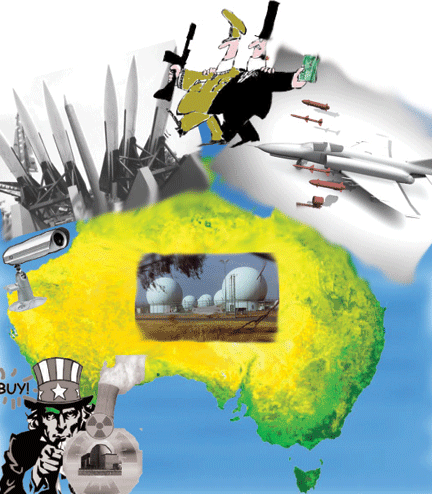
Barely mentioned is the potential of a nuclear power industry to provide a pathway for the development of nuclear weapons: first, by providing a large pool of nuclear scientists, engineers and technicians and, second, by creating the means to manufacture the fissionable material needed for a bomb. The latter would require further heavy investment in either a uranium enrichment plant or a plutonium reprocessing plant, or both.
Such a discussion has been underway largely behind closed doors in strategic and military circles for decades.
WSWS, Peter Symonds, 19 July 24
Federal opposition leader Peter Dutton’s announcement last month that the Liberal-National Coalition would build seven nuclear power plants seeks to overturn longstanding official opposition to nuclear energy, entrenched in state and federal law. Currently, Australia has just one nuclear reactor, operated by the Australian Nuclear Science and Technology Organisation (ANSTO) for research and the production of medical isotopes.
Dutton slammed Prime Minister Anthony Albanese’s Labor government for its reliance on renewables, claiming that nuclear power would provide cheap, reliable, environmentally-friendly energy for households and businesses. He dismissed problematic issues of nuclear waste and safety by pointing out that the Albanese government had already ditched Labor’s nuclear-free policy by embracing the acquisition of nuclear-powered attack submarines under the AUKUS pact with the UK and US.
In the ensuing wave of commentary on the nuclear power proposal, critics derided Dutton’s lack of detail, including costings, and pointed out that nuclear reactors would not be operational for at least a decade. Advocates of the profitable renewable industries touted solar and wind power as the cheap, clean, safe alternatives to nuclear power.
Barely mentioned is the potential of a nuclear power industry to provide a pathway for the development of nuclear weapons: first, by providing a large pool of nuclear scientists, engineers and technicians and, second, by creating the means to manufacture the fissionable material needed for a bomb. The latter would require further heavy investment in either a uranium enrichment plant or a plutonium reprocessing plant, or both.
Such a discussion has been underway largely behind closed doors in strategic and military circles for decades. Plans for an Australian atomic bomb were seriously considered in the 1950s and 1960s, with the 1968‒71 Coalition government of Prime Minister John Gorton taking the first steps in building a nuclear power reactor that provided a route to manufacturing a nuclear weapon.
In the midst of the Cold War, however, Washington was determined to maintain the effective monopoly of its massive nuclear arsenal and thus its use as a menacing threat or in war itself against the Soviet Union or any other potential rival. Under the guise of disarmament, the Nuclear Non-Proliferation Treaty (NPT) banned the manufacture of nuclear weapons except for the five countries with a known nuclear arsenal—the US, the Soviet Union, Britain, France and China—and effectively stymied the Australian project as well as most similar plans by other countries. Australia signed the NPT in 1971 and ratified it in 1973.
The global geopolitical landscape, however, has dramatically changed since the dissolution of the Soviet Union in 1991 and the end of the Cold War. Far from bringing global peace and prosperity, US imperialism has been waging war for the past three decades in a desperate attempt to maintain its global hegemony. Conflicts in the Middle East and Central Asia are now rapidly metastasizing into great power conflicts and world war involving nuclear-armed powers. The US and its NATO allies are already waging war against Russia in Ukraine and, in league with its Asian allies, including Australia, preparing for war against China.
In this context, as the danger of nuclear war looms larger, debate has reemerged in military circles over the building of an Australian atomic bomb. In his book How to Defend Australia, published in 2019, prominent strategic analyst Hugh White devoted an entire chapter to the question: “Does Australia need its own nuclear weapons to preserve its strategic independence in the decades ahead?”
The way White posed the question points to the central argument of the book as a whole—the necessity of Australian imperialism forging a foreign and military policy that does not rely on America’s waning power.
………………………………. In the Indo-Pacific, the US has been preparing for war with China, which Washington regards as the chief threat to its global domination. Far from leaving Australia isolated, the US is integrating the Australian military directly into its war plans against China—the AUKUS pact being the most obvious expression. This places the Australian population on the front lines of such a war.
White speaks for a minority in the ruling class that doubts the wisdom of being drawn into a catastrophic military conflict with Australia’s biggest trade partner. He and others argue for Australian imperialism to adopt a stance of heavily-armed neutrality. While not explicitly calling for an Australian nuclear weapon, White’s book certainly implied its necessity. Grossly inflating the threat posed by China, he argued that without the protection of the US, the only realistic means of countering such a threat is for Australia to have its own nuclear armaments.
……………………………………………………………………………………………………………………US imperialism is already, in reality, engaged in a war with nuclear-armed Russia in Ukraine and making advanced preparations for conflict with nuclear-armed China. The Australian military, including its bases, forms a vital component of the Pentagon’s strategy for fighting a nuclear war and, thus, a potential nuclear target. American nuclear submarines and nuclear-capable strategic bombers are being stationed in western and northern Australia. US spy and communications bases in Australia are indispensable to the US military’s global war plans. In other words, if US imperialism launches nuclear war, Australian imperialism is automatically involved……………………………………………………………………………………..more https://www.wsws.org/en/articles/2024/07/20/qxon-j20.html—
Can the Voices model help communities fight off nuclear reactors?
By Bianca Hall and Mike Foley, July 20, 2024
Coal communities across the country – facing the loss of industry, jobs and the social fabric that binds them together – are poised to transition from the fossil fuel that built their histories.
But what the future will look like in towns like Lithgow in NSW and Traralgon in Victoria’s Latrobe Valley is far less certain. Will they pivot to privately owned renewables, or have government-owned and funded nuclear reactor sites imposed on them by a future Coalition government?
Community groups in every site nominated by Peter Dutton as a potential future nuclear site have joined forces to offer their answer to his proposal: no.
Wendy Farmer is president of Voices of the Valley, a community group that formed in the Latrobe Valley after the Hazelwood coal mine fire in 2014, which burned for 45 days and caused health concerns for those living there amid the smoke.
Farmer united community groups from each area nominated for a nuclear plant to campaign together against the plans. Together, they’ve formed an alliance representing seven communities to fight against the proposal, reminiscent of the independent Voices movement that sent Cathy McGowan to federal parliament in 2013 and has since been replicated across the country.
Already, two people are preparing to nominate as independent candidates to take the fight to the next election.
“I’m really hoping that it will show communities that united, we can really make a change,” she says. “We can actually demand what we want as community. To me, it’s really important that we just aren’t dumped on and told ‘this is what’s good for you, and this is what’s going to happen’.”
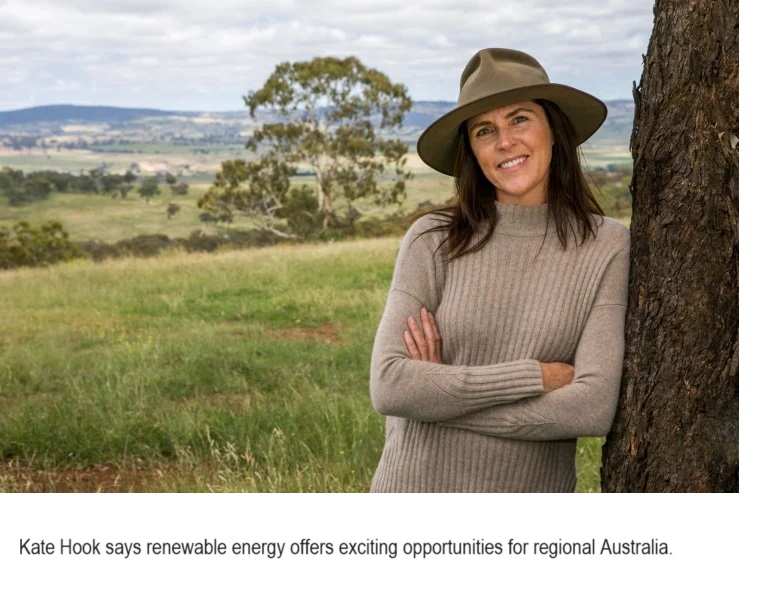
Kate Hook, who ran as an independent candidate in Calare in central western NSW in 2022, says she’s considering putting her hand up again at the next election against Nationals MP-turned-independent Andrew Gee.
Key to her candidacy, which she would run as a Voices-style campaign, is renewable energy and nuclear. “Is it a bunch of politicians who have just got together and said, ‘Here’s a talking point that will distract from renewable energy’?” she says.
“Because there is already something under way [the switch to renewables], which is an amazing opportunity for this region that we haven’t had in decades, and there’s a risk that that is squandered.”
AGL has announced its ambition to transform the sites of its coal-fired power stations in Victoria and NSW – the last of which is due to close in 2035 – into low-carbon energy “hubs” spanning renewable energy generation, big batteries and green tech manufacturing.
Meanwhile, Dutton in June nominated seven regional communities that he said would be home to nuclear reactors under a future Coalition government, at the sites of current or closing coal power plants.
They would be hosted at Lithgow and the Hunter Valley in NSW, Loy Yang in Victoria’s Latrobe Valley, Tarong and Callide in Queensland, Collie in Western Australia and Port Augusta in South Australia.
The announcement was made without consultation with the owners of the privately owned coal stations they would replace, according to several well-placed sources.
Unease about Dutton’s nuclear ambition isn’t limited to communities: local MPs are also wary of Dutton’s bid to build reactors on the sites of former coal-fired power plants.
Bathurst MP Paul Toole, who represents Lithgow in the NSW parliament for the Nationals, has criticised the lack of consultation by the federal opposition over the proposed takeover of the Mount Piper plant, about 20 kilometres north-west of Lithgow.
Rather than commit to the party line, he said he would back the community’s position. “I think the community feels as though they’ve been left in the dark,” Toole said last month. “The announcement lacks detail and raises more questions than answers. I’ll be backing the views of my community 100 per cent.”
Calare MP Andrew Gee, an independent who represents Lithgow in federal parliament, is also a sceptic of the opposition’s nuclear plans who has criticised lack of community consultation……………………………………………………………………………………..more https://www.theage.com.au/politics/federal/can-the-voices-model-help-communities-fight-off-nuclear-reactors-20240716-p5ju4o.html
Nuclear too slow to replace coal, and baseload “simply can’t compete” with wind and solar, AEMO boss says
Giles Parkinson, Jul 16, 2024, https://reneweconomy.com.au/nuclear-too-slow-to-replace-coal-and-baseload-simply-cant-compete-with-wind-and-solar-aemo-boss-says/
The head of the Australian Energy Market Operator, Daniel Westerman, has rejected nuclear power as an option to replace Australia’s ageing coal fleet, saying it is too slow and expensive, and that baseload power sources in any case won’t be able to compete in a grid dominated by wind and solar.
The comments by Westerman at the Clean Energy Summit in Sydney on Tuesday, come as the federal Coalition intensifies its push for nuclear power, outlining plans to build nuclear facilities at seven current and former coal generation sites across the country.
Westerman says the updated roadmap released by AEMO last month, known as the 2024 Integrated System Plan, does not consider nuclear because it remains outlawed in Australia and is not part of any government policy package. But he said it was clear from AEMO’s work with CSIRO in the GenCost report that nuclear was expensive, and too slow.
“To be clear, AEMO does not form the view that one form of energy is ‘good’ and another ‘bad’,” Westerman said.
“Our engineers and economists are focused on finding the least-cost path to reliable and affordable energy for Australian consumers.
“Even on the most optimistic outlook, nuclear power won’t be ready in time for the exit of Australia’s coal-fired power stations. And the imperative to replace that retiring coal generation is with us now.
“In fact, the old notion of “baseload” generation which runs constantly, then supplemented with “peaking generation” for the daily peaks in demand, simply does not reflect the way our power system works today, or into the future.
“When the sun is shining and wind is blowing, renewable generation produces energy at zero marginal cost, and “baseload” energy simply can’t compete. It is either pushed out of the market entirely, or has to sell its energy at a loss if it can’t flex up and down to absorb the peaks and troughs of variable renewable supply.
Westerman’s comments were echoed by Damien Nicks, the CEO of AGL Energy which is the country’s biggest producer of coal power, all of which will close by 2035.
“We haven’t got time to wait,” Nicks said. We need to build 12 GW of both firming and renewables over that period of time and we have to get on with it. Nuclear is not part of our strategy.”
Rob Wheals, the former head of gas company APA who now heads iron ore billionaire Andrew Forrest’s renewable investor Squadron Energy, agreed. “Nuclear does not actually solve the problem(of impending coal closures) …. we’ve got to get on with the job of building and rebuilding Australia’s energy system.”
The AEMO ISP outlines plans to deal with the expected retirement of all of Australia’s coal fleet over the next 10 to 15 years, and the costs involved to build new wind, solar and storage, as well as transmission lines – which AEMO puts at $122 billion.
That figure – along with the conclusions from the GenCost report – have been repeatedly attacked by the federal Coalition, right wing “think tanks” and mainstream media outlets. They claim that the ISP ignores costs such as networks, and consumer energy resources, which will be one of the major components of the transition.
Westerman rejected this. “It does not include the cost of distribution networks whose plans are made at a local level…and it does not include the cost of consumer devices like rooftop solar systems, because those investment decisions are made by consumers themselves,” he said.
The ISP maps out a dramatic transition in Australia’s main electricity grid, from around 60 gigawatts (GW) now, including 20 GW of rooftop solar, to more than 300 GW and more than 86 GW of rooftop solar, with demand doubling as a result of economic growth and electrification in homes, industry and transport.
This will require 60 GW of large scale wind (up from 12 GW now), 58 GW of large scale solar (up from 10 GW), and 44 GW of battery storage capacity.
It will also need 15 GW of gas capacity, up from 11.5 GW now, but that meant that around 13 GW of new capacity would be needed as much of existing capacity is ageing and will need to be replaced.
He said gas will not be used much – maybe just 5 per cent of the time – but it will be important to meet demand peaks, and also to fill gaps in so-called “dunkelflaute” the German word for extended wind and solar droughts which may be apparent in states like Victoria, particularly in winter.
One of the biggest challenges remains the management of consumer energy resources, particularly rooftop solar, which are largely uncontrolled. This meant that protocols had to be introduced to protect “minimum load” levels which would enable AEMO to remain control of the grid and keep the lights on.
Westerman said the overall pace of investment needs to increase, and the connections process – cited by investors as one of the biggest causes of project delays – also needs to be streamlined.
He said the capacity of new generation and storage projects in various stages of the connection process in the National Electricity Market had grown to close to 43 GW from 30 GW a year ago.
AEMO is also working on the engineering requirements to accommodate periods of 100 per cent renewables on the main grid. Already new milestones had been reached, including renewables reaching more than 70 per cent of NEM demand, rooftop solar alone providing 50 per cent of the NEM, and more than 100 per cent in South Australia.
He noted that South Australia, which leads the country and the world with a 70 per cent renewable share – wind and solar – over the past year, had also met more than 90 per cent of its supply with wind and solar, mostly rooftop PV, even when the state grid was electrically separated from the rest of the NEM as a result of a storm last year.
“Australia is leading the world in proving how to reliably source the majority of electricity for a developed economy from the wind and the sun.
Don’t make my home a nuclear power hub- nuclear reactors in Latrobe Valley unsafe and unrealistic.
As some Coalition MPs have let slip, talk of nuclear reactors is really code language for extending the life of coal and gas for at least 20 years until nuclear reactors can be regulated, built and actually generate energy into the Australian energy grid. This is incompatible with our global commitment to limit warming to 1.5 degrees and will see Australians more vulnerable to extreme heat, fires and floods.
By Hayley Sestokas, July 10 2024, https://www.canberratimes.com.au/story/8691386/nuclear-reactors-in-latrobe-valley-unrealistic-and-unsafe/
Earlier this year the federal Coalition began spruiking their ill-conceived idea to build nuclear reactors on the land of retired coal-fired power plants as a solution to Australia’s energy future. That talk has now reached fever pitch as Peter Dutton announced his proposed sites last week – including in the Latrobe Valley.
Leaving aside for a moment the prohibitive costs and safety concerns associated with nuclear reactors – it seems clear that Peter Dutton nor his Coalition colleagues bothered doing their homework or actually speaking to local people on the ground before naming the Latrobe Valley as a potential site.
If he had conducted even a superficial survey of community attitudes to the proposition of turning the Latrobe Valley into a nuclear power hub, he would have realised quickly that the vast majority of the community can see this proposition for what it is – a dangerous distraction that ignores the more urgent need for safe mine rehabilitation.
As it currently stands, the so-called retired coal mine sites being referred to are facing ongoing issues associated with rehabilitating the existing toxic and unstable mine pits that remain full of flammable coal. It doesn’t take too much of a mental stretch to realise that mixing old unstable mine pits and nuclear reactors is not likely to end well.
The Latrobe Valley also sits in an earthquake hotspot near the fault lines of the Strzelecki Ranges. The Fukushima nuclear disaster, which led to mass evacuations, hundreds of billions of dollars of economic loss and the release of large amounts of radioactive contamination to the air and ocean, clearly showed the danger of building a nuclear reactor on a fault line.
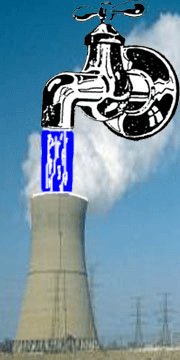
The other glaring gap in the nuclear push is water. According to the World Nuclear Institute, one nuclear reactor requires between 1514 and 2725 litres of water per megawatt hour. That equates to billions of gallons of water per year, all of which requires intensive filtering.
So where, might we ask, is all this water going to come from? Especially at a time when it’s not clear where the millions of litres of water for rehabilitating all three mine pits are going to come from. We are already in the midst of a looming water crisis without the added intensive drain of a nuclear facility.
As recently as 2019 local MP Darren Chester already publicly stated that the government had no plans to change the moratorium in place on nuclear power – let alone that his own electorate would be the site on which it would be staged.
Mr Chester has previously said safety concerns would need to be ameliorated and the development would need to demonstrate direct “social and economic benefits”. So it sounds like having opposed the nuclear push it now seems he is prepared to support his Coalition’s nuclear pipedream, at the right price.
As the area that has powered Victoria for decades, people in the latrobe valley know better than anyone that we are now in the midst of a clean energy transition. we can’t afford to wait decades for nuclear reactors when we have clean sun and wind energy right here and right now, already powering 40 per cent of our electricity grid.
It is also disingenuous that after decades of inaction and outright climate denial from the Coalition parties, the same party are now spruiking nuclear as the fastest way to reduce emissions. Instead, the Coalition needs to get with the program and focus on the fast and fair rollout of renewable energy as we phase out burning coal and methane gas.
As some Coalition MPs have let slip, talk of nuclear reactors is really code language for extending the life of coal and gas for at least 20 years until nuclear reactors can be regulated, built and actually generate energy into the Australian energy grid. This is incompatible with our global commitment to limit warming to 1.5 degrees and will see Australians more vulnerable to extreme heat, fires and floods.
While many local people are experiencing a worsening cost-of-living crisis, the federal Coalition is proposing we transition Australia to the most expensive source of energy in the world. The current levelised cost of energy (LCOE) puts nuclear generated electricity at $US180 per megawatt hour compared to $US50 for onshore wind and $US60 for utility-scale solar.
In addition to the very high cost of electricity from nuclear reactors is the huge cost to build them. In the UK, the Hinkley Point C reactor was originally budgeted to cost £18 billion, it will now cost up to £46 billion with inflation factored in. This is in a country with an established regulatory framework and nuclear industry.
Despite the reassurances of those in the Coalition who really should know better, there is still no long-term solution for the radioactive waste from nuclear reactors that meets community expectations for safety and environmental protection. Australia currently struggles to store low-grade waste from nuclear medical facilities, let alone the more radioactive waste from nuclear power reactors.
Dating right back to when the British first tested nuclear weapons in central Australia in the 1950s and ’60s in South Australia, First Nations communities, particularly in remote areas, have borne the brunt of the harm caused by nuclear activities in Australia.
First Nations communities continue to protest and take legal action against radioactive waste burial on country. There are communities who are still unable to access their land due to radioactive waste – let’s not add to that shameful legacy. Not here, not anywhere.
In pitching this radioactive, future technology, the Coalition is ignoring the fact that the clean energy transition is already well under way – and the Latrobe Valley community is out in front with a vision for a healthy, sustainable and safe future in our region. Gippsland has more than 25 large renewable energy projects in the pipeline, worth $54 billion.
With the support of the local community, these projects are already delivering the kinds of jobs and energy solutions we need now, not two decades away.
Hayley Sestokas is the Latrobe Valley community organiser for Environment Victoria.
Peter Dutton’s nuclear proliferation claims. What’s the scam?
by AAP and Kim Wingerei | Jul 11, 2024 https://michaelwest.com.au/peter-duttons-nuclear-proliferation-claims-whats-the-scam/
The scam is that it is wrong. According to a fact check done by AAP, his claims are misleading at best. Five other nations in the top 20 – Germany, Italy, Turkiye, Saudi Arabia and Indonesia – do not generate nuclear energy.
Germany, Italy and Turkiye import very small amounts of electricity generated from nuclear sources, but Indonesia and Saudi Arabia don’t consume any nuclear power.
–Australia is the only top 20 economy that doesn’t generate, import or have a plan to do so.
Mr Dutton has made the claim at least four times in interviews about the coalition’s plan to build seven nuclear power stations in Australia without clarifying that he’s counting countries planning to use nuclear power among those that are actually using it.
“Nuclear energy actually is not used by three of the world’s 20 largest economies.”
Mr Dutton said nuclear power was “used by 19 of the 20 biggest economies in the world” at a June 18 press conference in NSW.
He again claimed that of the top 20 economies in the world, “Australia is the only one that doesn’t have nuclear” in a June 20 interview on Sky News.
That same day, the opposition leader spoke out about how Australia could benefit from nuclear power “as 19 of the world’s top 20 economies have done” in an ABC News Breakfast interview.
Mr Dutton again said Australia was the only one of the 20 biggest economies that “doesn’t operate” nuclear at a press conference on July 5.
Australia, Saudi Arabia and Indonesia do not generate or use nuclear power for electricity.
He also said Australia was the only G20 member that didn’t use or plan to use nuclear power in an ABC TV interview on April 2
The G20 is a global forum for countries with large economies. Despite its name, the G20 includes only 19 nations, plus the African Union and the European Union. Spain is invited to the G20 as a permanent guest.
It’s unclear if Mr Dutton is referring to the G20 countries plus Spain, or the 20 largest nations by gross domestic product, as he’s used both interchangeably.
However, AAP FactCheck has analysed the former because the nations that don’t generate nuclear power and the nations that only import small amounts of it are exactly the same for both groupings, as per World Bank 2023 GDP data.
Fourteen G20 countries operate nuclear power plants: Argentina, Brazil, Canada, China, France, India, Japan, Mexico, Russia, South Africa, South Korea, Spain, the UK and the US.
Three G20 nations that don’t generate nuclear power but import small amounts are Germany, Italy and Turkiye. That year, about 0.5 per cent of the electricity consumed there was imported from France, which generates about two-thirds of its electricity from nuclear sources.
Italy closed its last reactors in 1990. Today, about six percent of its electricity consumption is imported nuclear power.
The country effectively banned nuclear power in 2011, but the current government wants to restart it.
Turkiye is building a plant that could start generating electricity from 2025. The country is also planning to build two other nuclear plants.
In 2022, the country imported a tiny amount of the electricity it consumed, including 0.8 per cent from Bulgaria, which generates about 35 per cent of its electricity from nuclear sources.
Therefore, a fraction of Turkiye’s electricity consumption could be produced from nuclear – likely less than half a per cent.
The country effectively banned nuclear power in 2011, but the current government wants to restart it.
Therefore, a fraction of Turkiye’s electricity consumption could be produced from nuclear – likely less than half a per cent.
Saudi Arabia doesn’t use any nuclear energy either, but it’s taking steps towards doing so in future.
Indonesia doesn’t have any nuclear reactors but has tentative plans to build some in the coming decades.
Dr Yogi Sugiawan, a policy analyst at the Indonesian government agency responsible for developing nuclear energy policies and plans, told AAP FactCheck that his country doesn’t generate or import nuclear energy.
However, Dr Sugiawan says Indonesia’s government is considering nuclear power, with an initial plant “expected to be commissioned before 2040”.
The verdict
The claim that Australia is the only G20 nation that doesn’t use nuclear power is misleading.
Evidence and experts say six G20 countries do not generate any nuclear energy, and three of those don’t consume it either.
Misleading – The claim is accurate in parts, but information has also been presented incorrectly, out of context or omitted.
AAP FactCheck is an accredited member of the International Fact-Checking Network.
Dr Yogi Sugiawan, a policy analyst at the Indonesian government agency responsible for developing nuclear energy policies and plans, told AAP FactCheck that his country doesn’t generate or import nuclear energy.
However, Dr Sugiawan says Indonesia’s government is considering nuclear power, with an initial plant “expected to be commissioned before 2040”.
“The Sun has won”: exponentially growing solar destroys nuclear, fossil fuels on price

Given Dutton’s claims about solar power costing more than nuclear are made ridiculous by the fact that solar’s break-even price has fallen by a factor of more than 1000 and the trend is continuing.
Meanwhile cost overruns in nuclear are endemic and SMR’s only exist in Dutton’s imagination.
By Noel Turnbull, Jul 11, 2024, https://johnmenadue.com/the-sun-has-won-exponentially-growing-solar-destroys-nuclear-fossil-fuels-on-price/—
It’s not known if Peter Dutton reads The Economist but if he does, he must probably think from time to time that it is sometimes dangerously left wing.
In the 22 June issue, it had a special essay on solar power – headlined ‘The Sun Machine’. The sub-head was “An energy source which gets cheaper the more you use it marks a turning-point in industrial history’.
The essay is a total contradiction of almost everything Dutton is claiming about nuclear and renewable energy.
“What makes solar energy revolutionary is the rate of growth which brought it to this just-beyond the marginal state”, the essay says.
They cite a veteran energy analyst, Michael Liebreich, who shows that in 2004 it took a year to install a gigawatt of solar power capacity; in 2010 it took a month; in 2016 a week; and in single days in 2023 there were a gigawatt of installation worldwide.
Current projections are that solar will generate more electricity than all the world’s nuclear plants in 2026; than wind turbines in 2027; dams in 2028; gas-fired plants in 2026; and coal-fired ones in 2032.
All that well before Dutton’s nuclear plants – if at all – start generating power. Moreover, unlike nuclear power which notoriously always takes longer to build than predicted, predictions about the rate of solar power roll-out are consistently under-estimates.
The Economist points out that in in 2009 The International Energy Agency (IEA) predicted solar would increase from 23GW to 244GW by 2030. It hit that milestone in 2016 – less than a third of the predicted time. The world capacity was 1419GW by 2023.
Ironically, one of the few organisations which got their predictions roughly right was Greenpeace – yet even their prediction was an under-estimate.
Given Dutton’s claims about solar power costing more than nuclear are made ridiculous by the fact that solar’s break-even price has fallen by a factor of more than 1000 and the trend is continuing. Meanwhile cost overruns in nuclear are endemic and SMR’s only exist in Dutton’s imagination.
Dutton is stronger on ideology and outrageous claims than economics, but the manufacture of photovoltaics is a classic example of the benefits of mass production – benefits which have always eluded the nuclear power industry.
As The Economist points out solar cells are standardised products all made in basically the same way and “they have no moving parts at all, let alone the fiendish complexity of a modern turbine.”
“Manufacturers compete on cost, by either making cells that make fractionally more electricity, by either making cells that make fractionally out of a given amount of sunshine or which cost less.”
Economics 101 teaches us that a commoditised product does not lead to more and more aggressive competition on the supply side – simply in this case by getting more electricity out of any given amount of sunshine or by costing less.
Rob Carlson, a technology investor, told The Economist: “There is no other energy-generation tech where you can install one million or one of the same thing depending on your application.”
“The Sun has won” he says.
The Economist said: “From the mid-1970 to the early 2020s cumulative shipments of photovoltaics increased by a factor of a million which is 20 doublings. At the same time prices dropped by a factor of 500. That is a 27% decrease in cost of doubling of installed capacity, which means a halving of costs every time installed capacity increases by 360%.
Adair Turner, an eminent economist and financial services executive, was Chair of Britian’s Climate Change Committee which was set up to help transition to zero emissions.
He told The Economist: “We totally failed to see that solar would come down so much.”
BloombergNEF estimated, in 2015, that the cost for solar on a global basis was $122 per MWH – higher than on shore wind and coal. Today both solar and onshore wind are almost half the cost of coal.
Meanwhile, Dutton has welcomed Keir Starmer’s election win by pointing to his support for nuclear power. Which, given that the UK has already installed nuclear power, the cautious Starmer is unlikely to announce that he is closing it down.
Moreover, Starmer’s major problem with nuclear is managing the spiralling delays in, and cost of, nuclear plants being constructed following typical Tory blunders.
The question which Dutton needs to answer is why he knows more about nuclear and solar power than The Economist reporters, Bloomberg, Adair Turner, Rob Carlson, many major investment funds and the overwhelming majority of Australian scientists?
He might ponder all that while the Murdoch media is becoming a tad critical of him – criticising his policy on supermarket divestment and speculating on who might be the Liberal Party leader if Dutton loses the next election.
Meanwhile, notwithstanding their doubts about Dutton’s chances and policies (other than nuclear) The Australian never totally loses its manic opposition to anything progressive. The inimitable Greg Sheridan opined on The Australian front page (6/7) that Labour had not won but the Tories had lost. Partly true obviously, but his piece was enough to prompt the subs to headline the piece with “Self-described socialist is set to drag Britain far to the left”.
Sheridan also rehearsed his regular hates and speculated how it would all come undone.
Jeremy Corbyn would love that to be the case but Starmer not so.
Perhaps the funniest lines in Sheridan’s’ piece were: “Starmer is brainy and works hard. Too deep immersion in the law has rendered it impossible for Starmer to write felicitous prose or create memorable images.”
From a journalist who year after year simply reproduces the same old opinions on the same old subjects that is, to say the least, a bit much.
The IPA just exploded their argument that the “Atlas Network” is tinfoil hat conspiracy

Lucy Hamilton, 11 July 24 https://theaimn.com/the-ipa-just-exploded-their-argument-that-the-atlas-network-is-tinfoil-hat-conspiracy/
The Institute of Public Affairs (IPA) has just shown its links to the Atlas Network, the group to which the Heritage Foundation and Project 2025 belong. The IPA has been a blight on the Australian scene since some of its senior figures went to a Mont Pelerin Society meeting in Hong Kong in 1978 and determined to change it from being a body that promoted the market for businessmen (but with checks and balances) to a much more extreme agenda. Mike Seccombe recounted the story from the old guard’s explanation: “Former IPA head: radicals ‘hijacked’ thinktank.”
This reflects the fact that the IPA was established – in 1943 – before the Mont Pelerin Society first met in 1947. Both bodies grew out of a business world that was terrified by the New Deal and other Keynesian responses to the Great Depression and the Great War. The aristocrats and robber barons were aghast at the thought that they might lose property to the filthy masses as the Russian elites had in the revolution. They perceived government efforts to hold off revolution by offering some support to the population, immiserated by capitalism’s failure in the late 20s, as the first step to their own impoverished exile.
The program was funded and fostered by resource extraction money from the earliest days at both the Mont Pelerin Society and the IPA.
This Cold War bogeyman continues to haunt the IPA. It is campaigning to demonise socialism on social media, using propaganda resources manufactured by its partner organisations in the Atlas Network.
The IPA is terrified of a world where young people have seen the ugliness of neoliberalism. That term is best defined not so much as an ideology, but as the network of people and organisations which have worked over decades to turn us from societies into a global market of consumers. The massive inequality it has fostered since the Mont Pelerin Society’s campaigning moved from the fringes in the 1940s to power under Reagan, Thatcher, Pinochet and Rogernomics is clear and miserable. Social democracies seem a much sounder path to a sustainable society and world.
The Mont Pelerin Society first colonised the Chicago School. The laissez faire economics taught there had been fighting monopoly power as a distortion of the free market. Under Friedrich Hayek’s influence, they converted to fighting the antitrust law that impeded monopolists. The new agenda of Hayek’s Chicago School was for the big money to control government. Thus they would shackle their less-connected competitors, and prevent the masses standing in their way. Milton Friedman was their great salesman. His work became systemised, by founder Antony Fisher at Hayek’s instigation, in junktanks that pretended to be think tanks or university centres or phoney grass-roots civil society organisations.
There was no “free market.” That was propaganda. This is visible in the long trajectory of the campaigns the neoliberal network pursues. In America’s Republican states, it is stark. The blocking of union formation is a mission to prevent the worker having any power over their conditions. The campaign does not stop there. This is accompanied by non-compete clauses so that a worker who does not like their conditions of employment, in the most menial of jobs, cannot move to a rival who provides better conditions. Not only that, but state laws (of the kind written by these networks) punish employers within their state boundaries that offer better conditions.
Labor conditions in Republican states are appalling. It is worse in these Confederate states for non-White people. Through a raft of laws that make it miserable to exist, through to an entire infrastructure designed to imprison Black men and hire out their bodies as slave labour, the intent is clear. There is no free market for labour.
The redistribution of society’s tax money to the rich in a variety of ways (think Jobkeeper and Harvey Norman) shows, just as the Republican state experiment does, that the neoliberal experiment is not about “property rights” but “property rights for the rich.” Our property is their property.
If they wish to make our property worthless by fuming poisoned air over it, that is our tough luck.
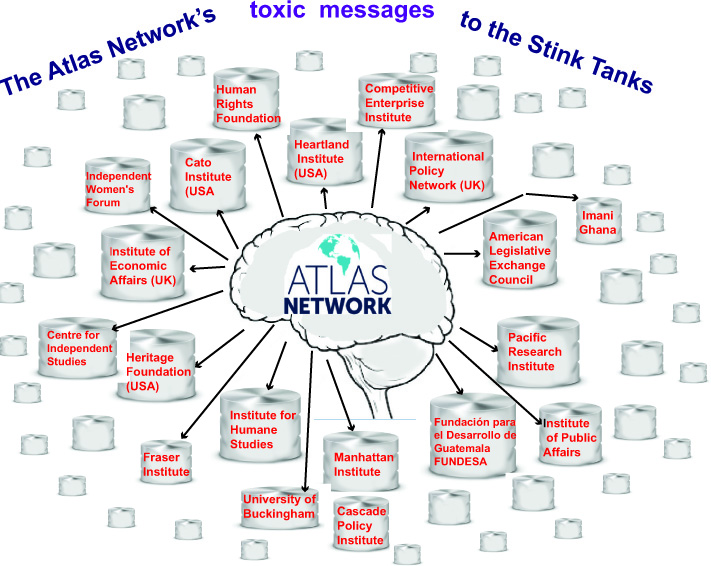
When one of the Atlas Network’s favourite IPA apparatchiks, Tim Wilson, was made Human Rights Commissioner by IPA-affiliate Tony Abbott, his public campaign was for free speech rights. Of course Yassmin Abdel-Magied’s free speech was not to be protected. Free speech is for their faction, not the Other.
Behind closed doors, however, Wilson’s primary battle for rights was for property rights. He spoke at the libertarian Friedman Conference with utter scorn of the high-ranking rights experts with whom he was forced to work in that role. His infantilised distortion of the British tradition of liberalism placed property rights as the prime factor. Their more sophisticated (French?) tradition of liberalism treated the rights of oppressed humanity as a higher priority.
Anyone watching the authoritarian intent behind the Project 2025 mission that threatens to accompany a Trump victory in November sees that it protects the property rights of the rich as much as key Atlas funder and strategist Charles Koch could demand. The human rights of anyone who fails to live as the obedient “traditional” identity, however, is under serious threat. The fact that the humanity of the gestating woman or pregnant person is made invisible, a machine gestating the potential humanity of a small ball of cells inside, illustrates the threat. Control of anyone who does not play by their rules is already a life and death matter in American Republican states.
The IPA shared a snippet of video made by one of the American Atlas partners, the Liberty Fund. In this, grim socialist footage of communist Estonia illustrates that “socialism” is ugly, monotone suffering not Bernie Sanders. The youth must be chastened out of the idea that their humanity deserves rights or that they have a justifiable claim for a decent standard of living, even if the plutocrats have to give up a little of their extraordinary wealth. At the bottom of that Liberty Fund page, key partners in the Atlas Network are listed.
The low-rent IPA campaigns on social issues to foment culture war. They aim to distract those most disadvantaged in neoliberalism’s world. They have not, however, forgotten the main game. A more equitable society means the rich must pay their fair share of tax. The financial, legal, governmental systems that they have gamed must be deconstructed. Before 2020, eight men alone owned as much property as that held by 3.6 billion people. Since the pandemic, that situation has worsened dramatically. In the years since 2020, 26 trillion dollars of new wealth has been snatched by the 1%. By contrast the rest of the world’s population gained $16 trillion. A 5% wealth tax on the handful of billionaires could raise enough to bring 2 billion people out of poverty.
Business has always benefitted from tax-funded infrastructure. Hospitals, schools, roads, railway, the internet etc make businesses possible. The bunk economics of neoliberalism denies that fact. Their friends at ultraconservative Quadrant warned that neoliberalism’s zero sum game would destroy the Australian way of life, and they are being proved right.
This impoverished world has been created by the plutocrats’ influence network and their junktanks infesting our public debate, media, academia and government. Neoliberalism was their construction and continues to threaten our survival by their obdurate refusal to transition away from carbon-based energy.
We should thank the IPA for sharing Koch (and Templeton) propaganda. Next time they say that talk of the Atlas Network is tin-foil hat conspiracy theory, we can remind them that they proved our point themselves.
Gas before nuclear ‘thought bubble’ as coal reign ends
Yahoo/Finance! Jack Gramenz, Tue 9 July 2024
Federal opposition plans to roll out nuclear energy have been dismissed as a thought bubble as the nation races to replace coal power.
Alternatives to the fossil fuel – which still powers much of the grid in NSW, Victoria and Queensland – are being rapidly rolled out with coal’s reign “swiftly ending,” according to electricity company bosses.
Proposals to increase natural gas supplies for the nation’s most populous state are being assessed and welcomed as renewable projects come online, NSW Energy Minister Penny Sharpe says.
“We don’t want to see price spikes and we don’t want to see uncertainty for industry,” she told a Committee for Economic Development of Australia event on Tuesday………………….
“More and more renewable energy is entering the system, but it’s always happening more slowly than we would like,” Ms Sharpe said.
The state Labor minister said she was “unimpressed” by a proposal from the federal coalition to roll out nuclear power stations.
The plan posed too many important but unanswered questions and threatened to smash a hole in the certainty provided by the state’s energy strategy, she said.
“NSW will not be risking our future economic prosperity for a policy thought bubble designed to play politics,” Ms Sharpe said……………………..
The chief executive of Australia’s largest energy generator and greenhouse-gas emitter reaffirmed nuclear power was not part of the company’s future.
AGL’s Damien Nicks told the same event the electricity supplier focused on renewable generation and storage.
“AGL’s generation portfolio will look completely different by 2035, when we’re no longer generating electricity from coal,” he said……………
The transmission network operator is building 2500km of new lines to carry an expected 17-gigawatt surge in renewable generation as more projects enter the grid.
Ms Sharpe on Tuesday announced the inaugural chair and seven commissioners for the state’s Net Zero Commission……. https://au.finance.yahoo.com/news/gas-nuclear-thought-bubble-net-044223314.html
No House? Two-party Senate squeeze on cross-bench locks in Defence spending debacle
Defence has little oversight. Whenever they turn up to Senate Estimates or the Joint Parliamentary Committee on Accounts and Auditing, and the subject matter strays into areas of embarrassment, Defence pleads “it’s classified, we can’t talk about it.”
by Rex Patrick | Jul 8, 2024, https://michaelwest.com.au/no-house-two-party-senate-squeeze-on-cross-bench-locks-in-defence-spending-debacle/ (sorry about the coloured bits – my ludditeness)
On the last day of sitting before the winter parliamentary break, the Albanese Government, who’ve had bills delayed and amended, for the first time in the 47th Parliament had a piece of legislation voted down in the Senate. It’s an outcome that does not serve Australians well. Rex Patrick reports.
Comedy in the Senate
Last Thursday in the Senate, Greens’ Senator David Shoebridge rose from his seat and gave an impromptu speech on Defence. Anyone watching might reasonably have thought he was engaging in a moment of comedy, but he wasn’t; the topic was deadly serious.
“It’s hard to know where you end the list of defence procurement disasters which have happened because, whether it’s Labor in government or the Coalition in government, whether it’s Labor in opposition or Coalition in opposition, the usual practice is that the club doesn’t hold Defence to account.“
The club just signs off on whatever new funding fantasy Defence comes up with and pretends that Defence can achieve it.
Zero, zero,zero
Shoebridge then made some blunt observations on submarine procurement.
“Two decades of this nonsense on submarines has given us a $20 billion hole. I’m trying to think how many submarines we got in the last 20 years – oh, zero. We’ve given $5 billion to the French for no subs, $5 billion to the US for no subs, $5 billion to the UK for no subs and $5 billion trying to keep the Collins class going for another ten years under an experimental project. How many new subs have we got? Zero”
He moved on to frigates.
“I think we were meant to get nine frigates for $45 billion. Now it looks like we’re going to get six frigates, and guess what the price tag will be? It’s $45 billion and counting.”
“Let’s be clear: the $45 billion on the Hunter frigates is to date the single largest procurement contract ever signed by the Commonwealth, and it’s a disaster zone. How many Hunter frigates do we have? You’ll be pleased to know we have the same number of Hunter frigates in service as we have new submarines. Zero.”
He finally turned to the Navy’s Offshore Patrol Vessels……………………………
A mess that needs fixing
Defence, by far, has the most public money committed to projects. If you wanted only one agency of government to spend money wisely, it would be Defence.
But they don’t spend it wisely. Defence procurement is an absolute mess. [excellent chart here on original]
The starting point for that mess is Admirals, Air Marshalls and Generals with little project and risk management experience making purchasing recommendations to Cabinet ministers with no experience in project and risk management.
Senator Shoebridge rightly pinged the timidity of successive governments, cabinets and ministers when it comes to defence:
“They pretend they’re tough on Defence until somebody strides into the room with a little bit of gold braid on their shoulder, and then there’s this obscene subservience from both the Labor party and the coalition: ‘Oh, Sir! Oh, Madam! How much money can we give you? Does it go ‘whoosh’? Will it go ‘bang’ at some point? Oh, that’s great! You can have the money.”
Oversight vacuum
And that leads us to the failed Bill last Thursday.
.
Defence has little oversight. Whenever they turn up to Senate Estimates or the Joint Parliamentary Committee on Accounts and Auditing, and the subject matter strays into areas of embarrassment, Defence pleads “it’s classified, we can’t talk about it.”
In late May, the Government introduced a Defence Amendment (Parliamentary Joint Committee on Defence) Bill 2024 that would establish a parliamentary committee that would meet in secret (by default) and have the power to inquire into just about any aspect of Defence.
The Committee, as prescribed in the Government’s Bill, was to consist of 13 Senators and MPs: seven Government members and six non-government members. The Liberals and Nationals went into a cataclysmic spasm. This would allow the Prime Minister to appoint a cross-bencher or two. OMG!
We have 14 cross benchers in the House (out of 151 MPs – 9%) and 20 cross benchers in the Senate (out of 76 senators – 26%). Having their representation on the Committee is appropriate, particularly given that most Defence projects are so long they extend across parliamentary terms and indeed several changes of government. Both Labor and the Coalition are to blame for the many screw-ups and are hesitant to engage in vigorous scrutinise.
So, Senator Birmingham moved an amendment to restrict the membership to seven government members and six opposition members. That amendment went down, and the Government and cross-bench voted against his changes. This put a nail in the Bill’s coffin, ensuring the Coalition would eventually vote against it.
So, Senator Birmingham moved an amendment to restrict the membership to seven government members
Two-party squeeze
Senator Shoebridge, rightly suspicious of the wording of Labor’s Bill, sought to amend it from seven Government members and six non-government members (which could easily just mean opposition members) to seven government members, four opposition members and two cross-benchers, one from the House and one from the Senate. That option was not supported by Labor or Liberal and was voted down.
That left the original wording of the Bill without Liberal or cross-bench support. The Bill went then went down in flames. It was Labor’s first comprehensive legislative failure in this Parliament.
There were some happy winners though; Defence’s bloated and complacent bureaucratic leadership. For them it’s business as usual; billions of taxpayers’ dollars to splurge with little scrutiny and even less accountability. There were, no doubt, a few bottles of (contractor supplied) champagne popping at Defence central on Russell Hill. They had dodged a bullet.
Politics, as it so often does, got in the way of a good outcome for the Australia public.
Dutton’s claim about G20 nuclear energy use doesn’t add up
William Summers , July 5, 2024, https://www.aap.com.au/factcheck/duttons-claim-about-g20-nuclear-energy-use-doesnt-add-up/
WHAT WAS CLAIMED
Australia is the only G20 nation that doesn’t use nuclear power.
OUR VERDICT
Misleading. Five other G20 nations don’t generate nuclear power, and two of those don’t use it.
AAP FACTCHECK – Federal Opposition Leader Peter Dutton claims Australia is the only country not to use nuclear energy out of the world’s 20 largest economies.
This is misleading. Five other nations in the top 20 – Germany, Italy, Turkiye, Saudi Arabia and Indonesia – do not generate nuclear energy.
Germany, Italy and Turkiye import very small amounts of electricity generated from nuclear sources, but Indonesia and Saudi Arabia don’t consume any nuclear power.
Australia is the only top 20 economy that doesn’t generate, import or have a plan to do so.
Mr Dutton has made the claim at least four times in interviews about the coalition’s plan to build seven nuclear power stations in Australia without clarifying that he’s counting countries planning to use nuclear power among those that are actually using it.
Mr Dutton said nuclear power was “used by 19 of the 20 biggest economies in the world” at a June 18 press conference in NSW.
He again claimed that of the top 20 economies in the world, “Australia is the only one that doesn’t have nuclear” in a June 20 interview on Sky News.
That same day, the opposition leader spoke out about how Australia could benefit from nuclear power “as 19 of the world’s top 20 economies have done” in an ABC News Breakfast interview.
Mr Dutton again said Australia was the only one of the 20 biggest economies that “doesn’t operate” nuclear at a press conference on July 5.
When asked to clarify his claims, the opposition leader’s spokeswoman told AAP FactCheck that he’s counting countries that have nuclear power and those “taking steps towards embracing nuclear”.
Mr Dutton accurately stated 19 of the world’s 20 biggest economies used nuclear power or “have signed up to it” in another press conference on June 19, and a Today Show interview on June 21.
He also said Australia was the only G20 member that didn’t use or plan to use nuclear power in an ABC TV interview on April 21.
The G20 is a global forum for countries with large economies. Despite its name, the G20 includes only 19 nations, plus the African Union and the European Union. Spain is invited to the G20 as a permanent guest.
It’s unclear if Mr Dutton is referring to the G20 countries plus Spain, or the 20 largest nations by gross domestic product, as he’s used both interchangeably.
However, AAP FactCheck has analysed the former because the nations that don’t generate nuclear power and the nations that only import small amounts of it are exactly the same for both groupings, as per World Bank 2023 GDP data.
Fourteen G20 countries operate nuclear power plants: Argentina, Brazil, Canada, China, France, India, Japan, Mexico, Russia, South Africa, South Korea, Spain, the UK and the US.
Three G20 nations that don’t generate nuclear power but import small amounts are Germany, Italy and Turkiye.
Germany shut down its final three reactors in April 2023. That year, about 0.5 per cent of the electricity consumed there was imported from France, which generates about two-thirds of its electricity from nuclear sources.
Italy closed its last reactors in 1990. About six per cent of its electricity consumption is imported nuclear power.
The country effectively banned nuclear power in 2011, but the current government wants to restart it.
Turkiye is building a plant that could start generating electricity from 2025. The country is also planning to build two other nuclear plants.
In 2022, the country imported a tiny amount of the electricity it consumed, including 0.8 per cent from Bulgaria, which generates about 35 per cent of its electricity from nuclear sources.
Therefore, a fraction of Turkiye’s electricity consumption could be produced from nuclear – likely less than half a per cent.
Saudi Arabia doesn’t use any nuclear energy either but it’s taking steps towards doing so in future.
Indonesia doesn’t have any nuclear reactors but has tentative plans to build some in the coming decades.
Dr Yogi Sugiawan, a policy analyst at the Indonesian government agency responsible for developing nuclear energy policies and plans, told AAP FactCheck that his country doesn’t generate or import nuclear energy.
However, Dr Sugiawan says Indonesia’s government is considering nuclear power, with an initial plant “expected to be commissioned before 2040”.
THE VERDICT
The claim that Australia is the only G20 nation that doesn’t use nuclear power is misleading.
Evidence and experts say six G20 countries do not generate any nuclear energy, and three of those don’t consume it either.
Misleading – The claim is accurate in parts but information has also been presented incorrectly, out of context or omitted.
AAP FactCheck is an accredited member of the International Fact-Checking Network. To keep up with our latest fact checks, follow us on Facebook, Twitter and Instagram.
With its nuclear energy policy, Peter Dutton seems to have forgotten the Liberal Party’s core beliefs
Judith Brett, Emeritus Professor of Politics, La Trobe University,6 July 24, https://theconversation.com/with-its-nuclear-energy-policy-peter-dutton-seems-to-have-forgotten-the-liberal-partys-core-beliefs-233444
When Robert Menzies was out of office in 1943, in between prime ministerships, he was thinking about the future of non-Labor politics in wartime Australia. He read Edmund Burke’s book Thought on the Present Discontents. In it, Burke included the now-famous definition of a political party as:
a body of men united in promoting by their joint endeavour the national interest upon some particular principle on which they are all agreed.
For Burke, political parties were legitimate when they were based on shared principles and were committed neither to personal nor sectional interest, but to the interest of the nation as a whole.
Recently, Opposition Leader Peter Dutton announced the Coalition would not have an emissions reduction target for 2030. Instead, it would build seven nuclear power plants to reach zero emissions by 2050.
I have spent much of my research life thinking and writing about the Liberal Party and its predecessors, as well its three most successful leaders: Alfred Deakin, Robert Menzies and John Howard. So I have been running Dutton’s nuclear policies against my understanding of the Liberal party’s core principles.
It’s left me puzzled. Setting aside the many technical questions about the cost and feasibility of the plan, the proposal seems to breach some of those core principles.
Public ownership?
Political parties change and evolve over time, so it’s worth assessing the Liberal Party’s current web page for a contemporary statement of beliefs.
As expected, there are clear statements about the party’s commitment to maximising private sector initiatives. This includes statements like “government should only do those things the private sector cannot”, and “wherever possible government should not compete with an efficient private sector”.
So why is the Liberal Party proposing to build and own nuclear power plants on sites the government doesn’t even own, like Liddell in New South Wales? Or Loy Yang in Victoria where the owner, AGL, has plans already in train to develop low-emission industrial energy hubs?
How would a resort to compulsory acquisition of privately owned sites be justified by a party committed to private enterprise? And what would be the cost of these acquisitions?
Section 51 of the Constitution allows the Commonwealth to acquire property “on just terms from any State or person for any purpose in respect of which the Parliament has power to make laws.” Just terms – that means the property so acquired has to be paid for, by us, the tax payer, and this has to be added to the considerable cost of building the plants.
What about the states?
The state premiers of Queensland, NSW and Victoria oppose the plan, as do some Liberal opposition leaders such as Victoria’s John Pesutto.
Speaking to the Liberal Party Federal Council in June, Dutton said that the Commonwealth can override state laws, so the state premiers won’t be able to stop the plan.
Well it can, but it requires legislation that has to get through a Senate unlikely to be controlled by any future Coalition government. It would also cost a mountain of political capital.
But in terms of principles, how does this sit with the Liberal Party’s long-standing support for the rights of the states within the federation? One of the Liberal Party’s beliefs is that “responsibility should be divided according to federal principles, without the Commonwealth taking advantage of powers it has acquired other than by referendum.”
National interest or political interest?
It seems the policy as announced breaches two of the Liberal party’s core principles:
government should not do what is better left to private enterprise- the Commonwealth should respect state rights
But what of the national interest? The Liberal Party has always claimed it is not a sectional party and so is best able to represent the national interest. This, it says, is in contrast to Labor, with its ties to the unionised working class, and the Country Party turned Nationals which represents farmers, the regions, and increasingly, the miners.
What was most shocking about the Coalition’s plan is that it blithely flirts with sovereign risk and hence with Australia’s national interest. This is completely out of character for the Liberal Party.
Energy infrastructure is a long-term investment. Local and foreign investors are spooked by the collapse of bipartisan commitment to a clean energy transition and reconsidering their investment plans. And if the investment goes, so will the jobs it would have created. How is this in the national interest?
Shadow Minister for Energy Ted O’Brien tried to settle investors down by claiming the Coalition was still committed to renewables as well, but with little detail about the planned mix.
The only one of the Liberal Party’s traditional principles visible in this policy is the one that gives the leader, rather than the party, authority over policy.
But where does this leave the Liberals in federal parliament when their leader’s policy is so fundamentally at odds with their party’s core beliefs? Loyalty to the leader can only go so far. Perhaps Liberal MPs should consult their party’s website to remind themselves of the principles on which they stood for election. It seems in the pursuit of winning political points, political principles are all too easy to forget.
Australia’s ‘carbon budget’ may blow out by 40% under the Coalition’s nuclear energy plan – and that’s the best-case scenario
The Conversation, Sven Teske, Research Director, Institute for Sustainable Futures, University of Technology Sydney July 2, 2024
The Coalition’s pledge to build seven nuclear reactors, if elected, would represent a huge shift in energy policy for Australia. It also poses serious questions about whether this nation can meet its international climate obligations.
If Australia is to honour the Paris Agreement to limit global average temperature rise to 1.5˚C by mid-century, it can emit about 3 billion tonnes, or gigatonnes, of carbon dioxide (CO₂) over the next 25 years. This remaining allowance is what’s known as our “carbon budget”.
My colleagues and I recently outlined the technological options for Australia to remain within its carbon budget. We did this using a tool we developed over many years, the “One Earth Climate Model”. It’s a detailed study of pathways for various countries to meet the 1.5˚C goal.
So what happens if we feed the Coalition’s nuclear strategy into the model? As I outline below, even if the reactors are built, the negative impact on Australia’s carbon emissions would be huge. Over the next decade, the renewables transition would stall and coal and gas emissions would rise – possibly leading to a 40% blowout in Australia’s carbon budget.
Australia has a pathway to 1.5˚C
Earlier this year, my colleagues and I analysed the various ways Australia could reduce emissions in line with the 1.5˚ goal…………………………………………………………………………. more https://theconversation.com/australias-carbon-budget-may-blow-out-by-40-under-the-coalitions-nuclear-energy-plan-and-thats-the-best-case-scenario-233108
1 This month


Help Aunty Sue Protect Her Land and Sacred Sites From Destructive Rocket Testing.
.

Australians deserve the truth
about
AUKUS – https://aukuspublicinquiry.com/

PETITION – To: Prime Minister Anthony Albanese and the Australian Labor Government

of the week – Australians for War Powers Reform (AWPR)
To see nuclear-related stories in greater depth and intensity

