Inside the nuclear influence machine

Documents unearthed by The Fifth Estate lay bare how funding for the strategy, now in motion, is coordinated by a coal mining leader from Queensland, working with possibly Australia’s most influential conservative think tank, and also a key member of Australia’s unofficial nuclear club.
Is the push for nuclear power in Australia more stalking horse for coal than a genuine alternative for a clean energy future? Here’s how the nuclear cabal is working its pitch
THE FIFTH ESTATE, MURRAY HOGARTH, 29 May 24
There’s a sophisticated, well funded strategy underway to prolong coal and gas and eventually take Australia down the nuclear road.
Documents unearthed by The Fifth Estate lay bare how funding for the strategy, now in motion, is coordinated by a coal mining leader from Queensland, working with possibly Australia’s most influential conservative think tank, and also a key member of Australia’s unofficial nuclear club.
For this to work, the Liberal-National coalition needs to win back political power at the next federal election due by May next year.
- A key conservative think tank aims to keep coal until nuclear power arrives
- Its energy security argument is echoed by Peter Dutton as coalition policy
- A Queensland coal baron mustered donors to fund this influence machine
As things stand, nuclear power is currently prohibited in Australia, and the Labor government is committed to fast-tracking a renewables-led energy transition and says it has no plans to lift the ban.
Canberra retreat
The documents we’ve obtained and refer to in this article are the script and slides from a revealing energy security project update to a private strategy retreat held in Canberra last year on 12 May 2023 by the Institute of Public Affairs (IPA).
Behind the current campaign to bring nuclear energy to Australia is a deliberate agenda to prolong coal generation and disrupt the renewables rollout
The Fifth Estate contacted the speaker and two other key IPA-connected figures identified in this story for comment on Monday 27 May, inviting on-the-record interviews and providing questions. On Tuesday evening 28 May, the IPA chief executive officer Scott Hargreaves responded by email but declined to be interviewed. Full details of that response and related information are included at the end of this article.
The Melbourne based IPA is known as Australia’s leading conservative think tank, a key influencer of Coalition policies, and breeding ground for conservative politicians.

It habitually loads speaking point bullets for coalition politicians to fire. And it looked like Opposition Leader Peter Dutton did just that when he delivered his headland nuclear policy speech at an IPA public event, just two months after the Canberra retreat on 7 July last year.
In 2023, the IPA threw an arm around one of the favourite sons of the nuclear club, University of Queensland Adjunct Professor Stephen Wilson, making him a Visiting Fellow, as part of a big new donor-funded influence project, running over three years.
A key and recurring focus of this project and subsequent related policy talking points is energy security.
The internal IPA documents, authored by Wilson, lay out what many people suspect and have alleged: that behind the current campaign to bring nuclear energy to Australia is a deliberate agenda to prolong coal generation and disrupt the renewables rollout.
The final commentary and slide in Wilson’s presentation show an IPA-orchestrated master plan for Australia to defend and preserve coal and gas in the 2020s; then build “mini and small modular reactor (SMR)” nuclear plants in the 2030s under the mantle of reaping energy security, environmental and low-cost rewards in the 2040s.
It’s a parallel universe to the view a vast number of people have of Australia’s energy future. And it’s totally at odds with the clean energy transition agenda and the federal government’s targets of 43 per cent greenhouse gas emissions reductions below 2005 levels and 82 per cent renewables by 2030.
Threat to climate targets
It’s also likely to breach Australia’s staged progress, with five yearly sub targets (for example 43 per cent by 2030, with 2035 targets due to be announced early next year, with a range of 65-75 per cent being evaluated by the Climate Change Authority), towards its bipartisan commitment to 100 per cent net zero by 2050, which was made by the former Morrison coalition government ahead of the UN Climate Summit in Glasgow in the UK in 2021.
The IPA, however, is no fan of UN processes, and as Wilson made clear in his project update notes for the IPA insiders, the aim of its strategy was definitely not to prolong a Labor government……………………………..
The coal connection
Wilson also identified in the presentation who was pulling together the funding for his IPA project, with a bit of ideological explanation to set the scene:…………………………………………………………………….
Bring on Peter Dutton
The private IPA retreat in Canberra on 12 May last year was followed less than two months later by Dutton’s major speech to launch the coalition’s new energy security themed nuclear policy. This was delivered at a public IPA event in Sydney on 7 July.
Dutton’s speech mirrors the theme
Dutton’s headland nuclear speech substantially mirrored the energy security theme and language from the IPA retreat. And it also picked up on themes from earlier “nuclear club”events and activities, a number of them involving Stephen Wilson. If Australia’s nuclear club has anyone it would like to make its intellectual rock star, it’s Wilson.
Dutton’s IPA speech directly referenced Wilson, most significantly:
Professor Wilson says that we must stop procrastinating and prepare real options to deploy nuclear energy in case we need them. Countries are queuing up to put in their orders. Australia could have SMRs [small modular reactors] installed within a decade.
Wilson also confirmed his presentation to the IPA retreat in the video of another IPA event earlier this year, its 2024 Generation Liberty IPA Academy aimed at young conservatives, and relayed how Dutton had quoted him on a couple of occasions, expressing some surprise, saying, “I didn’t know he was going to do that.” (Dutton’s 7 July speech also quoted three other nuclear club regulars, as well as Wilson.)
Since then, SMRs have been a disappointment. Very inconveniently for Dutton and Wilson, the US showcase for new and thus far commercially-unproven SMR-design nuclear power stations, the NuScale project in Idaho, was cancelled in November last year due to cost overruns and lack of electricity buyer interest.
NuScale’s chief executive officer was reported as saying: “Once you’re on a dead horse, you dismount quickly. That’s where we are here.”
On message for energy security
However insecure the NuScale experience sounds, it’s worth remembering that the core theme of Wilson’s earlier 12 May IPA presentation, based on the notes and slides, was energy security. That was also a central theme of Dutton’s 7 July IPA speech:………………………………………………………………
The future of the nation and Western civilisation as we know it
On a geo-political note, national security was weighing heavily on Wilson’s mind on 12 May, as it did for Dutton on 7 July. According to Wilson’s speaking notes, at stake was nothing less than the future of the nation and Western civilisation as we know it:…………………………………………………………………..
Nuclear club bona fides
To be clear, this is the same Stephen Wilson who joined Queensland Liberal MP Ted O’Brien, Dutton’s Shadow Minister for Climate Change and Energy, and other nuclear club players, on a so-called “due diligence” study tour to the US and Canada in January-February 2023.
As Wilson’s slide deck for the IPA Canberra Retreat showed, the study tour group visited major nuclear industry companies, government representatives, lobbyists and campaign organisations. (Ted and friends’ excellent nuclear adventure in North America will feature in other upcoming articles in The Nuclear Files.)
By his own account, judging by a number of publicly available videos, Wilson imbibed deeply in the North American nuclear sector Kool-Aid, riffing off a theme he picked up on the US study tour, to proclaim that: energy security IS national security.
That became the inspiration for a key paper he published with the IPA on 1 November 2023, titled Energy security is national security. Its 1 November 2023 launch, in London on the perimeters of a global gathering of about 1500 ultra-conservatives, is another story coming soon from The Nuclear Files.
The Fifth Estate’s questions to key players in this story
The Fifth Estate provided these questions to IPA CEO Scott Hargreaves early on Monday afternoon:………………………………………………………………………………
The nuclear story, then and now, in brief
Nuclear power has been considered for Australia numerous times over the past nearly 70 years, from the 1950s, but has never happened, mainly for economic reasons. Historically because of the low cost and wide availability of coal, and now it is the low cost of renewables. This month the 2024 CSIRO GenCost report found that traditionally designed large scale nuclear power stations would cost at least 50 per cent more than solar and wind backed by batteries, and take at least 15+ years to develop, and more technically-advanced Small Modular Reactors (SMRs) could be four to six times more expensive than renewables.
On ABC Radio Sydney on Wednesday morning, 29 May, Opposition nuclear frontman Ted O’Brien was pressed on the timing for release of the coalition’s highly anticipated nuclear policy, and insisted it would be revealed “in due course”. He confirmed that the coalition wanted to replace coal-fired power stations, as they exit the electricity grid, with nuclear ones, and that gas generation would fill any gap (which could be one to two decades) between coal shutting down and nuclear starting up. https://thefifthestate.com.au/columns/columns-columns/the-nuclear-files/inside-the-nuclear-influence-machine/
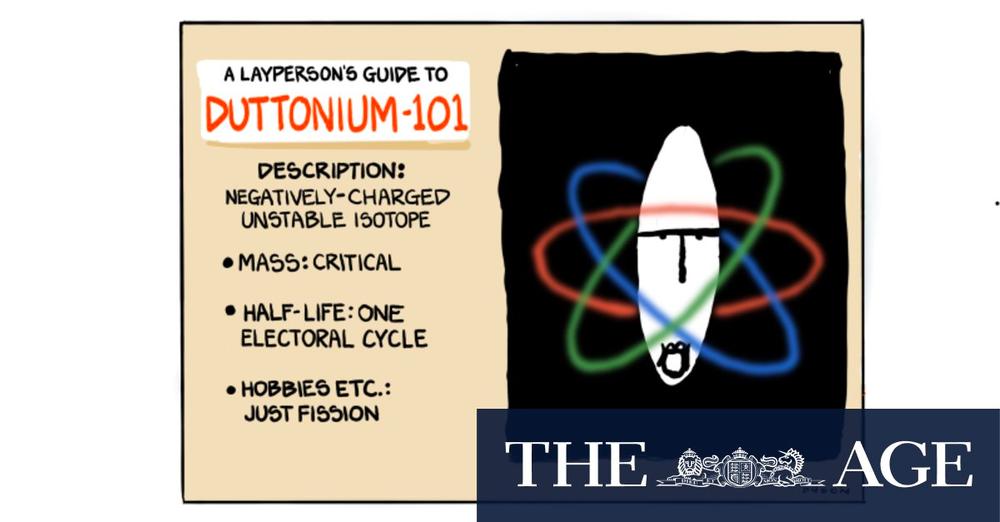
Among opposition leaders, Peter Dutton is a miracle survival story. But is he about to nuke himself with women voters?
ABC, By Annabel Crabb 29 May 24
Peter Dutton is a freak of nature. Politically, that is…………………………………
Two years in, Dutton is not only still in office, but nobody inside his own party — or even in the National Party — is trying to blow him out of it. It is a truly extraordinary achievement.
His public popularity remains firmly in negative territory, according to Newspoll. So why isn’t this translating into the customary seasonal orgy of backstabbing?
Two reasons.
The first is that there really isn’t, ahem, any alternative……………………………………………………………………………….
Dutton much a much more dangerous opponent for Anthony Albanese than is commonly assumed.
But there is one risk associated with this unseasonably warm bath of internal approbation……………………..his decision to pursue nuclear energy as a principal policy decision is a high-risk call, as a new piece of research — supplied to the ABC — makes clear……………………
When it comes to nuclear, public opinion divides along gender lines
Over recent weeks, the RedBridge Group conducted a survey of around 2,000 Australian voters, seeking their views on various issues including nuclear energy. Respondents were asked whether they would support or oppose an Australian government lifting the ban on nuclear power so private investors could build nuclear power plants here.
The responses, across all voters, were kind of evenly divided. Strong supporters constituted 17 per cent, another 17 said they were supportive, 19 per cent were “neither”, 15 per cent were opposed, 20 per cent strongly opposed, and 12 per cent were unsure. This shakes out to an extremely slender net negative of-1
But the truly fascinating detail in the survey comes when you dig down into who especially loves the idea of nuclear, and who hates it.
And the biggest difference of opinion on nuclear, it turns out, breaks along gender lines……………….
Women disapproved of nuclear power strongly – just 7 per cent strongly agreed a ban should be lifted, compared with 24 per cent of male respondents. That’s a net negative of -29 for women, and net positive of 26 for men.
The only demographics showing real enthusiasm for nuclear power were Coalition voters, those aged over 65, those who earn more than $3,000 a week, and those who own their own home. In each of these instances, every other group was majority opposed.
In other words, every other party’s voters apart from the Coalition’s registered a net negative, as well as every other age bracket apart from the most elderly, and all other income brackets apart from the top one.
Renters and mortgage holders alike disapproved on the whole. Among those who described themselves as under “a great deal of financial stress”, the feeling on nuclear ran at negative 15. Among those under “no stress at all”, however, the reception was much warmer – positive 19…………………………………………………………………………….
And in the two years that have elapsed since female voters demonstrated their annoyance at being ignored and talked down to, the Liberal Party has failed to do anything about its structural under-representation of women in parliament, …………………………………………………………..
There always seems to be an abundance of reasons to get rid of women; almost as many reasons as traditionally abound for holding on to and even promoting male duds. Women do notice this stuff.
And “Never mind ladies, have a nuclear power plant” may not be a very compelling change of subject. https://www.abc.net.au/news/2024-05-29/peter-dutton-nuclear-power-policy-may-risk-alienating-women/103870338
Coalition’s brave nuke world a much harder sell after new CSIRO report
Graham Readfearn, https://www.theguardian.com/australia-news/article/2024/may/26/coalitions-brave-nuke-world-a-much-harder-sell-after-new-csiro-report?CMP=soc_568
The agency’s GenCost analysis says a first nuclear plant for Australia would deliver power ‘no sooner than 2040’ and could cost more than $17bn
The Coalition’s pitch on nuclear energy for Australia has had two recurring themes: the electricity will be cheap and it could be deployed within a decade.
CSIRO’s latest GenCost report – a document that analyses the costs of a range of electricity generation technologies – contradicts both of these points. It makes the Coalition’s job of selling nuclear power plants to Australians ever more challenging.
For the first time, the national science agency has calculated the potential costs of large-scale nuclear electricity in a country that banned the generation technology more than a quarter of a century ago.
Even using a set of generous assumptions, the CSIRO says a first nuclear plant would deliver power “no sooner than 2040” and could cost more than $17bn.
It is likely to spark an attack on the credibility of the report from nuclear advocates and those opposed to the rollout of renewable energy. Opposition leader, Peter Dutton, has already attacked the report.
In the meantime, Australia waits for the Coalition to say what kind of reactors it would deploy, where it would put them and how much it thinks they would cost.
Now that CSIRO has released its report, here’s what we know about the viability of a nuclear industry in Australia.
What’s new on nuclear costs?
CSIRO’s GenCost report says a 1,000 megawatt nuclear plant would cost about $8.6bn to build, but that comes with some large caveats. The main one is that this was the theoretical cost of a reactor in an Australia that already had an established and continuous program of building reactors.
The $8.6bn is based on costs in South Korea, which does have a continuous reactor building program and is one country the least beset by cost blowouts.
To make the cost more relevant, CSIRO compared the Australian and South Korean costs of building modern coal plants. Costs were more than double in Australia.
But CSIRO warns the first nuclear plants in Australia would be subject to a “first of a kind” premium that could easily double the $8.6bn build cost.
In the UK, a country that has been building reactors intermittently, costs for its under-construction Hinkley C reactor (more than three times the size of a theoretical 1,000MW reactor in Australia) started at $34bn and could now be as high as $89bn.
In the United States, the country’s largest nuclear plant has just turned on its final unit seven years behind schedule and at double the initial cost. There are no more nuclear plants under construction in the country.
What about the cost of the electricity?
CSIRO also offers cost estimates for the electricity produced by large-scale reactors, but those too assume a continuous nuclear building program in Australia.
Electricity from large-scale reactors would cost between $141 per megawatt hour and $233/MWh if they were running in 2030, according to GenCost.
Combining solar and wind would provide power at between $73 and $128/MWh – figures that include the costs of integrating renewables, such as building transmission lines and energy storage.
What about those small modular reactors?
The Coalition has also advocated for so-called “small modular reactors” which are not commercially available and, CSIRO says, are unlikely to be available to build in Australia until 2040.
One United States SMR project lauded by the Coalition collapsed in late 2023 because the cost of the power was too high.
That project, CSIRO says, was significant because its design had nuclear commission approval and was “the only recent estimate from a real project that was preparing to raise finance for the construction stage. As such, its costs are considered more reliable than theoretical projects.”
GenCost reports that power from a theoretical SMR in 2030 would cost between $230 and $382/MWh – much higher than solar and wind or large-scale nuclear.
How quickly could Australia build a nuclear plant?
Nuclear advocates tend to point to low nuclear power costs in countries that have long-established nuclear industries.
Australia has no expertise in building nuclear power, no infrastructure, no regulatory agency, no nuclear workforce and a public that is yet to have a serious proposition put in front of it.
Australia’s electricity grid is fast evolving from one dominated by large coal-fired power plants to one engineered for and dominated by solar, wind, batteries and pumped hydro with gas-fired power working as a rarely used backup.
This creates a major problem for the Coalition, because CSIRO estimates “if a decision to pursue nuclear in Australia were made in 2025, with political support for the required legislative changes, then the first full operation would be no sooner than 2040.”
Tony Wood, head of the Grattan Institute’s energy program, says: “By 2040, the coal-fired power stations will be in their graves. What do you do in the meantime?”
“You could keep the coal running, but that would become very expensive,” he says, pointing to the ageing coal fleet that is increasingly beset by outages.
Wood says the GenCost report is only a part of the story when it comes to understanding nuclear.
The Coalition, he says, would need to explain how much it would cost to build an electricity system to accommodate nuclear.
Could you just drop nuclear into the grid?
The biggest piece of generation kit on Australia’s electricity grid is a single 750 megawatt coal-fired unit at Kogan Creek in Queensland. Other power stations are larger but they are made up of a series of smaller units.
But the smallest of the “large-scale” nuclear reactors are about 1,000MW and most are 1,400MW.
Electricity system engineers have to build-in contingency plans if large units either trip or have to be pulled offline for maintenance. That contingency costs money.
In Australia’s current electricity system, the GenCost report says larger nuclear plants would probably “require the deployment of more generation units in reserve than the existing system consisting of units of 750MW or less.”
But by the time a theoretical nuclear plant could be deployed, most if not all the larger coal-fired units will be gone.
Who might build Australian nukes?
Some energy experts have questioned whether any company would be willing to take up a contract to build a reactor in Australia when there are existing nuclear nations looking to expand their fleets.
Right now, nuclear reactors are banned federally and in several states.
The GenCost report also points to another potential cost-raiser for nuclear – a lack of political bipartisanship.
The report says: “Without bipartisan support, given the historical context of nuclear power in Australia, investors may have to consider the risk that development expenses become stranded by future governments.”
WA Liberals reject Peter Dutton’s nuclear plan
New Daily, AAP, May 26, 2024,
The Western Australia Liberal Party has poured cold water on the federal Coalition’s plan for nuclear power in the state, while backing coal to keep the lights on.
Energy spokesman Steve Thomas says federal Opposition Leader Peter Dutton’s plan for nuclear power won’t work in WA.
“To get approvals and construction happening on a nuclear power plant, whatever the size is, is probably a 15-to-20-year timeframe,” he told reporters on Sunday.
“In the meantime, we have to keep the lights on we have to keep the air conditioners running and we have to do it at a cost that the community can afford.”
WA’s power system was small and a large cost-effective nuclear power plant wouldn’t work, Mr Thomas said.
“The size of the unit would matter significantly because as CSIRO has said, the small ones which will fit into our marketplace are more than two-to-three times as expensive per unit of electricity as the large ones,” he said.
“There might one day be room for a small one when the time is right and the business case steps up and the community accepts it.”
A CSIRO report released last week found building a large-scale nuclear power plant in Australia would take 15 years, cost at least $8.5 billion and produce electricity about twice the cost of renewables.
Any nuclear plant in WA would need significant federal government investment and Mr Thomas said he was happy to look at Mr Dutton’s business case and continue talks.
“This is a long, ongoing discussion and we the state Liberals are not afraid of nuclear energy … but it has to stack up and it has to have support,” he said………………………………… https://www.thenewdaily.com.au/news/2024/05/26/wa-liberals-reject-dutton-nuclear-plan
Dutton’s devoid-of-details nuclear plan an atomic failure
By Belinda Jones | 25 May 2024 https://independentaustralia.net/politics/politics-display/duttons-devoid-of-details-nuclear-plan-an-atomic-failure,18632
Given the absence of substance in Peter Dutton’s nuclear policy so far, his ‘lack-of-details’ cry over The Voice must surely come back to haunt him, writes Belinda Jones.
TWO YEARS AGO, Nationals Leader David Littleproud called for a national discussion on nuclear energy.
Said Littleproud:
‘Peak business groups and unions are calling for the moratorium on nuclear power to be lifted, amid a push to ensure Australia is “technology agnostic” during its transition to cut emissions. It’s time to have the discussion.’
Almost two years later, neither Littleproud nor Dutton has yet produced anything of substance on the issue for the Australian public to consider — just broken promises and delays over when details on the Coalition’s nuclear energy policy will be delivered.
Prime Minister Anthony Albanese has called on the Coalition to release details on its nuclear energy policy.
Dutton’s level of preparedness for a discussion on nuclear energy appears only to have extended to a tweet at this stage.
Since taking over the nuclear conversation, Dutton has incurred the ire of the Commonwealth Scientific and Industrial Research Organisation (CSIRO), which was forced to defend its reporting in a “rare intervention”
In March 2024, Dutton made incorrect claims about Australia’s national science agency’s costings and slammed its GenCost 2023/24 report, prompting a warning from CSIRO chief executive Douglas Hilton that public trust requires our political leaders refrain from disparaging science.
In a telling statement this week, Member for Wannon Dan Tehan pledged his support for the Coalition’s nuclear energy policy — just not in his electorate. This may be the reason for Dutton’s delay in releasing the policy details: a divided party room.
To be fair, mainstream media has attempted to elicit answers from Dutton for months now, to no avail. The public’s desire for detail on the Coalition’s nuclear policy is becoming more pressing as both the 2024 Queensland State and 2025 Federal Elections loom.
IA contacted Peter Dutton to try to get some direct answers for our readers, asking the following questions:
In terms of transmission of nuclear energy, what changes to existing power grids and transmission systems will have to be made to accommodate nuclear reactors or SMRs? What will be the cost and timeframe of those changes?
How many nuclear reactors or small nuclear reactors (SMRs) does the Liberal/National Coalition want to build?
What will be the average cost per nuclear reactor and SMR?
What is the estimated date of nuclear reactors or SMRs being operational?
Where will the proposed nuclear reactors or SMRs be located?
In proposed nuclear reactor or SMR locations, what steps has the Coalition taken to consult with the local community, environmental agencies and other levels of government about the impacts of the proposed nuclear reactor or SMR, and are any details of those consultations available to the public?
Does the Coalition plan for nuclear include significant taxpayer investment? If so, how much?
What budget measures will have to be taken to free up funding for nuclear reactors or SMRs, that is, what cuts in other areas of the budget will have to be made?
How many short-term jobs will be created during the construction phase of each proposed nuclear reactor or SMR? Will those jobs be mainly local jobs or FIFO?
Traditionally, government support of a new enterprise/industry is conditional on the creation of secure, new, ongoing jobs. Given the fact nuclear reactors and SMRs will likely be fully automated requiring very few jobs when operational, what is the quid pro quo for government funding? Will taxpayer funding secure an equity stake in nuclear businesses in return for government support in lieu of a significant number of jobs?
How will the nuclear reactors or SMRs be cooled? Do the proposed locations have enough water to support a nuclear reactor or SMR, especially during drought? Please provide evidence to support your answer.
Will the Coalition’s proposed nuclear reactors or SMRs draw water from the Great Artesian Basin at any time? If so, how much and what will be the impact?
What is the Coalition’s plan for the nuclear waste generated by nuclear reactors and SMRs and the long-term site repatriation costs and timeframe of any proposed nuclear reactor or SMR site?
What business groups, individual persons or businesses, or private investors have expressed interest to the Coalition in building nuclear reactors or SMRs? And what is the current estimate in dollar terms of that interest?
Are any of those business groups, individual persons or businesses, or private investors already invested in other industries associated with nuclear energy, such as mining and resources?
Two hours later we received a curt reply stating, ‘… we will announce further detail regarding our energy policy in due course’.
The email also suggested IA “continues its own research”.
This reply from Dutton’s office is wholly unsatisfactory, so IA will continue seeking answers from the Coalition to these important questions — answers that our readers have a right to know – until we get a more informative response. After all, it was the Coalition that called for a conversation on nuclear energy in the first place and its “plan” is to implement a nuclear policy if it wins office in less than 12 months.
Time is running out for Dutton to present his nuclear energy policy — important electoral dates approach.
But, clearly, the Coalition’s behaviour around the much-awaited policy details indicates how totally unprepared it is to hold government. It wants to lead the conversation and the country, yet it hasn’t put in the work. After almost two years of “discussion”, the Opposition still comes to the table empty-handed — no information, no plan, just a series of thought bubbles and meaningless L-NP talking points.
Dutton’s words –“When you deliberately keep the detail back, people become suspicious” – will no doubt come back to haunt him. Because when it comes to the Coalition’s nuclear energy policy — if Australians don’t know, they’ll vote no.
Powering ahead: Dutton to name nuclear sites within weeks

The Age, By James Massola, Mike Foley and Hamish Hastie, May 22, 2024
The federal opposition is set to announce the locations of up to seven proposed nuclear power sites in a matter of weeks, with two of the sites to be in Liberal-held seats and either four or five sites in Nationals-held seats.
Possible nuclear power plant sites that have been discussed within the Coalition include the Latrobe Valley and Anglesea in Victoria, the Hunter Valley in NSW, Collie in Western Australia, Port Augusta in South Australia, and even potentially a plant in Nationals leader David Littleproud’s electorate of Maranoa in south-west Queensland.
All of these sites currently host either coal or gas-fired power stations.
This masthead has been told by a coalition MP, who asked not to be named to brief on confidential deliberations, that the much-anticipated announcement of the six or seven sites – a closely guarded secret for months – has been finalised, and a policy launch has been pencilled in to take place by early June.
That MP said technical work on the Coalition’s policy was still under way, discussions had been held with nuclear construction companies who could build the plants, and that the launch, which would include detailed costings, was imminent.
The revelation that sites are all but locked in comes after a day of mixed messages from shadow ministers including Littleproud, Angus Taylor and Jane Hume over the timing and details of a policy that will be at the heart of the Coalition’s election pitch.
Opposition Leader Peter Dutton dismissed the CSIRO’s annual GenCost report, which found that the first large scale nuclear reactor in Australia would cost more than $16 billion and would not come on line before 2040, while the cost of subsequent reactors would ultimately fall to about $8 billion
Dutton questioned the credibility of the report as it was “based on the current government settings” and said it didn’t consider what he claimed was a more than trillion-dollar cost for the Albanese government’s renewables roll out.
The GenCost report factored in $40 billion worth of transmission lines as well as batteries by 2030 and still found an electricity network that was 80 per cent powered by renewables would provide cheaper power than gas, coal or nuclear power.
Asked when the Coalition would finally release its policy, Dutton said “we’ll provide that information in due course”, and added that Prime Minister Anthony Albanese had said there were 12 months until the next election.
Dutton refused to say where the sites would be: “I haven’t ruled out or in any sites. I’ve said that we’re looking at coal-fired power stations that are coming to an end of life.”
Victorian Nationals MP Darren Chester, whose seat takes in much of the Latrobe Valley, last month spoke out to caution that his constituents would need a significant economic package if they were to host a nuclear power station.
Several MPs, who asked not to be named, expressed concern that the nuclear policy had been delayed after Dutton had flagged, back in March, that it would be released before the May federal budget.
One MP said “this is a complex policy and we will have to educate 26 million people. There will be a scare campaign from Labor and they will frame the next election as a referendum on nuclear.”
In March, 12 Coalition MPs publicly backed lifting the moratorium on nuclear power in Australia but would not commit to hosting a nuclear power plant in their own electorate.
Littleproud told Sky News on Wednesday that “we’re going to announce them, we’ve been very clear, we’ve been very honest about this, that we will get to juncture in the coming weeks”.
But Taylor told the National Press Club the opposition would release its energy policy “in the coming months”, and ruled out offering subsidies to ensure the plants are commercially viable……………………………………………………. https://www.theage.com.au/politics/federal/powering-ahead-dutton-to-name-nuclear-sites-within-weeks-20240522-p5jflb.html
Australia can learn from the American experience with nuclear power

Amory B Lovins, May 21, 2024, https://reneweconomy.com.au/australia-can-learn-from-the-american-experience-with-nuclear-power/#google_vignette
During my current visit to Australia I’ve been surprised to see nuclear power promoted by the federal Coalition and by certain media.
Rather than fact-check the questionable claims of nuclear proponents, let me here outline the recent experience with nuclear power in my home country, the United States, and then discuss how that experience could inform the energy debate in Australia.
Nuclear power in the US is in decline. A dozen reactors have been shut down over the past decade — 41 in all. The decline will continue because US reactors average 42 years old, beyond their original design life. Of 259 US power reactors ordered since 1955, 94 are still in service; by 2017, only 28 remained competitive and hadn’t suffered at least one outage of at least a year. That’s an 11 percent success rate.
Only two nuclear power construction projects have commenced this century, and Australians should take careful note of those projects’ failure despite massive government support.

The V.C. Summer project in South Carolina, comprising two Westinghouse AP1000 reactors, began construction for an estimated US$11.5bn total in 2013. It was abandoned in 2017 after costs rose to US$25bn, wasting US$9bn. Westinghouse soon filed for bankruptcy protection.
In addition to a $US9 billion hole in the ground, the V.C. Summer fiasco gave rise to the ‘nukegate’ scandal, a web of corruption that has already seen some culprits jailed with others likely to follow.
The other US reactor construction project was the Vogtle project in Georgia, also comprising two AP1000 reactors. It was recently completed but many years behind schedule and at extravagant cost, echoing similar experience in Finland, France, and the UK.

Westinghouse said in 2006 that it could build an AP1000 reactor for as little as US$1.4 billion. The Vogtle project’s final cost was over 10 times greater at US$17.5 billion per reactor. That money that would have been far better spent on renewables and energy efficiency programs. Buying nuclear power instead displaced less fossil fuel per year and per dollar, worsening climate change.
Small modular reactors
The failure of large reactor construction projects has led the industry to pivot to so-called small modular reactors (SMRs). But SMRs don’t exist, unless you count two demonstration plants in Russia and China. SMRs are unlikely to improve the safety, security or waste problems of large reactors, and SMRs’ economics are even more unattractive than large reactors’.

NuScale Power, leading America’s most advanced SMR project, recently abandoned its flagship project in Idaho due to soaring costs despite about US$4bn in US government subsidies. With no other credible customers, the firm seems more likely to go bankrupt than to build any SMRs.
NuScale’s most recent cost estimate was an astronomical US$9.3 billion for a 462 megawatt (MW) plant with six 77-MW reactors. That’s US$20,100 per kilowatt (kW). Compare the actual 2023 market prices per kW found by leading US investment firm Lazard: US$700-1400 for utility scale solar PV and US$1025-1700 for onshore wind.
Nuclear’s higher capital cost per kW far outweighs its greater output per kW, leaving it several-fold out of the money before counting its substantial operating costs. And including grid integration costs would actually widen nuclear’s disadvantage because its outages tend to be bigger, longer, sharper, and less predictable than solar and wind power’s variations, requiring more and costlier backup.
Other companies hoping to develop SMRs or so-called ‘advanced’ reactors are faring no better. Indeed a pro-nuclear lobby group noted late last year that efforts to commercialize a new generation of ‘advanced’ nuclear reactors “are simply not on track” and it warned nuclear enthusiasts not to “whistle past this graveyard”.
Coal-to-nuclear
The Coalition’s energy spokesperson Ted O’Brien claims that “evidence keeps mounting that a coal-to-nuclear strategy is good for host communities, and especially workers as zero-emissions nuclear plants offer more jobs and higher paying ones.”

Mr. O’Brien has promoted Terrapower’s plan to replace coal with nuclear in Wyoming but the company is at the early stages of a licensing process and it is unclear whether finance can be secured or whether the adventurous new technology can ever get built and compete on the grid despite about US$2bn of government subsidy.
In 2009, applications for 31 new reactors were pending in the US. Nothing eventuated other than the abandoned South Carolina project and the recently completed Georgia project. No reactors — large or small — are currently under construction in the US. For the time being at least, we’re being spared the economic and climate costs of further disastrous nuclear projects.
Lessons for Australia
What lessons can Australia learn from the US experience?
Industry claims should be treated with skepticism. Early cost estimates for the Vogtle project were out by a factor of 10. Westinghouse’s claim that it could build an AP1000 reactor in “approximately 36 months” also proved to be wildly inaccurate: the Vogtle reactors took 10 and 11 years to build; closer to 20 years if you include the planning and licensing process.
Proponents claiming that Australia could have reactors operating by the mid-2030s are sadly mistaken. Most or all of Australia’s remaining coal power plants will have closed long before nuclear reactors could take their place in the energy market.
It’s vital that Australians consider the fact that you would be starting a nuclear power industry with none of the United States’ 70-plus years’ experience – despite which 42 reactor projects were abandoned, 41 built but closed, and scores now operate only thanks to government rescues. It would be folly to imagine that Australia can do better.
The point was made sharply by NSW Chief Scientist Hugh Durrant-Whyte in a 2020 report prepared for the NSW Cabinet. A former Chief Scientific Adviser at the UK Ministry of Defence, Dr Durrant-Whyte said: “The hard reality is Australia has no skills or experience in nuclear power plant building, operation or maintenance – let alone in managing the fuel cycle. Realistically, Australia will be starting from scratch in developing skills in the whole nuclear power supply chain.”
Likewise, former Australian Chief Scientist Dr Alan Finkel states: “Any call to go directly from coal to nuclear is effectively a call to delay decarbonisation of our electricity system by 20 years.”
I’m pleased to learn that the Australian government aims to double renewable supply to the National Energy Market to reach 82 percent by 2030. It’s especially impressive to witness the world-class renewable energy revolution in South Australia, where renewables provide 74 percent of electricity on average and the state government aims to reach 100 percent net renewables as soon as 2027.
Nuclear power is a minor distraction, adding each year at best only as much electricity supply as renewables add every few days. It has no business case or operational need anywhere. Especially it has no place in Australia’s energy future. No one who understands energy markets would claim otherwise.
Amory Lovins has been an energy advisor to major firms and governments in 70+ countries for 50+ years; has authored 31 books and about 900 papers; is an integrative designer of superefficient buildings, factories, and vehicles; and has won many of the world’s top energy and environmental awards. He is Adjunct Professor of Civil and Environmental Engineering at Stanford University.
Peter Dutton to reveal nuclear power locations ‘soon’ amid energy debate

MY COMMENT on Dutton’s statement – He said the report was a blueprint for investors, and the Coalition was centring its nuclear policy around what would be best for consumers.
So Dutton thinks that if nuclear power is bad for investors, it would somehow be good for the public – “consumers”
Well, I guess that means that it would have to be paid for by tax-payers?
The backyards where the Coalition plans to build nuclear power plants will be announced “soon”, as Australia’s energy debate ramps up.
Ellen Ransley, May 23, 2024
Australians “won’t have to wait long” to find out if the Coalition plans to build a nuclear reactor in their backyard, with policy and possible locations to be announced soon.
The Coalition won’t be drawn on reports it is set to announce the locations of up to seven proposed power sites within weeks, which according to Nine Newspapers, could include sites in two Liberal-held seats and four or five Nationals-held seats.
They reportedly include the Latrobe Valley and Anglesea in Victoria, the Hunter Valley in NSW, Collie in WA, Port Augusta in South Australia, and potentially a plant in the southwest Queensland electorate of Maranoa, held by Nationals leader David Littleproud.
All of those areas currently house coal or gas-fired power stations.
Coalition energy spokesman Ted O’Brien wouldn’t comment directly on whether the opposition had those sites in its sights, offering instead a promise of an announcement “in due course”………………………..
Environment Minister Tanya Plibersek said the Coalition’s plan was “still a fantasy
Why doesn’t Peter Dutton just front up and tell us. It was coming nine weeks ago!” she told Sky News.
“We need to know where they will go, how much they will cost, and when they will be released.”
Asked directly if Collie was a location, Mr Dutton said he hadn’t “ruled it out or in”.
“I’ve said that we’re looking at coal-fired power stations that are coming to an end of life,” he said.
Mr Dutton also dismissed the CSIRO’s annual GenCost report, after it found the country’s hypothetical first large-scale nuclear reactor could cost up to $17bn and take until 2040 to be built.
Moreover, the report found the cost of the electricity it would generate would be twice as much as that of renewables.
Mr Dutton said the report was “based on the current government settings, which are against the use of nuclear”, and said it didn’t consider what he claimed was a more than trillion dollar cost for the government’s renewables rollout.
Mr O’Brien said while some of the capital cost assumptions in the report were unproblematic, it was “hard to say exactly what the first plant would cost”.
He said the report was a blueprint for investors, and the Coalition was centring its nuclear policy around what would be best for consumers.
“Once you have nuclear in the mix, prices come down,” he said.
Treasurer Jim Chalmers, meanwhile, said the CSIRO report “torpedoes” Mr Dutton’s nuclear “fantasy”.
“I think the CSIRO has completely torpedoed this uncosted nuclear fantasy of Peter Dutton’s,” he said.
“The madness of this I think is laid bare in the CSIRO report for Australia we have immense opportunity in the renewable sector as the world transitions to net zero.” https://www.theguardian.com/australia-news/article/2024/may/22/australia-nuclear-power-plants-csiro-peter-dutton-liberal-coalition-plan
Anthony Albanese accuses Coalition of hiding key details on nuclear policy
The prime minister has lashed out at the opposition for failing to reveal where nuclear power plants after ‘extensive’ polling was done in potential electorates.
Eleanor Campbell, May 19, 2024 , https://www.news.com.au/finance/business/other-industries/anthony-albanese-accuses-coalition-of-hiding-key-details-on-nuclear-policy/news-story/4869e764cab8286dc57a0883412c89c4
Anthony Albanese has attacked the coalition for failing to reveal key details of its controversial nuclear energy policy, which now looks be delayed until the end of the year.
Opposition Leader Peter Dutton’s reply to the federal budget last Thursday omitted key details of the signature energy policy, including the total costs and locations of the six nuclear power plants slated to replace a retiring fleet of coal-fired power stations.
Nationals leader David Littleproud on Sunday said it would not have been “appropriate” for Mr Dutton to outline the full costs in his budget reply speech, but confirmed the policy would “of course” be released before the end of 2024.
“We have done extensive polling of the electorates, we’ll be looking at six or seven sites … and they have been very supportive of a nuclear future,” Mr Littleproud told Sky Sunday Agenda.
Describing the opposition’s nuclear idea as “shocking policy” when asked at a press conference on the NSW Central Coast, the Prime Minister accused Mr Littleproud of intentionally hiding details from the public because the plan “didn’t stack up”.
“David Littleproud has said that they have done polling in the areas where the nuclear reactors are going to be built,” Mr Albanese said.
“So he clearly has full knowledge of where these reactors will be built, but he won’t tell Australians where it will be.
“Earlier this week, he said he’d look Australians in the eye and tell them where it would be, what it would cost, who would build them and who would finance them.
“Today, he’s saying, ‘We’ve got polling, but we’re not going to tell you’.
Going nuclear on power and wages may not be the election winner Peter Dutton thinks it is

Guardian, Paul Karp, 20 May 24
Opposition leader has laid fertile ground for progressive attack ads to grow in policy-lite budget reply
Peter Dutton’s budget reply sets the Coalition up for an election campaign focused on migration and law and order. At least, that’s the election he wants because it’s one he thinks he could win.
But Dutton’s policy-lite speech contains the seeds of campaigns that will inevitably be deployed by the progressive side of politics: on nuclear and wages.
The nuclear debate has been a train wreck in slow motion for months now.
So many front page stories in the Australian promised the policy before the budget with such juicy details as the type of technology, the number of reactors, their putative location.
Then, a deferral. All in good time.
In Thursday’s speech, Dutton made the case that nuclear is popular. Bob Hawke supported it, so does John Howard, the Australian Workers Union and “65% of Australians aged 18 to 34 years of age”.
One couldn’t help but wonder: if it’s so popular, why not make it the centrepiece of the speech and actually announce the policy?
Perhaps because it’s so expensive that it completely fails the Coalition’s new test for Future Made in Australia projects – that they must be commercially viable without taxpayer support. Perhaps because the friendlier-sounding small modular reactors are not commercially available.
Or perhaps because it is not, in fact, that popular.
Labor are increasingly cocky that the nuclear thought-bubble is an exploding cigar for the opposition. On Thursday the energy minister, Chris Bowen, gleefully cited choice anonymous quotes from Coalition backbenchers in question time that the policy is “madness on steroids” and within the ranks there is “a sudden sense of bewilderment” about the idea.
A few months ago I wrote a slightly trolling column about the possibility of a plebiscite on nuclear power to accompany the next election. Labor see Dutton doing everything in his power to turn the next election into a straw poll on his big bad idea anyway.
The attack ads write themselves. I can see the bunting wrapped around schools on election day already, with nuclear cooling towers, yellowcake, plutonium rods and Dutton’s face.
In his post budget reply press conference the education minister, Jason Clare, said simply: “If he won’t tell you where he’s going to put all the nuclear reactors, why would you vote for him?”
This is the obvious scare campaign. Let’s also look at the slower burn issue: wages.
An easy win – but not for him
In his speech Dutton promised to “remove the complexity and hostility of Labor’s industrial relations agenda, which is putting unreasonable burdens on businesses”…………………
It’s absolutely fine for Dutton to create some policy differentiation with Labor, but if he doesn’t set out chapter and verse what’s in and what’s out, the unions will paint him as against all of it………………………………………………………………
The minor themes of the speech have the greatest potential to develop into major problems for him https://www.theguardian.com/australia-news/article/2024/may/20/going-nuclear-on-power-and-wages-may-not-be-the-election-winner-peter-dutton-thinks-it-is
The president of the ACTU, Michele O’Neil, said: “Dutton committed to getting rid of the workplace laws that are finally seeing real wages grow, after 10 years of wage stagnation by the last Coalition government.”
Dutton “told workers that if he is elected, he will again commit the Coalition to running an economy based on low wages” and “turn secure jobs into casual jobs”.
Australian Greens’ dissenting report on The Australian Naval Nuclear Power Safety Bill .

1.1The Australian Naval Nuclear Power Safety Bill 2023 (the Bill or ANNPS) is deeply flawed legislation that is only being progressed because of the deeply flawed trilateral agreement that is AUKUS.
1.2The Bill proposes a seriously flawed regulatory model for the dangers of naval nuclear reactors and associated waste.
1.3 The proposed regulator lacks genuine independence, the process for dealing with nuclear waste is recklessly indifferent to community or First Nations interests and the level of secrecy is a threat to both the environment and the public interest.
1.4 Any amendments proposed to improve the many deficiencies of this legislation should not be interpreted as support for the Bill itself or for the AUKUS deal.
1.5 This Bill establishes a new defence naval nuclear regulator that will oversee all aspects of the nuclear production and waste cycle associated with Australian nuclear-powered submarines (and with regard to waste but not the operational activities of UK and US submarines) that operate, are constructed or decommissioned in Australia and Australian territorial waters.
1.6 This regulator will be entirely separate from the existing and long-standing nuclear regulation framework in Australia, which currently sits under the Australian Radiation Protection and Nuclear Safety Act 1998 (ARPANS Act).
Independence
1.7This Bill fails to meet the fundamental international principles of regulatory independence for safely addressing the inherent risks of nuclear power and nuclear waste.
1.8In this Bill, the proposed Australian Naval Nuclear Power Safety Regulator reports directly to the Minister of Defence. The Defence Minister is also responsible, through the Australian Defence Force, for the operation of those same nuclear submarines.
1.9 This is widely out of step with international standards of legal and functional independence for nuclear safety and is contrary to current practice on civil nuclear regulation in Australia.
1.10This is also in direct opposition to the International Atomic Energy Agency in its Fundamental Safety Principles that state: An effective legal and governmental framework for safety, including an independent regulatory body, must be established and sustained.[1]
1.11It is also not in line with the current regulation of nuclear waste in Australia. The regulator, called the Australian Radiation Protection and Nuclear Safety Agency (ARPANSA) sits in the Ministry of Health whereas the Australian Nuclear Science and Technology Organisation (ANSTO) (which operates the Lucas Heights reactor) sits in the Ministry of Industry and Science. This is to ensure the regulator is independent of the industry it oversees.
1.12As the majority report notes in some detail, the proposed model under this Bill is distinct from either the UK or US naval nuclear regulators.
1.13 In the UK, while the main naval nuclear regulator does report through the Ministry of Defence, there is a significant ongoing role for the independent civilian Office for Nuclear Regulation (ONR) in overseeing defence nuclear activities. This is formalised in the General Agreement between the Ministry of Defence and the Office for Nuclear Regulation. This agreement clearly delineates the relationship between the Ministry of Defence and the ONR in discharging their respective roles and responsibilities for the UK’s defence nuclear operations. There is no equivalent role for ARPANSA in this Bill.
In the US, the regulator is known as the Naval Nuclear Propulsion Program (NNPP). This is not run solely by Defense but rather is jointly managed and self-regulated by the civilian National Nuclear Security Administration (NNSA) that reports to the Department of Energy, and the Department of the Navy. By contrast, under this Bill the regulator will be entirely within the Department of Defence and the Defence Minister will have sole ministerial responsibility.
1.15The importance of regulatory independence was outlined in a letter to the CEO of ARPANSA from the Radiation Health and Safety Advisory Council in October 2022 that stated:
Independence of the regulator is a critical part of its effectiveness. The regulator should be independent of the operators and departments overseeing any aspect of purchase, manufacture, maintenance, and operation of the program. It is noted that some of the more significant global nuclear and radiation incidents have arisen from inadequate separation of responsibilities from regulatory capture. More than functional separation, it is important that the independent regulator can operate without influence, and with a strong voice. If a regulatory body cannot provide information on safety and incidents at licensed facilities without the approval of another organisation, issues of independence and transparency will arise. Reporting arrangements should therefore enable the regulatory body to be able to provide safety related information to the Government and the public with the maximum amount of transparency.[2]
1.16During a committee hearing, these concerns were put to the Royal Institution of Naval Architects (RINA), concerning the importance of independence in ‘social licence’:
Senator SHOEBRIDGE: We have good examples, though, of independence. ANSTO is an operator. The regulator of ANSTO reports to a different minister, and that is part of how ANSTO gets social licence. That’s a good example, isn’t it, of structural independence?……………………………………………………
ARPANSA also acknowledged that the key to their social licences was independence through reporting to a minister not associated with the industry they are regulating
1.18In further questioning concerning how this independence can be achieved with the Defence Minister having both the regulator and the body it’s regulating reporting to them, ARPANSA stated:
Senator SHOEBRIDGE: Do you agree it’s a weakness in this bill to have the operator and the regulator both report to the same minister? Or if you don’t want to adopt my phrase, tell me how you would respond to the fact that the regulator and the operator both report to the same minister, given the fundamental importance of independence?
Dr Hirth: I think it’s important to go back to the IAEA, and I think the comments made by RINA in your questions to them this morning around undue influence. Establishing reporting arrangements in order that there isn’t undue influence of interested parties does present a challenge for the Minister for Defence…………………………….
1.19Furthermore, there were concerns raised about the development of a new regulatory body, with all the concerns of independence with the ANNPS Bill, which may also lack the expertise needed……………..
The ability of the Minister through proposed section 105 to issue directions to the regulator further blurs the independence of the new regulator. This was a concern for the Australian Shipbuilding Federation of Unions (ASFU),……………………………………………
1.21Another aspect of the lack of independence concerns the staffing and leadership of the new regulator. It is true that neither the Director-General nor Deputy Director-General can be an active member of the ADF (Australian Defence Force) as specified in proposed section 109.
1.22 However, there is nothing stopping someone from immediately stepping out of the ADF and the next day becoming the Director-General or Deputy Director-General, as this exchange with Defence made clear:……………………………………………………..
1.23 Furthermore, there are no such restrictions on the staff of the regulator, which may all be drawn from active ADF personnel.
1.24 This means the supposed independent regulator of Defence can be run by someone who, the day before was in the Defence, staffed by the Defence and report to the Minister of Defence.
Recommendation 1
1.25 It is recommended that the Bill be amended to ensure a genuinely independent regulator and that the regulator reports to the Minister of Health rather than the Minister of Defence.
1.26 Alternatively, that the regulator more closely reflects the arrangements in the United States and jointly reports to both the Minister of Health and the Minister for Defence, with these Ministers jointly holding Ministerial responsibility under the Bill.
Recommendation 2
1.27 It is recommended that for transparency any direction issued under section 105 be tabled in Parliament within three days where the direction may, or will, negatively impact public health or safety.
Recommendation 3
1.28 It is recommended that section 109 be amended to:
prohibit the Director General from being a current or former member of the ADF or Department of Defence, and;
that the Deputy Director General not be a current member of the ADF or Department of Defence or have been a member of the ADF or Department of Defence for at least two years prior to any appointment.
No public or First Nations consultation
1.29This Bill allows the Minister of Defence to establish ‘designated zones’ for the storage, management and disposal of low, medium and high-level nuclear waste in any part of Australia the Minister chooses by regulation.
1.30This Bill establishes an initial two zones, one at HMAS Stirling at Garden Island in Western Australia and another at the Osborne Naval Shipyard in South Australia. Both zones are close to major metropolitan centres.
1.31Concerning future nuclear waste dumps, the Minister for Defence has indicated that they will only be on Defence land, however, that includes large parcels of land within every major population centre in the country. The Minister also said this can include ‘future’ Defence land.[9]
1.32However, the Bill does not provide even this limitation on where nuclear waste can be located. In fact, the Bill says in bold terms the waste can be on defence land or ‘any other area in Australia’ identified in the regulations. This means, with the flick of the Minister’s pen, any location in Australia can be made into a high-level nuclear waste dump.
1.33This completely excludes any consultation with the local impacted community or with First Nations people whose land and water will be targeted by Defence. With this Bill, neighbours to large defence sites like Holsworthy in Sydney or Greenbank in Brisbane are right to be concerned that they may wake up one morning, with no notice, to find they back onto a high-level nuclear waste dump.
1.34 We have seen from decades of failed attempts to set up nuclear waste sites across the country, most recently at Kimba, that Federal governments have routinely sought to override First Nations people’s claims to the land on this issue. The United Nations Declaration on the Rights of Indigenous Peoples (UNDRIP) specifies the importance of free, prior and informed consent before any such action is taken. This Bill does not even pretend to engage with these principles.
1.35 As the submission from Friends of the Earth stated:
First Nations communities have repeatedly defeated thuggish, racist governments in relation to radioactive waste facilities but that has come at a huge cost in terms of physical and mental health.[10]
1.36The few protections that the law currently gives to First Nations people over their land are removed by this Bill. The Independent and Peaceful Australia Network raised this during a hearing, stating:
There doesn’t seem to have been any notice taken of the United Nations Declaration on the Rights of Indigenous Peoples. They should have the right to prior informed consent on this issue and have full consultation before any designations are made for nuclear waste.[11]
1.37Multiple submissions also raised the comments by Dr Marcos Orellana, UN Special Rapporteur on Toxics and Human Rights, in 2023 on this issue, saying:
It is instructive that all siting initiatives by the Government for a radioactive waste repository have failed, leaving a legacy of division and acrimony in the communities. The loss of lives and songlines resulting from exposure of Indigenous peoples to hazardous pesticides in the Kimberley region, from asbestos exposure in Wittenoom in Western Australia, and from the radioactive contamination following nuclear weapons testing in South Australia, are all open wounds. Alignment of regulations with the UN Declaration on the Rights of Indigenous Peoples is a critical step in the path towards healing open wounds of past environmental injustices.[12]
1.38Concerning the proposed nuclear ‘designated zone’ in Perth, Nuclear Free WA and Stop AUKUS WA noted the importance of the areas around HMAS Stirling, stating in their submission:
Cockburn Sound and Garden Island have significant cultural value for First Nations Peoples … The ecological values of Garden Island, the proximity to Cockburn Sound make radioactive waste disposal here incompatible.[13]
1.39 It is remarkable that on an issue so vital to communities, the potential location of a nuclear waste dump, there is zero public consultation required under this Bill. Compare this to existing laws such as the National Radioactive Waste Management Act 2012, where a site must be voluntarily nominated, evaluated against technical, economic, social and environmental criteria, and offered for public consultation.
1.40 This, together with the express inclusion of the UNDRIP principles, is the minimum standard that should be expected under this Bill for public and First Nations consultation.
Recommendation 4
1.41 It is recommended that the Bill must ensure that there is free, prior and informed consent from First Nations people and the communities impacted before any designated zone is established for low, medium or high-level naval nuclear waste.
Recommendation 5
1.42 It is recommended that the Bill should expressly include reference to, and compliance with, Australia’s international obligations including the United Nations Declaration on the Rights of Indigenous Peoples.
Recommendation 6
1.43 It is recommended that the Bill should adopt the requirements for public consultation and site identification for designated nuclear zones found in the National Radioactive Waste Management Act 2012.
Transparency and collaboration
1.44 The ARPANS Act has key elements to ensure the management of nuclear waste is done in collaboration with other experts and bodies, as well as openly with the public. This Bill fails on both of these fronts……………………………………………………………………………………………
1.47 By creating a legally and functionally separate naval nuclear regulator this Bill ignores decades of experience in both the UK and the US where there is a co-regulatory civil and defence regime. This not only ignores international experience, it also ignores the decades of experience held in Australia’s civilian nuclear regulators and advisers. This is a reckless proposal that will leave Defence to be both the nuclear operator and the nuclear regulator without having ongoing advice from an independent body.
Recommendation 7
1.48 It is recommended that the Bill should require close co-operation and consultation between the proposed naval nuclear regulator and the civilian regulator ARPANSA.
Recommendation 8
1.49 It is recommended that the Bill should be amended to ensure that the Director General receives advice from the relevant nuclear safety advisory groups including the Radiation Health and Safety Advisory Council, Radiation Health Committee and the Nuclear Safety Committee.
UK and US nuclear waste dumping ground
1.50 As noted above the Bill is drafted to allow the UK and US to dump nuclear waste, including high-level nuclear waste, from their existing and decommissioned nuclear submarines in Australia.
1.51 Despite Minister Marles rejecting this as ‘fear-mongering’ when first raised, this fact was admitted by multiple witnesses, including Defence officials and BAE Systems Australia. It also flows from any even moderately close reading of the Bill.[16]
1.52 It turned out to be significantly more than this with numerous organisations confirming that this Bill indeed does allow for the dumpling of nuclear waste in Australia from UK and US submarines.
1.53 Mr Peter Quinlivian, Senior Legal Counsel, BAE Systems Australia admitted the law would permit the dumping of nuclear waste from UK nuclear submarines in the following exchange:…………………………………………………………………………………………………………………….
1.54 Mr Adam Beeson, General Counsel, Australian Conservation Foundation, further corroborated this information said:………………………………………………………………………….
1.55 Mr Kim Moy, Assistant Director-General of the Domestic Nuclear Policy Branch, Department of Defence also admitted that this Bill would allow for the dumping of foreign nuclear waste:……………………………………………………
1.56 Question on Notice 1 from Defence during this hearing also made clear that the current definition is not just limited to low-level nuclear waste, but high-level nuclear waste too.[20]
1.57 This is particularly disturbing given the UK currently has no plan to dispose of the nuclear waste from their nuclear submarines. In the UK there are now six decades of decommissioned rusting nuclear submarines that are filled with high and medium-level nuclear waste for which they have no solution.
1.58 To be clear, under this Bill, there is a real and present danger that either this government or a future government will allow UK nuclear waste to be brought to Australia. This is an extraordinary proposal and is so clearly not in Australia’s interests, let alone the interests of communities and First Nations peoples on whose land this toxic waste will be dumped.
1,59 Mr Dave Sweeny, Nuclear Policy Analyst, Australian Conservation Foundation addressed these concerns ………………………………………………………..
1.60If the AUKUS nuclear submarine deal is to splutter on, then it must not be allowed to become a back door entry for the world’s most toxic nuclear waste.
Recommendation 9
1.61 The Bill must be amended to ensure that no UK or US nuclear waste can be stored or disposed of in Australia.
Overrides other laws
1.62 This Bill also seeks to override or disregard other laws and international obligations.
1.63 For example, the Bill allows for the Minister to override State and Territory laws that might limit where the Federal Government proposes nuclear waste will be stored through proposed section 135 which reads:
If a law of a State or Territory, or one or more provisions of such a law, is prescribed by the regulations, that law or provision does not apply in relation to a regulated activity.
1.64 This issue has been noted by local communities and environmental groups including David J Noonan who stated in his submission:
The Bill is undemocratic and disrespectful to the people of SA in a proposed power under Section 135 “Operation of State and Territory laws” to over-ride any SA Laws or provisions of our Laws effectively by decree, a fiat of unaccountable federal agents to annul our Laws by naming then in Regulations.[22]
Recommendation 10
1.68 It is recommended that section 135 of the Bill should be removed to retain existing State and Territory protections for the safe treatment of nuclear materials.
Recommendation 11
1.69 It is recommended, to ensure the Bill meets the existing requirements for Australia’s nuclear safety regime to be consistent with international standards, that section 136 be amended to require functions performed to be in accordance with, rather than simply to have regard to, prescribed international agreements.
1.70 Each of the above amendments are intended to strengthen a dangerously undercooked bill. Taken together they would significantly strengthen the proposed regulatory regime to make it more independent and to ensure the public interest, public consultation and First Nations’ rights are respected.
1 .71 However, even if all were adopted, the Bill’s express purpose is to facilitate Australia spending some $368 billion to obtain a handful of nuclear submarines. This entire project comes at an eye-watering cost that strips vital public resources from addressing the climate challenge, the housing crisis and rising economic inequality in our country.
1.72 For all these reasons the Bill should be rejected by the Parliament in its entirety.
Recommendation 12
1.73 It is recommended that the Bill be rejected in full.
Senator David Shoebridge, Substitute member, Greens Senator for New South Wales
Footnotes ………………………………………………………………………………………………………………………….. https://www.aph.gov.au/Parliamentary_Business/Committees/Senate/Foreign_Affairs_Defence_and_Trade/ANNPSBills23/Report/Australian_Greens_dissenting_report?fbclid=IwZXh0bgNhZW0CMTAAAR05CTHduGYDKKcA97g2CvxUE5GZijeBqCITeyjzP0E6YtRmwA_t1EDhwE0_aem_AfsyqQjkM1ez6NUjpa-gSqQ_S_XuhvR6d41rhpWq5VIanWmfHvNRjs3Fqrq_uzaOhVymvSX39Jdbj-LRRbQGamPl
The 13 leading sites for a nuclear reactor in Australia – including a dam that supplies drinking water for a major city.
- Nuclear for Climate has Liberal Party endorsements
- It favours turning coal stations into nuclear reactors
- Also suggested Brisbane’s Wivenhoe Dam as site
By STEPHEN JOHNSON, ECONOMICS REPORTER FOR DAILY MAIL AUSTRALIA,12 May 2024
A dam that supplies drinking water near a major city could be used to cool a reactor should Australia embrace nuclear power.
Opposition Leader Peter Dutton is expected to use his upcoming Budget in Reply speech to provide more detail on potential sites for nuclear reactors, with the Coalition arguing Australia cannot solely rely on renewable energy to meet its climate change targets.

Nuclear for Climate Australia has been endorsed by Coalition MPs and its founder, a disillusioned former Labor candidate, is now advising the Opposition on nuclear energy policy.
Nuclear plants use the process of fission – splitting atoms – to heat water from the dam to create steam, which powers a turbine that creates electricity.
The dam’s water would also be used to cool down the nuclear system, with the water then recirculated back into the reactor.
‘While recirculating systems don’t add heat to the river or lake, they do consume water through evaporation,’ Nuclear for Climate Australia said……………………………
Robert Parker said Wivenhoe Dam offered cooling qualities during a drought.
‘You need to ensure that you got sufficient water in the highest demand, hot periods when everyone’s got their air conditioners going, you do not want your plant losing cooling ability,’ Mr Parker told Daily Mail Australia.
‘Smaller nuclear power plants would need to be able to get an allocation of water, particularly in the hot-weather periods out of those dams to cool themselves.
‘If the water allocation can be given to the power station, it would be a phenomenally good resource for cooling a nuclear power plant.’
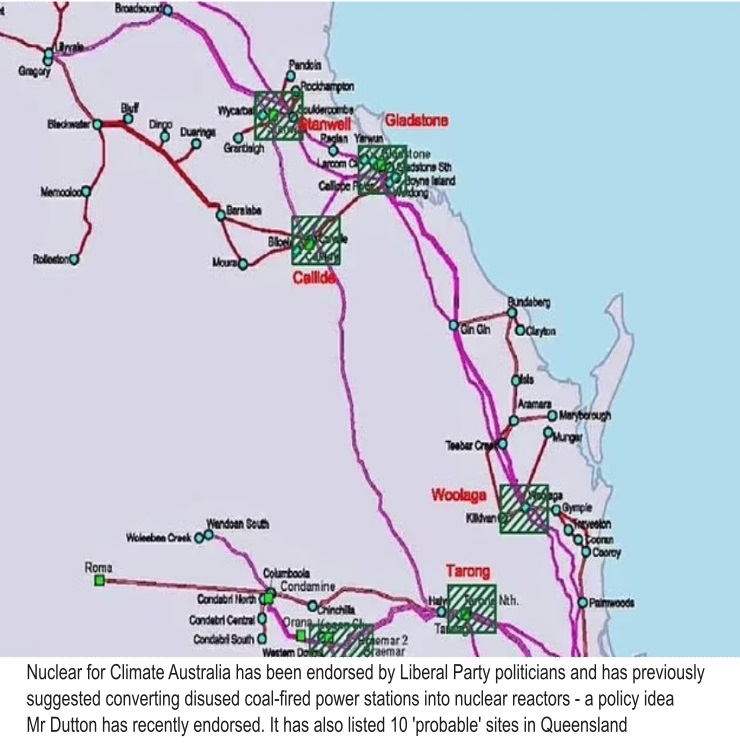
This site was one of 10 ‘probable’ sites in Queensland along with another three ‘possible’ sites in the home state of Mr Dutton and the Coalition’s energy spokesman Ted O’Brien.
Opponents of nuclear power argue it is too risky to put a plant near any population centre because of the risk of meltdown, even though nuclear medical isotopes for cancer treatment are produced at Lucas Heights in suburban Sydney.
The meltdown at the Soviet-era Chernobyl plant in Ukraine in 1986 resulted in a mass leakage of radiation that devastated surrounding areas for decades, while the effects of the 2011 earthquake on the Fukushima plant in Japan also caused a major radiation event.
Other possible nuclear power plant sites
Nuclear for Climate’s 13 recommended potential reactor sites include seven existing coal-fired power stations: Callide, Stanwell, Tarong, Gladstone, Millmeran, Kogan Creek and Collinsville, along with gas-fired Swanbank in suburban Ipswich.
‘In Queensland coal fired plants were constructed adjacent to available coal mines and other infrastructure,’ it said.
‘New nuclear plants will where possible take advantage of the resource used for cooling at these plants.’
Mr Dutton has flagged the idea of potentially converting five disused coal-fired power stations into nuclear energy reactors, arguing Australia could not entirely rely on wind and solar energy to meet its target of net zero carbon dioxide emissions by 2050.
The Coalition argues the existence of electricity transmission lines from these sites meant nuclear power could be delivered affordably – unlike Labor’s $20billion Rewiring the Nation plan……………………………………….
Nuclear for Climate has also suggested Ross River in north Queensland, the existing site of a solar farm near Townsville that is also close to the sea.
The three ‘possible’ sites included Stockleigh in suburban Logan south of Brisbane, Samsonvale west of Brisbane, and the Burdekin regional in north Queensland.
Mr Parker compiled that list in 2022 but since then he has revised it to drop two sites too far inland, citing droughts……………………………………………….
Nuclear advocacy group
Nuclear for Climate was influential within Coalition circles even before Mr Dutton in March revealed a government led by him would push for a nuclear power industry.
Mr Parker, who ran as a New South Wales state Labor candidate in 2007, said he was now providing advice to the federal Coalition……………………………
In 2022, he addressed the Parliamentary Friends of Nuclear Industries, chaired by Nationals backbencher David Gillespie.
Coalition senators in 2022 also cited Mr Parker in their dissenting report on the government’s plan for Australia to source 82 per cent of its energy from renewable sources by 2030.
Hollie Hughes, Ross Cadell and Bridget McKenzie wrote their report as members of a Senate environment and communications committee who opposed the Climate Change Bill 2022, which Labor and the Greens backed.
Mr Parker’s Nuclear for Climate group had made a submission to this bill arguing Australia could not rely on renewable energy for power generation……………………………….
Mr Parker has also been endorsed in Parliament by Liberal MP Rick Wilson.
In November 2022, the assistant shadow minister from Western Australia hailed his expertise on small modular reactors that can produce 300 megawatts, or 300million watts of power.
‘Speakers like Robert Parker, founder of Nuclear for Climate Australia, described the journey of Canada’s expanding nuclear power using SMR technology,’ he said.
SITES EARMARKED FOR NUCLEAR POWER
’10 PROBABLE SITES’
COLLINSVILLE: coal-fired plant in Whitsunday region of north Queensland
MILLMERRAN: coal-fired plant in Darling Downs region of south Queensland (dropped)
CALLIDE: coal-fired plant at Biloela in central Queensland
GLADSTONE: coal-fired plant in central Queensland
TARONG: coal-fired plant in South Burnett region of south Queensland (scaled back)
STANWELL: coal-fired plant near Rockhampton in central Queensland
KOGAN CREEK: coal-fired plant north-west of Toowoomba in south Queensland (dropped)
SWANBANK: gas-fired plant in Ipswich in south-east Queensland
WIVENHOE: hydro plant north-west of Brisbane in south-east Queensland
ROSS RIVER: solar farm near Townsville in north Queensland
‘3 POSSIBLE SITES’
STOCKLEIGH: rural area west of Logan
BURDEKIN: pumped hydro in north Queensland
SAMSONVALE: rural area west of Moreton Bay in south-east Queensland
Source: Nuclear for Climate Australia’s 2022 list which founder Robert Parker has reconsidered in 2024 https://www.dailymail.co.uk/news/money/article-13394175/13-sites-nuclear-reactor-Australia.html
Nuclear waste from AUKUS nations could be on cards

Greens senator David Shoebridge, who sits on the committee, said the laws would allow the defence minister to designate any area as a nuclear waste facility.
“This runs roughshod not just over local communities but also First Nations peoples who have a long history of protecting their land from nuclear waste, from Muckaty to Kimba,” he said
“This just shows the lengths the Albanese government will go to try and keep the failing AUKUS nuclear submarine deal sputtering along.”
Andrew Brown, May 13, 2024, https://www.thenewdaily.com.au/news/2024/05/13/nuclear-waste-from-aukus-nations-could-be-on-cards
Nuclear safety laws should allow for Australia to accept low-level waste from the UK and US as part of the AUKUS submarine deal, a Senate committee has found.
An inquiry looking at how nuclear safety would be carried out as part of the $368 billion submarine deal found that while Australia should not accept high-level nuclear waste, low-level waste from the submarine programs of AUKUS nations would be accepted.
The Senate committee on Monday recommended the safety laws pass Parliament and extra oversights should be set up for nuclear regulators.
However, opponents say the laws would allow Australia to become a dumping ground for nuclear waste.
Greens senator David Shoebridge, who sits on the committee, said the laws would allow the defence minister to designate any area as a nuclear waste facility.
“This runs roughshod not just over local communities but also First Nations peoples who have a long history of protecting their land from nuclear waste, from Muckaty to Kimba,” he said
“This just shows the lengths the Albanese government will go to try and keep the failing AUKUS nuclear submarine deal sputtering along.”
However, while the committee in its report acknowledged the concern of what would happen to the nuclear waste as part of AUKUS, proper processes would be in place.
“Terms like ‘dumping ground’ are not helpful in discussing the very serious question of national responsibility for nuclear waste of any kind,” the report said.
“There is an important distinction between the categories of nuclear waste which spans from waste with lower levels of radioactivity generated by day-to-day submarine operations … to waste with higher levels of radioactivity, such as spent fuel produced when submarines are decommissioned.”
As part of the AUKUS deal, the US will sell Australia three second-hand Virginia-class submarines in the next decade before a new class of vessels will be used that are co-designed by all three nations in the pact.
In a dissenting report to the inquiry, the Greens also took aim at the oversight of the proposed Australian Naval Nuclear Power Safety Regulator.
Senator Shoebridge said the regulator reporting to the defence minister was out of step with similar bodies set up in other countries.
He said the body should instead report to the federal health minister to ensure its independence.
The report’s findings are set to be considered by the government before being brought back for debate in Parliament.
Amidst genocide and war, anti-Zionism protesters are demonised as ‘extremists’
Independent Australia, By Martin Hirst | 13 May 2024
As human rights experts warn of an ongoing genocide in Gaza, any opposition to Zionism is being egregiously labelled as extremism, Dr Martin Hirst writes.
STUDENT PROTESTERS around the world are being demonised by politicians, bureaucrats and the news media for taking a stand against genocide.
This is just an updated version of the moral panic playbook that conservatives use to demonise young people who don’t toe the establishment line.
In the last six weeks, student protests have exploded around the world on a scale not seen since the Vietnam Moratorium almost 60 years ago. These students are protesting against what human rights experts are not hesitating to call a genocide in Gaza.
This reporter knows some of the Australian leaders of these protests quite well, organising politically with them as a long-term member of Left-wing group Socialist Alternative and a writer for its newspaper, Red Flag.
We know that none of these outstanding young activists are antisemitic. We know they are better educated about Palestine from a contemporary and historical perspective than our Prime Minister and most politicians…………………………………………………
We know that these young people are on the right side of history.
We also know that attempts by political leaders, intelligence agencies, Zionist hacks, the police and some university administrators to brand these brave students as violent, dangerous and antisemitic is a bald lie.
It is the lie itself that is dangerous because it actually emboldens Zionist thugs to launch ever-more violent attacks on student encampments, causing injury and mayhem.
It is also dangerous because it is a serious attempt – carried out with planning and intent – to criminalise anti-genocide activists and to criminalise their right to political speech.
What is happening in Australia, across Europe and in the United States is the creation of a state of emergency based on these dangerous lies. Right in front of our eyes, pro-Israel elements of the ruling class are establishing the conditions for a new wave of moral panic.
Students are being demonised as the 21st-Century version of the “folk devil“. The protests are being compared to 1930s Germany – which most people who make this comparison know absolutely fuck-all about – and they are being used to launch a McCarthyite witch hunt against students and academics who stand up for Palestine.
There’s nothing new about moral panics — the phrase was coined by British sociologist Stanley Cohen in the 1970s to describe the clamour for the state to take action against “Mods” and “Rockers” — two rival youth subcultures that enjoyed different types of music.
Interestingly, the Pogroms against Jews that swept Europe in the 1920s were a form of moral panic…………………………………………………………………………………………………
A moral panic only works when those in power – who feel threatened by resistance from below – can enlist loyal handmaidens in the media to prosecute their case and amplify their fear-mongering. Now, these tactics of intimidation are aimed at silencing dissent and any vocal opposition to the Israeli slaughter in Gaza.
Make no mistake, it is happening. Take it seriously because the Zionists and the political establishment are taking it seriously……………………………………………………
Failed Liberal Minister Josh Frydenberg helped to produce a “documentary” helpfully explaining to Sky News audiences how Australia is sliding into Nazi-era pogroms because of the threat to civil order posed by the student encampments and the wider anti-genocide movement.
In the last week alone, there has been a slew of opinion columns and news pieces in The Australian slandering student encampments while ignoring the attacks mounted on them by Zionist thugs.
Andrew Bolt and the usual list of suspects are apoplectic with rage that university administrators haven’t (yet) moved to shut down the protests.
However, the universities are beginning to move. The administration at Monash University in Melbourne is demanding students remove ‘Zionists not welcome’ signs from around their encampment because of some spurious “legal advice” that it is vilification.
Police have been allowed to install surveillance cameras overlooking the Monash encampment. Vice Chancellors from the Group of Eight — Australia’s richest universities — have asked Attorney-General Mark Dreyfus to advise them if the slogans used in the encampments are “hate speech”.
This is particularly egregious because Dreyfus himself is a Zionist. Dreyfus declined to provide legal advice but urged people who feel offended to lodge complaints under Section 18a of the Racial Discrimination Act. …………………………………………………..
It is too early to tell where all of this will end, but we can confidently predict that the Labor Party will support Sarah Henderson’s call for a Senate inquiry.
Anthony Albanese is fuelling the moral panic with apparent joy. He is reported to have told a room full of senior Zionist elders and student leaders that he believes the campus protests are led by outside agitators.
Helpfully, he was able to name them too. It’s all “the Trots‘ fault”.
This is deeply ironic for two reasons:
Russian revolutionary leader Leon Trotsky was a Jew and when he fell foul of the Stalinist regime, his Jewish heritage was used against him to launch a moral panic that even spread to Australia and poisoned the minds of many good Communist Party members, including the artist Noel Counihan who famously called Trotsky a “fascist gangster”.
Albanese has also been demonised as a Trotskyist by Murdoch hacks and (former Liberal MP Bronwyn Bishop) “Kerosene Bronny“…………….. https://independentaustralia.net/politics/politics-display/amidst-genocide-and-war-anti-zionism-protesters-are-demonised-as-extremists,18594
Coalition MPs dismiss International Energy Agency advice to ditch nuclear plans

IEA chief urges Australia to prioritise ‘untapped potential in solar and wind’ as opposition pushes on with its nuclear policy
Guardian Sarah Basford Canales, Fri 10 May 2024
Coalition MPs have dismissed advice from the world’s international energy body urging Australia to ditch any nuclear plans in favour of the “untapped potential” of solar and wind power.
After the Albanese government’s announcement on Thursday that gas will remain key to the country’s energy and export sectors to “2050 and beyond”, the opposition has doubled down on its plans to unveil a nuclear energy policy before the next federal election.
While details of the plan, including the location of up to six possible sites for nuclear plants, have yet to be announced, the Nationals leader, David Littleproud, said the Coalition’s goal was to plan for a “gradual transition from coal to nuclear, gas and renewables built in the right place and in the right concentration”.
In an interview with the Australian Financial Review, the International Energy Agency (IEA) executive director, Dr Fatih Birol, said politicians in Australia should be prioritising the country’s renewable energy sources over investing in new nuclear projects…………..
Birol told Nine newspapers nuclear was not an avenue Australia should be looking at.
Birol said he hoped discussions around nuclear “can be made more factual, less emotional and political”, stressing Australia should prioritise the “untapped potential in solar and wind”…………………………………………………….
O’Brien’s Nationals colleague, Keith Pitt, similarly dismissed Birol’s advice as coming from a “Paris-based” commentator, saying the IEA has had “more positions on energy advice to Australia than the Kama Sutra”.
It is understood the Coalition will propose locating nuclear power plants on the site of retiring coal power plants, claiming the use of existing transmission infrastructure would bring down costs.
Figures released by the federal energy department last September revealed the plan could cost as much as $387bn. The analysis showed a minimum of 71 small modular reactors – providing 300MW each – would be needed if the policy were to fully replace the 21.3GW output of Australia’s retiring coal fleet.
CSIRO’s GenCost report showed that once up and running, a theoretical small modular reactor built in 2030 – which is unlikely to exist – is estimated to cost $382 to $636 per MWh while solar and wind would cost between $91 and $130 per MWh once integration costs are included.
Outside the Coalition, political support for a domestic nuclear power industry is limited.
The climate change minister, Chris Bowen, has previously accused advocates for an Australian nuclear industry as “peddling hot air”, saying Labor’s plan backs the IEA chief’s comments.
The Fremantle MP, Josh Wilson, a loud nuclear critic within Labor, questioned the Coalition’s “obsession” with the “most expensive and slowest form” of energy generation.
The independent ACT senator David Pocock, a vocal advocate for renewable energy, said nuclear power “makes no sense in this country”.
The senator’s lower house independent colleagues Monique Ryan and Kate Chaney agreed but added that Labor’s future gas strategy was also the wrong path forward.
Chaney said it was a “no-brainer” that IEA would steer Australia towards its obvious solar and wind advantages, noting it was “driven by data rather than politics”.
Ryan said Australia was once again being seen as a pariah internationally on climate policy.
The Greens leader, Adam Bandt, said the federal government should deliver “massive investment” in public solar and wind, instead of opening up more gas mines. https://www.theguardian.com/australia-news/article/2024/may/10/coalition-mps-dismiss-international-energy-agency-advice-to-ditch-nuclear-plans
1 This month


Help Aunty Sue Protect Her Land and Sacred Sites From Destructive Rocket Testing.
.

Australians deserve the truth
about
AUKUS – https://aukuspublicinquiry.com/

PETITION – To: Prime Minister Anthony Albanese and the Australian Labor Government

of the week – Australians for War Powers Reform (AWPR)
To see nuclear-related stories in greater depth and intensity

