Here’s why there is no nuclear option for Australia to reach net zero
Dr Alan Finkel, Guardian, 22 Mar 24
Any call to go directly from coal to nuclear is effectively a call to delay decarbonisation of our electricity system by 20 years.
The battle lines have been drawn over Australia’s energy future.
With the nation signed up to net zero emissions by 2050, the Albanese Labor government is committed to renewables. The Coalition wants nuclear.
The opposition leader, Peter Dutton, has a vision for meeting Australia’s energy needs that would include large-scale nuclear power plants and small modular reactors, a technology that is not yet proven, but which the shadow minister for energy, Ted O’Brien, says could be “up and running within a 10-year period.”
While nuclear power might experience a resurgence globally and eventually have a role in Australia, right now, no matter how much intent there might be to activate a nuclear power industry, it is difficult to envision before 2040.
The reality is there is no substitute for solar and wind power this decade and next, supported by batteries, transmission lines and peaking gas generation.
Any call to go directly from coal to nuclear is effectively a call to delay decarbonisation of our electricity system by 20 years……………………………………………………………………….
The cons
There are challenges for nuclear power in Australia, most notably timetable and cost.
Legislation. Commonwealth legislation passed by the Howard government in 1998 prohibits nuclear power. Australia is the only country in the G20 to have a legislated ban on nuclear power. This would need to be lifted before anything else could happen.
Public support. An August 2023 poll by the Resolve Political Monitor found 40% of people backed nuclear power, 33% were undecided and 27% were opposed. It is likely that no matter how small the opposition, it will be vocal.
Ramp rate. Large nuclear power generators cannot ramp up and down rapidly like batteries or peaking gas generators. This reduces their compatibility with a predominantly solar and wind powered electricity grid. It is expected, though, that small modular reactors (SMRs) will be better in this respect than large, conventional reactors.
Falling investment. The various operational, political and cost challenges faced by the nuclear industry have led to nuclear’s share of global electricity generation falling from more than 17% in 1996 to 9% in 2022.
Starting from scratch. It is unlikely that Australia would switch from being a laggard to a leader. That is, we would not proceed before we saw a licensed SMR (not a prototype) operating in the US, Canada, UK or another OECD country.
After that, we would need to beef up the regulatory system, find the first site, find and license the first operator, approve and issue construction contracts, establish a waste-management system, establish the decommissioning rules and decommissioning fund, run the environmental and safety regulatory gamut, train a workforce, respond to the inevitable protests and respond to the inevitable legal opposition all the way to the high court.
Only then could construction begin. It is difficult to imagine all this could be accomplished and provide an operational nuclear reactor in Australia before the mid 2040s.
The cost of wind versus nuclear
Coal-fired generators and nuclear power generators can dispatch electricity at full power more than 90% of the year. In practice, because demand fluctuates, the typical dispatch level from the Australian coal-fired fleet is about 60%.
For comparison, what would be the capital cost of a wind farm to dispatch 60% of the year? A simplified approach would be to ignore market economics and the variability of solar electricity in the system, and assume a 30% capacity factor for the wind energy. With these assumptions, for a windfarm to dispatch 60% of the year, we would need to install 2GW of wind turbines. The first 1GW of turbines would dispatch when the wind is blowing. The second 1GW of turbines would be used to charge a 7GW-hour (GWh) battery, to be discharged into the grid on demand.
Using figures from the CSIRO’s GenCost draft 2023-2024 report, the cost in this simplified model would be around $7bn per GW. Other, less costly, integration configurations are available. In comparison, based on the latest cost estimates for the Hinkley Point C plant under construction in the UK, the cost for nuclear power would be $27bn per GW.
The big opportunity in thinking small
In Australia, we would be looking to use SMRs because of the enormous cost and construction delays of large-scale nuclear plants. But we will want the reassurance of first seeing SMRs work safely and well in the UK, Europe, Canada, the US or another OECD country.
The trouble is, there are no SMRs operating in the UK, Europe, Canada, the US or any other OECD country. Nor are any SMRs under construction or approved in an OECD country.
There is no data to support any claims about how much SMRs will cost when deployed as operating power stations………………………………………https://www.theguardian.com/commentisfree/2024/mar/22/heres-why-there-is-no-nuclear-option-for-australia-to-reach-net-zero
Shadow energy minister Ted O’Brien’s nuclear energy misstep

https://www.canberratimes.com.au/story/8560035/shadow-minister-ted-obriens-nuclear-energy-misstep/ By John Hanscombe, March 20 2024
A couple of weeks ago, during a run of sunny, breezy weather, the price of electricity actually went into negative territory in NSW as wind and solar kicked in.
I discovered this on a fascinating website, OpenNEM, which tracks national energy market data, including where the power comes from – solar, wind, hydro, coal and gas – the emissions it produces, and its value at any given point. It’s become a bit addictive, regularly checking to see where most of the power has come from.
It was heartening seeing renewables – especially rooftop solar – generating so much power during the day when conditions were favourable.
Solar’s peak was especially high last Tuesday, the same day shadow energy minister Ted O’Brien appeared on the ABC’s 7.30 to spruik the Coalition’s push for nuclear energy. O’Brien made the mistake of trying to mansplain to Sarah Ferguson (is there a more patronising expression than “Let me unpack this”?) why his party thought nuclear was the way to go. It was painful to watch.
He fumbled through awkward questions about cost. Questions about the fact it takes the US, with its established nuclear energy industry, 19 years to build a reactor. Questions about the Coalition’s intentions to keep coal in the energy mix. Every attempt by Ted to “unpack it” ended up in a ditch.
This question from Ferguson on Bill Gates’s enthusiasm for nuclear, cited repeatedly by the Coalition, was when things really went bad for poor old Ted: “I asked Bill Gates, on this program, whether Australia should be involved in nuclear energy, and this was his answer: ‘Australia doesn’t need to get engaged on this. Australia should aggressively take advantage of Australia’s natural endowment to do solar and wind. That’s clear-cut and beneficial to Australia.'”
By the end of the interview, the shadow minister was a shadow of his former self.
“He ended up looking like he’d been through a woodchipper,” said a mate watching from Hobart.
News from the Australian Energy Market that electricity prices were not going to be hiked next year, and would even start to come down, will make the Coalition’s nuclear pitch even harder to sell.
Most energy experts agree the cost of setting up nuclear power in Australia will be borne by consumers, that it would likely be the mid-2040s when a reactor would finally come on line.
Peter Dutton keeps calling for a mature discussion on nuclear energy.
There’s nothing mature about dismissing the work of the CSIRO, our peak scientific body, just because its research shows renewables are cheaper than coal and nuclear.
There’s nothing mature about Ted O’Brien ignoring the advice of one of the world’s most successful business operators and nuclear energy champions, Bill Gates, who says Australia doesn’t need to go down that expensive path.
And skipping from hailing theoretical small modular reactors one week to large-scale reactors the next is all over the shop.
The whole push seems to be a Quixotic attempt at relevance, a guileless opposition tilting at windmills.
Dutton’s bid for nuclear power: hoax or reckless endangerment?
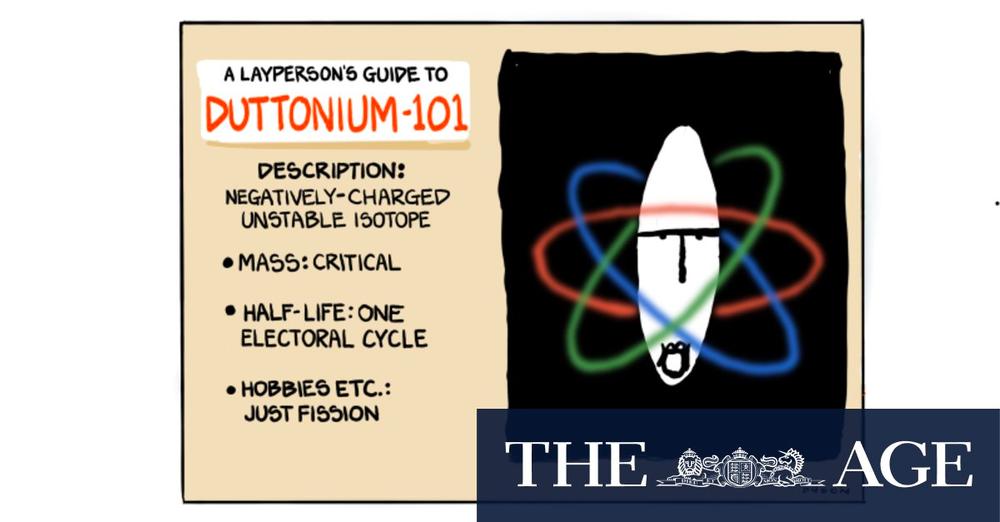
“In the last few months, we’ve seen a bill introduced into the Parliament by the Labor Government that legalises the acceptance of nuclear waste from the UK and US and provides the Government with the power to nominate any place in Australia as a nuclear waste site, with no requirement to consult with local communities or other interested groups.”
In the bigger picture, AUKUS depends upon a gamble that nuclear power will be the naval fuel of the future. And the even bigger gamble that submarines are not yet obsolete.
But beyond the tactics of Labor-baiting and the politics of diversion ……. lurks the original – and only – economic rationale of nuclear power – as an adjunct to a nuclear arms industry.
March 18, 2024, by: David Tyler https://theaimn.com/duttons-nuclear-dream-is-a-dead-cat-on-the-table-to-distract-us-from-his-dunkley-debacle/
It’s incredible. Such is our love-in with Peter “Junkyard” Dutton, our former Border Overlord, who used to play the bad cop dispensing rough justice–doing whatever it took to keep us safe-that today, he’s being cheered by most of the press gallery for reckless endangerment in his punt on nuclear energy.
Is it just to please his sponsor, Gina Rinehart and other richly attractive mining oligarchs who will make a few extra billion out of delaying the end of coal-fired power generation? Even if they do hasten the end of the world, they do get to star in their own perverted, planet-destroying mother of all snuff movies?
Or… brace yourself- does “Dutts” blunt truth and other fiction’s pin up boy-harbour
And what a boon for democracy. Voters choose between the pro-mining, colliery-opening, Labor Party and the pro-mining right-wing rump of a moribund Liberal Party, only in the race because of its secret agreement with the National Party, a mob of pro-mining, faux populists who pose as saviours of The Bush and its battlers, such as Riverview Old Boy, Barnaby Thomas Gerald Joyce’s Weatherboard Nine.
Or Bob Katter’s family which includes the incredibly successful arms manufacturer, son-in-law Rob Nioa.
ulterior motives?
Of course. A whiff of Emu Field, Montebello and Maralinga on the campaign trail helps with Coalition branding and product differentiation. “I’m with nuclear, stupid” would be a killer of an election slogan. Albo and Dutts could get together to whip up a referendum for the next federal democracy sausage BBQ. Besides, no-one in the nuclear power side hustle isn’t also itching to develop his or her own nuclear weapon cycle. Nuclear energy only makes sense if you are a nuclear arms manufacturer.
Nuclear is also a feint in the climate wars. Let’s talk tactics. Team Dutton can say that Labor is on the right track but has “no credible pathway” unless you have nuclear energy in the brew, firming up your mix. The Liberal Party plays the front end of the Coalition panto horse; the Nationals bring up the rear.
And just as he did after defeat in Aston, Dutton dashes into nuclear after his Dunkley debacle. Note he’s now a big reactor man, having got the email that small modular reactors are scarce as rocking-horse manure. It’s a revolutionary turn. A year or so ago, Dutts opposed, “the establishment of big nuclear facilities”. But being a conservative in Australian politics means, you don’t have to explain or apologise.
-ADVERTISEMENT-
Nor do you have to heed our scientists. “… the CSIRO has made clear, large reactors are too large for our small grids, and small reactors are still unproven commercially.”
Smear them. Say it’s a discredited study.
Sean Kelly sees Dutton’s pro-nuclear vision as a way of buying unity. Nobody on Dutton’s team thinks it’s a real policy, he claims, and it’s a long-term fantasy, so they won’t buck Dutton’s wilful stupidity. He’s sniping at CSIRO, too, which always wins friends amongst a growing anti-science brigade, a resource tapped into shamelessly by such figures as, “planter saint”, Barnaby Joyce; off his nut about the “green peril”. The former deputy PM also calls windmills, “filth” whilst renewable energy is a “swindle”.
The Coalition attack on CSIRO parallels its harassment of a now cowed ABC, on which it inflicted a barrage of criticism, funding cuts and Morrison’s captain’s pick of Ita Buttrose as chair. Cutbacks in the CSIRO have also taken their toll but their CEO, Professor Doug Hilton publicly rebukes Dutton.
“For science to be useful and for challenges to be overcome it requires the trust of the community. Maintaining trust requires scientists to act with integrity. Maintaining trust also requires our political leaders to resist the temptation to disparage science.”
Kelly might add that the Coalition is riven by at least ten factions, post-Morrison, and has rivals hatching plots of helping their leader by taking his job away from him. One of these, with some experience of edged weapons, is former SAS Patrol Commander, Captain Andrew Hastie who must have been cheered when in 2017 the AFP cleared of war crimes, an SAS soldier who cut the hands off two suspected Taliban fighters. Handy Andy was in command of some other soldiers at the scene. Hastie’s mentor is none other than party kingmaker, Big Mining Shill and fellow happy clapper, the Nationals’ John Anderson.
A spill now could avoid some bloodletting in the next federal election, a surgical strike, perhaps.
Rex Patrick sees Peter Dutton’s move as a “nasty” political wedge given that the federal Labor government has already signed us on to Morrison’s AUKUS which guarantees a small modular nuclear reactor inside a submarine moored near you if you happen to live close to HMAS Stirling Naval Base in Perth, the Osborne Naval Shipyards in Adelaide, SA or the yet to be opened mystery envelope containing only three options, Sydney Harbour, Wollongong/ Port Kembla or Newcastle.
Hint. The Royal Australian Navy berths in Sydney Harbour.
Moreover, the disposing of nuclear waste is also well in hand, notes Patrick.
“In the last few months, we’ve seen a bill introduced into the Parliament by the Labor Government that legalises the acceptance of nuclear waste from the UK and US and provides the Government with the power to nominate any place in Australia as a nuclear waste site, with no requirement to consult with local communities or other interested groups.”
In the bigger picture, AUKUS depends upon a gamble that nuclear power will be the naval fuel of the future. And the even bigger gamble that submarines are not yet obsolete.
Yet even today it’s uneconomic and fraught with a perplex of disposal and safety issues. Dutts the Kiwi Bikie Gangster Deporter, Dual Citizenship-Stripper, Dole-bludger-buster, or the African Gang vigilante; dog-whistling racism, fear and division, demonising the other, is as complex as the next bloke. But he is not a big ideas man. Fizza Turnbull has never heard Peter propose a single constructive idea.
Dutton’s mentor, John Howard was rarely troubled by big ideas either. But now, Dutton is calling for “a mature debate™” on a nuclear energy, we don’t need, can’t afford, could never rely on and can’t fuel. We’d be importing expensive fuel rods we can’t make at home for reactors which would never be built in time (without a slave labour workforce like the UAE) to replace our rapidly clapped-out coal-fired plant
Continue readingNuclear energy debate ‘many years’ away: Qld Deputy Opposition leader
Queensland Deputy Opposition leader Jarrod Bleijie claims the nuclear energy debate is “many years” away as he focuses on lowering power prices in the immediate future.
Mr Bleijie said he is focusing on making sure energy is affordable and reliable as the Opposition pushes to bring its coal power stations back online.
“There is a lot of water to go under that bridge before that is the case and I suspect we will be at an election before our federal counterparts,” Mr Bleijie told Sky News Australia.
“I stood at the booths in Ipswich West and Inala and every second person was talking about the cost of living crisis in Queensland now.
“People are hurting, they need to see their electricity bills reduced now and that has to be our priority.”
Peter Dutton refuses to say where his nuclear reactors will go

Peter Dutton, Bill Shorten clash on nuclear on Today show
After Australia’s peak science body called out the Opposition Leader, Peter Dutton has failed to answer one question on nuclear.
Ellen Ransley news.com.au 17 Mar 24
Peter Dutton has failed to answer a key question in a fiery clash with Bill Shorten over nuclear energy.
The Opposition Leader has this week been spruiking his plans for moving nuclear, but when asked by the NDIS Minister where the reactors would go, Mr Dutton didn’t answer.
“Are you willing to host one of your nuclear power plants in your electorate or anywhere in Queensland? Where are you going to put your reactors?” Mr Shorten posited to Mr Dutton on Nine’s Today Show on Friday morning.
Bill Shorten and Peter Dutton clashed on nuclear during a TV segment on Friday morning.
Mr Dutton did not answer the question, instead pointing Mr Shorten towards a “huge argument in the United Kingdom at the moment, where adults are able to have a conversation”.
“The Labour Party there is arguing for the Tories to have more baseload nuclear power because they know it’s zero emissions,” Mr Dutton replied.
“This government, your government, has no chance whatsoever of meeting the net zero by 2050 target. That’s the reality of it. What we’ve said is that where you’ve got a retiring asset … you can replace that coal with a zero emissions technology, the latest technology, the same technology you’ve signed up to for then nuclear submarines.”
During the segment, Mr Dutton was questioned on his stance on Australia’s national science agency CSIRO over comments he made earlier this week.
On Tuesday, Mr Dutton said it had been “well documented” that CSIRO “can’t be relied up” during a press conference where he discussed nuclear energy and a report by the agency that found nuclear energy was more expensive.
Mr Dutton said the report was “discredited”.
It prompted the agency to make a rare statement, with a letter from chief executive Doug Hilton published online on Friday morning, saying that for science to be useful, it requires the “trust” of the community.
“Maintaining trust also requires our political leaders to resist the temptation to disparage science,” he said.
“The GenCost report is updated each year … (It) is carefully produced … and updated regularly as new data comes to hand.
“The GenCost report can be trusted by all our elected representatives, irrespective of whether they are advocating for electricity generation by renewables, coal, gas, or nuclear energy.”………… https://www.news.com.au/national/politics/peter-dutton-bill-shorten-clash-on-nuclear-on-today-show/news-story/2a872c38238b358c5b3043158498775a
NUCLEAR POWER STATIONS ARE NOT APPROPRIATE FOR AUSTRALIA – AND NEVER WILL BE

Climate Council, 15 Mar 24
The prospect of nuclear power in Australia has been a topic of public debate since the 1950s. While Australia has never had a nuclear power station, we do have 33% of the world’s uranium deposits and we are the world’s third largest producer of it. Periodically, as with the changing of the seasons, various individuals appear in the media singing the virtues of nuclear energy – claiming it is the only option for clean and reliable electricity in Australia.
In fact, over one third of Australia’s electricity is already powered by renewables, and new initiatives like the Capacity Investment Scheme are set to push us towards 82% renewable energy by the end of this decade. While the move to clean energy is still not happening fast enough, it is underway and starting to speed up. We do not need distractions like nuclear to derail our progress now, so let’s set the record straight.
Why doesn’t nuclear power make sense for Australia?
1. Nuclear power stations can’t be built anywhere in Australia.
They are banned in every state, and in every territory. Such bans were introduced because of community concerns about the health and environmental risks. Many parliamentary inquiries at a federal and state level – see this Victorian Inquiry, this Federal Inquiry, and this South Australian Inquiry for instance – have been held into nuclear energy, and all have concluded that it makes no sense in Australia.
2. Nuclear power stations are expensive and take too long to build.
Australia’s independent science information agency, CSIRO, has found that solar and wind are by far the cheapest ways of producing electricity(even when factoring in storage). In contrast, the cost of building and operating nuclear in Australia remains prohibitively high.
Analysis conducted by the nuclear industry itself shows nuclear power stations take an average of 9.4 years to build – compared to 1–3 years for a major wind or solar project. Australia needs to replace its ageing coal-fired power stations as quickly as possible to rapidly reduce emissions this decade. As shown in the Australian Energy Market Operator’s Integrated System Plan, by far the cheapest and quickest way to do this is to ramp up renewable energy paired with storage like pumped hydro, and batteries.
3. Nuclear power poses significant community, environmental, health and economic risks.
Radiation from major nuclear disasters, such as Chernobyl in 1986 and Fukushima in 2011, have impacted hundreds of thousands of people and contaminated vast areas that take decades to clean up. Even when a nuclear power station operates as intended, it creates a long-term and prohibitively expensive legacy of site remediation, fuel processing and radioactive waste storage.
4. Nuclear power is not renewable, and it is not safe.
Uranium is a finite resource just like coal, oil and gas. It needs to be mined and, just like mining coal, oil and gas, this carries serious safety concerns, including contaminating the environment with radioactive dust, radon gas, water-borne toxins, and increased levels of background radiation. On the other hand, energy generated from the sun and wind releases no pollutants into the air and is overwhelmingly considered to be safe.
There you have it: nuclear power is expensive, illegal, dangerous and decades away from powering our homes and businesses. It makes no sense. On the other hand, energy from the sun and wind is cheap, abundant, safe and available now. So, let’s get on with building more renewable energy!
What is a nuclear power station?…………………………………………………
Unlike coal and gas, no greenhouse gas pollution is created in the operation of the nuclear reactor. However, all other steps involved in producing nuclear power – from mining, to construction, decommissioning and waste management – result in greenhouse gas pollution.………………………….
Case Study 1: Hinkley Nuclear Power Station, United Kingdom………………………
Case Study 2: NuScale Power, United States of America……………………………..
Meeting the climate challenge means taking bold and decisive action this decade with the technologies that are ready to go in Australia today. The significant limitations nuclear energy faces means that there is no real prospect of it playing a role in reducing Australia’s emissions.
The Government will dictate where the high level nuclear dump will be.
@MrRexPatrick, ·Mar 13
The Govt has refused to provide #FOI access to its high level radioactive waste site selection process. But it turns out we don’t need to know because, as uncovered by @DavidShoebridge examining #AUKUS legislation today, the Govt will just tell us where the site will be
Nuclear power in Australia — a silver bullet or white elephant?
ABC News, By political reporters Tom Crowley and Tom Lowrey 16 Mar 24
“It’s time to talk nuclear,” Ted O’Brien declared in a video message filmed on an isolated beach last February.
Appointed shadow energy spokesperson a few months earlier, Mr O’Brien’s enthusiasm for nuclear power was already well known, but not yet fully formed as Coalition policy. By many in Canberra, it had been regarded with idle curiosity.
But it was the choice of beach that raised eyebrows on this occasion: Mr O’Brien was in Fukushima.
The small Japanese city was the site of an infamous nuclear accident in 2011, when the Daiichi power plant was damaged by an earthquake and tsunami.
Mr O’Brien had travelled to visit the plant at his own expense as a myth-busting exercise.
“I’ve heard many stories about the Fukushima Daiichi Nuclear Power Plant, including some unfounded horror stories and wildly untrue claims. I therefore decided to travel to Fukushima to find out for myself,” he said.
“I discovered a beautiful place and wonderful people, and I returned home with enormous optimism for their future.”
A year on, nuclear energy for Australia has firmed as Coalition policy, and Mr O’Brien’s “enormous optimism” has earned derision from Energy Minister Chris Bowen.
“Tell him he’s dreaming,” Mr Bowen said last Sunday when asked about the Coalition’s plans. His concern was not safety, where there have been significant improvements since Fukushima, but cost and practicality.
“I don’t know what expert he’s talking to … The average build time of a nuclear power plant in the United States has been 19 years. Ted O’Brien thinks he can do it in Australia from 10 [years] with a standing start,” he said……………………………………………………………………………………….
Nice work if nuke can get it
………………………..setting up in the Australian context would be a different proposition, and would present several hurdles.
First, large-scale nuclear power plants are expensive. The cheap power produced by plants in Europe comes only after decades of operation, enough time for the operators to have recouped their significant upfront capital costs.
It would take a long time – the Coalition hopes for a decade, but Labor says it would be at least twice that – to get them up and running, and an even longer time to bring costs down.
Second, the CSIRO and the AEMO doubt that large-scale nuclear plants are the right fit for Australia’s energy needs.
The east coast electricity market is relatively small by global standards, owing to Australia’s small population.
A single large plant of the sort used in Europe, according to CSIRO and AEMO, would account for such a huge chunk of our power needs that it would be inadvisable, since the whole grid would falter if the plant went offline for maintenance, or due to some fault.
Instead, the agencies say we would need more than one plant working together, like the coal plants currently do. But that would be even more expensive.
Some have called instead for “small modular reactors” (SMRs) – mini nuclear plants, assembled in a factory, which can be set up quickly. Unlike large plants, they can also be switched on and off quickly, which means they could “pinch hit” to provide power alongside renewables or other power sources.
If this sounds appealing, cool your jets – the technology to do this on any notable scale doesn’t exist. Attempts to build them elsewhere, such as in the US, have so far run into fatal cost barriers.
None of that has dimmed the enthusiasm of SMR optimists, including Bill Gates, Rolls Royce and for a time the Coalition.
But the latter’s embrace of nuclear has shifted away from its early focus on SMRs and it now appears set to land on advocating larger-scale nuclear plants on decommissioned coal sites.
A radioactive political issue
This points to a political challenge on top of the practical one.
The Liberal Party has tried, and failed, to start a conversation on nuclear power on more than a few occasions.
John Howard took a nuclear policy to the 2007 federal election, hoping public perception of the industry had shifted. It hadn’t.
Nearly two decades on, the Coalition is hoping it is right this time.
Coalition backbenchers have been agitating on the issue for years, urging the former Morrison government to take up the idea.
Those pleas weren’t heeded, beyond a very low-key parliamentary inquiry, as the party feared a scare campaign on nuclear reactors in the suburbs.
But the change in leadership after the 2022 election saw a surprisingly rapid shift — with new Nationals leader David Littleproud openly calling for nuclear power to be on the table just weeks after polling day.
Peter Dutton also flagged early enthusiasm, although at first only in principle. Then, shortly after the Dunkley by-election loss a fortnight ago, he confirmed this would become official Coalition policy.
An announcement is expected before the budget, which Mr Dutton has hinted will include a list of possible sites for nuclear, likely large-scale nuclear.
Prime Minister Anthony Albanese can scarcely contain his glee at the prospect of a nuclear fight.
“I’ll give you this tip, when they release their policy, you’ll hear a very clear response … [from] the communities where these giant nuclear reactors are going to go,” he said this week.
“[Peter Dutton] is a guy who’s scared of a solar panel but thinks that a nuclear reactor will be well received. I’ll wait and see.”
But Coalition MPs are confident they can sell the idea to voters, insisting the issue plays well with younger voters in particular.
They point to published opinion polls, which suggest more than half of Australians are now either supportive of nuclear or at least open to the idea.
The most prominent such poll was The Australian’s Newspoll, which suggested approval from 65 per cent of 18- to 34-year-olds.
That poll question asked about SMRs and described them as “zero-emissions energy on the sites of existing coal-fired power stations once they are retired”.
Nuclear in my backyard
But if this has created some optimism in the Coalition, the announcement of locations looms as an early political hurdle.
Just a handful of regions have coal-fired power stations that could fit the bill. This includes the Hunter, Gippsland and Central Queensland.
MPs in those areas would have the difficult task of selling a nuclear reactor to their electorate. So far, they seem cautiously enthusiastic, though some want assurances the technology is safe. Gippsland MP Darren Chester warned community concerns would need to be “ameliorated”.
There’s also the question of where to put the waste. Mr Dutton has sought to “put things in perspective” by pointing out the waste generated in the US since the 1950s “would fit in the area the size of a football field, to a depth of about nine metres”.
But if selling locals a nuclear plant is challenging, selling them a nuclear dump would be even more so – although as Mr Dutton points out, the same challenge awaits on waste from nuclear submarines under the AUKUS agreement.
Bonanza or boondoggle?
Even if the Coalition can convince enough voters to back nuclear power and put them in government, that won’t be the last of the political hurdles.
Next comes the question of money.
Labor’s Chris Bowen has suggested “eye-watering” amounts of taxpayer money would be needed to make nuclear viable.
“Every country in the world with nuclear has required massive transfers of taxpayer wealth to the nuclear constructors,” he said.
The Coalition has been coy on whether its policy will include a taxpayer subsidy, but has hinted at details to come in its forthcoming announcement.
And energy experts say that realistically, any private sector contribution would only come if investors had enough confidence the project would make it through to completion. That would require bipartisan support.
Bipartisan support may also be needed to overturn the federal ban on nuclear power. State-level bans in NSW, Victoria and Queensland would need to be overturned too.
Labor’s national platform currently includes an explicit ban on nuclear power, and some key unions are resolutely opposed to the industry.
‘Niche’ at best
All of that points to a difficult road ahead. And it’s one many energy experts say it would lead to a small benefit at best.
Alison Reeve from the Grattan Institute does not see nuclear as part of the mix, but says that if anything SMRs could play a “last resort” role, supplementing renewables during winter troughs.
“That would be the only possible niche I could see for nuclear … but you’re having to build generation that’s only used for a couple of weeks every year,” she said.
“At the moment it looks like the most economic opportunity for that role is gas, with offsets to cover the emissions.”………………………………….. https://www.abc.net.au/news/2024-03-16/nuclear-power-in-australia-silver-bullet-white-elephant/103571824
Reversing Europe’s and Australia’s slide into irrelevance & insecurity – National Press Club of Australia speech- Yanis Varoufakis

First, Australia must restore a reputation tainted by blindly following America into lethal adventures in Iraq, Afghanistan and, today, via its active and crucial complicity in Israel’s deliberate war crimes in Gaza, East Jerusalem and the West Bank.
Children are not starving in Gaza today. No, they are being deliberately starved. Without hesitation or remorse. The famine in Gaza is no collateral damage. It is an intentional policy of starving to death thousands until the rest agree to leave their ancestral homeland.
Second, Australia has a duty to de-escalate the New Cold War. To understand that this can only be done if Australia ends its servility to a United States’ actively creating the threats that they then make us pay through the nose to protect us from.
Imagine an Australia that helps bring a just Peace in Ukraine, as opposed to a mindless forever war. A non-aligned Australia that is never neutral in the face of injustice but, also, not automatically aligned with every warmongering adventure decided in Washington.
Imagine an Australia which, having re-established its credentials as a country that thinks and acts for itself, engages with China in the spirit of peaceful cooperation – a far better way of addressing Beijing’s increasing authoritarianism toward its own peoples than buying useless, hyper-expensive submarines that only succeed in forcing China’s political class to close ranks around a more authoritarian core.
Imagine a truly patriotic Australian Prime Minister who tells the American President to cease and desist from the slow murder of Julian Assange for the crime of journalism – for exposing American war crimes perpetrated behind the back of US citizens in their name.
To conclude, if Europe and Australia are to escape gross irrelevance, we need separate but well-coordinated European and Australian Green New Deals.
DiEM25, our paneuropean movement, is working toward this goal.
Yanis Varoufakis – 14/03/2024
Europe and Australia are facing a common existential threat: a creeping irrelevance caused, on the one hand, by our failure properly to invest and, on the other hand, by our ill-considered slide from a strategic dependence on the United States to a non-strategic, self-defeating servility to Washington’s policy agenda.”
Yanis Varoufakis’s address at the National Press Club in Canberra on Wednesday 13 March, 2024
…………………………………. The three post-war phases that shaped Australia’s and Europe’s habitat
Our present moment in Europe and in Australia has been shaped by three distinct postwar phases.
The first was the Bretton Woods system. America exited the war as the only surplus, creditor country. Bretton Woods, a remarkable recycling mechanism, was, in effect, a dollar zone built on fixed exchange rates, sustained by capital controls, and erected on the back of America’s trade surplus. With quasi-free trade as part of the deal, Washington dollarised Europe, Japan and Australia to generate aggregate demand for the products of its factories – whose productivity had skyrocketed during the war. Subsequently, the US trade surplus sucked the exported dollars back into America. The result was twenty years of high growth, low unemployment, blissfully boring banking and dwindling inequality. Alas, once the United States lost its trade surplus, Bretton Woods was dead in the water.
The second phase was marked by the violent reversal of this recycling mechanism. The United States became the first hegemon to enhance its hegemony by boosting its trade deficit. Operating like a powerful vacuum cleaner, the burgeoning US trade deficit hoovered up the world’s net exports. And how did America pay for them? With dollars which it also hoovered up from the rest of the world as German, Japanese and later Chinese capitalists sent to Wall Street 70% of dollar profits made from their net exports to the US. There, in Wall Street, these foreign capitalists recycled their dollar profits into Treasuries, real estate, shares and derivatives.
This audacious inverted recycling system, built on US deficits, required ever increasing American deficits to remain stable. In the process, it gave rise to even higher growth than the Bretton Woods era, but also to macroeconomic and financial imbalances as well as mind-numbing levels of inequality. The new era came complete with an ideology (neoliberalism), a policy of letting finance rip (financialisation), and a false sense of dynamic equilibrium – the infamous Great Moderation built on hugely immoderate imbalances.
Almost inevitably, on the back of the perpetual tsunami of capital rushing in from the rest-of-the-world to Wall Street, financiers fashioned gigantic pyramids of complex wagers – Warren Buffet’s infamous Weapons of Mass Financial Destruction. When these crashed, to deliver the Global Financial Crisis, two things saved Wall Street and Western capitalism:
- The G7 central banks, that printed a total of $35 trillion on behalf of the financiers from 2009 to last year – a peculiar socialism for bankers. And,
- China, which directed half its national income to investment, thus replacing much of the lost aggregate demand not only domestically but also in Germany, Australia and, of course, in the United States.

The third period is more recent. The era of technofeudalism, as I call it, which took root in the mid-2000s but grew strongly after the GFC in conjunction with the rapid technological change that caused capital to mutate into, what I call, cloud capital – the automated means of behavioural modification living inside our phones, apps, tablets and laptops. Consider the six things this cloud capital (which one encounters in Amazon or Alibaba) does all at once:

- It grabs our attention.
- It manufactures our desires.
- It sells to us, directly, outside any actual markets, that which will satiate the desires it made us have.
- It drives and monitors waged labour inside the workplaces.
- It elicits massive free labour from us, its cloud-serfs.
- It provides the potential of blending seamlessly all that with free, digital payments.
Is it any wonder that the owners of this cloud capital – I call them cloudalists – have a hitherto undreamt of power to extract? They are, already, a new ruling class: today, the capitalisation of just seven US cloudalist firms is approximately the same as the capitalisation of all listed corporations in the UK, France, Japan, Canada and China taken together!
Continue reading‘The most beige person’: The man behind the Coalition’s nuclear plans
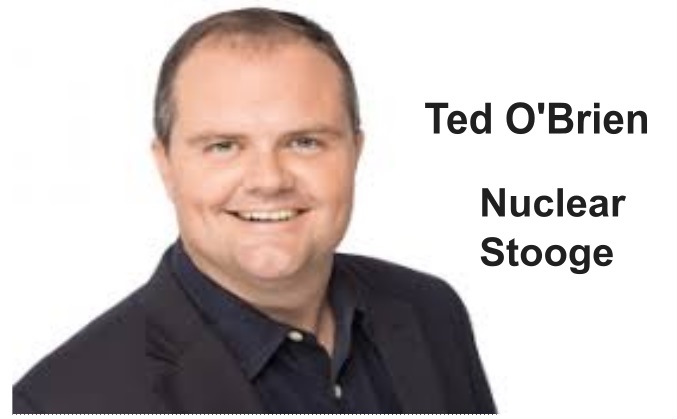
The Coalition’s spokesman for climate change and energy, Ted O’Brien.
Mike Seccombe is The Saturday Paper’s national correspondent. March 16, 2024Just two months after the 2019 election, Barnaby Joyce was making trouble for the new Morrison government. The dumped Nationals leader was part of a group of maverick MPs pushing for nuclear power. He reckoned he knew a way to make such a policy saleable.
The Joyce plan, as articulated in The Sydney Morning Herald on July 21, was this: “If you can see the reactor [from your house], your power is for free. If you are within 50 kilometres of a reactor, you get power for half price.”
People living or working up to 75 kilometres away would get a 25 per cent reduction on their electricity bills, he told the paper. By his reckoning, communities across the country would be lining up to get reactors.
Scott Morrison didn’t want a bar of the idea, or of nuclear power. Inquiring media were assured the position taken by the Coalition to the election still held: there were no plans to build nuclear power plants and there would be none unless and until there was evidence they could stack up economically.
Still, the problem persisted. The split on energy policy was boiling over between moderates and right-wingers in the [Coalition] government’s ranks – the latter mostly from Queensland, mostly climate change sceptics and proponents of more coal-fired power as well as nuclear.
A number of the pro-nuclear members, prominently including Keith Pitt and James McGrath, had long been calling for a parliamentary inquiry into the prospect of taking Australia nuclear.
A few weeks later, Morrison gave them one, although technically the August referral to the Standing Committee on the Environment and Energy was from the then minister for energy and emissions reduction, Angus Taylor.
The chair of the committee was Ted O’Brien, the Liberal member for Fairfax on Queensland’s Sunshine Coast, a relative neophyte elected to the parliament only three years prior, on the slogan “Time for Ted”.
To him fell the difficult task of steering through a report that would pacify the pro-nuclear zealots without undermining the Coalition leadership’s “no nukes” policy.
In some respects, O’Brien is typical of Queensland’s conservative party, a unique amalgam of the Liberals and Nationals.
Like many in the Liberal National Party, he is the scion of a family business with agricultural links, Defiance Mills. He began his working life as a trainee baker, before moving into management.
In other ways, though, he differs from the norm. ——— (subscribers only) https://www.thesaturdaypaper.com.au/news/environment/2024/03/16/the-most-beige-person-the-man-behind-the-coalitions-nuclear-plans#mtr
Opposition eyeing off six sites for nuclear reactors
New Daily, Poppy Johnston, Mar 12, 2024
Households and businesses close to the six nuclear power reactors the opposition hopes to see built could have their energy bills subsidised.
Teasing the coalition’s yet-to-be-unveiled energy policy at the Australian Financial Review Business Summit in Sydney on Tuesday, opposition leader Peter Dutton said the plan would likely include six nuclear plant sites.
Tasmania has been ruled out as a potential host state.
Dutton said the coalition would seek a social licence by incentivising close-by communities with subsided energy, a model he said was used in the United States.
“It provides incentive for industry to establish jobs,” he told the audience.
The opposition is expected to release its energy policy ahead of the federal budget in May, with the plan likely to include overturning the moratorium on nuclear technology and possible sites for reactors on old coal station locations to take advantage of existing transmission infrastructure…………….
The Albanese government has dismissed nuclear as an unsuitable technology for Australia that has a high price tag and will take too long to roll out.
Energy experts also say it’s difficult to estimate the cost of transitioning to nuclear given the technology is not currently commercially available.
Dutton addressed a number of what he described as “straw man arguments” against nuclear, including cost.
He used other regions with nuclear in the energy mix – South Korea and the Ontario region of Canada – to make his case for the system-wide cost of the energy source and its influence on power bills.
Reactors also produce a “small amount of waste” and Dutton said the government had already signed up to deal with nuclear waste via the AUKUS agreement……………………………. https://www.thenewdaily.com.au/news/politics/australian-politics/2024/03/12/dutton-six-sites-nuclear-reactors
Refuting Peter Dutton’s recycled nuclear contamination
By Michelle Pini | 14 March 2024, https://independentaustralia.net/politics/politics-display/peter-duttons-recycled-nuclear-contamination,1841
Nuclear power is one hell of a way to boil water.
~ Albert Einstein
MANY AUSTRALIANS are accustomed to the Coalition’s deliberate lies and obfuscation on most issues, which is why they are no longer in power, at least for now.
The lengths to which the “friendly” media’s ongoing Right-wing public relations campaign is prepared to go in support of such obvious nonsensical blathering is, however, alarming.
In recent days, Opposition Leader Peter Dutton has been running free all over the countryside spruiking nuclear energy. Who cares? We hear you say. Well, apparently, every mainstream media platform, since they are not only publicising his outright lies, but in many cases, promoting them as credible policy.
Despite the current political state of play in Australia, in which the Labor Party has been elected federally and in every mainland state and territory, plus his “popularity” continuing to dwindle towards complete extinction, Peter Dutton appears mired to the outdated policies of generations past.
After yet another election loss, this time in the Dunkley by-election, Dutton has sprung up on every media platform, keeping the climate denial fires burning and rambling about nuclear as if it were a new idea, rather than the stale, worn-out dance with annihilation that it actually is.
According to Pete, nuclear is:
“…The only credible pathway we have to our international commitments to net zero by 2050.”
And proving yet again that facts never stood in the way of a good PR campaign, the Fourth Estate say: Facts be damned! We already had to (mostly) give up on climate denial so let’s give nuclear a good old-fashioned, vested-interests-funded, radioactive show of support!
This week, the usual suspects flooded our screens, radio waves and Google searches with headlines such as:
‘Nuclear will help Australia reduce emissions by 2050’ ~ Sky News
‘Shadow Energy Minister Ted O’Brien floats 10-year timeframe to get nuclear up and running in Australia’ ~ The West Australian
And the winner of the Most Creative Bullshit Headline award, once again, goes to that much-awarded Murdoch rag…
‘There’s no rational reason for maintaining the nuclear ban’ ~ The Australian
We may currently have a Labor Government, which has canned nuclear energy, but the media barons’ collective power to keep greenhouse gases spewing, corporate donors’ pockets overflowing and public minds contaminated should not be underestimated.
And so in answer to the Coalition and its nuclear-friendly media disciples, here are a few, by no means exhaustive, rational reasons to maintain Australia’s nuclear ban, keep nuclear energy firmly out of the energy mix and out of everyone’s backyard.
LIE #1: IT’S CHEAP
Even in the U.S., which boasts the biggest nuclear energy sector in the world, nuclear power costs have escalated. As recently as mid-2021, despite huge government subsidies, the target price for nuclear power increased by 53 per cent, to almost twice the price of utility-scale solar PV systems with battery storage.
Climate Change and Energy Minister Chris Bowen has estimated that the Coalition’s nuclear plan will carry a price tag of $387 billion – 20 times more than Labor’s current renewables investment fund – and would not be delivered before 2040. Nuclear energy, then, does not appear to be cost-effective.
LIE #2: IT’S QUICK
We (thankfully) don’t have nuclear reactors in Australia and thus there is no established nuclear reactor industry in place.
Nonetheless, back in 2023, Dutton first claimed:
“New nuclear technologies can be plugged into existing grids and work immediately.”
In their more recent ramblings, Dutton, his current Shadow Energy Minister Ted O’Brien and the unnamed “experts” to whom they refer claim Australia can have large nuclear reactors – magically – ready to go within ten years.
In the U.S., which boasts the largest nuclear industry in the world, it currently takes 19 years to achieve this.
According to Ted, the UAE produced a nuclear reactor from go to whoa in “ten years”. In reality, however, even with the UAE being an autocracy with a command economy, where communities are not permitted to object to reactors in their backyards, it actually took 13 years.
But what’s three extra years and a few more glow-in-the-dark communities between climate-denying friends?
Nuclear energy does not appear to be fast, either.
LIE #3: IT’S CLEAN AND GREEN
Even before we get to the radioactive leaks part of why nuclear power isn’t “clean”, there is the small matter of the Coalition’s stated need to maintain coal-fired power stations until all these nuclear reactors magically emerge, which even in Dutton’s plan, requires at least ten more years, but which based on the U.S. experience, we know will take more like 20.
This is, of course, at the heart of the Coalition’s nuclear push. This is the reason the Coalition gets energetic (pardon the pun) about most things. Nuclear energy generation takes a long time to develop at great cost, which would prohibit further investment in renewables and necessitate the extension of coal-fired power stations, currently set to be phased out by 2040.
According to its own Nuclear Regulatory Commission, in 2017, out of 61 operating – and self-regulating – nuclear power plant sites in the United States, 43 have had leaks or spills involving groundwater contamination above the EPA’s safe drinking water threshold.
So, nuclear energy does not appear to be “clean” or “green” or, as we indicate below, safe.
LIE #4: IT’S SAFE
There is still no answer to nuclear waste disposal or the toxic bi-products of nuclear storage. There is no safe way of “recycling” it.
There is still no answer to the “management” of radioactive leaks.
Nuclear waste, depending on its elemental composition, takes between 290 to a few hundred billion years to decompose. High-level nuclear waste consisting of spent fuel from nuclear reactors – of the type Peter Dutton and co would like to build – accounts for most radioactive waste and needs to be safely stored for up to a million years.
And then there are unplanned natural disasters, such as Fukushima.
As Dave Sweeney recently explained on IA, despite its established technical sophistication and even after 13 years, the best Japan can do with Fukushima’s ongoing radioactive waste is ‘pump and dump’ it into our oceans.
LIE #5: THE LIGHTS WILL GO OUT
According to self-styled nuclear energy mastermind Ted O’Brien, if we “prematurely” shut down coal-fired energy generators and implement nuclear reactors right now, “the lights will go out”.
Unsurprisingly, there is no factual basis for this claim. However, the lights may well go out if we do as his party is suggesting since natural disasters affecting nuclear reactors on a scale like Fukushima cannot be anticipated or prevented. Then there’s the “slight” problem of global warming, which, if we continue to accelerate by burning fossil fuels, will, indeed, result in all the lights going out.
To sum up – rationally – we repeat, nuclear power isn’t safe, it’s not cost-effective and it certainly ain’t green, unless you count glowing in the dark.
Dutton’s blast of radioactive rhetoric on nuclear power leaves facts in the dust

Graham Readfearn, Guardian, 14 Mar 24
Coalition’s claim of cheap power and quickly built reactors is at odds with real world experience of other countries.
We may not yet be entering a nuclear age in Australia, but we would all be best advised to handle the rhetoric around the issue as carefully as we would radioactive waste.
This week opposition leader Peter Dutton said an annual CSIRO report that had included estimates of costs for small modular reactors – which are not yet available commercially – was “discredited” because it “doesn’t take into account some of the transmission costs, the costs around subsidies for the renewables”.
Dutton is referring to a report known as GenCost, which calculates the cost of generating electricity from different technologies when fuel, labour and capital are included. This metric is known as the levelised cost of electricity.
Despite Dutton’s claim, the most recent GenCost report does include the cost of integrating renewables such as solar and wind into the electricity grid. That is, it includes the cost of building new transmission lines and energy storage such as batteries.
The most recent GenCost report estimates a theoretical small modular reactor built in 2030 would cost $382 to $636 per megawatt hour. It says this is much more expensive than solar and wind, which it puts at between $91 and $130 per MWh even once integration costs are included.
The calculations in GenCost don’t include subsidies for any generating technologies – including renewables or future SMRs.
The cost estimates for SMRs are challenging because no commercial plant has been built. But the closest a project has got to existing – the Carbon-Free Power Project in Utah – was cancelled late last year primarily because the cost of the power would have been too high. And that project was given more than $2bn from the US Department of Energy.
Mycle Schneider is an independent nuclear expert and coordinator of the annual World Nuclear Industry Status report that tracks nuclear power development around the globe. He points to research from US financial group Lazard that says in the US, the costs of unsubsidised solar and wind including firming costs, such as batteries, range from US$45 to $141 per MWh compared to new-build nuclear at US$180 per MWh.
Ramping up the nuclear rhetoric
On Tuesday, Dutton said he would soon reveal six potential sites for nuclear reactors around Australia – likely to be close to, current or retiring coal-fired power stations.
Shadow energy minister Ted O’Brien claimed this week Australia could have nuclear power “up and running” within a decade.
“Nuclear ‘up and running within a decade’ does not fit with the experience we have seen elsewhere,” said Prof MV Ramana, a nuclear expert at the University of British Columbia and a contributor to the nuclear industry status reports.
Ramana points to Finland that has operated reactors since the 1970s, where parliament voted in 2002 to add a fifth reactor to the country’s fleet. Work started in 2005 but the reactor didn’t connect until 2022 “almost exactly 20 years after the parliamentary vote,” he said.
“We can see similar long periods of time between decisions to build reactors and when they start operating, again in countries that already have nuclear plants, in countries like the United States and the United Kingdom.”
Dutton and O’Brien have both said there are 30 economies around the world using nuclear and “50 more” that want to.
But Schneider says there are actually 32 countries with nuclear reactors, “but the top five generators produced 72% of the nuclear electricity in the world.”
“Over the past 30 years, only four countries started nuclear programs (Romania, Iran, Belarus, UAE) and three phased out their programs (Kazakhstan, Lithuania, Germany). There are reactors under construction in three more newcomer countries (Bangladesh, Egypt, Turkiye). Most other ‘plans’ are vague.”
The UAE – a model case study?
On Sky News, O’Brien pointed to the United Arab Emirates as a country that had commissioned South Korea’s Kepco to build four reactors of the size that could be considered for Australia in less than a decade.
In fact, each of the 1.4GW UAE plants was expected to be delivered in five years, but took eight, according to the industry status report. And it took 12 years from the announcement of the plan in 2008, to the first unit coming online in 2020.
The problem with using the UAE as a case study is that it is not a democracy, but an autocracy.
“The UAE is not a good model for Australia,” Ramana said………………………………………..
Reactor reactions
Experts have told the Guardian that even if Australia were to remove its federal and state bans on nuclear energy, it would be unlikely to see reactors generating power until the 2040s – at which point most, if not all, of Australia’s coal-fired power will have been turned off years earlier. One nuclear advocate questioned whether Australia could actually find a company to build reactors.
This week one political journalist said on Sky that “Canada is about to put in small modular reactors” and had selected a site in Ontario.
While Ontario Public Generation does plan to build a fleet of four small modular reactors, the company doesn’t yet have a licence to construct them.
If it does go ahead, OPG has said it doesn’t expect the first-of-its-kind unit – each about one-tenth the size of Australia’s biggest coal-fired power plant – to be working commercially until the end of 2029.
Expertise needed to make giant leap
O’Brien and Dutton have rejected the notion that Australia would be “starting from scratch” on nuclear, citing the existence of the tiny reactor at Lucas Heights near Sydney, the country’s existing reserves of uranium and the agreement to buy nuclear-powered submarines in the future.
Glenne Drover, the secretary of the Victorian branch of the Australian Institute of Energy and a broad supporter of nuclear power, said it was “quite a step up” from the 20MW Lucas Heights research reactor “to 1,000MW+ and to build, own and operate a pressure reactor”………………………more https://www.theguardian.com/environment/2024/mar/14/peter-dutton-nuclear-power-comments-csiro-small-modular-reactors
Cold turkeys: The demise of nuclear power
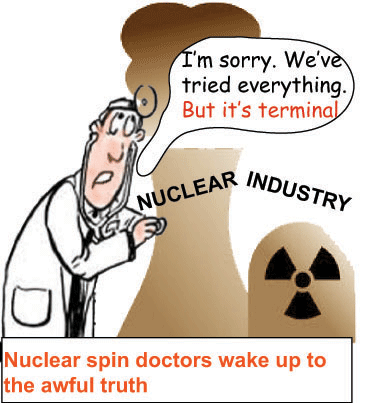
Jim Green, Mar 12, 2024, https://reneweconomy.com.au/cold-turkeys-the-demise-of-nuclear-power-in-australias-aukus-partner-countries/
When announcing the AUKUS agreement in 2021, then Prime Minister (and secret energy minister) Scott Morrison said: “Let me be clear: Australia is not seeking to establish … a civil nuclear capability.” He also said that “a civil nuclear energy industry is not a requirement for us to go through the submarine program.”
However, Coalition Senators argued in a report last year that Australia’s “national security” would be put at risk by retaining federal legislation banning nuclear power and that the “decision to purchase nuclear submarines makes it imperative for Australia to drop its ban on nuclear energy.”
So, let’s see how nuclear power is faring in our AUKUS partners, the UK and the US.
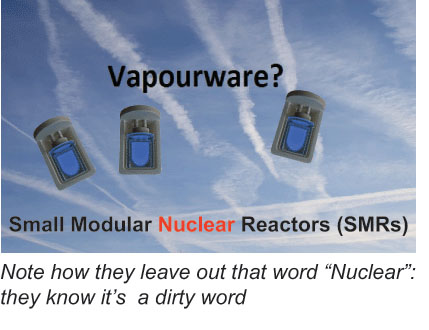
This is a story about conventional, large reactors. All that needs to be said about ‘small modular reactors’ in the UK and the US is that none exist and none are under construction.
This is a story about conventional, large reactors. All that needs to be said about ‘small modular reactors’ in the UK and the US is that none exist and none are under construction.
The UK
The last power reactor start-up in the UK was 29 years ago — Sizewell B in 1995.
Over the past decade, several proposed new nuclear power plants have been abandoned (Moorside, Wylfa, Oldbury) and the only project to reach the construction stage is Hinkley Point C, comprising two French-designed EPR reactors.
In the late 2000s, the estimated construction cost for one EPR reactor in the UK was £2 billion (A$3.9 billion). When construction of two EPR reactors at Hinkley Point commenced in 2018 and 2019, the cost estimate for the two reactors was £19.6 billion.
The current cost estimate for the two reactors has ballooned to £46 billion (A$89 billion) or £23 billion (A$44.5 billion) per reactor. That is 11.5 times higher than the estimate in the late 2000s. Further cost overruns are certain. This is an example of the Golden Rule of Nuclear Economics: Add a Zero to Nuclear Industry Estimates.
The UK National Audit Office estimates that taxpayer subsidies for Hinkley Point — primarily in the form of a guaranteed payment of £92.50 (A$180) per megawatt-hour (2012 prices), indexed for inflation, for 35 years — could amount to £30 billion (A$58 billion) while other credible estimates put the figure as high as £48.3 billion (A$94 billion).
Delays
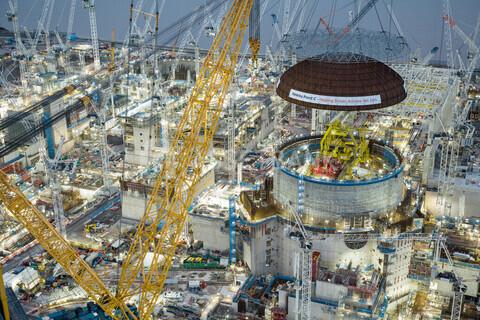
The delays associated with Hinkley Point have been as shocking as the cost overruns. In 2007, French utility EDF boasted that Britons would be using electricity from an EPR reactor at Hinkley Point to cook their Christmas turkeys in 2017. In 2008, the UK government said the reactors would be complete “well before 2020”.
But construction of the two reactors didn’t even begin until 2018 and 2019, respectively, at which time completion was expected in 2026. Now, completion is expected in 2030 or 2031.
Undoubtedly there will be further delays and if the reactors are completed, it will be more than a quarter of a century after the 2007 EDF boast that Britons would finally be using electricity from Hinkley Point to cook their Christmas turkeys.
Construction will take well over 10 years; planning and construction over 25 years. Yet in Australia, the Coalition argues that Australians could be cooking Christmas turkeys with nuclear power 10 years from now.
‘Something of a crisis’
Nuclear industry lobbyist Tim Yeo said in 2017 that the UK’s nuclear power program faced “something of a crisis”. The following year, Toshiba abandoned the planned Moorside nuclear power project near Sellafield despite generous offers of government support — a “crushing blow” according to Yeo.
Then in 2019, Hitachi abandoned the planned Wylfa reactor project in Wales after the estimated cost of the twin-reactor project had risen by 50 percent.
Hitachi abandoned the project despite an offer from the UK government to take a one-third equity stake in the project; to consider providing all of the required debt financing; and to consider providing a guarantee of a generous minimum payment per unit of electricity.
Long gone was the 2006 assertion from then UK industry secretary Alistair Darling that the private sector would have to “initiate, fund, construct and operate” nuclear power plants.
The UK Nuclear Free Local Authorities noted that Hitachi joined a growing list of companies and utilities backing out of the UK nuclear new-build program:
“Let’s not forget that Hitachi are not the first energy utility to come to the conclusion that new nuclear build in the UK is not a particularly viable prospect. The German utilities RWE Npower and E-on previously tried to develop the site before they sold it on Hitachi in order to protect their own vulnerable energy market share in the UK and Germany.
“British Gas owner Centrica pulled out of supporting Hinkley Point C, as did GDF Suez and Iberdrola at Moorside, before Toshiba almost collapsed after unwise new nuclear investments in the United States forced it to pull out of the Sellafield Moorside development just a couple of months ago.”
Sizewell C

The UK government hopes to progress the Sizewell C project in Suffolk, comprising two EPR reactors, and is once again offering very generous support including taking an equity stake in the project and using a ‘regulated asset base‘ model which foists financial risks onto taxpayers and could result in taxpayers paying billions for failed projects — as it has in the US.
If recent experience is any guide, the government will struggle to find corporations or utilities willing to invest in Sizewell regardless of generous government support.
(The same could be said for plans for small modular reactors or mid-sized reactors envisaged by Rolls-Royce — it is doubtful whether private finance can be secured despite generous taxpayer subsidies.)
Many reactors have been permanently shut down in the UK: the IAEA lists 36 such reactors. Since the Sizewell B reactor startup in 1995, there have been 24 permanent reactors shut-downs and zero startups.
Repeat: since the last reactor startup in the UK, there have been 24 shut-downs!
The capacity of the nine remaining reactors (5.9 gigawatts — GW) is less than half of the peak of 13 GW in the late 1990s. Nuclear power’s contribution to electricity supply has fallen from 22 percent in the early 2000s to 14.2 percent.
Meanwhile, the UK government reports that renewable power sources accounted for 44.5 percent of total UK generation in the third quarter of 2023, a higher share than fossil fuels and around three times more than nuclear’s share.
What to make of the conservative UK government’s goal of quadrupling nuclear capacity to 24 GW by 2050? It is deeply implausible. The facts speak for themselves. Two dozen reactor shutdowns and zero startups since 1995.
The Hinkley Point project has been extremely slow and extremely expensive. The Sizewell C project is uncertain. Other proposals — including proposals for small modular reactors — are even more uncertain and distant.
Unsurprisingly, the extraordinary cost overruns and delays associated with Hinkley Point have complicated plans to advance the proposed Sizewell C project.
In 2010, the UK government announced that Sizewell was one of the locations slated for new reactors. Fourteen years later, construction is some years away and it remains uncertain if the project will reach the construction stage. EDF and the UK government are seeking to raise a further £20 billion from new investors. All reasonable offers considered.
France
The Sizewell C project is equally complicated across the channel due to EDF’s massive debts and its plan to replace the EPR design with an EPR2 design, about which little is known except that safety will be sacrificed on the altar of economics. EDF’s debt as of early 2023 was €64.5 billion (A$107 billion) and it was fully nationalised later in 2023 due to its crushing debts.
In addition to its adventures across the channel, EDF has a “colossal maintenance and investment programme to fund” in France as the Financial Times noted in October 2021.
As in the UK, there has not been a single reactor startup in France since the last millennium. The only current reactor construction project is one EPR reactor under construction at Flamanville. The current cost estimate of €19.1 billion (A$31.6 billion) is nearly six times higher than the original estimate of €3.3 billion (A$5.5 billion).
Construction of the Flamanville reactor began in 2007 and it remains incomplete 17 years later. Planning plus construction have taken over a quarter of a century. Yet the Coalition argues that Australians could be cooking Christmas turkeys with nuclear power 10 years from now.
France’s nuclear industry was in its “worst situation ever“, a former EDF director said in 2016 — and the situation has worsened since then. Another former EDF director said in early 2024 that the French nuclear industry is “on a slow descent to hell” and he has “fierce doubts about EDF’s ability to build more reactors.”
The US

The V.C. Summer project in South Carolina (two AP1000 reactors) was abandoned in 2017 after the expenditure of around US$9 billion (A$13.6 billion). Construction began in 2013 and the project was abandoned in 2017.
The project was initially estimated to cost US$11.5 billion; when it was abandoned, the estimate was US$25 billion (A$38 billion).
Largely as a result of the V.C. Summer disaster, Westinghouse filed for bankruptcy in 2017 and its parent company Toshiba only avoided bankruptcy by selling its most profitable assets. Both companies decided that they would no longer take on the huge risks associated with reactor construction projects. A year earlier, Westinghouse said its goal was to win overseas orders for at least 45 AP1000 reactors by 2030.
Criminal investigations and prosecutions related to the V.C. Summer project are ongoing: the fiasco is known as the ‘nukegate’ scandal.
Vogtle

With the abandonment of the V.C. Summer project in South Carolina, the only remaining reactor construction project in the US was the Vogtle project in Georgia (two AP1000 reactors).
Construction of the Vogtle reactors began in 2013 and the expected completion dates of 2016 and 2017 were pushed back seven years to 2023 and 2024. In 2014, Westinghouse claimed a three-year construction schedule for AP1000 reactors but the Vogtle reactors took 10 and 11 years to complete.
The first licence application for the Vogtle project was submitted in 2006 so planning and construction took 17 years in addition to the time spent before the 2006 application.
The latest cost estimate for the Vogtle project is $34 billion (A$51 billion), more than twice the estimate when construction began (US$14–15.5 billion). The project only survived because of multi-billion-dollar taxpayer bailouts.
In 2006, Westinghouse said it could build an AP1000 reactor for as little as US$1.4 billion (A$2.1 billion) — 12 times lower than the latest Vogtle estimate of US$17 billion (A$25.5 billion) per reactor. Another example of the Golden Rule of Nuclear Economics: Add a Zero to Nuclear Industry Estimates.
Corruption scandals
In 2005, the US Nuclear Energy Institute claimed that Westinghouse’s estimate of US$1,365 per kilowatt “has a solid analytical basis, has been peer-reviewed, and reflects a rigorous design, engineering and constructability assessment.”
In fact, the estimate was out by an order of magnitude and the Institute’s involvement in a raft of corruption scandals has been exposed. No doubt the Dutton Coalition would happily parrot whatever lies the Institute chose to feed them, and no doubt the Murdoch/Sky/AFR echo-chamber would happily amplify those lies.
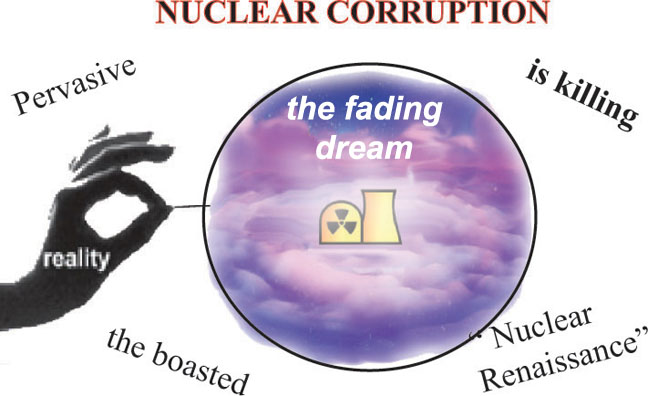
During the ill-fated ‘nuclear renaissance’, the US Nuclear Regulatory Commission received applications to build 31 reactors, but only the Vogtle and V.C. Summer projects reached the construction stage and only the twin-reactor Vogtle project was completed. Two out of 31 ain’t bad. Well it is, actually.
Thirteen reactors have been permanently shut down since 2013 with many more closures in the pipeline. The US has one of the oldest reactor fleets in the world with a mean age of 42.1 years. The mean age of the 29 reactors closed worldwide from 2018‒2022 was 43.5 years.
Around 20 unprofitable, ageing reactors have been saved by nuclear bailout funding but their future is precarious. In addition to the V.C. Summer corruption scandal, nuclear bailout programs are mired in corruption scandals (see here, here, here and here and if you’re still not convinced see here, here, and here).
Dr. Jim Green is the national nuclear campaigner with Friends of the Earth Australia and a member of the Nuclear Consulting Group.
Coalition will seek a social licence for nuclear: Dutton

AFR, Phillip Coorey, 12 Mar 24
Communities will be consulted and “incentivised” to adopt nuclear power, Opposition Leader Peter Dutton says as he amplifies his case for the energy source to play a central role in Australia reducing its emissions.
Mr Dutton will also pledge to “ramp up” the domestic production of gas to help firm renewable energy, in his keynote speech to be delivered to The Australian Financial Review Business Summit on Tuesday.
He will also hint at an expansion of rooftop solar, as already flagged by Nationals leader David Littleproud, as an alternative to large-scale renewable energy projects and the thousands of kilometres of transmission infrastructure that those will require……………………….
In setting the scene for his nuclear announcement, Mr Dutton will outline three principles that will guide the policy.
“First and foremost, we want to get the highest yield of energy using the smallest amount of land,” he will say.
“We want to maximise the amount of energy we can obtain per square metre and minimise our environmental footprint.”
This will be achieved by putting reactors on or near the sites of old coal-fired power stations so they can use the existing transmission grid.
The second principle will involve seeking a “social licence” for the policy “by listening to and incentivising communities to adopt nuclear power”.
A third principle is that the Coalition will put people at the centre of our energy policy by making lower energy bills a key consideration.
Mr Dutton dared the government to lift the nuclear power moratorium and let the market decide.
‘Does not make sense’
But energy experts appearing at the Summit continued to cast doubt on the feasibility of the Coalition’s approach.
Carbon Market Institute chair Kerry Schott said she was technology neutral but nuclear “really does not make sense for Australia”.
“Nuclear by far, like daylight by far, [is] the most expensive,” she said.
“It really doesn’t make sense for Australia because we have so much renewable energy resources.”
She said firming wind and solar with hydro and “a little bit of gas” until hydrogen was commercially available was “by far the cheapest and easiest”.
She did, however, agree, that putting solar panels on every rooftop would alleviate the need for Labor’s thousands of kilometres of transmission infrastructure……………………………… https://www.afr.com/business-summit/coalition-will-seek-a-social-licence-for-nuclear-dutton-20240311-p5fbby
1 This month


Help Aunty Sue Protect Her Land and Sacred Sites From Destructive Rocket Testing.
.

Australians deserve the truth
about
AUKUS – https://aukuspublicinquiry.com/

PETITION – To: Prime Minister Anthony Albanese and the Australian Labor Government

of the week – Australians for War Powers Reform (AWPR)
To see nuclear-related stories in greater depth and intensity

