Cook by-election candidate Simon Kennedy says locals are ‘comfortable’ living near nuclear reactors
ABC News, By Ethan Rix 13 Apr 24
The by-election for former prime minister Scott Morrison’s southern Sydney seat has not garnered national fanfare the way other by-elections have in the past.
And as voters head to the polls today, you can count the apathy being felt in the electorate of Cook — with early voting down by about 11 per cent compared to the 2022 federal election and nearly 13 per cent lower than the Voice referendum late last year, according to the Australian Electoral Commission.
Even the Liberals’ candidate, Simon Kennedy, won’t be able to personally boost voter turnout as his team confirmed he didn’t move into the electorate in time to meet the registration deadline — denying him an opportunity to pose for the cameras as he votes for himself.
Perhaps the lack of enthusiasm is because the Liberals look set to comfortably hold a seat they have held for half a century, or maybe it’s because the Labor Party has opted not to put a horse in the race, diminishing any usual analysis the result could be a “test” of Anthony Albanese’s leadership.
But for people who are eligible to cast a ballot today, what are they really voting for?
A nuclear reactor in Cook’s backyard
Former McKinsey consultant Simon Kennedy has openly backed his party’s push to introduce nuclear power to the national energy grid, with the opposition preparing to announce up to six possible sites for nuclear plants.
When asked whether he would oppose a nuclear power reactor being built in the electorate of Cook, Mr Kennedy said locals were “comfortable” with the concept because there was already one positioned on its “doorstep” in Lucas Heights.
“People are comfortable with where Lucas Heights is, they’ve been comfortable with that concept,” he said.
“I haven’t heard any fear or worries about that at all.”
Lucas Heights, which is located on the outskirts of the Sutherland Shire, is home to Australia’s only nuclear reactor, which is not used to produce electricity.
It instead produces medical and industrial isotopes and stores low-level waste and a small amount of intermediate-level waste on-site.
“They’re [voters] not looking for people pushing clean or coal or one over the other, they’re looking for cheap, reliable and clean power,” Mr Kennedy said.
Looking at getting more female candidates
The number of female MPs in the Coalition has also been a key question in the lead-up to this by-election.
Mr Kennedy comfortably defeated the only female candidate to put her hand up for Liberal pre-selection, Veteran Family Advocate Commissioner Gwen Cherne, who received 35 votes to his 158.
The result was said to have upset those within the party pushing for more females to be preselected to safe Liberal seats……………….
Who else is running?
…………… The Australian Greens have put up Martin Moore, who has a Fine Arts Degree with a Masters in Social Ecology and ran for the local seat of Miranda at the 2023 NSW election.
Mr Moore disagreed with Mr Kennedy that locals would be comfortable living next to a nuclear reactor.
“I feel that people are really concerned that we’re being dragged into a nuclear wasteland with the AUKUS deal … and the opposition’s ideas of reactors,” he said……………………………… https://www.abc.net.au/news/2024-04-13/cook-byelection-simon-kennedy-nuclear-reactors/103696760—
TODAY. Australia is EVER so grateful to the global nuclear lobby!
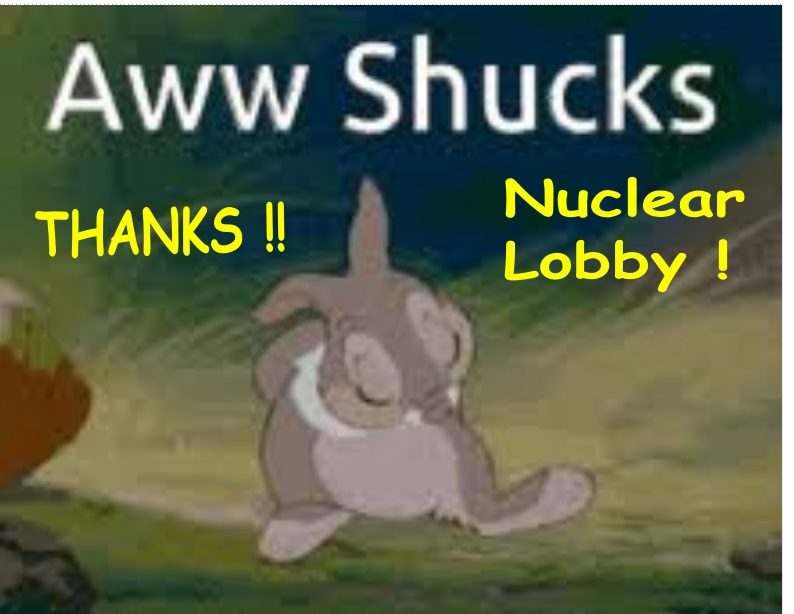
First of all, we Australians LOVE spending money! Not on health, education, preserving our unique biodiversity, certainly not on shelter for our growing homeless.
With our relatively small population, we are still delighted to cough up nearly $400billion to buy a second-hand American nuclear submarine and to buy all the USA and UK nuclear submarine wastes that these dear friends vouchsafe to dump on us.
And, it was interesting to read today, that the UK has spurned paying $millions to Rolls Royce as the maker for its proposed fleet of small modular nuclear reactors.
No problem to the nuclear lobby. Rolls Royce now plans to flog them off to Australia instead – Opposition leader Peter Dutton has pledged, if elected, to deliver Rolls Royce small modular reactors into the grid by the mid-2030s.
Any old or useless stuff that the nuclear industry has to get rid of – no probs – Australia will buy it!
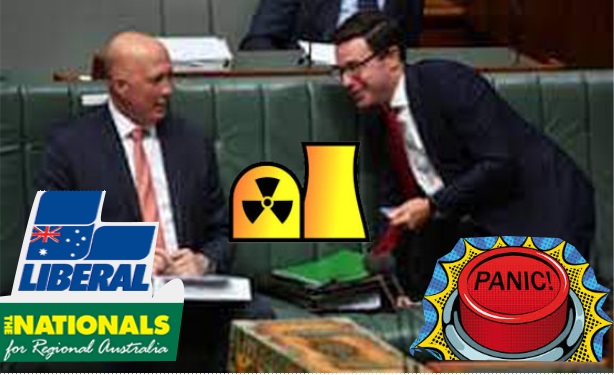
Coalition “in a panic” about response to confused and unpopular nuclear power plan
The Australian noted the Australian Workers Union’s support for nuclear power but didn’t mention the opposition of the Australian Council of Trade Unions, Australian Education Union, Australian Manufacturing Workers Union, Australian Nursing and Midwifery Federation, Australian Services Union, Communication Workers Union, Electrical Trades Union, Independent Education Union (Vic – Tas), Maritime Union of Australia, National Union of Workers, Tasmanian Unions, Unions ACT, Unions WA, Unions SA, Unions NT, United Voice, United Firefighters Union, and the Victorian Trades Hall Council.
Jim Green, Apr 8, 2024, https://reneweconomy.com.au/coalition-in-a-panic-about-response-to-confused-and-unpopular-nuclear-power-plan/
The Coalition’s nuclear power policy is being released in instalments in the Australian newspaper ahead of its formal release sometime before the May budget.
Under a plan taken to the Coalition shadow cabinet in March, seven coal regions have been identified as potential locations for nuclear power plants, the Australian reports.
Presumably those regions are Collie in WA, the Latrobe Valley in Victoria, the Hunter Valley and Lithgow in NSW, and three regions in Queensland — the Darling Downs, Gladstone and Central Queensland.
The Australian reports that a shadow cabinet subcommittee will produce ‘economic impact statements’ to promote the potential economic benefits in the seven regions.
The Coalition will try to win local support by using taxpayer funds to reduce power bills for people living near the proposed nuclear plants. Workers will be offered higher-paid jobs, presumably at taxpayers’ expense. And taxpayers will be on the hook for workforce training, regulation, waste disposal and much more.
The plan “will involve the creation of new precincts for advanced manufacturing centred on cheap energy from small nuclear reactors”, the Australian reports. Cheap nuclear power will attract heavy industry, adding to the high-paid jobs bonanza.
A “community engagement process” would be rolled out once the coal sites had been identified, opposition leader Peter Dutton says.
But just like everything else associated with the Coalition’s nuclear policy, the plan to win over communities in coal regions has hit a snag.
The Murdoch press reported on April 7 that focus group research carried out in the Hunter Valley in NSW and the Latrobe Valley in Victoria found that voters are “hostile” to plans for reactors in their own areas.
An unnamed Coalition MP said of the Liberal and National Party rooms: “My read is they’re in a panic about it. They don’t know what to do.” A Coalition frontbencher said Dutton is “obsessed with this nuclear thing — obsessed with it.”
Rolls-Royce reactors

“There is every reason to be optimistic about bringing small modular net-zero emission nuclear into the power mix in the 2030s,” Dutton told the Australian.
Indeed he has “pledged” that if the Coalition were returned to government at the next election, the first nuclear reactors would be up and running by the mid-2030s. That’s a big pledge since there is zero chance of reactors operating in Australia by the mid-2030s.
Dutton recently met privately with executives from Rolls-Royce to discuss “the pursuit of low-cost small modular reactor technology for Australia”, the Australian reports.
Rolls-Royce claims it could build a reactor in Australia in just four years (once licensing and a myriad of other issues were sorted). Let’s compare that speculation with real world experience:
Continue readingPeter Dutton to press ahead with nuclear despite opposition in regional Australia

Locals who live in areas earmarked for nuclear reactors have delivered a blow to Peter Dutton’s energy plan.
James Campbell National political editor, April 7, 2024, The Sunday Telegraph
https://www.adelaidenow.com.au/news/nsw/peter-dutton-to-press-ahead-with-nuclear-despite-opposition-in-regional-australia/news-story/53a7108e83484542ee99870d5002fba9
Peter Dutton will press on with his plans for nuclear power, despite recent Coalition research finding widespread opposition to the proposals in regional areas earmarked for reactors.
Coalition sources said focus group research carried out in the Hunter Valley in NSW and the Latrobe Valley in Victoria in recent weeks found hostility to the proposed polices.
It found that while voters were aware of the general arguments for nuclear power, they were hostile to plans for reactors in their own areas.
A Coalition source familiar with the research said the findings had come as a shock.
“They had convinced themselves that people would be queuing up for these things,” the source said.
Another said it was clear “more work needs to be done” on winning the argument.
But Mr Dutton is still set to release his plan for net-zero energy before the May budget.
The Weekend Australian reported the Coalition’s plan would offer heavily discounted power bills to communities with nuclear power plants.
It also reported the plan is to install small nuclear reactors at as many as seven sites, which will be operating by the mid-2030s.
“The ability to produce zero-emissions baseload with 24/7 electricity to firm up renewables is within our grasp,” he told the paper.
However a Coalition MP who strongly supports nuclear power said there was increasing concern in both the Liberal and National Party rooms that it was already too late to win the public argument about nuclear power in the time left before the next election.
“We haven’t even seen the policy yet,” the MP said. “My read is they’re in panic about it. They don’t know what to do.”
The Sunday Telegraph spoke to a number of Coalition MPs, including frontbenchers, who expressed concerns about the saleability of nuclear power from opposition.
But they all agreed Mr Dutton is not for turning on ¬nuclear power.
According to one frontbencher who supports the plan “the best case scenario” from pushing nuclear power would be a “nil-all draw” with the Government.
“Let’s not kid ourselves that this is some kind of vote-catching policy,” the frontbencher said.
But he said there was no chance Mr Dutton would walk away from it.
“He’s obsessed with this nuclear thing – obsessed with it,” the frontbencher said.
“Peter is very determined to go down this path,” another said.
On Wednesday, Mr Dutton told reporters: “I think we need to have a proper, mature discussion about how we migrate to a new energy system where we can have renewables that are firmed up by zero emissions, latest generation nuclear technology”.
He added: “In terms of regions, we’ve been very definite in our advice that we’re looking at about half a dozen sites, on brownfield sites, those where you’ve got a coal-fired generator coming to an end of life”.
The high-stakes power play that will shape our future
April 5, 2024, The Australian, Simon Benson; Political editor
The climate wars may be over but an equally divisive battle is arising out of the nation’s new political consensus. Both sides of politics are locked into a net-zero emissions target by 2050, Labor by choice, the Coalition by the force of political reality. But Peter Dutton’s introduction of the nuclear option creates a stark contest between the main parties on how to get there.
The competing pathways to net zero offer profoundly different outcomes for the nation’s future. They go beyond climate change and raise the fundamental question: what sort of Australia will emerge once a point of no return in the rollout is reached?
…………………………………. a new ideological contest into the debate, reigniting a clash of ideas not only over the future of energy but for the communities that have generational ties to its production.
There are two essential issues at stake.
While the question of energy security has become the axis around which Albanese’s radical transformation of the economy pivots, the economic future of the nation’s coal communities has become the new political frontline between Labor and the Coalition.
In this sense, Australia is not unique. The US is grappling with its own socio-economic dilemma……….
Last week, as the Prime Minister was preparing to fly to the Hunter Valley coalfields to announce a $1bn solar panel scheme to generate jobs as coal exits the community, Dutton was meeting privately with executives from Rolls-Royce for a deep dive into the feasibility of small modular reactors in an Australian context.
This juxtaposition symbolises the chasm of policy approaches to the challenge of decarbonising the economy. Both sides are embarking on equally ambitious road maps. While Albanese has rubbished the idea of an Australian civil nuclear energy program, Dutton is convinced it can work.
In an interview with Inquirer on Wednesday, he pledged that if the Coalition were returned to government at the next election, the first nuclear reactors would be up and running by the mid-2030s.
It is understood Rolls-Royce is confident its small modular reactor technology could be ready for an Australian market in this time-frame with a price tag of $5bn for a 470-megawatt plant. Each plant would take four years to build and have a life-span of 60 years.
Rolls-Royce signed a contract with the Albanese government in February to build the nuclear reactors for the second tranche of AUKUS submarines.
According to this timeline, nuclear power generation could begin being rolled out at about the same time as the first nuclear-powered submarines are delivered. The feasibility of this timeline will be strongly contested.
Social licence is essential to the Coalition’s ambitions…………………..
Under a plan taken to Dutton’s shadow cabinet two weeks ago, seven coal communities were identified as potential locations for coal-to-nuclear transition on or near the sites of exiting coal-fired power stations, with the promise of cheaper electricity for those communities, higher paying jobs and upgraded infrastructure……………………………………
Not all of Dutton’s colleagues are convinced there is enough time in the political cycle to start building the political case for nuclear power……………………..
Both sides are highly alert to the acute political consequences of an ill-managed transition.
What looms is an election battle over energy security set against vastly contrasting ideologies…………………………………………………
The Albanese government’s Net Zero Economy Authority bill passed by the parliament before Easter set out the agency’s purpose as one clearly designed around the transition to renewables. It was unambiguous in its assessment of the cost and scope of Labor’s plan. The bill was equally clear about what is at stake with the exiting of coal-fired power stations across the country and the consequences if steps aren’t taken to protect these communities.
It defines coal-fired power stations and associated thermal coalmines as being located in six regions around Australia: Collie in Western Australia, the Latrobe Valley in Victoria, the Hunter Valley and Lithgow in NSW and three regions in Queensland – the Darling Downs, Gladstone and Central Queensland.
The political expression of this reality is the number of regional seats that will be affected. Some sooner than others. Neither side can claim a monopoly on ownership of these constituencies.
In NSW, Labor is at risk in the Hunter Valley in the seats of Hunter, Shortland and Paterson, while Calare west of Sydney, held by the Nationals until Andrew Gee resigned to sit on the crossbench, covers the coal community of Lithgow.
In Queensland, the LNP has Flynn stretching west from Gladstone to consider with legacy coal community economics also stretching into Capricornia, which takes in Rockhampton up to southern Mackay. Both seats have been in Labor hands before. Nationals leader David Littleproud’s massive Queensland seat of Maranoa is another that takes in coal communities through Queensland’s southern and central west.
In Victoria, coal communities stretch across the Nationals’ seat of Gippsland, which now takes in the industrial region of the Latrobe Valley………………………………………………………………………………..
Peter Dutton vows to bring small nuclear reactors online in Australia by mid 2030 if elected.

April 5, 2024, The Australian, Simon Benson
https://www.theaustralian.com.au/nation/politics/peter-dutton-vows-to-bring-small-nuclear-reactors-online-in-australia-by-mid2030-if-elected/news-story/eaf9eaf2084916fa118fbeebf2ed72c9
Cheaper power prices would be offered for residents and businesses in coal communities to switch from retiring coal-fired generators to nuclear power if the Coalition wins government.
Peter Dutton has pledged that if elected, the Coalition could deliver the first small modular reactors into the grid by the mid-2030s, with British manufacturer Rolls-Royce understood to be able to deliver them at an estimated $3.5bn to $5bn each.
Economic impact statements will also be conducted on at least seven communities identified by a shadow cabinet subcommittee established by the Opposition Leader to develop the Coalition’s energy security policy.
Mr Dutton confirmed to The Weekend Australian that under the Coalition’s net-zero energy plan, to be released before the May budget, cheaper electricity bills would be offered to those communities that took up nuclear when coal-fired power stations were retired.
The plan will involve the creation of new precincts for advanced manufacturing centred on cheap energy from small nuclear reactors.
Mr Dutton met privately last week with executives from nuclear power plant manufacturer Rolls-Royce and its Australian partner Penske over the pursuit of low-cost small modular reactor technology for Australia.
It is understood Rolls-Royce is confident that its small modular reactor technology could be ready for the Australian market by the early to mid-2030s with a price tag of $5bn for a 470 megawatt plant.
Each plant would take four years to build and have a life span of 60 years.
Rolls-Royce will also build the nuclear reactors for the second tranche of the future AUKUS nuclear-powered naval submarines under contracts signed in February with the Albanese government.
“There is every reason to be optimistic about bringing small modular net-zero emission nuclear into the power mix in the 2030s,” the Opposition Leader said in an interview with The Weekend Australian, adding: “I think the mid-2030s.
Grattan Institute Deputy Energy Director Alison Reeve says the nuclear energy debate is a “bit of a distraction” when there are “immediate problems” to worry about. Ms Reeve joined Sky News Australia to discuss the future of energy in the country. “The federal opposition has said they want to take the ban off nuclear power – they could do that,” she said. “The thing is that there’s a hell of a lot of things that would need to happen before you end up with being able to actually build a nuclear power station. “In the meantime, we’ve got an awful lot of other stuff that we need to concentrate on building.”
“If we win the election, it is clear to me that (South Australian Labor Premier) Peter Malinauskas would be the first to sign up, and we could deal with regulatory burdens quickly.
“There is no question about that. And there is every reason to believe other jurisdictions would follow suit.
“I think when you look at where technology has advanced and what Rolls-Royce is doing with the nuclear submarines the government has signed up to buy, the future is much closer than we think.
“The ability to produce zero-emissions baseload with 24/7 electricity to firm up renewables is within our grasp.
“My honest view is we have to embrace a new energy system and we have to have an orderly transition but the government doesn’t have a credible pathway to net zero by 2050.”
Mr Dutton said a community engagement process would soon be rolled out once the potential coal sites had been finalised. He confirmed that those communities supportive of future transitions from coal to nuclear would be offered cheaper power prices and higher-paid jobs…………………
The first phase of the Coalition’s net-zero energy plan was taken to shadow cabinet two weeks ago and will be released before the May budget.
The debate facing the Coalition now is over the cost and timely delivery of nuclear into the energy mix, as well as the future of some coal communities facing bleak socio-economic outcomes one coal-fired generators exit the system……………….
Anthony Albanese told The Weekend Australian his government had a clear focus on the future of coal communities and insisted that no one would be “left behind”, claiming Labor’s renewable energy plans would drive new manufacturing jobs in those regions.
“Eleven coal-fired power plants have already closed and the former Coalition government didn’t lift a finger to help workers in these communities,” the Prime Minister said
“Rather than playing politics with the transition, the government is putting in place practical measures to ensure workers are looked after. The Net Zero Economy Authority will support workers to access new employment and to help create jobs in new businesses and industries.
“The Energy Industry Jobs Plan introduced into parliament last week outlines a redeployment scheme to align workers with jobs in new industries.
“The authority will work with business unions and communities.
“We will not leave them behind.
“A practical example is the Liddell site in the Upper Hunter which is being transformed into an energy and manufacturing hub, employing more people than the old power station did.
“Recently, Rio Tinto signed Australia’s biggest renewable energy deal to power its Boyne aluminium smelter in Gladstone.”
https://www.theaustralian.com.au/nation/politics/peter-dutton-vows-to-bring-small-nuclear-reactors-online-in-australia-by-mid2030-if-elected/news-story/eaf9eaf2084916fa118fbeebf2ed72c9
“No feasible pathway:” Liberal MP Matt Kean quits Coalition-based charity because of its obsession with nuclear

Giles Parkinson, Apr 4, 2024, https://reneweconomy.com.au/no-feasible-pathway-kean-quits-coalition-based-charity-because-of-its-obsession-with-nuclear/
Former NSW Liberal government energy minister Matt Kean has quit his role as ambassador of an environmental charity dominated by state and federal Liberal and National Party MPs, saying it had become obsessed with promoting nuclear power and is seeking to delay the rollout of renewables.
Kean says he is quitting the Coalition for Conservation (c4C) because of concerns about the direction of the charity, which has undergone a major shift in focus in the past year, coinciding – according to the AFR – with the growing involvement of patrol Trevor St Baker, the former coal baron and now nuclear investor and proponent.
“When the network was formed, I was an enthusiastic supporter, because I believe that it is the Coalition that should be the best custodians for our environment,” Kean wrote in a letter to the organisation’s chair, former federal Coalition minister Larry Anthony.
“It has become clear in recent times that the Coalition for conservation has increasingly focussed on nuclear power in the electricity system.
“In particular I was concerned to read an article in the Canberra times advocating nuclear power stations as an alternative to building new large scale transmission lines.
“While I recognise that one cannot rule out nuclear playing a constructive role in the Australian electricity system in the distant future, the reality is that there is no feasible pathway to play any material role in helping Australia replace our coal fired power stations in line with the climate science.”
The C4C appears to have undergone a rapid rethink on emissions reductions, dumping its previous support for renewable as the cheapest path to net zero in favour of nuclear.
It is a major major shift which has coincided – according to the AFR’s Rear Window column – with the growing involvement of one of the C4C two patrons, the billionaire Trevor St Baker, the former coal baron and now nuclear investor and proponent.
Kean is the architect of the plan to replace Australia’s biggest fleet of coal generators with wind, solar and storage, and whose work now forms the basis of the Federal Labor government’s Capacity Investment Scheme that will lead its own ambitious renewable energy targets.
His decision to quit the group highlights the growing divide between moderates in the Coalition, and the hard right, which has become obsessed with nuclear and is supported by a growing number of so-called “think tanks”, Murdoch media, and charities such as C4C.
The group’s recent activity on X and its own website have been focused entirely on nuclear, and it has joined the chorus of conservatives, including Coalition leader Peter Dutton and energy spokesman Ted O’Brien, in attacking institutions such as the CSIRO and AEMO for their GenCost reports and renewable energy roadmaps.
Kean wrote in his letter that large scale nuclear reactors have proven costly and slow to deliver, particularly in the UK with the massive delays and cost overruns at the Hinkley point C nuclear power project.
He also noted that small modular nuclear reactors promoted by the charity as a solution to Australia’s energy challenges are not currently commercial anywhere in the world, and early stage demonstration projects have been cancelled or delayed into the 2030’s.
“Even if (nuclear energy in Australia) were possible, it would be extremely expensive and far more expensive than the alternative as set out in AEMO’s integrated system plan,” he wrote.
“I not only regard advocacy for nuclear power as against the public interest on environmental, engineering and economic grounds, I also see it as an attempt to delay and defer responsible and decisive action or climate change in a way that seems to drive up power prices in NSW by delaying renewables.”
Matt Kean admonished by federal Opposition for criticising nuclear direction
NSW Shadow Health Minister Matt Kean has been admonished by Shadow Treasurer Angus Taylor after he expressed concern over the Coalition’s direction away from renewables and towards nuclear power, reports NSW Political Reporter Julia Bradley.
The comments follow former NSW treasurer and energy minister Matt Kean’s public resignation from an organisation called Coalition for Conservation, which works with the Liberal Party on issues to do with climate change.
The Shadow Health Minister for NSW says he became “increasingly concerned with the direction of the Coalition for Conservation” after he claimed the institution became “increasingly focused” on nuclear power rather than renewable energy, Ms Bradley explained.
Mr Kean posted the resignation letter to his X social media page on Friday morning, claiming there is “no feasible pathway” for nuclear energy “to play any material role in helping Australia replace our coal-fired power stations in line with climate science.”
Shadow Treasurer and former energy minister Angus Taylor responded to the story with a statement expressing his disappointment a Coalition MP could not understand “Labor’s renewable only madness will fail”.
Dutton’s perks for nuclear plan

April 2, 2024, The Australian, Simon Benson; Political Editor
Peter Dutton is poised to release a major incentive package for coal communities to move from coal-fired power stations to nuclear energy, promising higher paying jobs and industry energy subsidies, following a US report that found the coal-to-nuclear transition pumped millions of dollars into regions that adopted them.
The Australian understands the Coalition will release the first major plank of its nuclear energy plan within weeks after identifying six or more potential sites, primarily in Queensland and NSW.
The Liberal leader will address a small business conference on Wednesday to promote the Coalition’s nuclear plan as the only proven technology that emits zero emissions while providing cheap, consistent and clean power as a source of baseload power to firm up renewables.
A report by the US Department of Energy released on Monday confirmed it would look to replace its fleet of coal-fired power plants with nuclear reactors, citing significant economic benefits to the local communities who agreed to the transition………………………………………..
Coalition climate change and energy spokesman Ted O’Brien confirmed that a Coalition package that would incentivise local coal communities would be announced before the May budget.
He said that “social licence” would be key to a future rollout of coal-to-nuclear with gas as a transition baseload energy provider.
Mr Dutton has flagged that the Coalition’s nuclear energy plan would provide incentive packages, including potential subsidised electricity prices for local industries as well as new infrastructure.
A key element of the packages would be transition arrangements for coal plant workers to upgrade to higher-paid jobs in nuclear plants………………..
Former Victoria Liberal Party President Michael Kroger says Peter Dutton has to show why “life will improve” under his government, in order to win the next election………………….
Mr Dutton will tell the Council of Small Business Australia conference that under its current approach, the government couldn’t credibly meet its 2050 net zero emissions target.
“That is why a Coalition government will ramp up domestic gas production to make energy more affordable and reliable and to help transition our economy to new energy systems,” he will say.
“And that is why we want Australia to move towards adopting the latest nuclear power technologies.
“Nuclear is the only proven technology which emits zero emissions, which can firm up renewables, and which provides cheap, consistent and clean power………………………………………….
https://www.theaustralian.com.au/nation/politics/peter-dutton-to-reveal-key-details-of-going-nuclear/news-story/87fc2f81063750adfd93a0c802d7c0e4
Coalition to release nuclear incentive package
Sky News 3 Apr 24
Peter Dutton has flagged higher paying jobs and energy subsidies for coal-fired power stations that move to nuclear energy.
Sky News Australia understands the Opposition Leader could release part of his party’s nuclear energy plan within weeks.
This comes after flagging more potential sites along the East Coast.
He is attending a small business conference in Sydney today to promote the Coalition’s nuclear plan……https://www.skynews.com.au/australia-news/politics/coalition-to-release-nuclear-incentive-package/video/fad99f67779685ace4f51b1e1ffbf58d
Senior Western Australia Liberal calls for Australia to become nuclear weapons power

Brisbane Times, Hamish Hastie, March 11, 2024
A two-time WA Liberal candidate and party office bearer says Australia should have nuclear weapons.
Jim Seth made the argument at a Liberal Party state council meeting this month, saying nuclear weapons had made North Korea untouchable and suggested Australia should follow suit.
At the party’s March 2 meeting, details of which were leaked to WAtoday, Seth asked the question-and-answer panel:
“North Korea, a small country, has got nuclear fire, right? Nobody can do a mimicry [sic] on them, no neighbour can touch them, why we as first world country not nuclear react?”
Seth, who was a WA Liberals candidate for Bassendean in 2017 and for Morley in 2021 and is now the marketing committee chair and state executive member, furthered his point in a follow-up question about the Australian Navy’s capabilities to counter drone attacks…………………..
Seth claimed $90 million was being paid every day to Canberra public servants to create federal policies and suggested this money could be better spent on making Australia a nuclear power.
“We could have spent that money into making Australia a nuclear power, so nobody can come and do mimicry [sic] on us,” he said………………………….
WAtoday contacted Seth to clarify whether he was talking about nuclear energy or weapons, and he said “as a patriotic Australian” he believed Australia should have nuclear weapons.
He did not respond to follow-up requests for comment.
Australia has since 1970 been a signatory to the United Nations Nuclear Non-Proliferation Treaty, which binds the country to an agreement not to acquire nuclear weapons.
According to the Department of Foreign Trade and Affairs Australia has been one of the treaty’s strongest supporters and was a key player in ensuring the treaty was extended indefinitely in 1995.
Seth’s comments alarmed Nuclear Free WA co-convener Mia Pepper who said nuclear weapons would make Australia a target, not safer.
“Nuclear weapons have no strategic utility and would not enhance Australia’s defence or security,” she said.
“In a time of growing conflict and uncertainty, Australia should be proliferating peace and diplomacy, not fuelling nuclear tensions and threat.”………………… https://www.brisbanetimes.com.au/politics/western-australia/senior-wa-liberal-calls-for-australia-to-become-nuclear-weapons-power-20240308-p5fazr.html?ref=rss&utm_medium=rss&utm_source=rss_feed
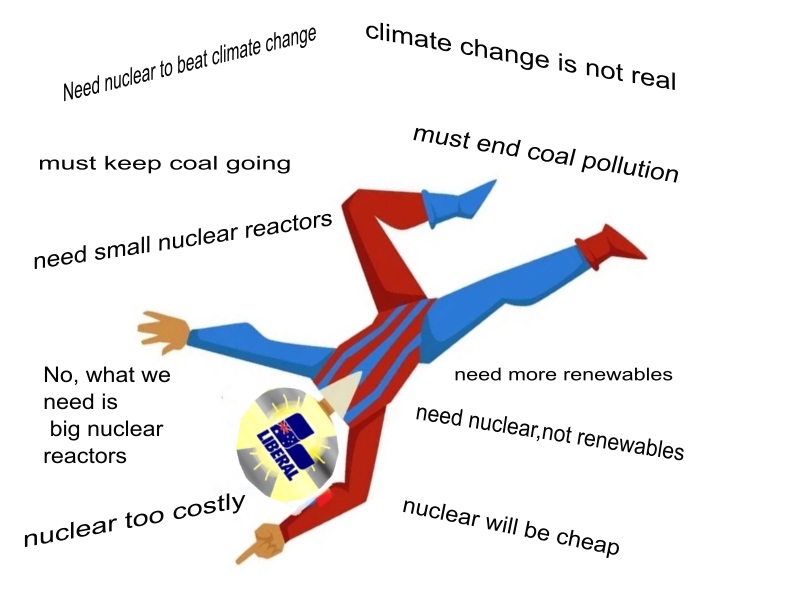
Liberal Coalition twisting itself into knots over nuclear policy
Liberal MP warns Dutton on nuclear energy as Labor steps up attacks
By Paul Sakkal, March 28, 2024 , https://www.smh.com.au/politics/federal/liberal-mp-warns-dutton-on-nuclear-energy-as-labor-steps-up-attacks-20240326-p5ff92.html
Liberal MP Bridget Archer has issued her colleagues a caution on the political risk of the party’s nuclear energy plans, which the backbencher claims have been catapulted into political debate partly to keep climate change doubters on board with the Coalition’s net zero emissions policy.
While there is widespread support within Peter Dutton’s opposition for a conversation on nuclear energy, several Coalition MPs speaking confidentially to detail private concerns said they were worried the opposition was moving too quickly and creating an easy target for Labor attacks.
As the first Liberal to ask questions about the Coalition’s approach, Archer argued fiscally conservative opposition MPs, including herself, would be uneasy with the massive government investment required to build multibillion-dollar plants.
Nuclear energy, which Archer — a leading moderate voice within the party — says she is open to, should be pursued only if coupled with a rapid surge in renewables, she said, a contrast with Dutton and other Coalition MPs, who suggest extending the life of coal until nuclear availability in 10 or 20 years.
Dutton and the shadow cabinet MP leading the nuclear push, Ted O’Brien, are expected to detail their energy plans, including about six plant sites, by the budget in May, but Archer said the initial policy should be limited to lifting Australia’s nuclear moratorium.
“I’m very agnostic about it and I don’t think we should be afraid to just have conversations. But there are a lot of things that need to line up,” she said, noting technological and economic factors that might inhibit private investment even if the decades-old moratorium was overturned.
The opposition has spoken in favour of nuclear energy since losing government in 2022, and escalated its commitment this year as it declared support for large-scale nuclear on top of new-age small modular reactors.
Its backing of the new energy source has guaranteed that climate change and energy will be a key election issue. Voters will be presented with a choice between Labor’s renewables-heavy path to a zero emissions future and one complemented by nuclear energy, amid doubts over Labor’s emissions-reduction targets and expensive energy bills.
Signalling Labor’s future election attacks, Prime Minister Anthony Albanese compared Dutton to the contentious energy source in parliament on Wednesday, saying: “One is risky, expensive, divisive and toxic; the other is a nuclear reactor. The bad news for the Liberal Party is that you can put both on a corflute, and we certainly intend to do so.”
Dutton has been open about the potential need for government investment in nuclear plants, which Labor says have cost tens of billions overseas.
Archer, a member of an influential parliamentary inquiry into nuclear energy last term, said she would be uncomfortable with a “big government” approach to energy investment, which she said might irk Liberals with a fiscally conservative bent.
O’Brien has emphasised nuclear as a zero-emissions option to smooth Australia’s bumpy transition to net zero. However, some of the strongest voices for nuclear energy are MPs such as Barnaby Joyce, who oppose renewables and have questioned scientific orthodoxy on climate change.
Earlier this month O’Brien said, “we should not be closing our coal-fired power stations prematurely” because under Labor’s plans 90 per cent of baseload energy would exit the grid by 2034.
Archer, who Dutton this week congratulated for winning the McKinnon Prize for political leadership, said nuclear energy should not be used as an excuse to prolong fossil fuel reliance.
“There is no point even having a nuclear discussion if you don’t accept a need to decarbonise, to transition away from coal and gas,” she said. “There only is a case for nuclear if there is a fairly rapid transition to large-scale renewables, otherwise why are you doing it?”
“I think part of the reason for having the discussion is to keep people in the tent on net zero.”
Allegra Spender, a teal MP who some Liberals believe should be recruited to the party in future, said nuclear “may have a role in the distant future”.
But it is too slow, too expensive and the UK Hinkley [nuclear power station] experience shows the costs are too uncertain for it to be relevant to our current energy plans,” she said.
“AGL Energy, Alinta, EnergyAustralia and Origin Energy have all dismissed nuclear.
“The community does not trust the Coalition’s commitment to climate action, and their current stance reinforces it.”
‘They don’t have a plan’: Chris Bowen slams Opposition push for nuclear
Climate Change and Energy Minister Chris Bowen has slammed the Opposition over its push for nuclear because they “don’t have a plan”.
“Rolling out renewables and storage over this decade is critical not just for reducing emissions … but because it’s the cheapest form of energy available,” Mr Bowen said during Question Time on Wednesday.
“It is important for jobs and job creation, and also it’s very important for reliability.
“The alternative approach that’s been proposed by those opposite is nuclear.
“Any sort of nuclear plan is irresponsible and incorrect.
“Maybe they got it right because they’ve got a thought bubble, but they certainly don’t have a plan.”
On nuclear, Coalition prefers the optimism of misleading, decade-old, unverified claims

The Coalition is a fan of quoting the Australian Nuclear Science and Technology Organisation’s optimism on nuclear timelines compared to the CSIRO. But do the numbers add up?
JOHN QUIGGIN, MAR 22, 2024, https://johnquigginblog.substack.com/p/on-nuclear-coalition-prefers-the?utm_source=post-email-title&publication_id=806934&post_id=142847313&utm_campaign=email-post-title&isFreemail=true&r=1ise1&triedRedirect=true&utm_medium=email
To the extent that most Australians have heard of the Australian Nuclear Science and Technology Organisation (ANSTO), we know it as a supplier of radio-isotopes for use in medicine and as the operator of a small research reactor at Lucas Heights in the suburbs of Sydney.
So, it may have come as a surprise to hear shadow energy minister Ted O’Brien cite ANSTO as the source for an estimate that a small modular reactor (SMR) could be constructed in three to five years, and a large reactor in eight to 12 years.

Appearing on the ABC’s 7:30 report in mid-March, O’Brien stated “that is the advice from ANSTO. That is the advice of the Albanese government’s nuclear agency”. In view of the fact that widely publicised advice from an extensive study undertaken by CSIRO yields much less optimistic conclusions, that seems like a surprising claim.
But O’Brien is correct. ANSTO is indeed the government agency officially advising on nuclear technology, including nuclear power.
Section 5 of the ANSTO Act mandates the organisation provide advice on aspects of and the application and use of nuclear science and nuclear technology. ANSTO provides such advice to government, parliaments, ministers, departments and agencies, inquiries and investigations, members of the public, and international, multilateral and bilateral partners — in pursuit of the national interest.
In a submission to the Senate standing committee on environment and the communications inquiry into the environment and other legislation amendment (Removing Nuclear Energy Prohibitions) Bill 2022, ANSTO stated that SMRs “have the potential to reduce build costs using a variety of strategies, including reducing plant build times from six to eight years for large reactors to two and a half to four years for SMRs via the use of series-production methods“.
These numbers are even more optimistic than those cited by Ted O’Brien. But terms like “potential” can do a lot of work in claims of this kind. Nuclear fusion, for example, has the potential to meet all the energy needs of the planet, but it won’t do so any time soon.
A natural response from an interested member of the public would be to visit the ANSTO website to get more detailed information on the assessment of nuclear technology. This leads us to a webpage titled “What are small modular reactors and what makes them different?”, which leads with the claim “the USA is expected to have its first SMR operating by 2026” and includes the timeframe of three to five years for construction.
A note hastily added in the last week states: “Please note that this content was current at the time of publishing (July 2020), and the projected construction time of SMRs (three to five years) is referenced from a University of Leeds research paper. In November 2023, NuScale [the subject of the 2026 claim] announced it was discontinuing its SMR project in Idaho.”
Even in 2020, this research was out of date. The NuScale project, originally projected to be delivering power in 2023, had already pushed its target past 2026 by then. But given that the project has been abandoned, there’s no need to look too closely at this.
The University of Leeds paper is more interesting. It turns out to be a literature survey covering the period 2004-19. The three- to five-year estimate for the construction time for SMRs is taken from a non-peer-reviewed 2016 report by consulting firm Ernst and Young (which worked with one of the authors on the University of Leeds study). The information used to compile the report is even older, going back to 2014 or earlier. To put it bluntly, this is worthless.
Rather than complying with its legal obligation to keep abreast of nuclear power technology and inform the public of its findings, ANSTO has relied on decade-old, unverified claims, made by a consulting company. This sloppy treatment of an issue that should be a central focus of ANSTO analysis contrasts sharply with the careful assessment undertaken by CSIRO.
I went to ANSTO for a response but didn’t hear back.
Ted O’Brien can scarcely be blamed for taking ANSTO’s word on these matters, particularly when its claims are so convenient to his case. But ANSTO needs to retract its misleading claims as soon as possible. That would give the LNP an opportunity, if it wants it, to drop its nuclear policy and put the blame on an Albanese government agency for misleading it.
One final irony. The ban on nuclear power, which is now the subject of so much controversy, was introduced by the Howard government to secure the passage of legislation that allowed ANSTO to build a new research reactor at Lucas Heights. In light of this history, maybe ANSTO’s remit should be revised to steer the organisation clear of nuclear power once and for all.
Peter Dutton in standoff with state Liberal leaders over federal Coalition’s nuclear plan
The federal opposition leader’s calls to include nuclear power in Australia’s energy mix has so far failed to win support from his state colleagues
Guardian, Tamsin Rose, Catie McLeod and Tory Shepherd, Sun 24 Mar 2024
The federal Coalition faces a battle with the states on its proposal for nuclear power stations at the sites of decommissioned coal power plants, with state premiers and opposition leaders alike largely against Peter Dutton’s proposal.
Labor governments and Coalition oppositions in Queensland, New South Wales, Victoria and South Australia are either outright opposed to the plan or have failed to endorse it.
Most of those states have their own bans on nuclear that would need to be lifted in addition to the federal ban if Dutton’s plan were to progress.
Despite this, the federal opposition leader has repeatedly called for nuclear to be considered as part of the future energy mix for Australia.
Here’s how the debate is playing out around Australia.
Queensland
It is illegal to run any forms of nuclear facilities in Queensland, including power stations and radioactive waste dumps. Any change to this would need to be passed by parliament.
David Crisafulli, the Liberal National party leader, is the bluntest in his opposition to Dutton’s plan.
When asked if he supported the federal Liberal leader and fellow Queenslander’s energy campaign earlier in the week, the opposition leader said: “No, we don’t.”
“Until both sides of Canberra agree, that will never happen because there won’t be investment,” Crisafulli said.
The state’s deputy opposition leader, Jarrod Bleijie, said debate was “many years” away and the party was focused on the cost of living in the immediate future.
“People are hurting, they need to see their electricity bills reduced now and that has to be our priority,” he told Sky News.
New South Wales
Similarly, in NSW there is a ban on uranium mining and nuclear power for electricity generation.
The state’s shadow energy minister, James Griffin, said he supported a “rational discussion about nuclear energy” but stopped short of endorsing the federal Coalition’s proposal……………………………….
The premier, Chris Minns, has dismissed any nuclear energy strategy that uses modular reactors for NSW………………………………………
Victoria
A number of nuclear-related activities, including exploration for uranium and construction or operation of a nuclear reactor, are banned in Victoria.
Like its northern counterparts, the Victorian opposition has failed to endorse the federal Coalition’s nuclear plans.
The shadow energy minister, David Davis, said “the Victorian Liberals and Nationals support a commonsense transition to renewables that ensures affordability and security of supply”.
South Australia
There are no state-level bans on nuclear power in place in South Australia and the premier, Peter Malinauskas, has repeatedly said he is open to or neutral towards the idea of nuclear power, but that the economics do not stack up.
SA is something of a nuclear state thanks to uranium mining and the prospect of building nuclear submarines, but Malinauskas does not think nuclear should be part of the power mix, not least because he has pledged that SA’s power will be fully sourced from renewables by 2027.
The energy minister, Tom Koutsantonis, said: “While we have nothing in principle against nuclear power, this current debate is nothing but a distraction because it is not economically feasible or viable for Australia.”
The opposition leader, David Speirs, said “all options should be on the table in the pursuit of an affordable, reliable and clean energy future”.
“That includes looking at new generation nuclear energy as a possible addition to our energy mix,” he said.
Coalition yet to produce costed nuclear energy policy
Last week, Dutton claimed the annual report from science agency CSIRO that had included estimates of costs for small modular reactors – which are not yet available commercially – was “discredited” because it “doesn’t take into account some of the transmission costs, the costs around subsidies for the renewables”.
CSIRO rejected Dutton’s claim that its estimates were unreliable, with its chief executive, Douglas Hilton, warning that maintaining trust “requires our political leaders to resist the temptation to disparage science”.
The most recent GenCost report estimates a theoretical small modular reactor built in 2030 would cost $382 to $636 per MWh. It says this is much more expensive than solar and wind, which it puts at between $91 and $130 per MWh even once integration costs are included.
The federal Coalition is yet to produce a costed energy policy, despite arguing for a lift to Australia’s ban on nuclear energy and suggesting it will nominate six potential sites for nuclear reactors around Australia – likely to be close to current or retiring coal-fired power stations.
With additional reporting by Benita Kolovos, Paul Karp, Graham Readfearn and Andrew Messenger https://amp.theguardian.com/australia-news/2024/mar/24/peter-dutton-liberal-leaders-nuclear-power-ban
1 This month


Help Aunty Sue Protect Her Land and Sacred Sites From Destructive Rocket Testing.
.

Australians deserve the truth
about
AUKUS – https://aukuspublicinquiry.com/

PETITION – To: Prime Minister Anthony Albanese and the Australian Labor Government

of the week – Australians for War Powers Reform (AWPR)
To see nuclear-related stories in greater depth and intensity

