Australia’s AUKUS nuclear submarines could fuel regional arms race despite assurance
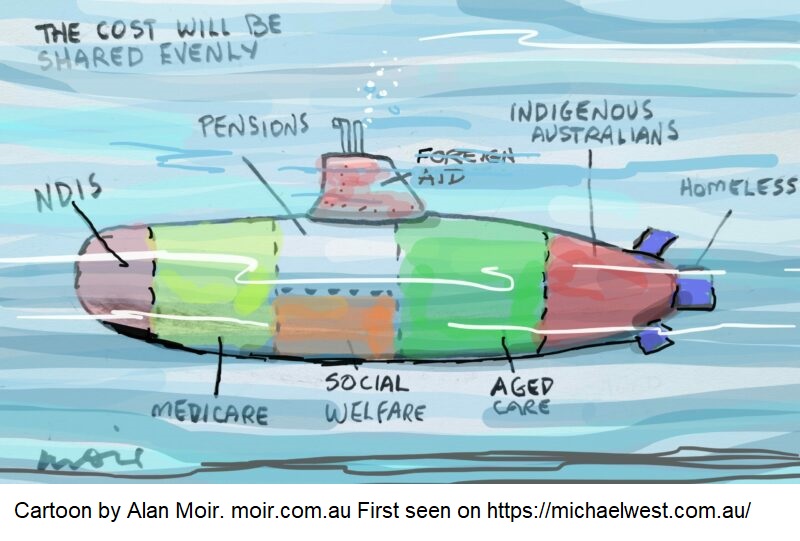
“AUKUS is designed to shore up American power in East Asia, not de-escalate tensions,”
By Su-Lin TanDec 4, 2023, https://johnmenadue.com/australias-aukus-nuclear-submarines-could-fuel-regional-arms-race-despite-assurance/
Defence Industry Minister Pat Conroy says Australia is not worsening the arms race and gives assurance about the submarines’ nuclear reactors. The deal could still spark a defence build-up in Asia-Pacific while Australia lacks the facilities to deal with nuclear waste, analysts say.
Australia may have asserted that its acquisition of nuclear-powered submarines under AUKUS is not aggravating the “arms race”, but the deal and the three-nation alliance could still fuel a defence build-up in the Asia-Pacific and heighten regional tensions, security analysts say.
At the national press club in Canberra on Tuesday, Australian Defence Industry Minister Pat Conroy reiterated the importance of the submarines to the country’s defence while debunking “myths” about the trilateral deal struck with Britain and the United States, which is largely seen as a countermeasure targeting China.
“The arms race is the greatest it’s been since 1945, and that is why I reject assertions … that Australia is somehow fuelling that arms race,” he said, adding that rising tensions in the Asia-Pacific had posed the most challenging strategic environment for Australia since World War II. “We are responding to it in a responsible and mature manner, like Australian governments should.”
Australia will own at least eight submarines over the next three decades through the A$368 billion (US$243 billion) deal. First announced in 2021 and finalised earlier this year, the controversial pact has raised concerns in the region.
Collin Koh, a senior fellow at the S. Rajaratnam School of International Studies in Singapore, said Conroy’s comment was not a surprise as countries including China and others in Asia-Pacific often couched their arms acquisitions in “defensive terms”.
Most countries would do so in the name of national security interests but it did not mean such actions ensured peace or safety, he said.
Even before AUKUS was announced in 2021, China and other regional countries had already embarked on significant military build-up since the 1990s, Koh said.
“Conroy may not be necessarily wrong to say AUKUS responds to this already ongoing condition, yet at the same time, it’s also not wrong to say that AUKUS … may not only be used by Beijing to legitimise its naval build-up, it also could be exploited as a justification for other regional countries’ military build-up programmes,” Koh said.
Australia’s acquisition of the submarines might trigger new problems as other countries could argue that they should also acquire similar capabilities, said Maria Rost Rublee, a nuclear politics expert at Monash University.
These countries are not limited to “dangerous actors”, for instance, in South Korea where the majority of its people have expressed a desire for their country to own nuclear weapons, Rublee added.
“Just having this type of technology in the hands of a country where you have strong popular support for nuclear weapons could be an issue,” she said.
In an analysis earlier this month, Ankit Panda, the Stanton Senior Fellow in the Nuclear Policy Programme at the Carnegie Endowment for International Peace, warned the accumulation of weapons such as missiles could potentially lead to unintended attacks.
“The Indo-Pacific region has entered a new missile age … each nation individually seeking deterrence while as a whole steering the region into ever more dangerous waters,” he said. “A particular risk concerns the prospects of attacks on the nuclear forces of countries like North Korea and China, by US or allied forces in ways that may not be intended.”
By the 2030s, the Indo-Pacific region would be “full of thousands of new missiles that can be expected to be used widely in the context of a major regional war”, Panda said.
Responding to Conroy’s comments, the national convenor of Labor Against War in Australia, Marcus Strom, said: “If your answer to growing regional tension is to add offensive weaponry, you create a logic towards war.
“AUKUS is designed to shore up American power in East Asia, not de-escalate tensions,” he added.
While Conroy has given assurances about the safety of sealed nuclear reactors within the submarines, analysts argued that the lack of facilities in Australia for the eventual disposal of these reactors is worrying.
“The strength of this agreement is that the reactor module comes to us sealed. It comes sealed, designed to be never opened over the life of a submarine. You don’t have to refuel it, you don’t have to insert new fuel rods … [over] the life of the submarine,” Conroy said.
But nuclear waste expert Ian Lowe said in an analysis on The Conversation website earlier this year that Australia has failed for decades to find long-term storage solutions for small quantities of low- and intermediate-level nuclear waste.
Even Australia’s allies and AUKUS partners, the US and the UK, do not have long-term solutions for nuclear waste storage, according to Lowe.
“This should be concerning. To manage the waste from our proposed nuclear submarines properly, we’ll have to develop systems and sites which do not currently exist in Australia,” Lowe said.
Australian states such as Victoria, Queensland and South Australia have said they would not accept a nuclear waste facility within their borders.
While it will be another 30 years before Australia has to worry about dumping the submarine’s nuclear reactors, it is not a long time, Rublee said.
“If they take their nuclear stewardship obligations seriously, they must immediately begin working on the long-term storage of high-level nuclear waste,” she added.
US reactor project fail heats up Australia’s nuclear power debate
ByMike Foley, November 10, 2023 — https://www.smh.com.au/politics/federal/us-reactor-project-fail-heats-up-australia-s-nuclear-power-debate-20231109-p5eisu.html
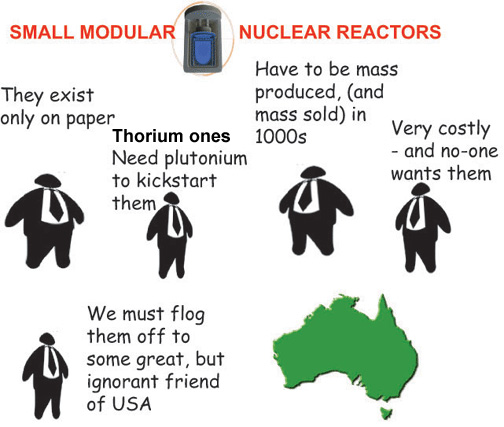
A nuclear energy developer championed by the Coalition has canned its most advanced project in the United States, raising questions over the viability of the technology in Australia.
NuScale Power, which was developing small modular reactors at a US government-owned site in Idaho with plans to sell electricity to suppliers across the regional network by 2029, on Thursday said it had abandoned the project due to a lack of customer sign-ups.
The federal opposition, which wants Australia to overturn its longstanding ban on nuclear energy, claims small modular reactors – the next generation of nuclear power plants – are the only viable backup for renewable energy as the country transitions away from fossil fuels.
But Climate Change and Energy Minister Chris Bowen said NuScale’s announcement was further proof that small modular reactors were not viable for Australia.
“The opposition’s only energy policy is small modular reactors,” Bowen said. “Today, the most advanced prototype in the US has been cancelled. The [opposition’s] plan for energy security is just more hot air from Peter Dutton.”
NuScale’s small modular reactor design was the first to be approved by the US Nuclear Regulatory Commission in January. It was awarded more than $US1 billion ($1.56 billion) in government funding to support its development.
The company said in 2021 it would supply power from its small modular reactor plant for $US58 a megawatt hour. Since then, that figure has more than doubled to $US89 a megawatt hour.
Mason Baker, the chief executive of NuScale’s government-owned partner, Utah Associated Municipal Power Systems, said it was working with the company and the US Department of Energy to wind down the project.
“This decision is very disappointing given the years of pioneering hard work put into the [project],” Baker said.
Opposition Leader Peter Dutton has said small modular reactors could easily replace Australia’s coal-fired power plants.
“Australians must consider new nuclear technologies as part of the energy mix,” he said in July. “New nuclear technologies can be plugged into existing grids and work immediately.”
Opposition climate change and energy spokesman Ted O’Brien said in May that NuScale’s designs offered “exceptional flexibility” and would allow a “simple expansion” for Australia’s energy grid.
“North America has done the maths. It has mapped its course to a net-zero future, and it’s one that sensibly includes next-generation, zero-emissions nuclear energy.”
But recent Energy Department modelling found more than 70 small modular reactors, which are forecast to generate 300 megawatts each, would be needed to replace all of Australia’s coal plants at an estimated cost of $387 billion.
O’Brien said on Thursday that Bowen had applied “faulty logic” to NuScale’s announcement and if he applied the same test to renewables, they too would be considered a failure.
“Is Bowen arguing that wind power is dead because the world’s leading supplier, Siemens, is seeking a €15 billion government bailout, or the days of solar are over because plans for the world’s largest solar plant, Sun Cable, have run into trouble,” O’Brien said.
“If Australia is serious about reaching net-zero emissions by 2050 while keeping the lights on and getting prices down, we cannot afford to take any option off the table.”
Coalition are ‘climate charlatans’ making false claims about Australia’s nuclear power potential, energy minister says
Chris Bowen describes the opposition’s promotion of the banned energy source as an attempt to ‘continue the culture climate wars’
Adam Morton Climate and environment editor. Guardian, Tue 10 Oct 2023
The climate change and energy minister, Chris Bowen, has accused the Coalition of using “the rightwing playbook of 2023 – populism, polarisation and post-truth politics” in making false claims about the potential for nuclear power in Australia.
Speaking on Tuesday, Bowen said the opposition’s suggestion the country could embrace the banned energy source to meet climate targets was the “latest attempt at deflection and distraction now that outright denial is less fashionable” and an attempt to “continue the culture climate wars in Australia”…………(registered readers only) ………..more https://www.theguardian.com/australia-news/2023/oct/10/coalition-making-false-claims-about-australia-nuclear-power-says-energy-minister-chris-bowen?fbclid=IwAR1CU7royDx89hZP5FAfRgkj3ioG6SrbFIQmvDyDNaovfVAGKf3HWqxH0W4
Is nuclear energy feasible in Australia (and how much would it cost)?
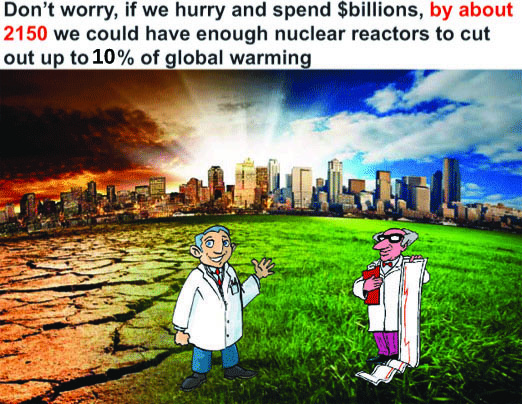
What problem is nuclear trying to provide a solution for, asks Ernst & Young climate change and sustainability partner Emma Herd. “If it’s cost of living, it’s expensive. If there are challenges with social licence for renewables then nuclear has got 10 times more social licence problems. If it is the need to rapidly deploy low-emissions energy technology to replace coal then nuclear takes a long time to get approval for, let alone to build, let alone to get up and operating. If it’s the need for rapid decarbonisation, again, it’s too slow.”
Debate has erupted over nuclear energy’s role in Australia’s shift from fossil fuels. Could it work? And why is it so controversial?
SMH, By Mike Foley, OCTOBER 7, 2023
Australia is in the middle of an unprecedented energy revolution, switching from the fossil fuel-powered electricity grid that’s been the bedrock of the nation’s economy for decades to clean energy, through a rush of renewables as wind and solar farms spring up across the country.
The shift is being driven by Australia’s commitment to help tackle climate change by cutting damaging greenhouse emissions.

But a fiery political debate has erupted over the future of Australia’s energy supply in recent months, with federal Opposition Leader Peter Dutton demanding the Albanese government remove the nation’s longstanding ban and deploy what he claims is clean, cheap and reliable nuclear power…………..
What would be the costs? And how does nuclear power work?
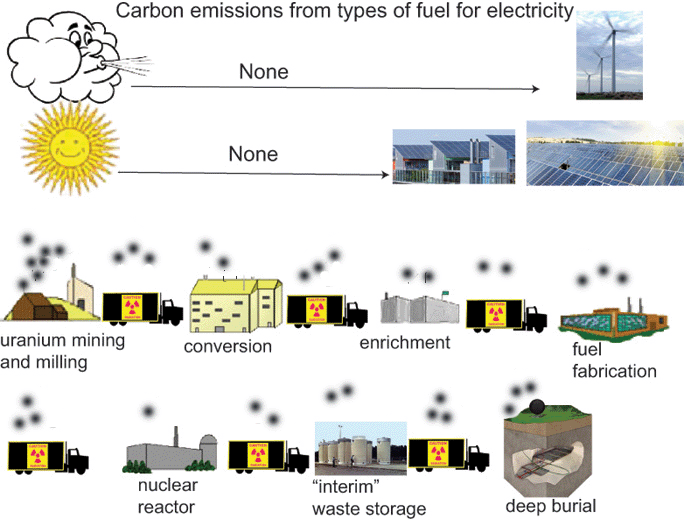
………………………………………………………………………… This atomic fission also creates zero greenhouse gases, [ed. note: in the reactor operation, but not in the entire fuel cycle] which is a key benefit cited by nuclear energy advocates, but its opponents point to the dangers associated with storing the radioactive waste and the potential for spent fuel from nuclear reactors to be used to make nuclear weapons.
Past accidents have undermined public confidence……………………………..

…………………………………. In Australia, a national ban on nuclear energy was put in place by the Howard government in 1999, after horse-trading with the Australian Democrats over the government’s signature green reform, the Environment Protection and Biodiversity Conservation Act, which stated that the relevant minister could not approve a nuclear power plant.
Seven years later, the Howard government asked Telstra chief executive and trained nuclear physicist Ziggy Switkowski to investigate the merits of nuclear power in Australia. That report delivered a hammer blow to the industry. Switkowski found that nuclear power could compete economically with coal power only if a politically contentious carbon tax was imposed.
In 2019, Switkowski also told a parliamentary inquiry there was little prospect for Australia to develop a nuclear energy industry because the “window for large gigawatts to go in nuclear generators has now closed for Australia”. He said a nuclear industry would take too long to establish and be too costly to build compared to alternative infrastructure. He also said it was unlikely the industry could establish enough support to gain a social licence to operate.
“Given that the investment in a power station, particularly a big one, would begin at $US10 billion and go up from there, and it would take around 15 years to make it work, you can’t progress without strong community support and bipartisanship at the federal level, and there is not too much evidence of that,” he said.
But now the federal Coalition is calling for the nuclear energy ban to be abolished.
……………………………. Nuclear energy proponents argue nuclear should replace coal. Those advocates include the Minerals Council, prominent Nationals including leader David Littleproud and former leader Barnaby Joyce, and some Liberal MPs including Dutton and his climate change and energy spokesman, Ted O’Brien.
……………………………….Renewable energy advocates point out that investors are flocking to large-scale wind and solar projects, which are pumping cheaper energy into the grid and outcompeting coal. The Australian Energy Market Operator (AEMO), which manages the electricity grid, says a grid based on renewables will be just as reliable as a system centred on baseload power.
Could we get a nuclear industry happening in time?
Speed is of the essence, say climate scientists. Global emissions are on track to exceed the goal of the Paris Agreement to limit global warming to less than 2 degrees, a level that would avoid the worst damages from climate change. While renewables are available now, and cheaply, it would likely take decades to establish a nuclear energy industry in Australia.
Australia’s former chief scientist, Alan Finkel, told this masthead in August it was highly unlikely Australia could open a nuclear power plant before the early 2040s, pointing out the autocratic United Arab Emirates took more than 15 years to complete its first nuclear plan using established technology.
What problem is nuclear trying to provide a solution for, asks Ernst & Young climate change and sustainability partner Emma Herd. “If it’s cost of living, it’s expensive. If there are challenges with social licence for renewables then nuclear has got 10 times more social licence problems. If it is the need to rapidly deploy low-emissions energy technology to replace coal then nuclear takes a long time to get approval for, let alone to build, let alone to get up and operating. If it’s the need for rapid decarbonisation, again, it’s too slow.”
Herd says it would take decades of investment in enabling services for the nuclear energy value chain before a new plant could be built, on top of the likely 20 years needed to plan, gain approval for and build a plant.
“Nuclear has got not just a 20-year timeframe to build something, it’s actually probably more a 30- to 50-year timeframe to build an industry,” she says. This includes either educating or importing a generation of nuclear experts to design and operate facilities, capability to construct the complex facilities, creating a bureaucracy to administer the industry and writing the laws to govern it.
Could nuclear energy solve the power line ‘problem’?
A key sticking point in the Opposition’s criticism of renewable energy is the Albanese government’s push to build some 10,000 kilometres of power lines to link the plethora of renewable energy projects springing up across the country with major cities. AEMO has forecast that could cost around $13 billion by 2030. Nuclear energy advocates say those costs could be avoided by building nuclear plants on the sites of existing coal plants, where existing transmission lines converge.
In fact, even if there were no renewable energy expansion, expensive new transmission lines are still needed to upgrade the grid and increase its capacity in line with population growth, but they have been delayed. Energy experts are increasingly worried that time is running out, risking Australia’s ability to compensate for the looming closures of coal-fired power plants.
A major factor in the delays is community backlash against transmission lines, with farmers denying land access to private companies. Littleproud is leading the charge against the renewable energy rollout and backing farm groups in their protest. Backed by Dutton, he has accused the government of running a “reckless race” to renewables and is calling for a halt to privately run transmission projects, for a Senate inquiry or summit into renewable energy and for a national discussion on removing Australia’s moratorium on nuclear power.
Isn’t there a new type of nuclear technology now?
With Dutton heading the push for a plan to replace Australia’s existing fleet of coal plants with nuclear, Littleproud has declared he is open to having a plant in his Queensland electorate. The Coalition says Australia could deploy the next-generation of nuclear technology called small modular reactors, which are based on the energy units in nuclear submarines.
Finkel has said that, from a “purely engineering” perspective, nuclear technology is appealing, with zero emissions, a continuous supply of baseload power and a small mining footprint for fuel. But he has said that small modular reactors are not currently viable technology. “There’s no operating small modular reactor in Canada, America or the UK, or any country in Europe.”
Finkel noted that private company Nuscale is aiming to commission 12 small modular reactors starting from 2029, but he said it would take at least a decade to follow suit in Australia.
Is nuclear cheaper?
A joint study by the CSIRO and AEMO, the GenCost report, calculated the future cost of energy generation for a range of technologies. It found that solar and wind energy generation would cost between $60 and $100 per megawatt hour by 2030, including back-up power from either batteries, pumped hydro or gas plants. (This figure also includes CSIRO and AEMO-termed “sunk costs” of new transmission lines.)
GenCost forecast that one megawatt hour of power from a small modular reactor in 2030 would cost between $200 and $350 per megawatt hour.
Another energy advisory, Lazard from the US, calculated the levelised cost of nuclear and renewables – which means the average net present cost of electricity generation for a generator over its lifetime. It found that one megawatt hour from solar power, including back-up storage, costs between $72 to $160 per megawatt hour, while a traditional nuclear plant costs from $220 to $347.
Why is the politics of nuclear toxic?
Even if the Albanese government wanted to open a debate over the future of nuclear power in Australia, the party’s official policy platform that is formed by rank and file members states Labor will “prohibit the establishment of nuclear power plants and all other stages of the nuclear fuel cycle in Australia”.
While it’s not impossible for politicians to ignore the policy platform, it is extremely challenging.
In any case, the government has come out swinging against the opposition’s call for nuclear power in Australia. Bowen……………………. https://www.smh.com.au/politics/federal/is-nuclear-energy-feasible-in-australia-and-how-much-would-it-cost-20231004-p5e9qc.html
Aukus: UK defence giant BAE Systems wins Australian £3.95bn #nuclear submarine contract
BBC News By Peter Hoskins, Business reporter 2 October 23 #antinuclear #nuclear-free #NoNukes
Britain’s biggest defence firm, BAE Systems, has won a £3.95bn ($4.82bn) contract to build a new generation of submarines as the security pact between the US, UK and Australia moves ahead.
In March, the three countries announced details of the so-called Aukus pact to provide Australia with nuclear-powered attack submarines by the late 2030s.
The pact aims to counter China’s ambitions in the Indo-Pacific region.
Beijing has strongly criticised the three countries over the deal.
……………………..”This multi-billion-pound investment in the Aukus submarine programme will help deliver the long-term hunter-killer submarine capabilities the UK needs to maintain our strategic advantage and secure our leading place in a contested global order,” UK Defence Secretary Grant Shapps said as the Conservative party conference got under way in Manchester.
………………….Other major UK defence contractors are also getting a boost from the Aukus deal.

In March, it was confirmed that Rolls-Royce Submarines would provide all the nuclear reactor plants that will power the SSN-Aukus vessels.
In June, Rolls-Royce said it would almost double the size of its Raynesway facility in Derby as a result of the deal. On Sunday, Babcock International, which maintains and supports the UK’s submarines, said it had signed a five-year deal with the Ministry of Defence to work on the SSN-Aukus design.
The Aukus security alliance – which was first announced in September 2021 – has repeatedly drawn criticism from China.
However, the three Western countries say the deal is aimed at shoring up stability in the Indo-Pacific more https://www.bbc.com/news/business-66979798
Nuclear power on Surf Coast “incomprehensible”, says Greens MP
Surf Coast Times, September 28, 2023 BY James Taylor
GREENS MP and former City of Greater Geelong councillor Sarah Mansfield has pushed back against Opposition Leader Peter Dutton’s support for nuclear power at old mine sites, saying it would be “incomprehensible” to build a reactor at the former Anglesea mine.
During a visit to Ocean Grove last week, Mr Dutton said he wanted a “mature discussion” about nuclear energy in Australia, and touted the benefits of small modular reactor (SMR) technology as a viable solution to decarbonising the economy.
Alcoa’s Anglesea coal mine and power station supplied power to the former Point Henry smelter and closed in August 2015.
Asked if a nuclear reactor would be a hard sell for people in Geelong, the Bellarine and the Surf Coast, Mr Dutton replied: “Well, is there a coal mine that’s operating here at the moment that’s coming to end of life?”…………………………………………………………………………………….
Ms Mansfield, who became a Member for Western Victoria at the 2022 state election, said in a letter to this newspaper that she was “deeply concerned” by Mr Dutton’s comments.
“His arguments promote dangerous misinformation about nuclear technology.
“Moreover, the suggestion that these reactors could be placed at old mine sites (such as the Anglesea Alcoa site) is incomprehensible.”
She said nuclear power was not safe, clean, or renewable.
“The health risks associated with uranium mining and nuclear reactors are well established. Imagine the devastation to our beautiful coast and communities if there was a nuclear accident? Then the waste – where will it go? Australia already struggles to deal with medical industry nuclear waste.
“And to claim it is zero emissions is simply wrong. No energy source is completely emissions-free when you consider whole of life emissions (e.g. transport, materials, construction) – and nuclear produces greater emissions than renewables like solar and wind.
“It’s hard to believe the Coalition is serious about this proposal. They know that coal and gas are on the way out, but they’re blocking renewables and have come up with a nuclear fantasy that no reasonable economist or energy expert is willing to back.”
Labor has rubbished the Coalition’s proposal, with Energy and Climate Change Minister Chris Bowen saying modelling from his department found replacing Australia’s coal-fired power stations with SMRs would cost $387 billion. https://timesnewsgroup.com.au/surfcoasttimes/news/nuclear-power-on-surf-coast-incomprehensible-says-greens-mp/
Modelling shows estimated cost of Peter Dutton’s nuclear energy plan
Each reactor’s estimated capital cost is $18,167/kW in 2030 compared with large-scale solar at $1058/kW and onshore wind at $1989/kW. When broken down, the modelling suggests each individual taxpayer would be burdened with a “whopping $25,000 cost impost” for such a transition
.Australian taxpayers would be slugged with a $387bn bill if Peter Dutton’s current plan to transition to nuclear was actioned.
Ellen Ransley, news.com.au, 18 Sept 23
Replacing Australia’s retiring coal-fired power stations with the Coalition’s suggested nuclear energy model would cost taxpayers up to $387bn, new modelling suggests.
Opposition Leader Peter Dutton, backed particularly by junior Coalition partners the Nationals, has previously suggested that Australia could “convert or repurpose coal-fired plants and use the transmission connections which already exist on those sites”.
Mr Dutton has also said nuclear is the “lowest cost form” of low carbon electricity, but has not explicitly outlined how much such a transition would cost.
New analysis done by the energy department shows the projected cost, which assumes replacing all of the output from closing coal-fired plants with small modular reactors, would be costly.
Energy and Climate Change Minister Chris Bowen said Mr Dutton and the opposition “need to explain why” Australians would be slugged with a $387bn burden for their nuclear energy plan that “flies in the face of economics and reason”.
But the Greens have called on the government to stop the distraction and explain to Australians why they are forging ahead with new coal and gas projects when the country is in the grips of a “climate crisis”.
“Australia is forecast to have its worst summer since the Black Summer, and yet Labor is approving more coal and gas. Peter Dutton’s nuclear push is a distraction from Labor’s continual approval of new coal and gas projects,” party leader Adam Bandt said.
“We should not allow ourselves to be distracted by Peter Dutton’s push for nuclear when Labor keeps opening new coal and gas projects in the middle of a climate crisis.”
A minimum of 71 small modular reactors – providing 300MW each – would be needed if the policy were to fully replace the 21.3GW output of the country’s retiring coal fleet.
Each reactor’s estimated capital cost is $18,167/kW in 2030 compared with large-scale solar at $1058/kW and onshore wind at $1989/kW. When broken down, the modelling suggests each individual taxpayer would be burdened with a “whopping $25,000 cost impost” for such a transition.
The opposition want to trump the benefits of non-commercial SMR technology, without owning up to the cost and how they intend to pay for it,” Mr Bowen said.
“After nine years of energy policy chaos, rather than finally embracing a clean, cheap, safe and secure renewable future, all the Coalition can promise is a multi-billion dollar nuclear flavoured energy policy.”
In total, the $387bn plan costs about 20 times what the Albanese government’s Rewiring the Nation fund is projected to cost.
The government says that fund will help achieve 82 per cent renewable energy by 2030, by unlocking over 26GW of new renewable generation capacity, and over 30GW of transmission capacity.
When Mr Dutton made his pitch for a nuclear transition in July, he suggested the Liddell Power Station could be a possible site for a small nuclear reactor…………………………………..more https://www.news.com.au/finance/business/mining/modelling-shows-estimated-cost-of-peter-duttons-nuclear-energy-plan/news-story/39f543faf65d77c53f33ec8d10175d02
Bowen demolishes case expensive for nuclear power

AuManufacturing 19 September 2023
Minister for Climate Change and Energy Chris Bowen has rubbished opposition calls for Australia to embrace nuclear poower in the form of small modular reactors.
Opposition leader Peter Dutton has injected his idea of a nuclear renaissance into the energy debate, suggesting he might change the Coalition’s official opposition to nuclear power, saying Labor was putting ‘party interests ahead of the national interest’.
According to the former head of the Australian Nuclear Scientific and Technology Organisation Dr Ziggy Switkowski who chaired a federal review of nuclear powe that ‘on paper, they (SMRs) look terrific’, but that we won’t know their costs ‘until the SMRs are deployed in quantity’.
Bowen told a Canberra press conference: “Since the last election, the party which spent ten years telling us we didn’t need to worry about climate change says they’ve found a solution for climate change and it’s nuclear.
“They didn’t bother for their ten years in office to promote a nuclear agenda, but as they desperately search around for an alibi for their hatred of renewable energy, they settled on this since the last election.”
Dutton made a nuclear plan the centrepiece of his Budget reply, but Bowen said there was actually no policy and nothing costed.
“Peter Dutton said at a speech earlier this year that it’s easy, you just plug and play nuclear in to replace coal. Well if it’s so easy, Mr Dutton, where is your plan?”
Bowen released cost estimates of $387 billion to replace Australia’s 21.3 gigawatts of coal-fired power with nuclear.
This would involve the construction of 71 nuclear reactors spread across Australia.
Given the public pushback on even low level waste disposal sites, any plan to build 71 nuclear power plants would likely be political suicide for any government……………………………………………more https://www.aumanufacturing.com.au/bowen-demolishes-case-expensive-for-nuclear-power
Nuclear too costly, too slow, too risky for Australia

The federal government’s preliminary cost estimates for small modular reactors highlight one of the many reasons why this nuclear technology – which isn’t being commercially deployed anywhere in the world – is not a viable option for Australia.
Australian Conservation Foundation nuclear policy analyst Dave Sweeney said the nuclear option would dramatically increase household electricity bills, slow the transition to clean energy, introduce the possibility of catastrophic accidents and create multi-generational risks associated with the management of high-level nuclear waste.
“The government’s initial cost estimates show the unacceptably high financial costs of technology that does not even exist on a commercial scale,” Dave Sweeney said.
“Aside from financial costs, Australians don’t need or want to take on the massive risks that accompany nuclear energy – catastrophic meltdowns like Chernobyl and Fukushima, plus the intergenerational danger of storing high-level radioactive waste for centuries.
“We cannot afford to squander more time in moving our economy away from its reliance on climate-damaging coal and gas. Nuclear is a dangerous distraction to effective climate action.
“Australia is blessed with amazing clean energy resources. Our energy future is renewable, not radioactive.” For interviews contact: Dave Sweeney 0408 317 812, or Josh Meadows 0439 342 992
Replacing Australia’s retiring coal power stations with small nuclear reactors could cost $387bn, analysis suggests
The figure adds fuel to the growing political dispute over the pace and form of Australia’s energy transition
Daniel Hurst https://www.theguardian.com/australia-news/2023/sep/18/replacing-australias-retiring-coal-power-stations-with-small-nuclear-reactors-could-cost-387bn-analysis-suggests
The federal government says it would cost as much as $387bn to replace Australia’s retiring coal-fired power stations with the form of nuclear power proposed by the Coalition.
The figure, produced by the energy department, is the projected cost of replacing all of the output from closing coal-fired plants with small modular reactors.
The opposition leader, Peter Dutton, has previously suggested that Australia “could convert or repurpose coal-fired plants and use the transmission connections which already exist on those sites”.
However, he has not been explicit about how much of the coal-fired electricity output would be replaced with nuclear-sourced energy – an uncertainty that makes projecting the cost difficult.
The figure adds fuel to the growing political dispute over the pace and form of Australia’s energy transition.
The government said the new analysis showed a minimum of 71 small modular reactors – providing 300MW each – would be needed if the policy were to fully replace the 21.3GW output of Australia’s retiring coal fleet.
“According to the 2022-23 GenCost report modelling under the current policies scenario, this could cost $387bn,” a government summary said.
“This is due to the estimated capital cost of $18,167/kW for [small modular reactors] in 2030, compared to large scale solar at just $1,058/kW, and onshore wind at $1,989/kW.”
The government said this would represent “a whopping $25,000 cost impost on each Australian taxpayer”.
The minister for climate change and energy, Chris Bowen, said the opposition wanted to promote the benefits of “non-commercial” small modular reactor technology “without owning up to the cost and how they intend to pay for it”.
“Peter Dutton and the opposition need to explain why Australians will be slugged with a $387bn cost burden for a nuclear energy plan that flies in the face of economics and reason,” Bowen said.
“After nine years of energy policy chaos, rather than finally embracing a clean, cheap, safe and secure renewable future, all the Coalition can promise is a multi-bullion-dollar nuclear-flavoured energy policy.”
Dutton identified Liddell as a possible site for a small modular reactor when he gave a pro-nuclear speech in July.
At the time, Dutton said he saw nuclear “not as a competitor to renewables but as a companion” and he wanted “an Australia where we can decarbonise and, at the same time, deliver cheaper, more reliable and lower emission electricity”.
He called on the government to consider removing legislative prohibitions on new nuclear technologies – a step the former Coalition government didn’t attempt during its nine years in power – “so we do not position Australia as a nuclear energy pariah”.
Dutton further accused Bowen of burrowing “so deeply down the renewable rabbit hole that he refuses to consider these new nuclear technologies”.
“The new nuclear technology train is pulling out of the station. It’s a train Australia needs to jump aboard.”
The estimates released by the government on Monday are partly based on the costs for small modular reactors outlined in the CSIRO’s GenCost report.
That report notes that global commercial deployment of small modular reactors is “limited to a small number of projects and the Australian industry does not expect any deployment here before 2030”.
The report notes some uncertainty around the projections.
“Nuclear SMR current costs are not reported since there is no prospect of a plant being deployed in Australia before 2030,” said the CSIRO report, released in July.
“However, some improved data on nuclear SMR may be available in future reports and projected capital costs for SMR have been included from 2030 onward.”
The federal government has set a goal of 82% of electricity coming from renewable energy by 2030, up from about 35% today.
To achieve this, the federal government has committed $20bn in low-cost finance for “rewiring the nation” – updating transmission lines – but is facing pushbacks from rural communities.
Peter Dutton wants Australia to jump on the VERY UNECONOMIC “nuclear train”
| NUMBERS NUKE PETER’S PIPE DREAM – Crikey Worm 18 Sept 23 |
Opposition Leader Peter Dutton’s push to switch coalmine sites out for small nuclear reactors (SMRs) would cost us $387 billion, the Department of Climate Change and Energy found, because we’d need at least 71 to match the coal power. Guardian Australia reports that’s about $25,000 a taxpayer — far more per megawatt hour than cheap power from the sun or wind, per the latest Net Zero Australia report.
Not that it’s stopped Dutton from droning on about Australia needing to jump on the “nuclear train”. Do we? China has 50 gigawatts of nuclear power capacity and 95-120 gigawatts of solar expected this year alone, The Conversation adds. Multibillion-dollar SMRs in the US, France, Finland and the UK have either blown way over budget, way over time, or been abandoned altogether. This comes as the South Australian Chamber of Mines & Energy — whose biggest member, the AFR ($) notes, is uranium miner BHP — told the state government nuclear is the “logical solution”./************************************************************************************************************************************************************************************************************************************************************/**************************************************************************************************************************************************************************************************************************************************************//////////////////////////////////////////////////////////////////////////////////////////////////////////.lOpposition Leader Peter Dutton’s push to switch coalmine sites out for small nuclear reactors (SMRs) would cost us $387 billion, the Department of Climate Change and Energy found, because we’d need at least 71 to match the coal power. Guardian Australia reports that’s about $25,000 a taxpayer — far more per megawatt hour than cheap power from the sun or wind, per the latest Net Zero Australia report. Not that it’s stopped Dutton from droning on about Australia needing to jump on the “nuclear train”. Do we? China has 50 gigawatts of nuclear power capacity and 95-120 gigawatts of solar expected this year alone, The Conversation adds. Multibillion-dollar SMRs in the US, France, Finland and the UK have either blown way over budget, way over time, or been abandoned altogether. This comes as the South Australian Chamber of Mines & Energy — whose biggest member, the AFR ($) notes, is uranium miner BHP — told the state government nuclear is the “logical solution”.
Nuclear energy remains weapon of choice for climate deniers and coal lobby.
ReNeweconomy, Giles Parkinson 11 September 2023
The Nationals, and the Liberal Party coalition partners, are in furious
agreement: They are not the slightest bit serious about strong climate
action, and the only difference between former National leader Barnaby
Joyce and current leader David Littleproud is that Joyce wants to stop the
pretence.
Littleproud, let’s remember, believes that net zero 2050 means
not having to do much any time soon. Like too many corporates, and the
fossil fuel industry in particular, it’s an excuse to sit around and do
nothing – make some grand promises and wait for some new technology to come
along that doesn’t disrupt their business plan. Nuclear, and small modular
reactors, are a perfect tool for this. SMRs don’t exist in any western
country, do not have a licence to exist, and no-one – even in the nuclear
industry – seriously believes they will be in commercial production within
a decade, if then.
Renew Economy 11th Sept 2023
Waste site: Govt reveals bill for dumped Kimba nuclear facility

Former SA senator Rex Patrick was concerned the money “wasted” on the failed repository could be replicated with the AUKUS nuclear submarine program.
The high cost of the federal government’s failed bid for a national nuclear waste storage site on South Australia’s Eyre Peninsula has been revealed.
Resources Minister Madeleine King says that $108.6 million was spent on preparations for establishing the now dumped National Radioactive Waste Management Facility near Kimba between July 1, 2014, and August 11, 2023.
The figure was given in response to a Senate Question lodged by Liberal Senator Gerard Rennick on August 11, but information relating to his questions about further expected expenditure of taxpayer dollars around the project was not provided.
King was asked whether the government planned to select a new site before May 17, 2025 – the last date before Prime Minister Anthony Albanese can call a federal election – or whether the Woomera Prohibited Area in SA’s outback was being considered.
“Information on expenditure and site selection will be available once the government has considered options and made decisions in due course,” SA Labor Senator Don Farrell said while answering the question on behalf of King.
The news comes after the federal government announced in August it was walking away from the Napandee plan after seven years of consultation and promises of around $31 million in incentives for the Kimba region.
Its decision was triggered by a Federal Court ruling in favour of the Barngarla Determination Aboriginal Corporation’s battle to stop the low-level waste repository on the Eyre Peninsula.
The costly court battle centred on the Barngarla arguing that Indigenous owners were not consulted by the former Morrison Government when it announced it had won “majority support” of 61 per cent in the community for the Napandee site.
Justice Natalie Charlesworth quashed former Liberal Federal Resources Minister Keith Pitt’s decision to build the National Radioactive Waste Management Facility in Kimba, saying it was affected “by bias”.
InDaily reported last year that in reply to questions on notice, SA senator Barbara Pocock heard that since January 1, 2017, the Commonwealth Government had spent at least $9,905,737 on legal work for the nuclear waste dump and the Australian Radioactive Waste Agency.
Work has now been halted at the Napandee site and King said work already completed would be reversed.
Former SA senator Rex Patrick was concerned the money “wasted” on the failed repository could be replicated with the AUKUS nuclear submarine program.
“It was clear back in February 2018, when I initiated a Senate Inquiry into the selection process for a national radioactive waste management facility in South Australia, that the selection process had gone off the rails,” Patrick said.
“The then government were cautioned about the flawed nature of the process, but ignored the findings and recommendations of the inquiry.
“There is a $110 million dollar lesson for the current Government in the need to engage the community and listen when dealing with these sorts of programs.”
He called on the federal government to be more open with the community with its AUKUS nuclear submarine program in relation to what will happen in relation to nuclear stewardship, operational radioactive waste and dealing with spent nuclear fuel rods.
Federal government spent $100 million on now abandoned nuclear waste dump near Kimba

ABC News, By Ethan Rix, 12Sept 23,
Key points:
- The Federal Resources Minister said the government had spent $108.6 million
- The Commonwealth abandoned plans to build the facility after a Federal Court ruling
- Former SA senator Rex Patrick said the “waste” of taxpayer money could have been avoided
………………………. Senator Rennick also questioned whether the government would find a new location for the NRWMF before May 17, 2025 and if the government would consider placing the facility within the Woomera Prohibited Area.
Ms King said that information about a future site and any further spending would be available once the government had “considered options and made decisions in due course”……………………………………………………………
Former resources minister had ‘foreclosed mind’
Federal Court Justice Natalie Charlesworth found there had been apprehended bias in the decision-making process under then-resources minister Keith Pitt.
Justice Charlesworth found that Mr Pitt — who formally declared the site in 2021 — could be seen to have had a “foreclosed mind” on the issue “simply because his statements strongly conveyed the impression that his mind was made up”.
The court set aside the declaration from 2021 that the site at Napandee, a 211-hectare property, be used for the facility.
Following the Federal Court ruling, Ms King told federal parliament in August that Australia still needed a nuclear storage facility and that the government remained committed to finding a solution that did not involve the Napandee site.
………………………………Mr Patrick said he was concerned that the current Labor government had not learnt any lessons from the recent Federal Court ruling.
“The lesson that needs to be learned, in relation to this, is you need to properly engage [with] a community to get a social licence,” he said.
He said it was clear the government “has their eye on” the Woomera Prohibited Area as a potential location for the facility, which is a military testing range more than 400 kilometres north of Adelaide.
“They are simply not being transparent — they’re not talking about it and that’s going to end up in tears in several years’ time.”
A spokesperson for Ms King said she has instructed her department to develop “policy options” for managing Commonwealth radioactive waste into the future. https://www.abc.net.au/news/2023-09-11/commonwealth-kimba-napandee-nuclear-waste-dump-100-million/102840994
Nuclear submarines are now a core Labor value?
By Margaret Reynolds, Sep 9, 2023, https://johnmenadue.com/nuclear-submarines-are-now-a-core-labor-value/
Perhaps AUKUS should be renamed MAUKUS – the Morrison, Albanese, United Kingdom and United States agreement – to clearly identify those responsible. Indeed, it is surprising that neither Defence Minister Richard Marles nor Defence Industry Minister Pat Conroy invited Australian Labor Party National Conference delegates to support a motion of appreciation to former Prime Minister Morrison for providing a ready-made defence policy for the Labor Government.
Does Kim Beazley support AUKUS as an Historian, Former Defence Minister or Former Ambassador to the United States?
As a former Defence Minister it is entirely predictable that Kim Beazley would be an enthusiastic cheerleader for the massive $368 billion nuclear submarine deal now in place. Writing with Peter Dean for the Australian Strategic Policy Institute, “The Strategist”, Beazley celebrates the success of AUKUS at the recent ALP National Conference in Brisbane.
“There was no rebellion. In the end support for AUKUS was resoundingly endorsed.”
However, as an historian he should be more diligent in presenting evidence to support his claim.
In the lead up to the National Conference, there was considerable angst within government and party hierarchies, anxious about dissent on two fronts, AUKUS and Palestine. The Prime Minister himself led the charge announcing there would be no debate on these policy issues. Clearly this was unacceptable and mobilised many members in Labor branches and trade unions to express their concerns about the way a major defence decision had been taken without open and independent consideration about the risks and costs to the Australian community. The need for an AUKUS debate at the National Conference became a media focus so ultimately of course the ban was withdrawn.
However, it is important to record that at the conclusion of debate the vote was not put to conference delegates for a democratic show of hands to record the numbers in support as that was deemed too politically risky. Instead, this motion of such significance to the future of Australia was passed on the voices and various reports have estimated that about one third of delegates voiced their opposition.
The ALP National Conference focus on AUKUS has revealed grass root activism across Australia questioning our lack of independence, our increased militarisation and unknown agreements which lock us into future American defence policy. Labor Against War, a network of ALP branches, is leading a strong and growing movement against Australia outsourcing its defence policy. Unionists, students, church and peace groups are active in many communities determined that Australia must not be led into another war launched from Washington. The Australian Education Union is leading a revolt against the way the Defence Department is encroaching on schools’ curriculum and university students oppose those staff who welcome defence grants to further the training of nuclear submariners.
Furthermore, a number of these groups are already in contact with our Asia Pacific neighbours who are distressed that so many billions of dollars are being directed into our military infrastructure while Australian dollars are so limited in tackling the impacts of climate change in the region.
The Lowy Institute April 2023 Survey of Australian attitudes reveals that neither the Albanese Government nor the Australian Labor Party can assume their current defence policy is “resoundingly endorsed“ by the community. Polling attitudes to defence policy show widely divergent opinions.
- 48% consider AUKUS will make us safer, while 44% consider the agreement makes us less safe.
- Nuclear powered submarines are supported by 33%, but only 28% consider they will deter conflict, while 30% believe they will contribute to greater risk.
- The cost of Australia’s nuclear powered submarine program is supported by 27% but rejected by 44%.
- 28% consider Australia should invest more in defence to deter our enemies but 40% wanted investment closer to home.
- There was limited support for foreign military to be based in Australia with 22% supporting the UK and 17% the U.S
Neither the Albanese Cabinet nor the defence and security establishments can ignore the increased disquiet many Australians share about the way AUKUS has been imposed on future generations without rigorous scrutiny and independent assessment. We have witnessed two Prime Ministers, Scott Morrison and Anthony Albanese, fail their due diligence test requiring expert analysis of the economic, social and environmental impacts of AUKUS. Perhaps indeed this defence policy should be renamed MAUKUS, -the Morrison, Albanese, United Kingdom and United States agreement to clearly identify those responsible! Indeed, it is surprising that neither Defence Minister Richard Marles nor Defence Industry Minister Pat Conroy invited National Conference delegates to support a motion of appreciation to former Prime Minister Morrison for providing a ready-made defence policy the Labor Government could so easily adopt!
According to the article in “The Strategist”:
“Nuclear powered submarines are now a core Labor value and a critical part of the party’s platform to support both deterrence and self-reliance.”
Really? Just how could nuclear powered submarines be regarded as a core value? How will Australia’s eight nuclear submarines deter an aggressor? And how does an outsourced defence policy make us self-reliant when it ties us closer to allies with a record of warfare?
The US Congressional Research Service has reported 251 American military interventions around the globe 1991 -2021 (Multipolarista, September 2022) so it is only realistic for Australians to worry about our future security depending on a country so preoccupied with military solutions.
Kim Beazley has a proud record of service to the Australian people and long history of commitment to the real values of the Australian Labor Party.
Perhaps as he takes on his new role as chair of the Australian War Memorial, he will need to review his understanding of Australia’s war history, which highlights the tragic consequences of Australia’s subservience to foreign governments.
1 This month


Help Aunty Sue Protect Her Land and Sacred Sites From Destructive Rocket Testing.
.

Australians deserve the truth
about
AUKUS – https://aukuspublicinquiry.com/

PETITION – To: Prime Minister Anthony Albanese and the Australian Labor Government

of the week – Australians for War Powers Reform (AWPR)
To see nuclear-related stories in greater depth and intensity

