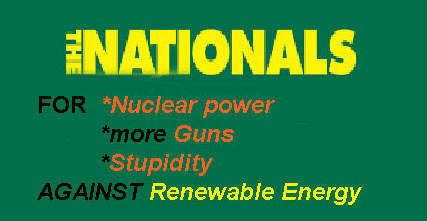
Nuclear shift and net zero feud stir Nationals’ leadership tensions
SMH, By Paul Sakkal, September 9, 2023
A nuclear policy overhaul backed by a trio of Nationals MPs and a push to ditch the Coalition-backed net zero emissions target has intensified pressure on leader David Littleproud and reignited the party’s long-standing climate feud.
Former deputy prime minister Barnaby Joyce said he wants Australia to talk about building conventional nuclear plants, days after conservative Queenslanders Keith Pitt and Matt Canavan urged Coalition MPs in a private meeting to consider the merits of the technology.
Until now, debate on nuclear energy has been confined to the prospect of what are known as small modular nuclear reactors, which are supported by the Coalition. But Pitt and Canavan put the far more expensive and controversial idea of traditional plants on the agenda in Tuesday’s Coalition party room meeting, according to five MPs who spoke anonymously because the meetings are confidential.
Joyce said debate on large-scale nuclear plants was valid, and claimed Climate Change and Energy Minister Chris Bowen, who strongly rejects nuclear options, was more pro-renewables than climate activist Greta Thunberg, who has criticised the German government for reopening coal mines instead of keeping nuclear plants alive…………………………..
The climate change mitigation policy is hated by right-wingers such as Pitt and Canavan. However, it is supported by Littleproud and politically important for Opposition Leader Peter Dutton to win the votes of those who worry about climate change. Dutton reaffirmed his commitment to net zero on Friday………………………….
Former chief scientist Alan Finkel said last month said it would take decades for Australia to develop a nuclear energy industry, and he and other experts rejected the push to switch focus from renewables to nuclear energy as implausible………………………………………………………………………..more https://www.smh.com.au/politics/federal/nuclear-shift-and-net-zero-feud-stir-nationals-leadership-tensions-20230908-p5e367.html
All the way with Anthony A – Labor locks in AUKUS support despite union opposition
by Zacharias Szumer | Aug 19, 2023
The Labor Government’s continuation of the Morrison-era AUKUS agreement, and a $350 billion spend on nuclear-powered submarines, was expected to be the most contentious issue at the Labor conference this week. After a minor scuffle, the PM emerged victorious. Zacharias Szumer reports.
Going into the conference, the way AUKUS debates would proceed still seemed a partially open question. Most presumed backroom deals would minimise any open conflict, but there was still a few unknowns.
As it played out, delegates were only able to vote on whether those submarines should be nuclear, and after the Government’s side prevailed, another motion that proposed removing all references to AUKUS from the platform was shelved.
In the end, debate over AUKUS came down to two different amendments.
The first was a proposal for a 1,300-word pro-AUKUS “statement in detail” to be added to that party’s platform, which was brought by Defence Minister Richard Marles and Defence Industry Minister Pat Conroy.
The other – brought forward by Electrical Trades Union (ETU) national secretary Michael Wright and supported by Member for Fremantle Josh Wilson – was essentially that statement with all references to nuclear technology taken out.
One proposed amendment was:
“Making our contribution to the collective security of our region … is at the heart of Australia’s strategic intent behind acquiring a conventionally-armed, modern and fit for purpose nuclear-powered submarine capability.”
And another:
“Labor will ensure that the nuclear-powered submarine program will deliver secure, well-paid unionised jobs…”
There’s plenty more for those interested in plumbing the depths. They can read the entirety of the amendments here and here.
After a day and a half of largely frictionless procedure, the AUKUS debate saw not just the first moment of open conflict, but the first animated audience participation of conference proceedings.
Marles’ received a strong round of applause from delegates when moving to the lectern to make his opening statement, but was met with boos from some as soon as he mentioned the word “nuclear.”
The obligatory Curtin references
Marles said AUKUS followed in the footsteps of WWII Labor prime minister John Curtin, who “made the decisions which gave Australia its independence.”
“This isn’t giving us independence … It’s tying us to the US,” shouted a voice from the stands………………………………………..
Rank and file opposition to AUKUS
With that motion carried, it was declared that the conference wouldn’t hear a third amendment that would remove all reference to AUKUS from the party’s platform. That motion was brought by NSW Legislative Council member Anthony D’Adam, who told MWM that the outcome was “predictable” but still “disappointing.”
Nevertheless, he said forcing AUKUS onto the agenda “was a victory for the rank and file.”
Around 50 of Labor’s roughly 800 branches have passed broad anti-AUKUS motions, and two former federal senators, Doug Cameron and Margaret Reynolds, have signed on as the founding patrons of Labor Against War (LAW).
National convenor of LAW Marcus Strom told MWM that it was only a “partial victory” for his group because “what we’re having is a partial debate.”
In addition to not hearing the stridently anti-AUKUS motion, the party also reportedly knocked back an application from LAW to hold a stall and event at the conference fringe, which hosted a series of panel discussions on the sidelines of the main proceedings.
However, Strom said that the anti-nuclear proposal received support from “a broad coalition, and it’s something to build on.”
Around 50 of Labor’s roughly 800 branches have passed broad anti-AUKUS motions, and two former federal senators, Doug Cameron and Margaret Reynolds, have signed on as the founding patrons of Labor Against War (LAW).
National convenor of LAW Marcus Strom told MWM that it was only a “partial victory” for his group because “what we’re having is a partial debate.”
In addition to not hearing the stridently anti-AUKUS motion, the party also reportedly knocked back an application from LAW to hold a stall and event at the conference fringe, which hosted a series of panel discussions on the sidelines of the main proceedings.
However, Strom said that the anti-nuclear proposal received support from “a broad coalition, and it’s something to build on.”………………………………………………
MWM reached out to Marles’ office on Friday afternoon to discuss the merits of Marles’ approach but didn’t receive a reply.
So much Labor hope is riding on an empty vessel

Labor’s leaders have put staying in government first. But it’s a bit pointless when they cannot even persuade their own supporters why they are taking the positions they are.
AFR Laura Tingle, Columnist 18 Apr 23
On one side of the discussion there was a disparate collection of people expressing concerns about a profound policy shift which has a multitude of troubling – and unanswered – questions attached to it.
On the other, a cabinet full of ministers who before September 15, 2021, when it was announced by Scott Morrison, had never remotely considered that Australia buying nuclear-powered submarines from the Americans was obviously the strategic……………………………. (Subscribers only) https://www.afr.com/politics/federal/so-much-labor-hope-is-riding-on-an-empty-vessel-20230814-p5dw8a
Coalition’s campaign for nuclear energy implausible, experts say
SMH. By Mike Foley, August 21, 2023
Former chief scientist Alan Finkel says it would take decades to develop a local nuclear energy industry, as he and other experts reject the Coalition’s push to switch focus from renewables to nuclear energy as implausible since Australia needs urgent replacement for its ageing coal-fired power plants.
Opposition Leader Peter Dutton wants Australia to deploy emerging nuclear power technology, while Nationals leader David Littleproud has criticised what he calls the government’s “reckless race to renewables” and asked for the government’s clean energy target to be paused and reconsidered.
The Albanese government has pledged to more than double the amount of power the electricity grid sources from renewables to 82 per cent by 2030, to help achieve its target of cutting greenhouse gas emissions by 43 per cent by the same deadline.
Federal parliament banned nuclear power in 1998 and the moratorium has remained in place with bipartisan support, but Dutton is calling for the deployment of small modular reactors to reduce emissions from the electricity sector, instead of renewables that require a vast array of new power lines to link wind and solar farms to the cities.
Finkel said it was highly unlikely that Australia could open a nuclear power plant before the early 2040s, pointing out the autocratic United Arab Emirates took more than 15 years to complete its first nuclear plan using established technology………………………………………………..
Responding to assertions that small modular reactors, which are smaller than traditional nuclear plants, may be quicker and cheaper to build, Finkel said: “The reality is, it’s not being done in Europe and America.
“There’s no operating small modular reactor in Canada, America or the UK, or any country in Europe.”
Finkel noted that private company Nuscale is aiming to commission 12 small modular reactors starting from 2029, but he said it would probably take at least a decade to follow suit in Australia.
“I just can’t see anything less than 10 years from the time that the [Australian] government saw Nuscale start operating in America,” he said.
……………………………Energy analyst Dylan McConnell said deploying a small modular reactor at an old coal plant would not be the “plug-and-play” operation some optimists have suggested.
“You would have to decommission the existing coal plant and then build a new nuclear plant,” he said.
Alison Reeve, a climate and energy expert at the Grattan Institute, said investors could not start to investigate a nuclear project in Australia until the moratorium was lifted by federal parliament, and it would probably take years after that for states to pass their own laws and for a regulatory framework to be developed.
“This is not as simple as just removing the moratorium and then everything will be fine,” Reeve said. https://www.smh.com.au/politics/federal/coalition-s-campaign-for-nuclear-energy-implausible-experts-say-20230821-p5dy2a.html
‘Unbelievable’: Defence spends $8.5m on consultants for AUKUS nuclear regulator
Greens defence spokesperson Senator David Shoebridge said: “It’s genuinely unbelievable that in the middle of a national scandal about outsourcing core government functions to the big four consultants, Defence has gifted an $8.5 million contract to one of them to design a new national nuclear regulator.
“It was always wrong to have Defence in control of its own regulator for the AUKUS nuclear submarines, and now we can see how they have hand-picked a pro-nuclear consultant to design the whole thing.”
SMH, Matthew Knott, August 21, 2023
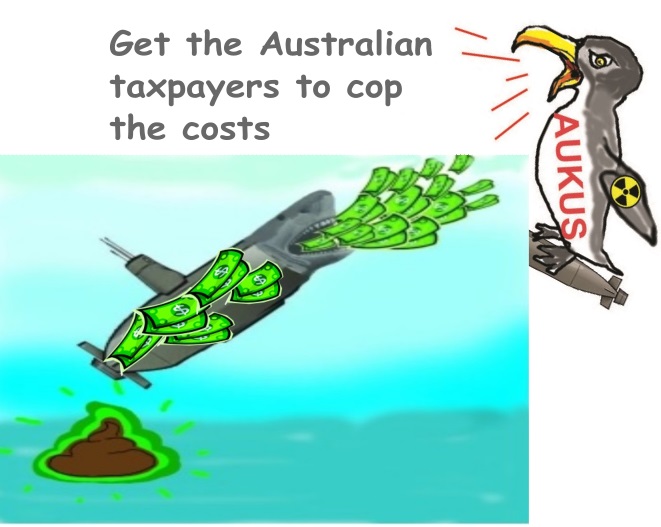
One of the big four consultancy firms will receive almost $8.5 million in taxpayers’ money over the next year to help design a new agency to monitor safety issues associated with Australia’s acquisition of nuclear-powered submarines under the AUKUS pact.
The Defence Department contract with EY, also known as Ernst & Young, comes amid a growing debate about the federal public service’s reliance on advice from external consultants for tasks that would previously have been performed in-house.
The Albanese government announced in March that it would create a new agency, known as the Australian Nuclear-Powered Submarine Safety Regulator, to “regulate the unique circumstances associated with nuclear safety and radiological protection across the lifecycle of Australia’s nuclear-powered submarine enterprise”.
The regulator, which will sit within the Defence Department, will also monitor infrastructure and facilities associated with the AUKUS pact such as the yet-to-be determined east coast submarine base.
Prime Minister Anthony Albanese stared down concerns from Labor’s Left faction about AUKUS, including about nuclear safety and the risks of nuclear proliferation, at the party’s national conference on the weekend.
Earlier this month the Defence Department revealed that it had awarded a 12-month contract to EY worth $8.4 million to advise on the design of a future nuclear regulatory agency.
Greens defence spokesperson Senator David Shoebridge said: “It’s genuinely unbelievable that in the middle of a national scandal about outsourcing core government functions to the big four consultants, Defence has gifted an $8.5 million contract to one of them to design a new national nuclear regulator.
“It was always wrong to have Defence in control of its own regulator for the AUKUS nuclear submarines, and now we can see how they have hand-picked a pro-nuclear consultant to design the whole thing.”
Shoebridge said he was troubled by EY’s deep connections to nuclear companies including US firm NuScale Power Corporation and China General Nuclear Power Co, as well as its role as the longstanding auditor for Japan’s Tokyo Electric Power Company, which operated the now decommissioned Fukushima power plant.
“This contract needs to be torn up and then this core duty of government, designing a nuclear oversight agency, needs to be done by government, not by a hired gun from the big four,” Shoebridge said………………………………………………………………………………………..
EY declined to respond to questions about the contract.
During a Senate appearance in July EY Oceania chief executive David Larocca distanced the firm from rival PwC, which is under fire for leaking confidential government information to its clients.
Shoebridge said the nuclear safety regulator should sit inside a separate department – such as the Department of Climate Change, Energy, the Environment and Water – rather than Defence to ensure it could provide independent oversight of the AUKUS submarine program.
…………………………… The government has been widely expected to name Port Kembla, in the Illawarra region of NSW, as the east coast base for Australia’s fleet of nuclear-powered submarines, but the idea has attracted a backlash from residents and unions.
The government has said it will store nuclear waste from the AUKUS submarines on defence land. Woomera in remote South Australia is seen as the most likely location. https://www.smh.com.au/politics/federal/unbelievable-defence-spends-8-5m-on-consultants-for-aukus-nuclear-regulator-20230820-p5dxxo.html
Why the Coalition backs nuclear

“Our sense of this is that nuclear is a debating issue that gives the Coalition cover for its quite diverse and often quite split positions … It enables them to not have to announce what their actual policy position is.” (Dave Sweeney of Australian Conservation Foundation)
The Saturday Paper, By Mike Seccombe, AUGUST 19 – 25, 2023 | No. 463
Previously staunch opponents of nuclear energy in the Coalition are now backing it as an alternative to renewables, despite largely unproven technology, long delays for approvals and the unsolved problem of waste. .
In his younger days, Ted O’Brien, the federal shadow minister for climate change and energy, was strongly anti-nuclear. But these days, he marches with a different crowd. Indeed, he leads it.
Tony Abbott is among them. As is Gina Rinehart, the richest person in the country. And Warren Mundine, a leader of the campaign against an Indigenous Voice to Parliament. And Andrew Liveris, an architect of former energy minister Angus Taylor’s abortive “gas-fired recovery” plan. And the climate change sceptics at the Institute of Public Affairs (IPA). And a raft of right-wing commentators, particularly in the Murdoch media, which also dutifully records each new salvo fired by Rinehart, Mundine, Liveris and others on the latest front in the climate wars.
The front is the battle for acceptance of nuclear power as an alternative energy source to renewables.
It is perhaps unsurprising things have come to this. Despite the efforts of the last federal government to slow-walk the shift to renewables and to extend the life of fossil fuels – particularly the dirtiest of them, coal – it has long been increasingly obvious they are on the way out. There will never be another coal-fired power station built in this country. Gas is an expensive alternative of very limited and declining utility.
Having spent years fomenting resistance to wind and solar, battery storage and new transmission infrastructure, the political right could hardly be expected to reverse course. Nuclear, though, presented an opportunity for differentiation. And so, last month, Opposition Leader Peter Dutton grasped it firmly. In a speech to the IPA, he accused the Albanese government of “renewable zealotry … putting our nation at risk”.
“The Albanese government is recklessly rushing to renewables and switching off the old system before the new one is ready,” he said.
………… Dutton offered a new variation on an old, radioactive theme.
………………… [Dutton advocated] “next-generation nuclear technologies which are safe and emit zero emissions. Namely, small modular reactors, or SMRs. And microreactors or micro modular reactors – MMRs – which are also known as nuclear batteries.”
A single SMR, Dutton said, could power 300,000 homes. An MMR could power a hospital, a factory, a mining site or a military base…………………………………. Dutton was singing from the songsheet Ted O’Brien has been assiduously composing for years.
………………. In 2019, the House Standing Committee on the Environment and Energy, chaired by O’Brien, conducted an inquiry into nuclear power.
Interestingly, it did not give a blanket endorsement. It found Australia should definitely reject old nuclear technology, but conditionally approve new and emerging technologies of the sort Dutton spoke about. There were dissenting reports from Labor members on the committee and the independent Zali Steggall.
The report’s title was “Not without your approval”, a recognition that nukes faced a big problem in gaining social licence.
It stressed that nuclear plants and waste facilities should not be imposed on local communities.
The response – or rather lack of response – from O’Brien’s superiors suggest they also worried about its public acceptability. The government made no move towards addressing the threshold problem with having nuclear power in Australia: that it is illegal under two separate pieces of legislation, passed under the Howard government.
…………. The most optimistic forecasts, including by O’Brien himself, suggest that even if new legislation were passed to remove the existing bans, it would take at least five years to get a reactor approved, up and running. A significant weight of expert opinion suggests far longer – probably 10 to 15 years.
Way back in 2006, the Howard government appointed the nuclear physicist Ziggy Switkowski from the board of the Australian Nuclear Science and Technology Organisation to conduct a review of Australia’s possible nuclear future.
The review concluded nuclear power would likely be between 20 and 50 per cent more costly to produce than power from a new coal-fired plant. It would take 10 to 15 years, and government subsidies, to get any nukes into the grid. Switkowski also foresaw cost reductions in renewable generation that would make them even more competitive.
That was before SMRs were contemplated, of course, but in the years since, the calculus hasn’t changed much, except that renewables and storage have become cheaper and faster.
Big questions remain about the cost of power from SMRs and the timeframes for deploying them.
Even Dutton’s assertion that modular reactors are a “feasible and proven technology” is questionable. They certainly look feasible, but they are hardly proven.
Mark Ho, newly elected president of the Australian Nuclear Association, an independent professional body of nuclear advocates, says there are currently just two operational SMRs in the world – one in Russia and one in China. Many more are in prospect. According to Dutton – and there is no reason to doubt him – 50 or more countries “are exploring or investing in new SMRs and nuclear batteries”.
But they are a way off being operational, Ho says. “In the US, there’s two leading designs, the NuScale reactor and BWRX, slated for completion by 2029.” In the UK, Rolls-Royce plans to have a first SMR up and running by 2029. Others are under development in Canada and elsewhere, Ho says, all looking to be operational around the end of the decade.
These timeframes mean SMRs would do nothing to help Australia meet its 2030 emissions reduction target…………………
It’s noteworthy that none of the talk reflects an actual policy commitment, says Dave Sweeney, nuclear-free campaigner for the Australian Conservation Foundation. “Our sense of this is that nuclear is a debating issue that gives the Coalition cover for its quite diverse and often quite split positions,” he says.
The debate gives the impression that the conservative parties are sincere about finding the best way forward, he suggests, when in reality a significant portion of its ranks “just don’t want renewables” and remain committed to fossil fuels.
“It enables them to not have to announce what their actual policy position is. When asked what is their response to energy and climate issues, what they say is ‘we need to consider everything’,” says Sweeney.
“They talk about the need for discussion, conversation, all that sort of stuff – as if we haven’t talked about it and had royal commissions about it and federal/state inquiries about it ad nauseam.”
Which is essentially what O’Brien tells The Saturday Paper when asked what the opposition’s actual policy is………………………..
The opposition is constrained, too, by its internal divisions. Sweeney cites a recent example, from last month’s Liberal National Party Queensland convention, “where there was a motion to support nuclear and [state party leader David] Crisafulli just slapped it down”.
……………………………………………………….. The same pro nuclear argument was made by Coalition senators in a report from yet another parliamentary inquiry, which came down last week.
The impetus for this one was a private member’s bill introduced last year by a Nationals senator and implacable foe of renewable energy, Matt Canavan, and co-sponsored by eight other conservatives. Its purpose, Canavan told the Senate, was to remove the bans on nuclear power “because that would be the best way to take advantage of future technological developments that could see nuclear energy as the most competitive carbon free option to produce electricity”.
Two pieces of Commonwealth legislation prohibit nuclear power in Australia. They are the Environment Protection and Biodiversity Conservation Act and the Australian Radiation Protection and Nuclear Safety Act, and they prevent the construction or operation of nuclear facilities for power generation, as well as facilities for the fabrication of nuclear fuel, uranium enrichment and the reprocessing of nuclear waste.
A further complication is that the three large east coast states, New South Wales, Victoria and Queensland, also have legislation prohibiting the construction of nuclear plants, while Western Australia, South Australia and the Northern Territory have legislation that prohibits the transport or disposal of nuclear waste.
Canavan’s bill was duly shunted to a committee, and when it reported back, it was, to no one’s surprise, split.
The majority recommended the bans remain, citing eight reasons: that “next generation” nuclear technology was unproven; that expert evidence held it would take 10 or 15 years to come online, by which time it would be unnecessary because Australia would have hit its 83 per cent emissions reduction target; that it was inflexible in its output; that it posed risks to human health and the environment; that it required vast quantities of water for cooling; that it created national security risks because neighbouring nations might suspect we would make nuclear weapons, and might in response target us; that it lacked a social licence and that renewables were cheaper.
Coalition members produced a dissenting report…………………………..
Regardless of the relative merits of the competing arguments, what mattered was what always matters in politics: the numbers. And the government had the numbers on the committee, just as it has the numbers in the parliament. So the ban on nukes stays, so long as Labor and the anti-nukes who dominate the cross benches hold power.
And they hold power so long as public opinion is with them.
On that front, much has been made in conservative media of an opinion poll taken in May, which found 45 per cent of voters either strongly or somewhat supported nuclear power as a domestic energy source, with 23 per cent opposed and the rest undecided. It also found 51 per cent support for removing the bans on nuclear energy.
The poll was commissioned by the Minerals Council of Australia, a body that has long supported the nuclear industry, but the questions asked were pretty straightforward.
It would be interesting to see the results of a poll that asked voters if they would like to see a nuclear plant or waste facility in their electorate. Because you can bet that’s the scare campaign nuclear opponents would mount if the opposition formally adopted the position Dutton, O’Brien, and the conservative members of that committee have intimated.
And in that case, you really have to wonder whether the endorsement of such prominent supporters as Gina Rinehart, Tony Abbott, Warren Mundine and Andrew Liveris and the power of the IPA or even the Murdoch media would sway many votes. https://www.thesaturdaypaper.com.au/news/environment/2023/08/19/why-the-coalition-backs-nuclear
Albanese defends against attempt to strike nuclear submarines out of Labor platform
ABC News, By political reporter Jake Evans; 19 Aug 23
Prime Minister Anthony Albanese has fought off an attempt to have references to nuclear-powered submarines struck from Labor’s platform.
Key points:
- The government has faced off a motion to strike nuclear-powered submarines from Labor’s platform
- Some delegates wanted to avoid Labor committing to nuclear submarines, which are fiercely opposed by some members
- The party instead resolved to redouble its non-nuclear efforts
Mr Albanese is in favour of the AUKUS defence deal with the United States and United Kingdom, as he attempts to quiet internal rebellion against the plan to acquire nuclear-powered submarines.
……………………………… “If you come to the position, as I have, that Australia as an island continent needs submarines, then it is compulsory … that nuclear-powered submarines are what Australia needs.”
It was Mr Albanese’s only intervention into a debate at the conference so far.
The government succeeded in blocking the rebellion, as well as ensuring Friday morning that the conference was prevented from debating a wider motion to have references to “AUKUS” struck from the platform.
Electrical Trades Union secretary Michael Wright, moving the attempt to have references to nuclear propulsion struck from the platform, said his union did not support AUKUS.
“Why would this decision we are taking here not ripple around the world?
“Serious questions must be asked: is this the best way of securing our national interest? Is this the best spend of $360 billion?” he asked.
Mr Wright said Labor should not lock nuclear submarines into its platform, but “keep the window open” for further debate.
Defending the government’s policy, Defence Minister Richard Marles said Australia’s security depended on acquiring nuclear-powered submarines.
“In a difficult moment, Australians are looking to us. I know the word ‘nuclear’ evokes a strong reaction, but we are not talking about nuclear weapons.
“We will never base nuclear weapons on our shores.”
Defence Industry Minister Pat Conroy told Labor delegates only “strength” would deter war, not “appeasement”.
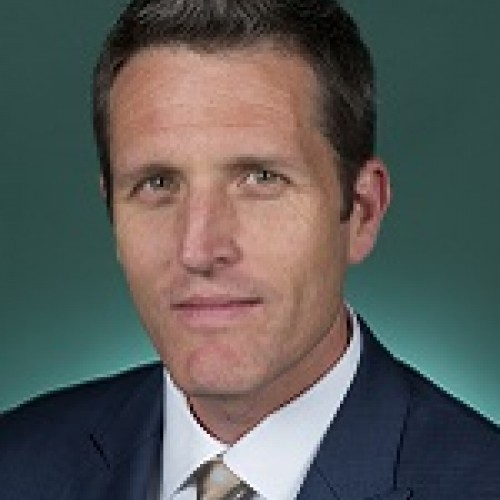
Labor MP Josh Wilson, one of the only government MPs to break ranks on AUKUS, said the decision to acquire nuclear-propelled submarines was “not justified”.
“To a person with a hammer, every problem looks like a nail. Deterrence is not a one word justification for every defence position,” Mr Wilson said.
“And with the greatest respect to delegate Conroy, the suggestion that anyone who questions a particular defence and security decision or acquisition is in the game of appeasement … is ridiculous.”
Government seeks to reassure rank and file, redoubling non-nuclear commitment
The government instead moved to recognise “the growing danger that nuclear weapons pose” and committing the government to redouble its efforts towards nuclear disarmament in an effort to settle disquiet within its ranks on AUKUS.
Several local branches have opposed AUKUS and the pact now faces a challenge from internal group Labor Against War, represented by former senators Doug Cameron and Margaret Reynolds.
Outside the conference, Labor Against War convenor Marcus Strom said Friday’s debate at the conference was just the beginning of a campaign against AUKUS.
“The best opposition we get is, ‘Look, let’s keep things calm, we don’t want to scare the horses ahead of elections,’ but this is more important than one election, one parliament, one government,” Mr Strom said.
“This is a 30-year program, multi-billion dollars of wasted opportunity we could be spending on housing, on cost of living pressures, on the transition to a green economy.”
https://www.abc.net.au/news/2023-08-18/government-defends-aukus-at-labor-conference-nuclear-submarines/102745950
AUKUS a cover for the Coalition’s nuclear power agenda
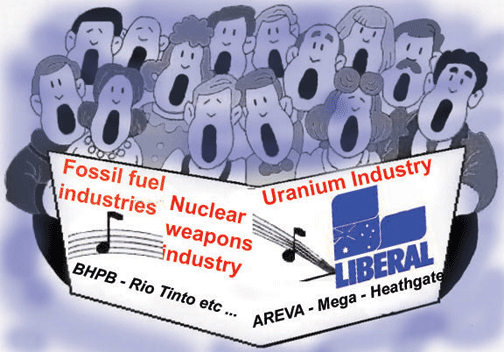
By Jim Green, Aug 18, 2023 https://johnmenadue.com/aukus-a-cover-for-the-coalitions-nuclear-power-agenda/?fbclid=IwAR0tsw-FLtHUY-EFgpbh_b1Lm2jlJSceGe5qkDm0EaLfgKe7NPUlExm4DQw
The federal Coalition’s dissenting report on a Senate inquiry into nuclear power claims that Australia’s “national security” would be put at risk by retaining federal legislation banning nuclear power and that the “decision to purchase nuclear submarines makes it imperative for Australia to drop its ban on nuclear energy.”
The Senate Environment and Communications Legislation Committee released a report into nuclear power on August 11. The majority report, endorsed by Labor and Greens Senators, argued against nuclear power and against the repeal of Howard-era legislation banning nuclear power in Australia. A dissenting report by Coalition Senators argued for repeal of the legislation banning nuclear power.
The majority report concludes that repeal of the legal ban “would create an unnecessary escalation of risk, particularly given Australia is able to utilise readily available firmed renewable technology to secure a reliable, affordable and clean energy system for Australia’s future”.
The Coalition Senators put forward a suite of false and questionable claims in their dissenting report: that nuclear power is expanding worldwide; it is popular; it is important and perhaps essential to underpin the AUKUS nuclear submarines project; promoting low-carbon nuclear proves that the Coalition is serious about greenhouse emissions reductions; and renewables are unreliable and more expensive than nuclear.
The Coalition has yet to state clearly that it will repeal laws banning nuclear power if elected, but it’s only a matter of time. The nuclear push has the full support of Opposition Leader Peter Dutton.
The Coalition’s economic illiteracy
The Coalition Senators’ dissenting report makes a number of absurd economic claims.
It cites Tony Irwin from the SMR Nuclear Technology company, who claims that the costs of nuclear and solar are “basically the same”. He bases his calculation on the assumption that a small modular reactor (SMR) would generate 13 terawatt-hours (TWh) of electricity per year. But reactors typically generate about 7.2 TWh per 1,000 megawatts (MW) of capacity, so a 300 MW reactor (the upper end of the range for SMRs) would generate about 2.2 TWh – nearly six times less than Irwin claims.
Based on that nonsense, Irwin goes on to make the equally absurd claim that until legislation banning nuclear power is removed, “Australia’s power system will continue to be constrained at great cost to the economy.”
SMR Nuclear Technology also fed economic nonsense to a federal parliamentary inquiry in 2019/20. As RenewEconomy editor Giles Parkinson noted, the company’s claim that 100 per cent renewables would cost four times more than replacing coal with nuclear was based on “Mickey-Mouse modelling” by a husband and wife team who used absurd figures for solar and wind and admitted to deliberately ignoring anticipated cost reductions.
Of course there’s no need for Tony Irwin, SMR Nuclear Technology director (and coal baron) Trevor St Baker, or any other nuclear lobbyist to get their facts straight. As long as their claims fit the narrative, they will be parroted by the Coalition and by the Murdoch/Sky echo-chamber.
Cost blowouts
The dissenting report cites John Harries from the Australian Nuclear Association complaining that CSIRO GenCost reports aren’t “looking at the actual builds happening around the world at the moment.”
Be careful what you wish for, John. Does the nuclear lobby really want to draw attention to the six- to twelve-fold cost blowouts in reactors under construction in the US, the UK and France, with the latest cost estimates ranging from A$25-30 billion per reactor?
The dissenting report concludes that: “If nuclear is more expensive than alternatives, as the CSIRO and others claim, then legalising nuclear energy will not change anything because investors will choose to build the cheaper options.”
However there isn’t a single reactor project in the world that isn’t propped up by state support and taxpayer subsidies.
As for private-sector SMR projects, not one has reached the construction stage anywhere in the world — and perhaps none ever will.
The 2015/16 South Australian Nuclear Fuel Cycle Royal Commission commissioned research on the economic potential of two SMR designs: Generation mPower and NuScale Power.
Generation mPower was abandoned in 2017, and NuScale is struggling. Despite lavish US government subsidies, NuScale is struggling to secure private-sector finance to get the project off the ground and it still has licensing hurdles to clear.

NuScale’s latest cost estimates indicate it has no hope of competing with renewables. NuScale estimates capital costs of A$14.4 billion for a 462 MW plant, with levelised costs estimated at A$138 per megawatt-hour. The Minerals Council of Australia states that SMRs won’t find a market unless they can produce power at a cost of A$60‒80 / MWh.
NuScale’s history can be traced to the turn of the century but it hasn’t even begun construction of a single reactor. Likewise, Argentina’s SMR project can be traced back to the last millennium but it hasn’t completed construction of a single reactor.
A dog whistle to climate denialists
Continue readingA profound change’: AUKUS debate looms for Labor’s rank and file.

The New Daily James Robertson 15 Aug 23
At this week’s ALP national conference, delegates will vote on a proposal to remove an expression of support for the AUKUS security pact in Labor’s platform.
Some 400 party members will attend the conference, which will be in Brisbane and run from Thursday to Saturday.
One of two motions expected to be put to the conference stops short of rebuking AUKUS but would instead amend the party’s draft platform on defence by removing an explicit endorsement.
“Our self-reliant defence policy will be enhanced by strong bilateral and multilateral defence relationships, including AUKUS,” the platform currently reads.
The proposed amendment would delete the words “including AUKUS”.
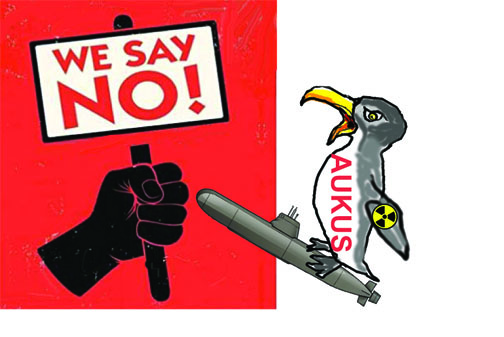
Under the deal, Australia will acquire and build nuclear-powered submarines from America and the UK.
Five federal electorate councils have passed motions either expressing reservations about AUKUS or calling for it to be reviewed or delayed, according to a tally kept by Labor Against War, a party activist group.
A spokesman for the group, Marcus Strom, said the conference motion was a significant step, noting earlier reports that it would not be on the agenda.
“Forcing AUKUS to be debated is a victory for the rank and file,” he said. “The first of many, we expect, as we campaign against it.”
Members of the Labor Left will comprise a majority of delegates.
But they are not expected to vote as a unified bloc on either defence policy or a vote to elect party executive members.
Supporters of Prime Minister Anthony Albanese and Foreign Minister Penny Wong, both of the Left, are not expected to back the AUKUS amendment.
It will be brought by NSW MP Anthony D’Adam, from a grouping once known as the “soft” Left and historically a rival to Mr Albanese’s support base.
ALP president Wayne Swan said last week he expected a conference debate on AUKUS in keeping with Labor tradition.
“National defence has always loomed large in our national conferences,” he said.
Majority support
But the former Treasurer predicted most delegates would support the Prime Minister’s position.
“Our position in the region has changed so dramatically in the last decade or so [that it] has brought about a profound change […in] our defence stance and orientation,” he said.
Defence Minister Richard Marles and Defence Industry Minister Pat Conroy held a briefing for party members on AUKUS via Zoom on Monday night.

Mr Marles described AUKUS as a “difficult call” but said it had been the right decision, one person on the call said.
AUKUS also includes a second phase for sharing advanced defence technology.
US representatives are pushing for export controls to be eased so Australia can access these technologies more quickly, such as quantum computing and artificial intelligence.

In October, Mr Albanese will be received at a state dinner in Washington.
Other issues on the agenda in Brisbane……………https://thenewdaily.com.au/news/politics/2023/08/14/aukus-debate-labor-conference/
Senate inquiry nixes nukes. Here’s why

Renew Economy, Jim Green 15 August 2023
The Senate Environment and Communications Legislation Committee released a report into nuclear power last Friday.
The majority report, endorsed by Labor and Greens Senators, argued against nuclear power and against the repeal of Howard-era legislation banning nuclear power in Australia.
A dissenting report by Coalition Senators argued for repeal of the legislation banning nuclear power.
The majority report concludes that repeal of the legal ban “would create an unnecessary escalation of risk, particularly given Australia is able to utilise readily available firmed renewable technology to secure a reliable, affordable and clean energy system for Australia’s future.”
The majority report gives the following reasons for its conclusions:………………………………………………………………….
Coalition Senators’ dissenting report
The Coalition’s dissenting report was endorsed by Senators Matthew Canavan and Gerard Rennick (Qld), Alex Antic and David Fawcett (SA), Hollie Hughes and Ross Cadell (NSW), Richard Colbeck (Tas), and Matt O’Sullivan (WA).
The Coalition has yet to state clearly that it will repeal laws banning nuclear power if elected, but it’s only a matter of time. The nuclear push has the full support of opposition leader Peter Dutton.
The Coalition Senators argue in their dissenting report that nuclear power is expanding worldwide – it is popular; it is important and perhaps essential to underpin the AUKUS nuclear submarines project; SMRs are the bees knees; promoting low-carbon nuclear proves that the Coalition is serious about greenhouse emissions reductions; and renewables are unreliable and more expensive than nuclear.
Is nuclear power growing? No – it has been stagnant for the past 30 years and if there’s any non-trivial change over the next 20 years, it will be downwards.
Just 16 per cent of the world’s countries operate nuclear power reactors (31/195), so clearly the Coalition Senators are wrong in describing Australia as a nuclear “outcast.”
Nine per cent of the world’s countries are building reactors (17/195), 91 per cent are not. Only six countries are building more than two reactors.
The International Energy Agency (IEA) expects record global renewable capacity additions in 2023 amounting to 440 gigawatts. Nuclear power has gone backwards so far in 2023, with a net loss of one reactor or 2.4 gigawatts.
The IEA projects that in 2027, renewable electricity generation will have increased to 38 per cent of total global generation. Nuclear power has fallen below 10 per cent and will likely never reach double figures again.
Economics
The Coalition Senators’ dissenting report makes a number of absurd economic claims.
It cites Tony Irwin from the SMR Nuclear Technology company, who claims that the costs of nuclear and solar are “basically the same.” He bases his calculation on the assumption that a “small-body reactor” would generate 13 terawatt-hours (TWh) of electricity per year.
But reactors generate about 7.2TWh per 1,000 megawatts (MW) of capacity, so a 300MW reactor (the upper end of the range for SMRs) would generate about 2.2TWh – nearly six times less than Irwin claims.
The Coalition has yet to state clearly that it will repeal laws banning nuclear power if elected, but it’s only a matter of time. The nuclear push has the full support of oppositi
Is nuclear power growing? No – it has been stagnant for the past 30 years and if there’s any non-trivial change over the next 20 years, it will be downwards.
Just 16 per cent of the world’s countries operate nuclear power reactors (31/195), so clearly the Coalition Senators are wrong in describing Australia as a nuclear “outcast.”
Nine per cent of the world’s countries are building reactors (17/195), 91 per cent are not. Only six countries are building more than two reactors.
The International Energy Agency (IEA) expects record global renewable capacity additions in 2023 amounting to 440 gigawatts. Nuclear power has gone backwards so far in 2023, with a net loss of one reactor or 2.4 gigawatts.
The IEA projects that in 2027, renewable electricity generation will have increased to 38 per cent of total global generation. Nuclear power has fallen below 10 per cent and will likely never reach double figures again.
Based on that nonsense, Irwin goes on to make the equally absurd claim that until legislation banning nuclear power is removed, “Australia’s power system will continue to be constrained at great cost to the economy.”
SMR Nuclear Technology also fed economic nonsense to a federal parliamentary inquiry in 2019/20. As RenewEconomy editor Giles Parkinson noted, the company’s claim that 100 per cent renewables would cost four times more than replacing coal with nuclear was based on “Mickey-Mouse modelling” by a husband and wife team who used absurd figures for solar and wind and admitted to deliberately ignoring anticipated cost reductions.
Of course there’s no need for Tony Irwin, SMR Nuclear Technology director (and coal baron) Trevor St Baker, or any other nuclear enthusiast to get their facts straight. As long as their claims fit the narrative, they will be parroted by the Coalition and by the Murdoch/Sky echo-chamber.
The dissenting report cites John Harries from the Australian Nuclear Association complaining that CSIRO GenCost reports aren’t “looking at the actual builds happening around the world at the moment.”
Be careful what you wish for, John. Does the nuclear lobby really want to draw attention to the six- to twelve-fold cost blowouts in reactors under construction in the US, the UK and France, with the latest cost estimates ranging from $A25-30 billion per reactor?
The dissenting report concludes that: “If nuclear is more expensive than alternatives, as the CSIRO and others claim, then legalising nuclear energy will not change anything because investors will choose to build the cheaper options.”
However there isn’t a single reactor project in the world that isn’t propped up by state support and taxpayer subsidies.
In the UK, the government insisted that reactors would not be subsidised, but the UK National Audit Office estimates that taxpayer subsidies for two reactors under construction at Hinkley Point – the only reactor construction project in the UK – could amount to £30 billion (A$58.6 billion) while other credible estimates put the figure as high as £48.3 billion (A$94.4 billion).
A dog whistle to climate denialists
The Coalition Senators’ dissenting report claims that nuclear must be in the mix “if we are serious about the reduction of emissions to meet targets”.
But the Coalition isn’t serious about reducing greenhouse emissions. ……………………………………….
Promoting nuclear power doesn’t provide the Coalition with any cover or credibility. The Climate Council, comprising Australia’s leading climate scientists, speaks for those of us with a genuine interest in reducing greenhouse emissions. The Council issued a policy statement in 2019 concluding that nuclear power plants “are not appropriate for Australia – and probably never will be”…………..
https://reneweconomy.com.au/senate-inquiry-nixes-nukes-heres-why/
Stop renewables and wait for nuclear: Nationals stunning rejection of science and industry
Giles Parkinson 14 August 2023 https://reneweconomy.com.au/stop-renewables-and-wait-for-nuclear-nationals-stunning-rejection-of-science-and-industry/
Nationals leader David Littleproud says he wants to have an “honest” conversation about Australia’s energy transition. Well and good. But maybe Littleproud himself can help that process by not telling outright lies.
On Sunday, Littleproud did us all a favour by spelling out in detail the Nationals energy policy, just in case it wasn’t already obvious: Stop renewables and wait for nuclear.
It has been, he admitted, the party’s policy for at least the last decade, if not longer.
That’s not surprising, given that its the favoured policy and strategy of Big Oil, Big Gas, Big Coal, and the likes of Gina Rinehart to whom the Nationals appear completely beholden. And it wins support at all levels of the Nationals grass roots through a co-ordinated and quite extraordinary campaign of fear and misinformation.
Littleproud’s train crash of an interview on ABC’s Insiders program on Sunday – well, it might have been a train crash if he had been questioned by someone with the wit to hold his talking points up to scrutiny – highlight the tragedy of Australia’s and the world’s current climate policies.
All these policies are focused on net zero by 2050, or 2060 if you happen to be China. As many scientists fear, it’s a target that is used as a prompt by naysers and do-nothings – such as the Nationals and the fossil fuel industries – to put things off for another day.
It is another excuse for delay, delay, and yet more delay – even though the science tells us, quite clearly, and more emphatically given the summer in the northern hemisphere and tumbling heat records – that what matters most is how quickly we act now.
Littleproud is completely unfazed by the science. In fact, it is a stunning rejection of the science. He wants a “pause” to the roll out of wind and solar and transmission links and a stop to the “reckless pursuit” of the government’s 82 per cent renewables targets.
He suggests that wind and solar has its place, but that solar should be built on city rooftops, not on “prime agricultural” farmland, or in remnant forests. We should wait for nuclear, he says, because “we’ve got time” and net zero by 2050 is the government’s “only commitment.”
He wasn’t asked the obvious question about the Nationals acceptance of climate science, the need to act by 2030, the need to try and cap average global warming to 1.5°C, a target that would require net zero to be reached more than a decade earlier.
Littleproud appealed for “honest conversations”, and then said the federal government’s 83 per cent renewables target requires 28,000 kms of new transmission lines.
Let’s be absolutely clear, that is simply not true.
The Australian Energy Market Operator’s Integrated System Plan suggests that up to 10,000kms of new transmission will be needed over the next two decades under its “step change” scenario, which includes the 82 per cent renewable share that is now the federal government’s target.
That renewables target, by the way, is key to reaching Australia’s modest emissions reduction target of 43 per cent below 2005 levels – a year chosen because of its peak land clearing of remnant forests under the Liberal/National Coalition.
Granted, the preparation work for the transmission lines have been poorly handled, by transmission companies, governments and the likes of AEMO, but it should be noted that most of these transmission lines are considered necessary even in the “slow scenario”, where science is completely ignored and coal hangs around a lot longer.
Littleproud’s number of 28,000kms is only mentioned in the “hydrogen superpower” scenario that imagines huge arrays of wind and solar in remote areas that might need to be connected to the grid. It is of course, his sponsors’ worst nightmare – because it means the end of the fossil fuel industry as we know it.
Littleproud then goes on to mention the prospect of nuclear SMRs (small modular reactors), and even something called “micro reactors”, which are little more than an idea, and probably even further down the pipeline than the SMRs, which are themselves at least a decade away, and not likely to be cheap.
The Nationals leader reckons big industry users like smelters might like the idea of micro reactors because they are modular, and about 3-5MW and can be used to power their facilities, and bring down costs.
It’s a ridiculous suggestion. A smelter draws up to about 500MW of load, so it will need around 100 of these things that don’t exist, and as the former head of the US Nuclear Regulatory Commission wrote recently, only ideologues and ‘tech bros” think that nuclear can be cheap. And the Coalition.
The owners of Australia’s smelters, for the record, have already made their views clear. Rio Tinto, for instance, has said that its smelters only have a future beyond the end of the decade if they can convert their power supply to renewables by 2030.
If not, they will not be able to compete with the rest of the world, either on cost, or on emissions. And who is providing the biggest stumbling block to renewables? The Nationals and fossil fuel industry led campaign against wind, solar and transmission.
And therein lies the tragedy, the dishonesty, and the absurdity of the Nationals’ and the Coalition’s stance against green energy.
It will stuff industry in Australia, and the local economy, long before it stuffs the planet and the environment. But by then, they – and the Murdoch media which trumpet their positions, and the mainstream media that refuses to question it – will have found something else to whinge about.
Senate nuclear power report sees no role for nuclear .
A Senate committee released a report into nuclear power last Friday. The majority report, endorsed by Labor and Greens senators, argued against nuclear power and against the repeal of Howard-era legislation banning nuclear power in Australia. A dissenting report by Coalition Senators argued for repeal of the legislation banning nuclear power.
The majority report concludes that repeal of legislation banning nuclear power “would create an unnecessary escalation of risk, particularly given Australia is able to utilise readily available firmed renewable technology to secure a reliable, affordable and clean energy system for Australia’s future”. It gives the following reasons:
1. Nuclear power is the most expensive energy option for Australia whereas firmed renewable energy is the cheapest option. Introducing nuclear power into Australia’s electricity network would “drive up power prices, causing additional economic pain for everyday Australians who are already struggling with the cost of living pressures.”
2. Next generation nuclear technology is unproven and there are no commercially operational ‘small modular reactors’ anywhere in the world. “It is clearly not possible for Australia to develop a nuclear power sector with SMR technology which is not commercially available,” the majority report states.
3. Given the “very considerable” lead time that would be involved in establishing a new nuclear industry in Australia, the contribution of nuclear power to the electricity market would likely be negligible given Australia’s projected 83 per cent uptake of firmed renewables by 2030. “The committee recognises that addressing climate change requires immediate action and pursuing nuclear energy would only be a distraction from Australia’s 2030 target and broader efforts to reach net zero emissions by 2050.”
4. Nuclear power is inflexible. The energy output of nuclear power plants lacks the flexibility required to meet the needs of a modern electricity market. Firmed renewables are much better suited to the load profiles of modern electricity grids which require greater flexibility.
5. Nuclear carries inherent and consequential safety risks. In addition to other risks, establishing a nuclear power industry in Australia “would unnecessarily add to the local and global problem of managing high-level nuclear waste”.
6. Water scarcity — an issue “close to the hearts of many Australians”. Reactors require “significant volumes” of water for cooling and the “necessity of locating nuclear power plants near sea water would likely mean the construction of nuclear reactors near densely populated areas and would create additional environmental and security risks.”
7. Nuclear power would create “potential and unnecessary national security risks” due to “perceived links between civil nuclear industries and nuclear weapons proliferation, as well as opening the possibility of nuclear reactors being the target of hostiles.” Australia continues to be an international advocate of nuclear non-proliferation and the committee supports Australia’s ongoing participation in the Nuclear Non‑Proliferation Treaty, as well as the international and bilateral nuclear safeguard agreements it has ratified.
8. “There is no social license to support the establishment of a civil nuclear industry in Australia. A significant majority of Australians are not comfortable with the prospect of having nuclear power plants, or the radioactive waste they produce, in their backyards. Overwhelmingly, Australians recognise the importance of transitioning to a secure and sustainable energy future, and firmed renewables are the key to achieving that future.”
Gina Rinehart: Australia’s wealthiest person uses Bush Summit speech to push for nuclear power
Rebecca Le May, The West Australian, Mon, 14 August 2023
Gina Rinehart is pushing for Australia to become nuclear-powered instead of upsetting farmers with more “bird-killing wind generators and massive solar panel stretches”.
The multi-billionaire used the final sentence of her keynote speech at The Australian Bush Summit on Monday to call for a national foray into the contentious energy source — easing into the topic with a joke purportedly by nuclear physicist Edward Teller, who helped Robert Oppenheimer produce the first nuclear bomb………… (Subscribers only) more https://thewest.com.au/business/mining/gina-rinehart-australias-wealthiest-person-uses-bush-summit-speech-to-push-for-nuclear-power-c-11581010
Why the nuclear option is clever in opposition but a nightmare in government
The Coalition’s push to include nuclear energy in the nation’s arsenal has nothing to do with solving the climate debate.
InQueensland, August 14, 2023, John McCarthy
If only that was the case.
The first and most reasonable question for them is why is the Coalition is pushing nuclear now and did nothing to progress it when they were in power?
The answer is just as reasonable. It has no hope and it’s not because of its inherent cost and efficiency, which seems to make up a lot of the debate.
An example of how difficult it would be to push forward with nuclear energy was the recent Federal Court decision to overturn the approval of a waste dump for radioactive material in the South Australian town of Kimba, where the issue had split the town.
It took a decade to get to that point and the division in Kimba would be likely to be played out nationally if the Coalition ever got serious about adopting nuclear energy.
……….The reason the Coalition has started pushing nuclear is very much the same reason it won’t succeed. It’s devisive. It would be a nightmare.
You may think that’s a criticism of the Coalition but it isn’t. It’s politics and clever politics, as well.
Nuclear provides an agitation point for the Albanese Government and a pivot on which the Coalition can position themselves as forward-thinking and rational…………………………..
It should also be noted that a nuclear power station in the US was recently completed seven years late and cost $US34 billion ($52.3 billion), about $US21 billion over its initial budget.
While adopting nuclear, the LNP in Queensland has ditched coal. Its support is now whispered rather than championed, as it was in 2019 when it was instrumental in handing Government to Scott Morrison.
………………………………………………… The real issues however are about waste, where a nuclear power station would be sited, how much would it cost and how long would it take to develop and, most importantly, is it safe? All pretty reasonable questions.
Whether they would continue to advocate for nuclear if they returned to Government is a completely different question. It’s reasonable to assume that the issue would be handed to a committee where it would gather dust.
……………………….. The problem is nuclear remains a social and environmental nightmare…….. https://inqld.com.au/opinion/2023/08/14/why-the-nuclear-option-is-clever-in-opposition-but-a-nightmare-in-government/
How will they explain themselves to their grandchildren?

August 11, 2023, by: Mark Buckley https://theaimn.com/how-will-they-explain-t
It is hard to understand the stupidity of Australia’s political leaders when it comes to the climate catastrophe. It is a given that the likes of Barnaby Joyce and Tony Abbott will ignore the facts as they unfold, but even they must have noticed what’s going on.
Maybe the political class don’t watch television, or read newspapers, or have relatives living overseas, but the rest of us do.
Two years ago there were horrific floods in Germany and Belgium, in mid-July 2021, which killed more than 220 people. Damage was widespread and was seen as far away as the Netherlands, Austria and Switzerland. In Europe, in summer.
In Australia we know the lasting devastation of floods, and the impossibility of future proofing. The only solution is to re-build, if re-build you must, on higher ground.
Is a flood more real if it happens in Germany rather than in Lismore, or Shepparton? Are wildfires more devastating when they happen in Canada or Greece? Does total destruction of a town in Hawaii mean more than if it happens in Mallacoota?
Ask Matt Canavan why he chooses to ignore the facts of climate destruction in Australia. What does he think of the lack of sea ice in the Antarctic this year? Some scientists think the rise in sea levels, caused by the undermining of the ice in Antarctica, could range from between 2 metres to 10 metres.
Imagine the harm to our coastal cities if it comes in closer to 10 metres. Well, they won’t be there anymore, so it’s not difficult to imagine the damage. It won’t make it hard to get onto the West Gate Bridge, because the West Gate Bridge will be an abandoned arc of empty roadway, and what would be the use of driving to Geelong, because Geelong won’t be there anymore.
Kardinia Park will be an empty reservoir. But enough imagining, already. For our intellectually challenged leaders, the plight of our civilisation is at stake.
Droughts and bushfires will alternate with flooding rains, as the seasons change. Mass starvation will lead to mass migrations, from those lands most affected, to those less affected.
If you think living in the mountains, far away from the mass populations of cities, will make you safe from the changes in the climate, think again.
Towns in the Andes mountains in Peru have reached 38°C or more, while in Argentina’s capital, Buenos Aires, temperatures above 30°C have been recorded; this month. It is winter there now.
Peter Dutton wants to fix the climate crisis with nuclear power. Does he know how long it takes to arrange for a nuclear power station to be approved, planned and built? Does he not own a clock, or a calendar?
On the government’s side of the ledger, more than 2,000 medical professionals have demanded that the Albanese government withdraw $1.5bn funding for the Middle Arm industrial development, in the Northern Territory.
The funding is a handout to assist the development of the huge Beetaloo Basin gas field. Labor is struggling to disguise the funding. Are votes in the short-term worth wrecking the climate?
We have been told that the earth is reaching, and in some cases, passing through “tipping points” for the climate.
It doesn’t take much imagination to recognise the utter failure of almost every government on earth to react to the crisis.
See the piss-ant state governments as they legislate to criminalise the actions of climate activists. Jailing them won’t achieve anything. It is as effective and as ridiculous as trying to stop the tide.
See how the so-called leaders of governments world-wide baulk at the difficult conversations they need to have with their citizens, to convince them that time has almost run out.
Believe it or not, but the scientists need to change their language, from calm reason to barely suppressed terror. We are facing Armageddon, and politicians are worried that people will either panic, or vote them out of power.
They need to get to the front. Show some leadership. Make change. Don’t worry about plans for fifty years in the future, your rubbish plans for nuclear subs and inland rail.
Worry about the end of civilisation as we know it. Worry about our children and their children. I don’t want my grandchildren starving because we had a leadership which valued the chance of a directorship with a gas company over the survival of humanity.
And the leaders of today need to know there is nowhere to hide if it all turns to manure. They were warned, and there is not a mountain high enough to escape to.
1 This month


Help Aunty Sue Protect Her Land and Sacred Sites From Destructive Rocket Testing.
.

Australians deserve the truth
about
AUKUS – https://aukuspublicinquiry.com/

PETITION – To: Prime Minister Anthony Albanese and the Australian Labor Government

of the week – Australians for War Powers Reform (AWPR)
To see nuclear-related stories in greater depth and intensity

