Labor criticises Coalition energy spokesman Ted )’Brien for filming nuclear power videos at Hiroshima
Guardian, Josh Butler, Tue 7 Feb 2023
A Labor government MP has accused Coalition energy spokesperson Ted O’Brien of “bizarre and disrespectful” behaviour after filming videos discussing Australia’s potential for nuclear energy at the site of the Hiroshima atomic blast and the Fukushima power plant in Japan.
The prime minister, Anthony Albanese, accused O’Brien of a “frolic” on advocating for nuclear power, but the Liberal MP said he had sought to be respectful on his privately funded trip to study the technology………….
O’Brien, the member for the Queensland seat of Fairfax, recently posted two videos from a trip to Japan on YouTube titled “Time to Talk Nuclear: What can Australia learn from Japan?” and “Time to Talk Nuclear: What can we learn from Hiroshima?”
Guardian Australia previously revealed O’Brien’s “Time To Talk Nuclear” campaign, which he described as a “grassroots” community engagement program, was using a website registered by a business that helps an American small modular reactor company.
he Coalition opposition has consistently advocated for the government to investigate nuclear energy, despite not building such options during its previous nine years in federal office.
O’Brien wrote alongside the videos that he visited Japan as part of “an in-depth analysis into the possibility of including advanced nuclear technology in Australia’s future energy mix”.
“No people have a more complicated relationship with nuclear technology than the Japanese,” he wrote in a caption, saying he had visited Tokyo, Hiroshima, Fukushima and Rokkasho to meet business owners, government officials, nuclear experts and locals.
“We all know the tragedy of war and we all know how Japan certainly suffered at the end of World War II. In some ways, it’s had the ability to turn what has been a tragedy for the nation into a message of hope,” O’Brien said in one video.
“Despite actually having two atomic bombs land on it, it’s firing on all cylinders on nuclear energy.”
O’Brien said Australia should “have the humility to learn from those nations that know about [nuclear] technology far greater than us”. That video says he also visited Fukushima, the region where an earthquake and tsunami in March 2011 led to a nuclear disaster at a power plant.
In another video filmed last week, O’Brien went to Hiroshima’s Peace Park, overlooking the famous dome which was devastated when American forces dropped an atomic bomb on the city in August 1945. Up to 140,000 people were estimated to have died from the blast and related radiation effects.
“If we are going to talk about the potential for advanced nuclear energy to be used in Australia, we’ve got to understand the full range of implications of the technology,” O’Brien wrote.
The shadow minister interviewed a man he said was a tour guide from the Hiroshima Museum, named Yukio Yokohama, about how Japanese people viewed nuclear energy. Yokohama answered that nuclear was used for cheap energy to support industry.
O’Brien has been absent from parliament this week as he is in Canada on a study tour.
Labor senator Catryna Bilyk, chair of the Australia-Japan Parliamentary Friendship Group, criticised O’Brien for filming the videos at Hiroshima.
“It’s up to the shadow minister to explain why he chose to travel to Japan, stand at the Hiroshima Peace Memorial Park and spruik nuclear energy,” she told Guardian Australia.
“Using the site of the deaths of tens of thousands of people to cynically push a domestic ideological obsession is bizarre and frankly disrespectful behaviour.”
O’Brien’s spokesperson said the MP’s trip to Japan “was privately funded, not taxpayer funded” and rebuffed those criticisms from Labor…………………………………………
Albanese, in parliament’s question time on Tuesday, noted O’Brien’s absence.
“He’s been researching his solution on a YouTube video that he put up,” Albanese said, to laughter from government benches.
“The shadow minister is off on this frolic of nuclear energy, even though we know it’s the most expensive form possible for Australia.” ………… https://www.theguardian.com/australia-news/2023/feb/07/labor-criticises-coalition-energy-spokesman-for-filming-nuclear-power-videos-at-hiroshima
Medical Association for Prevention of War recommends that Australia keep its nuclear prohibitions.

Environment and Other Legislation Amendment (Removing Nuclear Energy Prohibitions) Bill 2022
Submission 28
The Medical Association for Prevention of War (Australia) is an association of medical and
other health professionals who work for the elimination of all weapons of mass destruction
and the prevention of armed conflict. Nuclear weapons abolition is our primary focus. We
promote peace through research, advocacy and education. MAPW is affiliated with IPPNW,
the International Physicians for the Prevention of Nuclear War (Nobel Peace Prize 1985),
and was the founder of ICAN, the International Campaign to Abolish Nuclear Weapons
(Nobel Peace Prize 2017).
Principal author: Dr Sue Wareham OAM
President, MAPW Australia
RECOMMENDATIONS
The existing legal prohibitions against nuclear power for Australia should remain.
Australia should not acquire naval nuclear reactors, and legislated prohibitions on nuclear energy should not be compromised to allow for the acquisition of naval nuclear reactors. Their proposed acquisition should be separately and publicly scrutinised with regard to the Nuclear Energy Prohibitions Bill, and to longstandingpublic opposition to nuclear energy.
Australia must sign and ratify the Treaty on the Prohibition of Nuclear Weapons.
INTRODUCTION AND SUMMARY
Climate change is already having devastating ecological and health consequences, with worse to come. It demands urgent responses to transform global energy production to zerocarbon emissions. Nuclear power proponents, including those associated with uranium mining interests, have again called for the consideration of nuclear power for Australia as part of this response. Their calls paint an idealised and simplistic picture of an industry
which has a long list of mostly insurmountable problems.
It:
is inextricably linked with producing the world’s worst weapons,
is carbon-intensive in nearly all stages of its operation,
produces intractable highly toxic waste which remains a global problem,
is far too slow to implement, even as part of a response to climate change,
is vulnerable to disastrous accidents and sabotage,
requires huge amounts of our most precious resource – water,
has major health implications for populations living near its facilities,
Is prohibitively expensive,
Is unnecessary, given the rapid expansion of renewable energy sources.
Nuclear power is a time-wasting distraction from the real work of tackling climate change, when we don’t have such time to waste.
This submission will examine most of the above problems, but will first address the current context of this inquiry, specifically the government’s deliberations on naval nuclear power for Australia. This is highly relevant for two reasons.
Firstly, the nuclear reactors on board nuclear submarines share nearly all of the problems of reactors on land, as listed above.
Naval nuclear power should in no way provide a foothold for the nuclear industry in Australia.
Secondly, it is unclear how the current prohibitions on nuclear power in Australia – prohibitions which would extend to naval reactors – will be managed if the naval nuclear power proposal proceeds. There is grave risk that they will be weakened in order to pave the way for technology which has been consistently rejected by a majority of Australians.
Combined Environmental Non Government Organisations submission to the Australian Senate recommends keeping the existing and prudent federal nuclear prohibitions.
FROM:
Friends of the Earth Australia
Australian Conservation Foundation
Greenpeace Australia Pacific
The Wilderness Society
Conservation Council of WA
Conservation SA
Nature Conservation Council (NSW)
Environment Victoria
Queensland Conservation Council
Environment Centre NT
Environs Kimberley
Submission to the Senate Environment and Communications Legislation Committee
Inquiry into the Environment and Other Legislation Amendment (Removing Nuclear Energy Prohibitions) Bill 2022 Submission 14 January 2023.
EXECUTIVE SUMMARY
Our groups maintain that federal and state legal prohibitions against the construction of nuclear power reactors have served Australia well. We strongly support the retention of these prudent, long-standing protections.
Proponents of the Environment and Other Legislation Amendment (Removing Nuclear Energy Prohibitions) Bill 2022 (The Bill) are seeking to remove these prohibitions, claiming this is needed to address climate change. However nuclear power is – at best ‒ a distraction to effective climate action.
It is important to note that promoters of nuclear power in Australia are not suggesting we build the nuclear technology that currently exists in the commercial world. The reactors that exist today are increasingly seen as a high cost and high-risk way to make electricity. They are also directly linked to high-level radioactive waste and nuclear security, weapons and terrorism concerns.
Nuclear promoters are staking their hopes – and Australia’s energy future – on technology which is uncertain and unproven. At the time of the 2021 Glasgow COP26, the UN Secretary General’s Special Advisor on Climate Change Selwin Hart stated that nations seeking to base their climate response on technologies that have not yet been developed are “reckless and irresponsible.”1
The good news about the renewed nuclear discussion is that it highlights that business as usual with fossil fuels is not an option. The bad news is the very real risk of delay, distraction and a failure to advance a just energy transition.
In response to the 2019 federal inquiry by the Standing Committee on Environment and Energy into the pre-requisites for nuclear power, over 60 Australian organisations representing millions of Australians, and including trade unions,
Indigenous, environment, health, faith and peace groups, signed a joint statement opposing nuclear power:
“Our nation faces urgent energy challenges. Against a backdrop of increasing climate impacts and scientific evidence the need for a clean and renewable energy transition is clear and irrefutable. All levels of government need to actively facilitate and manage Australia’s accelerated transition from reliance on fossil fuels to low carbon electricity generation.
The transition to clean, safe, renewable energy should also re-power the national economy. The development and commercialisation of manufacturing, infrastructure and new energy thinking is already generating employment and opportunity. This should be grown to provide skilled and sustainable jobs and economic activity, particularly in regional Australia.
There should be no debate about the need for this energy transition, or that it is already occurring. However, choices and decisions are needed to make sure that the transition best meets the interests of workers, affected communities and the broader Australian society.
Against this context the federal government has initiated an Inquiry into whether domestic nuclear power has a role in this necessary energy transition. Our organisations, representing a diverse cross section of the Australian community, strongly maintain that nuclear power has no role to play in Australia’s energy future.
Nuclear power is a dangerous distraction from real movement on the pressing energy decisions and climate actions we need. We maintain this for a range of factors, including:
Waste: Nuclear reactors produce long-lived radioactive wastes that pose a direct human and environmental threat for many thousands of years and impose a profound inter-generational burden. Radioactive waste management is costly, complex, contested and unresolved, globally and in the current Australian context. Nuclear power cannot be considered a clean source of energy given its intractable legacy of nuclear waste.
Water: Nuclear power is a thirsty industry that consumes large volumes of water, from uranium mining and processing through to reactor cooling. Australia is a dry nation where water is an important resource and supply is often uncertain.
Time: Nuclear power is a slow response to a pressing problem. Nuclear reactors are slow to build and license. Globally, reactors routinely take ten years or more to construct and time over-runs are common. Construction and commercialisation of nuclear reactors in Australia would be further delayed by the lack of nuclear engineers, a specialised workforce, and a licensing, regulatory and insurance framework.
Cost: Nuclear power is highly capital intensive and a very expensive way to produce electricity. The 2016 South Australian Nuclear Fuel Cycle Royal Commission concluded nuclear power was not economically viable. The controversial Hinkley reactors being constructed in the UK will cost more than $35 billion and lock in high cost power for consumers for decades. Cost estimates of other reactors under construction in Europe and the US range from $17 billion upwards and all are many billions of dollars over-budget and many years behind schedule. Renewable energy is simply the cheapest form of new generation electricity as the CSIRO and the Australian Energy Market Operator concluded in their December 2018 report.
Security: Nuclear power plants have been described as pre-deployed terrorist targets and pose a major security threat. This in turn would likely see an increase in policing and security operations and costs and a commensurate impact on civil liberties and public access to information. Other nations in our region may view Australian nuclear aspirations with suspicion and concern given that many aspects of the technology and knowledge base are the same as those required for nuclear weapons. On many levels nuclear is a power source that undermines confidence.
Safety: All human made systems fail. When nuclear power fails it does so on a massive scale. The human, environmental and economic costs of nuclear accidents like Chernobyl and Fukushima have been massive and continue. Decommissioning and cleaning up old reactors and nuclear sites, even in the absence of any accidents, is technically challenging and very costly. Unlawful and unpopular: Nuclear power and nuclear reactors are prohibited under existing federal, state and territory laws. The nuclear sector is highly contested and does not enjoy broad political, stakeholder or community support. A 2015 IPSOS poll found that support among Australians for solar power (78‒87%) and wind power (72%) is far higher than support for coal (23%) and nuclear (26%).
Disproportionate impacts: The nuclear industry has a history of adverse impacts on Aboriginal communities, lands and waters. This began in the 1950s with British atomic testing and continues today with uranium mining and proposed nuclear waste dumps. These problems would be magnified if Australia ever advanced domestic nuclear power.
Better alternatives: If Australia’s energy future was solely a choice between coal and nuclear then a nuclear debate would be needed. But it is not. Our nation has extensive renewable energy options and resources and Australians have shown clear support for increased use of renewable and genuinely clean energy sources.
The path ahead: Australia can do better than fuel higher carbon emissions and unnecessary radioactive risk. We need to embrace the fastest growing global energy sector and become a driver of clean energy thinking and technology and a world leader in renewable energy technology.
We can grow the jobs of the future here today. This will provide a just transition for energy sector workers, their families and communities and the certainty to ensure vibrant regional economies and secure sustainable and skilled jobs into the future.
Renewable energy is affordable, low risk, clean and popular. Nuclear is simply not. Our shared energy future is renewable, not radioactive.”
There is now a consensus or near-consensus that, in the words of Dr. Ziggy Switkowski at the 2019 federal nuclear inquiry, “the window is now closed for gigawatt-scale nuclear” in Australia. Dr. Switkowski further noted that “nuclear power has got more expensive, rather than less expensive”, that there is “no coherent business case to finance an Australian nuclear industry”, and that no-one knows how a network of small modular reactors (SMRs) might work in Australia because no such network exists “anywhere in the world at the moment”.
The 2019 federal nuclear inquiry2 included Coalition MPs who were, in principle, enthusiastic about nuclear power. However, the Committee’s report argued that the government should retain legal bans prohibiting the development of conventional, large nuclear power reactors (“Generation I, Generation II and Generation III”).3 Committee chair Ted O’Brien said, “Australia should say a definite ‘no’ to old nuclear technologies.”4
The Committee’s report called for a partial repeal of legal bans to permit the development of “new and emerging nuclear technologies” including SMRs, a call that was ruled out by the Morrison government.5 The current Labor federal government and the Australian Greens (among others) support the legal prohibitions.
The Labor dissenting report to the 2019 federal nuclear inquiry argued for retaining the prohibition:
“There is no basis for lifting the legislative prohibition on nuclear energy (Recommendation 3). There is no need for additional work or specific investigations into the science or economics of nuclear energy (Recommendation 2) as Australia already has significant expertise and engagement in this space through the Australian Nuclear Science and Technology Organisation (ANSTO), the Australian Radiation Protection and Nuclear Safety Agency (ARPANSA), the Australian Energy Market Operator (AEMO), the Commonwealth Scientific and Industrial Research Organisation (CSIRO), and through our nuclear-related international treaty-based collaborations. Devoting resources to a nuclear wish-fulfilment exercise, including what sounds like a nuclear propaganda exercise (e.g., ‘manage a community engagement program that would educate and inform Australians’) would be a costly and wasteful distraction.”
We wholeheartedly agree.
A January 2019 statement issued by the Climate Council, comprising Australia’s leading climate scientists and other policy experts6 argued that nuclear power reactors “are not appropriate for Australia and probably never will be” and further stated:
“Nuclear power stations are highly controversial, can’t be built under existing law in any Australian state or territory, are a more expensive source of power than renewable energy, and present significant challenges in terms of the storage and transport of nuclear waste, and use of water”
The pressing climate and energy crisis would be exacerbated by opening the door to nuclear power which would complicate and delay the much-needed transition away from fossil fuels. The opportunity cost of investing time and money in Gen IV nuclear power concepts and SMRs would be high and would distract from far more effective climate responses, especially as novel nuclear technology is unproven, not commercially available, and retains many of the same problems and risks as conventional, large-scale nuclear power.
SMRs do not have any meaningful existence. Some small reactors exist but currently there is no such SMR mass manufacturing capacity, and no company, consortium, utility or national government is seriously considering betting billions building an SMR mass manufacturing capacity. The only two operating SMRs ‒ one each in Russia and China ‒ could only loosely be described as SMRs (lacking serial factory construction of reactor components or ‘modules’). Both were long delayed and subject to large cost increases.
Instead, we should embrace a diverse suite of renewable energy options. Australia is well placed to be a global leader in this sector and to grow and enjoy the clear environmental, energy security and economic benefits.
Further, we maintain that the prohibitions on nuclear power should be retained because:
- Nuclear power could not possibly pass any reasonable economic test. It could not be introduced or maintained without huge taxpayer subsidies and would undoubtedly result in higher electricity prices.
- There is no clear social license to introduce nuclear power to Australia. Opinion polls indicate that Australians are strongly opposed to a nuclear power reactor being built in their local vicinity (10‒28% support, 55‒73% opposition); and opinion polls find that support for renewable energy sources far exceeds support for nuclear power (for example a 2015 IPSOS poll found 72‒87% support for solar and wind power but just 26% support for nuclear power).
- The pursuit of a nuclear power industry would almost certainly worsen patterns of disempowerment and dispossession that Australia’s First Nations communities have and continue to experience from uranium, nuclear and radioactive waste projects.
- The issue of the long-term management of low, intermediate and high-level nuclear waste resulting from a nuclear power should preclude further consideration nuclear power as an energy option. This unresolved inter-generational waste issue highlights that nuclear is not a ‘clean’ energy source.
- The introduction of nuclear power would delay and undermine the development of effective and cost-effective energy and climate policies based on renewable energy sources and energy efficiency.
- Introducing nuclear power to Australia would necessitate 10 years for planning and approvals, 10 years for construction, and an estimated 6.5 years7 to repay the energy and carbon debts from construction. Thus, nuclear power could only begin to contribute to reducing greenhouse emissions around 2050 even in the unlikely event that legal prohibitions were repealed in the near future. If we assume 10 years for the repeal of current legal prohibitions, nuclear power could only begin to contribute to reducing greenhouse emissions around 2060.
- Nuclear reactors are increasingly vulnerable to climatic changes and extreme weather conditions.
- Significant security and safety considerations, including the potential for infrastructure weaponisation and the vulnerability of civilian nuclear reactors in conflict zones as highlighted in the Ukraine war.
It is important to note that the impact of the nuclear industry on First Nations communities in Australia and globally has been disproportionate and discriminatory. In Australia this can be seen in many cases, including long standing concerns and tensions over radioactive waste management.
Decades-long efforts to establish a repository and store for Australia’s low and intermediate-level radioactive wastes continue to flounder. The federal Labor government has inherited and is currently progressing the previous government’s plans for a national nuclear waste facility near Kimba in regional South Australia. This is despite the opposition of many local farmers and the unanimous opposition of the Barngarla Traditional Owners. A legal challenge initiated by Barngarla Traditional Owners is currently underway and contest around the waste plan is growing.
Our groups believe there is a pressing need for the federal government to pause the current National Radioactive Waste Management Facility process pending the findings of a dedicated inquiry that explores all available options for the management of Australia’s existing holdings of radioactive waste.
The policy calcification and community division around the management of our existing national radioactive waste inventory should sound a cautionary note over any moves to take Australia further down a nuclear path.
Indeed, former Resources Minister Matt Canavan stated in June 2019 that “if we can’t find a permanent home for low-level radioactive waste associated with nuclear medicines, we’ve got a pretty big challenge dealing with the high-level waste that would be produced by any energy facilities”.
Fortunately, we are not faced with the limited energy options of coal, gas or nuclear.
A growing number of expert studies have mapped out viable, affordable scenarios for 100% renewable electricity generation in Australia8, while numerous studies demonstrate the significant and widening cost advantage enjoyed by renewables compared to nuclear power. Moreover, CSIRO/AEMO research shows that even when transmission and storage costs are factored in, renewables are still far cheaper than nuclear power.
Australia cannot afford to lose more time on energy ‘culture-wars’ or on the false promise of unproven and non-commercial technology.
The former Chair of the US Nuclear Regulatory Commission, Professor Allison Macfarlane, provided a further reality check in 2021 stating, “when it comes to averting the imminent effects of climate change, even the cutting edge of nuclear technology will prove to be too little, too late.”9
Wishful thinking is no substitute for real world evidence and action, or for effective climate action.
Renewable energy exists in the real world and this is the crucial decade when real climate action is urgently needed to make the required transition to a low carbon future.
It is our considered view that the pursuit of nuclear power would delay and undermine efforts to reduce Australia’s greenhouse emissions and address the challenges and opportunities of climate change.
Our shared energy future is renewable, not radioactive.
Recommendation:
Our groups call on the Committee to support effective climate action by recommending against the proposed Bill and reaffirming support for the existing and prudent federal nuclear prohibitions.
Howard ministers considered extinguishing native title over South Australia site earmarked for nuclear waste dump.

Cabinet papers 2002: documents shed light on strategy amid decades-long battle to create national storage centre https://www.theguardian.com/australia-news/2023/jan/01/howard-ministers-considered-extinguishing-native-title-over-sa-site-earmarked-for-nuclear-waste-dump Tory Shepherd, Sun 1 Jan 2023
John Howard’s government considered extinguishing native title over a South Australian site earmarked for a nuclear waste dump “by agreement or by compulsory acquisition”, the 2002 cabinet papers reveal.
The records, released on Sunday by the National Archives of Australia, shed light on the Howard government’s part in the decades-long battle to create a national storage site for Australia’s low- and medium-level nuclear waste.
The Keating government began searching for a site to store the nation’s nuclear waste as early as 1992.
In 2012 the Gillard government passed a controversial bill to create the nation’s first nuclear waste dump – saying it hadn’t yet decided on a location, although many believed it was destined for remote Aboriginal land in the Northern Territory.
Now preliminary works have started on a site at Napandee, near Kimba in South Australia, after the Morrison government resources minister Keith Pitt declared native title had been extinguished there.
The legal and political obstacles were apparent in 2002 when the finance minister, Nick Minchin, and science minister, Peter McGauran, brought their submission to cabinet.
They proposed that federal laws should be used to override SA laws that would ban the establishment of a dump, and that Indigenous land use agreements could be used to override native title.
If native title parties had not “agreed to the surrender of their native title through an ILUA”, the government should consider compulsory acquisition, they said.
Cabinet noted that “the extinguishing of native title, whether by agreement or by compulsory acquisition, is likely to raise difficult issues”.
The cabinet submission noted there were “strong imperatives” for “the safe keeping of hazardous radioactive waste materials” that arise from medicine, industry and research. The waste is now stored at Lucas Heights outside Sydney, and more than 100 institutions across the country.
“Given the sensitivity of the project and the need for certainty of tenure that provides exclusive use of the site for the duration of the project, there appears to be no practical alternative to the extinguishment of native title,” the submission said.
But the government would need to provide “benefits” in return, and be prepared for legal challenges. The submission also suggested a media strategy, saying that ruling out having intermediate waste (leaving just low-level waste) would “deprive the SA government of the argument the national repository was the thin end of the wedge, and that the government has a hidden agenda to site the national intermediate waste store in the state”.
The current government plan is to use the Napandee site as permanent storage for low-level waste, and temporary storage for intermediate-level waste (the long-term plan for the intermediate waste is not clear).
The prime minister’s department agreed with the 2002 plan, while the Attorney General’s Department supported it,, but said there was not enough information to work out whether “security measures will be sufficient to prevent access to the repository for the purpose of terrorist or other criminal activity”.
The Department of Foreign Affairs warned of the “distinct” possibility of “dirty bombs”, in the wake of the September 11 attacks. A dirty bomb is where an explosive is used to scatter radioactive dust.
The Department of Defence had “serious concerns” about the initial proposal to use Woomera for storage.
“A principal concern is the risk of a weapon impact on the national repository as well as the negative publicity that would result,” the department said.
The traditional owners of the Napandee site, the Barngarla people, are still fighting the federal government in court. The SA premier, Peter Malinauskas, has said he supports their cause.

The federal resources minister, Madeleine King, has said the waste “cannot continue to build up”, and has committed to working with the Barngarla people to protect the site’s cultural heritage.
Scott Morrison’s booby trap: Buying US nuclear submarines is a huge mistake.

https://www.unz.com/mwhitney/tucker-gets-it-putin-doesnt-want-american-missiles-on-his-borde Clinton Fernandes. Academic and former intelligence officer. 28 Dec 22,
Submarines are in the news a lot these days. Nuclear-powered ones especially.
There is no doubt that submarines are an essential defence capability for a maritime nation like Australia. They raise the stakes for any adversary contemplating hostile action against us. Submarines are expensive, but countermeasures against them are much more expensive. They allow the government to act at a time of its choosing and under any realistic threat scenario.
Australia’s defence interests would be better served by conventionally powered submarines, not nuclear-powered ones. Air-independent propulsion (AIP) submarines are a proven technology. They go as deep as nuclear-powered submarines and can lurk in an area for months. They convert chemical energy into electric power at high efficiencies, and can go for up to three weeks without having to surface to recharge their batteries, a process known as “snorkelling”. Their hydrogen fuel cells and Stirling engines are much quieter than nuclear-powered submarines, which have large meshing gears between their steam turbines and propellers and must also keep their reactor cooling pumps running
AIP submarines are lighter as well. They are better at shallow water operations. They are considerably cheaper than nuclear-powered boats, meaning many more could be purchased, with more local maintenance jobs throughout the life of the boats.
Japan, South Korea and Singapore use air-independent propulsion submarines, as do Norway, Sweden, Germany, Spain, Portugal and Italy. So does Israel, a nuclear-capable state.
As former submariner and senator Rex Patrick has argued, Australia could have 20 modern, off-the-shelf submarines built in Australia and enhanced by Australian industry, for $30 billion. By contrast, the eight nuclear-powered boats may cost as much as $171 billion. Conventional submarines would free up funds so that Australia can acquire more fighter jets, a $40 billion industry resilience package, a national shipping fleet, long-range rockets and other artillery systems, utility helicopters, shoulder-fired anti-aircraft missiles, and more.
As the weeks and months pass by, the mirage of Australian nuclear-powered submarines will stay as alluring as ever, and as out of reach as ever, with the Labor government persisting, however absurd and expensive this theatre becomes.
They don’t seem to understand that Scott Morrison booby-trapped the defence self-reliance of this country. Some submarines will eventually be located in Australia, with Australian flags and personnel, but they’re essentially US boats operated in the US’s great power interests. We’re paying for them to set up part of their current and future fleet in Australia.
Nuclear-powered submarines create another problem. When the nuclear-armed states signed the Nuclear Non-Proliferation Treaty, they insisted on exempting fissile materials used in nuclear-powered ships and submarines from inspection by the International Atomic Energy Agency (IAEA). They wanted to preserve the secrets of their naval reactor designs.
The US and Britain’s submarines operate reactors that use 93.5 per cent-enriched uranium as fuel. The US Navy’s reactors currently use about 100 nuclear bombs’ worth of highly enriched uranium every year, more than all the world’s other reactors’ production combined. Civilian reactors typically use 3 to 5 per cent-enriched uranium as fuel. (The French Suffren-class submarine runs on fuel enriched below 6 per cent).
Australia will become the first non-nuclear-armed state to acquire nuclear-powered submarines, and these will require the same high-grade uranium as the rest of the US fleet. Australia will have to work with the IAEA to figure out how to account for the fissile material without disclosing secret naval reactor design information. Iran, Brazil, South Korea and other countries could use the Australian precedent to develop or acquire nuclear-powered vessels too, enjoying similar exemptions from IAEA inspection.
There are powerful arguments for Australia to modernise its submarine fleet. Conventionally powered submarines make the most sense on grounds of performance, defence relevance, cost and non-proliferation.
Professor Clinton Fernandes part of the University of NSW’s Future Operations Research Group which analyses the threats, risks and opportunities that military forces will face in the future. He is a former intelligence officer in the Australian army.
The nuclear lobby is revving up its campaign, with submissions to the Senate to remove legal bans on nuclear activities

It is not too late to send submissions to the Senate to keep the ban on Nuclear power etc. I haven’t sent mine yet, but I sure am going to. And I urge everyone to do so.
The nuclear lobby has really revved up on this. They have set up a fake charity – probably specifically for this purpose , and are busy promoting the nuclear cause on social media. I heard it from a pro nuclear shill Tyrone D’Lisle – spokesman for Fake Dishonest Australian Greens https://nuclear.foe.org.au/fake-greens-group/
Call for Parliamentary vote required before Australia goes to war.
https://au.news.yahoo.com/call-vote-aussies-sent-war-051054745.html 10 Dec 22, Top secret information wouldn’t be compromised if Australia opened up debate on sending troops to war, a parliamentary inquiry has been told.
Giving evidence before a committee into international armed conflict decision-making, former diplomat Dr Alison Broinowski said the decision to go to war should be more transparent and be voted on by the lower and upper houses of parliament.
The prime minister and cabinet decide when the country should go to war, without the approval of the parliament.
The president of the Australians for War Powers Reform organisation said highly classified information, which might relate to military strategy, would not need to be disclosed to all parliamentarians during a debate on making the decision to join a conflict.
“What we seek is for Australia not to repeat the mistakes that we have made in the past when troops were sent to war, without any clear understanding of why,” Dr Broinowski said.
“The process should be open, transparent and public, not private.
“The national security committee of cabinet and the prime minister can discuss it, but it needs to be brought to the parliament for a debate and a vote before the commitment to war is made.”
In a submission, the Defence Department has argued against making any changes to the decision-making process, warning a shift would “risk significant adverse consequences for Australia’s national security interests”.
The Greens remain committed to introducing war powers legislation, which would require the upper and lower houses of parliament to vote in favour of deploying defence force personnel overseas.
Nuclear power does not stack up for Australia – PM Albanese
Australian Prime Minister Anthony Albanese has shut down calls for the
country to consider nuclear power options despite rising electricity
prices.
The prime minister recently declared that proponents of nuclear as
a carbon-neutral energy source in Australia are wrong. His comments came
after Peter Malinauskas, the premier of South Australia, urged both sides
of politics to be more mature on the nuclear question, saying the debate
has become “consumed by culture wars” rather than based on evidence.
In response, Albanese told radio station FIVEaa on Monday that the case for
nuclear power in Australia does not stack up, citing waste storage as a key
problem.
Xinhua 6th Dec 2022
https://english.news.cn/20221206/e6558b077e90438e977ac388f850f859/c.html
War veterans call for Parliamentary vote on going to war, but most politicians OK with Prime Minister’s power to alone make that decision
Reform, say vets who know the horrors of war, yet most politicians say status quo
Michael West Media, by Zacharias Szumer | Dec 9, 2022
The senate hearing on War Powers Reform starts today. Of the over 100 submissions made to the government’s “Inquiry into international armed conflict decision making”, the most compelling come from Australian veterans themselves. Zacharias Szumer reports.
As far as can be surmised from the submissions, those who have experienced the horrors of war generally support war powers reform. However, some veterans in parliament remain opponents of major changes to the status quo.
Two Vietnam War veterans have called for further democratisation of the way Australia goes to war, saying that the “poor decisions and dire unintended consequences” of Australia’s involvement in foreign wars have led to “many veterans suffering moral injury” and a wider “loss of faith in the integrity of Government”. In their submission to the inquiry, John Phillips and Noel Turnbull state:
“Australia’s involvement in Vietnam, Iraq and Afghanistan was based on justifications which were expedient politically rather than militarily necessary” and in all three conflicts “the commitment, loss of life, ongoing costs and economic and social impacts far outweighed any perceived benefits.”
All commitments were the result of a Prime Minister alone making a decision – a captain’s call in effect – without proper reflection, debate or analysis of consequences,” say Phillips and Turnbull, who were both deployed to Vietnam. Turnbull was conscripted and served as an artillery officer and Phillips was a career infantry officer.
The two veterans said that “the direct and indirect impacts of moral injury on veterans are ultimately a significant cause of veterans’ mental health”, which had led to the “the enormous cost of treating and supporting veterans and their families”. This moral injury, Phillips and Turnbull write, had led to “profound feelings of guilt or shame —and in some cases a profound sense of betrayal and anger…” among some veterans.
They join other former servicemen and MPs Rex Patrick, Andrew Wilkie and Bob Katter in calling for reform to war powers, where one person decides to take Australians to war.
Phillips and Turnbull recommend that a parliamentary vote on military deployments should be required, with limited powers remaining “with the Prime Minister and the Executive only in national emergencies where there is a direct threat to Australia”. According to the two, there hasn’t been any direct threat to the nation in any of the wars we have been involved in since the Korean War in the early 1950s.
Other veterans have also made submissions to the inquiry supporting war powers reform. Richard Jones, who served 20 years in the Royal Australian Navy, writes:
“Those sent to war, and their loved ones, should be able to do so in the knowledge that this action has the backing of the majority of the Parliament, and that there are clear political and diplomatic goals.”
……… A submission made by Retired Major Cameron Leckie similarly argues that “Australia’s long-term best interests are best served by a legislative requirement for both houses of the Parliament to vote on the decision to commit to armed conflict overseas prior to any deployment of troops.”
…….. People who went to Iraq are still suffering the ill-effects of that and will probably continue to do so for the rest of their lives, so at the very least the parliament should be making those decisions,” said Leckie in a recent radio interview.
Other veterans support reform
Leckie’s name was among 158 other veterans who signed an open letter to the parliament on ANZAC Day this year, urging politicians to “change Australian law so that our armed forces cannot be sent to an overseas conflict without the approval of our parliament.”
………That letter also had the backing of former Navy Admiral Chris Barrie, who served as Defence Force Chief between 1998 and 2002. Barrie recently reiterated his support on ABC radio, saying that he supports “the basic notion of having the parliament decide to send Australian troops to a war or conflict in other countries.”
………………………………….. Parliamentary veterans divided
Three other servicemen and current or former federal parliamentarians—Bob Katter, Rex Patrick and Andrew Wilkie—are also supportive of a greater role for the parliament. Wilkie, who served in the ADF for 21 years, has also made a submission to the inquiry, reiterating his support for war powers reform.
However, some veterans in the parliament are staunchly opposed to parliamentary war powers. They include Liberal party Senators Jim Molan, Linda Reynolds and David Fawcett, who are all members of the defence subcommittee handling the Inquiry into international armed conflict decision making…………………………..more https://michaelwest.com.au/reform-say-vets-who-know-the-horrors-of-war-yet-most-politicians-say-status-quo/
South Australia’s premier, Peter Malinauskas, is in ‘furious agreement’ with PM that nuclear power would not work for Australia

https://www.abc.net.au/news/2022-12-06/peter-malinauskas-says-hes-in-agreement-with-pm-on-nuclear-power/101740942?fbclid=IwAR2AajPe6nGkHskgd0XWzR84heLMYylh1VFQGmOxmtPE5ZkoZthzzhIpw5w 7.30 / By James Elton, Tue 6 Dec 2022
South Australia’s premier has comprehensively rejected the future use of nuclear power generators in Australia, saying the “completely uneconomic” technology had already been thoroughly investigated and dismissed.
Key points:
- Peter Malinauskas says he did not “seek to suggest that nuclear power should be part of the mix in our nation”
- He says nuclear power is not a viable option because it would make energy more expensive
- Mr Malinauskas says price caps on gas and coal are “worthy of consideration”
In an interview with ABC’s 7.30, Peter Malinauskas recast comments he made earlier in the week in a News Corp interview, that were widely interpreted as pro-nuclear energy and were labelled a mistake by the Prime Minister.
“I didn’t seek to suggest that nuclear power should be part of the mix in our nation,” the South Australian premier told ABC’s 7.30 host, Sarah Ferguson.
“I think we should acknowledge that nuclear power would make energy more expensive in our nation and [we should] put it to one side, rather than having a culture war debate around nuclear power.”
In his earlier remarks, Mr Malinauskas reportedly said he “always thought the ideological opposition that exists in some quarters to nuclear power is ill-founded”. He said people should be “open-minded” about the technology.
Prime Minister Anthony Albanese responded by telling an Adelaide radio station he had a “great deal of respect for Mali, but everyone’s entitled to get one or two things wrong”.
However, in his ABC’s 7.30 interview, the South Australian premier said his only intention had been to say the nuclear power debate should be contested solely on the evidence.
“I was simply saying: ‘We’ve got people who are advocating that position without any reference to what the implications would be of the price on energy in our nation at the moment’. And that strikes me as being rather foolhardy,” he explained.
He said he had spoken with the Prime Minister on Monday evening and said they were in “furious agreement” on nuclear energy.
Nuclear off table as states seek power fix
Alex Mitchel, AAP December 5, 2022 https://www.perthnow.com.au/news/world/nuclear-off-table-as-states-seek-power-fix-c-9061484 Prime Minister Anthony Albanese and Environment Minister Tanya Plibersek were quick to shoot their Labor colleague down, each pointing out nuclear energy wouldn’t work out financially.
The discussion comes as Australia desperately seeks a fix for soaring power bills, the PM labelling talk around nuclear energy as a distraction.
“I have a great deal of respect for ‘Mali’, but everyone’s entitled to get things wrong,” he told FiveAA radio.
“Every five years or so we have economic analysis of whether nuclear power stacks up and every time it’s rejected.”
Ms Plibersek was similarly strong, saying nuclear power was “slow to build and really expensive”.
“All this nonsense about small-scale nuclear reactors in every suburb, I don’t know if there’s people up your street who want a nuclear reactor in the local park … I really don’t think that’s the case,” she told Seven.
Adelaide is expected to build at least eight submarines under the AUKUS arrangement, which Mr Malinauskas said would show safety concerns around nuclear energy were misplaced.
“In respect of my position on nuclear power for civil consumption, or use, I’ve always thought the ideological opposition that exists in some quarters to nuclear power is ill-founded,” he told News Corp.
“Nuclear power is a source of baseload energy with zero carbon emissions. For someone like myself, who is dedicated to a decarbonisation effort, we should be open-minded to those technologies and it would be foolhardy to have a different approach.”
The PM will meet with state premiers at national cabinet on Wednesday, with a cap on coal and gas prices expected to be a priority agenda item in an attempt to get power bills down.
It is important that the price of gas is reasonable and can make a profit, but the idea that you have super profits being made at the same time as businesses going out of business … is not on,” Mr Albanese said.
“We will act before Christmas and I don’t think there is a premier or chief minister who will sit back and say ‘yep this is all ok’ as prices continue to rise.”
Deputy Liberal leader Sussan Ley said Labor’s “messy” power fix was coming too late.
You can’t just clumsily wade in and put price caps in place when you don’t understand the commercial realities, the investment horizons of the companies that are onshore producing the gas, as well as the international agreements they’ve made,” she told 2GB.
“We have the state governments saying, ‘well this looks like a good idea, but the Commonwealth, you will have to stump up billions of dollars in compensation because we’re certainly not going to’.”
Albo nukes nuclear energy idea

Crikey, 6 Dec 22 Anthony Albanese says nuclear energy is off the table……
Prime Minister Anthony Albanese has said SA Premier Peter Malinauskas is wrong to argue in favour of nuclear energy. Labor right-leaning Malinauskas said the eight AUKUS nuclear submarines expected to be built in his state should open our minds to the “zero carbon emissions” power source — Albo was like, I respect you, Mali, but everyone can get “one or two things wrong” sometimes.
The PM countered that the economic analysis of nuclear energy has proven it a dead end, time and time again. Why? Nuclear reactors take ages to build, they’re really bloody expensive, and where would we put the waste? Albanese asked. It comes as Coalition MP Ted O’Brien is running a “grassroots” survey facilitated by a company that works with nuclear projects in the US, Guardian Australia reports. Consulting company Helixos developed O’Brien’s website, but the MP says he paid for the grassroots community campaign himself. https://www.crikey.com.au/2022/12/06/nuclear-albanese-malinauskas/
MP Ted O’Brien’s “grassroots” survey linked to a firm that promotes NuScam’s small nuclear reactors
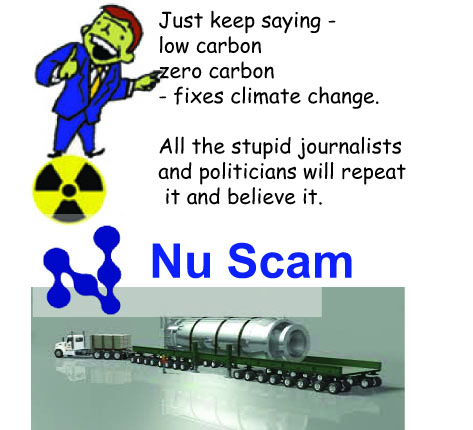
Coalition MP’s ‘grassroots’ nuclear power survey linked to consulting firm: Ted O’Brien’s Time to Talk Nuclear website was registered by business that helps US reactor company, Guardian, Daniel Hurst, 4 Dec 22,
A Coalition frontbencher conducting a “grassroots” survey about nuclear power is using a website registered by a business that helps an American small modular reactor company, records reveal.
Ted O’Brien, the shadow minister for climate change and energy, issued a statement on Friday saying he was “launching a grassroots community engagement program” under the banner “Time to Talk Nuclear”.
He urged Australians to “join the conversation” by completing a short survey on the website, with the first question being: “What do you think could be the benefits of nuclear energy in Australia?”
Guardian Australia can reveal the web domain was registered by Helixos Pty Ltd, a Sydney-based consulting company whose projects include “supporting the commercialisation of new nuclear energy technology”.
Helixos lists the US company NuScale Power as one of its clients.
Helixos says on its own website that NuScale Power “is reinventing nuclear energy and Helixos is helping them bring it to market”. It adds: “Helixos also provides training for employees to become technology ambassadors and engage with stakeholders and the public.”
A search of domain records for O’Brien’s website shows the contact name for the domain registration is Lenka Kollar, a nuclear engineer who co-founded Helixos in 2020. She previously held the role of director of strategy and external relations for NuScale Power.
In that previous role, Kollar was “working to bring NuScale’s small modular reactor to market through business plan development and clean energy outreach”, according to a profile published in 2017.
Kollar addressed a Global Uranium Conference in Adelaide last month on the topic “reaching net zero with nuclear energy”.
In tweets summarising her speech, Kollar said: “The time is now for Australians to have a conversation on nuclear energy and potentially overturn the ban.”…………………………………………..
Helixos’s projects are listed openly on its own website.
It works with the Energy Policy Institute of Australia “on editing public policy papers to promote progressive, technology-inclusive energy policy”, including one focusing on “the ability of small modular reactors (SMRs) to support a ‘just transition’ for coal communities in Australia”.
Helixos states it worked with SMR Nuclear Technology Pty Ltd “to develop a proactive stakeholder engagement strategy” to “help achieve the main goal of having nuclear energy considered as part of Australia’s future energy mix”.
Robert Pritchard, who is both chair of SMR Nuclear Technology and executive director of the Energy Policy Institute of Australia, declined to comment…………………………….
The survey has only three mandatory questions, starting with views on the benefits of nuclear energy in Australia.
It then asks what concerns, if any, the participant holds about nuclear energy, followed by any questions they might have. There is an optional section to “stay informed” by submitting an email address and postcode to O’Brien’s team.
O’Brien’s website also sets out frequently asked questions such as: “Is nuclear energy clean?”
The answer states: “Yes! Nuclear power’s total life-cycle carbon emissions and raw material requirements are the lowest among other energy sources, even lower than wind and solar.”
The climate change and energy minister, Chris Bowen, has previously accused the Coalition of pushing the nuclear debate as a “rearguard attempt to undermine and deny the transition to renewables”……………. https://www.theguardian.com/australia-news/2022/dec/04/coalition-mps-grassroots-nuclear-power-survey-linked-to-consulting-firm
Mining lobby tricks government with its big taxpayer fairytale, swaps Deloitte for EY
https://michaelwest.com.au/mining-lobby-tricks-government-with-its-big-taxpayer-fairytale-swaps-deloitte-for-ey/by Callum Foote | Nov 29, 2022 |
The Minerals Council of Australia has duped Energy Minister Madeleine King into repeating its highly inflated claims of how much taxes its mostly foreign multinationals members pay. Callum Foote reports on an $85 billion PR scam.
The Minister for Energy, Madeline King, has repeated claims from mining lobby group, Minerals Council of Australia, that the mining industry made payments of $43.2 billion in company tax and royalties to Australian governments in in a speech given at the NT Resources Week conference. The figures were repeated on ABC Radio without question.
As revealed here last year, Big Four consulting firm Deloitte used to do the misleading report for the mining lobby. This year it is another Big Four firm, Ernst & Young. The EY report, has – like Deloitte’s previous work – failed to disclose that up to 60% of the tax that they claim the mining industry pays is returned in the form of GST refunds.
They have included GST paid but not refunded, which is massively misleading. The false claims come at a critical time for the mining and energy sectors which are reaping record profits, partially at the expense of energy customers, and the minerals lobby is threatening a public campaign against the government if efforts are made to increase taxes and royalties.
The big GST swindle
The tax numbers produced by EY are derived from the ATO’s Corporate Tax Transparency data and, while their methodology differs somewhat from that of Deloitte’s last year, the report still fails to disclose the GST refund the minerals industry enjoys.
The report avoids mentioning that the mining industry, as an exporting industry, legitimately receives a huge GST refund every year.
A different set of ATO data, the Taxation statistics 2019-20 reveals that over $7.5 billion was refunded to the mining industry as a whole in 2019-20 which is the latest year that data is available.
Over the last decade years, almost $85 billion have been returned to the mining industry through GST refunds, which equals 55.7% of the $152 billion in company tax paid by the industry as a whole.
In the accounting profession, company taxes are regarded as deriving from company revenue. That is, income from a business comes in, costs such as wages are paid which leaves gross profit upon which company tax is paid. Taxes like GST and PAYG are *collected* for the government, not *paid* by the company.
According to forensic accountant Jeff Knapp “GST doesn’t come through the revenue of the company into profit, which would be ‘company tax’. It is collected from customers, just as PAYG is collected from employees”. These taxes are not paid by a company, they are collected, for government, on behalf of a company.
The claims made by MCA CEO Tania Constable regarding the amount of tax paid by her industry have been used to defend against calls for higher mining taxes: “A new tax on Australian mining companies would seriously undermine our international competitiveness, resulting in jobs losses across the country and devastating many communities which rely on mining,” she said.
The Minerals Council refused to defend its claims when approached, numerous times, for comment about its members receiving GST refunds and the misleading nature of the report.
EY has been contacted for a comment, along with the MCA and Minister for Energy.
Running the line
Compared to last year’s report, this year’s has received far less attention. In 2021, Australia’s major media organisations, News Corp and Nine Entertainment were duped by the mining lobby’s false claims about its contribution to Australia.
This year, it’s mainly the industry outlets such as Mirage News, Australian Mining and Mining Magazine that have repeated the claims.
It should be noted that Deloitte’s report considers only the minerals industry, excluding oil and gas from its analysis. This is important because gas corporations are presently the most profitable of all minerals thanks to the Russian invasion of Ukraine and soaring energy prices. This sector is notorious for tax avoidance and dollar-for-dollar avoids more tax than any other sector. The PRRT, a tax which was designed to capture more of this wealth, is regarded as a failed tax.
GST data for the minerals industry is only available for four years between 2015 and 2018. During this period, GST refunds to the minerals industry averaged year-on-year 60% of the company tax total, compared to the mining industry’s overall 61%. In 2018 the figure was higher, with minerals at 36% to mining’s 32%.
So why have royalties and company tax been singled out?
It appears the report was intended from its inception to provide an exaggerated view of the contribution of the minerals industry to Australian governments to ward off attempts to increase taxes.
First commissioned in 2014 under MCA’s then-CEO Brendan Pearson – who has been more recently employed in the Prime Minister’s office – Deloitte’s report was used as proof in an argument that supported the MRRT being repealed.
Pearson said the report “underlines that we are paying an effective tax rate above 40 per cent, when you combine the tax rate and the royalties”.
Royalties and taxes are two entirely separate concepts and to conflate the two is misleading. However, it is a well-worn strategy used by the mining industry to make it appear as though they are paying a higher tax rate than they really are.
Brendan Pearson was forced out as CEO of the Mineral Council in 2017, when BHP took issue with his pro-coal, anti-Paris Agreement lobbying. BHP threatened to review its membership with the MCA, with Rio Tinto signalling it would do likewise if Pearson did not step down.
Pearson, landed on his feet taking up a senior advisory role regarding international trade and investment in former Prime Minister Scott Morrison’s office in 2019.
BHP and Rio Tinto, who are the MCA’s largest members, declined to be interviewed for this story.
Premier Peter Malinauskas reaffirmed South Australian Labor’s position that the Barngarla people have the right to veto the Kimba nuclear waste dump project
Criticism over site works for SA nuclear waste dump
The Albanese Government has come under fire after it confirmed preliminary works will begin at the site of a proposed national nuclear waste facility on the Eyre Peninsula, despite a Federal Court challenge to the project still being underway.
InDaily Jason Katsaras 16 Nov 22
In correspondence seen by InDaily, federal Resources Minister Madeleine King said preliminary works would begin at Napandee near Kimba, but they were not construction works.
“Site characterisation activities will commence next week on the site, which are low-level, localised investigative studies to gather more detailed data on matters such as the site’s geology, hydrology, seismology and baseline radiological conditions,” she said…………………………………..
the Australian Conservation Foundation said the move effectively pre-empted a court bid to block the project.
“While these works are not the start of facility construction, they are a clear sign of intention and are inconsistent with repeated federal government assurances that it will not pre-empt the outcome of a current Federal Court challenge by Barngarla Native Title holders to the validity of the former government’s selection of the site,” it said.
In December, the local Bangarla people, represented as The Barngarla Determination Aboriginal Corporation, applied for judicial review of the decision to suspend work on the planned nuclear dump, arguing they weren’t properly consulted before the site was selected.
“This week they will have boots on the ground – it’s a significant escalation and a conscious choice,” ACF spokesman Dave Sweeney said.
“Federal Labor inherited a divisive and deficient approach to radioactive waste management from the former government.
“The decision to commence site works is a poor one, but not an irreversible one. It should not be advanced by a federal Labor government.”
The choice of site for the nuclear waste facility has been a hotly contested issue in the region since the then Liberal Government acquired the 211-hectare agricultural site in Napandee in 2021.
In September, Premier Peter Malinauskas reaffirmed South Australian Labor’s position that the Barngarla people have the right to veto the project.
“I think that the traditional owners of the land on a project as controversial and as significant as this one, and as long-lasting as this one, are entitled to have a say and that is what has underpinned our position,” he said. https://indaily.com.au/news/2022/11/16/protest-over-site-works-for-sa-nuclear-waste-dump/
1 This month

of the week – Australians for War Powers Reform (AWPR)
To see nuclear-related stories in greater depth and intensity
 Antinuclear